



Abstract
The paper problematizes the emergence of ‘LGBT-friendly organizations’ by examining the nascent forms of control that accompany efforts at including ‘diverse’ gender/sexual subjects in the workplace. Drawing on qualitative material collected through 25 semi-structured and in-depth ‘ethnographic interviews’ with LGBT employees who work in an ‘LGBT-friendly organization’, presented through three case studies, I argue that control in LGBT-friendly organizations operates through expectations and normativities concerning how gender/sexuality are supposed to be put to work in the (re)production of ‘queer value’. This contributes to our understanding of organizational control by thinking inclusion and control in a way which acknowledges the complicities between cultural norms and economic questions of value. I conclude by reflecting on what this can tell us about new and inclusive forms of organizing and the importance of remaining attuned to how financial imperatives control gender/sexuality by producing ‘diverse subjects’ tailored to its own needs.
Introduction
‘LGBT-friendly organizations’ are understood as ‘work settings [that] do not simply tolerate. . . but accept and welcome’ (Williams, Giuffre, & Dellinger, 2009, p. 29) LGBT people: places in which LGBT employees can be ‘authentically themselves’. These have emerged as part of the contemporary re- or dis-organization of capitalism and work towards greater flexibility and inclusiveness, whereby gender and sexuality ‘no longer correspond so easily to organizational hierarchies’ (Hearn, 2014, p. 407). While some celebrate their emergence as a progressive step away from historical realities of ‘the closet’ and homophobia, others question the financial motivations driving inclusion and the promise of liberation which accompanies it (e.g. Rumens, 2018), arguing that the discourse of LGBT-friendliness is little more than a capitalist ruse designed to make us ‘feel good’ (Fleming, 2007; Fleming & Sturdy, 2009, 2011; Irving, 2008). From this perspective inclusion is the latest permutation of organizational control: a managerial mechanism designed to buttress the semblance of ‘freedom’ while maintaining the ‘fungibility of labour’ (Hearn, 2014) and keeping employees ‘happy’ and (self-)managed for the sake of organizational productivity.
But between celebrating and denouncing inclusion, much goes unexamined. As a critical scholar motivated by matters of social justice, I share the political impetus driving the latter perspective which problematizes the increasingly central role played by the ‘[t]emples of global capitalism’ (Rao, 2015, p. 38) in the creation of supposedly more ‘inclusive’, ‘welcoming’ and ‘friendlier’ gender/sexual ‘scenarios’ (Hearn, 2014). At the same time, as a lesbian and thus an imagined target of LGBT-friendly promises of inclusion, I am deeply troubled by the ease with which this critique privileges matters of economic redistribution over questions of cultural recognition (Butler, 1997). While it may certainly be true that capitalist organizations are exploiting our need for recognition to further entrench labour and global inequalities, conceiving questions of gender/sexuality 1 as ‘merely cultural’ (Butler, 1997) matters risks diminishing the lived experiences of gender/sexuality and missing the complex ways by which these are controlled, managed and regulated in contemporary ‘inclusive’ organizational formations.
The paper makes an intervention into this otherwise polarized debate to offer an alternative perspective on inclusion and control in contemporary LGBT-friendly organizations. Drawing insights from queer theory and conceptualizing the performance of gender/sexuality itself as a form of labour (Wesling, 2012), I demonstrate how control in LGBT-friendly organizations unfolds through the expectations and normativities concerning how gender/sexuality are supposed to be put to work in the organization in the (re)production of ‘queer value’ (Wesling, 2012). I build my arguments by drawing from three ethnographic interview encounters with LGBT employees in LGBT-friendly organizations in London, presented as case studies. These contribute to our understanding of inclusion and control by foregrounding the complicity between cultural normativities and economic questions of value, shedding light on how control in the LGBT-friendly organization operates through the mechanisms by which the organization extracts the ‘productive value of queer labour’ (Wesling, 2012, p. 108).
In the first part, I review extant perspectives on LGBT inclusion and control. Seeking to redress two major shortcomings, I then detail Meg Wesling’s (2012) notion of ‘queer value’ and queer interventions in the field of organization studies (OS) more broadly to offer a queer perspective on control in LGBT-friendly organizations. After discussing my research methods, and based on observations and 25 ‘ethnographic interviews’, I present, analyse and discuss three employees’ contrasting accounts of their experiences of gender/sexuality in an LGBT-friendly organization. I conclude by detailing this project’s contribution to our understanding of inclusion and control.
Inclusion and Control in the LGBT-Friendly Organization
Standing in opposition to organizational histories of exclusion and homophobia, ‘the LGBT-friendly organization’ is petitioned as a welcoming place in which LGBT people are not simply ‘tolerated’ but free to ‘come out of the closet’, express their ‘true’ self and be proud of their ‘difference’ (Colgan, Creegan, McKearney, & Wright, 2007). Their emergence has also been accompanied by proliferating professional opportunities for LGBT people both within the inclusive organization and through networking across a number of sites (e.g. ‘the workplace LGBT inclusion conference’, ‘the LGBT workplace role model program’) beyond the typical spatio-temporal boundaries of ‘work’ and ‘organization’ (Sewell & Taskin, 2015; Williams, Muller, & Kilanski, 2012). Yet, while it is increasingly common for organizations to label themselves and be labelled by others as LGBT-friendly, the term itself is seldom comprehensively defined or understood (Rumens, 2015).
Earlier understandings focused on the presence of inclusive organizational structures, heralding the existence of active LGBT staff networks, inclusive employee policies and LGBT-friendly marketing strategies as evidence of LGBT-friendliness in organizations. More recently however, and mirroring broader dislocating shifts in the ontology of organization (Sewell & Taskin, 2015), emphasis has shifted away from organizational structures and towards more individualized markers such as the presence of LGBT workplace ‘role models’ 2 as examples of inclusion and inclusiveness (Stonewall, 2012). Moreover, while earliest efforts placed emphasis on gay, lesbian and (to a lesser extent) bisexual inclusion, 3 the topic of trans inclusion is increasingly receiving more attention. These changes are reflected in the Stonewall’s annual Workplace Equality Index (WEI), an annual list of Britain’s most LGBT-friendly employers produced by the British LGBT organization Stonewall (Rumens, 2015). Originally launched in 2005, the WEI now openly includes and measures trans inclusion in its formula.
The nebulousness of the term and the different ways in which it is measured has not hindered its popularity and reach. Indeed, both research and a cursory glance at the make-up of Pride parades worldwide, largely populated by corporate sponsors, suggests that being (or at least, being perceived to be) LGBT-friendly can yield important (cultural as well as economic) dividends for organizations interested in unlocking the productive potential of difference (Fleming & Sturdy, 2011). This compounds wider societal trajectories through which (some, but by no means all) LGBT people are increasingly ‘incorporated, normalized, and praised as productive and respectable’ (David, 2016, p. 401) citizens, producers and consumers. LGBT inclusion in this context emerges as a desirable ‘good’, underpinned both by an ‘implicit. . . ethics of tolerance and liberalism’ (Rumens & Broomfield, 2014, p. 367) and an economic promise of financial profit and gain (Rao, 2015; Rumens, 2018).
Nevertheless, we should approach these trajectories with caution. Indeed, a change in the organizational stance towards LGBT people (i.e. from hostility and/or indifference to ‘friendliness’) does not ‘automatically change how the organization regulates or privileges certain forms or performances of sexuality’ (Compton & Dougherty, 2017, p. 877). As Rumens and Broomfield (2014) have demonstrated, even in LGBT-friendly professions such as the performing arts, gay men regulate and ‘normalize’ their gender/sexuality in the achievement of professional success (see also Benozzo, Pizzorno, Bell, & Koro-Ljungberg, 2015). Moreover, the idea that mere ‘authenticity’ leads to inclusion also seems inadequate. As Benozzo and colleagues (2015) have argued, ‘coming out’ may reintroduce the gender/sexual subject to other, perhaps more subtle, forms of control which ultimately limit its applicability for those displays of difference that challenge notions of (white, middle-class, able-bodied) gay, lesbian, bisexual and (increasingly) trans ‘normality’.
The emergence of new practices of inclusion in organizations, where ‘openness’ and ‘authenticity’ replace ‘the closet’, thus demonstrate, first, that it might be unhelpful to understand LGBT-friendly organizations as emancipative places simply because they allow LGBT employees to ‘be themselves’. Second, it also raises questions of organizational control. This seems to occur less through outright ‘exclusion’ and more via the ‘normalization’ and ‘regulation’ of certain expressions of difference over others at work. Our focus should be thus (re)directed towards understanding the shifting nature of gender/sexual norms in the workplace and in relation to workplace cultures.
LGBT inclusion as a capitalist form of control
One way in which this has been done is by linking the changing nature of workplace gender/sexual norms to the financial imperatives of capitalist organizations (Irving, 2008). An example is Peter Fleming’s (2007) work – and, more recently with Andrew Sturdy (Fleming & Sturdy, 2011) – on Sunray, a call centre with a ‘gay-friendly atmosphere’ (Fleming, 2007, p. 248) in which employees are not simply permitted but encouraged to ‘be themselves’ (p. 251). Fleming’s (2007) and Fleming and Sturdy’s (2009, 2011) reading of Sunray’s ‘culture of fun’ perceptively exposes how celebratory LGBT-friendly discourses operate as forms of organizational control by buttressing unequal and exploitative labour relations. From this perspective, efforts to include and normalize ‘diverse’ subjects are being used, managerially, as a ‘diversion tactic. . . [to] take. . .attention away from an otherwise alienating work process’ (Fleming & Sturdy, 2011, p. 180). Thus, rather than being liberating or emancipative, the organizational turn to inclusivity is inextricably linked to traditional forms of bureaucratic surveillance and ‘the enhancement of [capitalist] control and domination’ (Fleming & Sturdy, 2011, p. 192).
The perspective adopted by Fleming (2007) and colleagues (Fleming & Sturdy, 2011) has clearly much to offer to extant critical approaches to LGBT-friendliness and LGBT inclusion. In particular, it allows us to consider how normalization is related not simply to matters of organizational culture (e.g. Compton & Dougherty, 2017), but also organizational bottom lines, labour relations and desires to extract and maximize the ‘productive value of queer labour’ (Wesling, 2012, p. 108).
While I am broadly sympathetic to the political impulses which underpin this reading of inclusion and control, and particularly appreciative of the attempt to link the shifting nature of workplace cultural gender/sexual norms to ‘the business case’ for diversity and economic questions of organizational productivity, reading LGBT inclusion as a form of capitalist control in this way exhibits three shortcomings.
First, in understanding control as all-encompassing and simply as a form of domination, this perspective runs the risk of underplaying the agency of ‘diverse’ subjects in negotiating inclusion (Zanoni & Janssens, 2007) and the manifold ways in which contemporary practices of control are enshrined in workers’ subjectivities and internalized in ways which blur distinctions between ‘the controllers’ (managers) and ‘the controlled’ (employees) (Alvesson & Willmott, 2002; Sewell & Taskin, 2015).
Second, underpinning these arguments is what Spivak (1985) calls a ‘‘romantic, anti-capitalist’ tendency’ (p. 161) to interpret efforts to include ‘diverse’ subjects in organizations as mere forms of recognition that take attention away from more pressing redistributive concerns (Fleming, 2007; Fleming & Sturdy, 2009, 2011). Reading inclusion in these terms establishes a separation between cultural (recognition) and economic (redistributive) matters, and places gender/sexuality on the former side of the equation (Butler, 1997; Rao, 2015). The result is an analysis which accounts for economic inequalities but fails to do justice to the lived experiences of (seemingly) cultural matters of gender/sexuality.
Third, it is yet to be seen whether the perspective adopted by Fleming (2007) and colleagues (Fleming & Sturdy, 2011) has stood the test of time. Indeed, to the extent that ‘long-term security, standardized career ladders. . . and management controlled evaluations’ are being replaced by ‘teamwork, career maps and networking’ (Williams et al., 2012, p. 549), the forms of bureaucratic control identified by these critical scholars, which unfold through structural labour relations and organizational logics (e.g. Acker, 1990), may be less relevant to a world of work increasingly organized around more ‘self-managed’, ‘fluid’, ‘autonomous’, ‘deterritorialized’ and ‘distantiated’ work practices (Sewell & Taskin, 2015).
In the next sections I thus turn to work in and around ‘queer’ and ‘organization’, and specifically to Meg Wesling’s (2012) work on ‘queer value’, to redress these shortcomings and provide an alternative reading of control and gender/sexuality in LGBT-friendly organizations.
Queering Inclusion and Control
Queer perspectives too have questioned whether the arrival of LGBT-friendliness signals more ‘welcoming’ and ‘open’ [read: less controlling] gender/sexual scenarios (Bendl, Fleischmann, & Walenta, 2008; Benozzo et al., 2015; Fleming & Sturdy, 2011; Giuffre, Dellinger, & Williams, 2008; Hearn, 2014; Rumens, 2015, 2018; Williams et al., 2009). However, a queer perspective also pays careful attention to how gender/sexuality are performed, lived and laboured in complex ways.
First, from a queer perspective gender/sexuality are not fixed and ‘authentic’ properties of individuals’ ‘true selves’ but rather performatively constituted and in a constant process of becoming (de Souza, Brewis, & Rumens, 2016; Riach, Rumens, & Tyler, 2016; Valocchi, 2005). This deconstructs the very notion of ‘diversity’ and ‘authenticity’ (Benozzo et al., 2015). Indeed, while Fleming and Sturdy (2011) are pointing us in the right direction when they argue that ‘the freedom to “just be yourself” is not freedom from control. . . but managerially prescribed freedom around control’ (p. 195), they do not adequately deconstruct the notion of ‘being yourself’, nor do they explore the manifold ways in which the gender/sexual categories to which they make reference (e.g. ‘gay’) are themselves a product of discourse and thus integral to practices of control (de Souza et al., 2016; Prasad, 2012). A queer perspective on gender/sexuality thus re-reads control beyond (merely repressive) managerial domination to explore how these are (productively) regulated and disciplined through gender/sexual categories, normativities and the intricacies of everyday life (Bendl et al., 2008; Valocchi, 2005).
Second, a queer perspective thus shifts our focus from seeing control as operating by diverting attention from labour processes (e.g. Fleming, 2007; Fleming & Sturdy, 2009), to reading control as operating through the very performance of gender/sexuality. For example, as Priola, Lasio, Serri and de Simone (2018) demonstrate in their analysis of sexuality and inclusion in four Italian firms, while organizations promote discourses and practices of inclusion ‘there is also greater institutional control, regulation and a hierarchical ordering of which expressions of sexuality are socially and organizationally accepted and acceptable’ (p. 748). From this perspective, control operates not so much by ‘distracting’ employees from structural relations of labour inequality but rather through the continuous work involved in (re)producing ourselves as ‘socially legible’, ‘accepted and acceptable’ [read: normative] gender/sexual subjects according to limited social scripts. A queer approach thus contributes to our understanding of control by shedding light on the importance of looking at the performance of gender/sexuality as an empirical question in its own right rather than simply as a category of difference.
‘Queer value’ and the performance of gender/sexuality as a form of labour
While a queer approach offers useful preliminary insights into control and inclusion, it has often retreated from an analysis of how the changing organization of gender/sexuality is linked to capitalist relations to production (Hennessy, 2000). In this section I thus use the work of Meg Wesling (2012) to demonstrate how a queer approach to control can be reconciled with critique of political economy and develop a theoretical framework to make sense of the specific ways in which contemporary LGBT-friendly organizations control gender/sexuality.
In ‘Queer value’ Wesling (2012) is interested in making room for ‘a materialist reading of sexuality. . .to address the historical specificity of capital’s investment in [its] formations’ (p. 107). She does so by tracing the (re)production of ‘queer value’ in Gilpin’s and Bernaza’s film Mariposas en el Andamio (1996), a documentary about a community of drag performers in Havana, Cuba. As she explains, the contribution of ‘queer value’ is not simply to shed light on ‘how queers work’ (p. 108), but on the ‘productive value of queer labour’, and specifically, on how Marxist readings of labour and value might be adapted to account for the (re)production of ‘normative’ and ‘disciplined’ gender/sexual subjects.
The crux of Wesling’s argument revolves around understanding the performance of gender/sexuality as a ‘ritualised, disciplined, and highly invested’ (p. 107) form of labour. That is, while gender/sexuality are often seen to be ‘authentic’ truths of individuals, in Wesling’s understanding their performance is not ‘natural’ but entails and requires work. Here Wesling draws upon Marxist distinctions between (alienated, profit-oriented) labour and (socially meaningful, non-profit-oriented) work yet revises these by reading work not as ‘the antithesis to labour’ (p. 111) but rather as a performance that accrues affective and material value (p. 108) ‘even when (or precisely because) that performance is asserted to be natural’ (p.108).
‘Labour’ emerges here not simply in ‘socially necessary’ terms, that is, in terms of the ‘minimal necessary requirements needed for the worker to reproduce himself or herself’ (Wesling, 2012, p. 108), but also in affective terms, which includes ‘those activities that work towards the aims of the body’s comfort, pleasure, and the satisfaction of desire’ (p. 108). Extending the notion of ‘drag’ to all social performances of gender/sexuality, Wesling (2012) ultimately reads these laboured performances of gender/sexuality as integral components of the (re)production of ‘socially legible’ ‘gendered and sexualised subjects’ (p. 108).
This reading further expands our understanding of LGBT-friendly control in two major ways. First, conceptualizing gender/sexuality as forms of labour illuminates how control operates through the performance of this ‘affectively necessary’ (p. 107) and ‘self-conscious’ (p. 108) form of labour, not as a distraction from it. Here Marxist distinctions between the cultural and the economic, or rather, between the cultural recognition of diverse gender/sexual subjects (inclusion) and economic matters of workplace redistribution (labour relations), are collapsed. This exposes how LGBT-friendly control is at once cultural and economic, operating through the labour involved in (re)producing ‘queer value’ and a normative gender/sexual subject.
This extends Fleming and Sturdy’s (2011) understandings of ‘value’ for, as mentioned, the value of these laboured performances of gender/sexuality is at once economic and affective: not simply ensuring the worker’s reproduction but also ‘producing and preserving the space within capitalism’ (Wesling, 2012, p. 122) for the desires and practices ‘wrapped up in the category of [gender/]sexuality’ (p. 122). Simply put, while Fleming and Sturdy (2011) are correct in exposing and condemning the operation of cultural ‘value-based normative controls’ in contemporary ‘inclusive’ workplaces through the discourse of ‘being yourself’, their understanding remains limited in that they see these as separate from harder control systems, as simply ‘detracting’ from these more ‘conventional. . .controls’ (Fleming & Sturdy, 2011, p. 195). They thus privilege a simply economic reading of control over cultural understandings of workplace norms and normativities. Meg Wesling’s (2012) notion of ‘queer value’, whose working definition might be all that is (re)produced, as an effect of labour, in the ‘psychic realm of desire and the material realm of accumulation and exchange’ (Wesling, 2012, p. 107), confounds such dualisms.
Second, we can also identify the operation of control in those moments in which these performances ‘fail’. Fleming and Sturdy’s (2011) explore how ‘the freedom to express gay identity’ (p. 197) is dependent upon the (re)production of (queer) value. Yet, they do not explore what this might mean for those gender/sexual subjects who are not able and/or willing to engage in valuable and successful laboured performances of gender/sexuality. The paper extends our understanding of control by asking how control also operates in relation to those LGBT employees who fail to (re)produce ‘queer value’ and thus do not benefit from the organization’s newfound friendliness.
The paper builds upon these insights and avenues to address the following questions: how are gender/sexuality put to work or laboured in the LGBT-friendly organization? And what are the forms of organizational control that emerge in relation to this work in specific LGBT-friendly organizational settings? I ask these questions with the aim of exploring how control in the LGBT-friendly organization works through the laboured performances of gender/sexuality. To answer them I draw on ‘ethnographic interviews’ conducted with LGBT participants about their experiences and understandings of gender/sexuality (how these are constructed and strategically mobilized in pursuit of inclusion and the (re)production of ‘queer value’) in the LGBT-friendly organization. In so doing, I make a theoretical and empirical contribution to extant understandings of organizational control and inclusion by (a) offering a way of thinking inclusion and control which acknowledges the complicities between cultural norms and economic questions of value, and (b) examining how subjects actively (re)produce, inhabit, negotiate and resist these discourses in pursuit of inclusion. In the next section, I further detail the methods of this study before discussing my findings.
Methods
In this study I analysed empirical material collected through semi-structured, in-depth and open-ended ‘ethnographic interviews’ with 25 employees in LGBT-friendly organizations (see Appendix A). Participants were initially recruited either via email or in person during ethnographic fieldwork conducted as part of my doctoral project on LGBT inclusion and asked if they’d like to partake in an interview for a project on LGBT-friendly organizations. Subsequent participants were recruited via a snowballing process.
While the findings presented in this paper are based on data collected through interviewing, they are complemented with insights emerging from eighteen months of ethnographic participant observation conducted among LGBT professionals, ‘role models’, ‘straight allies’ and ‘diversity and inclusion’ specialists in London (see Appendix B). This is a world which unfolded in Canary Wharf, London’s financial district, and, more specifically, around various corporate LGBT events or ‘sites’ (Schatzki, 2005) which aimed to share ‘best practices’ of LGBT inclusion and which offered opportunities for the kind of ‘LGBT networking’ and ‘self-promotion’ which Williams et al. (2012) argue are increasingly becoming the ‘principal means through which workers identify opportunities for advancement both inside and outside their firms’ (Williams et al., 2012, p. 551).
Access to these events was granted both on the basis of a shared interest in LGBT inclusion and my identifying as a lesbian. Indeed, given that being LGBT was (often, but not always) a requirement for attending the corporate events at which I conducted participant observation, ethically speaking, I wouldn’t have been able (and willing) to conduct participant observation in these sites had this not been the case. The findings presented in the paper are thus grounded in broader conclusions and insights emerging through participant observation, somewhat redressing one of the major limitations of interviewing: the impossibility of checking whether what participants say is happening is actually happening. While on most occasions I was not able to observe interviewed participants in their workplaces, nor did I follow them at the LGBT corporate events, the fieldwork findings (in terms of the stories and observations recorded) sustain and confirm their accounts. I thus opted for the term ‘ethnographic interviewing’ (Hirst & Schwabenland, 2018) to describe the specific combination of the interview and participant observation-based approach adopted in this study.
Ethnographic interviewing
All participants worked in for-profit, private, corporate organizations which are known and broadly recognized – by the participants, by Stonewall, and/or by the organizations themselves – as LGBT-friendly. While I did not require participants to identify as LGBT in order to qualify for the study, all (except for one) identified with some version of the LGBT acronym, occasionally expanded to include queer, intersex and asexual (e.g. LGBTQIA+) or those whose gender/sexual identities are not easily encompassed by its use (e.g. non-binary, often denoted by the Q or by the +). While preliminary questions instigated the discussion and worked to set the focus of the interview (e.g. ‘Can you tell me about your experience of being gay/lesbian/bisexual/trans/non-binary/etc. . . at work?’ ‘What does being gay/lesbian/bisexual/trans/non-binary/etc. . . at work mean to you?’), I followed Hirst and Schwabenland (2018) in the spirit of ‘ethnographic interviewing’ and allowed and encouraged interviewees to ‘shape the questions being asked and develop the focus of the research’ (p. 164). I also let participants decide where they’d like to be interviewed. Some interviews were conducted in participants’ workplaces, some in nearby cafes or pubs. All were tape-recorded, lasted from one to three hours, were subsequently anonymized and manually transcribed. All participants were assigned a pseudonym in order to prevent identification.
A number of issues relating to the practice of ethnographic interviewing are worth mentioning. First, interview encounters can be highly performative situations in which we run the risk of reifying gender/sexual categories through the process of recruitment and/or interviewing (see also Burchiellaro, forthcoming). In response to this I followed and endorsed de Souza et al.’s (2016) suggestion to ask participants how they described their gender/sexuality and what this meant for them, foregrounding the ways in which not only do we ‘all use different terms to describe ourselves’ (de Souza et al., 2016, p. 608), but that these terms also (may or may not) mean very different things to different people.
Another issue at stake became how to conceive of data gathered through interviews. Indeed, if as queer thinking argue, ‘subjects and subjectivities are fluid, unstable and perpetually becoming. . .[how] can we gather “data” from those tenuous and fleeting subjects using the standards methods of data collection such as interviews. . .?’ (Browne & Nash, 2010, p. 11). In response to this, I followed others in adopting a queering method which understands the interview as data producing, rather than (simply) data collecting (Ashcraft & Muhr, 2018; Ford & Harding, 2008; Lee, Learmonth, & Harding, 2008; Riach et al., 2016; Rumens, 2012). In conducting interviews, I therefore do not intend to treat participants’ accounts as revealing a ‘transparent self’ ‘but rather a self who is constructed in the very process of speaking the narrative in the interviews’ (Ford & Harding, 2008, p. 235). Thus, rather than merely treating ‘queering’ as a reflexive strategy ‘for analysing empirical materials already gathered’ (Ashcraft & Muhr, 2018, p. 223), I follow Ashcraft and Muhr (2018) in conceiving of queering as a strategy which ‘begins the moment we enter the field and continues throughout the life of a project’ (p. 223).
Also particularly relevant in relation to this last point was the multiple ways in which my knowledge of queer theory and politics more broadly positioned me as a sceptical listener and observer. I acknowledge that these interests and interested positionalities may have inevitably affected the interview encounter, shaping what participants felt comfortable to disclose. Yet, having moved beyond the search for a ‘transparent self’, this was less a problem than an opportunity to mobilize my knowledge of queer politics, and in particular a queer embrace of an anti-capitalist politics, to generate insights, elicit responses and reveal something about participants’ understanding of ‘how the world worked’ (see also Burchiellaro, forthcoming).
Data analysis
Data was thus not so much ‘collected’, as if to imply a passive and (impossibly) objective relation to the ‘things’ studied, and more as ‘co-produced’ (Ashcraft & Muhr, 2018; McDonald, 2016). Indeed the point here is not so much for the reader to take this account as truthful version of the world (though, of course, an element of ethnographic validity and credibility is still importantly strived for), nor to simply develop theory out of data. Rather, the ethnographic project of knowing is herein accompanied, first, by a recognition of the performativity of knowledge and the manifold ways in which the practices of research (of conducting it, as well as designing and theorizing it) work to constitute and construct the objects and subjects of study. And second, by an understanding which posits ‘knowing’ itself as constituted through fieldwork encounters and experiences, understood as ‘modes of ethical engagement wherein the ethnographer is arrested in the act of perception’ (Borneman & Hammoudi, 2009, p. 18).
I thus conceive of the process of interviewing itself as a form of analysis: an ongoing process of following, linking and chasing up ideas, ‘looking for other people and other facts that seem relevant’ (O’Reilly, 2005, p. 203) to the topic of research in light of the research questions posed. Thus, rather than adopting a deductive approach where ‘a hypothesis is derived from existing theory and the empirical world is explored. . .to test the truth or falsity of the hypothesis’ (O’Reilly, 2005, p. 26), I approached the field through an iterative-inductive approach ‘guided by what emerges from the data’ (Rumens, 2012, p. 964) and where the researcher is not devoid from but ‘open about one’s preconceptions’ (O’Reilly, 2005, p. 26).
Interview transcripts were sorted without the use of software according to the themes they embodied and the stories they told. In the process of sorting, I moved from a chronological approach to a thematic approach and begun looking for patterns. The themes of ‘expectations’ and ‘gender/sexual labour’ were two such themes. Rather than counting how many times these themes were covered, I was more interested in thinking about what the specific situated ethnographic encounter(s) could tell us about the laboured performances of gender/sexuality engendered by ‘the LGBT-friendly organization’: where these succeeded, where they failed, the kind of value-producing functions these served, and ultimately, the forms of control they (re)produced.
The case studies
Ultimately, out of the 25 participants interviewed, three (Kostas, Anita and Andrea) were selected as case studies to be presented in this paper. These were selected for the ways in which they shed light on the different forms of labour performed in order to be(come) included in ‘the LGBT-friendly organization’, thus demonstrating the diversity of the experiences of LGBT-friendliness recorded in the study. In particular, I sought to choose participants with different degrees of ‘success’ (broadly defined) in relation to the performance of this labour. Indeed, as it will emerge, while the participant in the first case study successfully performs this labour in the (re)production of ‘queer value’, the latter two participants are less able and/or unwilling to do so (see Table 1). These latter case studies expose what happens when the performances of this labour fails.
Outline of case studies.
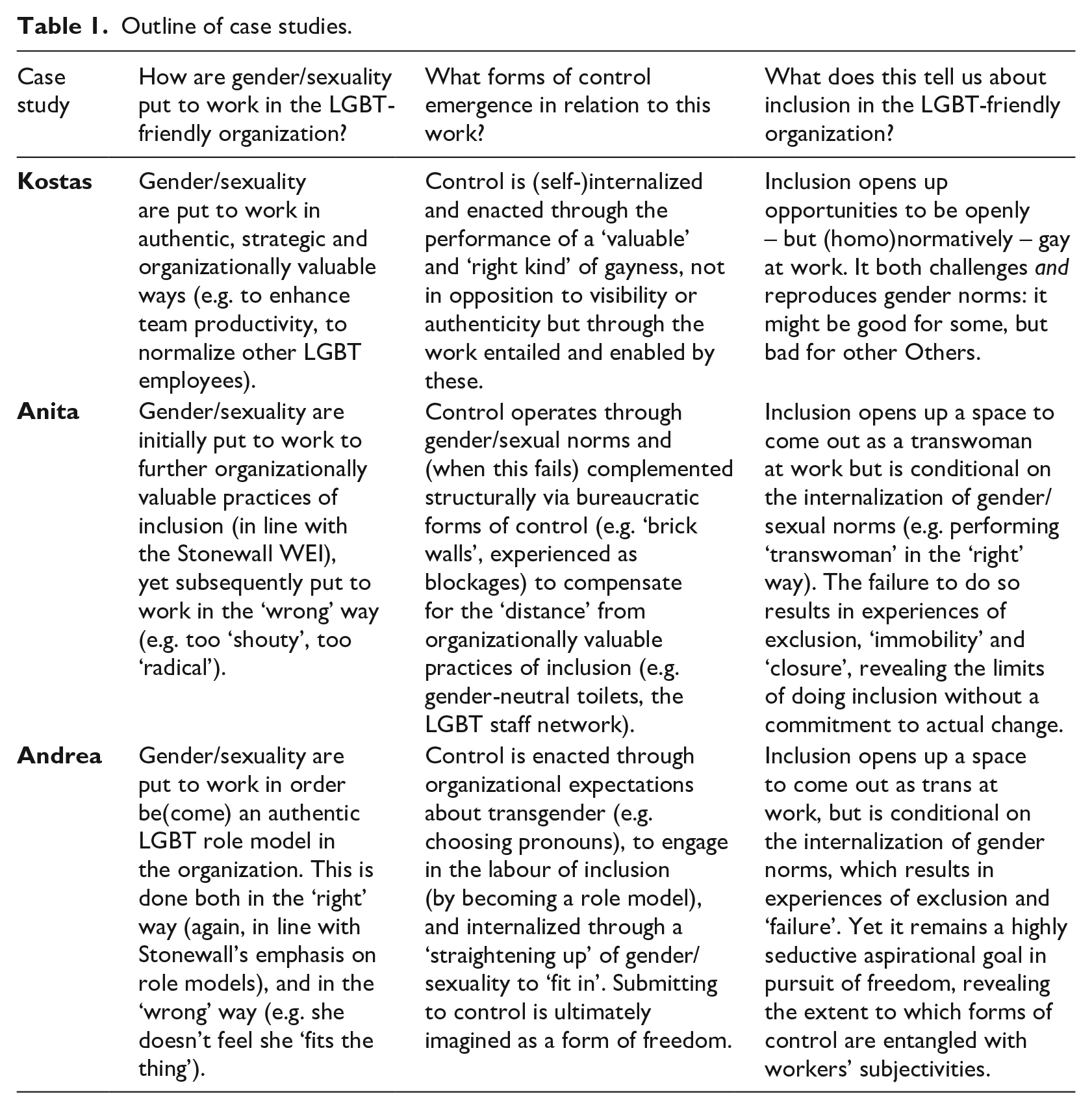
In so doing, these contribute to our understanding of control in LGBT-friendly organizations in three major ways. First, they shed light on the labour or ‘work’ that goes into performing gender/sexuality ‘authentically’ and in ‘organizationally valuable’ ways. Second, they show that performing gender/sexuality in such ways is a requirement for inclusion, with problematic consequences for those unwilling and/or unable to do so. Third, and therefore, they demonstrate that control in the LGBT-friendly organization should be interpreted as an integral part of the labour process itself, or, more specifically, of the ways in which organizations attempt to extract the ‘productive value of queer labour’ (Wesling, 2012, p. 108). In this sense, the case studies are not archetypal representations of the populations under study but rather methodological devices mobilized to shed light on the broader themes, questions, tensions and paradoxes emerging from the ethnography: as a way of making sense of the diversity of stories and observations gathered through the ethnographic work.
Focusing on three case studies instead of presenting the empirical data also enables a more detailed focus on participants’ interpretations and perceptions, reconstituting ‘diverse’ gender/sexual subjects’ agency in negotiating inclusion. At the same time, this could also be interpreted as one of the major limitations of the study: that its results are limited by not being generalizable and/or applicable beyond the individual case studies presented, limited to individuals’ own perceptions of their situation. Nevertheless, having embraced a post-structuralist appreciation for the co-production of data, and complementing and situating the findings with and amid broader ethnographic research conducted in the field, such an approach may nevertheless yield important insights into dynamics of freedom/control and inclusion/exclusion which inflect experiences of inclusive and LGBT-friendly workplaces. In the discussion I thus not only read the individual case studies in relation to the research questions, but also reflect on what these can tell us, more broadly, about the intersections between gender/sexuality, inclusion and control, reflecting on the empirical and theoretical contribution of the study as well as avenues for potential future research.
On LGBT-Friendly Control, Labour and the Reproduction of Queer Value
In what follows I focus on data co-produced in three encounters with Kostas, Anita and Andrea. In each, I focus on how gender/sexuality are put to work in the LGBT-friendly organization in the (re)production of queer value and flesh out the forms of organizational control that emerge in relation to these laboured performances of gender/sexuality.
Kostas, the ‘right kinda gay guy’
I meet Kostas, a white gay man who is head of sales in the HQ of the bank for which he works. The bank is a consistent ‘top performer’ in Stonewall’s annual WEI and invests considerable energy and resources in promoting ‘diversity & inclusion’ inside and outside the workplace. It is one of London Pride’s major sponsors. Kostas is actively involved in and supportive of these discourses and initiatives, lauding the bank as a ‘truly inclusive and LGBT-friendly employer that recognises the value of diversity’. Kostas also acts as co-chair of the LGBT staff network and is listed in OUTstanding’s top 50 LGBT+ Future Leaders list (in 2017 and 2018), a list, compiled in collaboration with the Financial Times, which showcases ‘inspirational future leaders’ making a ‘significant contribution to LGBT inclusion’. As we make our way up from the lobby, Kostas leads me into the small glass room located in the centre of the floor which he has booked for our interview.
We begin the interview and immediately I note in my fieldnotes that I am impressed by his professional accomplishments. At only 28, he manages around 50 employees and has made it onto to the senior leadership team. ‘The youngest one after me is 42’, he explains, proudly. Intrigued by his success story, I ask him why and how he thinks he has made it this far up in the organization. His response revealed a remarkable level of self-conscious, strategic and ‘highly invested’ (Wesling, 2012) labour performed to use his ‘gayness’ and to stylize, re-package and promote himself as ‘the right kinda gay guy’: My dad always had one advice to me when I came out: use what you’ve got. And when I joined [the bank], it was all about ‘use what you’ve got’. And if I think about it, that’s when I started getting really involved in LGBT, cause I’m a white guy, that doesn’t make me a minority. And I’m a man in a corporate environment, that’s an asset but still, nothing special. So there’s nothing making me stand out. You can be a high performer, but the reality is, you’re gonna be a really good performer one year, [but] you’re not gonna have every single year being the top . . . for me this was a painful realization, because I started at [the bank] and my first 3 years were amazing and then we just had a really bad year and I was like ‘oh, I’m not used to this’, so what I had was that I was the white, immigrant, gay guy in a pretty inclusive firm. So I was that guy. And I started working on that. I started toning it down in some places, I started learning how to speak, slower, controlling my emotions, just being the right kinda gay guy you know? Being gay can be a good thing, but only if you know how to use it, because that is how the game is played. But obviously it needs to look natural.
Kostas’ gender/sexuality emerge here not as ‘authentic’ attributes of the self but as products of labour. This labour is at once intentional and ‘affectively necessary’ (Wesling, 2012, p. 108), to compensate for the ‘really bad year’, and to navigate the demands of contemporary work practices organized around ‘networking’ and individualized ‘career development’ programmes, and marketing the (gender/sexual) self as a ‘product’ or ‘asset’ (Williams et al., 2012). And it works to (re)produce a ‘socially legible’ [read: normative] subject: the ‘right kinda gay guy’. Control herein operates through the performance of gender/sexuality and the labour he self-consciously performs in order to package and use his difference in entrepreneurial and ‘acceptable’ ways (e.g. not ‘emotional’). This is a labour which (re)produces, at once, not only ‘a corporeal and desiring subject’ (Wasser, 2016, p. 58), the ‘right kinda gay guy’, but also ‘queer value’.
The ‘queer value’ that Kostas’ performance of gender/sexuality (re)produces takes many forms. On the one hand, it (re)produces affective value for Kostas himself as he copes with the realities of market capitalism and struggles to come to terms with the ‘painful realization’ that ‘you’re not gonna have every single year being at the top’. On the other hand, as Kostas’ interview continued, he also explains that he laboriously deploys his ‘diverse’ gender/sexuality on the senior leadership team as a form of ‘normalization’ and to keep his employees ‘entertained’: On the senior leadership team, I tend to overdo it in terms of the gayness. And the campness. And on the floor, I overdo it. . .so I actually overdo the campness. You know, not many people will be as extravagant as me, and I think if you are here [raises his hand], and it’s over the top sometimes, people who are never gonna be there [gestures with hand], they’re here [lowers hand], they’ll be comfortable being themselves. More importantly, if people on the floor see that this is a benchmark of what gay means, and somebody else has something more normal, they’ll actually say ‘oh, that’s cool’. They see that the other person is normal. And also of course sometimes it entertains them. It can get pretty boring around here.
Here Kostas performs an excessive or overdone [read: ‘camp’, ‘feminine’ or ‘overt’] version of gayness – on the senior leadership team and on the floor – to elevate the ‘benchmark of what gay means’ and thus enable other – ‘more normal’ [read: less camp] – employees to ‘be comfortable being themselves’. In some ways this is reminiscent of Williams et al.’s (2009) discussion of the ways in which LGB employees in gay-friendly contexts are faced with a choice: ‘being so-called normal. . .or being visible’ (p. 42). Yet while Williams et al.’s (2009) participants’ choice seems to be forced, Kostas’ laboured performances are more intentional, self-reflexive and strategic. Indeed, he is highly aware that this adds ‘queer value’ both for other LGBT employees and also for the organization itself by performing a task that is central to discussions and constructions of LGBT-friendly organizations as places in which LGBT employees feel comfortable ‘being themselves’ (Stonewall, 2012).
But also, reminiscent of Emmanuel David’s (2015) discussion of ‘purple-collar’, Kostas’ laboured performance of ‘stereotypical expectations’ (p. 183) akin to those necessitated in other, less ‘professionalized’, forms of gender/sexual labour – such as drag, for example – produces queer value for the organization by cutting through the boredom of banking life, buttressing his managerial role with ‘campness’ and helping to keep his team ‘entertained’ and thus (perhaps) even motivated. Ultimately then, it is by engaging in various laboured performances of gender/sexuality that Kostas ‘puts to use’ his ‘diversity’ in the (re)production of ‘queer value’ and in order to be(come) included in the LGBT-friendly organization.
Yet, arguably Kostas’ campness is at least partly enabled by his whiteness, which somewhat immunizes him from the most trenchant forms of misogyny. As Jane Ward (2015) argues in Not Gay, heteromasculinity is often buttressed and reinforced by whiteness in ways which not only render gayness ‘safe’ but which also embody forms of homosociality which, rather than breaking down existing forms of white heteronormativity, actually reinforce them. In particular, Kostas’ detailing of the interactions he had with his boss, such as, for example, when he told me about complimenting the size of his boss’s penis in one of the office changing rooms and using such an interaction as evidence of his boss’s ‘friendliness’ towards his performances of gender/sexuality, are reminiscent of ‘locker room talk’ and white forms of masculinity such as the ‘frat boy’ (Ward, 2015). This suggests that ‘campness’ in this case might actually reinforce rather than challenge (his boss’s) heterosexuality and status.
What emerges from the interview encounter is that, in the LGBT-friendly organization, Kostas ‘puts to work’ his gender/sexuality to (re)produce queer value for himself, for other LGBT employees, and for the organization. He does so by performing the ‘right’ version of gayness, that is, a version of gayness that is, in his view, valuable because it is normalizing. The ‘right kinda gay guy’ is herein performed in terms of a particularly upwardly mobile and entrepreneurial version of difference, that is at once challenging of workplace norms (through camp or excessive performances of gay identity), yet ultimately works to re-inscribe these norms by erecting new normativities or benchmarks for other LGBTs, and reinforcing (rather than challenging) heterosexuality. Organizational control herein operates through the performance of gender/sexuality, unfolding first, through the labour Kostas dedicates to this task, which reveals a remarkable level of self-control (of his emotions, his speech, of the version of gayness he brings to work) required in order to perform gender/sexuality in a way which is deemed ‘valuable’ for the organization, and which enable him to affectively and professionally ‘navigate’ the contemporary world of work (Williams et al., 2012). And second, through the deployment of this performance of gayness to improve efficiency and buttress his managerial role, which he effectively uses to control other employees. In both these examples, organizational control operates in (homo)normative (Duggan, 2003) ways in terms of the expectations internalized by Kostas in order to be(come) included and (re)produce (queer) value, and the labour required in order to ‘be yourself’ in the ‘right’ way.
Anita, ‘the shouty one’
Anita is a white business manager and co-chair of the LGBT staff network (organizationally referred to as a ‘business resource group’) in a large investment bank that is, too, listed in Stonewall’s WEI. Anita identifies as a transwoman. I contact Anita in early 2017 under the auspice of another participant. A few months later we meet for an interview in the HQ of the bank in which she works. After a few misunderstandings which resulted in my not being granted access to the building, we settle in a nearby café.
During the interview, I ask Anita about how she experiences her gender/sexuality at work and she says that her initial experience coming out as trans was ‘amazing’. As she explains, ‘they encouraged me to come out, they bent over backwards to say yes to everything I wanted’. She is aware that, in her own words, the ‘ruthless investment bank’ is partly interested in accommodating her needs due to fear that she would ‘make a fuss’. Yet, ultimately, she doesn’t seem to have a problem with the fact that the organization was ‘fundamentally supportive because it’s good for money’. So she begins wearing sandals and vest[s] to work– because only women can show their shoulders’ – and accepts a role as co-chair of the LGBT business resource group. Anita describes her work for the staff network as ‘immensely valuable’. While, of course, Anita has (conscious and unconscious) vested interests in portraying herself as engaging in ‘valuable’ work, these comments are confirmed by her listing, like Kostas, in OUTstanding’s 50 LGBT+ Future Leaders List (in 2017 and 2018), in which she is lauded for her ‘valuable’ contribution to the making of an LGBT-friendly(er) workplace culture. This includes delivering gender-neutral toilets, Transgender 101 classes to other employees and managers and more inclusive gender self-identification options for monitoring purposes (all of which are indicators of LGBT-friendliness in Stonewall’s WEI and have become especially prized in light of recent developments in the field of trans inclusion).
These initial reflections suggest that, on the one hand, the LGBT-friendly organization offers Anita a space to ‘be herself’. However, as Anita becomes more involved in matters of workplace LGBT inclusion, and after the ‘real high. . .about being yourself’ wears off – and perhaps, after the fear she would ‘make a fuss’ does too – her perceptions change. ‘You don’t imagine the number of brick walls I’ve come up against in actually trying to help them understand how to create a more inclusive environment for LGBT people but particularly for trans people’, she explains.
While it clear that Anita’s change of stance also stemmed from disagreements with other members of the network, her comments should not be taken in isolation but rather situated amid broader observations, made by critical diversity and inclusion scholars, about the non-performativity of diversity. Indeed, as Sara Ahmed (2012) reflects, ‘diversity work’ can often ‘feel like banging your head against the brick wall’ (p. 17), whereby organizational commitments to diversity and inclusion may in fact make it more difficult for those interested in actually trying to change things, that is, in trying to actually render the organization more inclusive and not simply friendly.
Moreover, and poignantly considering recent developments in the Stonewall WEI, Anita believes these brick walls are erected ‘particularly for trans people’. Ultimately, these prevent her from doing the very ‘diversity work’ that she was initially entrusted to perform as chair of the LGBT business resource group. In addition, notwithstanding but also perhaps because of the organization’s support for LGBT-friendliness (under the guise of which Anita is encouraged to ‘come out’), and despite the supposed desirability of being your ‘true self’, Anita’s (failed) laboured performances of trans-ness lead her to experience inclusion as a ‘sign of immobility’: I’ve been demoted. I got stuck. In the year that I came out I was on a year-long training course that prepares you for promotion. So, coincidentally, after I transitioned, I wasn’t put up for promotion, actually a lot of my responsibilities gradually got removed. It’s a big coincidence isn’t it? I kinda feel straight-jacketed from a career-progression perspective. It’s a story you get a lot from other trans people. Sometimes people say that in coming out you suddenly become the spokesperson for all trans people. But for me it’s the opposite. I don’t get asked to do anything anymore. They just think ‘oh it’s her again, the shouty one’.
While Anita is cautious in her tone, entertaining the possibility that this might all just be a coincidence, she nevertheless draws connections between her transition and the removal of her responsibilities and her chances of promotion. Needless to say, there is a remarkable disjuncture between the organization’s image as LGBT-friendly and Anita’s experiences at work. Ultimately then, it seems that the very performance of the labour expected and required of her in order to be(come) included, such as helping the organization ‘understand how to create a more inclusive environment’, is what leads to her ‘failure’, not in the sense that she fails to perform this labour altogether, or that it does not accrue value for the organization (in fact, it does), but in the sense that this labour fails her because it is performed in the ‘wrong’ [read: shouty] kind of way.
What emerges from this interview encounter is that, once again, inclusion in the LGBT-friendly organization is dependent upon performing one’s gender/sexuality in the ‘right’ [read: not shouty] kind of way. Here, extending findings emerging from the previous case study, we see once again the operation of subtle forms of control of gender/sexuality, which operate through the laboured performances of gender/sexuality Anita is required to adopt in order to be(come) included and be valuable. Initially, we could argue that control operates by re-inscribing the gender binary in what is considered to be a socially acceptable performance of (trans)woman (showing shoulders, wearing sandals and vests). While Anita successfully performs this category, it is nevertheless her shoutiness or activism, or, as she interprets it, her attempt to ‘actually. . . create a more inclusive environment’, that triggers the operation of organizational control and punitive measures through which she is ultimately ‘straight-jacketed’.
Thus control operates through the performance of gender/sexuality Anita is expected to engage in as an out transwoman. These operate, as in Kostas’ case, in terms of gender norms. Yet they also operate in terms of the expectation of being ‘unthreatening’ to the organization, to ‘not make a fuss’ and essentially to not try to dismantle ‘the brick walls’ erected to preserve the organizational status quo. However, once organizational control in terms of gender norms fails, we see a resurgence of more traditional bureaucratic forms of control as Anita’s organization seeks to manage, contain and ultimately immobilize Anita’s activism (also see Zanoni & Janssens, 2007). They do this to compensate for her distance from organizationally endorsed and approved forms of LGBT-friendliness, to compensate for her distance from practices of inclusion that are considered organizationally valuable (toilets, trans 101 classes), and proximity to forms of LGBT activism (‘actually trying to change the organization’) that are deemed ‘too threatening’. Here, while we might be tempted to establish a distinction between soft and hard forms of organizational control, the former operating through norms and the latter through more traditional organizational disciplining methods such as demotion, it is important to note that these do not operate distinctively but are rather mutually constitutive: Anita’s attempts to change organizational structures by virtue of her activism leads to her failure to perform the appropriate [read: unthreatening] version of ‘transwoman’, which in turn leads her to become more materially vulnerable. This also exposes two competing understandings of inclusion: on the one hand, a friendly form of inclusion which is valuable to the organization in terms of Stonewall’s WEI yet arguably superficial; on the other hand, a deeper (and perhaps more meaningful and radical) kind of inclusion (e.g. dismantling brick walls), which is that endorsed and considered more valuable by Anita, yet dismissed by the organization.
Andrea doesn’t ‘fit the thing’
Andrea is a white transwoman who works for a financial services corporation also listed in Stonewall’s WEI. I first met Andrea at an LGBT workplace role model training programme held in London. The programme was designed by a professional LGBT organization which partners with businesses to promote LGBT inclusion on the workplace. The programme was targeted at LGBT employees and aimed to encourage these to ‘be themselves’ and ‘step up’ as role models: to be(come) living and visible examples and ambassadors of diversity in the organization. Andrea reads her having been sent to the programme as representative of organizational efforts to be more LGBT-friendly. A few months after the programme, I arranged to meet her for an interview in a nearby café.
Nine months ago Andrea came out as trans at work. She has since been living full-time as a woman. Andrea explains that her company has generally been supportive. However, when asked to elaborate on her experiences of gender/sexuality in the workplace, Andrea speaks of nascent expectations in relation to how to ‘do’ transgender in the LGBT-friendly workplace: I just want to be myself, however, the thing is I am questioning myself regarding every aspect of my life. . .at work, they have some expectations, but it’s not written expectations, it’s more like they officially say ‘we’ll go at your pace, we’ll do whatever you want’, and everything like that, however, for example, in order to do the transgender approach, they say ‘we need a name for people to call you, we need you to decide what pronouns you want to use’ and everything like that, which I understand but it’s not something I was initially interested in.
While her workplace is supportive, ‘they have some expectations’ in relation to how transgender is to be (normatively) performed in the workplace. While these are not explicit written expectations, they nevertheless require Andrea to align herself with managerial performances of diversity and inclusion, and engage in forms of labour (choosing a name, choosing pronouns, adjusting her pace to their) which do not represent her own desires for and understandings of ‘transgender’.
The tensions between Andrea’s understandings of transgender and organizational expectations concerning how this is to be ‘put to work’ also emerge in relation to the labour she is expected to perform after attending the training programme. This labour took the form of workshops, organized by her manager, in which Andrea is expected to share what she has learnt from and provide feedback on how the organization could be more trans inclusive. Andrea claims the workshops made her feel a bit awkward and that she felt bad for ‘burdening her colleagues’: In theory the workshops are not for the LGBT person, they are for the other ones [cisgender or non-LGBT colleagues]. . .And so far I haven’t had weird questions asked of me, but I feel weird being in the room because it’s given me more questions. ‘Why did I do this?’ ‘Why did I do that?’ Or ‘is it really me?’ ‘Did I do that?’ Things like that. You know, when I am somewhere, I don’t really think what I have between my legs. I am me. So when I am going to some of these meetings and they’re saying ‘you are part of that’, by default it’s like people are pointing fingers at me. . . but I don’t feel I fit the thing.
Andrea affirms that her awkwardness does not arise from having received ‘any weird questions’ (which could be read as a sign of intolerance) but that it is her very ‘being in the room’ that has caused her to feel ‘weird’ and has given her ‘more questions’. Andrea thus finds that these newfound opportunities to ‘be herself’ accrue numerous (affective) costs: they have ‘given [her] more questions’ and forced her to ‘think [about] what [she has] between [her] legs’. She explains that she feels ‘obliged to come’ and is subject to expectations to conform to managerial understandings of ‘transgender’. Here, interestingly, while Andrea does not elaborate on whether she would encounter repercussions if she refused to participate in the workshops, she nevertheless perceives attendance to be expected of her, to be a requirement, to so to speak, as a function of ‘gratitude’ for her organization investing resources in matters of inclusion.
Yet, like Anita, she fails to perform this labour in the ‘right’ way, leading her to state that she doesn’t feel she ‘fit[s] the thing’, that is, she doesn’t fit ‘transgender’. Ultimately, the laboured performances of gender/sexuality which she is required to engage in after attending the programme lead her to explain that she is: a bit annoyed at this role model. . .on all the LGBT things. . . I’m sorry if I’m going against your thing [my study]. . .but I don’t feel I fit the thing. . .You see, to be a role model you need to know where you are and where you wanna go. . .[and] that’s a bit my problem because I don’t know where I wanna go. I know what I am not. But I don’t know where I wanna go.
Andrea understands being a role model, as an ‘authentic’, active and empowered LGBT employee that is oriented in the ‘right’ [read: normative] direction. The content of this direction is subsequently revealed: Andrea says she feels that she doesn’t ‘fit’ because she ‘still [hasn’t]. . .come out to half of. . .[her] family’ and she ‘still. . .[hasn’t] changed. . .[her] name’. Thus, Andrea fails to do the work required to (re)produce ‘queer value’ and to inhabit the ‘right’ kind of transgender subject, the one who chooses to fully transition, socially speaking, the one who ‘know[s] where [they] wanna go’. Towards the end of the interview, Andrea ultimately expresses scepticism in relation to whether the emergence of LGBT-friendliness is ‘helping. . .employees be more themselves’ or whether it is just ‘a made-up thing. . .from a commercial point of view’. Like Anita, she links organizational commitments to inclusion to the financial imperatives of the organization, problematizing celebratory readings of the business case for LGBT-friendliness. It thus seems, once again, that making inclusion dependent upon the reproduction of ‘queer value’ poses some problems for those ‘diverse’ gender/sexual subjects unable and/or unwilling to perform gender/sexuality in organizationally valuable ways.
What emerges from this ethnographic encounter is that organizational control, once again, operates through the expectations that attach to the performance of gender/sexuality. Yet, unlike Anita, we could argue that to some extent Andrea does put her trans-ness to work in valuable ways, attends the workshops and ultimately chooses a pronoun, as she is expected to do. While this prevents her from experiencing organizational control in overtly disciplining ways, she internalizes these forms of control to the detriment of her emotional well-being.
Yet ultimately, whether part of a genuine interest in inclusion or a mere capitalist subterfuge, and despite the fact that this has caused her annoyance, Andrea concludes that attending the role model training programme was: not necessarily a bad thing. . . because they [the trainers] will try to. . .help you to know where you fit and what counts as normal behaviour. . . And sometimes I say, maybe I need it to in order to move on, or in order to make [the organization] happy.
From a queer perspective, here we can see the operation of organizational control in terms of expectations to ‘fit’ and to engage in ‘what counts as normal behaviour’. At the same time, this reading would simplistically accuse Andrea of giving in to normativity rather than acknowledge the seductive appeal of inclusion. After our interview I note in my fieldnotes that I was moved by the clarity with which Andrea posed the problem of inclusion and control: that no matter how unintelligible our desires may be, and no matter how violent, unjust and problematic the forms of organizational control (re)produced by the discourse of LGBT-friendliness might be, life would (probably) be easier if we could just fit, if we could just move on. This reveals the extent to which forms of LGBT-friendly control are entangled with workers’ subjectivities, whereby in submitting to normative expectations to perform her trans-ness in valuable ways, Andrea is ultimately provided with another form of freedom: the freedom to move on.
Discussion
In this paper I have so far dealt with two questions: how are gender/sexuality put to work or laboured in the LGBT-friendly organization? And what are the forms of organizational control that emerge in relation to this work in specific LGBT-friendly organizational settings? These questions were approached through an analysis of three case studies of LGBT employees’ experiences of working in an LGBT-friendly organization. To develop this contribution, I first reflect on how gender/sexuality are put to work in the LGBT-friendly organization and explore how control unfolds in relation to this work. I then outline two key theoretical lessons for critical conceptualizations of inclusion and control, and conclude by outlining the limitations of the study and future research directions.
The main way in which gender/sexuality are put to work or laboured in the LGBT-friendly organization is to (re)produce ‘queer value’. The ‘queer value’ (re)produced from the laboured performances of gender/sexuality accrues both in the ‘psychic realm of desire and the material realm of accumulation and exchange’ (Wesling, 2012, p. 107). In terms of the former, it enables the ‘diverse’ gender/sexual subject to become intelligible, recognized and thus included in the LGBT-friendly organization. In terms of the latter, it buttresses managerial efficiency and works to maintain the LGBT-friendliness of the organization by contributing to the indicators by which it is measured in the Stonewall WEI.
This exposes the complicity between cultural gender norms and normativities and economic questions of value. As the example of Kostas reveals, campness and/or exaggerated performances of gender can be harnessed in pursuit of greater organizational productivity, becoming incorporated in processes of wealth accumulation and ‘put to work in the global expansion of neoliberal capitalism’ (Irving, 2007, p. 190). Here laboured performances of gender/sexuality are made compatible with processes of capital accumulation in ways which might both resemble and differ from Jeff Hearn’s (2014) reflections on ‘the late-capitalist scenario’. On the one hand, they confirm that while the contemporary organization of work around increasingly ‘flexible social markers’ between workers and ‘management’, ‘including sexually’ (Hearn, 2014, p. 406) re- or dis-organizes the relationship between gender/sexuality and organizational hierarchies, ‘the deep gender/sexual structure remains patriarchal and capitalistic’ (p. 407). On the other hand however, while Hearn (2014) considers this to be a form of ‘pure capitalism’ in which ‘inclusive organizations’ no longer care ‘for the age, gender, ethnicity, racialization or sexuality of workers’ (Hearn, 2014, p. 404), in our case these do indeed still care: they harness the performative capacity of difference in pursuit of greater productivity.
At the same time, these laboured performances of gender/sexuality are not always converted into value. This stems from an inability to be(come) aligned with the normativities through which inclusion is done. The data reveals that this is particularly relevant for trans employees and/or for employees who experience and/or perform their gender/sexuality beyond normative understandings. This reading challenges understandings of gender/sexuality as ‘merely cultural’ matters by, first, accounting for the economic value and the cost which accrues from their successful and failed performances, and second, by shedding light on the labour involved in performing these in organizationally valuable ways (Butler, 1997; Fraser, 1997; Wesling, 2012).
While the (successful) performance of this labour enables (some) ‘diverse’ gender/sexual subjects to be(come) recognized and included, it also ushers in new and insidious forms of control. Control unfolds around the expectations and (homo)normativities concerning how gender/sexuality are supposed to be put to work in the LGBT-friendly organization, and is part and parcel of the mechanisms by which the LGBT-friendly organization seeks to extract the ‘productive value of queer labour’ (Wesling, 2012, p. 108).
A number of conclusions can be drawn from these findings. First, the data suggests we refrain from reading LGBT-friendly organizations as liberating and welcoming environments. Indeed, shedding light on how inclusion is dependent upon performing gender/sexuality in ‘valuable’ ways, the case studies suggest that while the LGBT-friendly organization may indeed open up ‘new possibilities for recognition and social validation’ (David, 2015, p. 190), these possibilities, however appealing, often sustain conditions of ‘unfriendliness’ and exclusion (Benozzo et al., 2015; Giuffre et al., 2008; Williams et al., 2009).
The result is not only feelings and/or realities of exclusion, but also the unveiling of a remarkably harsh and paradoxical reality: that the semblance of LGBT-friendliness may initially encourage LGBT employees to be themselves, only to punish them for failing to perform this newly disclosed gender/sexuality in the ‘right’ way. Here control operates both discursively, as a function of normativity which requires ‘diverse’ subjects to be ‘respectable’, ‘manageable’ and ‘unthreatening’ despite (and arguably because of) their ‘difference’ (Ahmed, 2012; Zanoni, 2011), and materially in the form of managerial disciplining mechanisms which literally punish and discipline the ‘diverse’ subject for failing to (re)produce these normativities. This demonstrates how inclusion and LGBT-friendliness, as new work practices, entail not the dissipation of control but both its ‘friendlification’ and internalization (through performances of gender/sexuality), enshrined through workers’ subjectivities and, when this fails, the resurgence of more traditional bureaucratic forms of control adopted to compensate for the distance from practices of inclusion that are considered organizationally valuable. This suggests while the LGBT-friendly organization may indeed appear more ‘inclusive’ and ‘sexually flexible’ [read: less controlling], it adopts a constellation of both ‘both identity-regulating discourses and bureaucratic controls’ (Zanoni & Janssens, 2007, p. 1371) to regulate the shape and direction of inclusion in normative ways. This marks both the fluidification (from ‘the organization’ to accreditation schemes such as the Stonewall WEI) and deterritorialization (from the closet to authenticity) of traditional forms of organizational control, and their resurgence, through ‘brick walls’.
The findings also challenge readings which see control in LGBT-friendly organizations as simply operating by taking attention away from the labour process by foregrounding how control operates through the laboured performances of gender/sexuality required in order to be(come) included (Fleming, 2007; Fleming & Sturdy, 2009, 2011). Indeed, in showing how control operates through the mechanisms by which the LGBT-friendly organization extracts the ‘productive value of queer labour’ (Wesling, 2012, p. 108), the data reveals that control in LGBT-friendly organizations is not simply an ‘alleviating distraction’ (Fleming & Sturdy, 2011, p. 180) from the labour process but enacted through the very labour required to perform gender/sexuality in organizationally valuable ways.
Moreover, against accounts which simply posit LGBT-friendliness as a managerially contrived control mechanism, the data also illustrates that control in LGBT-friendly organizations is negotiated, inhabited and resisted in complex ways. Indeed, what all the cases ultimately reveal is that, while the LGBT-friendly organization controls gender/sexuality, LGBT subjects are not passive recipients but active participants of these promises of inclusion, sometimes successfully, sometimes unsuccessfully, but nevertheless creatively engaging with control mechanisms in pursuit of their own goals.
Theoretical Implications of the Study
Three key theoretical lessons can be drawn from the discussion. First, conceptualizing the very performance of gender/sexuality as an ‘affectively necessary’ form of labour (Wesling, 2012, p. 108) provides critical scholars of inclusion with a way of accounting for how organizational control is mediated through cultural as well as economic structures (Zanoni & Janssens, 2007). While much of critical scholarship rightfully exposes the reproduction and persistence of (redistributive and economic) inequalities and control mechanisms in supposedly inclusive organizations (Fleming, 2007; Fleming & Sturdy, 2009, 2011; Irving, 2008), much less attention has been paid to how these are mediated through, and not simply alongside, culturally sanctioned subjectivities. As the data reveal, inclusion and control do not operate ‘along different dimensions’ (Fleming, 2007, p. 252). Rather, control and inclusion operate in symbiosis, mutually constituting each other through the labour ‘diverse’ gender/sexual subjects are required to engage-in in order to be themselves. Exposing how culturally normative understandings of gender/sexuality are ‘never outside the economic machinations of value and, by extension, the presence of exploitation’ (Wesling, 2012, p. 122), the study makes a theoretical contribution to the extant literature by offering a way of thinking inclusion and control which acknowledges the complicities between cultural norms and economic questions of value (Spivak, 1985; Wesling, 2012).
This contribution can be extended to shed light on the broader experience of difference and diversity in inclusive organizations. As others have shown, performing ‘difference’ in ‘valuable’ ways is also expected from other diverse subjects such as women (Ahmed, 2009; Mirza, 2006), migrants (Sang & Calvard, 2019), ethnic minorities (Swan, 2010) and those who have a disability (Kumar, 2018; Zanoni, 2011). For example, Zanoni (2011) discusses how ‘ableist discourses of disability as lower productivity’ (p. 1365) can at once be site of control and emancipation for workers with a disability. The theoretical framework proposed in the paper offers one possible way of linking the nature of workplace norms to the financial imperatives of capitalist organizations in ways which do not deny the agency of the subjects of diversity.
Second, the analysis foregrounds the importance of a queer(ing) approach to inclusion and control. Indeed, while queer theoretical perspectives in/on organization are emerging (Courtney, 2014; Muhr & Sullivan, 2013), much is yet to be said about how these reframe our understandings of control in the context of inclusive organizations (for exceptions see Benozzo et al., 2015; Priola et al., 2018; Rumens & Broomfield, 2014). From a queer perspective, control in inclusive organizations operates through the continuous work involved in (re)producing ourselves as ‘socially legible’, ‘accepted and acceptable’ [read: normative] gender/sexual subjects according to limited social scripts. Moreover, contributing to a limited yet emerging field which aims to centre the voices of trans and/or non-binary employees in organizations (e.g. O’Shea, 2018), the data also revealed that forms of LGBT-friendly control are particularly taxing for employees who experience and/or perform their gender/sexuality beyond normative understandings. Thus it appears that despite Stonewall’s efforts at measuring trans inclusion in the WEI, gender normativities continue to restrict the performances of trans-ness that are deemed ‘valuable’ and thus included and includeable in organizations. This further contributes to the theoretical queering of organization by encouraging scholars to look at how control is operationalized through the performance of identity categories and not to take these categories as a priori sites of emancipation. In shifting organizational interests away from the realm of ‘diverse’ identities towards an exploration of how ‘difference’ is performed and lived in practice, such an approach seems to be better suited to account for contemporary (productive, not simply repressive) forms of managerial work and the ‘blurrings, fracturings, intersections [and] abolitions’ (Hearn, 2014, p. 415) these entail.
Finally, the paper contributes to extant conversations about control in relation to ‘the new world of work’ (Sewell & Taskin, 2015) by demonstrating that newfound opportunities for autonomy, openness and authenticity in LGBT-friendly organizations re-inscribe control (initially at least) ‘elsewhere’ (Brivot & Gendron, 2011; Sewell & Taskin, 2015). Indeed, it seems that emerging opportunities for authenticity actually accentuate the performative labour of LGBT employees, instigating new ‘games of visibility and observation (e.g., exhibitionism and voyeurism) which engender diverse forms of social control’ (Brivot & Gendron, 2011, p. 139). This dovetails conversations about how the increasing ontological ‘fluidity’ and ‘deterritorialization’ of work practices – which in our case is both literal (through work practices of LGBT networking that occur outside the typical spatio-temporal boundaries of ‘organization’) and metaphorical (outside of the closet) – enshrines new forms of self-control. ‘Authenticity’ emerges here as a new ‘site’ of work and a form of (self-)management that is mobilized to navigate the demands of contemporary work (geared towards networking, and promoting oneself as a ‘productive and valuable LGBT subject’), affecting the nature of control practices from homophobia and/or tolerance to friendliness and (homo)normativity, thereby creating new opportunities for surveillance of the gender/sexual self and of other Others. Yet, despite such ‘friendlification’ or ‘fluidification’ (Bauman & Lyon, 2013) of control practices, it might be premature to wholly discount traditional forms of organizational control, as these continue to regulate the shape and direction of inclusion in LGBT-friendly organizations.
Conclusion
While the turn to LGBT-friendliness in organizations may open opportunities for LGBT employees to be themselves, an ethnographic interrogation of how this is lived and experienced reveals forms of control unfolding in relation to how gender/sexuality are expected to be ‘put to work’ (Wesling, 2012) in the reproduction of ‘queer value’. These unfold in relation to the particular forms of labour that ‘diverse’ subjects are required to perform in order to negotiate, manage and inhabit their difference in valuable, legible and (thus) include-able ways. As organizations increasingly brand and market themselves as inclusive environments, it is of paramount importance for scholars of organizations to remain attuned to new questions of organizational control and the lived experiences of diversity by recognizing how financial imperatives limit the ‘unpredictable constellations’ (Wesling, 2012, p. 108) of gender/sexuality by producing ‘diverse’ subjects tailored to its own needs.
Footnotes
Appendix
Funding
The author received no financial support for the research, authorship, and/or publication of this article.
