




Abstract
Digital entrepreneurship is presented in popular discourse as a means to empowerment and greater economic participation for under-resourced and socially marginalised people. However, this emancipatory rhetoric relies on a flat ontology that does not sufficiently consider the enabling conditions needed for successful digital enterprise activity. To empirically illustrate this argument, we examine three paired cases of UK women digital entrepreneurs, operating in similar sectors but occupying contrasting social positionalities. The cases are comparatively analysed through an intersectional feminist lens using a critical realist methodological framework. By examining the relationships between digital entrepreneurship, social positionality, and structural and agential enabling conditions, we interrogate the notion of digital entrepreneurship as an emancipatory phenomenon producing liberated workers.
Keywords
Introduction
Entrepreneurial activity is often portrayed as a contemporary universal solution to global socio-economic challenges such as poverty and inequality (Bruton et al., 2013; Tedmanson et al., 2012), as well as a pathway to personal emancipation (Rindova et al., 2009). In recent years, the widespread adoption of information and computing technologies (ICTs) and mobile Internet has popularised a notion of increased entrepreneurial possibility through online means, as it is argued that digital ventures require minimal resources to create and operate (Mason et al., 2011). By facilitating enterprise, digital technology access is expected to enable greater economic participation for socially marginalised people through reducing under- and unemployment, thus creating wider economic benefits (Government Equalities Office 2014; Schmidt, 2011; Thompson Jackson, 2009). Simultaneously, coverage of successful digital entrepreneurs permeates UK online news and print media (Bownass, 2016; Bravo, 2016; Urwin, 2017; Walker, 2016), while leading digital platforms encourage such activity. Despite this, relatively sparse evidence exists regarding the effects of participating in digital entrepreneurship, particularly for marginalised and disadvantaged people (Martinez Dy et al., 2017; Sussan and Acs, 2017) who are more likely to experience structural challenges to employment (Berry and Bell, 2012; Healy et al., 2011). The rapid growth of online trading, a key aspect of digital entrepreneurship, is as yet underexplored within the business and management literature (Chandra and Coviello, 2010; Nambisan, 2016; Williams, 2011). Moreover, limited popular or academic attention is afforded to marginalised people acting entrepreneurially online (Giones and Brem, 2017; Noble and Tynes, 2016). Consequently, there is a lack of empirical support for, or theoretical critique of, the popular claim that digital entrepreneurial activity is a viable solution to socio-economic marginality and, as such, a pathway to emancipation.
This article contributes to this debate by using critical realist (CR) philosophical tools to provide an empirical analysis of digital entrepreneurship in light of social positionality. Our research objectives are to ascertain how social structures can enable or constrain digital entrepreneurship, and to what extent the agentic use of technology enables structural barriers to success to be overcome. Contrary to assumptions that the Internet is a neutral space open to all, it is diverse and unequal (Terranova, 2004). Simple access is not enough – successful use is subject to varying conditions (Ignatow and Robinson, 2017); this has implications for those who seek to create digital ventures. Whereas the trend within entrepreneurship studies is to neglect structure in favour of agency (Blundel, 2007), a CR approach considers both in depth. We also adopt an intersectional feminist stance that attends to the simultaneous and sometimes contradictory effects of multiple social structures, such as gender, race, and socio-economic class (Anthias, 2001; Cho et al., 2013), linking this with our CR ontology (Martinez Dy et al., 2014). By juxtaposing the ideological message of digital entrepreneurship with an intersectional CR ontology and our empirical investigation, we demonstrate that expectations of digital entrepreneurial emancipation fail to account for structural conditions and the manner in which they can enable or constrain entrepreneurial action.
To address these issues, this article is organised as follows: first, we introduce digital entrepreneurship discourse and problematise its ideological message. We then ontologise the phenomenon, critiquing sociomaterialist approaches within extant literature and developing a CR perspective. Next, we present an empirical study of UK women digital entrepreneurs, in which three paired cases from a larger sample are comparatively analysed through an intersectional lens and a CR framework of structure, culture and agency. Through contrastive explanation techniques, we retroduce and discuss the underlying causes of these divergent digital enterprise outcomes. Finally, we present the implications and draw the conclusions.
Critiquing digital entrepreneurship as emancipatory pathway
Contemporary academic and popular discourse on digital entrepreneurship is grounded in the 20th-century emergence of the neoliberal state and attendant enterprise ideology (Hall, 2011). The macroeconomic paradigm shift from Keynesianism towards neoliberalism, and the concurrent move from full employment to natural rate of unemployment (NRU) thinking, tied employment rates to the free market (Cook et al., 2003). Central to this shift was the valorisation of entrepreneurial activity, enacted by the heroic individual who, freed from state constraints, could maximise personal potential for innovation and wealth creation (Da Costa et al., 2012; Mole and Ram, 2012). In the 21st century, entrepreneurship remains central to global discourses concerning wealth creation, echoed by populist rhetoric (Swail et al., 2014). Consequently, organisations, employees, students, mothers, retirees, the unemployed and so on are encouraged to embrace entrepreneurship, innovation, creativity and risk: such constructs form the basis of contemporary enterprise culture discourse and ideology (Jones and Spicer, 2009; Mallett and Wapshott, 2015; Ogbor, 2000).
However, the dominant positive discourse surrounding entrepreneurship obscures a number of detrimental effects (Acs et al., 2016; Parkkari and Verduijn, 2017; Wright and Zahra, 2011). For example, evidence suggests that encouraging entrepreneurial attitudes towards employment fuels widespread under-employment in the form of the ‘gig’ or ‘post-employment’ economy (Burtch et al., 2018; Graham and Shaw, 2017). Outsourcing, sub-contracting and privatisation of public sector services has meant low-paying, insecure temporary work for many – a phenomenon cutting across social class, from taxi services to academia (Kendzior, 2018). This coincides with contemporary transformations in work, as labouring processes in general have become more individualised and immaterial (Jones and Murtola, 2012). Precarious self-employment has replaced many secure permanent jobs (Harvey et al., 2016) but is portrayed as preferable to dependence upon an increasingly punitive benefit system (Dvoulety and Lukes, 2016; Marlow, 2006). Furthermore, entrepreneurial earnings are highly skewed: overrepresented at both the highest and the lowest ends of overall income distribution, the self-employed often fall into the lowest income groups and earn less than for equivalent waged work (Carter, 2011; Lambrecht and Beens, 2005). While entrepreneurship and self-employment do not refer to precisely the same phenomena, it is both expedient and common to conflate the two, though care must be taken in interpreting statistics (Carter, 2011); however, illustrative of our argument, self-employment is uncritically presented as entrepreneurial activity within contemporary enterprise culture ideology. This activity is then portrayed as the means by which to achieve personal and professional liberation, while contributing to national well-being.
The assumed emancipatory potential of entrepreneurship arises from an analytical association between individualism, autonomy and attainment (Dannreuther and Perren, 2013) in the context of a de-regulated neoliberal economic system (Marttila, 2013). Fundamental to this are notions of voluntary entrepreneurial intention and orientation (Mousa and Wales, 2012): the individual propensity to recognise and pursue opportunities through new venture creation. Indeed, a persistent focus of the entrepreneurship literature is the conundrum of varying levels of entrepreneurial orientation and intention, or why some people act entrepreneurially while others do not (Greene et al., 2013; Parkkari and Verduijn, 2017; Wales et al., 2013). Implicit within this enquiry is the notion that entrepreneurship is essentially liberating and meritocratic and, as such, should be desirable and accessible to all. With low entry barriers, no required qualifications and no application process, attainment is assumed to pivot upon the energy, determination and innovation of the individual to identify and enact opportunities; success is, therefore, seen as an indicator of individual effort made manifest through the auspices of neoliberalism.
Critics, however, dispute the notion of entrepreneurship as a meritocracy, arguing that the realisation of entrepreneurial potential through successful new ventures is dependent upon the resource base of the firm (Jones et al., 2013; Terziovski, 2010). Attainment is fuelled neither by ingenuity nor agency alone, but by resource accrual: entrepreneurs with access to finance, appropriate networks, family support, accessible markets and high rates of human capital are most likely to create successful ventures (Åstebro and Chen, 2014). Consequently, structural impediments to resource accrual, such as disadvantageous social ascriptions and positioning, can be expected to constrain performance, illustrated by critical analyses of the impact of, for example, class, race, age and gender upon entrepreneurial propensity and achievements (Ahl and Marlow, 2012; Anderson and Miller, 2003; Carter et al., 2015; Jones et al., 2013). As such, there is a stream of contemporary literature that recognises a diverse range of structural influences facilitating or constraining entrepreneurship, countering the evangelical discourse that it is a predominantly agential phenomenon holding emancipatory potential for all (Jones and Murtola, 2012; Tedmanson et al., 2012).
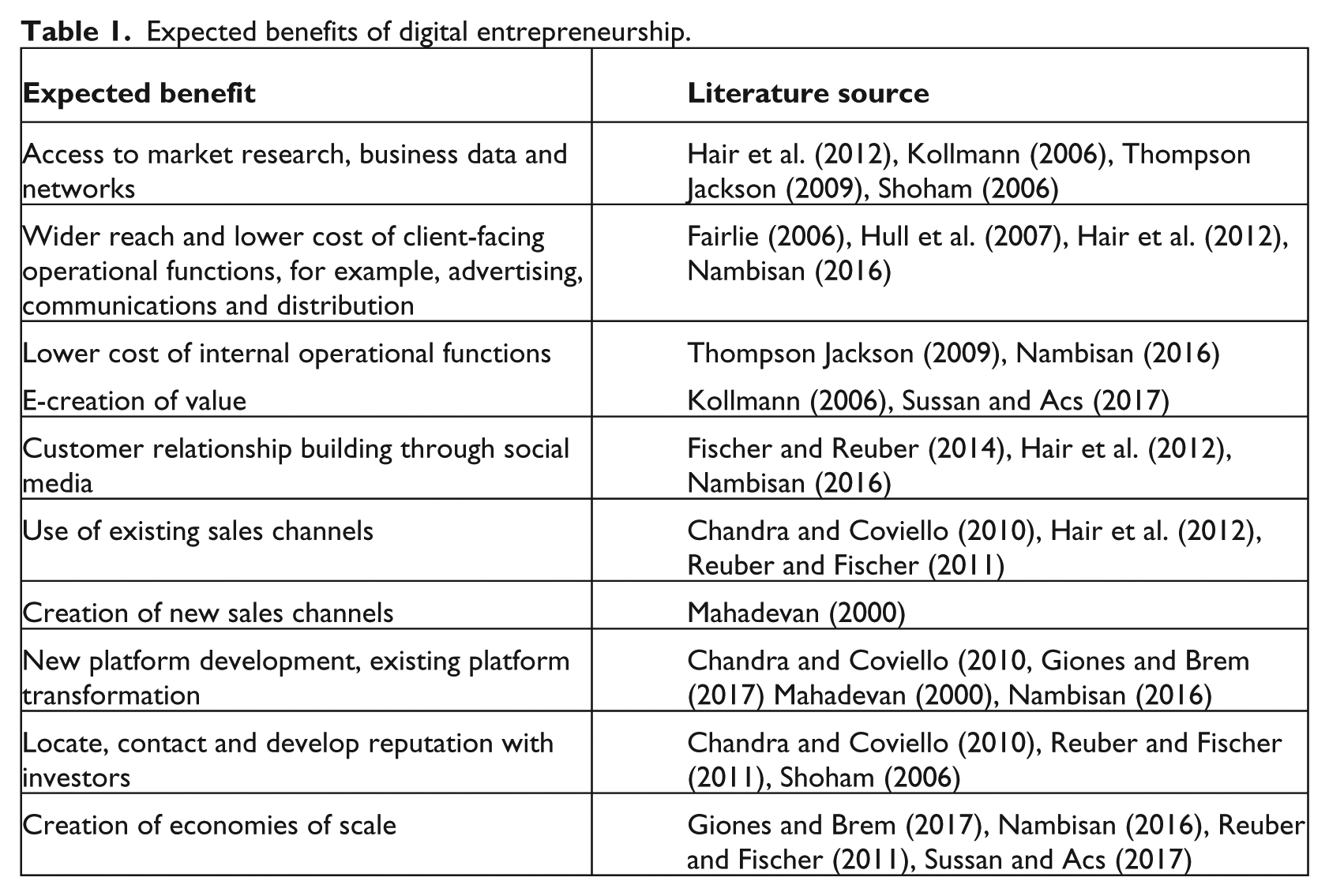
Notably, these debates have centred primarily upon entrepreneurs operating in physically rooted firms with a substantive market presence. Digital entrepreneurship, in contrast, is an emergent phenomenon in which new digital artefacts, platforms and infrastructure are being used to pursue innovative and entrepreneurial opportunities, to the extent that the relevance and applicability of traditional understandings of entrepreneurship are called into question (Davidson and Vaast, 2010; Nambisan, 2016). Its emergence has reignited arguments regarding meritocratic and unbounded opportunities (Martinez Dy et al., 2017), given historic assumptions that virtual exchanges facilitate access by reducing both entry costs and stereotypical discrimination (Daniels, 2009; Martin and Wright, 2005). This constructs the ideological foundation for a ‘digital enterprise discourse’ whereby access to digital platforms and encouragement of entrepreneurial behaviour is assumed to empower people to embrace the entrepreneurial promises of freedom and flexibility (Jones, 2017), enhance their personal socio-economic circumstances (Thompson Jackson, 2009) and contribute to the national economy (Schmidt, 2011). Extant business and management literature on digital entrepreneurship implicitly reflects these positive assumptions (Table 1) regarding expected entrepreneurial benefits (Giones and Brem, 2017; Sussan and Acs, 2017). However, despite the rise of digital entrepreneurship discourse and its obvious relevance to the contemporary economy, the phenomenon itself is still significantly underexplored, with a lack of consensus regarding measurement scales (Bogdanowicz, 2015) and a dearth of empirical analyses exploring viability and returns (Jarvis, 2010; Nambisan, 2016).
Expected benefits of digital entrepreneurship.
As technological advancements are generally presumed socially beneficial and politically neutral (Wajcman, 2010), this leads to assumptions that they can rectify or negate, instead of reproduce or compound, social inequality (Boyd, 2009; Daniels, 2012; Marwick, 2014). Since it is expected that the accessibility and supposed neutrality of digital platforms generally facilitate and encourage entrepreneurship (Mason et al., 2011), such activity is deemed particularly apposite for the socially marginalised. Digital entrepreneurship discourse specifically hails underrepresented, often marginalised and/or disadvantaged populations such as women, youth and people of colour (Accenture 2014; Genachowski, 2011; Government Equalities Office, 2014), who are encouraged to use the Internet to overcome entrepreneurial resource and experience deficiencies (Fairlie, 2005; Thompson Jackson, 2009). Such activity would appear to offer an equalising, even emancipatory, pathway to socio-economic participation. To illustrate, at the 2011 Minority Media and Telecom Council Broadband and Social Justice Summit, US Federal Communications Commission Chair Julius Genachowski (2011) presented broadband Internet access as ‘the great equaliser’, calling it a platform for economic growth and job creation.
We argue that such assumptions arise from a flawed logic. Shifting entrepreneurial activity into an online space is expected to ease the required resource burden to creating sustainable ventures while counteracting offline discrimination arising from negative social ascriptions. Yet entrepreneurial activity, regardless of where it is performed, is made possible through the structural distribution, material accrual and agentic mobilisation of resource pools. The rise of the digital space as a stage for entrepreneurial activity may have the scope to transform the manner in which materiality and agency are combined to inform innovative articulations of these constructs. It cannot, however, categorically remove structural impediments to the accumulation of material resources, or fundamentally alter the social positions and ascriptions fuelling such impediments. While creating digital ventures may not require investment in premises, staff and other fixed costs, it is still a resource-based activity requiring access to, for example, technical knowledge, digital marketplaces, online services, software and hardware. Yet these aspects of the phenomena have not been adequately theorised. We therefore, suggest there is a need to develop an ontology of digital entrepreneurship that recognises contemporary entrepreneurship theory regarding how agents use structurally distributed resources to enact opportunities (Anderson and Miller, 2003; Jayawarna et al., 2014; Jones et al., 2013).
Ontologising digital entrepreneurship
As digital entrepreneurship as a field of study is still in its infancy, the ontologies underpinning extant literature are not yet clearly defined. We argue that current conceptualisations in emergent work are problematically informed by the tendency of most entrepreneurship literature to prioritise agency over structure (Blundel, 2007) or to conflate the two (Mole and Mole, 2010). Two foundational articles (Davidson and Vaast, 2010; Nambisan, 2016), based loosely on the Information Systems work of Orlikowski and Scott (2008), draw upon Latour’s actor-network theory (Alcadipani and Hassard, 2010; Latour, 1987) to suggest a sociomaterial approach. In these articles, agency, materiality and the social world are all explicitly identified as essential to the phenomenon: Davidson and Vaast (2010) argue that ‘the digital entrepreneur exerts her agency … [and] becomes an element within a complex of sociomaterial practices, embedded in a network over which she may have limited influence’ (p. 4). Nambisan distinguishes between materiality (digital artefacts and their capabilities) and human actors, organisations and institutions, noting that porously bounded, collective agency is a new feature of digital entrepreneurial processes (Nambisan, 2016: 12, 18). Attention to ontology for such a new field is necessary, and indeed, welcome. Yet, we find that these notions of agency are underdeveloped in that they suffer from methodological individualism, or what Archer (2007) calls upwards conflation, in which structure is collapsed into agency. Although Davidson and Vaast’s (2010) analysis acknowledges the ‘limited influence’ of actors on their networks, there is no examination of the structural or cultural factors that may be constraining (placing barriers to, or limitations upon) or enabling (presenting facilitators to, or simply not impeding) their choices and the actualisation of their agential powers. Similarly, Nambisan’s (2016) attention to the shift precipitated by digital technologies from individual to networked entrepreneurial agency focuses primarily upon the involvement of additional entrepreneurial actors; his enquiries into how they shape agential beliefs, behaviours and actions omit discussion of wider structural or cultural forces (p. 7). Furthermore, the divergent agential powers of dissimilar entities are not distinguished from each other. While Davidson and Vaast (2010), in the actor-network tradition, locate agency in the material as well as in the human actor (p.4), they do not consider how human and technological agency might differ, nor how these differences mean that such agency may be constrained or enabled in completely different ways.
Critical realist theorists have problematised the notion of constitutive entanglement of the social and the material featured in sociomaterialist and similar approaches, and highlight their relative inattention to social structures and their effects (Elder-Vass, 2017; Mutch, 2013). In particular, they critique the flat ontologies that reduce social structures to individual-level phenomena (Elder-Vass, 2017: 92; Mutch, 2013: 36), which are implicit in the conceptualisations offered by both Davidson and Vaast (2010) and Nambisan (2016). The dominant view of digital enterprise as an unbounded space in which to realise entrepreneurial potential relies on precisely such a flat ontology (Mole and Mole, 2010), consistent with the presentation of the phenomenon in most extant literature (Table 1). In general, the expectations of what the digital can do for entrepreneurial processes are overwhelmingly positive because they fail to account for the unequal structural barriers that agents may encounter.
To present a more nuanced picture, we offer an alternative ontology for digital entrepreneurship, drawing on CR conceptual tools, including a depth ontology, a causal powers framework centred upon enabling conditions and a model of the social world that focuses on structure, culture and agency (Porpora, 1998) as they apply to entrepreneurship (Vincent et al., 2014). Adopting a depth ontology (Bhaskar, 2008) means we suppose that what exists contains more than simply that which we can observe, including, for example, potentials and absences, and that reality can be analytically stratified into levels, such as the structural and the agential. From a CR perspective, the world is made up of things which have properties; these properties instantiate causal powers (Fleetwood, 2009: 8). Causal powers and generative mechanisms are sometimes used interchangeably; in this article, we refer to powers at the level of agents and mechanisms at the level of structure, defining both as processes that can produce an outcome, resulting in contingent causality in open systems (Bygstad and Munkvold, 2011; Sayer, 1992). Things may be sentient beings (such as a human), material (such as a computer) or discursive (such as a belief), with attendant properties and limitations, while powers/mechanisms have three states: in potential, exercised and unactualised, or exercised and actualised (Fleetwood, 2009, 2011; Martin, 2014 – see Table 2). Specific unities of things, properties and actualised powers (such as a system of computer–human interaction) are thus argued to have particular causal efficacy.
Causal powers framework (adapted from Fleetwood (2011) and Martin (2014)).
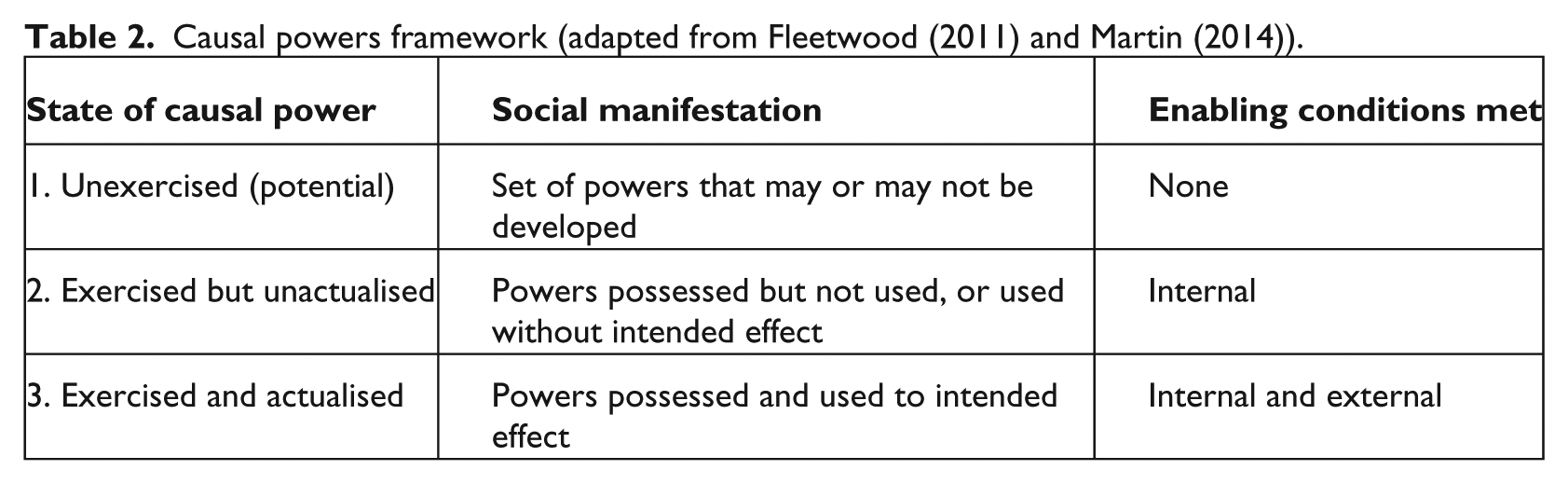
Yet, context is crucial: things must satisfy certain internal conditions and encounter particular external conditions if their powers are to be exercised and actualised (Fleetwood, 2009). As such, entrepreneurial opportunities are seen as potentials or propensities for turning market demand into profits, through the presence of appropriate structural conditions and considerable agential effort (Ramoglou and Tsang, 2016). Depending upon properties such as prior experience, knowledge and ability, different agents may or may not have the set of internal conditions needed to undertake digital entrepreneurial activities. If they do, the external conditions needed to fulfil their aims may or may not exist. It is the presence and interaction of appropriate conditions that lead to the development and actualisation of entrepreneurial powers (Leca and Naccache, 2006: 631).
The linking of entrepreneurship and digital platforms, both of which ideologically signal notions of unbounded agency, has led to a popular conception of digital enterprise free from social structures. But in a realist conception of the social world, this is impossible, as structures exist prior to the development of agency, constraining and/or enabling actors who then contribute to their reproduction or transformation (Archer, 2007; Porpora, 1998). To expand our argument, we combine our CR definition of structures as systems of human relationships among social positions (Porpora, 1998) with that of Bourdieusian sociologists (Anthias, 2001, 2013; Ignatow and Robinson, 2017) 1 who attend to the effect of such dynamic, yet durable, positionality on life chances, resource access and accrual. These are essential to both entrepreneurial processes (Anderson and Miller, 2003; Jayawarna et al., 2014) and digital skills development (Ignatow and Robinson, 2017). Actors have agency, or the ability to choose among various courses of action, and do so while embedded in systems of thought, belief and ideology – cultures – that profoundly shape their internal conversations and concerns (Archer, 2007); entrepreneurial agency, then, is tied to the cultures and structures of particular communities (Vincent et al., 2014). Furthermore, digital inequality mirrors offline resource inequality (Ignatow and Robinson, 2017), and social positionality affects the realm of digital entrepreneurs: for example, high-tech digital entrepreneurs originate from the highest echelons of the paid earnings distribution, offering numerous advantages, including greater access to financial resources and powerful social networks (Braguinsky et al., 2012; Dashti, 2010). Broadening our analysis to include structure and culture thus illustrates that digital enterprise pursuits are not purely agential, and that their outcomes and emancipatory potential will be subject to external constraint and enablement.
Finally, a realist ontology of digital enterprise must account for, and distinguish between, not only the structural and the agential, but also the physical and the virtual. Digital enterprise activities are enacted by embodied humans whose physical bodies are, again, subject to constraining and enabling social structures and cultures. Despite assumptions that digital disembodiment makes the online space more egalitarian and democratic, race and gender are still salient online (Noble and Tynes, 2016; Smith-Prei and Stehle, 2016). In addition, while some aspects of digital entrepreneurial activity are loosed by the online nature of the transactions, other aspects remain tied to the physical world – so for instance, although an e-retailer may wish to ship internationally, the physical distance between the source and the destination of the goods could cause shipping prices to increase substantially. Furthermore, some activities, goods and services will be hybridised; attention to both physical and virtual aspects is essential if we wish to accurately consider how enterprise activity is shifting due to the digital context, as well as any associated implications for emancipation. Therefore, despite the popular beliefs that the Internet ‘levels the playing field’ and widens the scope for entrepreneurial success, these assumptions cannot be taken for granted. In fact, the heterogeneity of the means itself and resource differences across users mean that these benefits may not be actualised. We now turn to an empirical investigation to illustrate our analytical critique.
Methodology and method: CR intersectional feminist contrastive explanation
Our CR perspective is complemented by an intersectional approach (Collins, 2015; Martinez Dy et al., 2014) that attends to structural and cultural mechanisms emergent from the historical social meanings attached to co-constituted categories of gender, race and socio-economic class. Such categories are understood as social ascriptions, or abstractions (Gunnarsson, 2011) corresponding to positions in established social hierarchies forming, structural relationships of power with material consequences (Anthias, 2001). These are understood to operate simultaneously and in concert in entrepreneurial (Essers et al., 2010) and digital (Ignatow and Robinson, 2017) processes. At the structural level, they shape life chances, social conditions and resource distribution (Anthias, 2001), while at the agentic level, they shape constellations of concerns, internal conversations and courses of action (Archer, 2007). Following Anthias (2013: 129), we assume first that the effect of a position in a certain hierarchy may be stronger and more manifest than another at a particular point in time, and second, that positions in different hierarchies may potentially be mutually reinforcing, or dialogical and contradictory, resulting in nuanced complexes of privilege and oppression. Finally, we combine intersectional and CR insights to assert that while the array of hierarchies forming social reality are ontologically co-constituted, they are analytically separable (Gunnarsson, 2011, 2015; Martinez Dy et al., 2014).
We undertook a qualitative study consisting of semi-structured, in-depth interviews with 26 women digital entrepreneurs based in England and Scotland. Capturing participant perceptions of digital entrepreneurship, and whether discursive expectations and policy objectives are realistic, is possible through interpretivist methods such as interviews (Ackroyd, 2004; Sayer, 2000), supplemented with demographic questionnaires to capture data, such as age, racial ascription, start-up capital, annual income, generation to attend university and job title at last paid employment, to support a comparative analysis. Although the sample was composed of women only, the intersectional perspective we adopt assumes heterogeneity within groups of women; as such, the structural advantages and disadvantages arising from various dimensions of social positionality were explored. The criteria for inclusion were that participants identified as women, had a digital business and had begun trading. Initial contacts were obtained through a women’s business incubator in the north-west of England, and the sample was selected in a non-probabilistic, snowball and purposive way focused upon adequacy, saturation and knowledge of the research topic (Bowen, 2008; Guest et al., 2006). Participants were located across England and Scotland in rural, suburban and urban areas, and were engaged in a range of digital entrepreneurial activities at various stages: start-ups, early-stage and established businesses. They had a diversity of financial resources, education and employment histories, as well as varying knowledge of business processes, digital skills and digital entrepreneurship in particular. The amount of accessible start-up capital ranged from less than £500 to more than £50,000. In this article, we examine a subset of the full sample: six women digital entrepreneurs, from diverse demographic backgrounds, occupying contrasting social positionalities, presented as a set of three paired comparative case analyses.
The outcome of CR research requires a causal explanation of the phenomena at hand, which involves identifying powers/mechanisms that are operating as well as those that have the potential to operate, and whether they are enabled or constrained. The DREI(C) method underpins this methodological approach, and guides theoretical explanation (Bygstad and Munkvold, 2011; Danermark et al., 2002). It requires describing the object of enquiry (D), through, in this case, examination of extant literature and discourse on digital enterprise discourse, considering theory-practice contradictions or anomalies. The next step is to retroduce (R) the likely (active or passive) causal powers in operation, the potential causes influencing a context and how participant accounts offer insight into causal processes. We combined thematic (Braun and Clarke, 2006), intersectional (Byrne, 2006; Healy et al., 2011) and contrastive (Lawson, 2003; Mussell, 2016) analytical techniques to inform our comparative case method (Kaarbo and Beasley, 1999) and assist in retroduction. Using a thematic intersectional analysis, we sought to identify the most relevant structural and cultural mechanisms in an iterative way, beginning with deduction. A start list of broad codes based on key concepts from the literature included gender, race, class, resources, and entrepreneurial benefits and challenges of the digital environment. Data points were coded in three rounds: during transcription, after importing into NVivo10 and an additional round of line-by-line coding for more detailed themes. These focused upon the personal, social and technical experiences of digital entrepreneurship, business outcomes and the constraining and/or enabling effects of social position and resource access. The constant comparative method was used throughout (Bowen, 2008); newly gathered data were systematically and continually compared with previously collected data and their coding.
Next, paired cases were selected (Kaarbo and Beasley, 1999) through identifying relevant variables based on theory (aspects of social positionality) and comparable dimensions (digital entrepreneurial aims in the same industry sector). Drawing upon Lawson’s (2003: 231) contrastive explanation technique, first, we identified differences between the outcomes of the paired participants and second, comparatively examined the cases to identify the causes responsible for the difference. By iteratively using theory to explore cases, and using cases to explore and refine theory (Kaarbo and Beasley, 1999), we accounted for the presence or absence of relevant core and countervailing agential powers and structural or cultural mechanisms, considering their differently weighted interactions (Ackroyd and Karlsson, 2014; Kessler and Bach, 2014). Our overall analytical aim was to ascertain the key structural and agential aspects of social positionality that shaped experiences of digital entrepreneurship in order to achieve an explanatory critique of the interplay between them. While no analysis can explain the complete causal conditions of any social phenomenon, we focused upon key mechanisms by considering specific differences that explained why similar outcomes were not achieved in each pair (Lawson, 2003: 231). Finally, a retroductive causal explanation must also include the elimination of competing explanations (E; in this case, the veracity of the claims within digital enterprise discourse), followed by inference (I) and confirmation (C) of the causal powers at work. We offer further detail in the discussion section regarding the manner in which this analysis was undertaken.
Comparative cases: fashion designers, social media experts and vintage wear retailers
1. The fashion designers
Rebecca was a White British woman in her early twenties who graduated with an MA in pattern cutting, part of fashion design, in a city in the English Midlands. She worked part-time for minimum wage as a restaurant server, was single with no children and belonged to the first generation in her family to attend university. Encouraged by her tutor, she began designing clothing and set up a fashion label. Her father, a web designer, built a transactional website through which she sold handmade clothing; she wrote a business plan and conducted some competitor research, but had no previous business experience and between £500 and £1000 start-up capital. Her limited financial resources led to a piece-work business model in which she produced a sample, took photographs, uploaded them to the website and then produced to order. She worked with local networks of photographers, models and a seamstress whom she met through university. The main traffic to her page came through Google AdWords; Facebook was ‘good for getting to people to look’ at her site but did not result in many sales. Promotion and marketing were the most difficult aspects of her business. In particular, she found it extremely challenging to work on the business in addition to her job, through which the business was funded. If she worked more hours, she had more money for the business, but less time; if she worked fewer hours, she had more time, but less money. Eventually, Rebecca moved back to her northern hometown and lost access to the creative sector network she had built through university. Approximately 18 months after inception, she decided to close the business due to a lack of sales and because, as she put it, her ‘heart was no longer in it’.
Jasminder, a British Asian (Indian) woman in her mid-thirties, was a second-generation university graduate and trained optician in a large city in the English Midlands. She was married with a young daughter. Since childhood, she wanted to own a business, but her family strongly discouraged this, giving her only four options: doctor, pharmacist, dentist or optician; she became an optician ‘to keep them happy’. In addition to her career, for eight years she and her husband ran two digital businesses, one in property and the other matching UK investors with Indian entrepreneurs. This experience proved extremely useful when she founded a solo digital venture designing and selling professional women’s clothing. She had an intern, no employees and more than £20,000 start-up capital. Her husband did the photography and graphic design work, and she outsourced web development and maintenance for £1500 per month, ensuring the site had a professional appearance and consistent functionality. To produce her designs, she travelled to China to identify a suitable factory. It took approximately six months to gain a critical mass of customers, during which time she maintained her full-time work as an optician, gradually reducing her working hours as her fashion business increased. Dedicated technology was employed to closely track customer behaviour on her site, assessing it in terms of targets, real-time version testing and overall strategy. While her husband was supportive of her entrepreneurial activity, his family, which she described as ‘traditional’, were not. As they disapproved of her desire to be an entrepreneur, she hid her business from them and so was unable to take advantage of the childcare they would have provided under different circumstances. Their opposition to her entrepreneurial activity and lack of support for her business pursuits was an ongoing issue of great concern.
2. The social media experts
Sebi was a Black British woman of Nigerian heritage living in south-east London; she was in her early fifties, married, with teenage children. A third-generation university graduate, she was employed in the public sector for 25 years, and during the UK austerity cuts of 2010–2011, took voluntary redundancy with severance pay. She did not apply for another public sector job because of what she perceived as the ultimate ineffectiveness of the numerous regeneration programmes of which she had been a part. She described being a Black woman in employment as ‘soul destroying’ and ‘tiring’, with experiences that ‘eat away at your confidence ‘cause you start to think well, something must be wrong with me’. Sebi knew many unemployed Black women of a similar age, and attributed their unemployment to the combined racism and sexism experienced by Black women, which has been termed misogynoir (Durham et al., 2013), as well as discrimination based on her age. She identified that older Black women face significant barriers when they are ‘up against what is most desirable, which is white male, then white female, and young’.
As such, she believed entrepreneurship was a pathway to economic security and autonomy. Her experience was in the area of business coaching and mentoring, so she began a coaching business, then joined a small social media business and later began another social media business in partnership with her sister. The first business was unsuccessful, while her partner in the second business recommended that she ‘whitewash’ her online profile by adopting a typically White name and using pictures of White people on their website, which she refused to do. Despite being skilled in the area of social media, and having £10–20,000 to fund the business at start-up, she found it difficult to obtain clients, despite doing ‘all the things they say you should do’. Business networking meetings were ineffective because ‘everybody was there to sell’. To address these issues, she engaged in additional self-funded training, but to no avail; she perceived that the stereotype of Nigerian people being linked to fraud was a likely reason for difficulty obtaining clients, because despite being ‘very Anglicized’, she says, ‘I’ve got a Nigerian name and a black face … Forget it! Literally, people don’t give you a chance’.
Louise, a White British woman in her forties, lived in an English seaside town; she was divorced with adult children and grandchildren. She did not attend university, and had a successful career in sales and marketing as a manager for a large property company based in Spain. After the 2008 recession, she moved back to the UK and began working in sales for a company in the water treatment industry. Exploring social media, she had a surprise success securing a large number of contracts via Twitter, and her company created a new position for her as social media manager. When the company downsized, she volunteered for redundancy and used her redundancy pay to start a social media management business. After researching training options, she paid for a lifetime membership for online social media training with two mentors (approximately £140 each). Within six months, she had ten clients acquired primarily by networking and word of mouth. As her client base grew, they asked her to undertake other public relations and marketing work for them, so she took additional online courses and expanded her business to include these services. She specifically targeted clients whose businesses reflected her interests and in which she could envision herself as a customer, and measured success by customer satisfaction. All were White British except one, whose business was Indian cuisine, which she found it challenging to market as it was not to her taste. She was social media manager for one of the biggest tourist attractions in a nearby city, which had a number of businesses on its property. Many of these approached her and became new clients independently.
3. The vintage wear retailers
Melanie, a Black British woman of Afro-Caribbean heritage, lived in a small English Midlands city; she was in her fifties, single, with an adult daughter. She was a qualified hairdresser and previously owned a hair and beauty salon that closed due to issues with the tenancy. At the time of the interview, Melanie was on Jobseeker’s Allowance and worked ad hoc as a hairdresser. At the job centre, she was advised of a now-defunct government scheme, Get British Businesses Online (GBBO). The scheme provided seed funding of £200, and a domain name and web hosting for two years; however, she had to build the website herself. It also provided a small amount of income support money for six months. Her limited experience using Internet technology, unfamiliarity with selling online and a lack of finance were significant barriers to progression in her business. Before she built the website, she tried unsuccessfully selling a few pieces of clothing on eBay; it was only after all the seed funding had been spent on stock that she realised funding was required for advertising, without which the stock could not be sold. Not having sufficient stock to make the website look full, and then learning she was not legally allowed to use copyrighted photographs of her stock, was problematic, particularly as she could not afford professional photography. The basics of digital entrepreneurship were overlooked: her domain name was complicated, the website was confusing to navigate and although she was aware of some principles of online marketing, she did not know how to implement them, relying instead upon her daughter to assist with website-related issues. Despite this, Melanie was averse to outsourcing and delegation. Even if she were to have sufficient funds to hire assistance, she felt this might prevent her from knowing how to problem-solve. Consequently, the business had reached a number of structural impasses. She was attempting to set up a business networking group to try to overcome these challenges, but prospects were not promising.
Lucy, a White British woman in her thirties, was a third-generation university graduate in a large English city. She had five years of management experience in large fashion retail chain stores and lived with her partner. While employed, she test traded vintage fashion items on eBay, and began selling at local vintage fairs a year before she left her job. Financial support was available from her partner if required; she also had savings. Access to these resources positively influenced her decision to leave employment and create her own venture. She had additional valuable experience in retailing, sewing, dressmaking and photography, skills regularly employed in her business activities. Unsure about setting up a new business, she contacted a local women’s business incubator, which provided significant support with the legal and practical aspects of venture creation, such as developing a business plan and taking courses on marketing and online presence. She spent around £1000 in start-up costs and described this as a ‘low financial risk’. Along with selling at vintage fairs, she sold through eBay and in time developed a Facebook sales page. It took two and a half years to establish the business: ‘quite a slow process’. Lucy did not use an independent website as she deemed it ‘too costly’ but identified a number of advantages of selling primarily through Facebook: frequency of customer use, legitimacy of platform and facilitation of a more personal relationship with customers, which she felt were key to her business growth. She described her typical customer profile as very similar to her own: ‘professional woman between about twenty-five to thirty-five, white, potentially … I don’t think a really high income, maybe £20-25,000-ish, quite confident in her own style’. Approximately 70% of her customer base is in the local area, and Lucy hoped one day to eventually expand throughout the UK and possibly into Europe.
Discussion: deepening digital enterprise discourse through intersectionality and critical realism
The challenges to entrepreneurial success detailed in these accounts of digital enterprise activity will not be unfamiliar to scholars of entrepreneurship more generally, as the knowledge and resource constraints participants describe are well rehearsed (Sarasvathy, 2001; Shane, 2008). Yet this resonates with the argument that contrary to popular expectation, the digital context does not necessarily ameliorate or help to overcome structural disadvantage (Ignatow and Robinson, 2017). Digital tools offer the potential for improvements in work efficiency and scalability, but crucially, do not fundamentally alter the basic resource requirements demanded by new venture creation processes. Resource needs have instead shifted – while rental costs for physical premises may be reduced, costs for developing and maintaining web presence, shipping products and digital advertising are taking their place. Furthermore, offline inequalities, resulting in the absence of appropriate experience, networks, skill and information deficits, are quickly compounded, as Internet use reproduces structural hierarchies and exacerbates differentials (Boyd, 2009; Marwick, 2014).
We now discuss the findings. Through an intersectional feminist lens supported by a CR framework of structure, culture and agency (Martinez Dy et al., 2014), what emerges is a complex array of core and countervailing agential powers, and structural and cultural mechanisms, resulting in comparatively weaker or stronger positions as digital entrepreneurs. The paired cases and contrastive analytical approach (Kaarbo and Beasley, 1999; Lawson, 2003) showed that specific differences of socio-economic class and race in particular, accompanied by corresponding resource access or lack thereof, precipitate the presence or absence of powers and mechanisms that explained the divergent outcomes of each pair.
The fashion designers
The primary structural mechanism informing the divergent entrepreneurial outcomes of Rebecca and Jasminder was the effect of socio-economic positionality on work experience and accumulated resources. As a digitally savvy, highly educated creative person, Rebecca was an ideal subject of the digital enterprise discourse, who would be expected to succeed. Yet, she was underemployed with few options for gaining more financial or temporal resources. In comparison, Jasminder had a number of class-related socio-economic advantages. With a professional career and experience of running three previous businesses, two online and one offline, Jasminder had much greater tacit business knowledge, such as in-depth awareness of how online tools offer insight into customer behaviour. She also had a much higher paying job, commensurate to her skillset, where she could work flexibly, which allowed her both to outsource the production of her designs and to travel internationally to do so. Consistent with the argument outlined by Jayawarna et al. (2014) that those who face a higher opportunity cost for foregoing employment will start businesses with higher earnings prospects, Jasminder had high aims for her business, including intentions for international growth. Although caring responsibilities limited her availability, she was able to reduce her working hours when she chose without significantly constraining financial resources for her business. Rebecca, by contrast, had very little relevant work experience, and worked for low pay with little flexibility. In addition, her youth combined with her gender were arguably also a disadvantage; she mentioned that she had been treated like a ‘little girl’ in a number of business situations. Making clothes by hand was time and labour intensive, and her lack of experience and poor access to financial and temporal resources hindered her ability to outsource production and to better exploit the online space to market her business. This led to structural impasses she could not overcome and the business’ eventual closure.
However, attention to cultural mechanisms adds additional nuance. Although Jasminder was privileged in the area of social class and had access to more useful resources overall, she was somewhat disadvantaged by an intersection of gender and culture. While Rebecca had the agency and privilege to pursue her entrepreneurial endeavours with encouragement by her father and tutor, Jasminder, although supported by her husband, had to contend with the disapproval of his family. In response, she maintained an unwanted silence around her entrepreneurial activities in order to avoid attracting negative attention, and her agency to pursue entrepreneurial activities was somewhat constrained as a result. The family’s stance, informed by conservative notions of femininity and traditional female ethnicity (Essers et al., 2010), meant their perception of Jasminder was contrary to her own: she considered herself a modern entrepreneurial woman rather than limiting herself to the role of mother and employee, as they wished. This supports Jayawarna et al.’s (2014) conclusion that gendered divisions of household labour affect the capacity to apply class-structured privilege to entrepreneurship, and highlights how race and ethnicity complicate the notion of entrepreneurship for women of colour (Knight, 2016). However, the countervailing cultural mechanism emerging from this intersection was evidently too weak to prevent her from pursuing her entrepreneurial venture, albeit within the outlined constraints.
The social media experts
In Sebi and Louise’s divergent experiences, geographical location arguably plays an important role. Louise is based in a small city with less competition, evident in the number of people she described encountering with no social media components to their business, and therefore, room for her to enter as social media manager. In contrast, Sebi is based in London, where the competition is much higher and more intense. However, this competition is clearly compounded by the constraining effect of racial discrimination, a generative structural and cultural mechanism negatively affecting people of colour and immigrants. Racism was a key feature of Sebi’s employment experiences, and influenced her decision to enter entrepreneurship, reflecting the findings of Knight (2016) that entrepreneurship may hold for Black women the promise of an escape from racist and sexist workplaces (Van Laer and Janssens, 2011). For these reasons, she viewed entrepreneurship as more secure than waged work (Hytti, 2005). Although both elected to take redundancy as a result of downsizing due to the economic recession, there was arguably more of a push factor for Sebi, who was dissatisfied with her previous employment due to experiences of racial and sexist discrimination as well as with the overall ineffectiveness of the programmes with which she had been involved. Accordingly, she was looking for a means of economic security in which she would not be subject to such discrimination. Yet, she perceived that everyday interpersonal and online racism, due to her name, skin colour and country of birth, prevented her from obtaining clients. This is despite the fact that she has a degree, extensive industry experience and more training than Louise, which could normally be expected to result in a better outcome.
In comparison, Louise experiences White privilege (Acker, 2000; Frankenberg, 1993) which, due to the normativity of whiteness in the UK context, serves as a vital entrepreneurial resource. Louise is unconcerned with issues of race, except when confronted with clients who are culturally different to herself; she can expect that her race will generally not be a hindrance to obtaining clients, and she can choose to work only with clients that are ‘like her’ without narrowly restricting her potential client base. White privilege can also stand in for qualifications: although she does not have a degree, she is still perceived as qualified. Since whiteness is an invisible norm, as a White entrepreneur she will not be grouped with others, as Sebi is grouped with other Nigerians; instead, she can expect to be judged as an individual on the basis of her character, work and accomplishments. Thus, we identify that in this context, White privilege comprises part of a generative mechanism through which entrepreneurial agency is arguably more recognised and enabled by society (Ogbor, 2000).
White privilege also increases the likelihood of being able to link into influential social networks. Although Louise was from a working-class background, a number of individuals within her predominantly White social network were themselves entrepreneurs, which Anderson and Miller (2003) note is extremely beneficial. Members of these networks, some of whom were positioned relatively high in the local occupational strata, recommended her to potential clients with whom they came into contact. It is possible that the impact of these recommendations would be amplified in a smaller city with less competition; this was how she obtained the recommendation to the management of a large tourist attraction that became one of her top clients. Sebi was middle class, but as a Black resident of a large UK metropolitan area, she did not have the same level of network influence. Overall, Sebi was from a significantly higher socio-economic position and possessed extensive human capital, but faced overt and subtle racial discrimination (Van Laer and Janssens, 2011) in a difficult geographical market that left her struggling to gain clients. In this case, her agential powers were severely constrained by strong countervailing mechanisms emergent from both structure and culture. Furthermore, the encouragement to whitewash her identity is reminiscent of a similar phenomenon whereby women working in technology or as digital entrepreneurs are encouraged to adopt a male persona or use only their initials on job applications to avoid discrimination (Greathouse, 2016; Sample, 2016). This is based on the problematic assumption that individual behavioural change is a viable solution to structural inequality. While Louise had significantly less human capital and came from a lower socio-economic position, a combination of higher social capital in an area with less competition alongside her white privilege enabled her to gain clients successfully. In her case, structural and cultural mechanisms were seen to enable the successful exercise of agency. The dialogical and contradictory effects of social categories of difference (Anthias, 2013) are thus evident in these complex experiences.
The vintage wear retailers
When considering the differences between the cases of Melanie and Lucy, the foremost differentiating structural mechanisms are the constraining or enabling effects of lower or higher socio-economic class positionality, respectively, which accounts for their marked difference in access to financial, human and social capital. Melanie was in a precarious economic position, working intermittently in a low-margin service industry; her digital venture was prompted by access to a government scheme aimed at unemployed people, and financial resources were limited to £200 seed funding. With no experience selling the product, she was still encouraged to do so by the GBBO scheme representatives at the Job Centre. She therefore exemplifies the marginalised and vulnerable individuals who are exhorted to be entrepreneurial and create a digital business, even in an area where they have little or no experience. Engaging with the scheme does, however, ensure they no longer claim welfare benefits and are repositioned as self-sufficient providers. As she lacked the relevant digital skills, Melanie could not even begin test-trading in the GBBO programme’s allotted six month period.
In contrast, Lucy was from a higher socio-economic background with savings and her partner’s back-up income. With significantly more human and social capital in fashion retail management in a large company, as well as experience selling vintage wear online via eBay, Lucy had essentially been test trading for a few years. Only after this period, when she was confident of generating sufficient income through her vintage retailing, did she leave employment. Unlike Lucy, Melanie did not have organisational support, nor friends able to offer professional advice. The GBBO scheme provided Melanie with some information, but no specific training regarding sales and marketing like that which Lucy accessed. It is evident that the effects of higher social positions and access to more effective social networks were critical differences that benefitted Lucy and disadvantaged Melanie. Although the effect of disadvantaged racial positionality does not clearly emerge as a deciding structural mechanism in their entrepreneurial experiences, past experiences of racism, in the case of Melanie, and White privilege, in the case of Lucy, doubtlessly shaped the life chances of these women (Anthias, 2001). Melanie believed she was denied bank funding to support her hair salon business on account of her race, while Lucy, similar to Louise, did not have to even consider race as her stakeholders – whether advisors or customers – were her social peers. This is illustrative of tacit privilege as the advantage of credibility and familiarity enhances rather than constrains her potential client base. Thus, both structural and cultural mechanisms are seen to enhance Lucy’s agency (Porpora, 1998).
These findings offer qualitative support to the conclusions of Jayawarna et al. (2014) that privileged class backgrounds enable resource acquisition through mobilisation of labour market privilege. Although Melanie’s previous business ownership may have been expected to benefit a digital venture, her experience as a hair salon owner was not relevant to the new business, while her lack of financial resources combined with fear of the online environment hindered access to advice and relevant training. Her participation in the GBBO scheme arguably diverted time and energy from job-seeking to a digital venture with little potential for success, in which her entrepreneurial agency was heavily constrained by marginal positionality and the related absence of appropriate human and social capital.
The value of a CR perspective and method
Extant literature (Davidson and Vaast, 2010; Giones and Brem, 2017; Nambisan, 2016) presents digital entrepreneurship with a flat ontology, so whether certain powers exist in potential, exercised or actualised in a given entrepreneurial scenario remains unexplored. Neither is there a conception of structural conditions necessary for their attainment, as they are analysed primarily at the level of the individual. In contrast, a CR analysis encourages us to explore enabling conditions at both levels, which we did following the DREI(C) method (Bygstad and Munkvold, 2011; Danermark et al., 2002). First, we described (D) the expected benefits suggested by extant literature (Table 1) of using the Internet for enterprise activities. Through contrastive case analysis (Kaarbo and Beasley, 1999; Lawson, 2003), we identified various barriers preventing disadvantaged entrepreneurs from availing of these supposed benefits (Table 3), illustrating how digital entrepreneurial activity is constrained by poor resource access. Second, we considered the entrepreneurs who were successful in establishing profitable, sustainable businesses and retroduced (R) the enabling conditions that must have existed in order for them overcome such barriers. Assuming the relevance of both various external and internal resources to successful entrepreneurial activity (Jayawarna et al., 2014; Jones et al., 2013) and following established CR method (Bygstad and Munkvold, 2011; Danermark et al., 2002), we organised and theoretically redescribed these conditions into two groups. First, social resource access (external or structural): material, financial, cultural and temporal resources accumulated over the life course and second, individual know-how (internal or agential): tacit knowledge such as digital and business skillsets, problem-solving skills and auto-didactic ability. Higher positionalities were associated with high levels of social resource access, albeit in different combinations, as illustrated in the cases of Jasminder, Louise and Lucy, in whose business outcomes the effects of expected benefits were evident. This is in contrast to the cases in which entrepreneurial exploitation of the technology was constrained by lower positionalities and low social resource access, as illustrated by the experiences of Rebecca, Sebi and Melanie.
Barriers for digital entrepreneurs (DEs).
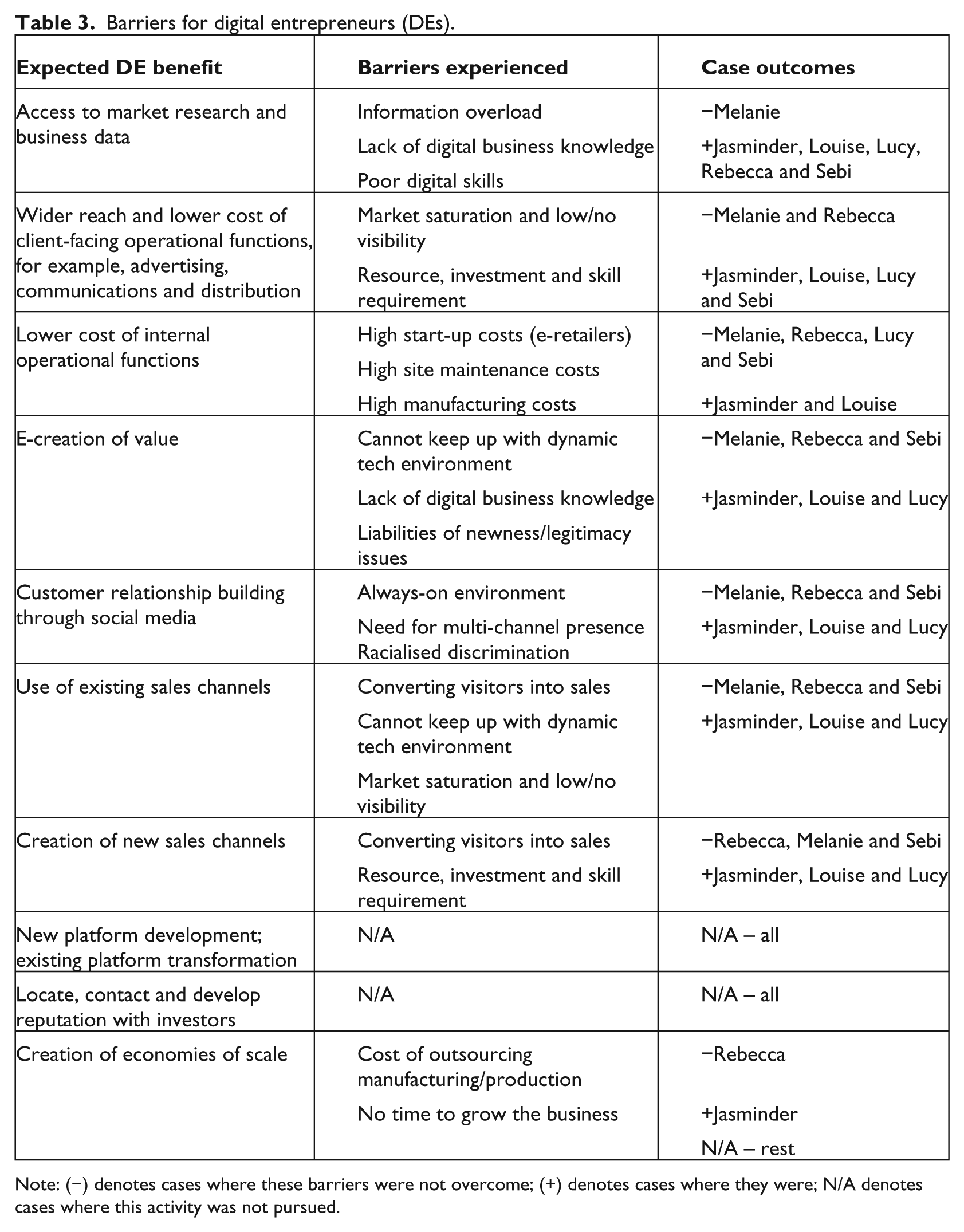
Note: (−) denotes cases where these barriers were not overcome; (+) denotes cases where they were; N/A denotes cases where this activity was not pursued.
Third, we considered competing explanations (E), such as the possibilities implicitly suggested within digital enterprise discourse that the disadvantaged entrepreneurs were not properly exploiting the technology, or alternatively, were not working hard enough to achieve their intended goals. But the data consistently showed that structurally distributed social resource access, alongside individual know-how and hard work, preceded digital entrepreneurial success. Participants who possessed relevant knowledge and showed evidence of hard work, but lacked social, cultural and material resources struggled in comparison. Although a high degree of specialised technical knowledge could lead to better employment opportunities and valuable business experience, it did not ameliorate a basic need for social resource access. In contrast, those who had access to wider resources, but lacked technical knowledge, were able to mobilise those resources to develop the internal conditions by learning, or alternatively, learning to manage the outsourcing of, necessary skills. This enabled us to infer (I) that relevant structurally distributed resources created external enabling conditions with causal efficacy for digital enterprise.
However, in keeping with the CR goal of explanation over prediction (Bygstad and Munkvold, 2011), we do not claim that the presence or absence of these conditions is deterministic. Instead, we argue that their presence contributes, alongside other factors, to a causal explanation of digital entrepreneurial success. When external enabling conditions are inaccessible, as is often the case with marginalised or disadvantaged entrepreneurs, impediments to success abound. As confirmation (C) of our analysis, we found that the negative effects of the absence of these conditions were, in various combinations, evident across our sample group. A key example is those who worked in low-waged service roles, had no management experience and little financial savings, found that their life conditions generally did not endow them with the necessary resources to effectively build or sustain a digital venture. To fund their businesses, hours in employment had to be increased. As such, time was not flexible or elective in the way it was for professional-level earners and their capacity to develop the business was severely undermined. Accordingly, our CR perspective offers an empirical critique of entrepreneurial emancipation as agential-level phenomenon.
Implications for theory, policy and practice
Contemporary discourse on empowerment through digital entrepreneurship cannot ignore the relevance of social positionality and life conditions upon both digital skills and entrepreneurial activity. The sociological literature demonstrates how family background and life chances affect experiences of education, employment and digital skills development (Anthias, 2001; Ignatow and Robinson, 2017); we extend this analysis to consider how experiences of digital entrepreneurship are similarly shaped. If the distribution of antecedent social resources is favourable, there will be fewer challenges to acquiring further resources, accessing critical business networks, and obtaining the financial and temporal resources necessary to experiment entrepreneurially and learn from failure. The precise technological competencies required for digital enterprise, then, become secondary and can be developed as the venture progresses. While our thesis that key digital entrepreneurial resources are structurally distributed, rather than agentially obtained, may not resonate with myths of the heroic entrepreneur (Ogbor, 2000), our findings resonate with literature streams that critique the notion of entrepreneurship as meritocracy by emphasising the influence of class and life course pathways on the accrual of entrepreneurial resources (Anderson and Miller, 2003; Jayawarna et al., 2014), and examining performance constraints arising from disadvantageous ascriptions of gender, race and intersections thereof (Carter et al., 2015; Knight, 2016; Marlow and McAdam, 2013). They also reflect cyber- and techno-feminist perspectives, which suggest that technological development has the potential not only to improve, but also exacerbate existing structural inequalities (Daniels, 2009; Wajcman, 2010). Our theoretical critique of the assumed benefits of the Internet for entrepreneurship, and empirical identification of structural and agential barriers and enablers, thus advances interdisciplinary discourse on the phenomenon.
To assess the extent to which the Internet enables people to enact entrepreneurship, we must first acknowledge what it does not do: crucially, it does not grant entrepreneurs easy access to political, social, material or cultural resources. Likewise, it does not guarantee funding or network connections to key industry players. Finally, while it is an incomparable source of information, independent learning or outsourcing is required, which takes time, tacit knowledge and/or financial resources. The implications of such arguments for practitioners, business support providers and policy makers are considerable; it may be that policy efforts aiming to teach technical skills to potential digital entrepreneurs – for example, the Do More Online campaign, which encourages micro-businesses and sole traders to ‘go digital’ (BIS, 2014) are founded upon a false promise of expected achievement. People following these avenues may see their time, resources and energy unnecessarily diverted from more appropriate courses of action. Moreover, many new entrants encouraged by this discourse may have little realistic potential for success and no support mechanisms in place in case of failure. Although we are not suggesting that only individuals in higher social positions will succeed in this domain, we stress that they are more likely to have balanced resource portfolios with which to build sustainable digital ventures. Thus, to support potential digital entrepreneurs from marginalised populations, greater access to socially distributed material, cultural and financial resources should be facilitated: for example, business mentorship and internship matching programmes and substantial, yet competitive, seed funding. In addition, a concerted effort must be made to reduce discriminatory push factors, such as workplace sexism, racism, ageism and ableism, so that entrepreneurship is not a last resort for people who would otherwise prefer employment. To ignore these considerations means risking setting the most vulnerable up to fail, with extremely damaging consequences.
Conclusion
We advance the emergent literature upon digital entrepreneurship with the argument that the possibilities for emancipation through undertaking digital entrepreneurial activity are constrained or enabled by social positionality. Using a CR framework, intersectional feminist approach and contrastive case study method, we identify external and internal enabling conditions for digital enterprise and provide theoretical and empirical support for the notion that digital entrepreneurship is beholden to many of the same resource requirements as traditional or offline entrepreneurship. As such, the use of digital platforms for entrepreneurial activity does not in itself ameliorate the negative effects of low or marginal social positionality. Digital entrepreneurial outcomes are neither primarily agential nor meritocratic, but are substantially facilitated or hindered by wider structural and cultural influences. This evidence further suggests that not only are familiar inequalities exacerbated with the phenomenon of digital enterprise, but also that new dimensions of inequality are emergent, such that the socially marginalised and resource-poor cannot be expected to find it an effective route out of marginality. Thus, the Internet is no leveller for entrepreneurial activity: instead, greater structural social equality is needed if we wish to support aspiring digital entrepreneurs, who still require substantial investment of a variety of resources to build their businesses over time. Finally, it is the responsibility of those who publicly promote such activity to turn away from the uncritical assumptions of typical discourse and recognise the structural, as well as agential, conditions that underpin digital entrepreneurial success.
Footnotes
Acknowledgements
The authors are grateful to the guest editors, Joe O’Mahoney, Steve Vincent, and Bill Harley, and the anonymous reviewers for their encouragement and constructive feedback in the development of this article. They recognise and thank the University of Nottingham for the PhD studentship funding the basis of this research.
Funding
The author(s) disclosed receipt of the following financial support for the research, authorship, and/or publication of this article: This research was funded by a PhD studentship at Nottingham University Business School, the Vice-Chancellor’s Scholarship for International Research Excellence. No specific grant was received from any funding agency in the public, commercial, or not-for-profit sectors.
Notes
Author biographies
