




Abstract
Recently there has been renewed academic interest in co-operatives. In contrast, media accounts of co-operatives are relatively scarce, particularly, in the United Kingdom, where business reporting usually focuses on capitalist narratives, with alternatives routinely marginalised until a scandal pushes them into the public eye. This article analyses media coverage of the United Kingdom’s Co-operative Bank (2011–2015), tracing its transformation from an unremarkable presence on the UK high street to preferred bidder for Lloyds Bank branches and its subsequent near collapse. The article charts changes in reporting and media interest in the bank through five discursive frames: member and customer service; standard financial reporting; human interest, personality-driven journalism; the public relations machine; and political coverage. Our analysis discusses three points: the politicisation of the story through covert and overt political values; simplification and sensationalism; and media hegemony. We argue that although moments of crisis provide an opening for re-evaluating the dominant reporting model, established frames tend to reassert themselves as a story develops. This produces good copy that reflects the interests of the publishers but does not extend understanding of co-operative organisations. Thus, the article identifies the role of the media in delegitimising organisations with alternative governance structures, thereby promoting ideological and economic conformity.
Keywords
Introduction
Since the financial crisis of 2007–2008, there has been a renewed interest in co-operatives (Cheney et al., 2014) in the academic and policymaking communities as co-operatives are seen as offering alternatives to discourses of austerity and consumer capitalism. Rather than simplistically positioning co-operation as a solution to rampant capitalism on one hand and austerity on the other, studies have highlighted the complex environment within which co-operatives operate (Bretos and Errasti, 2017; Levi and Davis, 2008; Meira, 2014; Noterman, 2016; Sanders and McClellan, 2014). They argue that co-operatives cannot be analysed in isolation; the wider social, political and institutional contexts need to be taken into account (Boone and Özcan, 2016; Gupta, 2014; Lambru and Petrescu, 2014). Moreover, because commercial success and mutuality exist in tension (Mangan, 2009; Storey et al., 2014), what counts as success and failure are difficult to judge (Cheney et al., 2014). This kind of sensitivity and appreciation of context has been relatively rare when judging alternative modes of organising; there is a long tradition of analysing co-operatives using neoliberal economic theories that fail to account for concepts such as altruism, self-help and social justice (Lambru and Petrescu, 2014). A broad assumption is that co-operatives must function in a ‘business-like’ manner in order to survive in a capitalist marketplace (Sanders and McClellan, 2014), but this is to neglect co-operatives’ interest in social justice, dating back to the foundation of the first co-operatives in the United Kingdom (Birchall, 1994).
In contrast to this renewed interest shown by academics and policymakers, media accounts of co-operatives are relatively scarce, particularly, in the United Kingdom, and this reinforces public ignorance about co-operatives. In one sense, this is not surprising because alternative organisations often suffer from invisibility (Rodgers et al., 2016) in mainstream business discourse until a scandal or unusual event pushes them into the public eye. Moreover, unlike other parts of Europe (e.g. Scandinavia or Ireland) where credit unions and co-operatives are common, public knowledge about mutuality has been in decline in the United Kingdom. Demutualisation of building societies and the growth of out-of-town supermarkets in the 1980s both reduced the presence of co-operatives on the UK high street. Although there are over 6000 co-operatives in the United Kingdom, spread across every region and contributing £37 billion to the economy (Mayo, 2015), they are relatively invisible to the general public, and business reporting in the UK media more often reinforces this situation. Thus, while participative values and practices are of pressing concern to members and worker-owners in co-operatives, the general public is often unaware of co-operative alternatives to mainstream for-profit businesses.
This article explores how co-operatives are presented to the public in the media. The empirical data are drawn from 5 years of UK newspaper reporting on the Co-operative Bank (2011–2015), from when the bank was a solid, yet unremarkable, presence on the UK high street to its rise as the preferred bidder for Lloyds Bank branches and then its near collapse. Our initial interest in this topic came from curiosity about how the Co-operative Bank was portrayed in the press during the series of crises in 2013. Coverage presented the co-operative and its customers as unfashionable and seemed to blame the bank’s failings on unprofessional behaviour by lay people who did not understand banking. Yet only 18 months before that, the Co-operative Bank was being hailed by the newspapers as ‘the saviour of the high street’ when it emerged as the UK Government’s preferred bidder for the Lloyds Bank branches that were being sold off.
Although not a mutual itself, until 2013, the bank was wholly owned by The Co-operative Group, a larger member-owned co-operative that has included businesses such as food retail, funeral homes, travel, banking, insurance and pharmacies. The Co-operative Group has its roots in the mid-19th century, when the Rochdale Pioneers Society was established (Birchall, 1994). The Co-operative Wholesale Society (CWS) was established in 1863, merging with Co-operative Retail Services (CRS) to become The Co-operative Group in 2000. The CWS set up the CWS Loan and Deposit Department in 1872. In 1971, this became the Co-operative Bank and was a wholly owned subsidiary of CWS first and then the Co-operative Group. The bank adopted a customer-led ethical policy in 1992 and marketed itself as the world’s first ethical bank. It survived the financial crisis of 2007–2008 without a UK government bailout. However, following a financial crisis at the bank, precipitated by a ratings downgrade and a £1.5 billion capital shortfall in its finances in 2013, 80% of the Co-operative Group shareholding was sold to international hedge fund investors. Many customers subsequently left the bank, arguing that it was no longer a mutual or ethical. In 2017, the Co-operative Group sold its remaining shares in the bank.
The article is organised as follows. First, it examines media reporting, exploring how stories are framed for public consumption, the role of the media in legitimising certain discourses over others and how the financial crisis was reported around Europe. The second section on media reporting focuses on organisational critical discourse analysis, summarising the key frames used to shape public knowledge of business. The ‘Methods’ section explains how the newspaper articles were chosen, categorised and analysed using frames and political discourse analysis (Fairclough and Fairclough, 2012). In the case study, the article charts the changes in reporting and media interest in the bank through five discursive frames: member and customer service, standard financial reporting, human interest or personality-driven journalism, the public relations (PR) machine and political coverage. Our analysis suggests a series of overt and covert discursive strategies in the highly politicised coverage of the bank’s financial crisis. The analysis highlights the role of the media in delegitimising co-operatives with alternative governance structures; newspaper coverage of co-operatives is based almost exclusively in a neoliberal for-profit discourse where non-profit organisations are judged by for-profit values. We argue that the media’s hegemonic power serves to promote ideological and economic conformity. The article concludes with reflections on how the Co-operative Bank case contributes to wider research on media reporting of the financial crisis and suggests areas of further research.
Media and business news: framing stories for public consumption
The power of the media to frame stories and set the agenda for public debate is a perennial topic of debate, with critics arguing that mainstream media offer an overwhelmingly neoliberal perspective on the economy and business reporting. To explore this contention and contextualise the media’s treatment of the Co-operative Bank story, the literature review is formed of two sections. The first draws on media studies research to explore the question of hegemonic mainstream media perspectives through an examination of framing and the textual operation of media power. This is followed by examples of research into how the financial crisis was reported around Europe. The second section focuses on organisational critical discourse analysis, summarising the key frames and gaps in organisational discourse studies. Taken together, the research on media and corporate discourse highlights the role of the media in legitimising and prioritising certain discourses over others.
Media reporting on business news: framing the financial crisis
Much has been written about the ability of media to generate or determine the meaning of actions, events and situations, particularly, given the unaccountable nature of private, profit-seeking media organisations. This is often referred to as the media hegemony thesis, and it relates to how power shapes the way stories are framed for public consumption (Carragee and Roefs, 2004). They argue that it is necessary therefore to examine how stories are framed by paying particular attention to the relationship between media frames and issues of social and political power. This concern is echoed by Freedman (2015) who argues that media power is based on a series of relationships ‘between actors, institutional structures, and contexts – that organize the allocation of the symbolic resources necessary to structure our knowledge about, and by extension our capacity to intervene in, the world around us’ (p. 274). For Freedman (2015) then, media power is the ‘comprehensive … unstable and contradictory’ sum of a series of these relationships (p. 286).
In this theorisation of media power, neutral stories are conceptually impossible, but the public sphere requires a diversity of ‘frames’ for the public to arrive at informed judgements (Baden and Springer, 2014). The media frame stories to construct public opinion through conscious and unconscious reference to deeper ideological and social assumptions, thus naturalising and reinforcing these assumptions (Entman, 1993; Vliegenthart and Van Zoonen, 2011). At their simplest, frames operate by ‘selecting and highlighting some facets of events or issues, and making connections among them so as to promote a particular interpretation, evaluation, and/or solution’ (Entman, 2003: 417). They are social constructs that promote certain meanings and are thus implicated in the production and reproduction of power (Carragee and Roefs, 2004; Doudaki et al., 2016).
Visible frames include the selection of particular facts or sources for inclusion in an article; invisible frames include the underlying ideological assumptions that lead to the promotion of analytical perspectives and courses of action (Van Gorp, 2007). In the sphere of economic activity, media have the discursive power to construct and reproduce a ‘natural’ set of practices that support and justify the activities of globalised neoliberal business elites. At points of financial or economic crisis, media discourse temporarily expands to incorporate critical or alternative perspectives to some extent but also applies existing frameworks to consideration of alternative structures or organisations, thus delegitimising them. While a crisis might encourage media organisations to seek alternative perspectives, the pressure to evaluate complex situations swiftly also results in over-reliance on familiar sources and narratives – such as moral or individual failings – to the detriment of (alternative) organisations fighting to establish their legitimacy (Baden and Springer, 2014).
According to Bjerke and Fonn (2015), ‘political drama and horse-race journalism’ make it easier to frame a complex crisis for readers but reduce the potential for sustained critiques of established ideological and economic methods and structures (p. 125). Similarly, Kleinnijenhuis et al. (2015: 2) assert that in times of crisis, the complexity of conceptual frames is reduced as clearer explanations or causes are sought. This was the case in British media stories about the financial crisis: Schifferes and Coulter (2013) identify three long-standing explanations: ‘scandal (blaming the bankers), moral panic (blaming the public) and reform (blaming the politicians)’ (p. 246). In Van Gorp’s (2007) view, these are ‘cultural phenomena’, in which a journalist’s desire to tell a story leads to the identification of moral lessons, heroes and villains. As Compton and Dyer-Witheford (2014) put it, during times of crisis, ‘media become a key site where new discursive articulations are made, new subject positions stitched together, and where the ruling class grasps for a new narrative’ in ‘frame contests’, before largely reverting to legitimising dominant hegemonic narratives as ‘common sense’ (pp. 1200–1203). In this regard, they differ from Kleinnijenhuis et al. (2015), who believe that following a period of media moralising, ‘deviating perspectives gain attention … again, which in turn widens the perspective and reveals alternative solutions’ (p. 18).
In terms of framing the UK financial crisis, Robertson (2010) examines bias and hegemonic perspectives in the UK media. He focuses on three types of framing bias (distortion, content and decision-making), arguing that there was bias in the coverage of economic issues because journalists rely on a limited number of sources for business reporting. His findings are echoed by Berry (2016a) who argues that political and financial elites dominated news coverage of the crisis, thus reducing the perspectives broadcast to the public and ignoring alternative interpretations of events. Similarly, Temple et al. (2016) demonstrate that coverage of the financial crisis focused on citizens as ‘economic actors’ defined within a neoliberal, free-market setting. They argue that this is an example of how ideology can become discursively embedded in society, serving to dehumanise the crisis and stifle public debate on alternatives. Finally Berry (2016b) charts the dominance of neoliberal perspectives, demonstrating how the largely right-wing press defined the crisis in terms of public spending rather than private debt. This served to reinforce austerity policies rather than subject them to impartial analysis.
Beyond the United Kingdom, media reporting of the financial crisis also reduced complexity and relied on dominant neoliberal narratives to make sense of the crisis for their readers. For example, Bjerke and Fonn (2015) used framing theory to analyse two Norwegian newspapers’ reports on the European debt crisis of 2008. They argue that the crisis was framed as a short-term problem caused by rogue individuals rather than a longer-term problem caused by capitalist structures. They conclude that the Norwegian media framed the crisis using neoliberal perspectives that remain largely hidden from the public and therefore unquestioned. Preston and Silke (2011) make similar arguments about the hegemonic neoliberal values that shape the media in reportage of the crisis in Ireland. Finally, Doudaki et al. (2016) examine how the Greek media portrayed the crisis using three main frames: dependency, (non)liability and austerity. Again, they argue that the press articulated the crisis in mainly neoliberal terms, reinforcing the hegemonic presentation of the neoliberal interpretation of the crisis and Greek bailout and leaving the structures of the capitalist financial system unchallenged. This served to strengthen the hegemonic neoliberal discourse surrounding responses to the crisis rather than to uncover alternatives.
Media reporting on business news: using critical discourse analysis to analyse media reporting
To contextualise the media’s treatment of the Co-operative Bank, we need to understand its role in both legitimising and delegitimising particular business structures and practices over the long term and since the banking crisis that started in 2008. In this section, we draw on the long history of organisational discourse analysis of the media reporting on business news. The majority of these studies use critical discourse analysis to focus on the ways in which the public’s perceptions of organisations and business practices are shaped and influenced by the ways in which the stories are framed in newspaper reporting. Topics covered include mergers and acquisitions (Halsall, 2008; Kuronen et al., 2005; Vaara and Tienari, 2002), governance (Hartz and Steger, 2010), corporate scandals (Ailon, 2015) and the role of the media in (de)legitimising business activities (Pallas and Fredriksson, 2013; Zhu and McKenna, 2012). Taken together, the overwhelming conclusion of these articles is that the media have a significant role to play in constructing and reproducing a ‘natural’ set of discursive practices that serve to support and justify the activities of globalised neoliberal business elites.
We follow Fairclough and Fairclough (2012) and others in understanding linguistic discourse as constituting and reinforcing hegemonic power. Vaara and Tienari’s (2002) analysis of media coverage of a proposed bank merger asserts that the underlying ideological assumptions of media content can be discovered through the application of critical discourse analysis to individual media texts and groups of texts: Zhu and McKenna (2012) build on this and similar work to stress media’s power to (de)legitimise particular types of business activities by appealing to a range of cultural perspectives, such as ‘rationalism’. By categorising discursive techniques found in media texts, they connect linguistic and rhetorical devices to wider systems of political, cultural, ideological and economic power and recast media discourse as key to the construction of what come to seem ‘natural’ or ‘common sense’ economic orders, with the concomitant marginalisation of competing concepts.
We follow Zhu and McKenna’s (2012) approach, believing that the close analysis of rhetorical, lexical and intertextual features of individual texts reporting on the Co-operative Bank story reveal hegemonic assumptions which reduced opportunities for that and other alternative organisations to be evaluated on their own terms in the mainstream media. In this, Williams et al.’s (2011) analysis of death metaphors in business reporting contributes to our understanding of the power of metaphor in framing events in terms of responsibility or the lack thereof. In their work, death metaphors allow readers to attribute blame for corporate bankruptcy away from executives or companies which might otherwise be held responsible to situations and structures beyond their control: among the repeated metaphors found in the Co-operative story is the astronomically apocalyptic ‘black hole’, which may contribute to reinforcing hegemonic interpretations of this story. Williams et al. (2011: 552) tie the use of anthropomorphic metaphor to the naturalisation of capitalism and the marginalisation of alternatives: we will suggest that the network of metaphors applied to the Co-operative Bank story by various actors works in a similar hegemonic fashion. Certainly Temple et al.’s (2016) analysis of UK business reporting supports the impression that the use of natural metaphors reinforces neoliberal interpretations of events by framing the crash as ‘outside of human control’ and impacting consumers rather than human beings, therefore becoming impervious to collective emotional responses such as anger or outrage. We suggest that the Co-operative Bank coverage becomes embedded in neoliberal discourses through the use of natural disaster metaphors in one strand of the story’s development in order to delegitimise the organisation’s remaining credibility as an alternative to mainstream capitalist entities, while another strand – the Paul Flowers story – conversely delegitimises the co-operative movement through the introduction of human failure narratives.
Methods
Empirical data were gathered from a search of the Nexis UK newspaper database. We chose to concentrate on UK newspapers rather than broadcast media because the UK press has a long tradition of financial reporting and analysis. Second, the press is not subject to the regulation of balance and impartiality to the same extent as broadcast media: this leads to a greater range of opinion and commentary on current affairs.
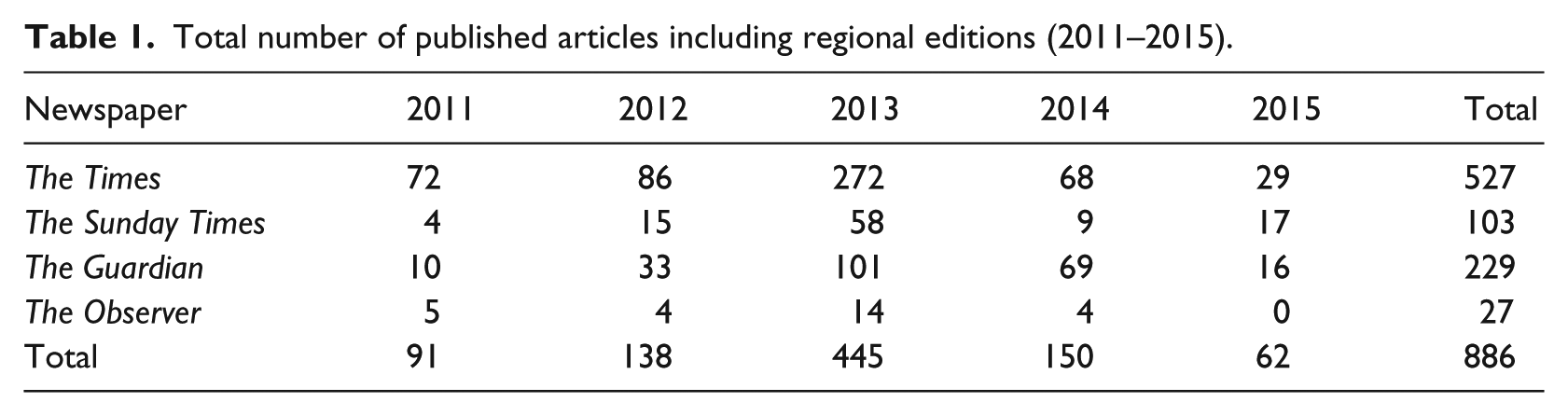
Using the search term ‘Co-operative Bank’ in UK national newspapers from 2011–2015 inclusive, with the search restricted to headline and lead paragraphs, yielded 1639 results in total. Of these, the highest results were for The Times (527) and The Guardian (229). Both papers are daily broadsheets, published Monday to Saturday, and they represent contrasting political stances. The Times offers a broadly right of centre perspective, while The Guardian represents slightly left of centre coverage. Given the contrasting ideological viewpoints and our interest in investigating whether the Co-operative Bank received more favourable coverage in a left-leaning publication (which has roots in the same industrial part of the United Kingdom as the Co-operative Group), we decided to focus on these two newspapers. To capture the reflective analysis traditionally offered in weekend newspapers, we also decided to include the two newspaper’s Sunday editions represented by the sister publications The Sunday Times (103 articles) and The Observer (27 articles), respectively. This gave a total sample size of 886 articles (see Table 1).
Total number of published articles including regional editions (2011–2015).
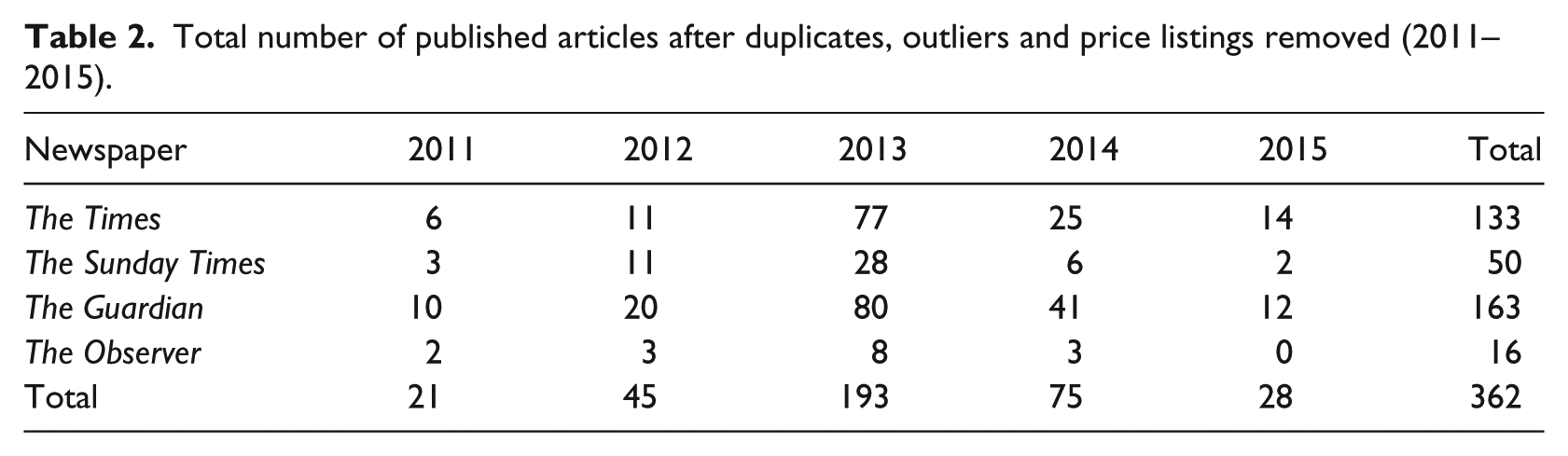
We removed duplicate stories (such as early, regional and online editions with the same byline and date). We removed outliers where the search term produced lists of stock prices but kept outliers where Co-operative Bank was mentioned as part of a story or opinion piece. This left a total of 362 articles, divided as follows: The Times (133), The Guardian (163), The Sunday Times (50) and The Observer (16) (see Table 2).
Total number of published articles after duplicates, outliers and price listings removed (2011–2015).
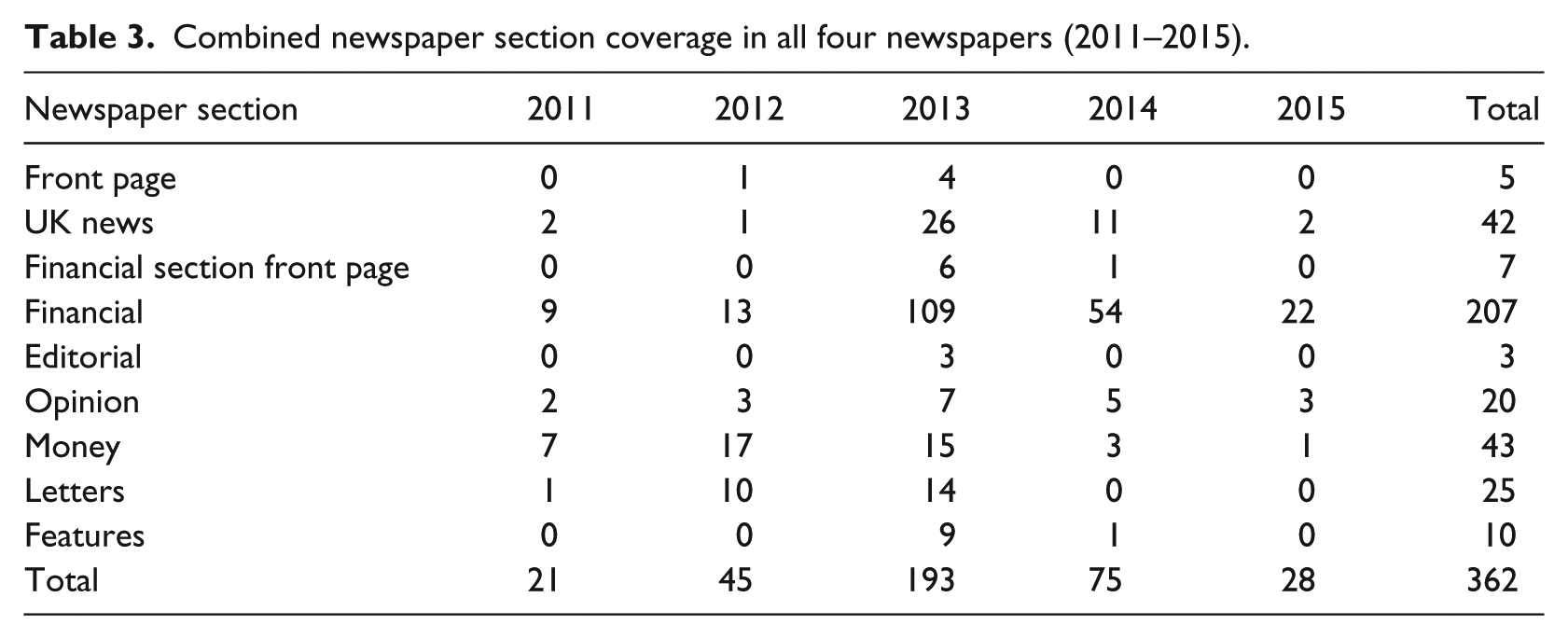
In addition, the first author categorised the articles by year and the section where they appeared in the newspaper (e.g. personal finance, finance/business, home news, editorial, front page), producing a broad outline of (a) the frequency of stories about Co-operative Bank and (b) the narrative arc of the shift from Co-operative Bank as the ‘great saviour’ of high street banking to ‘troubled’ institution (see Table 3).
Combined newspaper section coverage in all four newspapers (2011–2015).
Drawing on the history of organisational discourse analysis discussed above, we used Fairclough and Fairclough’s (2012: 44–45) taxonomy of argumentative components which sees truth claims by agents as the rhetorical products of overtly and/or covertly held values, goals, circumstances and means. In the texts we analyse, competing agents – customers, members, journalists and the media organisations which shape their reportage, various Co-operative Bank and Co-operative Group executives, executives from rival financial entities, regulators, politicians, lobbyists and shareholders – compete to establish evaluative authority by identifying what they understand to be the most relevant or compelling circumstances which caused the Co-operative Bank’s failure (including managerial incompetence, greed, market failure, amateur leadership, political interference) and the goals to be adopted. Fairclough and Fairclough (2012) assert that ‘values’ (a blend of moral, ideological and philosophical stances) contribute to the selection of goals and the circumstances within which arguments and claims can be situated. Much of the newspaper coverage of the Co-operative story can therefore be analysed as the product of circumstance, goal and means selection to justify explanatory claims made about the Co-operative Bank’s predicament, ranging from personal morality, commitment to social justice or neoliberal adherence to market efficiency. In their analysis of readers’ comments on bankers’ bonus stories, for instance, Fairclough and Fairclough (2012: 178) identify commitments to justice and morality as driving readers’ critiques of a Goldman Sachs executive’s defence of economic inequality. Accepting the discursive structures, we identify the various statements and evaluations made of the Co-operative Bank story in terms of the circumstances chosen, the goals stated or implied, the means proposed and finally the values and purposes implied by these aspects to demonstrate the discursive and conceptual complexities which surround the apparently simple events which befell the Co-operative. We further discuss whether the discursive field in these texts reflects public confusion over Co-operative Bank’s status as a commercial bank espousing a set of ‘ethical’ principles without itself being a co-operative, while being owned by a genuinely co-operative organisation.
To analyse the data, we read the articles independently, making notes on where the stories appeared in the newspaper, key phrases, rhetorical devices, individual or organisational focus, nouns, adjectives and other distinctive features of contemporary journalistic practice. In this phase of the analysis, we were interested in developing an overall understanding of how the newspapers covered stories about the Co-operative Bank. In the second phase of analysis, we compared our separate lists of key words, discussing similarities and differences between them. Given our different specialisms, one of us noted language related to co-operatives (mutuality, amateurism, professionalism, governance), while the other highlighted media rhetoric, journalistic tropes and tabloid-inflected journalism. We both highlighted examples of explicitly political rhetoric. From this, we developed a joint list of key words, which we used to formulate five discursive frames which indicated a range of implied values (Fairclough and Fairclough, 2012): member and customer service, standard financial reporting, human interest or personality-driven journalism, the PR machine, and political analysis. In what follows, we offer a discussion of each of these frames in turn, while the conclusion discusses the role of framing in media reporting of business news as it applies to the Co-operative Bank and the implications for it and similar organisations.
Findings
Table 3 shows a breakdown of where stories about the Co-operative Bank appeared in the four newspapers, combined to give an overview of how reporting of the bank shifted over the course of 5 years.
At first glance, the table shows that stories about the bank are relatively scarce in both 2011 and 2015, peaking at 193 in 2013 when the bank had a financial crisis. Also of interest is the movement and positioning of the stories. In 2011 and 2012, the Co-operative Bank rarely appeared in the UK news sections. Instead, it featured predominantly in the money or financial pages, with stories dealing with customer queries, new financial products or general news about appointments and financial results. Of note in 2012 was the number of letters about Co-operative Bank: seven in The Guardian and three in The Times. Of the latter group, there was a money query, a customer service complaint and a short witty letter about changing address. In contrast, the 7 letters in The Guardian were all positive and supportive of the bank, possibly reflecting the paper’s readership, which is assumed to be liberal-left and committed to values opposed to neoliberalisation. For example, one letter complained about ‘snide comments’ (The Guardian, 10 July 2012) made in parts of the media about the bank’s Board of Governors which included a nurse, a vicar and a plasterer. Discussing the financial crisis and subsequent government bailout of high street banks, the letter writer suggested, Had these respectable trades been present on, for example, the board of Barclays, it is inconceivable that they would have made as bad a fist of it as the existing banking mafia. What these lay people did consistently over the years was to ensure no bailout from government was needed at any time. (The Guardian, 10 July 2012)
In December 2011, Co-operative Bank emerged as the UK government’s preferred bidder for 632 high street branches of Lloyds Bank. This announcement prompted an increase in stories about the bank in 2012, albeit still confined to the financial and money pages.
Articles on the bank peaked in 2013, numbering 193 in total, up from 45 the previous year. The fourfold increase in stories can be linked to three major events which precipitated a crisis at the bank. First, the bank was downgraded by a ratings agency, following a £700 million loss in the first 6 months of 2013. Second, a £1.5 billion shortfall was uncovered in the bank’s balance sheet related to the takeover of Britannia Building Society in 2009. Finally Paul Flowers, the non-executive chairman of the Co-operative Bank from 2009 resigned in June 2013 in response to the £700 million loss. In November 2013, he was subject of an exposé relating to his personal life by The Mail on Sunday, a UK mid-market newspaper, quickly followed up by broadsheet and tabloid publications. Notable about 2013 is that the stories began to appear beyond the financial and money pages, featuring on the front pages, in UK news, features, editorials and opinion pieces. Letters about Co-operative Bank also peaked in 2013, before disappearing altogether in 2014–2015.
The bank still featured in the news, opinions and financial features in 2014 (11, 5 and 54 articles, respectively), but the story was of little interest in other parts of the newspapers. By 2015, the bank had gone back to levels similar to 2011, with a total of 28 articles, 22 of them in the financial pages. Having examined some overarching trends in the numbers and types of articles published between 2011 and 2015, the next section focuses on five discursive frames: customer/member service, standard financial reporting, human interest or personality-driven journalism, the PR machine, and political manoeuvring. The first two frames are predominant in 2011 and 2012, while the other three emerge when the bank begins to have problems.
Customer and member service
This frame dominates the early reporting on Co-operative Bank. Articles in the money pages of the newspapers reported that the bank’s customers were the most satisfied and received better than average customer service. Journalists suggested that the bank did not offer particularly competitive products but that it operated well and was more reputable than its competitors (‘unsullied by the latest [rate fixing] scandal’, The Observer, 01 July 2012), with the clear implication that the bank’s origins and values were the cause of its quiet success.
The bank’s favourable reputation was enhanced when news broke in 2011 that the Co-operative Bank was the UK government’s preferred bidder to take over the branches Lloyds Bank was forced to shed as a condition of its government support bailout: The choice was hailed as a victory for the mutual movement against shareholder-owned capitalism. (The Times, 15 December 2011)
Reports framed the Co-operative as a successful ‘mutual’ and ‘alternative’ provider which survived the crash, whereas multiple mainstream operators failed. The stories therefore belatedly and not entirely accurately incorporated the Co-operative into a narrative of free-market failure and ethically informed survivors: the underlying values of the public discourse were becoming closer to attitudes previously found only in readers’ and customers’ letters. Such attitudes identified a new means – the promotion of co-operative values – to a goal which was rarely previously stated in public discourse: stability rather than growth.
When the Lloyds deal fell through in April 2013, The Guardian reported that consumer groups were disappointed that ‘the unhealthy dominance of our biggest banks’ (The Guardian, 24 April 2013) would not be challenged. The organic metaphor implies again a new set of values which promotes regulation (or medical treatment) rather than laissez-faire competition, reflecting the trauma inflicted on the population by the crash. The newspaper also began advising readers on other ethical banking options while also suggesting that the bank was not a ‘true co-operative’ (The Guardian, 17 June 2013) because it was only a subsidiary of The Co-operative Group rather than an actual co-operative itself. Similarly, The Times suggested that any deal to sell Co-operative Bank ‘will horrify customers with a strong emotional attachment to the bank for its ethical values’ (The Times, 11 May 2013): without quite endorsing these customers’ values, both newspapers tacitly endorsed the legitimacy of incorporating a moral dimension within financial and economic discourse. After the bank’s purchase, however, this discursive frame fell away as the customer and member service discourse became subsumed under more standard business reportage.
Standard financial framing
Coverage of the Co-operative as an equal player in the financial sector began with the announcement of the Lloyds bid and was marked by a shift from stories in the money pages to financial news and comment. The Guardian was initially welcoming, arguing that the bank was ‘a positive model of thrift’ that could ‘point a way forward from the financial wreckage’ in the banking sector (The Guardian, 20 December 2011). In other papers, the tone was also broadly positive with comments such as ‘the deal will transform the Co-op’ (The Sunday Times, 22 July 2012) and the ‘audacious expansion plans … could now look exquisitely well-timed’ (The Observer, 01 July 2012). The goals (Fairclough and Fairclough, 2012) implied in the coverage ranged from a standard free-market desire for more competition on the high street to the need for a more stable banking sector. Underneath these goals are values rarely glimpsed in mainstream coverage: while faith in capitalism had not failed, newspaper reports recognised that unrestricted capitalism had failed and required new structures and values, derived in this instance from the Co-operative’s mutual history and perceived mode of operation.
The newspapers’ tone shifted as the Lloyds deal fell through and the bank’s financial problems become apparent. The Guardian initially avoided explicit criticism of the bank, focusing on what the collapse would mean for customers following the ratings downgrade (10 May 2013). The newspaper began to question whether the Co-operative Bank was a ‘real’ mutual following the ‘bail in’ of bondholders: The British Co-op is not actually a co-operative bank; it is a regular commercial bank that is owned by the Co-operative Group. This has a big impact on how the bank is likely to behave. It means the Co-op has no direct local customer ownership or oversight, which is why its managers seized upon the opportunity to buy Britannia and expand their empire, without properly considering whether this move was actually in the interests of their customers. (17 June 2013)
The Times began to describe the bank and its activities negatively (‘no one fully believes the published accounts’, 13 May 2013; ‘the ailing bank’, 16 May 2013; ‘mounting concerns about its financial strength’, 25 May 2013), while The Sunday Times attacked the bank’s governance structure: The bank has to answer to the board of the Cooperative Group, an eclectic collection of people elected from the regional boards, including a plasterer and a nurse. (09 June 2013)
From May 2013, criticism of the bank was continual. The Times began to use the expression ‘black hole’ to describe the bank’s balance sheet debt (‘Co-op finance chief to step down as questions mount over “black hole”’, 27 May 2013). The newspaper had 36 usages of ‘black hole’ between May 2013 and September 2015. The Sunday Times went further, using the expression 14 times between May and December 2013, a high frequency for a weekly publication. The Guardian preferred the phrase ‘capital shortfall’ (64 uses); ‘black hole’ only appeared in late November 2013, during the Paul Flowers coverage. The higher use of ‘black hole’ in The Times/The Sunday Times coverage reflects the newspapers’ outspoken critique of the bank in editorial comment pieces; it became overtly hostile towards the bank quite soon after the Lloyds deal fell through. Such a metaphor, likening the financial crash and specifically the Co-operative’s takeover of Britannia to a catastrophic, uncontrollable natural phenomena, allows commentators and those involved to – as Fairclough and Fairclough (2012: 120) assert – deny agency and responsibility, serving the interests of the Bank’s executives, governors, regulators and even customers who might otherwise have to examine their own actions and values.
Thus, there are two competing frames in action, informed by opposing values. The Guardian maintained its traditional scepticism of unrestrained markets and its sympathy with co-operative values by ascribing the Co-operative Bank’s failure to its adoption of non-cooperative behaviour. The Sunday Times, in contrast, reinforced its belief in the strengths of élite corporate capitalism by viewing the bank’s failure as the result of amateurish governance by unqualified individuals. The subsequent revelation of the non-executive chairman’s unorthodox personal life introduced a new frame for analysis of the Co-operative Bank’s troubles, one which referenced an entirely different set of values, as we shall discuss in the next section.
‘Say It With Flowers’: human interest or personality driven journalism
If you occupy a certain kind of bully pulpit of the moralising right, you can try to build out of this one lurid saga a more general theory about the debauchery of the liberal-left. If you can see the tragedy in this sorry business, you can reflect mournfully on the withering of the mutual tradition that grew out of the self-help ethic of the Victorian working class. If your taste is for painful paradoxes, you can dwell on the irony that the Co-op has now fallen into the hands of hedge-funds. American hedge-funds to boot. Whatever you want to say, you can say it with Mr Flowers. (The Observer, 24 November 2013)
This discursive frame is organised around the idea of moral failings, both at an individual and organisational level, judged against an implicit but undisclosed moral code. As the quote above demonstrates, events can be consciously as well as unconsciously framed to demonstrate the truth of multiple moral and political perspectives. All four newspapers in this study are broadsheets, but it is noteworthy how the language of tabloid journalism shaped how the Co-operative Bank was reported on from 2013. The Co-operative Bank had marketed itself as corporately ethical: at no point did the bank claim that it operated as a co-operative nor did its ethical stance cover individual officers’ behaviour. Once it got into trouble, however, coverage of its financial problems contrasted the bank’s democratic structure and ethical stance with its governors’ perceived moral failings until these personal behaviours became merged with key corporate events to provide a new narrative of the bank’s collapse.
The bank’s former non-executive chairman, Paul Flowers, was not mentioned in The Guardian until October 2013, when he appeared before a government committee to answer questions on the bank’s financial difficulties. The first report on his drug use appeared on 17 November 2013, with The Times reporting the story from 18 November 2013 onwards. The Guardian treated the story as a sociological curiosity and then entertainment, rather than linking his private life to the bank’s troubles: What is really startling about the footage of Paul Flowers buying cocaine and crystal meth (and opting against ketamine) is the fact that he is 63. We just don’t think of older people loading up with party drugs. But should we? (19 November 2013)
While The Guardian and The Observer reported that Flowers had been nicknamed the ‘Crystal Methodist’ (he was a Methodist minister), The Times used the phrase to criticise the bank and continued to refer to it long after Flowers had disappeared from the public eye: Pantomime characters like its former chairman now known as the Crystal Methodist (though not for his Waterford collection, nor his godliness) have turned the Co-op Bank into a laughing stock. (The Times, 12 August 2015)
Thus, the Co-operative story is reframed as one of amateurism and personal moral perversion undermining a previously stable institution. Attention is directed away from the neoliberal behaviours which crashed the financial sector and, arguably, the Co-operative Bank and reinforces the argument that the Co-operative failed because it was not run by experienced orthodox capitalists. Most newspapers referred to Flowers as the bank’s chairman but did not explain that his position was as a non-executive nor that he joined the bank’s board after it took over the Britannia. This allowed them to question his competence without having to explain that the bank’s daily operations were managed by seasoned banking executives or that multiple mainstream failed banks were also run by experienced officers. The Times in particular repeatedly described Flowers as a ‘financial illiterate’ in 2014–2015, a phrase first employed by the Chair of the Treasury Select Committee after Flowers gave incorrect figures for Co-operative Bank’s balance sheet, loan book and assets.
Furthermore, discursive frames were available to news media, giving the Co-operative story a political or ideological dimension. The Times linked the Co-operative Bank’s problems to its financial and cultural ties to the Labour Party, enfolding the Co-operative in its traditional party political campaigning and free-market conservatism. These links are made twice as often in The Times as The Guardian (120:65 uses of ‘Labour’ and 34:17 uses of ‘Labour Party’), often implying both that the Labour Party and its values were responsible for the bank’s failings. For example, an editorial accused the Labour Party of political interference because ‘The Co-op is an intrinsic part of the Labour movement and this led directly to the appointment of a man with no serious credentials in banking’ (19 November 2013). Equally, a Sunday Times editorial labelled the Co-op an ‘embarrassing friend’ (24 November 2013) of the Labour Party and implied that the unsuitable leadership at the bank was mirrored in the Labour Party leadership. A features piece in the same edition argued that Flowers was ‘not an obvious ethical bank boss’, implying that the Labour Party was tainted by association because ‘Flowers helped approve millions of pounds of political donations from the Co-op Group’ (24 November 2013). Newspaper coverage also drew on standard tabloid adjectives such as ‘troubled’ and ‘disgraced’ and used stock phrases such as ‘sources’ and ‘took to Twitter’ to imply alleged misconduct.
The PR machine
Before 2013, there was little PR driven reporting about the bank. After May 2013, however, PR activity in the newspapers increased both in terms of press statements and individual interviews given to justify actions and apportion blame. Past and present Co-operative Group personnel generally went to The Guardian, whose coverage was perceived as sympathetic, while critics and competitors mostly favoured The Times and The Sunday Times, both of which took a strongly critical editorial line. These interviews often appeared around the dates of parliamentary hearings, report publications and managerial changes and therefore reflect standard PR strategies. Niall Booker, appointed Chief Executive of Co-operative Bank in May 2013, admitted in The Guardian that ‘we got ourselves into a mess’ but argued that ‘we have a proud tradition of doing things differently’, and the bank would use that tradition as an ‘important step in our rehabilitation’ (08 June 2014). In contrast, Euan Sutherland, whose 10 months as Chief Executive Officer (CEO) of the Co-operative Group was marked by frequent press coverage of his remuneration package, gave a self-justifying interview to The Sunday Times discussing his ‘ordeal’ (10 November 2013) trying to save the bank.
These are just two examples of a sustained PR campaign undertaken by serving executives and a range of former executives, competitors and opportunist consultancy firms, all of whom were lobbying for particular interpretations of events. Typical PR tropes used in these reports include phrases such as ‘friends have claimed’ and ‘broken her silence’. For example, The Times reported that Bridget Rosewell, a former director of the Britannia Building Society, had ‘broken her silence’ and ‘challenged the consensus view that the Co-op bought a pig in a poke [bad investment] when it merged with Britannia in 2009’ (08 July 2013). Similarly, The Sunday Times reported that Neville Richard, the bank’s former CEO, was ‘expected to attempt to distance himself this week from the near-collapse of the lender’ and cited ‘friends’, ‘industry sources’ and ‘rumours’ to back up the story (01 September 2013).
One further PR campaign of note is by Lord Levene, chairman of the rival NBNK bid to buy the Lloyds Bank branches. Both The Times and The Sunday Times reported (June–December 2013) his belief that there was political interference in the bidding process that favoured the Co-operative Bank. Interestingly, when a UK government committee published its report into the collapse of the Lloyds takeover, it rejected Lord Levene’s claims of political interference. The Guardian ran an analysis of the report (23 October 2014) but neither The Times nor The Sunday Times reported on its publication.
Political manoeuvring
The passion of the Co-operative Bank has triggered a dirty political war. (The Guardian, 22 November 2013)
Co-operatives and co-operation are traditionally associated with left-leaning politics in the United Kingdom as Co-operative Party members are also allowed to be members of the Labour Party and the two parties field join candidates in general elections. Therefore, it was not surprising to find articles linking events in the Co-operative Bank with the Labour Party.
The tone and content of the reports differed between the broadly left-of-centre The Guardian and The Observer and the right-of-centre The Times and The Sunday Times. The Guardian and The Observer were broadly sympathetic to the links between Labour and the co-operative movement, while The Times and The Sunday Times were more hostile, suggesting improper links between them. On 19 November 2013, The Times listed all the meetings between Paul Flowers and senior Labour Party figures and quoted a Conservative politician who called Flowers a ‘man of dubious character’, implying incompetence and guilt by association for Labour politicians. This story featured in the paper’s editorial which denounced Flowers’s ‘sordid lifestyle of hard drugs and homosexual orgies’ and warned against the dangers of mixing business and politics, suggesting that Labour was guilty of political interference in its dealings with the bank.
The Guardian’s apportioned political blame more widely, mentioning that both Labour and Conservative politicians had frequent meetings with the Co-operative Bank. An opinion piece argued that the ‘saga is an embarrassment for the Co-operative movement, UK financial regulation and – perhaps – politicians of all main parties’ (20 November 2013). While The Times editorial (19 November 2013) attacked co-operatives and the Labour Party, The Guardian’s editorial defended co-operation: The sensible lesson from this sad tale is that mutuals may have limits and should probably test them by growing organically rather than by hubristic capitalist-style merger and acquisition …. The weakness of the Co-op bank wasn’t that it was a co-operative, but that it was a bank. (20 November 2013)
Discussion and conclusion
Previous research on media hegemony argues that ideological and moral values determine the presentation of news stories to the public, legitimising and reinforcing dominant perspectives (Fairclough and Fairclough, 2012; Zhu and McKenna, 2012). Studies point to the predominantly neoliberal analysis of the financial crisis both in the United Kingdom and across Europe (Berry, 2016b; Bjerke and Fonn, 2015). This article extends this analysis by exploring the difficulties of presenting alternative models to capitalism in the media, illustrating the point by a discursive frames analysis of reporting on the Co-operative Bank. We develop this argument by examining three issues: the story’s politicisation through covert and overt political values, simplification and sensationalism, and media hegemony.
In terms of politicisation, frames legitimise values by promoting particular interpretations, goals and solutions (Entman, 2003; Fairclough and Fairclough, 2012). Thus, we argue that all five discursive frames are political. In the case of customer and member service and standard financial reporting, the political aspects are covert, akin to Van Gorp’s (2007) invisible frames. They are hidden in underlying British cultural assumptions about co-operatives as ‘other’, or marginal, and at odds with the requirements of contemporary capitalism. The customer and member service positioning is based on the assumption that being co-operative rather than for-profit is ‘better’ in the sense that it is framed as a more socially responsible consumer choice. In contrast, standard financial reporting questions the legitimacy of co-operative finance and mutuality. The three remaining discursive frames are overtly or visibly political: human interest or personality-driven journalism highlights perceived moral and professional failings by individuals at the bank; the PR machine features lobbying by various players with reputational stakes in the story; and political manoeuvring reveals the newspapers’ ideological leanings. This analysis extends existing research (Baden and Springer, 2014; Entman, 1993; Vliegenthart and Van Zoonen, 2011) about the politicisation of media narratives. We demonstrate that reporting on the Co-operative Bank is a politically charged activity where neoliberal business practices, allied with ‘horse-race journalism’ (Bjerke and Fonn, 2015: 125), combine to discredit mutuality and co-operative principles.
The second point relates to simplification and sensationalism. The Co-operative Bank’s near-collapse in 2013 was the first time that UK media addressed this non-standard financial organisation in depth and across a sustained period. The media frequently reduce complex issues into simplified, sensationalist terms, and this reduces the capacity to question underlying assumptions and values (Doudaki et al., 2016; Kleinnijenhuis et al., 2015). As Schifferes and Coulter (2013) demonstrate, scandal, moral panic and reform have served as three long-standing explanations of the financial crisis in the UK media. In terms of sensationalism, the personal travails of Paul Flowers provided scandalous comic relief and were used to demonstrate the supposed shortcomings of co-operative governance. In terms of simplification, the £1.5 billion shortfall inserted personalised commentary about the Board of Governors in place of detailed structural and financial analysis of the troubled takeover of Britannia. Thus, it can be argued that broadsheet newspapers had a reporting template ready for discussing the Co-operative Bank’s troubles, one which fell back on familiar tropes and values (Bjerke and Fonn, 2015) and neglected to interrogate the operational and structural complexities of an unfamiliar organisational model.
The final point relates to media hegemony. The covert and overt political values, in tandem with simplified, sensationalised stories demonstrate how media practices promote hegemonic perspectives; in this case, neoliberal orthodoxy. Neutral news stories are conceptually impossible (Baden and Springer, 2014; Freedman, 2015) because conscious and unconscious reference to deeper ideological and social assumptions naturalise and reinforce hegemonic perspectives (Entman, 1993; Vliegenthart and Van Zoonen, 2011). While Kleinnijenhuis et al. (2015) argue that periods of crisis open space for wider perspectives and alternative solutions to be presented in the media, our findings suggest that this window is extremely narrow and difficult to capitalise on. Following Compton and Dyer-Witheford (2014), we argue that although moments of crisis provide an opening for re-evaluation of the dominant reporting model, established frames tend to reassert themselves very swiftly as a story develops. For example, the proposed takeover of Lloyds Bank branches initially positioned mutuality as the saviour of high street banking in the United Kingdom. However, standard reporting frames, simplification and the Paul Flowers scandal soon re-established dominant financial narratives and closed down debate on co-operative values.
Therefore, we argue that a hegemonic neoliberal frame of reference underpinned both newspapers’ analysis of the crises at the Co-operative Bank. Although co-operatives are ‘living experiments in democracy’ (Gupta, 2014: 106), this is something that the media analysis and commentary chose to ignore. Critiques of the Co-operative Group’s oversight and the tensions inherent in maintaining mutual values in a capitalist marketplace were lost among personality-driven, politicised discourses informed by a neoliberal frame. This type of judgement accords with the ‘enfants terribles’ assessment of co-operatives (Levi and Davis, 2008) which argues that they are too socially inclined to operate according to standard economic models and too economically inclined to fit the non-profit model. Equally, many analyses too often fail to account for co-operative concepts such as altruism, self-help and social justice (Lambru and Petrescu, 2014), and this is reflected in the newspaper accounts of the crisis in the bank. The wider social, political and institutional contexts of co-operatives need to be taken into account (Boone and Özcan, 2016; Gupta, 2014). Moreover, commercial success and mutuality exist in tension (Mangan, 2009; Storey et al., 2014), with co-operatives often accommodating paradox (Noterman, 2016). While this is apparent to academic readers and co-operative members, it is not a message often made visible to the general public.
This case study about the marginalisation of co-operatives in the UK media demonstrates how the dominant reporting module re-asserts itself as a story develops. Although it is based on a single organisation, located in a specific economic, social and historical context, we argue that the lessons about the dissemination and legitimisation of neoliberal values through the press are relevant beyond the United Kingdom and reflect broader concerns about neoliberalism. For example, the literature review demonstrated how similar neoliberal values were used to report on the financial crisis across Europe (Bjerke and Fonn, 2015; Doudaki et al., 2016; Preston and Silke, 2011) and as such, our study contributes to this wider project of investigating media reporting of the financial crisis using situated case studies. Taken together, these studies suggest that neoliberalism has become the underlying value of media reporting, informing the construction of public discussion. The Co-operative Bank story demonstrates how difficult it is to challenge or overturn these values, even in a relatively diverse media landscape. Given that substantial coverage of co-operation has only appeared at times of crisis and is inflected by normative neoliberal values, it is likely that public understanding of, and faith in, co-operation has been damaged beyond the essential facts of the bank’s failure.
While this seems to be an overly pessimistic conclusion, Freedman (2015) reminds us that media power, although comprehensive, is ‘unstable and contradictory’ (p. 286). Therefore, we argue that further research is needed into how co-operatives and other alternative organisations can promote their economic and organisational models in the public sphere. Possible directions this research could take include single or comparative case studies of media coverage in countries where co-operative and alternative economic perspectives are far more mainstream. This could include research such as: credit unions in the United States, Canada and Ireland; co-operatives in Latin America; micro-credit in countries such as Bangladesh and Kenya; Islamic finance; and the experience of Crédit Agricole in France, which has a comparable history to the Co-operative Bank. Other research directions could include examining the exclusion of co-operation, altruism, self-help and social justice in business ethics and public discussion of corporate social responsibility. Moreover, as newsprint declines, research is needed into the presence of alternative economic perspectives in social media and digital spaces. Beyond media research, it would also be revealing to explore the discursive continuities, tensions and paradoxes in mutual organisations that employ professionals with for-profit backgrounds. Finally, research could explore practical efforts to determine how co-operatives could get their message heard in a crowded media landscape by communicating directly with the public. While the Co-operative Bank story demonstrates the shortcomings of communicating co-operative values in a largely hostile media landscape, further research may well reveal more fruitful ways to publicise and legitimise mutuality in public discourse.
Footnotes
Funding
The author(s) received no financial support for the research, authorship, and/or publication of this article.