




Abstract
Whereas categories are important cogs of market dynamics, their construction process has been largely overlooked to date. Drawing on the Actor–Network Theory, the article tackles this issue by redefining categorisation as a translation process transforming multiplicity into unity through inscriptions. This process sheds light on the very practices of categorising, the devices involved and their agency. Combining multiple data sources, it describes how organisers and exhibitors at a trade fair use visual inscriptions like pictures and movies, logos and maps, catalogues and fashion parades to define ethical fashion, make compromises between ethics and aesthetics, and project a fashionable image of the nascent category. This offers new insights into the construction of markets by breaking down the performative process of categorisation and revealing the visual mediations involved.
Look with all your eyes, look!
Categories drive market dynamics by enabling organisations, consumers and public authorities to make sense of and act on markets (Rosa et al., 1999). In particular, they help organisations to identify their competitors (Porac et al., 1995), position themselves accordingly (Navis and Glynn, 2010) and define their targeting and pricing strategy (White, 1981). Furthermore, by imposing social codes to which actors have to conform, they establish status and hierarchies among market participants (Delmestri and Greenwood, 2016), thereby shaping consumer expectations. Until now, category studies have mostly focused on the effects of categories (Vergne and Wry, 2014). These are usually viewed as disciplinary mechanisms, which, once cemented in a cultural code, set a ‘categorical imperative’ (Zuckerman, 1999) forcing actors to comply with the features and behaviours of the category to which they belong. If not, they run the risk of being sanctioned by their audience (Hsu, 2006; Kovács and Hannan, 2010; Negro et al., 2010a; Paolella and Durand, 2016). For instance, firms that fail to fit into taken-for-granted categories are less attractive to investors and their shares more volatile (Zuckerman, 1999). However, by paying attention exclusively to the disciplinary effects of categories, previous research evaded the question of their origins, meaning that we know little about the actual construction of categories. This blind spot leaves the way in which markets transform shrouded in mystery. Recent articles have called for efforts to fill this gap by shifting the analysis from categories to categorisation (Corbett et al., 2013; Kennedy and Fiss, 2013; Navis and Glynn, 2013; Vergne and Wry, 2014; Durand et al., 2017; Durand and Khaire, 2017).
The present article answers this call by initiating a theoretical shift. Whereas categorisation is usually defined merely as a cognitive (Durand and Paolella, 2013) or discursive practice (Delmestri and Greenwood, 2016; Grodal and Kahl, 2017; Navis and Glynn, 2010), this article theorises it as a material translation process transforming multiple market actors into a single categorical unit (Latour, 2004). Drawing on the Actor–Network Theory (ANT), it recommends a focus on three overlooked aspects of categorisation: categorising practices (Durand and Khaire, 2017), the material market devices involved (Callon et al., 2007) and their performative effects (Callon, 2007). The article does this by stressing the role of visual inscriptions, which bring categories into being by inscribing them onto paper, screens or in space (Latour, 1986).
In line with Durand and Khaire (2017), the article follows innovative agents—and intermediaries particularly—in order to study a nascent category rather than existing ones. It thus analyses how a trade fair, the Ethical Fashion Show (EFS), contributed to the formation of the ethical fashion category. Located at the intersection of commercial, aesthetic and ethical principles, this category faces three issues inherent in emerging categories. Ethical fashion needs to alleviate uncertainty over its definition (Navis and Glynn, 2010), enmesh rival principles (Durand and Khaire, 2017) and acquire legitimacy (Khaire and Wadhwani, 2010). Combining multiple data sources, the article shows that visual inscriptions like lists and maps, fashion parades and video clips help the EFS’ organisers and exhibitors to overcome these concerns. These visuals embody the category by defining its boundaries and subcategories, its members and prototypes. They combine aesthetic and ethical principles by publicising the trendy and ecological, social and traditional qualities of its goods. Finally, they break with the stigmatised image of ethical fashion by staging an ideal representation of the category.
The article makes a double contribution to organisational scholarship. First, it theorises the material process of performing categories. Departing from the fuzzy performative argument that devices produce what they represent (Gond et al., 2016), this process unfolds the successive practices that bring categories into being. It thus provides a more nuanced and complex approach to performativity. Second, the article formalises three visual mediations through which inscriptions transform what they represent. They enrich our understanding of the agency of visuals and, thereby, participate in the growing attempt to unpack the material aspects of performativity (Barad, 2003; Callon, 2007; Orlikowski and Scott, 2014).
Redefining categorisation
Whereas researchers in category studies analysed the consequences of categories in depth, they paid little attention to their formation (Durand and Khaire, 2017). The present literature review fills this gap by responding to the call to shift the analysis from categories to categorisation (Durand et al., 2017). It redefines categorisation as a process of translation (Latour, 2004) using not only cognition and discourses but also materials to transform diversity into unity. It especially underlines that most of these materials are involved in practices of seeing (Styhre, 2010) that produce inscriptions (Robson, 1992), where varied entities are transported, assembled and stabilised to dominate the market at a glance (Latour, 1986).
Beyond cognition and discourse: the materiality of categorisation
Category studies define categorisation as the range of activities through which information is sorted, organised and interpreted to represent the market (Negro et al, 2010b). Categorisation thus enables market actors to transform a plurality of heteroclite entities (like firms, products or consumers) into a coherent unit distinct from other categories. For instance, it leads to different vehicles being grouped together under the label of minivans (Rosa et al., 1999), or disparate artworks being placed in the new category of Indian modern art (Khaire and Wadhwani, 2010). To date, researchers have mostly focused on two categorisation approaches (Durand et al., 2017).
One highlights the cognitive process of assigning objects to a category depending on their resemblance to a prototype (Mervis and Rosch, 1981), metaphorical or metonymical relations between semantic domains (Lakoff, 1987), similarity to causal features (Durand and Paolella, 2013) or ability to reach a goal (Durand and Boulongne, 2017). Although this approach helps us to understand how people classify information and conform to categories, it reduces categorisation to ‘a largely automated process by which actors individually assess a new entity’ (Durand et al., 2017: 8). Consequently, by confining categorisation to the black box of the mind, it overlooks its collective and social aspects (Navis and Glynn, 2013).
Other studies overcome this limitation by shedding light on the social process of categorisation (Durand et al., 2017). They argue that categories are ‘semantic objects’ (Negro et al., 2011: 1451), which enable actors to reach a social and collective agreement about what a category means, which valuation principles are relevant, and which members are legitimate. Seen through this lens, categorisation not only occurs in the mind but also through interactions between market actors. In particular, categorisation is mediated by stories (Rosa et al., 1999), linguistic frames (Navis and Glynn, 2010), vocabularies (Ocasio et al., 2015), and narratives (Delmestri and Greenwood, 2016), which make actors’ representations communicable. However, despite the recent call to study categories in their material context (Grodal and Kahl, 2017), this approach focuses on disembodied discourses and, thereby, says little about the way categories are achieved through artefacts, devices, spaces, bodies and visuals.
Such a blind spot is all the more problematic as a growing number of researchers emphasise that organisational activities are entangled in networks of practices, discourses and materials (see Leonardi, 2012). In particular, Bloomfield and Vurdubakis (1997) note that many organisational activities consist of inscribing representations like categories onto paper and screens. For instance, these involve projecting the worldwide financial markets onto traders’ computers (Knorr Cetina and Bruegger, 2002), categorising law schools through ranking tools (Espeland and Sauder, 2007), sketching the typology of petrol stations through a segmentation tree (Azimont and Araujo, 2010), classifying software vendors in the form of a matrix (Pollock and D’Adderio, 2012) or displaying compatible partners on the pages of a dating website (Roscoe and Chillas, 2014). Far from being limited to communicating information, these visuals build specific visions (Küpers, 2014) that allow actors to make sense of their environment, define their identity and act on organisations, markets and people (Meyer et al., 2013). It is therefore essential that category studies analyse how categories are materially constructed and appropriated. The following paragraphs develop an ANT-based framework to address this challenge.
The visual inscription of categories: an ANT perspective
An ANT approach to categorisation
The ANT may refresh three concerns of categorisation. First, it provides fruitful insights on how actors construct equivalencies between disparate entities. In this respect, the notion of translation relates to the many activities consisting of connecting and making intelligible elements, which a priori seem incommensurable (Latour, 2004). Translations are based on operations of measurement, recording, commensuration, classification and argumentation that enable one term to be expressed as another. Seen through this lens, categorisation may be defined as the translation of diversity into unity or, in the case in point, of heteroclite firms, products and consumers into a coherent market unit. Second, the ANT stresses that translations involve at once human and non-human beings. They especially need materials to remain beyond the here and now (Latour, 2004). Hence, it is important to study translations in relation to ‘the medium and the material into which they are inscribed’ (Callon, 1990: 143). Indeed, materials like lists, charts, maps and figures not only help organise what one has in mind but also make it possible to memorise, share and combine it with other elements (Latour, 1986). Third, the ANT renews the issue of representation by replacing the representational idiom by a performative one (Muniesa, 2014). Whereas the former considers that representations like categories reflect a natural state of things, the latter states that the world is radically uncertain, always in the making and produced by the practices meant to represent it. From this performative perspective, markets do not exist per se but only through the many practices of assembling that bring them into being (Callon, 2007). In short, an ANT perspective redefines categorisation as a socio-material process of translation through which multiple market actors give rise to a coherent unit. The following section draws on the ANT’s notion of inscription to unpack this process. This serves to highlight the material aspect of performativity.
Visual inscriptions
Inscriptions are material representations that make visible an object that is to be known (Latour and Woolgar, 1979). The national economy, for example, remains invisible as long as surveys have not been transformed into numbers, the numbers compiled into statistics and the statistics turned into inscriptions like indicators, graphics or tables; these help people think about the economy, make decisions and legitimise economic policies (Latour, 1987a). This argument develops a true ‘epistemology of the eye’ (Styhre, 2010), which maintains that the phenomena market actors seek to discover are usually invisible to the naked eye and only appear to the ‘clothed’ eye of inscriptions (Latour, 1986). This may explain the ubiquity of visuals (Kavanagh, 2014) within markets (Schroeder, 2002) and organisations (Davison, 2015), which, just like graphs, tables, matrices, maps and images, make them stable, observable and credible, and therefore manageable (Robson, 1992). More precisely, studies inspired by the ANT highlight three visual aspects of inscriptions.
The first denotes an action, which relates to the practical process of making the world knowable (Latour and Woolgar, 1979). In this respect, a visual looks like a ‘machine’ (Quattrone et al., 2012), insofar as one can put raw materials in it, mix the ingredients and bring out a new inscription from the machine. The Balanced Scorecard (BSC) is a case in point (Busco and Quattrone, 2015). Its process selects the relevant entities to manipulate thanks to a list of topoi that translate abstract concepts into operational questions. The BSC then shapes how selected entities are assembled by providing a visual space where managers can confront their points of view, ordering information through logical paths and figures, and engaging in a performance that transforms the inscription as it is played and replayed. This process of framing and assemblage implies displacements and drifts, inventions and mediations that create materials which did not previously exist (Latour, 1999). Thus, far from recording a pre-existing state of the world, they produce their referent by the very act of visualising it. This relates to the illocutionary force of inscriptions that do things with visuals (Austin, 1962).
If the first facet of inscription is dynamic, the second is static. It refers to a frozen representation of the world, which confines a given state of affairs to a black box (Latour and Woolgar, 1979). Such is the case of the two-by-two matrix studied by Pollock and D’Adderio (2012). This cements the relationship between the flow of the market and the stabilised ranking of vendors. Such an equivalence causes losses and gains. On the one hand, the visual inscription reduces the complexity of the situation by imposing the selection of just a few market actors and projecting their multifaceted qualities onto the only two-dimensional quadrant. Hence, the matrix engages in ‘an interplay between sameness and diversity’ (Quattrone, 2009: 87), which leads to a betrayal under the guise of analogy (Latour, 2004). However, on the other hand, the inscription gives managers a supplement of power. By visualising the actors’ positioning, looking at strategic groups and observing hierarchies, they are able to act on markets. Here, the force of the inscription is a locutionary one (Austin, 1962), which resides in the so-called stabilisation of its meaning that sets the relationship between the inscription and its referential context.
Whereas the two previous facets respectively refer to the production and meaning of the inscription, the last one engages its audiences. By being stabilised, the inscription is transformed into an object that has a life of its own (Latour and Woolgar, 1979). Thus objectified, it takes place in the world, so that actors may manipulate it. Three main qualities facilitate its appropriation: the inscription is stable and therefore recognisable to its users; it is mobile and thus can travel from one situation to another; it can be combined and so connected to other inscriptions in order to make a comparison, assemblage or aggregation (Robson, 1992). In addition, Qu and Cooper (2011) stress that inscriptions are reproducible and superimposable insofar as different visuals may offer different points of view on the same object. Actors take advantage of these affordances (Meyer et al., in press) by mobilising inscriptions in their organisational practices, for instance to translate global concepts into local culture (Höllerer et al., 2013), facilitate memorisation (Quattrone, 2009), acquire legitimacy (De Vaujany and Vaast, 2016) or assert a professional identity (Pratt and Rafaeli, 1997). Ultimately, it appears that visual inscriptions have a ‘perlocutionary force’, which enables or constrains action (Austin, 1962).
To sum up, visual inscriptions have three performative aspects. They achieve actions (illocutionary force), provide meanings (locutionary force) and orient practices (perlocutionary force). The remainder of the article explores how these facets perform the category of ethical fashion.
Method
The article analyses how visual inscriptions produced at the EFS perform the ethical fashion category. Three considerations determined the case selection. First, trade fairs are field configuring events (Lampel and Meyer, 2008) and intermediaries (Khaire, 2017) involved in the shaping of market categories. Their role is particularly important in the creative industries, which, like fashion, are characterised by the dispersion of their actors (Skov, 2006). Second, previous research has recognised that the EFS participated in the development of ethical fashion by connecting its actors, promoting its brands and transforming its image (Balsiger, 2012; Ertekin and Atik, 2015; Özçaglar-Toulouse et al., 2010; Poldner et al., 2015). Indeed, the EFS was the foremost European trade fair dedicated to ethical fashion. It was held on 10 occasions from 2004 to 2012, open to professionals and journalists for 3 days and consumers for 1. The last edition hosted 60 exhibitors and several thousand visitors. Third, as the industry of beauty and appearance, fashion is intrinsically concerned by visuals, which support conspicuous consumption (Veblen, 1899), distinction (Bourdieu and Delsaut, 1975), exhibition of novelty (Lipovetsky, 1987) and presentation of self (Goffman, 1959). This makes visual inscriptions more important than in any other context. Visuals like posters, video clips, glossy catalogues and fashion parades were mobilised by the fair’s organisers and exhibitors to develop, promote, stage and organise ethical fashion (Poldner et al., 2015). The article takes advantage of this rich—but often unexploited (Bell and Davison, 2013)—material to analyse the many visualisations of ethical fashion.
Data collection
Consistent with the performative approach to visuals (Meyer et al., 2013), the data collection mainly focused on material devices produced by the actors themselves (Steyeart et al., 2012). This involved gathering four different types of data which, taken together, capture the entanglement of visuals in a web of objects, bodies, texts and practices (Bramming et al., 2012).
Visuals
Many objects were assembled to explore the ‘programs of action’ inscribed in them (Akrich, 2005) and, thereby, analyse their agency (Callon, 1986). Most of them have a visual dimension. Some staged the event, the participants and the market itself. They include catalogues, posters, press kits, photos, videos and conference recordings. Others organised the event and its participants. They encompass a code of good conduct, an ethical questionnaire, regulations and the exhibition layout.
Observations
A performative approach to visuals does not focus on visuals alone, but considers the context of their production and consumption (Meyer et al., 2013). This involves observing visuals in use and capturing backstage activities. Therefore, a data collection grid was used to facilitate observations of the last editions of the EFS (September 2011, March 2012 and September 2012). It included sections relating to individuals and objects (who?), events and interactions (what?), location (where?), means (how?) and number (how many?). This grid was used to take field notes on each EFS location (entrance, showroom, stands, catwalk and even the restaurant) and many events (cocktail receptions, fashion parades, transactions, etc.). Pictures were also taken to perfect descriptions at a later stage.
Interviews
Interviews were conducted to understand how actors construct and make sense of the visuals, the EFS and ethical fashion (Figure 1). First, semi-structured interviews were conducted with the director of the fair. As the creator of the fair, she was able to explain the history, strategy and mise en scène of the EFS. Informal interviews with the head of communication and his intern were conducted at the fair to expand on these themes. They presented an opportunity to discuss backstage activities, for example, by following the head of communication when he visited certain stands to collect the exhibitors’ impressions and solve their problems. Second, discussions were conducted with exhibitors at their stands. They lasted from 5 to 30 minutes depending on the size of the crowd at the fair. The main topics were their ethical commitments, attitudes towards conventional fashion, participation in the trade fair and brand strategy. Third, two semi-structured interviews were conducted with the manager of the Acteurs de la mode éthique (AME) network. This comprised a dozen French ethical fashion brands. The main topics were the transformation of ethical fashion as well as the strategy of affiliated brands. This provided a general overview of ethical fashion.
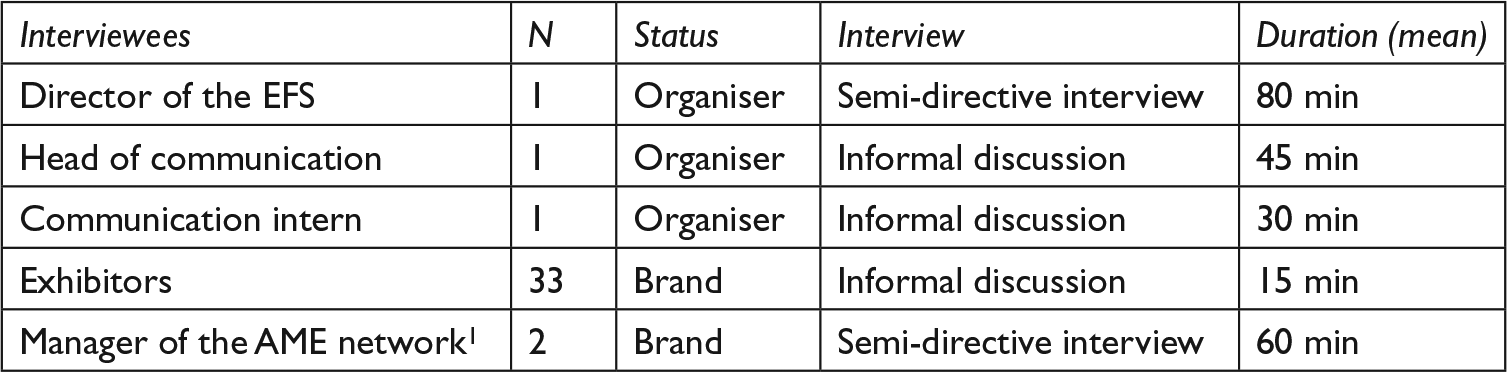
Presentation of interviews.
Texts
One major methodological challenge was to connect the visuals produced at the EFS to the main concerns of ethical fashion. A total of 609 press articles were collected to study the general issues facing the market and follow the circulation of inscriptions beyond the frontiers of the EFS. Of these, 156 relate specifically to the EFS. The search was limited to French newspapers in the Factiva database and involved the following keywords in the bodies of text: ‘Ethical Fashion Show’, variants of the term ‘ethical fashion’ and the exhibitors’ brand names. The press reviews available on the EFS and exhibitors’ websites completed the corpus.
Data analysis
Two analytical phases served to progress from a mass of data to a structured description of visual performativity. The first used a discursive analysis to identify the issues facing the market, while the second analysed the way in which visuals cope with these issues and thereby perform the market.
The problematisation phase
The first phase involved exploring the main issues in ethical fashion. The analysis mainly focused on interviews, press articles and documents produced by the EFS. It was conducted using Prospero, which is a textual analysis software designed for the study of controversial situations (Boltanski and Chiapello, 1999). The analysis followed the procedure suggested by one of the sociologists who developed the software (Chateauraynaud, 2003). First, all the words in the corpus were coded based on type (verb, noun, adjective or adverb) and category of meaning. Second, the analysis focused on how the actors concerned combine categories in sentences or paragraphs in order to detect typical configurations. Third, these configurations were used to identify the main controversial issues on the market. They include perceptions of price, uncertainty over the ethical dimension of goods, brand legitimacy, the clash between conflicting values, the categorisation of the market and the image of ethical clothes.
The visual phase
The second phase involved analysing the visuals in light of the controversial issues identified previously. Many iterations between texts, interviews, field notes and visual data led to the observation that visuals relate to three main issues: (1) defining the category, (2) making compromises between conflicting principles and (3) staging ethical fashion. The analysis therefore focused on these practices by developing a methodology adapted to each one. First, category studies detail the content of categories. They explain that categories are based on labels (Navis and Glynn, 2010), definitions (Carroll and Swaminathan, 2000), prototypes (Mervis and Rosch, 1981), boundary work (Lamont and Molnár, 2002) and typologies (Pollock and D’Adderio, 2012). The analysis therefore focused on how these categorical elements were inscribed in visuals. Second, sociologists and management scholars study compromises by highlighting the presence of conflicting themes in a single discourse (Patriotta et al., 2011; Reinecke, 2010; Taupin, 2012). These themes encompass a wide repertory of values, symbols, people and objects (Boltanski and Thévenot, 1991). The analysis therefore concentrates on the association of entities belonging to different universes of meaning (especially ethics and aesthetics). Third, the theatrical metaphor developed by Goffman (1959, 1986) provides a rich vocabulary to depict the staging of ethical fashion (Skov et al., 2009). In particular, this meant paying attention to actors, assistants, settings, costumes, stages and backstage. This repertory provided the guidelines for analysing pictures, videos and field notes.
Categorising ethical fashion
By connecting the practices involved in the EFS to the general issues concerning the market, the article reveals that ethical fashion faces three of the traditional problems that affect nascent categories (Durand and Khaire, 2017). It suffers from uncertainty over its definition, has to reconcile conflicting valuation principles, and must acquire legitimacy. This section therefore explains how the EFS’ organisers and participants produce and appropriate visual inscriptions to define the category, construct compromises between ethics and aesthetics, and stage a fashionable image of ethical fashion.
The EFS as a mirror: visualising the category’s definition
The analysis of texts and interviews highlights controversies over the definition of ethical fashion and who its legitimate members are. This is clear from the lexical fields of argumentation and criticism (Blanchet, 2017), which at once differentiate between this category and conventional fashion and establish its internal definition. At a visual level, these practices are about producing a miniature of the market that, just like a mirror, offers a visual inscription through which actors observe one another and, subsequently, position themselves. The making of this categorical mirror needs to frame the affiliated organisations within a visual space, where they are assembled to produce a visual inscription of the category that can circulate across the market.
Framing
To produce a visual representation of the market, the EFS’ organisers select exhibitors based on strict criteria. In particular, they use an ethical questionnaire to identify the members of the category in the trade fair, while excluding outsiders. Using 33 questions, they evaluate brands based on their social and environmental commitments and efforts to preserve traditional skills. Exhibitors have to prove that they work with marginalised partners, contribute to local development, limit pollution, pay a fair price and promote traditional techniques or materials. In addition, they must provide samples of their collections to demonstrate the aesthetic qualities of their products. Ultimately, the questionnaire achieves three things. It defines the category’s founding principles, it controls its frontiers by testing whether brands comply with them and, by playing with presence and absence, it establishes a visual divide that makes members of the category conspicuously visible in the fair’s showroom, catalogues, parades and website, while outsiders remain invisible.
Assemblage
The EFS’ organisers use several visual inscriptions to make explicit the internal organisation of the category. The first of these are logos, which serve three categorical functions. First, they define the subcategories of ethical fashion. The logos represent a weighing scales for fair trade, a ball of yarn for the use of natural materials, two intertwined arrows for recycling, a hand and a needle for respect for craft skills, two hands coming together for social projects and the letters ‘bio’ for the use of organic materials. Captions accompany the logos, detailing the six ethical commitments. The text thus overcomes the ambiguity of visuals by setting definitions and criteria for membership (Figure 2). Second, the logos also identify the members of each subcategory. Each exhibitor is associated with at least one logo, but many are related to several logos. Third, the logos are clearly visible on stands, in fair catalogues and press releases, thus giving the category a public presence. They introduce a clear boundary between labelled ethical fashion brands and those that do not belong to the category.
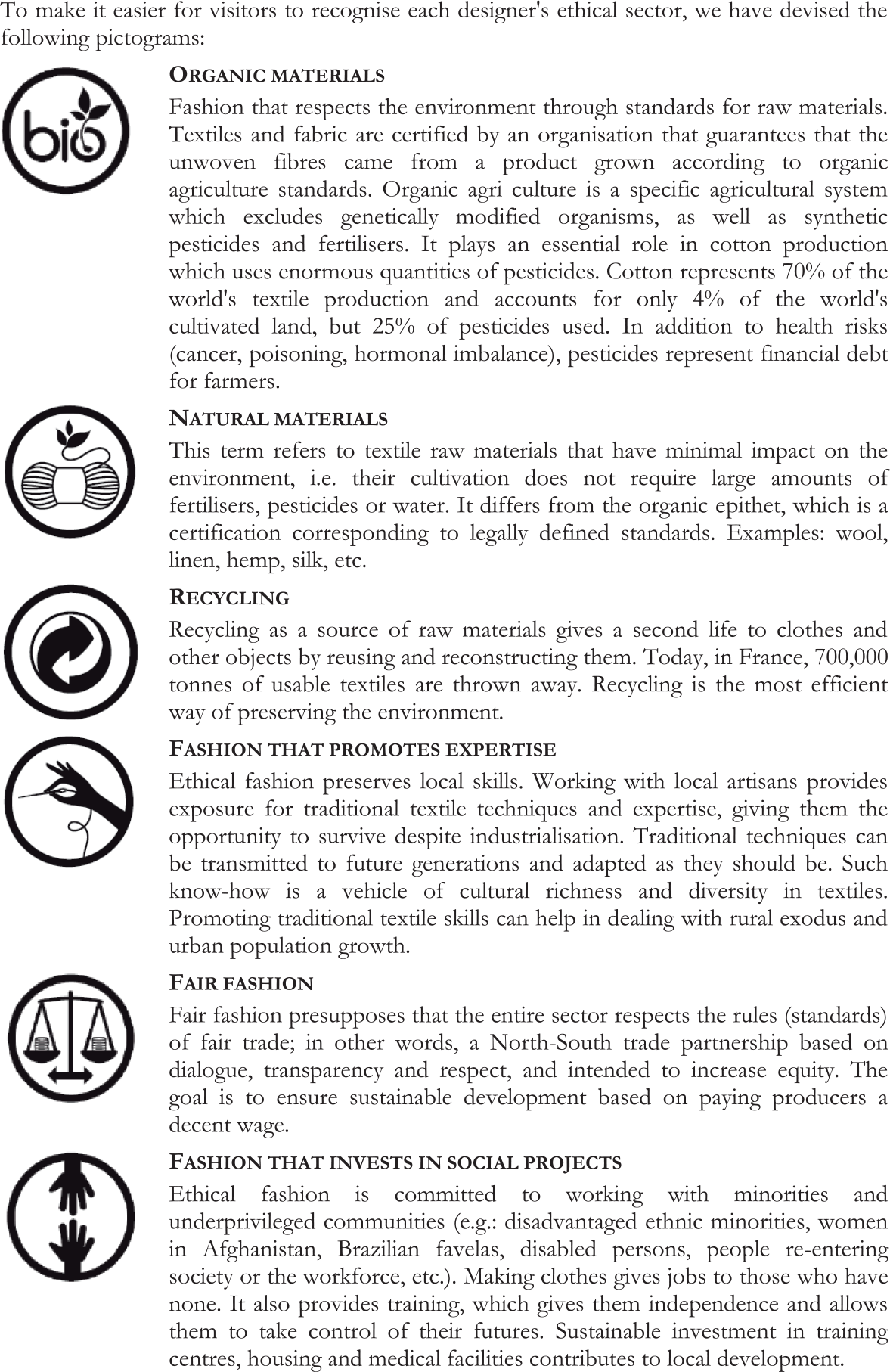
Logos categorising the ethical fashion.
Lists are the second type of visual inscriptions used to categorise the market. They are made up of words, but the visualisation to which they give rise matters at least as much as the text itself (Goody, 1977). The fair’s catalogue presents the list on opposite pages, so that a mere glance is sufficient to view the four segments of ethical fashion (Figure 3). Four aspects are important in the categorisation process here. First of all, the list contains few sentences (apart from definitions of each niche), but instead provides the exhibitors’ brand names. This serves to identify the category’s legitimate members. Second, the list is broken down into four sub-lists, each one associated with a label (‘For Nature by Nature’, ‘Precious skills’, ‘Re-life’, and ‘Made with love’) and a definition. It thus draws boundaries between the different subcategories of ethical fashion. Third, the combinatory rules of the list mean that no one brand can belong to several segments at once. In this way, the list classifies the members of ethical fashion in their appropriate subcategory. Fourth, the sub-lists draw a distinction between their members. The first few are set apart by their font (bold) and by a number connected to a photograph. These brands are therefore depicted as prototypes within their category. In short, the lists visually arrange the market players by producing calculated associations and dissociations. Whether one is forced to place one word in front of another, whether words are left aligned or read from top to bottom, written in large or small font, in
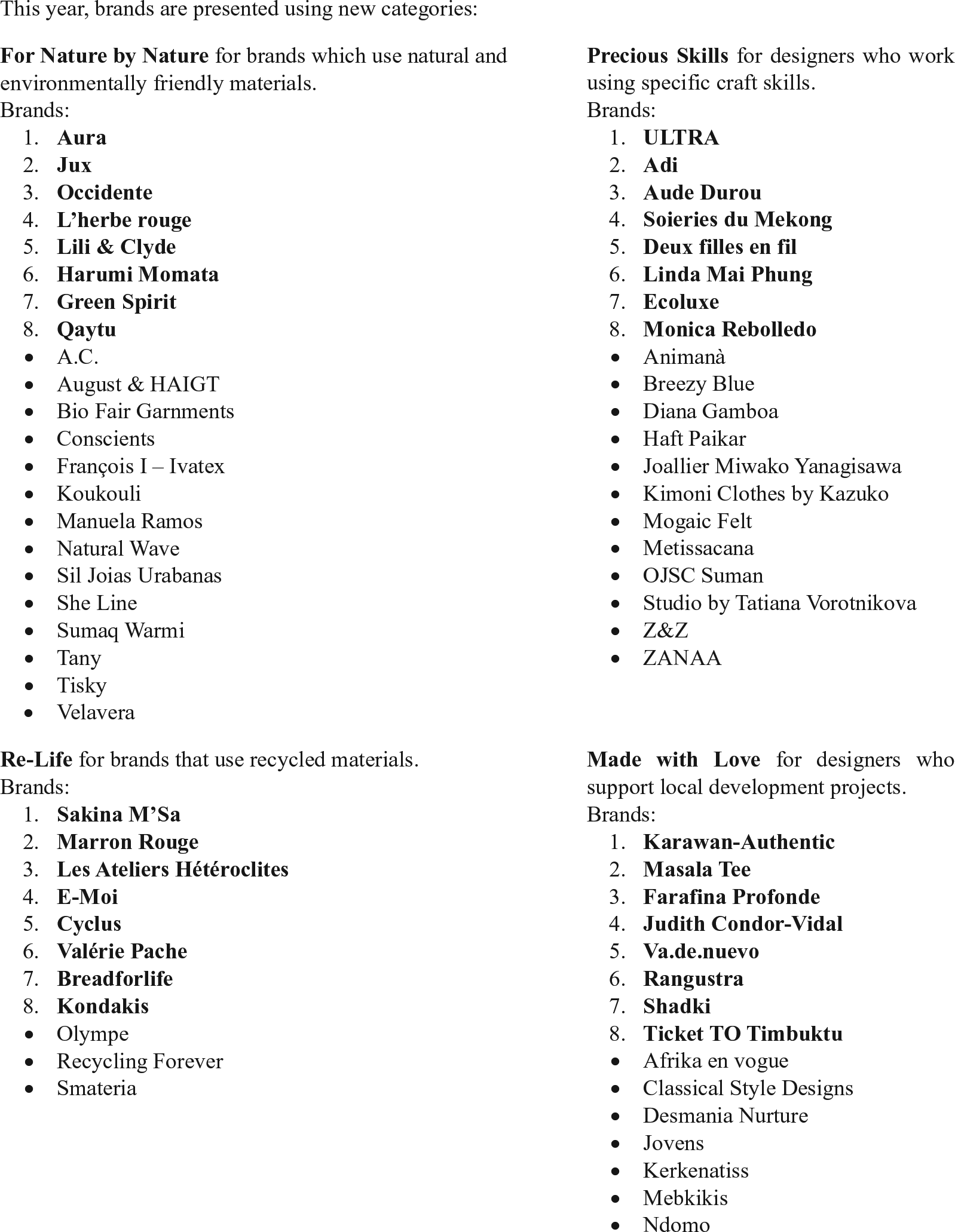
List of exhibitors—2011.
Space is the third device involved in the categorisation process. Categorisation takes place through the spatial distribution chosen for the trade fair itself. It clearly appears on the fair’s maps (Figure 4). The location of each stand is indicated by coordinates as part of a geometric space. As these points are connected, new divisions are revealed. First, three groups are formed based on affiliation to a network. In the south-east, one finds the Peru Moda brands (D02, D04, E02, E03, E04, E07, F03, F05); just above them, those of Source West Africa (E06, E08, F07, F07bis, F09, F09bis); and to the west, those of Origin Africa (B08, B12, C11, C13). These three networks are based in either Africa or Peru, and their brands promote the craft skills of these regions. Their boundaries represent an ‘ethnic’ brand segment. Second, groups are formed based on brand offers. In the north, one finds fashion accessories (A02, C13, D02, D10, D11, D12, D14, E06, E10, E12, F11, F12, F13), and in the west and centre, there is a sort of progression from casual (A02, A06, B02, B03, B04, B06) to more ethnic prêt-à-porter (C02, C07, D11).
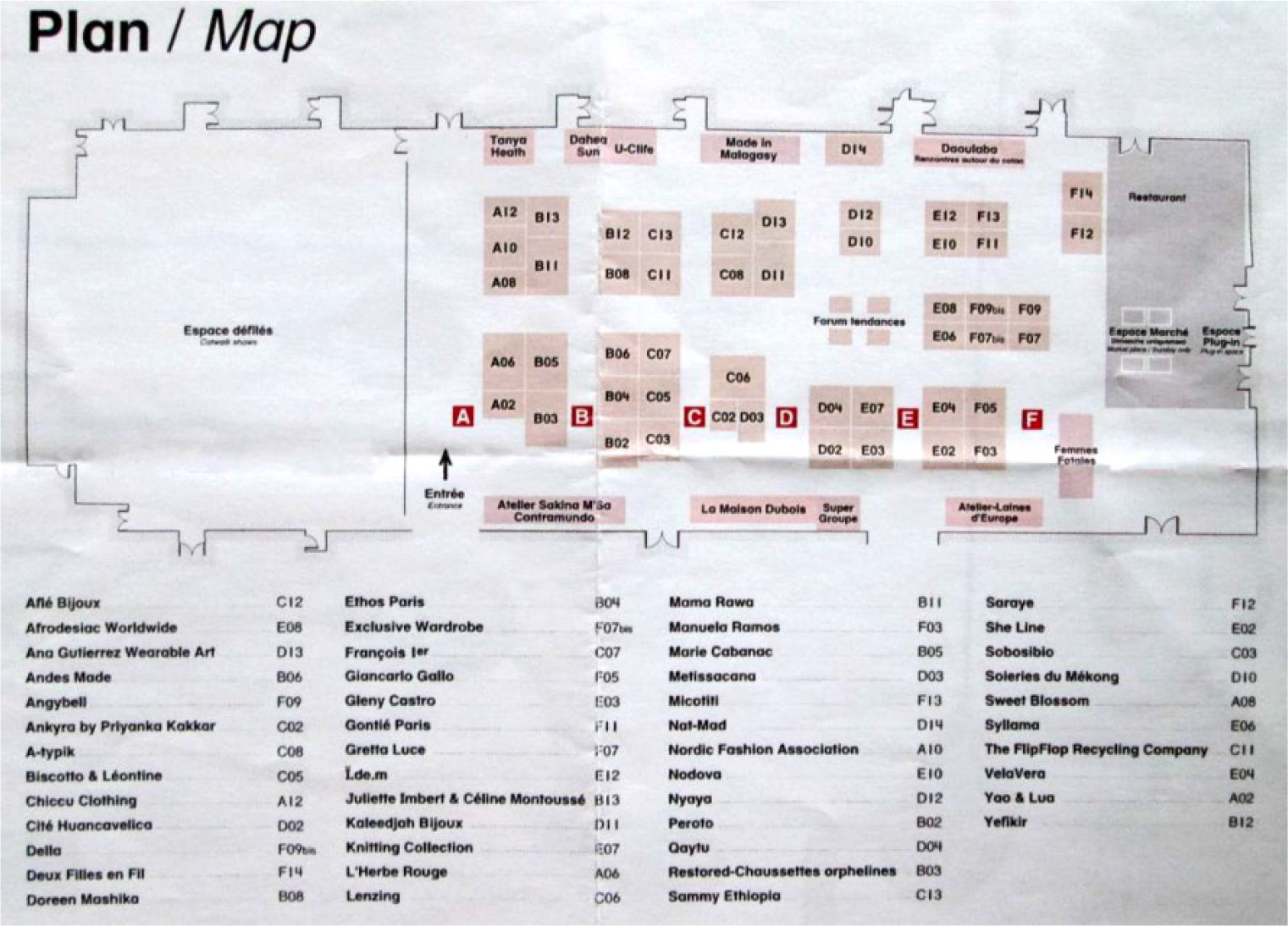
Map of the Ethical Fashion Show (September 2012).
Inscription
Logos, lists and space produce multiple visual inscriptions that reflect ethical fashion. All of them serve analogous functions: visuals separate ethical fashion from other categories and assemble brands to define its subcategories. However, these operations give rise to competing categories. These are grounded in the material dimension of visuals and, in particular, the ways to label brands, write a list or spatially arrange stands. Logos categorise the market in respect of ethical practices, while lists do so through the use of products and space, mostly based on their origins. These categorical principles directly refer to the multiple principles involved in ethical fashion. Superimposed in this way, the inscriptions produce a multi-layered categorisation that reveals the plasticity of markets. This makes it clear that categories do not register a pre-existing state of affairs, but rather give order to the market by representing it.
Appropriation
Market participants appropriate the visual inscriptions of the category to position their brand or change the representation of the market. The first mode of appropriation leads to categorisation as a way to dissociate subcategories from one another. For example, one exhibitor expressed regret that ethical fashion was not more aesthetic and less ethnic. He pointed to a visual boundary to support his argument: ‘just look at what’s going on over there [at the end of the hall] and you’ll see what I mean’. He was not referring to a single brand but rather pointing to an entire region, which represented South American brands and their fashion items inspired by traditional costumes. By doing so, the exhibitor rejected one subcategory to reinforce its affiliation to another.
The second mode of appropriation concerns the association of brands within a category. For instance, one exhibitor explained that she was unhappy that her stand was right next to a brand that offered the same type of products. The resemblance, she said, was all too clear to visitors, who saw the two brands as blending into one. While the previous exhibitor was highlighting the heterogeneity of the segments, this lady was criticising the excessive homogeneity of her segment.
The third mode of appropriation involves using the visual inscription of the category to transform the image of the whole category. In a press article, the EFS director explains,
Prêt-à-porter, designer brands, casual streetwear, sportswear and also kidswear and accessories are the new product segments on display at this year’s Ethical Fashion Show. This gives visitors a clearer offer, presented according to product categories, in contrast to previous years, when the categorisation emphasised the materials used (natural, environmentally friendly and recycled), craft skills and local development projects. […] ‘The offer has become increasingly diverse, and buyers don’t have much time to make their purchases. So we have chosen a segmentation based on product categories in order to facilitate their task and improve brand visibility’.
Here, we can see that the EFS’ organisers use visuals (through space and maps) to modify and communicate the way they categorise ethical fashion. In particular, they appropriate the traditional segments of mainstream fashion to make the subcategories of ethical fashion clearer and fashionable.
The EFS as a showroom: visualising compromises
The interview and textual analysis reveals that ethical fashion faces paradoxical tensions. It denounces the unethical practices of mainstream brands, but at the same time aims to produce fashionable clothes. Moreover, it promotes responsible practices inspired by sustainable development, while denouncing the clichéd Peruvian poncho associated with ethical clothes. Hence, to prove their affiliation to the category, exhibitors must reach compromises between ethics and aesthetics, but also criticise some aspects of these principles. The showroom is a key visual device with which to build compromises. The stands enable exhibitors to connect brands with their public, stage fashion collections and display their ethical and aesthetic qualities. They do so by framing, assembling and stabilising entities in a visual inscription that actors may then appropriate.
Framing
Stands frame three types of entities, which make the aesthetic and ethical engagements of brands visible. First of all, they exhibit the real actors of the category by displaying fashion items like clothes, shoes, jewellery and accessories. These objects present the current and future collections of the brand, which have to comply with the principles of the category. Visitors may inspect the cut, colour and motifs of clothes to appreciate their aesthetic quality, but they need additional information to assess their ethical quality. To overcome this problem, other entities give voice to the silent products. Some are human spokespersons like brand directors, designers and employees. They greet visitors by telling them the history of the brand, presenting the partners involved upstream in the supply chain and laying out their ethical commitments. Most of these spokespersons wear their own collections to communicate with visitors. For example, a green dress adorning a mannequin is also worn by the female representatives of Sobossibio, and the same silk scarf hanging on a wardrobe also hangs around the neck of a representative of Soieries du Mékong. Thus, clothes are strategically manipulated to provide visual information on how the clothes are to be worn. Other spokespersons are non-human. Posters recount the brand’s history, glossy catalogues present collections, and quality indicators (like labels, certificates, and awards) proudly praise the ethical quality of exhibited items. Finally, the third type of entity serves to accentuate accessories and clothing. For example, mannequins are used to emphasise the quality of tailoring, jewellery racks to display plant-based ivory ornaments, black busts to accentuate glass necklaces, and lamps to illuminate items or highlight subtle colours. These objects visually dramatise the representation. While the first two entities act on stage, the third one is supposed to remain out of frame (Goffman, 1986).
Assemblage
Exhibitors assemble entities to build compromises between ethics and aesthetics. To do so, they deploy three visual strategies. The first involves telling visual stories to ensure the consistency of visible entities. The plot is usually structured around the different stages of the production process. Several brands highlight the transformation of materials used to create fashion items. For example, the Flip Flop Company uses recycled rubber to create jewellery, bags and decorative objects. Therefore, alongside these items, the exhibitors display some of the flip-flops made from recycled raw materials. Similarly, Gontié Paris salvages Coca-Cola bottles to create glass bead jewels, and the exhibitor displays the bottles next to the brand’s fashion items. In each case, the visual story emphasises the brand’s environmental concerns by showing the transformation of polluting waste into fashion articles (Figure 5).
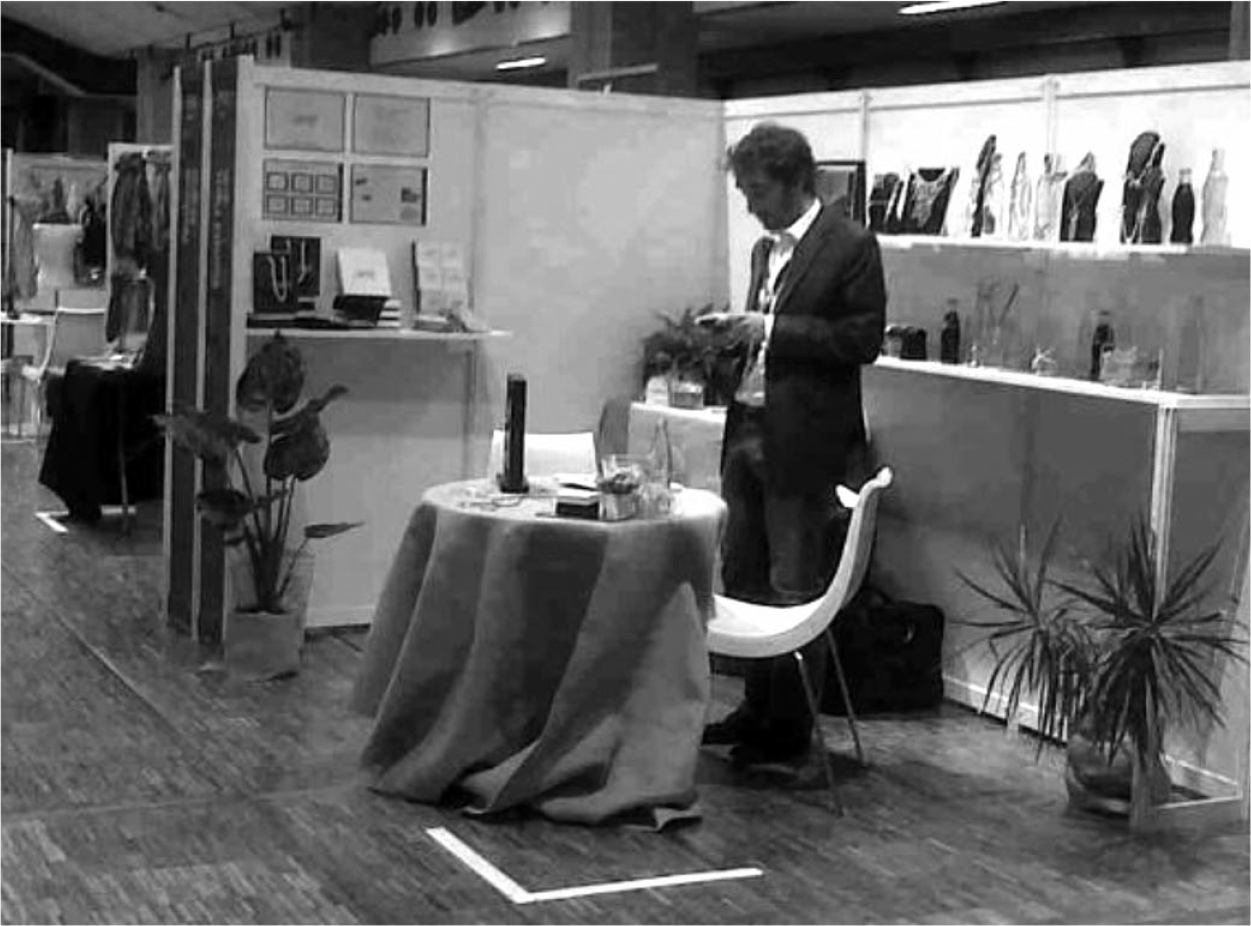
The stand of Gontié Paris.
Another common visual technique is to establish the links between local communities, producers and creators. For instance, posters are used by A-Typik to put faces on the women who craft its jewellery, the children of the orphanage supported by the brand and the creators visiting its southern partners. Such a story emphasises the social commitment of the brand and promotes the traditional techniques used to produce its fashion items.
Another strategy is to build compromises by playing on visibility and invisibility. This contrasts the ethical fashion brands present at the EFS with the mainstream fashion brands absent from the fair. For example, L’Herbe Rouge enmeshes two discourses. One emphasises the social and creative approach of the brand. The designer explains that ‘L’Herbe Rouge has created an urban and poetic style with a contemporary design in which true aesthetics combine beauty, quality, ethics and ecology at a price that is both fair and affordable’. According to her, the artistic commitment visually appears in the catalogue, whose photos are the work of an artist who ‘has worked with the greatest’ and ‘is engaged in a study of light’. The other discourse denounces the practices of fast fashion, criticises H&M and Zara, and cites studies by the Clean Clothes Campaign and Greenpeace to support the arguments made. Such criticisms only target brands that are absent from the showroom.
These strategies raise an important problem. Most informants point to the conflicts between ethical and aesthetic principles. For instance, the manager of an ethical fashion network observes that ‘to speak of fair trade is not acceptable in fashion. It evokes images of Peruvian ponchos that have stuck with us and we struggle to leave behind’. In the same vein, the EFS directors, journalists and fashion designers stress that the promotion of ethical commitments may undermine the glamour of fashion. Exhibitors use a third strategy to overcome this paradox: articulating multiple visual spaces to compartmentalise the conflicting terms (Poole and Van de Ven, 1989). Andes Made deploys such a strategy:
The ethical side of things can act as an obstacle, a small burden. What happens nowadays is that we don’t communicate about the ethical side of things. […] We don’t impose it, but we try to push it forward. Each item is signed; we have the name and a photo of the weaver who made the scarf, and on our website you will find a short video about her. It’s an original touch that provides a link to the question ‘what goes on over there?’ People take an interest in that, but only if they want to.
Here, the brand establishes a visual chain connecting the consumer to the weaver via the fashion item and signed label, the website and video clip. There is no obligation to follow these links and thereby perceive the conflicting principles. But those who do discover a series of shifts through different visuals which, once interconnected, reveal the social and cultural commitment of the brand.
Inscription
The showroom inscribes the compromises between ethics and aesthetics in many visuals. These offer a specific visual ‘atmosphere’ (Biehl-Missal, 2013) connoting the brand’s positioning. More importantly, they open a window through which to contemplate the entire supply chain from the raw materials, manufacturing techniques and conditions of production to the final fashion item. This visual inscription does not merely reveal unknown information or solve the problem of information asymmetry (as an economist might believe). The information did not exist before its inscription, but is in fact the achievement of the assemblage that brings together different qualities.
Appropriation
Visitors appropriate visual inscriptions by putting them on trial. They test them in different ways depending on whether they are assessing the aesthetic or ethical quality of goods. In the first case, their senses are often central to their enquiry. Visitors can try items and use their sight and touch to see how they suit them. Some try on the clothes or fashion accessories, then look at themselves in a mirror to appreciate the cut or style of the items. The initiative to test a product may also come from the exhibitors, who, as a sign of good faith, sometimes encourage visitors to examine their products up close. Thus, while lambasting fast fashion and its products, which become faded, misshapen and torn almost as soon as you have bought them, and contrasting this throwaway approach with that of ethical and high-quality fashion, the L’Herbe Rouge exhibitor invites visitors to come and see and touch the products to appreciate both their strength and softness. At another stand, one textile manufacturer backs up his sales pitch by encouraging visitors to feel the products for themselves: ‘Come and feel this denim fabric! It is absolutely incredible. The finest denim you will find anywhere. And of course much better than the finest brand of jeans’.
Although the asymmetry of information makes it more difficult for consumers, professional buyers and journalists to assess first-hand the ethical quality of goods, this limitation does not seem to dent their confidence. Only four of the 156 articles dedicated to the EFS emphasise the absence of consensual labels, moderate the impact of ethical fashion or call into question the sincerity of exhibitors. Others spread the message of the EFS’ organisers and exhibitors.
The EFS as a theatre: the visual staging of the category
The interview and textual analysis reveals that ethical fashion is a stigmatised category. It suffers from a negative image associated with poorly tailored, old-fashioned and ‘crunchy granola’ clothes. This stigma is embodied in the stereotype of the Peruvian poncho. In 2004, the EFS explained that ‘a lot of people reduce this sector to Peruvian ponchos and woolly hats’. This view is largely covered by the press, which in the early 2010s commented that ‘“ethnic” and “responsible” clothes need to leave behind them the “crunchy granola” and even “organic bourgeois hippy” image, get with the times and start attracting buyers’. This was what was needed to extend ethical fashion beyond a militant niche. Therefore, to break with the stigma, actors set about creating an ideal representation of the category, which at once appropriates and breaks with the conventions of mainstream fashion. To do so, they transform the fair into a theatrical space, where decor and carefully orchestrated sketches stage the aesthetic quality of the category (van Marrewijk and Broos, 2012). Fashion parades are the climax of this representation. Organisers maintain that they are the best windows to prove that fashion can be at once trendy and responsible, while visitors appreciate these events to the point of deserting the other spaces at the fair to attend the show. During the fashion parades, the dramatisation of the category needs to frame diverse entities into a visual scene, where the category is staged to produce a visual inscription, which can then circulate across the market.
Framing
Fashion parades are devices which transport entities onto the stage to produce an ideal representation of the market. Just like stands, they involve actors promoting ethical fashion, representatives conveying meaning and assistants staging the mise-en-scène. One tends to think that it is the models who are on display and that they are dressed in the designers’ pieces. In fact, the reverse is true. On the catwalk, the only real actors are the objects: they attract all of the audience’s attention, and for them, the models are no more than vehicles. So when a model walks on stage, the screen immediately displays not her name but that of the brand and the article on display. The information follows the ‘directional track’ and, by connecting the action (the parade) to an identity (the brand and specific item), removes all ambiguity from the representation (Goffman, 1986).
The models serve the objects entirely. First of all, they offer their body to the object, enable it to move around, to be held up to the light and displayed from every angle. In addition, models are professionals of the facade (Goffman, 1959), recruited for their expertise and mastery of presentation (Skov et al., 2009). They are trained to perform each and every movement (and non-movement) required on the catwalk. Their selection and training ensure that they correspond to the contemporary canons of beauty (Godart and Mears, 2009). Moreover, backstage, assistants devote themselves to perfecting the models’ appearance. From hairstyles to make up and clothing, everything is controlled. Finally, the models provide a commentary on each object and exaggerate its meaning. They inform onlookers about the values of each item (mixed-race models are used for fashion ‘from the four corners of the globe’) and unveil the history of the pieces they wear (a model bearing tribal tattoos suggests respect for traditions, while grass, leaves or a rose in her hair suggests respect for nature (Figure 6)).
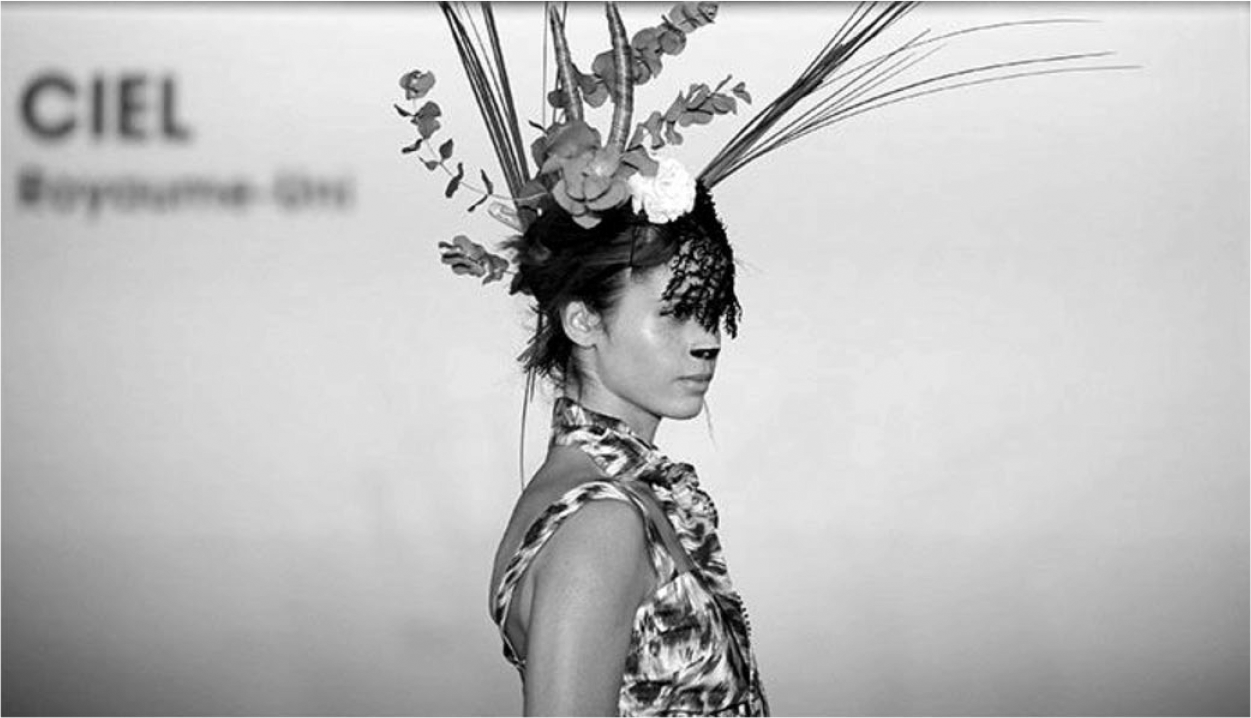
A model displaying flowers in her hair.
Parades add further artifices to this staging. Occasionally, the screen displays an image that is evocative of nature (woodland, a butterfly, the sea and waves). Music is also used as an accompaniment. Ethnic styles are combined with electro-tribal melodies and the rhythm of bongo drums; casual styles suit R&B riffs or refrains from rap songs; glamorous or chic fashion calls for jazzy music or an electronic composition using gimmicks sensually whispered by a woman: ‘O my Lord! It’s like a dream’. Music thus accentuates the drama of the fashion parade (Goffman, 1986): ethical fashion is not simply glamorous, but glamorously glamorous; it is not simply ethnic, but authentically ethnic.
Assemblage
Organisers and exhibitors stage fashion parades at once to appropriate and differentiate themselves from mainstream fashion. Parades thus follow one of two ‘routines’ (Goffman, 1959), either the stereotypical routine of the conventional catwalk (for a description, see Skov et al., 2009), or an atypical routine which takes certain liberties in departing from the former. In the first, the models walk at a steady pace with economic movements, head held high, shoulders upright, with a steady gaze and one hand in their pocket or on the lapel of their collar. The traditional sequence, which lasts on average 30 seconds, is as follows: (1) the model walks on stage, (2) stops to pose before the screen, (3) carries on walking, (4) poses again at the end of the catwalk, (5) turns around and walks back up the catwalk, (6) poses one more time before the screen (7) and walks offstage. It is rare to see more than two models on the catwalk at any one time, and their choreography is generally regulated to ensure that they pass one another just as one is swaying her hips and the other is posing. Most of the time, only one model is moving, and so the public’s attention is focused on only one element.
The second routine is peppered with eccentricities. In 2009, the models strutted about, danced and cavorted on the steps of a twin staircase. Their movements followed the rhythm of energetic rock, funk, pop and R&B music. In 2011, the fashion parade was introduced by two rappers who sang about a world of fairness and solidarity. During the parade, models tap danced and offered the audience a few tribal dance moves. In 2012, they scurried around, stood on one leg, bickered with one another, made up, played to the audience and blew them a kiss. During another parade, a film was shown in which some of the designer Giancarlo Gallo’s pieces were being made. The short film was set against the backdrop of the high plateaux of Peru, and showed women sewing who shared their experience of fair trade before finally coming together in solidarity to chant traditional songs.
From an analytical perspective, the assemblage follows a threefold modalisation (Goffman, 1986). In the first, the fashion items are presented. In the second, the presentation imitates that of conventional fashion parades. In the third, the models play out these conventional parades ironically, thereby distancing themselves from the previous frame. The EFS makes strategic use of this modalisation. The press kit states,
The show combines tailoring, designer and conventional prêt-à-porter, while at the same time drawing on the dynamism of urban culture: this offers a successful mix of genres that is also appreciated as the event’s trademark signature.
The EFS director sums up: ‘the idea is always to attract people. And also to be a bit different’. Thus, the EFS’ organisers and participants both appropriate and differentiate themselves from conventional fashion.
Inscription
Fashion parades are situated interactions, so that their mise-en-scène is dissolved as soon as the show is over (Goffman, 1959). In order for it to extend beyond the ephemeral time and space of the event, the organisers introduce a new form of modalisation (Goffman, 1986) that is inscribed in another visual device. The catwalk and the trade fair more generally are used as objects for a new dramatisation. Immortalised in video clips, photos and press releases, they can be seen by anyone at any time in any place. For example, video recordings of between 5 and 20 minutes capture the highlights of the event and are played again and again at cocktail receptions, fashion parades, exhibitions or conferences. The main roles in videos are played by three different entities. First, the recordings redeploy all of the iconic symbols of the fashion world: cocktails for VIPs, champagne, guests with eccentric outfits and hairstyles, the Louvre Pyramid, camera flashes, applauding audiences next to the catwalk, the models and the fashion items themselves. The products benefit from close-up shots, shown hanging from a stand or being worn by a model. Second, the exhibitors act as spokespersons for their products. They put them into words, emphasising their ethical commitments (‘This design is typical of Ethiopia and is entirely hand-woven’), their qualities (‘These are highly feminine items’) and the positions they have adopted (‘I feel it is essential for fashion to be ethical’). Third, the organisers praise their own event, savouring its success and reasserting its role: ‘We want to place ethical fashion under the spotlight’.
Appropriation
Visual inscriptions travel across the market to diffuse an ideal representation of the category. The discursive analysis attests to their impact: fashion parades are mentioned 151 times in 84 of the 156 texts dedicated to the EFS. Although some articles only inform readers that the fair organises fashion parades, others use the event to destigmatise the category. Strategies involve praising the compromises between ethics and aesthetics, making positive comparisons with conventional fashion parades and, for online press articles, proposing Internet links to the videos of the show (Figure 7). This way, actors use the symbolic codes of conventional fashion to promote the category: they not only maintain that ethical fashion is trendy, but put the visual proof before the eyes of their audience.
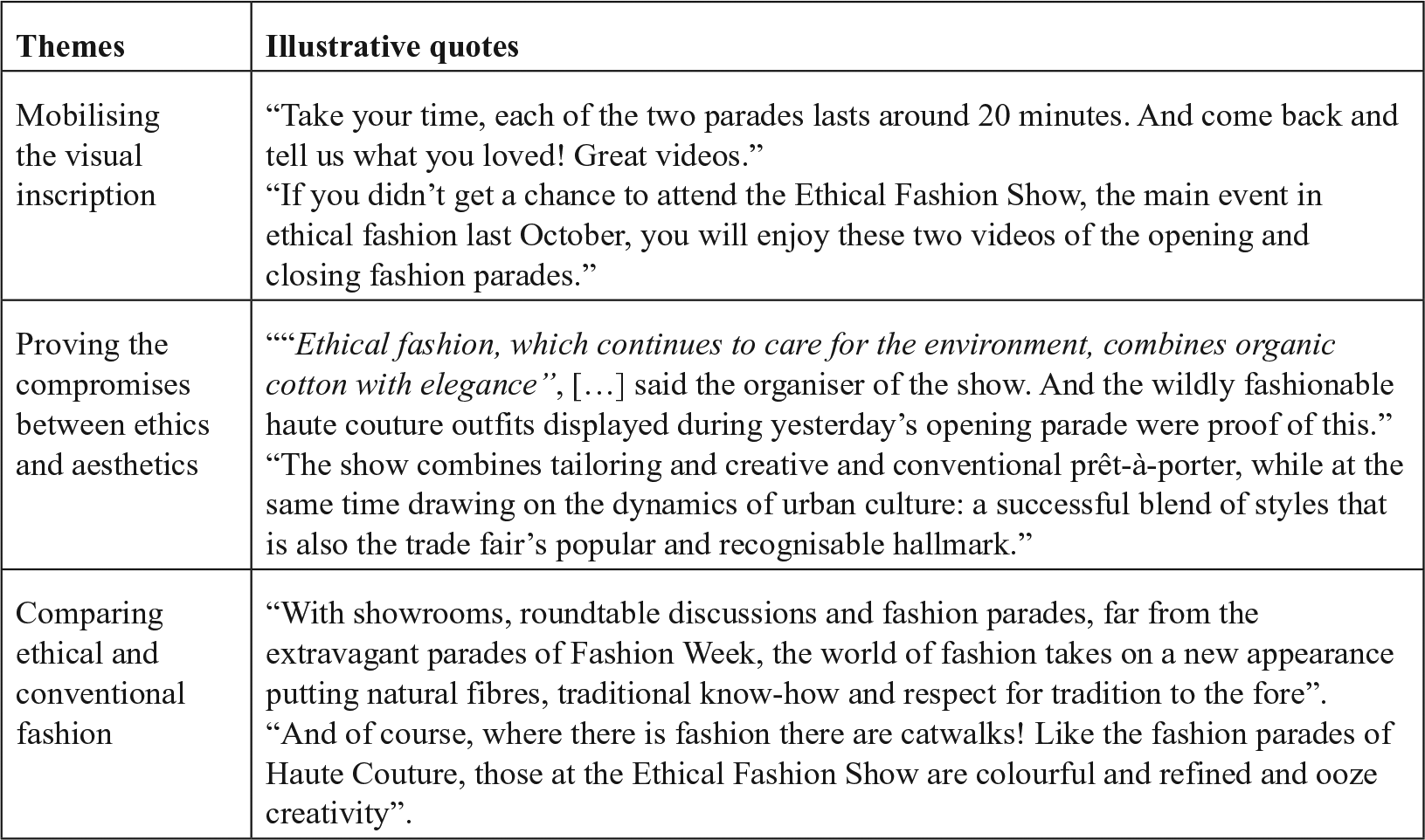
The circulation of videos across the market.
Discussion
The article has answered the call to shift analysis from the effects to the emergence of categories (Durand et al., 2017; Durand and Khaire, 2017; Kennedy and Fiss, 2013; Vergne and Wry, 2014). It does this by redefining categorisation as a translation process in which multiplicity becomes unity through visual inscriptions. Putting this theoretical shift into practice, this research analyses how actors in the EFS visually categorise ethical fashion. The fair simultaneously appears as a mirror in which participants see themselves, a showroom which builds compromises between competing principles, and a theatre where actors play out an idealised representation of the category. Common to these practices are the production and appropriation of many visuals like lists and pictures, videos and fashion parades. Far from merely recording a pre-existing state of the market, these visuals produce what they pretend to represent (Callon, 2007). The present discussion develops this performative argument by theorising the material process of performing categories and formalising three sorts of visual mediations.
The performative process of inscribing categories
Redefining categorisation as a translation renews the analysis of economic representations. Categorisation is no longer considered merely as a social construct that depends on the way actors think and talk about the market. Instead, it is defined as a construct in engineering terms (Latour, 2004), which needs concrete and tangible materials to assemble various entities into a coherent category. This article thus replaces the postulate of an ostensive world that is already there and just waiting to be interpreted with that of a world that is perpetually performed by innumerable translations (Strum and Latour, 1987). From this stance, category studies are concerned not only with the reactions that categories provoke but also the way they bring into being what they represent.
Although this issue is discussed by performative studies, the argument is often subsumed within a ‘mysterious mechanism’, which, just like the ‘Fiat lux et lux fit’ of the Old Testament, institutes the reality to which it refers through the force of the Word alone (Callon, 2007). The present article overcomes this limitation by unpacking the material process of performativity. This can be theorised as a four-stage process of inscribing the world. The first stage involves framing the entities to represent. It is based on boundary work, which excludes some entities while including others (Gieryn, 1983). This process is grounded in devices (Callon, 1998) which transport entities from their natural context to a calculative space (Latour, 1987b) that creates a visual separation between what is seen and what remains out of frame (Goffman, 1986). By organising the presence and absence of relevant entities (Bloomfield and Vurdubakis, 1997), this framing process gives rise to a certain description of the world, which shapes the actors’ preferences, expectations and decisions (Tversky and Kahneman, 1981). The second stage is about assembling the framed entities (Latour, 2004). Composing images and writing lists, arranging space and playing out social interactions step by step produces internal consistency within the various entities. This results in a shift from multiplicity to unity. The third stage is to stabilise the assembled entities in a material, tangible and observable inscription. Once objectified in this way, the inscription takes on an existence of its own, takes place in the material world and can thereby enter into a relationship with other objects or actors (Latour and Woolgar, 1979). Finally, the fourth stage involves appropriating the visual inscription of the category. The inscription thus provides a vision of the market that actors may manipulate, for example, to assess products, position a brand or promote the category.
This process is of interest in three ways. First, it unfolds the performative practices that bring something into existence. Performativity thus appears more complex than the simplistic fiat lux. In this respect, the process may help us to analyse the potential causes of performative failures (Butler, 2010) or performative struggles (Callon, 2007), which can be located in the framing of unwanted entities, the contradictions within them, the difficulty of stabilising them or the failure of their appropriation. Second, although the article has focused on visual inscriptions, the process may be extended to other materials such as literary inscriptions (Latour and Woolgar, 1979). The performative process resembles the rhetorical operations of finding (inventio) and ordering (dispositio) something to say, adding figures of speech (elocutio) and finally recording (memoria) and playing out (actio) the discourse. An attempt to work with these correspondences underlies research on the BSC (Busco and Quattrone, 2015) and accounting practices (Quattrone, 2009, 2015). Extending this to literary inscriptions could refine our understanding of what texts actually do (Cooren, 2004). Third, the performative process is sufficiently abstract to account for other market practices like risk framing (Nyberg and Wright, 2016) as well as the qualification (Karpik, 2010), valuation (Callon and Muniesa, 2005) and pricing of goods (Reinecke, 2010). It therefore has the potential to explain many facets of the construction of markets.
The visual mediations of inscriptions
The article also contributes to category, performativity and visual studies by showing that market representations cannot be separated from their material media. It thus enriches recent studies on the specificities of visuals by comparison with texts (Meyer et al., in press). Mainly drawing on the notion of affordance, these studies have highlighted how visuals specifically interact with actors to enable or constrain certain ways of thinking or acting (Alcadipani and Islam, 2017). They show that, compared to texts, visuals are more suitable for making the abstract concrete, infiltrating discourses by supporting critical mind, and enmeshing antagonistic principles (Meyer et al., in press). This especially allows actors to coordinate (Endrissat et al., 2016), resist (Alcadipani and Islam, 2017) or gain legitimacy (De Vaujany and Vaast, 2016) and support compromises in pluralistic contexts (Meyer et al., in press). The present article corroborates this research by showing that the EFS’ actors employ visuals to promote a shared definition of ethical fashion, legitimate the category by highlighting the compromises between ethics and aesthetics, and subvert mainstream fashion by co-opting its visual codes.
However, the analysis in terms of affordance postulates that visuals do not act for themselves, but merely offer the possibilities for action. Agency remains the prerogative of human actors. This article challenges this statement by showing what visuals actually do. They not only provide an image of the world that people may appropriate but also produce what they are meant to represent. The article therefore reveals the material aspects of performativity (Barad, 2003) by theorising three visual mediations through which inscriptions transform the world they represent.
Playing with scale
The first visual mediation involves modifying the dimensions of the represented entities (Latour, 1986). Many visuals engage in a play of scale, which reduces the size of the market and, in turn, increases that of its actors. This is how visual inscriptions deploy the market, although made up of many brands spread out around the world, onto the few square (centi)metres of a paper, screen or catwalk. Made to appear greater than the market in this way, actors are able to dominate it at a glance. Such a point of view enables them to see the category’s members, the relationships linking them and how best to manipulate them. Subsequently, by opening a window on remote actors, inscriptions make it possible to act from a distance (Law, 1986). The article describes this play of scale in several situations, including the representation of ethical fashion subcategories, the visualisation of the supply chain from recycled materials to the final fashion product and the dramatisation of the category.
Playing with (in)visibility
Another visual mediation is where some entities are masked and others made conspicuous. This is achieved in three ways. First, visual mediations may purify the category by hiding its undesirable entities. This relies on the framing process, which highlights the entities taken into account, while obscuring those left behind. In this respect, showing is also masking. In the case in point, such mediation results in entities perceived as dirty or unethical being swept under the carpet (for a similar example, see Morales and Lambert, 2013). It also leads to the visual partitioning between ethical and aesthetical qualities of goods, thus reducing the paradoxes between conflicting principles (for a comparable case, see Canniford and Shankar, 2012). Second, visual mediations may develop entities which would otherwise remain invisible to the naked eye. This echoes the argument that many organisational practices are concerned with making sense of the invisible and opaque rather than representing what is factually visible (Quattrone, 2015). This is all the more relevant in the case of sustainable markets insofar as actors are not able to see first-hand the ethical quality of goods. Visual inscriptions like labels or pictures of partners help to make them conspicuous. Third, visual mediations can emphasise some categorical elements in an effort to make them meaningful. This echoes marketing studies that depict how market encounters are made spectacular through communicative staging (Arnould et al., 1998) and, in particular, the exaggeration of display or the amplification of moral values (Deighton, 1992). This is especially evident in fashion parades as well as the filming and editing of video clips.
Playing with (in)(ex)teriority
The last mediation organises ubiquity. Category members may observe visual inscriptions from the outside while being a part of them at the same time. This leads to complex interactions between actors and their reflection in the mirror of the inscription. Such a mise en abyme—the observer observed through his observation—is reminiscent of the Lacanian mirror, which offers a child his first moment of recognition and structures his experience around and in relation to the reflected image. As pointed out in the case of financial markets (Knorr Cetina and Bruegger, 2002), management control (Roberts, 2005), and accountability (Quattrone, 2015), the many iterations between actors and their reflections not only constitute their identity but also lead to the exertion of control over it. This also echoes White’s (1981) approach to markets, which considers that categories are set not by firms responding to buyers’ expectations or consumers’ needs but by firms watching and imitating one another through a speculative mirror. Kennedy (2005) refines the argument by highlighting that such mutual observation is mediated by the mirror of the media, which gives producers a view of market categories, the structure of competitive rivalry and their positions in it. However, whereas these authors use the mirror as a metaphor, the article defends a literal meaning by analysing the construction of the material visual devices through which actors categorise themselves. These reflect the definition and subdivisions of the category, its members and prototypes. By doing so, visual inscriptions enable the actors’ gaze to dominate the gaze that dominates them (Latour and Hermant, 1998). Here partly resides the performativity of the mirroring inscriptions. They make the beholder believe that the reflected image, while clearly not the original, is an almost authentic copy thereof. Through this mirror play, visual inscriptions simulate the existence of a category as an external referent. Yet, in truth, in the same way that the words ‘I swear’ do not refer to anything, but rather at once constitute an utterance and an act (Austin, 1962), visual inscriptions show and enact ethical fashion in a single movement. They reflect and reflect upon ethical fashion and, in so doing, perform the category.
Conclusion
We live in a ‘culture of the eye’ (Kavanagh, 2014). One often hears of ‘world views’ or ‘points of view’. Such expressions should be considered not as metaphors but in their most literal sense. How do we see the market? How do its participants make it visible? The article has answered these questions by analysing the ways in which organisations visually categorise markets. Initiating a theoretical shift in category studies, it has redefined categorisation as a translation process assembling multiple and remote actors into a unique and coherent category. This performative process is mediated by visuals, which bring categories into being by selecting, assembling and stabilising entities in an inscription, which actors may then appropriate.
This framework answers the recent call to study the process leading to the formation of new categories (Durand and Khaire, 2017). The article thus reveals the decisive role of visual inscriptions regarding three challenges facing new categories. First, nascent categories usually suffer from high uncertainty over their definition, frontiers, legitimate members and internal classifications (Durand and Khaire, 2017). Hence, market actors have to engage in a sense-making process to reach a social agreement about their meaning (Khaire and Wadhwani, 2010; Navis and Glynn, 2010; Rosa et al., 1999). In this respect, the article shows that playing with scale and playing with (in)(ex)teriority enables brands to visualise the entire category, its subdivisions, members and prototypes. Visuals thus provide resources through which to promote collective identities or orient strategic differentiation. Second, new categories often recombine different and sometimes conflicting principles (Durand and Khaire, 2017). Such is the case in responsible markets (Reinecke, 2010) like ethical fashion (Poldner et al., 2015). The article shows that visuals help to make compromises more consistent. As Höllerer et al. (2013) point out, visuals make the abstract concrete and, because they have no predefined entry point, mask contradictions behind ambiguity. The article refines the argument by highlighting the play with (in)visibility that purifies categories while hybridising principles. Third, nascent categories have to acquire legitimacy (Durand and Khaire, 2017). Such an imperative raises a significant problem for stigmatised products (Barlow et al., in press) and organisations (Hudson and Okhuysen, 2009). In the case in point, actors use visual inscriptions to fight against the stigmatisation of ethical fashion. They use visuals to provide the public with proof that, henceforth, ethical fashion is trendy. In addition, the EFS’ organisers and exhibitors engage in visual irony by at once reproducing and distancing themselves from the codes of conventional fashion. This shows how organisations draw on the ‘symbolic repertory of an industry’ to construct new categories (Durand and Khaire, 2017). Overall, the article provides empirical insights into the theoretical assumption that visuals are involved in the process of institutionalisation (Meyer et al., in press).
This provides a fruitful framework for further research on categorisation, although a few limitations should be pointed out. First, by extending categorisation beyond its cognitive and discursive aspects, it points to the many materials involved. In addition to visual devices, future studies could explore the roles of algorithms and numbers, commensuration tools and measurement instruments in the making of categories. Second, by focusing on categorisation, the article has overlooked other important issues of market-shaping. Further research could usefully use the performative process to study, for instance, the valuation of goods. Third, by studying a single case, the article has neglected the many visuals produced outside the EFS. Future research could adopt a multisite analysis to better understand the conflict between rival inscriptions.
Footnotes
Acknowledgements
I am grateful to the anonymous reviewers and Samantha Warren for their constructive comments; Celine Berrier-Lucas, Claudine Grisard, Isabelle Huault and my colleagues at the ISG for their insightful remarks; Véronique Perret for overseeing the early stages of this research; and Myles O’Byrne for his copy-editing services.
Declaration of Conflicting Interests
The author(s) declared no potential conflicts of interest with respect to the research, authorship, and/or publication of this article.
Funding
The author(s) received no financial support for the research, authorship, and/or publication of this article.
1
Acteur de la mode éthique (AME) is a French network comprising a dozen ethical fashion brands.