




Abstract
Many studies of organizational resistance have focused on a knowing agent who intends to challenge power. In contrast, we suggest that resistance is the product of many agents of varying ontological statuses acting together. Using a study of bicycle commuting in the American Midwest (an activity that takes place at the edges of organizations), actor-network theory, and Cooren’s theory of ventriloquism, we demonstrate that resistance has a relational ontology. We show that bike commuters do not intend to resist through biking to work, decentering human action and intention in resistance. We then highlight three aspects of a relational understanding of resistance. First, bike commuting (and other resistive activity) is produced by a plenum of agencies of all ontological statuses, making resistance a hybrid activity, not limited to human agents. Second, activities of resistance and control come to have these meanings through their relationship with one another. Third, actions that come to mean resistance and control are put into conversation with each other to gain these meanings through ventriloquism. Through these arguments, we expand what can count as resistance, how resistance is produced, and who produces it, demonstrating that resistance is a relational production.
In this article, we challenge existing understandings that define resistance as an intentional activity performed by human actors. Instead, using a study on bike commuters, we show that resistance is the product of multiple human and non-human actants. That is, resistance has a relational ontology, a mode of being in which the social and material cannot be separated and in which humans never act alone. Specifically, we highlight three aspects of this relational ontology. First, we demonstrate that resistance is a hybrid production generated by a plenum of human and non-human actants. Second, resistance and control are relationally entangled and the two require each other for definition. Third, the relationship between dominant and alternative practices is ventriloquized by humans to make certain practices speak as control and others as resistance.
We develop these arguments using actor-network theory (ANT) (Latour, 2005) and the communicative constitution of organizations (CCOs) approach (Brummans et al., 2014). Empirically, we use data from a study of bike commuters in the American Midwest. We suggest that this group resists prevailing social and organizational practices through various facets of biking to work. However, this resistance is unintended. These bike commuters were not motivated to bike to work because they wanted to defy power. Rather, their actions came to communicate resistance as they existed in contrast to dominant practices. Through this association, certain activities can be made to speak as resistance and others as power. We suggest that by taking ANT (Latour, 2005) and ventriloquial (Cooren, 2010, 2012) perspectives on resistance, we can redefine resistance to understand it as the product of hybrid actants that offers an alternative to dominant practices preventing prevailing norms, meanings, and discourses from becoming entirely fixed or hegemonic.
If resistance is ‘a process through which meanings are prevented from becoming fully fixed, meanings remain open, partial, and contingent’, then in resistance different possibilities for being and living are materialized (Murphy, 1998: 504). In this way, resistance is like a foot in the door; its presence prevents closure that would be difficult to reopen, allowing space for discursive openings (Thackaberry, 2004). By challenging dominant transportation discourses and activities, bike commuters prevent these meanings from becoming absolute. Resistance is then enacted through communication as groups and individuals create meaning. We follow Mumby’s (2005) definition of resistance as an effort to engage in some form of praxis—individual or collective, routine or organized—in the context of ‘established social patterns and structures’ (including mechanisms of control), such that these patterns and structures are, at some level, dereified and their ‘identity logic’ interrogated. (p. 23)
From this, we claim that in our research context bike commuters’ actions are resistive as they present an alternative possibility for transportation that challenges the automobile as a normative vehicle as well as presenting alternative bodies and artifacts in organizational settings. Bike commuting is thus an activity that resists the ‘established social patterns and structures’ of workplace and transportation. Taking a relational ontology (the idea that agents always act with and through other agents), we suggest that bike commuters’ actions as resistance are in a constitutive relationship with mainstream social practices. That is, practices can only come to mean resistance or control because of their association with the other category of practices.
The study of bike commuters is salient to organization studies for several reasons. First, commuting happens at the ‘edges’ of organizations and in service to work, making it relevant to organizations. Second, bike commuting manifests itself within organizational spaces as a bike commuter parks her bike outside her building or carries her helmet into her office, presenting material manifestations of cycling that bridge personal and professional domains. Third, we suggest that in the American context, bike commuting is unusual and can therefore be construed as organizational resistance. Although 41% of American commutes are shorter than 5 miles, less than 1% of Americans ride bikes to work (Federal Highway Administration, 2011), making bike commuting an unusual and alternative activity in American society and workplaces. Fourth, we have argued elsewhere that bike commuters are an instance of organizing (Wilhoit and Kisselburgh, 2015). Fifth, the human/non-human hybridity of bike commuting makes it an interesting setting for studying relational ontology. Through this example, we explore organizational theory in an atypical context while making claims applicable to organizational resistance in traditional organizational domains.
Agency, resistance, and ventriloquism
Agency and relational ontology
We begin by explaining relational ontology and its implications for understanding agency and action. Agency is defined as the ability to ‘make a difference’, while action is the transformation brought about by an agency (Cooren, 2004: 374). More specifically, following ANT (Latour, 2005), we understand agency as a hybrid accomplishment achieved through the relationships between actants of any ontological status. This is a relational ontology: ‘action should be considered as always shared and/or distributed among a variety of agents with variable ontologies’ (Cooren et al., 2012: 297). Agency is not a natural human trait but an ability that emerges in association as a ‘plenum of agencies’ of humans and non-humans together construct our worlds (Cooren, 2006). There are three components to this understanding of agency: everything has agency, agency is relational, and intention is de-centered.
First, ANT holds that agency is not only a human affair but that non-humans also participate in action (Latour, 1992). To express this notion, ANT scholars prefer to call actors ‘actants’ to avoid privileging human actors, acknowledging that actors can be of any ontological status. This gives equal weight to collectives, office supplies, structural traits, texts, norms, and people as things that exert agency (Latour, 2005). One example of how non-humans exert agency is Latour’s (1992) often-cited example of the speed bump: a speed bump makes a difference in human behavior by causing drivers to slow down.
However, ‘the speed bump is ultimately not made of matter; it is full of engineers and chancellors and lawmakers, commingling their wills and their story lines with those of gravel, concrete, paint, and standard calculations’ (Latour, 1999: 190; emphasis in original). This entanglement leads to the second point that agency is never a matter of one actor, but emerges in relationships: ‘an actor is what is made to act by many others’ (Latour, 2005: 46). ANT is a ‘semiotics of materiality’ (Law, 1999: 4) or ‘sociology of associations’ (Latour, 2005: 12). Just as the relationships between words are what give an utterance meaning, the relationships among actants result in action. This means that one can never attribute activity to a single actant because action emerges from actor-networks (Latour, 2005). As a result, ANT is less concerned with actors in networks than networks as actors, a relational ontology. ANT epistemology entails tracing associations to see what emerges from these connections.
Third, because such an understanding of agency de-centers humans, ANT complicates the relationship between intention and agency (Robichaud, 2006). A frequent critique of ANT and other relational ontologies is that non-humans cannot act because they lack intention (cf. Giddens, 1984). Understanding agency in this way precludes the idea that people can act without intention. However, through a relational ontology, intention is also the product of relationships and associations, and human intention is conditioned by non-humans (Robichaud, 2006; Verbeek, 2011). Following ANT, we demonstrate that resistance also has a relational ontology and need not be limited to the realm of the single, intentional human actor.
Resistance
In contrast to this view of agency as relational and distributed, studies of resistance tend to reflect an individual, human actant who knows she is resisting and understands her activity as resistance (Wieland, 2011). Extant studies of organizational resistance have overwhelmingly focused on actants describing their acts of resistance, knowingly resisting, and identifying their actions as opposed to power (see Ashcraft, 2005; Bell and Forbes, 1994; Gossett and Kilker, 2006; Lawrence and Robinson, 2007; Murphy, 1998; Paulsen, 2015; Sotirin and Gottfried, 1999; Trethewey, 1997), even when resistance is conceptualized as everyday or routine (Prasad and Prasad, 2000). This trend is reflected in Mumby’s (2005) assertion that most studies of resistance position workers either without any real agency (even in resistance they reify power) or with ‘levels of agency and insight that sometimes stretch credulity’ (p. 38). In contrast, we propose that resistance is produced by a plenum of agencies and that the human who would often be labeled as the resistor need not intend her activity to be resistance. In the findings, we discuss three specific aspects of the relational ontology of resistance: materiality, the relationship between resistance and control, and how resistance is named as such.
First, we address materiality and resistance. Although studies of resistance often consider how bodies or other material objects are used to resist (Hollander and Einwohner, 2004), this research emphasizes humans manipulating material artifacts, giving the agency in resistance to humans. Instead, we suggest that non-humans are part of the actor-network that resists. Studies in factories that show how workers employ the material in defiance of managerial power illustrate the common understanding of material resistance (Graham, 1995; Kondo, 1990; Levidow, 1991). For example, in Burawoy’s (1979) study of how workers gamed production in a factory, employees resisted by appropriating products and parts on productive days, saving them up for a day when their output was lower.
Examples of humans manipulating materiality to resist are also present in more professional settings. Workers can resist dress codes by either taking the dress code to an extreme (Clair, 1998) or only dressing in managerially prescribed ways when there is a chance of being caught (Murphy, 1998). Workers can also reappropriate organizational space through decorating or changing space in ways that defy managerial imperatives (Bell and Forbes, 1994; Elsbach, 2003) and using spaces in ways they were not intended to be used (Turner and Norwood, 2013). Although non-humans are integral to this resistance, the resistance is understood as a solely human activity: a human manipulates and acts on materiality in order to resist. In this article, we reconceptualize resistance as not solely a human production but also a relational one in which actants of all ontologies participate.
Second, we argue that dominant practices play a role in the production of resistance. Considering the relationship between resistance and control follows the dialectical view of resistance that has become prevalent in critical and postmodern understandings of power (Mumby, 2014). This understanding, derived from Foucault (1977), refigures power as shifting and a struggle over meaning, rather than absolute and dominating (Zoller, 2014). A dialectical perspective on resistance thus emphasizes how control and resistance exist simultaneously and implicate each other. As a result, acts of resistance can sometimes function as forms of consent (e.g. Ashcraft, 2005; Clair, 1994; Ezzamel, 2001; Fleming and Spicer, 2008; Mumby, 2005).
This dialectical approach to power and resistance has been important for making organizational power more complex and has expanded what counts as resistance (Prasad and Prasad, 2000). However, this scholarship has focused on discourses (Mumby, 2005, 2014) and neglects material/symbolic relationships (Mumby, 2014; Zoller, 2014). In this article, we expand the relational understanding of resistance and control to show that dominant practices are part of the plenum of agencies that contribute to discourses or activities that emerge as resistance. That is, resistance and control do not just exist in tension with each other, but have agency in each other’s constitution.
Third, in reconceptualizing resistance, we need to address who names activities as resistance. In the case of bike commuters, the resistance is externally defined, that is, they make a difference in unintended ways (Hollander and Einwohner, 2004). Externally defined resistance (named either by researchers or an external social group) has rarely been studied (Hollander and Einwohner, 2004). We have found three exceptions. Brown (1994) suggested that the pleasure of viewing and talking about soap operas is a form of feminist resistance, even though fans often dismiss soaps as trash. Dick (2008) suggested that resistance can be unintended specifically when it takes the form of refusal by not participating in certain social structures. Wieland (2011) showed that resistance is often unobtrusive and there are many activities that can be viewed as resistance or control depending on point of view. These examples have shown that resistance does not need to be intentional. As we explicate the relational ontology of resistance, we extend externally defined resistance to demonstrate that it is far more common and naming it requires only the association of contrasts that keep certain meanings or actions from becoming fixed.
Ventriloquism
To develop a relational ontology of resistance, we use the CCO approach, particularly ventriloquism (Cooren, 2010, 2012), to understand how a plenum of agencies produce and name resistance. Much of CCO theory, particularly that of the Montréal School, builds on ANT to show that non-humans share agency in communication, organizations, and organizing (Cooren, 2004, 2006). While ANT provides a means for understanding how the associations between actants produce resistance, ventriloquism shows how these associations can speak and mean resistance.
Ventriloquism uses the metaphor of a ventriloquist and her dummy (or figure) to demonstrate how humans and non-humans speak through and to each other (Cooren, 2010). When a ventriloquist makes her figure talk, it appears that the figure itself is speaking. However, the ventriloquist animates the figure and brings it to life. At its heart, the metaphor of a ventriloquist calls to mind how actants speak and act through one another, expressing that a plenum of agencies is present in all situations (Cooren, 2006). Whomever or whatever makes a figure speak become an actant in a situation (Cooren, 2010, 2012). Although one sees a human speak or act, she is likely animated by non-humans who then share agency in the interaction. If one acts, it is because they have been acted upon, ‘even when this principal happens to be ourselves or what we perceive to be our own interests’ (Cooren, 2010: 66).
There are two ways that ventriloquism takes place. First, animation describes how other actants act upstream, providing ‘the reason(s) why we do what we do’ (Cooren, 2010: 66). For example, a stamp collector who goes to extreme lengths to obtain a rare stamp has been animated by her love of stamps (Cooren, 2010). Animation demonstrates that non-humans can participate in action and communication as they make other actants do or say something. Second, ventriloquism takes place as people mobilize other actants in their conversation (Cooren, 2010). For example, if one invokes traffic laws in a conversation as a justification for their behavior, they have made the law speak in a certain way. However, mobilization and animation also oscillate: when a ventriloquist speaks back to the figure through whom she is already speaking, the ventriloquist both mobilizes and is animated by the figure (Cooren, 2010). If one ventriloquizes a law by mobilizing it in conversation, that law will also animate one by making one defend certain ideas or positions (Cooren, 2012). Ventriloquism complicates who or what is acting in a situation as the figure (manipulated by the ventriloquist) makes the ventriloquist respond and act in certain ways.
Furthermore, Cooren (2015) has shown that through relational ontology and ventriloquism, communication can take place between things. He described a woman who told a story relating two pieces of artwork near each other in a museum. This example shows that a person can observe a relationship between things (in this case, pieces of artwork) and make them say something about their relationship. Although this connection could be entirely imaginary on the part of the human, and not intended by the artists or curators, the fact that the juxtaposition between these artworks is there, can be noticed, and made to speak means that the artifacts also contribute to the meaning found in this relationship. In this article, we build on this idea by looking at how dominant and alternative practices (composed of a plenum of agencies) can be put into conversation to say something about resistance, demonstrating how resistance is able to speak as such.
In using ventriloquism or other concepts from Montréal School CCO, it is important to mention research methods. Montréal School CCO research uses conversation analysis in order to study actual interactions and show specific instances of communicative constitution (Brummans et al., 2014). Recently, there has been some methodological divergence in CCO research (Wilhoit, 2014; Koschmann and McDonald, 2015; Jahn, 2016). Koschmann and McDonald (2015) made two arguments for using interviews and ethnography in CCO research that we follow here. First, rather than focusing on a specific interaction as most CCO scholarship does, we compile multiple episodes and accounts to make broader claims. Second, we begin with the assumptions of relational ontology and that communication constitutes organizations and then these to explain resistance in a new way. Such an approach is more appropriate for the subject of our research because we demonstrate that resistance does not emerge through a single interaction, but that it is a relational production that takes place across time, space, and actants. Additionally, for this study, conversation alone cannot represent material realities and we use video methods to see and understand bike commuters’ embodied experiences. Therefore, while the methods of this study do not align with typical ventriloquial studies, they are most appropriate for the questions we seek to answer and the empirical context we have chosen.
Methods
We chose to study bike commuters because it is a minority activity in our research context that has the potential to be made visible in organizational settings through material means. Data were collected through a three-part study of bike commuters, comprising in-depth, semi-structured interviews (n = 40), videos of commuting practices (n = 10), and follow-up interviews about the videos (n = 5). Because research investigating the material cannot rely exclusively on discursive reports, this approach allowed us to interrogate embodied and material activity. The videos of commutes captured commuters’ experiences, while the interviews represented an individual’s reflections on and descriptions of them.
The research was conducted in two adjacent Midwestern towns, Collegetown and Park City. Collegetown is home to a large public university, Central University. All participants worked and lived in these two towns. Census and population survey data on bike commuting do not exist for our research site because they are too small. However, these data are available for another university town in the same state that shares many characteristics with Collegetown and Park City. That town has 478 bike commuters out of a population of 101,168, roughly 0.5% of its population (League of American Bicyclists, 2012). These data, along with the interviews of participants and knowledge of the limited cycling infrastructure in the two cities, provide evidence that bike commuting is a minority activity. Many participants do work at Central University, and in general, universities have higher numbers of bike commuters. However, participants articulated a sense of bike commuting as unusual at the university and the estimated percentage of bike commuters is far lower than other American university towns (McKenzie and Rapino, 2011). The proportion of participants who work at Central University also reflects that Central is the biggest employer in the area.
In addition to living and working in Collegetown and Park City, participants needed to (a) have biked to work for at least a year, (b) normally bike to work at least 3 days a week, (c) ride between 0.5 and 12 miles each way, and (d) not be undergraduate students. The selection criteria were chosen to sample working adults who identified as bike commuters. Table 1 summarizes the demographic profiles of the participants. Participants were recruited through several methods. First, we used snowball sampling to solicit participation from personal contacts, as well as asking them to refer us to other bike commuters. Second, posters were hung around Central’s campus, local bike stores, gyms, the public libraries, and bike racks at other workplaces. Third, a call for participants was posted through Central University’s daily e-news.
Demographic profiles of participants with commute information.
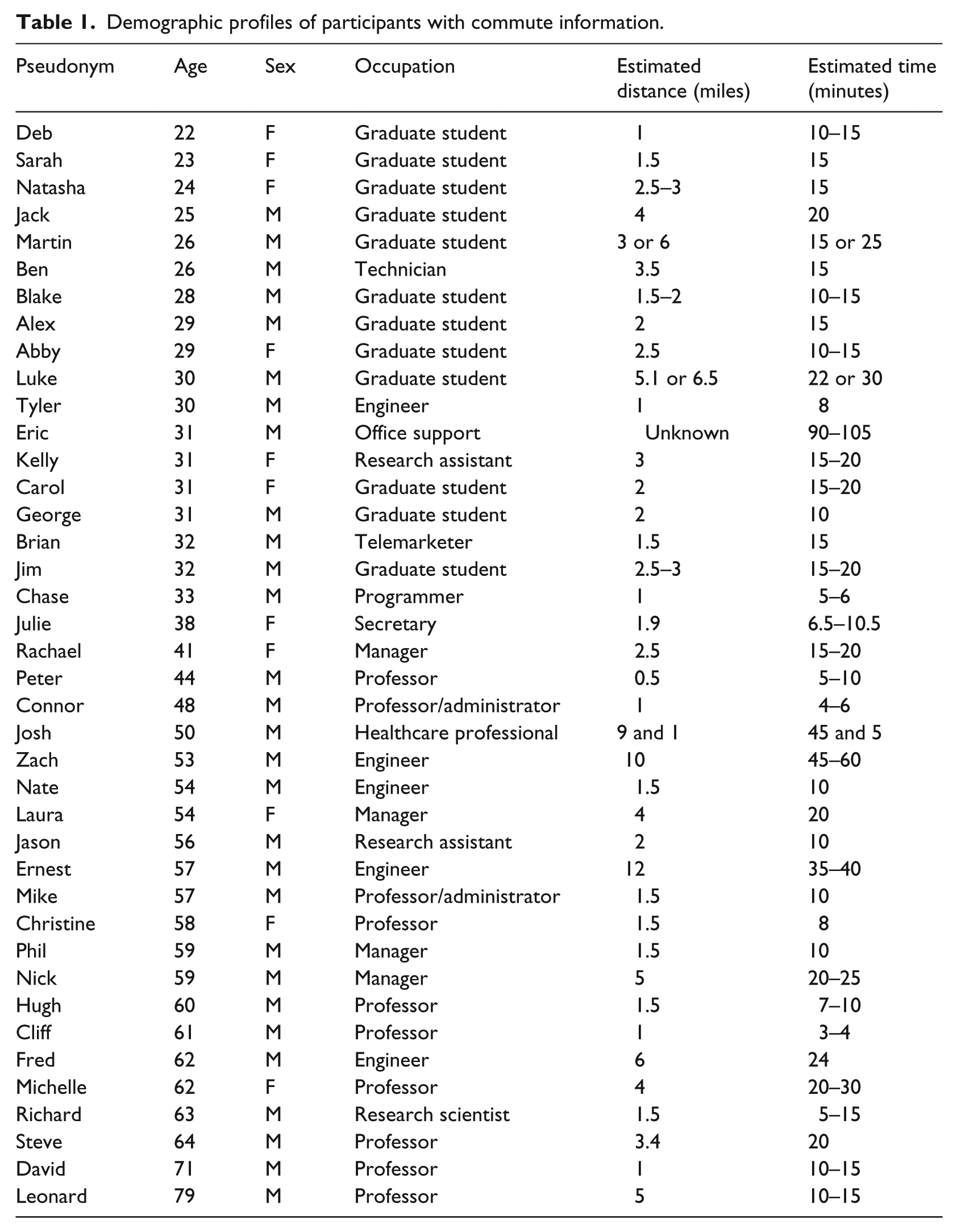
Data collection consisted of three phases. The first and largest set of data was collected through in-depth, semi-structured interviews with bike commuters. A total of 40 interviews were conducted face-to-face by the first author (E.D.W.) in a location convenient to the participant, averaging around an hour in length. The interview guide focused on eliciting a discursive account of bike commuters’ experiences. Most questions were generative (Tracy, 2013), including asking participants to describe a typical commute, explain why they commute by bike and their biking history, explain how they would act in hypothetical situations, and describe interactions with their work colleagues regarding the fact that one bikes to work. Participants were not asked explicitly about resistance. After 40 interviews, the authors were confident that saturation had been reached because the interviews no longer yielded novel information or concepts (Patton, 2002). The interviews were audio-recorded and E.D.W. transcribed the interviews, resulting in a total of 517 single-spaced pages of data.
The second stage of data collection used participant viewpoint ethnography (Wilhoit and Kisselburgh, 2016) to capture participants’ experiences of the actual commute and transition into the workplace to observe the material aspect of bike commuting. To gather these data, 5 of the 40 interview participants wore a video camera during their bike commute, on their head or helmet, to record their commute and the transitions into and out of their home and workplace on a single commuting day, both to and from work (see Wilhoit and Kisselburgh, 2015 for more detail). In total, 10 commutes were recorded, yielding 185 minutes of video data. Because the videos show participants engaged in illegal and potentially dangerous cycling practices, we do not believe that wearing the camera affected their cycling behavior.
The third phase was follow-up interviews. Before the interviews, E.D.W. reviewed both videos from a participant and selected the one that raised more questions or contained unusual moments. She then met with the participant and they watched the selected video. The participant was instructed to comment on any aspects of the video, including decisions that he or she made; the route he or she took; interactions with cars, pedestrians, and other bikers; and transitional moments into and out of home and work. The researcher asked questions during the video. Watching the videos with participants and eliciting their reflexive commentary allowed us to understand their individual experience as well as take advantage of the reflexivity offered by video methodologies (Pink, 2001). These follow-up interviews were also audio-recorded, yielding an additional 97 minutes of recorded data. Because of a recording error, one interview was only partially recorded; in this case, we relied on written notes to supplement the partial recording. Participants were compensated for participating in this phase of research with a US$25 gift certificate to a local bike shop.
Following data collection, both sets of interview texts were analyzed using thematic analysis to identify and interpret patterns in the data (Braun and Clarke, 2006). The thematic analysis was focused on understanding how bike commuting communicates through its materiality as well as how individuals experience bike commuting. Resistance was not initially a focus of the project, but in coding the data, resistance was manifest as participants talked about norms and a sense that they were deviating from or opposing normal behavior. They also frequently positioned themselves as a minority group that was somewhat victimized and powerless. Once these themes emerged in open coding, we coded for them more carefully in subsequent passes through the data. Finally, once we began to see ventriloquism as a possible theoretical grounding for this project, we revisited the data to see how and when participants mobilized other figures in their interviews, specifically finding that they mobilized driving and organizational norms as a contrast to biking to work.
Videos were coded to identify salient content categories. The videos were coded by initially watching them to generate a list of categories (e.g. surfaces, interactions, bike tools) in the videos. These categories reflect the ‘layers of timed action’ or multiple kinds of chronological activity that take place concurrently in video data (Mondada, 2012: 306). E.D.W. then watched each video once per general theme, taking notes relevant to the theme with timestamps. These lists (as representations of the videos) were coded along with the interviews to provide a different kind of evidence of similar themes. As the issue of the relationship between dominant and alternative practices became evident in the interviews, we revisited the videos to see where they showed evidence of this relationship.
Findings
Through these data, we demonstrate that resistance has a relational ontology and is produced by a variety of actants. To do this, we make three points. First, we demonstrate that participants did not see themselves as resisting. Second, we show that resistive activity is produced by a plenum of agencies, illustrating the relational ontology of resistance. Third, in showing how bodies, sites, and objects participate in resistance, we describe how the relationship between dominant and alternative practices can be ventriloquized to make some practices resistant.
What animates bike commuters
Participants expressed many reasons for biking to work, but none of them indicated doing so intending to challenge power or defy norms. Although resistance always has a relational ontology, whether or not there is a human actant who intends to resist, the lack of intention to resist or naming of resistance by participants highlights the relational nature of resistance. All participants were aware that biking to work was not normative, but they did not bike for the sake of being non-normative. Although some participants expressed social or political consciousness, they mobilized personal factors as animating them to bike (upstream ventriloquism; Cooren, 2010). Indeed, all participants gave at least one practical reason for biking to work, and many biked entirely for pragmatic reasons. For example, Mike said, ‘I live close enough to campus that it doesn’t make sense for me to drive my car … I only live a mile and a half away’. Similarly, Connor lives close enough to work that biking makes the most sense: ‘I’m not a biking nut. So I cannot say that I’m an evangelical biker … I bike cause it’s a sensible thing to do’.
Additionally, participants saw themselves as animated by the economics of biking. Julie was one of many participants who disliked paying for a parking pass at Central: ‘I’m too cheap to pay for parking’. Participants were also cognizant of gas and car maintenance costs. Tyler said, ‘For taxes, they’ll let you have like 35–50 cents a mile, so if you’re spending 50 cents a mile, plus like gasoline and all this kind of stuff … it’s relatively costly’.
Participants also cited health and environmental concerns as animating them to bike to work. Most talked about the health benefits of biking to work whether cycling was their only exercise or supplemented other physical activity. Being active animated Jim: ‘I also stay in shape, so I’m not just lazy. At the bare minimum, I’ve ridden my bike that day’. Environmental concerns also animated some participants who spoke about reducing their carbon footprint preparing for a future in which gas is prohibitively expensive. As Fred said, ‘My goal of [biking to work] 100 days every year [is] to break the oil habit’.
Finally, many participants found emotional rewards in cycling and mentioned that they bike to work because they enjoy cycling, being outside, or using their body. As Jack said, ‘It just makes me feel nice in the morning’. Whether biking for pleasure or practicality, participants did not position themselves as animated by a desire to resist. Instead, they attribute their upstream animation to personal concerns (Cooren, 2010). Still, as we will show, these practices can come to mean resistance, decentering the role of human intention and agency.
The material and relational ontology of resistance
If intentional human resistors are not primarily responsible for resistance, then who or what is? We argue that a plenum of agencies working together produce activity that comes to mean resistance. The actants who compose this hybrid resisting actor-network include bike commuters, their clothing, bicycles, paths through space, norms, laws, and car drivers. Additionally, the associations between normative and alternative practices contribute to the production of resistance. When alternative practices of bike commuting are present alongside dominant ones like driving, bike commuting praxis can be made to speak and communicate resistance, while driving can be made to speak as the normative and dominant form of transportation. Most studies of organizational resistance have a clear source of control, generally management or, in cases of concertive control, one’s co-workers (Barker, 1993). Our example differs somewhat because there is no monolithic entity who has forbidden biking to work or to whom bike commuters are opposed. Instead, returning to Mumby’s (2005) definition of resistance, we see bike commuting as a practice that dereifies and interrogates established social practices. Resistance and control thus define each other and are always implicated in how actions come to have meaning as one or the other.
We then argue that dominant practices, discourses, and materiality all have agency in making other practices, discourses, and materiality mean resistance and vice versa. This takes place through the contrasting material presences of different human practices (e.g. the presence of a car vs a bike in the office parking lot). We use Ashcraft et al.’s (2009) typology of bodies, spaces, and artifacts to demonstrate how each of these forms of materiality can enter into the plenum of agencies to resist as well as how dominant practices and materials also enter this plenum and are ventriloquized by bike commuters, complicating the relationship between resistance and control.
Bodies
First, we consider the embodied, corporeal aspects of resistance through the example of professional appearance. Through the act of bike commuting, participants often presented a version of embodiment at work that can be made to speak as resistance through its contrast with dominant bodily presentations in organizations. Many participants described presenting a different professional body at work. Although the university setting in which many participants worked allows for more informal attire than other workplaces might, bike commuters still present a different body through physiological signs like sweat or flushed cheeks. Nate said that when he arrives at work, You don’t look like you just got out of a car … you look more disheveled. I’m wearing a helmet, so maybe I need to brush my hair, comb my hair, or if it’s cold, maybe I have to wipe the condensation on my glasses … sometimes you can tell I’ve been outside in the elements.
Thus, the bike commuter presents a different appearance than the driver upon arriving at work. This was revealed in the video data: to turn off the camera, participants removed the camera from their head and looked directly at it to find the right button. During these moments, we could observe flushed and shiny cheeks and disheveled hair. We could also hear heavy breathing as participants walked into their office spaces. These physiological markers contrast expectations of groomed appearance in professional office contexts.
In addition to physiological evidence of cycling, bike commuters often dress differently in order to bike. Connor, who is both a faculty member and high-level administrator said, ‘[Administrators] wear a jacket and a tie every time … you see them. I don’t do that because I do it on a need-to basis’. Laura said that biking to work means ‘a lot of pants’. Leonard, whose wife is also a professor, described the differences between their concerns about appearance: My wife likes to dress. She feels that as a professor, see I’m not uncomfortable at all going to lecture like this, but she would be uncomfortable … going in with a pair of shorts. I go in with shorts and sandals. So she dresses very nicely and wears nice jewelry and so on. She would look goofy on a bike … So I don’t think she’d ever think of that.
Here, Leonard describes that biking to work involves accepting different versions of embodiment than their co-workers. Cyclists’ dress or the bodies they present in their organizations become some of the actants that contribute to making an activity come to mean resistance. In addition to bodies and clothing participating in producing resistance, normative organizational bodies and clothes act through association by providing a contrast. Participants were aware of this contrast and ventriloquized their practices in relation to others, showing how some bodies and activities are dominant while others are resistant. For example, Christine said, If you have a white collar job in this society that doesn’t entail a uniform, so you’re not a doctor or a nurse, a lot of workplaces expect you to look pretty polished and it’s hard to get off the bike polished, you’re tending to be a little sweaty at the very least, and you always wear slacks, always, just about always.
In this quote, Christine puts these two kinds of practices in conversation, articulating their differences as well as ventriloquizing the bike commuting body as deviating from the norms of professional appearance.
Sites
Second, space contributes to the production of resistance. Although there are places where biking infrastructure is highly developed, this is not the case in our research site. Many shared Carol’s sentiment that ‘the lack of bike lanes is a problem. I think that’s probably the biggest problem’. Where cycling infrastructure does exist, participants generally found it poorly designed or maintained. Cliff mentioned that the few bike lanes that exist ‘are also used for sewer drains, they’re used for leaf collection, trash collection’. This was evident in Luke’s video (see Figure 1). The area to the right of the white line is the bike lane, but in autumn, it is unusable because of the leaf piles. Additionally, the spaces that do exist exclusively for bikes are often not respected. Jack said, ‘even on the bike lane, people don’t realize it’s a bike lane … and I have to go around them’. An image from Jason’s video illustrates this problem (see Figure 2). The poor design and enactment of biking infrastructure contrasts the robust and maintained network of roads for cars.
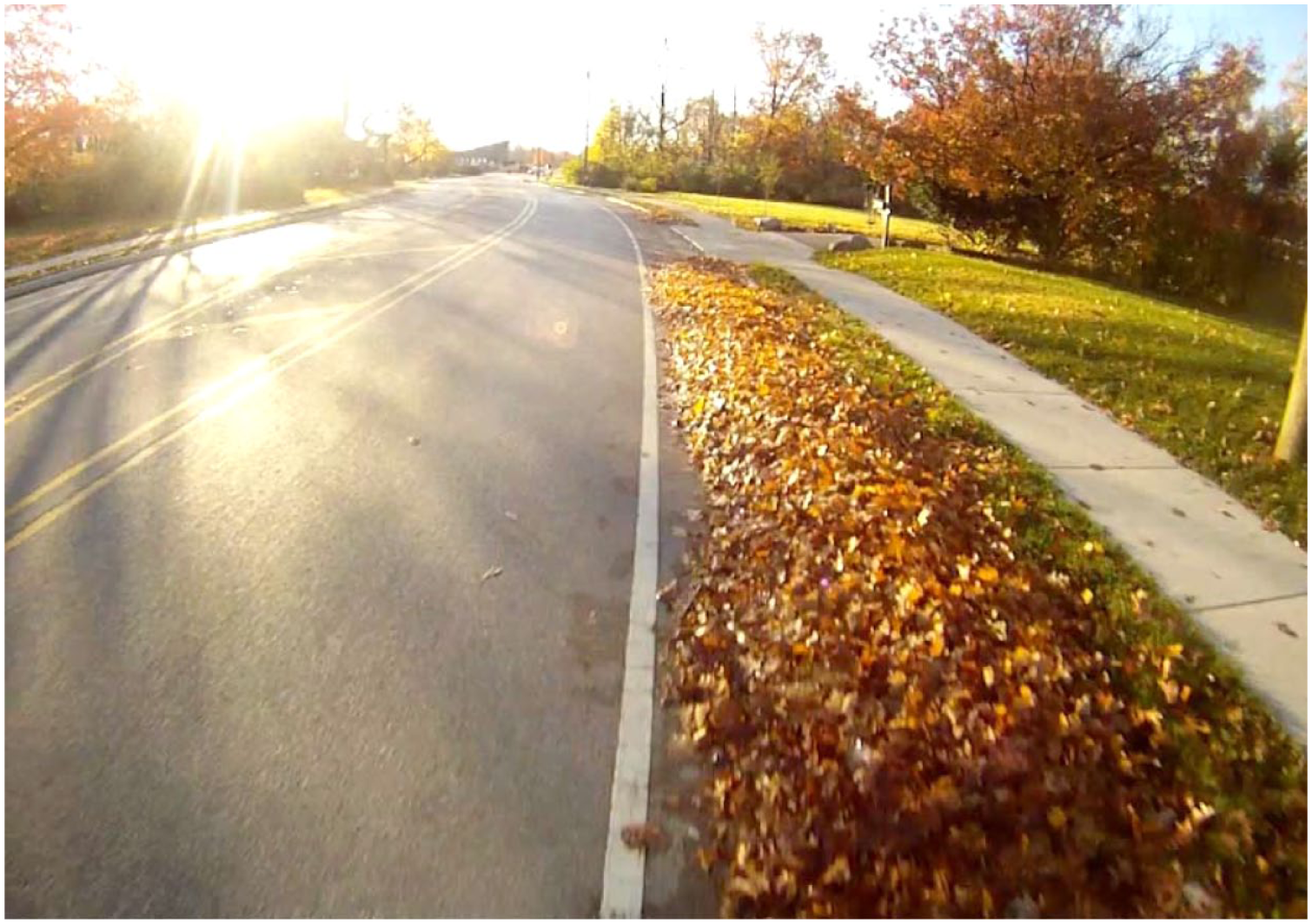
Luke has to avoid the leaves in the bike lane.
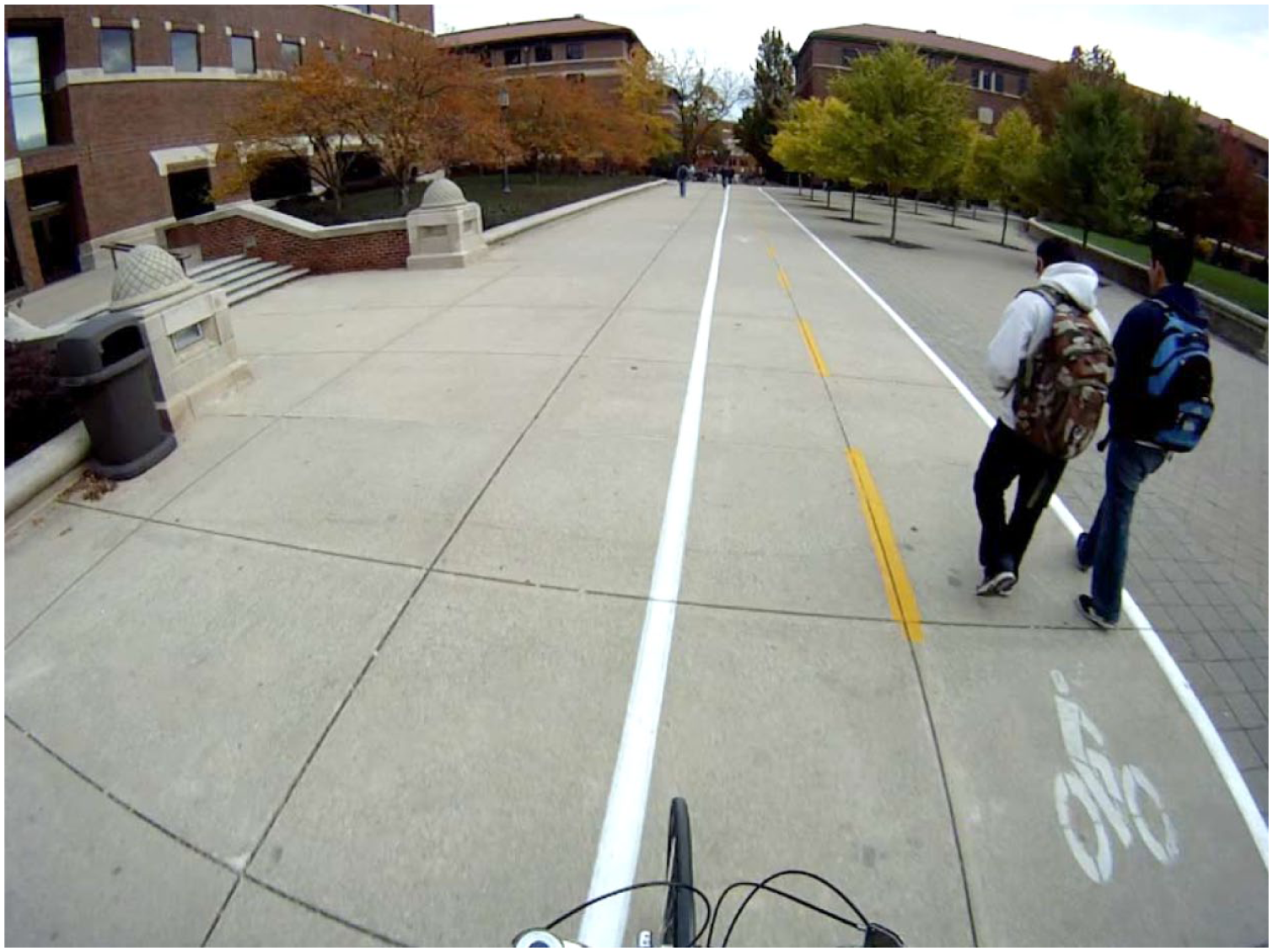
Jason avoids pedestrians walking in the bike lane.
As a result of the lack of infrastructure for cyclists, they are almost always moving in a space that has been designated for cars or pedestrians. Bike commuters then contrast the cars or pedestrians who are dominant in a given space. This is visible in Jason’s video where one sees cars in their lanes and pedestrians on the sidewalk while Jason rides in the shoulder (Figure 3). As Ben said, A car is a different kind of vehicle. For me to be on the road on a bike … I can see where drivers might get frustrated with me or where I really don’t fit in or don’t belong, so, honestly regardless of what the law says, I have every right to be on the road. That’s great for me I guess, but at the same time … I feel like I’m out of place anyways.
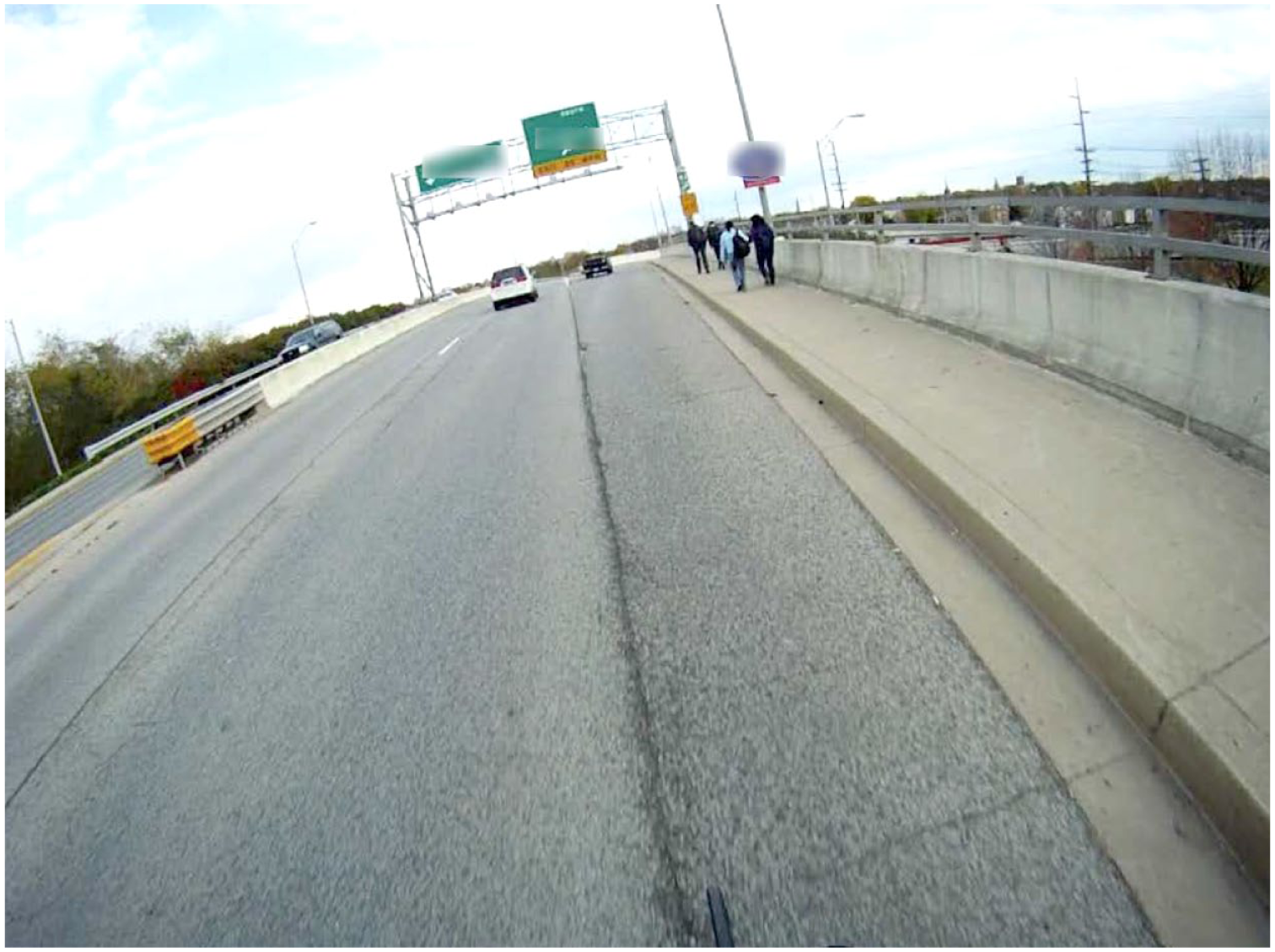
This image from Jason’s video shows pedestrians walking on the sidewalk and cars driving on the road, each in their designated area. Jason, however, rides on the road because there is no space set aside for bikes.
Here, Ben describes how actants including cars, drivers, bikes, roads, and the law contribute to an understanding that cyclists are resisting by being on roads alongside cars. In this quote, he also mobilizes the figure of the bike/car contrast in the road. He recognizes the association between cars and bikes in the space of the road and then ventriloquizes the contrast between cars and bikes to say that bikes are out of place because of their non-dominant position.
As Ben described, bike commuters do find themselves in a difficult position because legally they are supposed to ride on the road, but many drivers do not realize that bikers have this legal right and obligation. As a result, cyclists often feel like there is no place for them within the transportation infrastructure: roads mean a place for cars and sidewalks mean a place for pedestrians. By association, cyclists will always be an out-of-place contrast to the dominant form of transportation in that space. For example, Abby said she rode on the sidewalk only when going up a steep hill because she had to bike more slowly and that made her ‘feel that I’m in the way’ (see Figure 4). In Jason’s video, he rang his bell at a driver who did not see him when making a turn. The sound of Jason’s small bell presented a stark contrast to the sounds of the cars passing him.
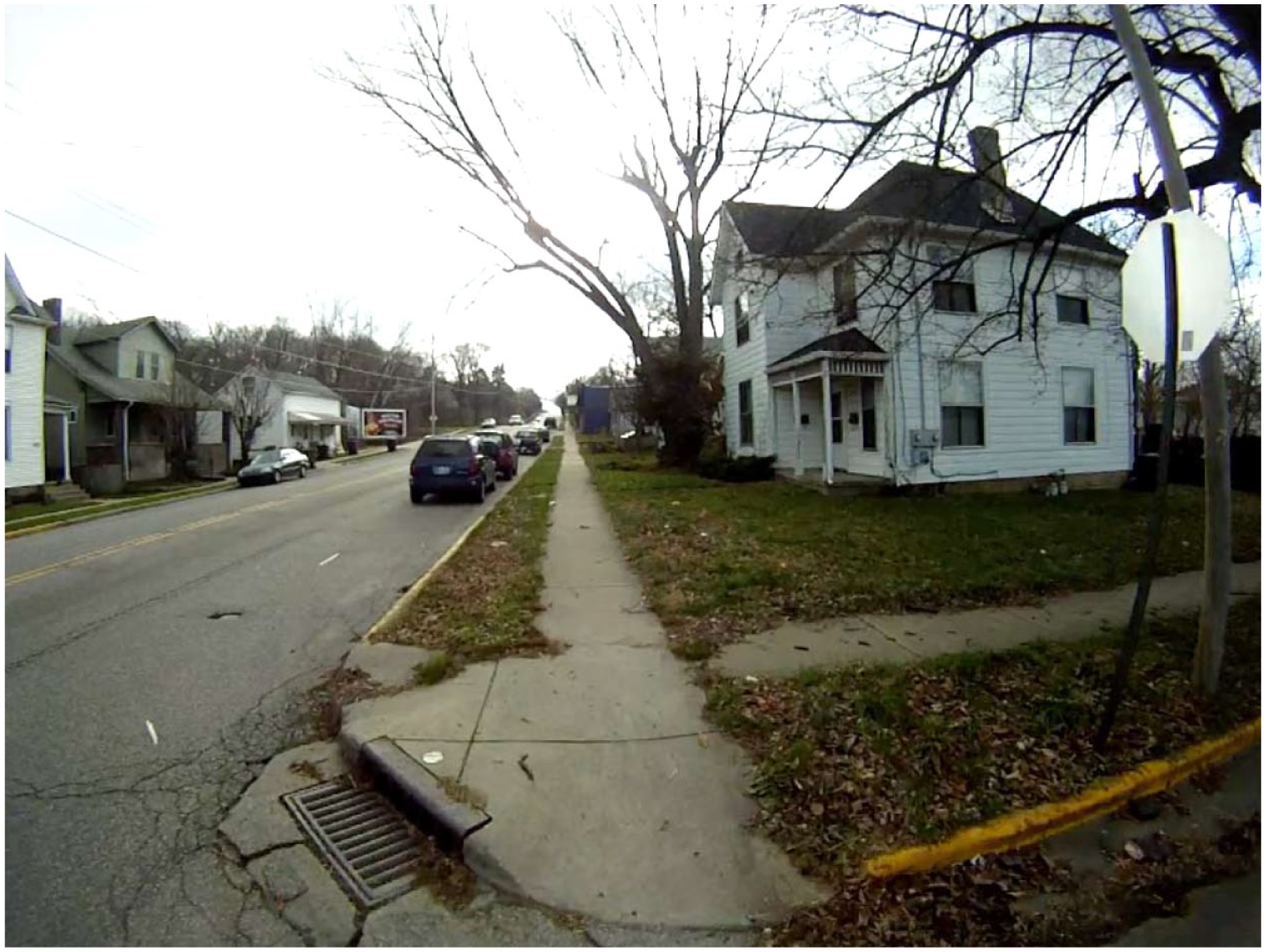
Abby moves to the sidewalk to bike uphill.
In addition to feeling out of place, participants reported activities from drivers that seemed to indicate that cyclists are not welcome on the road. For example, Julie described a common phenomenon: ‘I’ve had [cars] like come pretty close, and there was no reason for them to be that close to me as they drove past’. Richard also reported the common experience of drivers shouting at cyclists and assuming it was something angry: ‘Sometimes people shout things and I can never understand what they say, so I don’t always know why they get mad at me’. Natasha even had an exchange with a driver at a stoplight: ‘a guy got out of his car from behind me, and was like, “Do you realize that you’re blocking traffic?”’ These actions from drivers indicate to cyclists that they not only feel like a minority but that drivers do not see them as legitimate members of the road space. The association between cyclists, pedestrians, and especially cars and drivers within transportation spaces contributes to bike commuting as a resistant action. Additionally, laws, infrastructure, cars, bikes, horns, and other actants participate in the constitution of this resistance.
Objects
Our final example takes place through the presence of material artifacts associated with bike commuting entering organizational space. Through the presence of artifacts such as a helmet, panniers, or the bike itself in the workplace, bike commuters show that they have biked. Most of the material resistance that participants reported took place through such means—carrying a helmet into a meeting or coming into the office with a pants clip on their leg. As these artifacts are out of place in the workplaces of our research site, they can be made to speak as resistance in relation to what would normally be present in an organization.
Many participants said that their co-workers knew they biked because they saw them parking bikes outside their offices. Nick said, A lot of [my coworkers] see me when I’m parking my bike and chaining it up, they’ll see me downstairs and we’ll walk up to the office together, so I think most of them know that I at least occasionally ride my bike.
In the videos, the contrast between parking a bike and a car is evident. Chase and Abby’s videos both show the biking through parking lots full of cars to arrive at empty or nearly empty bike racks. When Chase arrives at work, there is one other bike on the rack, and the rack at Abby’s workplace is empty (Figure 5). The empty bike racks contrast full parking lots.
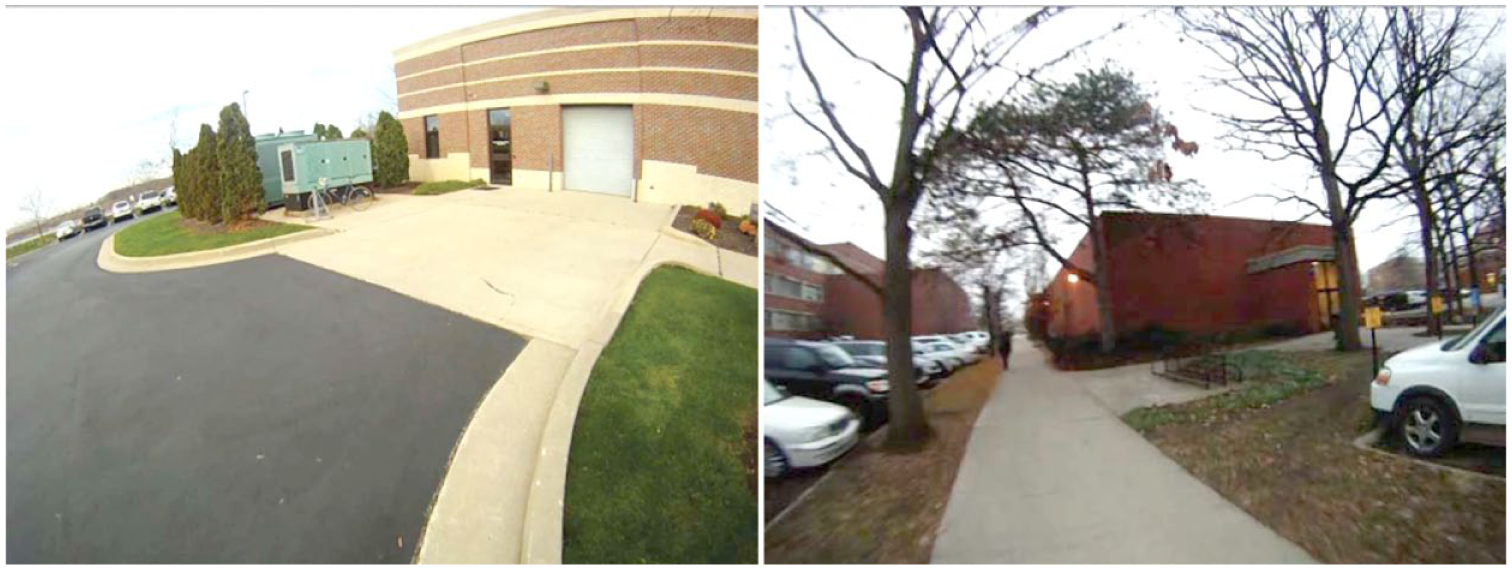
Chase and Abby both rode through full parking lots to arrive at empty bike racks. The rack at Chase’s office (left image) has one bike parked at it and the rack at Abby’s workplace (right image) is empty.
Additionally, comments like Zach’s about entering the workplace with manifestations of cycling were common: They see me walking in in the morning with a bike helmet. I’ve got a light on the back of my lunchbox … a lot of times it’s still blinking when I’m walking in. It’s pretty obvious. I’m wearing funny shoes when I’m coming in … for a real fashion statement. On Wednesday nights I change into my bike shorts and jersey for the club ride, at work, now this is mostly, you know 20–30 year veterans of blue-collar factory work. So, I don’t exactly fit in with everybody else at that point.
In this quote, Zach draws a comparison between himself and his artifacts of cycling and the other organizational members at his workplace. He puts his presentation and objects in conversation with the other workers, ventriloquizing himself as not fitting in with others at the factor where he works.
Additionally, the above quotes demonstrate that the presence of bikes and biking artifacts explicitly communicate to one’s co-workers one’s transportation choice. Two participants even reported bringing their bikes into their offices, making it very clear to their co-workers how they arrived at work. Additionally, the video data illustrate transitions into bike commuters’ workplaces, specifically showing how their cycling artifacts become actants of communication about cycling to their co-workers. For example, Blake uses two bright yellow panniers to carry things to work that he brings into his shared office. In Figure 6, Blake removes his pants clip from his leg, puts it into one of the panniers, and then places the panniers down by his desk, in the presence of his co-worker.
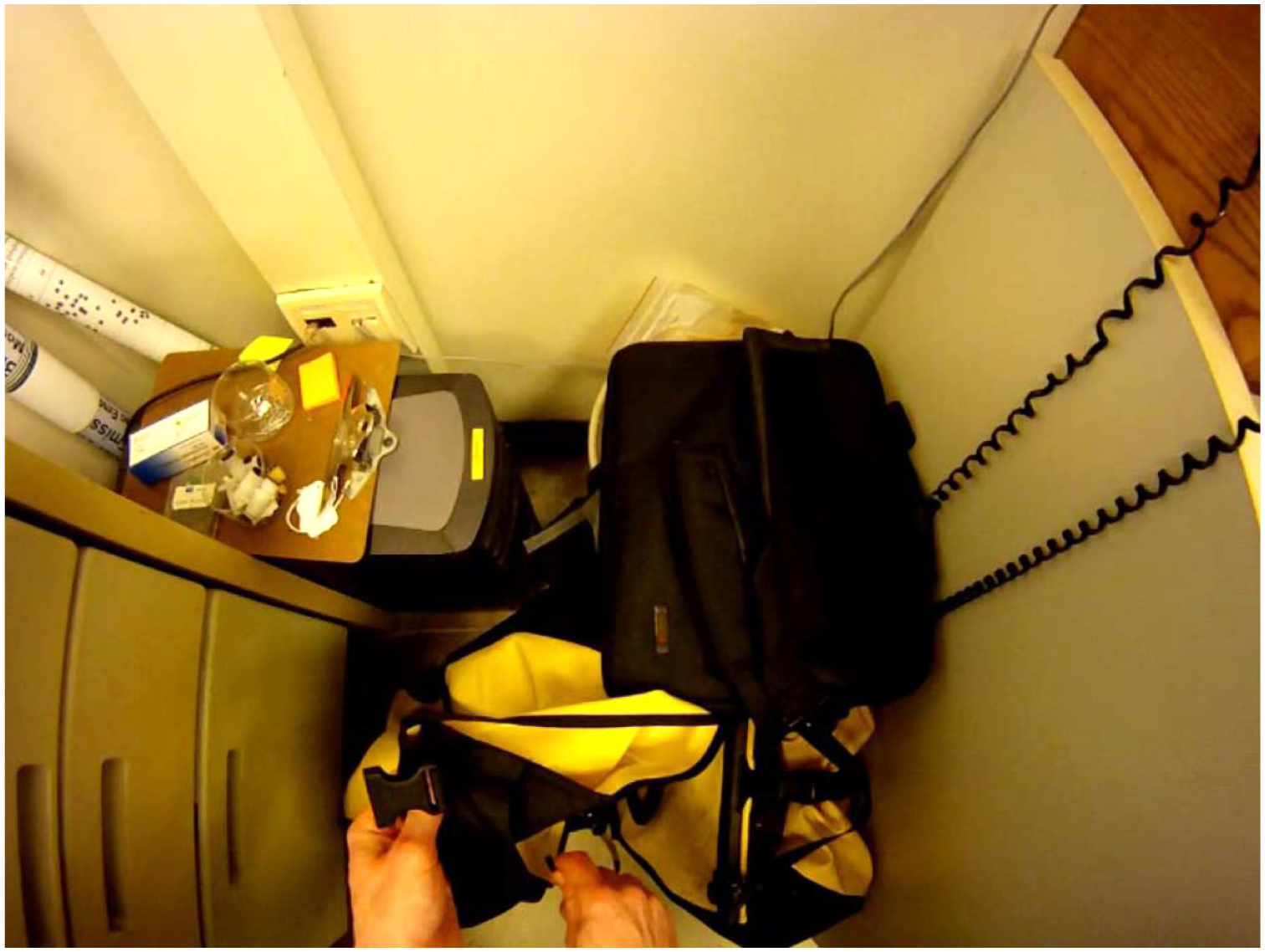
At his office, Blake puts his pants clip into his pannier.
The presence of cycling artifacts in the workplace contrasts prevailing cultural and organizational practices as they bring cycling artifacts into the workplace. Biking is necessarily accompanied by visible artifacts—one will at least have a bicycle that must be stored during the workday. These artifacts of bike commuting can be made to communicate resistance as they contrast normative commuting and workplace behaviors. These examples demonstrate that resistance is a hybrid production and involves a plenum of agencies in constituting resistance. Bodies, spaces, and objects in connection with people, discourses, and norms (among others) together contribute to producing activity that can be named as resistance.
We have also shown how bike commuters’ activities present a set of alternative practices that contrast the dominant norms of their community. The presence of alternative practices alongside dominant ones prevents the prevailing practices from becoming entirely fixed, rendering bike commuting resistive. This association (and the many actants responsible for it) demonstrates that resistance is not the intentional human production that it is generally understood as, but a hybrid accomplishment.
To conclude the findings, we also need to consider our role as researchers in identifying bike commuting as resistance. Although participants recognized the association between biking and driving and the way their contrast makes some practices dominant and others alternative, none of them used the word ‘resistance’. As researchers and authors of this article, we are also actants in this relational ontology (Law, 2009). Ultimately, it is we, the authors, who ventriloquize bike commuting as resistance. However, even if this is a misinterpretation, we are still not the only ones involved in making it as we have observed and invoked many other actants in support of this conclusion (Cooren, 2015).
Discussion: the relational ontology of resistance
In this study, we demonstrated that resistance has a relational ontology. Specifically, we demonstrated three relational aspects of resistance. First, resistance is a hybrid production in which actants of varying ontological statuses participate. Second, dominant and alternative practices, people, and objects exist in relation to each other and it is through their contrasting relationship that some things are called resistance while others are deemed to reproduce control. Third, this relationship between practices is ventriloquized or made to speak so that the contrast between activities gives some practices meanings of resistance and others meanings of domination. The person or people who do this ventriloquizing and naming are also part of the relational ontology of resistance. Resistance then cannot only be understood as a human activity, but, like all action, must be understood as something that takes place through many actants of heterogeneous ontologies connected in a network of relationships. This approach differs from existing studies of materiality and resistance that maintain focus on human actors. There are three main implications of such a shift in thinking about resistance, particularly in organizations.
First, a relational ontology of resistance changes the relationship between resistance and control. In the example of bike commuters, we have shown that power and resistance are implicated in each other’s definition and existence, that is, activities of resistance and control are associated in an actor-network; they are also connected in relational ontology. This approach differs from existing dialectical understandings of resistance (Mumby, 2005; Zoller, 2014) that demonstrate how power and resistance are implicated in each other not only in the ways they are enacted (i.e. resistive activities reproduce control; Knights and Vurdubakis, 1994) but also in terms of definition. Resistance and control require each other to demonstrate which activities can be construed as one or the other. Bike commuting provides a contrast with dominant activities and infrastructure and is therefore defined in terms of mainstream practices. In our example, practices are ventriloquized as alternative or dominant based on their relationship with other practices. In the context of a road without a bike lane, cycling is ventriloquized as a resistant practice because it contrasts (and impedes) the dominant form of transportation.
Although there certainly are ways that participants consent even while resisting (they are still going to work), for the most part consent is not co-present with resistance in the usual sense. Instead, resistance emerges through alternative practices because it is made to speak as a contrast to mainstream practices. Dominant practices are essential for defining resistance as such—without the presence of dominant practices, there cannot be resistance. This is true for all resistance. To give a more typical organizational example, the worker who pilfers office supplies from work is resisting only because his organization has rules against this and most people do not take office supplies. A memo reminding employees of this rule then acts to constitute this employee’s actions as resistance. Manifestations of power or domination then become actants in the hybrid agency behind resistance. This extends existing understandings of organizational resistance beyond demonstrating that resistance always reproduces power, acknowledging that power actually acts in defining resistance. It also softens the sharp contrast often drawn between resistance and power (Fleming and Spicer, 2008). Future research can continue to explore this, especially how people who intend to resist might position themselves as animated to resist by rules, dominant practices, or other forms of control.
Second, relational resistance requires a contextual approach. In general, work to extend what counts as resistance has considered whether behaviors like cynicism (Fleming and Spicer, 2003), ethics (Pullen and Rhodes, 2014), not working (Paulsen, 2015), or ‘bitching’ (Sotirin and Gottfried, 1999) count as resistance. However, one cannot decide a priori what is resistance; each activity must be examined within the context in which it is enacted (Prasad and Prasad, 2000) and in relation to the other practices, things, or people with which it is associated. Resistance then becomes extremely context-bound. E.D.W. has conducted additional research in Copenhagen, Denmark, where bike commuting is a dominant transportation practice (Wilhoit, in press). In that situation, the same practices come to have different meanings because the cultural context and transportation infrastructures are unique. This also means that defining resistance is an interpretive act. We acknowledge our role in ventriloquizing the associations between practices and know that our interpretations may not be shared (see Wilhoit and Kisselburgh, 2015). Thus, both the context of the action and the position of the interpreter will affect which practices are interpreted as resistance and control, further demonstrating the relational nature of resistance. From this, we suggest that additional research should consider the contradictions that can arise when multiple actants are present in an interaction. Contradiction and paradox are topics of interest to organizational scholars (Stohl and Cheney, 2001), but paradox between human discourses and material effects has not been studied: How do actants negotiate the alternate meanings that their practices can come to have? Additionally, research could consider how the interpretation of resistance might have consequences for punishment or reward.
Third, understanding resistance as a relational ontology extends what counts as resistance and requires a redefinition of it. We propose a reconceptualization of resistance that takes into account the relational ontology of resistance: The effects of a plenum of agencies that make a difference by providing an alternative and contrast to dominant practices therefore preventing prevailing norms, meanings, practices, and discourses from becoming entirely fixed or hegemonic. This definition de-centers resistance as a solely human activity and emphasizes the necessary, and dynamic, relationship between resistance and control. Although this definition could apply both when resisters do and do not identify their activities as resistance, it does not apply in clandestine or hidden transcript situations when resistant practices are not co-present with the dominant ones.
This is a broad definition of resistance, but that is our point: any activity, object, text, or actant of any ontological status that challenges dominant norms can be understood as resistance; resistance is not limited to intentional, obtrusive, dramatic acts. Instead, actions like wearing jeans to work because they are comfortable or checking personal email in a meeting to deal with a family emergency can be seen as resistance in workplaces where these behaviors are not normative. This redefinition of resistance then points to the potentially widespread presence of relationally defined resistance. Organizations tend to privilege conformity that defines a large number of practices as oppositional (e.g. using social media at work, not dressing a certain way, having a bad attitude). These practices that prevent managerial meanings from becoming entirely fixed or hegemonic can be seen as resistance even if the human actants involved in them do not identify them as such. Additionally, this example moves beyond looking at organizational resistance and control only in terms of management and employees, the focus of most literature on organizational resistance (Mumby, 2014). Power is produced in organizations in many ways and by both human and non-human actants, and it is important for research to consider its distributed and multiple nature, rather than seeing it only as the domain of management.
This study is then significant in broadening how we define and interpret resistance as well as how it is produced, implicating actants of all ontological statuses and even discourses and practices of control and the actants (both human and non-human) who are in power. Debates on what counts as resistance have been ongoing (Fleming and Spicer, 2008; Paulsen, 2015; Prasad and Prasad, 2000), but have not defined resistance this broadly or de-centered it as a human activity. The definition proposed here allows future scholarship on resistance to consider both more activities as resistive and more actants in its production. Future research should examine relationally defined resistance within workplaces, particularly how organizational members identify others’ behavior as resistance and which actants or practices manifest resistance.
Finally, this study has continued to expand how ventriloquism can be applied (Wilhoit, 2014). Although we have not used the typical method of ventriloquism, conversation analysis, to show how actual organizational interaction and constitution takes place, we have applied the metaphor of ventriloquism to explain how meaning emerges.
Through the somewhat unusual example of bike commuters, we have demonstrated that resistance has a relational ontology. Resistance is not only an activity undertaken intentionally by human actors but is also produced relationally through people, objects, actions, spaces, discourses, and more. This shift in understanding about resistance reflects the growing attendance in organizational theory to consider how non-humans also participate in organizations and organizing. By incorporating non-humans into models of communication and organization, scholars are able to develop more sophisticated understandings of these phenomena and create better practical advice for organizational members. Power and control have daily consequences for most workers and need to be understood in a relational way.
Footnotes
Acknowledgements
The authors thank Robin Clair, Sam McCormick, Dennis Schoeneborn, Jasmine Linabary, Jessica Sturgess, and the three anonymous reviewers for their feedback on earlier versions of this article.