Abstract
The recent proliferation of Web 2.0 applications and their role in contemporary political life have inspired the coining of the term ‘open-source politics’. This article analyzes how open-source politics is organized in the case of a radical political party in Denmark called The Alternative. Inspired by the literature on organizational space, the analysis explores how different organizational spaces configure the party’s process of policy development, thereby adding to our understanding of the relationship between organizational space and political organization. We analyze three different spaces constructed by The Alternative as techniques for practicing open-source politics and observe that physical and digital spaces create an oscillation between openness and closure. In turn, this oscillation produces a dialectical relationship between practices of imagination and affirmation. Curiously, it seems that physical spaces open up the political process, while digital spaces close it down by fixing meaning. Accordingly, we argue that open-source politics should not be equated with online politics but may be highly dependent on physical spaces. Furthermore, digital spaces may provide both closure and disconnection between a party’s universal body and its particular body. In conclusion, however, we propose that such a disconnection might be a precondition for success when institutionalizing radical politics, as it allows parties like The Alternative to maintain their universal appeal.
Keywords
Introduction
It takes a world to create a locality, and an imagined world to transform ourselves in place. Perhaps this is one way that (counter)hegemony is enacted. (Gibson-Graham, 2006: 196)
The recent proliferation of Web 2.0 applications and their role in contemporary political life have inspired the coining of the term ‘open-source politics’ (Hindman, 2007; Karpf, 2011). Originally, the open-source concept emerged in the area of computer software development but has since been transported into other domains, such as science (Koepsell, 2010), journalism (Lewis and Usher, 2013), architecture (Ratti and Claudel, 2015), and even law enforcement (Trottier, 2015). Online activist groups, such as MoveOn.org, first introduced the concept to politics, but it was former US Senator of Vermont, Howard Dean, who initially applied it to party politics (Kreiss, 2011). At its most basic level, open-source is defined as ‘something that can be modified because its design is publicly available’ (Opensource.com, 2015). In political organization, this means that the public is allowed to influence future and existing policies by participating in both planning and implementation processes (Sifry, 2004). As such, the notion of open-source politics signifies a break with traditional structures of representation inherent to liberal democracies as it dramatically reverses the political supply chain. Instead of limiting the role of the citizen to a simple consumer of politics, she or he is turned into a supplier of politics. Of course, this does not mean that we are witnessing the end of political representation but that a more participatory and less ‘mediated’ kind of party politics is emerging (Tormey, 2015: 83).
As such, the notion of open-source contains a ‘kernel of radicalism’ in that it problematizes the privatization of knowledge (Berry, 2008: 192). This, however, should not lead us to assume that open-source politics is necessarily a post-capitalist practice. As argued by a series of observers, the open-source movement was initially driven by profit-related incentives (Stallman, 2002), relies heavily on free labor (Terranova, 2004), and has its roots in capitalist conceptions of property (Klang, 2005). After all, the term ‘open-source’ was invented by software entrepreneurs to attract investors who resented the notion of ‘free software’ (Von Hippel and Von Krogh, 2003). However, the open-source process moves away from its capitalist origins when it is viewed as an end in itself rather than just a means to achieve certain ends (Weber, 2004: 56). Also, as Berry (2008) notes, the best way to support the vibrancy of an open-source community is by ‘acknowledging the precarious nature of its reliance on the market and exploring its democratic potentials through experimentation instead with state organizations’ (p. 193). In this way, the collaborative and nonproprietary ethos that runs through open-source politics could potentially be of great importance to the vision of a post-capitalist society (Mason, 2015: 120).
In Denmark, a radical political party called The Alternative has engaged with open-source politics by constructing their entire political program through publicly accessible bottom-up processes. The Alternative was founded in 2013 as a movement against the unsustainable program of neoliberalism and an ‘old political culture’ characterized by spin and tactics. After 1.5 years, it was registered as an official candidate in the national elections, and in June 2015, The Alternative entered the Danish parliament with almost 5% of the votes, which translated into nine seats in parliament. The hasty entry into parliament particularized and professionalized The Alternative’s political project significantly. Hence, in order not to marginalize all those supporters who disliked the party’s new identity, The Alternative needed to find ways of coping with the swift transition to parliamentary politics. In this article, we argue that The Alternative’s organization of open-source politics can be seen as a technology serving a dual purpose: It is part of a post-capitalist politics intended to bring ‘the people’ closer to the parliament, and it helps The Alternative cope with the organizational transformation from movement to party.
Organizational space as condition for open-source politics
In order to analyze The Alternative’s organization of open-source politics, we draw inspiration from the literature on organizational space (Clegg and Kornberger, 2006; Dale and Burrell, 2008; Taylor and Spicer, 2007). This literature has provided valuable insights into many organizational phenomena, but the specific relationship between organizational space and political organization remains underexplored. This may be a consequence of the static conception of space that has dominated political thought for decades (Foucault, 1980; Lefebvre, 1976; Massey, 1992). In contrast, we adopt a more dynamic notion of space, which allows us to view organizational space not only as the outcome of politics but also as the condition for politics. We investigate how different organizational spaces afford different practices in the case of open-source politics within The Alternative. Here, to ‘afford’ (Gibson, 1986) means that the various features of a given space and the social context in which this space is embedded invite a certain use (Fayard and Weeks, 2014: 247). Crucially, this is only an invitation. Other actions are always possible, depending on people’s perception of the space in question. It thus becomes an empirical question how the organization of space and the use of that space produce specific forms of political action. As we shall see, only some spaces fix meaning, while others invite political imagination and change.
The Alternative has constructed three kinds of physical and digital spaces in order to conduct open-source politics. Through an empirical investigation, we observe how these spaces are used to oscillate between openness and closure and how this oscillation produces a dialectical relationship between the associated practices of imagination and affirmation. Perhaps surprisingly, it seems that physical spaces open up the process, while digital spaces close it down by fixing meaning. Accordingly, we argue that open-source politics should not be equated with online politics but may be highly dependent on physical spaces. Also, contrary to a commonly held view in media studies (e.g. Bruns, 2008), sociology (e.g. Castells, 2009), and the e-government literature (e.g. Bekkers and Homburg, 2005; Dunleavy et al., 2006), we argue that digital spaces do not always open up political processes but may provide both closure and disconnection between a party’s universal body and its particular body. In conclusion, however, we propose that such a disconnection might be a precondition for success when institutionalizing radical politics, as it allows parties such as The Alternative to maintain their universal appeal.
This article is structured as follows. First, we present the case of The Alternative’s transformation from movement to party and pose the following questions: How does open-source politics help political organizations such as The Alternative cope with the transition from movement to party? And how are physical and digital spaces used in the construction of open-source politics? The presentation of The Alternative is followed by a review of the literature on organizational space, with a focus on the spatiality of political organization. After the ‘Methods’ section, the analysis describes three different spaces constructed by The Alternative as techniques for practicing open-source politics. In conclusion, we point to the specificities of the various techniques and provide reflections on the implications of our analysis for organization studies of post-capitalist politics in general and open-source politics in particular.
The Alternative: open-source politics in practice
In September 2013, the former Minister of Culture in Denmark, Uffe Elbæk, left the Social Liberal Party to launch a new political project called The Alternative. To the astonishment of most political observers, The Alternative started out with no political program whatsoever, having only a manifesto and six core values (courage, generosity, transparency, humility, humor, and empathy). With inspiration from the open-source community, the program was developed later through so-called Political Laboratories in which both members and non-members could participate (The Alternative, 2014a). The manifesto, which quickly became a main source of attraction for supporters, opens with the promising statement, ‘There is always an alternative’, and it ends with the following lines: The Alternative is for you. For you who can tell that something has been set in motion. For you who can feel that something new is starting to replace something old. Another way of looking at democracy, growth, work, responsibility and the quality of life. This is The Alternative. (The Alternative, 2013)
The manifesto’s broad appeal, and the idea of producing a political program from the bottom-up, allowed an incredibly wide range of people to read their own personal preferences into The Alternative. This obviously provided The Alternative with important momentum but made it equally difficult for the party to particularize its project without simultaneously losing support. With every proposal added to the political program, particular meaning was assigned to an otherwise universal identity. This problem was further accentuated by the party’s recent entry into parliament, where mundane day-to-day politics seemed to specify the meaning of The Alternative even further. At the time of writing, The Alternative has been in parliament for almost a year. The political program is now no less than 62 pages and contains more than 80 highly specific policy proposals. Despite this, and contrary to what most observers expected, support for The Alternative has continued to grow. Measured through membership statistics and opinion polls, the party is more popular now than ever before.
The remarkable success of The Alternative suggests that the party has found a way of coping with the rapid transition from movement to party. At least, it has found a way of maintaining support from all those who initially thought ‘The Alternative’ was going to be something different from what The Alternative turned out to be. This assumption is supported not only by membership statistics and opinion polls but also by 1.5 years of qualitative fieldwork, which has revealed that most of those who could be expected to feel marginalized by the increasingly fixed character of The Alternative remain dedicated supporters (Husted and Hansen, 2017). Liberalists and socialists alike continue to find representation in a party that you would be hard pressed to identify with any of these labels. While there are arguably multiple explanations as to how this has been possible, as we shall see, one explanation is related to the party’s spatial organization of open-source politics.
The formal organization
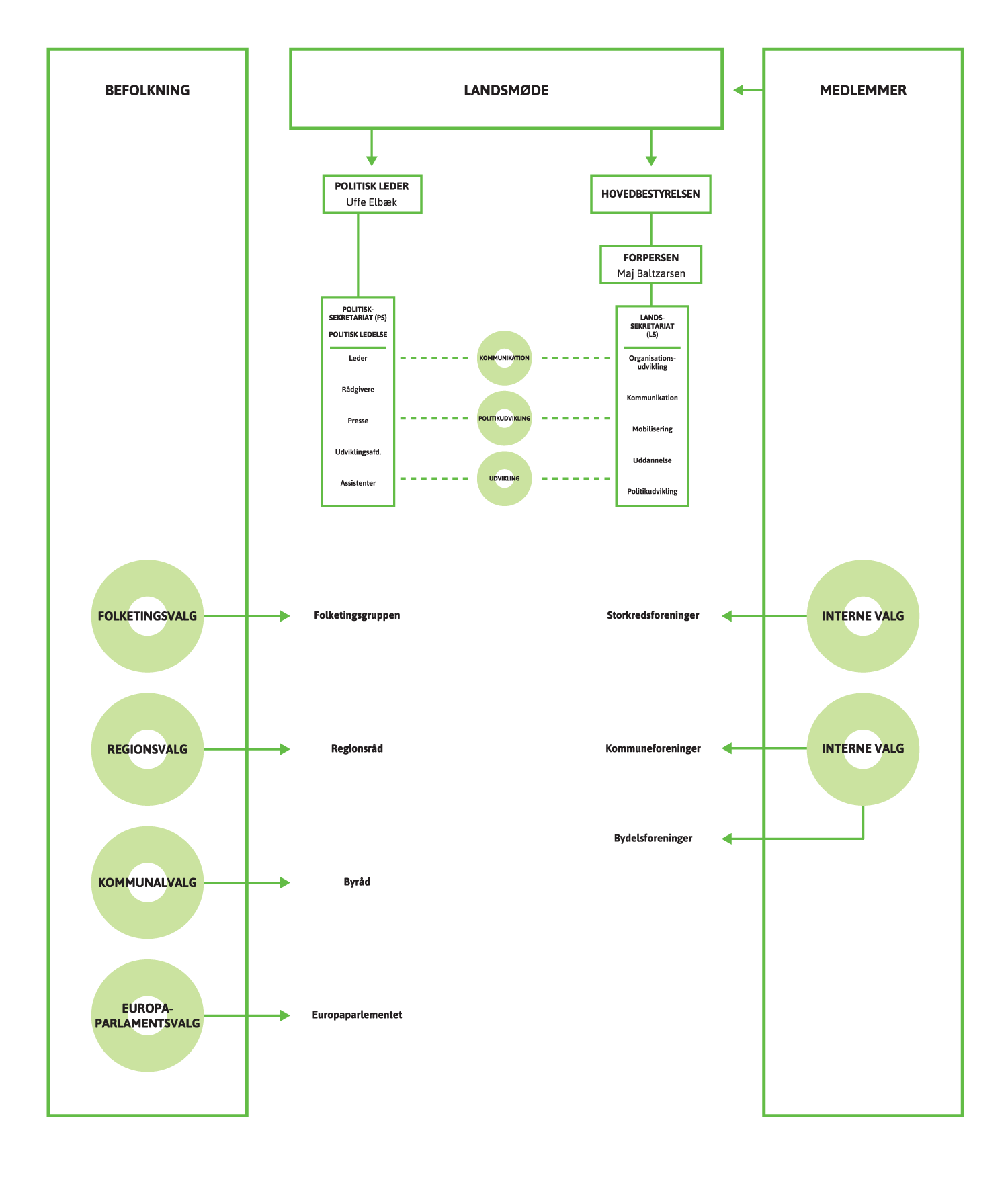
Formally, The Alternative is divided into two parallel sections: an administrative section dealing with organizational matters and headed by the board, and a political section dealing with policy matters and headed by the political leadership (the members of parliament (MPs)). Each section has its own secretariat with a dozen staff members, and each section has its own headquarters. Furthermore, while the administrative section is accountable to the party’s members through internal elections, the political section is accountable to the voters through national and regional elections (The Alternative, 2016). The process of open-source politics, which is at the center of this article, is closely associated with the political section of The Alternative. This, however, does not mean that it is not of concern for the administrative section. For instance, the people planning and facilitating Political Laboratories are usually associated with the party’s administrative section and often experienced organizational developers. These people are known as ‘facilitators’. Also, the majority of people participating in so-called Political Forum meetings are board representatives.
Internally, The Alternative’s organization of open-source politics is conceived as a more or less linear process comprising activities in at least three different spaces. The life of a policy proposal begins in a Political Laboratory (space 1), which is a public workshop for anyone interested in a certain topic. Immediately after, a group of volunteers embarks on the task of textualizing the outcome of the laboratory in order to post a written policy proposal on The Alternative’s online platform, Dialogue (space 2). Here, the proposal is further discussed by both members and non-members. After 3 weeks on Dialogue, the proposal moves into the third space, called Political Forum (space 3). Here, board representatives and the political leadership—approximately 40 people in total—meet to discuss whether the proposal should be included in The Alternative’s political program. This marks the finalization of the proposal. In keeping with the spirit of open-source politics, the task of Political Forum is merely to decide whether or not a proposal should be accepted. However, as we shall see, the forum frequently adds new ideas to the proposals and modifies them substantially. Below, we review the literature on organizational space with a specific focus on political organization in order to establish a foundation for understanding how these different types of spaces condition open-source politics.
Organizational space and political organization
In recent decades, the literature on organizational space has expanded significantly (Halford, 2004; Taylor and Spicer, 2007). Especially since the pronouncement of the ‘spatial turn’ in social theory (Soja, 1989) and since the English translation of Lefebvre’s (1991) seminal work on the production of space, organization and management scholars have appropriated the concept of space to analyze a wide range of organizational phenomena, such as control (Dale, 2005), hierarchies (Zhang and Spicer, 2014), trust (Nilsson and Mattes, 2015), learning (Englehardt and Simmons, 2002), work spirit (Kinjerski and Skrypnek, 2006), entrepreneurship (Hjorth, 2004), legitimacy (De Vaujany and Vaast, 2014), change (Carr and Hancock, 2006), and subjectivity (Halford and Leonard, 2006). A common argument in these texts is that different spatial configurations promote certain organizational practices and constrain others. As Baldry (1999) puts it, ‘Environments provide cues for behaviour’ (p. 536). This has led to studies focusing on the relationship between physical features of the environment and organizational behavior—a view of space that Taylor and Spicer (2007) call ‘space as distance’.
However, as argued by a series of social constructivist scholars (e.g. Clegg and Kornberger, 2006; Dale and Burrell, 2008; Hernes, 2004), the studies that apply the distance-oriented view tend to privilege what Lefebvre (1991) calls ‘perceived’ space and ignore what he calls ‘conceived’ and ‘lived’ spaces. On one hand, conceived space concerns formalized mental representations of space, as expressed through maps and literature. On the other hand, lived space concerns the local experiences of social actors that escape the hegemony of ‘the conceived’ by providing counter-discourses to the taken-for-granted ways of knowing spaces (Lefebvre, 1991: 10). This framing of lived space as spaces that cannot be represented as such has sparked an interest within organization studies in exploring various spaces of resistance (Kokkinidis, 2014; Munro and Jordan, 2013; Thanem, 2012) and encouraged new ways of accounting for the spatiality of organizing. For instance, drawing on Sloterdijk’s theory of spheres, Borch (2010) urges scholars to attend to the affective dimension of so-called organizational atmospheres when studying spatial configurations of organizations. Similarly, Beyes and Steyaert (2012: 50) propose abandoning spatial heuristics and instead using all the senses to envelop oneself in the event of spacing. The main inspiration from this strand of literature is the call to examine enactments of lived space, where space might be a site of political change.
Space and the political
Following this line of reasoning, space should not be viewed as something fixed and in-temporal (Foucault, 1980; Massey, 1992; Thrift, 1996) but as procedural and continuously performed by those inhabiting it (Dale and Burrell, 2008: 109). This runs counter to the dominant conceptions of organizational space, where the focus is still representational and not on the ‘becoming of space’ (Beyes and Steyaert, 2012: 47). If we look to bodies of work that link space and the political, we also find conceptions of space as representing determination and closure. For instance, in Laclau’s (1990) political theory, this is the case because space is conceptualized as time’s immediate counterpart and because time is conceived as the form of politics and change, while space is seen as inherently apolitical (p. 68).
Although Laclau’s notion of space is limited to instances where meaning is fixed, which means that not all physical spaces are ‘spatial’, we agree with Massey (1992) that the distinction between time and space makes little sense and leaves us ill-equipped to grasp the constitutive effects of spatial configurations. In her view, time and space are not each other’s opposites but are instead inseparable (Massey, 1992: 76). Contrary to the stasis view of space, this implies that spaces are inherently ambiguous, which means that they neither ensure nor hinder freedom (Kornberger and Clegg, 2004: 1103) or, by extension, political change. In terms of political organization, we may identify spaces that are strategically constructed to cultivate certain political identities or novel political ideas, but it remains an empirical question how space becomes part of political organization. This implies that space is not only the outcome of politics but also the condition for politics (Massey, 2005).
This view is reflected in the relatively small body of research that explores political organization from a space-sensitive point of view. One example is Wilton and Cranford (2002), who argue that social movements should be seen as sophisticated spatial actors that often succeed in disrupting the taken-for-granted by employing tactics of ‘spatial transgression’. Similarly, Ku (2012) shows how conservation campaigners in Hong Kong managed to reappropriate two ferry piers as spaces of oppositional discourse. Both studies can be considered part of a growing literature on the spatial tactics of social movements that demonstrate how movement actors skillfully engage in what Ku (2012) calls ‘place remaking from below’ (p. 18). While this literature has expanded with the rise of recent square protests and the Occupy movement (Prentoulis and Thomassen, 2013), gaps in our knowledge of organizational space and political organization still remain. For one, while most of these studies have implications for the study of organizational space, hardly any of the above-mentioned texts target organization studies directly (for exceptions, see Kokkinidis, 2014; Munro and Jordan, 2013; Thanem, 2012). Instead, their primary audiences are geographers and political scientists. Apart from this, the majority of space-sensitive studies of political organizations explore extra-institutional organizations, such as social movements and activist networks. To our knowledge, no studies have hitherto considered the question of organizational space within political parties. This is the research gap that this article seeks to cover.
Affordances of physical and digital spaces
As mentioned previously, The Alternative employs both physical and digital spaces in their organization of open-source politics. In our understanding, digital or virtual spaces cannot be demarcated from physical space in advance (Bryant, 2001; Cohen, 2007; Kivinen, 2006). This follows from our rejection of the previously mentioned conception of ‘space as distance’. We follow Fayard (2012) in arguing that while digital space might be conceived as a different kind of space, it nonetheless shares all the properties of physical space. This conceptualization of space is not about identifying x/y/z coordinates but about investigating how material entanglements, social practices, and narratives create spaces (Fayard, 2012: 178). Accordingly, this article’s distinction between the digital and the physical has been an empirical question rather than an a priori distinction between two inherently different concepts.
Although we approached the various types of spaces in a symmetrical way, without assigning them specific qualities from the outset, the empirical analysis showed that they afforded different kinds of practices. We identified how open-source politics produces a dialectical relationship between practices of imagination and practices of affirmation and how these practices are tied to different spaces. While the term ‘imagination’ refers to the creative exercise of envisioning that which does not yet exist (Castoriadis, 1987), the term ‘affirmation’ refers to the exact opposite practice, namely, the repetitive exercise of solidifying that which already exists. Accordingly, the practice of imagination is closely related to openness and unfixity (Latimer and Skeggs, 2011), while closure implies a provisional fixing of meaning (Komporozos-Athanasiou and Fotaki, 2015).
Hence, whenever spaces are constructed as open, there is room for imagination. Whenever they are constructed as closed, there is only room for affirmation of an already fixed meaning, and there is no room for ‘non-rational’ experiences that are tied to the affective dimensions (Shouse, 2005) of space. Here, ‘openness’ should not be confused with accessibility. Open spaces are not necessarily accessible to a large number of people (although accessibility is, of course, an important aspect of open-source politics). Instead, openness signifies a lack of determination at the level of meaning. This is why open spaces invite imagination and provide conditions for change, while closed spaces do not. The conceptual pairs of openness/closure and imagination/affirmation are drawn into the discussion to shed light on the organizational implications of open-source politics within The Alternative.
Methods
To understand how open-source politics works as a managerial technology in practice, we rely on a qualitative case study. We consider The Alternative a critical case (Flyvbjerg, 2006) because we assume that relatively few organizations engage in the organization of open-source politics through a varied use of spaces and that we can learn something about an emerging phenomenon by studying precisely this party. We also believe that it is a topical case because of the observable transformation from movement to party, which is marked by struggles to maintain a universal appeal—a transformation arguably shared by similar radical parties. Given the political landscape and the technological possibilities of our time, such transformations may become even more widespread in the years to come.
The empirical material for this article stems from relevant observations and interviews from a larger study of The Alternative’s organizational transformation. Of almost 200 hours of observations, 34 interviews, and well over 1000 pages of written material, we have chosen to draw more directly on ethnographic observations from six Political Laboratories and three Political Forum meetings and on 15 semi-structured interviews. This material was selected after we chose to focus on the dynamics of openness and closure. A thorough reading of the entire empirical material allowed us to select all the relevant sources of data for analysis.
Both the laboratories and the forum meetings took place from January 2015 to November 2015, and they concerned a wide range of political themes, such as taxation, education, and asylum policy. Especially, the first author participated actively in all six laboratories and in all three forum meetings (though not actively in the latter). This meant that besides observing and recording the events, we took part in the discussions and exercises that occurred at the laboratories. The primary motivation for doing so was to experience firsthand how open-source politics is enacted within The Alternative and to envelop ourselves in ‘the event of spacing’ (Beyes and Steyaert, 2012: 50). According to Jorgensen (1989), the aim of participant observation is to ‘uncover, make accessible, and reveal the meanings (realities) people use to make sense out of their daily lives’ (p. 15). Contrary to some ethnographers, we did not analyze the material with the hope of arriving at a true understanding of a reality ‘out there’ but rather to be able to thoroughly describe the narratives, practices, and materiality of the spaces of open-source politics.
The other part of the empirical material is 34 semi-structured interviews. These interviews lasted approximately an hour and were coded by both authors for the analysis of this article. While 15 of the interviews focused specifically on the organization of open-source politics within The Alternative, the remaining 19 dealt more broadly with the respondents’ individual perceptions of The Alternative as an organization and themselves as members of that organization. The respondents of the former type were recruited through the method of purposeful sampling, in which the researcher selects so-called information-rich cases (Patton, 1990: 169): in our case, people who worked with planning and facilitating Political Laboratories and Political Forums. The idea behind this sampling rationale was not only to get information about The Alternative’s motivation for engaging with open-source politics but also to understand why the facilitators tried to construct the different spaces in certain ways and what they hoped to achieve. The documents used in the analysis consist of both publicly available texts, such as the party program and the manifesto, and internal texts, such as a PowerPoint presentation on how to conduct Political Laboratories. 1
The analytical focus on the tension between openness and closure was developed on the basis of our observations. We could observe some very different policymaking practices in different empirical settings. For instance, the point about physical spaces ‘opening up’ or affording more political imagination than digital spaces was first observed at Political Laboratories and through online observations on the Dialogue platform. We went back to both interviews and observations and analyzed them by reading transcripts and field notes in an effort to identify recurring patterns and similarities across the two types of data. We noticed every time processes seemed to ‘open up’ and every time they seemed to ‘close down’. After an initial coding phase, we conducted more observations and interviews until we decided that we had enough material to describe three different types of space. The analysis treats each space in turn, highlighting the rationales for establishing each space, the techniques employed to shape them in a particular way, and the types of practices that can be observed in them.
Analysis: spaces of openness and closure
The novelty of The Alternative’s political project rests firmly with the party’s bottom-up process of policymaking. As mentioned above, the process begins with a Political Laboratory (space 1). It then moves through the party’s digital platform, Dialogue (space 2). After 3 weeks, it enters the Political Forum (space 3), which is a designated space for board representatives and the political leadership to discuss the quality of submitted proposals. The process ends with the policy proposal being either added to The Alternative’s official political program or rejected. This is the process that we and The Alternative (2014a: 2) refer to as open-source politics. The Alternative’s organization of open-source politics is usually portrayed as a linear process moving from openness toward closure, with the Political Laboratories representing openness and ambiguity and the party program representing closure and fixity. However, as will become apparent, the process is not linear. Instead, it oscillates back and forth between openness and closure, which is an observation that allows us to reflect on the relationship between organizational spaces and their implications for open-source politics.
Space 1: Political Laboratories
Perhaps the most original part of The Alternative’s organization of open-source politics is called Political Laboratories. This is the first space constructed to create politics from below. Political Laboratories can be defined as themed workshops open to the wider public. In the words of The Alternative (2015b), A political laboratory is the space we offer each other to investigate and interrogate a political topic/question. The laboratory is also the space for developing the politics of the Alternative—both locally and nationally. This can be done in various ways, like in workshops, seminars, meetings, interviews, online dialogue … The most important thing is to establish a space where we create new political conversations and thereby develop new political ideas. (p. 2)
There are few formal requirements for how to conduct Political Laboratories. Instead, the idea is to encourage ordinary citizens to take the lead in developing The Alternative’s policies. Political Laboratories may, therefore, assume any shape, take place at any time, and involve any kind of activity. For instance, one of the laboratories that we observed was organized by members of the political leadership, took place at a public school, and lasted a full afternoon; another was spontaneously organized by an ordinary member, took place at a bridge in central Copenhagen, and involved passersby responding to a single question (Figure 1).
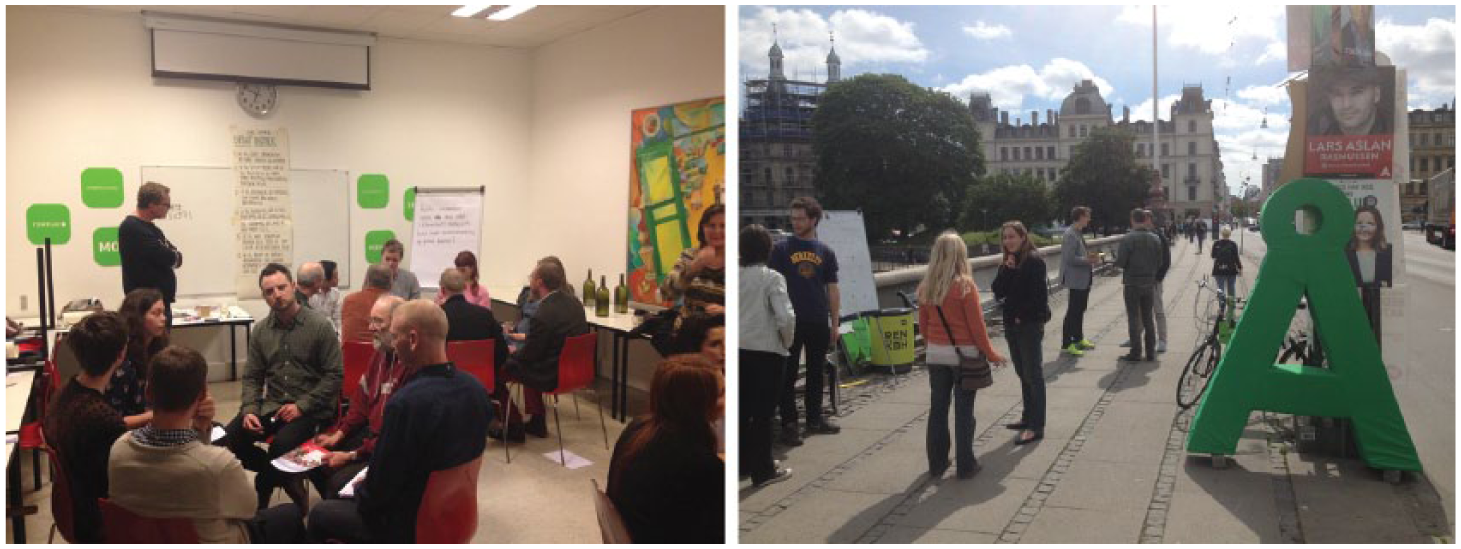
Examples of Political Laboratories.
As such, anyone can create laboratories, and everyone is welcome to participate. In practice, this means that both members and non-members (and even members of opposing parties) are allowed to attend the laboratories and contribute to policymaking (The Alternative, 2015b). The Alternative’s organization of open-source politics begins in this way as an extremely open process, both in terms of imagination and accessibility. It does not matter whether you propose paying taxes with artwork (Observation, POLA, 2015b) or abolishing the conventional school system (Observation, POLA, 2015a). Even the wildest of ideas are welcome. As explained by a member of the national team for Political Laboratories, Well, I think that there should be space for completely crazy ideas, where you just think to yourself: ‘This can never be realized’. If there’s no room for such ideas, we never get anywhere … This is what’s so cool about ordinary people participating and not just people who speak the language of politicians: You are actually allowed to propose suggestions that are completely unrealistic. (Respondent 18a)
The motivation for this radical openness may be found in the rationale behind Political Laboratories, best captured by the frequently used slogan ‘More People Know More’ (The Alternative, 2014a: 2). According to The Alternative (2015b), this means that the actual policies crystallizing out of Political Laboratories should be ‘based on as many good arguments, perspectives and as much knowledge as possible’ (p. 3). In this way, the articulation of the slogan ‘More People Know More’ illustrates the link between The Alternative’s process of policymaking and the general ethos of open-source communities (e.g. Raymond, 1999).
Uses of bodies in space
This rationale is supported by a range of techniques that afford particular practices during the laboratories. For instance, at the beginning of most Political Laboratories, participants are asked to circulate while sharing their hopes and visions on a particular topic. One respondent called these exercises ‘energizers’ and argued that they create a nice atmosphere that allows everyone a chance to express themselves (Respondent 4). Similar practices, such as coordinated greeting sessions (Observation, POLA, 2015b) and collective high-fiving (Observation, POLA, 2015c), likewise support the narrative of openness and inclusivity. Since high-five exercises are not the norm in policymaking, we interpret such bodily exercises as elements in the attempt to broaden the scope of what policymaking might be. In traditional political theory, ‘the political’ has primarily been understood as a domain where deliberative practices constitute the basis of reaching consensus through exchange of arguments bound by logical rules (Mouffe, 2005). For good reasons, policymaking has been tied in this way to the mind, to reason, and to rationality. Acknowledging and even encouraging the use of the body, emotions, and more ‘irrational’ behaviors can be seen as an opening of the policymaking process.
This ties in with a general trend in organizations toward play (Andersen, 2009), learning through experiments (Clegg et al., 2005), and ‘doing before thinking’ (Mintzberg and Westley, 2001). This trend runs parallel to the affective turn in social theory, which helps us understand how ‘non-rational’ experiences have effects on individuals and groups. The affective turn has also influenced organization studies (see, for example, Fotaki et al., 2017). It suggests that social analysis should transcend the dichotomies between mind/body and reason/emotions. As Shouse (2005) notes, ‘What is perceived as emotional is in fact both political and structural, and what we perceive as free from feelings, like politics and reason, are filled with precisely these elements’ (n.p.). In The Alternative, we observe a use of bodily and emotional experiences in the organization of politics, and the empirical material shows that the physical space, material objects, and the body’s place among them are interpreted as important elements in creating a specific kind of political dialogue and engagement. This is illustrated by a facilitator of Political Laboratories who reflects on how common understanding is created in this type of space: It is very tangible … that there is room to stand in a circle and look into each other’s eyes. There is room to sit around a table and work together and look into each other’s eyes. There is room for putting things up on the wall; for using the walls, too. There is tactility. That really means a lot. There are post-its, there are pens. (Respondent 23)
This quote highlights the importance of the body in space. It is not uncommon for participants to comment more on the techniques and the form rather than on the outcome of the laboratories and to link the space created here with a renewed political engagement and energy. Another participant in one of the laboratories evaluated it by noting how she ‘got so much out of these humorous and engaged discussions’ (Observation, POLA, 2015c).
Uses of the physical space
While techniques like this for engaging the body are important in opening the policymaking process, deliberation is not abandoned. This is illustrated by another important technique, namely, the so-called debate principles (The Alternative, 2014b). The principles contain six almost Habermasian rules of engagement for political debate within The Alternative.
2
For instance, one principle states, ‘We will listen more than we speak, and we will meet our political opponents on their own ground’. Similarly, another principle reads, ‘We will be curious about each and every person with whom we are debating’. During the laboratories, participants are almost always encouraged to pay close attention to the principles as a way of ensuring healthy and productive dialogue. Moreover, during the laboratories we observed, the principles were always embedded in the material surroundings. According to a frequent facilitator of Political Laboratories, material representations of the principles are of utmost importance: When I prepared my first laboratory, I wrote them [the principles] down on flip-overs. You know, large pieces of paper that were put up in the room. When we were done, I took them down again and coiled them up nicely so that I could bring them to my second and third laboratories. I think it’s extremely important to have both the principles and our values put up in the room so than you can point to them during political laboratories. (Respondent 12)
At Political Laboratories, the slogan of ‘More People Know More’ is embedded in this way both in a series of bodily practices and in a mesh of material entanglements. The concern with form over content, shared by facilitators and participants alike, contributes to the ambiguous (understood as unpredictable) nature of Political Laboratories, as it directs the focus away from the task of developing policy proposals. By the end of a laboratory session, no one knows what the outcome will be and how (or even if) that outcome will translate into policy. The ambiguity of the space also arises from the much-used techniques of pairing or grouping people while letting them deliberate by themselves. Individuals and groups can spend much time in the laboratory without going in the same direction or building on one another’s ideas. Again, the organizers’ focus is on opening up various avenues, not paving the same path.
Summing up, the first space of The Alternative’s organization of open-source politics is easily characterized as a space of openness and ambiguity. This picture seems to change, however, once we move to the second space, namely, the party’s digital platform, Dialogue.
Space 2: the Dialogue platform
Even though Political Laboratories do not always crystallize into actual policy proposals, they often do. This usually happens when a self-styled working group, consisting of whoever volunteers, embarks on the task of textualizing the outcome of the laboratory. In order to submit a policy proposal to Political Forum, the group needs to complete a template and post it on The Alternative’s (2015a) digital platform, Dialogue. At the platform, both members and non-members are allowed 3 weeks to discuss the policy proposal in detail. At this point, however, the proposal is already provisionally fixed. It cannot be edited, and it cannot be blocked. This means that the discussions taking place on Dialogue are primarily meant to aid the members of Political Forum in making a decision on whether or not to accept the proposal for the political program. As a respondent noted, this frequently causes frustration among the people discussing on Dialogue: It’s an attempt to prepare the members of the Political Forum through all the inputs that are made. It’s not an attempt to change it [the proposal]. And that’s difficult, because as soon as people see something like that … In fact, what we primarily see is people wanting to add something. They say: ‘That’s fine, but what about this and that’. (Respondent 6)
The rationale that guides Dialogue as an organizational space is thus not the same as the one guiding the Political Laboratories. While the slogan of ‘More People Know More’ helps configure the laboratories as radically open spaces where anything might happen, Dialogue is guided by a logic of quality improvement in the sense that it has been constructed in a particular way to avoid the addition of endless particular demands. As the respondent above explains, users are not allowed to add or retract anything from the proposals. Instead, their comments are meant to help members of the Political Forum make informed decisions about the quality of submitted proposals. This brings us to the question of what happens in practice in this space. In an observation of a proposal on tax policy uploaded to Dialogue, we could follow how a conversation was started by a facilitator of Political Laboratories. The proposal was well written and several pages long. Below the proposal, comments emerged. The first comment was posted on the same day and simply acknowledged the digital forum for being a nice place to develop politics. After four more days, another person added three posts with specific additional suggestions on different tax topics. After yet another day, a new user asked who drafted the proposal. After this, the ‘conversation’ more or less ended. It is worth noting that posts were not commented upon and that questions were not answered. In total, the proposal attracted 10 comments. After 11 days, there were no more comments or questions. However, some critical comments, such as the ones below, showed disappointment with the debate: Unfortunately, the debate is very slow here. Maybe it is because a proposal cannot be changed, only accepted or rejected? I believe you are right, that if the proposal can just be accepted or rejected, that kills the debate. At least for me. Although I try to make people participate in the debate. (Observation, Dialogue, 2015)
This resonates with the assessment by a facilitator of Political Laboratories. She pointed out that there is a huge difference in the kinds of practices afforded by the physical space at the laboratories and the kinds of practices afforded by the digital space created to qualify the proposals: I don’t spend any time there [at Dialogue]. And I don’t have any interest in it because that’s not what I believe in. I don’t believe in conversations like that … People say that language is an action, but there is so much more to my language than just words. There is also the performative, the physical presence … At the laboratories we made, people were so eager, like ‘wow, how can we participate further, what is going to happen now, how can we …’. And I went, ‘we continue the discussions at Dialogue’, and we have also made a Facebook page that we hoped worked differently than Dialogue. And nobody uses any of them. (Respondent 23)
It seems that the digital space narrows the room for imagination and hence the number of particular demands. As such, the idea of quality improvement is thoroughly embedded in Dialogue’s digital infrastructure and produces particular practices accordingly.
Uses of digital infrastructures
The Dialogue platform is built on an open-source system called Discourse, which again is modeled on the celebrated Q&A website Stack Overflow. This system is celebrated for its way of nudging users toward behaving according to the purpose of the platform. Dialogue does so by awarding badges—and hence privileges—to users who help improve the quality of the online debate. For instance, Dialogue awards badges to users who read the About section. It also awards badges to users who read other people’s posts, especially if they also spend some time doing maintenance work (e.g. by moderating ongoing debates). Badges are furthermore awarded to users who receive large amounts of likes and to users who post particularly popular links. By accumulating badges, users are able to advance in so-called trust levels, and with every trust level, more privileges are granted. Newcomers start out as ‘ordinary users’, but by earning badges, they may soon rise to become ‘regulars’ and, eventually, ‘leaders’. Contrary to ‘regulars’ and ‘leaders’, ‘ordinary users’ cannot send private messages to other users or post more than one image. ‘Leaders’ are able to edit all posts, close down topics, and much more (Observation, Dialogue, 2015).
On Dialogue, users are constantly encouraged to consider the quality of their posts and comments. For instance, as stated in the platform’s About section, ‘If you are unsure that your contribution actually contributes to the debate, then take some time to consider what it is you want to say, and then try again later’. Furthermore, when a user first replies to a post, a small textbox appears with a similar message, ‘Does your reply improve the conversation?’ (Observation, Dialogue, 2015). As one of the architects behind Dialogue explains, such messages are meant to support the platform’s ongoing focus on quality improvement by discouraging users from posting too long and obstructive comments: It’s clear to me that, online, you need mechanisms that kind of stop people in one way or the other. I actually think a lot about restrictions on speech rather than freedom of speech. It’s at least one of the purposes … or at least one of the means that such platforms need to use. You can’t have a user just writing 100 pages. They need to be restricted, such utterances. (Respondent 20)
Contrary to the radical openness and ambiguity of the Political Laboratories, the techniques employed to manage the Dialogue platform are geared toward quality improvement. Even though Dialogue may be used for other purposes in relation to The Alternative’s official organization of open-source politics, it provides both closure and fixity by eliminating users’ ability to directly influence submitted policy proposals. This runs counter to the assumptions of much of the literature on the role of digital media in politics (e.g. Bekkers and Homburg, 2005; Bruns, 2008; Castells, 2009; Dunleavy et al., 2006). Here, especially Web 2.0 applications have been celebrated as affording more open political processes, but as we see in this case, we need to look at how technological features and people’s use in practice produce very particular political processes—in this case, processes that participants consider closed and unproductive and choose not to engage in. Curiously, however, the process seems to reopen once a policy proposal leaves Dialogue and enters the third and final space, Political Forum.
Space 3: Political Forum
As already mentioned, the Political Forum is a designated space for the political leadership and board representatives to discuss the quality of submitted policy proposals. This means that contrary to the two former spaces, this third space is not accessible to everyone. Only around 40 people are allowed access. The Political Forum convenes approximately every other month to discuss two to five proposals. Formally, the forum may respond to submitted proposals in three ways: (1) by rejecting the proposal and returning it to the proposer, (2) by accepting the proposal with minor revisions, and (3) by appointing a working group to rewrite the proposal in a way that makes it acceptable for the political program (The Alternative, 2015b: 10). Even though facilitators repeatedly encourage the forum to choose option 1 or 2, option 3 is most frequently selected. As a facilitator of Political Forum meetings puts it, Almost all proposals are accepted with a group getting a mandate to finish writing it. And that’s the thing; do we ever get a product that is good enough to be accepted as it is? … All those people that are part of Political Forum are policy geeks that just want to delve into a proposal and continue developing it. And that’s where we say: If you want to take part in developing a proposal, then you need to participate in the Political Laboratories. Then you need to join one step earlier. You can’t develop proposals here. Here, you actually just need to ratify … or maybe not just ratify, but figure out if it matches our values and if it makes sense strategically. (Respondent 18b)
As this quote illustrates, the process of policymaking is more or less spontaneously reopened by members of the Political Forum, although this goes against the facilitators’ persistent recommendations. 3 This extension of the intended purpose of Political Forum was also articulated by a forum member at a meeting in November 2015. During a heated discussion on asylum policy, a participant leaned over and whispered indiscreetly to the person next to him: ‘Actually, this is not a discussion club, but a ratification club. But that is just not possible’. At the same meeting, another participant expressed the same concern, this time in plenum: ‘What we have been doing for the last one and a half hours is problematic. We are sitting here creating politics. There is a fine line, and that line has been crossed’ (Observation, POFO, 2015c).
Uses of bodies and physical space
Even though the rationale for the Political Forum is one of ratification or quality check, the techniques that help configure the forum as an organizational space bear a striking resemblance to the techniques used to create the Political Laboratories. This is perhaps best illustrated through the exercises that usually occur during both forum meetings and laboratories. For instance, at the beginning of a Political Forum meeting in August 2015, the participants were asked to move around and greet each other, in much the same way as occurs in Political Laboratories (Observation, POFO, 2015b). Similarly, at the beginning of another forum meeting in January 2015, participants were asked to hold hands while humming a sound. After a while, participants were then asked to imitate their neighbor’s sound, which eventually resulted in everyone humming the same sound (Observation, POFO, 2015a).
As with the bodily exercises discussed earlier, we interpret this as an attempt to use ‘affect’ as an element in policymaking. Affect is more than feelings or emotions; scholars of the affective turn in social science describe it as ‘a non-conscious experience of intensity; it is a moment of unformed and unstructured potential’ (Shouse, 2005: n.p.). Affect has also been described as the body’s way of preparing itself for action using ‘a grammar of its own that cannot be fully captured in language’ (Massumi, cited in Shouse, 2005: n.p.). Music—or in our case, humming—‘provides an example of how the intensity of the impingement of sensations on the body can “mean” more to people than meaning itself’ (Shouse, 2005: n.p.). The use of music or humming is thus not about conveying fixed meaning but about ‘moving’ people. Based on this thinking, we may interpret not only the greetings but also the humming exercise as imposing a sense of openness and inclusivity on an otherwise closed space. Why would such exercises be necessary if the only purpose of Political Forum was to close the process by voting on whether or not to accept submitted policy proposals?
Just as in Political Laboratories, these practices are intertwined with material arrangements. One example is the colorful post-it notes that are used in both spaces during brainstorming exercises. At the laboratories, the notes are used when participants are asked to form groups and generate ideas for future policies. Similarly, at forum meetings, the participants are often asked to form groups and write down suggestions for how to improve the submitted proposals. However, as observed during a forum meeting in August 2015, many of the post-it notes contained genuinely new ideas that, if realized, would alter the submitted proposals dramatically. As mentioned, the Political Forum frequently responds to a submitted proposal by appointing a working group to rewrite the proposal with these new ideas taken into consideration, and in this way, the process of developing policy proposals eludes its provisional fixing.
As such, the only elements that truly distinguish Political Forums from Political Laboratories as organizational spaces are their levels of accessibility and their rationales. While everyone is welcome at the laboratories, only a privileged few are allowed access to the forum meetings. In addition, while Political Laboratories are driven by the rationale of ‘More People Know More’, the Political Forum meetings are established on the basis of a rationale of ratification (as articulated by the facilitators). In the end, however, this rationale is trumped by a series of techniques and material entanglements that seem to produce an unintended reopening of the process of policymaking.
Discussion: dialectics in open-source politics
The final stage in The Alternative’s organization of open-source politics is the political program. Once the Political Forum has voted in favor of a policy proposal, which often happens after a working group has rewritten it, the proposal is added to the political program. Thus, the political program marks the final fixing of the process. In the analysis above, we observed how The Alternative’s organization of open-source politics oscillates back and forth between openness and closure. It is not a linear process running from openness toward closure but moves through three spaces and terminates with the political program, as illustrated by Figure 2.
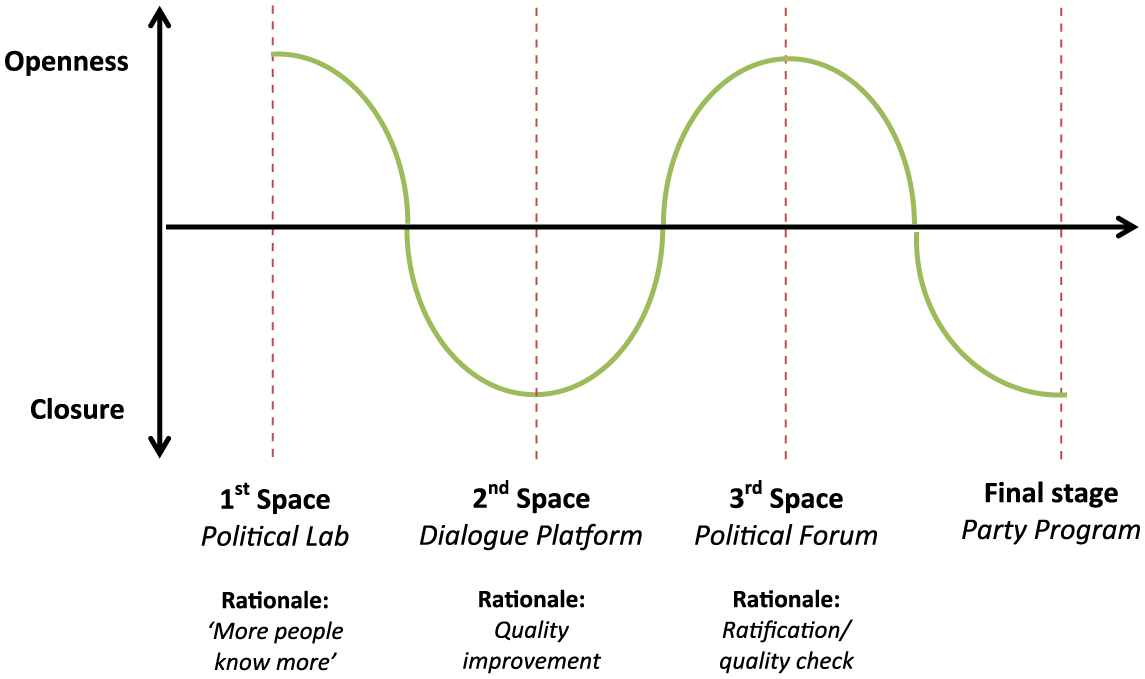
The Alternative’s organization of open-source politics from a space-sensitive perspective.
In what follows, we discuss the organizational repercussions of this process by highlighting three dialectical relationships that seem to configure The Alternative’s organization of open-source politics.
Between imagination and affirmation
As shown in the analysis, the Political Laboratories constitute a space of openness and ambiguity where no attempt is made to fix meaning by privileging some ideas and marginalizing others. As one respondent explained, the intention is to provide a space where ‘completely unrealistic’ ideas are welcome. Through a series of techniques and a mesh of material entanglements, the rationale of ‘More People Know More’ is sought realized in the laboratories. You could argue that the laboratories provide ample conditions for ‘political imagination’ (Castoriadis, 1997: 55).
Recently, the literature on imagination as a politically relevant concept has blossomed within organization studies (De Cock et al., 2013; Komporozos-Athanasiou and Fotaki, 2015). This is because imagination is seen as a key ingredient for organizations to envision new pathways and challenge dominant modes of representation and being (Wright et al., 2013). The concept of imagination is usually traced back to Castoriadis, who devoted much of his writings to exploring how something ‘new’ comes into being in an always already instituted society (De Cock, 2013). This happens when human beings use their immanent capacity for evoking images—or ‘imaginary significations’—of things yet to come (Castoriadis, 1987: 146). Conceived as a practice, imagination might be understood as the creative exercise by individuals and collectives of evoking that which does not yet exist.
In the analysis, we described how the facilitators of Political Laboratories used a number of techniques to engage individuals and groups in generating ideas (e.g. by establishing debate principles and organizing the space to trigger interactions among participants) and to create an atmosphere of recognition of even the most unconventional ideas (again, the debate principles as well as bodily exercises). These techniques are all intended to keep the discussions open, which is something that lies at the heart of imaginative practices. Imagination has been described as containing a break with the closure of meaning (Komporozos-Athanasiou and Fotaki, 2015: 328). As such, imagination could be seen as an inherently political activity. As Karagiannis and Wagner (2012) argue, ‘one may see the work of imagination as that which constitutes politics under conditions of autonomy’ (p. 14). Accordingly, the practice of imagination is afforded by spaces that provide autonomy, which allows people to resist the imposition of heteronomy by breaking with the closure of meaning. It requires little effort to see how the Political Laboratories constitute exactly such a space.
In contrast, the Dialogue platform is much more concerned with improving the quality of already fixed proposals. This is done through a somewhat restricting code of conduct, which is embedded in the technological affordances of the platform. As we showed in the analysis, the platform is technically geared to hinder long and obstructive comments (through pop-up boxes and guidelines) and to privilege users that contribute in very specific ways. These techniques help constitute Dialogue as a space of closure and fixity. Hence, you could argue that Dialogue only provides conditions for affirming an already fixed meaning since users are deprived of the ability to contribute directly to the submitted proposals. There are few incentives for engaging in imaginative practices because it appears that comments are neither encouraged nor used for anything. And as we saw in the analysis, this effectively kills discussions. Looking at the entire process of policymaking, the proposals created in the political laboratory are basically only affirmed in the digital space.
Curiously, however, the closure of meaning is once again broken in the Political Forum. This is done through a series of techniques that closely resemble those of the laboratories: energizing exercises, brainstorming activities, post-it notes, and so on. Hence, it becomes evident how The Alternative’s organization of open-source politics oscillates between openness and closure and how that oscillation produces a dialectical relationship between the practices of imagination and affirmation.
Between digital and physical spaces
These observations about the relationship between imagination (understood as the practice of evoking something new) and affirmation (understood as the practices of solidifying something already fixed) point to an important observation in relation to the spatiality of political organization: The physical spaces, represented by the Political Laboratories and the Political Forum, provide ample opportunities for political imagination. In contrast, the digital space, represented by Dialogue, effectively removes that possibility by reducing the interactions on the platform to a matter of quality improvement. In other words, while the physical spaces provide conditions for politics, the digital space solidifies the outcome of politics.
This finding runs counter to one commonly held view of digital media in politics. Here, digital media (and especially Web 2.0 applications) are seen as providing ordinary citizens with the possibility of participating in the horizontal mass construction of politics (Bekkers and Homburg, 2005; Castells, 2009; Dunleavy et al., 2006; Hardt and Negri, 2011; Shirky, 2009). The networked character and the permeable boundaries of these applications allegedly blur the distinction between producers and consumers to a point where every user is transformed into a ‘produser’ of politics (Bruns, 2008). For instance, as argued by Castells (2009), the diffusion of the Internet has helped strengthen people’s capacity to act autonomously, which in turn has allowed the ‘creative audience’ to instigate social change much more efficiently than prior to the rise of what he calls ‘technologies of freedom’ (Castells, 2009: 414).
However, despite Dialogue’s networked infrastructure and permeable boundaries, it does not grant ordinary citizens the autonomy to become active participants in the co-creation of The Alternative’s political program. Instead, it offers participants a chance to express their views and debate policy proposals without any direct impact. This is, to a large extent, a consequence of the platform’s constraining affordances rather than an inherent vice of digital media and the Internet as such. As explained by a respondent working with digital developments in The Alternative, the Dialogue platform ‘nudges’ people to avoid posting too long and obstructive comments by awarding badges to users who conform to the purpose of the platform. In this way, Dialogue is built to afford ‘restrictions on speech’ rather than ‘freedom of speech’. The Alternative’s digital platform hence functions more as a device for improving and legitimizing policy proposals than as a device for actually including citizens in the creative exercise of co-creating politics.
This finding contributes to the literature on open-source politics by highlighting the importance of physical spaces in the organization of bottom-up policymaking. Traditionally, this literature has been characterized by a soft technological determinism, manifested in a somewhat myopic focus on digital media and the democratic potential of the Internet (e.g. Hindman, 2007; Karpf, 2011; Kreiss, 2011). For instance, as Sifry (2004) notes, ‘New tools and practices born on the Internet have reached critical mass, enabling ordinary people to participate in processes that used to be closed to them’ (n.p.). However, as this article has shown, it is not necessarily the Internet-based tools that open up previously closed processes but instead tools and practices born in the physical world. This is the case not just because physical spaces—at least in the case of The Alternative—invite political imagination and change but also because the physical congregation of people creates an opportunity for using affect to broaden the scope of what policymaking might be (see also Dean, 2016: 220–222). In other words, open-source politics cannot be equated with online politics but should be seen as a practice comprising activities in both digital and physical spaces.
Between universality and particularity
Drawing on the vocabulary of Laclau (1996a, 1996b, 2001), one could describe The Alternative’s transformation from movement to party as a move from universality toward particularity. For Laclau, all social groups that are structured around specific political interests can be understood as particularities. They become universalized, however, once they assume the task of representing the larger community by partially surrendering what initially made them particular (Laclau, 1996a). When political projects become hegemonic, they usually undergo the above-mentioned process of universalization (Laclau, 2001) in which a particular identity is decontextualized and turned into a more or less ‘empty signifier’, that is, a signifier without a signified (Laclau, 1994). For instance, consider the detachment of the social democratic project from the working-class struggle—or more recently, the detachment of the Pirate Parties from issues of Internet freedom and copyright laws (Miegel and Olsson, 2008).
However, The Alternative (and similar parties like Podemos in Spain) seems to go through the exact opposite process: Instead of universalizing their political project, they particularize it by seeking to institutionalize an otherwise universal identity. In other words, once The Alternative abandoned its status as a ‘movement without demands’ and began crafting a detailed political program, they entered the process of particularization. This, however, created a problem because particularization invariably narrows the scope of representation (Laclau, 2005: 89). Elsewhere, this problem has been referred to as the problem of particularization (Husted and Hansen, 2017). But why does The Alternative’s (2013) ambition of representing ‘anyone who can feel that something new is about to replace something old’ not collapse under the pressure of particularization? As already indicated, the party’s spatial organization of open-source politics might help us answer that question.
The closing down and subsequent reopening of the process of policymaking reveal an interesting finding that has significant consequences for The Alternative as a political organization. Aside from breaking with the intention of moving linearly from openness toward closure, the winding process could be seen as breaking The Alternative in two. This breakup is illuminated by this article’s space-sensitive perspective: While the first two spaces (Political Laboratories and the Dialogue platform) belong to The Alternative as a movement, the latter space (Political Forum) and the party program belong to The Alternative as a party, and while anyone is allowed to participate in the movement, only a handful of people are allowed access to the party’s process of policymaking. From an organizational point of view, the transformation from movement to party thus seems to split The Alternative into two types of loosely coupled systems (Weick, 1976): one that operates at the level of particularity (the party) and one that remains universal (the movement).
As such, both movement and party have their own process of policymaking. While the movement’s process begins with a laboratory and ends with the Dialogue platform, the party’s process begins with a Political Forum meeting and ends with the political program. In this way, both the universal and the particular part of The Alternative contain spaces of openness and closure that afford the associated practices of imagination and affirmation. Of course, this does not mean that there is no link between The Alternative as a movement and The Alternative as a party. After all, it is usually the movement’s actors who decide which policy area to develop, and many of the ideas that surface during laboratories will make it into the political program.
Conclusion
These observations lead us back to this article’s main research question: How does open-source politics help political organizations like The Alternative cope with the transition from movement to party? The most straightforward answer to this question seems to be that The Alternative has somehow found a way to bridge the otherwise unbridgeable chasm between the universal and the particular. However, as shown above, another answer presents itself. By tying the process of policymaking to three different kinds of organizational spaces, The Alternative’s version of open-source politics oscillates back and forth between openness and closure, as illustrated by Figure 2. This oscillation then produces a dialectical relationship between the practices of imagination and affirmation—and this is what, ultimately, seems to split The Alternative into two loosely coupled systems operating at two different levels.
This finding contributes to our understanding of radical political parties and the organizational repercussions of entering parliament. In order not to lose their universal appeal, radical political parties must (partially) decouple their universal body from their particular body. This partial decoupling provides the MPs with room for maneuver in terms of seeking influence at the level of realpolitik. At the same time, it allows the movement actors room for maneuver in terms of imagining different radical futures beyond the scope of realpolitik. While there may be multiple ways of staging such a decoupling, we nonetheless argue that some kind of decoupling is vital for radical political parties that seek to maintain a universal appeal. The case of The Alternative’s spatial organization of open-source politics is but one example of this.
A series of implications for studies of political organization follow from this. First, the case of The Alternative shows that bottom-up processes can be far more ambiguous and non-linear than they usually appear to be. A space-sensitive perspective helps illuminate how different organizational spaces afford different practices and how that ambiguity might have serious consequences for the organization(s) involved. In this analysis, space becomes an important organizational object in the decoupling process described above. Also, this article’s focus on the dialectical relationship between physical and digital spaces reveals how physical spaces tend to provide much better conditions for political imagination—and politics in general—than digital spaces (see Husted, 2015, for a similar argument in relation to the Occupy movement). This insight did not arise from preconceptions about physical and digital spaces but was a significant empirical finding of the study—one that we think political movements organizing from below should pay more attention to.
Finally, the organizational decoupling between The Alternative’s universal and its particular body suggests that the sole purpose of open-source politics may not be actual policymaking. Instead, such bottom-up processes may be of equal (if not superior) importance to mobilization purposes. Far from being a drawback, this dual purpose is in keeping with the post-capitalist ambition of viewing open-source politics as both a means and an end (Weber, 2004: 56) and so is the collaborative and nonproprietary spirit that characterize bottom-up policymaking in general (Mason, 2015). As such, we do not claim that The Alternative is necessarily a post-capitalist project in itself but that the party’s organization of open-source politics can be seen in this way. In fact, the very act of inviting people to evoke and share images of alternative futures may be as important to the progressive agenda as actually translating these images into particular policy proposals, as it allows people to transform themselves into subjects of a post-capitalist politics. And that is, as Gibson-Graham suggests in our epigraph, at least one way that counter-hegemony is enacted.
Footnotes
Acknowledgements
We would like to thank Anne-Laure Fayard, Sara Louise Muhr, Peer Hull Kristensen, Vincent Pasquier, Héla Yousfi, and the participants in the 2016 EGOS subtheme on Organizational Practices of Social Movements for their valuable comments and encouraging remarks. Furthermore, we would like to thank the anonymous reviewers and the editors for their constructive feedback and helpful guidance.