




Abstract
It is said that all the world is a stage. But how do organizations physically stage performances such as sales pitches and research presentations? Drawing on a 14-month-long ethnographic study at a Fortune 500 strategic research company, this article explains how. Emphasizing the active role of human and non-human actors, it uncovers three staging practices that organizations use to transform spaces into stages. Organizations theme stages by populating them with certain objects. They produce a style of performance by arranging relationships between performers and audiences. Finally, they order movements from one stage to others so that plots emerge. Theorizing these staging practices through a materialist dramaturgy, the article challenges existing organizational theory that tends to focus on the ways organizations control and script performances. The article shows that organizational performances in service and knowledge organizations can be improvisational. They are not preordained but they are organized.
Introduction
This article analyses spaces where one organization performs for another. Examples of such spaces include meeting rooms, conference facilities and reception areas. These are essential to many organizations, especially those involved in the service and knowledge economies. They use them to pitch for investments, clients and staff, build relations and communicate information.
Despite their importance and a growing interest in space across the social sciences, organizational research has focused, instead, on liminal, hybrid and connecting spaces such as corridors and home offices and the relationships between physical and digital spaces (Cluley and Green, 2019; Gregg, 2011). These are theorized through the notions of enactment (Munro and Jordan, 2013), performativity (Beyes and Steyaert, 2012) and dialectics (Sivunen and Putnam, 2020) to show how occupants construct meaningful places from material space. Performance spaces differ from such spaces because they are designed to relate occupants as audiences and actors. As such, a dramaturgical perspective may offer fresh insight. Yet, space has rarely been considered as more than a background for action in organizational dramaturgy.
So, inspired by new-materialism, the article develops a materialist organizational dramaturgy through the thinking of Bertolt Brecht (1948, 1950a, 1950b, 1957, 1961). He emphasized that a stage can harness the acting capacity of humans and non-humans to produce improvizational performances. The article uses this perspective to interpret a 14-month ethnographic observation of an anonymized Fortune 500 strategic research company. Its award-winning European-based head office includes dedicated performance spaces that support its brand identity and production process. The article illustrates how these spaces are turned into stages through three staging practices: each space is themed through the selection of symbolic objects and designs features; each space arranges relations between audiences and actors to produce a distinct style of performance; and the spaces link together to create a plot. In each case, human and non-human objects act on the stages.
Through this analysis, the article makes three contributions. Its central contribution is to organizational dramaturgy. It exposes a limited conceptualization of materiality, direction and performances within the theoretical foundations of this perspective. The article also develops the organization study of space. Accessing spaces where organizations perform for other organizations, it focuses on an organized space that has rarely been considered and challenges researchers to recognize material and organizational differences between organized spaces. Finally, the article speaks to the methodological debates around post-qualitative inquiry. It suggests an abductive method of analysis may help organizational researchers to capture the materiality of organizational interactions.
To develop these contributions, the article first contextualizes recent thinking in organization theory. Introducing new materialism, it suggests that organization theory has yet to account for the materiality of space. Picking out a motif of performance from this discussion, the article suggests that dramaturgy offers potential insights into organized spaces. But it argues that organizational dramaturgy, too, has yet to fully explore the materiality of organizational performances. Turning to the dramaturgy of Bertolt Brecht, the article develops a post-qualitative inquiry and presents ethnographic data to illustrate three staging practices that allow an organization to transform spaces into stages. It concludes with reflections on organizational dramaturgy and organization theory.
Space and organizations
Space is ‘a key concept for the study of organizations’ (Munro and Jordan, 2013: 1497). It was a foundation of early management theory and sociological understandings of formal organizations. The former developed into an interdisciplinary literature exploring the impact of space on productivity, creativity, job satisfaction and other variables (Allen and Henn, 2007; Duffy, 1974; Newman, 1977). The latter views organized space as a symptom of social trends. Mills (1951: 189), for instance, sees sky-scrapers, office cubicles and computer rooms as ‘monuments’ of a bureaucratic society. Yet, as Milligan (1998: 5) observed two decades ago, such sociological analyses ‘rarely identify the human–environment relationships as the object of inquiry’ per se.
Recent contributions to organization theory directly address these relationships. They explore the symbolism of organized space (Decker, 2014; Hurdley, 2010; O’Neill and M’Guirk, 2003), the relationship between space and power (Courpasson et al., 2017; De Vaujany and Vaast, 2013; Fahy et al., 2014; Hirst and Humphreys, 2013; Zhang and Spicer, 2014) and the generative powers of space (Edenius and Yakhlef, 2007; Kornberger and Clegg, 2004). Generally, work in this area theorizes space as a social construction (Baldry, 1997, 1999) and emphasizes the experiences of the occupants of organized spaces (Edenius and Yakhlef, 2007). This is manifest in accounts that view space as being enactive, performative and dialectic through the thinking of Lefbreve (Dale and Burrell, 2008; Klaebe et al., 2009) and Foucault (Hardy and Thomas, 2015).
This trend is not without critics. Some writers caution that it uses concepts with limited applications to the materiality of organizations (Learmonth et al., 2016). For Cabantous et al. (2016: 197), for instance, the recent use of performativity ‘overlooks the materiality’ of the concept. A critical reading of organizational studies of space, then, suggests they have performed a theoretical vanishing act. They have paid greater attention to the material environment but, interpreting it as a practice (Fleming and Spicer, 2004), experience (Wapshott and Mallett, 2012) or tactic (Munro and Jordan, 2013), rarely address its materiality.
One reason for this may be a long-standing fear of determinism (Latour, 1994). However, the humanities and social sciences have witnessed renewed interest in materiality without resorting to vulgar determinism through new materialism (Fox and Alldred, 2016). It starts from the observation that the social and the material are integrated, even inseparable. As Latour (1994: 51) puts it: ‘To be human requires sharing with nonhumans.’ In fact, more and more, our social interactions, thoughts and feelings are not only facilitated by technical objects but are also produced by them (Wiberg, 2018). We are, in Haraway’s (1985) terms, cyborgs. So, rather than see materiality as static or socially constructed, new materialism approaches it as vibrant and active (Bennett, 2010). At the same time, it encourages us to integrate the human as a constitutive element of the physical environment (Luusua et al., 2017).
For some, this insight means we must develop an explicitly object-oriented ontology that accounts for material things in and of themselves (Harman, 2018). For others, it means we must develop relational conceptualizations that blur divisions between human and non-human actors (DiSalvo and Lukens, 2011). Such an approach emphasizes the more-than-human relationships that constitute contemporary human subjectivities. It demands ‘a renewed kinship system, radicalized by concretely affectionate ties to the non-human “others”’ (Braidotti, 2006: 199). This thinking has already been applied to spaces as researchers have asked how we can extend spatial practices such as participative design to incorporate more-than-human relationships (Forlano, 2015, 2017; Forlano et al., 2019; Wakkary, 2021).
Burrell’s (2013) notion of styles of organizing sets these concerns within organizations. Organizations, he tells us, involve cultures, identities, knowledge, communications and materiality. Burrell (2013: 73) explains: ‘The architecture of our thought systems, by which we undertake the ideational organizing of ourselves, resembles in no small measure that solid material architecture in which we walk, work, and sleep.’ Accordingly, Burrell (2013: 19) calls for organizational researchers to ‘look up at the buildings that they inhabit – but to think foundationally’. If we do, we will see ‘the same underlying expressions [and] intra-actions’ at work in political systems, architecture, management and work (2013: 19). New materialism, then, challenges organization theory to understand both the meeting points between space and action and how the materiality of organized spaces mediates action (Burrell and Dale, 2014).
Performing spaces: The drama of organizational life
A dramaturgical account may be a productive way to think through these issues. That is, if space is performative, surely we should consider the performances. The motif of a performance has been used to unpack materiality elsewhere in the social sciences. Latour (1994: 31), for instance, tells us that every artefact ‘has its script, its “affordances”, its potential to take hold of passersby and force them to play roles in its story’. Organizational dramaturgy starts from a similar idea. It assumes that ‘many aspects of life in organizations and elsewhere may be seen as being staged’ (Mangham, 2005: 943). Yet, in comparison to related fields (e.g. Foth et al., 2011; Seeburger et al., 2015), organizational dramaturgy primarily focuses on actors and their performances rather than the stages where performances take place. That is to say, although organizational dramaturgy starts from the idea that many aspects of life may be seen as being staged, it has yet to account for the staging of organizational life.
One reason for this is that organizational dramaturgy leans heavily on Goffman and his interpretation of Burke. There is a limited conception of stages in Burke’s original dramaturgical pentad. It explains an individual’s actions through five concepts (act, scene, agent, agency, purpose). The scene concerns ‘the background of the act, the situation in which it occurred’ (Burke, 1945: xv). Goffman (1959: 32–33) develops this in his concept of the setting. It covers the ‘furniture, décor, physical layout, and other background items which supply the scenery and stage props’ for a performance. For Goffman, these background material objects work symbolically. London chimney sweeps and perfume clerks, for example, wear ‘white lab coats to provide the client with an understanding that the delicate tasks performed by these persons will be performed in what has become a standardized, clinical, confidential manner’ (Goffman, 1959: 36–37). Expanding this in his work on total institutions, Goffman (1961: 98) claims the selection of material objects has ‘substantive implications’ for the self-presentation of organizations. He notes that many objects in organizational spaces have no practical use other than impression management. For illustration, Goffman discusses a prison that displays inmates’ artworks. He argues that, as material objects, they symbolize the prison’s commitment to do more than simply house criminals. They show that the prison allows its inmates time, space and resources to engage in cultural activities and suggest it is focused on reforming criminals for release back into society.
The setting, though, differs from Goffman’s conceptualization of a stage. A setting is made up of material objects. But a stage is ‘any place that is bounded to some degree by barriers to perception’ (Goffman, 1959: 109). Settings differ from stages, in other words, because stages encourage people to relate as actors and audiences. Here, Goffman implies a conceptual distinction between objects in a setting and actors on a stage. Both material objects and human actors represent cultural-defined ideas through what Goffman (1959) calls their appearance. But only human actors can modify the meaning of their appearance through the manner of their performances. Material objects cannot act in this way. For Goffman, they only appear – inert and passive.
The challenge for organizational dramaturgy in light of new materialism is, then, much like the challenge for organizational studies of space. If the materiality of objects matters (Wiberg, 2018), both need to consider the more-than-human relations in the constitution of human experience. In dramatic terms, organizational dramaturgy must consider how, when and where material objects act and how a physical space becomes a stage for more-than-human performances.
Staging and performances
To develop a materialist dramaturgy, we can turn to Bertolt Brecht, a German playwriter, poet and dramaturg born 10 February 1898 in Augsburg. He is a notable absence in organizational dramaturgy as he developed a unique approach to organizing theatrical performances. He is also ‘the rare dramatist who has written copiously and clearly about designing his plays’ (Baugh, 2006: 272). Moreover, Brecht’s ideas have profoundly influenced social theory. Walter Benjamin (1966) wrote about Brecht, as did Roland Barthes (1974).
For Brecht, a performance is a manifestation of a division of labour among a specific group of directors, dramaturgs, stage designers, writers, researchers, publicists, stagehands and actors. He believed that they can be organized to unleash their collective creative capacities or constrained to perform predefined individual functions. In this regard, Brecht distinguishes two unique styles of performance: the critical and the detached. Critical performances provoke productive responses on the part of actors and audiences. They ‘leave the spectator’s intellect free and highly mobile’ and present social rules and conventions ‘as imperfect and provisional’ (Brecht, 1948: 8–16). In contrast, detached performances leave actors and audiences ‘unaltered’ and allow them to ‘swap a contradictory world for a consistent one’ by forcing them into predefined roles (Brecht, 1948: 6).
The key point is that the style of a performance is not related to its content, only its organization. Central to this is Brecht’s concept of alienation, which he describes as ‘his great productive method’ (1948: 9). Brecht viewed alienation as a theatrical effect that makes the familiar become unfamiliar and the fixed become malleable. It occurs in a theatre when a performance allows participants to maintain but reframe their connections to the world outside. As Brecht (1948: 9) writes, audiences must ‘not to forget their cheerful occupations while we hand the world over to their minds and hearts, for them to change as they think fit’. Actors, too, must not ‘go so far as to be wholly transformed into the character played’ (Brecht, 1948: 9). They must present a double role by acting the character and showing themselves as an actor playing the role. These connections to the outside world challenge audiences and actors to look critically at themselves and each other during a performance. Through this, in a critical performance, they may see that their roles inside and outside of the theatre are open to innovation. Brecht’s first potential contribution to materialist organizational dramaturgy is, then, his insight into the unique styles of performances that can be produced through arrangements of actors and audiences.
Stage design is central to the creation of alienation effects (Brecht, 1950a, 1950b). Stages that reveal their social production alienate the relationships between actors and audiences. To achieve this, Brecht (1957, 1961) famously removed traditional spatial divisions between audiences and actors such as the curtain at the back of a stage and the fourth wall at the front. He would expose support staff and infrastructures to the audience to reveal the social practices needed to produce a performance. However, Brecht’s stages could also be elaborate, technological and cluttered. His productions used banners, projections and screens that commentated on the action. Background objects could unexpectedly speak or allow audiences to interact with them. Here, Brecht’s dramaturgy differs from organizational dramaturgy in a second notable way. Organizational dramaturgy often assumes that support work takes place backstage and performances take place in front regions. Brecht removes this distinction entirely – seeing only a single process.
Notably, for Brecht, the form of a stage is less important to the style of a performance than the way the stage is produced. That is, it is not the stage but the staging that is the subject of Brecht’s theory. Both minimal and cluttered stages can produce alienation effects as long as they reveal the performance as a social practice. Indeed, Brecht did not accept that a stage simply determined action. A stage, he was fond of saying, makes suggestions. In this regard, Brecht asked his designers and actors to work together throughout the production of a play. Even if a designer had responsibility for a stage, Brecht did not grant them dictatorial power to design it as they wished. Rather, he made them responsible for organizing a production process to allow actors and others to shape, reshape and improvise spaces. Brecht wrote: ‘This is how a good stage designer works. Now ahead of the actor, now behind him, always together with him. Step by step he builds up the performance area, just as experimentally as the actor’ (in Baugh, 2006: 265–266). In this sense, a final potential contribution of Brecht’s dramaturgy to a materialist organizational dramaturgy is to consider the construction of a stage as part of a performance.
Bringing this together, new materialism challenges the organization studies of space to develop an understanding of the materiality of organized space. Thinking about materiality through the motif of performances encourages us to account for space as a stage. Yet, here, too, while thinking dramaturgically, organization theory has not thought materially. Brecht’s dramaturgy suggests, instead, that it is possible to link the organization of a performance to particular types of social interactions via the materiality of a stage. Thus, Brecht opens up the possibility of developing a materialist organizational dramaturgy that accounts for the staging of organizational life.
Research methods
To explore the materiality of performances in organization life, in what follows, this article reports an organizational ethnography of a strategic research company. This ethnography did not set out to consider organizational performances, dramaturgy nor space. It was conducted by the author, who, following Watson (2011), sought to document the working of an organization and reflect on their experiences learning how to participate in the action. However, space and performances emerged as two key features of the research setting that demanded explanation.
Research setting and data gathering
The host organization, anonymized as SuperTech, is a strategic research company that was started in the late 1990s. It has since grown to employ over 500 staff spread across 20 offices worldwide. Shortly before ethnographic observations commenced, it was acquired by a Fortune 500 media conglomerate. It is split into five functional teams (Creative, Coding, Sales, Research and Strategy, and Admin), each organized hierarchically with Junior- and Mid-level Executives reporting to a Team Director who, in turn, reports to one of the Founders. Each team is led from SuperTech’s European head office. There are daily online meetings with international team members (called ‘huddles’) and regular in-person visits to the head office by overseas staff. The head office is also a central meeting place for SuperTech’s clients and representatives of its holding company. It is a key part of its brand. The Creative Team has formal responsibility for all aspects of its built environment.
Access to the research site was negotiated in 2017. Initial contact was made at an industry workshop. The author pitched a study to SuperTech’s Research and Strategy Director focusing, broadly, on understanding their research processes. In exchange for access, the author committed to conduct a literature review and work as an unpaid Junior Executive in SuperTech’s Research and Strategy Team. This role had responsibility for reviewing survey results, preparing presentations and research reports, coding media content and attending meetings and presentations. SuperTech’s willingness to support the research may have been influenced by their long-standing commitment to knowledge exchange with academic institutions. Not only did the founders hold teaching affiliations at European universities, SuperTech had also established collaborations with North American universities and had previously hosted academic researchers onsite. These relations were promoted in their marketing materials and had led to new product innovations. SuperTech did not, however, have explicit interest in the current research and only asked to view any research reports prior to publication.
Data gathering involved 225 hours’ full participant observation. Although all members of the organization were informed by email that the author was conducting ethnographic observations, the author used a laptop to type notes, record sound clips, take photographs and videos, and capture on-screen images in situ without disturbing the onsite action. Over 250 photos and over 200 screengrabs were gathered; 10 company meetings and presentations were recorded; and 30 huddles were observed. The author was added to mailing lists and recorded online activity for a further 12 months between 2017 and 2018. In addition, 23 unstructured interviews were conducted by the author to help focus the analysis and probe for relevant details. Three interviews took place prior to the ethnographic observations, nine during and 11 after. They did not focus exclusively on materiality, space nor performances but these were discussed in many of them.
Data analysis
Similar to Ghaffari et al. (2021), Rennstam and Kärreman (2020) and Skovgaard-Smith et al. (2020), who approach ethnographic analysis abductively, the analysis began as the ethnographer followed ‘ideas and hunches’ from the field (Hammersley and Atkinson, 1995: 205). The author noted the importance of the physical environment at SuperTech. Posters, artefacts and layout of offices changed daily, although the author never saw anyone changing them. Likewise, the author was surprised by the regularity with which distinct interactions played out in specific spaces. The author was also struck by how many discussions took place about the design of the office space.
The author treated these observations as ‘research puzzles arising in the field’ (Watson and Watson, 2012: 685) and explored them further after the onsite observations. Turning first to organization studies and organizational dramaturgy, the author used fieldnotes, photos and other ethnographic data to consider SuperTech’s head office as housing several types of space (liminal, managed, digital and so on). This led the author to focus on their observations of performances. A formal analysis began by dividing images and notes about the head office into stages with corresponding performances. A focus on representations of space was guided by new materialism. According to Braidotti (2006: 200), ‘new forms of literacy’ are needed to reimagine the relationships between humans and non-humans. She calls for a qualitative shift beyond the division of experience and materiality into post-qualitative methods that allow objects to speak and humans to materialize. As Braidotti (2019: 123) explains, post-qualitative inquiry can take ‘the form of cartographic renderings of embedded and embodied relational encounters. These encounters can be with texts, institutions or other concrete social realities, or people’. To this end, the aim of the initial analysis was to visualize, describe and categorize key features of the stages and performances using fieldnotes, sketches and photographs, sound recordings and videos.
Three stages were selected for detailed analysis (the TestLab, the Main Office and the Townhall). They were identified by the author and interviewees as key to SuperTech’s operations. As such, this selection is not meant as an exhaustive account of the stages at SuperTech and is not intended to summarize all performances and all stages that were observed. Rather, these stages operate more like ideal types.
Having rendered these stages and performances in visual and textual form, the analysis utilized the author’s onsite experiences to articulate how the stages shaped roles, actions and the relationship between audiences and performers. This is based on Watson’s (2011) method for reporting ethnographies of organizations. He asks ethnographers ‘to write about the understandings’ they observed and learned during ethnographic observations so that ‘any reader would be able to cope and survive’ in the research setting (2011: 209). Starting from this idea, the visualizations and descriptions of stages stimulated a reflexive account of the author’s experiences in each stage. The author iterated between these renderings, the ethnographic materials and organizational literature to clarify and expand these accounts.
At this point, the notion of a theme emerged to cover the symbolism of each stage (see Gottdiener, 2019). However, the author felt that this was insufficient to fully answer the research puzzle. The author felt that the physical environment was more than a symbol. It also shaped performances. Here, the author returned to dramaturgy. Taking a lead from Boje et al.’s (2003) call for a critical dramaturgy of organizations, the author turned to Brecht. As Carney (2005) explains, Brecht’s thinking is essential to understanding modern critical theory. Brecht’s theorization of distinct performance styles provided an initial interpretative framework that helped ‘disentangle complexities’ in the data (Skovgaard-Smith et al., 2020: 1591). Specifically, it encouraged the author to think beyond the appearances of the stages to the ways they arranged audiences and actors. This allowed the author to articulate two further elements of the stages (style and plot). Together with themes, these were conceived as staging practices. With this analytic framework in place, the author returned to the visual and textual descriptions of the stages and performances to link the staging practices, stages and performances.
This analysis was introduced by the author in the 11 ethnographic interviews that followed the period onsite to test face validity. This suggested the analysis had resonance with interviewees’ experiences. For example, the Creative Director confirmed the performance spaces were designed to stimulate specific and distinct responses. Echoing Brecht’s definitions of detached and critical performances, he said stages such as the Townhall were designed to ‘be stimulating’ so that occupants ‘focus on something else, then the solution comes naturally’. Other spaces, such as the Main Office, are ‘fun and serious’. Others communicate SuperTech’s ‘brand values’.
In what follows, ethnographic materials are presented to illustrate the physical nature of each stage and the typical performances that were observed during the observations. Stages and performances are described with an emphasis on the material cues that helped the author learn how to act. Relevant images that were captured during ethnographic observations have been anonymized from original photographs as line drawings with distinguishing features edited out by a professional graphic designer in keeping with the author’s agreement with SuperTech – original photographs and videos were used in the analysis. Following this, elements of each stage are highlighted to illustrate the three staging practices developed through the application of Brecht’s dramaturgy to the case.
Stages of organizational performances
SuperTech’s head office is located in a gentrified area of a large European city. It comprises a basement, street-level reception and three storeys. A lift and two staircases connect the floors. The basement is made up of four main rooms: a glass-walled meeting room used by the company’s executive group; a chill-out room with incense, mood-lighting and ambient music; a gaming area with sofas, bean bags, storage for bikes and staff lockers; and the TestLab. The ground floor houses SuperTech’s reception desk and waiting area. The first and second floors are open-plan offices. The top floor comprises a small room for internal meetings, an outside roof terrace and the Townhall.
The TestLab
SuperTech pitches to prospective clients in the TestLab. It comprises two areas demarcated by separate colour schemes. The first area one enters is painted white. It is centred around a large white vinyl conference table (see Figure 1.1). Next to the entrance, white lab coats hang from pegs on the wall. There is a large monitor for conference calls on the opposite wall and smaller touchscreen displays housed in ornamental picture frames hanging from another white-washed wall. When touched, the smaller displays play pre-recorded videos about SuperTech’s business, interviews with consumers (actually SuperTech’s staff acting as consumers) and other brand-related clips. Display frames with various scientific objects such as DNA strings hang on the final wall. In a second area, which is painted grey, there are two rows of green plastic chairs facing 11 large wall-mounted touchscreen displays (see Figure 1.2). Each plays a set of interactive slides that make up SuperTech’s sales pitch. A large telescope and other scientific artefacts are scattered around this section of the room (see Figure 1.3).
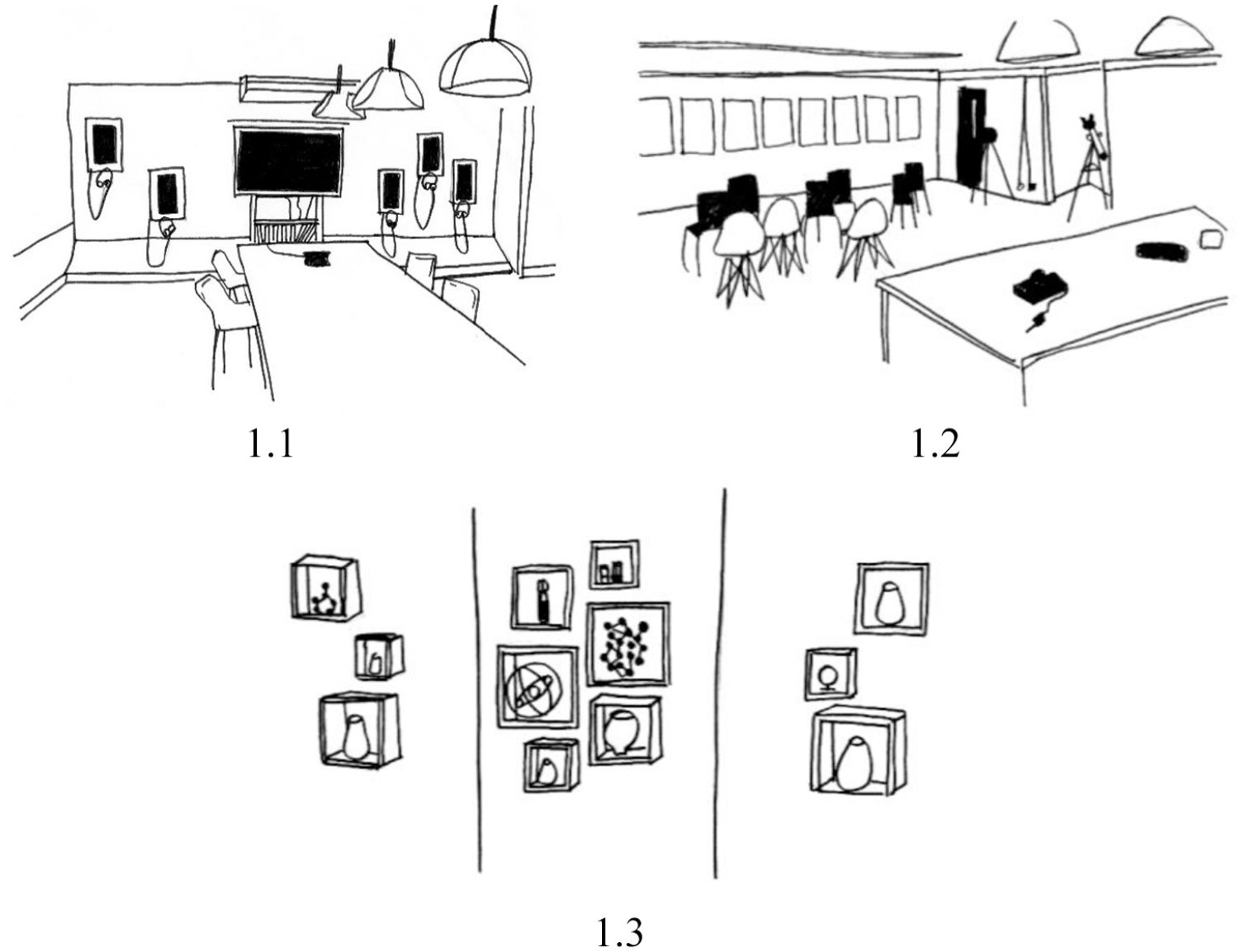
The presentation stage in the TestLab.
The TestLab is closed off from the rest of the organization and the outside world. Access is limited to a single entrance. Indeed, during the observation period, only the Research and Strategy Team Director admitted the researcher into the TestLab. In other cases, for example, when SuperTech’s staff need a meeting room, the TestLab was never used.
When there is a sales pitch, everyone in the company is informed by email. A sign is put up in the reception area to welcome the clients and inform everyone that a pitch is taking place. When this happens, the entire basement is avoided by staff unless they are involved in the pitch. The controlled access to the TestLab is reflected in fieldnotes written during the ethnographic observations. In Week 4, the fieldnotes describe the researcher’s first visit to the TestLab and note that staff outside did not acknowledge them entering it: Research and Strategy Director returned from lunch and asked me to go to the TestLab. In the basement outside the TestLab, three girls sat on bean bags. I recognized one from reception. Even though I’d spoken to her at length earlier and I tried to make eye contact, she didn’t even look at me nor Research and Strategy Director. He opened the door of the TestLab and said ‘Here’s where the magic happens.’ He offered to talk me through the pitch as if I were a client. I had to wear a lab coat. I asked if clients do this. ‘Sometimes’, he laughed, ‘We always ask them.’
The pitch itself is choreographed around the material space. Walking into the TestLab, clients are asked to put on one of the lab coats that hang next to the entrance. Clients may find this uncomfortable, but SuperTech’s Sales Team use it as a form of cold reading to profile them. A member of the Sales Team explained during an interview that it reveals clients’ attitudes to SuperTech’s brand and power dynamics within client teams. Such information is used in the presentations just as a hypnotist ‘gets a read’ on suggestible audience members before they begin their performances. The pitch itself is a scripted presentation delivered by Sales and Research teams. Presenters seamlessly tap the large wall-mounted touchscreens to bring up pre-loaded audio-visual materials. Each slide is arranged on a specific screen in a specific order so that presenters only have to press the screen to access the correct image. But they must move in harmony with the screens to ensure they are in the right place to access a slide. SuperTech’s Admin Team ensures that all the materials are in place days before a pitch.
During a pitch, it is by no means impossible for a client to voice concerns, ask questions or press a large touchscreen. But there is a sense that these actions are prohibited in the grey area as clients sit together as an audience away from these objects. As a result, audience members tend to allow presenters to work through their script uninterrupted. Returning to the white area after a presentation, the audience feel free to interact around the conference table and interact with the physical environment such as the headphones and small touchscreens.
The Main Office
Day-to-day production activities take place in an open-plan office spread across two floors called the Main Office. It includes three glass-fronted meeting rooms and an open-plan kitchen (see Figure 2.1). It is a space for typical office work (writing emails, participating in conference calls and producing electronic documents). Despite housing nearly 100 workers, the Main Office is remarkably quiet. Most workers listen to music through headphones and engage in online chats with colleagues and clients over headsets. In contrast to the TestLab, there is little control over who can access the Main Office. This applies to SuperTech’s own staff and visitors.
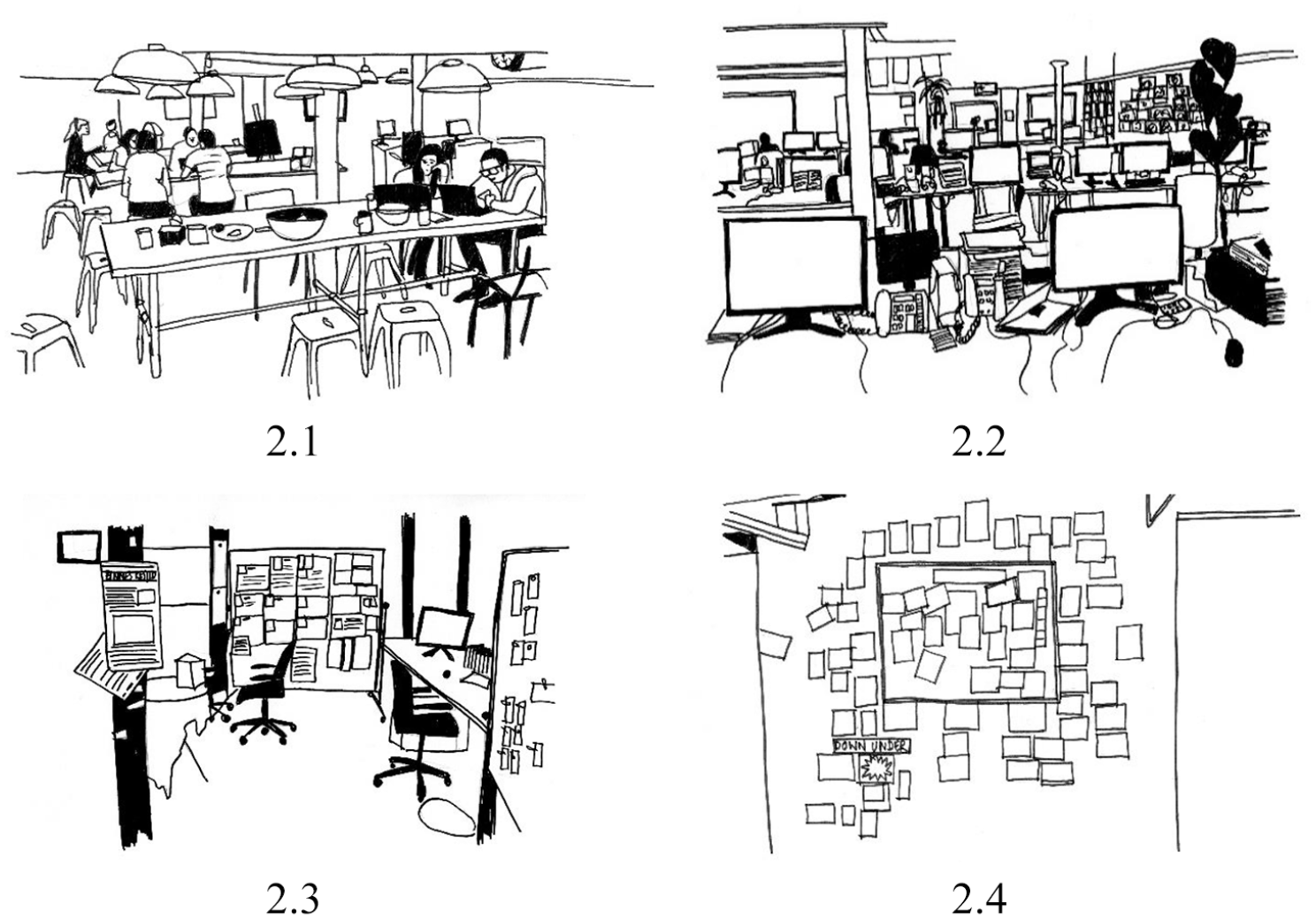
The Main Office.
The Main Office is focused on five large desks that house up to 20 computers each. The Founders and Team Directors sit at the same desks with the same access to facilities as other workers (see Figure 2.2). There is a broad grouping of workers in functional teams or, as it was described in a company meeting held by the Creative Director, ‘neighbourhoods’. Desks and computer equipment are provided by the company and are standard. Individuals are free to personalize their workspace and teams can also develop the Main Office around their shared working practices. For example, following an agile coding methodology, the Coding Team have organized their desks so that pairs of coders can work in isolation. To achieve this, they have repurposed portable whiteboards as partitions to form cubicle-like workstations. Further, on the understanding that coding is a different working practice, the Coding Team have physically separated themselves from the rest of the organization by taking over the first floor, moving all other teams to the second floor. The result of this is that other teams must walk past the Coding Team to get to their workstations. In response, the Coding Team purchased cardboard walls to shield their space (see Figure 2.3).
The most prominent element of the Main Office that is controlled is the doors and walls. These are adorned with press clippings, photos, real-time video links to SuperTech’s other offices and brand-related posters (see Figure 2.4). They are changed daily by the Creative Team depending on the priorities and activities in the building. The doors and walls also house artworks, toys, dolls and action figures selected and customized by the Creative Team.
The kitchen area on the second floor of the Main Office houses three long wooden canteen tables with benches and worksurfaces for coffee, tea, toasters, fridges and other food-preparation materials. The flooring changes in the kitchen area to an industrial stainless-steel panel. There are no other partitions between the kitchen and the desks. In an interview during the ethnographic observations, the CEO explained the importance of this space in two ways. First, it builds a sense of community by allowing members of the organization to ‘break bread together’. This is why management do not limit who uses the kitchen. They want people to make new connections. Second, the kitchen increases attendance. Workers arrive early and prepare breakfast in the office and stay late and make dinner. To entice people into the kitchen, SuperTech provides free breakfasts and hosts celebrations there with food such as cakes, sushi and pizza. The CEO explained that this is intended to maintain a ‘start-up culture’ where workers invest as much time as needed to get work done rather than limiting themselves to contracted working hours. Further reflecting the importance of the kitchen as a symbol of the organization, the Coding Team Director stated in a meeting about the design of the offices that ‘the kitchen is the heart of the company and must be in the middle!’.
Despite the flexibility of the space in the Main Office and the freedom staff are granted to move around, individuals and teams engage in routine working practices. In Week 3, the fieldnotes describe a sense of awareness of the rhythms of the office experienced by the researcher: The rhythms of the office are becoming clear. They aren’t the same every day but they do seem similar – perhaps varying across the week. Most of the time people sit with headphones on, either chatting in online meetings, watching videos or listening to music. The kitchen always seems to have someone in it. Occasionally, lots of people. There is a constant flow of traffic round the office and a very distinct sound. It is quiet. It almost sounds like an office with one person in it. As the day passes by around 4 p.m., some people start to migrate from their desks to other spaces in the building. Normally, they have their laptops with them or chat with others in the kitchen. Even when people need to have a private conversation, they tend to still be on display. Earlier, the Sales Director asked the Research and Strategy Director for a private talk. He didn’t acknowledge anyone else in the team when he came over. The two of them went to the kitchen. No one said anything but I presumed the rest of the team, like me, was desperate to know what they were talking about! One thing was clear to us, they were talking about something important.
The Main Office is not only a space for work. It is also a space where SuperTech performs for their clients. This was emphasized during a meeting about potential changes to the Main Office. The Creative Director described the Main Office as ‘a space to look into and out of the building’. It helps clients ‘enjoy the entire SuperTech experience when they come for meetings’, in the words of the Sales Director.
Clients experience the Main Office in three ways. First, it is the backdrop to productive work, meetings and conference calls between SuperTech’s team and clients. Second, it provides a spectacle clients enjoy around meetings. After sales pitches, for example, prospective clients tour the Main Office. Established clients, too, pass through the Main Office and were observed using a balcony on the top floor to look down on the office space. This occurs regularly with many clients taking a great deal of time to watch the action in the Main Office. Finally, the artworks and artefacts on the walls of the Main Office perform a brand image to clients. As the Creative Director explained in an ethnographic interview, the Main Office is a ‘physical manifestation of the brand . . . SuperTech has to appear different, we want to inspire our clients with what we can do’. The Main Office, he continued, is designed to ‘bring interest into space without character’.
The Townhall
The Townhall on the top floor can only be accessed via the main stairwell. This means that, unlike the TestLab, clients have to go through the Main Office to access it. The Townhall itself is a large open-plan room with exposed wooden floorboards, a mix of exposed bricks and whitewashed walls and an exposed ceiling with strip, spot and mood lights. It has its own bathroom next to the entrance. There is a bar area with free coffee, soda, beer and candy. The shelves behind the bar are stocked with drinking glasses and popular culture artefacts centred on a science fiction theme. There is a large retractable screen opposite the bar and the entrance. The space in between is occupied by an assortment of rugs, beanbags and leather sofas, which can be moved around as needed (see Figure 3).
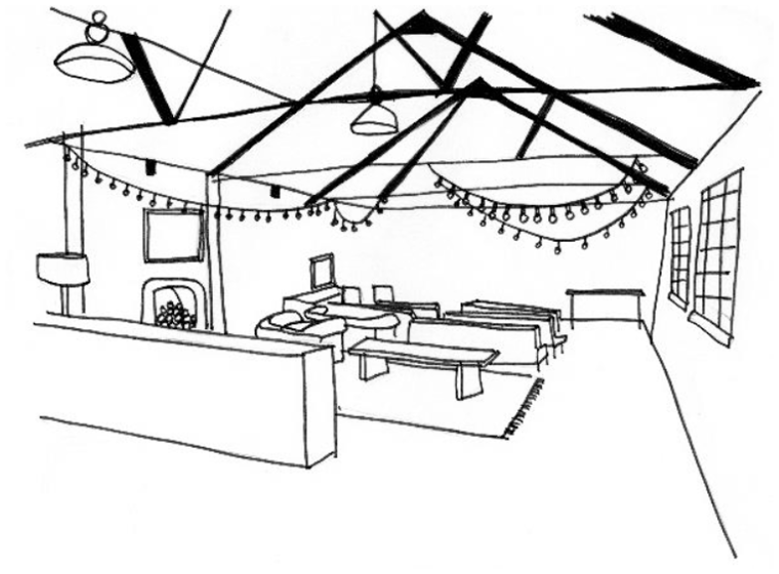
The Townhall.
Access to the Townhall is not controlled. While there is an online booking system, teams often use it for impromptu meetings. Indeed, the researcher used it as a convenient space to conduct interviews without booking it. Even when presentations are taking place, it is common for people to come and go. The entrance at the back of the room means they can do so unnoticed. The sense of openness is revealed in fieldnotes documenting the author’s embarrassment after interrupting a meeting in the Townhall. In Week 6, the author unintentionally walked into an open strategy session: I can’t believe what I just did! Looking for somewhere quiet to make a phone call home, I walked straight into a meeting of the Founders and Team Directors in the Townhall. The door was open and, as I approached, it looked like a couple of people were having a chat. Luckily, no one batted an eyelid as I walked in, in spite of the fact all the powerful people in the organization were sat there. In fact, although I wasn’t invited to the meeting when the Research and Strategy Director saw me, he nodded at me and moved across to make space for me to sit with him on a sofa. Each team had nominated a member to present a ‘big picture idea’. I couldn’t really see the logic of them. A member of the Coding Team spoke about designing a new website based on the design of an ATM! But I got a sense that these presentations were really meant to give the leadership team something to talk about.
The Townhall is used for a variety of different performances including pitches to SuperTech by suppliers, internal meetings and social events, and presentations to clients. However, most performances in the Townhall follow a similar structure that, as with the open strategy meeting above, blurs the division between the performers and the audience.
First, a narrator introduces the meeting. For Research and Strategy presentations, this involves a standard slideshow reviewing key performance indicators (KPIs). As the presentation progresses, the narrator gives way to a team of presenters. In a Research and Strategy presentation, the Director calls on his team members to describe specific slides relating to their areas of expertise. This progresses to an open dialogue between the audience and the presenters and ends, ideally, with a dialogue between audience members. When this happens, the role of the performer switches from the presenters to the audience. Presenters support the audiences’ performances by acting as stagehands. They move out of sight behind a computer by the projector screen and bring up materials and evidence as needed. Presenters also direct the audiences’ interactions through the staging in the room. Presentations in the Townhall utilize a large microphone cushion that is thrown between speakers. It is particularly powerful in presentations that are webcast to other locations as it is the only way a speaker can be heard online. SuperTech’s presenters use the microphone to stop the interactions descending into a chorus of different conversations.
So, in the Townhall, performances are spontaneous and unscripted, but arranged. Not only is the space staged to encourage audiences and performers to move between their roles, but materials, such as slides and videos, are also prepared in advance to enable them to do so. Presenters also rehearse their performances to explore how and when audiences might participate in a performance. For example, before one presentation, the Research and Strategy Director had been informed by the Sales Director that the relationship between a client and its advertising agency was problematic yet they were both going to attend the same presentation. The Research and Strategy Director told the team that, while the client wanted to use the presentation to ‘have a go’ at its underperforming advertising agency, they should not defend the agency nor criticize them. This was because the advertising agency represented SuperTech’s other clients. The team was directed to step back from the performance as quickly as possible, answer factual questions, load relevant materials as stage hands and leave the interactions between the audience to play out naturally. This presentation was rehearsed separately to several internal teams and both the agency and the client. After each rehearsal, the Research and Strategy team discussed the performance. Following the rehearsal to the advertising agency, the presenters reported there might be a problem given ‘how quiet and weird it was’. That is, the rehearsed performance had failed to spark a conversation among the audience. The next day, however, a second rehearsal to the advertising agency was deemed to be more successful because ‘they were way more talkative, they picked some holes in the methods’.
A successful performance in the Townhall, then, is not intended to deliver information but, as the Research and Strategy Director put it in a team meeting, ‘to get clients talking’. In fact, clients typically have access to research reports in advance of presentations and have the opportunity to view rehearsals of the presentation itself. What they do not have is an opportunity to come together as a group. The audience for Research and Strategy presentation, for example, might include clients’ board-level executives, marketing and brand managers as well as their advertising agency, media buying agency and other suppliers. A presentation in the Townhall is a rare event where they can meet and interact.
Staging practices
Having described the three stages observed at SuperTech, we can now consider how the physical setting created its performance effects. Milligan (1998) argues that to do so we should focus on specific participants, which she calls set designers, who construct stages prior to performances. But designated set designers do not always design all the elements of a stage themselves – especially in organizations. Informed by Brecht’s dramaturgy, it is instructive, then, to think in terms of staging practices rather than people. The use of practice here is not meant to link them to practice theory but to denote distinct activities and decisions that are involved in the production of a stage. Three staging practices emerged from the analysis: themes, styles and plot. In keeping with the ethnographic approach taken so far, these are evidenced here through the author’s experiences learning to act appropriately on the stages.
Theme
The types of objects and physical layout of a space can communicate symbolically. This is revealed in Goffman’s conceptualization of appearances and manifests in organization theory’s interest in understanding ‘what is it that tells us what kind of social activity is appropriate’ in a given setting (Baldry, 1997: 366). The term theme is used here to mark the creation of these messages (see Gottdiener, 2019). Unlike appearance, it emphasizes that meaning emerges from the combination of objects in a setting. That is, while each object has its appearance, collectively they have a theme. As Lukas (2007: 1) explains, theming a space is a practice that ‘involves the use of an overarching theme, such as western, to create a holistic and integrated spatial organization’.
The TestLab has a scientific theme. Objects come from scientific practice (DNA strings, gyroscopes and telescopes). Audiences wear white lab coats. However, just as Goffman (1959: 36–37) notes that chimney sweeps wear lab coats to provide their clients ‘with an understanding that the delicate tasks performed by these persons will be performed in what has become a standardized, clinical, confidential manner’, it is unlikely that anyone would believe SuperTech was engaged in the creation of scientific knowledge. Rather, these objects display SuperTech’s commitment and preparation. In this way, the symbolism of scientific artefacts harmonizes with the sense of certainty demonstrated by the pre-arranged slides and touchscreens of the sales pitch. They encourage actors to deliver scripted roles and limit the audience to consume the performance. A tight coupling between the theming of the space and the performance communicates a clear message to clients: you can trust us.
The Main Office is a productive space but there are simply too many objects and props that have little to do with the work itself to be ignored. Artworks, redundant fireplaces, surf boards, toys and actions figures are never used by workers in their productive activities. They are on display primarily for clients. As the Creative Director explained, they create a theme that is ‘fun and serious’. The message expressed to the researcher through the space and the performances here: we do something you cannot do yourself.
The theme changes again in the Townhall. The scientific artefacts displayed in the TestLab are replaced by science fiction toys. The Townhall is homely, welcoming and relaxed. It is furnished with wooden floors, cushioned sofas and natural light. Wires, brickwork and computers are left on display. The seating can be moved. The presentation is not scripted. The space, then, is themed like an urban loft. It is a space for cultural consumption. It suggests that SuperTech wants its clients to be involved in the performance. Here, the theme is again tightly coupled with the performance in the sense that both encourage audiences to get involved in the action. The message: relax, we are open to listening to you.
Style
The style of a stage refers to the suggestions it makes concerning the relations between actors and audiences. It is informed by Brecht’s dramaturgical insight into detached and critical performances and shows the applicability of Brecht’s thinking to performances in organizations. It alerts us to the ways in which some stages control interactions while others unlock their creative potential.
Detached performances occur when a stage enforces established divisions between audiences and performers. That is, the initial performers and audiences continue in their places until the end of the performance. When SuperTech uses the TestLab to pitch for new business they engage in this style of performance. The aim is to carry the audience with the flow of the presentation and persuade clients of the value of SuperTech’s offering. This involves a clear distinction between performers and the audience. These are built into the space through the seating and the controlled access to the touchscreens displayed around the stage. The choreographed script, tightly coupled with the built environment, suggests that audiences should not participate in the performances. This relationship is represented in Figure 4 through a simple unidirectional performance delivered by SuperTech’s presenters to their clients in the audience.
In the Main Office, there are multiple, overlapping detached performances taking place simultaneously. Actors perform for one audience and observe others at the same time. They play double roles. For example, staff perform for clients as they work. Clients and visitors pass through the Main Office constantly, with many having a virtual presence in online chats too. They watch SuperTech’s staff working. But the staff and the leadership team observe clients at the same time. The leadership team, too, perform for their staff using posters, artworks, screens and other artefacts to communicate strategic objectives and express the cultural values of the organization. Yet, the leadership team also observe staff and monitor their start-up culture. These relations are represented in Figure 4 as mixed actors who simultaneously perform and observe others. Here, we can identify a limit to Brecht’s dramaturgy. He theorized a single stage. In many organizations, performances take place on multiple stages simultaneously and, similarly, multiple performances take place on the same stage simultaneously.
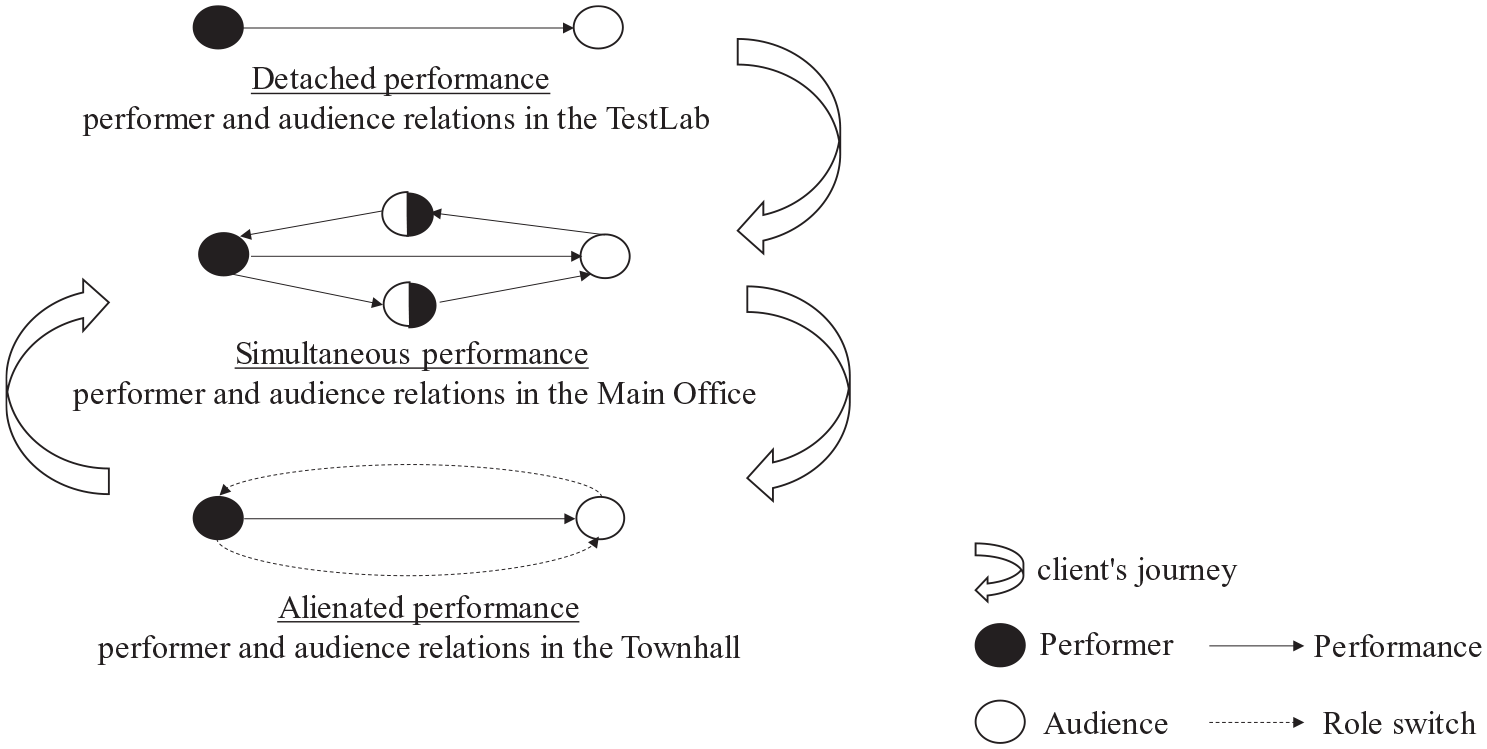
Performance relations.
Critical performances occur when performers and audiences combine and switch roles. When SuperTech reports to clients in the Townhall, they engage in this style of performance. The stage is organized to facilitate client participation in presentations. Indeed, the objects and presenters on the stage encourage contributions from audience members. Rather than following a set script, presentations in the Townhall are conversational. This is represented in Figure 4 as a unidirectional performance delivered by SuperTech’s presenters, which prompts the audience to switch roles, creating another performance and, potentially, further role switches. Accepting that performers usually observe their audiences, the key point here is that the stage appears designed to encourage role switching. That said, the role switching in the Townhall is never complete. The original audience can perform but only within the boundaries defined by the stages’ style. Unscripted is not unorganized.
Plot
The order in which stages are presented to audiences has a meaningful effect. Just as the passage of scenes in a play creates a narrative structure, the term plot indicates the effect that emerges when audiences move between organized stages in a planned way. The importance of this ordering is indicated by the extent to which most performing organizations control when audiences enter and exit particular stages.
At SuperTech, audiences appear to have freedom to move around the building but several objects and devices direct them to the appropriate stage. A reception desk greets audiences as they enter the building and allows performers to usher audiences to the correct stage. Signs are displayed in the building welcoming clients and assigning them to specific rooms. The result is that staff not involved in a performance can also usher audiences to appropriate spaces. During a performance, too, audiences are ushered from one stage to another. In an interval within a performance in the Townhall, for example, they might move to the bar or the kitchen in the Main Office for refreshments. Following a sales pitch in the TestLab, audiences and clients move to the white area for discussion around the conference table and then tour the Main Office. It is notable, on this point, that when audience members remain on a stage after being directed elsewhere, it is precisely because they want to take advantage of it as a private space.
The ordering of the three stages at SuperTech also symbolizes its relationships with other organizations. For clients, in particular, the stages operate sequentially and create a plot from the underground, hidden TestLab to the light Townhall on the top floor of the building. So, clients’ first experiences as an audience take place on a stage themed to present certainty. At this point, clients have not entered a formal relationship with SuperTech. This is reflected in a detached style of performance. Following a sales pitch, clients that enter into a formal arrangement with SuperTech move to the Main Office. Whether in-person or virtually, they begin working with SuperTech on their business problems and observe SuperTech at work. The move from the TestLab to the Main Office, then, represents a move into SuperTech. Finally, clients are directed to the Townhall. Here, the theme is homely and, stylistically, the space blurs the distinction between the audience and presenters. Here, in the third act of SuperTech’s plot, clients present their business issues, power dynamics and key concerns to each other and to SuperTech. SuperTech’s performers switch roles and become an audience to these performances. They report their observations back to colleagues in the Main Office. This is represented in the Client’s journey in Figure 4.
Staging performances
To bring this together, we can say that organizations can turn some spaces into stages for organizational performances by giving them a theme, style and plot. The objects in a stage play a key role in each practice. They perform a theme, shape interactions between actors and audiences and direct movements in, out and between stages. These staging practices can tightly couple the materiality of a stage to the performing relations and content of performances, as in the TestLab and Townhall. In the former, the stage and script left little room for actors and audiences to switch roles or improvise. In the latter, the stage and script encourage actors to become audience members and vice versa. In each case, the stages for organizational performances are more than background settings. They step forwards to participate in the action as well as shaping how human actors perform.
Discussion and implications
Many contemporary service and knowledge organizations perform for other organizations on designated physical stages. The article analyses these spaces through a combination of new materialism and Brecht’s dramaturgical theory. It reveals three staging practices that construct a space as a stage for organizational performances. By developing this materialist dramaturgy, the article makes substantive contributions to organizational theories of space and organizational dramaturgy.
Implication for organizational dramaturgy
The central contribution of this analysis is dramaturgical. While the starting point for organizational dramaturgy is to view organizational action as being staged, it has yet to account for the materiality of stages. It focuses on actors and looks past the arrangement of stages. Here, Brecht’s dramaturgy both complements and challenges existing thinking on materiality, direction and performances.
In terms of materiality, organizational dramaturgy tends to treat human and non-human actors differently. The non-human is seen as a background for action. Brecht’s thinking encourages us, instead, to see the material environment acting in performances. He challenges us to consider how physical objects and design features of a space interact to communicate a theme and arrange relations between audiences and performers. Here, we have seen the power of objects such as lab coats and microphones to act in a performance.
In terms of direction, organizational dramaturgy analyzes social interactions as if they were performances. Brecht’s thinking asks us to be attentive to the ways that performances are organized and the ways their organization plays out in performances. On this point, Brecht expands the ontology of a director. Rather than a single person, for Brecht, direction is a process undertaken by human and non-human actors. It is a more-than-human relation. At SuperTech, this plays out in a specific department that has formal responsibility for the design of space but also requires the involvement of a range of more-than-human actors to shape spaces.
In terms of performances, organizational dramaturgy assumes that performances involve the communication of a predefined message. It is telling, in this regard, that Goffman equates performances with confidence tricks. In both cases, the dramaturgical approach relies on a ‘sign-accepting tendency’ among the audience (Goffman, 1959: 59). The audience, Goffman (1959: 74) explains, ‘can be held in a state of mystification in regard to the performer’. Goffman (1959: 97) clarifies: ‘The obvious point must be stated that if [a performing] team is to sustain the impression that it is fostering, then there must be some assurance that no individual will be allowed to join both team and audience.’ In contrast, Brecht suggests other types of performances including those which expose their construction. In this way, Brecht’s theory marks a radical break from organizational dramaturgy in terms of his fundamental conceptualization of a performance. Such performances have clear resonance with organizations in the knowledge and service economies, such as SuperTech, who use them to learn about their clients and deepen organizational relationships rather than deliver a message. They also resonate with aesthetic trends in open office design, which expose the infrastructure of organizations and their buildings.
Implications for organization theory
Baldry (1997: 366) set an early agenda for organization studies of space to understand ‘what is it that tells us what kind of social activity is appropriate’ in a given setting. The dramaturgical perspective developed here suggests that some organized spaces suggest appropriate interactions by defining inhabitants as performers and audiences. That is, they appear as stages. They include themed objects, organize who can enter and script their interactions as audiences and performers.
This suggests that accounting for these organizational spaces requires us to pay more attention to what existing studies, influenced by Lefebvre, call managed and planned space ahead of lived space. Performance spaces are designed for different reasons to other spaces. We need theories of organizational spaces that allow us to recognize these differences. Here, Brecht emphasizes that space is material, that its materiality suggests certain types of action, but also that spaces are not equal. Some spaces make strong suggestions, others weak hints. A genuinely materialist spatial theory must reflect these differences. It must also reflect differences between organizations not only spaces. In this case, as business service organization, SuperTech focused on performing for other organizations to win business, produce their research and insights and learn about clients’ needs. This exposes the importance of materiality even in organizations that we might otherwise think have more to do with intangibles such as brands, information and communication.
This is not to say that all occupants of a space will follow the direction of a stage. However, the regularity with which suggestions from the material environment are followed by actors is an indication that something important is happening. Here, Brecht’s emphasis on direction makes a clear contribution to organizational theories of space. Existing works accept a processual view of space, even a dialectic conception (Sivunen and Putnam, 2020). Brecht exposes the mechanics of these processes. Drawing on his Marxist background, Brecht tells us that spaces work dialectically when there is a self-conscious agent to drive the dialectic. In Brecht’s dramaturgy, a stage designer is delegated the task of managing the production of space – not producing space. Their job was not to select props and decide on the form of a stage in isolation but to create a process through which these features would emerge from the social labour power of the theatre company.
Methodological challenges and future research
Recognizing the material element of space presents methodological challenges. Specifically, how can we represent materiality? Here, the article proposes that Brecht’s dramaturgical principles offer a productive way of performing space within research. He calls for actors to show how they learned to act on a stage in their performances rather than present themselves as capable and credentialed actors. This ethos can be applied to researchers too. It calls for us to show how we learn to act with other humans and non-humans in our research practices and research reports. In this article, this has been achieved by rendering space visually, describing performances and abstracting staging practices that suggested themselves to the author as they learned how to act at SuperTech. This necessarily involves a more speculative and personal performance of the role of the ethnographer than might otherwise be the case. But it is hopefully productive for further performances of human and more-than-human relations in organization theory.
In this regard, Brecht’s work opens up critical questions about the production of space. According to Burrell and Dale (2014: 701), ‘the connection between the scales and the processes which [produce space in organizations] remain[s] under-theorized’ in organization theory. Brecht’s thinking resonates on this point with trends in contemporary office design. These increasingly design space in different ways for different occupants (Foth et al., 2020). Such spaces may be staged into different areas through their themes but also divided in terms of the styles and plots they contribute to. Open for debate, in this sense, is whether the knowing or unwitting adoption of Brecht’s radical theatrical style has stripped Brecht’s method of its radical potential or if Brecht’s focus on the productive capacities of critical attitudes can and should be harnessed for any purpose. This article suggests that Brecht’s aesthetics have expanded beyond the theatre. This opens up the possibility for organizational dramaturgy to speak to wider dramaturgy.
Footnotes
Acknowledgements
Thanks to the reviewers and editors for their comments on earlier versions of this piece. Thanks also to Professor Steve Brown, Professor Martin Parker, Dr Victoria Cluley and Dr Simon Parker for their support on the development of the article.
Funding
The author disclosed receipt of the following financial support for the research, authorship and/or publication of this article: the author received financial support for the research reported in this article (British Academy SG161403).
