




Abstract
Organisation studies has paid little attention to the contemporary private security industry, despite its enormous recent growth as a supplement to or replacement for state military services in theatres of conflict. To address this neglect, we investigate the workers at the heart of the industry: private security employees or contractors. Amidst widespread and extremely critical media coverage of their activities, we consider the individual contractor as a central agent of contemporary conflict, identifying three main objections to their deployment: a lack of just cause, virtue and professional legitimacy. Using scholarship on identity work and stigma management more specifically, we analyse contractors’ accounts of their employment to identify the communicative strategies they employ to challenge the stigma attributed to their occupation and/or to them as incumbents. Our data set is memoirs written by five British contractors, published between 2006 and 2011. We also suggest that data such as these are under-utilised in organisation studies’ treatment of identity work, because they represent a distinctive form of this work which we label identity writing.
Keywords
Introduction
Existing in various forms throughout history, the commercial provision of military and security services reappeared in the 1990s in the guise of the private military industry (Singer, 2004; Stachowitsch, 2013). Growing from a relatively small ‘cottage industry’ (Sabga, 2008) to a multibillion dollar global concern following the Second Gulf War, this provision has diversified beyond direct military involvement to intelligence, logistics, training and security services. Today’s private security industry 1 (PSI) comprises privately owned firms contracted as a complement to and/or substitute for state military and security services in theatres of conflict and unrest. Private security companies (PSCs) also provide services for non- or supra-state actors including media networks, commercial enterprises, the United Nations and other inter-governmental agencies as well as not-for-profit organisations. This has led Stachowitsch (2013) to suggest that today’s PSCs ‘differ from the mercenaries of earlier times because they take on a modern corporate business form, are traded on the stock market and are tied to other firms and the public sector through complex financial arrangements and networks’ (p. 75). Moreover, in the context of the ongoing downsizing of many state militaries and in a post-Cold War era where the ‘War on Terror’ and the rise of so-called ‘low intensity’ conflicts and civil wars have seemingly come to replace mass inter-state warfare, the PSI is now widely recognised as vital to the west’s ability to conduct military operations. PSCs have become a fundamental component of the contemporary apparatus of organised violence, to the extent that many western nation states have outsourced so many of their activities to these companies that they can no longer function effectively without them (Kelty and Bierman, 2013; Singer, 2004).
In organisation studies, however, there has been only limited engagement with the PSI to date. Alongside Grey’s (2009) more general call for an exploration of parallels between organisation studies and security studies, notable contributions include Banerjee’s (2008) conceptualisation of necrocapitalism (simply put, capitalism which profits from the ability to deal death) and his discussion of ‘private military firms’ and Baum and McGahan’s (2013) exploration of the interplay between structure and agency in the PSI. Elsewhere, Godfrey et al. (2014) discuss the PSI’s re-emergence, aspects of its activity and key political concerns over its current deployment. While these articles offer an introduction to the PSI, they are very much macro level or political economy analyses. In this article, we explore the lived experience of the PSI, or the ‘Circuit’ as it is known colloquially, by focusing on the workers at its heart – contractors, as they prefer to be called (Sabga, 2008). In so doing, we respond to a call from security studies scholar Higate (2012) for more attention to the ‘micro-sociological dimensions’ of the PSI. In particular, he notes a lack of research on the self-reported identities of PSI employees and their strategies for pursuing professional legitimacy.
Our starting point is the widespread and damning critique to which contractors have been subjected. Following a brief description of the various controversies surrounding the PSI and contractors more specifically, we then review previous scholarship on identity work and stigma management more specifically. This is followed by a methodology section where we explain our use of memoirs by five British contractors, discussing their work in Iraq and Afghanistan and published between 2006 and 2011. Our findings then draw on military and security studies as well as politics and international relations scholarship to identify three main stigmatising objections to the use of private contractors in contemporary warfare: that they lack just cause, virtue and professional legitimacy. We read the memoirs alongside discussion of each objection to consider how these contractors use stigma management communication strategies to rebut them (Meisenbach, 2010). To resist the idea that contractors lack just cause and virtue, they articulate their motivations for doing this work as based on economic necessity as well as having a proven skill set which is undervalued in civilian life. In distancing themselves from the view of contractors as ruthless mercenaries, they emphasise their active avoidance of combat and killing especially, saying they always prioritise their own and their colleagues’ safety via cool-headed analysis learned from state military service. The contractors also distinguish themselves from others fighting alongside them, such as US contractors, newer entrants and the US military in particular. Here, they stress their high levels of skill, their stripped-down physical presentation and their ever-alert professionalism.
These memoirs provide empirical insights into contracting in the PSI, a rapidly burgeoning industry which operates under ‘a veil of secrecy … that is only occasionally lifted through investigative journalism or the odd piece of empirical research’ (Godfrey et al., 2014: 119). As such, they allow us to extend the organisation studies literature on identity work and stigma by investigating the communication strategies the authors employ to manage their stigmatised identity. But in our discussion, we also suggest that these memoirs represent identity writing, a form of identity work not yet conceptualised in our discipline. It is the remarkable symmetry across the five memoirs which leads us to this conclusion and the key differences between identity work done ‘in the moment’ and the identity work exemplified in these books. Identity writing is, we suggest, a set of retrospective practices undertaken for a prospective future audience. It is no less authentic or ‘real’ than its face-to-face counterpart. Rather, it is a type of identity work which is only possible at one remove from the events described and the audience for whom the description is intended. Moreover, testamentary memoirs (Marche, 2015, 2016) like the ones we use here – which explicitly justify the deployment of certain types of contractor in warfare – are useful for further illuminating the identity work done by those in stigmatised occupations.
The next section describes the controversies surrounding the PSI, PSCs and contractors themselves.
Private security contracting and the associated controversies
In August 2010, then Afghanistan President Hamid Karzai issued a decree banning PSCs from operating in his country. By December 2010, the ban had effectively been overturned (Baum and McGahan, 2013). Karzai initially condemned PSCs, in part, because of public concern over their activities and media reports of the abuses they had perpetrated. His later relaxation of the ban was largely predicated on the Afghanistan security forces’ inability to maintain the range of activity undertaken by these companies.
This example is very revealing of the tensions at the heart of the contemporary organisation of conflict and the role of the media in perpetuating certain images of PSCs and contractors. Much of the criticism directed toward contractors originates in media coverage of the atrocities they have committed in various conflict zones. Widely reported instances include the abuse of prisoners at Abu Ghraib prison, sexual assaults on civilian women and girls in Bosnia and killing unarmed civilians in Iraq. The most infamous case is the death of 17 Iraqi civilians in Nisoor Square in September 2007, at the hands of contractors working for US PSC Blackwater, one of the largest and most prominent in Iraq.
The widespread reporting of contractor atrocities has led to a common view of all contractors as mercenaries, a description that ‘deliberately evokes a frightening image of armed men with no loyalties or principles, going wherever there is a fortune to be made’ (Cohn, 2011: 382). Stachowitsch (2013: 84–5) reviews coverage in the New York Times between 2009 and 2011, identifying how contractors emerge as aggressive, greedy and undisciplined. Joachim and Schneiker (2012) also underline the PSI’s considerable image problem, citing media descriptions of contractors as ‘dogs of war’, ‘merchants of death’ and ‘guns for hire’ (pp. 365–6). They suggest that industry personnel recognise this problem all too well, quoting the then director of the British Association of Private Security Companies, Andrew Bearpark, as saying that ‘Iraq has frequently been described as a “big cash machine” for unaccountable western PSCs … operating in a lawless environment and wielding force without control’ (p. 369).
As a result of this media scrutiny, an ‘anti-mercenary norm’ has become ‘institutionalised’ across not only media outlets but also national and international governmental organisations and in wider public discourse (Percy, 2007). Commentators including Percy, Lynch and Walsh (2000), Rengger and Kennedy-Pipe (2008) and Baker (2011) identify three core objections to the use of contractors which are at the root of this norm. These are a perceived lack of just cause among contractors, an absence of virtue in their conduct and a dearth of professional legitimacy in theatres of conflict. These create an image of the ruthless, immoral mercenary against the ideal of the patriotic state soldier, loyally serving their country and protecting their compatriots. Contractors are seen to be motivated and to behave very differently from state military personnel, even when they work together in the same conflicts and undertake the same activities, and regardless of the fact that many contractors are military veterans. These objections have led to a stigmatising of the occupation of contractor and of contractors themselves. But how do individual contractors manage the stigma attached to their labour? To begin to answer this question, next we provide an overview of the concepts of identity work and stigma management as they have been deployed in organisation studies.
Identity work, stigma management and organisation studies
Snow and Anderson (1987) use the term identity work in their ethnography of homeless men and women in Austin, Texas, to refer to ‘the range of activities individuals engage in to create, present, and sustain personal identities that are congruent with and supportive of the self-concept’ (p. 1348). Given the stigma which the homeless frequently attract, Snow and Anderson ask ‘To what extent and how do the homeless generate personal identities that yield a measure of self-respect and dignity?’ (p. 1339). Their argument isolates identity talk as one strategy within identity work, where people verbally construct and represent themselves to others.
Organisation studies has taken up the concept of identity work with considerable enthusiasm: it has been used to analyse topics as diverse as organisational politics, mergers, project teams and emotions at work (Brown, 2015: 24). For Watson (2008), identity work consists of the
mutually constitutive processes whereby people strive to shape a relatively coherent and distinctive notion of personal self-identity and struggle to come to terms with and, within limits, to influence the various social-identities which pertain to them in the various milieux in which they live their lives. (p. 129)
He sees identity work as both an inward and an outward, interactional projection. More generally, identity work scholarship in organisation studies emphasises its ongoing, always provisional nature: identities are seen as always ‘becoming’ rather than ‘being’ (e.g. Alvesson et al., 2008: 14–5; Brown and Coupland, 2015; Coupland and Brown, 2012). Identity work is thus constituted as work, as a continual and often challenging endeavour which brings together multiple, perhaps conflicting identities, drawn from and limited by available discursive resources.
As such, Brown (2015) suggests that organisation studies tends to understand identities as ‘evolutionally adaptive, malleable or even perpetually fluid and shifting’ (p. 26). There is, he adds, disagreement as to the extent to which identities are fragmented and incoherent as a result, although one burgeoning theme is the insistence that ‘people in organizations mostly author a plurality of diverse and even contradictory identities’ (p. 28). Alvesson (2010), on the other hand, discussing what he calls the storyteller image of identity in organisation studies, quotes McAdams to the effect that life stories can ‘integrate the individual’s reconstructed past, perceived present, and anticipated future, rendering a life-in-time sensible in terms of beginnings, middles and endings’ (p. 203). Alvesson adds, though, that many organisation studies researchers take issue with this metaphor because it overestimates both our creativity and our capacity to tell persuasive stories about ourselves, the latter because of others’ dissenting interjections.
Organisation studies has certainly paid a lot of empirical attention to the workplace identities that we inhabit, often simultaneously, take up and discard according to audience or context. Scholars have also taken a particular interest in workplace situations in which ‘strains, tensions and surprises are prevalent, as these prompt feelings of confusion, contradiction and self-doubt, which in turn tend to lead to examination of the self’ (Brown, 2015: 25). Emerging as responses to forms of ‘identity threat’ (Toyoki and Brown, 2014), such identity work generates what Collinson (2003: 538), borrowing from Goffman, calls dramaturgical selves. These ‘are more likely to emerge where employees feel highly visible, threatened, defensive, subordinated and/or insecure’ – for example, where they embody a stigmatised characteristic or work in a stigmatised occupation or organisation (Lutgen-Sandvik, 2008). Some of this scholarship also makes reference to critical media constructions. For example, Knights and Clarke’s (2014) academic respondents suggest that the media represent them as detached from and undertaking research which is irrelevant to the real world, enjoying long holidays and generally having an ‘easy and undemanding’ job (p. 346).
For Goffman ([1963] 1990), stigma is ‘an attribute that is deeply discrediting’ (p. 13). As he notes, these attributes, whether physical, social or moral, emerge from ‘a language of relationships’ (p. 3) which discursively positions them as deviating from prevailing social norms. In this regard, Toyoki and Brown (2014) argue that stigmatised identities are effects of power whereby individuals are marginalised and ‘disqualified from full societal acceptance’ (p. 716) based on stigmatising attributes. It is not difficult to see how the stigmatising of the profession of contractor is a power effect of the anti-mercenary norm outlined above. It is what Meisenbach (2010) calls an intensely stigmatised occupation.
Organisational scholarship on stigma management explores the ongoing, reparative efforts through which workers with stigmatised identities or those employed in stigmatised occupations and organisations ward off the negative associations of their personae or jobs. Lutgen-Sandvik (2008), for instance, suggests that stigma management is present in the negotiation of workplace bullying where individuals work to repair or escape their stigmatised identity to overcome the trauma of being bullied. Here, stigma is ascribed not only by the bullying itself but also ‘comes from abuse content – the claims made about targeted workers. Bullying denigrates individuals’ personal lives, beliefs, values, personalities or physical characteristics, effectively portraying targets as undesirables’ (p. 101). Relatedly, Toyoki and Brown (2014) explore the ‘self-serving impression management’ strategies of inmates in a Norwegian jail. Here, the focus is on how inmates respond to their identities as prisoners and how they manage the stigma attached. In particular, Toyoki and Brown (2014) note how the inmates employ strategies that both ignore and selectively ‘refocus’ their identities to ‘affirm the meaningfulness of their lives’ (p. 732).
Clair et al. (2005) and Ragins (2008), on the other hand, point out that concealing stigmatised identities in various ‘life domains’ – like work – assists in avoiding discrimination and prejudice but creates stress due to the pressures associated with hiding and the constant sense of inauthenticity this entails. Ramajaran and Reid (2013) also focus on how we ‘negotiate [stigmatised] identities traditionally considered nonwork at work’ (p. 622). Various elements of our identities may become, to use Ramajaran and Reid’s terminology, aligned or misaligned as a result, with different sorts of positive and negative consequences in different settings. Relatedly, Creed et al. (2010) investigate how lesbian, gay, bisexual and/or transgender (LGBT) ministers in the United States navigate the contradictions between the notions of the Good News and Christian inclusivity and the widespread condemnation of LGBT people in their Protestant denominations.
Petriglieri (2011) also theorises how we respond to identity threats in the organisational context, the likely outcomes and the implications for identity mutability. She argues that context plays a significant part as to which ‘identity-protection response’ is selected. Equally the ‘shame nexus’, advanced by Creed et al. (2014), sheds light on whether and how we maintain, change or disrupt institutions – like work organisations – in our everyday lives when we receive stigmatising messages from those around us. This depends, they suggest, on the extent to which we value our social bonds within that institution, our personal capacity for shame, whether we understand the conditions for shame in this environment, how or whether we self-regulate accordingly, the naturalisation of rules around behaviour in that environment and episodic shaming as carried out by institutional guardians.
Here, though, we use Meisenbach’s (2010) synthesis of scholarship on the management of stigma to theorise the data from the contractor memoirs. Bringing together a range of literatures, including disability and health research, dirty work scholarship and commentary on corporate and political image repair, so also encompassing data on a variety of stigmatised populations, she offers ‘a theory and typology of stigma management communication’ (p. 268). Meisenbach’s model ‘begins with a stigmatizing message and ends with management outcomes’. It takes into account the message itself, the stigma type and ‘the discursive and material conditions surrounding the potentially stigmatized individual’ (p. 276) to predict the likely communicative response and its outcomes. We deploy her model because of its comprehensive range and its emphasis on communication in stigma management which is especially germane to our memoirs.
Meisenbach argues that stigmatised individuals either accept or challenge the stigma as it pertains to an attribute they are deemed to possess or the organisation or occupation in which they work. Whether they accept that the stigma exists or not, they may also refuse to accept that it applies to them. Given the specific communicative tactics we identify in the memoirs, we draw from the elements of Meisenbach’s model which outline how individuals might challenge a stigma per se and those which outline how they might refuse to accept that it applies to them.
For Meisenbach, where individuals seek to deny that a stigma applies to them, despite accepting it exists, they may: avoid the stigma by concealing it (e.g. renaming their occupation using a more positive label, such as dancing instead of stripping); avoid situations where stigmatisation is likely; work to reduce the stigmatising attribute (e.g. giving up a stigmatising habit or job); or distance themselves from it (such as telling themselves that others’ reactions are nothing personal). Another common tactic identified in stigma scholarship is making favourable comparisons with other individuals, other sub-groups, other organisations, other occupations or the stigmatised individual in the past. Here the intention is to portray oneself favourably in contrast to these others (/Others) – the escort who compares herself to a street sex worker, say, or those who suggest that they are not like ‘certain “bad” members of their occupation’ (Meisenbach, 2010: 280–1).
Challenging a stigma exists per se and likewise rejecting it as a label for oneself, on the other hand, can involve simple denial that the stigma exists, logical denial (e.g. providing evidence to refute the stigma or questioning the authority or competence of those doing the stigmatising), ignoring stigmatising attempts by others or continuing to display the stigma to normalise it. These communicative tactics are described as proactive as opposed to accepting or avoiding tactics which ‘do not seek to alter public opinion of the stigma’ (Meisenbach, 2010: 283–5). Meisenbach (2010) also emphasises that stigmatised people may employ several communication strategies, even to the extent that they contradict each other (p. 288).
Meisenbach’s model provides a framework for exploring the way that our five contractors, as members of a stigmatised occupation, seek to resist their discredited identity. We read the memoirs as exemplifying several of the stigma management communication strategies in the model, as a way of redefining their labour – and themselves – as worthy and valuable.
Methodology
Our analysis draws on the memoirs of five British contractors who worked in Iraq and/or Afghanistan between 2003 and 2010. We treat these as extended examples of identity work, given their lengthy descriptions and justifications of the role of the contractor in wartime. This data set allows us to isolate how our contractors engage in stigma management communication, in particular representing ‘their employment on The Circuit as a continuation of their public service, not an end to it’ (Sabga, 2008: 2–3). The memoirs also illustrate how the authors rebut the three main threats to their occupational identities: the lack of just cause, of virtue and of professional legitimacy.
Our decision to focus only on British contractors reflects what the memoirists claim are important variations in the practices of contractors from different countries. We chose memoirs of Iraq and Afghanistan as the theatres of conflict in which contractors have been most visibly present and from which the aforementioned objections have largely emerged. Like many other organisation studies scholars who have used such texts (e.g. Dempsey and Sanders, 2010; Goss et al., 2011; Srinivas, 2013; Weiskopf and Willmott, 2013), we call these books ‘memoirs’ and not ‘autobiographies’. This follows the literary convention that memoirs report on a particular period in the author’s life as opposed to offering a whole life history.
All five memoirs are written by men who previously served in elite branches of, or in senior roles within, the British state military. Table 1 gives more details about each.
The five memoirs.
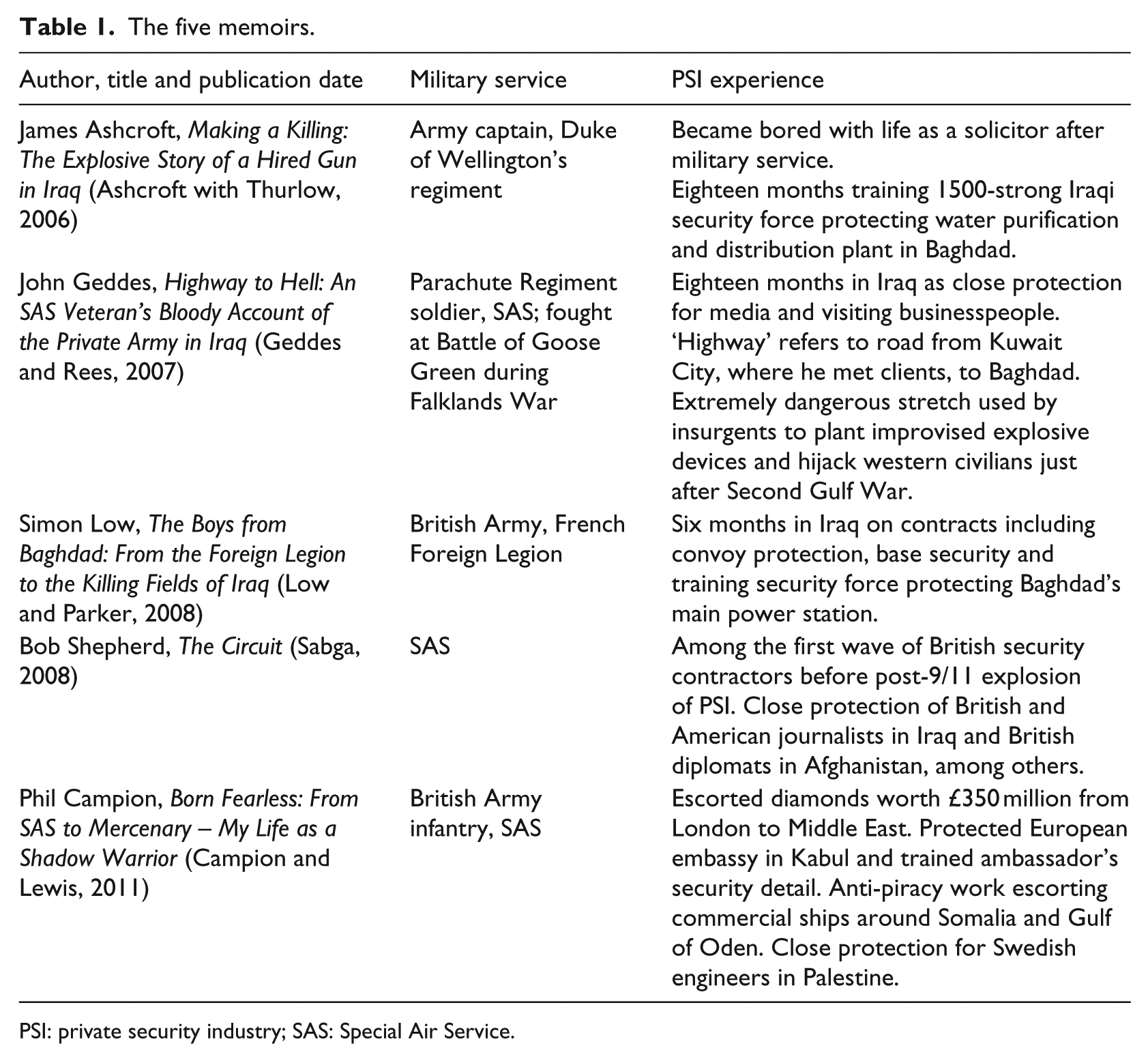
PSI: private security industry; SAS: Special Air Service.
The most obvious challenge to this data set would be to dismiss memoirs as ‘mere’ popular culture, exaggerated tales of derring-do written for a mass market. Nonetheless, the use of popular cultural accounts of work and organisational life as data is now well established. Rhodes and Parker (2008) provide a useful review – and defence – in this regard. Several studies have used popular cultural artefacts to explore the military as an organisation, and soldiering as an occupation, including Höpfl’s (2003) discussion of GI Jane, Godfrey et al.’s (2012) analysis of Jarhead and Godfrey’s (2016) use of military memoirs.
To consider our contractors’ stigma management practices, Richard undertook a close reading of each memoir, using thematic coding (Chandler, 2012). Instances in which contractors addressed either one of the three key objections directly and/or engaged in what he saw as stigma management were recorded. An extensive set of notes and quotations was compiled for each memoir. These were then collated to identify recurring themes and conflicting viewpoints. In the end, the memoirs had a great deal in common, displaying remarkable consistency in style, structure and narrative arc. Each began with a review of the author’s military service to establish their individual credentials. This was followed by a discussion of how, when and why the author moved into contracting. The memoirs then typically recount numerous experiences, contracts for and contacts in the PSI, often in detail and finish by reflecting on the role, relevance and future of the contractor. Four authors share copyright with a ghost-writer, whereas Shepherd’s wife Patricia Sabga is the sole copyright holder for his memoir.
Given the consistency across the five books, Richard cross-checked them against examples of the wider genre of military memoirs concerning the wars in Iraq and Afghanistan (Bury, 2010; Hennessey, 2009; Hunter, 2007; McLaughlin, 2006; Tootal, 2009). Here it became apparent that our contractors borrow heavily from the structure and style of the military memoir. The memoirs were also considered within and against the socio-political context of the conflicts which they described. This approach resembles Duncanson’s (2011) analysis of state soldiers’ memoirs of service in Iraq and Afghanistan. She explores the construction of military masculinity in conflicts where the stated aim of western intervention was as a force for good. Her approach – like ours – locates particular types of accounts in the texts. Moreover, although both analyses involved subjective interpretation, all the memoirs discussed are publicly accessible so that others can reach their own conclusions about the inferences drawn.
We now explore contractor stigma management communication in more depth. First, we outline the ‘just cause’ objection to contractors and identify it as one element of the stigma attaching to their work, before exploring contractors’ own accounts of why they entered the PSI after military service.
Findings: stigma management communication in the contractor memoirs
Just cause and the money motive
Dating back to medieval law and following Aquinas, the concept of a just war states that only wars deemed to be just in their intent should be entered into. In medieval times, the Church or the ruler was charged with these deliberations (Percy, 2007). With their approval, military personnel were understood to be fighting with moral certainty and thus just cause. The mercenary, fighting only for financial incentive, lacked such certainty (Lynch and Walsh, 2000). Although it is the state which now determines the legitimacy of military intervention, contractors are widely viewed as contemporary mercenaries whose only motive is money. Money provides neither moral certainty nor just cause. Hence, contractors are seen to have no moral grounds on which to fight or kill, and killing represents ‘unjustifiable homicide’ (Percy, 2007). Stigma attaches to the indefensibility of the money motive for taking part in warfare and to the repellent avarice of the individual contractor.
The money motive is described as an important incentive in our contractors’ memoirs. Phil Campion, for example, outlines what he says is a common experience for ex-military personnel; they have perfected a skill set which kept them at the top of their profession, but lacks relevance in civilian life. When he is offered a contract in Afghanistan, he explains ‘In truth, I’m desperate for the cash. It’s got so bad that for the first time in my life I’ve signed on the dole,
2
and been into the local job centre looking for work’ (Campion and Lewis, 2011: 58). John Geddes says
the same process is happening in the rest of the British Army as more and more blokes tipping out of a wide range of units are deciding on the freelance route to maximise the cash potential from their hard-earned military skills. (Geddes and Rees, 2007: 65)
Here though it is financial need – not avidity – which our memoirists argue compelled them to work as contractors, given a post-military experience featuring few other job opportunities. The skills these veterans possess were, as Geddes puts it, ‘hard-earned’ over many years in the military but have few legitimate avenues once service comes to an end. The implication is that these men had no choice but to take up work in the PSI: only by doing so could they capitalise on their military service. We read this stigma management strategy as concealing the stigmatising attribute via renaming (Meisenbach, 2010: 280) – the memoirists seem at pains to underline that their motives for entering contracting, while financial, were not mercenary.
Geddes also suggests that wanting to maximise monetary rewards from contracting is entirely understandable, because it almost always involves a high level of risk: ‘If a bloke is going to put his life on the line he’d be mad not to ask how much he’s going to be paid to do it’ (Geddes and Rees, 2007: 65). Here, he implies awareness of the mercenary stigma attached to contracting, but rebuts this to suggest that the work is dangerous by definition and thus merits significant remuneration, in contrast to serving in the state military during peacetime. Relatedly, Ashcroft argues that employing contractors is more cost-effective than utilising state military personnel who cost the US government ‘$[US]25,000 per soldier per month in Iraq’ (Ashcroft with Thurlow, 2006: 118). Our analysis suggests that this tactic can be read as ‘logical denial’ (Meisenbach, 2010: 284) and more specifically identifying fallacies in the stigmatising argument – here that significant financial reward is right and proper in such a dangerous occupation and represents much less of a drain on the national purse than deploying state military soldiers in conflict zones anyway.
Moreover, when reflecting on their contribution to various conflicts, our contractors agree that they were a force for good and that they were working for a just cause:
[I]t was PMCs who had the job of supervising the delivery of ballot papers around Iraq during the elections and referendums of 2005. It was PMCs who distributed the new Iraqi currency across the country as the economy was being revived. It is PMCs who protect the lives of the thousands of contractors rebuilding the country. They are for the most part lightly armed and they do not represent a cohesive offensive force but they have accomplished these high-risk tasks with style and professionalism. If democracy and the will of the people do eventually prevail in Iraq it will be in no small part due to the presence of private military contractors in the country. (Geddes and Rees, 2007: 326)
In this instance, we again identify the stigma management strategy in use as logical denial. A challenge is mounted to the stigmatising message that contractors lack just cause in the form of re-education (Meisenbach, 2010: 284) about them defending democracy, ensuring the rebuilding of an economy and protecting innocent civilians.
Virtuous warriors or bloodthirsty psychopaths?
The second key objection to the use of contractors comes from the idea of the virtuous warrior, or the argument for armed reluctance (Lynch and Walsh, 2000; Rengger and Kennedy-Pipe, 2008). This depicts war as ugly and destructive, something to be entered only with just cause, but also the belief that combat – and killing especially – should be a last resort. The virtuous warrior, schooled in the philosophy and practice of war, engages in combat reluctantly, always seeking another means of conflict resolution. This concept has its foundations in Greek and Roman ideas of virtue, but in its more contemporary form is found in political rhetoric around sacrifice and duty (Rengger and Kennedy-Pipe, 2008). In the context of the ‘War on Terror’, political leaders such as George W. Bush and Tony Blair 3 have drawn on this notion to justify invasions of sovereign territory, torture, indefinite detainment and unprecedented levels of surveillance over civilian populations. To make such practices more palatable, the political capital of the virtuous warrior has been augmented through extensive celebration of the armed services including, in the United Kingdom, the 2000 re-establishment of the Military Covenant, the establishment of Armed Forces Day in 2009 and the 2011 award of royal patronage to the town of Wooten Bassett for its role in the repatriation of military personnel killed in Afghanistan. It is also visible in the growing profile of charities such as Help for Heroes.
The virtuous warrior enters the theatre of battle reluctantly and kills only when absolutely necessary. The contractor, on the other hand, who chooses to accept a contract, seemingly lacks such virtue and is often depicted as actively desiring combat, free from the constraints imposed by military law and on the basis of a psychopathic love of violence (Baker, 2011). Contractors are also deemed to have a financial incentive for the continuation of violence – without which they do not get paid, unlike state military personnel. They are stigmatised as attracted to violence for its own sake and having a clear financial motive for its enduring.
In the memoirs, however, we see a different depiction of life in a combat zone, one which again circuits around the contractors invoking their military service as a means of resisting this stigmatising threat to their identity. Campion describes an incident when he was sent to negotiate with an Iraqi warlord and the dangers this involved:
There’s only one thing for it: act relaxed, but be ready to run, run, run. There’s nothing wrong with running. Elite soldiering isn’t about being bulletproof, or superhuman. It’s often more about getting yourself and your mates out alive, and knowing when to stand and fight and when to make yourself scarce. (Campion and Lewis, 2011: 96)
Campion describes himself as an ‘elite’ soldier and thus as well-versed in the philosophy and practice of war. He is reluctant to fight unless it is genuinely required, because ‘there’s nothing wrong with running’. Here Campion’s contractor labour is positioned as a continuation of his state military employment, as requiring the expertise that he built up during his service as well as its overriding ethos of ‘mateship’. In a slightly different vein, and reflecting on a firefight against insurgents in Iraq, Low says he was ‘scared – very scared’. The only thing that kept him from leaving the country immediately afterwards was his 17 years’ previous service as a soldier: doing so would have besmirched his history of professional soldiering and ‘my career would have been a sham’ (Low and Parker, 2008: 85).
Shepherd, meanwhile, explicitly articulates his self-presentation as a contractor:
In all my years on The Circuit I’ve never fired a shot in anger. I have never accepted an assignment that I felt ran counter to Britain’s national interests. I served my country proudly as a soldier for twenty-three years and continue to serve it through my work in the commercial security sector. I see myself as a patriot and a security adviser. Never call me a mercenary. (Sabga, 2008: 3)
The contractors also report falling back on standard operating procedures from their military days, as another excerpt from Campion’s memoir demonstrates:
Over the years spent soldiering in far-flung parts of the world, I’d come to believe firmly in the adage that ‘Experience is the knowledge that endures’. By immersing yourself in a foreign culture you can acquire a depth of knowledge that enables you to make the right judgments at the right time. You can be ‘street-wise’ in their world … Here in ‘Afghan’ – no [western contractor] calls the country anything other than Afghan for long – the first priority is to learn the local lingo. (Campion and Lewis, 2011: 71)
Later in the memoir, he recounts building rapport with Afghan soldiers by riding his motorbike up to the checkpoints in the hills surrounding Kabul and distributing radio batteries and British army rations to the men guarding them. Campion deliberately establishes a friendship with these men in case he and his team need to make a rapid getaway from the city via these checkpoints. As he says, ‘It’s not rocket science this. It’s what we called “hearts-and-minds operations” back in the military. And I figure it’s hearts and minds that might just save our skins here in the cauldron of Kabul’ (Campion and Lewis, 2011: 146). Here again Campion presents contractors as experienced, savvy, able to acquire the connections needed in a given context and to analyse individual situations and behave accordingly, precisely because they have been trained in the art of war to an elite level during their military service. Similarly, Geddes suggests of himself and his former Special Air Service (SAS) colleague JY that
Although ex-blades like [him] and me are now rare [in Iraq] we did leave a great legacy from those early days three years ago: a superb set of good working practices for the people that followed. We call them standard operating procedures or SOPs. (Geddes and Rees, 2007: 66)
Geddes also stresses that most British contractors are former state soldiers and that many are veterans of elite units like the SAS.
Relatedly, each memoirist recounts their experience of direct combat and, where applicable, killing. Geddes puts it most simply when he says ‘I believe I am no man’s enemy unless he chooses to make me one’ (Geddes and Rees, 2007: 42). Ashcroft also provides an interesting perspective here:
Civvies often ask if you enjoy killing people. They assume killing someone means wandering along the high street and slaughtering an innocent passerby with a loving family at home. But it’s not like that. The people I end up killing are always in the act of actively trying to kill me in some murderous, violent and agonizing fashion. So, no, I don’t enjoy killing people but, yes, I feel great afterwards because I feel the initial and immediate exhilaration at realizing that I am alive and that the man who tried to kill me has failed. (Ashcroft with Thurlow, 2006: 39)
Here again we see the argument for armed reluctance rather than a psychotic desire for death and destruction. Geddes suggests that his only enemies are those who regard him as an enemy. Similarly, Ashcroft insists that he does not ‘enjoy killing people’. He will only kill, he says, when his own life is in danger. Ashcroft goes on to suggest that ‘This is the heart of the misconception people have about security. The purpose of the job is to avoid trouble, not look for it’ (Ashcroft with Thurlow, 2006: 40). Also significant is his reference to ‘civvies’, despite being one himself.
In these extracts, the contractors represent themselves as experts in the art of war, knowing as much about how to get out alive as about combat or killing. They do not describe themselves as ‘superhuman’ but rather detached, calm and analytical, putting their own and their colleagues’ safety first. Their military experience is said to allow them to distinguish situations where they need to ‘stand and fight’, even to kill, although only when their own lives are in peril. In so doing, they embrace their former identities as elite soldiers and distance themselves from the stereotype of bloodthirsty mercenaries. As Ashcroft suggests,
Contractors, that was us, and although there was nothing in the contract about regimental spirit or patriotic duty, there was definitely a high standard of team loyalty and personal pride in one’s skills. We avoided the word mercenary with its villainous connotations and clothed ourselves in new acronyms – we were a PSD on CP: a Private Security Detail on Close Protection. This was a new kind of conflict. A new kind of war. We were writing the rules as we went along. (Ashcroft with Thurlow, 2006: 12)
Here the stigma management tactic in play once again appears to be logical denial (Meisenbach, 2010: 284), and particularly a refutation of the assumption that contractors are bloodthirsty psychopaths. These contractors say that they use their considerable military skill and standard operating procedures when in theatre, do not engage in unnecessary combat, always consider their and others’ safety as paramount and draw on the resilience and occupational pride they built up during military service.
By evoking their elite military backgrounds, the contractors also suggest that they are better placed to undertake private security work even than some state military personnel as a way of further denying the stigma ascribed to them – as we shall see next.
Cowboys or legitimate professionals?
Typically, the memoirs turn on a narrative fault line prior to the 2003 invasion of Iraq, emphasising the exponential growth of the PSI thereafter and positioning those already working as private contractors as more legitimate than their post-2003 counterparts. The following quote from Campion is an excellent illustration:
Before Iraq, the world of the circuit was a closed, secretive affair, one reserved for operators hailing from elite units who could handle the sort of missions we were tasked with. But in Iraq the industry exploded, and every guy who’d ever had an itch to carry a gun was there. There were ex-policemen, bodyguards and nightclub bouncers posing as elite warriors … For those who could bluff it, it was easy money. A thousand dollars a day, and no questions asked. (Campion and Lewis, 2011: 257)
The juxtaposition of men from ‘elite units’ with ‘bluffers’ serves, here and elsewhere in the memoirs, to distinguish the well-qualified contractor from the rookie impostor. As Shepherd notes, ‘the aftermath of the Iraq invasion had opened the floodgates to The Circuit, changing it beyond recognition’ (Sabga, 2008: 116). This, says Campion, created a fracturing in which
the circuit has become a two-track operation. There are those of us with provable track records and a cast-iron pedigree; and there are those who might have earned a stripe in Iraq [as contractors], and are floundering around trying to get work. (Campion and Lewis, 2011: 344)
For Geddes, similarly, the distinction is between those with proven credentials and the ‘soldier civvies … looking for a thrill and to make some serious dollars. There are a lot of them in Iraq’ (Geddes and Rees, 2007: 53). The underlining of ‘track record’ and ‘pedigree’, acquired through service in elite military units or senior roles, is important in distinguishing these contractors from those Shepherd calls ‘cowboys, Walter Mittys and posers’ (Sabga, 2008: 116). The memoirists explicitly distance themselves from the trigger-happy arrivistes who only want to be in the thick of the action.
It is not just the arrivistes from whom the memoirists differentiate themselves. Some of the memoirs position US contractors as much more aggressive in their tactics and behaviours than the British: ‘They treat all Iraqis as potential insurgents and I’ve seen their PMC convoys strafe junctions with machine-gun fire if they don’t like the look of the vehicles on the road ahead’ (Geddes and Rees, 2007: 75). Later Geddes says that ‘the US PMCs have alienated a lot of their international colleagues too … the Americans are more dangerous than the insurgency’ (p. 82).
At times there is an embodied flavour to these accounts, focused on demeanour, clothing and kit. Low talks of the cowboys as conforming to a particularly US-centric ideal of the contractor, ‘tooled up with weapons slung across their shoulders, oversized pistols strapped to their thighs and chest webbing cumbersomely laden with every conceivable gadget they could buy in the [military base store] surrounding their torsos’ (Low and Parker, 2008: 162). In contrast, Campion describes the typical professional British contractor as clad in ‘desert-colour combat trousers and a dark blue polo shirt … I’ve got a black grab bag with bare essentials – water, rations and torch. Plus, I’ve got a Gerber Leatherman multitool slung on my belt’ (Campion and Lewis, 2011: 3).
Here the bull-headed, excessively ‘tooled up’ US contractor, who embodies his masculinity in his swaggering gait as well as his attachment to ‘every conceivable gadget’ stands in stark contrast to the ‘bare essentials’ British professional, who carries as little equipment as possible, wears clothing designed to make him fade into the background and requires only a state of the art multitool. His masculinity is stripped down, back to basics and survives on its wits.
The threat of extreme force is not only associated with US contractors but also the US military. US state soldiers are represented as lacking discipline and as posing a threat to other members of the Allied forces:
The only thing to stop for was any scared US squaddie holding up a clenched fist, as they shoot first and don’t ask questions after. (Low and Parker, 2008: 37) The highest scoring killer of private security contractors up until [2003–2004] was, of course, the United States Army. (Ashcroft with Thurlow, 2006: 88)
These accounts explicitly distinguish professional, skilled and legitimate British contractors with ‘cast-iron pedigree[s]’ from Shepherd’s cowboys, Walter Mittys and posers. The memoirists accept the media representations of thrill-seeking, gun-toting mercenaries but distance themselves from these and other groups working in combat zones by placing boundaries around their labour, their abilities and their bodies. We see this stigma management strategy as making favourable comparisons (Meisenbach, 2010: 281–2). Our contractors acknowledge some of the criticism attached to their occupation but do this by assigning that stigma to other sub-groups of contractors and other occupations while rejecting the label for themselves. As such, they distance themselves from the stigmatised identity while reinforcing their own professional legitimacy. As Meisenbach (2010) suggests, here ‘the individual is more focused on avoiding the stigma’s applicability to them personally than on challenging public acceptance of [… its] existence’ (p. 282).
Discussion: memoirs as identity writing
Our analysis of the memoir data via Meisenbach’s (2010) extensive typology of stigma management communication strategies suggests that these contractors employ a combination of practices – some accepting a mercenary stigma exists and others denying it altogether – to resist their discredited identity. First, they employ concealment strategies of acceptance by renaming their monetary motivations for entering the occupation using positive labels – financial need, not greed and a lack of recognition of their military skill set in civilian life. They also emphasise that contractor pay represents appropriate remuneration for a high-risk job, as well as being more cost-effective compared to the price of deploying state military personnel. Here the memoirists proactively mobilise logical denial to underline fallacies in the stigmatising message, and thus rebut it. Furthermore, they stress they are a force for good in war zones, here using re-education to provide evidence contrary to the prevailing stigma.
Second, they employ logical denial again – including the claim that they avoid combat wherever possible – to reject the stigmatising message that contractors lack virtue in theatres of conflict. Finally, they make favourable comparisons with numerous others (/Others) – including newer contractors, US contractors and the US military – to establish their professional credibility. In so doing, they accept the mercenary stigma per se but distance themselves from it.
In addition to these empirical findings, we also offer a theoretical contribution that centres on distinguishing the memoirs as a specific type of identity work, which we call identity writing. Identity work as it is understood in organisation studies encompasses verbal, behavioural (e.g. dress and demeanour) and associational (stressing one’s connections with others) strategies. It can also involve the use of props or physical settings. It is said to be especially fraught for those with stigmatised identities as well as people who work in stigmatised occupations or for stigmatised organisations. Identity work is classified as work, as continuous, fluid and multi-dimensional, with more or less emphasis on smoothing out or living with identity conflicts depending on the author one consults.
Furthermore, identity work and stigma management research in organisation studies is typically undertaken via the generation of primary (predominantly qualitative) data. When memoirs are used to exemplify identity work, as we do here, this tends to be in passing rather than the main focus of the project. Examples include Dempsey and Sanders (2010) who use three memoirs written by celebrated social entrepreneurs. They acknowledge that these memoirs shed light on their authors’ identity work, but their central point concerns the social realities the books construct. Goss et al. (2011) analyse a memoir by Javinder Sanghera, recounting her escape from a forced marriage and subsequent setting up of a social entrepreneurship project aimed at making the practice illegal in the United Kingdom. Goss et al., like Dempsey and Sanders, suggest that Sanghera’s book is a ‘work of identity construction’, testifying to how she ‘has “made herself” from the meanings she takes from past experiences’ (p. 218). But their main concern is to use the text to present an argument about entrepreneurial action. Similarly, Weiskopf and Willmott (2013) analyse Daniel Ellsberg’s memoir of his leaking of the Pentagon Papers to the New York Times as an exemplar of ‘ethics as critical practice’, using Derrida and Foucault. However, their argument focuses on illustrating their theoretical argument through a close reading of Ellsberg’s book; their observations about memoirs as identity work are secondary.
In a piece which does take identity work as its focus, Watson (2008) makes use of the lengthy autobiography by Leonard Hilton, written after he retired from a senior position at GEC-Plessey Telecommunications as well as some of Hilton’s later writing from the mid-2000s, alongside primary data generated via participant observation at the firm and detailed interviews with Hilton himself. Watson situates Hilton’s identity work firmly within the specific context of the firm and its wider societal environment. And in perhaps the most sustained use of memoirs as a way to understand organisational identity work, Srinivas (2013) analyses a memoir by Prakash Tandon, the first Indian CEO of Lever Brothers. He explores Tandon’s identity work as undertaken by a member of a marginalised group called upon to ‘perform an institutionalized identity, become a professional manager’ (p. 1656). Srinivas suggests that Tandon’s story illuminates how Indian managers of his era ‘learned to be part of their profession, in an effort at acquiring a managerial identity in a colonial setting, but without recognizing the exclusions, nor the further social divides such a focus on professionalism perpetuated’ (p. 1666).
Although organisation studies has not used memoirs to any significant extent for analyses of identity work, we are persuaded by social movements’ scholar Marche (2015) suggestion that ‘because memoir writing is not spontaneous, but takes time and often requires authors to conduct their own research and confront their unmediated remembrances with external records, memoirs may yield different data than interviews ever can’ (pp. 273–4). Marche suggests that historical accuracy is much less the concern of memoirists than the truth of their own pasts, so memoirs represent an ‘autobiographical narrative reconstruction’ (p. 281). Our contractor memoirs can also be classified as efforts to ‘validate … personal experience within a given context or a divergent notion that seeks to alter the social landscape by introducing a new “face” for cultural consideration’ (Sousa, 2011: 223–4). In other words, they are what Marche (2015, 2016) calls testamentary forms of identity inscription. We therefore assert that memoirs are not simply a substitute for primary data in exploring identity work.
Moreover, the identity work of memoirs is not verbal, bodily, associational or to do with props and physical settings. Instead, it is carried out through identity writing. It is by definition retrospective – this is not identity work done in the heat of the interactive moment – and crafted for an imagined future audience, not a co-present one. Identity writing can therefore proceed relatively undisturbed – there is no immediate polyphony here as writing and audience reception happen asynchronously. The absence of an immediate audience is undoubtedly part of the explanation for this, as is the opportunity to generate one’s account of oneself using a unitary narrative voice. Identity writing, then, allows its authors a good deal more leeway, reflection and editorial control than verbal, bodily, associational and props- or context-based strategies performed in real time, for a co-present audience.
Identity writing within testamentary memoirs in particular also provides an important opportunity to examine how identity work mobilises practices of stigma management. Testamentary memoirs are fundamentally exercises in self-justification and so are ideal for exploring instances where authors’ identities are threatened due to their membership of stigmatised groups or involvement in stigmatised activities. Goss et al. (2011), Weiskopf and Willmott (2013) and Srinivas (2013) agree that in Srinivas’ words, memoirs are ‘self-justificatory, retrospective enquiries’ (p. 1661). Likewise, Marche (2015) formulation of memoirs as allowing for ‘self-reflexive deployment of their authors’ subjectivity … not just a passive remembrance of events but a more active recollection’ (pp. 273, 274) seems to us to capture this form of identity work well.
Conclusion
In this article, we have focused on an occupation that has been little researched in organisation studies – private security contractor. This occupation has grown exponentially in the last 15 years or more and there are tens of thousands of contractors across the globe. The reliance on them as an integral component in western nations’ capability to prosecute military and security activities shows no signs of abating. But the apparent need for contractors to fill the gaps in state military and security provision notwithstanding, this occupation is routinely and widely stigmatised. We have identified three dominant objections to the contractor, stemming from a stigmatising conflation of this occupation with that of the mercenary. These objections consist, first, of the argument that pursuit of financial reward for combat is repugnant and violates the tenet of just cause; second, the claim that contractors are driven by a bloodlust which conflicts with the idealised image of the virtuous warrior; and, third, the contention that contractors have no professional legitimacy in military and security operations.
Our analysis identifies how some contractors manage this stigma and seek to establish the value and legitimacy of their labour in response. Drawing on five memoirs by British contractors, we treat these accounts as outward-facing, interactive identity work and, more specifically, as containing examples of stigma management communication. From this analysis, we draw both empirical and conceptual conclusions. Empirically, and in response to the pronounced public scrutiny of their occupation, we observe in the memoirs a more or less explicit invocation of the three main objections to contractors and, in response, identity work techniques which mobilise stigma management communication to rebut these objections. As Shepherd observes in the closing pages of his memoir,
If you were expecting to read about a gun-toting madman shooting up terrorists from Baghdad to Kabul, I’m not sorry to disappoint … I wanted to share my personal experiences and hopefully shed some light on an industry most people only know through the distorted lens of Hollywood or sensationalist novels. (Sabga, 2008: 323)
Conceptually, we suggest that memoirs represent a particular sort of identity work, which we label identity writing.
Our analysis surfaces some intriguing ways in which the contractor, as a profoundly significant yet hugely stigmatised agent in the contemporary organisation of licit violence, can be read through the lens of identity work. The stigma management techniques they utilise would, we suggest, be usefully explored further, especially through comparative use of contractor memoirs featuring other voices and other conflicts.
Footnotes
Declaration of Conflicting Interests
The author(s) declared no potential conflicts of interest with respect to the research, authorship, and/or publication of this article.
Funding
The author(s) received no financial support for the research, authorship and/or publication of this article.