




Abstract
Of the 13,000 works of art in the Canadian War Museum’s holdings, only 64 display dead bodies. Prevailing explanations of this absence revolve around respect for the dead and ethical responsibility to avoid the glorification of war. And yet death and destruction are pervasive in war. The irony is that one leaves the museum with the sense that war does not produce corpses, or at least not very many of them. Nowhere is this irony more evident than in the Canadian War Museum’s armaments collection, described as ‘the way in which human ingenuity has been applied to the science of war, creating weapons and other devices to attack, protect and kill’, but with only technical information about weapon calibre and capacities provided. This article describes an effort to dig up the dead. Studying the form and function of the labels accompanying weapons, I argue that seemingly mundane technical specifications classify and standardize certain kinds of bodily injury and death, and make the bodies destroyed by war present. Overall, arguing that injury and death are in the (technical) details, I challenge the assumption that a focus on technological devices sanitizes war. Instead, I propose a way to investigate and interrogate how death and injury in war are calibrated and embodied in the standards that make weapons ‘conventional’.
Over the past few years, I have taken my senior undergraduate students on a fieldtrip to the Canadian War Museum (CWM). Prior to the visit, I ask them to consider the implications of Erasmus’ query, ‘Whoever heard of a hundred thousand animals rushing together to butcher each other, as men do everywhere?’ Primed by this question, rather than considering the museum’s exhibits through the standard narrative of the inevitability of war, the result either of an intractable human nature or of the unbridled self-interest of modern states, I encourage them to consider how and why war has evolved as a uniquely human activity – and a legally and morally sanctioned one in international politics at that.
At the conclusion of a recent visit, the curator left us with the following piece of information: Of the 13,000 works of art (paintings) held in the Museum’s collection, only 64 display dead bodies. 1 During this particular visit, this discordance between the death that occurs in war and its absence in its visual representation was particularly pronounced as the Museum’s commemoration of the centenary of the First World War showcased A.Y. Jackson’s A Corpse, Evening, an iconic image in Canadian war art (Figure 1) based on Paul Nash’s Menin Road II. Both depict a roadway from Ypres (France) to Menin (Belgium) that was a site of frequent bombing and shelling during the First World War, and the basis of the Menin Gate Memorial. Although determining the actual combat-related casualty numbers in the First World War is difficult, they are considered unprecedented. 2 And yet despite Jackson’s title – A Corpse, Evening – no dead, or even injured, bodies are depicted. To be sure, not all war art reflects this tendency. But such works appear to be more the exception than the rule. 3
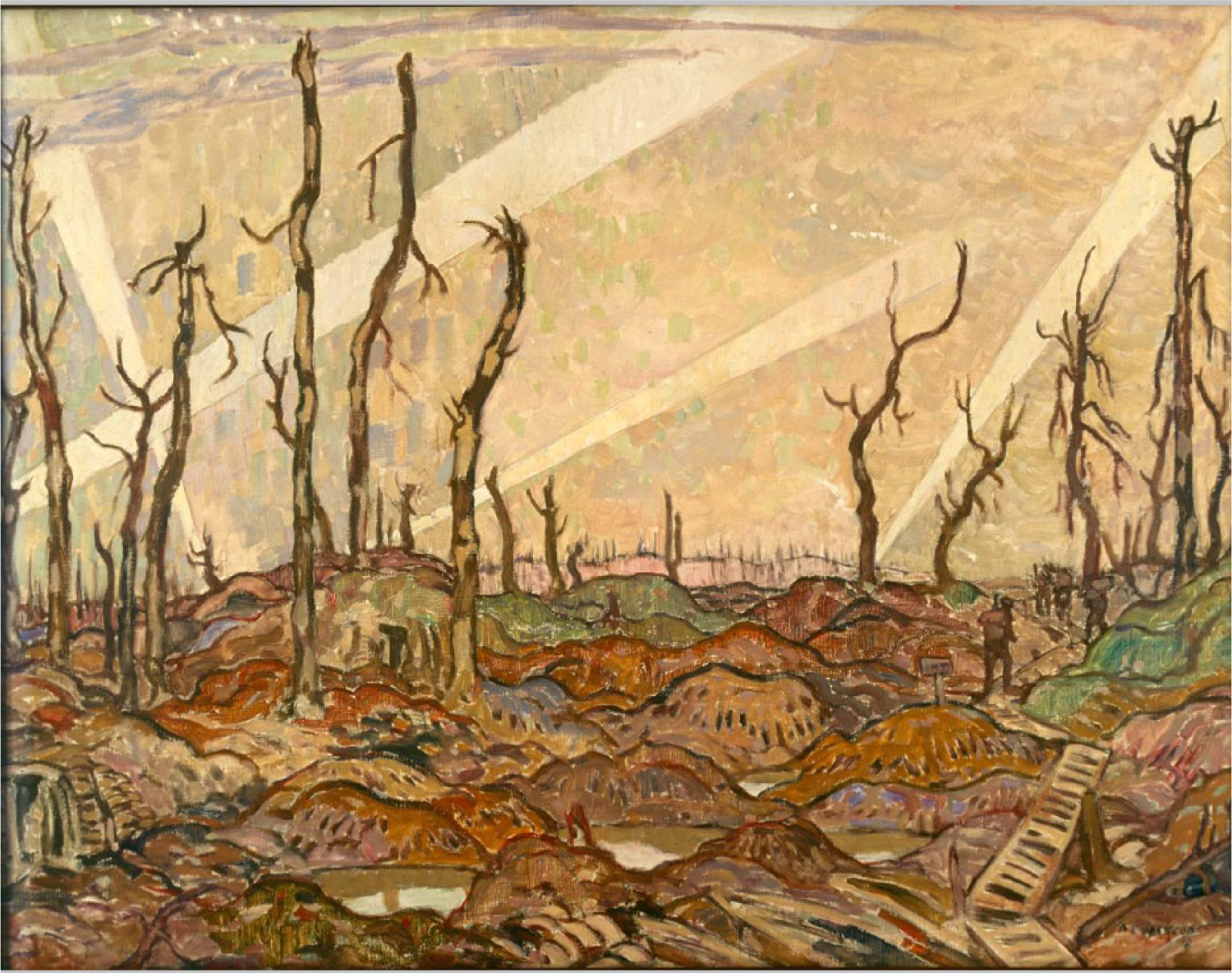
A.Y. Jackson, A Corpse, Evening. 4
That death or even injury in war art is an ‘absent referent’ is jarring because, as Gough (2010) notes, the battlefield is far from empty – it is ‘crowded … with the bones and bodies of the dead’. This disconnect is not unique to war art but is prevalent even in scholarly analysis. Efforts to decipher the causes and consequences of warfare are mired in a set of abstract formulations, with war studied as an outcome (or failure) of strategic interaction that can disrupt the balance of power among state (and increasingly non-state) actors in an anarchical ‘self-help’ system (Gilpin, 1981; Waltz, 1979). Even if critical of this approach, formulations excavating ‘ideational’ forces discuss war in terms of discourses, metaphors and other kinds of symbolic exchange, with little direct reference to the bloody matter of war – its dead and injured bodies (Barkawi and Brighton, 2011; Bartelson, 2011; Campbell, 1992; Hansen, 2006).
War, however, is something that people do. As Elaine Scarry (1985: 71) has evocatively observed, there is a contradiction between the representation of war ‘as a rarefied choreography of disembodied events’ and the fact that it is also ‘the most radically embodying event in which human beings everywhere collectively participate’. Correcting this imbalance, an emerging body of work has turned its attention to the myriad ways in which war is embodied through an array of physical, emotional and social experiences on and off the battlefield (Basham, 2013; Holmqvist, 2013; Howell, 2011; MacLeish, 2013; McSorley, 2013, 2014; Sylvester, 2011, 2013; Wilcox, 2015). From combat to commemoration, war shapes the body. Bodies, however, are not just created by war. In war, bodies are dismembered; they ‘putrefy, fester and decompose’ (Gregory, 2016: 950). People may live through war, but they also die or are wounded because of it. Said differently, people do not just become through war – they unbecome, or, as it were, they become dead. This makes the absence of warfare’s fleshy detritus, in both art and scholarly inquiry, even more surprising.
Attending to this apparent disregard for death and injury in war is important for many reasons. Principal among them is Bourke’s (1999) observation (p. xiii) that ‘the characteristic act of men [sic] at war is not dying, it is killing’. Within international law and the ethical criteria of ‘just war’ doctrines, under certain circumstances, killing and injurying bodies are normal and intended actions (McMahan, 2011; Norman, 1995; Zehfuss, 2012). Investigations into the causes of war may delineate what makes war probable. But war operates with legal and ethical parameters that make the intentional harm and killing of people in war possible, enabling dead and wounded bodies to proliferate.
This suggests that making dead and injured bodies more visible is essential to appreciating the consequences of war (Auchter 2014, 2016; Muppidi, 2012). However, as Gregory (2014, 2016) notes, this requires more than just adding bodies to the mix, attending, for instance, to kill ratios or body counts. Such facts and figures can be staggering. But Gregory (2014) points out that although the ‘bodies are counted … we rarely hear about what actually happens to the body in war’ (cf. Wilcox, 2015). In a pile of numbers, the actual violence inflicted on bodies is not apparent and does little to further ‘[an understanding of] the death and destruction caused by war’, the mangled ways in which bodies are killed or injured (Gregory, 2014). It is not just that people die or are wounded in war, and in great number; the question of how people die is equally significant.
An initial answer to this question might be found in the CWM’s Le Breton Gallery, which houses the museum’s weapons collection. In contrast to the dearth of death in the Museum’s artwork, the Le Breton Gallery is described to visitors as showcasing ‘the way human ingenuity has been applied to the science of war, creating weapons and other devices to attack, protect and kill’ (Figure 2). On display are a series of familiar objects of war – tanks, guns, artillery, bombs, all of which are considered ‘conventional’ weapons, technologies of war that all parties in a conflict can legitimately and reciprocally use. Some might be outdated or updated, but all are considered acceptable to use. Such conventional weapons demonstrate that the use of destructive force, often lethal in kind, is not arbitrary or unbridled in international politics. In addition to requirements of just cause, warfare is governed by rules of just conduct. Within this, laws around weaponry aim to limit the use of force only to those weapons that are sufficient to disable enemy combatants (mis hors de combat – ‘put out of action’), without rendering their death inevitable. 6 Based on principles of proportionality and preventing unnecessary suffering, weapons are restricted by volume, type and use (Greenwood, 1998). But adjudicating some standard of ‘sufficiency’ implies that violence, even lethal in kind, exacted by certain weapons is appropriate, falling within the requirements of military necessity and the moral or legal impetus for war. Killing might be particular to war, but it is killing of a particular kind. There are acceptable (conventional) ways in which bodies can be killed and injured in war. This makes the matter or material of war more than just its dead and injured bodies but also the materiel by which they are produced.
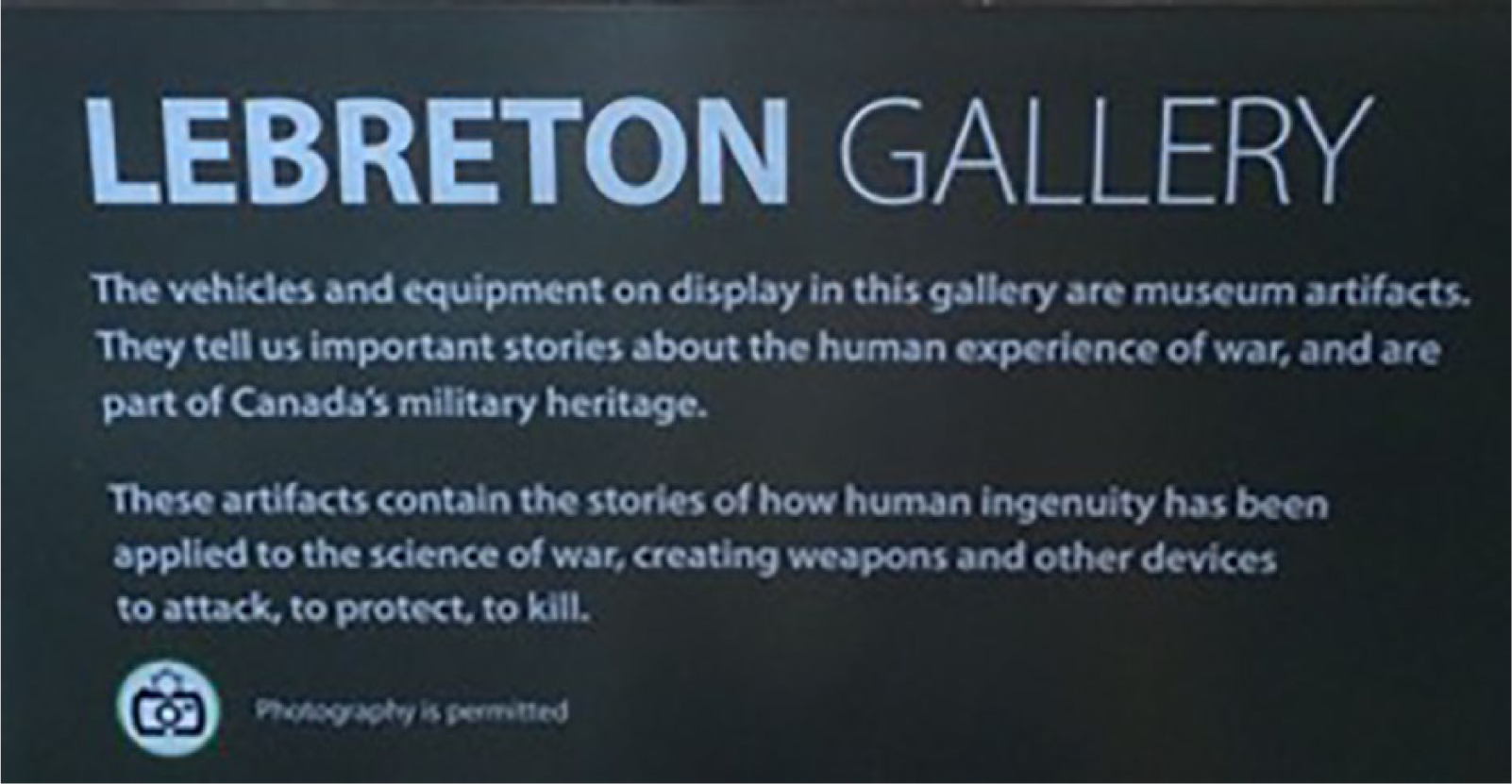
Description of the Le Breton Gallery. 5
And yet at first sight there is little by way of evidence in the Le Breton Gallery that such destruction of bodies occurs. The gallery, like other similar weapons collections, presents weapons as restored and ‘clean’, neatly arranged and organized through detailed information on their technical ‘specs’ (range, calibre, rounds per minute). The display is reminiscent of Cohn’s (1987) warning that the techno-speak around weapons sanitizes and makes invisible the bloody carnage of war, allowing it to be waged without confronting its violent effects on the bodies involved (Gregory, 2016; Scarry, 1985). Indeed, as one student remarked, despite looking down the barrels of some big guns, one could tour the entire collection without the sense that war produced corpses, or at least not very many of them.
This article challenges the ‘visible’ absence of death and bodily harm in the weapons gallery at the CMW (cf. Malvern, 2000; Whitmarsh, 2001; Winter, 2012, 2014). To the degree that the weapons on display are conventional weapons, the legitimacy of their use implies the legitimacy of their consequences for the human bodies involved in war; as visitors are told, the weapons on display ‘tell us important stories about the human experience of war’ (see Figure 2). Put differently, how people are killed or injured in war is a function of what comes to count as a weapon. I explore this relationship by revisiting the Le Breton Gallery equipped with Karen Barad’s (1998, 2003, 2007) work on ‘how matter comes to matter’. Objects and subjects, Barad contends, are not pre-given – they ‘become’, assembled through apparatuses that invoke grids by which some things are intelligible and thus accepted as subjects (humans) and objects (non-humans) and others not. Applied to the question of weapons, there is an ontology of violence in war that produces both what are acceptable weapons and the dead and injured bodies associated with them. Along these lines, I examine the way that the practice of killing and bodily harm is both practically and politically calibrated by the techno-scientific criteria of particular weapons. From this perspective, I contend that the weapons display is not as sterile as might at first seem. Because of, not despite, its technical focus, weapons emerge as ‘boundary objects’ (Bowker et al., 2015; Bowker and Star, 1999; Star, 2002), the technical capacities of ‘standard issue’ weapons disclosing standards of killing and injury in the conduct of international warfare.
Dead (and injured) bodies it turns out are present in the details. There is certainly much to be said about the complexity and politics of museum displays (Bennett, 1995, 2015; Dudley, 2010; Karp, 1991). Although relevant to the arrangement of the weapons galleries (Raths, 2012; Scott, 2015; Whitmarsh, 2001), as a student of international politics and science and technology studies, my interest in this space is to use it as a launching point for exploring how killing and injuring bodies are organized through the technical criteria that become weapons technologies. Heeding Gregory’s (2016) call for a theoretical framework ‘that can grasp the materiality of the wounded body or do justice to the political significance of bodily destruction’, I use the Le Breton Gallery as a thought experiment to propose a way to investigate and interrogate how death and injury in war are embodied in legitimate weapons and exacted in ethical ways.
Lives are not equally lost in war. Tragically, neither are they equally grieved (Butler, 2004, 2009; Gregory 2016). My effort in this article is not to diminish the significance of this disparity. Rather, it is to consider how certain kinds of bodily violence become acceptable in the first place: killing, maiming and attacking bodies in war, egregious though these acts may seem, are not by definition grievous offences. Situated in an emerging body of work that draws attention to how scientific and technological capacities manifest as weapons infrastructures (Bousquet, 2009; Bolton, 2015; DeLanda, 1991; Kindervater 2016), this article hopes to lay the groundwork for a broader inquiry into the ways in which certain ‘conventional’ weapons mediate and make sensible not just when – but how – the line between preserving life and killing it becomes not just possible but permissible.
Seeing death
The absence of dead and injured bodies both within the CWM’s war art collection and seemingly in the weapons gallery stands in stark contrast to more contemporary media representations of war. Images of mass killings from Bosnia and Rwanda, torture in Abu-Grahib, webcasted beheadings by the Islamic State of Iraq and the Levant (ISIS), the on-going war in Afghanistan and, more recently, the continuing civil conflict in Syria have broadcast the bloody reality of war. But even this, argues Campbell (2011), is limited in its scope, with the majority of the dead disappearing in media representations. Seeing the dead, especially in war, can be ghastly and abhorrent. Such images are not easily palatable; they can be distasteful expressions of violence that disregard norms about respect for the dead or the pain of those mourning their loss. Despite an effort to communicate the brutality of war, practices of prudence and caution can cleanse war of its destructive effects (cf. Beurier, 2004; Booth, 1993; Campbell, 2003, 2004).
Although sensitive that images of dead bodies can be gratuitous, Campbell (2011) still insists that the disappearance of the dead in representations of war should be lamented. Images can leave a lasting impression. We should see the dead and injured, he contends, because evidence of the business of war is a form of witnessing that can foster ‘an ethical responsibility in the face of crimes against humanity’ (Campbell, 2012; see also Campbell, 2004). Quintessential here is the example of photographs of the Vietnam War and their effect in reversing public support for the campaign in the United States. Likewise, video footage and photographs pointing to the use of chemical weapons in Syria, if not resulting in concerted action by the United Nations or its individual member states, did have an impact on public understanding of the civilian costs of the protracted civil war. In the face of atrocity, one must be forced to act.
The business of killing and injury in war, however, is not simply limited to crimes against humanity. There are certainly many deaths in war that would fall into this category. But, as noted, inflicting bodily harm in war is not by definition outlawed. Certainly, killing and injuring enemy combatants are not the sole purpose of war, and – pace Cannetti’s (1984) claim that war’s objective is to murder the enemy other – they are to be avoided or limited. But in the modern international system, war has special provenance as a necropolitical right of states (cf. Mbembe, 2003; cf. Bartelson, 1995; Walker, 1993). Although legal and ethical criteria may restrict when, why and how war occurs, they do not prevent it; on the contrary, they specify that the use of destructive force, developed and deployed with an express intention to harm and even to kill enemy combatants, is at times permitted.
Along these lines, as institutions of public learning, war museums become important sites for communicating the consequences of war. Museums, Alpers (1991) has famously noted, are a ‘way of seeing’. With the sanctioned destructiveness of war as an intrinsic part of their mandate, war museums are a way of seeing war. Contemporary war museums emerged following the unprecedented experiences of the First World War in Europe (Winter, 2004, 2006). Mass conscription changed the social experience of death as soldiers were no longer limited to mercenaries, volunteers or professionals. Policies against the repatriation of the dead, compounded by the effects of new industrialized warfare that quite literally ‘dematerialized’ bodies, left few ways for families to bury and remember their dead. War museums filled this gap. As museums they were designed as institutions storing and exhibiting objects of cultural, social and political significance. But as war museums they did so as memorial sites. War museums have thus evolved with a direct relation to the war dead precisely because the latter can disappear (Beckstead et al., 2011: 195–196; Kavanagh, 1988; Moriatry, 1997; Mosse 1990).
Attempting to make war’s deadly and destructive consequences more visible, however, is not straightforward. There may be a case for why we should see the dead, but ‘how’ we should see them is fraught with difficult ethical questions about showcasing war without encouraging a voyeurism that glorifies its gory details (Winter, 2012). Whether or not actual or models of dead bodies should be displayed is a fiercely debated issue for museums in general (Alberti et al., 2009; Linke, 2010; Marlin-Bennett et al., 2010). It becomes even more so when the bodies on display have been subjected to violence that may in fact make them unrecognizable as bodies (cf. Auchter, 2016). Similarly governed by norms about respect for the dead, war museums have opted for more figurative expressions of death. 7 Paintings such as Jackson’s, for instance, are evocative in part because they illustrate the devastation of war as ruined landscapes. Although these paintings reflect how the built environment can be a casualty of war (Coward, 2006; Lisle, 2011), they also work metaphorically, with desecrated fields, burnt out houses and demolished public landscapes standing as a ‘gentler way to communicate’ war’s human costs (War Art of the First World War, exhibit description, 2015). Likewise, items such as the display of shoes and clothes, among other personal items, a common practice in exhibits of the Holocaust, can communicate what happens to bodies in war.
If paintings and other items display violence and death by proxy, then the ‘art of war’ becomes more literal in the Le Breton Gallery’s collection of weapons. Here visitors are exposed to war beyond aesthetic representations in paintings or photographs. Nor are the affective responses to war’s brutality delegated to the personal items of those killed or injured in war. Rather, on display are the artefacts by which war is waged. Indeed, if the question is attending to how bodies become injured or dead, the CWM’s description of the Le Breton Gallery as tools ingeniously designed to ‘attack’ and ‘kill’ appears to provide direct access to witnessing how bodies are potentially destroyed in war.
However, if avoiding voyeurism is seen as a responsibility, of all the different dimensions of a war museum, weapons galleries are seen to run the risk of encouraging a morbid fascination with the gruesome details of war, a space where the object fetishism of military enthusiasts can venerate rather than reflect soberly upon the destructive power of given technological devices (Raths, 2012; Winter, 2012; Whitmarsh, 2001). That being said, weapons exhibits rarely demonstrate what happens to the body in war. Alpers (1991: 27) warns that despite aiming to help viewers see, museums can ‘make it hard to see’, as objects are often presented without any context of their use or cultural significance. In the case of war museums, weapons exhibits tend to ‘display the tools, not the destruction wreaked by those tools’ (Bartov quoted. in Whitmarsh, 2001: 6). This approach is not entirely accidental. As one curator puts it, the focus on ‘[w]eaponry as technology, how it worked, and the evolution of engineering, is an effort not to concentrate too much on the killing aspect of it’ (Bennett quoted in Scott, 2015: 497).
Not concentrating on the damaging dimensions of weapons, failing to communicate that such instruments were ‘built by human beings, filled by humans beings and used against human beings’ (Raths, 2012: 177), somewhat paradoxically contributes to making weapons galleries one of the most sterile spaces of a war museum. Removed from their battlefield contexts, presented as pieces of ‘mere’ technology, the lethal or injurious consequences of exhibited weapons can be overlooked or misunderstood. As one curator notes,
You have to have a massive amount of imagination and a fair degree of knowledge of how the weapon actually worked, the size of the bullet and what a bullet actually does to the human body, to see it as something dangerous. (Moreno quoted in Scott, 2015: 497)
A suggested antidote is to provide more graphic displays, the ‘real’ stuff of war being ‘what [weapons] do to the arms and legs and the rest of us’ (Winter, 2012: 162). The US National Aerospace and Science Museum, for instance, revamped its descriptive labels so that weapons were explained in terms of the civilian casualties caused (Whitmarsh, 2001). Likewise, the German Tank Museum has been recently redesigned so that images of those on the receiving end of a specific tank are now placed directly beside it (Raths, 2012: 180). This goes some way to demonstrating how people are injured or killed in war. But it still raises problems for how to achieve a delicate balance between providing an informed account of weaponry and potentially descending into ‘war porn’ (Scott, 2015). Even more, others worry that such graphic images can actually be counterproductive to developing an informed account of warfare (Raths, 2012).
In the name of avoiding voyeurism, bodies, the target and product of weapons, seemingly disappear. This raises the possibility that little is achieved by weapons displays in terms of understanding the consequences for the people affected – wounded or killed – by the large-scale legitimate organization of destructive force. That weapons are designed by ‘human ingenuity’ with the intent to attack or kill is no longer visible – at worst it is unimaginable. How such weapons become possible as permissible means of injury and killing is a question that fails to be asked and answered.
Becoming a weapon
The literature on weapons is certainly not short in supply. In the most standard political science approach, weapons are viewed as a material ‘variable’, the preponderance of which can shift the balance of international power towards or away from the outbreak of war (Levy and Thompson, 2005; Vasquez, 1993; Waltz, 1979). Beyond this, weapons have been the focus of communities that include museum curators (Raths, 2012; Regan et al., 2010; Scott, 2015), military historians and strategists (Keegan, 1993; Smithhurst, 2011; Van Creveld, 1991) and scholars of science and engineering (Adas, 1989; Edwards, 1996). The social and cultural impacts of their violent consequences have also been keenly observed by anthropologists (Henig, 2012; Kim, 2016; Navoro-Yashin, 2012), geographers (Gregory, 2011, 2016; Kindervater, 2016; Woodward, 2004), archaeologists (Rackozy, 2008), architects (Weizman 2007) and social theorists (Chamayou, 2015; DeLanda, 1991; Massumi, 2015).
Within this literature, the question of what counts as an acceptable weapon has been answered in different ways. Efficiency is often assumed to be a value, with the technical properties of a given artefact determining whether a weapon is useful on the battlefield (Keegan, 1993; Van Creveld, 1991). However, even if developed with specific technical properties that lend themselves to destruction, efficiency only explains how weapons become available, not which of them become acceptable. Important scholarly and policy work on ‘weapons taboos’ – moral opprobriums restricting or prohibiting the use or development of certain weapons – demonstrates that some very efficient weapons (e.g. chemical weapons) can be removed from the assumed inventory of war (Dolan, 2013; Price, 1997; Tannenwald, 2008). The tenor of this work is to focus on those weapons that are rendered illegitimate, even inhumane, in the practice of warfare. But the implication is that norms that condemn some weapons also condone others – the use of precision bombs over cluster bombs is a prominent example (Zehfuss, 2012).
Divergent though they may be, in each of these renderings the weapons under study are taken for granted as objects readily available for their users. Moreover, norms only evaluate and regulate weapons as ‘good’ or ‘bad’ after the fact (ex post facto). If efficiency is too deterministic an account of weaponry, neglecting its social and political contexts, attention to norms and rules at best leaves the question of weaponry as a secondary, epiphenomenal effect of cultural discourses, metaphors or ideologies (e.g. Mutimer, 1997; Weldes, 1999). Evidently, technological capacities on their own do not determine death, evolving as they do as forms of violence that are rendered appropriate or not. But weapons technologies are not merely side effects or material facets of a broader set of cultural forces (see, for instance, Saunders, 2004; cf. Appadurai, 1988; Miller, 2005).
A different approach inquires into the ‘agency’ of weaponry to shape both the physical exercise of violent force and the normative landscapes in which it operates (Bourne, 2012; De Larringa, 2016; Gregory, 2011; Salter, 2015, 2016). Drawing on new approaches to materiality (Bennett, 2010; Braun and Whatmore, 2010; Coole and Frost, 2010; Latour and Weibel, 2005; Marres and Lezaun, 2011), and longstanding work in science and technology studies (Latour, 1987, 1999; Law and Hansard, 1999), weaponry is cast in a new light (Anaïs, 2011; Bolton, 2015; Bousquet, 2009; Gregory, 2011; Salter, 2015, 2016). From this perspective, weapons are not seen as constraints on human action, ‘brute’ things that get in the way of ideas. Instead, they are taken to be actors in and of themselves that interact with human beings to produce networks through which systems of warfare emerge. Agency, in this way, is not a purely human trait, but is distributed across both humans and things in a variety of ‘actor networks’ or ‘assemblages’ (DeLanda, 1991; Deleuze and Guattari, 1987; Latour, 1999, Law and Hansard, 1999, Mol, 2003). Along these lines, weaponry is not just a tool that soldiers (among others) use – rather, through interaction weapons also shape expectations about the physical and political exercise of violent combat. Weapons as a result are thus better understood as an ‘apparatus’ of violent action, both the outcome and the operation of organized ‘congeries of actors, objects, practices, discourses and affects’ (Gregory, 2011: 196). That a given weapon’s agency entails more than just its physical features, including as well its interaction with the people, norms, rules and the activities of war, to some extent illustrates the multiple dimensions that constitute the ‘machines’ of war, both as systems and as specific tools (cf. DeLanda, 1991). However, interaction similarly assumes that weapons are already in place and primed for action.
If weapons must become acceptable, strategically and politically, they are not pre-given. To uncover how a weapon becomes (acceptable), Karen Barad’s (1998, 2003, 2007) ontological approach to matter can provide important insight, shedding light on what comes to count as a weapon. Before interaction, Barad claims, there is intra-action in which capacities are defined, shaped and sorted in ways that make some things, and not others, sensible as objects and their users. An apparatus, with all its component parts and people, is a grid of intelligibility that determines what counts or is observed and understood as a weapon, who uses it and against whom it may be used. Without a doubt, weapons technologies are artefacts made through the designs of people (cf. Bjiker, Hughes and Pinch, 1989). But more than this, an acceptable weapon relies on the ways in which technical capacities, human ingenuity and predilection for warfare constitute and are conditioned by ‘conventions’ between appropriate and inappropriate means and ends of violence. Said differently, conventional weapons emerge through a relational set of performances by and between a variety of forces (technical properties, legal and ethical criteria, operational directives, military strategy) that delineate a boundary between legitimate and illegitimate violence. As agents of destruction, then, weapons materialize through an apparatus in which fighting war and killing and injuring become appropriate and available in specific forms.
This approach to weaponry does not imply that (dead and injured) bodies are simply (un)intended side effects. A weapon is evidence of an ontology of violence whereby capacities for harm converge in both the technologies of battle and their attendant bodies. Dead and harmed bodies certainly materialize because of weapons (Gregory, 2016; Wilcox, 2015; cf. Butler, 1990). However, that certain kinds of death and injury are not just foreseeable but allowable in war instils particular kinds of weaponry as being capable as agents of destruction. Bodies, then, dead or wounded, are not just consequences but consequential in the apparatuses of war that become entrenched. There are particular kinds of dead and injured bodies that, even if regrettable, are acceptable. There is, in short, not a strict linear causality but a relational ontology between becoming a weapon and becoming dead or injured. What counts as a weapon and the harmed bodies of war that are assumed to be ‘calculated costs’ emerge in tandem through intra-action. In a word, dead and injured bodies materialize in the ontology of violence through which certain kinds of materials (weapons) of war become acceptable to use.
Rendering weaponry as a question of ontology, however, is not to sidestep the question of ethics. Following the logic of Barad’s approach, in the realm of weaponry ontological questions are inherently ethical ones because of the way that seemingly anodyne technical or operational standards create boundaries between what is and is not taken for granted and unquestioned as a means of force, potentially lethal in kind and consequence, and which dead and injured bodies are reasonable in war (cf. Star, 2002). In this respect, the line between conventional and unconventional weaponry is not simply between those instruments that are authorized as or those that are barred from being acceptable weapons. Rather, weapons that become acceptable to kill and injure make intelligible the inventory and impressions of what comprises war. The instruments of war, in other words, are not just a means to an end (casualties), but an end in itself: specific kinds of ‘instrumental violence’ become allowable, even justifiable, in terms of their consequences for human bodies.
Calibrating harm
Returning to the Le Breton Gallery with the above discussion in mind, the brutality of war becomes evident precisely through the technological display of the ‘tools’ of war. The Le Breton Gallery is an impressive space, populated by a vast array of guns, bombs and tanks acquired from militaries around the world (Figure 3). As an exhibit of weapons, it draws on a tradition of displaying weaponry in the armouries of feudal lords and monarchs, for whom the show of weapons was linked to power. By the 19th century, as armouries lost their ornamental value, they became storehouses, in which new and old weaponry were kept and distributed to local regiments. Less fantastical displays, armouries became more repositories of standard military equipment. Although not war museums as officially founded later in the 20th century, armouries did have an element of exhibition, but principally as a functional inventory of a regiment’s military equipment that was showcased to local communities. Based on this tradition, weapons galleries came to occupy a central space during the emergence of war museums in the 20th century (Malvern, 2000; Raths, 2012). The context of their founding amid the experiences of the new industrialized machines of the First and Second World Wars only reinforced the premise that weapons galleries made the ‘stuff’ of war visible (cf. Saunders, 2004).
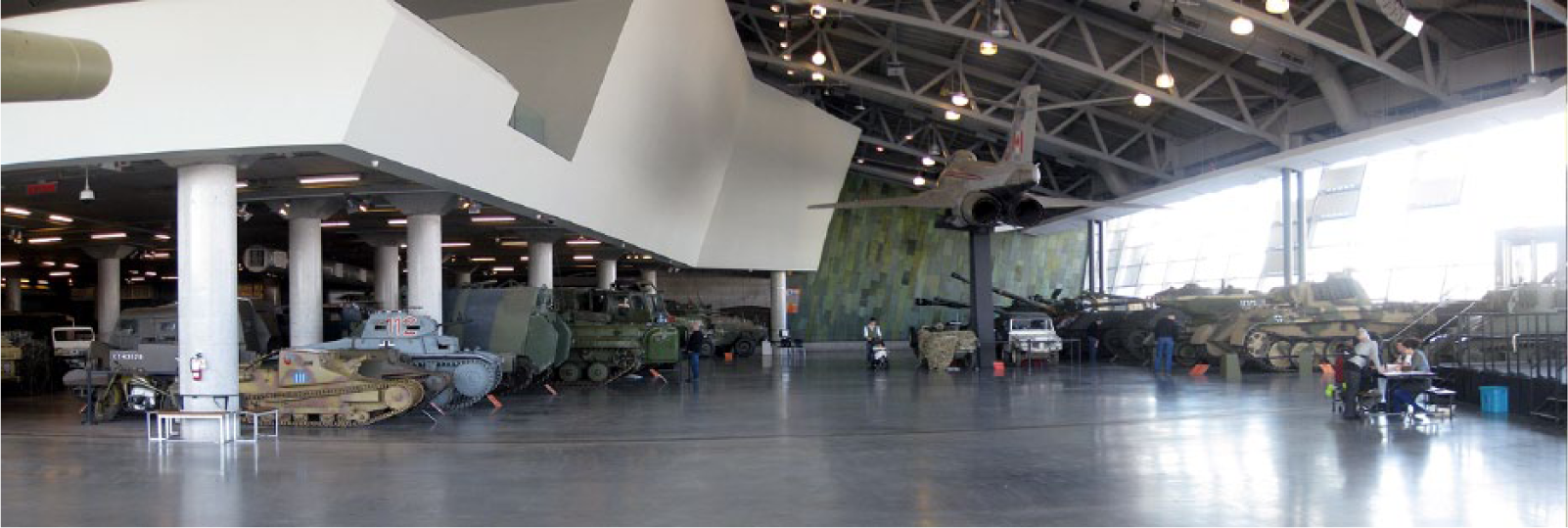
The Le Breton Gallery at the Canadian War Museum. 8
Although not founded until 1942, the CMW has its origins in an effort to collect and develop an archive of the Canadian government’s military artefacts that began in 1888. The Le Breton Gallery in this way is the most traditional space in the museum. This is not just because of the gallery’s ‘content’ (weapons) but also its presentation. 9 Despite the fact that war museums have expanded their collections beyond weaponry (to include flags, uniforms, paintings, sculpture, photography, etc.) and use more modern techniques of immersive spectatorship and interactive visitor experience, weapons exhibits like the Le Breton Gallery are reflective of the ‘functional’ interpretation of weapons established in the 19th century. Organized either by use or in chronological fashion, weapons are placed in neatly arranged rows and accompanied by ‘informative’ labels (Raths, 2012; Scott, 2015; see Figure 4).
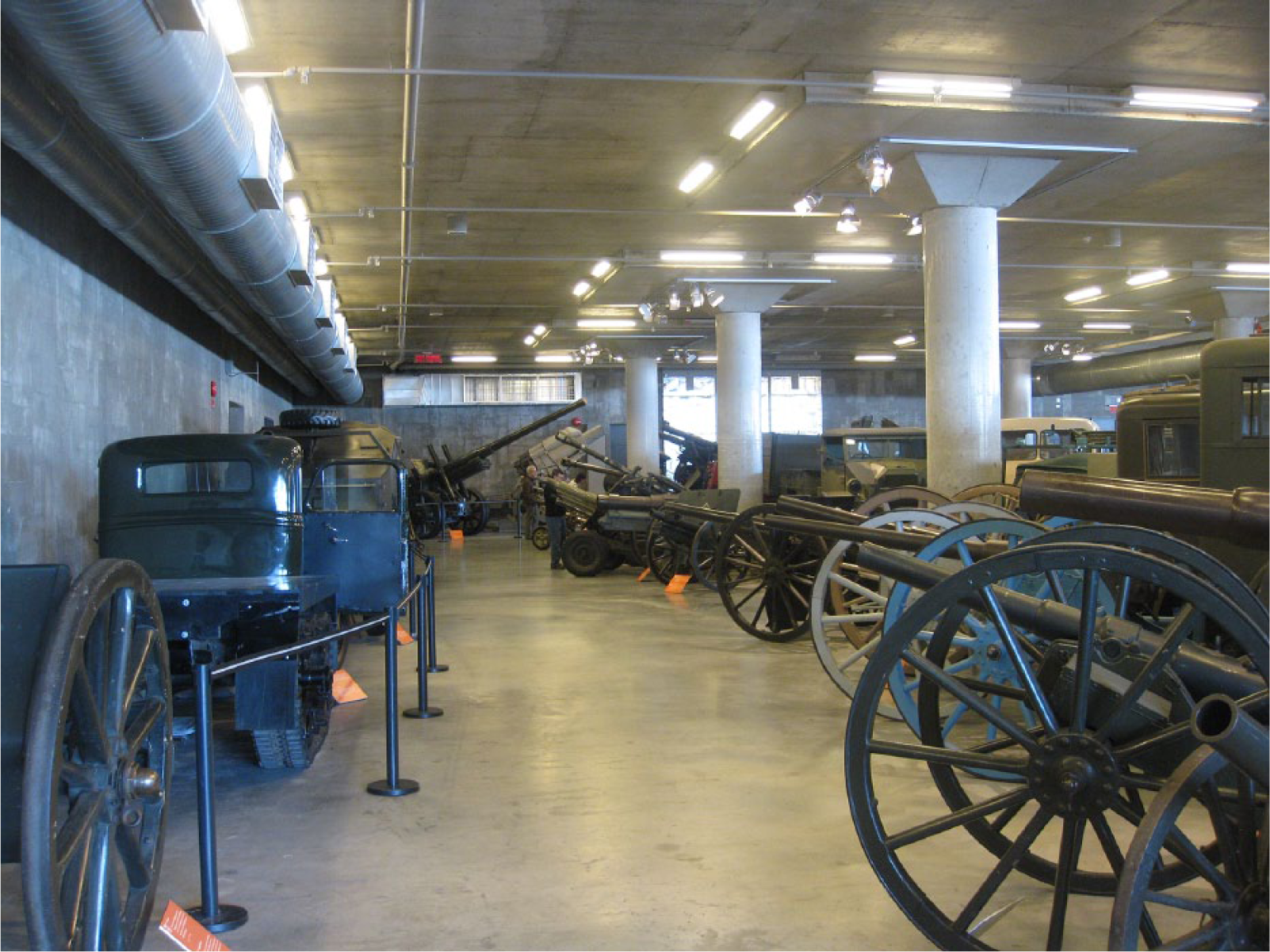
Typical arrangement of weapons in the Le Breton Gallery. 10
Labels are an iconic and important dimension of museum culture and practice. According to Sherman (1995), ‘regardless of the intrinsic value of objects … organizers of historical museums fear that in the absence of explicit, text-based orientations, visitors will experience [the space between the objects and label] as a sort of chaos’ (p. 52; cf. Fragomeni, 2010; Kanel et al., 1991; Miller, 1990; Wolf and Smith, 1993). The stuff of war is not presumed to speak for itself, with labels providing an essential aide in the visitor’s learning experience. A practice of ‘show and tell’, labels help visitors make sense of objects and their relationships with each other (Bennett, 1998: 350; cf. Classen, 2007; Crary, 1992).
Following this practice, a variety of different labelling practices guide the visitor experience in the Le Breton Gallery. First, visitors are introduced to weapons according to their use on ‘Land’, ‘Air’, ‘Sea’, or as ‘Field Artillery’, ‘Armoured Fighting Vehicles’, ‘Cannon or Mortar’ and ‘Tanks’. More detail is then provided for each piece of weaponry, outlining how and what they were designed to do, and how they were used. Most prominent is information about their performance criteria, such as range, projectile size and speed. For example, visitors are told that the ‘20 mm T171E1 Vulcan Cannon’, with a projectile size of 20 mm, is a ‘revolutionary advance in aerial firepower’ that furnishes the ‘ability to fire 6000 rounds per minute’. And Did you know? (as a special descriptive section is titled) that because the Vulcan cannon ‘permits a much higher rate of fire than a gun with a single barrel’, the ‘wear on gun barrels’ or ‘problems caused by gun barrels heating up when they are fired’ are significantly reduced? (Figure 5(a) and (b)). Likewise, the ‘B-11 Recoilless Rifle’, with a projectile size of 107 mm, rate of fire of 5–6 rounds per minute, a range of 450 m and the ability to penetrate amour up to 380 mm thick, was designed to ‘eliminate … the rearward motion of the gun’, which allowed the gun to be ‘smaller and lighter’, even though ‘the blast caused by gases can give away its location’ (Figure 6(a) and (b)).
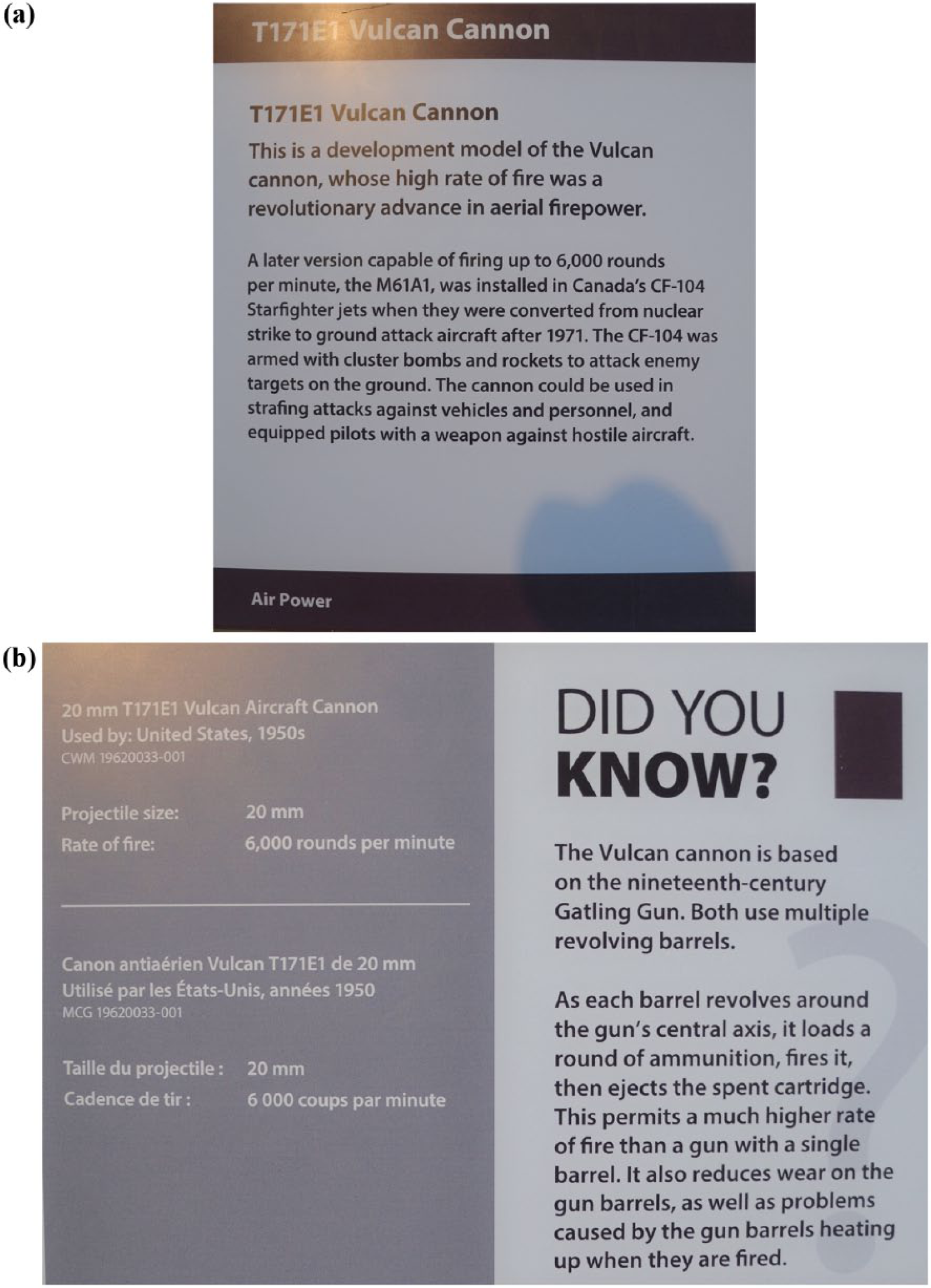
Descriptive labels for the 20-mm T171E1 Vulcan Cannon. 11
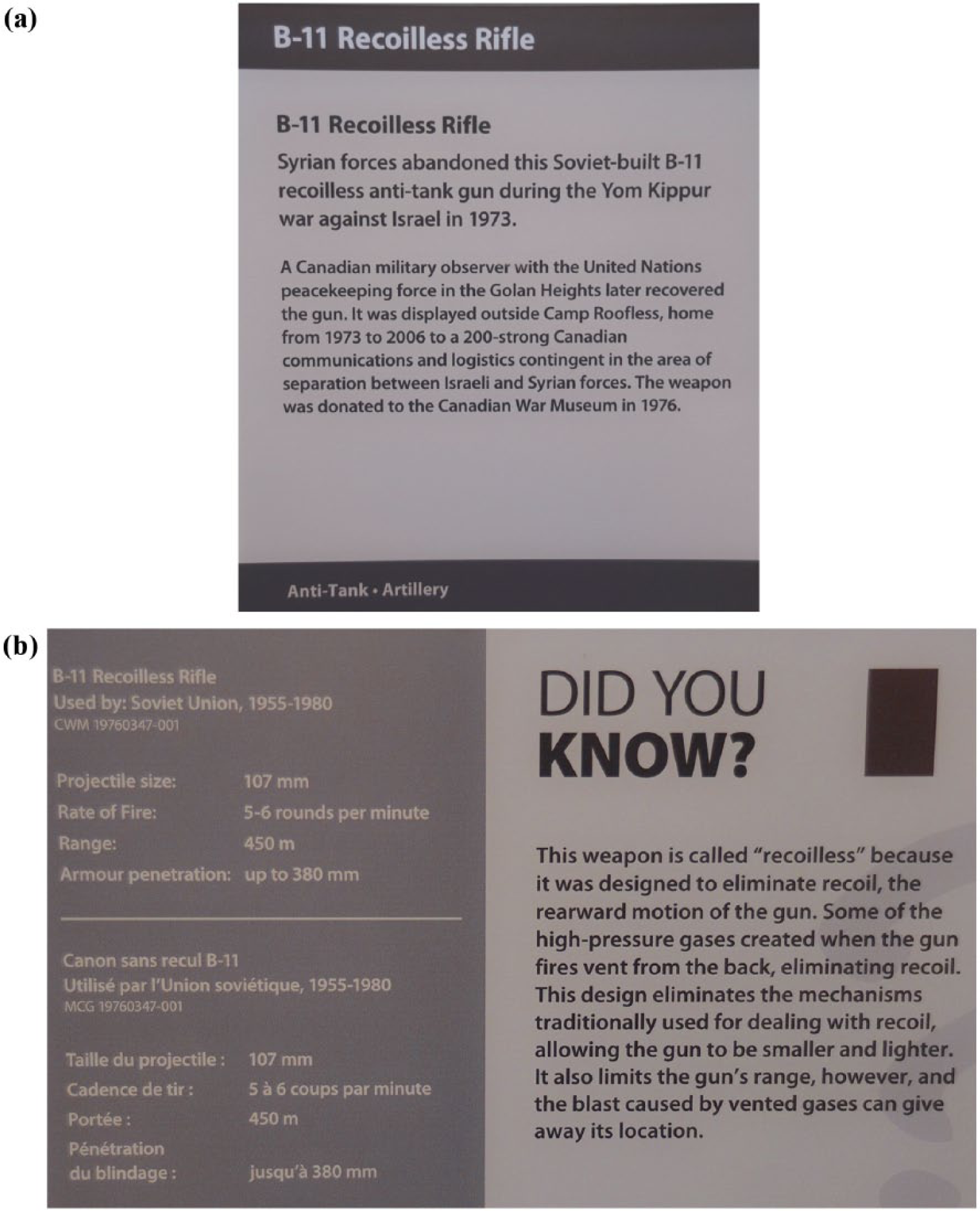
Descriptive labels for the B-11 Recoilless Rifle. 12
That labels describe and situate objects gives them a certain epistemological power to shape what the object is understood to be. Although museums were conceived amid the modernist assumption that knowledge ‘mirrored’ nature (Rorty, 1979), such an implied (impartial) objectivity as a basis for knowledge and ‘truth’ has been challenged on a number of fronts (Crary, 1992; Foucault, 1977; Jay, 1993; Rorty, 1979). In museums specifically, the presumed ‘objectivity’ of labels to communicate the ‘nature’ of the objects displayed has been recast as a practice of providing narratives, an exercise of emplotment, in which objects become ‘vital’ in a particular way (Bennett, 1998; Gurian, 1999; Kanel and Tamir, 1991; Moser, 2010; Sherman, 1995). Labels, in other words, shape how objects come to be understood. Daston and Galison (2010) have elucidated this in a more general sense by uncovering how practices of observation define what is considered to be an object. Less a question of bias, they are interested in how certain practices of observation become entrenched within a community. What amounts to ‘proof’, the evidence used to detect and describe objects, actually shapes what objects are worthy of being seen. Observation, in other words, amounts to a kind of ‘object’-ivity – how objects are portrayed actually produces what they are.
With its focus on technological features, the Le Breton Gallery is emblematic of the labelling conventions in weapons galleries (Raths, 2012; Scott, 2015; Whitmarsh, 2001). The narrative that tends to come to the fore, as Raths (2012) observes, boils warfare ‘down to a comparison of gun size, armour thickness and engine power’ (p. 178), the consequence of which is that the ‘technical character of objects ‘fills’ the mind of visitors and employees alike’, with little room left for appreciating the fact that the objects on display have been used to attack or kill people (Scott, 2015). The labels provided in this way do more than paper over the destructiveness of war; more significantly, their focus on minutia makes it ‘either inconceivable or at least unnecessary to have more than a purely technical point of view’ (Raths, 2012: 176). What results, Raths continues, is an obsession with a model of the weapon rather than what it does. That discussion of weaponry has been dominated by a technological discourse that sanitizes war of the destructive consequences of the ‘tools’ by which it is waged has long been noted (Cohn, 1987; Der Derian, 2009; Scarry, 1985; Zehfuss, 2012). In the weapons gallery, that discourse is ‘materially’ reproduced and preserved as an archive of military history. Reduced to an idealized typology (Land, Air, Sea, etc., calibre, weight, range), the dead and injured bodies that accompany a weapon’s use are absent, or at least put into the margins. It is easy to forget that ‘ground up bodies, limbs torn apart, carnage, and butchery are all part of [war’s] habitual theatre’ (Cavero quoted in Gregory, 2016: 951).
As noted, that this technical point of view can remove the brutality of war is not fully lost on curators of weapons displays (Scott, 2015). At the same time, the effort not to focus on the killing dimensions of weapons technology is based on an assumption that ‘[technology] is … a relatively uncontroversial and “safe” subject. Technological parameters can be measured precisely, and are not open to moral debate’ (Whitmarsh, 2001: 5). The idea that technological artefacts are morally or politically ‘neutral’, however, has long been discredited (Adas, 1989; Bijker et al., 1987; Latour, 1987; Star, 2002). This raises the question of just how sterile an exhibit organized through a detailing of technical specifications might be and what kind of politics or morality of warfare might be embedded in and exercised by weapons.
If labels allow objects to be observed in some ways and not others, the Le Breton Gallery’s techno-scientific details become the grid by which weapons become intelligible. Put differently, the technical details on view communicate the ‘evidence’ that have made the objects on display acceptable (as) weapons and, through this, the kinds of bodily injury and harm that become appropriate in the practice of warfare. As a detailing of ‘technological parameters’, they may at first appear to be ‘nothing more than lists of numbers’ (Star, 2002: 110). However, precisely because they are parameters they have political weight as standards (Bowker and Star, 1999; Star, 2002). Standards include and exclude, shaping which technologies and infrastructures become operational and how. Seemingly innocuous specifications such as the size of bores or the shape of bullets are thus more than markers of the efficacy of a weapon. Rather, standards create weapons as ‘boundary objects’ (Bowker et al., 2015; Bowker and Star, 1999). On the one hand, as standardized items, weapons are not just ‘functional’ tools of warfare but reflect boundaries between which weapons are understood as useful, legal and ethical, and which are not. On the other, because they are standardized, they generate ubiquitous understandings of what kind of weaponry can or should be used across a group of actors – bureaucratic officials in war offices, commanders and soldiers, and even the public at large. In short, standards become the irrefutable measures of what kind of matter matters in war. To the degree that ‘conventional’ weapons have certain kinds of injurious or lethal consequences and not others, their seemingly uncontroversial parameters embody and exercise acceptable conduct in warfare. Technical standards, in other words, are a political device by which killing and injuring in war are calibrated, mechanically and morally (cf. Marres and Lezaun, 2011).
Reconsidered in this way, the museum’s focus on a conventional weapon’s technical details ‘emplots’ the destructiveness of war, making it intelligible as acceptable. To return to the example of the Vulcan Cannon, its ‘revolutionary advance in aerial firepower’, visitors are told, has been used by Canadian forces to ‘attack enemy targets on the ground’, specifically in ‘strafing attacks against vehicles and personnel’. To strafe is to engage in a repeated attack, with bombs or gunfire, usually using low-level aircraft. It is not just vehicles that are strafed but also personnel in their vehicles or people in their villages. As another example, the 24-cm Albrecht Mortar is a weapon developed by the German army to ‘attack enemy positions’ in trench warfare. This mortar, according to the information provided, ‘fired large bombs into Allied trenches’. Developed for ‘siege warfare, firing projectiles on a high trajectory to attack targets protected by fortifications and usually out of sight’, it is no wonder that ‘[i]t was not uncommon for soldiers to run back and forth in the trenches, trying to evade the mortar’s slow-falling bombs’. It is also unsurprising that incendiary bombs on display, causing fires ‘more destructive than high explosives in regular bombs’ and used against ‘dense targets like cities’, attacking warehouses and factories, were prohibited from the class of conventional weapons by Protocol III of the UN Convention on Conventional Weapons. Evidently, then, there is an ‘action potential’ inherent in the humdrum details of technical infrastructure (Bowker and Star, 1999; Star, 2002). What at first sight might appear to be lists of numbers not open to debate are deeply indicative of which weapons and wounds are ‘conventional’ in war.
In sum, far from removing the element of death and injury technical criteria say a lot about the bloodshed inherent in war. This is not to dispute the arresting power of images of dead or injured bodies. Rather, it is to appreciate that it is in technical criteria that the conventions of war become standardized. In this way, the technical standards that govern war mechanically and morally can be an equally graphic display for understanding the (terrible) business of war. Those killed and wounded in war are not out of sight because of technologically focused descriptions – they appear precisely because of them, because the technical descriptions provided in the Le Breton Gallery’s labels direct visitors to the strategies of attacking, often intended to kill, that are ‘activated’ in moments of warfare. If museums are intended to be ‘theatres of proof’ (Jenkins, 1994: 257), the Le Breton Gallery’s labels provide evidence of the past and present conduct of war through the categorization of weapons by use, by capacity and by chronology. The Gallery organizes the destruction of war in a way that preserves the legitimacy of lethality and injury that occurs on the battlefield.
Death in the details
A corpse, according to Auchter (2016), can invoke ‘ethical and moral questions’ (p. 8): making dead bodies more visible is thus critical to the study of war. The complex questions embodied by a corpse are not just that corpses are produced, but how they are produced, and whether in ethical and moral ways. In considering this dimension of the how of war, I have opened up a space to consider the relationships between war’s weaponry and its dead and injured bodies. Using the Le Breton Gallery and the display of conventional weapons as starting point, my objective has been to provoke a different agenda and approach in research around how war is organized in and through its acceptable weaponry. I have challenged the view that a ‘technological’ approach to war prevents an understanding of the death and destruction of human bodies in war – that bodies are elided and made invisible. Instead, drawing on the work of Karen Barad, I have developed a framework in which we might see how technological features calibrate how corpses and wounded bodies are produced through an ontology of violence in which acceptable death and injury materialize in and through the weapons of war. Weapons not only cause injury and death – they are also their condition of possibility. Corpses in this way are produced by the technical capacities of weapons that make legible the legitimate ways in which death happens. Attention is thus required of the ways in which the technical features of weaponry become standardized not simply as a matter of efficiency but as the matter of legitimate warfare. If death is in the details, the display of weaponry is perhaps disturbing less because dead bodies are absent but instead because killing in war becomes present in acceptable and even expected ways.
Footnotes
Acknowledgements
The author is grateful to Maja Zehfuss, Lucy Suchman, Debbie Lisle and two anonymous reviewers. Their careful reading of this paper has significantly improved its contributions. Thanks are also due to Laura Brandon and Stacey Barker for their guided tours of the Canadian War Museum, and to Christopher Leite and Adam Kochanski for their diligent research assistance. Any remaining errors are those of the author.