




Abstract
In this article, our interest is in what subjectivities are fostered among schoolchildren through the recent introduction of entrepreneurship initiatives in primary and secondary school. The educational terrain is but one example where entrepreneurship has been discursively transformed during recent decades from the notion of starting businesses into a general approach to life itself in the advancement of neoliberal societies. The inherently elitist and excluding position of the entrepreneurial subject is now offered to all and sundry. While entrepreneurship pedagogy is explicitly intended to be gender neutral and inclusive of all such identities traditionally suppressed in the entrepreneurship discourse, we ask what kind of enterprising selves are mobilised and de-mobilised here. Second, in what way are these seemingly ‘gender-neutral’ enterprising selves gendered? Our analysis of three recent and dominating entrepreneurial initiatives in the Swedish school system emphasises the need for activation, performativity and responsibility. The analysis also shows that gender is indeed silenced in these initiatives but is at the same time productive through being subtly present in the promotion of a ‘neo-masculine’, active, technology-oriented and responsible subject. Entrepreneurship is presented as being equally available for all and something everyone should aspire to, yet the initiatives still sustain the suppression and marginalisation of women and femininities. The initiatives specifically promote a responsible and adaptive masculine subject position while notions of rebellious entrepreneurship and non-entrepreneurial domestic positions are mobilised out of the picture.
Introduction
In this article, we are interested in what subjectivities are being fostered among schoolchildren through the recent introduction of entrepreneurship in primary and secondary school. The emphasis on entrepreneurship as a mission statement in education during the last decade has given rise to an abundance of entrepreneurship pedagogy initiatives (cf. Testa and Frascheri, 2015). Swedish schools have been targeted by several such initiatives, with the promise of a more innovative and entrepreneurial teaching approach that can enthuse and (re)activate pupils. We report on how the emergence of entrepreneurial education both mobilises and de-mobilises particular gendered enterprising selves – that is, draws on and promotes some subject positions while obscuring, disclocating and suppressing others. While gender is silenced in these initiatives, it is nonetheless present in the promotion of an active, technology-oriented and responsible subject. Entrepreneurship is presented as equally available for all and something everyone can aspire to, yet the initiatives still sustain the suppression and marginalisation of women and femininities (see also Bröckling, 2005; Fenwick, 2002; Gill, 2014; Holmer Nadesan and Trethewey, 2000; Wee and Brooks, 2012). The study is located in the emerging literatures on entrepreneurship, enterprise culture and its consequences for working life and, in particular, the literature that has elaborated on the link between gender and entrepreneurship discourse (Ahl and Marlow, 2012; Bröckling, 2005; Bruni et al., 2004; Gill, 2014; Holmer Nadesan and Trethewey, 2000; Ogbor, 2000; Scharff, 2016; Wee and Brooks, 2012).
As noted by Du Gay, Salaman and Rees (1996), inhabitants of a neoliberal society are increasingly becoming part of an ‘enterprise culture’ in which notions of employability, flexibility, project orientation and individual responsibility are central to the way in which we justify ourselves and our actions (Burrows, 1991; Chiapello and Fairclough, 2002; Keat, 1991; Kelly, 2013). In such a context, the enterprising self (Rose, 1999) is not merely one of several possible subject positions, but rather a technology that calls upon our freedom to assume new identities, such as to become an entrepreneurial pupil, teacher or parent. The enterprising self thus comes with a prescriptive force and can be described metaphorically as a strong current in contemporary societies (Bröckling, 2016: 196, xiii). While mainstream entrepreneurship has typically been concerned with prescriptions for how fast and effectively a person can swim in these waters, and the best strategies for swimming upstream and downstream, this study is interested in the current itself and how the introduction of entrepreneurship in the educational context ‘draws people in particular directions’ (Bröckling, 2016: xiii). Thus, with the enterprising self comes less of a description of who we should be and is instead almost the opposite; ‘actually, you can become anything you want’, at least as long as you think about yourself as an enterprise (compare Foucault, 2008). Through the ideal of the enterprising self, the neoliberal subject is governed in subtle, ‘nicer’ and more productive ways. Whether this self is governed through choice (Gleadle et al., 2008), freedom (Pongratz and Voss, 2003) or a higher calling (Dempsey and Sanders, 2010), it entails the unfolding of redesigned and entrepreneurialised subject positions. It is no longer sufficient for children to be enrolled into school as pupils; they are to become entrepreneurial pupils.
During the last decade, entrepreneurship has been successfully implemented in national curricula among European member states, as well as in other parts of the Western world (Testa and Frascheri, 2015). This surge in pedagogical initiatives aimed at introducing entrepreneurship and entrepreneurial learning can be traced back to the Lisbon Strategy in 2000 (European Commission, 2000). In the process of translating entrepreneurship to the world of school, it has been extended from a conventional starting-a-business approach to the exercising of particular competences in order to develop a general entrepreneurial approach to teaching, learning and to life itself (cf. Dahlstedt and Hertzberg, 2013; Hytti and O’Gorman, 2004). The initiatives taken aim to inform and transform pupils and also teachers into creative, experimental and entrepreneurial citizens draw upon neoliberal thoughts of infinite space of action and the free market as the place of transformation and valuation – open for everyone, fair to everyone (Harvey 2005; Kelly, 2013; Peters, 2001; Rose, 1999). The connection between education, the enterprising self and neoliberalism is also recognised as an expansion of capitalist relations, highlighting the role of schools in preparing pupils with certain skills, knowledge and values so that they can be competitive on the labour market (Ball and Olmedo, 2013; Bendix Petersen and O’Flynn, 2007; Connell, 2013; Down, 2009). We have followed how supranational governmental programmes have been disseminated to national governmental programmes. This has created conditions for new organisational arrangements through which entrepreneurship education providers have been able to orchestrate different teaching materials with more or less detailed descriptions for how pupils, through teachers, are to achieve the desired state of an enterprising self.
The educational terrain is but one example where entrepreneurship has been discursively transformed in recent decades from the notion of starting a business into a general approach to life itself in the advancement of liberal societies. The inherently elitist and excluding position of the entrepreneurial subject (Gill, 2014) is now offered to all and sundry. While discourses on entrepreneurship have been widely criticised for being biased in terms of gender, class and ethnicity, lending primacy to White, middle-class men in defining the phenomenon (cf. Ahl, 2006; Gherardi and Poggio, 2007; Ogbor, 2000), enterprise has also been highlighted as a potential means to achieve gender equality and social change (Ahl et al., 2016; Calás et al., 2009). The consequence of this all-encompassing enterprise discourse and the exclusionary notion of entrepreneurs is that entrepreneurship is sustained and reinforced as a process of both independence and dependence (Perren and Jennings, 2005), as an obligation and an ideal (Bröckling, 2016) and as a precondition and solution to an abundance of societal problems (Da Costa and Silva Saravia, 2012; Smyth, 1998). The ambiguity of enterprise has been discussed in studies of both older workers (Ainsworth and Hardy, 2008) and working-class entrepreneurs (Gill, 2014), suggesting that some categories are not able to take on the mantel of enterprise, although they are subjected to it. Other studies show instead how women in particular are called upon to work continuously on themselves and strive to extricate a more enterprising self (Bröckling, 2005) and veil or let go of vulnerability and insecurity (Scharff, 2016).
Practising entrepreneurship within such a discursive context includes the constant handling of identity, not least for those who deviate from the dominating norms (cf. Ahl and Marlow, 2012; Essers and Benschop, 2007; Warren, 2004). At the same time, these deviations are not reflected or acknowledged in discourses of enterprise as their very legitimacy is based on the principle of being all-inclusive and all-encompassing. While entrepreneurship pedagogy is explicitly intended to be gender neutral and inclusive of all such identities usually excluded or suppressed in the entrepreneurship discourse, we ask what kind of enterprising selves are mobilised and de-mobilised here. Second, in what way are these seemingly gender-neutral enterprising selves gendered?
This article aims to analyse how enterprising selves are produced through images and ideals of entrepreneurs and entrepreneurship that are conveyed to teachers and pupils through pedagogical concepts and teaching materials in the Swedish context. Of particular interest is how gender is invoked in these concepts and materials. Our specific contribution to earlier research concerns how gender is present in the activation, performance orientation and responsibilisation of children, that is, in ‘entrepreneurialising’ young people’s expectations of their future working lives. Inquiry into the practising of entrepreneurship pedagogies involves several inter-related perspectives – such as political goals, students, teachers, pedagogical methods and course contents (Testa and Frascheri, 2015). For example, some critical scholars have found the teacher perspective of interest, focusing on teachers as performative workers (Ball, 2003) and how they can resist the enterprise culture (Ball and Olmedo, 2013). However, given the focus of our interest in this article – namely what subjectivities are fostered among schoolchildren through entrepreneurial pedagogies – we here depart from, and contribute to, the earlier studies concerned with the discursive context of the enterprise culture and the desired and unfolding consequences for subject positioning among pupils.
The article starts with a theoretical discussion on gendering the enterprising self, informed by both recent developments in critical management studies and on-going research into the enterprise culture in critical education studies. Thereafter, three recent and dominating Swedish pedagogical initiatives offering various forms of entrepreneurial training are analysed in terms of how the enterprising self is gendered. It will be shown that gender relations are indeed present in these initiatives, but are rendered invisible or impossible. Entrepreneurship pedagogies thus present children with certain notions of entrepreneurship that exclude and suppress gendered subject positions that deviate from the hegemonic masculinities of enterprise culture.
Theoretical framework: gendering the enterprising self in educational contexts
The enterprise discourse as technology of self
The enterprising self comes as part and parcel of the historical emergence of (neo)liberalism and the constitution of the autonomous, self-regulating and economically rational individual (Barry et al., 1996). Neoliberalism is typically related to economic reasons resting on the belief that unregulated markets deliver efficiency, growth, opportunities and freedom for each and everyone and, therefore, prosperity for all, irrespective of dominating and excluding structures (Harvey, 2005; Kelly, 2013). These ideas have led to political reforms such as privatisation of state-owned enterprises, deregulation of markets and the support of private sector development making entrepreneurship and innovation principles of everyday life (Keat, 1991, Marttila, 2013).
The notion of the ‘enterprise culture’ in sociological analysis can be traced back to Thatcherist ideological developments in the United Kingdom during the 1980s (cf. Morris, 1991). Among its many manifestations were privatisations and deregulations, grounded in strong beliefs in the benefits of unleashing entrepreneurs and market mechanisms. But Thatcherism was also based on a strong moral critique of UK citizens having been socialised into a passivising ‘culture of dependency’, where they expected the state and the public sector to take care of all sorts of problems instead of assuming responsibility themselves (Keat, 1991). The Conservative government was thus not only able to expose organisations and individuals to new legislative regulations in order to effect change; it also entailed conscious ‘cultural engineering’ to induce Christian virtues of ambition, hard work, wealth creation and independence in the population (Morris, 1991). Individuals who lived by, and practised, such virtues would not only support themselves and their families; by using their initiative and resources to help others, they would also become the pillars of a strengthened civil society.
In the enterprise culture, the role and responsibility of the citizen have thus changed from claiming entitlement to particular rights guaranteed by the state towards having to actively and entrepreneurially participate in solving problems themselves (Berglund and Skoglund, 2015). This implies giving one’s life ‘a specific entrepreneurial form’ (Lemke, 2001: 202) through which neoliberal ideas are fed into individuals’ abilities to enact entrepreneurial principles in everyday life. This means that the notion of the enterprising self is no longer connected only to the entrepreneurial individual who starts a new company but also to the very embarking on life as an entrepreneurial project (Kelly, 2013; Rose, 1996). In that sense, the entrepreneur has come to form a background against which we judge human beings in contemporary society (Du Gay et al., 1996; Fournier, 1998), whereby the enterprising self can be understood as a technology of self which invokes us to take new subject positions within contemporary discourses. This is typically driven by the need of individuals to strive for development and potential (cf. Costea et al., 2012) while veiling insecurity and vulnerability (Scharff, 2016).
Drawing on Foucault (2008), we acknowledge the double meaning of ‘subject’ as articulating a power that simultaneously subjugates and makes subject to. This definition highlights the productive nature of disciplinary power to name and categorise people in hierarchies of, for example, normality and morality. The individual becomes a subject when she or he is put in the positions from which discourses make most sense, which is called subjectivisation. To insist on a precise definition of ‘subject’ and ‘entrepreneur’ would, however, be to close down the possibility of becoming a new kind of subject, which is why the reverse has occurred in a society that has allowed entrepreneurialism to become its beacon (cf. Bröckling, 2016). Entrepreneurship has expanded to new contexts, usages and identities and thus been opened up to all and sundry. At the same time, the entrepreneur is constructed as a superior and heroic ‘Darwinian man’ (Ogbor, 2000), that is, as someone equipped for the ‘survival of the fittest’ game, apt to take risks and conquer the environment, all in accordance with the Western model of the autonomous, rational and economic man (Hekman, 2004).
Gendering the enterprising self
Substantial research efforts have been made to show how entrepreneurship is constructed as a gender-biased and ethnocentric concept (Ahl and Marlow, 2012; Bruni et al., 2004; Lindgren and Packendorff, 2009), giving privilege to an unattainable hero (Drakopoulou Dodd and Anderson, 2007; Jones and Spicer, 2005; Ogbor, 2000; Sørensen, 2008). Studies have illustrated how men, and masculinity, are part of constructing men as entrepreneurial and innovative, diminishing women and femininities, and thus strengthening the idea of men and woman as different species (Ahl, 2006). The entrepreneur has been recognised as being more difficult for women, who are involved in innovative and entrepreneurial endeavours, to identify with (e.g. Warren, 2004). Despite these shortcomings, policy entrepreneurship has also been linked to the feminist project through which women could achieve social change by using market-based principles (Ahl et al., 2016).
From a gender perspective, this implies an interesting catch-22 situation in which the primacy of traditional masculinities is obscured and social boundaries are neglected. On one hand, we are all invoked to become enterprising selves – because this is how humans are seen to be(come) in neoliberal society, ‘an ontological priority’ of the subject (Du Gay et al., 1996: 270). Yet, on the other hand, ‘entrepreneur’ still refers to stereotypical ideas of masculinity, given high status, resources and thus a prominent position in contemporary society (Ahl and Marlow, 2012). Referring to the enterprise culture, Wee and Brooks (2012) argue that ‘the broader expectations about what it means to be an enterprising person are metaphorically derived from a narrower understanding of what it means to be an entrepreneur’ (p. 574).
The undetectable gendering of entrepreneurship and entrepreneurs is further reinforced by notions of the entrepreneur as a necessarily unattainable subject position, driven by a desire for desire itself (Cremin, 2010). In their Lacanian treatment of entrepreneurship, Jones and Spicer (2005) suggest that one does not secure identity by ‘“being” an enterprising subject but in the gap between the subject and the object of desire’ (p. 237). In this sense, we are all – men as well as women – called upon to desire this position, which is offered to us as a ‘choice’ constructed of ‘individual willpower’. To resist such a position would imply submitting to the power of others. However, as much as we want to take this position, we are compelled to fail in securing the enterprising identity as it is constructed as an object of desire. Some masculine individuals are indeed elevated to heroic status, but while they are still made sense of as entrepreneurs they will inevitably fail to stabilise and secure the position of the entrepreneur. For feminine subjects, such a position is even less attainable.
In the enterprise culture, otherness and its ensuing disadvantages are seen purely as matters of individual responsibility and ambition, never as structural phenomena. Holmer Nadesan and Trethewey (2000) further this reasoning on the gendered enterprising self by illustrating how popular magazines encourage women to embrace the entrepreneurial ideal and strive for success. However, simultaneously, they confront ‘subtle remarks that as women they can never hope to achieve it’ (p. 224). They argue that women’s discourse offers a paradox, in the sense that success is contingent on developing an enterprising self that is ultimately held to be unattainable because of ‘unsightly (feminine) leakages that always/already reveal their performances as charade’ (Holmer Nadesan and Trethewey, 2000). As has been illustrated elsewhere, women’s magazines offer the kind of inspiring stories with self-help sections and improve-yourself advice that invite women to work on their enterprising self (Bröckling, 2005). This ‘need to improve oneself’ was part of the urging of women to abandon working in the home and part-time self-employment and move into growth-oriented new technology sectors which took place in the 1980s (Allen and Truman, 1991) and is still echoed in women’s entrepreneurship programmes (Pettersson et al., 2017).
This need to work on oneself may also lead to a backlash as women are constituted as inadequate and incomplete, reminding them about the gap to the idealistic entrepreneurial figure. Working harder does not make the subject position more accessible: the harder one works, the more this subject position may fade away, escaping those who struggle to achieve it, constituting them as ‘an other’.
As noted in earlier research on entrepreneurial pedagogies, significant efforts are being made to instil entrepreneurial values in the population already from very early years (cf. Connell, 2013; Curran and Blackburn, 1990; Dahlstedt and Tesfahuney, 2011). The above discussion on the gendering of entrepreneurship and the enterprise culture is thus of interest not only where adults are concerned but also in educational contexts where gender and entrepreneurship may be mixed up in an on-going identity construction and subject positioning of young people.
The enterprising self in educational contexts
With its emphasis on ‘cultural engineering’ as a vehicle for socialising the British population into becoming responsible and independent citizens, Thatcherism actively targeted the educational sector as instrumental in conveying new moral ideals to young people (Morris, 1991). The practical manifestations of this across the world often revolved around the need for schooling children into self-employment and entrepreneurship (Curran and Blackburn, 1990; Smyth, 1998). Not surprisingly, this increase in educational reforms aimed at encouraging young people to acquire entrepreneurial and innovative capacities has been subjected to closer scrutiny by critical scholars (Ball, 2003; Bendix Petersen and O’Flynn, 2007; Bragg, 2007; Peters, 2001). The reforms are often found to be based on instrumentalist human capital approaches and a stance that ‘what is good for business is good for education and society’, instead of values such as human sensibility, democracy, critical inquiry, civic engagement and educated hope (Down, 2009).
Leffler (2009) suggests that the entrepreneurship discourse, centring on business activities, is only one part of the current developments. She therefore refers to an enterprising discourse, based on pupil activity and the encouraging of pupils to take initiative and responsibility, as central to the understanding of recent pedagogical developments. Several studies have inquired into the consequences of this. Komulainen et al. (2011) reveal how pupils in Finland are encouraged towards internal rather than external entrepreneurship, towards an enterprising mentality with attributes of self-responsibility, diligence and independence. When the pedagogies are explicitly aiming at starting up small businesses, they tend to induce a general sense of fear among youth – of failure, of not having the proper personal qualities, of not being able to raise resources, of luck and other external forces determining the outcomes (Testa and Frascheri, 2015).
Korhonen et al. (2012) show that there is also an external entrepreneurship discourse by which teachers explicate the differences between pupils’ abilities. ‘Entrepreneurial’ boys – not academically accomplished but equipped with social talent, creativity, a willingness to take risks and competent at practical things – were contrasted to ‘high-performing’ girls who were seen as not capable of breaking the rules of the game as the boys did. In this vein, high-performing pupils were not seen as the entrepreneurial type. These studies thus present entrepreneurship education as not primarily a matter of inspiring children to start their own companies but also as a creeping identity transformation of both pupils and teachers towards becoming more self-sufficient, active, creative, pattern-breaking and responsible.
Following Komulainen et al. (2009: 32), the enterprising self embraces ambivalent and contradictory dimensions since it approves some personal properties and defines others as deviant. What is required here is not the fighting of an authoritarian dictatorship, but to participate in an ‘inner’ decision-making dialogue (Bröckling, 2005: 13), which is offered through concepts provided to teachers and pupils in entrepreneurship education. Such an ‘inner’ decision-making dialogue is put forward as a vital part of fostering the qualities of the enterprising self (Berglund, 2013).
To sum up, extant research has indeed regarded the enterprising self as not only a technology for activating individuals in society to be useful and take responsibility but also an explicit ambition with current pedagogical initiatives in school settings. Pupils (as well as teachers) are expected to internalise the need to perform, to be innovative and to submit to established ways of measuring and evaluating this (e.g. Ball, 2003). They are presented with a reality in which everyone has the same opportunities to succeed regardless of gender, class, ethnicity, age and other categorisations (Dahlstedt and Tesfahuney, 2011). As earlier research has shown, such suppression obscures important power dimensions, and in the following analyses, we will discuss what consequences we have found in the form of available gendered subject positions.
Methods and materials
The introduction of entrepreneurship into Swedish education is a journey that has taken place for over a decade. Since 2011, entrepreneurship has been included in the national curriculum as a competence to be fostered by the Swedish school system (Dahlstedt and Hertzberg, 2013). This should take place within the general principle of equality strongly expressed in the same curriculum: ‘Inviolability of human life, individual freedom and integrity, equality among all people, equality between women and men and solidarity with the weak and vulnerable are values that the school should represent and impart’ (National Curriculum, 2010).
The introduction of entrepreneurship into the school system originates from both within and outside the school system. Engaged teachers initially saw entrepreneurship education as a means to create space for pedagogical development, and gradually this path was breached as entrepreneurship became a mission statement in the national curriculum. This paved the way for ready-made entrepreneurship pedagogical approaches with concepts and methods from the ‘outside’, conceived by associations organised and sponsored by private companies, successful entrepreneurs and government organisations in collaboration. These external approaches were often based on an ambition to bring the school system closer to business life and dissatisfaction with the ways in which business and entrepreneurship were represented in pedagogical practice.
Today, there is a plethora of educational concepts of entrepreneurial learning to be found in Sweden, targeting teachers from pre-school level to university (Holmgren, 2012). While the internationally widespread Junior Achievement programme stresses entrepreneurship in general, we have seen a recent surge in more focused Swedish initiatives addressing issues such as innovation (e.g. Invent), technology (e.g. Flashes of Genius), social change (e.g. ChangeMakers), development of entrepreneurial attitude (e.g. Seeds of the Future), and entrepreneurial mindsets (Lighting Souls of Fire). These conceptual ideas are also often amalgamated into teachers’ own applications of entrepreneurial learning to make (young) people more independent, creative, industrious, opportunity seeking, positive and active (Norberg, Leffler and From, 2015). Even if reflexivity is emphasised, it is largely connected to the ability to solve problems, see opportunities and take initiatives, rather than inviting pupils in the mode of denaturalisation that characterises critical management studies (Fournier and Grey, 2000)
In our investigation of what kind of entrepreneurial selves are (de)mobilised in entrepreneurship education initiatives, we have conducted an analysis based upon the three initiatives which currently dominate the Swedish school system: Flashes of Genius, Seeds of the Future and Junior Achievement. They are all well-established throughout the country and employ full-time staff working actively to expand the operations and initiate new collaborations and applications of their pedagogical ideas. The initiatives are all based on the principle of introducing entrepreneurship into the classroom setting through various pedagogical techniques and activities. Junior Achievement has been operating in Sweden since 1980, while the other two concepts are of more recent origin and have also received funding from the Swedish Government. Most of the materials offered through these concepts contain not only hands-on instructions to teachers on how to work with various issues related to creativity, innovation, societal economics and company start-ups but also exercises, short stories, drawings, cartoons, games, pictures, examples and simple check-lists for the pupils to read and watch. In this section, we present the three concepts and related material, followed by a description of how we conducted the analysis of the material.
Flashes of Genius (Snilleblixtarna) was founded by a Swedish inventor and entrepreneur at the beginning of the 1990s and is today a non-profit organisation with nation-wide coverage The concept is directed at pupils from pre-school to the 9th school year (from 4 to 15 years old). Flashes of Genius is aimed primarily at the teacher who ‘wants to awake the interest of boys and girls for technology, natural sciences, inventions and entrepreneurialism while it stimulates creativity, the ability to take initiative and self-reliance’ (www.snilleblixtarna.se). Through stimulating children’s ability to interconnect dreams, ideation, technology and science, innovations and inventions, the anticipated results are an increased curiosity and a will to learn. Flashes of Genius offers courses and educational material for teachers in pre-school and compulsory school throughout Sweden. Teaching material can be downloaded free of charge from their website. The material consists mainly of stories about innovation and entrepreneurship, tasks related to the stories and examples from different schools. This material was printed in its entirety.
Seeds of the Future (FramtidsFrön) is organised by a non-profit association which offers a series of courses and pedagogical tools for teachers at all levels from pre-school to upper-secondary school across Sweden. The pedagogical model is built up around six interactive pedagogical tools, each representing different aspects of entrepreneurship and future challenges, rather than different age groups. Seeds of the Future aims to increase children’s self-reliance by encouraging their ‘natural entrepreneurial abilities’, arguing that ‘if Sweden shall be able to keep up with the international developments we must bring forward many creative and courageous entrepreneurs’ (www.framtidsfron.se). The main focus is to initiate a transformation from creative play to enterprising, affecting attitudes and mindsets. The main concepts and tools are presented on the website: Environmental Rally (sustainable development), Radio-active (broadcasting exercise), Detectives (historical research), My First Company, Hands-on Enterprising, and Business Orientation. While some examples are free, there is a login for registered users. We were given access to the website as a registered user and could download the teaching material in its entirety.
Junior Achievement (Ung Företagsamhet) has been a well-established international non-profit concept since 1919 and was introduced in Sweden in 1980 by an engineer, an operations management professor and a manager at the Federation of Swedish Industry. Today, it is the market-leading concept in Sweden. Junior Achievement focuses on pupils in upper-secondary schools and offers instructions and a methodology which teachers and pupils use to start real-life prototypical companies, “Junior Achievement companies”. Over 200,000 Swedish pupils have started a Junior Achievement company as part of a mandatory or optional course. Recently, however, Junior Achievement has introduced new concepts as a supplement to their traditional ‘start your own company semester’, which is directed towards students in upper-secondary school, and also introduced teaching materials for compulsory school. Apart from gaining experience and developing skills for starting and managing small ventures based on a clear business idea, the focus for Junior Achievement has expanded to include training entrepreneurial attitudes. The new concepts are directed at the lower age groups: ‘Our society’ (years 1–4), ‘See the opportunities’ (years 1–9 + upper-secondary school), ‘My future and economy’ (years 7–9 + upper-secondary school). This material is not available on the web, but is only sent to its customers. To study Junior Achievement in its entirety, we ordered this material, which was delivered in different coloured cardboard boxes.
Our analysis took its starting point in a view of the materials as consisting of micro-narratives on various aspects of enterprising that had been devised and designed in order to recreate and re-shape social reality for teachers and pupils (cf. Dempsey and Sanders, 2010). These micro-narratives came in different forms: often as stories intended for teachers and/or pupils and also as cartoons, images, slide shows or instructions. In the Flashes of Genius concept, we were provided with the micro-narratives as it had a story-based approach based on tales and anecdotes, while the other concepts were less ‘storied’ but provided us with material through which we could read the story in the subtexts. In line with Ahl (2007) and Smith and Anderson (2004), we view the material as providing a legitimising context for entrepreneurship, implying an interest in what actions and appearances are seen as acceptable and desirable and what social orders are promoted. The analysis was done in two stages, where the first stage involved tracing the enterprising self in the material. In the next stage, our interest was in how this enterprising self was gendered.
In the first stage of the analysis, all the co-authors read the materials independently and performed an individual initial thematisation of what stories on entrepreneurship and entrepreneurialism were told. All the materials were read thoroughly in relation to each suggested pedagogical activity, and we also studied the examples provided. Next, we met and compared our readings and found that some themes recurred. Two of these were entrepreneurship education as training to start a company (which was often referred to as a narrow view of entrepreneurship) and the theme of stimulating an entrepreneurial approach (referred to as a broad view of entrepreneurs). Since these themes were mainly linked to the stated aims of the concepts, we moved on to read the key excerpts we had independently marked in our reading. Reading these meta-narratives showed that the three themes of activity, achievements and responsibility recurred consistently and linked the concepts to each other. We were also able to link these terms to academic discussions on how the enterprising self is aligned with activation, performativity and responsibilisation of the enterprising self (Bröckling, 2016; Keat, 1991; Scharff, 2016).
We then re-read the material, marking each theme with a specific colour. In this reading, the focus of interest was on how each micro-narrative related to the activation, performativity and responsibilisation of the enterprising self. Each theme was then further broken down into sub-themes, for example, that activation contained both aspects of dreaming and vulnerability, and that performativity related both to the creation of technical solutions and to bodily appearance as professional entrepreneurs and how responsibility was related to both the business survival and social issues. Here, we took a specific interest in key themes, plot lines, turning points and contradictions in the micro-narratives.
In the second stage of the analysis, these themes and sub-themes were analysed from a notion of the gendered enterprising self. Here, we paid attention not only to explicitly gendered plots, examples and personae in the micro-narratives but also to what was obscured, suppressed and absent – usually women and femininities, but also possibly ‘deviant’ forms of masculinity (Ahl, 2007; Ely and Meyerson, 2000; Hytti, 2005). It appeared that the material not only emphasised and legitimised traditional masculine entrepreneurial subject positions similar to corporate employees, activated through bounded creativity, performing the archetypical businessman and responsibly fitting into extant societal structures (cf. Komulainen et al., 2009), but also obscured and suppressed radical/heroic masculinities as well as domestic/emotional femininities.
Empirical findings: the activated, performing and responsibilised enterprising self
In this section, we explore how notions of enterprise and gender are present in the promotional and educational materials analysed through three inter-related themes that were identified in the analysis. The first stresses the need to be creative and to engage in dreams and fantasies about how something can be (re)newed. We link this theme to the activation of the enterprising self. The second theme stresses the children’s ability for practical knowledge and craftsmanship in order to use their creativity by constructing and producing innovative and often technological solutions. We link this theme to the performing of the enterprising self. Finally, the third theme focuses on management and business, where the pupils are required to take responsibility for their creativity/dreams and the technologies/products and services invented and to organise their dissemination through established principles of enterprise. We link this theme to the responsibilisation of the enterprising self.
The three themes are not easily separated since they merge in many of the tasks and exercises offered. In the following analysis, we have, nevertheless, tried to separate them, not by trying to connect various concepts to the three different themes but to emphasise and give examples of how the themes are part of the educational concepts that aim to promote entrepreneurship among teachers and pupils. In sum, these three themes illustrate how pedagogical initiatives reproduce the neoliberal order and its correlating and correcting citizen while mobilising gendered notions of entrepreneurship out of the picture, specifically those not supporting the particular legitimised version of enterprise put forward in the material. This fosters an ideal of the citizen that not only thrives in complex and risky settings but also fervently enjoys it.
Creativity and dreams: activating the enterprising self
A general characteristic of the concepts studied is the notion of children as potential activists within the bounds of societal and economic usefulness. The importance of societal activism is introduced through a reference to the historical developments whereby the modern liberal market economy was created. Junior Achievement contains playful activities in ‘Our society’ in which children are encouraged to fantasise about how they could rebuild society. The concept opens with the question ‘What is a society?’ and moves on to questions of new ideas and which of the ideas invented by the children were the best. This exercise in competition (who came up with the best ideas?) ends with a description of how money circulates in society, where children learn that work generates salaries from which they can buy products and services. The story circulates around private business life as a productive force, downplaying the role and function of government and public organisations. The emphasis on (re)writing economic life and history and promoting human initiative and ambition as the main factor in societal development is also visible in the Flashes of Genius concept. The very freedom that we enjoy in modern urban industrial society is here said to be a result of entrepreneurship:
Ten thousand years ago we started to adapt nature to the needs of man. We went from the hunter/gatherer society to the agricultural society where 95% of the population lived in the countryside and worked in farming. You worked and obeyed the priest and the aristocracy. You thought that everyone had been given their place in society by God and that you should remain there. You stayed within your social standing. But about 200 years ago, entrepreneurs started to make for the cities. They started small factories of genius and people longed for a more independent life than the locked-in country life and hoped for a better future in the cities. All family members needed to work to pay for food and rent. Many of them toiled and moiled in the dirty and noisy factories, but average length of life and prosperity were on the increase. (FoG)
This story not only suppresses most aspects of conflict, oppression, colonialism and gender/class differences but also defines power as the will, ability and need of each individual to take action and develop new ideas for the betterment of society and human lives. In addition, ‘family members’ refer to both men women in a gender-neutral way as if they – all of a sudden – start to see themselves as unencumbered individuals with the willpower to improve their standard of living and free themselves from lock-ins of class and gender. Furthermore, it invokes the active child to envision the future and how it can make itself secure in a world that is not only complex but also potentially in disruption. In the following excerpt, children are included in the ‘we’ (being homo sapiens) to formulate questions, but the responsibility for answering these questions (and come up with solutions) is deftly shifted over to the children:
We know a lot … we who belong to the species homo sapiens - people who know. But do we know enough? Are all our inventions good for us? Do we have full control of what we are doing?’ [Pupils are here to reflect on themselves and how they take part in society] ‘What happens to all the procedures we have in the environment? What if the machines we invent become smarter than we are? Might they help us to sort out what is not working? Maybe man will be ousted by his own inventions? No one knows. What do you think?’ (FoG)
As the story begins, teachers and pupils alike are included into the ‘we’ of human beings. But as the story continues, the children are alone and, at the end, urged to actively envision the future of how they can make themselves secure in this seemingly complex world by telling or writing a story about what they believe. Children are here constructed as having the need to become aware of the potential disruption of the secure world that they take for granted, but they are also to be taught that they can create positive things in this risky environment through imagining, fantasising, thinking and dreaming. They will then train their practical skills in order to know how to take action. It is thus emphasised that working with new ideas is somewhat tricky as it involves both finding the road to fantasy and finding one’s way back to reality:
There are people who will never find their way to Fantasy Land, and there are people who can but then remain there for the rest of their lives. But there are also some who travel to Fantasy Land and then return to their own world. Those are the ones who can heal both worlds. (FoG)
This quotation illustrates an affirmed need to induce a separation between ‘boring reality’ and ‘exciting adventures’, but also that this divide is to be bridged. Hence, creativity is presented as something that should be both fun and useful, requiring both fantasy and anchoring in real-life matters. This is also evident in the other two concepts. In Seeds of the Future, creativity is linked to various exercises, such as ‘dropping the egg’ where children are invited to figure out how they could drop a raw egg from a height of 12–16 m without breaking it. Apart from activating the children’s imagination, they also become innovative constructors of new technologies such as airbags, pillows and parachutes. Children are here presented with a task that is initially experienced as a ‘mission impossible’, but come to learn that there are always solutions to be found and that they have the ability to invent these new solutions.
The ability of children to take a position which is positive yet sceptical is emphasised as an outcome of these exercises – not all ideas are at their best from the beginning; they need to be developed, nurtured and subjected to critical scrutiny. By going through these exercises, children are taught to conquer obstacles on the way and also that there are rewards awaiting those who succeed. These exercises fit well with how an enterprising self is to think about herself or himself as a company. Negotiations with producers, customers, employees and so forth are not to be expressed in real relationships in this exercise but should be figured in an inner dialogue by the person herself or himself (Berglund, 2013). Developing entrepreneurial virtues thus implies splitting oneself according to the logic of enterprise.
In the materials, the traditional school sector is not described as the place to learn how to be active, creative and a problem solver; rather, it is construed as problematic in relation to the aim of educating free and responsible citizens. Schools are implicitly described as closed worlds, irrelevant and meaningless unless they are opened up towards society and business life. Teachers are presented with the alternatives of either moving on within the traditional domains or relating to the new, modern and meaningful notion of entrepreneurial learning. Seeds of the Future emphasises that the pupils will meet ‘real tasks from real companies, and the pupils shall use their enterprising spirit to solve them’. It is claimed in all three concepts that from entrepreneurial learning follows a learning process through which school is opened up to society. One example is the archetype of Junior Achievement’s where students are invited to start a company of their own. Another example of such a real-life task is Make a Difference, in which pupils involved in Seeds of the Future are introduced to social entrepreneurship. In one of these exercises, they are to ‘reduce poverty and child labour in the developing world and help people to get a better life’. The very conditions that are elsewhere described as arduous but unavoidable past ingredients of the emergence of Western prosperity (people raising themselves from poverty during the Industrial Revolution) are here framed as something to be alleviated from the outside through responsible actions by those in possession of wealth and resources. This is not, however, a matter of pure altruism; it will be achieved through conventional business principles: through research, goal-setting, argumentation, marketing, consumption and so on.
All three pedagogical concepts explicitly relate to, and embrace, the National Curriculum in which gender-related differences and inequalities are described as unacceptable and something to be countered by the school system. Gender is still visible in several ways, not least in stories and fairy tales. The characters frequently twist traditional notions of gender, for example, in the story on YesYes and NoNo in Flashes of Genius. The male character NoNo is idling as a result of being in love, and his female friend YesYes tries to awake him from his crush by turning his thoughts in other, more constructive directions. However, love is still described in a traditional masculine way, as something which causes people to go astray and become idle, and thereby as an obstacle to becoming a Genius. Falling in love is an escape to Fantasy Land and there is a risk of not finding the way back and becoming rational again. The best creativity is the rational and controlled creativity, not just wild ideas. This well illustrates how gender is masked by a supposedly gender-neutral, rational, enterprising self that comes close to the classic distinction of rational men and irrational women from the Enlightenment.
There are also suppressed subject positions in the materials, those which are not directly addressed since they are not proper for the enterprising self. Yet they serve as a backdrop against which the enterprising self can be depicted. In Flashes of Genius, suppressed subject positions are vaguely sketched by associations with traditional femininities such as domestic life, being left behind in history and traditions, being trapped by one’s feelings and dreams. The initiatives are all-encompassing, targeting all children with a message of empowerment, to ‘break with the circle of conduct’ as Schumpeter (1947) once wrote. Schools – traditionally a feminine setting – are presented in Seeds of the Future as closed worlds, ignorant of what happens in commercial settings – that is, traditional masculine settings. Thereby, the notions of entrepreneurial learning draw upon a traditional division between feminine and masculine subject positions (teachers and businessmen) and the need for the former to open up their minds to the latter.
Technology, innovation and entrepreneurs: performing the enterprising self
The concepts studied also contain an aspect of performativity (Ball, 2003; Gond et al., 2016) – apparent both in the explicit focus on the Entrepreneur as positively embodying the activated enterprising self and technological inventions, monetary rewards and social recognition as desired and celebrated outcomes. As noted by Ball, performativity implies
a culture and a mode of regulation that employs judgements, comparisons and displays as means of incentive, control, attrition and change – based on rewards and sanctions (both material and symbolic). The performances (of individual subjects or organizations) serve as measures of productivity or output [and] as such they stand for, encapsulate or represent the worth, quality or value of an individual or organization within a field of judgement. (p. 216)
In the materials, we find several examples of how children are supposed to embrace and act upon the virtues of enterprise, thereby co-constituting the enterprise culture and their subjectivation as enterprising selves. In Flashes of Genius, children are taught how to conquer obstacles on the way and also that rewards and glory await those who succeed. There is a central scene in one of the fairy tales where a Genius character is at the centre of a grand award ceremony for his achievements in organising a museum, thereby also introducing the notion of competition and social recognition as natural ingredients in creative work. Junior Achievement works very actively to promote local, regional and national competitions as a way of encouraging the pupils to work hard with their Junior Achievement Companies.
Activating children to see the current state of matters in society as a product of hard work and ingenious inventions in the past is followed by concrete activities intended to train these very abilities. For example, in the second year of Flashes of Genius, one of the activities suggested is to make ‘re-inventions’ from trash, that is, using contents in trash bins to construct new things that can be sold. The explicit purpose of this activity is to train entrepreneurship, which is then defined in the course material as the ‘manufacturing of products and the marketing and selling of them’. Financial aspects are brought into these activities, stressing the need to find a target market, set a price, organise the work and plan what to do with a possible profit. The actual activities are linked to traditional masculine notions of technology, illustrating great inventions of man and men as great inventors, inscribing particular technologies and sectors into the concept of entrepreneurship (usually the manufacturing of products in traditional industries or in emerging high-tech areas).
Likewise, the pedagogical tools in Seeds of the Future convey an image of play and playfulness as bases of entrepreneurial learning, although play and playfulness are primarily connected to masculine subject positions, to a masculine homo ludens (Berglund and Tillmar, 2015; Hjorth, 2005). Entrepreneurial pedagogical concepts invite young children to role-play, using social media, watching movies, participating in games, story-telling, creativity exercises and innovation training. But contrary to the idea of an unrestricted and free playfulness of human beings, these concepts typically prescribe detailed step-by-step instructions for teachers to introduce more creativity into the classroom (Holmgren, 2012). In the Radio-Active tool, playing with radio equipment and making a local radio broadcast is presented as ‘a good way to create an interest in technology and media at the same time as the pupils may exercise their inherent entrepreneurialism’ – emphasising play as purposeful and related to technological objects. In this way, the activated enterprising self is – in this case – presented with the main option to channel her or his energy and creativity through masculinised technological outcomes.
As children move on through the school system and the initiatives studied here, they are gradually introduced to the subject position of the entrepreneur as a desired outcome of their own identity work. The entrepreneur is characterised as a self-confident, independent individual who sees opportunities, finds solutions, thinks creatively and presents herself or himself and her or his ideas in a convincing manner. In ‘See the Opportunities’ (Junior Achievement), pupils are encouraged to reflect upon their own entrepreneurial characteristics, practise opportunity recognition, solve complex problems in the same manner as named hero entrepreneurs and present their ideas in a convincing and attractive manner. In the final exercise, each individual compiles their own entrepreneurship profile, again inspired by examples of famous entrepreneurs – most of them men – and mainstream entrepreneurship concepts. In Seeds of the Future, tools explicitly designed to promote the creation of business ideas and companies, pupils are presented with an ‘entrepreneurial puzzle’, in which they are to identify the following concepts as central to entrepreneurship: ‘persistence, opportunities, identify, confidence, optimistic, energetic, positive, feedback, desire, risk-taking, goal-setting, discipline, networking, organise, responsible, communicate, create, flexibility’ – that is, most of the traditional masculinities inherent in the entrepreneurship discourse (Ahl, 2006).
Management and business: responsibilising the enterprising self
The enterprising self is not only an activated individual who delivers on societal expectations on entrepreneurs and technological progress – he or she is also someone who assumes responsibility for organising this in a proper manner and adhering to established principles of governance. Closely linked to general discourses on management and leadership (O’Reilly and Reed, 2011) and pedagogical techniques (Andreasson and Carlsson, 2013), the concepts studied emphasise the need for, among other things, organisational structures, governance regulations, clearly defined areas of accountability and responsibility as technologies of the self. By invoking the conceptual apparatus of the established large-scale industrial corporation, pupils will not only be able to enact their entrepreneurial qualities in a rational and controlled manner, they will also make sure that it is possible to control, measure and evaluate its usefulness. Likewise, economic activity is linked to the betterment of society, blurring the boundaries between state and industry and portraying the enterprising self as a positive and committed actor. The responsibilisation of the enterprising self takes place in conjunction with the reconfiguration of politics – from ‘old’ versions of social democracies (taking care of its citizens) to more advanced liberal democracies where ‘the very meaning, legitimacy and limit of politics’ is put at stake (Rose, 1996: 145).
Responsibilisation of the child starts by emphasising the role of the individual as a useful and morally accountable component of society. In Junior Achievement’s new concepts for compulsory school – Our Society (2nd–5th year) and See the Opportunities (6th–9th year) – pupils are encouraged to envision how they can (re)build society. In the concept ‘Our Society’, which is organised in five modules, pupils aged 8–11 creatively fill empty buildings with crucial community services. By voting, they learn to practise the fundamentals of democracy and to agree upon what a society should look like, what it should contain and how it can be built. Furthermore, pupils should discover that there is both a public and a private sector, but that the private sector is more powerful since it starts with a bigger pot of money while the public sector receives much smaller resources but can increase them by collaborating with business. Children thus learn how money circulates in society, the negative consequences of stifling such circulation, and that the public is dependent on the private. They are encouraged to be critical, but mainly in order to deal with technical and commercial problems in a constructive and successful manner, and not to question ‘the rules of the game’. Critique is welcomed, but only when channelled through entrepreneurial activities.
At a later stage, this notion of responsibility – participating constructively and usefully in organised settings – is transferred to the enterprise itself. This is most visible in the original upper-secondary school version of Junior Achievement, which is a concept focused explicitly on company creation as a valuable practical experience for pupils. While it relates to notions of creativity and ideation in the same way as the other concepts, company creation is the main activity and happens in parallel with the creative process. Pupils are instructed to come up with a business idea – that is, something that meets a need on a market and can thus be sold – and then to start organising the company and get the business going. In the teaching material, the Junior Achievement Company is constructed as a prototype of a rather large traditional industrial firm, thereby inscribing traditional notions of machine bureaucracies and formalisation into entrepreneurial activities. The main parts of the teaching material are concerned with what needs to be done in different areas of the company, such as accounting, sales, manufacturing and human resource management. Pupils work in groups and are expected to form management teams where everyone is given a formal managerial position such as CEO, CFO and marketing manager – all prescribed in the teaching material. The business ideas are also rather traditional, usually focused on some sort of simple product or gadget that is easy to manufacture, distribute and imitate. Competition is built into the concept; every year there are national, regional and local competitions among the participants.
The visual imagery supporting these instructions borrows heavily from corporate presentational materials – pupils are depicted as cheerful, slender, well-groomed and smartly dressed, conducting management team meetings around conference tables, discussing important matters over mobile phones. The masculine notion of young urban professionals is invoked: a person in full control of his mind and body, a disciplined individual who fits nicely into prescribed organisational structures and contributes to the common good by enacting his individual capacities in intense teamwork. Pupils are thus presented with a specific version of how to act responsibly, which is by engaging in business and society within the bounds of what is acceptable and legitimate and does not challenge or disrupt the social order.
Discussion: gendering the enterprising self in the school context
After analysing the three initiatives in terms of how children are framed as having the need to activate their creativity, perform as entrepreneurial personae and take responsibility through company creation, we will now turn to the question of how gender is invoked in this construction of the enterprising self. Arguing that the specific version of the enterprising self constructed and sustained through these initiatives shares many characteristics with contemporary corporate hegemonic masculinities (cf. Ogbor, 2000; Wee and Brooks, 2012), we find that traditional entrepreneurial masculinities related to bold and ‘crazy’ entrepreneurs (cf. Jones and Spicer, 2009) are mobilised out of the picture, as are traditional femininities centring on domestic life and relational (rather than transactional) priorities (cf. Ahl et al., 2016). The difference between the latter is that the charismatic, disrupting entrepreneur is made invisible in the initiatives – that is, is present, but not referred to – while the domestic and relational subject position is constructed as impossible in an enterprise culture. Disrupting and challenging the prevalent social order are unacceptable, but standing outside it is inconceivable.
The enterprising self – as it is successively constructed in the initiatives – is a subject position driven not only by possible rewards but also by the risks associated with not performing (Scharff, 2016) or not being useful enough (Peters, 2001). As such, they fit well with the governance of the neoliberal subject through productive power (Rose, 1996) that tends to frame the individual as responsible both for his (sic, because this person is often of male gender, cf. Hekman, 2004) own fates (social Darwinism) and for not being a burden to others (usefulness). In this hegemonic discourse, the individual is positioned ‘as the author of his or her own success […] by naturalizing economic and political inequalities’ (Dempsey and Sanders, 2010: 441) – with the consequence that if the ‘author’ fails, it is her or his own fault. Hence, the individual is put at the centre while structural conditions are mobilised out of the picture. In consequence, if pupils do not relentlessly work, build, decide and create, they will not only fail to make something of their own lives and partake in the re-building of society, but they will also be instrumental in its demise.
The concepts thus explicitly proclaim that the individual should (1) recognise imminent disruption, (2) take steps to use their own body to develop solutions, and (3) use the form of enterprise to spread these solutions. In the entrepreneurial pedagogical concepts, the traditional school system is presented as a failure which does not allow children to obtain a real understanding of reality in which they need entrepreneurial methods to face an uncertain future. But through playful exercises, children are invited to conceive of themselves as both vulnerable (something might happen, etc.) and strong (we can secure ourselves and the future!) to meet the uncertainty that is constructed. Entrepreneurial pedagogical concepts thus invite teachers to subscribe to an increasingly prevalent neoliberal critique of the government and to take part in supporting the production of a self-reliant individual able to navigate in a world where the promises of opportunities go hand in hand with the disruption of society. The individual needs to become increasingly adaptable and responsible, in line with Evans and Reid’s (2013) conclusion that the neoliberal subject is deemed to be a vulnerable and non-political subject. Through entrepreneurial education, schoolchildren are taught that they cannot conceive of any other way of life than the entrepreneurial life. In a sense, history repeats itself: from the child labourers in the dirty factories of the Industrial Revolution, to the kindergarten pupils in the knowledge economy who practise Curriculum Vitae (CV) writing before their seventh birthday, to taking responsibility for giving children in poor countries a better start in life.
The idea of the enterprising self is present in the material in different ways. In the text, we have discussed some expressions and we have also recognised the link between enterprising self and gender. The material for young children tends to emphasise pupils as free spirits untarnished by cultural norms – they can be stimulated and activated to produce new and creative ideas, but they can also be hampered in their development by traditions and conservative pedagogies. In the materials intended for older pupils, the emphasis is instead on pupils as potential business people and team-playing members of the organisation, as individuals expected to be useful to society and taking responsibility through inventing products and services, building up functioning business organisations and adapting to the norms and requirements of their environment. There is a successive de-creativisation and rationalisation as pupils grow older and an increased emphasis on caution, conscientiousness and usefulness.
The material invokes gender in several ways. As noted above, activation of the child rests on a rejection of everything that is domestic, romantic, over-emotional and idling – including the traditional, non-entrepreneurial school environment and its employees. Traditional femininities are thus framed as obstacles not only for individual development but also for societal development and prosperity (cf. Allen and Truman, 1991). The pedagogical initiatives emphasise technology and science as the main arenas in which useful inventions will appear, thereby not only masculinising the desired results of creativity but also pointing out certain masculinised societal sectors as central to economic survival and success. In the same manner, the subject position of the entrepreneur is gradually introduced through references to traditional and masculine personality traits and characteristics. Since the newborn entrepreneurs are expected to perform entrepreneurship in a responsible and useful manner, they will invoke the personality of the cheerful, well-behaved and disciplined businessman and work obediently within the bounds of social order and corporate organisational structures (cf. Du Gay et al., 1996; Peters, 2001). The apparent attempts to neutralise gender issues through playing with established gender roles and always introducing both female and male characters in tandem tend to sustain notions of gender rather than change or dissolve them, as these attempts take place in a masculinised setting that makes them appear as surface effects.
What happens is that a particular enterprising self which partly deviates from traditional notions of entrepreneurs is promoted and made visible and accessible. The emerging enterprising self is a disciplined and hard-working team player, useful to both society and his peers, displaying the manners and appearance of a professional businessman. Risk-taking is kept at reasonable and controllable levels, the ventures are expected to live on and expand into viable permanent companies, and the entrepreneur enjoys both the support and the competition of the local business community. Creative ideas may exist within the limits of the reasonable and market demands, but will not challenge and subvert existing norms. It is an entrepreneurial identity that is available to the many (cf. Cohen and Musson, 2000) and hence also becomes the expectation for the many – making entrepreneurship a responsibility for all future adults rather than a characteristic of a few norm breakers. The initiatives studied here thus also represent a commodification of entrepreneurship, re-formulated in terms that make it a generic quality, possible to convey to a majority of children and youngsters as a natural and integral part of becoming a good citizen.
However, two other subjects are suppressed at the same time as the coveted enterprising self is promoted (see Table 1). The first is the rebellious self, which is not rejected but still made invisible in the traditional discursive image of the entrepreneur as an individualistic norm breaker who tears down existing power structures and replaces them with others. This masculine notion of the aggressive, dangerous and somewhat crazy lone entrepreneur who constantly challenges and provokes is more or less absent in the material analysed here. Likewise, the related notions and desired consequences of ownership, such as the accumulation of wealth, the building of vast business empires, the display of success through extravagant consumption habits and rude behaviour, tend to be invisible. The historical processes whereby large corporations and societal wealth have been built tend to be depicted in terms of incrementalism, harmony and responsibility rather than as laden with radical ideas, conflicts, dialectical tensions and creative destruction. By downplaying this subject position without explicitly rejecting it, the masculine notion of the entrepreneur as the obedient saviour of capitalist society (Sørensen, 2008) is sustained at the same time as it is deprived of its revolutionary, subversive and empowering potential. This is well in line with the moral sub-text of the enterprise culture of the 1980s: not only to build wealth and success through hard work and initiative but also to remain a responsible part of society and not revolt against its general structures (cf. Fournier, 1998; Keat, 1991).
Modes of activation, performing and responsibilisation in the promoted and two suppressed subject positions.
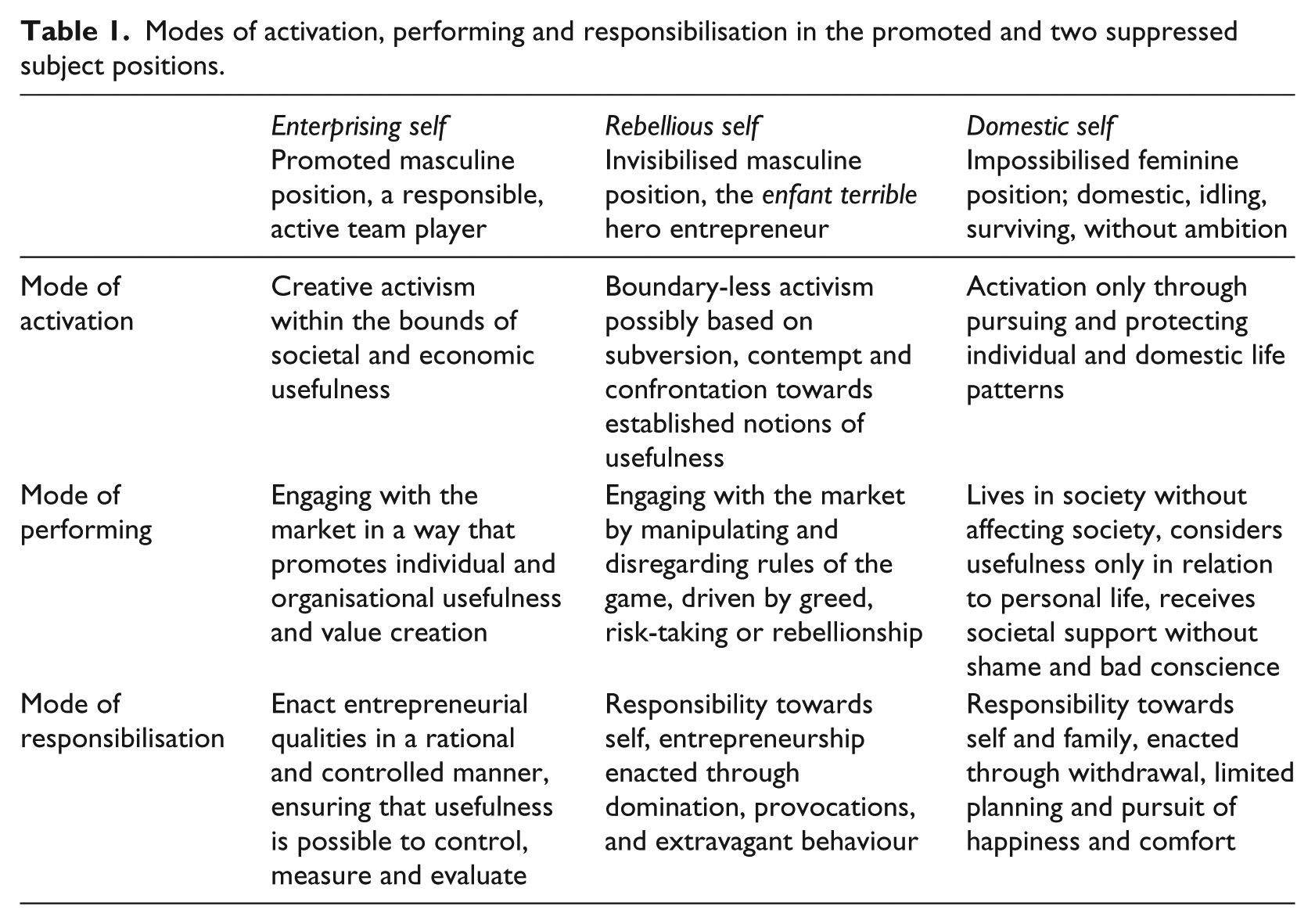
The second main suppressed subject position is the domestic self. This subject is, however, not only made invisible but rather is rejected outright and hence made impossible. It is the traditional feminine notion of the non-entrepreneur – focused on the domestic and the mundane, trapped in emotions and relations. This division between the (feminine) private and the (masculine) public is part and parcel of modernism, and here further extended in the urge to women to move fully into the public sphere (cf. Allen and Truman, 1991). Included in this subject position are not only the teachers and kindergarten staff that pupils meet during their upbringing but also people involved in societal and economic activities who do not conform to the profit-focused, technology-based, corporation-like ventures emphasised in the pedagogical materials – such as women doing household work, public sector employment or wage-replacing self-employment. It is a subject position that is not only morally impossible – since it is based on an ignorance of economic usefulness – but also inconceivable, in the sense that it cannot be imagined within an enterprise culture.
The pedagogical concepts target all children with their messages, yet the presentation and connotations are masculine in character. The role of schools is, then, to activate masculine attributes in both boys and girls, which will generate gendered effects. One way of viewing this is that ‘good enough’ reasoning is the prerogative of men, while women are often far from the norm and have a lot of identity work to do in order to be good enough; they are offered tools for self-fulfilment, but it will be hard to reach the level of good enough. Girls will be judged against the masculine norm and they will deviate as a minority in business life. They do not have the same possibilities (space of action) to construct identity since they will represent the group of women (Kanter, 1993). Nonetheless, while men are more of a confirmation of entrepreneurial heroes, women are expected, but still exceptions. This means that although the idea of a ‘gender-neutral’ enterprising self is communicated in the concepts, gender is apparent in the constructions of entrepreneurship education. However subtle, the enterprising self unfolds gendered subject positions very thoroughly.
While the subject position mobilised in the pedagogical initiatives appears to be gender neutral – in contrast to the ‘invisibilised’ masculine heroic entrepreneur and the ‘impossibilised’ domestic housewife – it manifests the male enterprising self in the subtle sense that traditional notions of collective and political emancipation and structural change are replaced by individual self-reflection and self-improvement for rational problem solving. As the productive neoliberal enterprising self has evolved from being a possible subject position among others to become an inevitable ontological priority, it has been de-politicised (Evans and Reid, 2013; Rose, 1996) in the sense that entrepreneuring is no longer related to structural conditions and ideological controversy. Instead, it invokes responsibility for change and development located to, and embraced by, the individual herself (Cicmil et al., 2016). The pedagogical initiatives studied make entrepreneurship a matter of individual adaptation, in the sense that societal development is framed as a process of rational problem solving, in which the individual is a self-helping self-changing subject, an active but conforming team player working within the bounds of what is acceptable and non-controversial.
Conclusion
In this article, we aimed to analyse how enterprising selves are produced through images and ideals of entrepreneurs and entrepreneurship that are conveyed to teachers and pupils through pedagogical concepts and teaching materials in the Swedish context. Departing from the notion of the enterprising self as a technology for subjectivation of neoliberal citizens, we analysed how the texts emphasised activating, performing and responsibilising pupils and teachers, and how gender was invoked in these texts.
While playfulness is a strong common denominator in these pedagogical concepts, the content and organisation of entrepreneurship education vary significantly across the initiatives. Despite the diversity, there is a common urge to create motivation for learning and development by explicitly situating school education in a larger societal context – to make pupils aware of the relation between themselves and society and the need to take action, adjust to prevailing circumstances and take responsibility. Entrepreneurial pedagogical concepts therefore indicate that neither society nor the security of its members can be taken for granted (Cicmil et al., 2016) and that sustaining society is also a responsibility for its youth (Dahlstedt and Tesfahuney, 2011).
Hence, pedagogical initiatives for entrepreneurship produce a world of the active, performing, adaptable human being who takes responsibility, not only for its own well-being but also for (re)making a well-functioning and prosperous society (cf. Kelly, 2013; Peters, 2001). The discursive construction of entrepreneurship as a positive promise of rationality and progress, a construction in which power structures and questionable consequences are carefully suppressed, is there to drive this process forward (Dempsey and Sanders, 2010) – in the same manner as when such hope is attached to ‘rational’ forms of work (Lindgren et al., 2014), the supremacy of leaders and leadership (Grint, 2010), the necessity of innovation and innovation systems (Pettersson and Lindberg, 2013) or the possibilities to achieve sustainability (Cicmil et al., 2016).
We found that the subject position linked to entrepreneurship resonated well with the core tenets of the enterprising self and that gendered aspects were suppressed and obscured. The subversive and revolutionising aspects of the traditional masculine notion of individualist hero entrepreneurs were suppressed, as were traditional feminine notions of domestic life and emotional reasoning. Traditional femininities were seen as unproductive and thus as problems to be removed [domestic self], while certain traditional individualistic masculinities were indeed constructed as productive, but at the same time too radical and too egoistic and thus as problems to be obscured [rebellious self]. What is left is a ‘neo-masculine’ but purportedly ‘de-gendered’ position in which children are seen as developing into ambitious, achieving entrepreneurial selves so that, as time passes, they can turn themselves into disciplined employable selves, obediently assuming responsibility for participating successfully in rational problem solving rather than taking part in political debates and structural emancipation.
Together with recent scholarly work in this area, this article contributes to how enterprise is drawn upon in educational settings to organise the life of young generations. Enterprise is found to be a discourse that concerns everyone – as a precondition for life in neoliberal society rather than a choice – while it presents youth with a specific version of what entrepreneurship is about. The close relationship between the subject positions produced in entrepreneurship education and the notion of the enterprising self excludes not only the visibility of traditional heroic masculinities and the possibility of traditional domestic femininities but also any subversive critique of societal power structures. The wider consequences of the contribution made here relate to the very possibilities of ‘the feminist project’ in a neoliberal society. In a society populated by people striving for individual prosperity through rational problem solving and constant pursuit of employability, notions of politics, power and gender are at best seen as ineffective, at worst as unthinkable.
The research reported here points to several possible future lines of inquiry. In empirical terms, it would be interesting to inquire into how the materials are used in class in interactions between teachers and pupils and the consequences for subject positioning. It would then be of interest both how the subject positioning of pupils unfolded (Komulainen et al., 2009) and how this affected the teachers and – in the long run – the teaching profession (Ball, 2003; Ball and Olmedo, 2013; Korhonen et al., 2012). Furthermore, it would be of interest to see what kind of resistance can be mobilised by pupils, teachers and also parents (Fournier, 1998). In theoretical terms, the notion of the enterprising self could then be further developed in terms of resistance, alternatives and what it could mean to act ‘different differently’ (Bröckling, 2016), but the general re-construction of children, childhood and upbringings in an enterprise culture is also worth consideration for future research (Kavanagh, 2013).
Footnotes
Acknowledgements
The authors would like to thank the reviewers for insightful and constructive comments and advice that has helped develop central ideas in the article. We are also indebted to the stream convenors and participants at the 2012 Gender, Work & Organization 7th Biennial Interdisciplinary Conference, in which an earlier version of this paper was presented.
Funding
The author(s) received no financial support for the research, authorship and/or publication of this article.