




Abstract
This article proposes a new conceptual framework for analysing diversity and opportunity in the cultural and creative industries as outcomes of specific decisions. It suggests the following three analytical foci: (1) the points at which decisions influence an individual’s opportunities for workforce participation and advancement; (2) individual workers as objects of decisions, in particular with respect to (a) an individual’s likelihood of being considered in a particular decision process in the first place and (b) what individuals present for decision makers to decide upon; and (3) the decision makers and the context of their decision making. Using this conceptual framework, this article reviews and synthesises existing evidence from academic and industry research to ascertain what is currently understood about the factors that influence decisions about workforce participation, promotion and admission into higher education, and which research gaps remain. By focusing on decisions, this article transcends current analysis of diversity and opportunity in the cultural and creative industries, which is largely concerned with how social and economic capital intersects with work and employment practices to shape workers’ opportunities. The article argues that a decision-making focus enables an important shift of perspective for understanding diversity and opportunity in the cultural and creative industries and how they might be improved.
Keywords
Introduction
The creative and cultural industries (CCIs) have been heralded as providing work and employment opportunities for everyone. Traditional discriminations and social inequalities in work would be overcome, proponents such as Florida (2004) argued, because competitive advantage in these industries derives from workers’ talent and creativity which are not dependent on, for instance, class, gender or ethnicity. While such promises have drawn policy makers’ attention to the CCI (e.g. Cable, 2010; Clifton et al., 2009; Mellander et al., 2012), empirical evidence suggests it does not hold true. Certainly for the United Kingdom, one of the earliest and most comprehensive adaptors of CCI-focused economic policy and the empirical focus of this article, there is ample evidence that opportunities for workforce participation and advancement in the CCI are unequally distributed (for overviews, see Eikhof and Warhurst, 2013; Oakley, 2004, 2006; Randle et al., 2015). The latest industry data for the United Kingdom show that the CCIs are a young, white, male and middle-class sector (unless otherwise referenced, all figures in this paragraph Creative Skillset, 2015). They boast a fairly equal gender split for younger age bands but women appear to leave the CCI in their 30s and 40s. Female workers in the CCI are much less likely than men to be aged 50 or older (11% vs 19%) which means that women are significantly under-represented in advanced and thus more influential and better paid positions. Genuine gender pay gaps persist as well (i.e. once age and occupational segregation are controlled for) which evidences that women not only find it more difficult to get into and get on in the CCI but they also get less out of working there (Creative Skillset, 2010). Workers from ethnic minority backgrounds are similarly under-represented in the CCI. Although they make up approximately 9% of the United Kingdom’s workforce overall black and minority ethnic (BME) workers account for just 5.4% of the CCI workforce (Creative Skillset, 2012). This discrepancy is even larger in Greater London, where most of the CCI workforce is employed (28.8% ethnic minority workers in Greater London’s workforce overall vs 8.9% in CCI, according to Creative Skillset (2012)). Data on workers’ socio-economic background are less readily available, and education and qualification tend to be used as proxies. In 2014, 78% of the creative media workforce was educated to at least undergraduate degree-level, compared to 32% of the United Kingdom’s overall workforce, and at 14%, the percentage of workers who had attended an independent or fee-paying school was twice that of the national average. Nearly half of the workforce surveyed came from families in which at least one parent had attended university. Previous industry surveys show similar patterns for both the audio-visual industries and the CCI more broadly (for overviews, see Eikhof and Warhurst, 2013; Randle et al., 2015). Overall, there is thus little doubt that women and workers from ethnic minority and non-middle-class backgrounds are less likely to participate in the CCI workforce and if they do enter the CCI, they are less likely to advance in their careers. While gender and (to a lesser though increasing) extent ethnicity and socio-economic background have so far dominated empirical studies, more recent studies indicate that opportunities for workforce participation and advancement also vary by physical ability, region and age (Allen and Hollingworth, 2013; Eikhof and York, 2015; Randle and Hardy, 2016).
Academic studies too have provided important evidence of constraints to diversity and opportunity in the CCI. The most prominently discussed issue has been the role social capital plays in excluding women and workers from ethnic minority and working-class backgrounds (e.g. Gill, 2002; Grugulis and Stoyanova, 2012; Randle et al., 2015). Other studies have analysed implications of work and employment practices generally (Eikhof and Warhurst, 2013; Dex et al., 2000; Gill, 2002; Randle and Hardy, 2016; Siebert and Wilson, 2013), and the sexist and ageist industry culture (Eikhof and York, 2015; Banks and Milestone, 2011; Dean, 2005, 2008; Gill, 2002; Sang et al., 2014; Scharff, 2015). Methodologically, these studies typically either focus on a specific group of workers and the barriers to workforce participation and advancement this group faces or identify a problematic structural feature of the CCI and discuss its implication for diversity and opportunity. Collectively this body of work has presented evidence that complements the industry workforce statistics and provides valuable insight into specific causes of direct and indirect, intentional and unintentional discrimination. However, and some studies have noted this in relation to intersectionality (e.g. Allen and Hollingworth, 2013; Randle et al., 2015), what is needed is a conceptual lens that allows analysing the multidimensionality and interplay of factors influencing workforce participation and advancement in the CCI. This article aims to provide such a conceptual lens.
For an individual worker opportunities to participate and advance in any world of work are shaped through decisions about admission into education or training, recruitment into a particular job or promotion into a more senior position. Analysing these decisions about admission, workforce participation and advancement – the actors who make them; the interplay of structural factors that shape the decisions and outcomes – is crucial for developing a better understanding of diversity and opportunity in the CCI and for developing interventions aimed at improving the current situation. This article therefore proposes to analyse workforce participation and advancement in the CCI as an outcome of key decisions about individual workers and posits three foci for such analysis. First, the points at which decisions that substantially influence an individual’s opportunities for workforce participation and advancement are made, that is, recruitment into work, promotion and admission into CCI-relevant higher education. Second, individual workers as objects of decision making, in particular with respect to the factors that influence (a) an individual’s chances of being considered in a particular decision process in the first place and (b) what individuals present for decision makers to decide upon, that is, their creative persona. Third, the decision makers and their context, for example, not only their perceptions of art, their organisational positions and attitudes towards risk but also the business models that decisions are embedded in. Analysing these aspects of decisions on admission, workforce participation and advancement, this article argues, progresses our understanding of how social inequalities in CCI work originate and how they might therefore be tackled.
The aim of this article is to extend and improve our understanding of diversity and opportunity in the CCI. It proposes a conceptual framework that allows analysing diversity and opportunity in the CCI as outcomes of certain decisions (section ‘Conceptualising social inequalities in the CCI as outcomes of decision making’). Using this conceptual framework, the article proceeds to review and synthesise existing evidence from academic and industry research with a focus on decisions about admission into higher education, workforce participation and advancement (section ‘Conceptualising social inequalities in the CCI as outcomes of decision making’). Building on this review and synthesis the discussion explains how focusing on these decisions extends and improves our understanding of diversity and opportunity in the CCI (section ‘Discussion’). The conclusion offers a critical appreciation of the possibilities for, and probabilities of, a more equal allocation of opportunities for workforce participation and advancement in the CCI (section ‘Conclusion’).
Conceptualising social inequalities in the CCI as outcomes of decision making
Before considering how workforce diversity in the CCI might be better understood some terminological clarification is required. Analysis of workforce diversity tends to be articulated with reference to the cultural and creative industries, that is, referring to a particular set of economic activity and one that is typically understood as the ‘commercial or public-service production of objects, texts, goods and services that are primarily valued for their creative, symbolic or aesthetic qualities’ (Banks, 2014: 3). While we agree with Hesmondhalgh’s (2007) assertion that ‘it is the collective nature of these [industries’] characteristics that matters’ it is important to recognise from the onset that differences exist among the CCI and also within them, in particular with respect to work and employment (p. 24). The prevalence of mid-/long-term employment contracts, for instance, not only varies substantially between industries (e.g. film vs. archives and libraries) but also within industries (e.g. film production vs. film exhibition) (Creative Skillset, 2015). Such variances pose significant challenges for studies that seek to statistically capture workforce diversity and opportunity. However, the majority of academic and industry research into workforce diversity in the CCI has focused on cultural workers, that is, those workers who constitute the ‘axis point of organized cultural production’ (Banks, 2014: 4), rather than on the semi- or unskilled workforce that dominate certain areas of CCI activity (e.g. cinema cleaning, front-of-house staff in theatres) or the skilled workers in positions that are not understood as creative in the artistic/cultural sense (e.g. accountants, HR and payroll, information technology (IT) support). For the purpose of this article we generally follow this dominant use of terminology and research focus but where possible signpost variances, for example regarding employment contracts or decision-making contexts.
Current studies of diversity and opportunity in the CCI predominantly take one of two approaches: The first approach is to focus on a particular worker characteristic, such as gender, ethnicity or class, and examine the barriers workers with that characteristic face when trying to successfully establish a career in the CCI. Sang et al. (2014), for instance, exhibit how the work and careers of women architects are constrained by gendered perceptions of commitment and creative capacity (for other studies on gender in the CCI, see Eikhof and York, 2015; Eikhof et al., 2012; Banks and Milestone, 2011; Conor et al., 2015; Dean, 2005, 2008; Scharff, 2015). Maxwell (2004) focuses on ethnicity and asks if the workforce participation of workers from BME backgrounds can be increased through targeted trainee programmes. Studies centred on workers’ socio-economic background discuss the impact of class on career aspirations (e.g. Allen and Hollingworth, 2013) and chances of gaining employment (e.g. Randle et al., 2015). Disabled workers, as Randle and Hardy (2016) point out, are doubly disadvantaged by the stereotype of CCI workers as able bodied and by the prevailing physical and temporal organisation of the labour process. The second approach is to examine the problematic consequences a particular structural feature of the CCI has for diversity and opportunity. The most prominently discussed of these structural features is the CCI’s reliance on personal networks and social capital (e.g. Grugulis and Stoyanova, 2012; Randle and Culkin, 2009; Siebert and Wilson, 2013). Other authors have studied employment practices (e.g. Dex et al., 2000; Gill, 2002) and the project-based system of production more broadly (Eikhof and Warhurst, 2013). Studies taking this approach foreground the structural features themselves and in a second step identify the groups of workers for whom these structural features constitute barriers to workforce participation and advancement.
Substantially the above-mentioned studies coalesce to make the same points: Diversity and opportunity are constrained in the CCI, with at least women, disabled workers and workers from working-class and ethnic minority backgrounds being less likely to participate and advance in the workforce. From this substantive perspective there might seem little point in distinguishing the two different approaches described above. Conceptually though it is worth tracing how current research arrives at its findings regarding diversity and opportunity in the CCI. Although replete with insightful first-person accounts and in-depth individual data both approaches focus on the interplay between individual cultural workers (or groups thereof) and structure. So far not systematically foregrounded are those concrete decisions made about individual workers that directly or indirectly influence opportunities for workforce participation and advancement – the decisions that translate structure and collective phenomena into an influence that becomes relevant to a specific individual life and career. Although, as Dean (2008) points out, the CCI ‘regard [themselves] as running on the decisions of individuals’, these decisions have so far been under-researched (p. 168). This paucity of research limits both our understanding of diversity and opportunity in the CCI as well as the efficacy of attempts to intervene in CCI practice. From the perspective of an individual worker opportunities to participate and advance in any world of work are influenced through concrete decisions, for instance admission into relevant degree programmes, recruitment into a particular job or promotion into a more senior position. Decisions on admission into higher education, workforce participation or promotion influence individual workers’ opportunities for earning a living, acquiring skills and knowledge, building career-relevant relationships and developing a professional reputation. In order to understand why certain groups of workers might be more likely than others to enjoy these opportunities we therefore need to analyse the decisions that influence how opportunities are allocated.
This article proposes to analyse diversity and opportunity in the CCI as an outcome of those decisions about individual workers that influence, directly or indirectly, workforce participation and advancement. For this analysis workforce participation shall be understood as an individual partaking in CCI production in a capacity that can be considered part of their chosen career trajectory. Because a substantial share of CCI work is unpaid, it is not useful to equate workforce participation with (paid) employment. Instead, this analysis recognises work in the CCI as participation in the respective industries’ production practices, regardless of the contractual context. Similarly, a CCI-specific view of advancement will be employed. Because of the nature of work and the project-focused production in the CCI for many CCI workers advancing in their career does not imply climbing a traditional ladder of organisational positions but moving through a network of projects (Jones, 1996). Advancement shall therefore be understood as an individual’s movement into positions that bring increased artistic or creative recognition, reach, freedom and/or responsibility, enable collaboration with more reputable partners or allow access to more or better quality resource.
Decisions can generally be analysed with respect to the following three aspects: the decision problematic (what is decided upon), objects of the decision (often conceptualised as alternatives a decision maker evaluates and ranks in terms of desirability) and the decision makers and their context (who decides and the structures, processes and other circumstances are they embedded in). For analysing decisions that influence opportunities for workforce participation and advancement in the CCI this general description of decisions translates into a framework with the following three dimensions (see Figure 1):
The decision points, that is those points at which concrete decision are made about individual workers that directly or indirectly influence these individuals’ opportunities for workforce participation and advancement in the CCI;
The individuals as objects of the decision making, in particular with respect to the factors that influence (a) an individual’s likelihood of being considered in a particular decision process and (b) what individuals present for decision makers to decide upon;
The decision maker(s) and the context of their decision making.
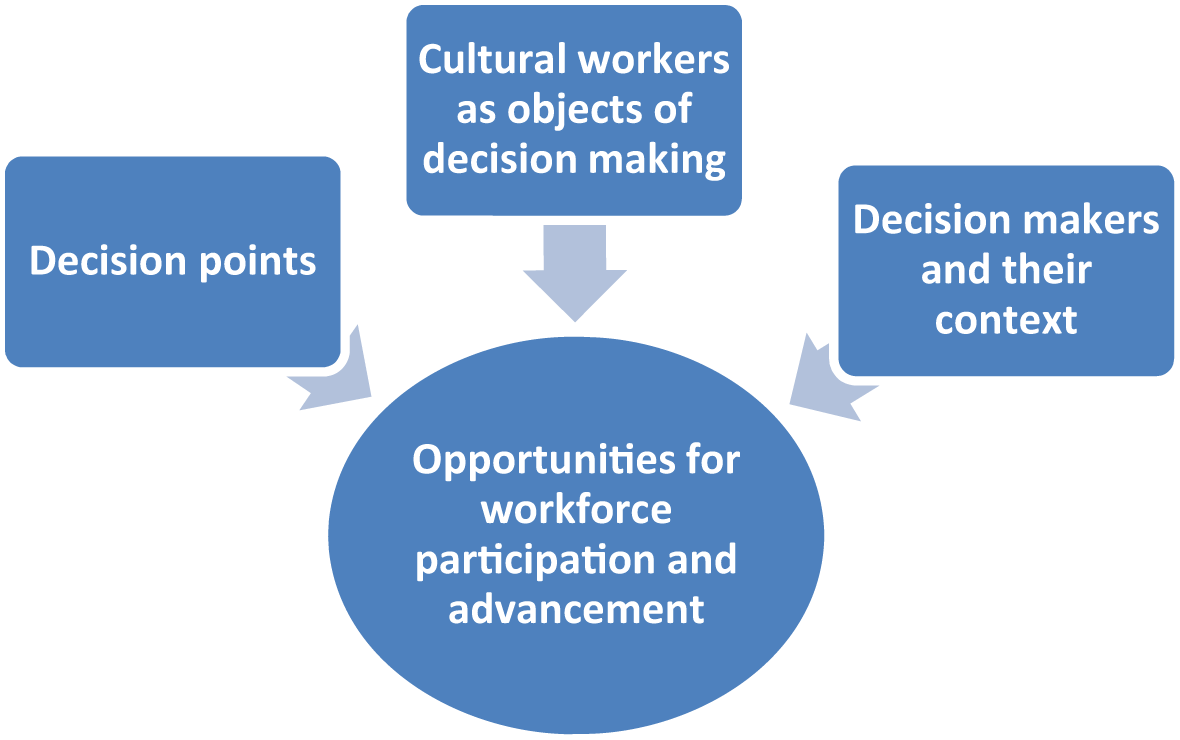
Dimensions of decisions that directly or indirectly influence opportunities for workforce participation and advancement in the CCI. CCI: cultural and creative industries.
In each of these three dimensions a variety of influences can come into play that shape – more or less powerfully – the outcome of a decision. To explore what these influences are and how they interact, the following section will review and synthesise existing research on work, employment and careers in the CCI. In doing so, we propose shifting the analytical focus from the aggregate, collective level to explore evidence on specific decisions, that is admission into higher education, workforce participation or promotion. Two qualifications are in order though. First, individual cultural workers do, of course, make a range of decisions themselves that influence their workforce participation and advancement. However, in the framework proposed here individual workers are deliberately conceptualised as objects of the decisions in question and the focus of the analysis is on where, how and by whom influential decisions are made about them. This conceptualisation has been chosen deliberately to improve our understanding of the structures in which individual workers’ agency may unfold in the CCI and to counter the overly positive view of unrestrained opportunities for individual career development that pervades much of the CCI literature. Second, neither the decisions nor the actors involved as subjects of decisions are understood as occurring or acting in a societal vacuum. Their multifaceted structural embeddedness (e.g. into specific organisational, industry, cultural and national contexts) is explicitly acknowledged, as is the fact that concrete decision practices in turn reproduce the structural contexts they are embedded in. Particularly important aspects of this structural embeddedness are societal perceptions of cultural work/workers and social constructions of talent, both of which contribute to exclusion of workers in ways that are only partly covered by their inclusion as influences on decisions in the analysis presented below. In this sense the change of analytical focus proposed in this article constitutes a revisiting of existing evidence from a different angle rather than a radical break with current evidence and conceptualisations.
Analysing diversity and opportunity-relevant decisions in the CCI
This section reviews academic and industry research for evidence on decisions about individual workers that directly or indirectly shape these workers’ opportunities for workforce participation and advancement in the CCI. It does so by considering in turn the following three dimensions outlined above: decision points, individuals as objects of decision making and decision makers and their context. The academic and industry research reviewed in this article is mainly focused on the United Kingdom, largely because, as one of the early adaptors of creative industries policy, empirical evidence is more advanced for this geography. We will return to the implications of this research base in the Discussion section.
Decision points
Across an individual’s life key points at which their opportunities to participate or advance in the CCI workforce are significantly shaped are those at which someone else decides about the individual’s participation in paid and unpaid work, advancement into promoted positions and admission into higher education. The following explores the CCI-specific characteristics of these three decision points. Common to all three of these decision points is an oversupply of applicants: There are many more individuals that want to establish a career in the CCI than there are positions that allow participating in CCI work (e.g. Hesmondhalgh, 2007; Menger, 1999). This strong competition makes it particularly important to understand the decision points at which factors that influence decision outcomes with a view to diversity and opportunity come into play.
The previous section has defined workforce participation as an individual partaking in CCI production in a capacity that can be considered part of their chosen career trajectory. Because a substantial share of work in the CCI is unpaid, CCI workers’ workforce participation is directly influenced by decisions about whether or not to recruit an individual into paid work as well as unpaid positions. Paid work in the CCI is undertaken in a wide range of employment relationships. In some CCIs such as archives and libraries or computer games, standard employment is widespread but a large share of the CCI workforce works on short-term and project-based contracts, either as temporary employees or as freelancers (Creative Skillset, 2012). In the United Kingdom industries such as film and TV provide almost only freelance work (Creative Skillset, 2015). The prevalence of short-term, temporary employment relationships means that decisions about whether or not an individual is offered paid work occur comparatively more frequently in the CCI. Moreover, in a number of CCIs, workforce participation depends on additional casting decisions in which decision makers choose a project team from an existing cast of employees (Eikhof, 2014). Actors, musicians or dancers, for instance, may be employed on ensemble contracts for a season or longer but still have to compete for parts in the project that the ensemble stages. Similar processes of selecting project teams from groups of workers on standard employment contracts are common in advertising or architecture (Grabher, 2002; Sang et al., 2014). Even if employment statistics show a CCI as having longer employment contracts or a lower share of freelance employment the prevalence of casting decisions may thus mean that workforce participation decisions still occur more frequently. The high frequency of workforce participation decisions has consequences for diversity and opportunity: factors that systematically (directly or indirectly, consciously or unconsciously) influence workforce participation decisions to the detriment of workers with particular characteristics come into play more often, and thus more regularly and powerfully shape and reproduce industry practice.
With respect to unpaid work the primary concern is its function as a gatekeeper for access to CCI careers. Across many CCIs unpaid work, whether formally labelled as an internship or work experience, or informally undertaken as ‘sitting in on an edit’ (Eikhof and York, 2015) or ‘learning by watching’ (DeFillippi and Arthur, 1998), is recognised as the standard form of on-the-job training that workers are expected to have undertaken before applying for paid work (Grugulis and Stoyanova, 2009; Siebert and Wilson, 2013). Unpaid work is undertaken in lieu for ‘copy and credit’ (Randle and Culkin, 2009), as the case of film and TV poignantly illustrates, that is for the opportunity to be publicly acknowledged as a contributor to a project and for a hard copy of the project outcome. In the creative media industries, for instance, 48% of workers surveyed by Creative Skillset (2015) had undertaken unpaid work and stretches of up to 2 years’ worth of interning are not uncommon in gallery work and curating. These expectations and practices have obvious implications for diversity and opportunity: They require individuals to be able to sustain themselves without earning a (full-time) income for the duration of the unpaid work experience or training. Individuals who can draw on parental or spousal support find it much easier to engage in the required amount of unpaid work and, conversely, the need to undertake unpaid work experience indirectly excludes individuals from working-class backgrounds (e.g. Randle et al., 2015; Siebert and Wilson, 2013).
Diversity and opportunity in the CCI are not just linked to workforce participation but also to advancement which has previously been defined as an individual’s movement into positions that bring increased artistic or creative recognition, freedom and responsibility, enable collaborations with more reputable partners or allow better access to resources. Such career advancement can result from internal promotion decisions (i.e. climbing up an organisational hierarchy of positions) or from recruitment into a promoted position via the external labour market. Work in the CCI has been described as vertically differentiated, for instance with respect to the ranking of creative inputs (e.g. Caves’, 2000 A-list/B-list property of the creative industries) or with respect to the work allocated to individuals in different roles (e.g. the descriptions of leading and support tasks for architects in Sang et al. (2014)). However, evidence specifically on promotion decisions in the CCI is scarce. Internal promotions appear to exist in those CCIs in which organisations are of sufficient size to offer promotion paths (e.g. Sang et al., 2014), but empirical evidence of decision-making practices and procedures is limited. Elsewhere there is some evidence that promotion is achieved through recruitment into a superior role on a subsequent project, for example from Assistant Light Designer to Light Designer (Blair, 2001), from an admin/support role into a creative role (Grugulis and Stoyanova, 2012) or from support acts to leading acts in the performing arts (Eikhof et al., 2012). However, as Jones (1996) notes, these career movements typically occur across networks of projects rather than within an organisational hierarchy. They are thus enveloped in workforce participation decisions about paid work which possibly partly explains the paucity of dedicated research into promotion decisions.
Workforce participation decisions and promotion decisions have an obvious immediate impact on workforce participation and advancement in the CCI. There is a third point though at which decisions are made that less directly but still substantially shape an individual’s opportunities for workforce participation and advancement in the CCI: admission into higher education. Despite the high profile of on-the-job training degree qualifications act as an important labour market signal in the CCI. In Creative Skillset’s (2015) study more than three quarters of audio-visual workers held at least an undergraduate degree. Possibly more importantly though, studying for a degree lays the foundation for access to relevant personal networks (as a production manager interviewed by Grugulis and Stoyanova (2012) remarked, ‘they all know each other from whatever bloody university they went to’ (p. 1323)), mediates access to decision makers for entry-level positions (e.g. when drama schools invite directors and theatre managers to their degree schools, Eikhof et al., 2012) and provides the space to explore and define the creative persona that an individual worker markets later on (Banks and Oakley, 2015; Burke and McManus, 2009). Little is known about how admission decisions are made though and, as Burke and McManus (2009) reveal, higher education institutions do not necessarily make public what the applicant is expected to submit and what their admission decisions will be based upon.
Decisions about workforce participation, promotion and admission into higher education are the three key points at which factors can come into play that influence workforce participation and advancement in relation to diversity and opportunity. This subsection has explored the CCI-specific characteristics of these decision points and identified implications for diversity and opportunity. The following two sections explore CCI workers as objects and decision makers as subjects of decision making.
Individuals as objects of decision making
This subsection explores the various factors that influence who decision makers encounter in workforce participation, promotion and admission decisions. It first considers an individual’s likelihood of becoming the object of decision making and second discusses what individuals present for decision makers to decide upon.
First, there are various diversity and opportunity-related factors that influence an individual’s likelihood of becoming the object of decision making. At entry level young people from working-class and ethnic minority backgrounds are disproportionately less likely to find themselves in admission or workforce participation decisions. Working-class youth often do not even consider a career in the CCI, instead they associate CCI work with people who are not like themselves (Allen and Hollingworth, 2013). Restricted access to financial capital typically limits their consumption of and engagement with culture and art which has in turn led them to perceive cultural production as something that is not legitimate or appropriate for them to engage in (Allen and Hollingworth, 2013). The same study found working-class parents actively discouraging their children from what they thought were unstable, financially insecure careers in the CCI. Perceptions about CCI work and employment therefore lead to young people to make decisions through which they effectively exclude themselves from the potential CCI workforce, and at very early, that is pre-further/higher education, stages of their lives. Access to CCI-relevant education is also class-linked. The young people in Allen and Hollingworth’s (2013) study were keenly aware that working in the CCI required a university degree and/or moving to geographical centres of CCI production such as London, both of which necessitated financial capital that was not readily available to them. Until the 1970s, local art schools provided low barrier entry routes into the CCI and spiked an influx of CCI workers from working-class backgrounds but the recent absorption of art schools into the general higher education system has limited local access to CCI-relevant education again (Banks and Oakley, 2015). In addition, because art schools often do not publish what is required in an admission process, applicants are reliant on ‘hot’ information (Burke and McManus, 2009: 19) passed on through personal contacts which young people from working-class and ethnic minority backgrounds are again less likely to have. They are also less likely to have access to industry contacts that can help secure unpaid work experiences (in addition to or in lieu of formal education) and access entry-level positions through which skills, knowledge and further industry relationships can be developed (Grugulis and Stoyanova, 2009; Randle et al., 2007; Siebert and Wilson, 2013). Overall young people from working-class and ethnic minority backgrounds are therefore much less likely to develop aspirations for a career in the CCI and to find themselves in situations in which admission onto a degree programme or workforce participation, in particular unpaid work experience, are being decided upon.
Once in the CCI the main factor that shapes an individual’s likelihood for being considered in a workforce participation or promotion decision is the quantity and quality of the social capital they command. Probably the most thoroughly documented feature of working in the CCI is the sector’s dependence on personal relationships. Recruitment through informal channels and personal networks is widespread (e.g. Blair, 2001; Gill, 2002; Grugulis and Stoyanova, 2012; Sang et al., 2014). More than half of the creative media workers surveyed by Creative Skillset (2015) had been recruited through informal channels and even where positions are advertised through traditional routes, personal connections are required to smooth the way: ‘I have never gotten a job off sending my resumé cold […] I have only gotten jobs because I knew someone in the office who could walk my resumé in’ (make-up artist, cited in Blair et al., 2003: 629). Networks are based upon an individual’s family and university acquaintances and extended through work collaborations and industry networking events. The influence of family and university again reproduces privileged access for white and middle-class workers (e.g. Grugulis and Stoyanova, 2012; Thanki and Jeffreys, 2006–2007). Women are also disadvantaged by the semi-private atmosphere of the networking events (Gill, 2002), and disabled workers struggle with the physical and temporal aspects of accessing personal networks (Randle and Hardy, 2016). Because being in work allows building personal networks, barriers to workforce participation arising from working conditions, in particular the long, unsocial hours, income insecurity and geographical mobility, also compound some worker’s lack of access to networks. Overall, for the United Kingdom at least, there is clear evidence that women, disabled workers, workers from ethnic minority and working-class backgrounds find it more difficult to access, accumulate and exploit the kind of social capital needed to facilitate positive workforce participation decisions.
In addition to those factors that influence how differently likely individuals from different groups are to get into a situation in which a workforce participation, promotion or admission decision can be made about them, analyses of diversity and opportunity also need to consider the factors that influence what individuals present to decision makers if they do become an object of such decisions. Workers in the CCI have to market their own labour power and, in doing so, develop a brand or distinctive creative persona (Bain, 2005). It is this creative persona that talent, creative capability, credibility, peer recognition and artistic reputation are ascribed to and that decision makers evaluate in workforce participation, promotion and admission decisions. An individual’s creative persona is perceived as an indicator for the creative work they are able to deliver. In some CCI the branding of the creative persona is comparatively specific and in that specificity particularly pertinent to workforce participation, promotion and admission decisions. Examples are film, music and the visual and performing arts (e.g. Bain, 2005; Eikhof and Haunschild, 2006), where individuals explicitly position themselves and their work in relation to genres or, as, for example, Lars van Trier with Dogme 95, create their own artistic movements (Alvarez et al., 2005). In these CCI constructing a creative persona requires a certain amount of subject knowledge. Admission tutors expect a surprisingly large amount of such knowledge already from art school applicants (Burke and McManus, 2009). In addition and across the CCI highly influential general images of an artist or creative worker exist which predominantly centre on the notion of the Bohemian artist. These images shape decision makers’ expectations of how a talented individual would present themselves and, consequently, individuals actively relate to these images in defining their own marketable personality (Author and Co-Author C; Becker, 2001; Røyseng et al., 2007).
From a diversity and opportunity perspective two problematic issues arise. First, the kind of knowledge about particular canons of art and culture that individuals can use to position themselves and their work is more easily accessible to middle-class and possibly also non-ethnic minority individuals (Allen and Hollingworth, 2013; Banks, 2017; Burke and McManus, 2009). Second, even in its hipster, bourgeois or tech-variants (e.g. Brooks, 2000; Gill, 2007) the habitus of the Bohemian artist or creative remains routed in the milieu of the dominant elite, that is a socio-economic setting in which individuals tend to command average to above average monetary means and above average recognised cultural capital (Bourdieu, 1984). The conventional image of an artist or creative worker is also an ethnically white and still predominantly male one (Proctor-Thomson, 2013; Scharff, 2015). These specifics of the Bohemian image again have two consequences: On one hand, the further away, socio-economically speaking, from the dominant elite an individual is socialised, the less familiar they are likely to be with the Bohemian artistic or creative habitus, its importance for the career they might aspire to and how they might be able to adopt it. On the other hand, because of the Bohemian habitus’ white/male/cultural elite characteristics, women and workers from ethnic minority and working-class backgrounds have to perform additional work to develop a recognised creative persona – they have to adapt and modify or challenge and oppose the dominant image of an artist or creative worker. Some modifications and challenges have resulted in prominent new cultural images and role models, for instance in the case of black rap musicians or Bollywood dancers. However, even those very successful images constitute ‘the other’ in comparison to an essentially European, white, male and Bohemian norm of artistic or creative habitus. Developing a creative persona that is both distinct and recognised as legitimate by decision makers is therefore disproportionately more challenging for women and workers from working-class and ethnic minority backgrounds (see also Morgan and Nelligan, 2015; Scharff, 2015). And for the latter two groups this challenge is further compounded by the fact that they are less likely than white and middle-class youngsters to access knowledge about dominant cultural canons as well as those ‘fertile, independent contexts […] for the cultivation of artistic sensibility and practice’ (Banks and Oakley, 2015: 10) that afford opportunities to accumulate subject knowledge and experiment with creative personas – arts schools and other higher education institutions (see also Burke and McManus, 2009). Consequently when women and individuals from working-class and ethnic minority backgrounds actually do make it into situations in which decisions about admission, workforce participations or promotion are being made, they are less likely than male, white and middle-class workers to present a creative persona that is positively received by decision makers. Recent research on disabled workers suggests that the stereotype of CCI workers as able bodied makes it similarly problematic for non-able bodied workers to present a positively received persona (Randle and Hardy, 2016).
Decision makers
This section explores diversity and opportunity-relevant influences on workforce participation, promotion and admission decisions that are linked to those individuals who make the decisions. Evidence explicitly focused on how decision makers decide who to allocate work and unpaid work to, who to promote or who to admit onto CCI-relevant degree programmes is rare and mostly focused on admission decisions.
The purpose of admission decisions for CCI-related degree programmes was to identify artistic and creative talent that can be developed through study. The underlying assumption, as Banks (2015) points out, is that individuals are differently endowed with innate talent and that those differences warrant offering some and denying others access to higher education with its manifold opportunities to accumulate social, cultural, symbolic and, ultimately, economic capital. Banks (2015) goes on to make the following two points: That talent is socially constructed and that in the CCI in particular, what is recognised as talent is significantly influenced by decision makers’ intuitive perceptions of an individual’s habitual dispositions, ‘their linguistic skills, self-presentation, whether they offer the physical embodiment (or not) of the kinds of dispositional qualities imagined to connote talent’ (Banks, 2015: 12). Or, as a visual arts admission tutor interviewed by Burke and McManus (2009) phrased it: ‘you know it when you see it [talent]’ (p. 25). As Burke and McManus (2009) go on to show, the social constructions of talent that decision makers base their admission decisions on are essentially those of a white, middle-class, European cultural elite. They expect talented applicants to be dedicated to their degree subject, speak knowledgably about different areas of art and culture, and to position themselves in relation to existing work and styles. Moreover, admission tutors evaluated work samples and portfolios for signs of a ‘critical understanding’ and ‘wide knowledge of contemporary art’ (Burke and McManus, 2009: 24) which would require not only innate talent but also a minimum of scholastic exposure to cultural production – something that middle-class applicants are much more likely to have enjoyed than applicants from working-class backgrounds (Gaztambide-Fernandez et al. 2013 (cited in Banks, 2015) offer similar examples for music education). Importantly, Burke and McManus (2009) also provide valuable insight into how legitimate intuitive decisions about talent are considered to be, recording, for instance, the following dialogue between admission tutors about an applicant whose portfolio they had deemed as appropriate prior to interviewing her (Burke and McManus, 2009: 41):
Why should we say we’re rejecting her?
Well, she’s all hip-hop and sports tops,
We’ll say that her portfolio was weak.
The admission tutors also included in the interview note that ‘the clothes she wore to the interview were not fashionable and that she lacked confidence’ (Burke and McManus, 2009: 41). The few existing studies into admission decisions are highly instructive in this regard and powerfully demonstrate how openly and unquestioningly decision makers assess talent against criteria that are highly dependent on their own cultural socialisation and thus socio-economic background.
There are even fewer studies that explicitly examine decision makers in workforce participation or promotion decisions. The current literature allows some inferences about potential influences but these inferences are almost exclusively drawn from either general descriptions of the CCI or the accounts of individuals who have been objects of decision making rather than the subjects. Systematic evidence on how decision makers assess individual workers in workforce participation and promotion decisions remains scarce. What appears to be relatively clear is that because recruitment mistakes are perceived to be so costly in the CCI, decision makers rely on personal networks, either their own contacts or recommendations from third parties, and on an individual’s reputation (e.g. Blair, 2001; Caves, 2000; Grugulis and Stoyanova, 2009; Wreyford, 2015). Reputation is constructed both formally, for instance through reviews and awards (e.g. Anand and Watson, 2004), and informally through industry gossip, information sharing in personal networks and social media posts (Boutinot, 2012; Jones, 2012; Millar, 2015) and covers an individual’s creative capacity as well as their personality and work ethic. However, how information about artistic reputation or personal characteristics is then used by decision makers remains unclear. As with admission decisions the perceptions and evaluations of talent that workforce participation decisions are based upon will depend on decision makers’ cultural socialisation (e.g. Banks, 2017; Burke and McManus, 2009). More likely than not, these cultural socialisations will place higher values on markers that comply with Euro-centric, male, white and middle-class standards of cultural production, talent and creativity. Whether the culture of a particular CCI or organisation is attuned to workforce diversity issues or, on the contrary, allows discriminatory practices go unchallenged, is likely to be a further influence (Creative Skillset, 2009; Maxwell, 2004). Decision makers also appear to consider whether an individual’s work ethic or family commitments might limit their ability to fulfil their work commitments and to base those considerations on biased and discriminatory assumptions, in particular about parents with caring responsibilities (Author et al.; Creative Skillset, 2008; Sang et al., 2014). Creative Skillset’s (2008) report on working parents in film and TV contains a rare first-person account from a decision maker stating, ‘I’d rather use a guy who has got no responsibilities and is available all the time … Completely no tolerance policy for me I’m afraid because it directly impacts on my business’ (Creative Skillset, 2008: 8; see also Wing-Fai et al., 2015). Relatedly, decision makers’ choices might also (consciously or unconsciously) be influenced by how important success in a particular project is to the reputation or financial situation of themselves or the organisation they work for (e.g. Grugulis and Stoyanova, 2009) which in turn would make the respective business model and organisational embeddedness of decision makers, the micropolitical structures they act in and the resources they have access to and responsibility for, potentially important aspects to consider. Weighing up diversity ideals versus ‘what the market wants’ an employer of screen writers interviewed for her study stated, ‘there’s a commercial imperative, so I don’t think there will ever be a place of active, positive discrimination’ (Wreyford, 2015: 88). Wreyford (2015) also emphasises issues of homophily and trust. She showed decision makers to be not only particularly concerned with the question of whom they could trust but also likely to place that trust in friends and people who were like themselves and to thus recruit what an employer described as ‘the kind of people you want to sit in a pub with for six hours’ (Wreyford, 2015: 92). Finally, Hesmondhalgh and Baker (2015) show that gendered stereotypes of work-related personality traits persist in the CCI (e.g. that women are more caring, better at organising and communicating) although again they do not offer first-hand evidence from decision makers on how such stereotypes influence decisions. Many of these influencing factors will differ between CCI and also within CCI, depending on the positions and careers that decisions are made about. However, whether this list of potential influences captures all the important factors and how differently influential these factors are in shaping concrete decisions cannot be inferred from the current state of research. What is needed are studies explicitly aimed at exploring the full range of factors that may influence decision markers’ choices about workforce participation and promotion, and the ways in which these factors interact with each other.
Discussion
Reviewing existing evidence on work, employment and careers in the CCI has confirmed that it is women, disabled workers and workers from ethnic minority and working-class backgrounds who are less likely to have opportunities for workforce participation and advancement in the CCI. It showed, however, that this lack of opportunity arises not only for those main reasons that previous studies have emphasised, that is lack of social and economic capital intersecting with project-based work and employment practices. Focusing on decisions about workforce participation, promotion and admission into higher education has exposed other ways in which shortfalls of social and financial capital are relevant as well as identified additional factors that affect diversity and opportunity in the CCI.
First, a lack of social capital is not only important in terms of direct access to decision makers. It is also important in terms of accessing the ‘hot’ information about how to apply for CCI-related degree programmes and of gaining an understanding of the ‘rules of the game’ for establishing a career in the CCI. Second, economic capital is not only important for buffering income insecurities and financing crucial periods of unpaid work experience. It is also needed for gaining exposure to, and developing familiarity with, cultural production as well as financing university studies which in turn are essential for knowing how to approach the CCI and positioning oneself in relation to existing cultural practice. Third, socio-economic and ethnic backgrounds are not only relevant for accessing social capital but also for recognising CCI work as a viable career option and for developing aspirations to pursue a career in the CCI in the first place. Fourth, the conscious and unconscious perceptions with which the creative persona individuals present for decision making is evaluated to make a favourable decision less likely for women, disabled workers and workers from ethnic minority and working-class backgrounds. The dominant image of an artist or creative worker is routed in the white, male and middle-class figure of the Bohemian genius. As has been particularly evident in the case of admission decisions, decision makers are steeped in the paradigms of particular cultural canons and schools that privilege white, male and middle-class notion of European high culture. Fifth, workforce participation and promotion decisions are shaped by a self-understanding of the CCI as a demanding, fast-paced and dynamic work environment in which long and asocial working hours are the norm and in which workers with caring commitments are less likely to successfully perform. Decision makers appear to be influenced by the resources they have – or more often, lack – for buffering the risks of workers not coping with these CCI working conditions. Analysing diversity and opportunity in the CCI with a focus on decisions that directly or indirectly influence workforce participation and advancement allows considering these factors in addition to the influence of social and economic capital and mobility and flexibility restrictions.
The focus on specific decisions presented in this article has also enabled descriptions of how the different factors that influence diversity and opportunity interact with each other and in relation to the general CCI context. It has shown that certain workers are not only less likely to become the objects of workforce participation, promotion and admission decisions (e.g. because they lack the social capital to obtain insider information or because they are unlikely to regard the CCI as a viable and appropriate career choice) but that even when these workers get themselves into decision situations, perceptions of talent and of the CCI as a work environment prevail that still make it less likely that these workers are afforded opportunities for workforce participation or advancement. The general CCI context exacerbates these dynamics: Because of the persistent oversupply of labour in the CCI there is little pressure on decision makers to change their decision-making practice with a view to securing a qualified workforce. Because a fair share of CCI production is organised in transorganisational project teams and decision makers are not necessarily members of the organisation that funds a particular project, decision makers may be influenced chiefly by CCI-wider practices, norms and perceptions of talent, and organisational initiatives aimed at increasing diversity are only of limited effectiveness. Last but not least, because of the high frequency with which decisions that influence opportunities for workforce participation and advancement are made, the discriminatory practices and outcomes are more powerfully reproduced and become entrenched more quickly.
What the decision-focused review of existing CCI evidence has also shown is that there is least systematic evidence about the decision makers themselves and the contexts and criteria of their decision making. Bar a few exceptions but that also focus on admissions rather than workforce participation and promotion decisions (Banks, 2017; Burke and McManus, 2009) there is little research that systematically explores these issues. Given the centrality of decision makers for how opportunities for workforce participation and advancement are allocated in the CCI, this omission is one that future research will need to address. Obtaining the relevant evidence will be challenging. As evident from Burke and McManus’ (2009) study, first-person accounts can provide much needed insight into how decisions are made and which criteria influence decisions making. However, such evidence is also likely to uncover practices that are at best socially undesirable, at worst unethical and illegal. Fear of exposure on part of individuals and organisations is thus likely going to restrict access to valuable data and insights. Less contentious but still insightful might be larger scale attitude surveys into the decision-relevant norms and values prevailing in certain CCIs. Such surveys might offer a more valid foundation for policy and practice than general claims that CCI workers value difference and diversity and try to ‘ensur[e] that all are integrated into the Creative Economy’ (Florida, 2004: 321). As flagged above, more empirical evidence on promotion decisions, on their processes, practices and criteria, is also needed. More generally, future research will need to even out currently unbalanced evidence on different CCIs and different diversity markers.
Finally, future research into decisions on diversity and opportunity in the CCI should usefully also encompass internationally comparative work. Although mainly drawing on UK-focused studies, the development of the conceptual framework presented in this article was partly driven by the aim to provide a unifying framework of analysis that allows accounting for a range of different influences on decisions. The above-mentioned analysis has acknowledged that decisions can be influenced by different factors (or by the same factors but with varying intensity) depending on, for instance, industries, professions or occupations and the respective business models, work and employment practices, skills and training paths and perceptions and interpretations of cultural work and workers. Internationally, the impact of different policy settings, public funding arrangements, employment systems for and perceptions of cultural work as well as arts education systems are likely to affect decisions on diversity and opportunity in the CCI (see, for example, Banks (2017) for international differences in the remuneration of artists). The conceptual framework proposed in this article would lend itself to new comparative research on such influences as well as to synthesising existing and new evidence on specific aspects or countries.
Conclusion
Previous studies have demonstrated that the CCI’s project-focused work and employment system poses challenges that women, disabled workers and workers from ethnic minority and working-class backgrounds find more difficult to successfully address. These groups of workers were found to be more likely to lack the relevant social capital, to find the income insecurities of CCI problematic and/or have less access to monetary support from spouses or parents, and to not be able to engage in long and unsocial working hours and geographically mobile work due to caring commitments that they did not want to or did not have the financial means to buy in cover for.
To extend our understanding of diversity and opportunity in the CCI, this article has proposed a conceptual framework that understands workforce diversity and opportunity as outcomes of decisions that directly or indirectly influence opportunities for workforce participation and advancement. This framework has been used to review academic and industry research with respect to, first, the points at which decisions about an individual’s admission into higher education, workforce participation and advancement are made; second, the individual’s likelihood to become an object of decision making and on what they present for decision makers to decide upon; and, third, the decision makers and their contexts. This decision-focused framework extended existing research in important ways. It made visible a range of additional influences and exposed the multidimensionality with which individual characteristics, such as gender, ethnicity, socio-economic background, age and physical ability are directly and indirectly relevant to an individual’s opportunities for workforce participation and advancement. It also exposes how specific factors that influence decisions interact with each other and with the general CCI context. By taking the contextual factors of decisions into account, for instance, the respective business model that might influence decision makers’ attitude towards risk, this perspective also allows more systematically accounting for differences between CCI or between different occupations within CCIs.
The conceptual shift towards analysing these decisions also has consequences for the critical appreciation of practitioner initiatives aimed at improving diversity and opportunity in the CCI. Mentoring, trainee programmes and networking events aimed at women and ethnic minority workers (e.g. Creative Skillset, 2009; Maxwell, 2004) have sought to make good the shortfall in social capital, for instance. In the United Kingdom, career advice and employability programmes, such as Cultural and Creative Skills’ Career Choices or Nesta’s Starter for 6, intend to increase individuals’ ability to develop and sell a marketable creative persona. But while helpful to some extent, these initiatives largely work within the system (Eikhof and Warhurst, 2013) and reproduce the decision-making practices that constrain diversity and opportunity: In particular mentoring and networking initiatives implicitly sanction and reproduce the CCI’s reliance on social capital as key to the allocation of opportunities for workforce participation and advancement. These initiatives also locate ‘the problem’ solely with the individuals and their alleged deficiencies, thereby perpetuating the myth that the CCI offer ‘full opportunity […] for all’ (Florida, 2004: 79) and that failure to capitalise on that opportunity originates from individual workers’ agency rather than structural constraints.
The above-mentioned analysis suggests that multiple factors have to be addressed in order to improve diversity and opportunity in the CCI. Moreover, while it is concrete decision practice that shapes opportunities for workforce participation and advancement, decision makers’ practices are directly linked into meso- and macro-structures. Organisational interventions, for instance, to increase awareness for diversity issues can be beneficial (Maxwell, 2004) and initiatives from higher education institutions to more clearly explain their admission criteria are urgently needed (Burke and McManus, 2009). However, because of the unmediated influence of societal perceptions of art and culture and the transorganisational nature of cultural production, change at meso- and macro-level is needed for individual decisions to become more conducive to diversity and opportunity in the CCI. Societally constructed and reproduced images of an artist or creative worker that influence admission and, most likely, workforce participation decisions need to be challenged. But, as the contributions in Banks et al. (2013) show, these images are rooted in long-standing, European and Anglo-Saxon ideas of cultural work and are reproduced in daily professional practice (e.g. Conor, 2013). Change is thus likely to be slow and reliant on a large number of small initiatives, such as those promoting greater diversity of role models to encourage more female, ethnic minority and working-class youth into CCI careers (Creative Skillset, 2009). Changing perceptions about cultural work as an appropriate career choice and thereby lowering the risk of certain groups of young people self-excluding from the potential CCI workforce are likely to be an even more challenging issue for policy makers than addressing the lack of economic and social capital that, as discussed above, also affects young people’s likelihoods of becoming the subjects of admissions and workforce participation decisions. At meso-level industry-specific perceptions, for instance, regarding the kind of dedication CCI work requires, and practices, for instance regarding working hours, have to be changed. Such changes at macro- and meso-level are difficult to instigate and drive, however. Initiatives by individual organisations can only have limited effect, especially if workforce decisions are made by freelance decision makers on behalf of organisations, and first movers, for example organisations that offer paid internships, might even incur competitive disadvantages in the form of higher costs. Legal enforcements or policy initiatives might facilitate change but, as experience with diversity campaigns in other sectors suggests, extrinsic rewards can change intrinsically held perceptions and beliefs only up to a point (Maxwell, 2004). Perceptions and practices are an amorphous target, and cultural producers, policy makers, sector organisations and education institutions will need to work together to change them. Attempts at forging coalitions for change, such as those undertaken by the Creative Society or Intern Aware in the United Kingdom, are therefore steps in the right direction. Whether they will reach far enough quickly enough remains to be seen. A better understanding particularly of the decision makers’ perceptions and practices promises to be a valuable catalyst for driving change and improving diversity and opportunity in the CCI.
Footnotes
Declaration of Conflicting Interests
The author(s) declared no potential conflicts of interest with respect to the research, authorship, and/or publication of this article.
Funding
The author(s) received no financial support for the research, authorship and/or publication of this article.