



Abstract
This article examines how Indigenous, Black, and people of colour (IBPOC) music industry workers navigate moments of racism and microaggressions. Through interviews with musical artists and industry workers (N = 55), the article identifies two strategies for navigating situational acts of racism: alleviation and confrontation. Those choosing to alleviate reactions to racism express a psychic weight that stays with them, while those choosing to confront racism report that social accountability guides their actions. These strategies reveal both the persistence of and resistance to the music industry’s somatic norm – the corporeal baseline of whiteness against which non-White bodies are perceived and judged. They also result in a longer-term mental load that becomes constitutive of career advancement efforts.
Keywords
Introduction
Creative work relies on collective action through an expansive network of producers, critics and the like (Becker, 1982). It also relies on labour that is unevenly distributed by race and ethnicity (Saha, 2018). Most prominent theories of creative labour foreground class or status as the primary means through which inequality is reproduced (e.g. Bourdieu, 1993; Williams, 1977), or they sidestep issues of inequality (e.g. Becker, 1982; Peterson and Anand, 2004). Given the central role of popular media in expressing and contesting racial inequality, it is curious that, ‘in the burgeoning field of research on cultural production, race and ethnicity have occupied an alarmingly marginal place’ (Hesmondhalgh and Saha, 2013: 182). This has changed in recent years, with increasing attention afforded to racialised valuations of creative products (Childress and Nault, 2019; Chong, 2011; Gualtieri, 2022) and workers (de Laat and Stuart, 2023; Erigha, 2019; Mears, 2010; Shim, 2021). However, less analytical attention is afforded to understanding everyday experiences with racism in creative work (Hesmondhalgh and Baker, 2010; Saha, 2018).
Exploring the experiential dimensions of racism in creative industries is important for two reasons. First, most creative careers are project-based (Jones, 1996; Mathieu, 2011). One’s next work opportunity is rarely guaranteed, and many creative workers lack the protection of long-term contracts and union protection (Alacovska and Bille, 2021). In such post-bureaucratic working environments, social capital and reputational prestige are important and it falls on the individual to foster professional relationships that may lead to future creative collaborations (Blair, 2001; Coulson, 2012; de Laat, 2015; Hesmondhalgh and Baker, 2008; Stokes, 2021). In the context of project-based careers, racialised workers’ responses to discrimination may facilitate or hinder future creative opportunities.
Second, music production and performance – the focus of this article – is collaborative in nature (Frenette, 2019; Skaggs, 2019; Umney and Kretsos, 2014). Even solitary practices rely on networks (such as distribution channels and publicity) to connect creative outputs to audiences and the marketplace (Becker, 1982). Whether created independently or collaboratively, creative endeavours depend on moments of cooperation that may be easily upset by undesirable interactions, and fundamentally influence the final output (de Laat, 2015). Indigenous, Black, and people of colour (IBPOC) music workers may be particularly mindful of upending relationships, reputations, or the creative process more generally through their decisions about how or whether to respond to acts of racism because their work opportunities are already circumscribed by negative stereotypes (Collins, 1990; de Laat, 2019; Erigha, 2018, 2021).
In brief, IBPOC music workers navigate the dual challenge of managing career precariousness and confronting discriminatory social encounters; in essence, they walk a tightrope to balance the creative process in relation to any negative consequences arising from racism and microaggressions. This article examines how IBPOC workers in the music industry manage this tension and argues that navigating racism is a habitual part of creative labour for those living outside of the ‘somatic norm’ – the corporeal baseline of whiteness against which non-White bodies are perceived and judged (Friedman and O’Brien, 2017; Puwar, 2001) – and such labour is not without costs. The article concludes by outlining the conditions under which there may be resistance to the somatic norm and its accompanying experiences of racism, and the psychic consequences this poses.
Racial politics of creative labour: Navigating the somatic norm
Much creative work is precarious in nature (Alacovska et al., 2022; Hesmondhalgh and Baker, 2010; Stokes, 2021). Compared with salaried employment, many jobs in creative industries are short-term, project-based, low-paying and devoid of job security and health benefits (Gill and Pratt, 2008). For those from working-class backgrounds, it is much more challenging to sustain a creative career in part because of the expectation of providing free labour as the cost of entry (Brook et al., 2020; Frenette, 2013). In Canada, where this study takes place, 57% of those working as creatives report a pre-tax income of less than CA$40,000, which hovers at or below the poverty line for families across the country (Statistics Canada, 2022). The difficulty of earning a sustainable living raises questions about how one is afforded a creative career, the strategies one must employ to ‘get in and get on’ and the challenges encountered along the way (Brook et al., 2020).
The need to overcome challenges is amplified for racialised cultural workers in ways that have only recently received analytical attention (Hesmondhalgh and Saha, 2013). Racial difference is a critical factor in determining status hierarchies and delimiting opportunities for racialised creative workers (Mears, 2010; Saha, 2018). IBPOC people working in creative fields are subject to tokenism (de Laat and Stuart, 2023; Saha, 2012; Shim, 2021) and occupational segregation and marginalisation (Erigha, 2018; Saha, 2018), which necessitates the use of strategies to persevere in racist encounters (Friedman and O’Brien, 2017; Sobande et al., 2023). To safeguard success and future opportunities, this may mean acquiescing to stereotypical branding or consenting to reductive representations of race and ethnicity (Friedman and O’Brien, 2017; Saha, 2012, 2013).
Navigating conflict is further complicated for IBPOC workers by what Puwar (2001) calls the somatic norm – ‘the corporeal imagination of power as naturalised in the body of white, male, upper/middle-class bodies’ (p. 652). It refers to the ways in which privilege is inscribed into bodies based on race, gender, class and other intersecting modes of social difference, and the institutional and organisational consequences of such inscription for members of historically marginalised groups. Those falling outside of the somatic norm may be deemed ‘too financially risky’ to carry a Hollywood blockbuster, as Erigha (2019, 2021) documents in her analysis of film executives’ leaked email correspondence about Black actors. In the fashion industry, models racialised as visible minorities must navigate a paradoxical tension to land prestigious editorial modelling jobs: they are told to embody whiteness while simultaneously convey the sort of exoticism that is stereotypically associated with ‘ethnic’ women of colour (Mears, 2010). The somatic norm is similar to tokenism (Kanter, 1977) in that both concepts highlight the significance of being a numerical minority and the added invisible labour it necessitates. However, whereas conceptual applications of tokenism assume similar experiences for different types of visible minorities (see, e.g., Turco, 2010), the somatic norm concept acknowledges that intersecting identities will greatly influence one’s relationship to the majority group.
The somatic norm has been effectively extended to creative work settings in Friedman and O’Brien’s (2017) study of actors. They demonstrate the importance of socio-cultural context by arguing that unlike bureaucratic settings purporting to be race-neutral (see, e.g., Bonilla-Silva, 2006; Puwar, 2001; Ray, 2019), in creative work settings the somatic norm is often quite explicit and openly discussed. Actors are aware how their race and ethnicity can either help or hinder their chances of landing certain roles due to the practice of typecasting. Typecasting designates a ‘somatic other’ when actors who deviate from the somatic norm are hired to play a much more limited set of roles that reinforce discriminatory stereotypes (Friedman and O’Brien, 2017: 367). Challenging the process of typecasting requires social, cultural and financial resources that are not often available to those from working-class backgrounds, and this results in further career constraints for the latter when they deviate from the somatic norm.
Typecasting is but one process through which deviation from the somatic norm is experienced. Like workers elsewhere (see, e.g., Darr, 2018; Dickson and Hargie, 2006; Shoshana, 2016), creative workers in the music industry navigate racism and microaggressions throughout the course of everyday interactions. In addition, somatic norms in the music industry are inscribed into genres. Historically, racialised social boundaries were intentionally deployed to create markets for certain types of music, such as country, or create corporate distance – and thus, mitigate perceived risk – from others, such as rap and blues (Alacovska and O’Brien, 2021; Lena, 2012; Negus, 1999).
Genres continue to structure much of the day-to-day coordination in the music industry: radio stations and streaming playlists are categorised by genre, smaller labels specialise in certain genres, and festival bookings are made based on genre and musical subculture communities (Dowd et al., 2004; Rossman, 2012). Music industry workers develop expertise and social networks based on musical genres and communities, which may in turn shape or constrain future working conditions and opportunities. Even if the numerical representation of people of colour were to dramatically increase in the music industry, this alone may not dissipate the somatic norm of embodied whiteness that transcends music industry genres and organisations (Saha, 2018). Further, because creative work depends so heavily on social networks and reputation, it is difficult to challenge the cultural status quo of the music industry and its accompanying stereotypes. This article argues that the strategies creative workers deploy in their everyday work lives to navigate racism help elucidate the persistence of and resistance to the somatic norm in creative work contexts.
Research site, data and methods
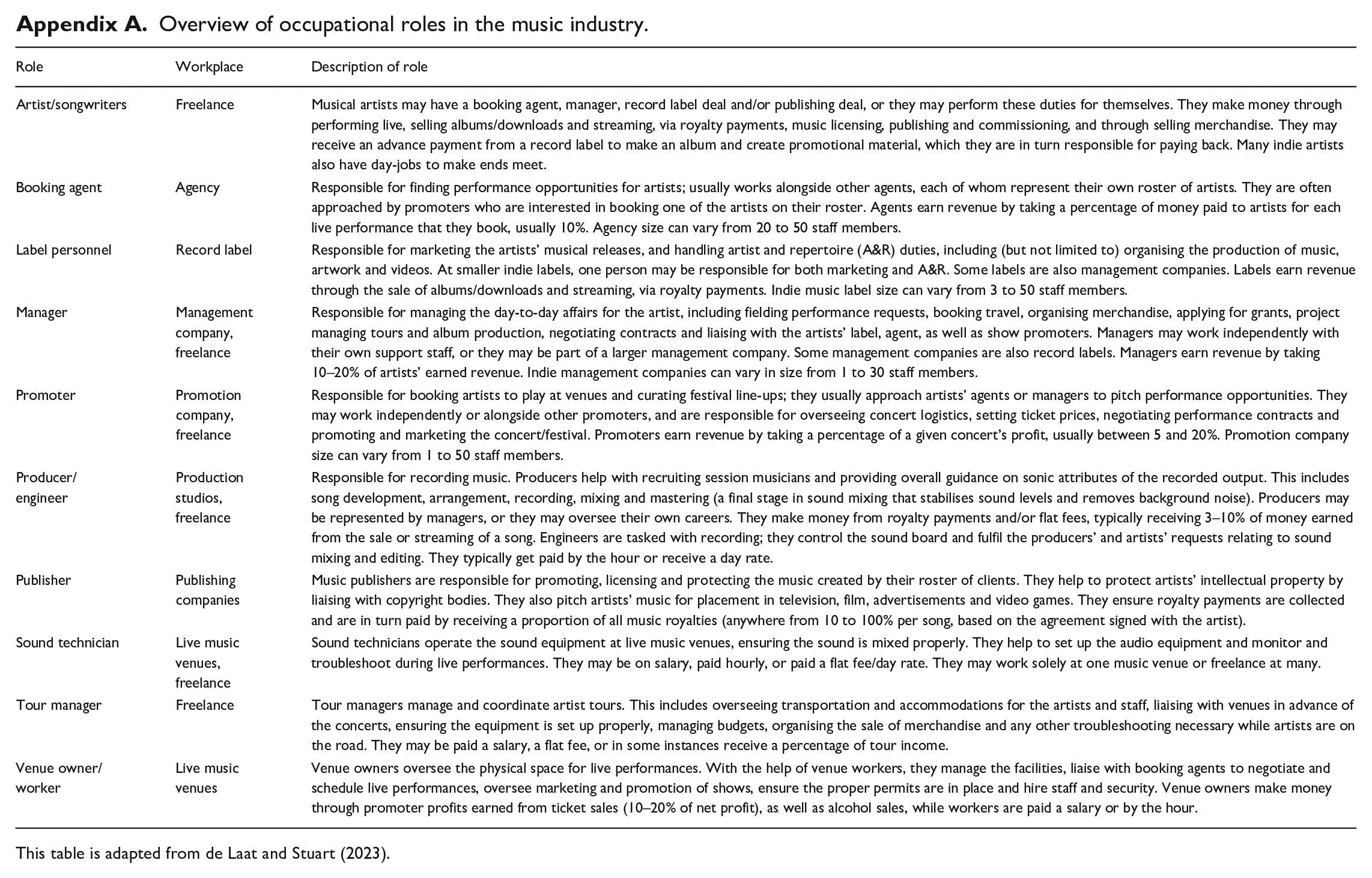
The research site for this study is the Canadian music industry, where jobs are spread across a variety of organisations including major and independent labels; recording and mastering studios; publishing companies; distribution companies; booking agencies; concert/festival promotion companies; artist management firms; and music venues. The occupational roles that fill these organisations include, among others, performing artists/musicians, songwriters, producers, recording engineers, record label and distribution company workers, booking agents, promoters, managers, sound technicians, tour managers, venue workers and venue owners. For more details concerning roles, responsibilities and how income is earned in the music industry, see Appendix A.
Two other features of the music industry are worth noting. First, unlike the bureaucracies studied by Puwar (2001), the music industry is composed of many small organisations that lack human resources divisions. In addition, most collaboration occurs across roles and organisations (such as artists liaising with producers, or agents working with promoters), meaning there is no formal grievance process when discrimination occurs. Outside of major labels and publishing companies, most music industry workers are on their own when it comes to navigating instances of mistreatment. Second, the project-based nature of creative work means that successfully navigating interpersonal conflict becomes a critical strategy for maintaining a good reputation in a labour context where ‘you’re only as good as your last job’ (Blair, 2001).
In recent years, the topic of inequality in creative sectors has received media attention, in large part due to social movement campaigns such as Black Lives Matter, Me Too, #TimesUp and #GrammysSoWhite. This has also been the case in the Canadian music industry, with critics remarking upon the lack of inclusivity, and activists organising speaking events and creating advocacy groups to address racism and underrepresentation (Bottineau, 2020; Gillis, 2016). Because of the increase in media attention, racism and inequality in music were top of mind among many industry personnel as the study began.
The authors’ standpoint stems from their personal and professional experience in the music industry. Stuart is a Black woman and active member of the Canadian music industry. The initial study was inspired, in part, by her lived experience working in male- and White-dominated spaces. de Laat is a White woman who previously worked at a major record label. The authors’ familiarity with industry practices helped to establish rapport and candour.
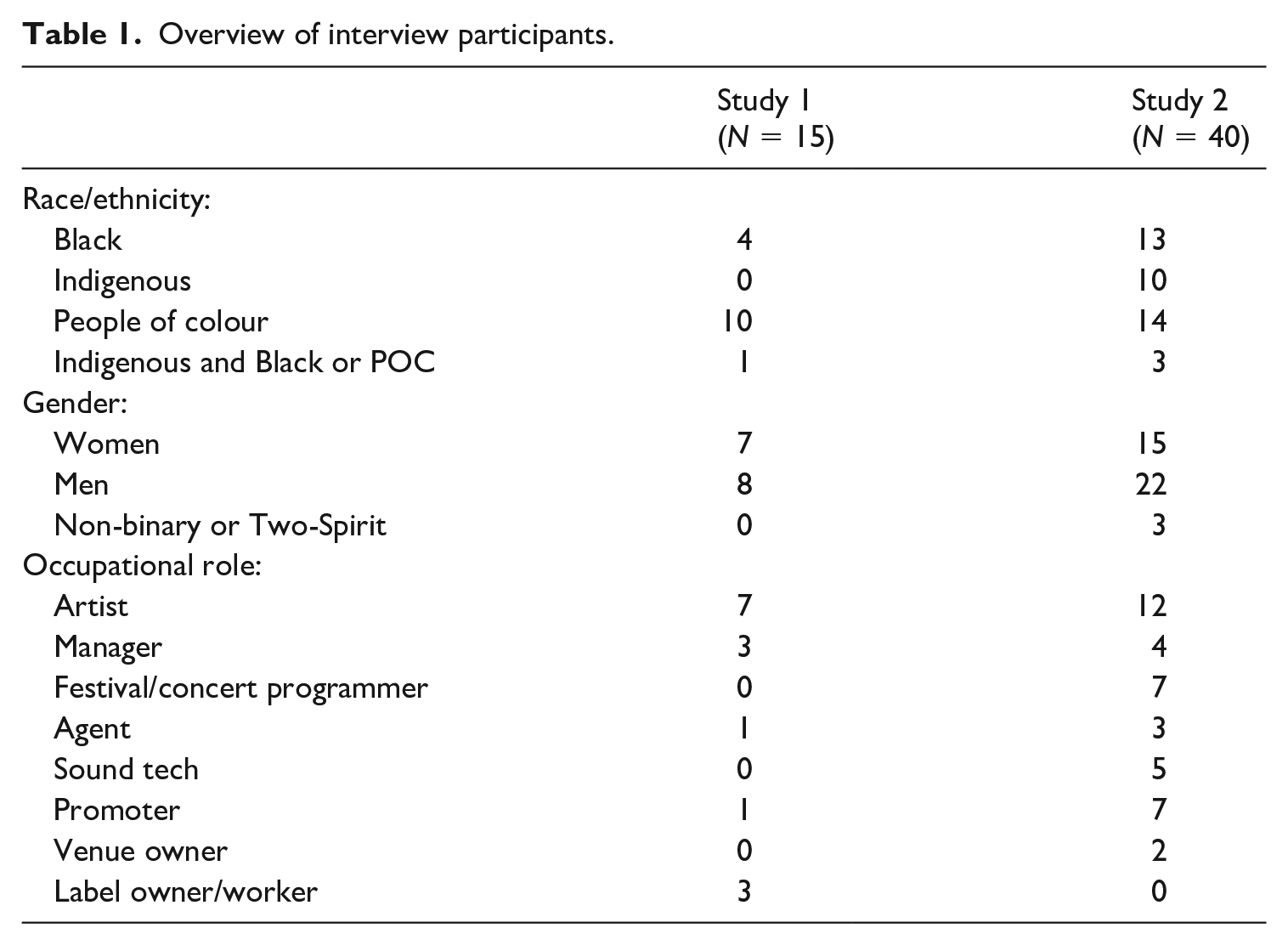
The data for this article are part of a larger project on racial inequality in creative careers and originate from two sources. In Study 1, music industry workers were interviewed by building a recruitment list from publicly available information in the Canadian Independent Music Association (CIMA) membership database and the Polaris Prize long list. 1 From these sources, 50 music industry workers agreed to participate in the study. Interviews took place with booking agents, artists, label personnel, artist managers and live show and festival promoters. The data used from Study 1 in the present article come from interviews with men (N = 8) and women (N = 7) creative workers that identify as IBPOC. Interviews were conducted by both authors and two research assistants and occurred in person and over the phone throughout 2018 and 2019. They lasted on average 1.5 hours.
Second, in collaboration with the Canadian Live Music Association, an advocacy organisation, interviews with men (N = 22), women (N = 15) and non-binary or Two-Spirit individuals (N = 3) identifying as IBPOC (N = 40) were undertaken for Study 2. Interviews were conducted with booking agents, artists, festival/concert programmers, artist managers, live event promoters, sound technicians and venue owners by a team of five research assistants and took place online throughout the summer of 2021. Sampling was purposive, and the research team relied on the Canadian Live Music Association’s knowledge of racialised live music workers across the country to inform the recruitment strategy. Study 2 interviews were one hour in duration on average, and all but one of the interviews were recorded and transcribed. 2
To reduce the potential for harm to the interview participants, interviewing teams were assembled for each project whose backgrounds vary across race, ethnicity, gender, citizenship and Indigeneity. The interviewers had experience in community research with equity-deserving populations and decolonial research methodologies. In addition, all the interviewers in Study 2 participated in a cultural protocol training workshop prior to conducting interviews. Participants identifying as Black or as a person of colour were invited to have someone from their support network join the interview. Indigenous participants were invited to have an elder accompany them, and for those without access to elders, the interviewers offered to connect them to an elder in advance of the interview.
There is no consensus regarding insider/outsider dynamics in qualitative interviewing (Maghbouleh, 2017; Twine and Warren, 2000); the team assigned interviewers based on availability, and not on interviewer/interviewee racial matching. In Study 1, all but two of the interviews with IBPOC interviewees were conducted by IBPOC interviewers. In Study 2, 80% of the interviews were conducted by an interviewer identifying as IBPOC. Participants were asked to self-identify according to their own words, and were given the option of providing a pseudonym, or having one chosen for them. In Table 1, aggregated racial/cultural identifiers are used to protect participants’ confidentiality.
Overview of interview participants.
Both interview guides included questions about workers’ experience within their occupational roles, the social organisation of their workplace, their relationships with others in the field, as well as demographic questions regarding race, ethnicity, gender, education level and salary. Upon the completion of each interview, a research note was drafted that included a summary of the interview and discussion of common themes. After the completion of five interviews, each interviewer wrote a detailed research memo to elaborate on thematic patterns across the interviews. For each study, the teams met bi-weekly to discuss the project and assess common themes as a group.
Interviews were analysed using Deterding and Waters’ (2021) approach to generating themes in qualitative data, which is a hybrid of positivist and reflexive traditions (see, e.g., Braun and Clarke, 2006). It is positivist because it is designed for analysing qualitative data with many interviews, where coding reliability and replicability is necessary because there are many people involved in the coding process. And it is reflexive because the approach acknowledges researchers’ subjectivity: researchers enter the field with well-developed theoretical understandings of the topic at hand, and their own cultural background influences interpretation of the data. This approach therefore advocates that researchers begin by coding large chunks of text that reflect the questions posed in the interview guide, which are in turn a reflection of researchers’ understanding of scholarly literature and their own social location, and iteratively develop more specific sub-themes based on surprising or confirmatory findings therein.
The first iteration of coding consisted of index coding, or what other researchers refer to as domain summaries (Braun and Clarke, 2019); thematic categories that had been identified during meetings and in the research notes and memos were coded. In addition, categories were generated by coding large swaths of text that reflected questions posed in the interview guide. This analytic technique enables large qualitative datasets to be broken into more manageable sizes for subsequent rounds of focused sub-theme coding (Deterding and Waters, 2021). The salience of experiences with racism was identified during index coding.
Next, the team engaged in analytic coding, which is a more flexible process of identifying sub-themes from index codes. Strategies for responding to racism became apparent in the indexed excerpts about participants’ experiences with racism. During this phase, specific responses to racism and microaggressions were identified – alleviation and confrontation – as were the effects of such responses – psychic weight and social accountability. This phase of coding was likewise iterative and involved refining and differentiating between thematic categories. For example, in earlier phases of the research we included the sub-theme of ‘giving racists the benefit of the doubt’ as a strategy for responding to racism. But in revisiting the interview data we determined that this reflected not a strategic response per se, but a different definition of the situation. In a third round of analysis, a patterned relationship between strategies and consequences was identified. All excerpts are statements made by those who identify either as Indigenous, Black, or as a person of colour. To protect the confidentiality of the participants, potentially identifying information has been altered in some of the excerpts.
Navigating racism: Strategies and consequences
Participants highlighted experiences with racial discrimination and microaggressions throughout the course of their everyday work lives. These experiences resulted in workers deciding how to react to racism and microaggressions, in contexts where workers feel somatically ‘othered’, and in moments where they must strategise music marketing and promotion to pre-empt White personnel’s reactions to music by racialised artists. In what follows, two ideal-typical strategies for navigating racism are identified: alleviation and confrontation. We group them as such for analytical purposes to aid in clear description, as well as to highlight their similarities and differences to other analyses of racism and microaggressions in the workplace. In reality, alleviation and confrontation exist along a continuum and encapsulate a repertoire of strategies that include silence, humour, reconciliation, ‘calling out’ and issuing ultimatums. Alleviation and confrontation are analysed alongside their longer-felt consequences, which persist beyond situational acts of racism and act as a canvas on top of which other experiences throughout the creative production process are layered.
Alleviation and bearing psychic weight
The first strategy described by interview participants to work past racially charged situations was to alleviate the potential for upset in others and avoid conflict. This came in the form of making light of offensive statements and actions, and mentally anticipating racially charged interactions. Participants’ reasons for choosing to alleviate varied; it was undertaken to maintain the professional relationships that provide a ‘seat at the table’, improve the likelihood that a project would be successful, or avoid further microaggressions.
Mark, an artist manager, relayed an instance of alleviation when he had to anticipate the responses of White colleagues to politically charged lyrical content. He shared how racial differences and fear of backlash shape his artist management strategies. One of the artists he represents wrote a song about the discomfort that White people feel regarding the treatment of Black people, and he described the additional strategising he engages in preceding the promotional roll-out:
We’re about to put out a song in two weeks. It’s a rock song. It’s fucking badass as fuck. The song is actually about the discomfort that White people may have in addressing the fact that Black kids, Black people are being shot, for no reason, in the back, holding no gun, by White people. It’s talking about the fact that there is blatant racism happening in our community . . . So, when we’re writing a press release to put out this song, it goes out to all White people, mainly, who run the rock world. What’s the agenda we put forward? I have to water down what we say and how we say it to make people accept [this artist, who is Black]. Because if we play the Black card, they’re going to be like ‘Oh, this is too Black for us’. So, when I’m moving and strategising, I am consciously always thinking about my race. I don’t think any other fucking race thinks about that shit. So, I have to water it down to make sure that we still put forth what the song is about, but in a friendly manner that everybody can relate to so that everybody can see the connection to it.
As a manager, Mark had to navigate concerns surrounding the reception of a rock song – a predominantly White music genre – about White apathy. Rather than present the song earnestly, he diluted the song’s message to ensure that it had a shot of resonating with his White colleagues. He acknowledged that this conscious effort is distributed unevenly, falling to him and other creative workers of colour.
In the following passage, Aria, a musician and performing artist, talked about the desire to continue getting invited into the ‘boys’ club’ of producers to solidify and maintain working relationships. While Aria highlighted sexism in the excerpt, as a woman of colour, she articulated her experience through a lens where her racial, ethnic and gender identities intersect:
Now call-out culture is a thing and thank goodness for it. But prior to that, it’s like you either have a job, or you don’t. Or you figure out quirky ways to navigate the inequalities to feel like you can have your power back . . . Which leads me to this: I took a workshop called the Power of Humour, and the idea is making and cracking jokes at misogynists. So, I choose to use humour. That way, [perpetrators] don’t fully lose their power because it’s like, ‘She just made a joke at me and put me down – She’s smart, maybe I won’t fuck with her too much’ . . . Like every time I go into a situation where there’s a bunch of producers there, mostly male, I’m like ‘Cool’. I don’t want to come in with a chip on my shoulder, right? I’m not going to be surprised that it’s a boys’ club. I won’t be surprised if there’s comments, and I’ve just got to be witty and light. That’s sort of how I have to play that game, because it’s kind of rare to get invited to a producer’s house.
She went on to give an example where her ethnic identity is explicitly signalled, and how she strategically used humour in response: ‘At a rehearsal someone will say, “Oh, let’s order Indian food. Aria, why don’t you call your friends?” Shit like that. And you go sarcastically, “Oh, thank you! Thank you for reminding me that I’m different, I guess.”’ Aria’s reaction to these situations was deliberate and skilled. She invested time and energy – going as far as attending a workshop – into strategically deploying humour in situations where she was differentiated from the somatic norm her collaborators embodied, to facilitate future collaborations.
For Aria and other interviewees, one outcome of this shared experience is a chronic cognitive load through which creative workers of colour are primed for how and when racism may impact their work experiences and working relationships. When asked how she feels about these exchanges, Aria conveyed a shared mental load that she and other IBPOC artists carry with them over the course of their creative collaborations:
The frustrating thing is the shared experience of frustration overall. It’s just like, ‘Well, here we are, I guess you’ve got to have thick skin’. It’s annoying. It’s eye rolling, in terms of race and gender. Because it’s a narrative that’s ongoing that’s like, oh, we’ve got to prove something. Which is weird, because I don’t want to have to prove anything, I’m done. Like, don’t you think that should be done by now?
Aria’s ongoing frustration in these encounters suggests that one of the consequences of engaging in alleviation is the assumption by those in the somatic majority that such actions do not cause harm. Whereas exposure and mutual acquaintance can in some cases reduce acts of everyday racism, for Aria and others, this expectation is unmet. Langston, a performing artist, similarly related to this frustration, and referred to the mental load as a psychic weight:
[These situations] are kind of exhausting. It’s emotionally exhausting to – The experience of being a person of colour in largely White environments – There’s just this psychic weight on me all the time of being like, okay, something inappropriate is happening and it’s like, ‘Am I gonna have to tell this person?’.
Langston introduced the term when expressing how it feels to be aware of his somatic difference among White performers and workers at music festivals, where anticipating racism was associated with emotional exhaustion for him.
Alleviation and the resultant psychic weight associated with anticipating microaggressions also came in the form of behavioural adaptation. When asked about any positive or negative experiences navigating the music industry, Connor, a sound technician, described his codeswitching strategy for anticipating remarks about racial identity. Codeswitching involves adjusting one’s behaviour to minimise marks of racial difference and facilitate the comfort of others in exchange for fair treatment (McCluney et al., 2019). It aligns with Puwar’s (2001) finding that those who are minoritised along lines of race and gender may deliberately acculturate to the dominant White organisational culture to achieve some degree of success. For Connor, this meant defying the stereotypical expectation held by others about his genre preferences:
If I’m playing some music to test out the PA system to make sure everything sounds balanced, I have to be really careful about what music I play. Otherwise, everyone will say, ‘Oh the Black guy’s here’, or you know, stuff like that. When I was starting out, in my early 20s, most of the people I’m working with are older White guys, so it’s like okay, well, let me let me get my classic rock game up, so I could fit in. So, when I play something on the PA it’s something everyone is accustomed to hearing. There are things like that, where you just have to switch what you want to do and even what you want to listen to. So, it’s really this extra like filter, where everything you’re doing kind of has to go through.
Connor adjusted his behaviour by playing music that he perceives as being palatable to his White peers to avoid being somatically ‘othered’. Despite being a practice intended to result in fair treatment, codeswitching nevertheless has psychological costs; it can lead to accusations of ‘acting’ and reduces authentic self-expression (Durr and Wingfield, 2011; McCluney et al., 2019). Connor went on to describe other encounters with racism and when asked about how he responded, he reflected on his strategy to alleviate:
I don’t know if I’ve responded appropriately to any of them. I see a lot of younger guys just be angry. And, you know, be visibly angry and vocal. And you know all of that stuff is justified. It needs to happen, and somebody needs to be angry and do all those things and make a lot of noise. But at the same time, then you’re just the angry person that nobody wants to hire. I don’t think there’s an easy way to discuss these issues, especially when you’re in an industry that is so based on who you know and reputation. And that’s why I say maybe the way I’ve treated some of these situations is not appropriate. But I think even though they haven’t been appropriate they’ve probably been better for my career because I feel like I’m in a very good spot in my career and I’ve made a good place for myself over the years. But was that the right way to do that? Am I a ‘sellout’ for doing that?
As a strategy for navigating racism, alleviation requires ongoing reflexivity, the psychic weight of which may induce self-doubt. Like Langston questioning how and whether to respond to racist moments, Connor questions the trade-offs of his efforts to navigate racism. His reflection raises important questions about how everyday interactional responses to racism cascade into longer-term career consequences. On one hand, he believes younger generations of creatives may simply be more comfortable with the discomfort that confrontation introduces. On the other hand, Connor suggests that his decision to alleviate is what allows him to meet with success, whereas younger creatives engaging in confrontation risk being boxed out.
Connor and others engaging in alleviation are not unique in how they choose to handle racial discrimination; other studies of everyday racism and discrimination identify alleviation as a tactic for insulating oneself from racial harm (Darr, 2018). The tactics can range from remaining silent (Shoshana, 2016), to engaging in humour like Aria (Dickson and Hargie, 2006; Yamashita, 2020). In these cases, alleviation shifts the source of the problem to the level of institutions and organisations, leaving day-to-day relationships intact, but wider issues of racial discrimination unchallenged. The result is that perceptions of structural inequality remain unchanged and continue to foster negative valence ranging from apathy (Yamashita, 2020) to contempt (Darr, 2018). In the present case, however, the strategy of alleviation co-exists alongside that of confrontation, raising questions about who has the potential to elicit change, and how.
Confrontation and social accountability
In contrast to alleviation – and rather than mitigate the potential for conflict – other participants made the choice to engage with a potentially wide range of responses by confronting racism and discrimination. Festival organiser and musician Chang described a time when he ‘called out’ other festival organisers for consistently failing to book artists of colour in a town that is majority-racialised:
I am able to open doors for myself, because everyone knows me, they know my band, I’ve sold a bunch of tickets for them. But I’m extremely cognisant of the fact that the next artist who probably could sell more tickets than me, has no in and can’t get a festival booking. I think a great example is the city of Oaktown’s Canada Day celebrations. Up until I called them out on social media last year, Oaktown, again, is minority White people. I think it’s like 40% White people, and 60% BIPOC, they had never had a BIPOC artist on their stage in the last 15 years.
In this instance, Chang confronted what he perceived to be discriminatory booking practices. While he risked upsetting relationships with the festival organisers, Chang conveys a feeling of obligation, or social accountability, to speak out on behalf of those who have not yet achieved the success and stability that he has enjoyed.
Accountability towards one’s community was acknowledged by many choosing to confront racism head-on. Darnell, a musician, shared a story of confronting harmful stereotypes in media interviews:
I have a song called ‘Lead’, and it talks about my experience being a Black man with things like police brutality, how the system has failed and even Black-on-Black violence. I had an interview with a TV network and as we were going through the song, they started really focusing on Black-on-Black violence. And they started to paint the narrative that, ‘You touch on this stuff in the song, that it’s not all these other things that are hindering us, actually, you guys are just killing each other’. For me, when it comes to media and stuff like that, I’m very bold. If I see something going in the wrong direction, I will definitely call it out and let them know. And so, I told them, ‘Listen, if the narrative is going to be controlled by you guys, and you guys are going to try and put a message like this out, which I know is going to hurt my community, then we’re not going to do this. And if you do go forward with this, then there’s definitely going to be consequences.’ And they listened, which they always do when I say stuff.
Darnell is not only subject to stereotypes himself; he must also be aware of what such representations mean for his community. Responsibility toward community motivates him to confront negative treatment in the moment, offer an ultimatum and arrive at a resolution. In doing so, Darnell risks damaging relationships with media representatives by creating space for shame, anger, or embarrassment in others.
Another example of confronting tokenising practices came from musician Cal, who shared his experience with discrimination and emotional trauma concerning the uncovering of unmarked burials at residential schools:
With all the residential school stuff that’s going on now, there’s a lot of these radio and entertainment folks that want to talk to us about it. But it’s only news to non-Indigenous people, right? This isn’t news to us, because our grandparents went to these schools, our parents went to these schools, our aunts and uncles went to these schools, we grew up with the stories. We know what happened. And so, I got contacted by a country radio station. And, you know, we’ve pushed our songs to commercial country radio. And this particular radio station was one of the places that said that our music wasn’t country enough for their station. But then we got an email not too long ago, right around the end of Indigenous History Month, where the radio programmer reached out to my publicist and asked to talk to me about these things. So, we sent them a whole email, telling them how it seems like they’re trying to capitalise on our trauma. I told them, ‘I’m not country enough for your commercial country station, but I’m Indian enough for your beads and feathers. By considering me an Indigenous artist, you are keeping me at a point where you can disregard me because of that, or you can bring me in to tokenise me. You’re putting me in this little box.’ I said, ‘I’m not an Indigenous artist. I’m an artist. I’m Indigenous, but I don’t make Indigenous music.’ And so, they never responded back to us . . . If it comes down to an opportunity versus my morals, I will fight for my morals every time just because the music that I make, and what I do, is much bigger than just songs and success.
This passage highlights the tensions that inhere in somatic norms; while Cal identifies as a country artist, radio gatekeepers are more inclined to perceive him as a ‘somatic other’ – he is perceived as an Indigenous artist by virtue of his cultural background instead of a country artist by virtue of his musicological catalogue. Cal’s experience further demonstrates how confrontation is underpinned by a felt social accountability to oneself and one’s community.
Maisie, an artist, identifies as queer and racialised. When asked about the kinds of feedback she received from her record label, she shared:
The only feedback that resonates in my memory that we ever received from our record label was to change one of our song titles on our last record. It was a song called ‘ampielezana’ and ampielezana is a Malagasy term that means diaspora. And it was suggested to us that we change that name so that it would be more radio friendly. And we didn’t because I believe that suggestion is inherently racist, so we kept it as is. It didn’t end up on the radio but I’m fine with that.
In her interview, Maisie conveys the professional consequences of addressing racism in creative industries. Maisie consciously accepted forgoing career-advancing opportunities in order to not adapt to the somatic norm. Throughout her career in the arts, she has often been called upon to speak about discrimination, and she expressed the emotional consequences of upholding such social accountability when asked to highlight traumatic moments because of her social location as a woman of colour:
When I’m asked to retell stories that have been painful for me, I have to make myself vulnerable in order for others to recognise the privileges that they have. This work often falls onto those who have visceral and painful experiences of racism and homophobia. And to reanimate those feelings with the hopes that we can begin to be more thoughtful or find different policies or be more equitable, is unfair for those who aren’t White.
The expectation that Maisie use her experience to provide industry knowledge on dealing with racism reveals the unequal distribution of social accountability between racialised music workers and their White colleagues. Maisie’s experience also highlights the assumption that workers of colour exclusively possess the knowledge to address racism within the music industry.
Discussion
This article investigates encounters with racism and microaggressions in the Canadian music industry, and the experiential tension that inheres in such moments. The analysis makes two contributions to the study of creative labour and interactional approaches to inequality at work.
First, it extends conceptual applications of the somatic norm to creative labour by elaborating on strategies for navigating racism and microaggressions in everyday work situations: IBPOC participants choose from a repertoire of strategies to either alleviate the unease that arises from harmful encounters or confront it directly. The strategies of alleviation and confrontation invite an added degree of insecurity to an already precarious work environment, as IBPOC music industry workers must weigh the costs and benefits of addressing racism in situ.
Alleviation and confrontation help us to understand the conditions under which resistance to the somatic norm, and its accompanying experiences of racism, may occur. While strategies for navigating racism require reflexivity and forethought, it is the case that they are also constituted with power and status dynamics, and one’s choice to pursue a strategy rooted in confrontation likely reflects status differences as well. Alleviation and confrontation influence and are influenced by larger systems of discrimination. The strategies emerge, in the first place, out of the need to contend with everyday acts of racism and microaggressions in work settings, experiences that are unequally distributed. And creative workers’ choice of strategy is likewise informed by one’s social location within broader systems of inequality (Jackson, 2018). Job insecurity, being new, or lacking social capital may increase the propensity to engage in alleviation out of fear over being labelled ‘difficult’ (see, e.g., Dickens et al., 2019).
Under certain conditions, highly masculinised work environments may make confrontation a more accessible strategy for men of colour (Berdahl et al., 2018; Jackson and Wingfield, 2013). While the findings indicate that women of colour are willing and able to confront racism and microaggressions, the music industry is male dominated. This suggests that women of colour choosing to confront racism face a double bind: they encounter the same need to navigate racism and the same risks of precarity as men of colour, with an additional gendered dimension (Stuart and de Laat, 2022). Those choosing to confront racism are often established in their career, and negative consequences for their professional reputation are mitigated by their social and professional standing within the music industry. In the case of artists choosing to confront racism, their heightened visibility may make retribution less likely. Another salient influence is the extent to which one has encountered racism in the past; more frequent encounters mean that individuals have developed a repertoire of resistance for navigating racism (like Cal), and which may in turn motivate them to confront racism directly.
Second, the analysis elaborates how experiential dimensions of racism imbue creative production processes, and the resultant psychic consequences of living outside of the somatic norm. For those choosing to alleviate, there is a considerable degree of labour that occurs to mitigate the potential for racial conflict. Even in the best possible circumstances, working across lines of difference is challenging (Phillips, 2014). If there is minimal conflict among a diverse group of creative collaborators, it is worth reflecting on whether anyone is engaging in invisible labour to facilitate such cooperation, and in turn, the costs of doing so. By contrast, when confrontation is racialised, it may come at greater risk to one’s status. The feelings of social accountability that motivate confrontation thus suggest the presence of a wider range of guiding principles within racialised creative processes. Struggles within fields of cultural production are not just about status and position-taking; they are fundamentally about racism and microaggressions, but also solidarity and community.
Conclusion
While alleviation and confrontation are deployed by IBPOC creative workers in moments of discrimination, all labour invoked in response to racism and microaggressions results in a longer-term psychic weight or social accountability that is present throughout participants’ working lives. The social and emotional strategies IBPOC creative industry workers employ to circumvent racism become enmeshed in the creative labour process. The cumulative effect of this labour is an imposed mental load that becomes constitutive of career advancement efforts. Navigating racism, then, is not something to overcome but an ongoing part of the job. There is a theoretically rich tradition of examining the ways in which ‘behind the scenes’ labour is necessary in the creation of artistic goods. This article demonstrates that such accounts are enhanced by rendering explicit the strategies and consequences of navigating racist encounters on the part of those living outside of the somatic norm.
Importantly, White people are also racialised and most often occupy a place of privilege in racist encounters, the outcomes of which – in terms of subsequent weariness and actions to remediate racism – are unevenly distributed (Evans and Moore, 2015). While the present article foregrounds the experiences of IBPOC creative workers, future research would be well served by a comparative analysis that includes the input of White creative workers and its impact on their experiences, and those of their IBPOC colleagues.
Footnotes
Appendix
Overview of occupational roles in the music industry.
| Role | Workplace | Description of role |
|---|---|---|
| Artist/songwriters | Freelance | Musical artists may have a booking agent, manager, record label deal and/or publishing deal, or they may perform these duties for themselves. They make money through performing live, selling albums/downloads and streaming, via royalty payments, music licensing, publishing and commissioning, and through selling merchandise. They may receive an advance payment from a record label to make an album and create promotional material, which they are in turn responsible for paying back. Many indie artists also have day-jobs to make ends meet. |
| Booking agent | Agency | Responsible for finding performance opportunities for artists; usually works alongside other agents, each of whom represent their own roster of artists. They are often approached by promoters who are interested in booking one of the artists on their roster. Agents earn revenue by taking a percentage of money paid to artists for each live performance that they book, usually 10%. Agency size can vary from 20 to 50 staff members. |
| Label personnel | Record label | Responsible for marketing the artists’ musical releases, and handling artist and repertoire (A&R) duties, including (but not limited to) organising the production of music, artwork and videos. At smaller indie labels, one person may be responsible for both marketing and A&R. Some labels are also management companies. Labels earn revenue through the sale of albums/downloads and streaming, via royalty payments. Indie music label size can vary from 3 to 50 staff members. |
| Manager | Management company, freelance | Responsible for managing the day-to-day affairs for the artist, including fielding performance requests, booking travel, organising merchandise, applying for grants, project managing tours and album production, negotiating contracts and liaising with the artists’ label, agent, as well as show promoters. Managers may work independently with their own support staff, or they may be part of a larger management company. Some management companies are also record labels. Managers earn revenue by taking 10–20% of artists’ earned revenue. Indie management companies can vary in size from 1 to 30 staff members. |
| Promoter | Promotion company, freelance | Responsible for booking artists to play at venues and curating festival line-ups; they usually approach artists’ agents or managers to pitch performance opportunities. They may work independently or alongside other promoters, and are responsible for overseeing concert logistics, setting ticket prices, negotiating performance contracts and promoting and marketing the concert/festival. Promoters earn revenue by taking a percentage of a given concert’s profit, usually between 5 and 20%. Promotion company size can vary from 1 to 50 staff members. |
| Producer/ engineer | Production studios, freelance | Responsible for recording music. Producers help with recruiting session musicians and providing overall guidance on sonic attributes of the recorded output. This includes song development, arrangement, recording, mixing and mastering (a final stage in sound mixing that stabilises sound levels and removes background noise). Producers may be represented by managers, or they may oversee their own careers. They make money from royalty payments and/or flat fees, typically receiving 3–10% of money earned from the sale or streaming of a song. Engineers are tasked with recording; they control the sound board and fulfil the producers’ and artists’ requests relating to sound mixing and editing. They typically get paid by the hour or receive a day rate. |
| Publisher | Publishing companies | Music publishers are responsible for promoting, licensing and protecting the music created by their roster of clients. They help to protect artists’ intellectual property by liaising with copyright bodies. They also pitch artists’ music for placement in television, film, advertisements and video games. They ensure royalty payments are collected and are in turn paid by receiving a proportion of all music royalties (anywhere from 10 to 100% per song, based on the agreement signed with the artist). |
| Sound technician | Live music venues, freelance | Sound technicians operate the sound equipment at live music venues, ensuring the sound is mixed properly. They help to set up the audio equipment and monitor and troubleshoot during live performances. They may be on salary, paid hourly, or paid a flat fee/day rate. They may work solely at one music venue or freelance at many. |
| Tour manager | Freelance | Tour managers manage and coordinate artist tours. This includes overseeing transportation and accommodations for the artists and staff, liaising with venues in advance of the concerts, ensuring the equipment is set up properly, managing budgets, organising the sale of merchandise and any other troubleshooting necessary while artists are on the road. They may be paid a salary, a flat fee, or in some instances receive a percentage of tour income. |
| Venue owner/worker | Live music venues | Venue owners oversee the physical space for live performances. With the help of venue workers, they manage the facilities, liaise with booking agents to negotiate and schedule live performances, oversee marketing and promotion of shows, ensure the proper permits are in place and hire staff and security. Venue owners make money through promoter profits earned from ticket sales (10–20% of net profit), as well as alcohol sales, while workers are paid a salary or by the hour. |
This table is adapted from de Laat and Stuart (2023).
Acknowledgements
Both authors contributed equally to the manuscript. We thank our team of research assistants: Sianna Bulman, Rachael Carson, Marie-Lise Drapeau-Bisson, Leon Liberman, Freddy Monasterio, Zina Mustafa, Madison Trusolino and Marek Tyler. We also thank Muna Osman and the Archipel Research team. An early version of this article was presented at the 2021 American Sociological Association annual meeting. We also extend our heartfelt thanks to the interview participants who took time to speak with us about their experiences.
Funding
The authors disclosed receipt of the following financial support for the research, authorship, and/or publication of this article: We gratefully acknowledge the support of Social Resources for Equity, and the Canadian Live Music Association.
