




Abstract
Organizations are frequently subject to changes that promote new and/or (supposedly) trendy identities for their members. Various studies have sought to understand how such identity regulation processes are achieved through discourse, a fact that has led researchers to call for a more material understanding of this phenomenon. Through an in-depth ethnography of a transformation programme aimed at constructing a new social identity among project managers – that of internal consultant – we find that identity regulation is exercised through a sociomaterial process affording the performativity of the promoted identity, mainly through the consultants’ bodily performances. This is important because it shows how identity regulation is achieved through both (and intertwined) discourse and materiality.
Keywords
A significant number of identity studies have focused on the importance of control (e.g. Alvesson and Willmott, 2002; Thomas, 2009) and see identity construction as a continuous process of ‘becoming’ (Clegg et al., 2005) influenced by identity regulation (Alvesson and Willmott, 2002). Sources of identity regulation studied so far are mainly discursive, a fact that has led researchers to call for a more sociomaterial understanding of identity regulation (Bardon et al., 2012). More specifically, some studies – including classical ethnographies about organizational control (e.g. Casey, 1996; Covaleski et al., 1998; Michel, 2011) – have already pointed to the role of material elements, such as artefacts, organizational arrangements or bodies in identity regulation processes; however, these studies have not really demonstrated the interplay between these discursive and material elements in identity regulation from a sociomaterial perspective.
In this article, we seek to address the following question: How is identity regulation sociomaterially achieved? Following previous insights from sociomaterial studies of identity (Symon and Pritchard, 2015), we adopt a performative view of identity (Butler, 1998, 1999). And to conceptualize sociomateriality, we draw on Leonardi’s studies about the relationships between the material and the social (2011, 2012a, 2012b, 2013). Following Taylor (2001), Ciborra (2006) and Sassen (2006), Leonardi (2013) conceptualizes the interweaving of material and human agency as a process of ‘imbrication’, a metaphor that refers to ‘the gradual overlapping and interlocking of distinct elements into a durable infrastructure’ (p. 70). The imbrication metaphor derives from the imagery of roof tiling in antique architecture, where ‘tegula’ and ‘imbrex’ are interlocking tiles used to waterproof a roof (Leonardi, 2012a, 2012b). According to this framework, it is the continued imbrication of human and material agency that produces sociomaterial outcomes. From this perspective, identity regulation can be studied as a sociomaterial process – the imbrication of material and human agency, involving discursive and material elements (artefacts, organizational arrangements and bodies) and which makes the identity regulation project concrete.
We make use of Leonardi’s framework to analyse data collected from an 18-month ethnographic field study of a programme targeting, among other things, the shaping of a new social identity, that of ‘internal consultant’. Our findings highlight that this programme can be analysed as two successive sociomaterial imbrications: first, the introduction of a technology aligned with the identity regulation goals of management; and second, the use of this technology by organizational members (targeted by the identity regulation) as part of a work routine that affords the performativity of the ‘internal consultant’ identity, that is, the constitution of this social identity through the entwinement of discourses and public and repetitive sets of actions and behaviours (Butler, 1999). Therefore, identity regulation is not only accomplished through discourse about ‘who the employee should be’; it is also achieved through the required and repetitive set of actions and behaviours involved in work routines and technology ‘in use’ that lead organizational members to perform the acts that will be constitutive of the (internal consultant) social identity.
In developing our argument, we make two contributions regarding (1) the process and (2) the modus operandi of employee identity regulation. First, we offer an understanding of identity regulation as a situated and local sociomaterial process involving discourse, artefacts and bodies, combined into an organizational arrangement that enables the performativity of a given social identity. This process is not only based upon the ascription/promotion of a specific social identity through discourse (as previous studies have found) but is more generally designed around the implementation of specific artefacts as part of work routines. Second, we aim to explain how the regulation of employees’ identities operates beyond the influence of identity regulation discourse. Our findings underscore that identity regulation also stems from the progressive internalization of the promoted identity through the repetitive bodily acts that organizational members carry out. These bodily performances, made up of repetitive public gestures, postures and attitudes, both signify the promoted social identity to external audiences and allow for a cognitive and bodily understanding by organizational members of the meaning of this social identity (i.e. what it means to be an internal consultant).
This article is structured as follows. First, we present some key insights from the identity regulation and sociomateriality literature. Second, we describe our empirical setting and our methodology, that is, data collection and data analysis. We then offer an analysis of the transformation programme, highlighting its discursive and material elements as well as their imbrication. The discussion section highlights the contributions regarding identity regulation processes. The article then concludes with suggestions for future research.
Theoretical background
Identity regulation studies, discourse and materiality
Identity is a long-standing topic of organization studies. Over the last 15 years, a growing number of studies have focused on individual identity from a control perspective (e.g. Ainsworth and Hardy, 2009; Alvesson and Robertson, 2006; Alvesson and Willmott, 2002; Thomas, 2009). From this perspective, the individual identity construction process is influenced by identity regulation which ‘encompasses the more or less intentional effects of social practices on processes of identity construction and reconstruction’ (Alvesson and Willmott, 2002: 625). It is important to distinguish between personal or ‘self’ identities (individual notions of who we are or want to be, both inwardly and outwardly) and ‘social’ identities (social constructions of who individuals should be as organizational members, Watson, 2008). Identity regulation is the prescription or promotion of the latter in order to influence the former.
In this article, we focus on organizational ‘modes of regulation’ (Alvesson and Willmott, 2002: 623) that promote social identities consistent with corporate expectations, such as a leader identity (Carroll and Levy, 2008), a self-managed identity (Garsten and Grey, 1997) or a consultant elite identity (Alvesson and Robertson, 2006). These modes of regulation can focus on the direct definition of employees (who they are or are not) and/or on group belonging and differentiation. They can also target the appropriate actions that organizational members have to accomplish and which are constitutive of the promoted identity (through motives, knowledge and skills or naturalized rules and guidelines). Thus, identity regulation can be analysed as a process designed to enable the performativity (Butler, 1999) of identity. Indeed, in Butler’s (1999) framework, identity does not exist as an internal essence to be disclosed but is performative, that is, constituted in what we do. Moreover, performativity is not a singular act, but a repetition and a ritual, which achieves its effects through its naturalization in the context of a body (Butler, 1999). As individuals repetitively carry out bodily performances, related (social) identities are constructed and internalized. Performativity is effective when the social identity becomes a norm that is taken for granted (Butler, 1999). Thus, according to this framework, in targeting the appropriate actions, identity regulation promotes ‘a stylized repetition of acts’ (Butler, 1999: 179, original emphasis) aimed at signifying and normalizing the related social identity prescribed. However, this repetition of acts ‘is never merely mechanical’ (Butler, 1998: 16): if a performance cites previous ones, it can also gradually drift away and open spaces for resistance or subversion to promoted social identities (Hodgson, 2005).
In their seminal paper, Alvesson and Willmott (2002) argue that organizational attempts to influence employees’ identities operate ‘primarily by means of discourse’ (p. 632). Organizational members are subject to (and actors in) organizational discourses that promote more or less positive and distinctive social identities. While previous studies based on this discursive understanding of identity regulation have produced valuable insights (e.g. Ainsworth and Hardy, 2009; Kuhn, 2006; Musson and Duberley, 2007), they have been criticized for their relative lack of consideration for the ‘material actualization’ of identity regulation (Bardon et al., 2012; Iedema, 2007). We acknowledge that discursive approaches can address materiality (see Hardy and Thomas, 2015), but this has been done in an unequal way – and mostly implicitly – in these studies (such ambiguity around discourse definition is quite common in organization studies, Alvesson and Kärreman, 2000). Furthermore, classical organizational ethnographies (e.g. Casey, 1996; Covaleski et al., 1998) as well as recent studies have highlighted that materiality is undoubtedly more involved than we think in identity regulation (Symon and Pritchard, 2015). In order to review current knowledge of materiality in identity regulation studies, we draw on Ashcraft et al. (2009), who highlight the most ‘commonly cited material elements’ (p. 25). In identity studies, that means artefacts, organizational arrangements and bodies.
Artefacts
If we restrict organizational discourses to being ‘instances of talk, text and conversations that take place within organizational “boundaries”’ (Bergström and Knights, 2006: 355), what part can ‘material’ artefacts play? Artefacts such as the ‘distinctive items of dress, insignia and equipment highly valued by the men’ which support the controlled process of becoming a paratrooper (Thornborrow and Brown, 2009: 366). One answer is that these artefacts are ‘additional semiotics’ in identity discourse (Ybema et al., 2009a: 304), that is to say they convey meanings, in this case specific social identities (e.g. a medal that suggests its wearer is a hero). Such a perspective focuses on artefactual symbolic properties rather than on their materiality. However, as Rafaeli and Vilnai-Yavetz (2004) have claimed, artefacts can also be analysed through their instrumentality (‘the extent to which the artifact contributes to performance or to promoting goals’, p. 94) or their aesthetic (‘the sensory experience it elicits’, p. 95). Moreover, since a significant amount of workplace artefacts have no readily accessible and socially shared symbolic meanings – for example, ordinary pens, tables, chairs, tools – but are part of the realm of organizational controls (what is given, or not, to employees to perform their tasks, as well as their usage instructions), the role of these other dimensions in identity regulation needs to be explored further.
Organizational arrangements
Many studies have underlined the role of organizational arrangements in identity regulation processes (e.g. Alvesson and Robertson, 2006). For instance, in her famous ethnography of Hephaestus Corporation, Casey (1996) reports that the new ‘preferred employee character type’ (p. 320) is promoted through both cultural and structural practices, that is, a flatter hierarchy and more participative decision-making processes, where employees are no longer simply executants but are ‘invited, and required to, have a substantive role in the design and management of production’ (p. 323). Similar ethnographic studies show that assessment and appraisal techniques, as well as management by objectives and mentoring, influence how employees define themselves (Covaleski et al., 1998; Grey, 1994). According to these studies, by altering work organization, these deliberate structural changes help shape the scope of employee behaviour and identification: organizational arrangements shape employees’ environments, which in turn contributes to the fostering of some forms of identity regulation (Dale, 2005).
Bodies
Finally, the role of the disciplined body has long been recognized in identity regulation processes (notably in feminist and Foucauldian studies, for example, Hassard et al., 2000; Trethewey, 1999). For example, the (re)production of a specific masculine identity has been found to be sustained by various disciplined bodily exercises such as ‘body maintenance’ – shaving and cutting hair, cleaning clothes and boots (Kachtan and Wasserman, 2015) – or ‘ritualised body work’ – working out, monitoring rugby players’ bodily statistics (Coupland, 2015). Moreover, in her 9-year ethnography, Michel (2011) found that bankers’ identities were influenced by embodied cues of organizational controls and the way they inhabit their bodies. This influence was achieved notably through timetables, space allocation or work techniques (i.e. organizational arrangements). These studies go beyond the usual conception of the body as expressive of identity through clothing and appearance. What is at stake are the required working postures and gestures and how they affect not only what we do but also how we consider our bodies and ourselves; bodily norms required for the purpose of task accomplishment may be less visible than a prescribed ‘dress code’ but are a promising avenue to shed light on the corporeal side of identity regulation. Such a perspective is consistent with Butler’s performative identity adopted in recent sociomaterial studies of identity (Symon and Pritchard, 2015).
Therefore, a large body of literature shows that there is more than discourse at work in identity regulation processes. However, a comprehensive picture is still lacking in terms of identity regulation involving discourse and these three material elements: artefacts, working arrangements and bodies. As Bardon et al. (2012) have claimed, ‘Understanding identity regulation thus requires seriously studying – from a sociomaterial perspective – how the managerial enterprising rhetoric is concretely deployed and understood in practice, through technologies, spatial arrangements, processes, routines and any other material artefacts’ (p. 356). As outlined above, exploring the accomplishment of identity regulation from a sociomaterial perspective can lay the foundations for a comprehensive picture of identity regulation.
A sociomaterial lens
In the past decade, there has been a growing interest in sociomateriality in order ‘to recognize and always keep in mind that materiality acts as a constitutive element of the social world and vice versa’ (Leonardi, 2012b: 34). However, the nature of the relationship between the material and social dimensions differs from one study to another; sociomateriality is more of an ‘umbrella’ (Orlikowski and Scott, 2008), and several different streams of research can be identified, notably on the basis of their underlying ontological positions (Cecez-Kecmanovic et al., 2014). For example, Orlikowski (2007, 2010) and Orlikowski and Scott (2008, 2013; see also Scott and Orlikoswki, 2013, 2014) assume a relational ontology, where people and artefacts are not separate entities with given properties. 1 They conceptualize the material and social as an assemblage of intra-actions. Their relationship is a mutual entanglement that is produced in practices. These practices are continually performing realities, such as organizations or markets, including identities (e.g. Symon and Pritchard, 2015).
An alternative view of sociomateriality assumes a substantialist ontology, especially in Leonardi’s (2011, 2012a, 2012b, 2013; see also Leonardi and Barley, 2010) critical realist framework, where people and artefacts are conceptualized ‘as separate and self-contained entities that interact and affect each other’ (Cecez-Kecmanovic et al., 2014: 809). In this article, we adopt Leonardi’s framework on sociomateriality in our analysis of identity regulation processes. In addition to being closer to our own ontological preferences, relational perspectives lead to a great deal of trouble in ‘unpacking’ the social and the material in empirical data, as commentators have argued (Faulkner and Runde, 2012; Jones, 2013; Mutch, 2013). This conceptualization of the relationship between the material and the social differs because human and material dimensions are thought to be entities, with distinct properties, whose interactions do not change what they really are. In this view, both humans and materials have agency: humans through ‘the ability to form and realize one’s goals’, something that is not determined by materiality but enacted in response to material agency (Leonardi, 2012b: 35); and material agency is ‘things a technology [or any material artefact] can do that are not entirely under the control of users’ (Leonardi, 2013: 70). Material artefacts have inherent physical properties that afford or constrain uses and actions and do not change over space and time (Leonardi, 2013). However, these material affordances 2 or constraints do not exist without people: ‘affordances and constraints are perceived differently by people depending on their goals or contexts’ (Leonardi, 2012b: 38). Finally, it is the continued imbrication of human and material agency that is productive of sociomaterial outcomes such as organizational routines or technologies (Leonardi, 2011). In other words, ‘materiality is thought to be a structural property while social interaction occurs in the realm of action. Over time, the material and the social become the sociomaterial through the process of imbrication and stay conjoined through continued imbrications’ (Leonardi, 2013: 72). That also means that imbrications evolve over time. Leonardi (2011) conceptualizes this dynamic as a succession of ‘layers’ of imbrication of human and material agency: a ‘material → human’ imbrication emerges when people choose to use material artefacts in a way that helps them reach their goals and produce a sociomaterial routine; a ‘human → material’ imbrication emerges when people modify material agency through changes in materials’ intrinsic properties. In that way, to overcome perceived constraints and produce a renewed sociomaterial technology which offers new affordances, ready to be used in a new way to produce a renewed routine, and so on (for a detailed presentation of the concept of imbrication, see Leonardi, 2011 and 2012b).
Leonardi’s framework allows for the study of the intertwining of different types of materiality and discourse (Putnam, 2015). From this perspective, identity regulation can be studied as a sociomaterial process – the imbrication of two ‘basic common building blocks’ (Leonardi, 2011: 152): material and human agency. To analyse this process, we identify the discursive and material elements (artefacts, organizational arrangements and bodies) involved in the promotion of a social identity and how these elements come to be imbricated in the modification, or creation, of technologies and routines which make the identity regulation attempts concrete.
Methods
Empirical setting
Following Alvesson and Willmott’s (2002) call for in-depth and longitudinal studies aimed at investigating the processes of identity regulation (p. 638), we conducted an 18-month ethnography of an identity regulation process: a transformation programme aimed at entirely redirecting the work practices of project managers, and simultaneously promoting among them a new identity of internal consultant. This empirical study took place within the Organization Department (OD) of a large European service company, employing several thousands of people worldwide. At the time of the study, this company was engaged in a transformation plan intended to simplify its processes and reduce costs. The OD is a department that was created by the company’s senior management in February 2013 and which was to become ‘the internal consulting firm’ of the organization ‘to support the company in its transformation’. In order to reach this goal, the OD’s employees followed a programme designed to train them to be internal ‘consultants’. The data analysis (especially comments made by OD managers) reveals that the related social identity has the following identity attributes: rational problem solvers, always in motion and efficient, exemplars and role models, transparent and dedicated to the delivery of projects. To entrust internal consultants with such a transformation plan is not exceptional in organizations that seek to instil change and to depart from what are seen as (post)bureaucratic forms of organization (Sturdy et al., 2016).
This ethnographic case study inspired the theoretical argument set out in this article. Sociomateriality emerged as a salient feature of the OD’s transformation and identity regulation programme, as it was quite clearly based on the promotion of new sociomaterial work practices which were themselves based on the introduction and use of new artefacts by the internal consultants. Indeed, we were struck by the originality of this case: identity regulation did not only begin with new discourses about ‘who employees were supposed to be’ but with the placing of new artefacts all over the offices (especially whiteboards) and the introduction of new organizational arrangements (such as the morning meetings) which required new (mandatory) bodily postures and gestures.
Data collection and analysis
Data were collected by one of the authors, who acted as a full-time consultant as part of a long-term internship. The fieldworker adopted the role of a participant observer (Atkinson and Hammersley, 1994), immersed in daily work, being simultaneously an ‘insider/outsider’ (Hammersley and Atkinson, 2007) and attending meetings, as well as lunches, with other employees. Formal fieldwork was conducted between February 2013, at the starting point of the transformation process described above, and July 2014. The research process comprised field observations, document analysis and informal conversations. Field notes (Van Maanen, 1988), taken almost daily, either on the spot or at the end of the day, enabled close tracking of changes in the OD. The fieldworker observed and took notes of discourses, discussions, interactions, practices and behaviours, with the intention of recording the programme’s implementation in great detail. The author was present during all collective practices, workshops aimed at defining the OD, weekly staff meetings and training sessions. The participant’s observations were gathered within the OD’s workplace, from consultants and in managers’ offices and rooms used for internal events and meetings. We also analysed documents such as training and managerial presentations. These were useful in supplementing the programme description. In addition to these formal events, numerous ‘improvised’ (Humphreys et al., 2003) informal conversations took place with other consultants, especially during breaks or over lunch.
To explore the sociomateriality of identity regulation, we first built up a narrative of the transformation programme, that is, the ‘construction of a detailed story from the raw data’ (Langley, 1999: 695), inspired by the fieldworker’s experience as a would-be consultant. The written narrative is one of the results of our research, expressing the richness and complexity of an organizational phenomenon (Lincoln and Guba, 1985); it also makes it possible to search for repetitive patterns in order to produce a relevant interpretation of our data (Denzin and Lincoln, 2005). This process of analysis was iterative: during several meetings between the authors, we moved back and forth between the narrative, data, interpretations and conceptual frameworks, and compared our individual interpretations, in order to refine the main categories emerging from our material. Repeated rewritings of the narrative around emerging categories led us to gradually refine categories and abstract interpretations. These meetings were also an opportunity to try to maintain a more distanced view of the programme (Ybema and Kamsteeg, 2009).
What drove the writing of this narrative was the ethnographer’s perception that the new work practices promoted by management were inexorably pushing her and her colleagues to adopt new attitudes and behaviours, albeit unwillingly (at least in the beginning). She actually felt surrounded, stunned and ‘trapped’ by the large amount of new objects, new discourses and new practices that came all at once as part of the transformation programme. She used the metaphor of a ‘tight net thrown over people’ to express her feelings at the time, inspiring us to analyse the identity regulation that was taking place as a sociomaterial process. Moreover, we realized that it was only as time went by, as she practised the new work methods and engaged her body with the new artefacts – and as she observed her colleagues doing likewise – that she gradually made sense of the promoted identity of the internal consultant. We felt it would be particularly interesting to understand how she and her colleagues came to experience what an internal consultant was supposed to be through the body. We were above all interested in understanding how the normalized internal consultant was brought to life within this organization. It inspired us to take a performative view of identity based on Butler’s (1998, 1999) work because it focuses on the production of social identities. We reflexively acknowledge that our account is an interpretive one that is shaped by our own positionality (Ybema et al., 2009b), that is, our critical lens mingled with the subjective experience of the consultant-fieldworker. Had she experienced other feelings towards the OD’s new organization (i.e. enthusiasm or indifference), the story would have been different (or may not have existed at all). Although the account is shaped by our own beliefs and values and places the standpoint of the fieldworker at the fore, she was far from being the only employee to adopt a critical view of the process (as evidenced in the article). Moreover, we sought to represent as faithfully and honestly as possible the plurality of the voices of the other employees and their various attitudes towards the process under study, as well as its complexity in order to leave the story open enough so that it ‘stimulates active interpretation on the part of the reader’ (Alvesson and Sköldberg, 2009: 222).
We identified the promoted social identity (internal consultant) by analysing all collected discourses – mainly speeches delivered by managers or consultants and improvised conversations – as well as the behaviours required in new working practices in search of ‘notions of who or what’ (Watson, 2008: 131) employees were supposed to be.
Finally, we chose to focus on a specific organizational practice involving a significant artefact (the whiteboard) in order to produce a precise analysis of the sociomaterial imbrications that both constitute and accomplish identity regulation. Indeed, the transformation programme itself encompassed several new working practices that appeared to exhibit distinct and situated modes of identity regulation. We chose the whiteboard because it is the core practice of the transformation programme.
Findings
In this section, we first outline the setting of the OD as it evolved over time during the transformation programme, and highlight the various components that come into play in the formation of the OD’s sociomaterial world: the new promoted identity, by means of new discourses, as well as new artefacts, organizational arrangements and body requirements. We then focus on the programme’s core practice, the ‘morning whiteboard meeting’, in order to show how the new social identity was created through sociomaterial imbrications. These findings are based on an ethnographic account written in the first-person singular or plural (OD employees) in order to fully acknowledge the presence of the fieldworker in the organization and underline that her observations were made from her position as would-be consultant, that is, from the position of those who are regulated rather than those who regulate.
The transformation programme and the promoted identity
The transformation programme began in February 2013. All the changes that I describe in this section took place in a short timeframe of 8 weeks. During this period, our world (that of the project managers) totally changed, as we heard new discourses and were required to radically change our work methods. For the sake of clarity, in the following paragraphs the story is organized into sections separating the various components of our sociomaterial world, but in actuality, none preceded the other and they all came at once. The extent and suddenness of the changes made us feel overwhelmed and somewhat caught into a net.
At the launch of the programme, the OD had just been created and resulted from the merger of two former project management departments, one dedicated to operational efficiency projects, the other to regulatory or business development projects, and was co-headed by two managers. The organizational arrangements in place before the programme was initiated were quite usual and standard for the company. Our hierarchical structure was rather flat, with only two co-managers. Within project teams, the project heads supervised the project managers directly and autonomously. Half of both departments was made up of external consultants (most of them from the same consulting firm, which had very close links to the managers), and the other half of internal employees, mixed together in project teams. Internal employees’ backgrounds, professional habits and ages (from 25 to 50 years) were diverse. At the outset, the OD was quite heteroclite and had no salient or stated identity.
When the OD was first set up, the managers decided that this had to be changed. One important contextual element is that the department had just been entrusted by the Top Management to promote and deploy, within the organization, a ‘lean management programme’ featuring new work and management methods. It was logically compelled to apply this programme to itself and be the showcase of its new business. The managers therefore started talking about us becoming an ‘internal consulting organization’. At one meeting, they stated that the OD could not remain ‘in its comfort zone’:
We want to become the reference consulting firm of the company, necessarily involved in solving all transformation issues and implementing continuous improvement … So we are going to create this internal consulting firm and give it a framework, structure it. We are convinced that we can and want to act as a role model for the rest of the company in terms of its organizational and collective mind-set. We must, therefore, be client-oriented, innovative and models in our behaviour and skills … exemplification is the key word … We are going to be in motion at all times, exhibiting a dynamic with a will to innovate. We must build collective momentum based on greater agility, always in motion. (OD manager)
This really came as a surprise as it was the first time that we had heard a speech about who we were (or supposed to be). In the following weeks, our managers engaged in a new and intense discursive activity, and quickly designated all of us as ‘consultants’. I was taken aback by this new designation, as it was previously used only to refer to external consultants. Nevertheless, it now applied to everyone without distinction, including us internal employees. This new categorization was just dropped into speeches without any explanation, as if it was natural and self-evident. As I could not figure out what it meant, I listened carefully to the speeches and noted some recurring identity attributes in defining the ideal consultant: s/he was to be ‘aligned’, ‘exemplary’, a ‘role model’, ‘problem solver’, ‘transparent’ and dedicated to the ‘delivery’ of the project. All those words seemed abstract and empty, as the managers never explained what they really meant, that is, what it took in concrete terms to become a consultant, and above all what it took to be ‘exemplary’, ‘aligned’ and a ‘problem solver’ (and so on). I was especially curious about ‘transparency’: did this mean that we had to become invisible? From that point on, we were told that we had a clear mission statement: ‘our job is to find sources of efficiency and performance for the company, and we must be proud of it’ (OD manager).
Along with promoting a new identity (albeit not delineated and sounding a bit like slogans), the OD managers decided to change the previous organizational arrangements. They immediately announced the creation of a new management layer, made up of two ‘delivery and people managers’ (hereinafter D&Ps), one internal and one external consultant. These new managers had no hierarchical role and were presented as ‘coaches’ dedicated to helping teams in the ‘delivery’ of their projects. Most of us were surprised, angry and sceptical at the announcement, and – unsurprisingly – did not look favourably on this new layer.
Finally, along with this new organizational structure and new intensive discursive activity, the OD managers (now referring to both managers and D&Ps) asked the new consultants to adopt new work practices:
Transforming means changing on a daily basis because a change that is only on paper is not a change. We are going to ask you to do things differently, the schedules of each of you will be affected; meetings will have to be set up. (OD D&P)
These new practices, inspired by lean management techniques, were impressively numerous (I counted seven of them). The most important one was called ‘cascade meetings’ and encompassed four types of meetings. The main one was a daily morning meeting (analysed in depth in the next section), which brought together each project team and their dedicated D&P for 15 minutes, in front of a new artefact that had appeared on every OD wall: a large magnetic whiteboard used to discuss and schedule tasks to be done in relation to the ongoing project. The three other meetings (‘problem solving session’, ‘feedback/reverse feedback’ and ‘one-to-one meeting’) were weekly and face-to-face meetings between the D&Ps and project heads, and between project heads and their project managers (lasting 30 minutes to 1 hour). They were collectively referred to as cascade meetings because they were designed to mirror the organizational pyramid, with the D&Ps holding the same meetings with the project heads as the managers held with the D&Ps. All these meetings were to be scheduled through our Outlook calendars for the whole expected life of each project, and most of them were collective, sometimes public, which contrasted significantly with our previous work methods, where most interactions were face-to-face and organized as needed. Now, interactions were framed.
Most of us objected, feeling constrained, framed and controlled by the new practices. I heard many colleagues commenting, ‘You’re in the army now’ and ‘this is policing’. Some project leaders would complain that their calendar was filled with pre-planned meetings at the expense of progress on projects (a project head could typically have nine fixed weekly slots in his or her Outlook calendar, totalling 7.5 hours – one working day). The managers claimed, in response, that the new activities served the same function as other pre-existing activities which had not been carried out in such an orderly manner but instead as part of a rather inefficient ‘fire fighting’ approach or ‘according to people’s own ways of working’. As one D&P commented, ‘It’s just a matter of ownership. We did problem solving before, but it wasn’t structured. Now people are pro-active; they feel in charge. I saw people improving as a result of the feedback and reverse feedback’. Although very much contested at the beginning, these practices were implemented and became routine. It was in any case very difficult not to comply as the D&Ps were in charge of checking implementation. Opposition to them lost ground over time. Before the practices were introduced, the OD’s open space was very similar to any other open space within the organization. Over a few weeks, large magnetized whiteboards appeared on all the walls of the open space (see Figure 1). Every morning, instead of people being seated at their desks, all employees could be seen standing and moving around in front of these whiteboards, dancing in a strange new ballet.
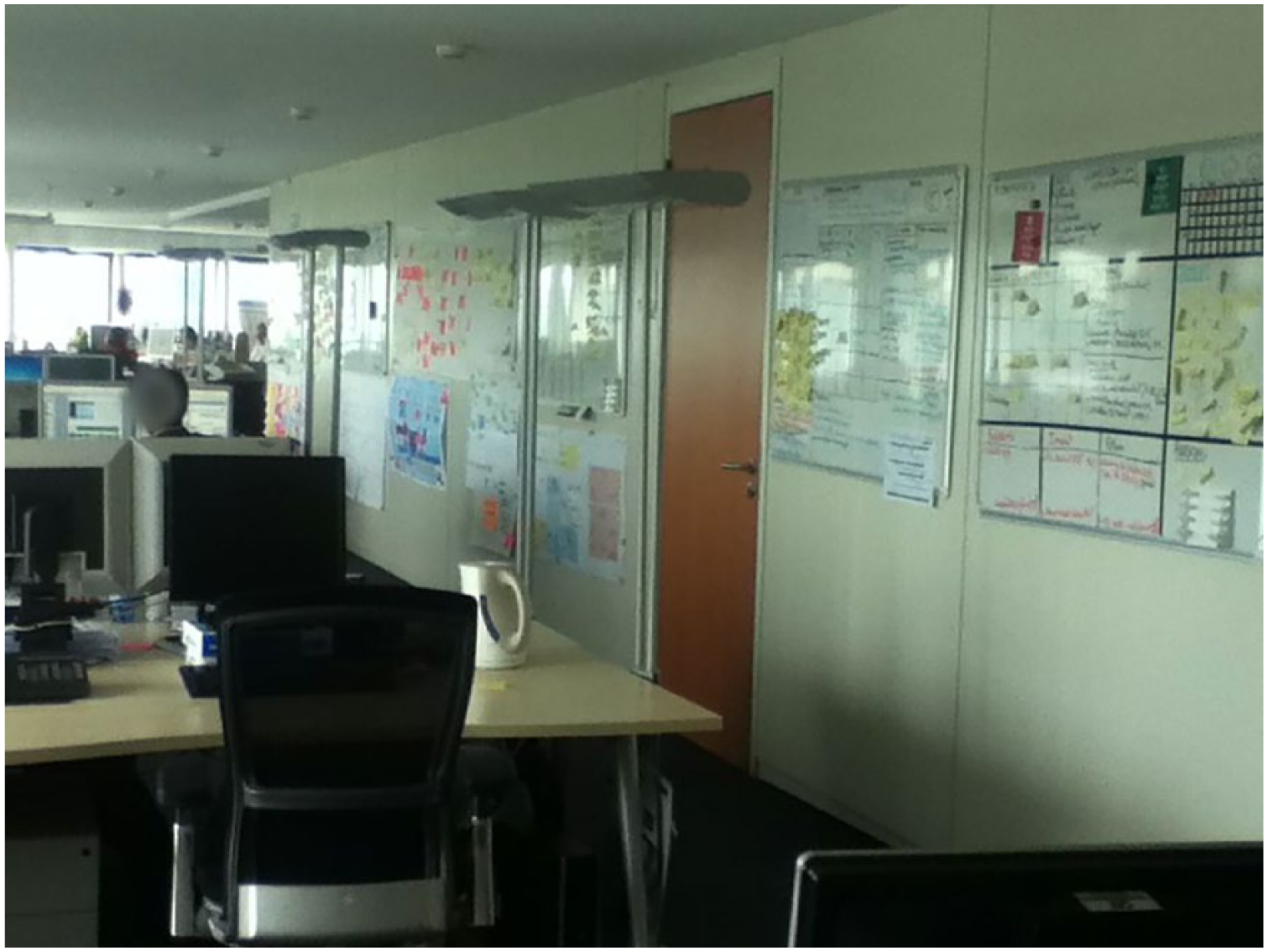
Whiteboards all over the open space.
Now that the programme has been introduced, as well as its discursive and material core elements, we (the authors) will turn to how these are imbricated and how this sociomaterial imbrication enabled the performativity of the new consultant identity.
The imbrication of discursive and material dimensions
In this section, we focus on the core practice of the transformation process (as management called it): the morning whiteboard meeting. We build our detailed analysis of this practice on Leonardi’s (2013) framework, presenting a temporal analysis of the imbrications of human and material agency that resulted in the practice becoming a work routine over time. From this perspective, the practice of the programme studied can be seen as the sociomaterial routine produced by two successive imbrications that both play a role in OD employees’ identity regulation as consultants. We first analyse the introduction of the whiteboard as an initial human → material imbrication, before going on to analyse the social interactions around the whiteboard as the second imbrication (material → human). We then consider how this second imbrication enabled the performativity of the consultant identity.
First imbrication: the introduction of the whiteboard
The morning meeting was the first practice to be promoted and introduced by management as ‘the backbone of the transformation of our practices’. The managers clearly linked their goal of transformation to the introduction of the whiteboard. Their view was that ‘the whiteboard fosters performance, dialogue and transparency’. At the training session for this practice, one of the two D&Ps illustrated the crossover between the social and the material by stating, ‘I am going to introduce to you a new member of the team, the whiteboard’.
The whiteboard was not just a blank artefact that OD employees could use freely to write on or attach memos to. We were trained to organize our whiteboard in a precise and standardized way. We were taught to draw six fixed boxes, using either a whiteboard marker or masking tape (see Figure 2). Three boxes were dedicated to checking the progress of projects (task completion and goal achievement). We had to divide the central one into five columns, one for each day of the week. On each column, each of us was supposed to write the tasks that we planned to carry out on a specific day (e.g. plan a workshop, finish a presentation, hold a meeting). In another complementary box, we had to write down the corresponding goals of the week we were to set ourselves (for instance, get the sponsor’s approval for the project roadmap, or achieve a specific deliverable). Finally, throughout the week, whenever a task was completed, we had to shift it to the box entitled ‘Done’ to record the progressive task completion. Two other boxes were dedicated to detecting potential problems in the running of projects. There was one entitled ‘Problems’, where we had to write down all the problems that we encountered and the date on which a dedicated problem-solving session would be organized (e.g. ‘the stakeholders are not aligned on the project’s objectives’). In another one, a happy, a neutral and an unhappy face were drawn, and each of us was requested to tick one of them each morning in order to express whether our project was going well or badly. In the last box, each team was requested to write down the ‘Key Performance Indicators’ that they would set themselves for the whole project.
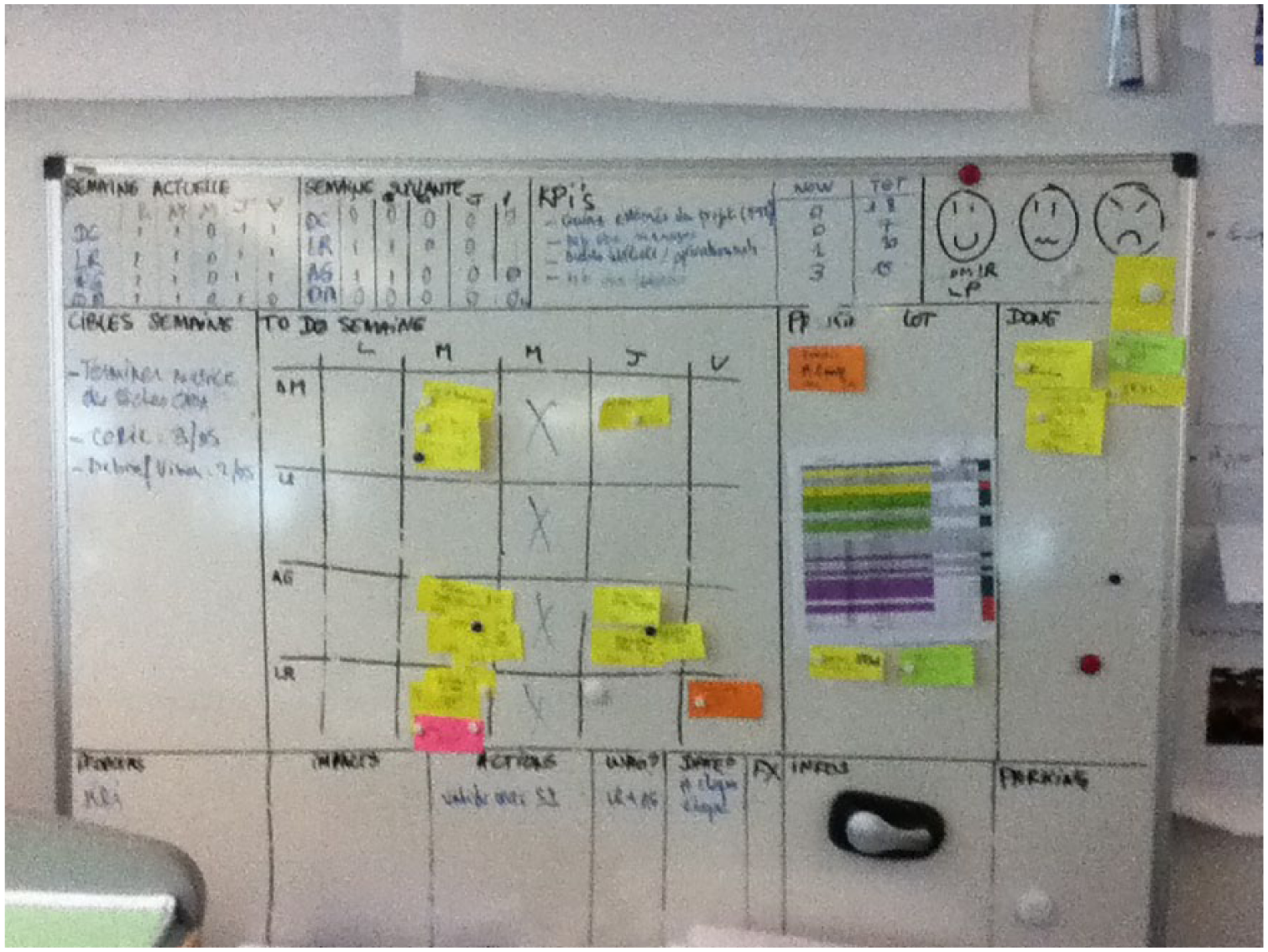
The whiteboard and its boxes.
Importantly, each team’s whiteboard was hung on the wall of the open space. Each team was requested to assemble every morning for 15 minutes in front of the whiteboard, so as to organize their work on a daily basis. We were given post-its and markers. We were requested not to sit (despite plenty of chairs being available) because the practice had to be quick to ensure efficiency.
The first imbrication of the sociomaterial process can be identified at this stage of the programme: the introduction of the whiteboard can be analysed as a human → material imbrication because the human agency – of the managers – (the fact that they felt constrained by the existing routines in reaching their goal of transformation) brought a new technology to the OD aimed at changing the work practices of the employees. Two physical properties of the whiteboard – the boxes and its position on the wall – can be seen as its ‘material’ properties, that is, their particular forms enduring across time and space, and shaping use patterns for users (Leonardi, 2013). Although the OD managers explicitly outlined the link between their transformation goals and the introduction of the whiteboard, they never explained to us why and how its material properties would ‘foster performance and transparency’. Things were always presented as if they were self-evident. One thing is certain: the managers did not ‘design’ those material properties, as the whiteboard practice is part of the more or less standardized lean management techniques that was brought in by the external consulting firm employing most of the OD’s external consultants. The management, probably to a large extent, took the whole package, the practices and the discourses that went with it. The whiteboard is of course not a new technology per se, but was new to the OD. We can now turn to the social interactions taking place around the practice, and see whether and which affordances are perceived and used by OD employees, and, subsequently, whether the related second imbrication leads to routines that makes the consultant identity performative.
Second imbrication: the whiteboard is ‘totemised’
Very soon, all the project teams, after drawing their whiteboard as requested and finding the most suitable place for it on the wall, started meeting in front of it every morning, from 9 to 9:30 a.m. I did the same with my team; we could see the other teams standing in the open space, just as they could see us. It was unusual to work this way, as all meetings had previously been conducted seated. My colleagues and I could now see each other from head to toe, and our gestures and postures were more noticeable than they were from behind a table. We had no table, no pen, no notebook and no chair to hold onto and hide behind – all we had was our bodies and we had to invent new ways of moving. We got on with the job and started talking about the tasks to be performed and writing them down on small post-its and sticking them on the whiteboard. Before this, we were used to having our own personal to-do list. Never before did we have to display our personal tasks so openly to others. It was now clear that each of us was able to assess whether the others had enough work, so writing down a small number of tasks was not really an option. In addition, as the whiteboard was hanging on the wall, visible all day long (by the other consultants, the D&Ps and the managers), an empty one would not do. It was preferable to display a beautiful and well-organized whiteboard, covered with post-its. It was also clear that we would be better off if our whiteboard displayed many post-its in the ‘done’ box as the end of the week was approaching.
When using the three boxes related to the management of tasks, I could observe various behaviours. Some would try to fool the others by splitting a task into smaller pieces to increase the number of post-its (but this trick had to remain within reasonable limits), while others effectively entered a kind of ‘post-it race’, assigning themselves an enormous to-do list with aggressive deadlines. This could have annoying consequences for the other staff members, pushing them to advance their own deadlines. Some consultants would even update their tasks all day long, going to the whiteboard several times a day, writing new tasks and removing those that had been completed (instead of waiting for the next morning’s whiteboard session). Some of us found this quite excessive, not to say childish, and it also put us under pressure, as we knew that this would be praised by the management. The management of tasks was actually quite important for the managers. Once, in my initial clumsiness in dealing with this practice, I wrote down all of my team’s tasks on post-its (after discussing them with those concerned of course). My D&P, who attended the meeting (as he did every morning), told me that each consultant had to write down their own tasks. In any case, personal daily tasks were now discussed collectively and were no longer simply a personal decision.
Beyond the various attitudes towards the whiteboard, the whiteboard practice was also perceived as truly helpful in terms of team organization and communication. Some colleagues found that the whiteboard made it easier to structure their workday. Moreover, it offered new opportunities to discuss the advancement, sequencing and priority of tasks, to pass on information, and share the same understanding of the project’s goals (as project goals are always moving). The presence of D&Ps, although very much criticized upfront (their role was to observe and control the practice), also proved to be helpful. The team members took advantage of this representation of management to issue risk warnings more easily. Before this practice, the project leader had to find time in the management’s timetable to talk about problems, which was never easy. However, not all boxes were perceived as useful right away. The box entitled ‘Problems’, for instance, did not immediately seem to consultants to be useful. It was more difficult to deal with it than task management, as it was culturally more unusual to talk about ‘problems’. The word ‘problem’ was a bad one, to be avoided. If we had one, we would usually try to settle it on our own before it surfaced. Hence, the D&Ps initially had to ask us explicitly whether we had problems, and even urge us to talk about minor ones. Even the management intervened one time:
I see there are no more problems on the whiteboards. This is a problem. It is part of agility. So please, there are issues, either in projects, in teams or in the department. So I must insist, the impact we have in projects and the successes accumulated are because we work differently, because we bring transparency, and we communicate on things that are wrong, not only on things that go right. So please, problems are not all big, there are many small issues which enable us to go further.
Then we had to force ourselves to write them down. Little by little, we realized that it was actually quite a relief to share problems, as the whole team was supposed to help in solving them. Writing a problem on the whiteboard would automatically trigger a collective ‘problem solving session’, bringing together several team members. Before this practice, we were left to face problems alone. The boxes containing smiley faces and the key performance indicators proved less successful: some teams used them but others did not, and the management (for unexplained reasons) seemed to be less committed to these boxes (they never commented on them). Some consultants found the box with smiley faces a little childish.
Overall, the whiteboard practice became a well-accepted work routine – which is why we see it as the second sociomaterial imbrication (material → human). The material agency of the whiteboard shaped social interactions in a particular direction (management of tasks and problem solving), which became imbricated with the human agency of the consultants and D&Ps. Indeed, thanks to the perceived affordances of the whiteboard, the consultants and D&Ps brought their goals (being well considered by the management and managing daily work in projects) to their interaction with the whiteboard. This imbrication led to the effective use of the whiteboard’s material properties and produced new social interactions. More precisely, OD employees perceived in the whiteboard three interrelated types of affordances: (1) affordances in work organization; (2) affordances in organizational control; (3) affordances in bodily performances. The latter will be developed in detail since it reveals the performativity of identity regulation.
First, we perceived the practice as facilitating work organization. It provided greater visibility of individual tasks and project advancement, a better capacity to deal with problems and better communication between team members. Some consultants appreciated having their day structured. Most felt the whiteboard allowed them to increase interactions with others and be better organized.
The second affordance is the ability given to the D&Ps to accomplish their mission of organizational control. It enabled them to get much closer to work practices than management had previously been able to do. It even brought greater legitimacy to this new group of actors, which would otherwise have been more difficult. The D&Ps’ presence was soon interpreted as allowing teams to take greater comfort in the conduct of projects and reduce uncertainty and ambiguity, making their mission of organizational control acceptable.
Third, in order to be well considered by management, the whiteboard practice resulted in the manifestation of new ritualized and public bodily performances, setting the path for the performativity of the consultant identity. It afforded public and ritual bodily performances of dynamism, commitment and alignment. We now stood firmly on our legs in front of the whiteboard, always ready to grab a post-it and write a new task without hesitation on the whiteboard. There was no way any of us could remain silent, with arms crossed, leaning back and just listening to the others. We had to move our bodies, talk, engage physically in the practice. Those daily bodily performances constituted and gave meaning and substance to the promoted identity attributes which had not been clearly delineated in discourses. We learnt what a ‘transparent consultant’ was: a consultant who displays his/her workload to others and talks openly about his/her problems. We learnt what a ‘problem solver’ was: a person who is not ashamed of problems, does not try to settle them in silence or procrastinate when it comes to solving them. We learnt what a ‘delivery-oriented’ consultant was: a consultant who sets himself aggressive daily and weekly deliverables, who is dedicated to performing his daily tasks, and who is ready to take over other people’s tasks if he has time. We learnt what it is to be ‘aligned’: in concrete terms, it means being physically aligned in front of the whiteboard and also part of a wider group of people. We learnt that it is about being there for the ‘performance’ of the whole team, and not just your own. All of this meant that we were the model consultant. As a consequence of the routine, the internal consultant identity was no longer abstract, external to us, but rather was now embodied. Those identity attributes were constituted (i.e. given substance and meaning) in the context of the specific performances brought about by the whiteboard, pointing to the performativity of the identity of the internal consultant.
To summarize, the whiteboard’s material properties enabled the performativity of the identity attributes. The boxes dedicated to checking the progress of the project mostly enabled the performativity of the ‘delivery’ identity attribute by urging consultants to set themselves short-term goals in front of others and bringing deadlines forward. The box displaying each consultant’s tasks, as well as the one with the faces and the one dedicated to problems enabled the performativity of the ‘transparent’ identity attribute, by urging consultants to show others what they were doing, express publicly their problems and their mood. Finally, the box dedicated to problems allowed for the performativity of ‘problem solver’ identity attributes by pushing consultants to actually tackle them and account for their efforts. Taken as a whole, these enabled the performativity of the ‘role model’ and ‘exemplary’ consultant.
Over time, the morning meeting created by this second imbrication was stabilized ‘into a durable infrastructure’ (Leonardi, 2013: 70), a repetitive routine that allowed for the performativity of the new consultant identity. However, as other studies have demonstrated, this does not mean that this process of identity regulation was all-powerful. First, the fact that not all boxes were used points to the fact that affordances must be interrelated and offer a minimum level of utility in terms of work organization. The three affordances perceived by the consultants cannot be separated, as they are mutually constitutive of one another. In short, we cannot be sure that the performative acts would be sustained if there were no affordance in organizational control or in work organization. Moreover, although the normative consultant came about, the concept nevertheless remained a little suspect for some of us. While most consultants just performed the practice as requested by management (i.e. meeting once a day), some consultants exaggerated their public performances to an almost grotesque level. One of my colleagues stressed this one day. He had been recruited after the transformation and was asked by management to make a presentation to the whole department to give his impression about our original work methods. But he said quite ironically,
I observed the various whiteboards and morning meetings and I noticed that, despite the apparent similarity, each team defines its own rules. There are different relationships with the whiteboard: ‘Polite’: people come to it in the morning just to say ‘Hello’. Information is updated … but it is rarely revisited afterwards … ‘Friendly’: the contacts with the whiteboard are more frequent and sometimes team members have their coffee around it. And the last category: ‘In love’, not to say ‘Passionate’. People come and go all day to the whiteboard in order to inform it about the progress of projects in real time.
The seemingly exaggerated attitude of some consultants allowed this new colleague to mock the ideal consultant. He also humorously compared the whiteboard to a ‘totem’, which interestingly signifies – albeit ironically – a sacred object or emblem that represents the new group of internal consultants. As Butler (1999) points out, parodic behaviours denaturalize the promoted identity, break the boundary between the natural and the artificial, and stress performativity. The variations of perceived affordances entail various performances, preventing the social identity from being totally taken for granted and homogeneously internalized.
Discussion and conclusion
We have analysed the OD programme as an imbrication of discourses and materiality, including corporeality. More specifically, identity regulation is exercised through particular and stabilized sociomaterial imbrications organized to afford the performativity of the new consultant identity. In our analysis, these imbrications are the result of the implementation of new technologies based on the instrumental properties of artefacts such as whiteboards and their implementation as new organizational arrangements that are work routines. These routines involve the framing of how employees must behave, including the appropriate gestures and postures. These findings have implications for the understanding of the complex nature and modus operandi of identity regulation, as well as its limitations.
First, in our study, identity regulation is not conveyed solely through discourse (i.e. instances of text, talk and conversation) and additional semiotics (such as symbolic artefacts or bodily appearance). Indeed, the social identity is one of the effects of designed technologies and of the routines organized around the use of these technologies. This has implications regarding the complex nature of identity regulation and enriches its situated understanding. Previous studies have underlined that this form of control over employees’ identities is complex due to the coexistence of various discourses, with diverse intensity and frequency (O’Doherty and Willmott, 2001), which can stem from various sources (e.g. employees are not only targets but also producers of these discourses, Alvesson and Willmott, 2002) including extra-organizational sources (Ainsworth and Hardy, 2009). Moreover, not all employees are equally targeted by or exposed to these discourses, because they are generally available to employees through ‘local-specific’ configurations (Kuhn, 2006). We add to this complex understanding of identity regulation the proposition that its situated nature is not only discursive but more generally sociomaterial. In doing so, we nuance Alvesson and Willmott’s (2002) claim that identity regulation operates ‘primarily by means of discourse’ (p. 632). As our analysis indicates, Leonardi’s sociomaterial framework allows for an integrated conceptualization of identity regulation where discourse, artefacts and bodies are combined into organizational arrangements that are productive of particular bodily performances as sets of actions and behaviours through which employees (re)produce the consultant identity. Notably, one insight revealed by our study is that this influence is exercised through the ‘instrumental’ properties of artefacts (Rafaeli and Vilnai-Yavetz, 2004: 94). The instrumental properties selected, manufactured or put forward by management are part of the attempt to influence the perceived affordances of an artefact. This is all the more effective as these material properties are stable across space and time and shape use patterns (Leonardi, 2013). These affordances cannot only be understood as what an artefact enables us to do but also ‘who we can be’ when using it. For example, in our case, this is achieved through the design of the whiteboard boxes, which offer affordances regarding work performance but also regarding the related set of actions and behaviours normalizing the discursive chosen identity features (‘delivery-orientated’, ‘problem solver’, etc.). Thus, saying that identity regulation processes are situated means that they are strongly embedded in the work of organizational members (what they do, how they do it and with what resources). This also confirms previous findings (notably Michel, 2011) which show that identity is not only regulated through dress codes and appearance but is more generally an embodied process. Actions and behaviours that (re)produce the consultant identity involve specific required gestures and postures (e.g. standing up or doing things energetically), organized around the appropriate way of using the artefacts’ instrumental properties. To sum up, we offer a more comprehensive picture of the identity regulation process as the design and implementation of organizational arrangements (including but not limited to discourse), through sociomaterial imbrications that are productive of specific identities in the context of bodies.
Second, and following up on this first point, this sociomaterial conceptualization also contributes to the extension of our knowledge about the modus operandi of identity regulation, that is, how influence is exercised on employees. Previous studies have focused on the self-positioning of individuals within identity regulation discourse through mechanisms of ‘participation’, ‘collaboration’ and ‘translation’ (Ainsworth and Hardy, 2009) which prompt ‘the linking of discourse to processes of self-identity formation’ (Alvesson and Willmott, 2002: 628). In addition, we show that identity regulation can attempt to create this linkage through the progressive internalization of the promoted identity due to the repetition of visible and congruent attitudes, gestures and postures. This internalization is interpreted as the progressive understanding of the meaning of the social identity being promoted. Indeed, this meaning (e.g. the actual features typical of who the consultant is) is not understood only cognitively through what is said but also through the actions required, that is, through performances. This is a response to the call for research into ‘the role played by sociomaterial elements in identity regulation’ (Bardon et al., 2012: 356). Here, the discourse, which promotes the new consultant identity, is ‘deployed and given meaning in practices’ (Bardon et al., 2012: 356) through a carefully designed technology and its implementation as part of a new work routine. Employees have to make use of a new technology (and especially its perceived affordances) in order to achieve their day-to-day work tasks. However, they are not left alone to decide how to use this technology: management also regulates its use. In our case, this is achieved through the initial training of employees and through the constant monitoring by D&Ps. These are opportunities to provide precise and targeted messages about ‘who’ employees are, or should be, and to link them to specific work practices. This influence over the perceived affordances is all the more effective as the technology is useful to ‘gain comfort’ and structure work accomplishments. The monitoring is also an opportunity to admonish employees who deviate (as in the call to start re-using the ‘Problem’ box in order to study problems and to show agility, transparency, etc.). Thus, over time, the repetitive use of the technology along specific guidelines creates a routine. This repetition brings the normative consultant into being, while simultaneously constraining employees’ behaviour (Butler, 1999). To sum up, the regulation of employees’ identities is expected to come from the progressive internalization of the required gestures and postures as well as the vocabulary, meanings and attitudes consistent with those of the promoted identity that are embedded in the technology.
Finally, consistent with previous studies, we do not conclude that identity regulation is bound to succeed. If normalized employee bodily performances are sought, an apparent conformity does not mean that employees’ self-identities have been successfully influenced (Collinson, 2003). Moreover, this routine repetition is not mechanical and provides space for subversion (Butler, 1998; Hodgson, 2005). Routines are subject to variations and change, especially in their performative dimension (Feldman and Pentland, 2003). In our case, employees’ perceptions of material affordance as well as the repetition – and sometimes alteration – of the practice influence the construction of their ‘relationship’ with the whiteboard (‘polite’, ‘friendly’ or ‘passionate’). This shows that routines can evolve, leading to the alteration of existing technologies in order to face perceived constraints and to give birth to new routines through successive, and only partially controlled, new sociomaterial combinations. Employees’ agency exercised through perceived affordance and constraints can undermine managers’ agency and influence the stabilization of the created routines – either to resist or to reinforce managerial logic, as shown by the ‘totemisation’ of the whiteboard.
These theoretical contributions offer a perspective that organizational scholars working on identity and sociomateriality may find useful. To pursue this line of inquiry, we would suggest areas for future research that expand on the findings of this study and address its limitations. First, we invite identity scholars to pay more attention to the role played by the ‘instrumental’ properties of artefacts used by organizational members to perform their tasks as well as to the gestures and postures implied. This raises, for example, interesting questions about the regulation of identities through the evolution (and/or uses) of mundane tools, artefacts, machines or technological devices (e.g. how a new computer programme plays out with professional identities, Petrakaki et al., 2016). To contrast with our study of ‘internal consultants’, it would be interesting to conduct field studies in factories, workshops or industrial construction environments where work involves machines and tools, sometimes highly repetitive gestures and tiring postures (e.g. on an assembly line), and where occupational identities are specific. Focusing on the use of working artefacts could be a way to ‘bring work back in’ to identity studies (Barley and Kunda, 2001). Second, with this article’s understanding of the modus operandi of identity regulation, additional empirical investigation could explore how individual ‘identity work’ is also imbued with sociomateriality (see, for example, Symon and Pritchard, 2015). These studies could provide interesting evidence of individual reactions to identity regulation incentives, that is, resistance to, or misappropriation of, new designed routines, deviant (or creative) use of the prescribed artefacts or required body gestures, and so on. Leonardi’s framework seems relevant to pursue this line of study: as imbrications evolve over time, further longitudinal studies could focus on their documentation and especially on individual perceptions of affordances and constraints, the exercise of their agency to transform existing technology or to alter work routines, and their implications in terms of identity work (and simultaneously about the role of sociomateriality in the maintenance, formation, repair or strengthening of individual identities). Finally, to discuss (and to enrich or challenge) this article’s findings, other field studies could focus on working environments where routines are less commonplace or more subject to changes (i.e. in creative or artistic settings). This could be an interesting way to test the relevance of our theorization regarding the internalization of the promoted/ascribed social identity (incidentally, it would also be an interesting way to discuss Leonardi’s framework). In addition, while there are a great many sociomaterial frameworks (for a review, see Cecez-Kecmanovic et al., 2014), this article is based upon a substantialist ontology. It could be interesting to explore the sociomateriality of identity regulation – and of identity work (e.g. Symon and Pritchard, 2015) – from a different ontological stance (i.e. a relational ontology). This could be done with frameworks such as ‘Actor Network Theory’ (ANT, e.g. Latour, 2005), Pickering’s (1995) ‘mangle of practices’ or the ‘entanglement’ perspective developed by Orlikowski and Scott (e.g. 2008, 2013). This would provide greater insight into the identity construction process that is conceptualized as the combination of identity regulation and identity work (Alvesson and Willmott, 2002).
Footnotes
Acknowledgements
We would like to thank Chris Grey for his comments on an earlier draft of our paper. We are indebted to Dr. Sierk Ybema, Associate Editor, and the anonymous reviewers who, through their exemplary engagement, contributed greatly to the development of this paper. We are also thankfull to the participants of the EGOS sub-theme ‘Things Ain’t What They Used To Be: Objects, Relations, Materiality’ in Rotterdam (2014) and DRM-MOST seminar at Paris-Dauphine (2016) for their feedback on earlier versions of the paper.
Funding
The author(s) received no financial support for the research, authorship and/or publication of this article.