




Abstract
Critical management studies have largely failed to offer a comprehensive understanding of the devising and implementation of workplace-safety policies and of the complex power arrangements these may imply. By primarily studying forms of control in relative isolation, these studies have instead produced various puzzles, namely, the persistence of a disciplinary treatment of workplace safety within the current neo-liberal era and the paucity of resistance to this. Drawing on the Foucauldian concept of apparatus and related analytical framework, we propose to remedy this through analysing the successive arrangements governing workplace accidents in the French construction industry during the 20th century. We evidence three successive regimes of control in which distinct apparatuses interact in various ways across different settings. Our study testifies to the composite nature of regimes of control governing workplace safety, and shows how it may impinge upon power relations, ultimately allowing more relevant struggles for a safer workplace to be envisaged. Additionally, by proposing an operationalization of the so-far-overlooked concept of apparatus, our study elaborates on the relevance of the governmentalist tradition for critical management studies.
Management scholars have to date shown only moderate interest in workplace safety (Turner and Gray, 2009; Zanko and Dawson, 2012). In critical management studies (CMS), this is surprising for at least two contrasting reasons. First, workplace accidents directly affect workers’ physical integrity, and failing to ensure employee safety can thus be considered one of the crudest facets of capitalist exploitation (Gephart and Pitter, 1993; Gray, 2002). But conversely, under the guise of ensuring workforce safety, organizations have too often been given free rein to develop oppressive forms of control (Rasmussen, 2011; Zoller, 2003). Thus, we contend that further elaborating the critical stance on workplace safety could expose important aspects of power relations within organizations and beyond.
Here, we are interested in those forms of control that have come together with devising and implementing workplace-safety policies. We acknowledge that existing literature has identified the presence in this domain – concomitant with neo-liberalism – of local discourses and practices associated with various forms of control, both bureaucratic and cultural. In analysing their functioning, the literature denounces their negative side effects for workers (Collinson, 1999; MacEachen, 2000; Zoller, 2003). However, we argue that it has largely failed to account for the entanglement of such forms of control within broader regimes of control, here understood as complex power arrangements that act as transmission belts in the practical fulfilment of ideological programmes, whether of neo-liberal, welfarist or other inspiration (Fligstein, 1990; Perrow, 2002; Rose, 1999). This lack of a broader understanding calls into question the ability of existing literature to account for actual power relations in safety policies and hence, more embarrassingly, to envisage appropriate forms of resistance.
To advance a possible remedy, we ask how various forms of control may operate in workplace safety, and interact within broader regimes of control. We propose a workplace-safety approach that is both governmentalist (Vallentin and Murillo, 2012) and historical (Carter et al., 2002), thus allowing us to study several instances in which well-documented forms of control interact with less-well-documented ones in the frame of broader regimes of control. Within the governmentalist framework, we choose to build on the Foucauldian concept of apparatus, defined as the essential technologies that support diverse forms of control (Foucault, 2009). The potential associated with this concept has only recently been hinted at by CMS (Raffnsøe et al., 2016); here, we leverage Foucault’s typology of apparatuses to characterize forms of control and their interactions in more detail.
Empirically, we engaged in a study of the various regimes of control that developed around workplace accidents in the French construction industry during the 20th century. These changing regimes were identified through discourse analysis of textual data covering the whole period. This led us to identify three main time periods, each characterized by a specific regime of control, the study of which allowed us to understand how apparatuses of distinct types could become linked and orient the treatment of workplace safety.
Our contribution is twofold. First, we contribute to the critical study of workplace safety by enhancing understanding of how workplace-safety policies are devised and implemented, and of the complex power arrangements implied. More specifically, our study testifies to the composite nature of regimes of control governing workplace safety, and shows how this may diversely impinge upon power relations, ultimately allowing more relevant struggles for a safer workplace to be envisaged. Second, by applying the so-far-neglected concept of apparatus and proposing an operationalization of its analytical framework, we extend the relevance of governmentalist approaches for CMS.
Towards a governmentalist perspective on workplace safety
Critical perspectives on workplace safety
Three main perspectives endeavour to analyse power relations in workplace safety. The first contends that accidents are best understood as consequences of the organizing principles of capitalism, in which the profit quest implies that corporations transfer risks to other institutions, organizations and individuals (Gephart and Pitter, 1993), including temporary staff (Gray, 2002) and subcontractors (Mayhew and Quinlan, 1997). On the ground, this means that the production-versus-protection dilemma (Goh et al., 2012) that organizations are said to confront is more often than not solved in favour of production. This generally translates into the banalization of unsafe work as a way of reaching increasingly challenging operational objectives (Gray, 2002; Turner and Tennant, 2010). Consequently, within this research perspective, the focus is less on the forms of control that accompany workplace-safety policies than on the multiple ways in which such forms are frequently bypassed in enduring capitalist exploitation.
The second perspective draws on social-constructionist approaches to workplace safety (Turner and Gray, 2009). Against the idea that a disembodied, objective and quantified knowledge of risk and safety could be developed, it contends that safety knowledge is instead the outcome of social processes in which the meaning of safety is contextually interpreted and negotiated (Gephart et al., 2009). This perspective is critical of prevalent power relationships in that it contests experts’ domination of safety discourses and undermines the legitimacy of related forms of control, instead giving voice to and empowering the bearers of local and situated knowledge (Gherardi and Nicolini, 2000, 2002; Power, 2008).
The third perspective – of Foucauldian inspiration – is also social-constructionist, but focuses more specifically on the negative effects on workers and safety stemming from the deployment of safety policies that reflect the domination of expert knowledge. In particular, a stream of works shows how the neo-liberal zeitgeist infuses local discourses about workplace safety (MacEachen, 2000; Rasmussen, 2011; Zoller, 2003), shaping the contours of a safety culture that emphasizes the individual responsibility of workers (Dale and Burrell, 2014; Gray, 2006, 2009). This culture often gives way to crude forms of disciplinary control, targeting workers’ bodies and attitudes (MacEachen, 2000; Zoller, 2003). In some cases, workers may themselves relay these forms of control: for instance, Zoller (2003) shows how peer-pressure is exerted on automobile-factory workers who cannot become fit enough to tolerate production-line work. In other cases, workers – fearing punishment – may conceal errors and near-misses, meaning that promoting a safety culture actually reduces safety (Chikudate, 2009). Finally, workers may oppose managerial injunctions by cultivating their own values, again exposing themselves to further risk: for instance, Collinson (1999) shows how, by obstructing the safety culture promoted by management, oil-rig workers emphasize their masculine identities and so accept a greater risk burden (see also Iacuone, 2005). In fewer cases, forms of control that are not merely disciplinary – for example, incentives that link employees’ performance assessment to safety outcomes – may be observed. But here again, similar negative effects are underlined: employees are encouraged to hide minor injuries and accidents to avoid compromising the attainment of targets, again reducing workplace safety (Collinson, 1999).
Here, we aim to contribute to this third perspective on workplace safety, embracing its attention to the forms of control that accompany the devising and implementation of safety programmes. Foucauldian studies have so far analysed several such forms of control, together with the resulting burdens on workers. They have also found limited evidence of workers’ resistance – and, even where there is resistance, its limited effect on emancipating workers and improving their safety. However, largely absent from these studies is a more systematic resituation of these forms of control in the broader regimes of which they are part, so concealing the complex arrangements that act as transmission belts in the (tentative and partial) practical fulfilment of ideological programmes, whether of neo-liberal, welfarist or other inspiration. This too-narrow focus may explain why Foucauldian studies of workplace safety have so far failed to account for the co-existence of seemingly contradictory forms of control – for example, the puzzling situation in which neo-liberalism appears to allow an increasing number of legal and disciplinary provisions. It may also explain why these studies struggle to account for the power relations at stake in safety policies – and so, more embarrassingly, in envisaging appropriate forms of resistance. To remedy this and extend the reach of Foucauldian studies of workplace safety, we turn to a governmentalist approach.
Governmentality and the concept of apparatus
A governmentalist approach is defined by its interest in the liberal forms of government and related orientation towards the ‘conduct of conduct’ (Burchell et al., 1991; Dean, 2010 [1999]). Governmentality studies have developed in reference to Foucault’s late focus on how liberal thinking has altered the problematic of government from a reflection on what makes it legitimate to a reflection on its actual practice – that is, on how rather than why one ought to govern (Foucault, 2009; Gordon, 1991). Governmentality is thus interested in any more or less calculated and rational activity, undertaken by a multiplicity of authorities and agencies, employing a variety of techniques and forms of knowledge, that seeks to shape conduct by working through the desires, aspirations, interests and beliefs of various actors, for definite but shifting ends and with a diverse set of relatively unpredictable consequences, effects and outcomes. (Dean, 2010 [1999]: 18)
As part of their analytics of government, governmentality studies usually distinguish three levels of analysis: programmes, technologies and bodies of expertise (Kurunmäki and Miller, 2011; Miller and Rose, 1990; Rose and Miller, 1992). Programmes refer to the general political ideals about how a given domain should be governed. Technologies encompass the various mechanisms, techniques and instruments that render such programmes operable by establishing connections between programmatic aspirations and the activities of individuals and groups. Finally, bodies of expertise encompass the various forms of knowledge that support the establishment of these connections. In this article, we are especially interested in the level of technologies, since we choose to focus on the technical instruments (e.g. laws, insurance mechanisms, public standards and management tools) supporting the diverse forms of control that accompany the deployment of workplace-safety policies, and on their interactions. In order to further characterize these technologies, Foucault uses the concept of apparatus (Foucault, 2009: 20–21). He delineates three such possible apparatuses of government – juridico-legal, disciplinary, security-based – characterized through three dimensions along which they present contrasting features: space, hazard (or event) and norm.
In the juridico-legal apparatus, law defines what is forbidden, and breaking it triggers a punishment. The juridico-legal system provides first a strict, binary cut-off between what is permitted and what is not, and then a correspondence scheme between a type of forbidden deed and a type of punishment (Foucault, 2009: 20). In workplace safety, an example of a juridico-legal apparatus is the ticketing system described by Gray (2009): employees who break the rules, whatever their reason, are fined, with the amount of their ticket commensurate with the seriousness of their offence.
The disciplinary apparatus complements the law by surveillance (aiming to prevent forbidden deeds by controlling the activities of potential culprits) and correction (not just punishing culprits – but also introducing measures to correct their behaviour) (Foucault, 1977, 1978, 2002, 2009). Rather than merely defining what is forbidden, the disciplinary apparatus tends to actively promote what is to be done (Foucault, 2009: 84–85). Unlike in the previous example of the ticketing system (Gray, 2009), a disciplinary apparatus would, for instance, include preventive surveillance of employees’ activities, and training aimed at inculcating safe behaviours.
In relation to space, a disciplinary apparatus can be viewed as centripetal in striving to delimit a space (e.g. the shop-floor or construction site) where it isolates the phenomenon being studied and exerts its power through boundless control of every aspect of the objects it circumscribes (Foucault, 2009: 67). In relation to the event, like the juridico-legal apparatus, the disciplinary apparatus considers accidents as an evil that must be prevented, and so activates rules and laws (Foucault, 2009: 53–54). But while the juridico-legal apparatus forbids certain behaviours (labelled as unsafe), the disciplinary apparatus actively supports appropriate behaviours (considered safe, or conducive to safety). In relation to norm, the disciplinary apparatus is described as a ‘normation’ process (Foucault, 2009: 85). This means that, unlike the juridico-legal apparatus (which mainly focuses on defining the abnormal), it prioritizes the norm by first setting a model to follow.
Finally, the apparatus of security corresponds to techniques that target whole populations in every aspect of human life so as to protect and develop them as collective entities (Foucault, 1978: 139). 1 The apparatus of security tends to reposition the phenomenon being studied (here, workplace accidents) within a series of probable events. Since the phenomenon cannot be eradicated, this apparatus deals with the probability of its occurrence, and so directly points to the notion of risk (Defert, 1991; Knights and Vurdubakis, 1993; O’Malley, 2004; Rose, 2001). The apparatus of security no longer deals with a phenomenon by separating the permitted from the not-permitted. Drawing on a cost–benefit calculation, it instead looks at an optimal average and a ceiling for the phenomenon (Foucault, 2009: 20–21). What is sought for now is thus knowledge of the natural or quasi-natural laws (Foucault, 2008: 117–118, 2009: 67–71) that constitute expertise in how elements of reality interact with the phenomenon in question (Foucault, 2009: 59–60). MacEachen refers to such a security apparatus when explaining that the Ontario government implemented (in the mid-1990s) a system that provided market incentives for employers to reduce their accident rates, thus drawing on the supposed interaction between corporations’ economic constraints and workplace safety (MacEachen, 2000: 319).
When it comes to space, the apparatus of security can be thought of as centrifugal: it reintegrates the phenomenon in question into its broader environment. Within this open space, the apparatus does not strive to control everything, but rather allows the interplay of the aforementioned natural or quasi-natural laws so as to achieve its objective (Foucault, 2009: 69). In relation to the event, unlike the juridico-legal and disciplinary apparatuses, the apparatus of security takes a neutral approach to workplace accidents. Considered neither evil nor good, accidents are envisaged as an element of reality – and it is through letting other elements of reality play their role that it becomes possible to exert an indirect influence on accidents (Foucault, 2009: 59–60). In terms of norm, the apparatus of security is defined as a ‘normalization’ process (Foucault, 2009: 85). It first engages statistical techniques to determine what is normal and abnormal, and then aims to bring the less favourable curves back in line with the more favourable ones. Therefore, unlike in the disciplinary apparatus, the norm no longer comes first; instead, it stems from studying the normal and abnormal (Foucault, 2009: 91).
As emphasized by Foucault, these three types of apparatuses should not be conceived in isolation: they do not simply follow one another, but rather coexist within broader and fluctuating regimes of control understood as complex arrangements (Foucault, 2009: 22; also Dean, 2010 [1999]; O’Malley, 2004; Rose, 1999: 5–6). The security apparatus typifies the liberal art of government, but the other two apparatuses, from before the liberal era, continue to exist, although they may be partly reshaped on liberal grounds (Dean, 2010 [1999]: 150; Rose, 1999: 10). In summary, the concept of apparatus is a powerful tool for characterizing technologies and studying their interactions. Yet, within CMS, little attention has so far been paid to this concept (see Raffnsøe et al. (2016), and – to a lesser extent – Hillier and Byrne (2016), for noticeable exceptions), to Foucault’s precise characterization of it (see Maravelias, 2016; Munro, 2012; Weiskopf and Munro, 2012 for partial insights), and a fortiori to interactions between apparatuses. In this article, we thus intend to leverage the potentialities associated with this concept not only to characterize some forms of control in the domain of workplace safety in more detail but also to analyse their interactions in broader regimes of control.
A historical approach to workplace accidents in the French construction industry during the 20th century
We adopted a historical approach for our study (Carter et al., 2002; Dean, 1994) – historical in the Foucauldian sense rather than in that underpinned by historians’ professional standards (Rowlinson and Carter, 2002). Exemplified by Discipline and Punish (Foucault, 1977), this approach emphasizes the contingencies that offer conditions of possibility for the existence of various power arrangements (Barratt, 2008; Burrell, 1988).
Our empirical setting is the field of workplace accidents in the French construction industry during the 20th century. In the West, concern for workplace accidents has grown with the development of capitalism (Aldrich, 1997), and has always been especially great in the construction industry (Daudigeos, 2013; Gherardi and Nicolini, 2000). Today, this industry remains the most dangerous in France, despite having received the attention of public authorities and private companies for decades (Institut National de Recherche et de Sécurité, 2013). Many public controversies have continued to arise over recent years around the problems of assuring safety on construction sites. This domain therefore seems especially promising for studying successive regimes of control over a long time period.
Data collection
We chose to rely on a trade journal as our main source of data (Franzosi, 1987; Shenhav, 1999); Le Moniteur des Travaux Publics et du Bâtiment was published twice a week from August 1902 to 1940, and has since appeared weekly. We selected this medium because it allowed us to cover more than a century; has occupied a central, unique position in the construction industry in France since its creation; and has a readership including the broadest range of professionals involved in the issue of workplace accidents. Appendix 1 provides more details on the journal’s inception, its position in the construction industry, the evolution of its circulation, and the place it grants to workplace accidents. To avoid the drawbacks linked to reliance on a single source (Shenhav, 1999: 32–33), we complemented these data with referential studies, mostly historical (see Appendix 2).
We had full access to the targeted trade journal, except some rare missing issues. We selected the articles related to workplace accidents by using relevant key words and phrases. We obtained a first set of articles and then sampled 1 year of every 10, from 1902 to 2010. Because of the partial publication of the journal during the two World Wars, the best coverage was obtained by selecting years ending in seven. However, the absence of several issues from 1907 led us to replace it with the year 1906. Our corpus eventually included 172 articles, ranging from around 100 to several thousand words.
Data analysis
Our data analysis followed a five-step process to detect the salient apparatuses governing workplace safety and their interactions. As the first step, we conducted a structural analysis of meaning, as coined by Mohr (1998). This contends that words derive their meaning from their placement within larger systems, so that the pattern of relations among words is more important than the words themselves (Carley, 1994; Krippendorff, 2004). Here, we applied to our corpus a descendent-hierarchical-classification (DHC) model in order to identify its structure, that is, its specific distribution of vocabulary.
Although some DHC models are discussed in medical, psychological and sociological studies (Breiger, 2000; Leenen et al., 1999), they remain largely unknown in organization theory. They are called ‘descendent’ because the starting point is the full corpus, which is then divided into classes of close lexical forms (whereas an ascendant classification would progressively aggregate words, starting from the closest pairs). The DHC model is hierarchical – in its mathematical acceptation – because the classes do not overlap, and they keep mirroring the content of the whole corpus.
To compute the DHC model, we used the algorithm developed by Reinert (1983) and available in the open-source software IRaMuTeQ (Ratinaud and Déjean, 2009). This algorithm works as follows:
First, the programme reduces the vocabulary to its roots – known as ‘lemmatization’. Lexemes are the full sets of forms taken by given words: for instance, the verb lexeme ‘judge’ corresponds to ‘judge’, ‘judges’, ‘judged’ and ‘judging’; and the noun lexeme ‘accident’ stands for singular ‘accident’ and plural ‘accidents’. For a phrase, for example, ‘inexcusable conduct’, the researcher can instruct the software to treat it as a single lexeme by inserting underscores between words within the corpus (‘inexcusable_conduct’).
The algorithm then divides the text into segments of 10 lexemes each, starting with the first sentence of the corpus and then successively moving to the end. Because of its sensitivity to the length of these text segments, the Reinert algorithm also operates a second segmentation based on 12-lexeme segments, and retains only those results that are similar for both sizes of segment.
Finally, classification divides the whole corpus into classes of lexemes. To do this, the algorithm first splits the corpus into two classes so as to maximize the contrast in vocabulary between them, that is, the DHC model finds the best arrangement of text segments into two classes so that the distribution of lexemes in both parts diverges the most from a uniform distribution. Chi-square (Karl Pearson’s χ2) is used to measure the actual distance from the uniform distribution of each lexeme within each class – and thus the strength of the link between lexemes and classes. A chi-square above 3.8 means a p-value lower than 0.05, that is, a statistically significant link. Then, the DHC model considers the larger of the two classes only, and repeats the operation to divide this into two new parts. It continues to create new classes as long as the double-classification process gives similar results and the latest class has not reached a minimum size. When this does occur, it means either that the links between the lexemes of the class are not strong enough and become sensitive to the initial process of segmentation, or that the remaining corpus becomes too small and homogeneous to create a new class that is statistically different. The final number of isolated classes thus depends on the algorithm itself.
The use of this algorithm has two main advantages over other methods of discourse analysis (e.g. thematic analysis) (Brier and Hopp, 2011). First, it allows the isolation, within a historical corpus, of classes of lexemes that are significantly associated with each other as well as with given time periods (Reinert, 2003). Indeed, the identified classes are composed not only of lexemes but also of signal variables, that is, here, the years and decades significantly associated with the class. A second advantage is that the data-interpretation process starts only once the algorithm has established a set of classes. The outcome of the classification may thus present researchers with new interpretative perspectives, freed from their a priori knowledge about the domain of study (Brier and Hopp, 2011).
As the second step, for each of the six distinct classes identified in our first step, we sorted the significantly associated lexemes (χ2 > 3.5; that is, p-value < 0.05) according to the three dimensions used by Foucault to characterize his apparatuses (Foucault, 2009): space (made visible through lexemes identifying people, places and environmental factors), hazard (through lexemes identifying descriptions of the accident) and norm (through lexemes identifying the various material elements, mechanisms and actions that influence behaviour). The lexemes not perceived to relate in any way to one of these three dimensions were put aside. Table 1 introduces the identified classes; years significantly associated with them; significantly associated lexemes sorted according to the three dimensions of space, hazard and norm; and type of apparatus identified (according to step 3).
Lexemes identified by the hierarchical classification, and their categorization according to the operationalization of Foucault’s framework.
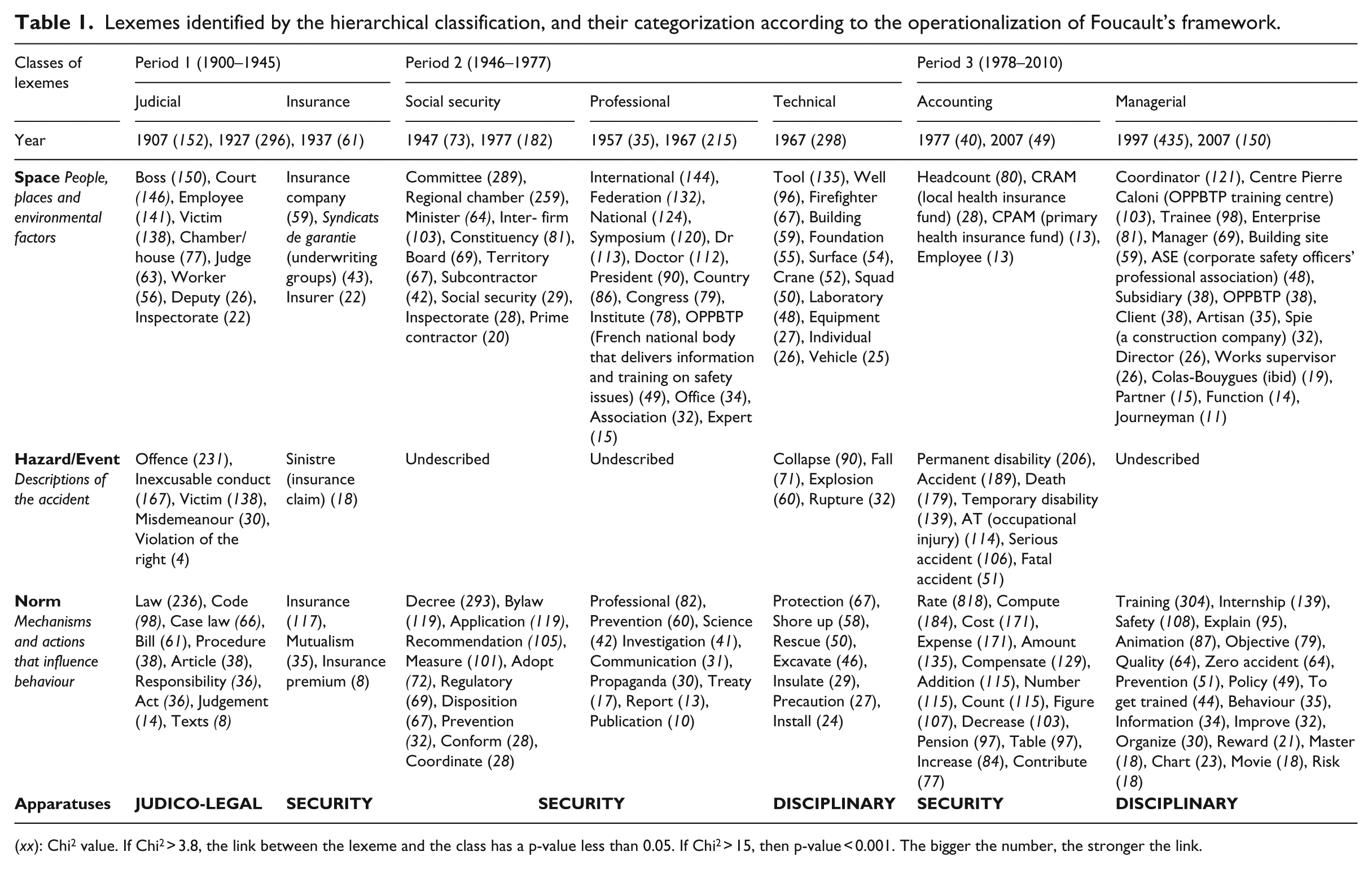
(xx): Chi2 value. If Chi2 > 3.8, the link between the lexeme and the class has a p-value less than 0.05. If Chi2 > 15, then p-value < 0.001. The bigger the number, the stronger the link.
As the third step, we used the grid constituted during step 2 to interpret each distinct class of lexemes in terms of its underlying apparatus. For instance, regarding the dimension of space, we checked whether the related lexemes of a given class were indicative of a centripetal approach to workplace accidents (i.e. aiming to circumscribe the question of accidents to the narrow space constituted by the sole construction site) or a centrifugal approach (aiming to reintegrate the question of accidents into the network formed by the broader environment of the construction site). Regarding the dimension of hazard, we interpreted whether the event – the accident – was considered an unacceptable evil that should be prevented, or a consubstantial element of a broader context. Regarding the dimension of norm, we similarly checked whether normality was defined a priori or resulted from statistical computation. At this stage, we systematically returned to the segments of the corpus from which the lexemes were issued in order to re-contextualize their usage and minimize the risk of misunderstanding their meaning.
As the fourth step, once all apparatuses were characterized, we sought to understand the relationships between concomitant apparatuses so as to compose original governmental arrangements. To isolate groups of these, we broke down our study period into shorter periods that would both minimize the overlaps between sets of apparatuses from different periods and maximize the overlaps between sets of apparatuses within a period (Figure 1). This led us to distinguish three periods: the first half of the century until World War II (WWII) (period 1), from the end of WWII to the 1970s (period 2) and from the 1970s to the present day (period 3). In this configuration, there remains only one overlap between sets of apparatuses from different periods (SOCIAL SECURITY and ACCOUNTING, at the intersection of periods 2 and 3), and all sets of apparatuses from a given period overlap with all other sets from the same period.
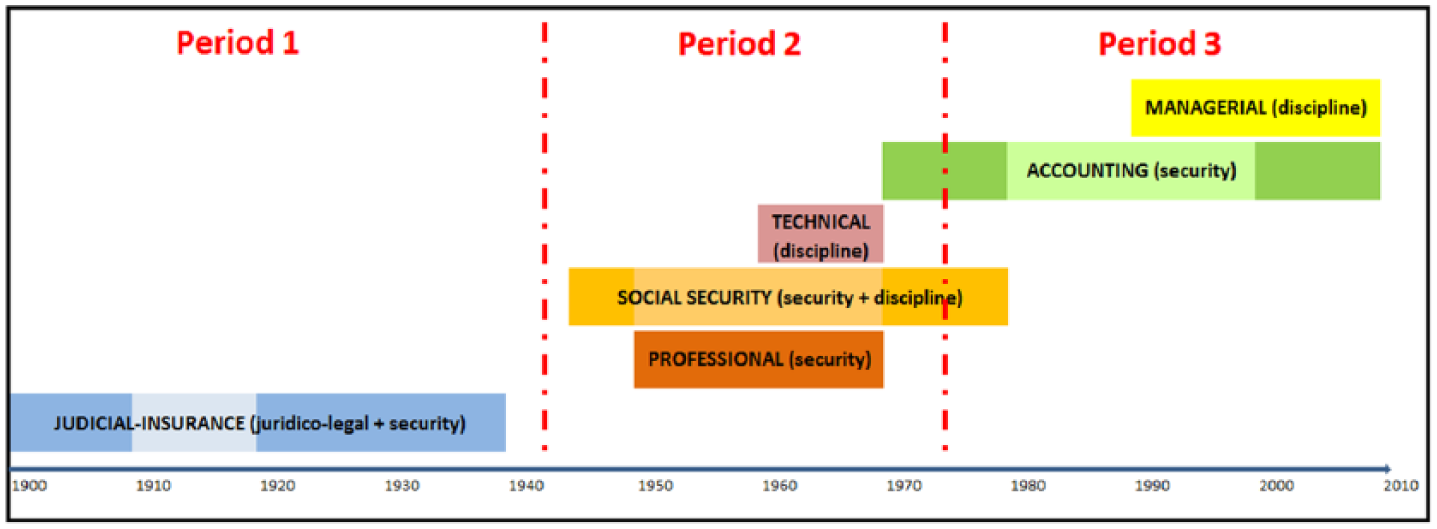
The evolution of frameworks and related apparatuses over the century.
Not illogically, this breakdown corroborates the split found in other governmentality studies – for example, O’Malley (2004) distinguishes classical liberalism (period 1), welfare liberalism (period 2) and neo-liberalism (period 3). Within each period, we looked at how apparatuses of different kinds interact within complex regimes of control. At this stage, we drew on our second source of data – studies, mostly historical, related to our domain of inquiry. These proved very useful in furthering our understanding of the apparatuses identified in our corpus, by providing contextual elements beyond the construction industry. For instance, Ewald’s book L’Etat providence was key to understanding how the health-insurance system worked at the end of the 19th century. In his study, Ewald lists (in appendixes) a number of regional-court decisions that illustrate power relations at play in this arena. In the same vein, Echec au risque by Caloni and Emploi et gestion de la main d’œuvre dans le BTP by Campinos-Dubernet are among the very few books that describe the context of workplace safety in the French construction industry between 1945 and 1970. They were essential to deciphering the link between Social Security and the rise of technical standardization that inferred from the analysis of our primary data.
In the fifth and final stage, we described power relations resulting from the government of workplace safety in each of the three identified periods through, in particular, the example of temporary workers (earlier called ‘tâcherons’ – contractual pieceworkers working temporarily for a construction company). The safety of temporary workers has always been contentious, and this case was thus particularly well suited to illustrating how the shifting of apparatuses matters for workplace safety, and impinges on power relations. Here again, secondary sources complemented our analysis stemming from Le Moniteur. If many power issues were implicit within the trade journal, they became more explicit when informed by the multiplicity of data sources. For instance, we found evidence of temporary workers’ struggles for recognition at the beginning of the 20th century, and examples of debates about technical standards addressing their safety after WWII.
Analysing successive regimes of control in the French construction industry during the 20th century
Private insurance and the court of justice in the first half of the 20th century: an arrangement of juridico-legal and security apparatuses
Within the first class of lexemes, we identified two distinct-but-related apparatuses (Table 1). To reflect this duality, we labelled this class JUDICIAL-INSURANCE. In the JUDICIAL part of the class, the space related to workplace safety is limited to ‘courts’, where a ‘judge’ solves conflicts between a ‘boss’ and an ‘employee’. The building site and its technical processes are totally absent. The event being studied is an ‘offence’ that leads to a ‘victim’, norm is articulated through the ‘law’ and regulatory tools (‘bill’, ‘case law’, ‘article’, ‘procedure’, etc.), and workplace accidents are understood as dealing with ‘misdemeanours’ or ‘offences’ for which individuals are liable. In fact, this assertion should be considered in relation to the 1898 French law on workplace accidents, which established the principle that the employer systematically has civil responsibility for all injuries taking place within the company: 12 September 1937: Under the 1898 law, the victim of an accident no longer has to prove the fault of the employer, who is presumed to be responsible; however, in return, the damages awarded cannot exceed a certain percentage of the salary … But the worker can … obtain full compensation for the harm suffered, if it is possible to prove the inexcusable conduct of the employer.
The key lexeme in understanding the apparatuses then governing workplace safety is ‘inexcusable conduct’. The 1898 law divides workplace accidents into two categories. First, where there appears to be inexcusable employer conduct, the judge decides whether it is the personal responsibility of the employer and whether the employee’s rights have been violated according to written judicial rules (e.g. ‘acts’, ‘case law’ and ‘bills’) (Gacia, 2005; Le Crom, 1998). Second, in all other situations, the employer benefits from penal immunity, having only a civil responsibility, which is where the INSURANCE framework comes in. Indeed, the employer’s civil responsibility is discharged by having private ‘insurance’, which contributes to the cost of the accident (Gacia, 2005; Pichon, 2003). Within this second framework, the accident itself is no longer understood as an offence to be punished, but as a sinistre (‘insurance claim’) to be reimbursed.
On one hand, the JUDICIAL part points to a juridico-legal apparatus. The 1898 law defines ‘inexcusable conduct’ and so provides a binary cut-off between what is permitted and what is not, and a list of offences with corresponding fines. On the other hand, the 1898 law also delineates situations where the responsibility of the employer is considered to have been discharged; in these cases, the law has nothing to say and another apparatus of government takes precedence. This is where the INSURANCE framework, the features of which point to an apparatus of security, comes in. The increasing use of private insurance in the 19th century has already been documented by some authors, drawing on the Foucauldian heritage and concept of security (Defert, 1991; Ewald, 1991). Thanks to the development of statistical and probability science (Desrosières, 1998), knowledge of the occurrence of workplace accidents and their average cost is being developed. The INSURANCE framework governs the field of workplace accidents through employers’ recognition of accidents as a source of costs. Within this body of knowledge, in line with the main features of apparatuses of security, whole populations (rather than individual bodies) constitute the object of the mechanisms in force.
During this period, the two apparatuses are complementary, with each governing its own space, delimited from the other by the principle of inexcusable conduct. But the two apparatuses also oppose each other in that it is a zero-sum game: any extension to the scope of one apparatus means an equal withdrawal of the other. However, primacy of the juridico-legal apparatus can be observed, making the INSURANCE framework dependent on the JUDICIAL – which, by retaining control over the definition of inexcusable conduct, orients the treatment of a small (albeit increasing) proportion of workplace accidents towards judicial treatment, while letting the vast majority be regulated through the security apparatus.
This specific regime of control affects how responsibilities for workplace accidents are conceived, and so shapes power struggles around safety in the industry. Who is made accountable for the accident depends on the apparatus at play: from employers having full penal and civil responsibility (in the case of inexcusable conduct) to their having limited civil responsibility, discharged by an insurance mechanism (in other cases). Besides traditional struggles around working conditions on the building site (Le Goff, 2004 [1985]), legal battles are fought in parliament and court, with important consequences for employment relations and the balance of power (Le Crom, 1998; Le Goff, 2004 [1985]). Two judicial issues are at stake: the definition of inexcusable conduct and the demarcation of the 1898-law perimeter.
In the first case, through passing bills and then issuing case law, legislators and lawyers substantiate the meaning to be attributed to the inexcusable conduct, so dealing with its potential ambiguities (Lenoir, 1980). These ambiguities give rise to debates on the legal categorization of specific types of misbehaviour and their related punishments: 25 March 1906: Year after year, case law extends the scope of the 1898 law. Indeed, many are the cases that magistrates today include within its scope and that legislators probably did not have in mind when passing the bill.
Through these court decisions, it is this linkage between the JUDICIAL and the INSURANCE frameworks that is disputed.
In the other case, legal disputes turn around the demarcation of the 1898 law, as evidenced by the struggles of the tâcherons (contractual pieceworkers working temporarily for construction companies). As tâcherons are not covered by this law, they need private insurance, since they would have sole responsibility if they suffered any accident. Secondary data show intense political struggles in regional courts. Tâcherons and their proponents either claim that their case is covered by the 1898 law or contest the legal boundaries of an employment or subcontracting relationship (Ewald, 1986). However, their voice would not be heard until period 2.
Indeed, the shifting balance between two distinct but complementary apparatuses – juridico-legal and security – would later be disturbed by the political upheaval in France, just after WWII. We witness then a dramatic change in the government of workplace accidents, with new forms of control gaining prominence and highlighting a new configuration of apparatuses.
Public insurance and the rise of the science of accident prevention from the end of WWII to the 1970s: an arrangement of disciplinary and security apparatuses
The three decades after WWII show a group of three distinct classes of lexemes dealing with workplace accidents (Figure 1): SOCIAL SECURITY, PROFESSIONAL and TECHNICAL, in order of appearance (Table 1).
In the SOCIAL SECURITY framework, the central actor is Sécurité Sociale (‘Social Security’), which is organized into ‘regional chambers’ and ‘committees’. Interestingly, the collectivization of the insurance of workplace accidents does not fundamentally call into question the INSURANCE framework in place before WWII (Dorion and Guionnet, 1985; Hatzfeld, 1971). While contributions and compensation awards are now made to and by the state, the features of the insurance system remain similar in nature, pointing to the possible links between past and present technologies of government (Knights and Vurdubakis, 1993; O’Malley, 2004). The SOCIAL SECURITY class of lexemes focuses on ‘prevention’ and considers a broad space of action, namely, a large territory delimited by public bodies (both national and regional) and the ‘constituencies’ they want to monitor: ‘firms’, ‘contractors’ and ‘subcontractors’.
The PROFESSIONAL class of lexemes fully echoes this concern for ‘prevention’ and for a large space for intervention. In this framework, the space for organizing workplace safety is even wider than in SOCIAL SECURITY, since it encompasses national and international events such as ‘conferences’ and ‘congresses’. This space is built by ‘doctors’, ‘scientists’, ‘experts’, ‘associations’ and the ‘OPPBTP’ (Organisme Professionnel de Prévention du Bâtiment et des Travaux Publics, the national body – created in 1947 – for preventing workplace accidents and illnesses, and improving working conditions). This opening-up of the space where the technology of government is built and operates resonates with the centrifugal nature of apparatuses of security.
The articulation of the event also confirms this orientation towards an apparatus of security. Strikingly, the event – that is, workplace accident – remains undescribed, appearing in neither the SOCIAL SECURITY nor the PROFESSIONAL class of lexemes. This echoes the characteristic of such apparatuses not to focus narrowly on the event but rather to resituate it within a broader network of connections. In the PROFESSIONAL framework, the emphasis is thus directed towards the development of a stream of knowledge, a ‘science’ of workplace accidents, built on ‘investigations’ and then disseminated through ‘communication’, ‘propaganda’, ‘treaties’ and ‘reports’: 13 May 1967: During this important event … two large reports will be introduced in addition to numerous medical and technical papers: one on the medical, social and professional consequences of workplace accidents in the construction industry; and the other on the medical, technical and psychological aspects of workplace-accident prevention in the construction industry.
This new expertise contributes to identifying natural or quasi-natural laws that may explain the occurrence of accidents and that nurture the ‘normalization’ process.
Within period 2, a third framework of a TECHNICAL nature appears (Table 1). In this, the space is strictly limited to the building site and, more precisely, to certain technical processes and devices within this: ‘wells’, ‘foundations’, ‘crane’ and ‘vehicles’. The event is visible anew and is represented by very precise facets of accidents, such as ‘falls’, ‘explosion’ and ‘rupture’. The mechanisms and actions that influence behaviours are based on prevention and reparation processes – for example, ‘protection’, ‘precaution’ and ‘rescue’ – which aim to prevent or limit the effects of accidents. The limited space and series of events to be avoided by ‘normation’ processes based on the promotion of adequate practices all point to characteristic features of a disciplinary apparatus: 6 October 1957: Compulsory devices: these devices are normally included in any construction equipment or should be made available on the building site by the user …
The appearance of this disciplinary apparatus is tightly coupled with the development of the apparatus of security. Indeed, in the decades following WWII, the state and the rise of a new professional expertise on accidents play a huge role in organizing workplace safety. Scientific knowledge of accidents allows the development of new standards imposed by the state or disseminated by the professions. The mediating status of the SOCIAL SECURITY framework, where the two apparatuses meet, is made visible in the presence of normative practices – embodied in ‘recommendations’, ‘adoption’ and ‘conformity’ – suggesting that the disciplinary apparatus already appears in outline within the SOCIAL SECURITY framework before reaching its full deployment through the TECHNICAL framework. The devising of regulatory measures by the state and professions leads to a surge in on-site surveillance and correction, especially by work inspectorates. Here, different apparatuses do not oppose each other, but are involved in a positive-sum game where the progressive extension of the apparatus of security translates into the parallel extension of the disciplinary apparatus. The state ensures a tight linkage between the two apparatuses by itself organizing the production and enforcement of technical norms and standards. It drives the ‘normalization’ process through Social Security and national bodies that produce a science of accidents, while it simultaneously drives the ‘normation’ process through using this fresh knowledge to devise new regulations enforced by Social Security or work inspectorates.
Under this regime of control, nobody is personally accountable, legally speaking, for workplace accidents, and cost and responsibility are shared through public collective insurance. However, a growing technical accountability in the field pushes construction companies towards adopting standardized processes (Campinos-Dubernet, 1985). The subsequent rise of technical standards and knowledge production causes disputes between the main protagonists of the industry outside construction sites and courts. Consequently, the national and regional agencies designed as multilateral entities (i.e. with a direction shared by worker unions, employers and state representatives) – and professional bodies, such as the certification agencies AFNOR (Association Française de Normalisation: French Association for Standardization) and CSTB (Centre Scientifique et Technique du Bâtiment: Scientific and Technical Centre for the Construction Industry) – become places of intense lobbying by professionals, worker unions and companies, all seeking to control knowledge production (Thébaud-Mony, 1991): 18 July 1977: But statistics alone do not guide the choice of topics for study and research. Indeed, other sources of information can be used … which may come in particular from the corporations’ safety departments, professional services, members of hygiene and security committees, worker unions …
Nevertheless, the detailed account of the field offered by our corpus and secondary data leads to a more nuanced view of these struggles. While the development of safety norms and standards testifies to the growing influence of civil servants and professionals (e.g. occupational physicians, ergonomists and safety officers) (Caloni, 1952), employers and workers may favour this trend. For employers, it is a way to escape a legal interpretation of their responsibilities in accidents: 18 July 1977: CNPF [Conseil National du Patronat Français, the main employers’ organization in France] vigorously denounces the bias of some unions and judges as regards the penal responsibility of CEOs … and endorses the new regulatory arrangements to promote prevention and built-in safety.
Similarly, worker unions regularly express their support for this trend towards rationalizing safety, with its main focus on technical processes rather than employees’ behaviour.
A look back to the case of tâcherons confirms this shifting in battlefield from legal arenas to public standardization bodies. While in period 1, a long-lasting struggle in court never achieved better working conditions, these pieceworkers were immediately covered by the public collective system of insurance: 2 March 1957: the law of 30 October 1946 … protects against the risk of workplace accident anyone who is salaried or working anyhow or anywhere for one or several employers or entrepreneurs.
The main issue for tâcherons then becomes making sure that rationalization and standardization bodies consider the specific risks associated with their activities. A few articles in Le Moniteur make it clear that their case is sometimes considered in choosing new technical standards, for example, for the use of explosives.
In summary, within this period, and in contrast to period 1, social actors try to influence not the balance of power between the two apparatuses in force, but rather their joint development. The 1970s would then witness the start of a reconfiguration of the government of workplace accidents. Indeed, the three frameworks studied here would lose their salience to two new ones, with a fresh arrangement of apparatuses thus being imposed.
Constitution of a market for accidents and its impact on enterprises from the 1970s to the present day: a new arrangement of security and disciplinary apparatuses
The last three decades present two distinct new classes of lexemes, labelled ACCOUNTING and MANAGERIAL (Table 1 and Figure 1). In the ACCOUNTING framework, the dominant space is that of public-insurance institutions, for example, the CPAM (caisse primaire d’assurance maladie: primary health-insurance fund) and CRAM (caisse régionale d’assurance maladie: local health-insurance fund), which focus on whole populations (‘headcount’ and ‘employees’). The event is represented not in the form of the accident itself but under its accounting code, ‘AT’ (accident du travail: occupational injury). It is therefore portrayed not in its own right but according to categories that facilitate the description and understanding of reality in computation-friendly terms (‘temporary’ or ‘permanent disability’, and ‘serious’ or ‘fatal accident’). Indeed, the relationship to the norm involves the quantification apparatus typical of statistics (‘compute’, ‘count’ and ‘number’). These features, made visible by the ACCOUNTING framework’s focus on cost calculation (‘rate’, ‘cost’, expenses’ and ‘amounts’), typify an apparatus of security. Here, statistical techniques translate workplace-safety issues into economic terms, aiming to set the price of an accident (its ‘rate’ in the public system). ‘Tables’ state ‘amounts’ for each category of injury. Translating the studied phenomenon into economic terms attaches a price-tag to each injury type and so creates incentives in a market where accidents are governed by supply and demand, and are understood as obeying quasi-natural laws. Indeed, this price system affects individual construction companies since, every year, they are taxed on the number and type of accidents on their building sites in the three preceding years. 2 This system also allows the introduction of bonuses and maluses to influence the behaviour of companies, who can be penalized for the most dangerous accidents and rewarded for a decrease in accidents.
Besides ACCOUNTING, a second framework developed slightly later in period 3 (Figure 1): the MANAGERIAL framework has private enterprises and their spheres of influence for its main space (Table 1), and its relationship to the norm suggests a disciplinary apparatus. Indeed, enterprises must conform not merely to laws but also to ‘objectives’, which trigger further actions and mechanisms aimed at conforming with them. The study of the MANAGERIAL class of lexemes – ‘objective’, ‘quality’, ‘policy’, ‘organize’, ‘improve’ and ‘master’ – shows that organizing risk has been integrated into enterprises’ organizational and rationalization processes. Enterprises set positive models that allow the deployment of various organizational processes – including intensively prescribing appropriate ‘behaviours’, the occurrence of accidents being increasingly interpreted as the consequence of individual wrongdoings: 9 March 2007: Do ensure that employees comply with safety rules, wear their personal protective equipment, do not tolerate situations that put themselves and others in danger …
However, the relationship to space involved in the MANAGERIAL framework also presents centrifugal features that depart from traditional disciplinary apparatuses. Despite belonging to private enterprise, the space of the MANAGERIAL framework is no longer confined to a narrow view of the corporation. While still focusing on the ‘building site’, it extends to acknowledging the firm dimensions relating to organization (‘corporation’ and ‘subsidiaries’), hierarchy (‘staff’, ‘director’ and ‘supervisor’), expertise (‘functions’ and ‘safety officers’) and value chain (‘client’ and ‘partner’). As the disciplinary mechanisms must now be exerted over a multidimensional, relatively open space, exercising boundless control over every detail becomes impossible. Discipline therefore relies not only on command-and-control mechanisms but also on norm internalization, with cultural control supplementing bureaucratic control (Edwards, 1979). The terms ‘training’, ‘internship’, ‘explain’, ‘animation’, ‘to get trained’, ‘behaviour’, ‘reward’ and ‘information’ reflect that the norm is now also explained and taught.
Making sense of this managerial evolution is difficult without establishing the link with the ACCOUNTING framework. Indeed, analysis of period 3 shows, as with period 2, that a disciplinary apparatus is supported by an apparatus of security, again in a positive-sum game. Since the 1970s, the statistical data required by the state to develop mechanisms of security based on economic incentives were also used by construction companies to develop disciplinary devices in the form of safety-management programmes. These focus on safety issues for which corporations are made accountable by the standardized indicators of the ACCOUNTING framework, but tend to discard all others.
Yet, the comparison with period 2 also reveals differences in forms of control governing workplace safety. First, the security apparatus unfolds more genuinely than before. Indeed, the ACCOUNTING framework only provides market incentives to other social actors, saying nothing about how they should be handled. By setting market prices, the apparatus of security provides what is needed to compute an optimized level of safety, but construction companies are free to choose how they achieve it through cost–benefit analyses (Lenoir, 1980). While the state previously played an active role in linking the apparatuses, private corporations now do so more loosely. Also, in period 2, the new Sécurité Sociale, providing collective insurance, treated workplace accidents as random. Its progressive accountingization conveys a radically different vision of workplace accidents in period 3, with a sense of individual responsibility. While, in period 2, nobody was held personally accountable for workplace accidents, period 3 emphasizes the role of individuals (employees or employers) (Babin and Pichon, 2002; Garand and Rozec, 2002). Workplace accidents are considered an outcome of misbehaviour and a matter of personal responsibility. The linkage between the production of an ACCOUNTING framework by the state and its use by corporations to develop strategies and objectives that target individual behaviours and responsibilities can, in period 3, be interpreted as a typical instantiation of neo-liberal forms of government (Rose, 1996).
The fact that workers’ attitudes and actions are regarded as being part of the safety mechanisms themselves makes it difficult for workers to denounce safety deficiencies embodied in organizational processes. Indeed, they are now in charge of adopting safe behaviours; consequently, criticizing safety failures, whatever their origin, becomes tantamount to highlighting their own failures. In turn, this emphasis on the responsible worker encourages workers to fight for more rights and resources so they can cope with their new responsibilities (Jounin, 2006; Rosanvallon, 1995), urging companies to enlarge the scope and depth of their safety policies. But, again, workers’ claims have only a limited chance of success without a corresponding market change that reorients incentives towards corporations to the same end, a link that may be far from obvious to workers (Supiot, 2006; Thébaud-Mony, 1991).
This situation is exemplified by the case of temporary workers, who have experienced a dramatically high accident rate in recent decades (Institut National de Recherche et de Sécurité, 2013). Our corpus shows much lively debate about their safety in the 1990s and 2000s. The cost of a temporary worker’s accident is scarcely borne by construction companies: 1 June 2007: Temporary workers are not your employees. They should not figure on your Social Security account unless they have an accident leading to an IPP [incapacité permanente partielle: permanent partial disability] of at least 10%. In this case, you must pay one third of the average cost of the fees.
This means that the incentives stemming from the ACCOUNTING framework hardly include temporary workers, who are consequently more exposed to risky situations (Daubas-Letourneux and Thébaud-Mony, 2001; Jounin, 2006). Under pressure from workers’ representatives and temping agencies, construction companies are regularly urged to attend more to temporary workers in their safety-management systems. Since the 1990s, this has led to many experiments: 8 June 2007: [An employers’ union and] the French union of temporary agencies signed a partnership agreement on 2 May. Valid for the next three years, the agreement aims to improve the integration of temporary workers, notably regarding safety.
However, these efforts have not been paralleled in the ACCOUNTING framework, and the cost of temporary workers’ accidents has remained marginal for construction companies, which may explain why the issue is so far largely unresolved.
Discussion and conclusion
We started by observing that Foucauldian safety literature denounces forms of control, attributing their emergence to the neo-liberalization of Western societies, without resituating them within their broader regimes of control. This omission has led to unsolved puzzles, for example, the continuous existence (and even surge) of disciplinary technologies in the neo-liberal era, and the paucity of resistance to these. Through our study, we demonstrate that a governmentalist perspective evidences the missing links in understanding the devising and implementation of workplace-safety policies, and the complex power arrangements these may imply.
Indeed, our study provides three historical examples of regimes of control, in which apparatuses of several kinds interact. In period 1, two distinct apparatuses (juridico-legal and security) are simultaneously complementary (in scope) and opposed (in involvement in a zero-sum game where one reduces as the other extends). In periods 2 and 3, the concomitant apparatuses are again different in nature (in each period, a security and a disciplinary apparatus). However, this time they reinforce each other, with the security apparatus nourishing the disciplinary apparatus. This means that forms of control, albeit different in nature, do not necessarily oppose each other; rather, they may take part in a positive-sum game. This observation supports the argument that workplace-safety-related forms of control should not be viewed in isolation (as in most literature) if, for instance, one is to grasp the apparent contradiction that leads liberal programmes to materialize into further legal (Gray, 2009) and/or disciplinary control (Collinson, 1999; MacEachen, 2000; Rasmussen, 2011; Zoller, 2003). Here, the development of specific disciplinary mechanisms on building sites during periods 2 and 3 can scarcely be understood without relating them to the apparatus of security. Indeed, this latter technology facilitates the translation of broad political programmes – of successively welfarist and neo-liberal inspirations – into the concrete forms of control that affect workers.
Identifying different regimes comprising interrelated forms of control has strong implications for the study of power arrangements around workplace safety. The example of temporary workers, followed throughout the three periods, illustrates how some forms of control originate and are discussed far from the building site: in courts and parliament, then national standardization bodies and now the national accounting system. This strongly contrasts with existing literature on workplace safety, which mainly looks at power, control and resistance from the sole-workplace standpoint (Zanko and Dawson, 2012). Moreover, the case of temporary workers also echoes how, within a regime of control, the more-or-less-tight coupling between apparatuses impinges on the complexity of – and so workers’ ability to understand – the power arrangements in place. Our findings highlight that the state had the upper hand on linking security and disciplinary apparatuses in period 2. The situation is quite different in period 3, when – through the operation of its accounting framework – the state sets the scope for the possible operation of other apparatuses without determining their content. From this premise, private corporations implement their own – often disciplinary – technologies of control, to reach the optimal safety level. This looser linkage between the two apparatuses makes the interaction less visible to workers, and so their struggles short-sighted. While awareness of this interaction should lead proponents of greater safety for temporary workers to fight for an evolution of the accounting categories devised by the state, the opacity that stems from the split of responsibilities between the state and corporations – and thus more ambiguous regime of control – prevents them from addressing the issue at the proper level. These findings reveal that Foucauldian empirical research has so far identified mainly situated forms of resistance to workplace-safety policies, whether based on concealing errors and near-misses (Chikudate, 2009; Collinson, 1999) or on accentuating workers’ professional culture (Collinson, 1999; Iacuone, 2005). They also cast a new light on why this literature has found only weak potential for such forms of resistance to produce a safer working environment. Ultimately, they open new ways of conceiving struggles for both emancipation and a safer workplace. Whereas current critiques within workplace-safety literature focus on the dominance of productivity over safety (e.g. Gray, 2002), the dominance of experts and their decontextualized knowledge (e.g. Gherardi and Nicolini, 2002), or the negative side effects associated with the promotion of a safety culture (e.g. Rasmussen, 2011), the current regime of control depicted by our governmentalist approach suggests the apparatus of security itself as a potential target. This could encompass contestation of the undemocratic process by which such an apparatus is devised, where the workers’ voices are hardly heard. But it could eventually embrace a more radical questioning of the ideological principles underpinning this apparatus. For instance, resistance could reject the authority and technologies that draw on the morally contestable principle of pricing accidents, instead reasserting that they are unacceptable at any price.
Finally, our study contributes to developing the governmentalist tradition in CMS (Doolin, 2002; Gleadle et al., 2008; Munro, 2012; Vallentin and Murillo, 2012; Weiskopf and Loacker, 2006; Weiskopf and Munro, 2012). Raffnsøe et al. (2016) have recently alerted the CMS community to the neglect of the Foucauldian concept of apparatus, and how detrimental this could be to a better understanding of organizational phenomena. Ours is the first empirical study to draw on this untapped potential, showing in particular how the typology of apparatuses developed by Foucault – together with their precise characterization (largely overlooked by Raffnsøe et al. (2016)) through the dimensions of space, hazard and norm – is conducive to finer analyses of the forms of control at work in a given domain, as well as their interactions within larger composite regimes of control. The pertinence of such fine-grained analyses is evidenced in at least two domains. First, literature tends to label as disciplinary any managerial technique considered oppressive, failing sometimes to acknowledge its primarily juridico-legal or security-based nature. To take an example again drawn from safety, in the case analysed by Chikudate (2009), the form of control exerted by the Japanese railway in the frame of its safety culture is too hastily characterized as disciplinary. Although genuine dimensions of correction and normation are embodied in some of Chikudate’s observations, the recourse to harsh punishment and public humiliation of contravening employees points to a dominantly juridico-legal apparatus (Foucault, 2009). This conflation between forms of control in many empirical studies is a major impediment to understanding their functioning, as well as to anticipating their effects. Another case in point is Raffnsøe et al.’s (2016: 284–285) theoretical assertion of the falseness of straightforward periodizations, which leads them to contest the claims of a transition from a disciplinary to post-disciplinary era (e.g. Munro, 2000). Indeed, in line with Raffnsøe et al., our empirical study shows that regimes of control involve different types of apparatuses, and that a transition in a given field from one regime to another may therefore not necessarily mean a shift in the types of apparatuses at play. Rather, it may simply mean a change in how they interact, which is enough to affect the complex power relationships in place. Our research thus suggests, nuancing Raffnsøe et al.’s argument, that periodization remains possible – and even desirable for proper understanding – as long as it rests on carefully weighed characterizations.
To conclude, if our historical approach proved helpful to establish such periodization, it also opened avenues for research that we have not addressed in this paper. Our intent was to study the interactions between apparatuses in each regime rather than the evolution from one regime to another, and hence links and transitions between subsequent forms of control. Elements pertaining to the latter nonetheless appeared at times in our results – in particular in the filiation between the frameworks of INSURANCE (period 1), SOCIAL SECURITY (period 2) and ACCOUNTING (period 3) – and in our reference to the role of WWII in the transition between periods 2 and 3. Obviously, the emergence and origination of both forms and regimes of control – as well as the retained influence of past forms of control on present ones – in the domain of workplace safety merits further inquiry. The present study lays the necessary groundwork for this future endeavour, which will require (among other things) a thorough investigation of the programmatic elements that have inspired the development of the technologies described above.
Finally, another avenue for future research lies in studying how the concept of apparatus could, in addition to furthering our understanding of regimes of control oriented towards generating safety, similarly enhance our comprehension of regimes of control oriented towards either making profit or delivering public services. Although interactions between forms of control composing regimes of the latter types have already been examined (Alvesson and Kärreman, 2004; Bejerot and Hasselbladh, 2013; Kärreman and Alvesson, 2004), in particular through the concept of control package (Malmi and Brown, 2008; Otley, 1980), the apparatus framework could contribute to better characterizing the technical dimensions involved in these.
Footnotes
Appendix 1
Appendix 2
Acknowledgements
We would like to thank the editors of the journal and three anonymous reviewers for their helpful guidance throughout the revision process. We are also thankful to Gazi Islam, Vassili Joannidès, Iain Munro, Véronique Perret and Marko Pitesa, as well as to participants to the MOTI seminar series in Grenoble (2012), 28th EGOS Colloquium in Helsinki (2012), 22nd AIMS Conference in Clermont-Ferrand (2013) and UMass seminar series in Boston (2015) for their feedback on earlier versions of the paper, and to Sarah Carr for her editing work.
Funding
The author(s) received no financial support for the research, authorship, and/or publication of this article.