




Abstract
Going beyond recent studies emphasizing the ‘successful’ nature of ethnic minorities’ agency, this qualitative study offers an in-depth analysis of the tensions and contradictions inherent to ethnic minority employees’ agency. To conceptualize agency, we draw on the resistance literature and adopt the notion of struggle, which stresses the dynamic and often contradictory interplay between power and resistance in everyday experiences and actions. Based on 26 in-depth interviews with ethnic minority professionals, our study highlights three main agentic strategies individuals use in relation to discourses of ethnicity: rejecting, redefining and adopting discursively available subject positions. Yet, these strategies are characterized by inherent tensions and contradictions, as all three involve both resistance and compliance, simultaneously challenging and reproducing discourses of ethnicity and relations of power. Our study further suggests that the tensions and contradictions inherent to ethnic minority employees’ agency can be linked to individuals’ involvement in struggles on three interconnected plateaux: the plateaux of identity, career and social change. Tensions arise as struggles on these plateaux come into conflict, forcing individuals to make important trade-offs. Finally, our study contributes to the resistance literature, reinterpreting the current debate on the prevalence of ‘banal’ forms of resistance as linked to its tendency to study (ethnic) majority individuals who have the privilege of focusing their agentic strategies on the plateau of identity.
Introduction
Challenging the notion that ethnic minority employees are passive victims of structural constraints, a small stream of studies has started exploring ethnic minorities’ agency throughout their professional lives. They persuasively show how ethnic minority individuals are reflexive, knowledgeable agents, able to create a space for themselves in ethnic majority-dominated workplaces and craft positive and successful professional identities (e.g. Atewologun and Singh, 2010; Essers and Benschop, 2009; Kachtan and Wasserman, 2015; Pio and Essers, 2014; Zanoni and Janssens, 2007). Although these studies offer an important counter-weight to the dominant tendency of only focusing on the discrimination and oppression ethnic minorities face, their explicit ambition to highlight agency runs the risk of resulting in an equally one-sided picture. Specifically, by strongly emphasizing the ‘successful’ and ‘emancipatory’ nature of resistance, this stream of studies risks overlooking and downplaying the way resistance is interconnected with power and pervaded with tensions and potentially self-defeating contradictions (Fleming and Spicer, 2008; Foucault, 1998; Mumby, 2005; Putnam et al., 2005).
Going beyond such studies, this article aims to offer a more nuanced understanding of ethnic minority employees’ agency by exposing, and theorizing about, its inherent tensions and contradictions. To do so, this study draws on theoretical insights from the organizational literature on resistance and adopts a dialectical approach to power and resistance (Ashcraft, 2005; Fleming and Spicer, 2008; Mumby, 2005; Putnam et al., 2005). Specifically, we conceptualize agency as involving struggles in which power and resistance are always implicated in an ambiguous and complex interplay of mutual constitution. This means that while discourses put into play certain relations of power, they never exist without resistance, which involves ‘a constant process of adaptation, subversion and reinscription of dominant discourses’ (Thomas and Davies, 2005a: 687) (Fleming and Spicer, 2008; Hardy and Phillips, 2004; Nentwich and Hoyer, 2013; Thomas and Davies, 2005b). A dialectical approach further acknowledges that power and resistance not only coexist in everyday life but also are bound in ambiguous and tense interactions with often unpredictable and contradictory outcomes (Fleming and Spicer, 2008; Nentwich and Hoyer, 2013; Putnam et al., 2005), making it a highly useful perspective to explore the tensions and contradictions in ethnic minority employees’ agency.
Empirically, we draw on 26 in-depth interviews with second-generation ethnic minority professionals of Turkish or Maghrebi descent. We focus on individuals of this descent because in the context where this study took place (Flanders, Belgium), they tend to be discursively constructed as the main ethnic and cultural other (Ceuppens and Geschiere, 2005). Still, their professional position – which is very exceptional in Flanders – implies that they have been able to develop tactics and strategies to negotiate certain structural barriers they faced. Through aiming to understand the tensions and contradictions inherent in these forms of agency, our study contributes to the organizational literature on ethnicity and diversity by showing how individuals display agency in the face of dominant discourses of ethnicity by using three main strategies. However, these strategies all involve both resistance and compliance and comprise trade-offs on three interconnected and conflicting plateaux: the plateaux of identity, career and social change. Through focusing on the struggles of individuals from a historically disadvantaged group and the identification of these plateaux, our study further contributes to the resistance literature, offering new insights into the current debate on the prevalence of ‘banal’ forms of resistance.
Theoretical background
Ethnic minority’s agency in organization studies
While organizational research on ethnic minorities (and other historically disadvantaged groups) has traditionally focused on exposing the mechanisms that produce inequality (Nkomo and Al Ariss, 2014; Zanoni et al., 2010), a small set of studies has recently started exploring ethnic minority individuals’ agency throughout their professional lives (e.g. Atewologun and Singh, 2010; Essers and Benschop, 2009; Kachtan and Wasserman, 2015; Pio and Essers, 2014; Zanoni and Janssens, 2007). Reflecting the re-emergence of the topic of resistance in critical organization studies as a response to the traditional overemphasis on the grasp of power and control (Fleming, 2005; Fleming and Spicer, 2008; Thanem, 2011), these studies specifically aim to go beyond the view of ethnic minorities as helpless victims and show how they are able to overcome structural barriers in their professional life. However, through strongly emphasizing the successful and emancipatory nature of agentic strategies, they risk painting an overly optimistic picture of ethnic minorities’ agency. This is problematic for two reasons. First, a too strong celebration of the success of individual resistance risks downplaying the continued importance of structural constraints and unintentionally fuelling neoliberal discourses, which solely stress individual responsibility for one’s labour market achievements or failures, and which argue that everyone can be successful as long as they use the ‘right’ strategies (Bauman, 2000; Cuzzocrea and Lyon, 2011). Second, it risks overlooking the possibility that agency and resistance are pervaded by power and control, and therefore by inherent tensions and potentially self-defeating contradictions (Fleming and Spicer, 2008; Mumby, 2005; Putnam et al., 2005).
Reflecting Mumby’s (2005) classification of resistance studies, we notice two main ways in which these studies have (often implicitly) approached agency. First, reflecting the dominant trend in studies on resistance (Contu, 2008; Fleming, 2013; Thanem, 2011; Thomas and Davies, 2005a), a number of studies approach agency through the lens of identity work (e.g. Atewologun and Singh, 2010; Essers and Benschop, 2009; Kachtan and Wasserman, 2015). Such studies show how ethnic minority individuals successfully respond to the discursive constellations facing them through crafting professional identities in which they might even be able to use their ethnic background to their advantage. For example, Essers and Benschop (2009) illustrate how Muslim businesswomen are able to reconcile their ethnic, gender, religious and entrepreneurial identities, and even legitimize their entrepreneurship through particular constructions of their religious identities, such as feminist readings of their faith. Further demonstrating how an ethnic identity can be used in a positive way, Kachtan and Wasserman (2015) show how, through different bodily practices, Israeli soldiers with a Mizrachi background are able to use their stigmatized ethnic identity in the construction of a valued form of masculinity. On the whole, such studies present an understanding of agency which reflects a conceptualization of identity work in which individuals might be confronted with specific discursive structures, but are able to respond to them by weaving together an identity which allows them to be successful (Alvesson, 2010).
Second, a number of studies approach agency through (also) focusing on ethnic minority individuals’ material actions and behavioural tactics to challenge processes of power and attain forms of micro-emancipation. For example, Zanoni and Janssens (2007) discuss how ethnic minority employees circumvent power relations not only through negotiating discursive constructions of ethnicity but also through contesting material and bureaucratic forms of control. For example, they show how Muslim employees are able to attain micro-emancipation through claiming the right for a job interview or through bending organizational rules and HR policies to practice their religion. Similarly, focusing on migrant Indian women in New Zealand, Pio and Essers (2014) illustrate how they succeed in negotiating circuits of power and become successful businesswomen by adopting different styles of agency. These range from the style of a fighter (e.g. suing supervisors for their demeaning behaviour), over a non-conformist provocative style (e.g. defiantly answering people who question their abilities) to a style based on subtle, integrative reform (e.g. working within the system and skilfully integrating Western and Indian ways of doing business). On the whole, this understanding of agency highlights how strategic individuals use targeted and deliberate behaviours to act upon and fight back against forms of control and circuits of power (Mumby, 2005; Thomas and Davies, 2005a).
Together, these studies persuasively illustrate how ethnic minority individuals succeed in challenging or overcoming constraints they face in their professional lives. While they offer a much-needed addition to a field which has traditionally portrayed ethnic minorities as victims of insurmountable processes of power, these studies risk overemphasizing the successful and emancipatory nature of agency, and overlooking the tensions and contradictions that arise in the interplay between power and agency (Ashcraft, 2005; Mumby, 2005; Fleming and Spicer, 2008). That tensions and contradictions are present in ethnic minority employees’ agentic strategies is for instance illustrated by Boogaard and Roggeband’s (2010) study on inequality in the Dutch police force. They show how ethnic minority employees, in their attempts to increase their organizational status, paradoxically reproduce the same discourses which reinforce their marginalization. In particular, stressing their ethnic background and asserting closeness to certain ethnic groups not only allows ethnic minority police officers to claim useful cultural and linguistic competencies but also, given the stereotypical association between these groups and criminality, creates distrust about their ‘true’ loyalties.
To further understand and conceptualize the tensions and contradictions inherent to ethnic minority employees’ agency, we turn in the next section to the resistance literature and the lens of struggle, which has been proposed as useful to capture the complex and often contradictory dynamics characterizing the interplay between agency and structural constraints.
Understanding ethnic minorities’ agency through the lens of struggle
Aiming to avoid an approach which privileges either oppressive all-powerful structural processes or successful agency, this study adopts a dialectical perspective to explore ethnic minorities’ agency. Drawing on this approach, we understand agency as defined by struggles, or interconnected dynamics between power and resistance, in which both elements are not only always mutually implicated but also entangled in ambivalent and complex ongoing tensions (Fleming and Spicer, 2008; Mumby, 2005; Putnam et al., 2005). From a discursive perspective, the notion of struggle implies that while individuals are embedded within relations of power and exposed to the constitutive effects of discourses, they always have the possibility of resistance (Fleming and Spicer, 2007; Hardy and Phillips, 2004; Nentwich and Hoyer, 2013). In this, resistance can entail micro-practices through which individuals make use of tensions between discourses, creatively negotiate subject positions, and contest, adapt or reinterpret discourses to temporarily and partially defy specific forms of power and create a space for self-determination and self-definition (Mumby, 2005; Nentwich and Hoyer, 2013; Thomas and Davies, 2005a, 2005b). Thus, resistance is not only understood as classic openly expressed, collective and organized forms of opposition or protest but can also involve discursive micro-practices such as humour, cynicism, irony or disidentification (Contu, 2008; Fleming, 2013; Fleming and Spicer, 2008; Thanem, 2011; Thomas and Davies, 2005b; Westwood and Johnston, 2012).
This dialectical perspective is especially useful to explore tensions and contradictions inherent to ethnic minority employees’ agency. On the one hand, it indicates that individuals always have the ability to resist, even when faced with very dominant, controlling discourses. So, even when they are exposed to discourses which construct minority ethnicities in denigrating ways, naturalize the view that their social worth is low, and legitimize exclusionary behaviour by ethnic majority individuals (Jenkins, 2008), ethnic minority individuals are able to negotiate these constructed differences and their power effects through various practices and actions. On the other hand, this dialectical perspective recognizes the ambiguous entwinedness of power and resistance. Behaviour that appears to be compliance or consent can never be reduced to complete submission to power as it can, even unintentionally, have disruptive effects and carry within it elements of resistance (Ashcraft, 2005; Contu, 2008; Fleming, 2005; Fleming and Spicer, 2007). Conversely, behaviour that appears to be resistance rarely allows individuals to completely liberate themselves from all discursive constraints and power inequalities. Moreover, resistance can even serve as a handle for power, as well as (unintentionally) contribute to reproducing the very discourses and relations of power it attempts to challenge (Jammaers et al., 2016; Fleming, 2013; Fleming and Spicer, 2008; Nentwich and Hoyer, 2013; Thomas and Davies, 2005a).
Together, by offering a better insight into the ambiguous micro-politics involved in individuals’ everyday experiences and actions, the lens of struggle provides us with a powerful tool to explore ethnic minority employees’ agency and theorize about its inherent contradictions and tensions.
Method
Research context and sample
To understand the tensions and contradictions inherent to ethnic minority employees’ agency, this study interprets the experiences of second-generation professionals of Turkish or Maghrebi (i.e. Moroccan, Algerian and Tunisian) descent. We study individuals from this ethnic group because of their specific position in Flanders, the Dutch-speaking region of Belgium. In this context, individuals of this descent tend to be constructed in dominant binary discourses of ethnicity as the main cultural, religious and ethnic other, labelling them as allochthons, in contrast to the ‘indigenous population’ of autochthons. This discourse of ethnicity, produced by the ethnic majority, is inherently linked to power as it tends to associate the ethnic minority with abuse of the social welfare system, an unwillingness to learn the Dutch language, and an adherence to a culture and a religion which is seen as antithetical to the ‘Western way of life’ (Blommaert and Verschueren, 1998; Ceuppens and Geschiere, 2005). In this way, this discourse is a reflection of, and a tool to reproduce, existing ethnic relations in society, in which those constructed as ‘allochthons’, on average, occupy the weakest socio-economic positions (Blommaert and Verschueren, 1998; OECD, 2008).
Within this ethnically stratified labour market, we focus on professionals, or individuals occupying managerial and staff positions. The reason for this choice is that, although comprehensive statistics are not available in Belgium, these jobs and organizational levels tend to be (almost) completely dominated by ethnic majority employees. The experiences of these professionals are therefore very suitable to study the contradictions and tensions inherent in ethnic minorities’ agency, as they are individuals who must have developed tactics and strategies to negotiate the structural processes traditionally relegating individuals from this group to the lowest strata of the labour market. This implies that while we focus on individuals who are part of a disadvantaged ethnic group and are almost all the children of low-skilled labour migrants, the interviewees occupied, at the moment of the interviews, a more privileged class position than individuals from this ethnic group do on average. While this makes their situation atypical, it is precisely this transition from a relatively weak socio-economic position to their current status which makes their agency particularly salient.
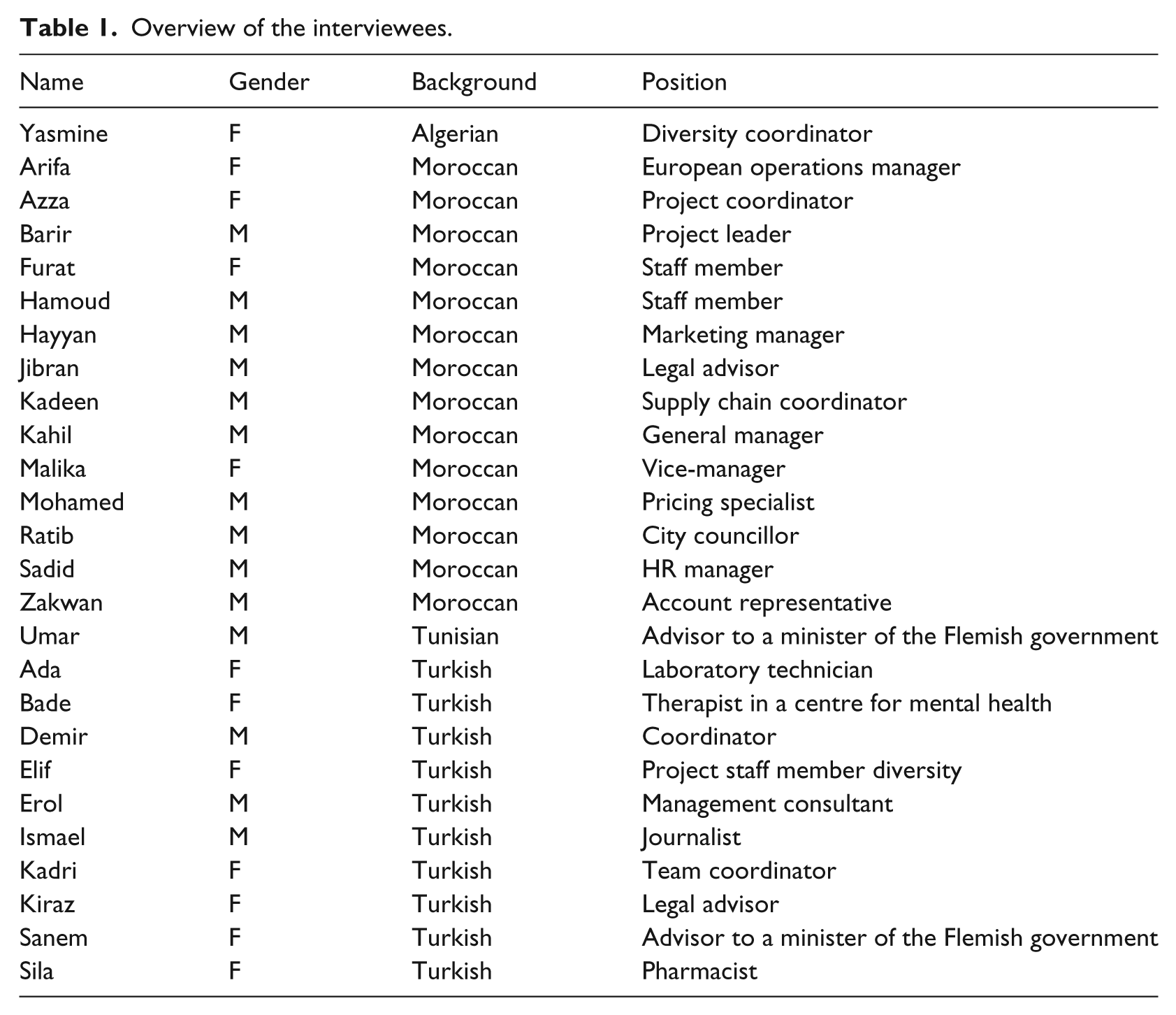
To explore these individuals’ agency and theorize about the tensions and contradictions involved, the research is based on in-depth, semi-structured interviews. Table 1 gives an overview of the 26 interviewees. As is often done to recruit interviewees who are part of a group that is not very large or not very visible in society, we used a snowball sampling approach. During this process, we ensured that the sample was diverse in terms of individuals’ gender and professions, and reflected the relative numerical importance of the different national backgrounds in the context under study. Specifically, reflecting the composition of this group in Flanders, our sample is heavily dominated by individuals with a Moroccan or Turkish background (OECD, 2008). To protect the anonymity of the interviewees, we have given them a pseudonym and opted to keep the provided information vague.
Overview of the interviewees.
The interview process
The interview schedule was developed with the aim of getting detailed accounts of individuals’ struggles in their everyday professional lives, focusing not only on the structural barriers individuals encountered but also on their own agentic behaviour in dealing with those structures as well as on the tensions, ambiguities and contradictions this entailed. During the first part, inspired by the critical incident technique (Flanagan, 1954), the interviewee was asked to offer an account of factors and real-life events he or she experienced as playing a crucial role in shaping his or her career. To explore these factors and events in-depth, the interviewee was asked to give detailed descriptions, focusing not only on his or her actions but also on the structural processes involved, thereby exploring both power and resistance.
We then continued the interview in a more semi-structured way and, depending on the issues that were already discussed during the first part of the interview, asked questions on both the way individuals felt treated by others and the way they themselves attempted to craft their own career and workplace experiences. Specifically, we discussed the interviewee’s feeling of inclusion in the workplace, his or her relationship with others at work, the way the interviewee deals with questions of ethnicity, the way others look at and approach his or her background, and the interviewee’s sense of self in relation to others around him or her. When answering these questions, the interviewee was again asked to describe specific, real-life (workplace) events and interactions, focusing on both the actions of others and his or her own actions and feelings, and on the ambiguities it involved. The length of the interviews varied from 1 to 3 hours.
Analysis of the interviews
An initial reading of the interviews immediately showed the strong emphasis the interviewees placed on their own agency in dealing with barriers and shaping their careers. In line with the research objective of this study, our analysis subsequently focused on identifying instances in which the interviewees described agentic actions and practices related to specific constructions of ethnicity. When we located such an instance, we wrote down some initial ideas about the specific discursive construction of ethnicity, the way the individual dealt with this construction, and the reasons he or she indicated for doing so, in a way that stayed close to the language of the interviewee (Van Maanen, 1979). After having gone through the interviews, we compared the different themes, both within the same interview and between different interviews. Through a back-and-forth between the empirical material and the relevant literature on ethnicity and (discursive approaches to) struggle, more theoretical second-order themes (Van Maanen, 1979) were identified, referring to different discourses of ethnicity, different agentic strategies and different types of struggles.
Throughout the interviewees’ accounts of their agency, we found different ways in which individuals were constructed in terms of ethnicity, which, through a process of interpretive analysis, resulted in the identification of four discourses of ethnicity creating particular subject positions. A first discourse constructs, in line with dominant stereotypes of ethnic minorities (Boogaard and Roggeband, 2010; Zanoni and Janssens, 2004), the skills and professional worth of the group of ethnic minority employees as inferior to those of the majority, creating the subject position of ‘less valuable other’. A second discourse constructs ethnic difference in terms of fundamentally different cultural and religious values that define the essence of an individual, creating the subject position of ‘cultural and religious other’. Reflecting dominant societal discourses (Blommaert and Verschueren, 1998; Ceuppens and Geschiere, 2005), this difference is often constructed not only as exotic or strange but also as suspicious, inferior and backward. A third discourse constructs, in line with business case arguments for diversity (Boogaard and Roggeband, 2010; Ghorashi and Sabelis, 2013), ethnic difference as a source of knowledge and legitimacy in relation to diversity issues, creating the subject position of ‘diversity-competent other’. Fourth, we identified a discourse of sameness, which constructs a specific individual as similar to the majority, but therefore as fundamentally different from ethnic minorities as a group, creating the subject position of ‘exceptional, assimilated other’.
Focusing on individuals’ agency, we identified three main strategies of negotiating the discursively available subject positions: (a) rejecting a subject position, which entails deliberately attempting to stay clear of it and refusing to occupy it; (b) redefining a subject position, which entails occupying it while simultaneously attempting to change the way it is constructed; and (c) adopting a subject position, which entails accepting it to use its meaning. While some of the interviewees’ stories were dominated by one specific strategy, individuals often switched between these different strategies in relation to not only different discourses but also even to one specific discourse. Through the analysis of the interviews, it became clear that this was linked to the inherent ambiguities and contradictory power effects of each of these strategies.
Further interpreting the tensions and contradictions interviewees talked about, we identified three different types of struggles they were involved in. The first type of struggle revolves around identity or individuals’ attempts to construct, maintain and display an identity on their own terms at work. The second type of struggle revolves around career or individuals’ attempts to advance their career and reap material labour market rewards, such as employment or promotions. The third type of struggle revolves around social change or individuals’ attempts to influence the way the group of ethnic minorities is constructed and treated in society.
Reflections on the methodology
Although this research is part of a project with emancipatory goals, we acknowledge that our approach may have the unintended consequence of reproducing the ethnic boundaries found in dominant discourses (Essers, 2009). However, the interviewees did not appear to experience our research approach or the way they were constructed in it as problematic. The stories produced during the interviews emerged out of an interaction between the interviewer and the interviewee, influenced by multiple forms of sameness and difference (Essers, 2009), including the ethnic and sometimes gender differences between the interviewees and the interviewer (the first author), a male researcher of ethnic majority descent without discernible migration history in his family. While cross-ethnic interviews can entail certain challenges, the interviewees were often positively surprised that someone of the ethnic majority was interested in issues related to (in)equality and diversity, which created a sense of mutual respect and seemed to motivate them to make extra efforts to explain their situation and experiences in-depth. As the interviewees were commonly older than the interviewer and had already established a relatively successful career, this sometimes created a sort of teacher–pupil relationship.
The analysis and writing process might also have been influenced by the identities of the first and second author, a senior scholar with a Flemish ethnic background, and by their theoretical frame of reference inspired by critical, discursive approaches to diversity and ethnicity. As a result, what follows cannot be seen as an objective reflection of reality but rather as stories produced in a particular setting and translated by specific authors. In line with other studies on ethnic minorities’ agency (e.g. Essers and Benschop, 2009; Pio and Essers, 2014; Zanoni and Janssens, 2007), we draw on the stories of three interviewees rather than on all 26 to present our findings. We adopt this approach as it allows us to do more justice to the ambiguities, nuances and tensions of the interviewees’ struggles. These three individuals were selected because, combined, their stories represent not only the different discourses of ethnicity, strategies and types of struggles but also the important tensions and contradictions characterizing the different strategies and struggles.
Findings
Ismael’s story
Ismael is a man of Turkish descent, who, at the moment of the interview, worked as a journalist for a major television station. In Ismael’s story, we see how the main struggle throughout his professional life revolves around his attempts to maintain a professional identity not overshadowed by his descent, while occasionally contributing to social change, which paradoxically involves highlighting his descent.
Because television news had always been exclusively ‘white’, Ismael’s recruitment itself became the subject of press coverage in which he was constructed as one of the first ‘ethnic minority journalists’. Feeling frustrated that some believed he was given preferential treatment or hired to provide a Turkish perspective on the news rather than because of his general competences as a journalist, Ismael’s strategy since then has been rejecting this construction of him as a ‘diversity-competent other’:
I’ve made that clear from the beginning: ‘I’m not here as an allochthon. I do have Turkish parents, that’s right, but I’m not a specialist on migration. If you want to know something from the ethnic minority community, go and ask them, I’m not here to represent anyone’. […] I don’t know whether it would have benefitted my career. It probably would have. If you can position yourself as a specialist on Turkey … But I don’t want to be pigeonholed. I’ve been pigeonholed my entire life. I certainly don’t want to be pigeonholed professionally.
While Ismael attempts to reject the subject position of ‘diversity-competent other’ in order to pursue a professional identity not overshadowed by his descent, he equally acknowledges that his strategy of not claiming unique expertise is not without problems and might have hurt his career. In his efforts to pursue a ‘colourless’ workplace identity, Ismael also rejects positioning himself as an ‘ethnic and cultural other’. Although he is bothered by the stereotypical way in which the majority often approaches ethnic minorities, this strategy also implies not challenging his co-workers’ jokes stereotyping ethnic minorities:
I just laugh with these jokes. […] These are the kind of things that happen everywhere, I don’t want to stick my neck out for things like that. I mean, you become one of the guys. I don’t want to position myself as Turkish.
Here, we see how Ismael feels this rejection of the position of ‘ethnic and cultural other’ allows him to blend into the workplace rather than have his identity overshadowed by ethnic otherness. Still, this means he treats ethnic jokes as normal, not challenging the stereotypical constructions of ethnic and cultural otherness they imply.
Key for Ismael thus is to reject subject positions which highlight ethnic otherness. However, at some moments, Ismael feels it as his obligation to deviate from this identity-focused strategy in order to pursue social change on a broader scale. For example, frustrated with the way the news portrayed ethnic minorities, he once decided to adopt the position of the ‘diversity-competent other’ and use his Turkish background to cover a story of ethnic minority youngsters rioting because of police harassment and discrimination:
I wanted to get rid of that label of ‘allochthonous journalist’. But then there were these riots. […] That’s one of my first and only reports about ethnic minorities. I just went to talk to these kids. They were like: ‘you’re a racist’, and I said: ‘I’m Turkish, so don’t start with me, no bullshit’. Then it became clear what was happening and that was probably one of the first times ethnic minority youth were on television to explain for themselves what was going on. I noticed that at that moment, journalists started to realize that ethnic minorities could talk and had something so say. […] I took that step because nobody in the office wanted to or could do that. Or thought about doing it.
So, in spite of Ismael’s explicit strategy to reject the subject position of the ‘diversity-competent other’, he sometimes also feels he has to put this identity concern aside, adopt this position and use the unique opportunity he has to change biased journalism and contribute to social change. Still, he also acknowledges in the interview that attempts to change media stigmatization might be futile as the news continues to stereotype ethnic minorities.
In a similar vein, while he wants to be seen in the same way as majority colleagues, he also strongly dislikes it when ethnic majority co-workers explicitly approach him as an ‘exceptional, assimilated other’. For example, when Ismael corrects language errors in his co-workers’ news reports, he rejects their conclusion that this is only possible because he probably is not really Turkish:
They think that’s weird, and say: ‘you’re not a real Turk. You probably only have one Turkish parent’. So I tell them: ‘No, I have two Turkish parents’. […] And I ask them: ‘what does a real Turk look like according to you? Do I have to wear a fez and have a moustache, so that I’m recognizable as an allochthon or a Turk?’ […] That type of stereotyping, I’ve always tried to go against that.
So, while this situation involves his co-workers refraining from approaching him based on his descent – as he prefers – he nevertheless rejects this subject position of the ‘exceptional, assimilated other’ because he feels this construction of sameness involves a stereotypical idea of Turkish people. By doing so, he again temporarily privileges the issue of social change over his own identity concerns, which means potentially reinforcing the view of him as different, which he generally tries to reject.
Bade’s story
Bade, the daughter of two Turkish parents, is a psychologist who, during her career of about 10 years, has worked for a large number of organizations, including therapeutic centres and university colleges. At the time of the interview, she worked as a therapist in a mental health centre, where she was responsible for the outreach towards ethnic minority clients. Throughout her story, we see how Bade uses different strategies to advance her career but also how her career struggle has the downside of creating identity tensions.
The main challenge for Bade revolves around promoting her career and, in particular, convincing ethnic majority employers and co-workers of her competencies and professional value. Redefining or attempting to change the negative views of her as an ethnic minority woman is one strategy she uses. An example of this occurred during a job interview where she experienced being positioned as a ‘less valuable other’ as the recruiters suggested that her ethnic background might scare away ethnic majority clients. She redefined her ethnic background in the following way:
My response to that was very laconic, like: ‘I wouldn’t know what to do about that, that’s their choice. It’s the same for a Flemish therapist with whom a client might not feel a connection’. […] At the end they said: ‘we’re sorry you react like that’. That was their reason not to hire me.
We see how Bade attempts to safeguard her chances to get the job by reframing the employer’s concern, and indicating that all therapists can have trouble connecting to certain clients and that she, as an ‘ethnic minority therapist’, is therefore not of less value than a ‘Flemish therapist’. However, this example also shows that this strategy might not be successful if the majority does not accept the redefinition.
Precisely because her attempts to redefine her value and competencies often fail to convince ethnic majority employers, Bade also turns to the strategy of adopting the subject position of the ‘diversity-competent other’ as a way to advance her career. In the following example, she recalls how she was able to get a job because of her ethnicity:
My descent also had its advantages, sometimes it was a disadvantage, sometimes an advantage. I mean, there are two sides to every coin, at some points it gave a bit of a push to my career. […] That job related to diversity is a perfect example. In all fairness, I didn’t deserve to get it. You could say it was a form of positive discrimination. […] People with strong CVs had also applied, who were older and had more experience with the topic. But I think my origin also matters, because it relates to the content of the job.
Bade acknowledges here that the strategy of accepting being the ‘diversity-competent other’ is a way to compensate for the discrimination she encounters when applying for other jobs. Still, she also recognizes during the interview that the strategy of using one’s ethnicity to claim specific competencies is not without ambiguity. She highlights how being hired in a job related to diversity reinforces your otherness in the eyes of your co-workers and can cause your entire identity to be overshadowed by your descent, which in the long run might also hurt your career. To deal with this problem, Bade assumes the radically different strategy of rejecting subject positions of difference rather than highlighting her descent. For example, experiencing that she is often seen by co-workers as a ‘less valuable other’ because of her ethnicity and gender, she attempts to show her competencies through working extra hard, developing her expertise, avoiding confrontations and trying to blend in:
You’re building your career and knowledge. But you’re also a rookie. And you’re a woman. And you have your own identity, your own character, your own culture. All of that makes it really hard. […] So I had the inclination to adapt myself and a preference to avoid conflicts. […] I am a person who really adapts herself. And so if they even start saying to me that I should be lucky to have a job, you know that kind of paternalistic attitude is really prevalent. And I’m someone who is really docile when it comes to things like that. […] I was adapting myself, but psychologically, all these things had their impact.
Here, Bade acknowledges that in attempting to secure her career, she experiences identity tensions as she adapts too much to the dominant work culture and is not sticking up for who she is.
Similar identity tensions arise as she uses this strategy of rejection to deal with the subject position of the ‘cultural and religious other’. For example, when co-workers express negative opinions about ethnic minorities and want her to comment on news events concerning individuals from ‘her community’, she would like to give her honest opinion, but she feels this would hurt her ability to be seen as a competent psychologist and cause her identity to be completely overshadowed by her descent:
My co-workers obviously came to me to have these discussions, but I was like: ‘discuss that among yourselves’. If I had radical opinions about something, that would not be accepted. You had to think about these things like they did. So each moment you were the representative of something else, you were never yourself. You were never Bade. My expertise became overshadowed. My knowledge, my being a psychologist, all of that didn’t matter anymore.
Here again, we see how Bade uses a strategy of rejection, as she knows that if she talks about topics related to ethnic (in)equality, she becomes seen as too radical or as the representative of the group of ethnic minorities rather than as just herself. While she feels this strategy is necessary to protect her job and maintain the view of her as a competent expert, it also creates fundamental identity-related tensions because she is not able to express her opinions or ‘real’ self. This feeling of disconnect between who she is and how she can be at work ultimately led her to quit many of the organizations where she worked. So, in the end, the strategy of rejection also endangered her career path by forcing her to turn to an ultimate form of resistance (Fleming, 2013): exiting an organization.
Hamoud’s story
Hamoud is the son of two Moroccan parents; he obtained two degrees: one in engineering and one in physics. As he felt working in the engineering sector would not allow him to do something socially relevant, he took his career in a different direction. He first worked for a news organization and at the time of the interview, in a staff function for a political party. The main struggles in Hamoud’s story revolve around his ambition to create social change, challenging the dominant constructions of the ethnic minority and especially Muslims – yet not without losing control over his career and identity.
The main strategy Hamoud uses is redefining or assuming a subject position of ethnic difference to change the way it is constructed. For example, when he is confronted with the discourse constructing him as a ‘less valuable other’, he does not only aim to show his own competencies but rather attempts to confront his co-workers with their stereotypical view on ethnic minorities’ competencies in general:
You try to confront people with their stereotypes, so in that sense it’s sort of a victory. But on the other hand, it’s also a bit discouraging you have to do that, I mean, here I am with two degrees. […] But I think and I hope that I’ve changed the stereotype that every allochthon is retarded.
As a very competent individual, Hamoud turns to the strategy of redefining the stereotypical idea that ethnic minorities are of less value, not only to improve his own position but mainly to create some kind of social change. Similarly, when Hamoud, who is an observant Muslim himself, is confronted with negative opinions about ethnic minorities or Muslims, he attempts to redefine these by assuming the subject position of the ‘cultural and religious other’ and subsequently acting as a sort of expert to educate his co-workers about the ‘real’ meaning of these differences:
After a while they listen to you because they sense you can really explain how a Moroccan feels. […] It’s a bit double, because it’s extremely exhausting. You notice that people have so many stereotypes. People really don’t have a good idea of what’s going on. They lump everything together: a headscarf is equated with extremism, with an unwillingness to learn Dutch. So where do you start? On the other hand, it gives you the opportunity to correct some things. For example, I remember this intense discussion with a female co-worker who was upset about a story of a Muslim man who refused to shake a woman’s hand. […] It took me half an hour to explain why that is, but then she nods and just says: ‘I still thinks that …’. So then you notice that people have these strong-held beliefs which are really hard to change.
Here, we see how Hamoud feels it is his task to contribute to social change by assuming a position of cultural and religious difference and offering his co-workers in the media organization and the political party – whose views might have broader societal implications – a different perspective on ethnic minorities. Still, it also is a frustrating endeavour because he is not always able to change the majority’s stereotypes.
Failing to alter others’ constructions of difference is however not the only risk of this strategy. Hamoud realizes that by constantly positioning himself as a ‘cultural and religious other’, he might become seen as completely different from his co-workers himself, which might endanger his own position. Therefore, despite his willingness to act as a spokesperson for the group of ethnic minorities, he also avoids talking about certain cultural or religious values or practices, thereby rejecting the position of ‘cultural or religious other’:
You could talk about it, but nobody would understand or be able to enter into a dialogue with you. You have two paradigms existing completely separate from each other. For example holidays. Sometimes we go on holiday to Morocco, to the place where my parents are from. There’s nothing to do there, it’s a farmers’ village. And still, you feel a moral obligation to go there every now and then. Things like that, you wouldn’t be able to explain that at work. […] And if I discussed at work how we look at relationships and marriage, they would see that as a form of backwardness. While it’s really all about respect and dignity.
So, while Hamoud often assumes the position of ‘ethnic and cultural other’ to redefine the way it is constructed, he simultaneously suppresses certain elements from his own identity. The reason for this is that he believes that his co-workers will always see certain religious and cultural values as ‘abnormal’, and that explaining them will only reinforce the idea that he is fundamentally different and endanger his position in the workplace. Similarly, despite his hope to contribute to social change, he stopped challenging all discriminatory remarks his co-workers make. For example, while he detests being positioned as an ‘exceptional, assimilated other’, he does not necessarily reject this position at work:
Sometimes it’s just embarrassing. Sometimes, they tell you: ‘you’re a good one, but those others …’. And then you actually have to start confronting this person. […] But especially at work, you don’t do that. Because you know that in a couple of days, you have to talk to this person again. So you prefer not attacking him or her. At work, you’re a bit more tolerant, you put up with racism a bit more.
In other words, while this position of exceptional sameness clashes with the way he sees himself and reproduces negative discourses on ethnic minorities in general, he often does not reject it because doing so might impact his relationship with his co-workers and hurt his career. Hamoud even used the following tactic in the job interview for the media organization when he was asked about rising creationism in the United States:
I know relatively well how a Fleming thinks about a Moroccan. And you can abuse that. I can, for example, play the role of someone assimilated. […] It was clear to me they asked that question to see whether I myself approached Islam critically. Then you can start raving about how terrible these creationists are, and if you do that, you get the effect you want: a broad smile.
So, despite his mission to pursue social change and his perception of the subject position of the ‘exceptional, assimilated other’ as a form of racism and in conflict with his identity, Hamoud still sometimes uses it because he realizes it can help him advance his career.
Discussion
This study aimed to go beyond research strongly stressing ethnic minorities’ ‘successful’ agency through adopting the concept of struggle. Analysing agentic actions and behaviours of ethnic minority professionals using this notion allows us to make two main contributions to the organizational literature on ethnicity and diversity. First, our study shows how ethnic minority employees’ agency is inherently characterized by tensions, ambiguities and contradictions as their strategies to negotiate discourses of ethnicity do not simply disrupt relations of power but are simultaneously reproducing them. Second, we identify three interconnected plateaux of struggles – identity, career and social change – which further explain the tensions and contradictions inherent to ethnic minority employees’ agency. In addition, applying the notion of struggle to the case of ethnic minorities provides new insight to the resistance literature and in particular allows us to reinterpret the current debate on the prevalence of ‘banal’ forms of resistance.
Ethnic minorities’ agentic strategies as combinations of resistance and compliance
Different from previous organizational studies stressing the ‘successful’ ways in which ethnic minority individuals engage in resistance (e.g. Atewologun and Singh, 2010; Kachtan and Wasserman, 2015; Pio and Essers, 2014; Zanoni and Janssens, 2007), our study shows the inherent tensions and contradictions in ethnic minority employees’ attempts to secure a place in majority-dominated workplaces. Specifically, it highlights that the different strategies through which they act as agents in relation to discourses of ethnicity all imply a combination of resistance and compliance and are, at the same time, involved in disrupting and reproducing discourses of ethnicity and relations of power.
We identified three strategies used by ethnic minority employees in negotiating discourses of ethnicity: rejecting, redefining and adopting discursively available subject positions. First, rejecting a discursively available subject position can be seen as a form of resistance (Mumby, 2005; Nentwich and Hoyer, 2013; Thomas and Davies, 2005a) as it involves a refusal to become an object of dominant discourses of ethnicity. Yet, this strategy also involves forms of compliance. As illustrated by the stories of Bade and Hamoud in their attempts to avoid having their workplace identity overshadowed by their descent, rejecting subject positions of difference involves conforming to the dominant idea of the ‘normal employee’ and thus adapting to majority norms through suppressing differences (Ghorashi and Sabelis, 2013). Or, rejecting a position of ‘exceptional sameness’, like Ismael did when challenging the idea that he is ‘not really Turkish’, requires refusing a position of relative privilege, and assuming one’s ‘natural’ position in traditional ethnic binaries and the relations of power they entail.
A similar logic of resistance, yet also compliance, can be found for the strategy of redefining. Redefining a discursively available subject position involves resistance as it aims to contribute to ‘the formation of a “reverse discourse”’ (Foucault, 1998: 101). In the case of ethnic minorities, this means redefining the stereotypical meanings attributed to ethnic identities. Yet, this strategy also involves compliance to the idea of traditional ethnic binaries constructing ethnic groups as fundamentally different, which forms the basis of the majority’s position of power (Foucault, 1998; Kalonaityte, 2010). Furthermore, its ultimate effect depends on these new meanings becoming accepted by the majority (Foucault, 1998; Hardy and Phillips, 2004), who maintain their position as the main (re)producers of the meaning of ethnic binaries. The stories of our interviewees indicate that this acceptance often does not occur. As illustrated by Hamoud’s experiences with ‘educating’ his co-workers, attempts to form a ‘reverse discourse’ risk mainly contributing to reproducing binary understandings of difference rather than to changing the stereotypical meanings attributed to ethnic minorities.
Finally, the strategy of adopting can be seen as compliance as it involves accepting the majority’s construction of ethnicity and contributes to reproducing ethnic binaries. Yet, this form of compliance also allows individuals to strategically exploit the discourse’s meaning to promote particular interests and resist certain processes of power (Ashcraft, 2005; Foucault, 1998; Hardy and Phillips, 2004). This was, for example, illustrated in Bade’s story, as her acceptance of a diversity-related job might not only reproduce the view of ethnic minorities as different from the majority but also help her advance her own career.
Overall, as each strategy has contradictory power effects and involves both resistance and compliance, none of them can be said to involve agency which is unequivocally ‘successful’. Consequently, ethnic minority employees tend to use different strategies in seemingly contradictory ways and oscillate in and out of the subject positions they entail. It is precisely by shifting strategies that individuals attempt to balance the different advantages and disadvantages each strategy implies.
Plateaux of struggle: trade-offs between identity, career and social change
Our study further suggests that ethnic minority employees’ agency is filled with tensions and contradictions not only because agentic strategies combine resistance and compliance but also because individuals are involved in several types of struggles. In line with Fleming and Spicer (2002), who draw inspiration from Deleuze and Guattari (1987) to suggest that individuals should be understood to be active on several ‘plateaux’ of power and resistance, this study proposes three different, interconnected plateaux on which ethnic minorities’ workplace struggles take place: the plateau of identity, the plateau of career and the plateau of social change.
The concept of plateau enables us to better grasp the complexities of agency in two ways. First, as Fleming and Spicer (2002) note, it provides a ‘spatial’ metaphor, which allows us to move beyond the simplistic opposition between some monolithic bloc of power and some unified force of resistance (Foucault, 1982, 1998; Fleming and Spicer, 2002, 2008; Mumby, 2005). Specifically, through metaphorically locating them on different planes, the concept of plateau highlights how individuals are faced with different manifestations of power, which are potentially linked to different types of resistance (Fleming and Spicer, 2002; Westwood and Johnston, 2012). Still, these plateaux are interrelated because several forms of power can be connected and one action can have potentially different outcomes on different plateaux, implying resistance to power on one and compliance to power on another plateau (Fleming and Spicer, 2002; Westwood and Johnston, 2012). Second, the concept of plateau captures the idea of a tension without an ‘orientation toward a culmination point or external end’ (Deleuze and Guattari, 1987: 22). Using this concept thereby allows us to highlight how the interplay between these different manifestations of power and resistance is always unresolved and therefore ongoing. Identifying three plateaux of struggle, linked to different expressions of power facing ethnic minorities, we argue that ethnic minority employees are confronted with the difficult and continuous challenge of making trade-offs across these different plateaux.
On the plateau of identity, individuals are involved in a struggle around the question ‘who can I be at work?’ and attempts to construct, maintain and display a specific sense of self at work in the face of processes of subjectification and power tying them to a particular identity in a constraining way (Fleming and Spicer, 2007; Foucault, 1982). In our study, this type of struggle is visible in individuals’ efforts to maintain a workplace identity not completely dominated by their ethnicity and in their attempts to express at work who they ‘really’ are. This type of struggle most closely reflects the ones described in the current resistance literature, revolving around processes of identity work and the deployment of discursive practices to secure a stable sense of self (Fleming and Spicer, 2008; Mumby, 2005; Thomas and Davies, 2005a). Similarly, this is the plateau often focused on in the literature on ethnic minorities’ agency, describing forms of identity work to reconcile professional and ethnic identities (e.g. Atewologun and Singh, 2010; Essers and Benschop, 2009). Yet, our study shows that struggles also occur on two other, interconnected plateaux, which might interfere with struggles on the plateau of identity.
On the plateau of career, individuals are involved in struggles around the question ‘what are my career opportunities?’ and aimed at advancing their career in the face of processes of power denying them access to labour market rewards such as jobs or promotions. In other words, this type of struggle does not revolve around the right to express one’s identity but rather around challenging economic marginalization and unequal access to resources, and around the types of materialist concerns which are currently often ignored in the literature on resistance (Fleming, 2013; Fleming and Spicer, 2007, 2008; Fraser, 2005; Mumby, 2005). While previous studies on ethnic minorities’ agency have referred to this plateau, showing how individuals are involved in actions to protect or advance their career in the face of discrimination (e.g. Pio and Essers, 2014; Zanoni and Janssens, 2007), our study further highlights that struggles on the plateau of career are not independent from struggles on the plateau of identity and that these struggles may come into conflict with each other. For instance, our findings show how ethnic minority individuals can improve their career opportunities by using their descent to obtain particular jobs, by hiding specific cultural or religious values, or presenting themselves as assimilated, but also how these strategies can, on the level of identity, clash with the way individuals see themselves and want to be seen by others. Consequently, individuals have to make trade-offs between career and identity concerns, or between their struggles on the plateau of identity and on the plateau of career. Further complicating ethnic minorities’ struggles, a third plateau of social change is relevant.
This third plateau of social change revolves around the question ‘how does society construct ethnic minorities?’ and involves struggles aimed at improving the way society approaches minority ethnicity. In other words, struggles on this plateau revolve around challenging processes of power underlying societal, structural forms of inequality and ethnic domination (Foucault, 1982; Nkomo and Al Ariss, 2014). This means that rather than about individual identity processes or career opportunities, struggles on the plateau of social change have a more collective focus and involve ambitions currently missing in the resistance literature, such as challenging the dominant (ethnic) order, advancing the interests of the group of ethnic minorities and promoting their ability to participate in society on a more equal footing (Contu, 2008; Fleming, 2013; Fraser, 2005; Thanem, 2011). This plateau of social change has also been largely absent in the literature on agency of ethnic minorities. One possible reason why struggles on this plateau are less observed is that they come at a price on the plateaux of identity and career, perhaps one too steep for some to (want to) pay. For example, our study shows how challenging societal stereotypes and promoting equality can come in conflict with individuals’ attempts to maintain a professional identity that is not overshadowed by their ethnicity or to pursue a successful career. In other words, individuals are forced to make trade-offs between struggles on the plateau of identity, the plateau of career and the plateau of social change, as their involvement on one plateau might interfere with struggles on the others.
These contradictory effects highlight the pitfalls of struggles for social change and against structural inequalities undertaken by individual members of minority groups. On the one hand, they might, as tempered radicals (Meyerson and Scully, 1995), contribute to incremental, small-scale change which might ultimately lead to broader, more structural changes. On the other hand, attempting to individually change the system of domination, of which they themselves are victims, is not necessarily successful. And even if it is successful on a more collective level, it can come at great personal (identity and career) costs. This highlights that individual struggles for social change, which have become more important in current neoliberal times characterized by increasing individualization and waning traditional, collective forms of resistance (Bauman, 2000; Beck and Beck-Gernsheim, 2002), also lead to individualized costs. These individual risks might lead individuals who are already in a disadvantaged position to refrain from engaging in struggles on the plateau of social change, perhaps especially if they feel they stand alone and are the sole bearers of these costs. Structurally addressing the barriers and discrimination ethnic minorities encounter therefore continues to require finding ways to reconnect more (majority and minority) individuals to the plateau of social change (Thanem, 2011). This can lead to collective interventions and to a broader collection of individual struggles by different actors, which might not only increase the chances of producing a more structural impact but also cause the costs of pursuing social change to be shared by more individuals.
Banality and privilege in studies on resistance
Our findings further allow us to shed new light on the recent debate in the resistance literature regarding ‘banal’ forms of resistance. Reviewing resistance studies from the perspective of the three plateaux of struggle identified here, it is clear that resistance on the plateau of social change and even that of career is largely absent in this literature (Contu, 2008; Fleming, 2013; Fleming and Spicer, 2007; Mumby, 2005; Thanem, 2011). Rather, the literature is currently dominated by forms of identity-based resistance such as irony, cynicism or humour, which some scholars now describe as innocuous, banal and decaf forms of resistance, completely disconnected from more radical intentions and with real-life effects which are ‘quaint, if not amusingly feeble’ (Fleming, 2013: 485) (Contu, 2008; Fleming, 2013; Fleming and Spicer, 2008; Thanem, 2011). Given the importance of the other two plateaux in our study on ethnic minority employees, we suggest that the prevalence of such decaf forms of resistance is tied to the literature’s tendency to overlook issues of whiteness and privilege (Dyer, 2012; Nkomo and Al Ariss, 2014), which thereby implicitly presents the professional situation of privileged, and seemingly White, individuals in managerial or professional functions as representative of the entire workforce.
Reflecting the idea that individuals mainly struggle with ‘instances of power which are the closest to them’ (Foucault, 1982: 780) and that ‘some plateaux of power may encompass people’s lives more than others’ (Fleming and Spicer, 2002: 77), it is perhaps not surprising that privileged, majority individuals are less involved in struggles on the plateaux of career and social change. As they are more likely to have relatively stable careers and are not affected by discrimination, they are able to ignore such plateaux and focus on ‘superficial’ and ‘myopic’ identity-related struggles. In contrast, our study well illustrates that individuals from disadvantaged groups do not have the luxury to ignore the plateau of career, or even the plateau of social change, and are therefore forced to make trade-offs in their struggles on these three plateaux. Consequently, the resistance literature’s attention for banal and inconspicuous forms of resistance might not (only) be the result of a decline of more fundamental struggles in organizations. Rather, it might also be the consequence of the literature’s focus on a specific group of relatively privileged employees who are unburdened by career barriers or the experience of domination, and who therefore have the opportunity to only focus on the identity plateau of struggle.
Limitations and future research
Reflecting on our study, we acknowledge the following limitations which simultaneously offer possibilities for future research. First, because of the underrepresentation of ethnic minority professionals in Flanders, we interviewed individuals working in different organizations and in a variety of jobs. As this gave us less in-depth insight into the way individuals’ struggles are connected to managerial practices and discourses in specific organizational contexts, future research might benefit from exploring ethnic minorities’ struggles in a set of contrasting cases.
Second, in line with much of the current literature on resistance and ethnicity, this study has focused on individuals in professional functions. It might be interesting for future research to also study the struggles of ethnic minorities in less privileged socio-economic positions, such as refugees or blue-collar workers, and explore whether they experience struggles differently. Third, the aim of this article was to explore ethnic minority employees’ struggles throughout their professional lives. However, as our study has provided less insight into the way ethnicity intersects with gender (or other social identities), future research could further explore such differences in the struggles of ethnic minorities.
Conclusion
Relying on the resistance literature to conceptualize agency through the notion of struggle, this study has shown the ambiguities, tensions and contradictions inherent to ethnic minority employees’ agency as they manoeuvre discourses of ethnicity while making trade-offs between concerns regarding identity, career and social change. By doing so, it highlights the danger of only focusing on ‘successful’ and ‘emancipatory’ forms of individual agency, as this might reproduce neoliberal discourses promoting the idea that individuals, including those from disadvantaged groups, are able to overcome the labour market barriers they are faced with, as long as they use the right strategies (Cuzzocrea and Lyon, 2011). The powerful tensions and important trade-offs individuals experience when engaging in these forms of resistance remind us that even if they overcome certain barriers, this can come at a high personal cost, which points to a continued need for more structural forms of change. In this, it is important to recognize that organizations can play an important role in crafting and institutionalizing discourses of ethnicity which can make it easier for ethnic minority employees to display valued identities and pursue a career.
Our study has also shown how important it is for studies on struggle and resistance to pay more attention to individuals from disadvantaged groups, such as ethnic minorities, employees with disabilities or sexual minorities. It is only by listening to marginalized voices that it can become clear that the experiences of privileged, majority employees are not representative of the entire workforce. And that even in contemporary organizations, there are employees whose struggles do not mainly involve superficial forms of decaf resistance, but also more intense and sometimes bitter ‘espresso’ struggles.
Footnotes
Funding
The author(s) received no financial support for the research, authorship, and/or publication of this article.