




Abstract
This article explores the ways in which the aesthetics of employees’ bodies are used as a site of control and resistance, processes which are activated through ethnic and gendered practices. By exploring three resistance strategies used by Israeli combat soldiers, we demonstrate the construction of competing identities of military masculinity. We demonstrate how, by activating a process of self-ethnicization, Israeli soldiers use an ethnic identity that empowers them and challenges the ‘appropriate‘ professionalism expected from them. This process illuminates the interrelations between ethnic and masculine identities, and emphasizes the dynamic and fluid nature of the constructing of identities within organizations.
Keywords
The aim of this article is to examine how the aesthetics of the male body, which are activated through ethnic practices, are used as a site of discipline and resistance. More specifically, the article focuses on the ways that the male body of Israeli combat soldiers serves as a resource of power in the struggle for status, prestige and dominance within the military organization. As such, it takes issue with previous analyses of the relations between ethnicity and organizations as well as with arguments about the links between masculinity and resistance. We examine two Israeli infantry brigades—the Golani brigade and the Paratroopers—which are assigned the same tasks and are perceived within the organization as having equal professional capabilities but still struggle for dominance and prestige through ethnicity and body practices. Specifically, where the Paratroopers are perceived as ‘white’, the Golani self-ethnicize a ‘black’ identity.
Our contribution to the existing scholarly literature is fourfold: First, in the existing literature, ethnicity is regarded as a social category, namely as a number of individuals who are seen collectively as a unit due to their possession of one or more identifiable and socially significant characteristics (McDermott and Samson, 2005; Omi and Winant, 1994; Sasson-Levy, 2002). In our case, ethnicity is used to demarcate an organizational unit comprised not only of similar attributes but with clear boundaries, criteria for membership, specific socialization processes and norms and a distinct organizational identity. By studying two infantry brigades, which are separate organizational units with different institutionalized ways of joining them and having clear boundaries, we demonstrate how ethnicity is actively used to create their separate organizational identities and culture. In other words, we show how ethnicity is used not to denote a certain class of people but rather discrete organizational units.
Second, while most of the existing literature on multiple masculinities is focused on struggles between men of different organizational statuses or occupations (white collar versus blue collar occupations; managers versus workers) (see Cohen, 1980; Kelley, 1993; Rutherford, 2001), we elucidate the multiplicity of masculine models within the same status and within the same occupation created by a struggle over organizational prestige, in which ethnicity is used as a resource of power. Here, by examining two organizationally identical high status infantry brigades, we demonstrate resistance strategies that challenge masculine and ethnic hierarchies, but which do not undermine the organization’s core mission.
Third, much of the existing literature in organizational studies examines ethnicity as an innate feature (i.e. as racial origin) and as it is experienced and interpreted by various people within and outside the organization (Darr and Rothschild, 2004; Simpson et al., 2011), but relatively little attention has been paid to the ways ethnicity is voluntarily adopted by people of varying purported ‘ethnic’ origins, especially in organizational contexts. We examine the dynamic nature of ethnicity by exemplifying how ethnicity is actively and deliberately taken on by members of groups or organizational units as a source of power. More specifically, we show how paradoxically a so-called inferior social etiquette is employed by members of one brigade to challenge the dominant and prestigious status of the other brigade while echoing the ethnic hierarchy in Israeli society. In this respect, our study exemplifies the tight interrelations between intra-organizational and extra-organizational identities and how external sources of power labelled as ethnic are mobilized by units in intra-organizational struggles.
Fourth, while in the last decade or so organizational studies have acknowledged the significance of the body in processes of identity construction, they have overwhelmingly focused on the feminine body and on its reification, commodification and standardization (Pullen and Simpson, 2009; Tyler and Cohen, 2008). The few studies which focus on the male body tend to regard it as the subject of disciplining and organizational control (Harding, 2002), especially in the military context (Godfrey et al., 2012). While acknowledging the male body as one of the most significant sites of military control, we show how the military male body can also be used as a means of resistance, subverting military control and disrupting the requirements of discipline, not by undermining the organization’s primary mission but rather advancing it, albeit in a different manner. More specifically, we focus on three bodily practices—wearing a uniform, body maintenance and skin colour—which are interpreted, enacted and staged differently by members of the two infantry brigades in a way that reproduces or resists models of the ideal organizational member, i.e. of ‘soldier-hood’.
Our case study is particularly suitable for these issues for two reasons:
The two brigades are similar in their status, occupation and designation but differ in their cultural heritage and ethnic identity, so that ethnicity becomes an overt and accessible feature in the process of their identity construction. This feature allows us to continue to examine how ethnicity is used in the struggle over organizational resources.
The focus on embodiment and the regulation of combat soldiers allows us to articulate a theoretical framework to integrate the role of bodies in organizations, specifically the link between the male body, ethnicity and organizational resistance. Put somewhat differently, the very centrality of the body in the experience of infantry soldiers makes it a highly accessible site for theoretical elaboration.
Based on three theoretical traditions—analyses of ethnicity, current conceptualizations of masculinities and studies of control and resistance in organizations—we examine how control and resistance are staged through ethnicized masculine practices that are engraved and imprinted on and by the body. We start with clarifying how our contribution to the three bodies of knowledge mentioned above—ethnicity, masculinity and resistance in organizations—is unique, by positioning it in relation to the literature on embodiment and the aesthetics of the body. We then elucidate our methodology by providing details of the processes of data collection and data analysis as well as some background on the Israeli context, which is required to understand our specific case study. After presenting the three bodily strategies used by the brigades, we present a model that summarizes our results, and conclude with implications for future research in organizational studies.
The role of bodily performances in processes of control and resistance
Critical organizational theory has long been interested in the dialectics of control and resistance in organizations (Ackroyd and Thompson, 1999; Fleming and Sewell, 2002, Fleming and Spicer, 2003, 2008; Jermier et al., 1994; Knights and McCabe, 2000; Knights and Willmott, 1989; Willmott, 1993), and much of the existing discussion examines this issue from two fairly distinct perspectives: theory focusing on the study of symbolism and organizational culture (Alvesson, 2002; Du Gay, 1996; Gabriel, 1999; Gagliardi, 1990; Kunda, 1992; Rosen, 1985) and feminist theory (Acker, 1990; Martin, 2000; Wilson, 1992). With the recent emergence of a new body of knowledge referring to body and embodiment in organizations (Hassard et al., 2000; Hindmarsh and Pilnick, 2007; Höpfl, 2003; Styhre, 2004) the body as a means of organizational control garners interest as well (Hancock and Tyler, 2000, 2007b), although most of the discussion focuses on the female body and/or on presenting organizations as organs without a body—with almost no discussion of control over the masculine body (for exceptions, see Harding, 2002). Since the male body is the most significant target of military control (Godfrey et al., 2012), a more thorough scrutiny of the role it plays in processes of disciplining and resistance is necessary and timely.
Power and control in organizations have fascinated scholars from Marx and Weber to Burawoy (1979) and Edwards (1979), to more contemporary researchers such as Clegg (Clegg et al., 2006), Fleming and Spicer (2007), Willmott (1993) and many others, who employ critical perspectives on power relations. With the expanding of Foucauldian theory in organizational studies, increasing numbers of scholars have begun to examine the role of various organizational practices (such as, discourses, rituals, artifacts, etc.) in disciplining employees. The interest in the role of bio-power in the process of engineering the employee’s self, namely the disciplining techniques of the body, were an integral part of these theoretical efforts (Hancock and Tyler, 2007a; Trethewey, 1999). Moreover, Foucauldian literature revealed that these ‘new’ techniques were mostly subtle, implicit and indisputable, and therefore difficult to resist.
Despite these new forms of organizational control, by the 1990s a growing interest in the concept of resistance questioned the corporation’s power to construct fully disciplined employees, and resistance was no longer perceived in terms of organized overt union protests; rather, ‘micro-tactics’ of resistance took over the focus of the research. Some of the resistance tactics examined were skepticism and cynicism (Fleming and Spicer, 2003), Svejkism (Fleming and Sewell, 2002), whistleblowing (Rothschild nad Miethe, 1994), stories (Gabriel, 1995), distancing (Kunda, 1992), spatial jamming (Wasserman and Frenkel, 2011), vandalism and destructive behaviours (LaNuez and Jermier, 1994), and others. Bodily resistance, however, was not examined as part of this research trend, and most studies in this field focused mainly on the submissive acceptance of the aesthetics of the organized body (Hancock and Tyler, 2000, 2007b).
In the last two decades, control and resistance have no longer been perceived as diametrically opposed to each other but rather as co-existing in complex and ambiguous relations, thus acknowledging that those in positions of power might also resist organizational culture, and that resistance is not always evoked in response to power or hegemonic groups. We therefore adopt the concept of struggle as suggested by Fleming and Spicer (2008: 305), because it ‘animates the interface between power and resistance and because [it underscores the] process of ongoing, multiple and unpredictable calls (power) and responses (resistance) in which power and resistance are often indistinguishable’. In this article, we examine the struggle of two models of military masculinity and show that this struggle is not mutual and two-sided but rather a struggle where one infantry brigade (Golani) constructs its identity by resisting another brigade (the Paratroopers), which is perceived as the more dominant and prestigious model of masculinity. Unlike most of the existing literature on resistance, we emphasize the bodily aspects of resistance as well as the role of the masculine and ethnic body in this struggle.
Masculinities in organizations
Organizations are an important site for the construction of masculinity and for the characterization of feminine and masculine identities. In recent years, increasing attention has been given to the processes in which masculinity is experienced, performed and negotiated in the context of work (Godfrey et al., 2012; Morgan, 1992; Simpson, 2004; Whitehead and Barrett, 2001). Studies on organizational masculinity demonstrate the multiplicity of masculine discourses (Kerfoot and Knights, 1993), the multiplicity of masculine identities (Kerfoot and Knights, 1998), the various practices which sustain and recreate different forms of masculinities (Hearn and Collinson, 1994) and the diverse models of masculinity within the army between the different military corps (Barrett, 1996). However, none of these studies examines the differences within the same profession and the same organizational status as we do in the current article. In other words, while existing scholarship focuses on struggles between men of low and high organizational status (such as labourers versus managers), in our case the struggle over masculinity takes place among people of the same (high) status.
Following Connell (1995), researchers began examining masculinity in organizations as part of social construction processes, and the multiple, dynamic, fluid and complex nature of masculinity became the focus of most studies in the field. As a result, more attention was given to the power relations between different types of masculinities (Barrett, 1996; Ouzgane, 2006), including men from blue and white collar occupations (Simpson et al., 2011), black and white men (McDowell, 2003) and heterosexual versus gay men at work (Thanem, 2011). As a result, masculinity is perceived nowadays as multidimensional and as experienced differently in various organizational contexts and in different organizational ranks (Alvesson, 1998; Alvesson and Billing, 1997; Collinson and Hear, 1994, 1996; Howson, 2006; Mumby, 1998; Pullen and Simpson, 2009; Rumens and Kerfoot, 2009).
The military organization is one of the most significant sites for the construction of masculine identities since it is socially, culturally and historically perceived as a male organization that relies on dichotomous definitions of femininity and masculinity for its existence (Enloe, 1983, 2000; Sunindyo, 1998). Within the army itself, the combat soldier is marked as one of the most significant models of masculinity as it is associated with physical strength, power, aggressiveness, independence, discipline, sexual potency, violence, heterosexuality, commitment to mission, facing difficult situations, a sense of invulnerability and, above all, manhood (Collinson, 1988; Gill, 1997; Hearn and Collinson, 1994; Hockey, 2003; Prividera and Howard, 2006; Woodward, 2000, 2003). In this sense, the masculinity of the combat soldier represents a dominant ideal of a most desired masculinity. However, the existing literature views the image of combat soldier in a most unitary and homogenous manner, and these images of masculinity are constructed through establishing a normative model of the masculine body (Godfrey et al., 2012). In the current article, we challenge the homogenous image of military masculinity by illustrating the various bodily enactments of the image of the combat soldier and show how these two masculinities come to represent two different versions of professionalism.
Although an extensive set of rules is daily enforced upon the male body, it is rarely the focal point of critical organizational studies, and usually not treated as a crucial part of organizational control. Nevertheless, recent critical studies in organizational aesthetics have become more aware of the role that the male body plays in organizational identity construction processes. For example, Harding (2002) examines managers’ bodies in their suits as an aesthetic code that symbolizes order, discipline and asceticism, and is aimed at promoting rationality and abstract ideals along with male potency. In a similar manner, Godfrey et al. (2012) explore movie images of the soldier’s body as a subject of organizational regulation and disciplining.
Much of the research in the field identifies the soldier’s role with ‘body work’: work that is performed directly by and on the body (Godfrey et al., 2012; Simpson et al., 2011; Van Den Brink and Stobbe, 2009). As opposed to managers, combat soldiers use their muscles and strength in order to fulfill their organizational role, as do working class men (Pullen and Simpson, 2009). While many studies on working class jobs focus on their low status, the routine and boredom that characterize these jobs and on the limited opportunities they permit (Cacchioni and Wokowitz, 2011; Gimlin, 2007), we will demonstrate the social acknowledgement that soldiers struggle to earn with their physical capital, which includes both bodily strength and physical skills.
In the current article, we focus on the male body as a site of struggle between two competing masculinities within the military organization, honing in on two equal groups of combat soldiers and accentuating the role of the ethnic body in this struggle. While the literature on intersectionality in organizations has gained much attention in recent years (Acker, 2006; Holvino, 2010, 2012; Styhre, 2004; Styhre and Eriksson-Zetterquist, 2008), it mostly focuses on the double (or triple) mechanism of social oppression of ethnic women, and leaves underdeveloped the intersection between masculinity and ethnicity in organizational identity struggles (see Collinson and Hearn, 1996).
Towards ‘doing ethnicity’ in organizations: a micro perspective
Post-colonial studies on ethnicity examine both the ways in which the dominant group perceives the ‘other’ and the modes in which it generates the image of the ‘other’. The post-colonial discourse deconstructs the cultural structures, mechanisms and institutions through which the West produces and represents the ethnic identity of the Orient, namely how the white constructs the ethnic identity of the black. According to post-colonial studies, not only minorities but also dominant social groups are regarded as ethnic groups because whiteness is perceived as a transparent standpoint that sets universal normative standards by which others are defined (Dyer, 1997; Frankenberg, 1997; Perry, 2001; Prividera and Howard, 2006; Rosaldo, 1993).
The post-colonial discourse enables not only a discussion of whiteness and blackness, but also challenges the binary division of black and white (Bhabha, 1996). Deconstructing this binary perception allows one to examine the integrated and hybrid nature of these identities, and the ways in which one group imitates the other, while acknowledging the fluidity of the boundaries between them. By adopting this theoretical approach, we are able to examine ethnic identities as fragmented and diverse (Bhabha, 1996). We can regard them as operating within a dynamic relationship, which is a result of a specific historical and social context that creates and changes within a specific interaction (Cornell and Hartmann, 2007; Jenkins, 1994; Nagel, 1994; Omi and Winant, 1994). Moreover, adopting this point of view allows us to examine, in a more fluid and changeable manner, the ethnic identity of the combat soldiers, challenging the perspective that it is homogeneous.
Post-colonial theory is also most suitable for the current research because it enables an examination of ethnicity and ethnic identities both from a macro and a micro perspective. The macro approaches examine how historical structures produce ethnic groups and relationships, and identify cultural contents, the ethnic features of the groups, the nature of power relations within society and how society ranks ethnic groups. The micro approaches focus on processes of identity and identification as well as on how individuals make decisions about the ethnic component of their identity, all of which are based on a variety of available options and on negotiations with cultural categories of ethnicity (Mittelberg and Waters, 1992; Waters, 1990). Where the macro perspective mostly emphasizes the structural elements of ethnicity, the micro perspective reflects the dynamic nature of identity construction, the process of the negotiated self and the variety of available options regarding cultural categories of ethnicity (Bolton and Houlihan, 2009; McDowell, 2003; Mittelberg and Waters, 1992; Nagel, 1994; Omi and Winant, 1994). Based on the notion that ethnic identity defines how individuals perceive themselves and how they organize the meaning of their social relationships (Waters, 1990), we aim at exploring how Israeli soldiers interpret, use and activate ethnicity in processes of identity struggle.
Within the organizational field, interest in ethnic identities tends to be focused either on diversity management (Bell, 2011; Cox Jr, 1991; Milliken and Martins, 1996) or social psychology and self-categorization, and is rarely examined from a post-colonial perspective. Moreover, much of the existing scholarship in organizational studies refers to race rather than to self-defined ethnicity (Sasson-Levy, 2008), often resulting in the relative neglect of the dynamic nature of ethnicity. While historically race has been used to refer to biological differences, and ethnicity to cultural variation, some scholars (for instance, Cox, 2004) claim that organizational researchers should use both terms—ethnicity and race—together, and use the term ‘racio-ethnicity’ in order to help resolve the fuzziness of the distinction between them.
Given that there is not enough empirical data on the ways in which workers deploy ethnic identities in the organizational context in order to maintain, to negotiate or resist it, we hope to deepen the understanding of these dynamics. Whereas some previous research has shown how people have socially constructed their racial/ethnic identity as a resource of power [for instance, Ely and Thomas (2001), who illustrate how black people use insights from their ethnic experience as a resource for organizational learning], we show a different strategy, whereby the social construction of ethnic identity serves as a means for resisting ethnic hierarchies in society as a whole. Moreover, while most of the existing scholarship on ethnic resistance focuses on practices of sabotage aimed at the organization and its high status members, we show a different type of resistance, which not only does not harm the organization’s core mission but rather advances it, in this instance by embracing a specific model of ethnic masculinity that is perceived as offering a new and improved model of professionalism with which to fulfill the organizational mission.
While many studies indicate how the dominant ethnic group whitens itself and blackens other groups, our study shows a reverse process of self-ethnicization that operates as a means of resistance and protest against the dominant group as well as a means of empowerment among the supposedly ‘weak’ group. Much of the scholarship regarding ethnicity as a source of power relates to social movements or youth protests (see Bucholtz and Hall, 2005; Lipsky, 1968). This case enables us to examine ethnic practices serving individuals engaged in processes of ‘doing ethnicity’ within organizations and without protesting against the organization’s primary mission.
In order to be able to explore how ethnicity is used as a means of resistance and empowerment, we focus on the bodily staging of ethnicity. Body and ethnicity have long been interrelated through skin colour, and the ways in which this salient phenotype is involved in the process of constructing ethnic identity have often been studied in many theoretical fields (Ashforth and Kreiner, 1999; Carter, 2003; Fanon, 1967; Hall, 2001; Mishani, 2006; Schilling-Estes, 2004; Tajfel, 1982). Most of the literature regards skin colour as permanent and unchangeable, and therefore the most prominent criterion by which we judge people, position them in social hierarchies and promote (or impede) them in organizations (Fanon, 1967; Shore et al., 2009). Alexander (2006) adds that the black body represents a performance of male dominance, while remaining subordinate and despised. Our study challenges this perception, as in the Israeli context, skin colour and racial origin have more complex implications, and we demonstrate how ethnicity and skin colour play an important role in identity struggles between two competing masculinities: ‘white manhood’ and ‘black manhood’. We describe not only how bodily practices construct the colour of both brigades but also how ‘self-blackening’ (or more precisely, a process similar to self-blackening, but with different implications in the Israeli context as we shall elaborate shortly) practices are aimed at undermining ‘white’ masculinity to accentuate another version of military professionalism. In order to clarify our stance, let us devote a few words to elucidate the Israeli context and its ethnic composition.
Even though Israeli society is a heterogeneous immigrant society, it is characterized mainly by two long-standing ethnic identities: ‘Ashkenaziness’ and ‘Mizrachiness’. The term ‘Ashkenazi’ refers to immigrants whose families came from European countries or the USA, and the term ‘Mizrachi’ refers to immigrants whose families came from Islamic countries. This distinction is deeply rooted within Israeli society as well as in Israeli public discourse, and is particularly important in the context of the current study.
To a great extent, the concept of Ashkenaziness in Israeli society resembles the concept of ‘whiteness’ in Western society (Ben-Rafael and Sharot, 1991). However, they are not synonyms since external markers (such as light colour of skin, hair or eyes) can also be found in Mizrachi people. Hence, Mizrachiness and Ashkenaziness are ethnic (not racial) identities that are openly discussed in Israeli public debates and are mostly defined as cultural differences. Accordingly, ethnicity is not often studied based only on one’s parents’ country of origin, but rather according to people’s self-determination, i.e. as a social category that people refer to themselves (Lamont, 2000; Nagel, 1994; Sasson-Levy, 2008).
Even though Ashkenazim (plural for Ashkenazi) are not the majority in Israeli society (comprising about 30% of the population), they have been historically characterized as the social elite in Israel and hence Ashkenaziness was constructed as the normative, neutral and taken-for-granted ideal, a transparent standpoint which signposts and defines others. In a similar way to whiteness (Dyer, 1997; Frankenberg, 1997), Ashkenazim do not define themselves as an ethnic group; it is the Mizrachi population that confers the name ‘Ashkenazi’ on them [some explanations for this are suggested by Sasson-Levy (2008) and Shohat (1988)]. Studies on Orientalism in Israel show that not only have Ashkenazim appropriated this elitist tagging, the Mizrachim have internalized their inferior status.
With the large-scale migration of groups from Islamic countries in the 1950s, these Mizrachim (plural for Mizrachi) were expected to undergo a process of ‘de-socialization’ and to give up their traditional cultural customs which were regarded as inferior. During that time, many institutions, including the army, were involved in the process of ‘re-socializing’ the Mizrachi immigrants and helping them adopt the so-called advanced, progressive Western culture in order to be equal to the Ashkenazim (Weiss Bar-Yosef, 1980).
Only following political and social changes in the 1970s did ethnicity become a visible and central component of Israeli society, and Mizrachi culture was accepted as a legitimate part of Israeli heritage (Levy, 2002). Even though it can no longer be said that Mizrachi people cannot become highly respected combat soldiers and attain senior army officer status, as was the case a few decades ago (Levy, 1998, 2003), ethnicity remains controversial both in the army and in Israeli society.
By linking all three theoretical literatures—resistance, masculinity and ethnicity—to each other and to the organizational literature on embodiment, we hope to enrich existing analyses of intersectionality that have mostly focused on women of various social groups (Acker, 2006; Styhre and Eriksson-Zetterquist, 2008). Thus, we argue that not enough theoretical effort has been invested in exploring the intersection of masculinities and all the above-mentioned fields. By adopting the intersectional perspective, we present a sophisticated form of identity construction, whereby competing ethnic masculinities are constructed and negotiated in order to shift power imbalances, while at the same time developing different versions of professional models through which to advance the organization’s mission. We start first with a portrayal of the methodological stages utilized in the current study.
Methodology
In order to examine how combat soldiers construct, experience and embody their identity, we base our analysis on an inductive qualitative methodology, which is well-suited to examining the subjective point of view of an individual operating within a studied frame of meaning (Creswell et al., 2007; Glaser and Strauss, 1999). Based on the interpretations and experiences of 60 combat soldiers, we were able to examine how ethnic, masculine and professional identities are integrated and combined into bodily practices, which suggest (an)other model of the infantry soldier which challenges the existing dominant model.
Data collection
The current study is part of an extensive study based on 60 interviews with soldiers serving in two combat infantry brigades considered to be the most professional in the Israeli army (30 soldiers in each brigade). The interviews were held during 2006–2007. Each lasted between one and two hours and was recorded and transcribed. The interviews were held with soldiers who had completed their compulsory military service one to three years previously, since it is not permitted to interview soldiers during their service. However, since soldiers in Israel continue to serve in the army reserves until the age of 40 (for at least 30 days a year), we assumed that gathering retrospective accounts from our participants after a short period would not significantly affect their accounts. In addition, the relatively short period that had passed since they had become reservists was another way of ensuring accurate reporting of their experiences in the military.
Snowball sampling was employed, such that once the first interviewees had been located in various ways (for example, researchers’ personal contacts or public notices), they then helped us contact other interviewees. In order to overcome the similarity bias of this sampling method, different sources were selected from varied social networks and from various geographical areas (students at a university in Jerusalem, a college in the coastal plains, friends of students, family friends, a notice in the local supermarket, etc.). As a result, the soldiers interviewed were from a variety of localities (villages, kibbutz settlements, large cities, small cities, etc.), had varied lifestyles (socioeconomic status, family background, practices, etc.), were from varied religious backgrounds (religious, secular, atheist) and had different ethnic backgrounds in a way that accords, more or less, with Israeli official demographic reports (almost 40% Mizrachi, 30% Ashkenazi, nearly 30% mixed).
The interviews were semi-structured, and the interviewees were presented with a number of similar questions in order to structure the interview to ensure that, as far as possible, we received all the data we were looking for in our questions. However, interviewees were at liberty to expand beyond what they were directly asked, and they were encouraged to exemplify their answers by telling stories, on the assumption that these stories could enrich the data. All interviews began with a general question about the interviewees’ military service in order to generate a pleasant atmosphere and comfortable setting. We assumed that even the first general answer would disclose relevant information regarding the brigades’ organizational culture. Following this question, the soldiers were asked specific questions regarding the most characteristic features of their brigade, their organizational identity and the perception of a combat soldier. The following questions were presented to the interviewees:
How did you get to this particular brigade? Tell me the story of your service from enlistment until you were discharged.
How would you characterize your brigade? What are the rituals, dress codes, behaviour, musical styles, etc. that differentiate your brigade from other brigades?
How do you perceive your brigade? How would you describe a typical Golani soldier/a typical paratrooper?
What is a combat soldier? What characterizes a combat soldier?
What is your ethnic identity?
How is ethnicity reflected in the army?
Could you detect a change in your ethnic identity during your military service?
Since ethnicity is a significant component both in the Israeli context and in the organizational cultures of these two brigades—Golani and Paratroopers, often the topic was spontaneously raised in interviews even when we did not directly ask about it. After realizing that ethnicity is a central motif in the interviewees’ identity, we added some direct questions driven from the main topics raised in the first interviews (see the three last questions above). Thus it is important to emphasize that the interviewees’ preoccupation with ethnicity was something that was raised of their own accord.
We could easily communicate with the interviewees due to our own experience in the army (military service in Israel is obligatory both for men and women); however, as female researchers, who did not serve as combat soldiers, we had to bridge the gaps of gender and age with the younger male interviewees. We therefore exerted serious efforts to create a comfortable atmosphere to share their stories by utilizing our own prior knowledge regarding the brigades and by sharing small talk about the army. However, we presume that the gender and age differences had some impact on the answers we got from the interviewees. Even though we are unable to pinpoint the effect, it did at least offer a number of benefits since the status of ‘stranger’ grants researchers qualities not available to insiders [for instance, Lomsky-Feder (1996), indicates the openness, honesty and freedom made possible in the encounter with the stranger, specifically between male soldiers and a female researcher]. Concretely, we found that we could ask about the most taken-for-granted matters that perhaps would have been missed by interviewers with a background in the combat units of the Israeli military (Ben-Ari, 1998).
In addition to age and gender, there was also, in some of the interviews, an ethnic difference between interviewer and interviewee. Since ethnicity is at times evident by skin colour, our own ethnic (white/Ashkenazi) origin was apparent during some of the interviews, and in some cases was directly discussed. However, it is important to note that differences in skin colour are not always evident since mixed marriages (Ashkenazim and Mizrahim) are common in the Israeli context and since ethnic differences are less overt than racial differences (see more detailed explanations in the theoretical section).
Even though we were concerned at first that soldiers from a different ethnic origin would find it difficult to share their stories with us—two middle-class Ashkenazi women—we discovered that, ironically, the interviews with soldiers from the same ethnic origin as ours required much more effort. The main reason for this difficulty stemmed from the fact that Ashkenazi soldiers expressed doubts regarding the validity and relevance of ethnicity in contemporary Israeli society. Such an attitude corresponds with the theoretical literature on whiteness and other hegemonic groups, where ethnicity becomes transparent and apparently irrelevant (Dyer, 1997; Frankenberg, 1997). Ashkenazim, who served in the Golani brigade, where team members constantly reminded them of their difference, were attentive to their ethnicity, but those who served in the Paratroopers were mostly indifferent to it. In contrast, Golani soldiers were very aware of their ethnic identity in both cases. As a result, the interviews with Golani soldiers were longer and more detailed, and provided a richer platform for analysis in the current study.
Despite these difficulties, we believe we succeed in drawing out the interviewees to talk about their ethnic and masculine identity by asking more questions without implying our own assumptions and without insisting on evoking camouflaged emotions that the interviewees did not mention by themselves.
Background of the case study: the Golani Brigade and the Paratroopers Brigade in the Israeli context
In order to better understand the social and historical context from which our interviewees draw their interpretations, we shall briefly sketch the historical ethos of both brigades. It is essential to the understanding of our case study to link this historical heritage with the previous section, where we elaborated the ethnic structure of Israeli society, since they are both echoed in the process of identity construction of both brigades as well as exemplifying the link between extra-organizational and intra-organizational identities.
This research project is based on a comparison between two leading combat infantry brigades in the Israeli army–the Paratroopers Brigade and the Golani Brigade–which were chosen as research foci due to their identical designations (they are assigned the same equipment, undergo the same training and are used for similar missions) but with very different organizational culture and image. On the one hand, as both are infantry brigades, they are combat soldiers required to do physical work, and they engage in combat and operational activities. On the other hand, the army has for years replicated the ethnic structure of Israeli society and, as a result, each of the brigades still has a very different cultural and ethnic image. They are also perceived very differently in Israeli public opinion. The long-standing rivalry between the two units as well as the existing stereotypical perceptions of the identity of each group was the main justification for choosing these brigades as our research foci.
The Paratroopers Brigade is perceived as prestigious and elitist and is marked by the army itself through distinctive symbols: it is a volunteer-based brigade, reached through a meticulous selection process; its members wear a different uniform (Paratroopers wear their shirts untucked and cinched by a belt); they have different coloured boots (most soldiers have black boots; the Paratroopers wear brown boots); their beret is red and is considered prestigious; and finally, the parachute course qualifies them for Paratrooper’s wings. The Paratroopers brigade was established before the founding of the State of Israel in 1948 and was initially composed of volunteer immigrants from European countries (i.e. Ashkenazim). In time, it defined itself as a distinguished brigade, with a particularly selective admission process and memorable operational successes throughout Israeli history, creating a celebrated heritage which remains at its core. Despite the ethnic diversity that characterizes the brigade nowadays and the unbiased selection process, it is still perceived in Israeli public opinion as a reputable unit with an ‘Ashkenazi’ character, probably since ‘Ashkenaziness’ is still grasped in Israeli society as a status symbol and because of the soldiers who self-select to serve in a unit that matches their own cultural background. However, it is important to note that formally the army does not assign only Ashkenazim to the Paratroopers.
The Golani Brigade had also already been established when the State was founded, but from the beginning it was branded ‘the people’s brigade’, a trademark that has remained a significant motif in its ethos to this day. Golani is not volunteer-based, has no selection processes and is perceived as a brigade that accepts anyone. However, many soldiers want to join Golani due to both its family-like tradition and its ‘Mizrachi’ organizational culture. In contrast to the Paratroopers’ Brigade, which stresses values of excellence and quality, the organizational vision of the Golani Brigade is based on family-like values, mutual support and on ‘management from the heart and soul’ (cited from the military website). Despite the high level of professionalism of both brigades, Golani is known for disciplinary problems among its soldiers, and the press often publishes news stories of mutinies, disobeying of army rules and partaking in other undisciplined behaviours. Therefore, Golani soldiers have become synonymous in Israeli society with wild behaviour, vulgarity, lack of discipline and rebelliousness. Nevertheless, they are still perceived as highly professional soldiers who achieve significant results on the battlefield.
Since all Jewish and Druze citizens in Israel are recruited into the army at age 18, the army has always been perceived as a neutral entity based on impartiality and equality as it provides all citizens an equal opportunity for recruitment and is based on universal objective criteria. However, the various military brigades differ not only professionally but in their organizational and ethnic identity.
Data analysis
To answer our research question about how these two brigades construct and embody their identities, we have based our analysis on an interpretative approach and according to a hermeneutic reading which involves searching for repetitive patterns in order to decipher concealed meanings (Denzin and Lincoln, 1994). Based on Age (2011), we adopt the interpretative approach as our philosophical orientation to grounded theory as a methodology. This approach allowed us to build our understanding of the soldiers’ experiences and interpretations rather than impose a particular framework upon them. We analysed our data in five stages, as illustrated in Figure 1.
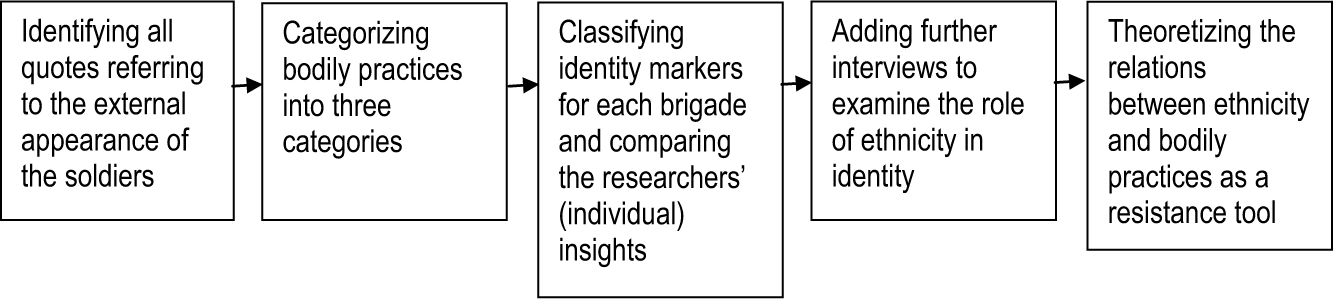
The methodological stages of data analysis.
In our first reading of the interviews, we noticed immediately that soldiers often mentioned their outer appearance as the most prominent factor that differentiates them from the other brigade. We collected all quotes related to daily physical practices, including their references to how to wear their shirts, how to hold the weapon, where to put the beret, how (and whether) to shave and how to expose (or hide) their body, etc.
In the second stage, each of us carried out a second meticulous reading of all quotes and classified them into three main categories: uniform, body maintenance and skin colour. We corroborated these categories by comparing our two separate insights (see exemplary quotes in Appendix A). Even though we noticed that additional practices were used by the soldiers to stage a unique identity, we do not report on them in this article since we agreed that they were related to linguistic aspects rather than to purely bodily practices (e.g. accent, music, jokes).
In the third stage, we noticed that soldiers of both brigades referred to the same three bodily categories but in a completely different manner, marking the unique identity of their brigade. In order to make these differences very overt to outsiders as well as to themselves, they stressed repeatedly that these practices reflect totally different organizational identities. Both of us separately noted these ‘identity markers’ of each brigade, and then we identified similarities between our interpretations in order to validate them.
In the fourth stage we realized that ethnicity played a crucial role in the process of constructing two different professional versions of the same occupation, and was not only a means of demarcating the brigade’s uniqueness. Rather, we found that ethnicity itself as an ‘identity marker’ was used, especially by the Golani soldiers, to stage and show off their own version of the combat soldier. To corroborate this interpretation we returned to some of the interviewees to deepen our understanding of the role of ethnicity both as an ‘identity marker’ and as posing (an)other professional identity that challenges the dominance and prestige attributed to the Paratroopers. We also noticed that soldiers defined the brigade’s ethnic identity both by echoing the ethnic discourse in Israeli society and the particular ethnic heritage of the brigade. These interviews validated not only the importance of ethnicity in staging their identity, but also the role of ethnicity in posing a competing professional organizational model in the military.
It was in the fifth stage that we became aware that ethnicity is not simply a neutral ‘identity marker’, but rather it is used by Golani as a means of resistance to the dominance of the Paratroopers. While the Paratroopers, as mentioned before, did not refer much to ethnicity, as for them it had become transparent, all of the Golani soldiers, including those who are not Mizrachi, referred to ethnicity (and the bodily staging of it to the outer world) as a tool to articulate their resistance to discipline, to the military establishment’s rules and to the dominance and prestige attributed to the Paratroopers.
These five stages (Figure 1) became the basis for our theoretical model, which will be explained at the end of the results section. Moreover, the process of data analysis and sense-making provides a further validation of the interrelation between professional and ethnic identities as well as the ways in which they are all constructed, maintained and resisted through the body, as we show in the section on the findings.
Findings and effects
The research findings indicate bodily strategies that construct two competing masculinities. We shall focus on three practices: clothing, body maintenance and skin colour. These practices seem to serve both as control tools and as resistance strategies grounded in an ethno-gendered basis. The analysis of these strategies takes two routes: in the first two strategies—clothing and body maintenance—we show how soldiers’ masculine identity is constructed and how this masculinity is interpreted through ethnic characteristics, while in the third strategy—skin colour—we start from the ethnic identity and show how this identity is based on masculine distinctions. This two-way process reinforces the intersection between masculinity and ethnicity and shows that these identities are interrelated through bodily performances.
Uniform
One of the most prominent resistance strategies emerging from the findings refers to the soldier’s uniform and its utilization. The Israeli army, like other armies, has clear and strict rules regulating the attire required of its soldiers: an identical, pressed and clean uniform, elastic bands for boots, berets, shirts tucked in, etc. are all aimed at presenting aesthetics of restraint, neatness and well-organized masculinity, projecting power as a direct result of this self-discipline. These regulations are intended mainly for soldiers headed home for vacation and are usually not applied to daily life and training, when combat soldiers dress carelessly, get muddy, daub their faces with camouflage paint and forego order and cleanliness. In practice, this has created two types of military aesthetics: representative aesthetics—defining dress and hygiene rules required from soldiers when encountering civilians in order to represent the army to the non-military surrounding and indoor aesthetics—defining dress and hygiene rules required for training and other daily duties. The indoor aesthetics is implied and unspoken, and therefore generates a ‘grey area’ where rules are equivocal. This aesthetics is not supposed to be seen from the outside, because the soldiers’ ‘dirty work’ is not supposed to be too visible [see also work on butchers by Simpson et al. (2011)].
Soldiers are expected to distinguish between these two kinds of aesthetics, to maintain a clear distinction between them and to know when to display each one. However, soldiers in the two brigades differ in their attitude to these rules: while Paratroopers mostly obey the organizational demand to distinguish between the internal and external aesthetics, Golani soldiers blur the distinction between these two aesthetics and ‘disrupt’ their uniforms and boots to display their unique masculinity, rather than adhere to established military rules. However, since they are key contributors to the core mission of the organization, the military often overlooks these ‘identity expressions’ (see also Anteby, 2008). One tactic utilized by Golani soldiers is to roll up their sleeves and expose manly muscles. Rami, a Mizrachi who served in Golani, describes how Golani soldiers dress when on leave:
When we go home, elastic bands are down and shirts are untucked … Unlike the Paratroopers, we dress sloppily, the dog tag at the back, and we wear second-rate uniforms [work uniforms worn only on base], and we don’t mind having a charge filed against us by the Military Police if necessary. It’s no big deal.
The dress code described by Rami presents a clear grasp of the ‘appropriate’ appearance of Golani soldiers when leaving the base for home. In contrast to Paratrooper soldiers, Golani soldiers wear work clothes intended for internal purposes and show them off even when outside the base. This dress code reflects their refusal to embrace the representative aesthetics of the dress and conduct codes required by the army, and thus expresses a resistance tactic aimed at establishing a different, distinct and alternative identity to that of the combat soldier as exemplified by the image of the disciplined paratrooper. Eliran, a Golani soldier of a mixed ethnic origin, interprets this dress style as part of masculine identity:
In Golani we are men … we roll up our sleeves to show our muscles. We are not very particular about our shirt buttons either … it’s manly and I even used to like it … Today I say to myself what a jerk I was … even in the winter, in the snow, freezing cold—I wouldn’t roll down my sleeves… because I’m a man, I have my dignity, I won’t roll down my sleeves.
Eliran’s words demonstrate how masculinity is presented both by displaying the male body and the aesthetics of exposed muscles as well as by the display of physical endurance in extreme cold. The masculine identity of Golani soldiers, even at the price of physical suffering, is symbolized by rebelling against formal military rules that forbid such exposure of the body. In contrast to the theoretical literature claiming that male bodies are less visible and projected (McDowell and Court, 1994), in this case, it seems that exposure of the body not only has no detrimental effect on masculinity but rather reinforces it and marks it according to the Golani soldiers’ perception as the more appropriate and fitting masculinity. Muscles—symbolizing strength, force and toughness—emphasize the outline of the body, which is partially exposed and capable of bearing the pain and suffering of hard labour in difficult conditions, highlighting its endurance and its manliness.
Radicalization of male performance by displaying the exposed body or by ‘disrupting’ the formal uniform is intended not only for resisting institutional authority, with its strict disciplinary requirements, but also as a means of protest against the dominant model of masculinity represented by the Paratroopers. Resistance to the Paratroopers’ dominant masculinity is, in their eyes, resistance to the establishment, as the Paratroopers’ masculinity is perceived as a symbol of what the establishment defines as the ‘proper masculinity’.
One of the manifestations of resistance against the Paratroopers’ dominant masculinity is the Golani soldiers’ feminization of the Paratroopers. Liran, a Mizrachi soldier serving in Golani, describes the process of feminization as follows:
The Paratroopers are all dandified whities with permanently neat and pressed uniforms … They have a special type of shirt that you wear untucked with a belt over it—it looks like a dress … like a kilt. We laugh at their dress … and the color of their beret, our brown looks much prettier than theirs. [The Golani beret is brown, the Paratroopers’ is red.] What is that red color? It’s like a menstruation on the shoulder … Golani is the exact opposite … when you think of Golani, you immediately think of combat soldiers who make a big mess. Their clothes are always sloppy and the gun is thrown over the shoulder [the gun is supposed to be carried crosswise]… The pants are low … Golani soldiers resemble an Arab Sheikh, a man. [the interviewee used further Arabic expressions to describe the soldiers’ behaviour]
By feminizing the Paratroopers’ masculinity, Golani soldiers reverse social power relations by using traditional gender relations between men and women, and implying an alternative hierarchy. As evident in Liran’s statement, Golani soldiers define their identity while comparing themselves to the Paratroopers, an identity that is constructed mainly on the basis of negation and degradation; the Paratroopers do not compare themselves to other infantry brigades. The feminization of the Paratroopers is aimed at challenging the existing hierarchies in Israeli society which historically allocates more prestige to the Paratroopers.
Moreover, the masculinity that Golani soldiers construct by means of their body and clothes is not neutral, but rather reflects existing ethnic distinctions within Israeli society. Their masculine performance is linked with behaviour perceived as characteristic of Mizrachi culture and masculinity within Israeli society. Mizrachi culture and its masculinity are perceived as contrasting with Ashkenazi culture and its masculinity which, in turn, is represented by the Paratroopers through the aesthetic performance and the neat appearance of their uniform. The coquetry that Liran attributes to the Paratroopers and the comparison between the red colour of the beret and menstruation expresses not only condemnation of their submission to the demands of the establishment but also a certain diminishing of the Ashkenazi body of the Paratrooper. Liran’s words undermine the dominance of the Paratroopers by ‘reducing’ their Ashkenaziness to femininity, thus questioning the power and dominance of the model they represent.
In contrast to the model of the restrained soldier embodied by the clean aesthetics of the Paratroopers, Golani soldiers forge an untamed, wild and uncontrollable masculinity through their undisciplined body. It is anti-establishment, non-normative and nonconformist masculinity, and its features are usually attributed to the non-dominant ethnic group (yet not a minority group) within Israeli society, the Mizrachim.
Even though this masculinity is often delegitimized within Israeli society (Shohat, 1988), it is adopted by all Golani soldiers regardless of their own ethnic origin and in spite of its so-called inferior status. Thus, adopting this model of masculinity should be regarded as a resistant identity against the dominant Ashkenazi masculinity represented by the Paratroopers. The uniform serves the soldiers as a particularly convenient medium for displaying an alternative model of proper masculinity which is no less professional and even more effective since it is not concerned with defying strict rules. Moreover, the ethnic identity Golani soldiers assume is further exaggerated and taken to an extreme when they adopt an Arab identity, which in the Israeli context constitutes an act of exceptional resistance.
Golani soldiers embrace Arab identity for several reasons: first, it serves as a strategy of resistance against the Paratroopers, since by adopting the image of the dark-skinned enemy they challenge the dominance of the white ‘dandified’ paratrooper. By assuming this dark-skinned identity, they set an alternative model of masculinity which is equal to that of the Paratroopers and which holds a potential threat to them. Moreover, Golani soldiers attempt to pose a much more professional martial model than that of the Paratroopers since they assume that the cultural similarity with Arab culture grants them a military advantage. They thus become more threatening; and, consequently, better soldiers.
Second, and at the same time, this strategy is also aimed against the Arab enemy, as they are transmitting the message that they can be just as ‘wild’ and ‘uncontrolled’ as their Arab enemies are. This message is understood in the Israeli discourse in an ambivalent manner as, on the one hand, it is perceived as an efficient way of deterring and fighting against the Arab enemy (especially against terrorism) but, on the other hand it, is criticized as an uncivilized model of action that is not appropriate for the Israeli army.
Third, from the theoretical perspective of Orientalism studies, the comparison with Arabs exemplifies a fascination with the Arabs (including the admiration of their power and their threatening image) along with a reduction and degradation of the Arabs’ perceived inferiority (including their primitiveness, crudeness and immorality). This dual attitude will be further elaborated in the next sections; however, it is important to note that while Golani soldiers take part in a hegemonic model of masculinity (the warrior’s model of masculinity), they run the risk of Mizrachiness being identified with the lower class in Israeli society. The Arab identity that they assume is portrayed in the form of pride in their manhood, but, at the same time, they occupy a socially inferior and disadvantaged position. Interestingly, the Golani soldiers don the mantle of this so-called disadvantaged, coarse and vulgar identity themselves: it is not forced upon them by the Paratroopers or any other brigade.
Body maintenance
The second practice utilized by the soldiers as a resistance strategy is body maintenance. The soldier’s body is his ‘work tool’, and therefore the army has clear and strict requirements regarding body maintenance (Godfrey et al., 2012). In other words, in addition to the rules of representative aesthetics required of the soldier’s clothing, the army has rules governing the representative aesthetics of the body. Expectations of body maintenance are identical in both brigades: soldiers are required to maintain personal hygiene by washing, wearing clean clothes and maintaining hair and shaving standards. Rules of the body aesthetics are summarized, according to the soldiers, in the form of two demands that have become a common linguistic idiom in military slang: shaving (the face) and shining (the boots). 1
The demand for body aesthetics refers both to maintenance and to control of the body: the body of the combat soldier is required to have physical strength and the ability to withstand hardship, but soldiers are also expected to restrain their corporeality. Soldiers are not allowed to grow beards without a special permit, as they (and hair in general) signify a masculine, untamed and uncontrollable nature (Harding, 2002) which the military organization strives to control in order to encourage conformity and conservatism. Thus, just as we might expect an employee wearing an ‘organizational uniform’ to display more obedience than an employee who chooses his/her own clothes (Rafaeli and Pratt, 1993), we would expect a soldier to dress neatly and meticulously.
At the same time, combat duty requires fieldwork which often includes lengthy stays in the field, thus part of the job demands include indoor aesthetics, which in this context means the ability to cope in an unsanitary environment over long periods with no showers or shaving. Soldiers are also often required to paint their faces for camouflage purposes during operational activities. If so, the job definition implicitly encompasses unsanitary and disorderly conditions which contrast with the formal requirements of order and cleanliness. These covert requirements, which enable soldiers in the field to dress in contrast to the representative aesthetics and to forego hygiene rules, are embraced by Golani soldiers as their rule of conduct on leave as well. Although leaving base requires soldiers to display the aesthetics of an organized body, Golani soldiers choose to show off their fieldwork and their disorganized body. Chen, a Mizrachi soldier from Golani, speaks of the brigade’s cleanliness requirements:
Our soldiers never shave and never shine their boots. Everybody asks for a beard permit; even those who do not have a beard permit say they do … We would never shine our boots, because shined boots look new; a nice boot is a scuffed boot, a boot that shows how long you have been in the army.
Chen refers to the body concept of soldiers leaving the military base for home (for civilian society). Unlike the Paratroopers, going on leave for Golani soldiers does not necessitate a metamorphosis from field appearance. Control of the body is determined according to social and not material standards, and it therefore has to do with attempts to control social chaos and disorder. Based on Douglas’s (1966) argument that dirt undermines the social order, we can understand the Golanis’ refusal to maintain their cleanliness as a resistance tactic, especially when they leave the area in which dirt is legitimate and enter the area in which it is not. In fact, Golani soldiers are unique in this ‘disrupted’ appearance (unlike other brigades, especially the Paratroopers), so that dirt and disorder has become the trademark of their brigade.
The above quote demonstrates how the norm in Golani calls for soldiers to display their work outwardly, and thus present an alternative professionalism, which centres on the portrayal of physical labour, the main means of performing combat duty (as distinct, for example, from the work of pilots or intelligence officers). In contrast to the Paratroopers who, as required by the establishment, present the neat and organized symbolic image of combat soldiers, Golani soldiers choose to display a different part of their duties, the part that is supposed to remain backstage. Golani soldiers ‘take their work with them’, engraved on their bodies and clothes, and display a professional model of ‘labourers’. While it is customary to leave symbols of physical ‘dirty work’ (Ashforth and Kreiner, 1999) within the limits of the organization and not display them outwardly (for example, surgeons do not leave the operating room wearing clothes covered in blood), here, Golani soldiers choose, consciously and intentionally, to project the dirty aspect of their work outwardly. Their professionalism is measured on a dirt index. While displaying sloppiness usually lowers status, here, the soldiers perceive the displaying of the dirty aspect of their work as empowering, as lending power.
This is manifested in the words of Yaron, an Ashkenazi who served in Golani. He describes the tension between the army’s requisites of order and cleanliness, required from those who represent the army ‘outwardly’, and the job itself, which involves danger, dirt and disorder:
You are in Lebanon and you know that any moment a charge can explode in your face, you have mud on your boots, you’re dying to get home because you haven’t slept, and then you go on leave and a military policeman comes and tells you that your appearance is disorderly and you haven’t shaved. You have to be very calm not to lose your temper in such a situation. Of course you shouldn’t behave violently, but yes, yes, I agree with the regiment commander who rejected the complaints of those military policemen and backed the combat soldiers.
Yaron portrays the contrast between the danger posed by his job and the demand, perceived as ridiculous, to maintain a neat appearance. From his point of view, demanding soldiers to be shaven, have short hair and shined boots, is not reasonable: shaving does not create professional soldiers; brave soldiers are not the product of shined boots; soldiers do not acquire physical and mental endurance by keeping their hair trimmed. However, these are major demands of soldiers in general, stemming from the army’s fear of losing control of the body. The army is concerned that facial and body hair will grow unchecked, and that the body will become and remain dirty, as will clothes and boots, so a significant effort is invested in controlling the soldier’s body. Control of the body by demanding cleanliness is perceived by many Golani soldiers as reflecting the norms of the establishment, which is represented by the Paratrooper. For example, Vladimir, of Russian [Ashkenazi] origin, who served in Golani, explains why Golani soldiers do not shave:
There was a rule that said that you don’t shave; hair grew wild. We look like men, not clean-shaven and dandified like the Paratroopers.
According to Vladimir, filth is perceived by Golani soldiers as a ‘masculine’ characteristic and cleanliness as a ‘feminine’ characteristic. Golani soldiers construct their masculinity through mess and filth, while simultaneously delegitimizing the Paratroopers’ cleanliness and order by presenting this requirement as a characteristic of femininity.
Liran, of Mizrachi origin, adds another dimension to the demand to avoid shaving in Golani: ‘To be a Golani soldier [means] not to shave, to get a beard permit, to look like an Arab’.
The norm adopted by Golani soldiers to avoid shaving attests to the resistant attitude against the establishment and against the Paratroopers as well as the role of ethnicity in this resistance. Not shaving is perceived by Liran as a characteristic of Mizrachi masculinity. Moreover, in contrast to the expectation that looking like an Arab be perceived as degrading, this is a source of pride for Golani soldiers. Once again, Golani soldiers take on an ‘inferior’ identity in the Israeli context, the identity of the Arab enemy, in order to resist the Ashkenazi establishment.
By objecting to the establishment’s demands to look and behave according to the model of the dominant soldier, Golani soldiers present an alternative organizational identity that produces alternative aesthetics contrary to formal aesthetics. For this purpose, they use ethnic characteristics. In the process of producing ethnic-masculine aesthetics, the soldiers not only produce an alternative masculine identity, but also undermine the characteristics of the most prestigious masculinity of the Paratroopers.
Nevertheless, Golani soldiers construct their masculinity in a most dialectic manner, as their masculinity is based on negation as well as on high commitment. This dialectic identity is manifested, on the one hand, through their embodiment of their resistant identity, namely the portrayal of ethnic corporeality and dirty work. They ‘blacken’ themselves and resist the abstractness and metaphysicalness of the Paratrooper image, such that while the Paratrooper is the ideal image of the combat soldier, the Golani soldier is his corporeal manifestation. This process exposes not only the corporeality of ethnicity, but also the notion of ‘doing ethnicity’, as the same body could change its ethnic affiliation through alternative body maintenance performed by the soldiers themselves. On the other hand, the Golani are highly committed soldiers, who are ready to sacrifice themselves for their brothers-in-arms and their organization. Their resistance does not delegitimize the army and its aims (nor does it challenge the superiority of warrior masculinity over any kind of femininity) but rather sets an alternative model of masculinity for the infantry warrior. Indeed, they are regarded as excellent soldiers. Such devotion attests to Fleming and Spicer’s (2003) suggestion that Golani soldiers might dis-identify with the dominant cultural prescriptions, yet still comply with them devotedly.
Skin colour: black soldier, white soldier
The third resistance strategy utilized by the soldiers to structure their ethno-gender identity is skin colour. Colour is an important and central component of the process of constructing ethnic identities: colour is imprinted on the skin, highly visible, permanent and unchangeable. It is the most conspicuous external mark and it therefore has become a criterion by which we judge people (Fanon, 1967). However, the significance of colour is not in the shade itself, as blackness and whiteness per se have no meaning, but rather in the experience of colour and the meaning given to colour (Mishani, 2006). ‘White’ and ‘black’ are unlike all other colours, as they serve as an initial criterion for ethnic labeling. They are used as a label that is not culture-neutral since each colour is associated with an entire world of expectations and meanings in regard to cultural and behavioural manifestations by ‘white’ or ‘black’ people (Bhabha, 1990; Fanon, 1967). Thus, even before one behaves or speaks in a certain way, a process of labelling takes place and positions one as part of a certain ethnic group, thereby arousing expectations of behaviour perceived as compatible with this group. In the Israeli context, skin colour is even more complex, since the difference between Ashkenazi and Mizrachi is not always so overt, and is often perceived as symbolic and cultural. Ehud, of a mixed ethnic origin, served as an officer in the Paratroopers, and links colour to behaviour:
When I became a team commander, I was certain that it would be very easy, that everybody would be blonde and do as I say. When you imagine a paratrooper, you think of a blonde soldier with blue eyes while Golani soldiers are ‘Yemenites’ [he means dark-skinned people]. This is expressed by their mentality: Paratroopers are white, they do everything by the book. For example, they put elastic bands on their boots … and Golani soldiers are perceived as those who do as they wish with no elastic bands, they don’t give a damn about the Military Police … you know … like, I’m a man, I’m an Arab, black …
Ehud adds colour to the stereotype associated with the Paratroopers and Golani Brigades, but whiteness and blackness are not actual colours but rather cultural signifiers of difference. The process delineated by Ehud may be divided into two stages: at first, he positions the blonde soldier in the Paratroopers and the Yemenite (black) soldier in Golani; in the second stage, he bases his conclusions regarding behaviour on colour. This process is compatible with that described by Bhabha (1994), where difference is first marked by colour and then rooted by stereotypes (manifested by the appropriate behaviour for each colour).
In this case, the stereotype has a double function: it determines the Ashkenazi paratrooper as the norm, as the ideal and the soldier favoured by commanding officers, and the Golani soldier as one who resists the norm, with the implication of being a problematic soldier. As with any stereotype, Ehud ignores any diversity within each group, as for him being a paratrooper inevitably means behaving like a ‘white’ person and being a Golani soldier means behaving like an ‘Arab’, or in other words, like a ‘black’ person. Ehud’s words express the force of the stereotype, where despite the actual diversity and variety within each brigade, we still expect and imagine homogeneous figures matching the stereotype.
Nevertheless, according to Ehud, colour serves not only as an ethnic mark, but also as a sign of the different masculinity required in each of the brigades.
Oren, a Golani soldier whose mother is Mizrachi and father Ashkenazi, describes the interrelations between colour and masculinity in similar terms:
I remember that I had one squad commander who was just a Nazi, he was really bad. One day Shai Grossman [this pseudonym is a typical Ashkenazi name], an Ashkenazi with glasses, arrived from a kibbutz, and I remember what the squad commander did to him at roll call. ‘You whitey, you female, come here. Until you paint your face every morning and come here black like a man, I’m going to tear you apart’. When you see one such example, and another and another, at some stage, even unconsciously, you undoubtedly begin to think in a certain way, you say that black is good, and being Mizrachi in the army is good.
Oren implies that black masculinity is more ‘appropriate’ in Golani, so that Grossman’s Ashkenazi masculinity is unacceptable and therefore he is required to undergo a real change to fit into the group. Grossman’s appearance, origins, and even place of residence, reflect what is perceived as Ashkenaziness: this is not tolerated in Golani and triggers a violent reaction. Grossman is required to change his appearance, as he cannot be ‘white’ or ‘Ashkenazi’ in Golani. He is required to conceal, in Fanon’s (1967) terms, the tattooed markings of colour on his body. However, this marking is not only ethnic marking but also the mark of masculinity, as in order to be a ‘real man’, Grossman is required to be black. Such an imperative was evident in other interviews, when some Golani soldiers reported that they would tan their skin during weekend leaves in order better to fit their brigade’s ‘aesthetics’.
The two soldiers quoted above show that ethnicity is characteristic of a certain type of masculinity. It is precisely because body colour is engraved on the skin and unchangeable that it reinforces ethnicity’s part in establishing the masculine identity, as body colour supposedly attests to authentic, innate masculinity. Similar interpretations emerged in other interviews as well, in which disorderly clothing, sloppiness, lack of rules and lack of discipline are portrayed as features of the Mizrachiness and ‘Arabism’ characteristic of Golani soldiers (see additional quotes in Appendix A). In contrast, the Paratroopers are characterized as disciplined, coming from a high socioeconomic level and ‘white’. However, colour markings and type of masculinity do not remain signifiers of difference alone, but are transformed into an organizational demand, enforced both by the soldiers themselves and by their commanders. In contrast to the Paratroopers’ body, which is perceived as white, disciplined and obedient, the body of Golani soldiers is highly visible and corporeal, and its masculine dominance stems specifically from this visibility. Interestingly, the black skin the Golani cloak themselves in is enforced on them neither by nature nor by the Paratroopers, or by any other brigade, but rather is willingly self-imposed. Our interviews reveal that the Paratroopers do not refer to themselves or the Golani in terms of colour, and they do not construct their professional identity by comparing themselves to Golani. This data corroborates the literature on ethnicity which suggests that whiteness is tacit, transparent, and taken for granted (Dyer, 1997).
The role of the masculine body in the process of control and resistance: a theoretical framework
After having presented three physical strategies of resistance and shown how they are used to pose an alternative ethno-gender identity to the dominant masculinity in the army, we wish to illustrate the dynamics of identity construction in both brigades to shed light on the role of embodiment in organizational resistance and control. Figure 2 illustrates our findings and theoretical frame:
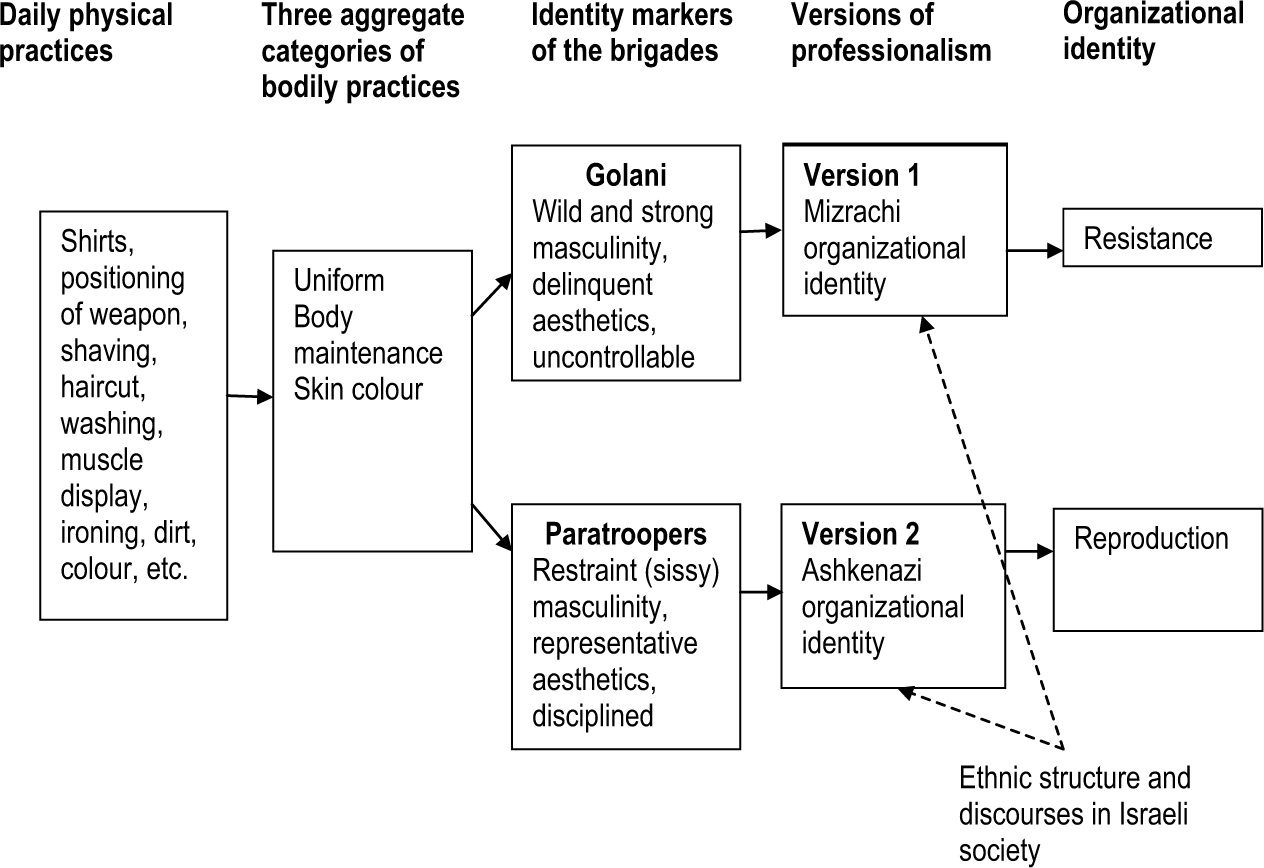
A summarizing theoretical framework.
As illustrated by Figure 2, our results demonstrate how daily bodily practices of combat soldiers are used as devices of control within and of resistance to the military organization. Being one of the most significant objects of control and discipline (Godfrey et al., 2012), the male body of combat soldiers is a central site for struggles over identity, which results in this case in resisting identities for one brigade (Golani) or reproducing identities for the other brigade (the Paratroopers).
Our data reveal that daily physical practices (such as shaving, ironing the uniform, controlling body hygiene and haircutting, carrying the weapon according to military instructions or tanning and exposing muscles) are organized around three main categories: uniform, body maintenance and skin colour.
These three categories are used by the soldiers as bodily strategies to stage their organizational identity. While the first two strategies are more changeable (uniform and body maintenance), the third is more permanent and uncontrollable (skin colour). Soldiers thus have the option of changing one look for another, dressing differently, and controlling body hygiene and hair growth (even if they choose not to do so because they prefer to adhere to group norms), but are limited in changing their skin colour (except tanning). Moreover, the first two strategies are related to external markers that one carries on the body and are located outside of it; the third is related to internal characteristics, inseparable from the body and built into it (for example, skin colour engraved on the body and body maintenance).
Each of the three bodily practices is used by members of both brigades as identity markers to demarcate their unique (organizational) identity. While the Paratroopers are characterized by their representative aesthetics, and their disciplined and obedient body—a masculinity centred on restraint and is prestigious and dominant—Golani soldiers are identified with their somewhat delinquent aesthetics, representing a dirty, wild and uncontrollable masculinity which goes against the military’s formal and binding rules (regarding cleanliness and bodily discipline).
To reinforce a competing model to the one found among the Paratroopers, Golani soldiers don the mantle of an ethnic identity (Mizrachiness) and adopt it as their organizational identity. By assuming the Mizrachi identity they pose (an)other version of professional identity that challenges the dominant model of the Ashkenazi combat soldier. The ethnic identity that the Golani adopt offers an alternative masculinity that equally fulfils the military professional requirements, but in ways that are different from the Paratroopers’ version. While the Paratroopers do not actively and consciously use their Ashkenazi identity to underpin their dominance (a behaviour typical of other hegemonic and dominant groups), Golani soldiers actively take on a so-called inferior social category that resonates with contemporary ethnic discourses and struggles in Israeli society. Although the demand for a certain ethnic identity is not a formal demand in Golani, it is a common micro practice utilized in the daily life of members of the brigade, and is the product of the interpretations given by soldiers and their commanders to social norms and ethnic stereotypes.
Finally, by constructing their identity through constantly comparing and opposing the dominant model of the Paratroopers, Golani soldiers represent a resistant stance in the military organization, while the Paratroopers reproduce the existing model of a disciplined and obedient soldier. Theoretically, it is important to note that ethnicity is used as the main tool to construct both resistance and reproduction, in a way that replicates extra-organizational identities within the organization and perpetuates social power relations.
Conclusion
This article demonstrates three bodily practices that are part of an extensive effort of ‘self-ethnicizing’ that Golani soldiers perform in order to undermine the legitimacy given to the more prestigious model of the infantry warrior in the Israeli context. These bodily practices of resistance show the dynamic nature of ethnicity, as opposed to race, which is usually regarded as a source of discrimination imposed on people of a specific ethnic group. Moreover, we demonstrate how ethnicity can be actively used as a deliberate resistance strategy, which empowers those who use it, rather than positioning them in an inferior status. Interestingly, the dominant masculinity is challenged by an ethnic identity which for many years has been perceived in Israeli society as marginal, and those who bore it were often required to discard it and internalize the dominant identity. While we would expect that Golani soldiers would embrace an ethnic identity with high social status, which would facilitate organizational affiliation, especially as they already possess a prestigious status, they have chosen an unaccepted and non-normative identity. The current study shows that far from rejecting this identity, they proudly show it off and even radicalize it. Therefore, our contention is that ethnic identity can serve as a means of empowerment, forming the basis of an alternative masculine identity, which advances the organizational mission.
Nowadays, with growing ethnic diversity and multicultural discourse within organizations and society, future research should focus on how the dominant (or hegemonic) ethnic identity is challenged by alternative identities. We urge researchers in the field of ethnicity in organizations to focus more on the ways in which ethnicity is actively ‘done’ by individuals and how it is maintained by specific groups (or organizations) in their identity struggle. We urge scholars to broaden the scope of the theoretical field that focuses on diversity management within organizations into the more dynamic aspects of ethnicity as an active strategy people use in organizational struggles.
Another direction indicated by this article is the study of organizational aesthetics and embodiment. While most of the critical literature in the field focuses on the ways in which aesthetics are used as a control tool, our study shows that it can also be used for resistance and identity struggles. The three bodily practices mentioned in this article may be seen to a great extent as a portrayal of alternative aesthetics to that demonstrated by the organization, such that while the formal aesthetic is one of ascetic, restrained and exemplary masculinity, the alternative aesthetic is a type of delinquent aesthetic, as it is perceived as a wild, untamable and law-breaking masculinity.
We believe that offering a new research domain of the ‘aesthetics of resistance’ might open up new directions of studies combining insights from both resistance and aesthetics literatures. The two rival aesthetics of the Golani and the Paratroopers are used as a crucial means in the competition over the appropriate professionalism of combat soldiers, and emphasize the importance of corporeality in organizational life. While the figure of the Paratrooper serves as a professional standard, dictating how one should look, how one should behave, and even how one should fight, Golani soldiers offer an alternative professional model based both on a different masculinity and on a different ethnic identification.
The confrontation over proper and authentic professionalism takes place in this case through a core feature of the military profession, i.e. masculinity, but could be deployed in other cases through other core features of the profession. In order to position themselves as professional combat soldiers, Golani soldiers display the aesthetic marks of masculine warfare (dirt, aggression, wildness, endurance, etc.) externally and in an exaggerated manner. We believe that our case indicates how a struggle over masculinity is used to gain professional legitimacy, and future research could use these results to examine other cases where masculinity, and the male body, are used for resistance purposes. This means that studies in the field of professionalism, as well as in the field of masculinity in organizations, could benefit from these results.
Moreover, our case reveals that masculinities are not always constructed through organizational hierarchy or occupation, as is the case with working class men and managerial corps, but rather through ethnicity. In our case, the struggle over masculinity takes place within the same rank and the same status, and therefore we cannot assume that men working in the same place and in the same occupation will define both their professional and their masculine identity in the same manner. The Golani and the Paratroopers perform two very different interpretations of masculinity, and show that even the identity of a combat soldier is not a unitary and unquestionable identity. Future research in the field of masculinity should examine intra-struggles between competing masculinities (or femininities) in the same occupation.
Organizations are major sites for structuring and maintaining organizational and extra-organizational identities, such as gender, ethnicity, social status, etc. Most organizational research focuses on only one of these categories; rarely does it attempt to link the various categories and clarify their inter-relations. We attempt to show the interrelations between these various identities through the body. The externalization of the masculine and ethnic identity through corporeality and bodily practices shows that although organizations are usually conceptualized as ‘organs without a body’, in this case we show a highly ‘embodied’ organization where the body plays an important role in identity construction processes as well as in acts of control and resistance. Our data reveal that Golani soldiers challenge the low status attributed to working class occupations by restoring and re-emphasizing the importance of the body and muscles as core features of masculinity. Therefore, we suggest regarding the body not only as an object of control, as implied by many recent studies, but also as a site of resistance in organizations.