




Abstract
This article uses an example of critically oriented Action Research to reflect on the pitfalls and tensions inherent in engaged scholarship. The tensions are analyzed within three types of research-related relationships involving power: (1) between the participatory inquiry and its cultural, institutional, and social environment; (2) within ‘the community’ being studied, which itself is not homogeneous in terms of interests, values, and ability of their realization; and (3) between the researcher and ‘the community’. These tensions connect to an attempt to use the three mutually exclusive approaches of pragmatism, critical theory, and constructivism. It is claimed that this meta-theoretical inconsistency, though not elegant, should be seen as a strength rather than a weakness. Following any approach in isolation would expose the researcher to the risk of opportunism (pragmatism), paternalism (critical theory), or relativism, and therefore paralysis (constructivism). Keeping a minimum level of variety enables the researcher to escape those pitfalls and to conduct ethical and emancipatory inquiry.
Keywords
Introduction
Critical management studies (CMS) and engaged scholarship in general seem to provide an ideal home for Action Research (AR) understood as a collaborative research method generating both scientific knowledge and democratic social change (Greenwood, 2007). Especially in its critical versions, like critical AR (Johansson and Lindhult, 2008), critical-emancipatory AR (Duberley and Johnson, 2009), participatory action research (PAR; Grant et al., 2013), or critical participatory action research (CPAR; Kemmis, 2013), the methods have emancipatory ambitions closely aligned with a critical approach to studying management (Huzzard and Johansson, 2014). It perceives the researcher as a change agent, and therefore, it directly enacts a critical theory ideal of a social science whose goal is to challenge and replace prevailing relations of domination (Alvesson et al., 2009).
Paraphrasing Kurt Lewin, a founding father of AR, one can say that critical action researchers learn to understand relations of domination while trying to change them. By taking an active stance, they are attempting to create a positive impulse within the critical tradition, an impulse considered necessary for avoiding a marginalization of the critical perspective (Alvesson et al., 2009). At the same time, by engaging into a dialogue with powerful, participatory action, researchers risk compromising their critical ambitions.
I argue that critically oriented versions of AR, which struggle to implement in practice the critical ambitions to change the world, focus on tensions and dilemmas encountered by the majority of the critical scholars. The goal of this article is to build a holistic framework helping to explore and manage these tensions, as well as the uncertainty and ambiguity of the research process that arise from pursuing emancipatory goals.
I hope that the following analysis will be of help for critical researchers, who like myself were and are perplexed in their search for an answer to one of the core questions for critical scholars community: How and where should they locate themselves in relation to organizational change or even broader to the change of organizational constituencies (Alvesson et al., 2009). The analysis extensively uses examples from research practice illustrating how the tensions manifest themselves in the real-life context and how researchers are trying to reconcile them and often concluding that they are forced to compromise either critical ideals or the prospects for change. The proposed framework is an attempt to free oneself from this straightjacket. It climbs to the meta-level, to observe the researchers struggle from the perspective of power and of three meta-theoretical perspectives (pragmatism, constructivism, critical theory).
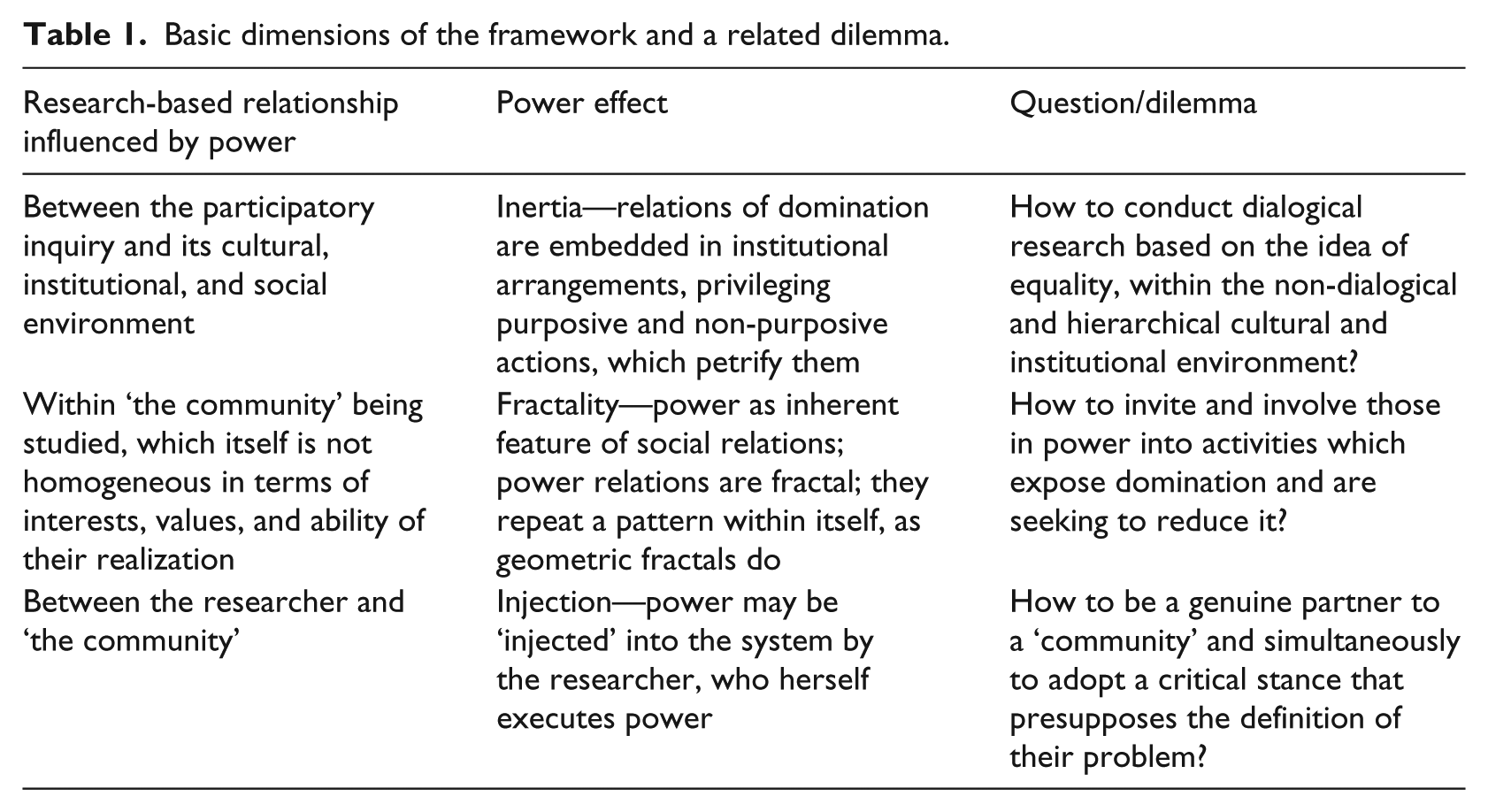
I depart from an argument that social research as any other kind of social relationship is constituted by multiplicity of force relations, that is, power. Power works through discourses, institutions, and practices that are productive of power effects, framing the boundaries of possibility that govern action (Foucault, 1979; Gaventa and Cornwall, 2013). The power effects infiltrating social research complicate the process of achieving emancipatory goals. I distinguish between three major types of research-related relationships involving power. These relationships are (1) between the participatory inquiry and its cultural, institutional, and social environment; (2) within ‘the community’ being studied, which itself is not homogeneous in terms of interests, values, and ability of their realization; and (3) between the researcher and ‘the community’. The major dilemmas corresponding to them are as follows: (1) how to conduct dialogical research based on the idea of equality, within the non-dialogical and hierarchical cultural and institutional environment, (2) how to invite and involve those in power into activities which expose domination and seek ways to reduce it, and (3) how to be a genuine partner to a ‘community’ and simultaneously to adopt a critical stance that presupposes the definition of their problem.
I use examples from research practice to illustrate that while facing these dilemmas and accompanying ethical risks, critically oriented AR scholars navigate between the three major meta-theoretical traditions of constructivism, critical theory, and pragmatism. When three traditions are used at the same time, the research practice is inconsistent. I claim, however, that this inconsistency should be seen as a strength rather than a weakness. These tensions are creative because they enable the researcher to expose intrinsic problems embedded in each approach in question, as well as in the use of any combination of two and to counterbalance them by a skillful management of the inquiry process. An exclusive following of any of them would expose the researcher to the ethical risks of opportunism (pragmatism), paternalism (critical theory), or relativism, and therefore paralysis (constructivism). Keeping a minimum level of variety enables the researcher to escape those pitfalls, manage the power effects related to the research process, and hence conduct an ethical emancipatory inquiry.
I start with a personal story illustrating the dilemmas I encountered when trying to implement critical theory ideals into research practice. I explore them further first through the meta-theoretical considerations and second by illustrating how researchers navigate between the three meta-theoretical positions when tackling problems of power within the three dimensions of research-related power relationships.
Setting the stage: researcher’s agenda and the power games
In my PhD research I was adopting a critical theory approach, asking questions about the possible conditions for the achievement of less unequal social relations. Using multiple case studies of environmental conflicts between corporations and local communities, I was going to illustrate relations between institutions and power. I was boldly offering all my interviewees access to my research results in order to raise their critical awareness and diminish power inequalities through exposing the interrelations between power, knowledge, and rationality. During the research process, my willingness to share the results gradually diminished. I was afraid that my detailed case studies of conflicts describing action, strategies, and the involved parties’ ways of thinking could be abused and somehow contribute to the worsening of the situation of groups which were already disempowered.
The field research was supposed to be published, thus advancing my scientific career. This made me more stressed as I seriously feared that somebody would be hurt because of my ‘intervention’. But then I was comforting myself: ‘nobody will bother to read it anyway’. Then it became clear to me: to solve my ethical problem, I was hoping that my research would not make any difference.
I started to reflect on the assumptions which had allowed me to believe that my research could make a difference. Some critical researchers (e.g. those creating critical ethnographies or critical case studies) would argue that the research results can have some influence on the wider public if it is communicated to them. They treat research results as ammunition helping ‘people involved in ongoing political struggle to question the relationships of knowledge and power and thereby work to produce change’ (Flyvbjerg et al., 2012: 2). Even if communication of detailed descriptive research on relations of power would not pose an ethical risk, as in the case of my own research, it is still prone to underestimate power inequalities. I have observed that pressures of stakeholders on participatory decision-making in ‘best case’ scenarios resulted in a ceremonial adaptation of dialogue principles. They were mainly used not for empowerment but for obtaining legitimacy for decisions that had already been taken.
My research did not change anything, and those few among the involved, to whom I passed the case reports, expressed their exasperation and frustration. I left disempowered groups where they were, but I added a critical mirror in which they could helplessly stare. This is how I came across the first research-related power relationship I distinguish in this article. I concluded that in the situation of high power asymmetries penetrating the institutional, cultural, and social environment of the research, it is not sufficient to just expose domination to make a difference. Here, the ‘conventional’ (not involving intervention) critical research not only does not reach the emancipatory goals. It even becomes an ethically risky exercise because it ‘teases, then frustrates its adherents, offering enlightenment to an existence of pessimism and despair, trapped within the confines of an immoral society that they are powerless to change’ (Zanetti, 1997: 156). In order to minimize this risk and the risk of an abuse of my research results, I compromised critical ideals and withdrew my empirical results into the realm of academia.
When looking for a research framework enabling me to introduce change, and simultaneously address the problems of both institutionalized power inequalities and ethics, I started to explore the literature on PAR. PAR recognizes that even ‘communicating new voices and categories is not enough’ (Gaventa and Cornwall, 2013: 181) and supplements its critical approach with a pragmatist component of problem-solving action. It seemed to address my concerns about the faint influence of ‘conventional’ research results on reality. Additionally, PAR seemed to answer my worries about the abuse of research results because it questions the divide between the research subject and object and allows for the sharing of responsibility for action and its consequences for those immediately affected by the problem.
I figured out that in order to arrive at change one can either support one marginalized group with common interests or adopt an attitude of ‘tempered radicalism’ implying working for a change ‘from within opposing structures’ (Meyerson and Scully, 1995). I choose the latter because I saw the non-participatory, hierarchical characteristics of local institutional arrangements as a main obstacle to arrive at democratic social relations. I situated my research on an aggregated level of policy making, in order to trigger a democratic process of negotiation between different value-based and thus inevitably conflictual perspectives present in the local community (Rayner, 2003). This in turn should result in broadening the scope of choices for those participating in the decision-making process. But then I realized that adopting the role of an ‘opener of a dialogue space’ was to ignore the power asymmetries that motivated my engaging with the research in the first place! As I had already observed in my previous research, just delivering an opportunity to be heard is not enough to guarantee that the voices of the relatively disempowered will be seriously taken into consideration.
This is how I came across the second research-related power relationship: between the participants of the ‘community’ being studied, which itself is not homogeneous in terms of interests, values, and ability of their realization. Not recognizing these differences meant petrifying the status quo.
I started to look for possibilities to strengthen the critical edge of my project. I planned to design research that would allow academic researchers, along with planners and administrators, to serve as transformative agents of change ‘as they work with citizens to educate and help uncover the relationships of oppression, exclusion, and inequity that prevail in so many political situations’ (Zanetti, 1997: 163). But problems kept on multiplying: How to invite and involve those in power into activities which expose and potentially reduce domination?
To make matters even more complicated, I started to reflect on my own power position. I felt that the strengthening of a critical edge will eventually force me not only to choose sides between ‘oppressors and oppressed’ but also to choose between the oppressed groups and between problems which eventually become a subject of the collective, problem solving inquiry. This reflection later developed into distinguishing the third research-related relationship based on power: between the researcher and the community under research.
I decided it was time to explore my dilemmas in practice and look for a community willing to be a partner in the project. I started with the community, which I had previously got to know in my research on conflicts. One of my former interviewees was a local activist who had become a councilor. I emailed him asking how he would estimate the usefulness of the undertaking. He offered to raise the issue at the council meeting. Anticipating the risk of associating the project with a specific political party I politely declined. Since the result of the project was supposed to be an implementation of a policy, the mayor, as representative of the executive power, seemed to be the right person to start with. The mayor, however, was not willing to meet me. After many phone calls and emails, he directed my proposal to the Department of Education [sic!], where it was supposed to be analyzed. After some time, I was informed by the assistant in the Department that the mayor rejected the proposition. Disappointed with this decision, I wrote to ‘my’ councilor informing him that the project would not be conducted.
The next morning, I received an email marked red and titled ‘The Mayor rejects the proposition of workshops financed by the National Science Center without consulting the councilors’. It was addressed to all councilors, local politicians, local administration officials, and the mayor himself. The content included an attack on the mayor’s general policy and my whole (semi-private?) correspondence with the councilor. My research was used in a power game before it had even begun. An email from the head of Department of Education followed directly. ‘You have misunderstood us’, it said, ‘due to time shortages the mayor rejected the proposition to meet with you, although not the project as a whole’. Along with one of the co-researchers, who was also a mediator, I met the head of the department and a vice-mayor. After a long ice-breaking conversation, they developed a strong interest in the project. However, the final decision was the mayor’s and he subsequently rejected the proposition. The vice-mayor, disappointed with the mayor’s refusal, stated, ‘he likes to hand control of everything, although it does not really work well. I think he could just not imagine a use for this kind of project’.
Summarizing, I was first imagining that my critical research will expose mechanisms of domination and therefore raise the critical awareness and empower stakeholders. Then, I faced ethical problems of communicating the research results and realized their faint significance outside of the domain of academia. The main source of the problem was the first research-related relationship involving power, that is, between research and its non-dialogical, hierarchical institutional context. This context limited the possibilities to pursue emancipatory effects with the use of ‘conventional’ critical research results. It remained a problem when an ‘unconventional’ component of action was introduced. That is, for those in power my proposition of a cooperative inquiry into the local governance processes was not so much endangering but was rather considered to be strange.
When trying to design a dialogue-like structure of the inquiry process, I was confronted with the risk of ignoring and even petrifying power inequalities within the community. But an attempt to strengthen the critical edge of the project would result in the problem of convincing those in power to participate in a power-deconstructing research. The final part of my ‘experiment’ warned me that non-academic participants might not recognize usefulness of participatory research as a learning opportunity but (ab)use it as a tool in the political struggle. These issues are later on analyzed as the second research-related relationship involving power, that is, power asymmetries within the community being researched.
The specific context of my project (local democracy) forced me to reflect on my own power position in the collective inquiry. I was going to influence the democratic process by supporting the disempowered. To what extent my facilitation will be in fact the excretion of power and not just ‘bringing out’ the local knowledge and values? I further reflect on these issues as an example of the third research-related relationship involving power, that is, between the researcher and the community.
I was consistently going back and forth from more a critical to a more pragmatist approach. I wanted to have both: critical reflection and transformative action, whereas it seems that you cannot make a transformative omelet without breaking the critical eggs. Table 1 summarizes the above considerations by connecting the research-based relationship influenced by power with a relevant power effect and dilemma.
Basic dimensions of the framework and a related dilemma.
A meta-theoretical framework
Out of a real explosion of intellectual, philosophical, and theoretical traditions important for the AR community (Reason and Bradbury, 2013), three traditions seem to be especially important and fruitful for the exploration of tensions within the critically oriented AR. These are the traditions of critical theory, pragmatism, and constructivism. 1
Critically oriented versions of AR prioritize emancipation as an ultimate goal of research (Johansson and Lindhult, 2008: 102). Participatory inquiry challenges the conventional processes of knowledge production, it creates a space in which dominant discourses are questioned and reframed, and it thereby shifts the horizons of the possible. The focus on the relationship between knowledge and power is traceable to the Marxist theory of ideology and to the writers exploring how social location shapes individuals’ perceptions of the social world (Abbott, 2001). This is the critical theory tradition, which combines epistemological subjectivism, that is, assumptions about the social construction of knowledge, with ontological realism, that is, assumption about the existence of a reality independent of human subjectivity (e.g. structures of domination; Duberley and Johnson, 2009).
The constructivist tradition is the second crucial reference point for emancipatory AR (Grant et al., 2013; Hielsen, 2006; Reason and Bradbury, 2013: 18). It posits that realities are local, specific, and socially constructed (Lincoln et al., 2011). Exploring and bringing out authentic local knowledge is an important part of the empowerment enterprise because of the assumption that self-knowledge can be liberating. But—in contrast to critical theory—the constructivist tradition assumes ontological and epistemological subjectivism.
The emphasis on exploring local knowledge and experience makes a connection to the pragmatist tradition. In fact, critically oriented AR approaches the problems of power armed with a methodology originating from Pragmatism. It assumes the necessity of a group process involving diverse stakeholders with different experiences and knowledge of the problems at hand (Levin and Greenwood, 2011: 29). Contrary to the mainstream account of science, Pragmatism assumes that the production of knowledge and its application are intertwined, hence the crucial epistemological role of action (which is often missed by the ‘pragmatist’ school of thought within CMS; Johansson and Lindhult, 2008). Pragmatically oriented AR aims above all at improving the workability of human praxis; hence, participation is here ‘not just a moral value’ but is essential for a successful inquiry into complexity of the problems addressed (Greenwood, 2007: 131). The assumption of the pragmatist approach is that complexity requires the knowledge and expertise of a broad and diverse array of stakeholders and that it is common action on the problem, which enables us to gain valid knowledge and seek an effective solution.
The attempts to use these three perspectives simultaneously create irresolvable tensions. Using a definition of PAR, a representative of critically oriented AR, I illustrate how the pragmatist, critical, and constructivist perspectives are mutually undermining each other within one methodological framework: PAR is a research methodology that attempts to address power imbalances and oppressive social structures. It values the ‘researched’ community as a vital part of the research project and its members as experts of their own experiences. PAR is especially concerned with oppressed communities and [it] attempts to create action as a catalyst for social change […] PAR identifies as goals: emancipation, participatory democracy, and the illumination of social problems and is a cyclical process of research, learning, and action. (Grant et al., 2013: 589)
So, PAR treats the ‘researched’ community as experts on their own experiences (constructivist perspective) and simultaneously presupposes that relations of domination are an important part of that experience (critical perspective). Thus, the critical theory perspective endangers the goals set by the constructivist perspective and vice versa (see Figure 1). PAR’s orientation toward action (Pragmatism) requires agreement on working within power structures and making use of the same power structures that it tries to challenge. This creates a serious risk of reinforcing the status quo or at least requires some form of compromise with it (endangering goals set by the critical theory perspective). PAR’s orientation toward exploring local knowledge through communication (constructivism) and toward problem solving (pragmatism) makes it prone to overlook the political nature of the cultural, institutional, and social environment within which inquiry takes place and by which all inquiry is infiltrated (strongly highlighted by critical theory approach). The constructivist and pragmatist orientations also make the researcher prone to assume that ‘the community’ is a monolith, just because as a whole it is producing common meanings and have some common problems to be solved. These tendencies go against the critical perspective, whose basic assumption is that relations of domination are universal and cannot be organized out of society.
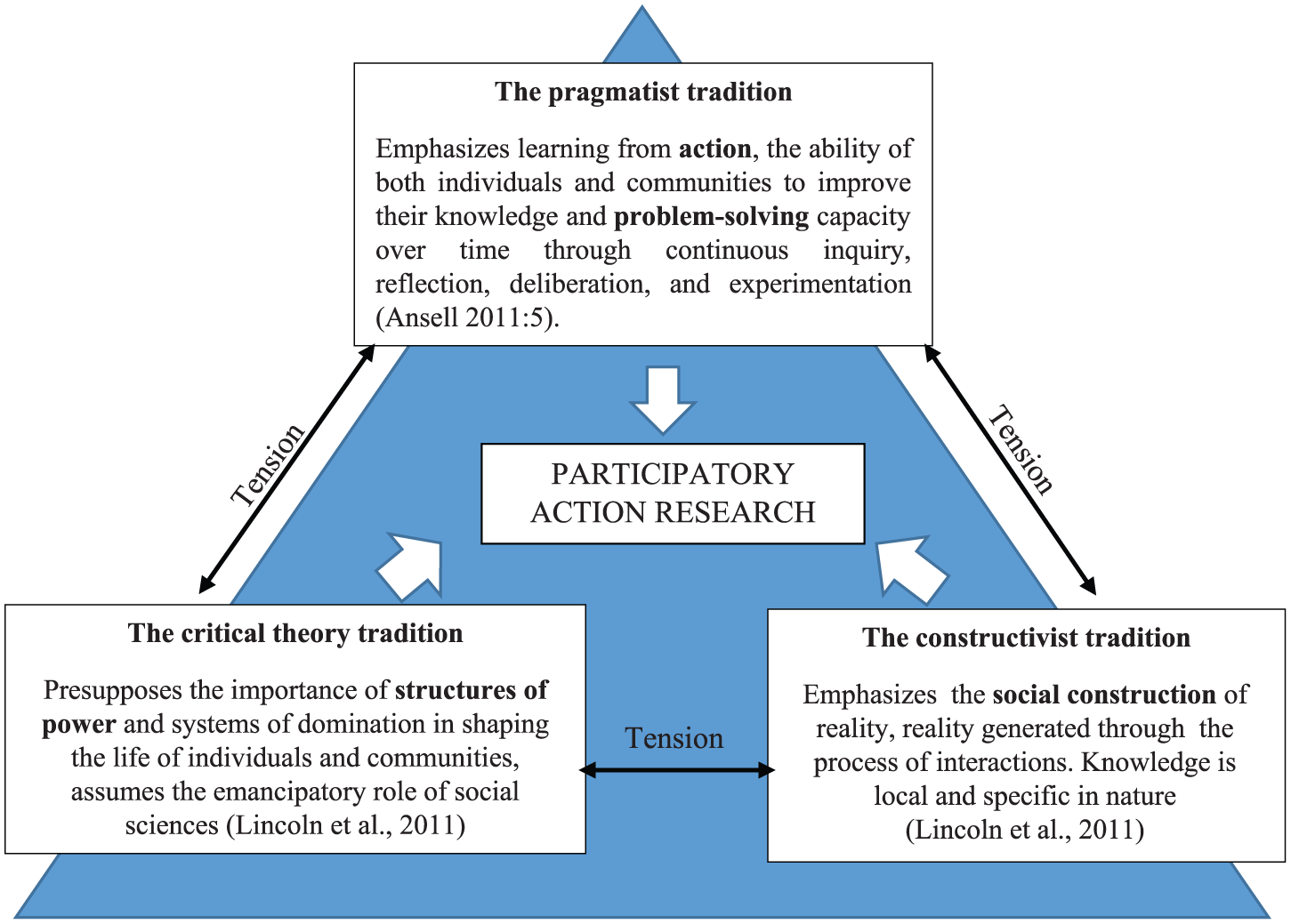
Meta-theoretical approaches present in PAR.
On the other hand, separating the three in the name of purism and consistency raises other problems: those of self-reference and power. Logically speaking, a consistent use of critical theory results in imposing the domination framework upon those under research and hence leads researchers to the execution of power (Eikeland, 2006). Consistently used constructivism leads a researcher to the crisis of representation questioning the researchers’ ability to ‘truthfully’ describe the perspective adopted by those being studied (Abbott, 2001; Woolgar and Pawluch, 1985). A consistent pragmatist resolves the crisis of representation, thanks to the approach of co-creating knowledge (Johnsen, 2010). But by emphasizing the cooperation and problem-solving action, she risks opportunism, at least until she asks how power asymmetries influence the definition and solution of the problem (Duberley and Johnson, 2009; Jessop, 2011). Hence, a consistent researcher is exposed to the ethical risks of either paternalism (critical theory), relativism, and therefore paralysis (constructivism), or opportunism (Pragmatism).
In the following discussion, I will show how tensions between every pair of perspectives, or within every single perspective, can be resolved (or at least softened) by the use of the third one. I propose to analyze these tensions through the lens of power effects connected to social research and present: (1) between the participatory inquiry and its cultural, institutional, and social environment; (2) within ‘the community’ being studied, which itself is not homogeneous in terms of interests, values, and ability of their realization; and (3) between the researcher and ‘the community’. This kind of anchorage allows to transform the paradigms’ discussion into a creative interplay and useful tool signaling an approaching ethical risk as well as indicating possible ways out.
Research based on the idea of equality and dialogue in the context of hierarchical, non-dialogical culture of an institutional environment
Participatory methods, emancipatory goals, and subversive results of collective inquiry confront dominant non-dialogical discourses, hierarchical modes of governance within private and public spaces. These institutional arrangements mirror and support the relations of power in a particular time and place, privileging purposive and non-purposive actions, which petrify them (Mahoney and Thelen, 2010). Hence, the goal and results of critical research are endangered by the problem of inertia. I will first exemplify this problem and then show how it can be answered by the use of a pragmatist approach.
Public discourse of science
Critical researchers perceive legitimacy deficits, displayed in low support and trust toward governments’ or organizations’ decisions and actions, as an important potential for creating pressures for achieving participatory and dialogical approaches in policy making or stakeholder management (Kemmis, 2013). However, the chances to use such an opportunity are limited, until critical, and AR becomes a fully legitimate type of research. And I mean, not (just) within the social sciences, but within the general public.
General public perceptions of plausible social research are deeply rooted in the non-dialogical model of science. The ‘non-traditional’ (participatory, critical) ways of doing research are unpopular (Gaventa and Cornwall, 2013) not merely because they are new, and hence not yet sedimented in social imagination, but because they contradict the legitimized way of performing scientific research. Any versions of AR seen as a scientific tool for enhancing reflexive management or policy making will never gain sufficient legitimacy under the currently dominant model of science due to its basic assumption about the separation of facts from values and knowledge production from knowledge implementation (for further discussion, see Funtowicz and Ravetz, 1993; Nowotny et al., 2001; Pielke, 2007).
Currently, the participants of AR face the consequences of challenging the divisions of labor between knower-researchers and the known-researched (Eikeland, 2006), but their imaginations of social research do not fit imaginations of the AR community. Scholars conducting collaborative research are expected to perform the role of an external academic, who delivers analyses and conclusions and uses tangible tools and devises for implementing direct change in organizations (Arieli et al., 2009; Meyerson and Kolb, 2000; Pedersen and Olesen, 2008). As a consequence, ‘the responsibility for the process [is] not undertaken collectively—the participants participate as guests and not as partners’ (Pedersen and Olesen, 2008: 271–2).
Field specific discourses
Participatory researchers trying to introduce change and facilitate reflection and learning confront discourses dominant in the field of their operation. Conducting research in the non-governmental entities and hospitals, Pedersen and Olesen describe their frustration caused by the inability to open up a dialogue about conflicting interests within organizations being studied. As the main obstacle, they identified specific characteristics of the Danish public discourse which treats discussion of conflicts of interests as ‘out-dated, implying disagreement, old-fashionedness, implying socialism and an unwillingness to communicate’ (Pedersen and Olesen, 2008: 274).
Research works aimed at collective reflection and experimenting are hard to conduct in organizations with performance-oriented commercial cultures—even if the process can potentially bring financial profits. A group of researchers encountered this problem in their collective inquiry aimed at furthering gender equity in a commercial organization (Coleman and Rippin, 2000; Meyerson and Kolb, 2000). The low status of collaborative working meant that senior managers who initially welcomed and supported the inquiry delegated the work to junior staff. Their withdrawal caused a lack of shared understanding of the diagnoses and solutions designed within the working group and in consequence diminished the possibilities to introduce a meaningful change. As Wakeford points out, even those commissioning the exercise of participatory research are no nearer to overcoming the anti-participatory inertia in their organization (Wakeford et al., 2013).
Answers to the inertia: toward radicalization or pragmatism?
The incongruity between dialogical and emancipatory research and the context of hierarchical, non-dialogical culture of an institutional environment has been recognized within critically oriented AR literature. 2 The fact that participatory projects have developed from marginalized efforts on the part of activists and social scientists to a popular rhetoric of policy arenas, and a commercially driven consultation industry, resulted in calls for ‘reclaiming the radical roots’ (Brydon-Miller, 2013; Gaventa and Cornwall, 2013; Lykes and Mallona, 2013; Wakeford et al., 2013).
But researchers who choose the strategy of scaling back to bottom-up approaches of advocacy will also eventually face dilemmas connected with non-dialogical policy-making patterns. Carr persuasively depicted ethical dilemmas connected to this transition. He started his research as advocacy for public skateboarding facilities on the ground level, involving representatives of local communities. To implement change designed within a critical collective inquiry on the bottom level, he made a pragmatic choice and entered the urban policy arena, where ‘political conflict is often negotiated through the production of polarized identities, working in that arena often subjects one’s research community to essentialized and disempowering representations’ (Carr, 2012: 62). These circumstances impede context-sensitive dialogue and the negotiation of solutions in the context of competing interests. He reports experiencing cynicism and frustration caused by attempts to achieve change through the political system and a simultaneous conviction that there are few other options. One of the options would be a reduction in the pragmatist element and withdrawal to the production of, for example, critical ethnography. In the presented case, it would mean giving up hope of having any real influence.
Researchers who find themselves in this kind of dilemma are in fact caught between two perspectives: the pragmatist and the critical one. The first one assumes human willingness to experiment in order to improve practice (Ansell, 2011). The second highlights the importance of structures of power and systems of domination in shaping the life of organizations and individuals. They both say something important, and both followed in isolation lead the researcher to compromise dangerously near to failure, the first to the risk of opportunism, the second to the risk of impotence.
In order to deal with the problem of inertia, caused by institutional arrangements privileging purposive and non-purposive actions petrifying the status quo, one needs to put the approaches of critical theory and pragmatism into the interplay. John Forester explicitly proposes to merge the two approaches into a critical pragmatism. He points out that the pragmatist perspective is exposed to the danger of naiveté, whereas critical perspective to the danger of cynicism: ‘The first assumes too easily the motivating power of abstract ideals; the second assumes too easily that those with power yesterday must prevail today and tomorrow’ (Forester, 2013: 4). A critical pragmatism must not just recognize but also avoid both of these dangers. The action-oriented pragmatist perspective allows to shift the realm of possible and explore what seems to work in practice. It prevents withdrawal and cynicism potentially caused by the confrontation with the inability to fulfill critical promises. The supplementation with the critical perspective delivers check and balance mechanism, preventing from creation of dangerous illusions, which, by ignoring power issues, are reinforcing status quo (Gaventa and Cornwall, 2013).
The second type of research-based relationship involving power: fractal power relations within ‘the community of an inquiry’
Even seemingly homogeneous communities and organizations are characterized by power asymmetries and diversified in terms of values and interests. Thus, the problem-solving action recommended by a pragmatist approach is likely to become problem solving of elites and bolster dominant position within a given research context (Johansson and Lindhult, 2008). The tension between pragmatist and critical assumptions resulted in the evolution of two orientations within AR. The critical orientation includes PAR and is associated with the work of Freire (1970) in its emphasis on the emancipation of underprivileged groups. The pragmatic orientation emphasizes generating local knowledge with practitioners with a view to improving workable praxis, but broadly leaving social relations untouched.
Escaping opportunism: toward critical theory
Some researchers suggest that the two approaches should be used in different contexts. The pragmatist one is more suitable in contexts where ‘concerted and immediate action is needed’ (Johansson and Lindhult, 2008: 95) and the critical one ‘where potentially transformative action is needed but has to be preceded by critical thinking and reflection which should reveal dominant ideologies and coercive structures’ (Huzzard and Johansson, 2014: 85). They further argue that critically oriented AR recognizes tensions and conflicts between interested parties, and the fact that some interests are dominant. To acknowledge such tensions and conflicts through reflective and self-reflective efforts is crucial, as well as giving a voice to unrecognized groups and interests. (Johansson and Lindhult, 2008: 105)
In an attempt to escape the risk of opportunism, critically oriented AR emphasizes reflection over action. Strengthening of the critical ‘leg’ raises the feasibility problem: How to invite those in power to deconstruct and minimize their possibilities to influence the decision-making processes? When we convince them, how do we prevent their domination within the dialogue?
Escaping impossibility: toward pragmatism
In areas of management and policy making, the encouragement for those in power to enter into dialogue would be the perspective of ‘getting things done’ (Schon and Rein, 1994: 157). Thanks to the frame-reflective dialogue on concrete problems, those occupying dominant positions can design more effective solutions. This is because the dialogue and self-inquiry enable them to escape from the trap of their own cognitive biases that prevent them from re-defining their own situation. This is all perfect until those privileged within structures of domination discover that their interests and power are endangered. In order to secure the cooperation of strategic stakeholders, the researchers will need to cut deals, which is outside of their announced role as knowledge and justice seekers. This particularly concerns critical organization researchers, who do not have much to offer in exchange for a permission to enter an organization. So already at the outset, critically oriented AR needs to make a step back in the direction of pragmatism adopting a ‘tempered radicalism’ perspective implying working for a change ‘from within opposing structures’ (Meyerson and Scully, 1995). In the following section, I illustrate these problems considering the example of a critical AR project situated in a commercial organization (Coleman and Rippin, 2000; Meyerson and Kolb, 2000). Interestingly, it proves that the component of action, not of reflection, was able to reveal the mechanisms of domination which prevent change.
Meyerson and Kolb describe how the strategy of a ‘dual agenda’ enabled them to access the research field. While presenting the project to the firm’s management, the researchers argued that the ‘gender lens makes visible how the same assumptions, values, and practices that compromise gender equity often undermine effectiveness as well, despite the organizational purposes they are intended to serve’ (Meyerson and Kolb, 2000: 556). The project gave primacy to critical reflection by delivering gendered interpretations of the work relationships within the organization. Researchers started with interviews in the workplace and then created a niche for a critical inquiry and dialogue over dominant ideologies and coercive structures. Interpretation of the interviews that they have offered resonated with the experience and observation of the work group participants. Despite the fact that professional researchers delivered an alternative discourse of gender equity in order to challenge the dominant discourse of organizational effectiveness, the latter prevailed when an action component was introduced into the project. One of the major reasons was that a dialogue over action plan was penetrated by the mechanisms of power. Some ideas coming from a work group were abandoned without any further consultation to the ‘top’. Participants of the group were predicting that ‘the boss would never agree’ to implement them or were even concerned that the experiment might threaten the jobs of those involved. The infiltration by power was also visible on the level of discourse: As the group and our internal partner worked on [action plan] it increasingly became a high profile presentation with the emphasis on the business benefits and only a passing reference, at our prompting, to the critique and story from which the idea had originally come. This presentation was a completely unprecedented action for this group of staff to take; in the process, they took on roles they would not previously have taken, and communicated with authority across vertical and horizontal workplace divisions in a way that was counter-cultural in the factory. However, by this time, we had all lost the gender focus of the project to such an extent that every time we raised it by asking them what their approach had to do with advancing gender equity, they simply looked at us, puzzled. (Coleman and Rippin, 2000: 583)
The above process illustrates two problems. The first is the gradual displacement of an emancipatory goal from the dual agenda and researchers’ inability to bring it back without disrupting the relationship with the working group. The second problem that emerged within a dialogue space was that the relatively powerless groups spoke in a way that ‘echoes’ the voices of the powerful, whether as a conscious way of appealing to comply with the more powerful parties’ wishes or as a result of the internalization of dominant views and values (Gaventa and Cornwall, 2013: 180). To make things more complicated, researchers began to realize that for the participants the goal of the communication to the rest of the workers was rather the advocation of what they wanted to do than letting people know what they had been discovering (Coleman and Rippin, 2000: 583).
In the project, there was an emphasis on critical thinking and reflection which preceded transformative action, and the subsequent collaborative action was critically interrogated. Despite these ‘critical antidotes’, the pragmatist plan to work from within the opposing structures resulted in a displacement of emancipatory goals. Although the managers were not present in a seemingly protected dialogue space, it was infiltrated by power asymmetries privileging the language of organizational effectiveness over the language of gender equality. Moreover, new power asymmetries were created between those participating in the working group and those who did not. Paradoxically, the open presence of senior staff might give the participants more freedom. But only under the condition that the differences of positions and accompanying consequences would be discussed and worked with openly (Pedersen and Olesen, 2008).
Some observers of critical AR practice question the appropriateness of Habermasian dialogue for critical approaches within AR indicating that in practice it may not live up to its emancipatory aims (Huzzard and Johansson, 2014). In fact, critically oriented AR based on a Habermasian ideal speech situation (e.g. CPAR, Kemmis, 2013) is not well equipped to deal with power asymmetries within ‘a community of inquiry’, especially because they give little attention to the positionality of those who participate and what this might mean in terms of the versions they present (Gaventa and Cornwall, 2013). CPAR conceives an inquiry process as dialogical and intent on opening ‘communicative space so emerging agreements and disagreements and decisions can be problematized and explored openly’ (Kemmis, 2013). The democratic dialogue is aimed at reducing asymmetries in power relations, but there are no suggestions of how to deal with power asymmetries at the outset of the project. Opportunities created by the opening of a dialogue are abused by powerful actors entering the ‘open communicative space’ (Flyvbjerg, 2001; Gaventa and Cornwall, 2013). ‘Open communication spaces’ can be ‘sites of oppression, which may be based on opinions, ethnicity, gender, age, style of dress, disabilities, or supposed lack of knowledge’ (Wakeford et al., 2013). And last but not least, open communicative spaces can create new power inequalities because participants do not necessarily look for knowledge and learning but can use the participation for self-interested oriented strategic purposes. Hence, tools are needed to deal with the ethical consequences of the fact that similarly as in ‘conventional’ research, the research projects are used to develop arguments in the political struggle. The frameworks, like this one of CPAR, should address these kinds of challenges explicitly. To arrive at non-violent communications, critical AR needs a lot of facilitation and mediation between conflicting interests.
As was illustrated, the influence of domination mechanisms became visible when researchers were trying to change them through action. Interestingly, Kemmis’ latest display of the CPAR largely omits the action component, so important to anchoring the enterprise in reality and preventing ‘flight from it’ (Gaventa and Cornwall, 2013; Greenwood, 2007). Shunning away from ‘transformative action’ seems to be typical for critical action researchers in general (Johansson and Lindhult, 2008) which makes them face the risk of leaving power asymmetries untouched and the participants helpless and frustrated.
Pragmatist answer to the impotence
The pragmatist answer suggests two things: communication should be situated in a specific problem and should take place in the ‘natural space of encounter’ (Arieli and Friedman, 2013; Schon and Rein, 1994). Forester (2013), a scholar concerned with practice in the face of power, inequality, and ideology, reflects on mediated public disputes in the following way: [we] might learn from the ways mediators have wrestled with problems of representing parties, tapping expertise, enabling understanding of others and issues, and far more—all that remaining quite distinct from achieving anything remotely resembling ‘ideal speech’, and all quite practically instructive. (p. 7)
Inability to fulfill the empowering potential of AR may cause frustration and cynicism. In order to avoid that, Forester (2013) proposes the following way out: ‘let’s spend less time rediscovering that power of course matters, and let’s spend more time exploring how we can do better—less time presuming impossibility and more time exploring actual possibility’ (p. 7). I partially agree, but add that the exploration of power is important for researchers’ ability to design an adequate methodology and for awareness of the fractal power structures, in which it is intertwined. That is why, when balancing critical and pragmatist approaches, we need to both explore power relations rhetorically and practically. This is also why we need to research (with) both the excluded (remembering that there are excluded among the excluded, asking questions about who is speaking for whom, etc.) and the powerful, trying to balance the power inequalities and recognizing the presence of multiple interest groups.
In conclusion, oppression is complex, nuanced, and unstable. There are internal divisions among the oppressed. Researchers who ignore such divisions are liable to be manipulated and corrupted by the more powerful groups/individuals (including among the oppressed). Therefore, pragmatist assumptions of deliberation and experimenting with cooperatively designed solutions need to be watched by critical considerations of power issues. And the reverse, critical consideration needs to be supported by transformative action, which facilitates reflection over power inequalities and delivers knowledge on what is feasible.
Relation researcher—community: power injected by the researcher
The main dilemma addressed here is encapsulated in the question: How to be a genuine partner to a ‘community’ and simultaneously adopt a critical stance that presupposes the definition of their problem? Within the critical AR literature this question was mainly analyzed in terms of balancing between closeness, which suggests maintaining an ethics of care vis-a-vis the actors in the field (Spicer et al., 2009), and distance, which suggests an ambition to make more critical assessments that can easily compromise the ethical contract (Huzzard and Johansson, 2014; Johansson and Lindhult, 2008). It is suggested that this tension can be managed by breaking the research process into the partly overlapping phases of collaboration, where existing knowledge and practice are explored, and of the critical interrogation, where knowledge and practice of all involved are critically reflected upon (Huzzard and Johansson, 2014). 3 I suggest that this framing, though helpful, is unspecific for critically oriented research. Both pragmatically and critically oriented AR imply questioning local knowledge and practice. The important difference is that in the case of critically oriented AR the questioning takes place on the ground of the framework delivered by a critical perspective, that is, through the use of a domination framework. Hence, critical action researchers are facing the challenge ‘common to social reformers and revolutionaries at all times: By what means can we achieve change and promote our goals, without self-destruction, destroying the realization of our goals through the application of our means, through our own practice?’ (Eikeland, 2006: 44).
Planning my research project I was asking myself, to what extent will my imagination about justice and democracy determine the course of research? I imagined that power may be ‘injected’ into the system by the researcher, who herself executes power, for example, by framing the agenda, and even consciousness. If so, I was wondering whether I was really able to remain indifferent to the outcomes of participatory inquiry or whether I was rather unrealistically hoping that informed and empowered stakeholders would turn out to be liberal, egalitarian, environmentalist, and collective in their orientations (Jordan, 2007). What will I do if they won’t? This is where constructivist ambitions to explore authentic local knowledge are endangered by a critical perspective, which imposes a framework for the problem definition. This is on the level of relations between the researcher and the community, where intrinsic tensions within the critical and constructivist approaches become potent.
The value-laden and culturally biased assumption underlying the critical perspective is that it is better to strive for emancipation (and for responsibility for one’s own fate) than to stay dependent and dominated (leaving responsibility for one’s own fate to more powerful others). It may well be that some community does not share the radical (emancipatory) views of the researcher (e.g. see Arieli et al., 2009). Calls for emancipation and empowerment are culturally biased not only in the ethnical sense (Grant et al., 2013) but also in terms of class. Participation and dialogue are concepts designed by and for ‘professional talkers’ and middle and higher class representatives (Jordan, 2007). Representatives of ‘lower’ classes may feel uncomfortable when forced to enter the discussion, and they are willing to pass over the responsibility for the representation of their interests to representatives in the traditional sense of a representative democracy. Should the researcher recognize and respect these kinds of views or instead treat them as a display of false consciousness?
The call for respect and autonomy of individuals grounded in critically oriented AR strongly connects with the constructivist approach. It requires the researcher to respect the conservative thought of a community/individuals. Are researchers calling for ‘reclaiming the radical roots of AR’ ready to respect the conservative perspective and sensibility? The constructivist perspective helps to expose an intrinsic problem within the critical theory. Referenced to itself the critical approach leads toward self-destruction.
Escaping paternalism: toward constructivism
So, the participatory researcher entering the field of study employs the third dimension of power, in Lukes’ (2004) sense. That is, she becomes a subject exercising power by presupposing the framework for the definition of the problem. Many researchers sensing the tension within the critical perspective are trying to frame their research in constructivist terms (e.g. Grant et al., 2013; Hilsen, 2006). It enables them to claim that what they are doing is ‘illuminating human experience’ and undermining relations of power, through facilitating individuals in exploring relations of power in their lived experience (Grant et al., 2013). This, however, does not solve the problem since facilitation is inevitably an enactment of power (Kristiansen, 2013; Olesen and Nordentoft, 2013), more or less conscious, and selective encouragement of certain lines of interpretations, which in turn influence the perception of interests (Schon and Rein, 1994). To what extent does this facilitation impose the researchers’ conception of the best interest of the parties involved? The critical perspective is questioned by the constructivist one. Unfortunately, consistently adopted constructivism informs researchers that they will never be able to produce knowledge reflecting something more than their perception of ‘reality’ (Abbott, 2001; Woolgar and Pawluch, 1985). This in turn exposes a critical researcher to the risk of relativism and hence paralysis.
Escaping paralysis: toward pragmatism
One possible way to escape this tension is to make the researcher’s agency, values, and agenda (such as the need for publications) visible and open to negotiation. All reports from the project are then perceived as objectifications achieved in the process of interaction between a professional researcher and ‘community’ representatives (Johnsen, 2010). In this sense, the pragmatist approach to AR, concentrated on the co-production of knowledge through problem solving and experimenting, comes to the rescue as a ‘third way’. In fact, both pragmatically and critically oriented AR imply that the role of research is not only to listen to the practitioners’ voices but also to be critical and provide contrasting images, reveal new perspectives, and problematize established conventions (Greenwood, 2007; Huzzard and Johansson, 2014).
Escaping the tension between the constructivist and critical perspective, we are moving in the grounds occupied more strongly by pragmatism and constructivism than by critical theory. We are not safe here either. By restraining ourselves from attempts to introduce power and domination into discussion, we are risking that they will not be discussed at all because participants themselves may avoid difficult, threatening, and painful issues. And by doing this, they may ‘unintentionally contribute to the ability of the dominant group to maintain power and perpetuate inequality while preaching coexistence’ (Gawerc, 2006).
And here we are at the center of ethical issues. The researcher who is directing individuals into the emancipation becomes responsible for its consequences. To be consistent, one should either take the responsibility and accompany given individuals/community on their long way to emancipation or start research only when explicitly asked by the community (and after making them aware of the possible risks). Usually, the length of the research projects financed by scientific institutions is very limited. Usually, the researcher approaches the community, not the other way around. Usually, the community does not really know what it agrees upon when it lets the researcher ‘in’. This is partially due to the dominating imaginaries of social research, complying with ‘traditional’ approaches, and partially due to the inability to predict unintended, adverse consequences. Long-lasting commitment can be in conflict with the researchers’ agenda which is connected with the pursuit of degrees, publications, and funding for new research projects. Dillon (2014) asks a relevant question in his self-inquiring analysis of relations of power in his AR project: ‘research topics that would have unreasonably extended the completion of my degree were taken off the table. However, what if those other options were more beneficial to the [community]?’ (p. 11).
Grant et al. (2013) emphasize the imperative of taking the responsibility for possible risks inherent in the commitment to change the world. This is very true, but it needs to be highlighted that the risk is to be borne mainly by the community, not by the researcher. That is why the researcher’s power must be accompanied by responsibility. An analogy with psychotherapy is useful here—once one decides to work on peoples’ consciousness in order to change it, one cannot leave them unless they are able to cope with their problems alone. Leaving ‘the patient’ without care in the middle of therapy is one of the worst displays of being an irresponsible therapist.
But then again, diving too deep into consideration enhanced by critical and constructivist approaches can be paralyzing. Those who decide to perform critical research involving ‘real people’ should not push those problems aside, but should act with careful consideration of them. Here in turn, what comes to the rescue in the stalemate is the pragmatist perspective. Research should be concentrated on problem solving and action, looking for ‘what works’ not just on participation and communication of new voices and categories. Critical and constructivist perspectives are important for ethical considerations and research design, but it seems that the pragmatist perspective is the leading one for the actual working of critical AR. But even then, ‘what works’ depends very strongly on interests, and so should be taken as the beginning of a reflection and not the end.
John Carr’s conclusions on the ethical consequences of research as advocacy can serve as a good example here. His alignment with the disempowered group strengthened its voice within the urban policy arena. Reflecting on the consequences of his involvement, he draws a largely overlooked conclusion: in the world of finite resources, a victory for ‘us’ always has the potential of coming at ‘their’ expense. Thus, by strengthening one party in the democratic process, we diminish the possibility of other parties realizing their values and interests. The ‘covenantal ethic’ usually adopted by action researchers, but in fact also by critical researchers in general, indicates that the researcher’s work is based on caring relationships between the researcher and researched, with a shared commitment to social justice and cogeneration of knowledge (Brydon-Miller, 2013; Hilsen, 2006). Carr raises the problem, what are our ethical commitments to the communities/interest groups/individuals outside of our collective inquiry? He proposes the extension of ‘covenantal ethics’ to those with whom we compete in the political arena: While we cannot abandon political advocacy work, a commitment to ‘fairer power relations’ and ‘human interdependency’ means taking different and opposing perspectives seriously […] a truly covenantal ethic requires not only trying to understand other voices in the political arena, but to count those voices among the constituency that we seek to serve. (Carr, 2012: 75)
His conclusions may be especially important for the critical researchers exploring the affinities between the aspiration of CMS and social movements and the possibilities of forging connections that could be mutually strengthening and enriching (Alvesson et al., 2009).
While conducting critical AR, researchers are the organizers of the process, who actively manage power differences in order to seek missing voices. One cannot fully comply with the constructivist ideal while doing this. A researcher’s knowledge and perception is there, inside of the co-produced knowledge, and she needs to face the risks and responsibilities connected to it. Since the researcher does not observe the objectification process, but actively participates in it, her constant reflection-in-action and reflection-on-action build a safety network, protecting her from failures and helping to balance irresolvable dilemmas. Not recognizing, and therefore not dealing with, one’s own agency, values, and interests in the process has important and negative consequences for both ethics and the quality of research.
Conclusion
Critical scholars have discussed paradigmatic tensions and power issues for decades. I argue that a simultaneous exploration of the ways in which power infiltrates the critical (action) research, and of meta-theoretical tensions, creates a heuristic structure which gathers these problems together and enables the systematic exploration and management of uncertainty and ambiguity of a research process.
To deal with the problem of power infiltrating critical AR in the three aspects—the relationship between research and the institutional and cultural context, the relationships within the community of inquiry, and between the researcher and the community—one should cultivate a flexible repertoire of responses balancing pragmatist, critical, and constructivist traditions. In this way, strategies can be combined and rebalanced to reduce the likelihood of failure, which could have consequences either for ethics or for the inability to introduce change, and most probably for both. As illustrated in the analysis, when confronted with the problem of power each of the perspectives is prone to produce specific failures and at the same time delivers important insights into emancipatory enterprises. The pragmatist perspective is exposed to the danger of naiveté or the risk of cynicism while assuming problem-solving action without taking into account power asymmetries. The critical perspective is exposed to the danger of cynicism and the risk of impotence while assuming the universal character of domination and hence refusing cooperation with those in power. Moreover, it is also exposed to the risk of paternalism while presupposing the definition of the problem and refusing to accept the conservative sensitivity. The constructivist perspective is exposed to the danger of relativism which connects to the risk of paralysis. The weakness of each perspective is exposed and can be managed with the use of the other. Figure 2 summarizes the exemplary flows between perspectives which together create the safety network for the scholar trying to navigate between these risks.
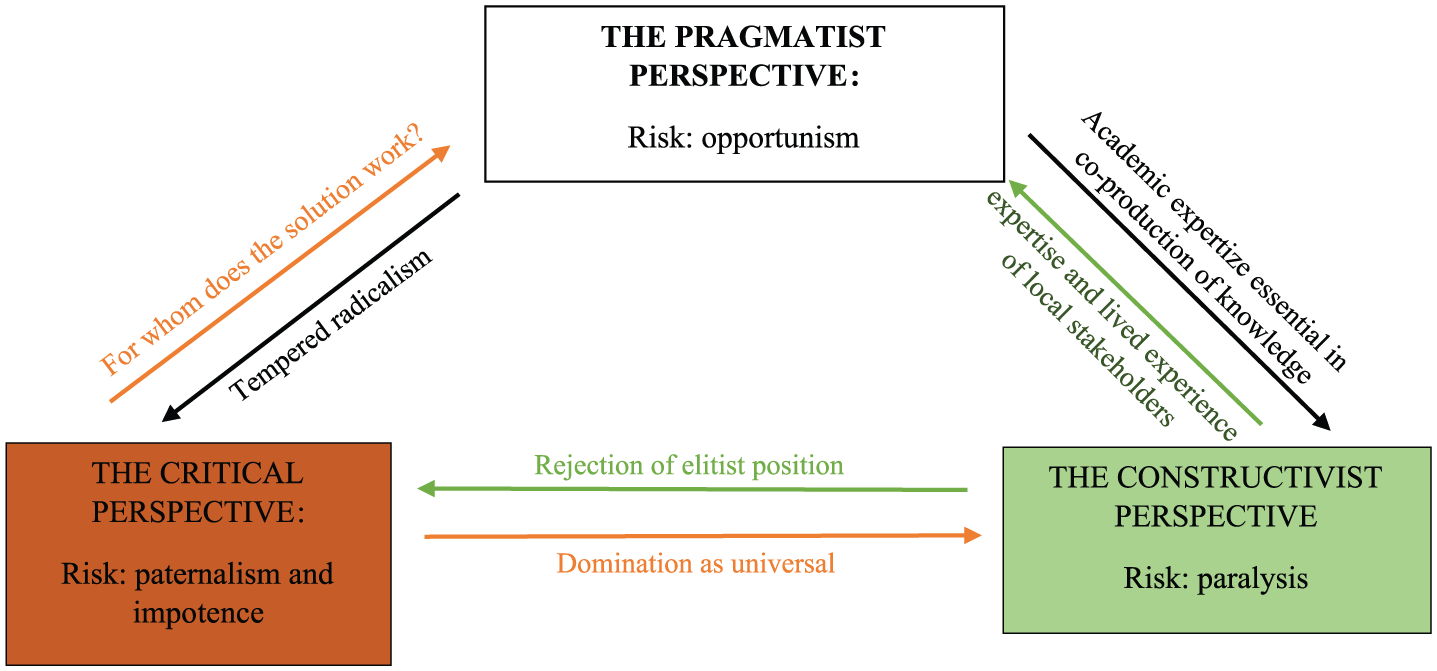
Navigating between perspectives.
Hence, the process of research can be described as a constant attempt to avoid failures resulting from the increasing dominance of any of the three perspectives. The failures will not disappear because they are embedded in tensions which are irresolvable by their own nature. We can cope with them using pragmatist thought as a leading point of reference, that is, by adopting a pragmatist attitude of irony. Jessop (2011) describes this type of attitude in the relation to governance practices, but they can easily be adapted to any participatory critical inquiry: The ironist accepts incompleteness and failure as essential feature of social life but acts as if completeness and success were possible. She must simplify a complex, contradictory and changing reality in order to be able to act—knowing full well that any such simplification is also a distortion of reality and, what is worse, that such distortions can sometimes generate failures, even if they are also a precondition of relatively successful interventions to manage complex interdependence. (p. 119)
The radicalism of critically oriented AR originating from the critical perspective should be tempered by conclusions drawn from the pragmatist perspective (action orientation—working within the system) and from the constructivist perspective (appreciating and respecting diverse realities and commitments). However attractive it may be for the researcher, the temptation of simplistic radicalism should be resisted. Putting it simply, critically oriented versions of AR should be critical in its aspirations, pragmatic in its practice, and constructivist in its understanding of its self, context, and tasks.
Footnotes
Acknowledgements
I am indebted to Steve Rayner for his hospitality at the Institute for Science, Innovation and Society, University of Oxford, and for very useful comments on earlier drafts of this paper. I also should like to thank Victor Friedman for critically important remarks and Sophie Haines, Frank Pot, Darek Jemielniak, Julian Kutyła, Emilio Marti, Karolina Mikołajewska, and Krzysztof Obłój and the three anonymous reviewers for constructive comments. But first and foremost, I am grateful to Jerome Ravetz for extremely helpful discussions of content and style.
Funding
This research was conducted as a part of a research grant funded by Ministry of Science and Higher Education and Kozminski University.