




Abstract
In the wake of the Beirut blast, we use Lebanon as an empirical context to examine how a group of scholar-activists organized to support ongoing collective action in the context of creeping crisis. Using the lens of resourcing theory, we provide a process model of resourcing agency as a fractal and embodied form of critical action, augmented and transformed by critical reflection, and collective healing and striving. We make four contributions. First, we demonstrate why organizational scholarship needs to attend to the increasing relevance of creeping crises and we model an approach to understanding both the lived experience of creeping crises and the implications for the situated cultivation of agency. Second, we extend resourcing theory by uncovering resourcing agency as an integral, embodied process in the context of crisis, particularly creeping crises, and show how it is itself a vital instantiation of agency. Third, further extending resourcing and process theories, we identify two types of ampliative cycles (sustaining and transformative cycles) implicated in resourcing agency when organizing in support of collective action amid creeping crises. Finally, our findings demonstrate the benefits of using a processual approach that attends to the embodied and fractal nature of action in creeping crises and other extreme contexts. We close with a discussion of the implications for engaged scholarship as a framework for action.
Keywords
Introduction
The new millennium has made salient a distinct class of crises that are not discrete punctuated events, but rather protracted contexts of increasing risk and societal fragility. Some organizational scholars suggest that as “the fragility of our world becomes ever more apparent,” management research on crises is now “a matter of life or death” (Hällgren, Rouleau, & de Rond, 2018). Yet, Scranton (2019), writing of the protracted social, economic, and environmental crises to be ushered in by climate change, asserts “the conceptual and cultural frameworks we have developed to make sense of human existence over the past 200 years seem wholly inadequate for coping” (para. 16) with them. His indictment applies more broadly to various “creeping crises,” accreting threats to life-sustaining systems that can give rise to acute crises (Boin, Ekengren, & Rhinard, 2020, p. 120), including pandemics, authoritarianism, forced displacement, and other types of socio-economic disruption that contribute to what the World Economic Forum calls “the deteriorating global outlook” (World Economic Forum, 2024, p. 6). Much of the organizational literature focuses on discrete crises, leaving underexplored the chronic, accreting nature of creeping crises (Dror, Lagadec, Porfiriev, & Quarantelli, 2001). We aim to extend the treatment of this type of crisis in organizational research.
This is needed for two reasons. First, although some recent management research reconceptualizes crisis either as a sequence of connected events (Roulet & Bothello, 2022) or an unfolding process (Williams, Gruber, Sutcliffe, Shepherd, & Zhao, 2017), it has not adequately engaged with the socio-historical embeddedness and endogeneity of creeping crises (Pforr & Hosie, 2008; Vaara & Lamberg, 2016). Second, prevailing conceptualizations focus on understanding the efforts of existing organizations to mitigate the consequences of grave disruptions to a functional system and return to normal operations. In creeping crises, where the antecedent conditions both exhibit and propagate risk and dysfunction, the goal for those not served by the dysfunction is transformation, not restoration, of the system.
Responding to the call for this special issue, we employ a process-oriented perspective (Langley, Smallman, Tsoukas, & Van de Ven, 2013; Langley & Tsoukas, 2010; Nayak, 2008) to ask: In a socio-historical context characterized by creeping crises, how do people organize in support of ongoing collective action? We find that the “multi-faceted doings that underpin” (Cloutier & Langley, 2020, p. 5) such organizing for a better future (Simpson, Harding, Fleming, Sergi, & Hussenot, 2021) are embedded in and constituted through a “web of dynamic relations” that are infused with people’s shared lived experiences (see Langley et al., 2013). By examining how a group of scholar-activists promote a new social order against the backdrop of creeping crises and a “flare-up” of huge proportion, we address some of the gaps in the organizational literature vis-a-vis the increasingly common challenges of creeping crises (Boin, McConnell, & ‘t Hart, 2021) and make the following contributions. First, we model an approach to understanding the lived experience and embodied nature of agency in settings characterized by creeping crises. Second, we extend resourcing theory by uncovering resourcing agency as an integral process in the context of crisis, particularly creeping crises, and show it is itself not only a vital instantiation of agency but perhaps the very apotheosis of agency. Third, further extending resourcing and process theories, we identify two “ampliative cycles” implicated in resourcing agency that sustain and transform organizing in support of ongoing collective action amid creeping crises. Finally, our findings demonstrate the benefits of using a processual approach that explicitly attends to both the embodied and fractal nature of action in creeping crises and other extreme contexts.
In Lebanon, our empirical context, a corrupt, clientelist regime has begotten political oppression, grinding poverty and economic dependency, and a chronic pattern of thwarted agency for change (Daouk-Öyry, 2023; Geha, 2019; Karam & Afiouni, 2021). There, on 4 August 2020, an epochal explosion at Beirut’s port killed 217, injured more than 7000, and displaced over 300,000. The next day, a grassroots recovery and social change initiative started to emerge. Khaddit Beirut (KB), which in Arabic means Beirut’s shake-up, included many scholar-activists living in Beirut who had for some time been researching and working on various societal problems in the country. Many were known to each other, either personally or by reputation; some were very closely connected through their affiliation with the American University of Beirut (AUB). Our work, starting less than a month later, provides a real-time inquiry into how they organized in support of ongoing collective action in such a context (Creed, Gray, Höllerer, Karam, & Reay, 2022; Geha, Kanaan, & Saliba, 2021).
We found that understanding KB’s organizing could not be disentangled from the participants’ shared lived experience of oppression and suffering nor from their shared understanding of the context. KB’s collective organizing, and its resourcing (Feldman & Worline, 2012), leveraged a shared critical consciousness rooted to a large degree in those experiences and the bonds forged through them. That critical consciousness (Freire, 1973)—a deep understanding of the conditions underlying the inequities of Lebanon’s creeping crises that compels action—animated their ongoing organizing for breaking the cycles of oppression and dependency. We thus found that critical consciousness is integral to support organizing for ongoing collective action in such creeping crises.
In what follows, we situate our inquiry in scholarship on organizing amid crises, integrating resourcing theory within a process perspective. We then present our research context and methods, followed by findings and a discussion of our contributions, and close with implications for engaged scholarship.
Theoretical Framing
At the outset, it is important to note that we undertook this research first and foremost to support KB’s organizing in response to the acute crisis that brought Beirut to its knees and changed the lives of four of the authors, their families, colleagues, and communities. Hence, we approached our theorizing abductively, acutely aware of the ways trauma, persistent oppressive conditions, and a history of thwarted activism shaped KB’s emergence. We were conscious of Lebanon’s creeping crises before we knew there was a theoretical label for them (Kistruck & Slade Shantz, 2022). Lived experiences of those creeping crises informed the theorizing.
Expanding organizational research on crisis: Creeping crises
The realities of creeping crises have been, at best, only hinted at in the organizational literature, where research has relied on two conceptualizations (Williams et al., 2017). The first, “crisis as an event,” has viewed crises as rare, high-impact situations that critical stakeholders agree are threats to an organization’s important values or viability. This “parochial focus” views crises as “singular disruptions,” isolated in space and time and brought about by a discernible cause (Roulet & Bothello, 2022). Hence, when facing a crisis, organizations need to take action, such as: the attribution of urgency (Spector, 2020); sensemaking regarding organizational purpose and direction (Maitlis & Sonenshein, 2010); and leaders’ efforts to “cultivate hope, build trust, and ensure safety for those whom one leads” (Gigliotti, 2020, p. 561). Consequently, this largely managerialist perspective attends almost exclusively to expeditious efforts to remediate any disruption and return to an “alignment,” while not attending adequately to how the crisis emerged in the first place (Williams et al., 2017).
In the second conceptualization, crisis-as-a-process, crises have “genealogies” comprising: antecedent conditions, dynamic periods of organizational weakening and missed signals, and “triggering” events (Roux-Dufort, 2009, 2016). Here the focus has been on organizational progression through response stages in a manner that is “formulaic, sequential, and based on a bureaucratic model, in which planning, preparation, and hazard mitigation are coordinated through a centralized decision-making entity” (Williams et al., 2017, p. 736). While the second attends to palpable temporal omissions of the first, both focus on existing organizations as at-risk actors and their bureaucratic responses to singular events. Both assume the goal of attempting “to bring a disrupted or weakened system at any stage of crisis
In contrast to singular, acute crises, Boin et al. (2020) conceptualize a creeping crisis as accumulating threat to “societal values or life-sustaining systems that evolves over time and space, is foreshadowed by precursor events, subject to varying degrees of political and/or societal attention, and impartially [sic] or insufficiently addressed by authorities” (p. 122). 1 A “special species of trouble” (Boin et al., 2020, p. 118), creeping crises are easy for some in power to ignore or deny. Their intermittent flare-ups are often misinterpreted as discrete events, instead of as symptoms of a protracted creeping crisis or as concatenated, related events (Roulet & Bothello, 2022). Creeping crisis is an important conceptual complement to the prevailing perspectives, neither of which recognizes that ostensibly singular events are, at times, symptoms of a system that enables the ongoing accumulation of grave risk and the sedimentation of painful lived experiences. Over time, the lived experience of creeping crises, both as socio-historical contexts and as sources of accreting risk and disruptions, inevitably shape the sedimented concerns that animate collective action for social change (Creed, Hudson, Okhuysen, & Smith-Crowe, 2022).
Recently, organizational scholars have offered perspectives that, at least in part, serve to help crisis researchers attend to endogeneity and embeddedness in specific socio-historic contexts and the implications for organizing for collective action in crisis. For example, Roulet and Bothello (2022) have theorized a “trickle up” process where a sequence of micro-level responses mediates the relationship between a chain of interrelated crisis events and a succession of macro-level outcomes. Writing on extreme contexts research, including crises, Hällgren et al. (2018) call for greater contextualization of the processes that unfold in extreme contexts. Emphasizing their potential for intolerable physical, psychological, or material consequences, Hällgren et al. (2018) argue that coping with extreme contexts is an embodied experience, and following Wacquant (2015), call for particular attention to the roles of sentience, suffering, and skill: [People] are sentient: they are capable of feeling and conscious of those feelings, they suffer, and they are skilled. This ability to sense, suffer, and perform skillfully is sedimented, meaning that it is cultivated over time through engaging in the world, and situated in that those sentiments themselves are “shaped by our unique location and peregrinations in physical and social space” (Wacquant, 2015, p. 3). . . . it is only by exploring how these elements work in concert through time and space that one begins to take “full epistemic advantage of the visceral nature of social life” (Wacquant, 2005, p. 446). (Hällgren et al., 2018, p. 142)
Thus, while they expressly emphasize the importance of understanding the processes that unfold in extreme context, their use of Wacquant implies equal importance for understanding the situated cultivation of agency.
In our research, this means attending to the lived experience of creeping crises as punishing contexts and the consequent sedimentation of suffering, animating concerns, and situated coping skills. This also means interrogating how the twin processes underpinning critical consciousness—critical action and critical reflection (Conlin, Douglass, Moradi, & Ouch, 2021)—are implicated not only in how people organize to redress the conditions that constitute creeping crises, but also how they actively seek to instantiate alternative ways of being (Kouamé & Langley, 2018). Consequently, we take a process perspective seeking to understand “the world from within based on the richness of lived experience . . . constituted by ongoing processes” (Cloutier & Langley, 2020, p. 3).
Resourcing: A critical process in challenging creeping crises
Creeping crises beget situations where resource pools are not only unevenly distributed and contested (Creed, Gray, et al., 2022) but where established patterns of inequitable access to resources effect challengers’ efforts to manipulate and mobilize resources (Edwards & Gillham, 2013). Resourcing theory offers a processual take on resource mobilization. Here, resourcing refers to “the creation in practice of assets such as people, time, money, knowledge, or skill; and qualities of relationships such as trust, authority or complementarity such that they may enable actors to enact schemas” (Feldman, 2004, p. 296).
The theory focuses on the skillful use of potential resources, rather than their mere availability (Wiedner, Barrett, & Oborn, 2017), and on “how organizational members take up and use assets as they pursue activities in line with what they wish to make happen in the world” (Feldman & Worline, 2012, p. 630). In other words, resourcing entails the practical transformation of assets or “potential resources” into resources-in-use through using them to energize action schema or frameworks. Indeed, potential resources or assets become resources-in-use only when they are used to enact a framework. Once paired, “a resource in use is altered at the same time that the resource in use continuously alters the nature of the framework it is used to energize” through “mutual adjustment” (Feldman & Worline, 2012, p. 632). Particularly important for our research is that such ongoing processes of adjustment can become “ampliative cycles” of “endogenous resourcing” wherein a “resourced framework”—one that has already been energized through creative pairing with resources-in-use—becomes available for use as a new potential resource for still other purposes (Feldman & Worline, 2012, p. 638). Ampliative cycles create more, and potentially better, resourced frameworks. Ampliative cycles epitomize the processual nature of resourcing theory.
Thus, we next turn to process theory as a meta-theoretical lens for both our theorizing and our methods.
Process theory and understanding organizing from within
Examining organizing from a process theory perspective emphasizes the dynamic, ever-changing nature of social phenomena. As Nayak and Chia (2011, p. 283) state, process theory “privileges process over end-states, becoming over being.” Similarly, Cloutier and Langley (2020, p. 19) state: “processes are viewed as complex arrangements of multiple individuals and groups of individuals interacting at different levels and different proximities, between themselves and with various objects in an ongoing manner, over time.” They point out that a strong process perspective leads to theorizing in which “elements are more fully entwined, enmeshed and joined together [and] traditional conceptual tools such as boxes and arrows become potentially useless” (Cloutier & Langley, 2020, p. 19). Process theorizing, consequently, involves finding a way to represent such complexity parsimoniously. This involves a combination of disentanglement and the adoption of “entirely different mediums of expression—such as narratives, metaphors or poetics (Tsoukas, 2017)” (Cloutier & Langley, 2020, p. 19). Following this, we shift our attention from fixed constructs to explicating “dynamic entanglements” to foster a deeper exploration and understanding of the intricate webs of relations and interactions among the elements that underpin organizing processes.
Of the many possible approaches to process theorizing, narrative and instantiation approaches are particularly relevant to collective action. Narratives involve temporal chains of interrelated events and characters’ actions (Gabriel, 2004) that ground processes for envisioning and enacting the future (Rantakari & Vaara, 2017). Narrating has a key role in constructing collective interests, leveraging resources towards a common goal, and “link[ing] these constructions to organizing and organizational phenomena as they happen” (Rantakari & Vaara, 2017, p. 277). As a complement, an instantiation approach probes how discrete actions directly constitute phenomena and processes, promoting “a deep understanding of the significance of micro-level interactions that are often understudied, [how] they can be consequential . . . [and] how micro processes and macro-outcomes can be simultaneously accomplished through the same micro-level actions” (Kouamé & Langley, 2018, p. 573). In integrating the process perspective with resourcing theory, instantiations are, effectively, enacted resourced frameworks.
Pulling these threads together, our research question can be restated as: How do actors transform potential resources, including existing resourced frameworks, into new resources-in-use capable of energizing new frameworks for ongoing collective action in the midst of creeping crises? More concretely, how do actors use existing resources (e.g., skills and expertise, familiar approaches to challenges, established relationships) in new ways to capacitate and sustain collective action amid creeping crises? In terms of creeping crises, little is known about the processes needed to generate new capacities for action commensurate with the needs of crisis circumstances. Based on our analysis, we conceptualize organizing in support of ongoing collective action in creeping crises in terms of resourcing agency itself. We find that, amid the trauma stemming from the blast, resourcing agency was an embodied, visceral process that drew on members’ lived experience of creeping crises and suffering to bolster their critical consciousness, resolve, and capacity for action through repeated cycles of critical reflection and critical action and of collective healing and collective striving. It involved entangled resourcing processes and ampliative cycles that fostered fractal, multilevel instantiations of agency.
Research Context and Methods
The activities underpinning this article were sparked by tearful phone calls in the hours after the explosion on 4 August 2020. The real-time data were collected for the purpose of supporting KB’s organizing in response to the acute crisis. Four of the authors (referred to as scholar-activists hereafter) purposefully engaged three additional authors (referred to as the documentarians) to document KB’s emergence through ongoing interviews intended to support strategizing and execution of impact-oriented initiatives, to foster learning, and to capture lessons learned in the interest of helping others address crises. Through the interview process, the documentarians pivoted into partners, participating in critical reflection on successes, setbacks, and other events, and deliberating on subsequent actions.
The process perspective
Before recounting our circuitous methodological journey, it is important to position our methods within a process ontology which emphasizes the complex and dynamic lived experiences of organizing. A process ontology resists reductionist (e.g., linear, hierarchical) approaches that risk reifying social phenomena, instead fostering appreciation both for differences in kind and for the union of the general and the individual (Nayak & Chia, 2011). To leverage this perspective, we adopted several moves advised by Langley et al. (Cloutier & Langley, 2020; Langley et al., 2013). Our analysis eventually came to focus on narratives in which participants recounted events and activities that instantiated various ways of organizing for and resourcing ongoing collective action in creeping crises. This approach helped uncover not only their specific “doings” in creeping crisis, but also the traces of the processes of sedimentation and cultivation behind the respondents’ collective capacity to “sense, suffer, and perform skillfully” (Wacquant, 2015, p. 3).
Data collection
Over the seven months immediately after the blast, the documentarians interviewed 11 founding members of KB (referred to as participants), including the four scholar-activists on the authorship team, every four to five weeks, yielding 49 semi-structured interviews (45 individual and four group). Participants were selected from leadership roles, either members of the secretariat responsible for setting KB’s general direction or leaders heading efforts in four focal areas (the impact initiatives). In the first interviews, the participants were asked about conditions and events leading up to the blast, including their prior activism; the day of the explosion; their experiences, emotions, and mental state in the wake of the blast; and KB’s formation. The interviews became a cathartic space for periodic reflection on the process of organizing. In each successive interview, participants reported on their activities, accomplishments, and setbacks since their prior interview, and their perceptions of KB’s evolution over time. Participants were also asked to reflect on what they had learned, how their thinking had developed or changed, the trajectory of their emotional and mental states, what they hoped to accomplish in the next month, and what they wanted to discuss in their next interview. Each interview lasted around 90 minutes. The interviews were transcribed and analyzed using Nvivo V12.
The interview data was supplemented by archival data generated through KB’s operations (e.g., minutes, strategy documents, grant proposals, and a series of essays capturing collective critical reflections on socio-political events and conditions entitled “Breaking the Cycle”). The documentarians also observed virtual meetings of the secretariat and a January 2021 retreat for all KB members.
Data analysis
All authors were involved in the coding process. Considering the intertwined nature of the data and authorship, we followed an iterative process of eight steps (Figure 1) aimed at minimizing potential individual bias in recollection or interpretation, maximizing collective understanding of events, and conceptualizing interview content in terms of existing theory. The dashed arrows in the figure refer to the co-development of the first interview protocol by documentarians and scholar-activists, followed by a long period of data collection. The figure then depicts iterations of horizontal arrows representing periods of independent coding, followed by curved arrows representing collaboration and multiple iterations of coding, member checks, and revisiting the literature before consolidating templates. Below is a description of these steps. Given the role of the scholar-activists inside KB, these meetings were tantamount to taking interpretations back to participants in a form of enhanced member checks (Chase, 2017). They also served as a counterbalance to overweighting the insider perspective through constant juxtaposition with the documentarians’ interpretations, coding, and analysis. This same process also helped stem any individual voice from being overrepresented in our analysis and theorizing.
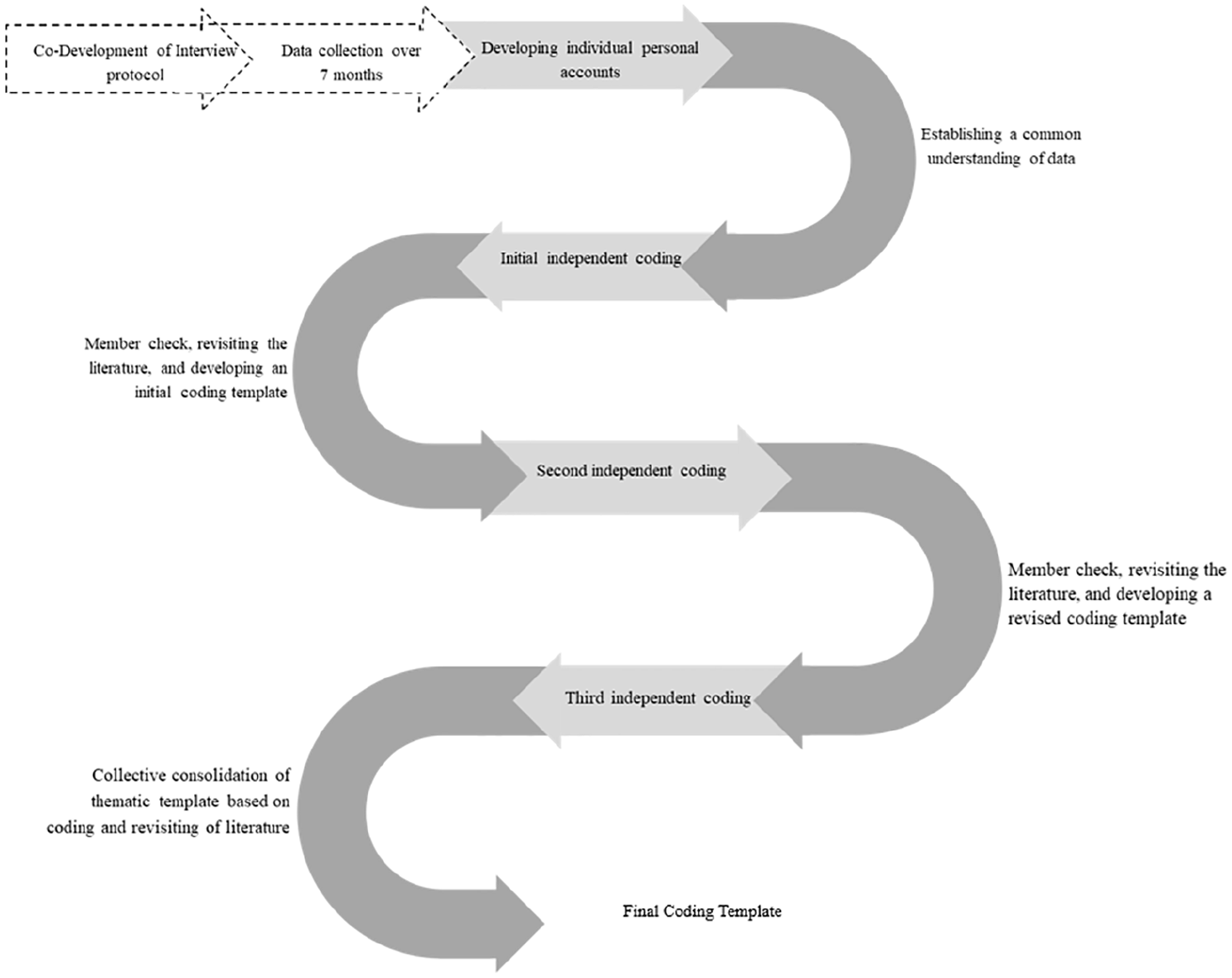
Data coding process.
Developing individual personal accounts: Establishing common understanding of data
As a first step, using a standard template, a qualitative personal account of each of the 11 participants’ roles and experiences in KB’s first seven months was drafted by one of the authors who had reviewed all interview transcripts for that participant. These draft accounts familiarized everyone with each participant’s personal perspective and ensured consistency in authors’ initial interpretations of data and identification of provisional themes. To ensure these accounts were grounded in the data collected through the interviews, the four scholar-activists did not write their own accounts.
Initial independent open coding, coordination, and provisional coding template
After each author independently coded interviews for key emergent themes, the team convened to reflect on the theories that could inform the coding results. KB was conceptualized as an emergent effort committed to putting expertise into action to aid a community in distress. This led to a sequence of aborted theoretical excursions, ranging from institutional and social symbolic work to resource mobilization theory through the various iterations outlined below.
Subsequent independent coding and recalibrated coding template
After another round of independent coding, we regrouped to consolidate our findings, resolve discrepancies, and assess our initial theoretical framing. We had identified clusters of activity related to how KB members were able to mobilize resources in a resource-scarce context. Returning to our research question of how actors organize to support ongoing collective action, we turned to Kornberger’s (2022) systematic review of collective action from which we determined that the social movement perspective was the most appropriate for our work. This led us to adopt resource mobilization theory (Edwards & Gillham, 2013; Edwards, McCarthy, & Mataic, 2018). Using Edward and Gillham’s (2013) typology of resources, we recoded our data by type of resource mobilized. We found that KB’s members drew not only on established resource types in their efforts, but also on an additional type of resource not easily captured in the existing theoretical typology, which we provisionally called embodied resources and discuss below.
Final round of coding and analysis
At this point in the review process, we received feedback that many of our core insights—the salience of agency and the dynamic nature of how it emerged in the context of organizing, the importance of webs of dynamic relationships, and the multifaceted doings underpinning sustained collective action—were perhaps better aligned with the processual approach of resourcing theory (Feldman, 2004; Feldman & Worline, 2012) than resource mobilization theory. This pivotal pointer provided a much more coherent theoretical framework and meta-theoretical lens for the final round of coding and analysis presented in the findings below.
Findings
If you think about the people who are in Khaddit Beirut. . . .. agency is at the heart of everything that we do. Even through our research, we work on things that will make a difference in people’s lives. (Amal)
2
Here, we are going to tell the story about how actors transformed potential resources into resources-in-use in the midst of creeping crises. It is a story about the transformative power of resourcing agency itself, a theme succinctly captured above in the quote from one of the scholar-activists. Despite the non-linear and entangled nature of our findings, we first deconstruct the model presented in Figure 2, providing a brief overview, introducing the constituent parts and connecting them in broad and practical terms, before elaborating the full model, grounding it in our data. As an analogy, imagine we are making a jigsaw puzzle, so first we describe the picture on the box before zooming in on individual components and walking through piecing together the jigsaw puzzle that is the culmination of our findings.
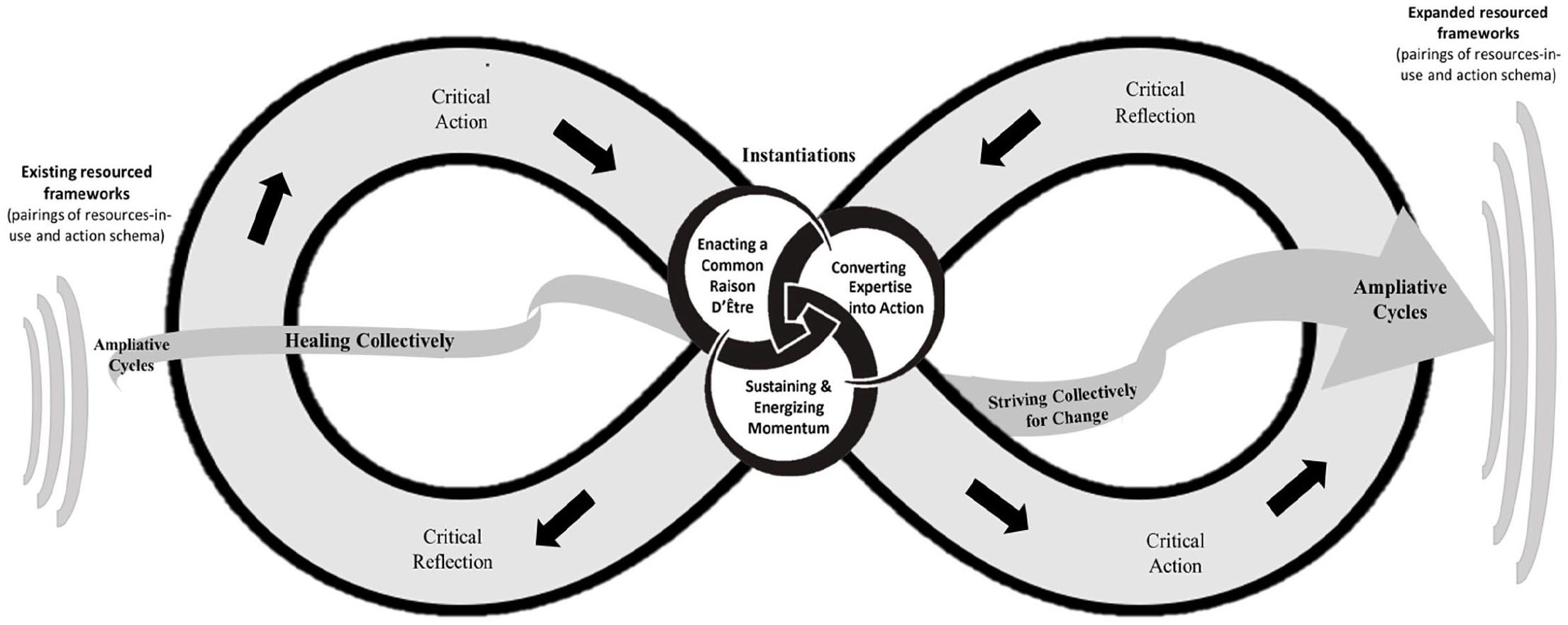
Resourcing agency for sustained collective action.
Introductory overview of the model
First, at the center of Figure 2 is a nexus of three entangled instantiations of resourcing: enacting a common raison d’être, converting expertise into action, and sustaining and energizing momentum. As we will elaborate below, these are instantiations of resourcing processes in which potential resources are paired with action frameworks to create new resources-in-use. Second, intersecting this nexus of processes is the pathway represented by the infinity symbol. This represents twin, iterative processes of critical reflection and critical action, discussed in conjunction because they together animate the ampliative cycle of critical consciousness that propels and sustains organizing for ongoing collective action. Third, the “ribbon” woven through the figure represents twin processes of collective healing and collective striving. It is expanding (in width) and has an arrowhead to indicate how it propels and augments sustained collective action. Although the arrow might appear to suggest a linear process, they constitute another ampliative cycle in the sense that they continuously take up resourced frameworks as potential resources for energizing an expanded repertoire of new action frameworks. This is depicted by the fourth component, the propagation waves that bookend the model and grow from left to right, indicating the expanding repertoire of resourced action frameworks.
Resourcing agency, we argue, involves the creation of new resourced frameworks for ongoing collective action—transforming potential resources into new resources-in-use, thereby “energizing” new action schemas and making expanded forms of agency possible. This transformation can include using existing skills and familiar action schemas in endogenous processes that make possible the new pairings of resources-in-use and energized frameworks that are at the heart of resourcing theory (Feldman & Worline, 2012). Grounded in a “conjunctive” process perspective, this model seeks to reject misleading dualisms and connect concepts “normally used in a compartmentalized manner” (Tsoukas, 2017 quoted in Cloutier & Langley, 2020, p. 14). In particular, we reject as false the distinction between resourcing agency as a process designed to enable agency and the instantiation of agency itself. For example, the nexus of recursive resourcing processes at the center of Figure 2 are at the same time instantiations of embodied agency. Similarly, critical action/critical reflection is not just an ampliative cycle of endogenous resourcing, continually energizing new action schemas and making expanded forms of agency possible; they are themselves conscious instantiations of resourced agency. These examples suggest a fractal nature to resourcing agency in organizing for sustained collective action amid creeping crises.
To demonstrate the practical application of the model, we offer the following synopsis from our case. In the aftermath of the blast, KB began transforming stocks of potential resources into resources-in-use in its recovery and social change efforts. Specifically, these stocks included: the social capital of its growing pool of members, including a history of complex connections to AUB; disciplinary and technical expertise developed through members’ experiences as researchers and consultants; a shared ethos bent on evidence-based action; and strategic and tactical repertoires. KB also drew on what we referred to earlier as embodied resources, a type not found in the literature on resource mobilization (Edwards & Gillham, 2013). Rooted in sedimented experiences of oppression and thwarted activism, these existing embodied resources were augmented in the wake of the blast by acute trauma, grief, and rage. Manifestations of the sentience, suffering, and skills that Hällgren et al. (2018) argue are of critical interest in the study of extreme contexts, these embodied resources were not only among the inputs to the three nexuses of resourcing processes, but also constituted and energized two ampliative cycles, i.e., the cycle of critical reflection and action and the cycle of collective healing and striving, that expanded the repertoire of action schema for KB’s members.
Our goal in this first section of the findings has been to offer a broad picture of resourcing agency as a nexus of processes that defies traditional notions of linear or hierarchically nested processes. In the extreme context of creeping crises, resourcing agency is an embodied collective process, entailing suffering, unfolding critical consciousness, healing, and striving in ampliative instantiations of resourced agency. Although we present the figure in two-dimensional space, its instantiations and cycles are not bounded processes with clear beginnings and ends. The model is perhaps better thought of as a mobius strip, without clear directionality or hierarchy, in which each dimension is capable of folding back on itself in a fractal nature.
Zooming in
We now turn to elaborating the specific mechanisms captured in our model, grounding it in the data from our context. First, we zoom in on the entwined nexus of processes at the center of the model to explain how they work in concert. Second, we zoom in further to focus on a particular constituent process, breaking the cycle, using it to show how, as a resourced framework, it both instantiates and illustrates the fractal nature of resourcing agency as a multiplex process. Third, we zoom out to explain how two ampliative cycles (Feldman & Worline, 2012) fuel the creation of an expanded repertoire of resourced agency. We address how critical consciousness—the ampliative cycle that mirrors the notion of praxis in institutional change (Benson, 1977; Seo & Creed, 2002)—appears essential to resourcing agency in creeping crisis and perhaps by extension, in other extreme contexts.
The three nexuses of resourcing processes
For KB, resourcing agency coheres around three distinguishable yet entangled nexuses of resourcing processes at the center of the model in Figure 2, presented in greater detail in Figure 3. They are: (1) enacting a common raison d’être, (2) converting expertise into action, and (3) sustaining and energizing momentum. Working in concert, these nexuses of processes take up potential resources—including existing resourced frameworks stemming from KB members’ scholarly expertise, prior experience with collective action, and lived experience of creeping crises—and transform them into qualitatively different resources-in-use and new resourced frameworks through new instantiations. Here, we go deeper into each nexus.
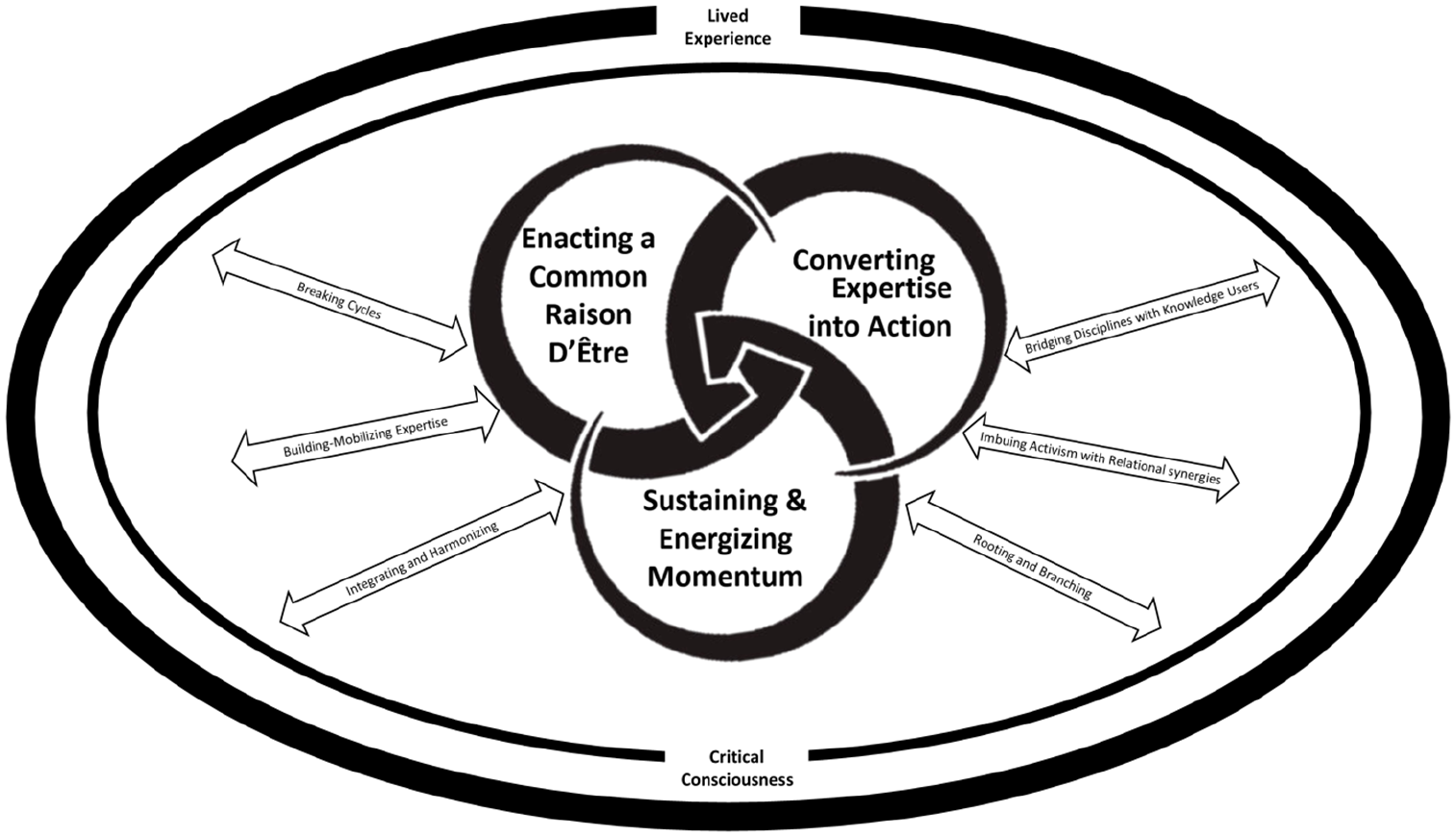
Nexus of resourcing processes.
Nexus 1: Enacting a common raison d’être
The blast triggered the accelerated development of KB’s model for engaged scholarship in Lebanon. Enacting a common raison d’être primarily entailed articulating and then translating the new model into practice: “What we are trying to set is a model of how the government should be working, based on evidence, based on people, [that is] transparent, accountable, and also thinking about the best interests of the community” (Salma). Another said they wanted to create “a model [that] changes things, the social fabric, the way people think about key issues and themes and have them cocreate their own communities” (Nader).
Enacting—and resourcing—a common raison d’être meant drawing heavily on existing resourced frameworks, including members’ shared commitment to scientific methods, evidence-based practices, and professionalism. From the start, KB’s founders signaled commitment to these values as a means to attract only those who were interested in embracing its vision, being accountable to the community, and mobilizing expertise garnered through scholarship for impact.
Given the deep, popular distrust of the political establishment, KB had to determine how to position itself as a group of experts working in a context of creeping crises.
We [talked] a lot about how political do we want to be and then we decided that we are going to stay on the evidence and the science. But at the end of the day, we cannot. . . . We are 100% political, but we are not a political party . . .. We are using our knowledge and expertise to create a model [of change]. (Amal)
This tension between evidence-based action and politics stemmed largely from their shared understanding of the consequences of Lebanese clientelism. “Dependency breeds dependency. . . . so that we don’t go back into that cycle” (Abir). Moreover, in a context where corrupt politicians remained in power at least in part through deflecting attention from their misdeeds by controlling the societal narrative, KB saw “lifting a new narrative” (Nour) as critical to protecting the credibility of their raison d’être: “We’re starting to put words and content out there; we’re working with the community” (Nour).
In this vein, a critical instantiating process was breaking the cycle. In its most immediate sense, “Breaking the Cycle” is a series of essays capturing critical reflections on socio-political events and conditions written by and for KB members during the first few months of its formation. Through its composition and promulgation, “Breaking the Cycle” both enhanced members’ understanding of the mechanisms underlying cycles of dependency, learned helplessness, and thwarted activism and framed their aspirations for the future. The series focused attention on what it would take to break specific cycles of oppression and on lifting a new narrative of accountable agency consistent with “The KB way.” (We will return to breaking the cycle in a later discussion of the entangled nature of resourcing processes.)
Hence, another key instantiation of enacting a common raison d’être was being accountable to the community. KB saw the pressing need for broader stakeholder involvement despite the country’s inequities, sectarian division, and yawning power distance. While sharing in many of the pains of Lebanon’s creeping crises, many of KB’s members nonetheless occupied positions of relative privilege and were affiliated with an elite institution. The implications of this for their efforts at inclusion, outreach, and accountability became a point of critical reflection and self-examination. At the January retreat, attendees explicitly engaged the question of whether, and in what ways, they are of “the community.” Separating us from the community is an insult to some. . . . We are from the community, and we are the community, and the ultimate goal is to engage and reach that place where we are all working together. . . . We are helping the people, and they are helping us back. So, it is part of being part of the community, it is organic that changes into working as one. . . .. We are all one community, even if some people don’t have the resources to live in a certain way [that many of us do], but we cannot separate us from anything that is happening around us. (KB Minutes of the January Retreat)
Together, the phrase “breaking the cycle” and the commitment to being accountable to the community became, for KB, their North Star.
From the individual level, through the organizational level, to the societal level, it is . . . all the same sorts of things. I got to be accountable for my actions. We have to be accountable for our actions. The government should be accountable for its actions. We are transparent about what we’re trying to do. (Nour)
Nexus 2: Converting expertise into action
This nexus of processes focuses on leveraging and harmonizing the heterogenous expertise, while also channeling it into the four impact initiatives addressing healthcare, education, SMEs (small to medium enterprises), and environmental health in ways congruent with the raison d’être. Opportunities for meaningful contribution stemmed in part from KB’s breaking barriers between the disciplinary silos entrenched in the social-organizational context. As Tala explained, “The disaster is . . . forcing us to think together and on a good and a comfortable day, we wouldn’t be doing this.” It also entailed challenging academic norms: “we call [for] actionable research . . . which has a lot of resistance in the academic world because they think it’s not something you can publish in Nature or Science” (Tala). KB’s approach was to look for a balance between people working in parallel versus people working in a concerted effort. Rather than, let’s see how we can divide tasks so that each has a piece of the pie. No, let’s see how we can all come together, make sure we know what we are trying to do (Abir)
While not all acquainted, most members shared similar experiences of working against Lebanon’s prevailing government wrongdoing. Amal’s experience is characteristic: “I cannot be in a place where I see things that are wrong, or people needing help [and not take action].” For many, engagement went beyond occasional volunteering because they identified with people’s suffering and disempowerment. Most shared Tala’s sentiment: “I want that the communities I’m working with to become knowledgeable of their rights and to demand change.” On this foundation, KB had to foster the shared embrace of the raison d’être, while meaningfully channeling members’ distinctive contributions into collective efforts. “Each one is bringing in his or her own education and expertise and research and putting it together into one problem. That’s why it’s so fascinating, and enriching” (Tala).
Converting expertise into action also required leveraging and sustaining access to ever more effective, interdisciplinary, and actionable expertise. For example, the blast devastated a bustling district that was home to many SMEs, making rebuilding and putting thousands back to work an imperative. Several founders knew that Nader, a business school colleague, had expertise in SMEs and worked to bring him into the inner circle. He, in turn, brought entrepreneurs and community members into the initiative. “Walking around is key. . . . I want them to see, to feel, to have a sense of what’s happening. So . . . I’m doing [the meetings] in the affected areas, and a lot has changed in a positive way” (Nader).
KB’s strategizing was itself an instantiation of expertise into action for the purpose of resourcing agency. The strategizing of the four impact initiatives was accomplished within two weeks of the blast because two members of the business school faculty at AUB adapted a strategic planning process they had used in consulting engagements. “None of those people [leading the impact initiatives] come from a business background or has this view of organizing in that structured manner. So, we felt that there is a clear way where we can contribute” (Amal). Many found this a heartening instance of converting expertise: [We moved] from structure and leadership and governance to actually teaching the leads in the impact initiatives how to create their own [strategies and objectives] . . . matching local community with experts, coming up with solutions, and then bringing in the diaspora as mentors (Nour).
KB also fostered deeper connection and greater appreciation for members’ diverse efforts in constructing a different future. “In the [KB] general assembly . . . we share expertise, . . . ideas, we invite speakers, so this is really . . . something that [many professors] have never heard before” (Tala).
Nexus 3: Sustaining and energizing momentum
The final nexus focuses on ensuring the members’ continued engagement. Within three months, KB had mobilized over 100 people, all focused on creating a “plan that was people-centric, evidence-based, and locally driven” (Nour). But social change requires mobilizing people for near-term action while fostering long-term commitment and sustained efforts. “We [are] very mindful about how are we going to coordinate well, how are we going to make sure that we sustain for a longer period of time” (Amal).
Past experiences of thwarted activism in Lebanon, both direct and vicarious, meant the founders had over time developed critical insights into sources of division and other pitfalls they needed to avoid and steps they needed to take to sustain collective action. Nader explained: So you felt good . . . becoming better acquainted with your fellow volunteers, and you detected real quality and alignment and values. But you also see the need for . . . a better balance, because it’s exactly the volunteerism that is going to exhaust everyone. (Nader)
In some cases, those same prior experiences helped sediment social networks built on both affective and task related trust. This was particularly true for those who shared an affiliation with and affinity for AUB. Because most members were scholars, breaking the pattern of episodic and stymied mobilizing meant addressing competing demands: “one continuing theme . . . from the very beginning is . . . alignment between the raison d’être . . . and what we do on a on a day-to-day basis, . . .our work and our life and everything else” (Amal). Dania, a nurse, encapsulated the struggle: “I’m doing all of these things, always at the front line, yet my career always suffered. So, I need to link these two together” (Dania). KB sought ways to establish a connection between members’ career activities and their activism, with the aim of reinforcing their job stability rather than jeopardizing it. “We’re even rethinking our academic careers and how we go about them” (Amal). One facet of the processes contributing to finding a harmonious balance was the interviewing conducted by the documentarians. As Amal explained: We need to try to figure out how we’re mobilizing [and] organizing, while also acknowledging how burnt out we are all feeling. . . . We are, as we have always been, worried about KB’s sustainability, . . . about our organizing and ensuring sustained initiatives. We have brought in . . . outside [documentarians] who are helping us think this through.
Finally, because of the sectarianism and distrust in Lebanon, sustaining collective action required integrating diverse voices and involving the Lebanese diaspora. KB members sought to transcend divisions by recognizing the history of shared struggles. As Nader explained: “It’s laboring to be transparent and data driven, and trustworthy, and community oriented.”
In this section, we explored the intertwined nexus of resourcing agency at the heart of our model. Their shared lived experiences of oppression and government malfeasance created a deep connection among KB members and provided a basis for forging a common raison d’être that played a vital role in animating their collective action. The blast brought them closer together and enabled a greater shared appreciation of the role of their collective efforts in constructing a different future.
Entanglements across the nexuses and processes
As mentioned above, Cloutier and Langley (2020, p. 19) explain the only way to make sense of entangled processes when boxes and arrows are useless is to “switch to entirely different mediums of expression—such as narrative, metaphors, or poetics, which have emerged historically for the specific purpose of capturing complex and entangled emotions, sensations and experiences.” Here, we show one example of the entangled doings of resourcing agency by expanding on our earlier discussion of “Breaking the Cycle,” mindful that it is but one lens into the entangled, fractal nature of resourcing agency and that is but one of the constituent resourcing processes associated with a nexus at the center of the model. Looking into any of the three nexuses, we also see nested instantiations that are microcosms of the whole rather than simply constituent processes.
Recall that “Breaking the Cycle” both enhanced KB members’ understanding of the cycles fueling Lebanon’s creeping crises and framed their aspirations for change; it “has pushed us to think beyond the immediate . . . [to] address long-term issues and plans. This is why we decided to work on a roadmap for recovery of Beirut that is inclusive and community-led” (Breaking the Cycle, Issue 4, p. 4). The processes of reflecting, writing, and promulgating these essays elevated expertise in action accountable to the community as the center of the common raison d’être. As a metaphor, breaking the cycle became a sound bite, a brief encapsulation of a collective action frame that triggers in its hearers an entire narrative that diagnoses problems, identifies culprits, proposes solutions, assigns responsibilities, and mobilizes people for action (Gamson & Lasch, 1983). So, while “breaking the cycle” appears first as a constituent process of the nexus “enacting a common raison d’être,” as a sound bite, it resonates in the words and minds of the KB members across their many doings and becomings.
It’s been an internal deliberative dialogue process . . . [it’s] what we think about besides what we’re saying we’re going to do. So, we’re doing the science, . . . community health, environment health, education, SMEs. Each of them have a strategy. But what do we stand for?. . . And how can we break the cycle? So, I think that’s also very good for trust building. (Nour)
“Breaking the Cycle,” as a nexus of actions and as a resonating metaphor, reveals the fractal nature of resourcing agency because many of the doings that support ongoing collective action required breaking cycles of division, inertia, distrust, lack of accountability, and thwarted activism. “Acknowledging the political decadence and complexities in Lebanon and the loss of morale amongst its people, Khaddit Beirut refuses to succumb to the doomsday scenarios circulated by the political elite” (Breaking the Cycle, Issue 2, p, 1). Each entry in the series is thus both an instantiation of “resourcing agency” and a resource to be taken up in resourcing a framework, as this excerpt illustrates.
We have broken the cycle of toxic politics by reclaiming the central role of politics in people’s lives. We redefine politicians not as zu’ama [feudal lords] but as public servants, as members of the community who take on the responsibility to serve the communities and can create solutions and scale them into policies. We want to transform politics by making it evidence-based, community-led, and locally driven while also being globally relevant. (Breaking the Cycle, Issue 3, p. 3)
KB’s model of engaged scholarship required breaking cycles of dissipating engagement. Many members had long histories of activism that often varied over time—increasing after specific triggering events, but dissipating as other demands, often professional, diverted their change efforts and fostered cynicism. KB also explicitly sought to break the cycles of its members taking an either/or perspective on their identities—scholars or activists—promoting a both/and approach, integrating the two as scholar-activists and finding ways to ensure that they served mutual purposes. Participants also invoked the metaphor to speak of bridging disciplinary divides: “We’re breaking all the boundaries . . . and silos at the university” (Tala).
The metaphor also resonates through efforts to engage with the community as peers, worthy of respect, with their own expertise to offer. Tala explained: “while we’re talking about expertise in action, it’s really trying to reduce power distance, and avoid being mischaracterized as elites from an ivory tower.” Indeed, KB often spoke not just in terms of “expertise in action,” but instead of “expertise in action, accountable to the community,” which it saw as a profound break from the fecklessness of the government. KB saw mutual accountability as so outside the norm as to require modeling. “We’re trying to model accountability. . . .. We need to be doing it, not only asking for it. If I’m going to start demanding other people to be accountable, I need to show them how” (Amal).
In this section, we showed how the simultaneity and resonance of these many instantiations of breaking the cycle energizes KB’s efforts to enact its raison d’être, convert multidisciplinary expertise into action accountable to the community, and sustain collective action. By engaging in breaking cycles, members created the opportunities for others to resource their agency. It is important to note, as shown in Figure 3, that we identified six constituent resourcing processes associated with the three nexuses—breaking the cycle, building and mobilizing expertise, bridging disciplines with knowledge users, imbuing activism with relational synergies, integrating and harmonizing, and rooting and branching. Due to space constraints, we detail only one here, but we found similar entanglements across all of them.
Zooming out to explore the ampliative processes
Resourcing theory alerts us to the possibility of expanded repertoires of action, created when existing resourced frameworks are taken up as potential resources for pairing with new action schemas in what Feldman and Worline (2012) call endogenous ampliative cycles. In our analysis, we find two ampliative cycles of resourcing which are simultaneously instantiations of resourced agency, demonstrating again the fractal nature of resourcing agency.
Critical Action/Critical Reflection
This ongoing, recursive process mirrors the reciprocal, reflective, and active moments of praxis, a key form of historically situated agency found in the organizational literature (Benson, 1977; Bernstein, 1971). Praxis comprises cycles of actors’ critical examination of existing social conditions, mobilization inspired by their “new, collective understanding of their social conditions and themselves,” and “multilateral or collective action to reconstruct the existing social arrangements and themselves” (Seo & Creed, 2002, p. 230). Critically understanding the causes of one’s suffering compels critical action to stem that suffering by transforming the society and the self (Freire, 1973, 1993). Hence, our use of the infinity loop in Figure 1.
Healing Collectively/Striving Collectively
The other ampliative cycle of great importance comprises the ongoing, reciprocal processes of healing collectively and striving collectively. Both processes are rooted in critical consciousness and underpinned by the cycle of critical action/critical reflection. They provide members with a heightened sense of personal and collective agency and wellbeing, which under the circumstances provides improbable springs of hope. Working in concert, these twinned processes buttress all the entangled instantiations of organizing for sustained collective action in creeping crises.
Collective healing fosters the psycho-emotional wellbeing of members who have been harmed by their shared lived experience of prolonged adversity. At base, it attends to the affective and visceral aspects of suffering under creeping crises, enabling members to draw from their emotional, psychological, and bodily capacities to cope, to heal, and to provide support to each other. An array of doings advances the healing process, including recognizing and responding to one’s own and others’ affective states, finding solace through sharing feelings, building trust through a focus on mutual wellbeing, and cultivating hope through healing together.
The sheer scale of the explosion triggered states of rage, trauma, numbness, anxiety, and helplessness. Most of KB’s members felt a threat to life and safety, coupled with bewilderment, stress, and a sense of violation. As Nour powerfully notes, “on August 4, I personally felt raped of all my rights and that’s why I carry so much anger in me.” Amal explains: “I think at the heart of everything that we are doing, and the emergence of KB is because of a collective trauma. This is what brought us all together, we needed to deal with that.” Many members’ descriptions of the early phases of KB’s organizing include accounts of trauma and the need for solace.
Nader recalls two calls from Tala after the blast. “Honestly, . . . I was crying out of nowhere. I was really in shock. And [Tala] called me, and she asked me: ‘how are you doing? I want to check on you’.” It was not until her second call, after he had processed some of the psycho-emotional distress, that she would propose he become part of KB.
[Tala] told me “I wanted to tell you something last week . . ., but you were . . . so depressed so I let it go. But . . . we started KB and I want you to be part of it.” So even the people around me . . . could sense this just by the tone of my voice. So, it took a while. . . . I didn’t feel like doing anything about it. The idea was to go back to Canada because I was fed up. I said, “it's too much”. (Nader)
Nader subsequently became the leader of one of the impact initiatives. Emotional bonds and opportunities to find solace created the supportive social infrastructure essential to KB’s emergence and collective organizing.
The term “therapeutic” came up in multiple interviews to describe the focus on mutual wellbeing. At their initial interviews, approximately three weeks after the blast, participants were asked to identify their emotions, using several prompts, including but not limited to hopeless/hopeful and enraged/serene. No one selected hopeful. Most, if not all, selected enraged. In addition, on its first website, KB introduced itself and its aspirations with a tone of angry determination, but not one of great hopefulness: “We are scholar-activists, artists, medical doctors, and business owners, citizens who deserve to live and breathe” (https://khadditbeirut.com, accessed 11 January 2021). Yet, as Nader describes it, hope was quickly palpable. “Personally, I had lost hope. And then with KB, I just sensed it in the first week. I still sense it until now. I think it’s a healing process for me. . . .. And that’s good.”
From the start, KB’s founders deliberated over how best to come together for collective action when they all had feelings of trauma and rage. They cultivated hope by resourcing genuine solace and emotional healing even as the strategic goal of putting expertise into sustained action always remained in sight. Collective healing fosters the willingness and the ability to engage in action.
It is like, [many people] gave up completely, and for them there is no hope. . . . They respect that we’re trying, but they say, “you will see that there is nothing you can do because nothing can be changed”. . . . This system has had its toll on people. . . . So, to see this whole group of experts and activists and survivors, coming together, working together, and continuing to do something good is basically encouraging people to team up. (Nader)
KB’s emergence shows that bringing different actors together for collective action in crisis is an embodied act; people reach out to others, they commiserate, they encounter their human vulnerabilities, and they feel seen, heard, appreciated, and connected. Over time, their visceral rage and despair gave way to hope; they even became themselves imbued with hope.
The complementary process in this ampliative cycle is collective striving. Like collective healing, collective striving is rooted in a critical consciousness of shared suffering and the challenges of addressing the adversities of creeping crises.
As lucky survivors of the August 4 Blast, we believe that collective agency drives change. . . . Let us together turn the catastrophe . . . into an opportunity to create a community-led, evidence-based, and locally driven model for recovery and change. Only then, we and other Lebanese can restore faith in ourselves, in humanity, and in our collective agency. (Breaking the Cycle, Issue 2, p. 3)
To animate collective striving, KB leveraged the ampliative cycle of critical action/critical reflection. Before KB’s birth, its founders had long attributed Lebanon’s creeping crises to endemic failures in governance. So, in October 2019, when protests shook the country, many founders were at the forefront of this movement. As Nour explained: “For years this government has been failing on everything − water, air, waste. So . . . [once again] we were going to the streets and trying to say, ‘enough is enough’. . . leave us alone.”
Ten months later, when the blast happened, they again recognized the role of the power structures in enabling this catastrophe—the “epitome of toxicity,” both environmental and political (Breaking the Cycle, Issue 3, p. 2)—and quickly articulated that connection through multiple media, including through the Breaking the Cycle series. KB’s members were tactical in establishing a critical understanding of the creeping crises as a broadly shared springboard for collective striving.
Through creating, reflecting on, and enacting the essence of the Breaking the Cycle series, the people of KB engaged seriously the idea that their actions would speak and that they collectively needed to be the change.
We are not just dreamers at Khaddit Beirut—we are doers and know that we are not alone. Together we have to break the cycle of despair and passivity. If not now in the wake of the horrible disaster of August 4, then when? Collectively, we can impact a change by adopting a trans-disciplinary and locally led approach to community work, while demanding institutional accountability and inter-ministerial collaboration. (Breaking the Cycle, Issue 2, p. 2)
KB’s name—“Beirut’s shake-up”—was chosen to capture the shared experience of cataclysm and awakening solidarity. Members depicted the blast as the apotheosis of the government’s negligence and corruption, and as a sign of things to come if not addressed: What happened on August 4th is kind of the proof for everyone else who was blind to what was happening. . . . Do you now believe us that this level of mismanagement and corruption is just going to lead us to bigger and bigger disasters? (Amal)
Constructing and embracing a shared visceral understanding of the creeping crises as an assault on human rights and dignity was central to KB’s organizing. This was evident even among those members who were participating from places of relative safety (two of the founders were on sabbatical or teaching at foreign universities at the time of the blast and throughout KB’s formation), who spoke of the need to share in the trauma and embody the struggle in communion with those in Lebanon.
I don’t want to be an ally. . . . I want to smell the smoke, I want to see the blood, I want to feel the hunger. So that . . . you embody the struggle. . . . I’m not saying that being an ally is not a good thing. And that’s a great choice for many people [who] need that psychological space to be and to help the struggle continue. But how can we create a KB that feels [and] embodies the oppression, and . . . isn’t just assumed as an ally space? . . .. I don’t know if that is possible, but that’s what I think we need to do. (Elena)
As Nour explains “We can do something . . . [if we] show the wound as it is.” The evocative imagery of showing the wound speaks to the role of the visceral in organizing to support ongoing collective action in creeping crises through grounding activism in the lived experience of oppression and suffering.
All of us in Lebanon have . . . been so oppressed and punched . . . that we’ve gotten to the feeling of learned helplessness. . . . [It’s a cultural narrative that] no matter how much we try, it’s not changing. So . . . we were very purposeful about breaking our own hopelessness and helplessness and feeling that we could do something, that we needed to do something, so that . . . we’re not going to fade into oblivion. (Nour)
Punched, seeing the blood, feeling the hunger, and breaking our hopelessness and helplessness—as the visceral images suggest, KB kept the sources of the wounds “as they are” front and center, fostering collective healing and fueling collective striving in an interwoven ampliative cycle that sustained collective action.
Creating the mechanisms for sharing the suffering and burdens bolstered collective healing and striving. Nader needed to feel the job was not on “just his shoulders,” that he can at times “let others carry the torch.” At the same time, he shared: “I owe it to myself and to others to give everything I can to, at least this time, change things and have a bigger impact.” Many other members spoke of the need for a determined endurance in their efforts to change the system. For example, Amal notes: “No matter how exhausted . . . we are committed to one thing. So long as we have energy and brain cells, we are going to do anything we can to try to change this reality.”
Five months after the blast (January 2021), KB held its first retreat to reflect on its coming together, its first accomplishments, its values and ways of doing things, and where it was going. Whereas rage had dominated members’ psycho-emotional states in its first month, a word exercise for the retreat revealed that hope was the one word the majority of members would use to describe KB. In the retreat minutes, the assembly recorded: “Khaddit Beirut gave us the space to exercise our agency to regain our dignity. This is healing us and giving meaning and hope to our lives. Thank you, Nour and Tala.” In closing the retreat, Tala encapsulated the process in this way.
We are . . . a community that has definitely lifted each other up. We needed each other, and today, while we were reflecting on our existence together, we were also expressing the sufferings of our country. We were highlighting how much it is difficult to actually go through this. I cannot thank [you all] enough . . . We might be a successful case [of collective action], but we might also be a failing case. In all, it doesn’t matter what the outcome is, what matters is the process. I think what we are gaining from the process is something that cannot be valued in words. (Tala)
In this section, we showed how two ampliative cycles worked in concert through processes of providing succor, lifting each other up, expressing and facing the sufferings of the country, striving to break the cycles, and coming together to express hope and gratitude. These recurring processes built on each other in ways that exemplify ampliative cycles’ capacity to “grow in a general direction, providing more energy for what one might refer to as a meta-framework . . . that the resourcing cycles contribute to” (Feldman & Worline, 2012, p. 638). In this case the meta-framework is resourced agency and every constituent process and ampliative cycle appears as fractals of it.
Discussion
Using Lebanon’s creeping crises in the wake of the Beirut blast as an empirical context, we have demonstrated how a group of self-described scholar-activists organized in support of ongoing collective action. Shared histories of praxis and deliberate activism enabled KB’s founding members to come together quickly and forge a movement for recovery and social change. It entailed an embodied process of resourcing agency—necessarily engaging whole persons—and, as such, was deeply entangled with participants’ overlapping lived experiences, their relationships, and their shared and evolving understanding of the context. Our analysis shows resourcing agency to be a fractal process—one comprising a dynamic mix of entangled instantiations of resourced agency, augmented and transformed by the ampliative cycles of critical action/critical reflection and collective healing/collective striving. These processes were rooted in a history of thwarted activism beyond the university walls, nourished by existing relationships, and grounded in a shared vision for the future. Thus, our theorizing on organizing in crisis is predicated upon three intertwined, and we propose, essential maneuvers: first, we used a processual approach; second, we took seriously the lived, embodied experience of the crisis and how this animated subsequent collective action; and third, once recognized, we attended to the fractal nature of agency in the context of creeping crises and its implications for amplifying and sustaining agency.
Here, we provide detailed insights into our contributions, which build upon each other. First, we demonstrate why organizational scholarship on crisis needs to attend to the increasing relevance of creeping crises and demonstrate the benefits of using a processual approach that attends to the embodied and fractal nature of action in creeping crises and other extreme contexts. Second, we extend resourcing theory by theorizing and modeling the integral process of resourcing agency itself in the context of creeping crises and identifying how embodying is a critical form of instantiating resources. Third, we identify two ampliative cycles that are implicated in resourcing agency and explain how they serve to transform and sustain actors engaged in organizing to support collective action amid creeping crises. We close with a discussion of the implications of our work for engaged scholarship.
Creeping crises and the embodied and fractal nature of organizing
Our subsequent contributions hinge upon first recognizing the importance of attending to creeping crises, a type of crisis that, while increasingly relevant, remains underdeveloped in the organizational literature. Attending to creeping crisis requires a shift in focus from existing, at-risk organizations’ efforts to return to normal operations to emergent organizing in response to accreting threat. In other words, it calls for attending to the processes of becoming, organizing, and working towards transformation (Tsoukas & Chia, 2002) rather than restoration of existing systems. The dual objectives of responding to immediate conditions and challenging the status quo perpetuating creeping crisis, while simultaneously trying to give shape and substance to a nascent collective movement, adds complexity to the process of organizing beyond what most existing organizational scholarship on crisis addresses. The shared and protracted suffering endemic to creeping crises shapes the history and nature of relationships among those organizing to support ongoing collective action. The resource inequities endemic to creeping crises necessitate different forms of resourcing to support sustained collective action for change. At the same time, the lived experience of creeping crises itself can provide a positionality from which to understand not only the need for change, but also where efforts need to be directed to create a better future.
Through using a processual approach, we uncover actors’ specific “doings” in creeping crises—attending both to how collective action unfolded in post-blast Beirut and to the history and evolution of KB members’ personal and collective capacity to sustain that collective effort. This approach created space to examine and theorize organizing grounded in personal and collective commitments to human dignity as an enduring goal, commitments that sustained engagement despite a history of thwarted activism and a malignant institutional context. The pairing of a processual perspective with a focus on the lived experience of creeping crises enabled us to add contours and depth to Hällgren et al.’s (2018) insight that coping with extreme contexts is an embodied experience by revealing, first, the fractal nature of organizing to support collective action in crisis and, second, the intertwined, almost inseparable, conjunctive nature (Tsoukas, 2017) of resourcing and instantiating agency. Future research on organizing in response to crises will benefit from attending to actors’ lived experiences, animating concerns, and situated coping skills and from probing the critical consciousness (Conlin et al., 2021) that underpins their understandings, aspirations, and efforts to effect change. The manifestly fractal nature of organizing to support collective action amid creeping crises may mirror the endogenous nature of creeping crises themselves, with their protracted patterns of accreting threat, making a process perspective and attention to fractality potentially especially valuable for studying responding to creeping crises.
Embodying as resourcing and as resourced agency
In all crises, but especially those with inequitable access to resources, people often need to work with whatever is at hand. This increases the importance both of endogenous resourcing—that is, resourcing from within—and of the ability to match those potential resources with new action frameworks commensurate with the demands of the circumstances. In the case of KB, the “within” includes the reservoir of situated, lived experiences of the actors who have suffered under the conditions of the creeping crises.
Our embrace of resourcing theory positioned us to move beyond the provisional construct of embodied resources to discover embodying, a special form of resourcing, predicated on the lived experience of creeping crises. It entails, both personally and collectively, the sentient and skilled taking up of potential resources at hand to energize situated action schemas for and of the whole person. Seen through the meta-theoretical lens of process theory, it is a particular form of instantiation. In the wake of the blast, KB created, within its collective, the space for recognizing a complex mix of emotions—including rage, helplessness, and eventually even hope. The psycho-emotional affirmation of shared suffering deepened members’ existing, sedimented relationality and bolstered solidarity. Much of what would become KB’s resources-in-use were both constituted by—and constitutive of—members’ socio-historical experiences, conceptualizations of the creeping crises they lived with, and their professional and moral commitments to particular shared action frameworks. This suggests the embodying of lived experience in resourcing agency—energizing what Wacquant (2015) referred to as sentience, suffering and a history of skilled efforts at change—can not only bolster patterns of collective action, but potentially inure actors to some degree against adversity over protracted periods.
Embodying is a social process. Affective connections that coalesce as part of living under creeping crisis can “bring multiple actors into a dynamic, orchestrated conjunction, so that these actors’ mutual affecting and being affected is the central dimension of the arrangement from the start” (Slaby, Mühlhoff, & Wüschner, 2019, p. 5, italics added). Slaby et al. (2019) highlight that such relationality emerges not just out of shared experiences; having mutual effect on each other is central. The resulting embodied resources—essentially action frameworks that have been resourced through relationality—“emerge out of multiple formative trajectories, for example, histories of . . . accommodation to various forms of resistance or failure, histories of reform, of expansion, of transformation, but also sheer historical accident” (p. 8).
Embodying resources animates a kindred process by which the affective and visceral aspects of lived experience—including deeply rooted connection and shared meanings among activists (DeJordy, Scully, Ventresca, & Creed, 2020), collective learning through trial and error (Savaget, Roulet, & Ventresca, 2024), and responsive relational capacities (Bertels, Hoffman, & DeJordy, 2014; Espedal & Carlsen, 2024)—can inform, sustain, and reshape organizing. Our conceptualization recognizes authentic affective experience as a critical potential resource to be paired with future-oriented action schema through embodiment. Embodying entails engaging with actors’ lived experiences—drawing on and responding to their mutual suffering and providing succor in ways that enable and even compel action. Through collectively embodying their lived experiences as whole persons under extreme duress, KB members transformed personal and shared histories into new resources-in-use.
Ampliative cycles
Entangled processes of resourcing were augmented by “ampliative cycles” of endogenous resourcing that catalyzed the creation of new resourced frameworks for ongoing collective action. We show how two ampliative cycles—healing collectively/striving collectively and critical reflection/critical action—serve to transform and sustain resourced agency.
Transformative amplification: Healing and striving collectively
Chronic suffering necessitates overcoming learned helplessness and other incapacitating effects of creeping crises. In this context, resourcing agency involves the transforming of adverse experiences into valuable resources-in-use. The first step is acknowledging the adversity among the collective, in order that individual sources of potential paralysis can be reconstituted as potential resources available to be taken up to energize new action schemas. Freire (1973) observed that once humans perceive, understand, and recognize possible responses to a challenge, they act. This abstract process appears in our findings in stories of turning rage and resignation into hope and action. Narrating experiences of suffering and trauma trigger sensemaking regarding their root causes, which prompts envisioning aspirational alternatives and speculation as to how to achieve them (Lok, Creed, & DeJordy, 2019). Such speculations can develop into new action schemas.
These processes can lead to an ever-expanding repertoire of resourced frameworks sourced not from traditional assets, but from experiences of trauma and, in extreme cases, oppression. In a form of mobilization alchemy, the very contexts and experiences which spawned learned helplessness and dependency, once recognized as the systemic conditions for collective suffering, can instead resource a cultural repository of novel frameworks. In the case of KB, the twinned ampliative cycle of collective healing and striving not only resourced new action frameworks but transformed the aims of that action as well. The embodied instantiations of healing and striving resources made both action and purpose more potent. Collectively “being the change” enabled the development of an ever-expanding repertoire of resourced frameworks. The repertoire expanded through novel pairings of action schemas, specifically those targeting structural antecedents of suffering, with the embodied resources-in-use arising from the shared embodied experiences.
Sustaining amplification: Critical reflection and action
While healing and striving collectively facilitate the expansion of available resourced frameworks for collective action, the twinned ampliative cycle of critical reflection and critical action propel organizing to support ongoing collective action amid creeping crisis as a whole. Freire (2000) theorized that as oppressed people begin to analyze their social conditions, they would feel able and compelled to act to change them and can become active agents of change (Freire, 1993). Coupling his arguments with an explicitly processes-oriented approach, we theorize that critical consciousness—animated by perpetual cycles of critical reflection and critical action—is essential to sustaining ongoing collective action in creeping crises where inequities and injustices are enduring characteristics of the context. It follows that, given the enduring nature of suffering in creeping crises such as these, such cycles of reflection and action could persist until the conditions fostering that suffering are remediated. Building on Dacin and her colleagues’ call for attending to the intersection of power and place in shaping political activism—not “on a grand scale, but rather the more mundane, yet very significant, and often counter-intuitive, daily kind of micro-politics (Foucault, 1980) and power that construct and are constructed by the dynamics of place” (Dacin, Zilber, Cartel, & Kibler, 2024, pp. 1202–1203)—we call for research into how critical consciousness and cycles of reflection and action animate the micro-politics of place-specific creeping crisis.
Ongoing cycles of critical reflection/critical action prompted KB actors to undertake multiple activities that were deliberately targeted towards multiple end goals, constantly redefining and expanding their very purpose. These ongoing cycles augmented their shared critical consciousness, further animating and amplifying processes by which resources-in-use instantiated through embodying were leveraged to inform, sustain, and reshape collective organizing. In this sense, critical consciousness appears an ampliative cycle that simultaneously sustains ongoing collective action as a whole and, each of the constituent processes—resourcing agency and the transformative ampliative cycle of healing and striving collectively. While presented discretely here, they are, true to a process ontology, entangled. More research is needed to explore how praxis, lived experience, embodying, and critical consciousness are jointly implicated in organizing in support of sustained collective action in creeping crisis.
Coda: Engaged scholarship
As creeping crises become increasingly prevalent and dire, KB, most of whose members were faculty at AUB, is an example of engaged scholarship that provides important lessons for organizational scholars. KB, as a case of disaster response situated in creeping crises, is embedded in a history of scholar-activism. KB members’ history and track record provided them not only with a shared critical consciousness, but with the resourced frameworks—including “expertise in action”—to organize rapidly and mobilize widely. KB members used what feminist scholars refer to as “epistemic privilege”—being better poised to gain insights into inequitable social realities due to both their experience of marginalization and oppression and their ongoing critical reflection on their lived experiences—to guide their activism (Harding, 2004). They show that scholar-activism is not only a viable, but a desirable and restorative pathway for academic praxis.
As was particularly true for KB, many academics in contexts of creeping crises have paradoxical lived experiences: they simultaneously live lives of relative privilege and intellectual safety within the walls of academia, but also share in the suffering outside those walls. In these times of increasingly prevalent creeping crises, engaged scholarship and critical consciousness can no longer be uncommon or an outlier, and consequently organizational scholars must start to explicitly cultivate the capacity for such engagement in themselves and in future generations of scholars.
Future work may therefore helpfully explore the relationships between epistemic privilege, critical consciousness, and engaged scholarship. We echo calls (e.g., Daouk-Öyry, 2023; Hoffman, 2021; Wickert, Post, Doh, Prescott, & Prencipe, 2021) to create a stronger harmony, balance, and alignment between the goals of promoting positive societal change and academic job requirements. Gray recently advised that we engage in “introspection about how our publishing norms may imprison us from doing the important work of addressing critical societal problems” (Gray, 2023, p. 183). One possible approach would be to conceive of our discipline as facing its own creeping crises (replication, dishonesty, irrelevance) and imagine how these findings could be usefully engaged to clean up our own house while helping to better the world around us.
Footnotes
Acknowledgements
We sincerely thank the editorial team and the three anonymous reviewers for their constructive feedback and guidance, which greatly enhanced the quality of this work. Our deepest gratitude goes to the Khaddit Beirut Secretariat, the leads of the impact initiatives, the community of scholar-activists, partners, and the American University of Beirut, to whom we dedicate this paper. This work is a testament to our shared pursuit of hope, love, and collective healing. It is published at a time when we face yet another flare-up of ongoing crises, underscoring the urgency of collective striving and action. Our solidarity extends beyond these words, as we prepare for the next chapter of organizing in response to this latest layer of catastrophe.
Funding
The author(s) received no financial support for the research, authorship, and/or publication of this article.
