




Abstract
Leisure crafting (i.e. the proactive pursuit of leisure activities targeted at goal-setting, learning, and human connection) enhances people’s lives. Because employees are more than just workers, this study examines whether leisure crafting not only improves non-work outcomes but also spills over to benefit work, particularly for older employees. We conducted an online leisure crafting intervention among working adults, to examine its effects on non-work benefits (meaning in life, need satisfaction, affective well-being, and sense of community), work benefits (meaning at work, employee creativity, and work engagement), and the moderating role of age. A 5-week randomized controlled trial compared our intervention comprising 196 participants against a passive control group comprising 266 participants. Analyses revealed that the intervention group experienced a greater increase in leisure crafting (i.e. the manipulation check was significant), employee creativity, and meaning at work. In addition, the intervention positively impacted affective well-being but only for participants older than 61 years. The findings suggest that leisure crafting has the potential to positively affect people’s work lives and can serve as an effective organizational tool to help older employees sustain satisfactory affective well-being.
As the workforce ages (National Academies of Sciences, Engineering, and Medicine, 2022), it becomes imperative to support older employees at their work and in their transition to retirement. To deal with aging, employees often regulate their behavior to optimize their resource pool (Kim and Kang, 2017). Job crafting interventions (i.e. learning to maximize one’s resource pool at work) have been found to assist older employees to develop a better fit with their jobs (Kooij et al., 2017) and, thereby, to experience their jobs as more meaningful. However, due to increased blurred boundaries and interconnections between the work and the non-work domain (Alcover et al., 2020), it is conceivable that older employees pursue and use resources not only at work but also outside of it (Kim et al., 2020; Strijk et al., 2012). Accordingly, we extend prior job crafting intervention literature for older employees, and we focus on leisure crafting, defined as the proactive pursuit of leisure-time activities targeted at (1) goal-setting, (2) learning, and (3) human connection (Petrou and Bakker, 2016).
Individuals who display leisure crafting experience a more meaningful (Petrou et al., 2017) and satisfactory life (Yazici et al., 2023) and elevated overall well-being (Teng, 2023). In addition, the benefits of leisure crafting can affect people’s work. For example, employees who engage in leisure crafting are more creative (Hamrick, 2022), well-performing (Wang et al., 2023), and engaged at their work (Liu et al., 2024), they are more proactive in their careers (Chen, 2020), and they experience work-related well-being (Abdel Hadi et al., 2021) and even meaningfulness at work (Petrou et al., 2024). Notably, most of these studies use survey methodology. To further validate this line of research, we will address the benefits of leisure crafting via intervention research. Unlike (self-report) survey studies, intervention research arguably reduces the chances of spurious causality and biases (Kristensen, 2005). In addition, because (job/leisure) crafting refers to straightforward and measurable self-developmental actions that individuals can undertake to improve their work and life conditions, interventions are an ideal methodological tool for crafting research (Mukherjee and Dhar, 2023). In this study, we aim to refine an existing leisure crafting intervention (Petrou and de Vries, 2025) and additionally examine the role of age for its effectiveness. Importantly, because learning to craft can be initially challenging and positive outcomes need time to unfold gradually (Van den Heuvel et al., 2015), we follow previous crafting intervention practice (Pekaar and Demerouti, 2023), and we employ a latent growth modeling analytic approach that operationalizes all our intervention outcomes in terms of linear growth.
Our focus on aging is in line with insights from the socioemotional selectivity theory (Carstensen, 1992, 2021). The basic tenet of this theory is that constraints on future time horizons lead older people to reconsider their goal priorities by favoring emotionally meaningful experiences or social contacts. Relatedly, older individuals prefer quality (i.e. emotional closeness) over quantity (i.e. number of relationships) within their social networks. Finally, prioritizing emotional meaning has a positive effect on the daily experiences of older individuals. It is, thus, legitimate to expect that leisure crafting interventions (i.e. targeting high-quality, meaningful and positive leisure activities) are particularly beneficial for older employees as they provide them with the resources to deal with age-related loss (Baltes, 1997). Secondarily, our study draws from the enrichment theory (Greenhaus and Powell, 2006) to substantiate the spillover effects of leisure on work. The self-determination theory (Ryan and Deci, 2017) is used as a lens to address the components of our intervention (autonomy, learning, and human connections).
As an overarching example of our scope, consider an older employee who works at an advertising company and approaches retirement age. She enjoys her job and also has an active life outside work. Her hobby is singing in a choir, which she particularly invests in as this gives her a sense of belonging, community, and support. In her last lesson, she discovered a new song she decided to use to advertise a new product at her job. In addition, a discussion with a classmate in her choir (who does not resemble the way her colleagues think) gave her an outside-the-box idea that she will use in a future advertisement at work.
Our study addresses non-work benefits (meaning in life, need satisfaction, affective well-being, and a sense of community) and work benefits (meaning at work, work engagement, and employee creativity). This selection of outcomes is relevant from a practical point of view, as it highlights individual non-work benefits that contribute to one’s quality of life as well as motivational and performance work-related outcomes that are meaningful for both employee and organizational development. This selection is also aligned with leisure crafting literature (Abdel Hadi et al., 2021; Liu et al., 2024; Petrou et al., 2017; Petrou and de Vries, 2025; Teng, 2023) and the theoretical frameworks of our study. First, the socioemotional selectivity theory (Carstensen, 1992) drives our focus on meaning (i.e. meaning in life and at work) and emotion (e.g. well-being and work engagement). Second, the self-determination theory (Ryan and Deci, 2017) drives our focus on non-work benefits, such as need satisfaction and sense of community. Third, the enrichment theory (Greenhaus and Powell, 2006) guides our focus on work-related benefits. Our expectations are two-fold: (a) Our intervention group will experience a greater increase in non-work and work benefits, and (b) those increases will be even greater for older employees (see Figure 1 for a depiction of our research design and expectations).
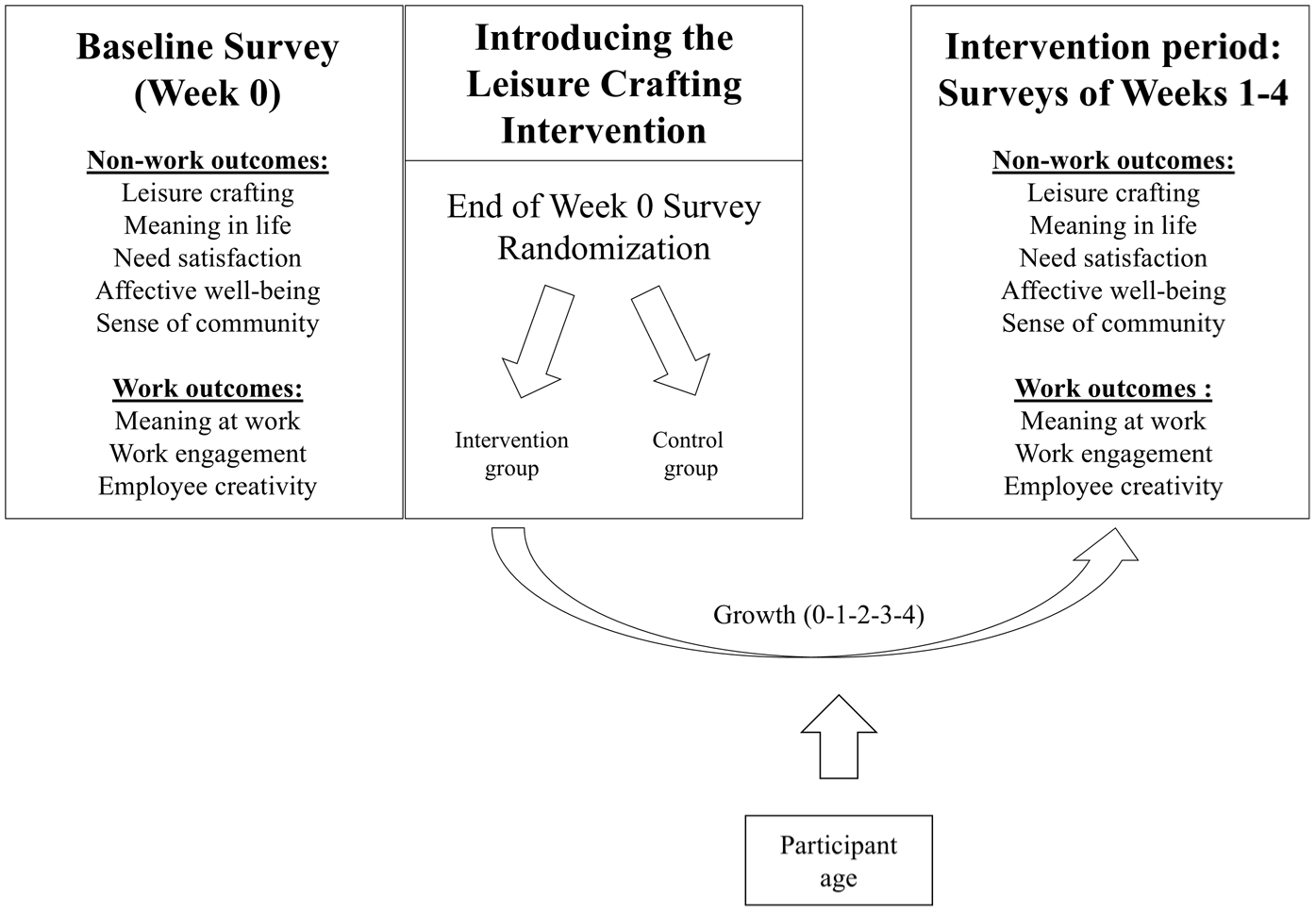
Our research design and expectations.
Our first intended contribution is to refine and advance the design of the already existing leisure crafting intervention that was conducted among young adults and students (Petrou and de Vries, 2025) and extend it to include a more representative (i.e. older) working population. Based on the socioemotional selectivity theory (Carstensen, 1992, 2021) and empirical evidence (Kim et al., 2020; Strijk et al., 2012) showing that active leisure activities benefit older adults (e.g. to deal with cognitive decline or achieve vitality at work), we expect that our intervention has stronger benefits for older participants. According to the socioemotional selectivity theory, emotional experiences and, thereby, affective well-being are of central importance for older individuals, in addition to previously examined outcomes (Petrou and de Vries, 2025). Our study will, therefore, also test effects on affective well-being.
Second, our aim is to cross-validate the effect of leisure crafting on meaning at work, found by survey research (Petrou et al., 2024), using intervention methodology. Our holistic perspective on meaning (Steger, 2019) acknowledges interconnections between experiences of meaning in different contexts. Work-related events and behaviors naturally influence work meaning but work meaning can also be shaped by factors unrelated to work, such as employees’ strengths and intrinsic motivation (Bailey et al., 2019; Lysova et al., 2019). Therefore, in addition to the known effect of leisure crafting on meaning in life (Berg et al., 2010), we test whether the effect manifests in meaning at work. When participants are trained to display leisure crafting, they may use their gained insights to redefine not only who they are as individuals (“What matters to me?”), but also their work (“Why does my work matter?”)
Third, drawing on literature that connects leisure with a rich social life (Toepoel, 2013), we address the potential of leisure crafting to create a sense of community. Since leisure crafters build a support network and long-lasting ties with other like-minded hobbyists (Jones, 2022), they can become active members of communities. The importance of the sense of community within leisure science is indisputable (Ross and Searle, 2019), yet, curiously, leisure crafting research has not addressed it. In addition to the known effects of leisure crafting on relatedness need satisfaction (Petrou and Bakker, 2016), our intervention addresses the possibility that through committed leisure activities, leisure crafters experience belongingness to a broader community. This possibility goes beyond one-to-one relationships as it refers to happier and more engaged communities rather than individuals.
The concept of leisure crafting
Since its emergence in the literature (Berg et al., 2010), leisure crafting has been conceptualized as a serious and committed leisure behavior that may cost effort but is also able to give much in return. The operationalization that the present paper follows (Petrou and Bakker, 2016) is aligned with the three basic human needs of the self-determination theory (Ryan and Deci, 2017). First, via leisure crafting, individuals express intrinsic motivation by taking ownership of their leisure time and setting autonomous goals. Second, they become competent via the learning component of leisure crafting. Third, they enjoy heightened human connection and relatedness by forming bonds with like-minded individuals.
Returning to the choir example, let us think of Nick and Ayla, two individuals who attend the same choir class weekly. Nick enjoys singing with his teammates and always has fun during the lesson and, especially afterwards, when they go for drinks. However, for the rest of his week, he does not think about his choir that much. It is just a way for him to have fun once a week. Ayla is quite serious about her choir. She often suggests new songs to her teacher, and she is always the first one to get involved in the show that they put on at the end of each year. Occasionally, she has taken extra private lessons to improve her singing, and, in the back of her mind, she considers the idea of leading her own choir in the future, where she will realize her artistic vision.
While Nick’s example is more likely to fall under what we commonly refer to as a “hobby,” Ayla’s is more likely to represent “leisure crafting.” However, we do not view leisure crafting as a dichotomous variable, in which a certain activity is or is not leisure crafting. Like any other psychological variable, leisure crafting operates in a continuum. Therefore, while Nick might be able to score averagely on leisure crafting, Ayla is likely to score higher. We also note that leisure crafting is not about the specific activity one exercises (e.g. singing or yoga) but more about the mindset and the behavioral attitude (i.e. growth-oriented) with which one approaches their leisure activity.
Non-work outcomes of leisure crafting
Our expected intervention effects on non-work benefits are explained by the ability of leisure crafting to address basic human needs, namely, autonomy, competence, and relatedness (Ryan and Deci, 2017). In addition, crafting activities, as well as serious and committed leisure activities, enhance identity development (De Bloom et al., 2020) and maximize one’s strengths (Kooij et al., 2017) and psychological resources (Kelly et al., 2020), which also explains our expected effects. Accordingly, our first cluster of potential non-work intervention outcomes include (a) meaning in life, referring to the felt significance of one’s existence (Steger et al., 2006), (b) human need satisfaction, pertaining to one’s autonomy, competence, and relatedness (Sheldon et al., 2001), (c) affective well-being, referring to the experience of positive emotions (Schaufeli and Van Rhenen, 2006) and (d) sense of community, defined as “a feeling that members have of belonging, a feeling that members matter to one another and to the group, and a shared faith that members’ needs will be met through their commitment to be together” (McMillan and Chavis, 1986: 9).
Meaning in life
Scholars (Martela et al., 2016) have theorized that meaning is built upon three pillars. Namely, people create and experience meaning according to their understanding of their place in the past, present, and future. Making sense of one’s past experiences exemplifies how the past produces meaning. Experiencing joy in a particular activity can represent how the present produces meaning. Setting goals or seeing connections between current and future activities is an example of how the future produces meaning. Notably, these three pillars of meaning may be captured by leisure crafting. First, learning and developing oneself via leisure crafting mirrors improvements compared to one’s past self, thus representing the past. Second, experiencing joy in a present activity via leisure crafting represents the present. Third, setting goals for future development via leisure crafting represents the future. Because people craft activities to better mirror what they need or what matters to them (De Bloom et al., 2020), we suggest that identity development is the primary mechanism explaining how leisure crafting enhances meaning. The ability of leisure to help people create narratives about their identity and what drives them in life (Bailey and Fernando, 2012) has been confirmed by qualitative (Berg et al., 2010), survey (Petrou and Bakker, 2016), and intervention studies (Petrou and de Vries, 2025) on leisure crafting.
Need satisfaction
Naturally, because the three components of leisure crafting (i.e. autonomous goal-setting, competence, human connection) are aligned to the human needs of the self-determination theory (Ryan and Deci, 2017), it follows that leisure crafting is prone to fulfill these needs (Petrou and Bakker, 2016; Petrou and de Vries, 2025). Planning one’s leisure time and using one’s leisure time activity to achieve intrinsically motivating self-set goals will enhance the satisfaction of the autonomy need. Self-development and learning new things about oneself or one’s leisure activity will enhance the satisfaction of the competence need. Finally, connecting with other like-minded individuals, inspiring them, and being inspired by them will enhance the satisfaction of the relatedness need.
Affective well-being
Leisure crafting may enhance affective well-being via the generation of psychological resources and by addressing human needs. On the one hand, by generating optimism, hope, and resilience (Hood and Carruthers, 2007; Kelly et al., 2020), leisure helps individuals deal with life setbacks and protect their well-being. On the other hand, the same resourcefulness can be seen if we zoom in on the three basic human needs (Ryan and Deci, 2017) that leisure crafters may pursue. A long-standing notion within leisure science is that play, which is inherently autonomous, enhances people’s well-being (Brajša-Žganec et al., 2011). This is particularly applicable to the concept of leisure crafting. By developing themselves, leisure crafters experience joy during their leisure activities (Berg et al., 2010). Especially the learning and the social components of leisure crafting highlight this. Learning and developing oneself is intrinsically enjoyable for humans and has been connected to the experience of positive emotions (Hökkä et al., 2020). Similarly, humans are social by nature, and interactions with peers are associated with positivity, enjoyment, and a happier life (Chapin et al., 2013). Cross-sectional survey research on leisure crafting has confirmed this effect empirically (Teng, 2023).
Sense of community
The deep human connections that individuals maintain via their leisure activities often have implications that go beyond simple social support (Hutchinson et al., 2017). Individuals engaging in leisure crafting form long-lasting ties with like-minded people, and they influence and inspire each other, often leading to the formation of clubs or even communities (Jones, 2022). Particularly, the human connection component of leisure crafting (i.e. parallel to the human need of relatedness; Ryan and Deci, 2017) may highlight this. Even more importantly, when human connection and relatedness (e.g. inspiring each other) occur in the context of long-term goal-setting (i.e. which is also a component of leisure crafting), this forms mutual expectations, responsibilities, and a long-term vision. This aligns with our conceptualization of sense of community, entailing a collective feeling of commitment of the community members to stay together (McMillan and Chavis, 1986). Similarly, leisure research has found that via increased social interactions and social support, leisure activities increase people’s sense that they belong to something bigger than the individual, namely, a community (Ross and Searle, 2019).
Work outcomes of leisure crafting
Our expected intervention effects on work-related outcomes are primarily explained by the ability of leisure to enrich and positively transform one’s work (Daniel and Zhan, 2023; Greenhaus and Powell, 2006). Secondarily, the effects can be explained by the ability of leisure to maximize psychological resources (Kelly et al., 2020) and enhance identity development (De Bloom et al., 2020). Our work-related outcomes include: (a) meaning at work, referring to a feeling of significance and purposefulness regarding one’s work (Steger et al., 2012), (b) work engagement, defined as a “positive, fulfilling work-related state of mind that is characterized by vigor, dedication and absorption” (Schaufeli et al., 2006: 702), and (c) employee creativity, referring to the production and the implementation of work-related ideas that are both novel and useful (Miron et al., 2004).
Meaning at work
Consistent with our aforementioned reasoning regarding the ability of leisure crafting to enhance identity development (De Bloom et al., 2020), we expect this renewed identity to boost not only meaning in life but also meaning at work. This is consistent with the tenets of the enrichment theory (Greenhaus and Powell, 2006), whereby, once individuals make valuable discoveries in one life domain, they will use those to navigate also other life domains. Meaningful work is naturally shaped by work-related factors, such as relationships at the workplace (Wrzesniewski et al., 2003). However, non-work-related employee characteristics can also shape meaningful work. For example, employees’ character strengths (i.e. “those qualities that are best about people”) have been found to enhance one’s experience of meaningful work (Littman-Ovadia and Steger, 2010: 419). This indeed suggests that development and growth are not tied down to specific life domains. Once an individual learns, grows, and develops, for example, via their leisure activity, they will gain insights that will also influence how they look at their work because their novel perspectives transform their lives holistically. For example, rediscovering how to connect to others via one’s leisure activity may lead to transformed relationships at work, which, essentially, leads to a renewed sense of work meaning (Jones, 2022). The positive impact of leisure crafting on meaning at work has been confirmed by a weekly survey study (Petrou et al., 2024).
Work engagement
Job enrichment is the primary mechanism that may explain how leisure crafting leads to work engagement. Extensive spillover literature and applications of the enrichment theory emphasize that good things that happen outside work energize people at work (Sonnentag and Kühnel, 2016; Timms et al., 2015). Leisure crafting generates positivity and joy. Even if these emotions are initially context-free, they can be expected to be carried over to work (Ten Brummelhuis and Bakker, 2012). Indeed, leisure crafting has been found by survey research to enhance work-related performance (Wang et al., 2023), well-being (Abdel Hadi et al., 2021), and even engagement (Liu et al., 2024). Regarding employee work engagement in particular, the link can be additionally explained by the resource-generating nature of committed leisure activities (Kelly et al., 2020; Petrou and de Vries, 2025). Psychological resources, such as self-efficacy and optimism, are essential drivers of employee work engagement (Xanthopoulou et al., 2007) because they help employees (re)discover the intrinsically motivating aspects of their jobs and deal with stressors.
Employee creativity
The effect of leisure crafting on creativity has been confirmed by survey research (Hamrick, 2022) and intervention research (Petrou and de Vries, 2025). Like work engagement, job enrichment is the primary mechanism to explain this effect. Empirical research (Petrou et al., 2024) using the enrichment theory (Greenhaus and Powell, 2006) found that leisure crafting generates developmental resources (e.g. knowledge or new perspectives) or affective resources (e.g. positive emotions) that employees carry over to work and put them to use there for their benefit. These two pathways mirror how the challenging elements of leisure crafting help people develop themselves while the play and joy associated with it induce the experience of positivity. Notably, the three basic human needs that leisure crafters pursue can also highlight the creative potential of leisure crafting. The intrinsically motivating aspect (i.e. people exercise it autonomously) and the developmental aspect (i.e. people learn from it) of leisure crafting echo the intrinsic motivation and the technical skills that are basic components of creativity (Amabile, 2013). Similarly, the fact that leisure crafters often have rich social connections highlights the diversity of perspectives and the exchange of opinions and inspiration, which are conditions under which creativity thrives (Perry-Smith, 2014).
The moderating role of age
Traditional perspectives on aging (Baltes, 1997) suggest that as people age, it becomes increasingly difficult to balance gained and lost resources. However, precisely because of this, it is likely that aging adults learn to become more selective, and they find adaptive ways to deal with increasing environmental demands or declining health. This perspective is echoed by the socioemotional selectivity theory (Carstensen, 1992, 2021). Accordingly, it is not old age itself but, rather, the constraints on future time horizons that motivate older people to opt for quality and meaning over quantity in their everyday life choices and in their contacts with others. It is more likely that older adults may find more interest in meaningful rather than mindless leisure activities, which are more aligned with the concept of leisure as proposed by our intervention. This agrees with the maturity principle (Schwaba et al., 2022), suggesting that individuals become more adaptable as they age, which would make them more able to reap the benefits of (leisure) crafting interventions in a way that realizes their full potential as individuals. Furthermore, from a practical point of view, older adults are no longer constrained by career and family obligations, typically accruing in middle-life stages (Wepfer et al., 2015), and have more room for meaningful and time-consuming leisure activities, like the ones proposed by our intervention. Even though this line of reasoning refers to our non-work benefits (e.g. meaning in life or affective well-being), it should hold for work-related outcomes as well. Age-related losses are not tied to specific life domains; therefore, older employees may also benefit from our intervention in the context of their work. For example, their focus on emotionality and meaningful experiences may help explain why outcomes such as meaning at work and work engagement will be affected. Additionally, their focus on meaningful relationships with others may help explain how their social networks will boost their work engagement (Xanthopoulou et al., 2007) or creativity at work (Perry-Smith, 2014).
Such ideas are reflected by existing leisure interventions. For example, a review of intervention studies has revealed that participation in intellectual leisure activities is mostly successful in terms of improving cognitive performance of older adults (Iizuka et al., 2019). The existing intervention studies raise the possibility that even though leisure crafting interventions are designed to benefit everyone, the benefits are more accessible for older employees. Therefore, much like older employees were found to benefit from a job crafting intervention because they are more able to use their strengths to make their work conditions more satisfying (Kooij et al., 2017), we propose that leisure crafting interventions have potential for older employees. Since older employees often prepare for their retirement (Johnson, 2011), it follows that their pool of resources is not to be found exclusively in the work domain; it can also be outside of it, for example, in the leisure domain. Tapping one’s potential as an individual does not only help someone to grow as an individual but also as an employee since personal strengths and resources are utilized across multiple life domains (De Bloom et al., 2020; Kooij et al., 2017). Hence, we formulate:
Methods
Participants and procedure
Participants were 462 employees from different occupational sectors in The Netherlands, recruited via the panels of Flycatcher, a Dutch internet research bureau. The selection criteria were that participants had a paid job for at least 3 days per week and either had a free-time activity or were willing to find one for the study period. The research included a baseline survey (i.e. at the end of which participants were allocated into intervention or control group via simple randomization; Kim and Shin, 2014), followed by four weekly surveys. Both the baseline survey and the weekly surveys contained the same items. The only difference was that the baseline survey additionally contained demographic variables. Also, only the intervention group received the intervention that consisted of the creation of a self-development plan via leisure activities (at the end of the baseline survey) and a weekly reflection regarding this plan (at the end of each weekly survey; for a full explanation see section “the leisure crafting intervention” below). The control group received no intervention; it only received the baseline and weekly surveys, thus constituting a passive control group (Kooij et al., 2017; Van den Heuvel et al., 2015).
In total, 1000 participants were invited to participate and N = 462 participated and fulfilled all criteria, forming our final sample (response rate = 46%). The criteria for retaining participants were three: First, participants had to fill in the baseline survey and at least, two more weekly surveys (otherwise, estimation of growth patterns would not be possible); Second, they had to report that, on average, they exercised a leisure-time activity, at least 0.6 times a week after the baseline survey. This means that, on average, they needed to have more weeks when they exercised their leisure-time activity than weeks when they did not exercise their leisure-time activity. Third, participants in the intervention group had to rate the effort they put into the intervention with more than 5, using a 1–10 answering scale, whereby 1 meant that they invested no effort whatsoever and 10 meant that they did their best.
Participants of the intervention group (N = 196) were 114 women and 82 men. They were, on average, 46.4 years old [standard deviation (SD) = 11.1], and they worked 33.2 hours per week (SD = 7.5) according to their contract. Their mean work experience in their current position was 13.8 years (SD = 11.1). Their occupational sectors mostly included, among others, health (23%), education (19.4%), government (9.2%), trade (7.7%), finance (7.1%), “other” (6.6%), industry (6.1%), communication (5.1%), consulting, research or business services (3.6%) and other services (3.1%). Their living situation included living with a partner or widowed and with kids in the house (40.3%), living with a partner or widowed and without kids in the house (37.2%), living alone without kids in the house (13.3%), living alone with kids in the house (5.1%), living with parents (2%), or “other” (2%). On average, they filled in 4.9 out of the five weekly surveys (SD = 0.5). They described the type of their leisure activity (or activities) using a scale ranging from 1 = always exercising alone/without others to 7 = always exercising with others, with an average of 4.2 (SD = 1.5).
The control group participants (N = 266) consisted of 146 women and 120 men. They were, on average, 47.3 years old (SD = 11.5) and worked 33.6 hours per week (SD = 6.4) according to their contract. Their mean work experience in their current position was 14.6 years (SD = 10.6). Their occupational sectors included, among others, health (22.9%), education (14.7%), government (10.5%), consulting, research or business services (8.3%), other services (7.1%), trade (6.4%), industry (6.4%), finance (6.0%), communication (3%), “other” (4.9%). Their living situation included: living with a partner or widowed and with kids in the house (40.2%), living with a partner or widowed and without kids in the house (30.1%), living alone without kids in the house (21.1%), living alone with kids in the house (5.6%), living with parents (1.5%) or “other” (1.5%). On average, they filled in 4.8 out of the five weekly surveys (SD = 0.6). They described the type of their leisure activity (or activities) using a scale ranging from 1 = always exercising alone/without others to 7 = always exercising with others, with an average of 4.2 (SD = 1.5).
Participants were invited to participate on the Friday of each week and they were asked to complete the survey by the end of the weekend. Each Monday, a reminder was sent, and a last chance was given for those who had not filled in the survey to do so by the end of the day. Participants were told that the research concerned their free time as well as their work activities and that they would be randomly allocated into either one of two versions of the survey: the extended version, in which they would fill in five weekly surveys and asked to create a “personal development plan” using their leisure-time activities and the short version, in which they would only need to fill in the five weekly surveys. They were also informed that if they filled in all five weekly surveys, they would receive 1350 points (to be exchanged for 15 Euro or a similar donation; control group) or 1800 points (to be exchanged for 20 Euro or a similar donation; intervention group).
The leisure crafting intervention
Our intervention is based on the validated leisure crafting intervention developed by Petrou and de Vries (2025). The only modification we made was to fine-tune the text of Petrou and de Vries’ intervention video, and we filmed the video in a professional studio. The aim of our intervention was three-fold, namely, (1) to increase awareness and understanding of leisure crafting among the intervention participants, (2) to coach them to set leisure crafting goals, using their free-time activities, and (3) to encourage them to display self-reflection regarding their personal development via their leisure-time activities. These three elements of raising awareness, goal-setting, and self-reflection are commonly used in (intervention) research aiming at behavioral change (Epton et al., 2017; Kersten-van Dijk et al., 2017). As in Petrou and de Vries (2025), the leisure crafting goals of the participants of the intervention had to mirror the three elements of the leisure crafting operationalization (autonomous goal-setting, learning, and human connection; which are parallel to the three basic human needs of the self-determination theory; Ryan and Deci, 2017). At the end of the baseline survey, participants of the intervention group were asked to watch the 5-minute intervention video, where a professional trainer discussed the three elements of leisure crafting using a PowerPoint presentation (i.e. the video showed the slides, the trainer and sometimes both, and is available via YouTube; Petrou and den Dulk, 2025). After the end of the video, participants of the intervention group had to name the leisure-time activity or activities that they would use to create a so-called “personal development plan” using their leisure-time activities in the coming 4 weeks (see “personal development plan” of Supplemental Appendix I). Accordingly, they had to write down how they would use their leisure-time activity in order to attain the three aforementioned elements of leisure crafting in the coming weeks. At the end of each one of the subsequent four weekly surveys, participants of the intervention group had to report how exercising their leisure-time activity went during the previous week, what the progress was in terms of attaining the three elements of leisure crafting and whether they would like to improve anything in the week to come (see “self-reflection” questions in Supplemental Appendix I). Upon completing the baseline survey or any weekly survey from week 1 through week 3, intervention participants received an automatic e-mail containing, respectively, their personal development plan or their self-reflection. All automatic e-mails also contained the link to the online intervention video that participants could rewatch at any point throughout the intervention period. The control group participants only filled in the five weekly surveys, without watching any video, creating a personal development plan, or answering any self-reflection questions.
Instruments
Participants from both the intervention and the control group answered the same questions. All items followed the sentence “During the previous week. . .” and they were rated using an answering scale ranging from 1 = totally disagree to 7 = totally agree.
Manipulation check
As a manipulation check, we used a shortened 6-item version (Petrou and de Vries, 2025) of the leisure crafting questionnaire, developed by Petrou and Bakker (2016). Sample items include “I tried to find challenging activities outside of work” and “I looked for inspiration from others through my leisure activities.” Cronbach’s alpha (a) ranged from 0.90 to 0.93.
Non-work outcomes
Meaning in life (e.g. “I had a good sense of what makes my life meaningful”; 0.89 < a < 0.93) was measured with three items from Steger et al. (2006; subscale “presence”). Need satisfaction (e.g. “I felt free to do things my own way”; 0.64 < a < 0.77) was measured with three items from Sheldon et al. (2001). For a similar approach of creating one aggregate score for need satisfaction, see Zeijen et al. (2020). Affective well-being was measured on the basis of a checklist of five adjectives (e.g. “enthusiastic,” “inspired”; 0.90 < a < 0.92) by Schaufeli and Van Rhenen (2006). Sense of community was measured with a self-made single item (“Thanks to my leisure-time activity, I felt part of a community”), based on previous literature using single-item measures of sense of community (Carpiano and Hystad, 2011).
Work outcomes
Meaning at work (e.g. “I viewed my work as contributing to my personal growth”; 0.85 < a < 0.92) was measured with the 3-item “meaning making through work” subscale from Steger et al. (2012). Work engagement (e.g. “I felt strong and vigorous while working”; 0.93 < a < 0.95) was measured with a 6-item version (Bakker and Xanthopoulou, 2009) of the Utrecht Work Engagement Scale (Schaufeli et al., 2006). Employee creativity (e.g. “I had a lot of creative ideas at work”; 0.90 < a < 0.93) was measured with the creativity questionnaire of Miron et al. (2004), adjusted to refer to work (i.e. the word “work” or “at work” was added in all items). This is a validated scale of creativity that has been used among heterogeneous samples of workers from different occupational sectors (Demerouti et al., 2015; Liu et al., 2023).
Analytic approach
We followed previous intervention research (Kroese et al., 2013; Petrou and de Vries, 2025) addressing increase in our outcome variables as growth. We adopt a Bayesian multilevel perspective where time is specified as a variable. The effect of time (week) is treated as a random slope so that it varies across individuals, representing the linear growth for each participant. We also used a multivariate approach to model the linear growth of all eight variables simultaneously: leisure crafting as the manipulation variable, the four non-work outcomes, and the three work outcomes. Analyzing all growth curves simultaneously required correlating all the residuals with each other, and correlating all random intercepts and all random slopes with each other. Our analyses examined linear growth (i.e. 0–1–2–3–4; whereby 0 represents the mean score of the outcome of interest in the baseline survey—Week 0—and 4 represents the mean score of the same outcome on Week 4, the last week). To evaluate Hypotheses 1 and 2, we followed previous intervention research (Fernandez et al., 2019; Maisto et al., 2015) and examined interaction effects between time and a dummy variable representing the intervention effect (being in the intervention group or not). For Hypotheses 3 and 4, we extended this approach and used three-way interaction effects between time, intervention, and age.
We analyzed our model using R (R Core Team, 2025) and brms (Bürkner, 2017). Since we do not have any strong prior beliefs that we wish to integrate in the model, we opted for weakly informative model priors. These allow for any possible reasonable coefficient estimates (given the range of the values in our data) while excluding extreme values. For all intercepts and slopes in our model we used centered normal distributions with a scale of 5 SDs. For the residuals, we used a single 8 × 8 covariance matrix and for the random effect errors a 16 × 16 covariance matrix (for the 8 intercepts and 8 slopes). Each of these was decomposed into a vector of scales and a correlation matrix (see Stan Development Team, 2025). For the scales, we used a half-Student-t distribution with 3 degrees of freedom and 2.5 SD for scale. For the correlation matrix, we used the LKJ distribution (Lewandowski et al., 2009) with shape 2 that slightly favors smaller correlations between variables. We tested our model for 10,000 iterations (5000 warmup and 5000 sampling) and 4 simulation chains, which was sufficient to establish convergence using multiple criteria recommended in the literature (Kruschke, 2021) including visual evidence from traceplots, the scale reduction factor (
Results
Preliminary descriptive analyses of the open comments
To get a better understanding of what leisure activities intervention participants used and how they used them, we coded part of their open comments in the following ways: (1) In the baseline survey, we coded answers regarding what type of leisure activities participants wanted to use for the intervention. (2) In the surveys of Week 1 through Week 3, we coded their answers to the question regarding what they planned to improve or to do differently in the week to come (i.e. this question was not present in Week 4). Regarding leisure activity, the majority of the participants opted for a sports activity (58%), followed by creative activities (18%), intellectual activities (8%), social activities (5%), cooking (6%), DIY activities or gardening (3%), or other activities (2%). On future improvements, participants indicated, among other things, no wish to improve (32%–46%), investing more time in their leisure activity (13%–20%), focusing on attaining their goals (7%–15%), trying something new in their leisure activity (8%–11%) or focusing on their planning (5%–9%). All the descriptive statistics can be found in Supplemental Appendixes II and III.
Dropout analyses and randomization checks
Before proceeding to the main analyses, we assessed whether respondents who dropped out after Week 0 (i.e. baseline survey) or Week 1 (N = 153) scored differently on Week 0 (i.e. baseline) variables, compared to the sample used for analyses (N = 462). Differences were found for three out of eight measured variables. Specifically, drop-outs scored significantly lower (M = 5.137) than our sample (M = 5.360) on affective well-being, t (613) = −2.408, p < 0.05. They also scored lower (M = 4.638) than our sample (M = 4.978) on meaning in life, t (613) = −2.986, p < 0.01. Finally, drop-outs scored lower (M = 5.342) than our sample (M = 5.523) on need satisfaction, t (613) = −2.302, p < 0.05.
Furthermore, we conducted randomization checks. Hence, we assessed whether there were any differences between the intervention group (N = 196) and the control group (N = 266) on any of the baseline (i.e. Week 0) variables, that is, on any variables prior to the intervention. Analyses did not reveal any statistically significant differences.
Measurement models
Before analyses, we assessed the factor structure of all our scales by conducting multilevel confirmatory factor analyses (i.e. weekly measurements nested within individuals) with Mplus. We did this in two steps. First, we built a four-factor model in which the items of all non-work variables (i.e. leisure crafting, meaning in life, need satisfaction, and affective well-being) loaded on their respective factors. This model displayed excellent fit to the data, χ2 (226) = 829.429, p < 0.001, comparative fit index (CFI) = 0.954, Tucker–Lewis index (TLI) = 0.944, root mean square error of approximation (RMSEA) = 0.035, standardized root mean square residual (SRMR) = 0.037 (within), and 0.069 (between). Importantly, it displayed superior fit compared to an alternative three-factor model (i.e. merging need satisfaction with affective well-being), a two-factor model (i.e. adding meaning in life to the previously merged factor), and a one-factor model. Second, we built a three-factor model, in which the items of all work-related variables (i.e. meaning at work, work engagement, and employee creativity) loaded on their respective factors. This model displayed excellent fit to the data, χ2 (124) = 586.689, p < 0.001, CFI = 0.957, TLI = 0.946, RMSEA = 0.041, SRMR = 0.041 (within) and .057 (between), and also superior fit compared to an alternative two-factor model (i.e. merging work engagement with creativity) and a one-factor model.
Descriptive statistics and manipulation check
Table 1 displays the mean scores and SDs of all our study variables, for the intervention versus the control group—intercorrelations between intercepts and slopes of all variables can be found in Supplemental Appendix IV. Before testing our hypotheses, we inspected the growth (i.e. random slope for week) in leisure crafting, which was significant (see Table 2). Importantly, there was a significant interaction between week and intervention (b = 0.084, 95% Confidence interval (CI) = [0.029, 0.138]) indicating that the slope was twice as strong for the intervention (b = 0.142, 95% CI = [0.101, 0.183]) than for the control group (b = 0.058, 95% CI = [0.023, 0.094]) (see Table 3). This suggests that the manipulation check of our intervention was successful (i.e. intervention participants reported increasing levels of leisure crafting over the intervention period).
Sample size, mean scores, and standard deviations of all study variables for intervention group and control group.
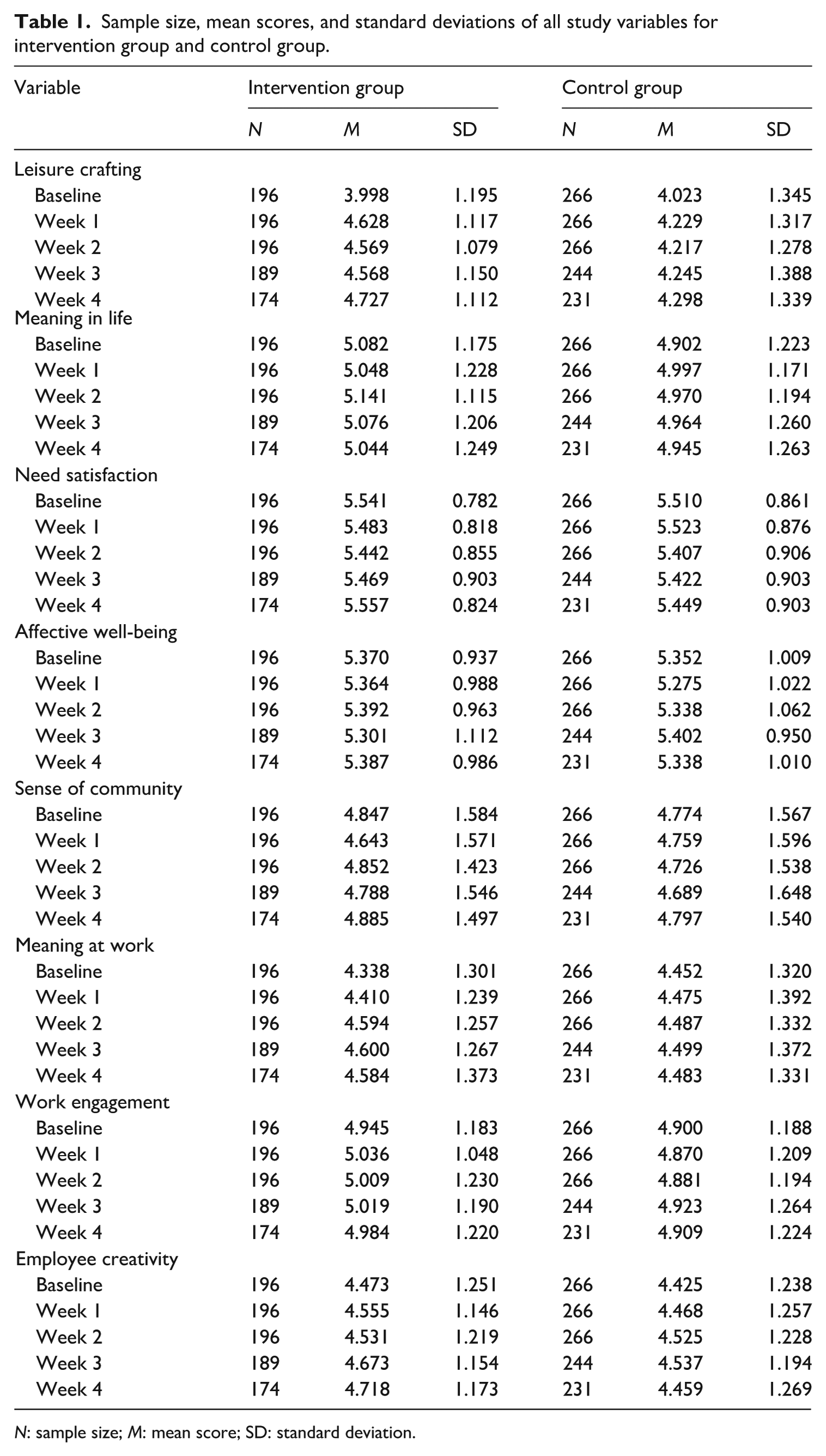
N: sample size; M: mean score; SD: standard deviation.
Multilevel Latent Growth Curve results (unstandardized estimates).
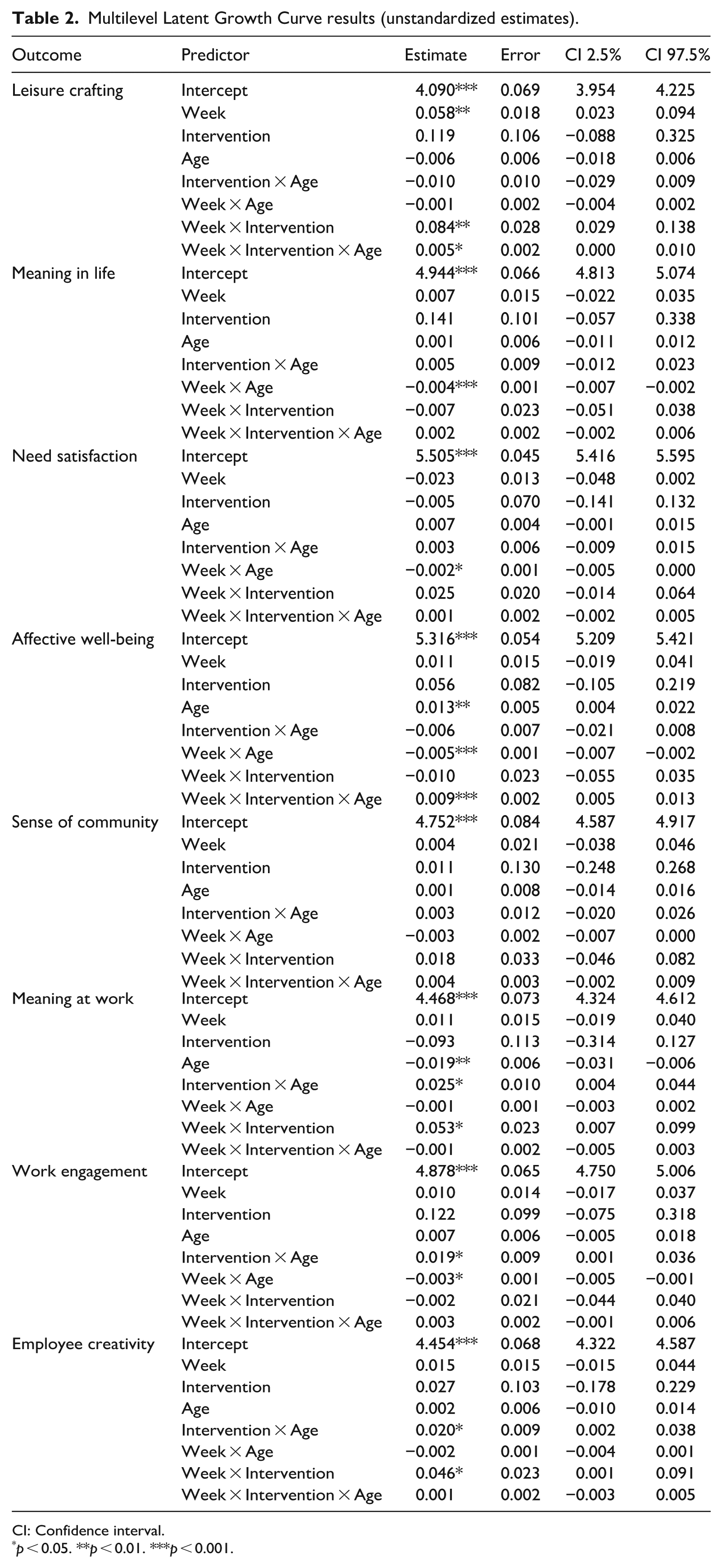
CI: Confidence interval.
p < 0.05. **p < 0.01. ***p < 0.001.
Intercepts and slopes for the control and intervention groups.
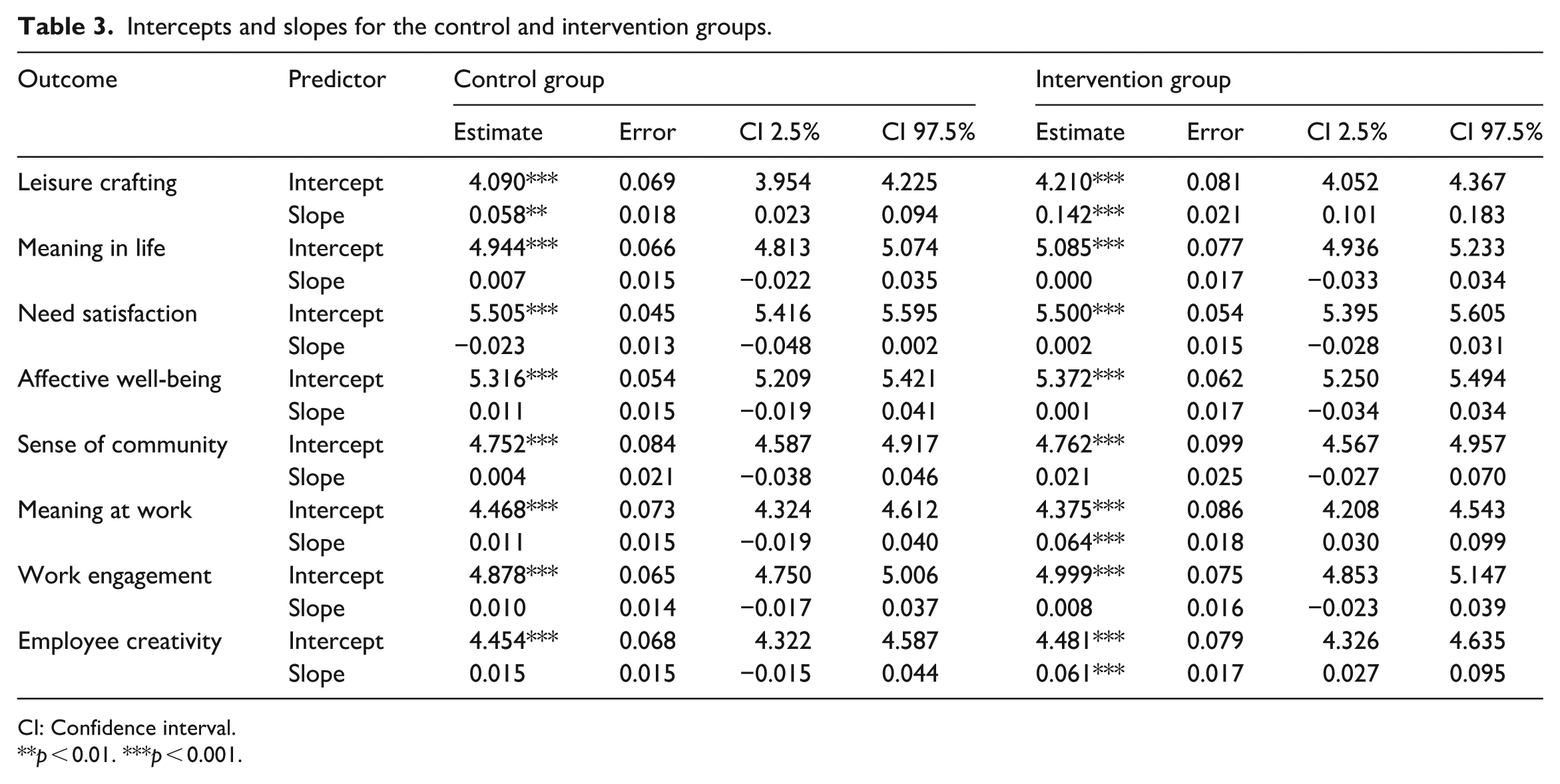
CI: Confidence interval.
p < 0.01. ***p < 0.001.
Testing Hypotheses 1 and 2: Main effects of the intervention
Analyses did not reveal any differences between control and intervention group in terms of their growth (i.e. slope) in the levels of meaning in life, need satisfaction, affective well-being, and sense of community (see Tables 2 and 3), which fails to support Hypothesis 1. However, analyses showed that the intervention participants experienced greater growth (i.e. steeper slope) in terms of their levels of meaning at work (b = 0.053, 95% CI = [0.007, 0.099]) and employee creativity (b = 0.046, 95% CI = [0.001, 0.091]), but not work engagement, which supports Hypothesis 2a and 2c but not 2b. Examining the specific slopes for these interactions showed that the slopes were significant only for the intervention group for both meaning at work (b = 0.064, 95% CI = [0.030, 0.099]) and employee creativity (b = 0.061, 95% CI = [0.027, 0.095]).
Testing Hypotheses 3 and 4: The role of age
To evaluate Hypotheses 3 and 4, we examined whether the latent growth curves were conditional on age by including the three-way and two-way interactions between age, week, and intervention. Table 4 displays all the interaction effects of condition (control vs. intervention group) by age that we tested on the slope of each outcome variable. The only significant three-way interaction effects found were those for leisure crafting (b = 0.005, 95% CI = [0.0001, 0.0096]) and affective well-being (b = 0.009, 95% CI = [0.005, 0.013]). Figure 2 shows the pattern of effects on leisure crafting for the control and intervention groups, and Table 4 displays the associated simple slopes analysis for the control and intervention groups at high (+1 SD), low (−1 SD) and mean ages. All the slopes were significant, showing that leisure crafting increased in all conditions, including the control group, over the course of the 5 weeks. In the control group, the effects were similar for high, low, and mean age groups. In contrast in the intervention condition, the linear trajectories were steeper, and importantly stronger for the older age group. To probe this further, we estimated the regions of significance (Johnson and Neyman, 1936; in Preacher et al., 2006), which revealed that, in the control group, the slopes became significant for those younger than 58.50, while in the intervention group, the effects became significant for those above the age of 30.31.
Simple slope effects for three-way and two-way interactions with age.
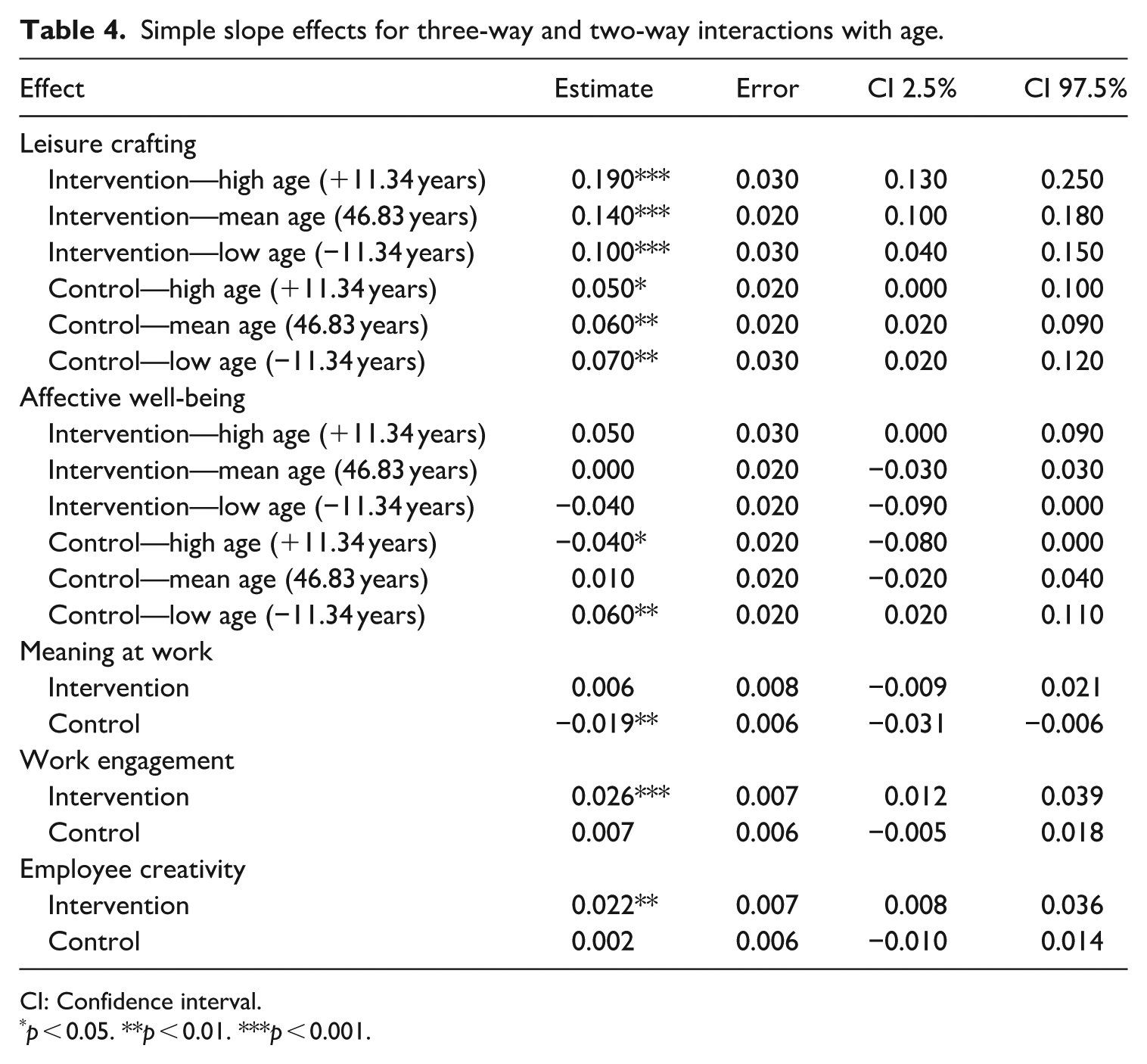
CI: Confidence interval.
p < 0.05. **p < 0.01. ***p < 0.001.
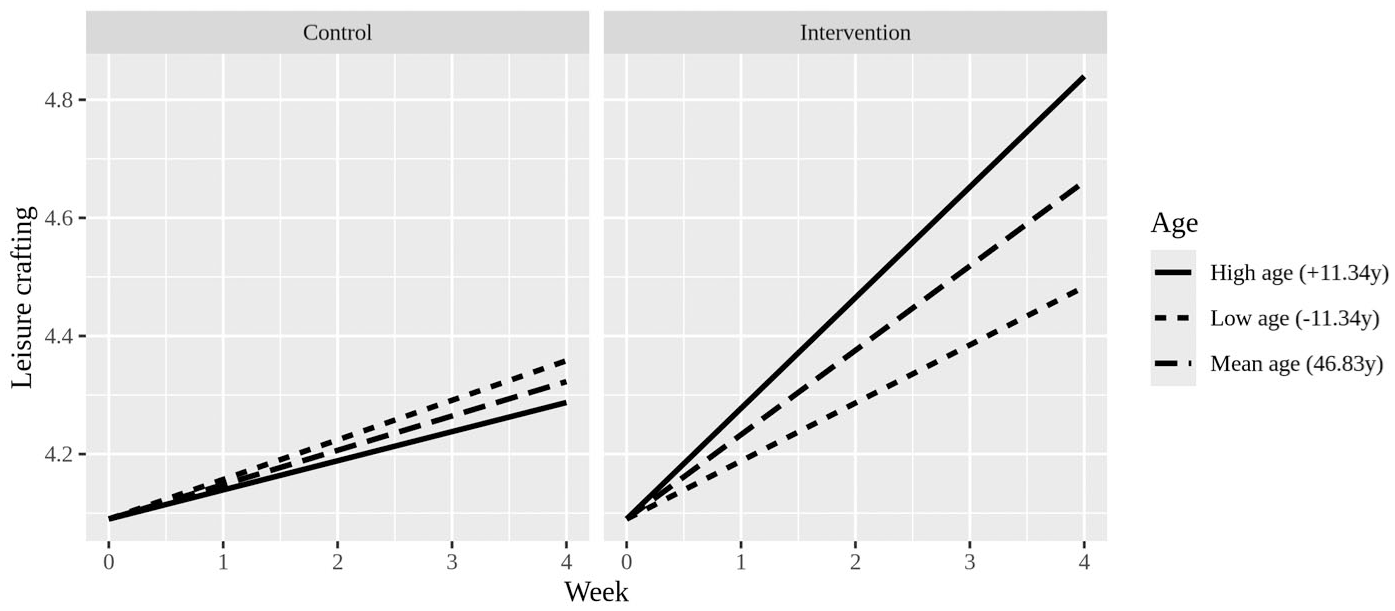
Three-way interaction effects between age, week, and group for leisure crafting.
Examining the three-way interaction for affective well-being shows a different pattern of effects where the trajectories of the control and experimental groups are in opposite directions (see Figure 3 and Table 4). In the control group, younger participants had a positive linear growth over the course of the study and older participants had a negative one. Those in the intervention group, however, had the exact reverse pattern with the older group showing a positive linear growth and the younger group a negative one. Further examination of the regions of significance revealed that in the control group, the significant region was below the age of 42.31 for a significant positive trajectory and above 57.81 for a significant negative trajectory. In contrast, in the intervention group, a significant positive trajectory manifested only for those older than 60.91, and a negative one for those younger than 25.81. Thus, the results provide partial confirmation of H3c.
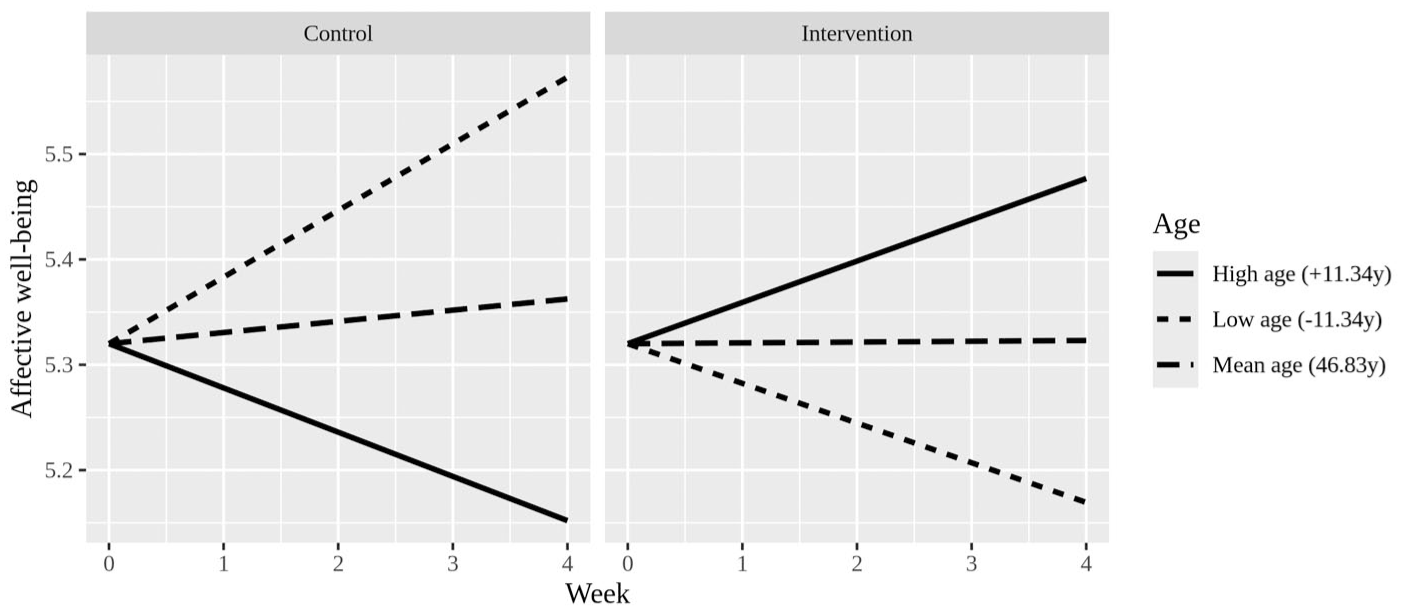
Three-way interaction effects between age, week, and group for affective well-being.
In addition to these effects, there were significant two-way interactions between age and the experimental group, suggesting that potentially age had an effect but this did not manifest in a linear trajectory. These interaction effects were significant for meaning at work (b = 0.025, 95% CI = [0.0041, 0.044], work engagement (b = 0.019, 95% CI = [0.001, 0.036]), and employee creativity (b = 0.020, 95% CI = [0.002, 0.038]). Simple slopes analyses (see Table 4 and Figure 4) revealed that in the intervention group, there was a positive association between age and work engagement, and also between age and creativity. The results for meaning at work however were significant only for the control group with a negative association so that older participants in the control group experienced less meaning at work. The simple slope plot showed that this effect was reversed for the intervention group, but not sufficiently to be significant.
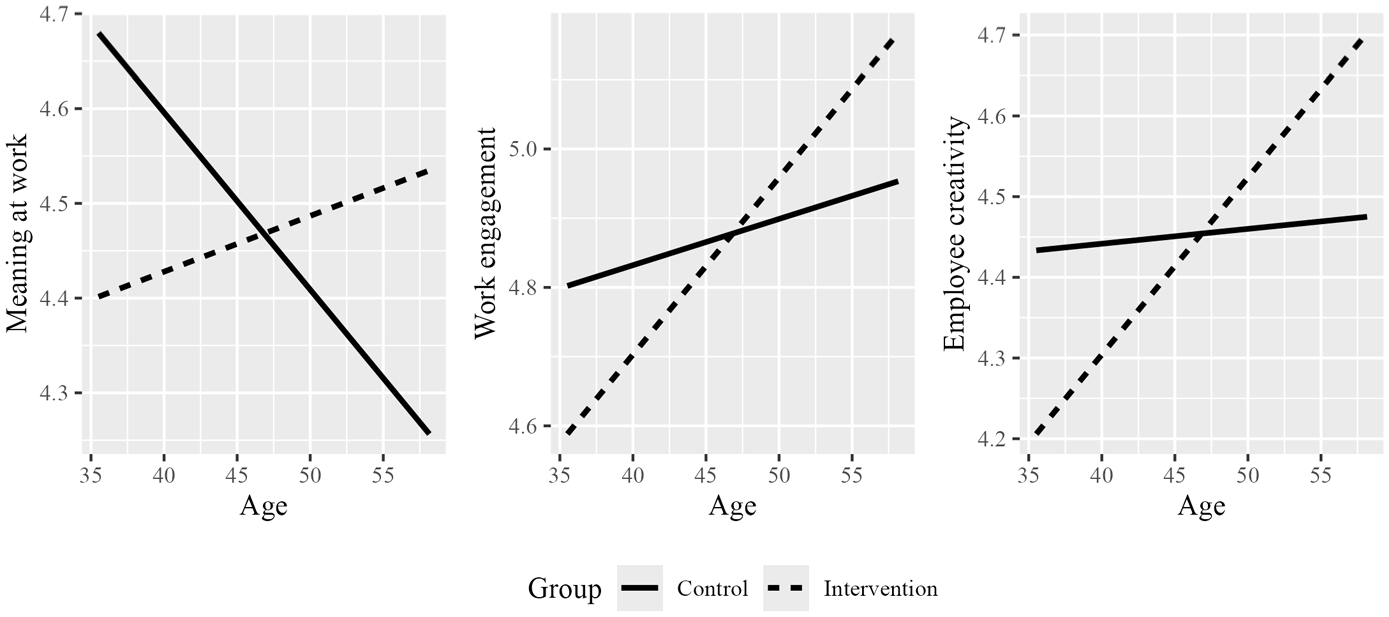
Two-way interaction effects between age and group for meaning at work, work engagement, and creativity.
Exploratory additional analyses
In additional analyses, we examined whether the type of the leisure activities that participants used (individual vs. collective) altered our reported findings. Similar to the analyses that we conducted with age as a moderator, we tested the interaction effect of the condition and a continuous variable representing the average extent over the 5 weeks to which participants exercised an individual versus a collective activity. All three-way interaction effects were non-significant, with the only exception being the one for leisure crafting (b = 0.044, 95% CI = [0.014, 0.074]). The pattern of results reveals that there was a stronger positive trajectory in the control group for individual activities and a stronger positive growth in the intervention group for collective activities (see Supplemental Appendix V and Supplemental Appendix VI).
Discussion
Based on extensive leisure crafting literature (Abdel Hadi et al., 2021; Liu et al., 2024; Petrou et al., 2017; Teng, 2023) as well as the self-determination theory (Ryan and Deci, 2017) and the enrichment theory (Greenhaus and Powell, 2006), we expected that, compared to a control group, participants of the leisure crafting intervention would report a greater increase in non-work benefits (meaning in life, need satisfaction, affective well-being, and sense of community) and work benefits (meaning at work, work engagement, and employee creativity). In addition, drawing from the socioemotional selectivity theory (Carstensen, 1992, 2021), we expected that the intervention effects would be stronger for older employees. Our results revealed that the intervention participants reported an increase in leisure crafting (i.e. manipulation check) as well as employee creativity and meaning at work. In addition, the intervention had a positive impact on affective well-being, but only for older employees (i.e. older than 61).
Theoretical implications
First and foremost, our intervention study gives further (ecological) validity to the concept of leisure crafting. Following up on intervention research revealing that students and young employees are well able to understand, learn, and apply leisure crafting behaviors (Petrou and de Vries, 2025), we have expanded this knowledge to refer to a more adult working population. Thus, in addition to job crafting interventions (Kooij et al., 2017), leisure crafting interventions appear to be a promising avenue that may assist (aging) employees. Workplace intervention research and practice needs to extend its focus on resources outside the work domain during employees’ leisure time. Interestingly, while our intervention did not have the expected effect on sense of community, its effect on leisure crafting (i.e. manipulation check) was stronger for collective activities. This validates qualitative evidence addressing social contacts as a major element of leisure crafting (Jones, 2022).
Second, our study results are aligned with the enrichment theory (Greenhaus and Powell, 2006) and expand previous research on the spillover effects of leisure (Daniel and Zhan, 2023) to refer to leisure crafting. Similarly, using an intervention methodology, we cross-validated previous survey research revealing that leisure crafting increases employee creativity and meaning at work (Petrou et al., 2024). In that sense, leisure can offer the tools to solve problems in a novel way at work (i.e. employee creativity) and, at the same time, to reimagine and reinvent one’s line of work (i.e. meaning at work). Notably, the tools that employees develop during their leisure time do not only transform the way they behave at work (e.g. creativity) but also the way they reflect on their work (i.e. reinventing the meaning of their work). In addition to discovering what matters in life (Petrou et al., 2017), leisure crafting helps employees discover what matters at work.
Third, as we expected, the positive impact of the intervention on affective well-being was particularly strong for older employees. This agrees with previous job crafting intervention research (Kooij et al., 2017) and extends it to refer to leisure crafting. Notably, affective well-being was the only outcome variable that was revealed by moderation analyses to be more strongly affected by the intervention among old participants. When it came to work-related outcomes (i.e. work engagement and creativity), those were stronger for older participants of the intervention group but the effects were not affected by time. Even though we expected that the propositions of the socioemotional selectivity theory (Carstensen, 1992, 2021) could be used to predict both non-work and work benefits, our results suggest otherwise. One could speculate—only future research could explore this more carefully—that if, according to the theory, older employees prefer quality over quantity in their (social) life, this may imply a lesser focus on performance or measurable outcomes. Older employees’ primary interest is to translate the newly acquired resources of the intervention into well-being, which is an indicator of quality of life rather than measurable behavior (e.g. creativity). This aligns with previous intervention research among older employees, suggesting that older employees prioritize well-being over performance outcomes (Cook et al., 2015; Strijk et al., 2012). An alternative interpretation may relate to the fact that more than half of the intervention participants exercised a sport. Physical activity is a powerful tool for protecting well-being, particularly among older adults who experience declining health (Bae et al., 2017). Perhaps other outcome variables (e.g. meaning in life) would have increased if there was a more even representation of physical versus intellectual activities.
Despite the found main effects of our intervention, surprisingly, none of those concerned non-work outcomes. One way to explain this is that, prior to the intervention, participants tended to score higher on non-work than on work outcomes, which leaves more room for improvement in the work benefits. Another way to explain this is via the content of the self-development plan of the intervention. In the baseline survey, participants were asked to report which leisure activities they planned to use and how they would reach the three leisure crafting elements. These questions involve a fair amount of goal-setting. However, (autonomous) goal-setting is already one element of leisure crafting. Hence, it could be that the goal-setting element was overrepresented in our intervention compared to the other two elements of leisure crafting. Since work is typically seen as more extrinsically motivated than leisure (Smith et al., 2022), it follows that goal-setting (i.e. performance) is more essential for work than for leisure. This may have primed participants to adopt a performance-oriented (rather than learning or joy) approach, which is more relevant for work-related outcomes. This interpretation is corroborated by the coded responses of the intervention participants (see Supplemental Appendix III), indicating that many of them identified goal-setting, planning, or performance-related standards as future improvement points throughout the intervention.
Limitations and future research
Our study is not without limitations, and there are several ways in which future research could address those. Given the non-significant effects on a sense of community and the fact that this was a central outcome of our study, future research may want to use multi-item measures (Fisher et al., 2016) to capture a sense of community, possibly making a distinction between different facets (Chiessi et al., 2010). Relatedly, future interventions with longer durations could address the possibility that a sense of community may need more time to unfold. Longer intervention periods and/or more time measurements may also help to address potential non-linear effects where the intervention effect may require more time to instigate change in the outcomes or conversely could have an initial strong effect followed by equilibrium and stability in subsequent weeks. Moreover, indirect intervention effects could be tested on outcomes (particularly those not affected by our intervention) via mediators that we did not measure (e.g. psychological capital, psychological resources, job enrichment, etc.). However, since all our outcome variables (including leisure crafting) were measured simultaneously, future research could temporally separate mediators from outcomes. Furthermore, in our aforementioned discussion of the role of age, we assumed that older employees value quality of life over performance. Future research could test this by measuring job performance as an outcome. Similarly, because age may be confounded with employment status (full-time vs. part-time) or centrality of life domains, future research may want to further explore these factors. Another important note is that our reasoning and methodology assume that once participants learn to display leisure crafting, they will unintentionally experience benefits (cf. Daniel and Zhan, 2023). Future research could train participants not only to engage in leisure crafting but also to recognize its parallel benefits and apply them in various life domains. It remains to be seen whether an explicit focus on how to utilize leisure crafting to achieve parallel benefits will enhance the effectiveness of our intervention. Finally, future interventions may want to manipulate the type of leisure activities (e.g. physical vs. intellectual) or further analyze respondents’ responses in their self-development plan to explore whether certain factors (e.g. type, frequency, or intensity of activities) make a difference in the intervention outcomes.
Implications for practice
The most consistent finding of our intervention study was that leisure crafting has the potential to enhance work benefits (i.e. meaning at work and employee creativity) rather than non-work benefits; showcasing leisure crafting as an organizational asset. In addition to work benefits, leisure crafting can be an effective organizational tool to help older employees sustain satisfactory affective well-being. There are several ways in which organizations and practitioners can maximize the benefits of leisure crafting, ranging from indirect and conservative approaches to more direct and explicit methods. On the one hand, organizations could be more aware that their employees are more than just workers. As such, they could facilitate them to realize their full potential outside work both in extrinsic ways (e.g. making hobbies eligible for the use of employee- or personal-development funds) and intrinsic ways (i.e. recognizing leisure-time commitments, “me-time” and personal leisure-time projects as a life domain that is also important next to, for example, family commitments). On the other hand, organizations could be inspired by our intervention and offer similar interventions to their employees, either as online or on-site masterclasses or personal development modules that can help employees grow in a holistic rather than in an exclusively work-related way.
Conclusion
Our intervention study was the first to be conducted among a mature working population and to demonstrate that leisure crafting can be understood, learned, and displayed by employees. Remarkably, our intervention helped participants attain predominantly work rather than non-work benefits. These results suggest that leisure crafting can enrich the work domain by enhancing employee creativity and meaning at work over time. In addition, affective well-being increased only for older participants, highlighting the role that leisure can play, particularly for employees who are closer to retirement age. Our intervention and findings have the potential to inspire both organizations and practitioners to coach their employees in a more holistic manner, thereby enhancing personal development across various life domains throughout the life course.
Supplemental Material
sj-pdf-1-hum-10.1177_00187267251407641 – Supplemental material for The leisure crafting intervention: Effects on work and non-work outcomes and the moderating role of age
Supplemental material, sj-pdf-1-hum-10.1177_00187267251407641 for The leisure crafting intervention: Effects on work and non-work outcomes and the moderating role of age by Paraskevas Petrou, Laura Den Dulk and George Michaelides in Human Relations
Footnotes
Funding
The authors received no financial support for the research, authorship, and/or publication of this article.
AI usage declaration
The authors acknowledge that they have followed Human Relations’ AI policy. No AI was used for preparing the manuscript.

Supplemental material
Supplemental material for this article is available online.
References
Supplementary Material
Please find the following supplemental material available below.
For Open Access articles published under a Creative Commons License, all supplemental material carries the same license as the article it is associated with.
For non-Open Access articles published, all supplemental material carries a non-exclusive license, and permission requests for re-use of supplemental material or any part of supplemental material shall be sent directly to the copyright owner as specified in the copyright notice associated with the article.
