




Abstract
This article explores the role of vernacular mourning in framing the death of Apple co-founder and former chief executive Steve Jobs. Using the concept of heterotopia to explore the spatio-temporal power relations of contemporary organizational memorialization, we show how the construction of temporary shrines and visual imagery rendered spaces and objects temporarily sacred and maintained Jobs as an ongoing presence in the lives of consumer-believers. Our analysis of these mourning practices identifies three themes: the construction of shrines as temporary organizational memorials in vernacular mourning; the distribution of photographs as memento mori; and the role of official corporate memorialization in disciplining mourners into letting go, severing their connection with Jobs so that the organization could continue without his physical presence. This highlights the importance of organizations in attempting to control mourning through official corporate memorialization and reveals the power relations entailed in determining who and what is mourned in organizational life, and how the dead are remembered.
Introduction
Apple co-founder and former chief executive Steve Jobs died on 5 October 2011. His death prompted a spontaneous and rapid social response. This included the construction of shrines outside Apple stores around the world, made up of objects which appeared to have been carefully selected for their ability to carry socially constructed meaning. These practices can be understood as an instance of vernacular mourning (Doss, 2008; Maddrell and Sidaway, 2010) that stems from a revival in the use of folk rituals to mark and celebrate death. In recent decades, vernacular mourning has become an established response to death in contemporary Western culture, including for high-profile public figures and popular cultural icons (Walter, 1994). This includes the construction of temporary memorials, which are integral to the revival of death as a public subject in contemporary societies (Doss, 2008). Such memorials exemplify late 20th-century shifts in the material, ritual and communicative aspects of cultures of commemoration. They are often located in a liminal space such as at a roadside or in front of a significant building. Examples include white-painted ‘ghost bikes’ to commemorate cyclists and flowers placed at roadsides for pedestrians killed in road traffic accidents (Foote and Grider, 2010).
Temporary memorials can also be seen in response to the death of organizations, for example, when symbolic objects are placed at factory gates following the closure of a company (Bell, 2012; Bell and Taylor, 2011). Official institutional memorials, such as large-scale permanent sculptures or cenotaphs, are increasingly likely to be prefigured by these spontaneous folk expressions of loss. Temporary emplacements usually arise rapidly before formal memorials can be planned or built, although this form of memorialization can also happen on or around the organized commemorative structure, as seen in the personal objects left at the Vietnam Veterans’ Memorial in the United States (Maddrell and Sidaway, 2010).
The meaning making potential of the vernacular mourning practices that followed Jobs’ death was amplified by the use of the Internet. A virtual community of mourners formed to share reactions to his death in the form of webpage comments and distribution of visual images, often on unofficial websites temporarily set up for this purpose. These vernacular practices contrasted with the formal, organizational memorializing practices, which included a virtual condolence book and an official memorial service, that we argue sought to discipline public mourning.
This article explores the significance of vernacular mourning in framing Jobs’ death and considers the role of official, corporate memorialization in constructing an alternative. Framing as an approach to media analysis focuses on how certain aspects of a perceived reality are selected in media reports to make them more salient and promote a particular interpretation of events (Entman, 1993; Reese, 2001, 2007). As implied by the metaphor of the frame, this involves drawing boundaries, directing attention to what is considered important and away from what is not (Creed et al., 2002).Here we focus on frames generated by a corporation and by consumers operating alongside conventional news reporting media. These framing practices relied on Internet-based communication which enables greater audience participation in the creation, communication and consumption of mass media messages (Castells, 2009). While attention has primarily focused on linguistic communication in message framing, our analysis also focuses on the role of the visual in framing messages.
Institutions, both secular and religious, have always sought to control the rituals of death and mourning for political ends (Walter, 1999). This includes situations of organizational death, including corporate shutdown and organizational failure, which organizational members can experience as the loss of a fundamental structure of meaning (Bell, 2012). We suggest that responses to death, including organizational death, are shaped by power relations that determine who and what is mourned and how the dead are remembered. However, much of the literature on organizational death draws on stage theories of bereavement and loss, treating grief as a temporary problem to be resolved through effective managerial intervention (see Bell and Taylor, 2011 for a critique). This normative functionalist perspective encourages the disciplining of grief and treats the grieving self as an object of power (Foote and Frank, 1999). It invites the application of a therapeutic discourse to enable ‘normal’ grieving to be distinguished from ‘pathological’ mourning and promotes practices which ‘help’ the bereaved to detach from the source of their loss. The application of such technologies of the self (Rose, 1990) is oriented towards rendering the bereaved docile, in the Foucauldian sense, by shaping their subjectivity. Yet grief has also been shown to be a resource which mourners can use for political purposes, as there always remains an element of the unexpected in the passions of grief which mourners are occasionally able to mobilize (Holst-Warhaft, 2000). This suggests that mourning can also be a means of resisting disciplinary power. In this article, we explore the power relations that shaped the public response to Jobs’ death.
We begin by locating our analysis in the context of Apple as a sacred organization and a consumer-believer community, a positioning which, we argue, is central to understanding how Jobs’ death was framed. We then outline our theoretical approach to understanding the power relations of mourning, which draws on the notion of heterotopia (Foucault, 1998) to explore the spatio-temporal aspects of memorializing the dead. Our analysis identifies three themes through which we observe the contestation of meaning in mourning rituals: the construction of shrines as temporary organizational memorials in vernacular mourning, the distribution of photographs as memento mori, and corporate memorialization. We suggest that vernacular ritual practices were oriented towards rendering material and virtual spaces temporarily sacred to maintain Jobs as an ongoing, embodied presence within consumer-believer communities. This is contrasted with organizationally regulated memorializing practices which framed Jobs as absent, encouraging finality in interpreting his death and disciplining mourners into letting go and moving on. Through this we show how, by encouraging mourners to sever their connection with Jobs, official memorialization was used to frame the meaning of his life and death in a way which focused on corporate survival.
Apple as a sacred organization and a consumer-believer community
The consumption of Apple technologies as a radical alternative to other brands relies on the construction of a sacred structure of meaning and a distinctive mythos (Geertz, 1973). This helps to differentiate Apple products and their users by convincing consumers of the moral and aesthetic rightness of their position (Belk et al., 1989). Apple’s brand identity rests on establishing a distinction between the sacred and the profane, the former referring to that which is set apart from the everyday, mundane aspects of human experience (Durkheim, 2001). This gives rise to a way of thinking and acting which is directed towards sacred things, including people, objects and places. Through investing the brand with significance in the formation of relationships with others and symbolic association with metaphysical beliefs (Lam, 2001), the organization encourages consumers to treat Apple products as sacred objects imbued with profound meaning. Sacralization involves attribution of quintessence, a magical ability of products to be exactly what the consumer wants them to be (Belk et al., 1989). While such cosmological meaning making is a common aspect of contemporary material culture through which consumers seek to create something they can believe in (Miller, 2008), in the case of Apple it is enacted purposively by the organization.
The construction of Apple as a ‘brand cult’ (Belk and Tumbat, 2005) characterized by quasi-religious devotion is nurtured by a purposeful and powerful corporate mythology. An early example of this relates to the promotion of Apple Macintosh computers in the 1980s using a technique described as ‘corporate evangelizing’, modelled on techniques used by Christian churches (Belk and Tumbat, 2005). Macintosh branding drew on a narrative of technological salvation as an expression of transcendent belief about the relationship between technology and humanity that sees the former as enabling liberation from the constraints of embodiment and normal earthly life (Lam, 2001). Consumers were encouraged to develop an emotional bond to the company and its products (Kawasaki, 1990) and to adopt a proselytizing attitude through which they sought to convert other technology users. More recently, the development of dedicated Apple stores plays further on ideas of technological transcendence. This involves the promotion of an ideal subjectivity based on creativity by presenting an idealized person who inhabits a utopian promised land shaped by Apple technologies (Yang, 2014). Some Apple consumers even insist that the company does not exist to make money but rather to invent ‘neat stuff’, suggesting that materialist capitalism can be transcended by purchasing Apple products (Belk and Tumbat, 2005).
This positioning of Apple as a sacred company (Demerath et al., 1998) relies on the construction of a quasi-deistic leader of a moral community. Jobs was frequently portrayed in life as a leader who was closely engaged with the sacred. He was framed as a prophetic figure, ‘oracle’ or ‘iGod’ who brought ‘intensive religious fervour’ (Lam, 2001: 248) to his work. His leadership was often contrasted with Bill Gates, who was characterized as dull (Lam, 2001) or even Satanic (Belk and Tumbat, 2005). The attribution of these quasi-deistic qualities in media reports intensified in the years prior to Jobs’ death and was reinforced by his dramatic high-profile keynote addresses at Apple product launches (Sharma and Grant, 2011). Quasi-religious intensity intensified when Jobs argued in his Stanford University Commencement Address, 1 a video-recorded speech given in 2005 soon after his first diagnosis with pancreatic cancer, that the work he did was a calling in a Weberian sense, ‘a destiny or fate that differentiates the mortal from the immortal and which often, and ironically, instantiates the immortality of leaders through their timely death’ (Grint, 2010: 93).
While many consumers of Apple technologies do not engage with the organization or its products in this way, and indeed some may be deeply sceptical about these beliefs and the organization that promotes them, we suggest that the formation of a community of consumer-believers who regarded Apple as a sacred organization was crucial in shaping responses to Jobs’ death. Although it is not possible to differentiate consumer-believers from consumers who are more disengaged and cynical about the brand and Apple’s corporate practices, we suggest there is a degree of permeability between these categories. Hence, some people might not wish it to be publicly known that they feel strongly and emotionally about the brand but privately may hold views about the sacredness of technological objects. In the section that follows, we outline Foucault’s (1998) concept of heterotopias which provides insight into changing spatio-temporal aspects of vernacular mourning and organizational memorialization that highlighted following the death of the organization’s co-founder.
Heterotopic places of memorialization
Foucault (1998) was interested in the relational nature of spaces that have the ‘curious property of being connected to all the other emplacements, but in such a way that they suspend, neutralize, or reverse the set of relations that are designated, reflected, or represented by them’ (p. 178). These unusual relational spaces and places fall into two key categories, utopias and heterotopias. Foucault (1998) passes over utopias quickly because they are ‘fundamentally and essentially unreal’ (p. 178) ‘nowhere’ spaces. Heterotopias, on the other hand, are real in an everyday sense, yet they feel different, provoke unusual thought or enable unconventional action. These social and cultural spaces are ‘both in place and out of place’ (Johnson, 2013: 797). They are interesting because they enable representation, contestation and reversal of society’s other real spaces. Such spaces mirror and simultaneously distort, unsettle and invert other spaces, enabling us to go against the grain, provoke ruptures, test custom and imagine differently (Johnson, 2006). Consequently, heterotopias allow us to consider, or reconsider, the relations that surround who we are and the spaces we normally live in without much reflection, including the power relations that frame the relationship of the subject within political and economic institutions.
Examples of heterotopias given by Foucault include asylums, prisons, gardens, rest homes, festivals and cemeteries—this final example being perhaps the archetypal heterotopic space. Through the exemplar of the cemetery, Foucault argues that burial and memorial spaces are conceptually significant because they materialize difference while simultaneously connecting to other cultural spaces to emphasize similarity. For Foucault, the physical movement of ‘cities of the dead’ from the centre of living spaces such as villages or cities to the margins reflects a cultural shift from belief in resurrection and eternal souls, to a physically based cult of the dead that required preservation of the body and a place to worship its remains. Understanding the organization of mourning spaces such as the cemetery through the notion of heteretopia is an important empirical and conceptual starting point in analysing the power relations of mourning.
The construction of a heterotopology of a specific site also involves consideration of possible ‘heterochronia’ or how such sites interact with time codes. For example, the festival is said to engage with time only fleetingly, while a cemetery encourages a break with it altogether. Foucault argues that pre-modern experience of spaces and places was disrupted by post-Enlightenment developments in cosmology, religion and politics. He further notes that time was comprehensively desacralized during the 19th century but space remained practically sacralized, even if only temporarily in ritual practices. The purpose of his observations on this shift was to propose that space in modernist societies might be best understood relationally, by looking at the interplay of space and sacralization (Johnson, 2006) and the mode of power that such spaces represent.
The concept of heterotopias is relevant here because it enables understanding of the changing spatial regulation and organization of death and responses to death. For the second half of the 20th century, the power relations associated with death, mourning and grief were characterized by separation. Practically, death and its immediate aftermath were sequestered from everyday life (Mellor and Schilling, 1993; Willmott, 2000) through the physical movement of the process of dying and the body of the dead person out of the home into medical or institutional spaces such as hospitals and funeral parlours. Conceptually, death was reframed as a metaphysically private, individual process and event, rather than a public or collective concern (Walter, 1994). Bereavement professionals sought to manage and control bereavement, through counselling based on stage models of grief that prioritize detachment (Walter, 1999) to minimize disturbance to everyday life (Walter et al., 2012). In recent decades, however, vernacular mourning has challenged this social and spatial positioning of death and the power relations that adhere to it through the construction of temporary heterotopic memorial spaces in public places. These mourning rituals are often practised against the wishes of those in societal or political authority and are a means of constructing meaning around the dead that challenges disciplinary regulation through separation of grief.
Methods
In the weeks immediately following Jobs’ death, we systematically searched for content related to the mourning using a range of relevant keywords on the search engine Google. We also monitored media coverage on selected Internet-based news sources 2 and other ‘Apple fan’ websites. The Internet is increasingly recognized as a valuable data source in understanding sensitive issues such as death (Wilkinson and Thelwall, 2011). Photographs and text were treated as published documents because they had been made available on public websites where there was no indication that exchanges were private. They were therefore analysed without the need for informed consent from the producer of each document or those represented in them.
We also collected data from the online condolence book set up by Apple, manually copying and pasting messages into a Word document on three separate days in October 2011 for 60 minutes on each occasion. This resulted in a sample of 810 unique messages containing around 45,000 words. Our analysis of these messages was based on repeated readings, through which we developed a grounded sense of their content and purpose (Brennan, 2008). We also downloaded the 80-minute film of the corporate memorial service held for Jobs at the company’s Cupertino campus headquarters. We watched the film repeatedly, noting its structure, tone, style and selectively transcribing from the eulogies.
Our dataset also comprised 100 distinctive photographic images: 11 formal portrait photographs of Jobs, 70 professional or amateur images of memorialization and 19 consumer self-portraits of people dressed and posed to ‘look like Steve’. Photographs were treated as distinct if they were different from others, that is, if the shot was framed, composed or angled uniquely, even if elements of the subject matter appeared in other images. Images were always accompanied by text of some kind or had text embedded somewhere in them. We therefore also considered the relationship between image and text, such as how words were used to illustrate an image. Through this we tried to retain sensitivity towards the differences between visual and linguistic modes of communication and accord them equivalent analytical status (Bell and Davison, 2013).
The photographs were intentionally signified (Barthes, 1977), produced with the deliberate intention of communicating a message. We therefore analysed them semiotically (Barthes, 1972), focusing on how they present and privilege a particular version of reality. We began by considering the photograph’s connotations, based on relevant cultural and historical codes that shape usage in particular contexts. This included the concealed, elusive connotations of images, for example the pose of the subject, and how certain embodied, physical gestures are connoted within the culture (Barthes, 1977). In addition, we explored the posing of objects within the photographs in deliberate arrangement as signifying units in combination, to focus on the rhetorical power of images in building mythical narratives that combine complex sign elements to create a cultural meta-language (Barthes, 1972). Photographic images constitute a more indexical sign-system than language, as the signifier is directly connected to the signified, rather than having an arbitrary relationship to it as in linguistic sign-systems. We remained alert to the polysemic nature of the photographs, taking care to avoid making naïvely realist assumptions in relation to them and considering the roles of the producer and audience in constructing meaning (Bell and Davison, 2013; Rose, 2007). However, it is a limitation of our analysis that we are only limitedly able to consider the role of design and media professionals in the formation of these images. We therefore focus our analysis on the cultural significance of the mourning processes that these images and text provide insight into.
Framing the death
Shrines as temporary organizational memorials
In the days immediately following Jobs’ death, news media reported widely that ‘shrines’ were being constructed outside and occasionally inside Apple stores and at other significant locations including Apple’s corporate headquarters and near Jobs’ family home. The shrines were often made up of numerous deliberately and symbolically arranged objects, the connotation of the whole being derived from various signifiers including candles, flowers and apples (Plate 1). Shrines provided an immediate, material and emplaced focus for mourning, bringing consumer-believers together for a short time period to display their grief. These vernacular mourning rituals were organized by mourners in spaces that they designated as significant for the physical and emotional enactment of their bereavement, using objects and practices which they selected to signify the loss.
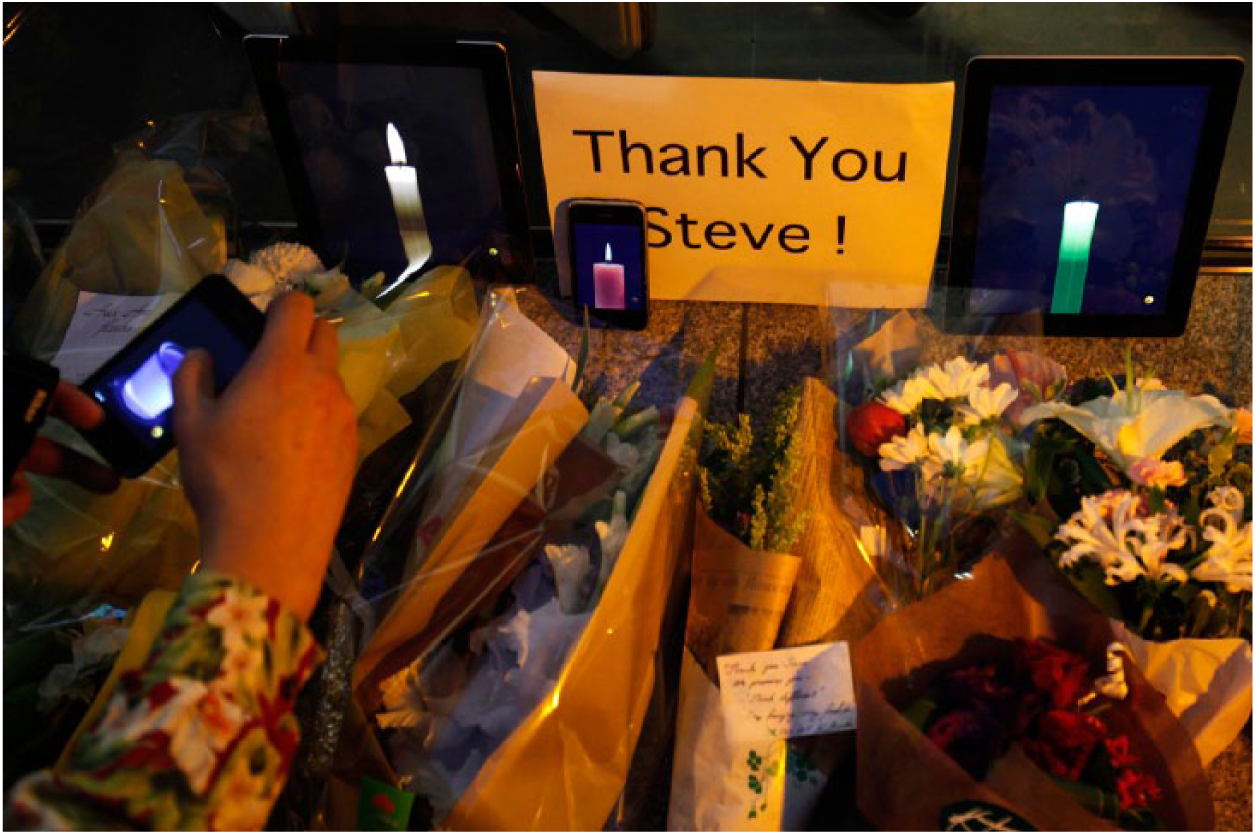
An Apple fan ‘lights’ a candlelight application during a vigil outside the Apple store in Tokyo’s Ginza district, 6 October 2011.
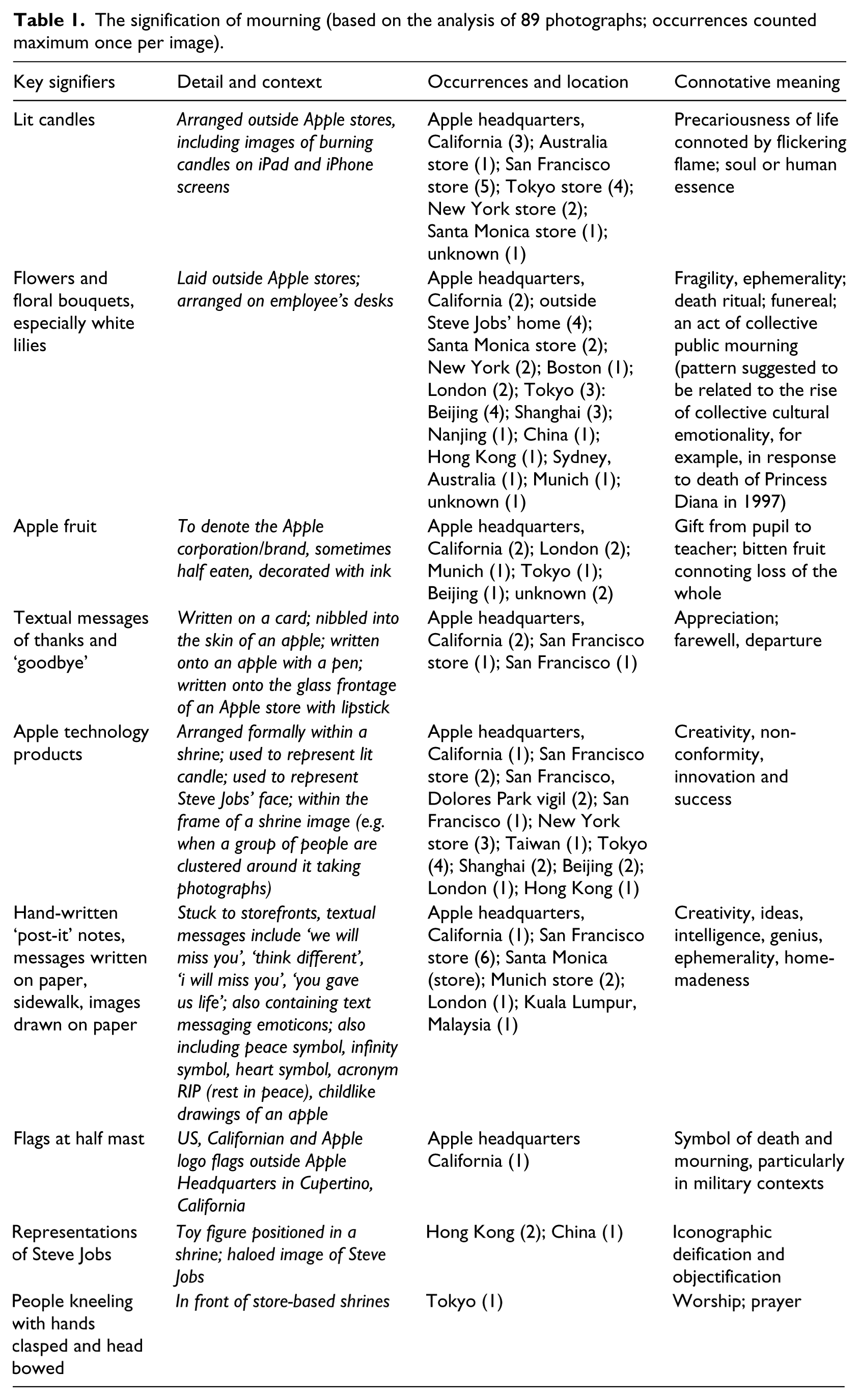
There was a high degree of consistency in the way objects were posed and photographed (see Table 1). The placing of flowers and the lighting of candles, both of which are widespread cultural and religious signifiers used to commemorate a human life, carried connotations of fragility and ephemerality (Hallam and Hockey, 2001). Many shrines incorporated the Apple logo, reframing the traditional connotations of the fruit as symbolic of lust, knowledge and danger towards signifying ephemerality and decay via the object of a half-eaten fruit. Shrines also incorporated coloured ‘Post-it’ notes to symbolize the creativity associated with Jobs, Apple and the consumer-believer community. The physical arrangement of these material objects suggested devotion to a deity or a sanctified individual through placement of photos or figurines of Jobs. Acts of ritualized embodied veneration including prayer were enacted in front of the shrines (Plate 2). The shrines were photographed (often using Apple technologies), and the images were distributed and commented on via the Internet in a way which blurred the boundaries between enactment and representation, as images of objects such as candles on iPads often took the place of the original (Plate 3).
The signification of mourning (based on the analysis of 89 photographs; occurrences counted maximum once per image).
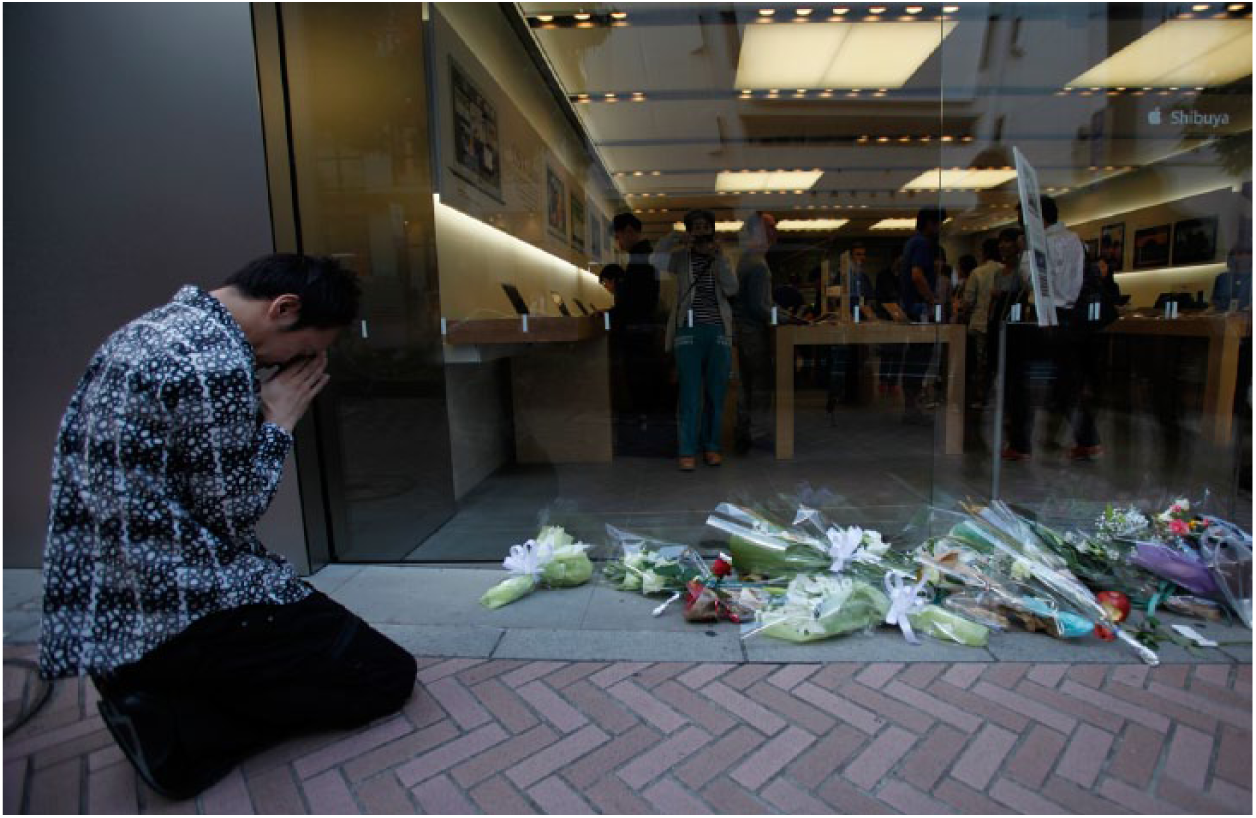
An Apple fan offers prayers outside the Apple store in Tokyo’s Shibuya district, 6 October 2011.
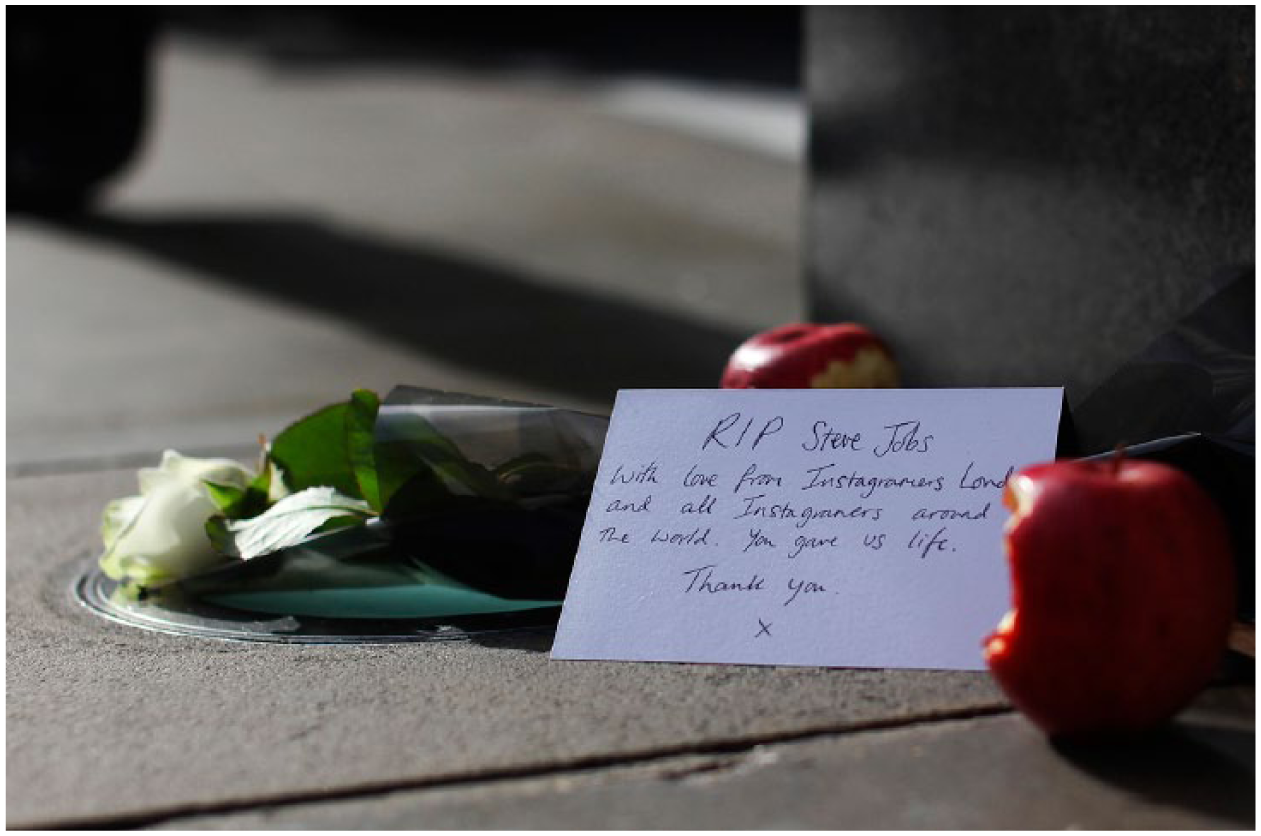
A tribute reading ‘RIP Steve Jobs’ sits outside the Apple Inc. store on Regents Street in London, UK, on Thursday, 6 October 2011. Apple Inc. fans worldwide mourned the death of co-founder Steve Jobs, paying tribute to the man who changed the way they listen to music, use their mobile phones and play on their computers.
Temporary organizational memorials focused on the public display of emotional reactions to Jobs’ death, constructing a shared notion of the life being commemorated, assessing the meaning of his life and death in relation to the mourners’ own and re-evaluating membership of the consumer-believer community. They were oriented towards the materialization and sacralization of memory by maintaining Jobs in the lives of the living. Images, texts and objects stood ‘as painfully isolated vestiges’ (Hallam and Hockey, 2001: 104) of the person they were once associated with, confirming the instability of physical life and the inescapability of death. They became transitory places of communion between the living and dead that invited broad, public participation and acquired social and cultural meaning. The shrines also drew attention to the ephemerality of the material world of technological objects and suggested a desire to demonstrate human permanence and continuity through maintaining continuing bonds with the deceased (Bell and Taylor, 2011; Klass et al., 1996).
Temporary memorials can also be a means of asking questions or requesting action (Margry and Sánchez-Carretero, 2011). A common question posed, either literally in written text or figuratively through symbolism, is ‘who is responsible for the death?’ Demands for action are often oriented towards the idea that a needless death should not be permitted to happen again. However, these temporary organizational memorials served a different purpose, by suggesting that another world is possible (Margry and Sánchez-Carretero, 2011). This involved challenging the conventional separation between the sacred and the profane, intensifying relations between consumer-believers and imbuing material objects, relationships and spaces that were conventionally regarded as secular with sacred meaning.
While the distinction between secular and sacred should not be overstated, these temporary organizational memorials transgressed the secular norms associated with spaces of consumption. The heterotopic spaces of the shrines transformed Apple stores into ‘deathscapes’ (Kong, 1999, 2010) which enabled identity formation of the deceased and living. However, this was not a straightforward shift but an extension of the heterotopic spaces Apple had already cultivated as the basis for brand-related cosmological meaning making. Apple stores are architectural icons, tourist attractions and places where consumer-believers meet to build community through participating in events, such as celebrating the release of a new product, which are characterized by emotional intensity (Yang, 2014). Media reporting of the shrines and rituals further unified the consumer-believer community by publicly articulating their shared values and identity and creating meaning that extended beyond the immediate and individual towards the collective community (Kitch and Hume, 2008).
Photographs as memento mori
Photographs are a key resource in communicating death by enabling exploration of presence and absence (Barthes, 2000 [1981]). Photographs act as memento mori, a reminder of the inevitability of death, emphasizing the vulnerability and inevitability of lives heading towards death, such that the ‘link between photography and death haunts all photographs of people’ (Sontag, 1979: 70). The importance of photography is closely connected to metaphysical belief, since to assume an image is entirely distinct from the thing it represents is to participate in a process of desacralization, separating the viewer from the sacred times and places when the images were taken. Photography thus revives the primitive status of images as something ghostly and magical (Sontag, 1979). They may become all that remain to us as material evidence of life, providing testimony to ‘time’s relentless melt’ (Sontag, 1979: 15). By taking a photograph we participate in the other’s mortality, creating a token of their absence and thereby acknowledging that their existence is receding into the past. In the act of being photographed, we may also feel ourselves as a subject becoming an object (Barthes, 2000 [1981]), an experience through which we are able to understand the precariousness of our own life (Butler, 2004).
The framing of Jobs’ death drew extensively on visual artefacts and photographic images which were used performatively and constitutively (Meyer et al., 2013) by mourners to communicate symbolic meaning. This included images of consumers and employees, as well as photographs of Jobs and Apple products. In addition to images produced by photojournalists, mourners took photographs and circulated them via the Internet. A key image was a black and white portrait photograph of Jobs which featured on the cover of Isaacson’s (2011) authorized biography published immediately following his death. Photographs are central in constructing impressions of authenticity for corporate leaders (Guthey and Jackson, 2005). This photograph was taken by fashion and commercial photographer Albert Watson as part of a ‘People in Power’ series commissioned by Fortune magazine in 2006. It shows Jobs’ face looking intently and directly at the viewer, one hand gently pressing the point of his chin. He is wearing a trademark black turtleneck sweater, his hair is short and neat, greying beard perfectly trimmed. The connotations of this pose bring to mind Rodin’s sculpture ‘The Thinker’, which is often used to suggest philosophical reflection. The address is urgent and intense. The Apple website homepage displayed this image prominently following his death, accompanied by the text ‘Steve Jobs 1955-2011’. The photograph was appropriated into the vernacular mourning of consumer-believers, forming the centrepiece of many shrines, either in printed form or on iPads and iPhones, and incorporated into consumer-believers’ embodied mourning rituals.
Consumer-believers’ relationship to the Apple brand is strongly embodied, through wearing Apple-branded clothing or having the brand logo tattooed onto their bodies (Belk and Tumbat, 2005). Following Jobs’ death, some mourners began an Internet campaign to commemorate his death by dressing to ‘Look Like Steve’. This involved copying Jobs’ dress code of black turtleneck sweater, jeans and sneakers, adopting the pose in the book-cover portrait, taking a photograph and sharing it via a dedicated website. Posters were invited to ‘talk about Steve’ by leaving comments or ‘tweet about Steve’ via a Twitter link. The website text suggested this could bring together people who admire [Jobs’] work … embraced his vision … and love what he’s brought to the world. 3 These aesthetic bodily performances provided consumer-believers with ‘a point of material contact with the body of a once living person’ (Hallam and Hockey, 2001: 155). By incorporating the deceased person into their own identities, consumer-believers engaged with the materiality of death and demonstrated their collective embodiment in way which blurred the boundaries between life and death.
These practices relied on the use of Internet-based social networking sites and virtual communities as places to commune with and about Jobs and sustain him in a ‘dialogic state of digital limbo’ (Kern et al., 2013: 3). This was a form of parasocial interaction, where an intimate unidirectional communication from stranger to public figure was constructed. Here, consumer-believers were able to speak relatively freely about Jobs and also to speak to him. It is possible that some mourners believed that communications were being received, through the notion that ‘the dead live in the virtual cloud, and can hear or read the messages from the living’, suggesting a ‘sustained belief in an afterlife … despite the increase in secularity brought about by modernity and mass media’ (Kern et al., 2013: 9).
Corporate memorialization
The online condolence book and official commemoration ceremony, organized and regulated by Apple, provided a contrasting framing of the death. Within a few days of the death, Apple set up a virtual condolence book hosted on their website. They stated that ‘more than a million’ condolence messages were received and a selection of these was made public as an electronic scrolling text. 4 Condolence books are a key aspect of the revival of death as collective social event because they provide a public means of articulating private feelings about death and the dead (Brennan, 2008). Contributors seek to continue and make real the bond they feel, bringing comfort and closure to themselves following the unexpected end of a relationship. Even when the relationship is non-reciprocated, imaginary and invisible, contributors often convey messages which are characterized by emotion, meaning and a sense of intimacy with the deceased.
This is, to our knowledge, the only corporate-hosted online condolence book dedicated to a specific individual. It is also continuously publicly available to Internet users and therefore different from paper-based artefacts which are often difficult to access or privately held (Brennan, 2008). Because of its public nature and the role of the corporation in its construction, we interpret it as a significant resource in framing Jobs’ death. We initially categorized the messages collected according to their primary purpose (Table 2). Messages are addressed to a range of audiences: Jobs, his surviving family, the Apple user community, Apple executives or employees and a generic unspecified collective ‘super-addressee’ (Brennan, 2008) which includes other mourners. They fall into three forms: terse formulaic statements of remembrance and sorrow, more poetic tributes and longer narratives which often recount a personal or career history related to Apple-branded products or Jobs’ public performances. Our sample did not contain any critical comments on either Jobs or Apple.
Framing in condolence book messages.
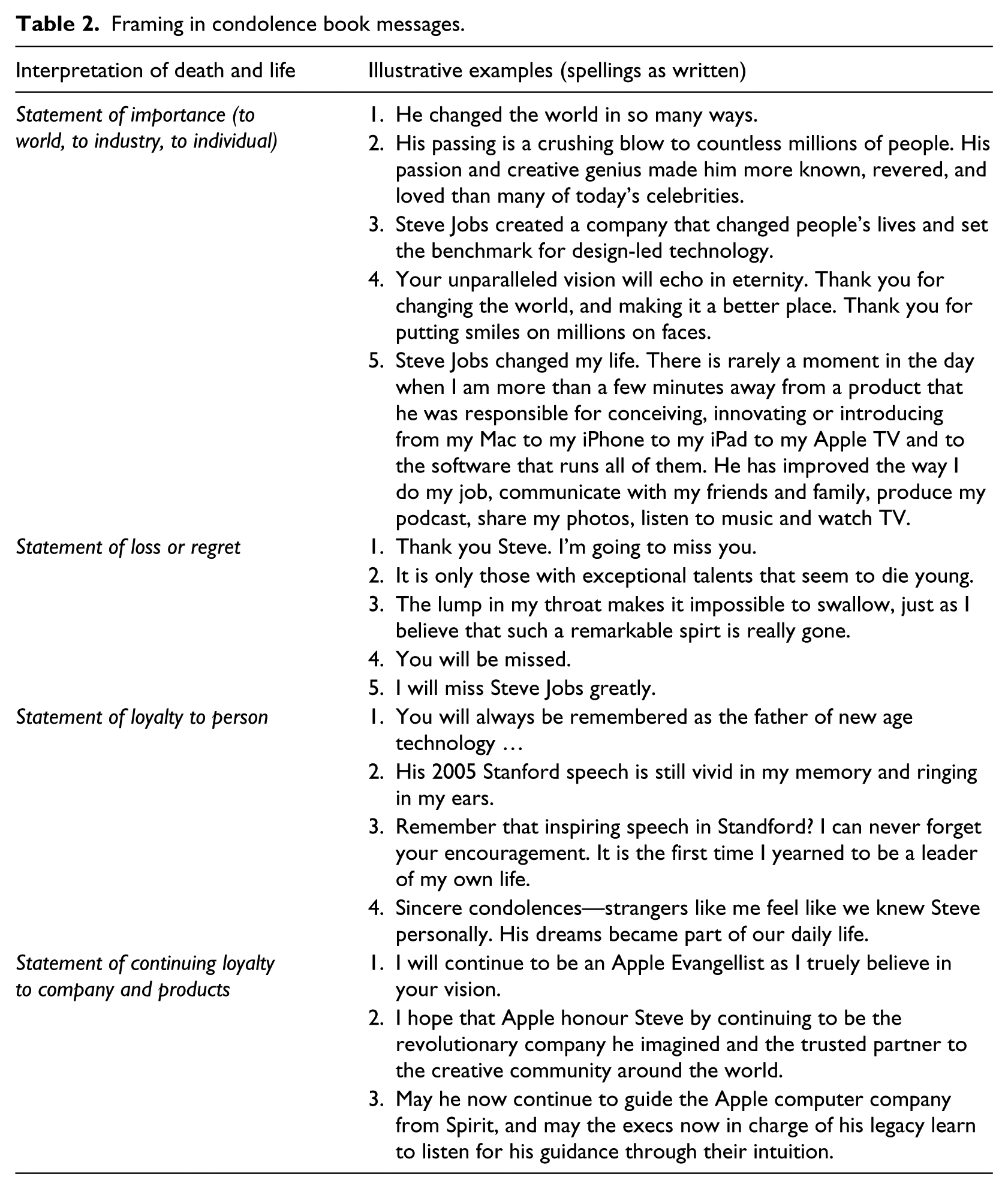
In addition to formulaic statements of remembrance, these messages memorialized Jobs in four distinctive ways. First, they described his significance to the world, the industries he worked in and for the individual contributor. This is based on contributors’ assessment of Jobs as an inventor, visionary, entrepreneur or leader. Occasionally, they took the form of a personal story describing how an Apple product enabled the contributor to overcome personal obstacles. Second, messages recorded personal regret that Jobs had died relatively early and that he would no longer be able to work. Some interpreted this as the ultimate sacrifice that further separated him from followers, confirming the sacredness of his leadership (Grint, 2010). Third, they expressed continuing loyalty to Jobs and the views he articulated in life. This includes numerous references to public performances such as keynote presentations and the Stanford address. Finally, they articulated continuing or renewed loyalty to the company and its products.
Framing through the condolence book messages was predominantly deferential and worshipful towards Jobs and Apple. This contrasted with journalistic assessments of Jobs and his legacy and online discussions, many of which were more critical and less reverent. 5 While the positivity and religiosity of Apple’s condolence book are consistent with other condolence book content (Brennan, 2008), including books for iconic celebrities who are only ‘known’ in a mediated relationship, condolence books have historically been relatively unregulated spaces where a range of experiences, opinions and feelings could be expressed. In contrast, the content of Apple’s condolence book appears to have been closely controlled, as the organization sought to frame Jobs’ death and regulate how it was interpreted. This is consistent with the organization’s reputation for attempting to control media representations and reports; biographical accounts suggest that new product presentations are closely managed by Apple and public exposure of errors or technology failures created significant organizational conflict, while journalists who wrote ‘hostile’ articles about Jobs or Apple could be excluded from events and denied information (Isaacson, 2011).
The official response to the death also comprised a memorial service at Apple’s corporate ‘campus’ headquarters in California held 2 weeks after Jobs’ death. Attendance at the memorial ceremony was by invitation and reporters were discouraged from attempting to speak to employees outside. 6 The service was broadcast live to Apple stores around the world and made publicly available online via the Apple website. The event follows the corporate convention of minimalism in its staging and structuring, informality in dress and attempts at the intimacy from speaker to audience for which Jobs was known (Sharma and Grant, 2011). The video recording begins with white title captions on black screen, fading in and out to tell the viewer that they are ‘Celebrating Steve October 19 2011’. Most of the audience is standing in front of the stage, as if at a music concert. Others occupy balconies on the buildings around a central arena and a small group stands and sits on the stage. The audience and eulogists are subdued. When the camera moves from the invited speakers, it pans slowly around the corporate campus and fades gently from one scene to another, lingering on the autumn trees. There are immense photographs of Jobs hanging from the buildings around the arena, which the camera occasionally focuses on.
The memorial service recording is a celebration of Jobs, Apple and the technology industry. It contains a series of 10-minute speeches from executive board members, punctuated by live music performed by global pop stars favoured by Jobs. A number of speakers refer to Jobs’ work ethic and how he would have wanted Apple employees to continue to work as hard as possible to develop new products. All but one refers to Jobs in the past tense, expressing a desire to ‘say goodbye’ and continue Jobs’ work. The ceremony communicates a powerful sense of closure, encouraging employees to move on from the death and focus on their work, as summarized by newly appointed CEO Tim Cook’s closing words: He thought about Apple until his last day, and among his last advice he had for me [pauses, breathes deeply] and for all of you was to never ask what he would do. ‘Just do what’s right’, he said. He said he saw Disney paralysed after Walt Disney’s passing, as everyone spent all of their time thinking and talking about what Walt would want and he did not want this to occur at Apple.
Official corporate memorialization, enabled by the online condolence book and the commemoration ceremony, encouraged consumer-believers to let go of their relationship to Jobs and move on. This frame drew on norms of detachment and closure and focused on the need for hard work, hope and belief in Apple-branded products in order to ensure success in the future. Apple thereby sought to minimize the loss of Jobs by presenting the organization as an entity that transcends individual death. This runs contrary to the popular discursive representation of Jobs in his lifetime as a unique, irreplaceable genius whose presence or absence directly influenced corporate performance. Instead the corporate framing of Jobs’ death was characterized by finality, suggesting that the organization could continue to survive and flourish without him. This was oriented towards controlling the extent, location and duration of public mourning and the emotions associated with it.
The organizational regulation of mourning
The vernacular framing of Jobs’ death involved consumer-believers coming together for a short time period in heterotopic, temporarily sacred places to express their loss. The vernacular construction of memorials and performances transformed Apple stores into places where death was present, imbuing them with sacred meaning and significance. As with the organized space of the cemetery, these temporary organizational memorials were heterotopic sites of tension and ambiguity, sacredness and secularity, where fear and hope were articulated simultaneously. These sites of mourning became a heterotopic ‘threshold space’ (Maddrell and Sidaway, 2010: 4). Through their location on the threshold between the material and the virtual, they brought together the dead and the living and blurred the boundaries between the sacred and the profane.
Images and technologies used to reproduce people and objects were central to the vernacular mourning practices enacted in response to Jobs’ death, the temporary presence of shrines and websites providing momentary testimony to the construction of memorializing communities. The symbolic power of material entities such as photographs and branded consumer goods arises ‘from both their association with the past life of the deceased’ and ‘their association with an uncontrollable event—the event of death’ (Hallam and Hockey, 2001: 122). Vernacular mourning represented a means of ensuring Jobs’ continuation after death, through imbuing material possessions he was associated with in life with potent meaning. These practices were enabled by the Internet which facilitated spontaneous, informal communication of responses to the death to large audiences.
Changing social rituals surrounding death in Western cultures in the past three decades suggest that it has once again become a public spectacle (Walter, 1994). Mourning for Jobs could be interpreted as an aspect of ‘memorial mania’ (Doss, 2008) in the form of a contemporary infatuation with memory and history. Memorial mania is characterized by an excess of emotion and meaning making and focuses more on the mourners than the dead. It is enabled by digital visual media and motivated by a desire to claim ownership of the person or issue that the memorial represents.
It is significant that the vernacular mourning did not include expressions of negativity or criticism towards Apple or Jobs. This is related to the organizationally regulated nature of the spaces in which it took place, suggesting the exercise of power during these grief rituals. The location of shrines outside Apple stores meant that employees and store managers could easily have dismantled these temporary organizational memorials were they not to their liking. Dismantling temporary memorials is not uncommon and can be seen in other organizational death-related events, including the post-crash shrine constructed in the City of London in 2008 which was quickly removed after being photographed and featured in several front page newspaper reports (Bell and Taylor, 2011). Yet while temporary memorials may be volatile and ephemeral, they are increasingly subject to a form of permanence through transfer to Internet webpages, by taking photographs or building the memorial online. This institutionalization of temporary memorials, Doss (2008) argues, leads them to become less vernacular, more ritualized, codified, scripted and managed. Hence, although the Apple shrines may have appeared disorganized in a formal institutional sense, they followed and revised established patterns of mourning, reproducing formulaic mourning codes which are designed to organize, objectify, perform and depersonalize loss (Doss, 2008). These norms were reinforced by news media reports, as journalists turned to ‘familiar elements arranged in recognisable order, stories that recur across media and over time to create a broader understanding of the meaning of death’ (Kitch and Hume, 2008: xv).
Conclusion
Understanding temporary organizational memorials as heterotopic spaces focuses attention on the changing nature of mourning practices in the 21st century and introduces the possibility that the boundaries which separated the living from the dead during the 20th century are becoming increasingly blurred. This reflects a late-modern reconfiguration of the separation of spaces for the living and the dead (Howarth, 2000), as mourning is increasingly articulated through symbolic and embodied action in meaningful places, including organizational spaces, where the dead are ‘imaginatively located and recalled’ (Kellaher and Worpole, 2010: 163). The dead are made more visible and more mobile through these new forms of memorialization. They are brought out of the heterotopic space of the cemetery and into the social, organizational spaces of the living.
As this case has also demonstrated, corporate organizations are significant actors in framing the death of ‘business celebrities’ (Guthey et al., 2009) by seeking to regulate their memorialization. Corporations have long played a part in memorializing senior and powerful organizational members. In Japan, companies erect monuments to founders and former presidents and hold annual memorial ceremonies to commemorate deceased employees (Nakamaki, 1995). Deceased corporate founders or chief executives are often represented through portraiture and named on public buildings (Bell and Taylor, 2011). However, the unprecedented global public mourning that followed Jobs’ death is an indication of the power of multinational corporations and global organizational leaders, especially in cases where the leader is seen as having charismatic authority (Bryman, 1992; Heracleos and Klaering, 2014).
This case suggests that we are engaged in a cultural shift away from a physically based cult of the dead (Foucault, 1998), temporary resacralization of social, organizational spaces of the living. The construction of organizational, consumer and leader identities in a way which invests them with sacred meaning is crucial in understanding the response to Jobs’ death. It is also important to acknowledge the power relations associated with belief-led organizations such as Apple (Bell and Taylor, 2003; Bell et al., 2012). Tourish and Pinnington (2002) suggest that charismatic conceptions of leadership are based on cult-like forms of organization that are inherently unethical because they inculcate dependency on the leader and deny the possibility of dissent. Writing from a Foucauldian perspective, Western (2008) interprets transformational leadership as a form of the ‘leader as Messiah’ (p. 105) discourse, linking it to the corporate culture movement and the rise of Christian religious fundamentalism in the United States since the 1980s. These organizations are intent on ‘remoulding individuality’ in ways that are always ‘socially harmful’ (Tourish and Pinnington, 2002: 156–157) by encouraging ethical sensibilities to be obscured and individual agency to be abdicated. The relocation of the dead in spaces of the living is, we suggest, enabled by the structuring of everyday action in organizations according to religious, including quasi-religious and spiritual values, in ways which are often supportive of established power interests (Bell et al., 2012).
The official, corporate memorialization that followed Jobs’ death can also be understood as an attempted exercise of biopower and a reflection of the changing nature of organizational power/knowledge (Foucault, 2008). Biopower focuses on the ways in which power is exercised through the whole person, including ‘life itself’, to render subjects productive and calculable (Fleming, 2014). As time and space boundaries between work and non-work become more fluid, employee identity has come to form part of aspirational brand narratives and the body has become increasingly regulated by economic ideologies (Land and Taylor, 2010). Biopower encourages exploration of the ways in which organizations attempt to index everyday social activities in the service of work or consumption (Fleming, 2014). Official, corporate memorialization for Jobs’ can be understood as an extension of biopower into an area beyond ‘life itself’, as knowledge and power are combined in indexing the conduct of a whole life, including at its end, through death.
In addition to determining who and what is framed as memorable (Doss, 2008), such power relations determine what makes for a publicly grievable life (Butler, 2004). The public response to Jobs’ death enables insight into processes whereby certain organizational lives become globally grievable. Butler (2004) suggests that grief arises from a primary vulnerability to others that cannot be willed away without ceasing to be human. This is related to the nature of our socially constituted bodies as sites of desire and physical vulnerability. But ‘the differential allocation of grievability that decides what kind of subject is and must be grieved, and what kind of subject must not, operates to produce and maintain certain exclusionary conceptions of who is normatively human’ (Butler, 2004: xiv–xv). The shaping of grief is thus a political act. Butler further argues that death exposes our collective vulnerability to loss, giving rise to the possibility of community being created from these conditions. Hence, when we lose someone through death, ‘we do not always know what is in that person that has been lost. So when one loses, one is also faced with something enigmatic: something is hiding in the loss, something is lost within the recesses of loss’ (Butler, 2004: 21–22). Hence, a final question raised by this case is what collective, corporeal vulnerability responses to Jobs’ death did expose. The public mourning and memorialization analysed here suggest that the power of corporations such as Apple in defining the significance of our everyday lives is something that we collectively feel vulnerable to losing.
Footnotes
Acknowledgements
Thanks to organizers and participants at a symposium on Steve Jobs at Academy of Management and an EGOS track on leadership in 2012, where initial versions of this analysis were presented. University of Birmingham funded permission rights purchases for the images. Margaret Gibson, Tony Walter, and the special issue editors all provided encouragement to pursue the arguments presented here.