




Abstract
This article provides insights into mobility in the context of geographical, economic, professional, temporal and imaginary movements of academics and theatrical artists. It explores how these dimensions of mobility intersect in the narratives of academics and theatrical artists, thereby producing a position ‘in between’ choice and necessity, and privilege and disadvantage with regard to movement. The analysis shows how both academics and theatrical artists engage in mobility to secure, maintain or improve their professional and economic position. On this basis, we suggest that they are part of an emerging category of professionals: the ‘mobile middle’, for whom mobility is a crucial part and principle of life. We argue that the phenomenon of the ‘mobile middle’ and mobility in general have wide-ranging implications for our understanding of contemporary careers, work and life organisation.
Keywords
Introduction
In recent years, the processes of globalisation and internationalisation have brought with them demands for mobility, with reference made to subjects, objects and culture more generally (e.g. Baerenholdt, 2013; Bauman, 2007; Beck, 2007). Diagnosing the current condition of Western society, scholars have proclaimed the emergence of a ‘mobility paradigm’ (Urry, 2002, 2007), proposing an understanding of mobility beyond the realm of individuals and personal movements to include ‘the actual and potential movement and flow of people, goods, ideas, images and information from place to place’ (Jensen, 2011: 256; Cresswell, 2006). The spread of mobility demands across different spheres of society has resulted in the widely accepted view that mobility constitutes an integral aspect of contemporary social life (e.g. Kaufmann, 2002; Kesselring, 2006).
Expectations to be on the move have also entered the professional sphere (e.g. Boltanski and Chiapello, 2006; Ciupijus, 2011), presenting management and organisation studies (MOS) scholars with the task to explore the under-researched question of how mobility infuses work and careers. In this respect, MOS research has focussed primarily on the geographical aspect of mobility (e.g. Cerdin and Selmer, 2014; Cohen, 2010; Costas, 2013). Here, studies have been underpinned by the understanding of mobility as either ‘free choice’ or ‘necessity’ (Al Ariss et al., 2012). In this article, we problematise the contention that contemporary workers are either active agents who freely take advantage of the opportunity to be mobile or that they are forced to be on the move as a result of precarious work and employment positions.
We engage with the phenomenon of mobility with reference to two professional groups: academics and theatrical artists. These have been chosen as academics and artists are members of occupations that for a long time have been characterised by mobility (e.g. Bennett, 2010; Dany et al., 2011; Menger, 2006). Moreover, both groups are considered interesting exemplars of the category of ‘creative knowledge nomads’ (Ackers, 2005), which increasingly has been attracting attention in studies of the organisation of contemporary worlds of work (e.g. Colic-Peisker, 2010; McKinlay and Smith, 2009). While there are significant differences in the nature of work carried out by academics and theatrical artists, the work and careers of members of both professional groups have been discussed as complex and dynamic (Dany et al., 2011; Eikhof and Haunschild, 2006). This complexity makes the two professional groups particularly suitable for an exploration of mobility beyond the dichotomies of necessity and choice.
Our investigation is inspired by social scientific research on mobility, the majority of which has been pursued by mobility and migration studies scholars. Mobility studies researchers have primarily taken a macro-perspective, linking mobility to broad sociological questions addressing, for example, Western governmentality, social power relations and the opportunities and capacities to access mobility (e.g. Baerenholdt, 2013; Cresswell, 2006; Urry, 2007). Migration studies scholars, on the other hand, have offered us insights into geographical migration, traditionally with a focus on ‘low skilled/low paid migrants’ and the ‘global elites’ (Favell et al., 2007; Munck, 2008). More recently, analyses of the working and living conditions of ‘highly skilled migrants’ have also gained momentum (e.g. Bjerregaard, 2014). Within MOS, researchers have so far given little attention to debates conducted within mobility studies, mainly drawing from migration studies to investigate mobility in the context of internationally mobile workers (Al Ariss et al., 2012).
This article generates new insights into mobility for MOS research through bringing understandings of mobility and its dimensions, as explored by mobility studies, into an analysis of the work and careers of academics and theatrical artists. Specifically, we offer a conceptualisation of a category of professionals which we refer to as the ‘mobile middle’ and demonstrate how it is produced at the intersection of different dimensions of mobility, in particular the geographical, economic, professional, temporal and imaginary. We thereby propose a view of mobility beyond the dichotomy of choice and necessity. Stemming from our discussion of mobility, we draw implications for how contemporary careers, work and lives are organised. Empirically, the article responds to calls for studying micro-level accounts of mobility practices, thus contributing to a growing body of work on mobile work and careers (e.g. Cerdin and Selmer, 2014; Cohen, 2010; Costas, 2013). We address the following research questions: How can we understand mobility in the context of work and careers beyond the dichotomy of choice and necessity? What insights into the dimensions of mobility can be gained from academics’ and theatrical artists’ accounts of mobility? How do academics and theatrical artists negotiate, evaluate and reflect upon the mobility that characterises their work and careers? And what are the implications of the category ‘mobile middle’ and mobility in general for our understanding of how careers, work and lives are organised?
Our study builds an understanding of the interconnected dimensions of mobility associated with the potential, imagined and actual movements of academics and theatrical artists. Through a fine-grained analysis, we show how the evaluations of, and reflections upon, mobility are shaped by the tension between autonomous choice and externally imposed necessity. Consequently, we suggest that academics and theatrical artists are part of an emerging category of professionals: the ‘mobile middle’. Members of the ‘mobile middle’ experience different conditions and effects of mobility and yet face the common demand to be, or at the very least to present themselves as, mobile, even if only to maintain their economic and professional positions. We argue for a conceptualisation of mobility as a complex phenomenon, and a crucial part and principle of contemporary professional life (see also Cresswell, 2006).
The article proceeds as follows. First, we position our study within existing research on mobility in mobility studies and MOS, questioning dualistic assumptions about mobility and movement. We then provide an overview of the literature on academic and artistic work and careers. Subsequently, we introduce our methodology and analyse how, in the case of academics and theatrical artists, the intersecting of different dimensions of mobility produces a position of being ‘in the middle’. Finally, we discuss the implications of the ‘mobile middle’ and, generally, mobility for our understanding of careers, work and life organisation.
The complex nexus of mobility, work and careers
As previously stated, mobility studies scholars have argued for the emergence of a ‘mobility paradigm’ (Urry, 2002, 2007) that is based on mobile practices, relations and a language of mobility rather than fixed and stable structures, territories and subjects (Szerszynski and Urry, 2006). In their view, mobility has become a ‘general principle of modernity’ (Kesselring, 2006: 270), crucial in organising and ‘securing social relations’ (Baerenholdt, 2013: 30).
A significant topic addressed in mobility studies is the distinctions between the different dimensions of mobility (Urry, 2007). The central dimension of mobility refers to ‘being on the move’ in a physical, geographical sense (Elliott and Urry, 2010). Interwoven with geographical movements, however, are other dimensions of mobility, such as professional, economic and social mobility. As suggested above, regular travel for work- and business-related purposes has become a necessity for many individuals wishing to establish, maintain and advance their professional position (Kesselring, 2014). Upwards economic mobility, that is, an improvement in individuals’ income levels, is commonly seen as an important consideration in migration decisions, while migration and, more generally, geographical movement can also bring about downwards economic mobility in the form of poverty and deprivation (Gogia, 2006). Similarly, geographical movement is connected to upwards and downwards social mobility in that it can be a source of an increase in individuals’ social status, but can also result in a decrease of social status or its loss (Sheller and Urry, 2006).
Mobility, moreover, always involves a temporal dimension: individuals’ movements in space may span a short or a long timeframe, and occur according to different temporal patterns and rhythms throughout different stages of life (Jensen, 2011; Peters et al., 2010). Furthermore, movement across space has a bodily and emotional dimension (Conradson and Mckay, 2007) as practices of mobility associated with, for example, working and commuting involve the development of particular habits and modes of conduct, triggered by and shaping the embodied experience of movement (Doughty and Murray, 2014). Linked to an understanding of mobility beyond geographical movement is, ultimately, the idea of a symbolic-imaginary dimension of mobility whereby mobility is considered a potentiality: something that individuals might not only practise but also perceive and imagine as relevant and/or desirable (Baerenholdt, 2013). Hence, movement and possibly concomitant transition and transformation do not only occur in physical spaces but also – and often simultaneously – in imaginary, virtual sites (Daskalaki, 2012). Doughty and Murray (2014) also remind us that how movement and its consequences are imagined at an individual level is influenced by the ‘rights to mobility’ discourses that pervade Western society. Citizens who experience mobility as an autonomous choice appear to be in a position that enables them to gain overall from mobility, conceived of as potentiality (see also Kim, 2010). Against this background, we consider the acknowledgement and inclusion of different mobility dimensions in MOS as important. It allows scholars to develop a complex understanding of mobility beyond the dichotomies of necessity and choice and to highlight the implications of mobility for careers, work and lives.
In raising issues of power and politics, mobility studies also evoke frictions associated with mobility. While in many contemporary economies ‘the mobilisation of the workforce’ and ‘freedom of movement’ in general are claimed to be a key political project, creating an international labour market (Ackers, 2005), mobility studies scholars argue that it is highly contested to what extent, where and for whom this agenda becomes ‘reality’ (Baerenholdt, 2013; Ciupijus, 2011). In pointing to the irreducible nexus of power and mobility, they link mobility to themes such as social inequality, inclusion, rights and democracy (e.g. Richardson and Jensen, 2008). The question of ‘which (im)mobility for whom and when’ (Jensen, 2011: 257) highlights the complexity surrounding the issue of whether mobility can and should be seen as an autonomous choice or an externally imposed demand. As Jensen (2011) argues, an examination of this complexity needs to take into account the specific dimension of mobility under consideration (i.e. which (im)mobility), the individual (i.e. for whom) and the point in time (i.e. when) to which the analysis of mobility refers. Such a nuanced analysis is also much needed within MOS, since at present this field offers a largely dualistic view of the mobility-power nexus.
For example, an evaluation of mobility as a free choice and an opportunity can be found within research addressing internationally mobile workers (e.g. Al Ariss et al., 2012). This is particularly evident in discussions of highly skilled professionals referred to as self-initiated expatriates (SIEs), defined as ‘individuals who personally take charge of their careers without the direct support of an organization’ (Cerdin and Selmer, 2014: 1281). SIEs are seen as mobile out of their own choice, volition and initiative and unrestricted in their movements between countries (Doherty, 2013). Moreover, they are presented as individuals who enjoy a stable economic position and freely engage in diversified social networks as they take control of their career (e.g. Cerdin and Selmer, 2014; Dickmann and Baruch, 2011). Similarly, career research, which extensively employs the concepts of ‘protean careers’ (Hall, 1996) and ‘boundaryless careers’ (Arthur and Rousseau, 1996; DeFillippi and Arthur, 1994), emphasises mobility as an opportunity and ‘career competence’ of contemporary elite workers (Arthur, 2014) wishing to take advantage of ‘a new career landscape where former constraints are dissolved and shattered’ (Baruch, 2013: 197). Protean careers are portrayed as characterised by physical mobility across jobs, functions and organisations. Moreover, they are considered as promoting self-management and adaptability by individuals, for whom mobility mainly creates chances for learning, self-development and making active choices about career progression (Briscoe and Finkelstein, 2009; Hall, 1996). Likewise, the notion of boundaryless career, defined as ‘a sequence of job opportunities that goes beyond the boundaries of any single employment setting’ (DeFillippi and Arthur, 1994: 307), is rooted in an understanding of mobility as a choice, fostering individual autonomy and job selection options (Rodrigues and Guest, 2010).
However, in addition to the view of mobility as freedom and choice, MOS literature, drawing on migration studies, also provides a contrasting depiction of mobility, that is, as a necessity and an externally imposed demand (e.g. Al Ariss et al., 2012). This is exemplified in studies of migrants which present a picture of low-skilled, poverty-stricken individuals, who relocate out of economic and/or political necessity and are constrained in their career and geographical destination choices (e.g. Al Ariss and Crowley-Henry, 2013). Economic migrants are portrayed as vulnerable and discriminated against in the workplace, limited by the (trans)national ethnic networks of which they are part and unable to form networks with members of the local community that would be useful for labour market success (e.g. Al Ariss et al., 2012; Fang et al., 2013). Similarly, critical MOS scholars exploring precarity in contemporary worlds of work develop their argumentation based on a conception of mobility as a necessity (e.g. Bergvall-Kareborn and Howcroft, 2013; Garsten, 2008). They highlight that for many workers, a career, characterised by a movement from place to place and from project to project (Boltanski and Chiapello, 2006), might not be a matter of choice. Rather, it is a strategy for securing a livelihood, pursued out of necessity by temporary workers (Garsten, 2008; Roper et al., 2010; see also Bauman, 2007).
Such dualistic assumptions about mobility constituting either a choice or necessity gloss over the ambivalences accompanying mobility (Cerdin and Selmer, 2014; Costas, 2013). With our study, we problematise these representations of mobility and mobile workers precisely to elucidate the ambivalences and complexities characterising contemporary work and careers. In doing this, we contribute to the MOS literature on mobility, especially as exemplified by studies of internationally mobile workers and career research. We bring into the analysis an understanding of mobility, from mobility studies, which recognises the significance of different mobility dimensions and the possible assessment of mobility as both necessity and choice. As they build the focus of our analysis, we now turn to discussing mobility in the context of academic and artistic work and careers.
The mobile work and careers of academics and artists
The work and careers of academics and theatrical artists have always been shaped by the practice of movement, including both physical and socioeconomic mobility (e.g. Cohen, 2010; Maadad and Tight, 2014). In the current context, the practices of mobility have become even more diverse, diffuse and complex (Kim, 2009). In socioeconomic terms, academics and theatrical artists are considered neither as professional elites nor as members of disadvantaged groups. In recent years, both academia and the arts have been referred to as ‘globally recognized professions’ (Colic-Peisker, 2010: 467), with academics and artists pictured as exemplars of ‘creative migrants’ (Bennett, 2010) and ‘knowledge nomads’ (Ackers, 2005). This, however, does not mean that there are no differences between the two professional groups, or that the groups themselves are homogenous. On the contrary, we see it as important for our study to acknowledge the similarities and differences that characterise academics’ and artists’ work and careers (Kim, 2009).
With regard to how the two professional fields are organised, flexibilisation, deregulation and liberalisation tendencies have been observed (Dany et al., 2011). Academia and the arts are subject to ever stronger tendencies of managerialisation and, therefore, application of measurement and output control instruments that define the value of work and the understandings of the quality of scholarly and artistic performance(s) (Butler and Spoelstra, 2012; Menger, 2006). In the past, the institutional conditions of higher education used to offer a relative continuity of employment. More recently, however, neoliberal governmental policies towards the sector, and specifically the gradual withdrawal of state funding for higher education, have resulted in an increase in the level of precarity and uncertainty of academic careers, manifesting in the spread of short-term, fractional and zero-hours contracts (Dunn, 2013; Richardson and McKenna, 2008). In the arts, employment and career prospects have for a long time been uncertain, individualised and non-linear (McKinlay and Smith, 2009). Following ever greater funding cuts, in the past decade, they have become more unpredictable in economic and professional regards (Eikhof and Haunschild, 2006; McRobbie, 2009). Performance pressures and competition have grown considerably in both professional fields, with expectations put upon academics and artists to become highly active, committed and self-managed subjects of their own ‘human capital’ (Colic-Peisker, 2010; Loacker, 2013).
While there exists a body of literature discussing academic mobility (e.g. Ackers, 2005; Kim, 2009; Maadad and Tight, 2014; Richardson, 2008), including studies of internationally mobile academics within the research on SIEs (e.g. Richardson and Mallon, 2005; Selmer and Lauring, 2011), there is little literature explicitly reflecting upon the mobility of artists and theatrical artists in particular (for exceptions, see Bennett, 2010; Haerdter, 2005). While actors are referred to as members of one of the most mobile occupations (Cohen, 2010), analyses of artistic work and careers typically focus on issues such as precarity, project-based work, self-organisation and self-control (e.g. Abbing, 2002; McRobbie, 2009; Menger, 2006). In contrast, academic careers are generally discussed with reference to their physical and occupational mobility and thereby often linked to international mobility (Baruch, 2013; Maadad and Tight, 2014). While academic labour markets are presented as ‘freer’, more mobile and global than many others, the careers of most academics are, however, not ‘boundaryless’ (Bekhradnia and Sastry, 2005). Performance measures against which academics are assessed differ from organisation to organisation, and from country to country, often presenting an obstacle to international movements (e.g. Ackers, 2005; Richardson, 2009). Moreover, academic mobility reflects differences in status among members of this professional group. In parallel with an increasing number of academics, especially early career researchers and those coming from less developed regions and less ‘prestigious’ institutions, who have to move in order to gain employment and persist within the field, there is a privileged minority able to make autonomous choices regarding where and when to move (Kim, 2009). Few studies, however, show how professional mobility influences the organisation of academics’ lives beyond work and career (e.g. Ackers, 2005; Suárez-Ortega and Risquez, 2014). Moving between universities, countries or locations is generally assessed as beneficial for individual academics, since it allows them to, for example, build new personal and professional networks and to enhance performance through collaborative research (Bekhradnia and Sastry, 2005). However, it is rarely acknowledged that academic mobility presents a challenging demand (e.g. Parker and Weik, 2014).
The above-mentioned discrepancies between ‘elite’ and ‘non-elite’ professionals are even more strongly pronounced among theatrical artists, whose institutional environment is characterised by high levels of structural inequalities and exploitation risks (Menger, 2006). In particular, during the early stages of their careers, many theatrical artists have to engage in ‘free work’ to acquire the necessary experience and to get involved in those networks that, potentially, might lead to future paid employment (Eikhof and Haunschild, 2006). Since many theatrical artists cannot afford to work for free for such long time periods, the best career prospects are enjoyed by those who from the start have high social and economic capital. As a result, upwards social mobility, even if often abjured, is rather rare in the arts (Haerdter, 2005). In addition, while a ‘globalised nature’ is commonly attributed to the ‘cultural’ or ‘creative industries’ (Bennett, 2010), the more traditional art fields such as acting, where, for example, fluency in the languages of audiences and local networks are of key importance, are not necessarily globalised or even international in orientation. In contrast to academics, actors are less involved in long-term, international migration. Nonetheless, physical mobility presents an integral part of artists’ daily work and its organisation (McKinlay and Smith, 2009). Many theatrical artists are obliged to be mobile for work: they do not primarily move in order to progress in their careers but to find project-based work, to establish contacts and secure income (Haunschild, 2003). Notwithstanding the efforts made, employment uncertainties as well as financial and social risks remain (Bennett, 2010). As Haerdter (2005) argues, due to the specifics of artistic labour markets and work organisation, the life of many artists, including theatrical artists, develops as a cycle of moving, settling, moving, temporarily settling and so on. It is therefore appropriate to speak of a ‘nomadism of artists’.
On the basis of the above discussion, in the analysis section, we develop an understanding of mobility as a complex phenomenon beyond the dichotomy of choice and necessity. We examine the narratives of academics and theatrical artists to demonstrate how their position in between disadvantaged and privileged workers is produced at the intersection of different dimensions of mobility. From there, we identify and discuss the emergence of a professional group to which we refer as the ‘mobile middle’. First, we introduce the methodological design of our study.
Methodology
We conceive work and careers as being in an ongoing state of transformation across time, space and culture (Urry, 2007). In the context of our empirical study, we adopted a critical-interpretive stance, acknowledging that social inquiry is a ‘world-making activity’ (Goodman, 1978) which is involved in ‘ontological politics’ (Law and Urry, 2004). We therefore recognise that the narratives of our research participants, and as such their constructions, evaluations of and reflections upon mobile work and careers, are informed by, and enact, contemporary social, political and professional discourses of mobility (Brown, 2006; Elliott and Urry, 2010).
In the process of data collection, we conducted open qualitative interviews with a narrative focus (Czarniawska, 2004), following a professional life history approach (Maclean et al., 2012; Śliwa and Taylor, 2011). Interviews, seen as ‘narrative production sites’ (Czarniawska, 2004: 49), allowed us to explore how participants articulate, discursively perform and make sense of their work and careers, in particular in relation to mobility. Moreover, studying mobility through a narrative lens made it possible to understand how academics and theatrical artists construct, negotiate and integrate mobility into the circumstances of their lives. This approach was especially suitable for the exploration of how mobility dimensions intersect to constitute the category of the ‘mobile middle’.
The specific type of interviews we conducted, that is, professional life histories, enabled us to analyse movements and transitions through simultaneously paying attention to the particularities of individual careers and the social conditions in which they unfold (Grandjean, 1981). This is tied to a conceptualisation of both careers and biographical trajectories as ‘being produced by the intersection of micro dynamics’ (Murgia and Poggio, 2011: 11), manifest through individual conduct and activities, and ‘macro dynamics’ such as social or institutional regulations, norms and demands (Murgia and Poggio, 2011). In other words, focussing on professional life histories allowed us to investigate mobility at the interconnected levels of individuals, professions and society.
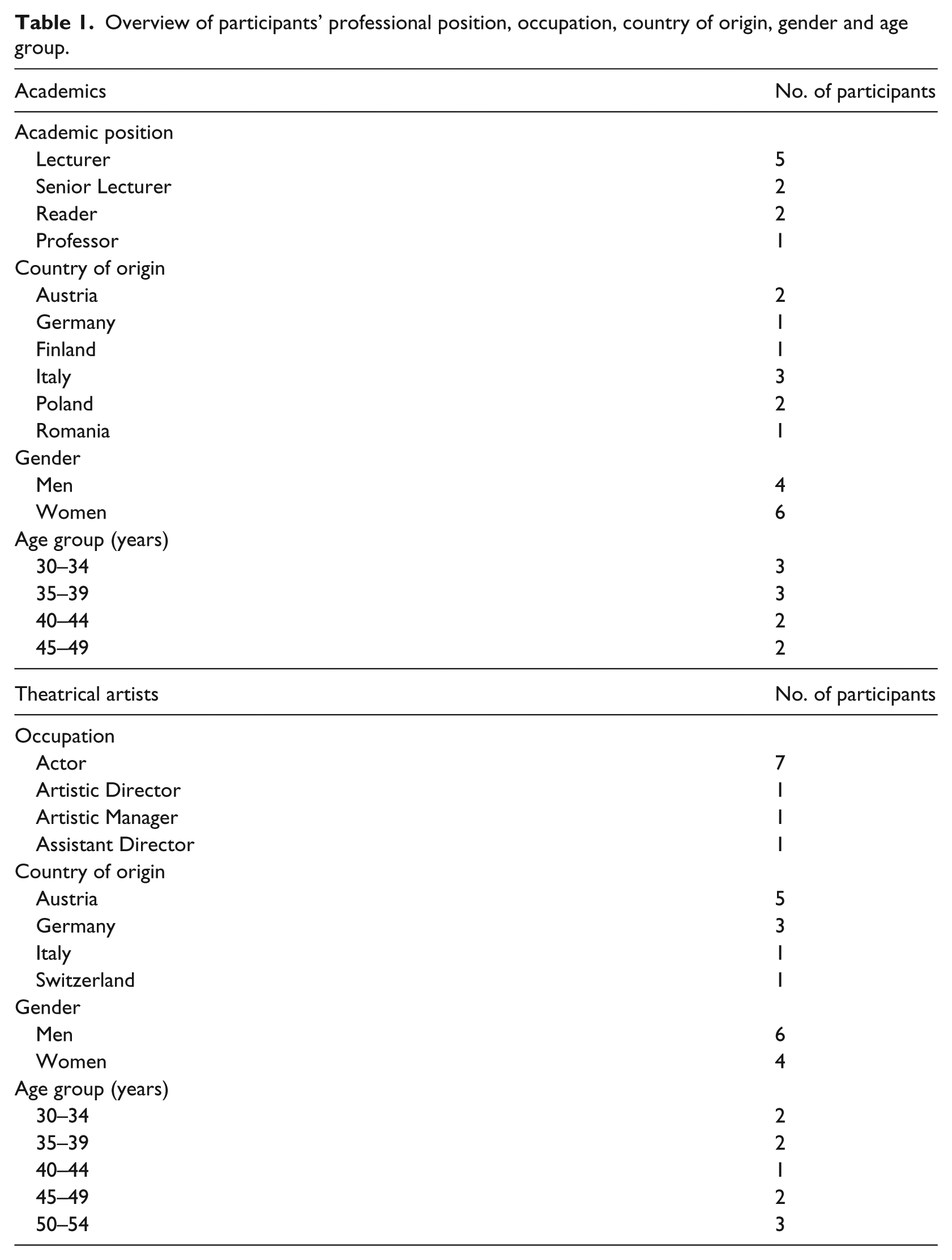
The empirical material drawn on in this article comes from a large, in-depth qualitative study addressing the mobile careers of creative knowledge workers in the European Union (EU). The interviews were conducted between 2007 and 2011. Out of a set of 84, we chose 20 life histories (10 interviews with academics and 10 with theatrical artists) representing a broad range of demographic profiles and a rich diversity of professional mobility experiences. The academic participants came from EU member countries and had experiences of working in different national academic systems. At the time of the interviews, they lived in the United Kingdom and were employed in business schools at various British universities. While the more senior academics (i.e. Senior Lecturers, Readers and Professors) we interviewed held long-term, permanent positions, some of the junior academics (i.e. Lecturers) interviewed did not have tenure, despite working full-time. They were either still on probation or, in one case, employed on a fixed-term contract. The theatrical artists, with one exception, originated from German-speaking countries and lived in Western Europe. At the time of the interviews, they were all engaged in the so-called independent theatre scene and held short-term, project-based contracts. Depending on the projects theatrical artists are involved in, length of employment can vary; however, in the independent theatre scene, employment is commonly limited to six months (see also Loacker, 2013). For the purposes of anonymity, we refer throughout to the participants using pseudonyms and make no references to specific nationalities or organisations (Table 1).
Overview of participants’ professional position, occupation, country of origin, gender and age group.
The interviews lasted between one and three hours; all were recorded and fully transcribed. We asked the participants to tell us about the unfolding of their professional lives and were specifically interested in how they narrate their practices of mobility as well as the reasons and justifications for movement. We also enquired about the participants’ professional relations, networks and community. Furthermore, we addressed the ways in which the academics and theatrical artists interviewed negotiate, and reflect upon, mobility and its different dimensions.
As mentioned above, life histories are constructed, not least in the interview encounter which presents a linguistically and socially complex situation (Alvesson, 2003). Our own circumstances and conditions (i.e. being academics, working outside our own countries of origin) allowed us to establish a degree of rapport with the interviewees and an atmosphere of safety, openness and trust. On the other hand, we were conscious that the interviewees might have presented certain experiences and views in line with what they felt the interviewers expected (Czarniawska, 2004). To address this, in the presentation of the empirical material, we sought to retain the spirit of the whole narrative from which a given extract was taken.
We analysed and interpreted the data through iterative circling between the interview transcripts, the thematically and theoretically structured material, the field notes and theoretical concepts used (Silverman, 2001). We paid particular attention to the language the participants employed in narrating the different practices and dimensions of mobility infusing their work and careers. In the following section, we discuss the empirical material along two analytical themes: (a) intersecting dimensions of mobility and (b) negotiations and evaluations of mobility beyond the dichotomy of choice and necessity.
Empirical analysis
Intersecting dimensions of mobility
From the narratives of the academics and theatrical artists we interviewed, mobility emerges as a work- and profession-related requirement and an integral part of work, career and life in general (Cresswell, 2006). This is illustrated by several accounts, such as the following one given by a theatrical artist: Life in the theatre is a life that is always in movement, motion and transience … It is a project in becoming. (Hannes, Artistic Director)
Both academics and theatrical artists present themselves as, above all, mobile in a physical, geographical sense. While given prominence, physical movement is, however, invariably connected to other dimensions of mobility, such as temporal, professional, economic and imaginary (Urry, 2007). The fact that physical mobility occurs according to temporal patterns is, for instance, shown by the presence of both short- and long-term movements. A closer look at the mobility practices referred to by academics and theatrical artists reveals that short-term, episodic movements, centred around project-based engagements, are especially typical for artists. For academics, mobility more often takes the form of longer term, transnational and national migration, as in the case of Marcos (Reader), who reflects on how throughout his career he has ‘been [employed] academically in four countries’.
Increasingly, academic work and careers are, similarly to those of artists, also shaped by short-term movements (Kim, 2009, 2010). As many of our participants work away from their place of residence, they spend considerable time commuting to and from work, and working while being mobile: on trains, planes, buses, at airports and so on. Depending on the distances and personal circumstances, movements are organised according to a weekly or fortnightly rhythm. As one academic explains, Each week, I go to [name of city] for three days and stay for two nights [there]. In the evenings, I sometimes work until late and sometimes a few of us go to a pub … When I’m back home again, I’d have caught up on office admin and gossip, and can switch to other kinds of work. (Chris, Lecturer)
While both groups consider physical movements between places as indispensable to organising their employment and life, the narratives of the theatrical artists, in particular, point to a professional expectation that individuals should always be prepared to be ‘mobile for work’ (Cohen, 2010), even at short notice. Actual movements are inherent to the nature of artistic work but, in many cases, they are also a result of precarious work and employment positions and triggered by the need to secure short-term employment projects (see also Bennett, 2010). An experienced actor states, It happens that you get a phone call and are asked if you want to take over this or that role. And when you say ‘yes’, the response can be: ‘good, see you tomorrow’. Then you change your plans, start packing your bags and get in the car. (Peter, Actor)
For many actors, such availability to travel is more a matter of necessity rather than a free choice. Theatrical artists also need to be physically mobile in order to become members of professional networks, crucial for gaining new engagements (Menger, 2006). Within the theatre scene, the demand to ‘get to know the right people’ can be accomplished, for example, through attending events where artistic circles meet. As reported by our participants, it is common for actors and artistic directors to travel between cities and/or countries to make an appearance at a post-premiere performance party where there is a potential to encounter a future collaborator or employer. In these situations, geographical mobility intersects with professional mobility in that it is seen as a necessary condition of countering a downwards movement in one’s work-related position and prospects. This is evoked in the following account: We don’t have any official institutions such as job or employment centres. Our labour market is constituted through various personal contacts. Thus, you have to be mobile. You have to go to premieres … and try to establish new connections. Without [them] you have no chance of getting work. (Raimund, Actor)
The approach to building one’s career through mobility aimed at network creation is also frequently referred to by academics. Similar to actors, networking can occur through episodic movements, such as travelling to conferences (Parker and Weik, 2014), as illustrated by the following quote: I always make sure I go at least twice a year to conferences. To get to the good journals, that’s what you need to do. If you want people to know you, you need to be present. (Sam, Senior Lecturer)
Sam’s comment draws attention to an important criterion according to which the work of academics is evaluated: publication of articles in highly ranked journals, usually termed ‘good’ journals (Butler and Spoelstra, 2012). Sam expresses a commonly shared belief in the existence of a close link between regular physical mobility, thanks to which a network of collaborators and other institutional contacts, for example journal editors, is cultivated, and the capacity to deliver professional performance outputs that will be evaluated as being of high quality. In this sense, geographical mobility intersects with, and is depicted as, an enabler of professional upwards mobility (Kesselring, 2014).
Expressions of the idea that professional career can develop due to geographical mobility are not limited to how academics and theatrical artists narrate their actual movements, but can also be found in references to an imaginary future. Here, mobility is often constructed as a source of ‘hope and imagination’: a potentiality that offers ‘limitless possibilities’ (Baerenholdt, 2013: 27). Such a portrayal of mobility underpins the individuals’ belief that the uncertainties they experience, for example, in connection to their promotion prospects, can be solved through movements. Juliette’s account emphasises this: After six years, I’m not wanting to stay here like a Lecturer forever … And the nice thing about the UK is that if you really want to work on your promotion, then you can just move university. (Juliette, Lecturer)
Stressing the importance of mobility as ‘potentiality’, as illustrated by Juliette’s comment, is shared, in particular, by those academics who do not belong to professional networks and who have not (yet) developed a publication record. Similarly, some of the artists we interviewed construct mobility as a key enabler of professional advancement, expressing a belief that they can still ‘make it to Hollywood’, even when their careers suggest that this is not a realistic option.
The emphasis on advancing one’s career or at least maintaining professional presence in the field does not denote an absence of an economic dimension of mobility in the narratives. While it is well-known that there exist substantial income discrepancies in the arts field (Abbing, 2002), Andrea, a Senior Lecturer, reminds us that such differentials are also not uncommon within academia, especially across different EU countries. In the country Andrea comes from, within a relationship, ‘you need one person to work [to support] both in order for [the academic] to have [her or his] “hobby” job’. While some participants frame the link between geographical and economic mobility as a choice made to improve their economic situation, others present movements as a necessary strategy for securing a livelihood and countering downwards movements in their economic position. Yet to others, the connection between geographical, professional and economic mobility is more complex: professional presence and career progression require physical movements, but at the same time do not guarantee, and indeed can be counterproductive to, the accomplishment of a stable economic situation. An account given by an actor who holds a ‘portfolio’ of positions is illustrative in this regard: If I get a role offered by a theatre [anywhere in the country], I go there if I think the play and the people I meet are interesting. The money isn’t really a criterion, because it is never enough anyway. I just have to be careful not to run too much into debt. In between engagements I hope to get some days of shooting somewhere, so that I earn some extra money and pay back my debts … At times I have some money and then, again, I have no money. (Robert, Actor)
Based on the discussion of the intersections of different mobility dimensions, below we elaborate on how they produce, in the case of our participants, a position ‘in between’ choice and necessity, and privilege and disadvantage with regard to movement. We show how our participants negotiate this ‘in between’ position and evaluate its consequences for their work, careers and life in general.
Negotiations and evaluations of mobility between choice and necessity
The narratives provide many instances of simultaneously positive and critical, and thus ambiguous and shifting, evaluations of mobility. When evaluating mobility, most academics and theatrical artists interviewed position themselves ‘in the middle’, that is, ‘in between’ those for whom it is a choice and privilege (Cerdin and Selmer, 2014), and those who are mobile because of the lack of other professional and livelihood options (Al Ariss and Crowley-Henry, 2013). They depict mobility as both a welcome source of inspiration and variety, associated with artistic and intellectual lifestyles and, as previously illustrated, an economic and occupational necessity. Several of the participants declare that without the variety and movement their profession offers, they ‘would not really function’ (Julian, Lecturer). They present it as positive that mobility prevents the development of routines: The uncertainty and mobility inherent within this profession and life are very attractive. I’m asked to always be awake and attentive. I don’t have to be afraid of developing monotony. I stay young through being involved in different contexts. (Richard, Actor)
This appreciation contributes to and further sustains the power aspect of mobility within the professional fields investigated, in the sense of mobility being considered as a privilege of members of these groups (Urry, 2007). Such a view of mobility as an expression and vehicle for autonomously shaping one’s work and career resembles that presented by the proponents of ‘protean’ and ‘boundaryless’ careers (e.g. Arthur, 2014; Hall, 1996). It also helps to explain why individuals actively pursue mobile lives, recognising that mobility is demanded of them but not resenting this demand.
Such simultaneous recognition of mobility as a demand associated with an individual’s precarious employment position and a positive evaluation of it can be partly explained by participants’ references to the imaginary dimension of mobility. Here, mobility is constructed in the context of one’s overall ‘Weltanschauung’, whereby it serves as a symbol of the ability to conduct a meaningful, fulfilling life (see also Daskalaki, 2012): I don’t ever want to arrive somewhere. If I had the feeling of having arrived, I would become self-satisfied. That would be awful. I think I’m only alive as long as I move … I want to touch others with what I’m doing, and this is something I can only do when I am in motion. (Marius, Actor)
Especially, the narratives of the theatrical artists suggest that, when faced with challenging and uncertain economic and professional circumstances, individuals negotiate their position ‘in the middle’ by declaring a strong commitment to mobility as their chosen ethical ideal while acknowledging that they submit to it as a demand that stems from the conditions underpinning their work and life.
In some of the narratives, problematic facets of mobility are more explicitly addressed. One aspect of mobility, which is seen as challenging, is the requirement for individuals to take over responsibility for their work and career situation in unstable, ‘fluid’ professional environments (Eikhof and Haunschild, 2006). The following account by a theatrical artist exemplifies a critical reflection on mobility as mainly triggered by necessity: Nowadays one can no longer speak of a career … The selection procedures are very hard and incalculable … and so the actors are asked to be permanently mobile, and to show initiative and self-responsibility; and yet, with the money you get you cannot actually survive. (Eleonore, Artistic Manager)
From the narratives, we also learn that, due to short-term engagements in different institutions, cities and countries, theatrical artists and, increasingly, academics often drop out of the respective social insurance and pension systems and have limited or no access to services such as healthcare protection or unemployment benefits. Such practical obstacles exemplify the exclusions and marginalisation that mobility can produce for those professionals who are, in economic and professional regards, positioned ‘in between’ privileged, career-advancing and disadvantaged, precarious workers (see also Richardson and Jensen, 2008; Urry, 2002).
Especially, those academics and theatrical artists who are not fully established professionally express a need to be mobile, even when they have become tired of ‘permanently living in exile’ (Hannah, Actor) or ‘lasting nomadism’ (Haerdter, 2005) since, otherwise, they might not be able to remain within their highly competitive and dynamic fields. Yet, the longer term consequences of physical mobility for their professional and economic situation are ambiguous and questionable. In the quote below, Julian, a Lecturer, reflects on his mobile life divided between two countries (the one he works in and the one he comes from and in which his family is based) and the possibilities of settling professionally in his place of origin, after several years of being on the move: I left my home country to gain experience of working abroad. This is something I always wanted, but I also knew it is expected within our field … I spend all my money on flight tickets, my second flat and on socialising with my colleagues from work. I invest my whole salary in making this mobile life possible … I’m now ready to go back home, but this is not as easy … It seems that I no longer fit into the local university system. I’ve also lost the contacts somehow. And I have the perception that the universities in my home country now consider me as a bit too exotic. (Julian, Lecturer)
Importantly, Julian points to a paradox and discrepancy between the public discourse surrounding academic mobility, according to which the experience of working abroad is coveted as desirable both for individuals’ careers and for the employing institutions, and the uncertainty faced by those who take the initiative to pursue international careers. His example shows that academic mobility gives no guarantee of either career progression or institutional recognition (King et al., 2005). Despite being employed by a reputable university and belonging to a transnational professional network, Julian finds that his ability to choose to move back to his country of origin and to accomplish a sustainable economic position is limited (see also Kim, 2009).
The wish to settle down in one place recurs in several narratives, pointing to the development of a mindset appreciative of what we would interpret as a ‘middle-level professional accomplishment’: contentment with a stable job and one’s career position. This evaluation runs contrary to how contemporary ‘knowledge workers’ are depicted in the literature on ‘boundaryless’ and ‘protean’ careers, which stresses the presence of a desire to continuously progress professionally (e.g. Arthur and Rousseau, 1996; Briscoe and Finkelstein, 2009). The accounts also point, in this regard, to the link between mobility and the passage of time. For example, one senior academic explains how after 20 years of moving between universities, he is satisfied with the achieved level of success in his discipline and ready to settle in his current institution: I no longer have big career plans … I might be occasionally unhappy with the way the department is run. But that wouldn’t necessarily mean that I would leave … I broadly feel at home at the institution where I work. (George, Professor)
Where the wish for settlement and thus more continuity in life cannot be fulfilled, pragmatic rationalisation of the conditions in which academics and theatrical artists are embedded can be identified in the narratives. In such cases, the articulated negotiations of their circumstances suggest that the position of being ‘in the middle’ is widely accepted. Underlying the rationalisations given by the participants, there seems to be an assumption about mobility being a taken-for-granted demand which they widely accept. This is revealed by the following two accounts: If you want to have certainty and continuity, then you can work for a bank. If you choose the artistic profession, you have [freedom but] no stabilities at all. But over time, you learn to cope with the dynamics and mobility attached to this profession. (Brigitte, Actor) I’m kind of used to [changing countries and universities]. It wasn’t something new to my own life … I would also say that it’s taken for granted, that you adapt to the system. (Nat, Lecturer)
Another, related aspect of the participants negotiating their ‘in between’ position comes from the impact professional mobility exerts on the organisation of personal life. Through moving, the individual often becomes disconnected from his or her previous personal ties (Szerszynski and Urry, 2006). Many narratives evoke how repeated movements, combined with institutional pressures to spend long hours working, bring about a risk of the professional domain colonising the personal. As it involves removing oneself from contexts other than the current working environment, mobility can result in models of work and life organisation in which the professional and personal spheres amalgamate: Work is my world. I’ve got friends from work, boyfriends from work … travel for work … Everything is work-related somehow … I don’t have a network of people on whom to rely for social purposes outside work. (Sacha, Lecturer)
Even if the majority of our participants present mobility as ‘natural’, in the context of inseparability of the professional from the private, there are also voices which, again, more critically and reflectively evaluate the consequences of mobility. An account from an artistic director is illustrative here: Mobility often means no home, no family or a very difficult family organization. You live in different places, and the costs arising from this particular life are massive, with regard to material and immaterial aspects. (Hannes, Artistic Director)
The narratives, furthermore, provide illustrations of the personal struggle linked to adjustments to living and working ‘in between’ locations, organisations, networks and projects (see also Conradson and Mckay, 2007): I’m used to both the closeness within artistic projects and the necessity to quickly distance yourself from this very emotional and intense kind of work. In the beginning this was awful to me … [But] my whole nature has developed in this direction – taking something on and giving it up again … It’s like flaying or changing the skin; it might hurt at first, but you get used to it. (Eleonore, Artistic Manager)
The above excerpts suggest that movement is considered to be a profession-related demand that also involves sacrifice and self-control. This ‘giving up on something’ is, however, raised mainly with reference to personal relationships. The area where the problematic consequences of mobility become most evident is the issue of reconciling working life with starting a family. The subject matter of having children is often approached, by both academics and theatrical artists, as an aspiration; at the same time, it is understood as incompatible with the profession and its mobility focus. Within both fields, many women thus remain childless (Kock, 2009; Stalford, 2005). As one participant explains, The demand to be permanently flexible and mobile is especially difficult for women. They reach the point where they must decide: ‘do I want to have children, would I be able to finance them – and if so, am I willing to waive my artistic practice?’ (Jutta, Assistant Director)
Due to economic uncertainty and the associated risk of downwards professional mobility, the theatrical artists often consider the work-family subject as an ‘either-or’ issue, at least in terms of their own ability to provide for family needs, since many of them admit to relying on family support on a regular basis (see also Abbing, 2002). For the academics interviewed, especially women, the irreconcilability of professional and private life becomes mainly evident in the case of professional progression, where starting a family often inhibits it. This is something that the women themselves might not readily consider as a structural constraint, although some specifically judge mobility to be the underlying reason for delaying or not starting a family, as explained by one of the lecturers: [Women academics] are moving around so much, they’re not feeling stable because if you … reach this position, then probably you’ve done a PhD and you’ve spent most of your life in education, which is a very unstable place to be. You don’t earn any money, you’re moving from one place to another, you don’t know where you’re gonna be in two or three years. That’s not quite an environment to have children. (Vicky, Lecturer)
While such problematic implications of mobility for personal life and its organisation are not unnoticed in the participants’ accounts, they are, as we have suggested above, often framed as a challenge and burden to be negotiated at the individual level, rather than as issues that should be addressed at the level of organisations, institutions or society.
To sum up, the narratives of our participants point to a process of gradual adaptation to the downsides of mobility. Despite the acknowledgement that mobility can be challenging, a lasting problematisation of it hardly occurs. The negotiations and evaluations of mobility also frequently shift in the narratives; they include a more or less reflective appreciation of the demand to be on the move, occasional questioning, uncritical subjection as well as pragmatic rationalisation of the demand. Our analysis brings us to a conclusion that individuals adapt to mobility not because they see it exclusively as an opportunity or because they believe they have no other option, but because they construct it as both a free choice and an externally imposed demand. We have demonstrated how, at the intersection of different dimensions of mobility, a position in between choice and necessity, and in between privilege and disadvantage is produced. This leads us to henceforth refer to our participants as the ‘mobile middle’. In the following section, we discuss in more detail the implications of the ‘mobile middle’ for the conditions mobile workers such as academics and artists live in and, more generally, for how contemporary careers, work and lives are organised.
Discussion
The phenomenon of the ‘mobile middle’
Our analysis has explored the mobility of academics and theatrical artists beyond a focus on geographical movement which, to date, has been given most attention by MOS scholars (e.g. Cerdin and Selmer, 2014; Cohen, 2010; Costas, 2013). We have considered professional, economic, temporal and imaginary dimensions of mobility and the ways in which they intersect with physical mobility, that is, long- and short-term movements as well as local and transnational migration and commuting practices, which occasionally result in what Ackers (2005) refers to as the phenomenon of ‘serial migration’. Consequently, we now put forward a conceptualisation of the ‘mobile middle’ that conveys the complex ‘between and betwixt’ position academics and theatrical artists occupy, particularly in professional and economic respects.
The work, careers and lives of academics and theatrical artists can be seen as located between, and combining, elements of those of economic migrants who move out of necessity (e.g. Al Ariss et al., 2012; Bauman, 2007), and those of the ‘elites’ whose movements are commonly seen by MOS researchers as self-chosen (e.g. Arthur, 2014; Cerdin and Selmer, 2014). In contrast to the ‘elites’, the economic position of members of the ‘mobile middle’ is not necessarily characterised by affluence. In some instances, it is rather close to that of typical economic, that is, ‘poor’ migrants (Al Ariss and Crowley-Henry, 2013). Indeed, our study illustrates that precarious economic positions are not only held by theatrical artists. While the circumstances of some of the academic participants, especially senior ones, are economically stable, our empirical material also provides support for Kim’s (2009) thesis about the emergence of a ‘proletarisation of academic labour’. Simultaneously, however, our insights suggest that the widely shared belief of academics and theatrical artists in the opportunities brought about by mobility demands and in the possibility that work- and career-related aspirations might yet become fulfilled, shows, on an imaginary level, parallels between the ‘mobile middle’ and the ‘elites’ (see also Baerenholdt, 2013; Doughty and Murray, 2014). Participants’ narratives combine an awareness and, in some cases, experience of economic and social insecurity with a sense of faith and hope for the future. In other words, the conditions of members of the ‘mobile middle’ exist on a spectrum, illustrating the ambivalences concomitant with mobility. At one extreme, there is uncertainty, anxiety, unpredictability and the inability to make long-term life- and work-related plans; whereas at the other, there is excitement, personal empowerment and autonomy. As the theatrical artists’ accounts in particular have shown, it is the latter group of ideals that make many of them appreciative of mobility and, therefore, widely compliant with the professional conditions under which their careers unfold (Loacker, 2013).
As our study has demonstrated, geographical movements are also connected to professional mobility. Often, in a fashion typical of individuals described by the ‘boundaryless careers’ literature (e.g. Arthur and Rousseau, 1996), members of the ‘mobile middle’ practise mobility to enhance their professional position. However, in many cases, their central concern is with maintaining their professional position and presence in the field. Like Alice, from Lewis Carroll’s (2007 [1871]) Through the Looking Glass, members of the ‘mobile middle’ experience the ‘Red Queen effect’ in their careers, whereby ‘it takes all the running you can do to stay in the same place’. Yet, both upwards and downwards professional mobility are a possible outcome of physical movement. The latter especially applies to theatrical artists whose circumstances are, as illustrated, more accurately understood as those of temporary, precarious workers (Garsten, 2008; McRobbie, 2009) than those of ‘boundaryless careerists’ (Arthur, 2014). In any case, in order to counteract the uncertainties and risks concomitant with mobile professional lives, in a self-responsible manner, members of the ‘mobile middle’ have to make continuous investments and sacrifices within the professional and the private sphere (Eikhof and Haunschild, 2006; Haunschild, 2003).
The risks of mobile work and careers thus also have consequences for the personal lives of academics and theatrical artists. Conducting a mobile working life often means that professional and personal life become both connected and separated (Beck, 2007). The ability of members of the ‘mobile middle’ to develop conventional family- and community-based bonds and lifestyles, and to make longer term commitments is limited. Yet, it is generally only over the course of (working) life that they begin to challenge the demand for mobility, its effects and costs. As Ackers (2005) contends, there is a certain ‘stickiness of human mobility’ that comes with age or the passing of time. Nevertheless, even if at times mobility is considered demanding and tiring, the majority of the participants continue to acknowledge and/or practise it. Here, the common understanding is that decisions regarding mobility are not so much a matter of choice or necessity, but a taken-for-granted part of life and an approach to making sense of it, both in a professional and a personal respect (Elliott and Urry, 2010). In other words, regardless of them actually being on the move, mobility has become an ‘ontological category’ to members of the ‘mobile middle’: a reference point for understanding, experiencing and evaluating the world (Jensen, 2011; Sheller, 2004).
To summarise, members of the ‘mobile middle’ are, at least temporarily, ‘fixed in circuits of mobility’ (Garsten, 2008: 99), whereby the movements they undertake might not be determined by the professionals themselves (Cresswell, 2006). Yet in some instances, academics and theatrical artists also practise mobility out of considered choice. Most often, however, their movements are underpinned by both necessity and choice. The relationship between necessity and choice underlying the movements of the ‘mobile middle’ is dynamic; at times, their circumstances might be closer to those of economic migrants and precarious workers (Al Ariss and Crowley-Henry, 2013; Garsten, 2008), and at other times to those of the privileged ‘elites’ (Cerdin and Selmer, 2014; Favell et al., 2007). To gain insights into the complexity and ambivalence of mobility in the context of work and careers, it is therefore necessary to take into account the ways in which geographical movements are interconnected with the economic, professional and imaginary dimensions of mobility. In the final section, we discuss the ambivalent implications that mobility and the phenomenon of the ‘mobile middle’ have for our understanding of careers, work and life and their organisation.
Implications of the mobile middle for careers, work and life organisation
Our analysis suggests that careers neither develop as a result of purely autonomous choices nor are they the sole product of external, institutional or organisational constraints and restrictions imposed on individuals. This insight makes, among other things, the rhetoric of ‘boundaryless’ careers (Arthur, 2014), as pursued by autonomously acting agents, questionable. The notion of boundaryless careers fits well with the idea of a globalised labour market in which ‘creative knowledge workers’ are free to move (Colic-Peisker, 2010) and the invoking of a ‘mobility paradigm’ (Urry, 2002) more generally. However, our study shows that members of the ‘mobile middle’ hardly engage in mobility in an unrestrained manner, and that in their career-related movements, they encounter practical issues and obstacles. Academic and artistic career trajectories thus challenge the notion of ‘non-sticky’, ‘smooth movements’ between organisations, institutions or nations (Kim, 2009; Knox et al., 2008).
Whereas most MOS and career studies research claims that contemporary workers either benefit or suffer from shifts in the organisation of work and careers (e.g. Arthur and Rousseau, 1996; Briscoe and Finkelstein, 2009; Hall, 1996; more critically, for example, Cerdin and Selmer, 2014; Costas, 2013; Garsten, 2008), our study points to the ambivalences and challenges concomitant with professional lives characterised by mobility: mobility simultaneously operates as an enabler and preventer of self-paced modes of work, career and life organisation. To quote Roper et al. (2010: 674), career boundarylessness, to the extent we can speak of it, ‘disadvantages at least as many people as it advantages’. While many members of the ‘mobile middle’ move in order to conform to professional mobility demands and, more specifically, to accomplish progression and secure employment or employability at the very least (Ackers, 2005; Bekhradnia and Sastry, 2005), there is no guarantee that movement effectively contributes to the achievement of these objectives. There is even the possibility that movement is counterproductive for (organisational) progression and one’s employment and career position (King et al., 2005). On balance, mobility thus makes the careers of the ‘mobile middle’ complex, dynamic and contestable. Compared to employees of the traditional ‘career regime’, members of the ‘mobile middle’ can no longer assume stable professional positions and calculable, long-term career progression, despite fulfilling profession- and work-related demands and norms (Boltanski and Chiapello, 2006).
This increased complexity brought about by mobility also affects contemporary practices and notions of work and work organisation. Our study suggests that pronounced professional mobility, in combination with strong performance pressures, dynamic professional boundaries and uncertainty regarding the development of careers, tends to result in an extension of work to the point where it colonises the personal life (see also Bergvall-Kareborn and Howcroft, 2013). This gives rise to questions about what ‘is’ currently work, what belongs to the sphere of work and what does not. Concomitant with an increase in the physical mobility of professionals and professional groups is thus also a change of the dimensions of work organisation, such as time, space and content of work (Ciupijus, 2011). The analysis of the working and living conditions of the ‘mobile middle’ indicates that time and space have, above all, become flexibilised and multiple, whereas the work content of professionals on the move can no longer be reduced to function-related tasks and qualifications. Subsequently, it becomes increasingly unclear and uncertain how, where, with or by whom work is organised (Haunschild, 2003).
Being a member of the ‘mobile middle’ means being, at least temporarily, ‘mobile for work’ (Cohen, 2010). Among other things, this is accompanied by a complexification, multiplication and self-responsibilisation of practices of organising work (Boltanski and Chiapello, 2006). Inter-organisational and international professional networks and communities, for instance, gain in significance for members of the ‘mobile middle’, while organisations seem to lose relevance as the primary or exclusive means of defining and organising work and work relations (Rodrigues and Guest, 2010). The emerging ‘mobility paradigm’ (Urry, 2002) hence implies a reduction and weakening of long-term and firm organisational bonds (see also Arthur and Rousseau, 1996). In promoting both demands for network orientation as well as self-management of different aspects of work and employment (Urry, 2007), organisation and organising currently obtain a more temporary, contested and individualised character (Costas, 2013; Haunschild, 2003).
Mobility contributes to a redefinition and repositioning of the spatial, temporal and social dimensions of work and work organisation (Cohen, 2010). Such repositioning, however, does not only affect practices and relations ‘at work’. It also shapes work-life boundaries and thus practices and relations beyond work. Our study suggests that profession-related mobility is often accompanied by a modification and dynamisation of the personal sphere and its organisation (Ackers, 2005), commonly assessed as both exciting and rewarding and as problematic and challenging by members of the ‘mobile middle’ (see also Cohen, 2010). In some instances, personal and professional life seem to merge, while in others, movement leads to new disconnections and lines of separation, as professional mobility can result in difficulties with maintaining and cultivating personal relationships (Szerszynski and Urry, 2006). As we have illustrated in our analysis, some academics and theatrical artists postpone the decision about starting a family or decide against it, whereas others live in long-distance relationships and do not see their families and partners on a daily basis. This shows that, for the ‘mobile middle’, mobility frequently comes along with the experience of irreconcilability of work and family life (Stalford, 2005). On the whole, the phenomenon of the ‘mobile middle’ has far-reaching implications. Work- and profession-related movements often lead to complex forms of personal life and life organisation that, in turn, reshape the forms of work and careers emerging under conditions of mobility.
Conclusion
This article has explored the complex nexus of mobility, work and careers. Based on a study of academics and theatrical artists, we have put forward a conceptualisation of the ‘mobile middle’: a category of professionals for whom actual as well as potential movements constitute a key feature of life. Our analysis, in particular, responds to calls within MOS for greater granularity in studies of (international) mobility, work and careers (e.g. Kim, 2009; Richardson and McKenna, 2008). It offers insights into the complex and contested ‘in between’ position of members of the ‘mobile middle’ vis-a-vis disadvantaged, precarious workers and the global ‘elites’. In contrast to predominant depictions of the ‘poor migrants’ or precarious mobile workers and the ‘elites’, found in migration, MOS and career studies (e.g. Arthur, 2014; Bjerregaard, 2014; Costas, 2013; Favell et al., 2007; Garsten, 2008), we have demonstrated how members of the ‘mobile middle’ are positioned in between choice and necessity with regard to movement.
Inspired by mobility studies (e.g. Baerenholdt, 2013; Urry, 2007), we have shown how the ‘in between’ position of the ‘mobile middle’ is produced at the intersection of different dimensions of mobility, such as geographical, professional, economic, temporal and imaginary. Through highlighting the importance of different mobility dimensions and the multiple ways in which they intersect, our study also extends discussions of mobility within MOS, which previously have placed emphasis on the geographical dimension of mobility (e.g. Al Ariss and Crowley-Henry, 2013; Cerdin and Selmer, 2014). In addition, the in-depth exploration of how academics and theatrical artists as exemplars of the ‘mobile middle’ evaluate and reflect upon mobility shows that in many instances, they engage in mobility in order to maintain the professional and economic position that they occupy. The study thus illustrates the ambivalences and frictions encompassing mobility as a ‘key modern phenomenon’ (Jensen, 2011), and, in doing so, makes a contribution to calls for micro-level analyses in the context of mobile work and work practices (e.g. Cohen, 2010).
With its focus on the phenomenon of the ‘mobile middle’ and its implications, the article has touched upon, but has not explored in detail, how mobility demands shape and inform questions of identity and identity constructions of ‘creative knowledge nomads’ (Ackers, 2005), that is, professionals on the move. In a recent study, Daskalaki (2012) gives an insightful autobiographical account of how being on the move contributes to the emergence of a so-called translocal identity ‘in becoming’, which is perpetually ‘mobile yet located’ (p. 435) between different physical and imaginary-symbolic sites. In a similar vein, Kim (2010) refers to knowledge workers as ‘cosmopolitan wanderers’ who are exposed to diverse displacement and replacement experiences. These experiences often appear to be at the same time personally and professionally enriching and burdensome, and are concomitant with the ‘making up’ of an identity that is constantly redefined and recreated in a liminal ‘transnational space’ (Kim, 2010: 584). In turn, we close now with a call for future research to critically investigate how complex and shifting spatiotemporal, social, personal and work-related identity sources affect the individual and the collective sense of self experienced by members of the ‘mobile middle’, ‘wandering about’ both by choice and necessity (see also Cohen et al., 2015; Conradson and Mckay, 2007). This promises to provide valuable insights for the field of organisational and professional identity studies and MOS more broadly. Such insights are needed, especially, if one concurs with the view that the ‘mobile middle’ is a multifaceted and ambiguous phenomenon that gains in relevance with the rise of new mobile forms of work and careers in the ‘creative knowledge economy’ (Daskalaki, 2012; McKinlay and Smith, 2009).
Footnotes
Acknowledgements
We would like to thank the Editor and Associate Editor of Organization and the three anonymous Reviewers for their encouragement, feedback and persistence throughout the development of the paper.