




Abstract
This conceptual article extends the literature on the disadvantages of calling. The article makes four main contributions. First, it argues that some of the burden of calling is shouldered not by called individuals or their employers, but rather by close family members. Second, it argues that calling influences work–life ideology, limiting a called person’s ability to exercise choice and self-manage their work–life boundary. Third, it introduces the novel notion of the sacrifice-reliant organisation, which relies on calling to achieve organisational goals. Fourth, the article argues normatively that organisations with called members have an enhanced duty of care towards families of its members that is commensurate with the extent to which they rely on calling to achieve their goals. Using ethics of care, it also develops guidelines on the extent and components of such an enhanced duty of care.
Introduction
Calling is highly salient to individuals, organisations and society at large. It can propel called individuals to achieve improved performance (Park et al., 2016), enhance work–life satisfaction (Duffy and Sedlacek, 2007) and reduce the need to manage individuals (Bunderson and Thompson, 2009). It is colloquially associated with professions such as priesthood, healthcare or the police, but called individuals can be found in a wide range of professions, from academia (Oates et al., 2005), to acting (Cinque et al., 2020), to zookeeping (Bunderson and Thompson, 2009). Yet, calling’s impact is ambivalent. Despite its positive effects, recent literature has started to address calling’s potential disadvantages (Cardador and Caza, 2012; Cinque et al., 2020; Cohen et al., 2019; Madden et al., 2015). Calling research has overwhelmingly focused on the individual and, to a lesser extent, on organisations employing them. This article argues that some of the impact of calling falls on called people’s families; a poorly understood and largely overlooked side-effect of the self-sacrifice associated with calling. This – the family – is the focus here.
The present article contributes to the extant literature on calling in four ways. First, it points to the burden of calling placed on family members, making families of called employees visible as organisational stakeholders in their own right. Second, it argues that calling influences a person’s work–life ideology (cf. Leslie et al., 2019). This in turn limits the perceived choice in boundary management. Third, it argues that organisations which depend on calling can be identified as sacrifice-reliant organisations (SRO). SROs contain many called members, generating a mutually reinforcing work environment. Fourth, with the help of the ethics of care framework, it argues normatively that an organisation employing called people has a duty of care towards members’ families which is proportional to its reliance on member calling to achieve its goals. The article adds to a growing literature on the ambivalences of calling (Bunderson and Thompson, 2009; Duffy and Dik, 2013; Duffy et al., 2016; Schabram and Maitlis, 2017) and suggests means to manage it.
The rest of the article proceeds as follows. It starts by setting the scene with a brief review of the literature on calling. It then develops its core arguments, employing work–life ideologies, boundary management and ethics of care. It then provides initial suggestions on how to operationalise an organisation’s duty of care for called individuals and their families, before concluding with implications for research.
Literature on calling and its effects
This section starts by distinguishing between different forms of calling. That leads to a brief overview of the calling literature.
Forms of calling
Calling is deeply meaningful work (Bunderson and Thompson, 2009: 32), with ‘personal, moral and social significance’ (Cinque et al., 2020: 2; emphasis in original). It has come to mean ‘a consuming, meaningful passion for a particular career domain or work that a person perceives as her or his purpose in life’ (Hirschi, 2012: 479) and is thus drawn to it (Conklin, 2012). Although there is little disagreement in the literature about the deeply personal nature of deeply meaningful work, calling’s constitutive elements – its ontology and teleology – have become subject to different interpretations.
Bunderson and Thompson (2009) identify a modern-classic notion of calling, which involves an externally felt impetus to work towards explicitly prosocial ends (Berkelaar and Buzzanell, 2015). Examples include religious ministry (Madden et al., 2015), academia (Oates et al., 2005) and animal welfare (Schabram and Maitlis, 2017). Bunderson and Thompson (2009) also identify a contemporary-modern form of calling, which is distinguished by its tendency towards self-actualisation or personal happiness, and whose telos is less clear. However, in a recent article on actors living a calling, Cinque and colleagues (2020: 3) implicitly collapse this distinction, arguing that calling is inherently prosocial. Inasmuch as there is a distinction, this article is interested in both forms of calling, as the lived mechanisms (e.g. self-sacrifice) appear to be similar. Indeed, Cinque and colleagues (2020) argue that individuals in western societies are taught to seek work that is meaningful (i.e. an end in itself) rather than being ‘only’ a means to an end (e.g. a salary).
In sum, following a calling in this article refers to the lived experience of a person responding to a transcendent and reported summons to follow a particular profession, often but not always of a prosocial nature, through their paid work. This means that called persons are less willing or able to resist the call that they experience.
The effects of calling
Following a calling is associated with positive individual outcomes. These include greater satisfaction with work (Duffy and Sedlacek, 2007; Xie et al., 2016) and life (Douglass et al., 2016; Torrey and Duffy, 2012), as well as enhanced feelings of identity (Bunderson and Thompson, 2009), fulfilment (Ahn et al., 2017), happiness and meaning (Dobrow, 2006; Duffy et al., 2017). Calling can also lead to enhanced work performance (Park et al., 2016), work engagement and career satisfaction (Xie et al., 2016). Called individuals often require less management, often greatly exceeding what is formally required of them (Bunderson and Thompson, 2009), as well as being absent less often (Peterson et al., 2009). As only a minority of full-time employees are engaged with their work (15% globally, according to Gallup, 2017), workers with a calling are particularly valuable to employers. Unsurprisingly, therefore, calling benefits organisations as well as individuals, and positively influences general employability (Praskova et al., 2015). The literature also suggests that called individuals are more stress resistant. Treadgold (1999) finds calling to be negatively associated with stress and depression. Duffy and colleagues (2016) show that called individuals with burnout are as satisfied with their work and life as uncalled individuals not suffering burnout or similar disorders.
However, extant literature also points to two potential disadvantages for called individuals. First, calling can negatively impact an employee’s career: they might overlook opportunities for preferment or promotion due to the way calling shapes their narrative and their job heuristics (Berkelaar and Buzzanell, 2015; Madden et al., 2015; Schabram and Maitlis, 2017). Second, as Bunderson and Thompson (2009: 52) put it, calling’s ‘profound meaning’ comes at the cost of ‘profound sacrifice’. Such sacrifice can include stress disorders, workaholism (Bunderson and Thompson, 2009; Duffy et al., 2016; Hirschi et al., 2019), or compassion fatigue (Abendroth and Flannery, 2006; Cohen et al., 2019), notwithstanding the resilience that following a calling affords. Such dysfunctional work behaviours can cause decreased subjective well-being (Angrave and Charlwood, 2015). Cinque and colleagues (2020) clearly note that exploitation can result, of which the called themselves are aware. Taking a useful differentiated view, Schabram and Maitlis (2017) find that individual animal shelter workers take different practice paths as they encounter challenges in following their calling. Two of the three paths they identify are associated with lack of resilience and inability to achieve emotional distance from work setbacks.
To sum up: current research shows that calling has numerous – largely positive – effects on the individual. It also shows that organisations benefit from calling. However, individuals do not live in isolation: the profound sacrifice associated with following a calling may have wider implications. Called people often have families, and the literature is nearly silent on the relationship between calling and families. Recent work by Hirschi and colleagues (2019) on older workers (aged 50–60), finds that calling is associated with positive affect at work and increased work–non-work enrichment, but also with increased work–non-work conflict. In an effort to move beyond the individual, the family is the focus of what now follows.
Calling and the cost to families
As shown previously, calling research has focused on the called individual and, to some extent, on their employer (Cinque et al., 2020; Dik and Shimizu, 2019; Steger et al., 2010). This has rendered the families of called people invisible. Yet they, too, are impacted by calling. Gaining a comprehensive understanding of the phenomenon of calling requires expanding the scope of research to include families. This section therefore develops a conceptual framework to provide insights into the ambivalences of calling. It argues that: families of called individuals may bear significant costs; called individuals struggle to self-manage their work–life boundaries; and these challenges are exacerbated by employing organisations often being reliant on the calling of their members.
Calling, self-management and the boundary between work and family life
The argument here draws on the substantial literature on the link between work life and non-work life, more commonly referred to as work and life (see Powell et al., 2019). There is a debate in this literature about what conceptually belongs to ‘life’; whether such activities as sport should be included (Casper et al., 2018; Hagqvist et al., 2019; Powell et al., 2019). As the focus of this article is on the family, the distinction is somewhat narrower. The ‘family-life’ part of the work–life distinction includes only those activities directly involving the home, such as playing with children, supporting homework, spending time with a partner, or doing housework. Current research clearly points to the ambivalent and bidirectional relationship between work life and family life. Much of the literature focuses on work–life conflict, ‘a form of interrole conflict in which the role pressures from the work and family domains are mutually incompatible in some respect’ (Greenhaus and Beutell, 1985: 77). A smaller body of work emphasises work–life satisfaction: ‘an overall level of contentment resulting from an assessment of one’s degree of success at meeting work and family role demands’ (Valcour, 2007: 1512).
Calling and work–life ideology
Leslie and colleagues (2019) introduce the notion of work–life ideologies, as an ‘implicit work–life theory’ (Powell et al., 2019: 57). Work–life ideologies frame an individual’s perception of the link between work and non-work life. Leslie and colleagues (2019) conceptualise various primers that can originate from different parts of an individual’s life, which lead to ideologies forming. A person’s work–life ideology thus reflects their values and belief-systems about the relationship between work and life. These ideologies impact the choices a person makes about how they define boundaries between work and family life (cf. Leslie et al., 2019). This article posits that calling has a significant impact on the configuration of an individual’s work–life ideology. Calling is profoundly personal, strongly linked to a person’s sense of identity and deeply rooted in their belief systems (Bunderson and Thompson, 2009; Cinque et al., 2020; Duffy and Dik, 2013; Madden et al., 2015; Steger et al., 2010). Moreover, many professions to which individuals feel a calling have values at their core that over-emphasise work (e.g. academics: Carvalho, 2017), with significant implications for an individual’s boundary management. In short, calling has a profound impact on the configuration of work–life ideologies.
Research on work–family-life management builds on the notion of choice (Desrochers and Sargent, 2004; Kossek and Lautsch, 2012; Matthews et al., 2010). It asserts that individuals choose how much their work imposes on family life, or vice versa (Kossek and Lautsch, 2012); this basic choice then influencing less fundamental decisions, such as the extent to which electronic devices are used for work at home (Chesley, 2005) or the amount of time spent at home. More generally, boundary management style research suggests that people choose between various generic options: flexible, permeable, symmetric or directional links between these two realms (Kossek and Lautsch, 2012; see also Kreiner et al., 2009). Here, an individual’s calling-influenced work–life ideology is likely to substantially restrict the boundary management options perceived. This means that they are unlikely to perceive the full spectrum of choices. In a way, calling acts as a set of blinkers, permitting only certain interpretations of how work and its priority should be perceived. Thus, the issue is not that certain boundary management options might be deemed unsuitable, but that calling impedes the awareness of their existence in the first place.
Moreover, a person’s boundary management style depends on their core (role) identity (Ashforth et al., 2000). As a person’s calling is a core part of their identity (Berkelaar and Buzzanell, 2015; Cinque et al., 2020; Madden et al., 2015), called individuals arguably have a higher propensity to prioritise their work over family. That is, calling bypasses mechanisms of choice to some extent, their choice of work–life management being strongly mediated by the impact of calling on their work–life ideologies. This results in the called person comparatively privileging work and discounting family relations. Family life may well be part of the sacrifice thus entailed. To illustrate, Ford and Collinson (2011: 263) quote a council manager (and parent) describing their work as the ‘sole purpose of my being’. The argument is supported by the sociology of professions literature, which shows how particular values become ingrained into certain professions (Evetts, 2013). Thus, following a specific profession could entail values such as prioritising the social good.
There has been little research explicitly addressing calling’s effect on families. However, some studies are relevant. For example, many US American black and Latino clergy do not have close friends and face high divorce rates (Contreras-Byrd, 2013). Called individuals frequently have dysfunctional relationships, or lack intimate relationships altogether (Bunderson and Thompson, 2009; Cinque et al., 2020). Similarly, Hirschi and colleagues (2019) report a positive relationship between calling and workaholism, and work–non-work conflict. Overall, anecdotal and scattered empirical evidence suggests that prosocial professions experience more dysfunctional relationships with partners and children; put more generally, a significant imbalance between work and family life strongly biased towards work (e.g. Cinque et al., 2020; Cohen et al., 2019; Krejcir, 2016; Zeyen and Beckmann, 2019).
Calling and collective reinforcement
Self-sacrifice is known to be common in called people (Bunderson and Thompson, 2009; Petriglieri et al., 2017). Indeed, Cinque and colleagues’ (2020) recent study on actors provides evidence that hardship (sacrifice) is seen as part of the job. Although self-sacrifice is not always problematic, persistent self-sacrifice suggests an inability to control behaviour or effectively self-manage. For instance, the majority of American Protestant clergy work between 55 and 75 hours a week (Contreras-Byrd, 2013; Krejcir, 2016). Other accounts refer to clergy routinely working 16-hour days, six days a week (Madden et al., 2015). Moreover, called individuals are often unable to stop thinking about their work even when not working (Bunderson and Thompson, 2009; Cottingham et al., 2020; Zeyen and Beckmann, 2019). Put differently, even when physically away from work, called individuals are very often at least (partly) mentally still working, often becoming ‘emotionally and physically exhausted’ (Schabram and Maitlis, 2017: 606). For called people with families, the burdens just described seem unlikely to be shouldered alone.
The deep sense of commitment that calling engenders (Cinque et al., 2020; Steger et al., 2010) further contributes to the challenge of self-management. One effect may be to limit a called person’s ability to ‘just go home’ after a full working day. For example, Contreras-Byrd (2013) finds that half of US American black and Latino clergy feel unable to fulfil the requirements of their job, yet, driven by their calling, attempt to do so nonetheless. Madden and colleagues (2015: 868), meanwhile, describe an Anglican priest ‘laugh[ing] at the idea of “time management” . . . her overwhelming sense of duty prevents her from stopping work while others need her’. Similar patterns are evident in actors, who despite the hardship of their profession, consider it worthwhile and essential (Cinque et al., 2020); for them, sacrifice is a clear professional value. Meanwhile, calling can also lead to flexible work arrangements failing in practice to achieve greater work–life balance. For instance, flexibility and strong control over working hours in small businesses often result in more work, rather than more time with family (Hagqvist et al., 2019). To be clear, not every case of going beyond one’s contractual obligations indicates self-exploitation: sometimes the line between calling and love of the job is blurred. However, those instances where employers rely on staff calling to achieve their organisational goals present a particularly interesting context.
Managing calling within organisations
Organisations may be structurally oblivious to the ambivalences of calling. This is because called individuals are often in occupations or professions where many, if not most, of their colleagues are also following a calling (Bunderson and Thompson, 2009; Cinque et al., 2020; Cohen et al., 2019). Thus, workers, supervisors and managers may all be following a calling: dysfunctional work–life patterns are more likely to be normalised within such organisations. At first glance, this collective argument might seem at odds with the notion of lack of choice – an individualistic argument – made earlier. However, the sociology of professions literature highlights how certain norms become collective through the professionalisation of occupations (e.g. Carvalho, 2017; Davies, 1996; Evetts, 2003, 2013). This literature suggests that calling can be seen as a professional norm, ‘infiltrating’ organisations through the individuals that enter the profession (and for a psychological perspective, see Cohen, 2003). In other words, the views of an individual and the organisation within which they work blur over time: calling is a collective as well as an individual phenomenon.
This blurring may further be amplified through emotional support at work. Emotional support increases satisfaction with work–life balance (Abendroth and den Dulk, 2011). Increased emotional support from co-workers and supervisors thus enhances a called person’s perception of a functional work–life pattern. Where colleagues are themselves following a calling, the entire organisation is at risk of being unaware of the impacts of calling on families: called members collectively reinforce each other’s tendency to self-sacrifice. Expressed formally: the more an organisation has members who are themselves following a calling, the less likely it is to be able to independently identify costs of calling for families.
Finally, many organisations to which called individuals are drawn rely on staff willingness to self-sacrifice. Prosocial and cultural organisations are often chronically under-resourced: they pay low wages and/or are unable to employ sufficient staff (e.g. Bunderson and Thompson, 2009; Cinque et al., 2020; Schabram and Maitlis, 2017). Many employers in called professions would be unable to attract talent based on competitive salaries or other job perks. They therefore rely on calling to attract members and achieve their goals. Operationally, providing space for members to follow their calling is a survival strategy for many prosocial and cultural organisations.
Calling, family and who should care
The argument so far suggests a normative question: under which conditions do organisations have a particular duty of care to the families of called members, and how can one determine its extent? This article contends that if an organisation relies on members self-sacrificing, then it has based its operating model on calling. It therefore has a responsibility to address any external costs generated by achieving its goals and borne by its members’ families. This section first unpacks the reasoning behind this statement. It then addresses the extent of the duty of care, before outlining some general components of a duty of care model.
At least two kinds of argument support the normative claim just made. The first is remedial. The basic purpose of organisations is to enhance well-being in society (Albrecht, 2003). This article has established that called persons’ ability to choose their own boundary management style is compromised, and that they have a propensity to self-sacrifice. An organisation whose operating model risks negative effects of calling for members and their families has a responsibility to take remedial action as part of fulfilling its basic purpose. On this argument, SROs face a normative need to find a balance between the benefits accrued and costs thereby generated.
The second argument is preventative, and is based on the organisation’s responsibility to prevent harm caused by its operating model. The ontological and epistemological assumptions of many organisations that rely on calling are well-matched with an ethics of care (see Burton and Dunn, 1996; Wicks et al., 1994). Also known as feminist ethics, ethics of care acknowledges the significance of relational thinking in ethical consideration (Burton and Dunn, 1996; Derry, 1996; Gilligan, 1993). It emphasises interpersonal relations and communal ties, in specific contextual circumstances (see below; also Held, 2006: 10–13). Initially focused on close caring (cf. Ruddick, 1980), ethics of care now conceptually extends very widely (Held, 2006; Noddings, 2013). It is congruent with the argument made earlier in this article, that the standard assumption of an individual, rational, moral agent freely entering into an employment relationship breaks down in the face of a calling situation. Held (2006: 83, 85–86) provides a powerful critique of the liberal (western) assumption of freedom, arguing that people are ineluctably embedded in their relationships and thus cannot be considered separately from their social environment. This critique is central to ethics of care (on this, see also Lindemann, 2019: 88–96). In short, the called person is not meaningfully free when following a calling, and ethics of care provides a useful frame to understand the normative imperatives on organisations to act. Moreover, ongoing changes in working practices (often mandated by government legislation on equality) mean that organisations cannot treat their members as being only employees, but also need to consider them as parents, spouses and carers for elderly parents (Albrecht, 2003; Cousins and Tang, 2004). This development helps to explain the increase in popularity of flexible working arrangements over recent decades, particularly with women in heterosexual relationships, who are known to shoulder a greater domestic workload (Abendroth and den Dulk, 2011; Ba, 2019; Cottingham et al., 2020).
It is easily argued that an organisation has at least an indirect relationship with members’ families and therefore has a generalised duty of care towards them. However, the question of the extent of that duty of care in specific circumstances immediately arises. For the most part, organisations clearly meet their duty of care towards families through standard HR practices: in the absence of calling, it makes theoretical and practical sense to conflate employees and their families, as is usual (e.g. Kelly et al., 2014; Kossek et al., 2011a, 2011b). However, this article claims that calling is a ‘wildcard’ that requires a more nuanced approach. What, then, are the outlines of an SRO’s duty of care to the families of called members? The present article now develops a model of duty of care towards the families of called organisational members, allowing for an individualised approach. The model contains two parts. Part one is about establishing the extent of an organisation’s duty of care; part two determines the components of that duty of care.
The extent of an organisation’s duty of care to families
Establishing the extent of an organisation’s duty of care is based on the normative assertion that the organisation’s responsibility towards a called person’s family should depend on the extent to which it relies on its members following a calling, and thus self-sacrificing; that is, it depends on the extent to which the organisation is an SRO. As an initial heuristic – subject to refinement and amendment over time – reliance on calling may be most easily determined by examining organisational rhetoric, and through one or both of two proxies that suggest reliance on self-sacrifice: wages that are significantly lower than market value for the called person’s expertise, experience and level of responsibility; and/or staffing levels that are chronically insufficient to ensure the completion of necessary organisational tasks without staff sacrifice, in the form of time and stress. Examples of wage sacrifice include workers in animal welfare (e.g. Bunderson and Thompson, 2009), the performing arts (Cinque et al., 2020) and the clergy (indeed, financial sacrifice is part of Anglican ordination; see Peyton and Gatrell, 2013). SROs need staff to engage in self-sacrifice to overcome structural and/or organisational limitations, thereby ensuring that the necessary work is done. This phenomenon may have measurable consequences for families. For example, actors report being faced with substantial hardships (e.g. ‘living at the border of poverty’: Cinque et al., 2020: 13) and over 50% of American clergy cannot pay their bills (Krejcir, 2016). Other proxies may also be usefully developed in future work, as could profession-specific indicators. For example, employers often expect substantial family engagement in professions such as law enforcement (e.g. Kirschman, 2018) and clergy (e.g. Caminer, 2012); and here, a family-involvement indicator may make sense.
Although the proxies just outlined suggest exploitative working conditions (see Berkelaar and Buzzanell, 2015), a more nuanced perspective is needed. The nature of calling means a simplistic judgement is inappropriate. Nonetheless, where an organisation relies on personal sacrifice to overcome limitations in staffing level and/or workload, it is strongly implicated in the family’s well-being. Expressed formally: The extent to which an organisation relies on members to self-sacrifice in order to achieve its goals, is the extent to which that organisation has a distinct responsibility towards the families of its members.
An obvious objection to this normative assertion would be that organisations have no business getting involved in family life; indeed, that doing so threatens autonomy and is paternalistic. However, linking responsibilities to reliance on calling robs such criticism of much of its sting. If called persons have a limited ability to select functional boundaries and a tendency to self-sacrifice, and the organisation relies on self-sacrifice to achieve its goals, then the organisation is already reaching substantially into family life. To draw on ethics of care, ‘avoiding serious moral wrongs’ (Held, 2006: 96) in such a circumstance requires remedial action. Here, the family is the salient stakeholder in its own right and should be treated as such.
Utilitarian sceptics may argue that, as called persons engaged in prosocial work, the costs to their families are outweighed by the benefits to wider society. However, this article’s argument is that SROs are expecting members’ families to make sacrifices on their behalf (often implicitly), precisely when their members are less capable of exercising judgement. Moreover, pointing to the inherently prosocial nature of a called person’s work is to inappropriately privilege the universal over the particular. Held (2006: 97–100) illustrates this by means of a vignette: a teacher routinely choosing to help especially needy children at the cost of helping their own child. She seeks not to convince readers of the superiority of the immediate and particular over the universal, but rather to argue that there exists ‘a conflict between commitment to the particular persons for whom they care and what morality might ask from an impartial point of view’ (Held, 2006: 98). Her point (Held, 2006: 116–119) is that ‘the moral claims of caring’ are ‘no less valid than the moral claims of impartial rules’ and that ‘considerations of impartiality’ should not always be considered as having priority. In other words, marginal prosocial outcomes associated with SROs do not excuse a failure to intervene in the case of called members. Indeed, making a binary choice between family well-being and wider societal outcomes is to fall into the ‘fallacy of restricted alternatives’ (Hutchinson, 1996: 81). The key point here is that the interests of all parties need to be balanced. With this argument in mind, it is now possible to develop the components of a model of duty of care towards the families of called employees.
Components of a duty of care for families
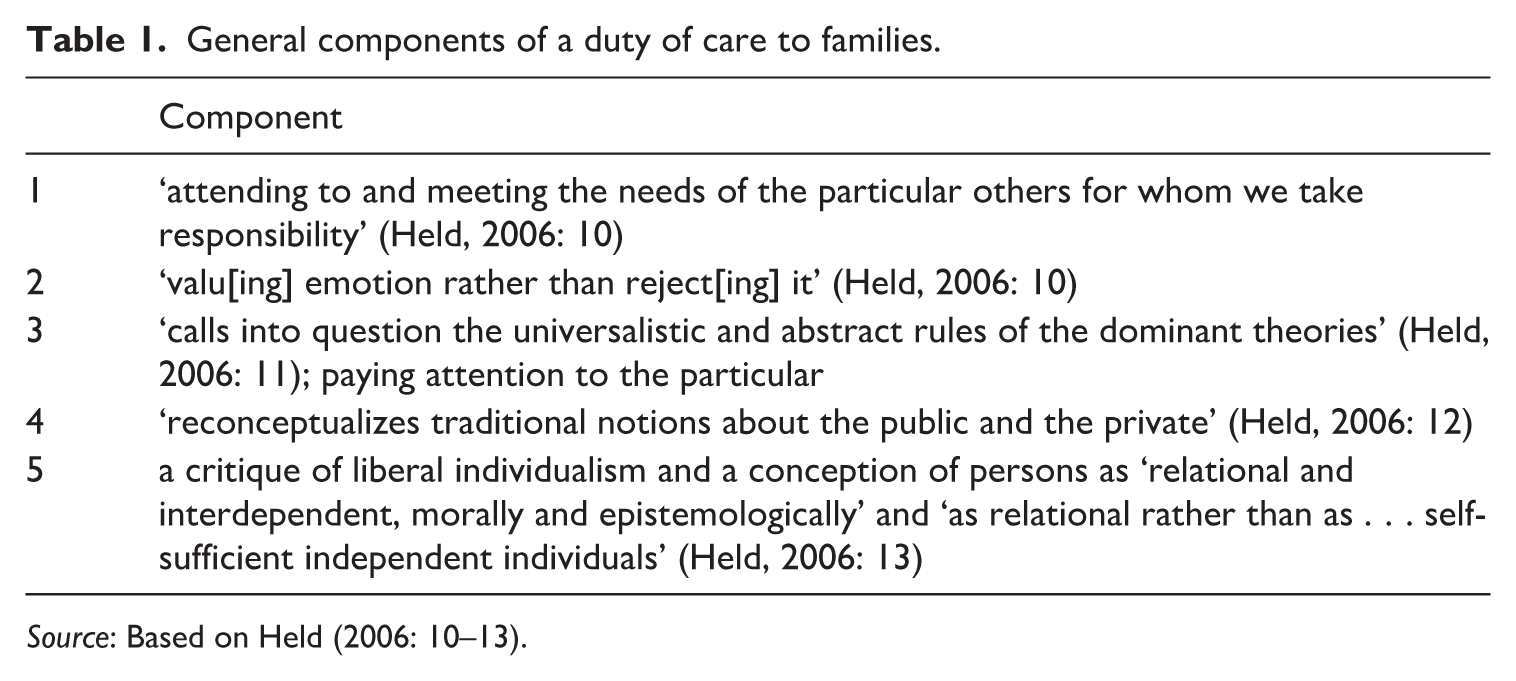
In this section, we show how the notion of a duty of care can be applied to the context of families of called employees. The components proposed here are conceptually organised around the five key features of an ethics of care (Held, 2006: 10–13), set out in Table 1. They would need to be implemented holistically. In line with the foregoing discussion, these components are general in nature, and would need tailoring before they could be applied to specific cases.
General components of a duty of care to families.
Source: Based on Held (2006: 10–13).
The first component involves SROs explicitly taking responsibility for, attending to and meeting the needs of families. For larger organisations, this might involve designating a board member to attend to the needs of families. It could mean having a representative of families in strategic planning. In practice, it means taking specific measures, not only to provide suitable practical assistance to families, but also to establish organisation-internal systems that help both the organisation and their members to achieve the kind of balance between work and family life that enables optimal benefit for all. Organisations with a high level of calling in management will need external assistance to understand and then respond to their reliance on self-sacrifice. This first component informs the notion of choice in work–family-life management discussed earlier, and is congruent with the principle of responsibility to address external costs. Moreover, if as argued earlier, an SRO is reaching into family life, then the family becomes a particular other for whom organisations should take responsibility.
The second component means SROs paying attention to the emotional concerns and well-being of their called members, as well as those of their families. It provides strong support for valuing the emotional pull of calling on individuals, as well as paying attention to the emotional needs of families. This must arguably involve engaging with families in both a structured manner (e.g. stakeholder dialogue, focus groups) and as needed (e.g. dedicated staff as designated contact persons for families). This approach may have a similar effect to that of insurance: most would not need to use it, and if many suddenly did, then that would be an indication of more serious trouble brewing. For this to work, organisational members need to be (or become) aware of the underlying cultural propensity for self-sacrifice discussed earlier, and collectively engage in emotional sense-making processes that help break the cycle.
The third component of a ‘duty of care for families’ model is to pay attention to the particular and to question universalistic and abstract rules. This implies moving beyond the work–life dichotomy that underlies the literature on work–life boundaries. It also suggests a need to develop a management approach that is specifically tailored to an organisation’s individual circumstances. Interventions for families would require tailoring to fit individual circumstances. For example, families with young children will have different needs from those without children, and a situational analysis is needed before specific prescriptions can be made. As Lindemann (2019: 17) puts it: ‘If you don’t know how things are, your prescription for how things ought to be won’t have much practical effect’. Tailored programmes and a fine-grained analysis of the specific situation of families are needed. For smaller organisations, this could involve focus groups and/or ‘town hall’ meetings. Larger organisations may find it useful to engage an external consultant. Whatever programme or initiative were chosen, based on detailed analysis, it would need to be offered in an accessible manner, such as choosing timing that works for families, and/or providing childcare during initiatives involving parents. Although Schabram and Maitlis’s (2017) research focused on individual sense-making, it is plausible that the multiple practice paths that they identify in the process of negotiating challenges could be influenced by employers paying particular attention to staff needs.
The fourth component is inherent in the approach of addressing families as distinct stakeholders: it is to reconsider the notions dominant in western thinking about the distinction between public and private. To an extent, it challenges the boundary management literature. For called individuals, the boundary between work and family may be indistinct. The notion of choice inherent in the work–life literature becomes less salient in this light, and suggesting that the household is not a private sphere that brooks no intervention. Rethinking the ‘public’ and ‘private’ categories also suggests a need to break down the perceived distinction between the organisation and those affected by it.
The fifth component conceptualises individual persons as being inherently relational rather than as self-sufficient ‘islands’ (Lindemann, 2019: 88–92): relationships of dependency and vulnerability play a key role. For called members with children or caring roles, for example, this means substantial flexibility in work arrangements. However, organisations need to go beyond merely providing such flexibility, given the limitations of flexible working noted earlier. Instead, organisations need to find ways of ensuring that members meaningfully use family-friendly policies. For many organisations in the social and care sectors with called staff, taking this approach implies applying their customer-focused approach internally. Moreover, this fifth component suggests that any changes would need to focus on strengthening relationships rather than by simply adopting policies for called persons to use (or not). It is risible to expect that called staff would choose to avail themselves of such policies, absent assistance. Organisations would need to identify ways in which employees can build on their existing relations to rebalance their work and life, while ensuring that the organisation can continue to achieve its mission. This will be challenging, not least because emotional support among called individuals often tends to reinforce their self-sacrifice rather than reduce it.
Implications and conclusions
This article has followed the call for more conceptual (Gazica and Spector, 2015) research into calling (Duffy and Dik, 2013; Lips-Wiersma et al., 2009) and especially its ambivalences (Duffy and Dik, 2013). It has introduced the family as the bearer of calling costs. It has promoted the view that SROs have a particular duty of care to families. The conceptual work has shown how called individuals’ work environments exacerbate the potential cost of calling. One of the central aspects of an ethics of care perspective is its interest in revealing concealed forces that lead to discrimination and injustice (Lindemann, 2019: 15–16). In their article on work–family spillover in nursing, Cottingham and colleagues (2020: 294) make a similar argument for the social sciences in general, writing: ‘One of the key roles of social science research has been to name what is often invisible’. This article has made visible the family as a stakeholder to SROs. It has implications for practice, in addition to suggesting numerous further questions for research.
This article has provided conceptually novel, interesting and useful insights to the calling literature, as well as illustrating the wider need to consider negative and positive effects on others even when studying an individually based phenomenon. It has thrown up several questions for investigation, scattered throughout. Empirical research is needed to further the understanding of links between calling and its impacts on families. The next step is to generate in-depth understanding of the situation of specific families, with a view to generating analytically sound categories of family concerns. Particularly interesting in this regard are questions around gender differences (seen in research on work–family conflict, e.g. Cottingham et al., 2020; Cousins and Tang, 2004; or those raised in the sociology of professions literature, e.g. Davies, 1996). It is probable that women and men will experience calling and its impact on families differently, not least because of gendered differences in domestic workload (see Hagqvist et al., 2019) and the recent suggestion (Cottingham et al., 2020) that women experience greater negative work–life spillover than do men. The experiences of women are therefore particularly salient, both as family members and as called individuals. Other distinctions worth further research are rural–urban divides, and research in the context of organisations facing chronic decline. It would also be interesting to investigate people for whom following a calling led to their never finding time for a family, as well as called people who are self-employed – such as social entrepreneurs, medical practitioners in private practice or many in the creative industries – due to the unique work–family challenges posed by self-employment (Craig et al., 2012). Additional work is also needed to assist in developing specific organisational action, beyond the initial ideas discussed above.
Moreover, understanding differences between individuals who follow different forms of calling would further help us understand calling’s impacts on families. It would also be interesting to understand the similarities and differences between calling and related concepts (e.g. ‘love of the job’, which appears prevalent in the creative industries). This article also suggests a clear need for more critical research. It does not offer explicit suggestions for the radical transformation of society, though ethics of care certainly has radical potential (Held, 2006: 12). Nonetheless, following the suggestions made would have substantial systemic implications. For example, taking families into account, involving them and attending to their needs may well result in higher staffing levels and/or different working patterns, in addition to families themselves being happier. To appreciate the radical potential of these changes, consider SROs trying to operate without self-sacrificing staff.
Moreover, many called people do not work according to market principles: their motivation is not economic gain, but rather following their calling. Bunderson and Thompson (2009) describe this explicitly in their study of zookeepers, and Cinque and colleagues (2020) do the same with actors. Held (2006: 110) makes the same argument conceptually, using teachers and doctors as examples. From an ethics of care perspective, the norms under which work is done are of fundamental importance. This opens an additional avenue for inquiry, as well as making the present article most timely. Arguably, most SROs are still not entirely market-driven, being involved in such areas as education, culture and healthcare. However, the rise in rhetoric around calling (Berkelaar and Buzzanell, 2015) suggests that increasing numbers of employers that do follow a market logic are seeking called staff. Such a development would see a great increase in the potential for exploitation and family misery. On a related topic, SROs seem likely to have developed normative expectations and workplace cultures that promote self-sacrifice. What about SROs (e.g. universities) that employ both called and non-called staff, particularly in view of the sociology of professions literature discussed earlier? What would be the consequences for non-called staff and their families?
Overall, making the family visible as a stakeholder of SROs provides valuable insights for both theory and practice. It points to the costs of calling on families, which have thus far been overlooked. It draws attention to the relevance of treating families as stakeholders. The article points to the challenges of addressing these issues and generates numerous questions, in the process exposing a rich vein of inquiry for future research.
Footnotes
Acknowledgements
The authors would like to thank Neil Conway for his helpful comments on an earlier version of the article, as well as the independent reviewers and Eleonore Kofman for their invaluable guidance throughout the process.
Funding
The authors received no financial support for the research, authorship, and/or publication of this article.
