




Abstract
Global labour governance has typically been approached from either industrial relations scholars focusing on the role of organised labour or social movement scholars focusing on the role of social movement organisations in mobilising consumption power. Yet, little work has focused on the interaction of the two. Using an exploratory case study of the governance response to the 2013 Rana Plaza disaster, this article examines how complementary capacities of production- and consumption-based actors generated coalitional power and contributed to creating the ‘Accord for Fire and Building Safety in Bangladesh’, making it binding and convincing more than 180 brand-name companies to sign up. The research has implications for understanding how the interface between production and consumption actors may provide leverage to improve labour standards in global supply chains.
Keywords
On 24 April 2013, in the Savar suburb of Dhaka, a building complex which housed several garment factories collapsed leaving 1129 garment workers dead and a further 2500 injured. The building had seen four floors added without planning permission and was originally built as a shopping complex and office block, not a number of factories housing over 3000, mainly female, workers and their machines. After the collapse, it quickly emerged that factories based in the complex produced for a checklist of household brands in developed countries including Primark and Walmart to name a few. While these multinational corporations had no legal duty of care to these workers, pressure grew on them to take responsibility for the incident. Within weeks of the disaster, a host of leading clothing brands had signed up to the ‘Accord for Fire and Building Safety in Bangladesh’ (hereafter ‘the Accord’), which is unprecedented in its scope and legally binding nature. However, the story is more complex than simply following a horrific human tragedy, a group of leading brands devised and signed up to the Accord to improve building safety in Bangladesh. This article uses the Accord, as an exploratory case study, to examine the emergence of labour governance in supply chains, particularly with respect to how production-based power and consumption-based power became complementary in creating coalitional power to establish a legally binding, collective agreement with 180 brand-name companies.
Global supply chains and the regulation of labour
A consistent theme of the employment relations literature over the past two decades has been that the traditional system of national labour regulation, in which trade unions were the driving force of labour governance, is under strain in the globalised economy. An area of growing focus has been on the shift in the regulation of labour from the national level to the global level (Meardi and Marginson, 2014) where production is distributed across global supply chains (Gereffi et al., 2005). Global supply chains pose a particular challenge to traditional forms of regulating labour in that they are often used explicitly to avoid regulation. Amid growing debate on new forms of private, transnational governance, scholars have focused both on the shifting role of ‘traditional’ actors within global labour governance, such as organised labour, and on the role of ‘new’ actors, such as consumers and collective actors who attempt to mobilise consumption power (Fransen and Burgoon, 2013). As a fragmented and polycentric patchwork of regulatory initiatives and hybrid forms of governance emerge, it has remained unclear what roles different actors play, how they can assert power in supply chain actors and how they can meaningfully cooperate.
To understand how global supply chain participants can be influenced to improve labour conditions, it is worth examining the governance of these chains which has become a major theme of debate. Gereffi’s (1994; Gereffi et al., 2005) influential framework highlighted the role of power relations in supply chain governance. Supplier-led supply chains are conceptualised as having power concentrated closer to the producing organisation. Alternatively, buyer-led chains are conceptualised as having power concentrated closer to end-user organisations. They are thus seen as providing greater scope for consumer activism. Supply chains in the apparel industry are often highlighted as the archetypal buyer-led supply chains where large developed country brands exert significant downward pressure on their suppliers. While this framework focuses on the extent to which organisations may exert power on each other, the approach ignores whether workers or consumers have the capacities available to disrupt or threaten to disrupt production and consumption across supply chains in response to the need to improve labour conditions. In this article, we explore how a coalition between those utilising consumption-based power and production-based power worked together to create a novel instrument of global labour governance.
Production actors in global labour governance
Unsurprisingly, the role of unions has been the main focus of industrial relations scholars who analyse global supply chains and focus on how unions contribute to the emerging global labour governance architecture (e.g. Fairbrother et al., 2013). National unions and global union federations have played a key role in the articulation of demands and the development of international regulation, such as the International Labour Organisation’s (ILO) tripartite regulatory activities, to which they are party (Jarman, 2012). As established actors, unions also hold access to state and intergovernmental decision-making, such as observer or advisory capacity, and can articulate demands and influence global policy making, such as social clauses in trade agreements (Cotton and Croucher, 2009; Cotton and Gumbrell-McCormick, 2012). The power resources of unions have been expressed in terms of Wright’s (2000) analysis of structural and associational power.
Structural power can be defined as ‘power that results simply from the location of workers within the economic system’ (Wright, 2000: 962) and refers to the potential of labour to affect the production process. Within supply chains, the structural power of workers is high when workers are not easily substitutable, when they have effects on other parts of the economic system and when knowledge of the structure of a supply chain enables workers to upset the flow of the chain. The associational power of labour can be defined as ‘the various forms of power that result from the formation of collective organizations of workers’ (Wright, 2000: 962). Within the supply chain context, associational power is contingent on the relationships between supplier-firm unions and lead firm unions, the degree of unity among unions and the ability of unions to coordinate solidaristic actions across the supply chain. Wright’s framework has been supplemented by Gumbrell-McCormick and Hyman (2013), who have added institutional power, that is, power enabled through participation in institutional arrangements such as works councils and national tripartite arrangements, and organisational power, where the membership and democratic processes increase power. In addition, they highlight three ‘complementary’ power resources—moral, coalitional/collaborative and strategic/logistical—which can be utilised by unions. Of particular relevance to this article is the idea of coalitional power resources where unions take resources ‘on loan’ from groups like nongovernmental organisations (NGOs) in advancing their agenda. Such coalitions may focus around member recruitment; alliances between ‘producers’ and ‘consumers’, particularly in relation to public services; equality and inclusion issues; environmental politics; and international solidarity.
Despite declining aggregate representation, unions continue to retain influence in some sectors, individual countries and multinational corporations. In particular, scholars have focused on how unions have leveraged domestic industrial relations systems on a global level and employed methods akin to collective bargaining to negotiate international agreements (Anner et al., 2006; Fairbrother et al., 2013; Lévesque and Murray, 2010). One unique example where domestic strongholds of labour power have been leveraged in a globalised industry is the coordinated international collective bargaining system for maritime shipping, a previously unregulated industry (Lillie, 2005; Umney, 2012). The International Transport Workers’ Federations leveraged the interconnected nature of shipping to develop transnational structures for mobilising industrial action. Another example where production-based power has played a role to establish global labour governance are International Framework Agreements (Hammer, 2005; Stevis, 2010). International Framework Agreements are agreements between single multinational corporation and global union federations that set out frameworks for industrial relations throughout the corporation and sometimes its supply chain.
In sum, among non-state actors, unions remain the representatives of organised labour. One weakness of the existing frameworks (e.g. Gumbrell-McCormick and Hyman, 2013; Wright, 2000) is that they have been developed in the context Western European, nation-state or local workplace-level analysis. In addition, while the analysis of Gumbrell-McCormick and Hyman (2013) provides a useful overview to categorise alliances, this article focuses more closely on the factors which enabled such an alliance to operate and achieve a meaningful outcome. However, as will be developed later, in global supply chains with varying levels of union density and organisation, the discussed power resources, especially structural and associational, are likely to be low. Thus, it is important to rethink the ways in which unions can utilise their role in labour governance institutions across global supply chains.
Consumption actors in global labour governance
Less, albeit increasing, attention in the area of industrial relations has been paid to the role of the consumer (Donaghey et al., 2014). The power of consumption-based actors in supply chains can be conceptualised using Hirschman’s (1970) exit, voice and loyalty framework (Donaghey et al., 2014). Consumers can exercise power through ‘exiting’ the consumption relationship by boycotting goods (or threat thereof). Consumers may also ‘buycott’ through the purchase of ethically labelled products, such as Fairtrade, or through ‘voicing’ complaints and grievances to repair or improve the relationship. But such consumption power is not simply a spontaneous outcome of consumer behaviour ‘but the result of organised and strategic conduct by collective actors who are highly attuned to the potentials of consumer-activism’ (Barnett et al., 2005: 46). As Barnett et al. (2005) argue, ‘what is most distinctive about this new politics of choice is the nature of the agencies and collective organisations that serve as the mediators of engagement and participation’ (p. 46).
We use the term of social movement organisations, which include faith groups, student organisations and human rights activists, to describe such collective actors that have increasingly mobilised consumers at the end point in the global supply chain to put pressure on multinational corporations to behave more responsibly (Bartley, 2007; O’Rourke, 2011). In the absence of a direct relationship between producers and consumers—as in global value chains—social movement organisations create ‘a chain of social connectedness’ between downstream consumption acts and upstream production actors (O’Rourke, 2011; Schrempf-Stirling and Palazzo, 2013: 10). Social movement organisations incite consumer activism by encouraging consumers to sign petitions, wear campaign badges or alert consumers by demonstrating in front of outlets (Barnett et al., 2005). As scholars have demonstrated (e.g. Bartley, 2007), the mere threat of such activities may suffice to alert companies to avoid inflicting damage on their actual sales or reputation of their brand, which has become a significant intangible asset in the global economy (Lury and Moor, 2010). By leveraging consumer sentiment and reputational threats, social movement organisations have played a critical role in pushing companies to protect labour rights in their global supply chains, such as through unilateral Corporate Codes of Conduct (Locke, 2013) or by adopting private labour standards (e.g. Bartley, 2007; Fransen and Burgoon, 2013).
But these consumer-driven governance mechanisms are far from a panacea for developing labour rights. Often as seen in voluntary corporate social responsibility, they lack meaningful enforcement, may often focus on ‘easy targets’ rather than the worst offenders and lack a democratic mandate by those affected (Egels-Zandén and Hyllman, 2007; Locke, 2013). Nevertheless, where freedom of association is limited, as in many developing economies that have served as hosts for global value chain activities, the mobilisation of consumption power is often the main vehicle for pressurising corporations to improve working conditions (Frenkel, 2001). It is thus important to understand how consumption-based actors can utilise their power over production processes in ways that can have a meaningful effect on labour governance.
Interaction between ‘traditional’ and ‘new’ actors in global labour governance
The interaction between production- and consumption-based actors has been highlighted as an important area of investigation for global labour governance (Compa, 2008; Donaghey et al., 2014). This can be conceptualised as a form of coalitional power, which Gumbrell-McCormick and Hyman (2013) have identified as an important complementary power resource. Studies of union–social movement organisation coalitions at community level highlight that successful coalitions involve shared interests among parties (Frege et al., 2004; Tattersall, 2005), an ideological fit between actors and strategies for grassroots involvement (Holgate, 2014). Union–social movement organisation coalitions in supply chains differ from these community-based coalitions as they focus on exerting consumer-based power on brands rather than politically based pressure on governments (O’Rourke, 2011). How coalitional power is built and exercised remains under-researched in global supply chain contexts. This is unsurprising as Compa (2004) highlights that those who mobilise threats of labour power have been viewed as uneasy bedfellows of those who mobilise consumer power (cf. Korczynski and Ott, 2004). Yet, scholars have shown that such coalitions can lead to improved implementation and monitoring of social clauses in US trade agreements (Douglas et al., 2004), increase buyer responsibility for labour rights (Egels-Zandén and Hyllman, 2006) and improve the governance of private labour standards (Fransen, 2011). Private labour standards can also play a role in strengthening union rights by incorporating freedom of association and the right to collective bargaining and, in some cases, have assisted the formation of local unions (O’Rourke, 2006). Such coalitions highlight how production- and consumption-based power can be complementary in advancing workers’ rights (Compa, 2004, 2008).
What is clear from the above is that there are weaknesses in both production- and consumption-based approaches to global labour governance. As both Heery (1993) and Compa (2004, 2008) speculate, the interactions between consumption- and production-based actors can potentially be complementary in supply chain labour governance, yet initiatives which involve both have attracted surprisingly little attention. This article seeks to use an exploratory case study to investigate the question of how production- and consumption-based capacities can interact to produce private labour governance in global supply chains. In particular, we examine the origins of the Bangladesh Accord with a specific focus on the power resources that were deployed to create it, including the nature of the production- and consumption-based coalition. To do this, we use the idea of complementary capacities to explain the nature of coalitional power in global supply chains.
Research context and methods
After China, Bangladesh is the second largest textile producing economy, with over 5000 factories employing approximately 4 million, mainly female, workers, producing primarily for the developed world. Since the textile sector evolved in 1976, it has dwarfed all others with US$21.5 billion (approximately 80% of total) in annual exports and 13% of gross domestic product (GDP), according to 2012–2013 figures. With the lowest minimum wage in the sector set at US$43 per month, the Bangladeshi sector provides cheap produce from primarily Bangladeshi-owned factories, thus removing Western brands from legal liability over labour abuses. From the mid-2000s onwards, and following a series of deadly factory fires and building collapses, including the Rana Plaza factory collapse in 2013, increased attention focused on labour issues within the Bangladeshi garment sector. Building and fire safety were often lacking, with buildings having locked exits and extensions upwards being built on top of existing buildings (Feldman, 2013).
The Accord for fire and building safety in Bangladesh
The Accord which emerged in response to Rana Plaza is a prime example of the complementarity of consumption- and production-based actors coming together to facilitate the creation of innovative governance mechanisms. The Accord reflects the mobilisation of consumption power at the downstream end of buyer-led supply chains, as brands were pressured to protect their brand image vis-à-vis the critical scrutiny of their consumers. For instance, the Worker Rights Consortium mobilised students as consumers of university-licensed apparel in the United States and Canada to include the Accord into university licence agreements. The Clean Clothes Campaign educated consumers about the brands sourcing from Rana Plaza and mobilised them to put pressure on brands to sign the Accord. But the Accord also reflects the mobilisation of production power, as global unions pushed for going beyond surface-level changes towards a more substantive agreement. The result is an unprecedented, legally binding agreement between the global union federations, IndustriALL and UNI Global Union, Bangladeshi trade unions and over 190 ready-made garment retailers and brands from 20 countries in Europe, North America, Asia and Australia, with four social movement organisations as ‘Witness Signatories’ (Clean Clothes Campaign, Worker Rights Consortium, International Labor Rights Forum and Maquila Solidarity Network). Signatories agree to implement:
Independent safety inspections by qualified engineering experts;
Support for factory remediation to ensure compliance with building, fire and electrical safety standards while maintaining employment for workers;
Worker participation in Occupational Health & Safety Committees and training;
Provision of worker complaints mechanisms and right to refuse unsafe work;
Transparent disclosure of all ready-made garment suppliers and sub-contractors, inspection reports and quarterly progress reports.
There is a complaints procedure which has a binding arbitration system where all signatories agree that awards and enforcement of fees may be pursued in their respective national legal systems. To ensure a solid commitment to the Accord, companies agree to a long-term sourcing relationship with Bangladesh, maintaining purchasing volumes for 5 years, thus providing an incentive for suppliers to invest in safety improvement. Brands commit to ensure that factories have the financial capacity to maintain safe workplaces and comply with remediation requirements through providing loans, accessing donor or government support or through offering other business incentives. Signatory firms agree to terminate contracts with factories that fail safety inspections. Companies assume responsibility for funding the activities of the steering committee, safety inspectors and training coordinators based on their annual volumes of garment purchases from Bangladesh on a sliding, pro-rata scale up to US$500,000 per annum. The training foresees a central role for workers and worker representatives, including direct trade union participation in factory training and factory inspections. Demonstrating a commitment to transparency, all supplier factories and inspection reports as well as corrective action plans are made publicly available on the Accord’s website. The Accord specialises in three types of inspection—fire, electrical and structural—for which specialist engineers are contracted in contrast to social auditors who are ill-qualified to assess many of the crucial safety aspects.
Methods
Research design
This research was based on an open-ended, inductive research design informed by a broad interest in understanding the complementarity of production- and consumption-based mobilisation in global supply chains. A total of 29 semi-structured, open-ended interviews were conducted from late 2013 to early 2014 with respondents involved in the creation of the Accord. Respondents included staff from trade unions (N = 8), social movement organisations (N = 8), sourcing or ethical trading managers from brands buying from Bangladesh (N = 6) and other relevant actors, such as the Ethical Trading Initiative, Accord steering committee members and Bangladeshi civil society activists (N = 7). Snowball sampling techniques were used to identify respondents (Guba and Lincoln, 1994). After the first 10 interviews, it became clear that most snowball recommendations tended to point to the same key actors that were involved. Respondents were asked to recount the events and their activities leading to the Accord, describe the contributions of the different parties involved to create the Accord and relationships between them. Interviews lasted between 30 minutes and 3 hours. All but one interview was fully recorded and transcribed verbatim. In addition, publicly available documents related to the Rana Plaza disaster and the Accord were collected. A search of the websites of brand-name apparel companies, social movement organisations and trade unions and their press releases in relation to Rana Plaza was carried out, and data were collected on the Accord.
Data analysis
Open-ended and inductive data analysis was conducted. In the first stage of the analysis, all the data were imported into an integrated database, and qualitative analysis software, NVivo, was used to develop, refine and organise emerging codes. The data were organised by developing a chronological account, noting critical events in relation to the Accord. The fieldwork was ongoing throughout this stage of the analysis, and additional insights were used to revise the analysis. In the second step, evidence was gathered about the formulation of a response to the Rana Plaza disaster. Actors involved in negotiating the Accord—notably campaigning groups, trade unions and brands and to a certain extent the ILO and platforms such as Ethical Trading Initiative—were then mapped. The data were then coded according to the contributions made by different actors, thereby carefully comparing self-descriptions with external assessments. To understand better the role of the Labour Caucus (see below), the concrete strategies that campaign groups and trade unions used to hold brands responsible and get them to sign the Accord were analysed. In the third step, the complementarities between the strategies of social movement organisations and trade unions were drawn out. Evidence of concrete instances where the Labour Caucus was successful in making individual companies sign was analysed with a particular focus on how complementarities played out. In addition to positive examples, negative instances of companies not signing up were identified.
Complementary capacities of production- and consumption-based actors
Central to the emergence of the Accord was the coalition between unions and social movement organisations forming the ‘Labour Caucus’ which united behind a shared objective. The Labour Caucus consisted of two global union federations, local Bangladeshi unions and four social movement organisations as witness signatories and was supported by online campaigning groups. Table 1 summarises the membership of the Labour Caucus.
The Accord Labour Caucus.
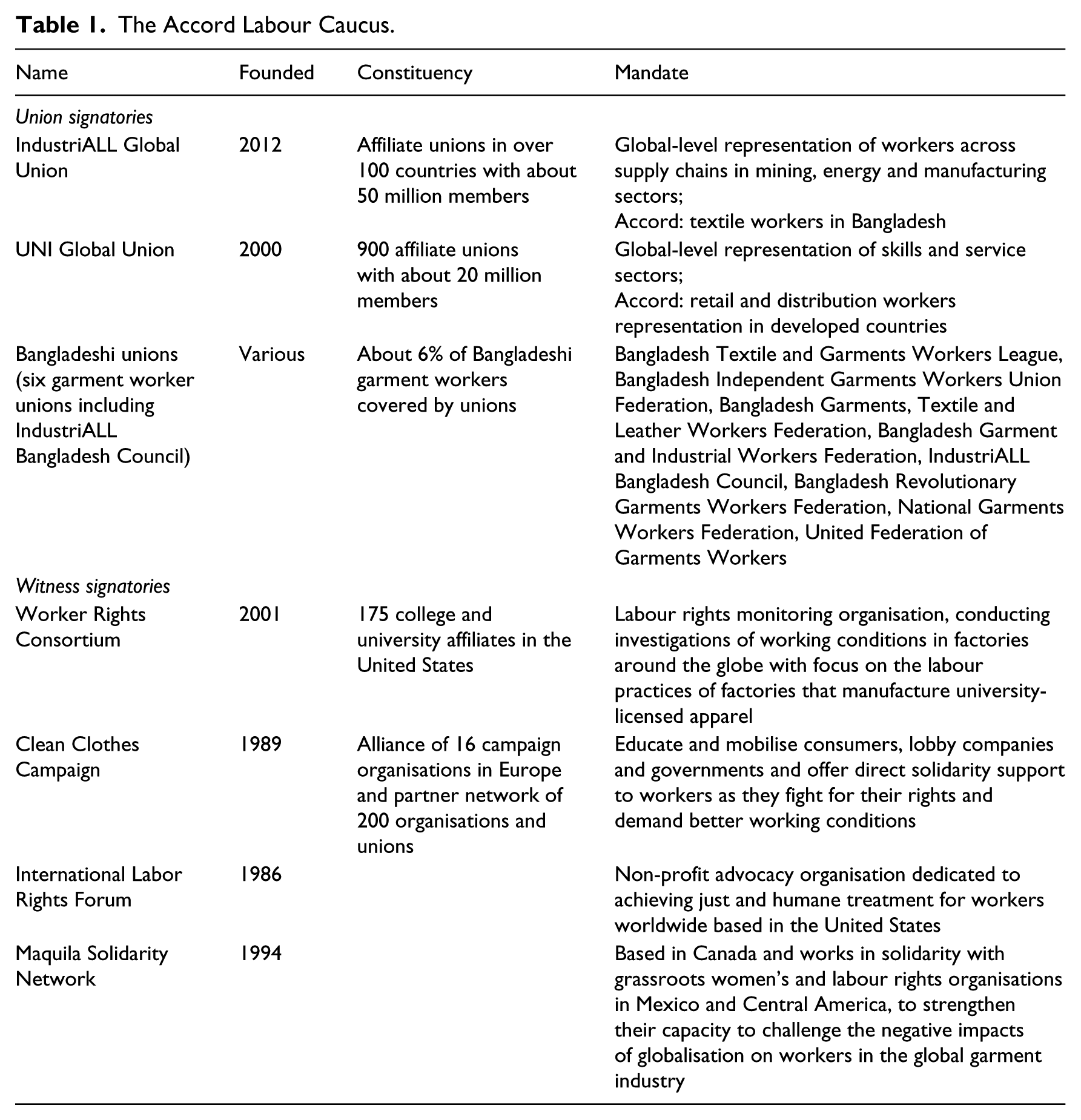
Our findings suggest that different actors within the Labour Caucus contributed complementary capacities. While the Bangladesh apparel supply chain reflects the low associational and structural power of workers employed in low-skilled, labour-intensive industries of this type, global union federations contributed critical representational and institutional capacities. In the context of low associational and structural power of unions to disrupt production processes, the role of social movement organisations became important as consumption actors in shaping governance at the production end of the supply chain by contributing mobilisation capacities and expertise, which the unions lacked in the Bangladesh context.
Production-based capacities: representational
The associational power of trade unions in Bangladesh was low in terms of mobilising the traditional tools of the labour movement: collective industrial action or threat thereof. Union fragmentation (involving 34 union federations), low density (only 222 enterprise unions registered in about 4000–5000 factories; ILO, 2014), an immature system of industrial relations and political corruption all meant that traditional labour resources were curtailed. Moreover, the global union federations’ assessment of the situation in Bangladesh was that local unions were not in a position to mobilise workers to take collective action. Within consumer countries, global union federations had relatively strong associational power through their affiliates. However, unions considered domestic industrial relations as the priority area for collective action over solidarity actions for remote workers in Bangladesh. Similarly, the structural power of trade unions was low in terms of the threat of withdrawing labour from the production process. With a large percentage of the workforce being young, female workers, with few alternative sources of income, workers were in a weak structural bargaining position to make demands.
While the associational and structural power of unions was low in Bangladesh, the unions’ representative membership structures gave them a high capacity to make claims at the international level. IndustriALL had the official mandate to represent factory workers in the Bangladesh ready-made garment sector. UNI Global Union had significant membership in some areas of retailing and could leverage industrial relationships with many brands. IndustriALL and UNI Global Union’s representational capacities were, therefore, complementary. This enabled the global union federations to mobilise bottom-up voices through their network of affiliate members. For companies with union recognition, the relevant unions, such as GMB, USDAW and UNITE in the United Kingdom or Handels in Sweden, could both negotiate with brand management to make internal demands or use the threat of mobilising their members to exert pressure.
Production-based capacities: institutional
The global union federations contributed institutional access within the global governance arena—an access which social movement organisations mostly lacked. The unions leveraged their formal role in the institutionalised governance landscape, particularly as constituents of the tripartite structure of the ILO. This institutional embeddedness helped gain the official endorsement of the ILO for the Accord through its agreement to Chair the Accord steering committee. In addition, it also enabled the unions to link to a broad network of global-level institutions as well as local-level agencies.
The other institutional dimension was that unions were viewed by many of the brands as being legitimate ‘insiders’ to the employment relationship and regarded as more appropriate negotiation partners because they shared a mutual interest in the well-being of the company and responsibility for the success of collective agreements. In contrast to social movement organisations, the unions were insiders and viewed as having ‘as much skin in the game on this as the companies have. So they’re not sitting on the outside and watching: they’re in the centre!’, as a respondent from the United Kingdom’s Ethical Trading Initiative observed. Being embedded in the well-established structure of collective bargaining with companies on a local, national, and international level also gave unions direct access to and influence at company headquarters where unions were recognised. Having such ongoing relationships enabled more cooperative bargaining and a willingness on both sides to compromise to retain existing relations. This enabled union federations to leverage existing national collective bargaining institutions at the global level, for instance, by contacting staff at corporate headquarters.
Consumption-based capacities: mobilising
Placed at the end point of the global supply chain and within a highly competitive consumer market, consumers had considerable voice and exit power. Consumer voice was seen to be expressed ‘via agencies that speak on their behalf’, as a brand respondent stated. These agencies, including the Clean Clothes Campaign and Worker Rights Consortium, were powerful in their ability to mobilise consumers to threaten to withdraw their purchasing power. This played a critical role in lifting labour rights violations from mere ethical to strategic concerns for companies. The key leverage point of campaign groups was creating a reputational risk to companies by damaging, or threatening to damage, their brand image through repeated negative press. As one trade union interviewee stated, ‘their main purpose as a campaign organisation is to campaign which means pointing the finger where things are wrong and then creating public pressure to change the situation’. Social movement organisations stood outside the tripartite system of industrial relations. Yet, this political non-accountability meant, in theory, greater freedom to agitate and engage in contentious politics to raise awareness and pressurise companies. The social movement organisations were thus regarded as ‘vital in creating the energy and the noise and the push’ for companies to sign the Accord. The mere threat of exit also posed a particular threat to specific brands in specific markets, which were at risk of a ‘short-term strategic kind of boycotting’ (social movement organisation interviewee).
While the witness signatories straddled the thin line between engaging and attacking corporations, online campaigns, including Avaaz, SumOfUs and change.org, occupied a role at the margin of the Labour Caucus. This role was effective in generating what respondents called ‘surge capacity’. Online campaigners would send email petitions to their large mailing lists asking members support particular causes (2.8 million members globally in the case of SumOfUs). In a successful campaign, this could confront ‘offending’ companies with a large number of people who declared themselves as consumers and/or users calling on them to take remediating action, such as signing the Accord.
Consumption-based capacities: expertise
In terms of making credible claims and rendering labour rights violations visible to consumers, social movement organisations were crucial in contributing expertise and in-depth knowledge of the industry. Social movement organisations’ research on the Bangladesh ready-made garment sector was critical in bringing to light the plight of textile workers, thereby making visible the connection between consumers in developed countries and the workers who make their brand-name clothes. Their role as ‘international watchdogs’ was particularly important in the context of the Bangladeshi textile sector. Worker Rights Consortium staff on the ground worked closely with a number of labour rights organisations and unions. In addition, actors who may otherwise have questioned the representational legitimacy of the social movement organisations rationalised their participation in terms of their knowledge and commitment of work in the Bangladesh garment sector.
Both global union federations recognised that they lacked expertise in the Bangladesh garment sector due to low union membership. In addition, UNI Global Union, coming from the service sector in developed economies, had few dealings with the types of issues at hand. The Clean Clothes Campaign, with their knowledge of the garment sector, and the Worker Rights Consortium, with their Bangladesh-specific knowledge, brought the sort of expertise that unions would normally bring to the table. This was important in formulating realistic and credible demands that both fulfilled the needs of people on the ground as well as recognising limited capabilities. Yet, a majority of workers in the garment industry had little knowledge about their rights and lacked skills to exercise them. This required a very different approach to engaging workers in monitoring activities compared to the approach used with relatively empowered and more knowledgeable retail workers in Western companies.
How were complementary capacities utilised in creating the Accord?
The coalition and associated division of labour between unions and social movement organisations was perceived as crucial in leveraging relationships to establish the Accord. Relationships between the parties within the Labour Caucus had built up over time since the Spectrum factory collapse in 2005 and intensified following the Tazreen factory fire in 2012, which killed 112. Frustrated with existing Corporate Social Responsibility activities by brands that had mainly focused on social auditing of suppliers, the Worker Rights Consortium and the Clean Clothes Campaign attempted to establish a ‘Memorandum of Understanding’ for brands to invest in building safety in Bangladesh, yet it failed to gather the necessary support of at least four companies to sign the commitment. When Rana Plaza occurred, the Labour Caucus regarded the disaster as confirmation that the prevailing social auditing paradigm was ‘a model that has failed’ (IndustriALL interviewee) to address the entrenched structural problems. 1 The emphasis became creating a proper, legally binding collective agreement with IndustriALL and UNI Global Union being the global union federations involved. 2
In negotiating the Accord, the representational legitimacy and institutional weight of IndustriALL and UNI Global Union enabled the development of a collective agreement, while consumer pressure mobilised by social movement organisations strengthened the unions’ bargaining position. Importantly, the power of the Labour Caucus was illustrated by its ability to trump an industry-driven solution in favour of a legally binding, collective agreement. By April 2013 when Rana Plaza collapsed, only two companies, Tchibo (Germany) and PVH (the United States), had signed the Memorandum of Understanding. The German Development Agency was simultaneously attempting to develop an alternative initiative with the Global Social Compliance Program that was in line with the industry-driven social auditing regime.
Shortly after Rana Plaza occurred, both approaches were being discussed at a meeting of unions, social movement organisations and brands in Eschborn, Germany. The united Labour Caucus aligned its position to insist on a broad line: a binding agreement, financial responsibility of brands, the role of unions and independent and transparent inspections. Using the momentum created by the disastercreated a ‘pressure cooker’ effect on companies. Companies, in contrast to the labour caucus, lacked a unified position. The meeting ended without a clear outcome but with the Labour Caucus demanding companies sign the Memorandum of Understanding by a deadline of 15 May 2013.
Both the unions and social movement organisations went beyond their normal ‘roles’ which had previously divided them. Prior to this, IndustriALL had invited brands and NGOs to a meeting in Geneva to negotiate a compromise. But following Rana Plaza, widely described as a ‘game changer’, and frustrated with brands’ response, IndustriALL was now ready to insist on a binding agreement. In turn, the Clean Clothes Campaign and Worker Rights Consortium were ready to leave the negotiations to IndustriALL rather than campaign against companies. The Accord became ‘a very high priority’ for the unions to the extent that the General Secretaries of IndustriALL and UNI Global Union became involved and negotiated directly with the brands over the Accord. Between 29 April and 15 May 2013, numerous bilateral and multi-lateral conversations were led by IndustriALL to negotiate the content of what became the ‘Accord’.
While some corporate actors were pushing to water down the Memorandum of Understanding to a more principle-based agreement, IndustriALL insisted on a substantive agreement instead of negotiating a weaker compromise. The Labour Caucus recognised the unique opportunity that they had to reach an unprecedented binding agreement. If such a demand could not be formulated in a situation in which the bargaining power of the Labour Caucus was backed by the enormous consumer pressure that Western companies faced, then they would never be able to do it. ‘I think that’s why, that’s what made us so determined to stand by it, to fight it out with the companies’, as a respondent from UNI Global Union explained.
Social movement organisations contributed vital expertise to the negotiations while refraining from immediate campaigning. Crucially, the Worker Rights Consortium’s ‘fact finding’ directly after Rana Plaza provided key evidence about the buyers present at the factory. This prevented brands denying that they were sourcing from Rana Plaza—a practice that some brands had attempted. Those brands who were shown to source from the factory complex, such as Primark, were among the most responsive and early signatories to the Accord. 3 In terms of crafting the text of the Accord, the unions relied on the social movement organisations for expertise and input that provided ‘a reality check’ which was crucial in making the Accord work. Through this coordinated approach to negotiating on multiple levels, the Accord evolved ‘behind the scenes’ and retained the key feature of being binding while integrating two key changes: linking to the Bangladeshi National Action Plan and bringing in the ILO as the chair of the Accord steering committee.
Getting companies to sign the agreement
The Labour Caucus took a collective approach and united behind a single demand of Western retail companies—sign the Accord. Compressing the complexity of factory safety in Bangladesh into one single demand helped focus attention and coordination of actions. Pressure was created by the combination of ‘insider’ unions leveraging institutional relationships and using threats of collective action and ‘outsider’ social movement organisations creating pressure on global brands.
Leveraging institutional position and threat of collective action
In getting companies to sign the Accord, unions took on the primary role of negotiating directly with companies by leveraging their institutional ‘insider’ position. The campaign to get H&M, the largest buyer from Bangladesh, to become the first signatory to the Accord illustrates the unions’ ability to leverage pre-existing relationships. Due to the existence of International Framework Agreements, respondents emphasised that IndustriALL and UNI Global Union had very constructive relationships with Inditex and H&M, respectively, both on the manufacturing side and on the retail side. Yet, negotiation on a global supply chain level was fundamentally different to more traditional unionism where one union was negotiating with one employer, a model which was seen as ineffective to address the deep-seated, structural safety issues in a global supply chain that was as mobile and fragmented as the Bangladeshi garment industry. To tackle multiple companies, there was close co-operation between the global union federations to play off lead brands against each other to sign the Accord with UNI Global Union targeting H&M and IndustriALL targeting Inditex. Union representatives reported that they ‘used a lot of credit that we had from developing those relationships to exert pressure on them. It was not always pleasant but I think it paid off to have an Accord’.
To exert pressure on the Swedish fashion retailer, UNI Global Union leveraged both its existing International Framework Agreement with the company and its national affiliate’s high level of density in union membership. H&M (2014) reports that 63% of its employees worldwide are covered by collective bargaining agreements. Invited by UNI Global Union, the Swedish union organising retail workers, Handels, used its relationship with H&M to have a dialogue at the company’s Swedish headquarters. In addition, unions published an advertisement in one of Sweden’s biggest newspapers to urge garment retailers to sign the Accord. While they did not have to resort to worker mobilisation, the potential and threat of doing so was perceived as a powerful lever in motivating the company to sign the Accord. Their own employees putting demands on their employers in petitions were seen to ‘resonate very, very strongly within those companies’. On 15 May 2013, H&M became the first signatory to the Accord, followed by Inditex.
Mobilising consumer pressure
In addition to demonstrating the role of production-based power, the case of H&M also illustrates the complementarity of social movement organisations and unions. Union negotiation was strengthened by the threat of renewed negative publicity. After having been previously exposed over living wages in Cambodia and pulled out ‘of its Swedish comfort zone’ as a Clean Clothes Campaign interviewee described it, H&M was vulnerable to consumer activism, and the retailer was aware that the Clean Clothes Campaign had been preparing a large-scale campaign against it.
The close link between the Worker Rights Consortium and university students—an important consumer group for many collegiate supplier brands such as Adidas—created consumer pressure in key markets. In particular, the Worker Rights Consortium, founded by the US-student activist group United Students Against Sweatshops, engaged students in its over 180 affiliate colleges and universities in the United States and Canada to advocate for university administrators to add the Accord to licensing requirements. For instance, student-led campaigns at five prestigious US campuses led Fruit of the Loom in November 2013 to sign the Accord despite already having been a member of the industry-led Alliance, as the company could not afford to lose consumers in its important collegiate market.
Social movement organisations benefitted from the freedom as ‘outsiders’ to agitate and ‘name and shame’ individual companies who refused to sign the Accord. A Clean Clothes Campaign interviewee argued that ‘it’s not their [the unions’] role to do campaigning’. Similarly, this quote from a UNI Global Union representative captures the complementarity of unions and social movement organisations in fulfilling negotiation and mobilisation roles:
Once you have exhausted your area of negotiation, once you’ve got your point where it’s just, you have to recognise as a union that you know, you just cannot get any further, the company is refusing to negotiate. That’s when we very much need the campaign organisations because they are simply better than us in public campaigning.
However, there was a fine line to decide when the possibility of negotiation was exhausted and when a public campaign, with the potential to create a more conflictual relationship with a company, should start. Social movement organisations agreed that this line ‘where we’d have to break ranks and do a campaign’ (Clean Clothes Campaign interviewee) would have to be negotiated with the unions. While social movement organisations were credited with mobilising consumer pressure, ‘the maturity of IndustriALL and unions knowing about negotiation, not just campaigning, was the important counter point’ (Ethical Trading Initiative interviewee). Thus, unions stressed that they worked ‘very, very closely with those groups’ (IndustriALL interviewee) and were in direct contact with them on an almost daily basis. In some cases, trade union organisations led campaigns and thereby shaped the emerging storyline in the media. In the United Kingdom, the Trades Union Congress identified eight brands that had not signed the Accord by September 2013. The union collaborated with the Clean Clothes Campaign and SumofUs to create a coordinated consumer-oriented campaign involving leafleting in front of brand-name apparel stores.
Online campaign groups such as SumOfUs helped raise consumer awareness and exert consumer pressure through online petitions against companies to sign the Accord, such as Gap and Walmart in the United States, Coles and Rivers in Australia, Loblaw in Canada or River Island and Edinburgh Woollen Mill in the United Kingdom. While not directly part of the Labour Caucus, these online campaign groups did coordinate some of their actions with organised labour. For instance, in the United Kingdom, the Trades Union Congress and SumOfUs coordinated a successful campaign against River Island with about 17,000 signatures from UK consumers, which played an important part in persuading the UK-based fashion retailer to sign the Accord.
However, online campaign groups were also seen as ‘uncontrollable’, and their interventions could sometimes be non-constructive. Surge capacity was a short-term campaigning strategy that attempted to build on outrage about news in the media rather than long-term coordinated action with other parties. The delicate complementarity between union-led negotiations and activist agitation is illustrated by online campaigning against Topshop. Online campaigners, who neither had direct relationships with the company nor pursued negotiations, were building a public petition against Topshop, a UK high-street fashion retailer, to pressurise them into signing the Accord. Yet, the brand was simultaneously in negotiations with unions and threatened to walk away from the Accord if they were publicly campaigned against. The petition was withdrawn after the negative reaction in the test phase, and shortly after, Topshop signed the Accord. While this success was attributed to the skills of union negotiators, respondents acknowledged an additional contribution: ‘having that implicit threat helped focus minds’, stated a respondent from SumOfUs. But the unions found it difficult to work with online groups strategically due to their unwillingness to cooperate.
Reconciling negotiation and mobilisation: role division and conflict
Respondents stressed the importance of maintaining a clear division of roles, particularly with regard to the different mandates of unions and social movement organisations. Unions were especially careful to uphold the distinction between the representative role of unions and the advocacy role of social movement organisations. The establishment of role division is manifested in the governance structure of the Accord. While unions were represented on the steering committee, social movement organisations accepted, albeit reluctantly, being ‘witness’ signatories to the Accord in recognition of the representational capacities of unions. Being granted the role of observers was seen as an important acknowledgement of what the role of a social movement organisations was vis-à-vis the role of a trade union, although the observer role gave no voting power. ‘It’s just making sure that those lines are clearly held at the interface bit base. But that is always a challenge’, a Clean Clothes Campaign respondent admitted.
As with any labour movement, a tension exists between when to negotiate and settle, on the one hand, and when to mobilise and campaign, on the other hand. While trade union negotiations and campaigning were both seen as valid approaches that could both achieve progress, this led to some tensions and divergence on tactical issues. Campaigners were both useful and distracting in the process of negotiating the Accord:
The campaigning NGOs were a double-edged sword in the sense that yes, the campaigning got the media involved and yes, the campaigning helped create the noise, but in my opinion they didn’t know when to switch off and move into negotiation. So there is a time when you’ve got them [brands] round the table, so stop shouting at them and listen and engage. (Anonymised respondent)
This clash of perspectives is illustrated by the joint consumer campaign between the Trades Union Congress in the United Kingdom and the Clean Clothes Campaign against Edinburgh Woollen Mills. The UK high-street retailer was targeted for its refusal to sign the Accord, its failure to pay into the victims’ compensation fund for Rana Plaza and other disasters like Tazreen and its failure to even negotiate with the unions. The national union federation and the social movement organisation planned joint action to create awareness among consumers outside a number of Edinburgh Woollen Mills stores across the United Kingdom on 24 November 2013, to mark the first anniversary of the Tazreen factory fire. However, just a few days before the action, Edinburgh Woollen Mills, afraid of alienating its consumers and risking reputational damage, signed the Accord. Not all demands had been met, such as compensation payments for Rana Plaza victims. But for the Trades Union Congress (TUC), the company’s decision was seen as a victory and the TUC called off the day of action. Keen to continue the campaign for victim compensation, the social movement organisation was frustrated that the TUC had called off the campaign and, instead, had commended Edinburgh Woollen Mill for signing the Accord.
The challenge for social movement organisations was seen as making the step from being a campaigning organisation which had no formal members to represent and thus no formal responsibility to being a responsible negotiator. Trade unionists were frustrated that campaigners were up to the last minute making ‘unreasonable’ demands, thereby jeopardising the progress made and the ‘success in their hands’. Social movement organisation interviewees, in contrast, demonstrated a frustration with the lengthy practices of working through formal institutions. With the main approach of campaign organisations being to attract publicity through campaigns, it was harder for them to try to negotiate privately before going after companies publicly. ‘They are in this campaign mentality and immediately switch into public action while we from our background are more used to negotiating things’, a respondent from UNI Global Union said.
The global union federations’ representative and institutional capacities were also a constraint to their ability to put pressure on companies. Global union federations had often long-term relationships with companies through their affiliated unions. Unions had to make a judgement call as to how far they could go when exerting pressure so that they would not do lasting damage to national labour relations, such as pay bargaining, when pursuing issues for workers beyond their direct membership. Union negotiators were seen to make ‘the more mature reflection’ to leverage the energy of social movement organisations but be prepared to negotiate with industry as partners. For unions, companies were ultimately going to be the partner that delivered on the Accord. ‘Beating people around the head and saying you’re evil and you must sign this or else you’ll burn in hell is never a great negotiating stance for a partnership’, a respondent from the Ethical Trading Initiative explained, and added that unions, therefore, regarded the Accord ‘not as a chance to bash companies but as a chance to engage them’. Collective action was seen as the last resort rather than the starting point for the unions.
Discussion: the role of consumption relations in governing production relations
Comparing the Accord to alternative consumption- and production-based governance
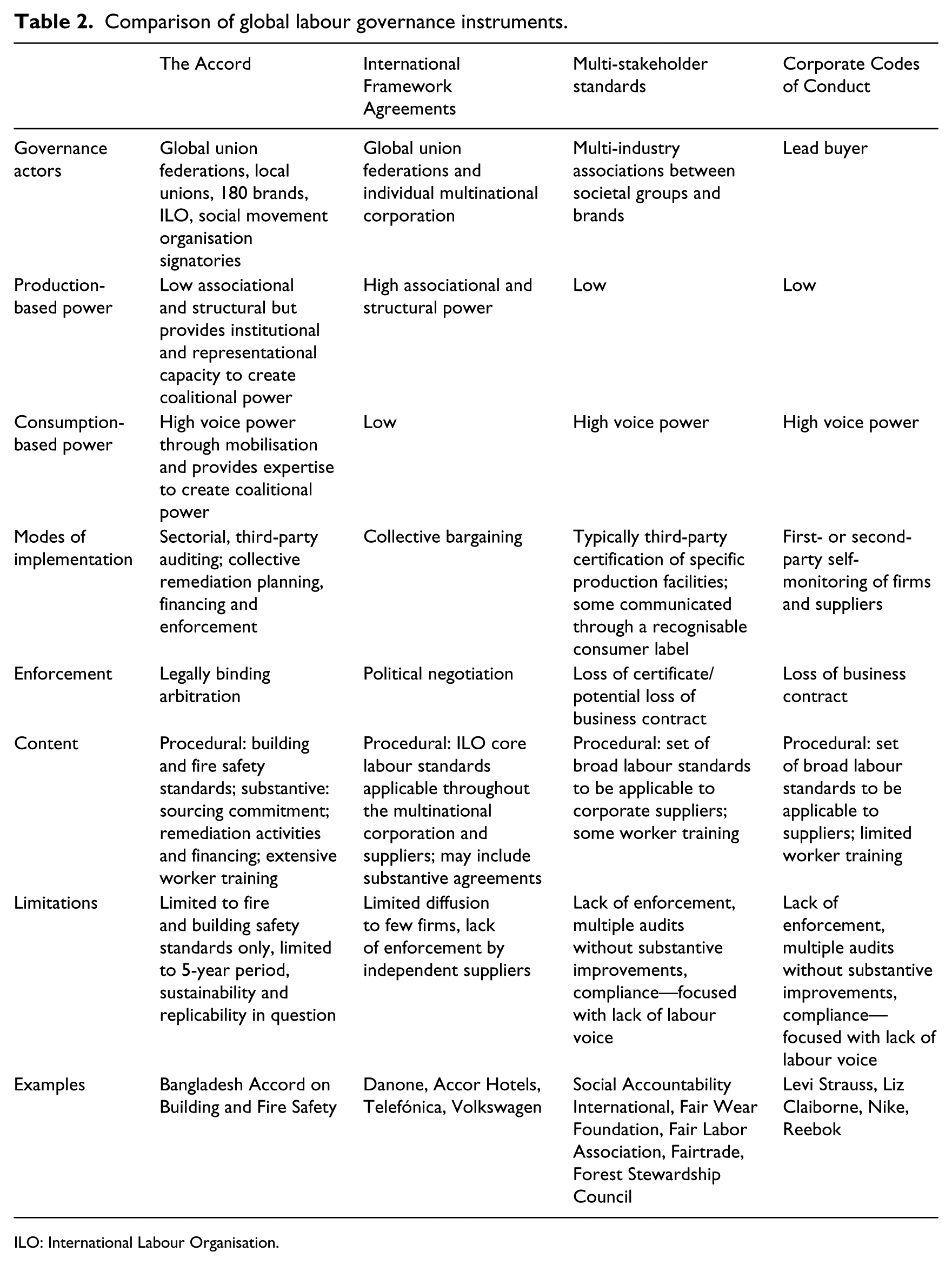
Despite years of experimentation, new governance approaches such as social auditing have not delivered on their promises. Both production- and consumption-based approaches have revealed serious limitations with regard to their ability to improve workers’ rights in global supply chains. Scholars have lamented the failure of the voluntary, private regime of social auditing (Locke, 2013), as also demonstrated by the series of collapses and fires in factories despite social auditing. Without doubt, the jury on the efficacy of the Accord is out: the mechanism is new and the arrangement is complex. Ultimately, the Accord will have to be judged in terms of what it delivers for garment workers in Bangladesh as it progresses over its initial 5-year life span. However, the Accord stands out as a unique and novel governance mechanism compared to existing mechanisms on a number of dimensions. Table 2 compares the Accord with existing types of supply chain labour governance: International Framework Agreements, Multi-stakeholder standards and Corporate Codes of Conduct. In Rows 3 and 4, it describes, from low to high, the role of consumption-based power, and production-based power, in formulating and implementing global labour governance. What is important to note here is that in the Accord, the effect of the power resources is manifest in the creation of a coalition, rather than operating independently, as in other governance mechanisms outlined in Table 2.
Comparison of global labour governance instruments.
ILO: International Labour Organisation.
First, in terms of governance actors involved outlined in Row 2 of Table 2, the Accord allows brands to take a collective approach to the problem of worker safety. Unlike International Framework Agreements, which are generally agreed between one multinational corporation and a global union federation, the Accord covers multiple brands (in excess of 180) and brings brands together to share costs, information, responsibility and risk, providing a cost-effective way for smaller brands to ensure safety standards. The Accord also stands out for being able to reach a large number of suppliers (in excess of 1500 factories employing more than 2 million workers) within a sector, backed by legal enforceability, thus avoiding the problem associated with International Framework Agreements which often work best where they are needed least, that is, in those sites where workers are organised and/or have strong legal support (Niforou, 2014). While not all factories are covered by the Accord, approximately half of all workers in the sector and most of those in directly exporting firms are covered by the Accord. Also, private labour standards have proliferated in the textile sectors, but they lack the Accord’s ability to coordinate multiple approaches, leading to competition and lack of coordination (Fransen, 2011). Thus, the collective brand approach of the Accord also brings benefits to supplier firms in Bangladesh by having a unified set of standards, rather than suppliers attempting to satisfy a multiplicity of codes of conduct for different buyers.
Second, in terms of modes of implementation and enforcement (Rows 5 and 6 of Table 2), the Accord has created an enforceable contractual relationship in the home country of the buyer brands. International Framework Agreements depend on using the structural and associational power of labour, which thus depends on high levels of collective worker organisation. For multi-stakeholder standards and codes of conduct, the only sanction available is the threat to brands depending on consumption power. The legally binding nature of the Accord also stands in stark contrast to the ‘Alliance’—an alternative corporate social responsibility and safety inspection programme with 26 members created by mainly US-based brands unwilling to sign the Accord. The point about the establishment of a legally enforceable contract is a very significant new departure in global supply chain labour governance. Through the Accord, brands have transferred oversight of their supply chain to a body which has a right to initiate legal action against the brands where they do not meet their commitments. It remains to be seen how the Accord will enforce sanctions. This sort of initiative has been mooted unsuccessfully in the past (Bronfenbrenner, 2007) but was achieved in this instance due to the pressure placed on brands by the harnessing of the complementary capacities of labour and consumption actors.
Third, in terms of content and limitations (Rows 7 and 8 of Table 2), while the Accord is focused on three highly specific and highly defined issues—electrical, fire and building safety—International Framework Agreements and private labour standards often cover a wider variety of industrial relations issues but may be less able to deliver in terms of expertise required and monitoring involved. The Accord also focuses on an area of the employment relationship which has traditionally lent itself to regulation, that of worker safety. Nevertheless, legal regulation of safety has led in other contexts to employment improvement in other areas (Anner et al., 2013) and could have meaningful effect in terms of spillover to other areas of employment relations in the Bangladesh sector. Moreover, what the Accord demonstrates is that companies can be persuaded through private tactics to develop credible commitments around worker rights. For future research, it would be thus worth examining how the impact and legacy of the Accord may enable negotiating collective agreements in other contexts.
Insights from negotiating the Accord: building coalitional power through complementary capacities
The Accord is a unique governance mechanism. Understanding the conditions that enabled it to emerge offers potentially important lessons for the development of meaningful global governance institutions in other contexts. First, we highlighted the role of ‘complementary capacities’ in developing private governance frameworks. This concept of ‘complementary capacities’ has helped to explain how and why the coming together of multiple actors may generate governance solutions which might not have been available with contributions from single-actor groups. While scholars have emphasised the multiplicity of actors involved in global governance arenas, it has not been quite clear how different types of actors contribute and create new opportunities for ‘collaborative governance’ (Rasche, 2010). In our case, both the tactics—the combination of contentious politics of social movement organisation mobilisation and the negotiation route of unions enabled by representative structures—and the sources of legitimacy—expertise and institutional embeddedness—were complementary. Complementary capacities which generate coalitional power may be developed in other areas including environmental and financial governance where coalitions of interests combine to develop governance initiatives. However, our case also suggests that the creation of coalitional power was not unproblematic as issues around democratic mandate, speed of response and related issues created tensions, which may, under different circumstances, hinder the forming of effective coalitions. Thus, future studies need to investigate under what conditions capacities developed between actors may become complementary and under what conditions they may become conflictual. In this case, one of the key factors was that long-lasting relationships between actors had led to a mutual recognition among the actors of their complementary capacities and division of roles. This may not be replicable in other contexts. Similarly, parties were ideologically committed to complementing each other rather than competing with or substituting each other which also may not be the case in other circumstances.
Second, in analysing the inter-organisational governance of supply chain actors (Gereffi et al., 2005), this article highlights that scholars need to extend their analysis of power to the actors at the very beginning and at the very end of supply chains—and the collective agencies able to mobilise their power: organised labour and social movement organisations. The governance of labour relations within supply chains must be viewed through the prism of both production and consumption relations. Production which has moved to the developing world has often done so to avoid higher regulatory standards, as in the Bangladeshi case where a weak state and low worker organisation led to a downward spiral in safety terms. Thus, the capacity in the short term to develop meaningful collective bargaining is highly limited. But consumer-based activity alone can often be short term and, lacking a meaningful enforcement mechanism other than brand damage, lead to symbolic commitments often associated with voluntary Corporate Social Responsibility. Future work can thus examine how the role of organised labour may affect the design and implementation of Corporate Social Responsibility policies. Conversely, narrowly focusing on unions and member-based organisations is likely to limit the scope of industrial relations scholars to conceptualise the nature of global supply chains. The geographic and economic differences within global supply chains may mean that actors need to move towards working together around complementary capacities and to move away from taking unilateral approaches. The formation of coalitional power through the utilisation of complementary capacities could prove an important part of extending regulation of employment into other less regulated supply chain contexts.
Conclusion
The Accord and, in particular, the complementary capacities developed in its Labour Caucus do carry important lessons for future research. Based on our analysis of how campaign groups and trade unions coordinated a unified response to the 2013 Rana Plaza disaster, we argue that the intersection of production and consumption power, which has received little attention to date, is a potent mechanism that can foster labour rights in global supply chains. This research complements that of industrial relations scholars and social movement scholars by offering understanding of how distinctive leverage points of different governance actors can interact in complementary ways to create coalitional power. The consumer-driven and market-based logic of corporate social responsibility and the collective bargaining-based logic of industrial relations are not necessarily mutually exclusive. The interface of these logics may provide a fruitful avenue for scholarly engagement.
Footnotes
Acknowledgements
We thank Marek Korczynski and the anonymous reviewers for their insightful suggestions on earlier versions of this article.
Funding
This work was supported by the British Academy/Society for the Advancement of Management Studies Small Grant SG141754 “Developing innovative international labour governance: the response to the Rana Plaza disaster”.