




Abstract
Why do some researchers observe that managerial corporate social responsibility discourse contributes to increased awareness of and commitment to solving global environmental and social issues, while others reveal that the same discourse works to obfuscate and sidetrack positive social transformation? This article tries to bring together these procedural and structural perspectives on corporate social responsibility discourse by introducing a communicative approach, which embeds the critical study of corporate social responsibility discourse in a complex and emerging discursive field. The discursive strategies of managerial corporate social responsibility are therefore as shifting as the discourses it competes with are varied. This article, grounded in Deetz’s theoretical framework of systematically distorted communication and discursive closure, explores the US garment industry’s corporate social responsibility communication on labor-related issues in the global supply chain. I position garment industry corporate social responsibility discourse within broad labor policy debates at the operational, institutional, and structural levels. I find that corporate-initiated corporate social responsibility communication operates through several internally coherent frames: establishing ethical standards, providing essential services, and innovating labor management systems. Each frame responds to alternative discourses about supply chain labor with discursive closure and non-closure strategies, that is, corporations choose to acknowledge, engage, or agree with some alternative discourses, while ignoring, suppressing, or eliding over others. I argue that the pattern of choosing discursive strategies for different types of alternative discourses is important in understanding systematically distorted communication in the context of a complex, fragmented discursive field.
Over the last two decades, amid numerous high-profile cases of business externalities (ecological disasters, health risks, human rights violations, etc.) and a plethora of corporate social responsibility (CSR) initiatives by multinational corporations (MNCs), the debate over global CSR has been cast and recast. One key debate centers on the role that discourse of CSR plays in ‘contributing to solving global environmental and social challenge[s]’ (Scherer and Palazzo, 2007: 1108), as scholars draw very different conclusions in analyzing CSR discourses from procedural or structural angles. The two approaches depart on whether to treat managerial CSR discourse as ‘steps toward improvement’, or a ‘smokescreen of corporate agenda’. In this article, I introduce Deetz’s communicative approach to discourse studies in order to bring together the procedural and structural perspectives on CSR discourse.
Building from Deetz’s (1992) theoretical framework of systematically distorted communication and discursive closure, this article argues that the nature of CSR discourse can be best exposed by positioning it in the broad discursive context of contestation. This discursive context is not understood as the immediate context of a specific speech event, but as a discursive field—a concept introduced by Foucault to describe discursive systems where meaning, power, and controls emerge from the clash and negotiation among various competing discourses. That is, the communicative approach is interested in how CSR discourse interacts with other discourses, possessing varying degrees of power, in the discursive field. Specifically, I explore the CSR communication by the US garment industry on its global supply chain, especially concerning labor-related issues. I position garment industry CSR discourse within the broad debate on labor issues, delineating key points of contention at operational, institutional, and structural levels. In so doing, this article explores how managerial CSR discourse builds internally coherent frames, and how those frames respond to a complex array of discourses in the discursive field.
Discourse of CSR: Toward a communicative approach
Over the past two decades, the critical management and organizational studies literature have significantly engaged with CSR as a topic of study (Fleming et al., 2013; Scherer and Palazzo, 2007). Many of these have recognized that CSR discourse should be analyzed as a related but distinct ontological category from CSR praxis. Observing the widening gap between what corporations say and what they do, their analyses focus on the self-aggrandizing, insincere, and hypocritical nature of managerial CSR discourse (Iivonen and Moisander, 2014; Tengblad and Ohlsson, 2010). Other researchers, however, point out that evaluating discourse using praxis as the main benchmark may fail to reckon with the social-constitutive potential of CSR discourse (Christensen et al., 2013; Schoeneborn and Trittin, 2013).
Discourse studies and critical organizational studies have long established the constitutive muscularity of discourse, meaning that discourse has a substantive impact on the material aspect of social and organizational processes. In the context of CSR, exactly how the discursive muscularity works in CSR is still largely contested. Very different conclusions are drawn about whether CSR discourse precedes increasingly socially responsible corporate practices and contributes to positive social challenge. By interrogating the socio-structural aspects of communication, researchers like Banerjee (2008) and Fleming and Jones (2012) focus on the centrality of corporate institutions in contemporary society and their structural positioning as powerful communicators. Their analyses, therefore, are less concerned with the immediate persuasive impact of language in the specific speech event, while emphasizing the relationship between powerful ideology and social structure. CSR discourse, in this approach, is understood as ‘an ideological movement that intend[s] to legitimize and consolidate the power of large corporations’ (Banerjee, 2008: 51).
However, researchers who focus on the procedural aspects of the discourse-society relationship emphasize how specific managerial CSR language can be enacted or inculcated into broader social consciousness about business ethics and standards, and eventually influence how decisions are made collectively in civil society. For example, Christensen et al. (2013) conceptualize CSR as ‘aspirational talk’, as discourse that serves as the avant-garde and creates conditions for actions. As such, managerial CSR discourse can move corporations to be more socially responsible, regardless of the managerial objectives and perspectives that may underlie its production. In their argument for a political conceptualization of CSR, Scherer and Palazzo (2007) offer another procedural understanding of CSR discourse: as part of the overall deliberative process of democratic decision-making. The deliberative concept of CSR is influenced by the more recent theoretical development of Habermas (Habermas2), which no longer centers on the concept of an ideal speech situation. Instead, it suggests ‘small steps of constant improvement’ and a democratic process characterized by disagreement in decision-making (Scherer and Palazzo, 2007: 1107).
From this procedural perspective, Scherer and Palazzo critique the structural perspective for failing to see the transformative potential of corporate discourse beyond the utopian pursuit of an ideal speech situation based on the earlier Habermasian (Habermas1) conceptualization. Therefore, according to Scherer and Palazzo (2007), the structural approach fails to establish a pragmatic (and realistic) ethical expectation for corporate communicators—they have to be either completely altruistic or stigmatized as ‘bad guys’. The procedural approach, therefore, offers ‘a less idealistic and more pragmatic [emphasis original]’ (Scherer and Palazzo, 2007: 1107) approach to understanding the relationship between ethical discourses and political decision-making. However, the question still remains whether the ‘small steps of constant improvement’ conceptualized by the procedural approach will result in anything more than token gesture of change, as empirical evidence has shown that CSR programs have not shown signs of effectively dealing with certain social-structural issues even after years. 1 Therefore, the key to the current theoretical debate on CSR discourse is to bring together the procedural and structural perspectives and explore the mechanism that specific discursive practices influence social structure. In short, the question is ‘will small and constant improvements eventually lead to social transformation?’
In light of these broad theoretical discussions, this article builds on Deetz’s (1992) theoretical framework of systematically distorted communication and discursive closure to propose a communicative approach to studying organizational discourse. Central to Deetz’s (1992) social critique is the mutually constitutive relationship between corporate power and corporate communicative practices, which is marked by what he calls ‘systematically distorted communication’. Systematically distorted forms of corporate communication dismiss, conceal, or otherwise obstruct the expression of opposition and are therefore central to the self-referential character of corporate system and the reproduction of corporate dominance. Although Deetz’s concepts of systematically distorted communication and discursive closure were introduced almost three decades ago, they are relevant to the current theoretical debate for a number of reasons.
Conceptually, Deetz brings together the procedural and structural aspects of corporate communication and explains why the deliberative process may not always lead to more democratic form of decision-making. In particular, Deetz compliments the Habermasian conceptualization of consensus with the Foucauldian concept of disciplinary power. By observing how discursive strategies are used to reproduce and reinforce structural dominance, he argues that in the context of powerful communicators, the deliberative process may move toward the opposite of a democratic public will—a hegemonic form of consensus.
Methodologically, Deetz offers an analytical approach to discourse rooted in communicative interactions in a discursive field. As corporate discourses work toward either democratic or (more likely) hegemonic consensus, they should be evaluated based on how they interact with competing discourses. Deetz uses the concept of discursive closure to categorize a set of discursive strategies that operate to close down ‘discursive openings’ (Thackaberry, 2004). Discursive openings—in the forms of disagreements, alternative expressions, and competing discourses—indicate moments where the interests of a variety of stakeholders can potentially be represented. Therefore, Deetz cautions about the closure of these discursive openings in the deliberative process, where consensus can be reached, but only toward more consolidated corporate power, and not positive social change. To summarize, Deetz offers the conceptual lens and methodological tools to investigate how corporate communicators act as ideological hegemon, rather than what Scherer and Palazzo (2007) conceptualize as one of many political actors in the deliberative democratic processes.
The communicative approach proposed by this article pushes Deetz’s theory further (and more pertaining to the discussion of CSR) by addressing a number of epistemological concerns. First, is Deetz’s analysis based on the preconceived notion of corporate dominance, and therefore biased toward discursive closure (and not other more democratic) form of communication? By bringing Deetz’s approach to studying managerial CSR discourse, I recognize that CSR is a highly contested discursive field, where corporate/managerial discourse, although powerful and prevalent, is routinely challenged by competing discourses from activists and other civil society organizations. The process of discursive closure that appears more totalizing in Deetz’s conceptualization of corporate colonization, therefore, is manifest as a more multi-dimensional political struggle. Thus, this study takes a more inductive approach that uses the empirical observation of corporate discursive strategies (both those that involve discursive closure and those that do not) to draw conclusions about whether (and how) systematically distorted communication and discursive closure take place in a complex and fragmented discursive field.
The second epistemological consideration concerns the overall evaluation of managerial CSR discourse when both closure and non-closure discursive strategies are employed by corporate communicators. The emphasis of my analysis is not whether discursive closure takes place, but whether discursive closure strategies are deployed consistently on certain types of social debates. Moreover, in making distinctions among different discursive strategies used by corporations, the objective of my analysis is not to distinguish CSR discourses that move toward deliberative democracy from the ones that perform discursive closure. Instead, I argue that those two types of CSR discourses are often one and the same. This is because a managerial CSR discourse functions fundamentally by framing and constructing a certain version of reality, as it works to ‘call attention to some aspect of reality while obscuring other elements [. . .]’ (Entman, 1993: 55). Frames are consequential to organizational discourse, as they define the issue (Bowen, 2005; Li and Adams, 1995), and subsequently affect attitudes and behaviors toward the organization (Nelson and Kinder, 1996). In comparison with other methods of textual analysis, frame analysis focuses on the coherent logic among frame components in discursively constructing an internally consistent version of reality. Social debates, therefore, can be understood as competitions among different versions of reality. In the context of CSR as a complex discursive field, a frame analysis approach highlights how the same line of managerial discourse can open and close different types of social debate simultaneously.
Third, this article answers the question about how to contextualize discursive closure strategies where the discursive opening is not naturally defined. Managerial CSR communication rarely takes to form of directly responding to an opposing discourse, and it can be argued that sometimes communication managers may construct their CSR frames without (consciously) responding to a specific line of opposing discourse. In my analysis of corporate discursive strategies, however, I am not interested in identifying the specific strand of competing discourse that the corporate discourse is directly responding to. Instead of this form of localized contextualization, I take a dialogic approach (Baxter, 2011) in my analysis, which is an epistemological framework that views meaning as socially situated (as opposed to locally situated). Here, communication is understood as a process where meaning is derived through the interaction of multiple discourses that have varying degrees of discursive power and resources within a discursive field. In particular, the dialogic approach recognizes that some voices can be suppressed or muffled in the discursive field and therefore provides a lens to problematize the very issue of ‘discursive closure without being aware of the opposing discourses’.
With the epistemological considerations above, an analysis of the managerial CSR discourse should be based on a comprehensive understanding of the complex discursive field—as corporations compete with a diverse array of social actors (government bodies, non-profit or non-government organizations, scholars and critiques, activism and advocacy groups, etc.). The next section of the article is a broad literature review on the discursive field. The survey of literature is focused on the discourse of the global apparel (alternatively, garment) industry CSR, with special focus on discourses of supply chain labor. It is complemented with non-academic articulations that are yet to find its way to the institutionalized field of knowledge.
Garment supply chain CSR: A survey of discursive opening
The global apparel (alternatively, garment) industry is an important case in the evolution of global CSR discourse (Stohl et al., 2007). The last four decades have witnessed significant changes in the garment manufacturing process, most markedly in the move toward the ‘globalized supply chain’, and in particular, the move from high-cost to low-cost production locations (Hale and Wills, 2011). Meanwhile, the garment industry increasingly faces organized opposition to their policies regarding working conditions overseas on issues ranging from sweatshop labor, workplace safety, and under-compensation (Akhter, 2014; Stewart, 2014). The industry responded to this public criticism and opposition, largely in the form of CSR programs that included the ‘widest adoption of ethical sourcing codes of conduct focused on working conditions and labour rights’ (Roberts, 2003: 164). As such, CSR discourse of the garment industry emerged in the context of a fragmented discursive field, marked by a plethora of alternative discourses. In Table 1, I provide a summary of key discourses, delineating key points of contention at operational, institutional, and structural levels.
Discursive opening at operational, institutional, and structural levels.
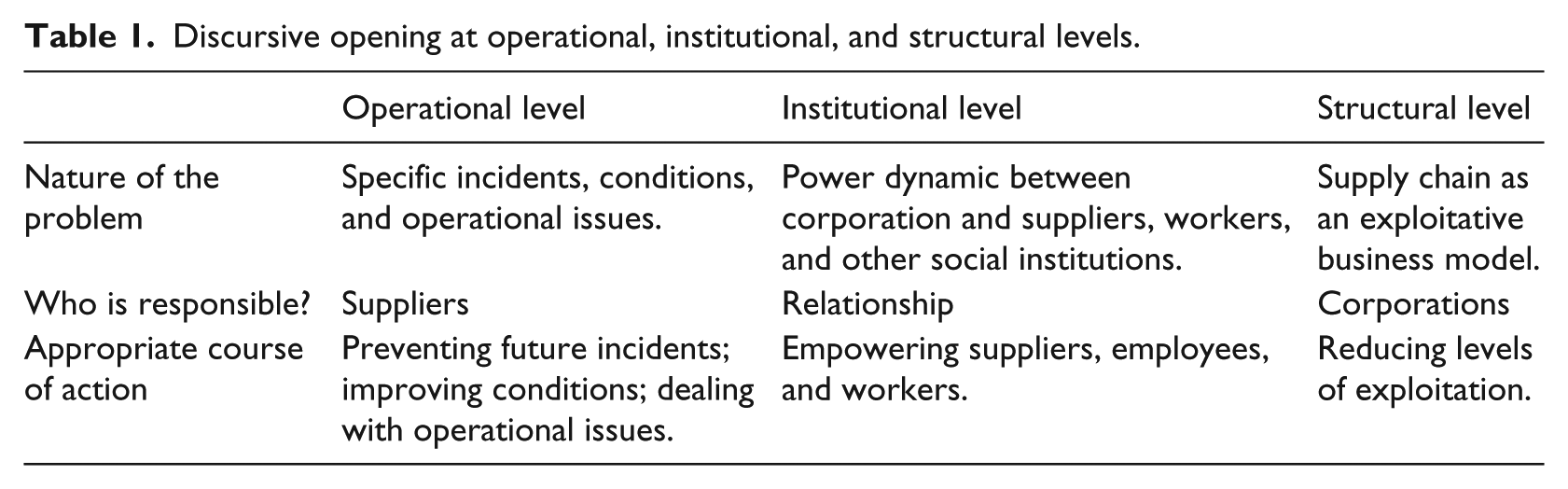
Discursive opening at the operational level
Operational-level discussions concern specific labor-related incidences, operational issues and policies in the garment supply chain context. At the operational level, labor issues are understood as ethically charged cases of business malpractice. In most cases, supply chain manufacturers and subcontractors are considered as primarily responsible for non-compliance to ethical labor codes. Operational-level discussions question the status quo on a number of focal issues (workplace safety, level of compensation, workers’ living conditions, human rights observance at work, etc.) and demand revision and rectification of business policies to end malpractices. Specifically, I have identified a number of key components to discourses in this category.
The first component exposes the health and safety risks in the supply chain production process. It focuses on a number of high-profile incidents, in particular, the 2013 Rana Plaza disaster 2 (Hobson, 2013; Taplin, 2014). Much of the criticism in the wake of this tragedy has focused on the exploitative nature of garment labor practices (Akhter, 2014; Stewart, 2014), which have led to waves of anti-corporate protests and other forms of labor activism (Lu, 2013; Reinecke and Donaghey, 2015).
The second component deals with a broader spectrum of human rights abuses, ranging from slave labor (Ho et al., 1996; Su and Martorell, 2001) to child labor (Brooks, 2005; Nielsen, 2005) and from excessive work hours (Ali et al., 2008; China Labor Watch, 2011) to various forms of discriminations at work place (Barnes and Kozar, 2008: 285). These abusive practices are sometimes examined in conjunction with the context of sweatshops (Arnold and Hartman, 2006; Emmelhainz and Adams, 1999; Esbenshade, 2009; Hall, 2000; Rosen, 2002). At the operational level, the emphasis is placed on specific ‘practices [that] are morally and legally unacceptable in view of universally accepted norms regarding human rights’ (Park and Rees, 2008: 488) and on the motivation to stop these specific practices.
The third component concerns fairness in compensation. Much of the discussion is focused on the difference between minimum wage (based on a legal mandate) and living wage (based on local cost of living) as standards for fair wage (Anker, 2011; Figart, 2004; Luce, 2004). A more comprehensive approach to fair wage benchmarking is offered by Vaughan–Whitehead in collaboration with the Fair Labor Association (2011). This wage standard identifies 12 dimensions, including considerations such as prevailing wages and the cost of living, rates of wage adjustments, wage bases and other forms of pay systems, overtime and wage deductions, and how pay systems are communicated with workers.
A number of common features shared by operational-level discourses differentiate them from those at the institutional or structural level. Prominently, most of them frame labor malpractices as moral and/or legal issues that take place in specific, individual manufacturing sites. Therefore, some corporations perform better than others in terms of compliance, and promoting best practices in code of conduct compliance becomes the key to solving labor issues.
Discursive opening at the institutional level
Institutional discourses focus on the organization of production and the interaction among different components in the social process. Labor malpractice is understood as the result of power structures and resource configurations within production sites. Of particular interest is the huge power differential between MNCs and their Third World subcontractors, and between management and workers within the subcontracting firm. The disempowerment inherent to such relationships is regarded as the root cause of labor malpractice. The empowerment of disadvantaged parties in the relationship becomes central.
At the institutional level, questions are asked about the role that MNCs play in labor malpractice, despite the fact that most instances of malpractice occur outside the boundaries of the corporations themselves. In other words, labor malpractice is not merely about suppliers’ compliance to codes of ethics, but often the result of the influence of powerful buyers (De Neve, 2009; Oka, 2010). Besides their influence on suppliers and subcontractors, this discourse also recognizes MNCs as powerful social actors that overshadow state, religious, familial, educational, and community institutions in what Deetz call the ‘centrality of the corporate institution’ (Deetz, 1992: 17) in contemporary society. In the context of supply chain labor, voluntary industry self-regulation has largely replaced (or at least reduced the importance of) other forms of regulation (Campbell, 2006; Haufler, 2013; Vogel, 2010).
Another component of the institutional-level discourse concerns the relationship between workers and management in the supply chain. It features, on one hand, condition of general disempowerment among workers and their lack of voice over labor-related issues, and on the other, workers’ agency expressed in various forms of protests, resistance, and collective actions (Mills, 2005; RoyChowdhury, 2005; Silvey, 2003).
Discursive openings at the institutional level, unlike operational-level discourses, are typically suspicious of the effectiveness of voluntary self-regulation. This skepticism stems from the analysis of power dynamics among various stakeholders and is therefore particularly concerned about the possibility of the compliance model further consolidating corporate power.
Discursive openings at the structural level
Macro-level discourses deal with the broad industry–society relationship. These include critiques of the profit-seeking nature of corporations in late capitalism (Fleming and Jones, 2012), and in particular, the cost-reduction logic inherent in supply chain manufacturing model. MNCs located on top of the international value chain ought to bear the greatest responsibility for the various labor issues accruing as a result of the perpetual drive to lower labor costs. Here, potential solutions require envisaging fundamental changes to the cost-reduction logic and reducing levels of labor exploitation in the supply chain.
At the international level, the cost-reduction logic in the globalized supply chain is linked to the concept of New International Division of Labor (NIDL), ‘a global assembly line is driven by the relentless search for cheap labor . . .’ (Jin, 2004: 231). Both institutional- and structural-level discourses reflect skepticism about the effectiveness of CSR programs heavily leaning on supplier codes of conduct (Bondy et al., 2008; Knudsen, 2013; Locke et al., 2009; Lund-Thomsen and Lindgreen, 2014). At structural level, the analysis is focused on the exploitative business model of supply chain production: suppliers have limited incentive to participate in voluntary governance, as subcontracting manufacturing remains the primary means for MNCs to reduce costs. For example, Locke et al. (2009) found that the pressures of and rewards for producing ever-cheaper goods at decreasing timeframes were at odds with improving labor and environmental standards.
In summary, the garment industry CSR discourse emerges concurrent to, and in response to the discursive openings at, the operational, institutional, and structural levels.
Therefore, in observing how corporate discourses respond to the discursive opening, it is possible to evaluate corporate communicative practices in relation to the normative idea of participative democracy. My analysis is sensitive to instances of discursive closure and to communicative patterns where such closure takes place. As such, I am not interested in the ‘foreclosure of conflict’ (Deetz, 1992), but in which conflict(s) are strategically foreclosed while others are left open. To wit, the two research questions guiding the study are articulated as follows:
RQ1: How does the US garment industry frame their supply chain-focused CSR efforts?
RQ2: How does this CSR framing respond to competing discourses in the discursive field? How and when does corporate CSR framing lead to discursive closure?
Methods
Data collection
In CSR research, company websites have been considered a major platform for communicating corporate self-image and social responsibility (Amaladoss and Manohar, 2013; Esrock and Leichty, 1998; Gomez and Chalmeta, 2011). Therefore, the subject of my analysis was corporate webpages that specifically dealt with issues of labor-related CSR. The research process began with compiling a corpus of relevant web pages from the top eight US garment business organizations’ official websites. The selection of these organizations was based on their sales revenue in 2014 as determined by the Hoover’s report on the apparel manufacturing industry (Hoover’s Inc., 2019). These included Nike, VF Corporation, L Brands, Avon Products, Pvh Corp., Ralph Lauren, Gap Inc. and Hanesbrands Inc. All of these corporations have sizable overseas supply chains contributing to the production of their garment brands.
Next, I compiled complete sitemaps for all the organizations. Some websites provided sitemaps, while others required manually collecting webpages using a snowballing technique. I then culled the number of webpages (including html pages and downloadable files) to those relevant to my research topic. The selection was based on whether the websites contained key words ‘supply chain’ (variation: ‘supplier’, ‘factory’), ‘labor’ (variation: ‘worker’), or ‘Corporate Social Responsibility’ (variation: ‘CSR’, ‘corporate responsibility’, ‘responsibility’). The ascertained corpus contained 68 webpages and articles, or approximately 620 pages of text.
Data analysis
I employed a two-step data analysis. The first step is a frame analysis method developed from Creed et al. (2002). The objective of the frame analysis was to achieve ‘narrative fidelity’ (Creed et al., 2002: 41) by parsing out the internal logic and coherence of the frames. Specifically, I used a constant comparative method (Charmaz, 2014) and multi-level coding (Strauss and Corbin, 1990) to code the corpus, one paragraph at a time.
After a number of key frames were identified, the second step of analysis focused on how CSR framing responds to discursive openings. Corporate discourse can respond to discursive opening in both closure and non-closure manner. By non-closure, I mean acknowledgement, agreement, or other forms of engagement that does not visibly aim at suppressing the competing discourses. Such instances of non-closure discursive strategies were identified based on the three frame analytical categories from Creed: recognition of problem, admission of responsibility, and commitment to take appropriate actions.
More importantly, I looked for instances of strategies of discursive closure prominent in each of the frames identified in the previous step. Deetz (1992) observes systematically distorted communication using a set of strategies for discursive closure. Specifically, disqualification is the discursive process through which an organization determines who possesses (or does not possess) the right to have an opinion. Disqualification can take many forms: through denial of communicative platforms, or the establishment of standards that can exclude certain groups, and even through actively ‘rendering the other to speak adequately’ (Deetz, 1992). Naturalization takes place when organizations make social relationships and subjective constructions into fixed and enduring objects. Topical avoidance is the socialized prohibition or discouragement of discussion over specific topics in organizations. Meaning denial and plausible deniability are often used as effective meanings of control. Legitimation strategies offer rationalization of irrational or inadequate organizational values by deferring to higher-order values like religion, tradition, or work ethic. Finally, pacification is the strategy of diverting conflict through an apparent reasonable attempt to engage it.
Managerial CSR frames
My analysis reveals three major frames employed by the US garment corporations in discussing supply chain labor practices. I have labeled these frames: (a) establishing ethical standards, (b) providing essential services, and (c) innovating labor management systems. To answer RQ1 (How does the U.S. garment industry frame their supply chain-focused CSR efforts?), I illustrate the construction of each frame (see Table 2).
Corporate frames on supply chain labor.
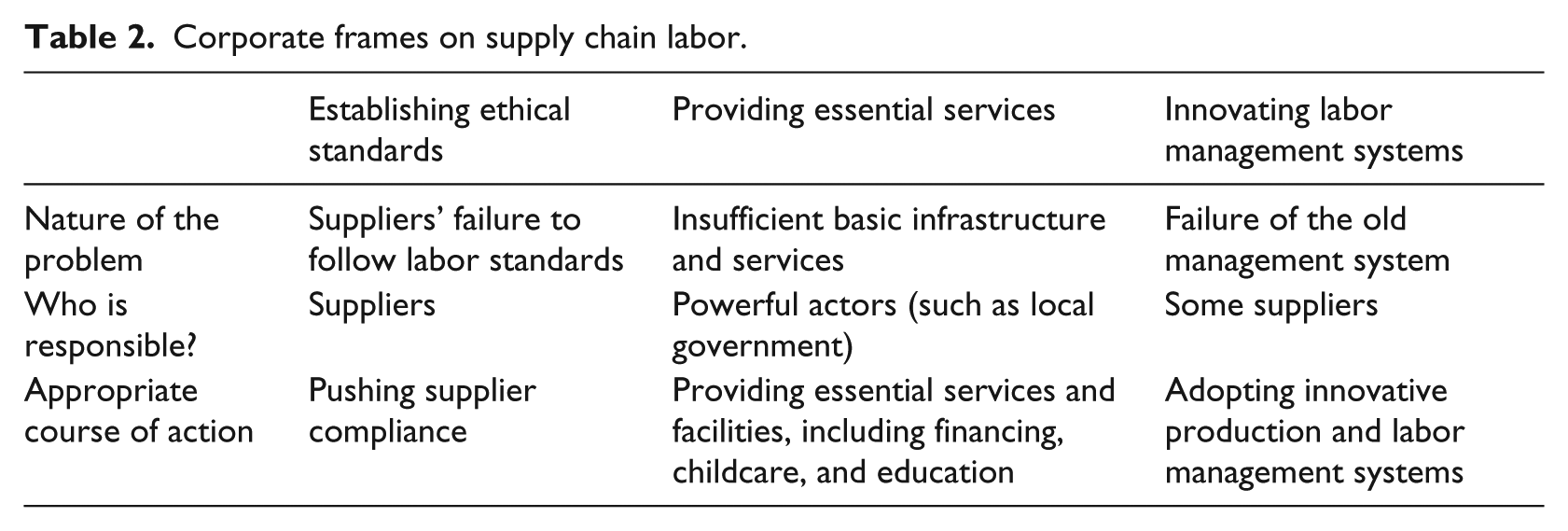
Establishing ethical standards
This frame communicated one central theme: supply chain labor is all about establishing and complying too ethical standards. The central problem identified here is unethical suppliers’ failure to follow labor standards. While the suppliers are responsible for labor malpractice, the US companies act as watchdogs for instances of incompliance.
A common practice among garment company websites is placing (or linking to) their supply chain ethical conduct standards in predominant places on the CSR page. These documents are often referred to as the ‘code of conduct’ (e.g. Nike, L Brands, Avon, Gap Inc.), statement on ‘responsibility’ (e.g. VF Corporation, Avon, Pvh Corp, Hanesbrands), ‘guidelines’ (e.g. Ralph Lauren), ‘standards’ (e.g. Nike), or generic ‘terms of engagement’ (e.g. Levi Strauss). Typically, such documents cover similar issues: minimum wage levels, maximum work/overtime hours, health and safety, child labor and slave labor, harassment and discrimination in the workplace, and freedom of association.
Alongside the comprehensive list of ethical guidelines are narratives about holding suppliers in compliance to these principles. Consider the following statement made by Nike:
We’ve run the course—from establishing a Code of Conduct that covers worker protections as well as environmental impacts to pulling together an internal team to enforce it, to releasing our contract factory Audit Tools and working with external bodies to monitor factories and work with stakeholders. Our focus now is on getting to the root of the problems, evaluating our supplier and manufacturing relationships, and finding new ways to define and share responsibility. (Nike Inc., n.d.-a, “From monitoring factories to engaging workers”)
US companies fulfill their CSR commitment (‘We’ve run the course’) by compiling and promoting various codes. The focus of this frame, therefore, is the suppliers’ responsibility to comply with the established labor standards. Itochu, explaining its textile supply chain CSR, highlighted how important it was ‘to gain the understanding and cooperation of suppliers with regard to our procurement policies, and . . . CSR Action Guidelines for Supply Chains’ (Itochu Co., n.d., “CSR at the textile company”). Along this line of logic, most corporations also claim that compliance to labor codes is an important evaluation criterion on suppliers. For example, Gap Inc., established a ‘Code of Vendor Conduct’, which ‘sets forth the basic requirements that all factories must meet’ (Gap Inc., 2007). Similarly, Levi Strauss claims that ‘the factories that make our clothes must adhere to our Terms of Engagement’ (Levi Strauss & Co., n.d.-a).
Providing essential services
Acknowledging that supply chain workers are a largely marginalized, disenfranchised population, this frame builds on the argument that workers’ disenfranchisement takes the form of insufficient basic infrastructure and services. Local governments and other powerful social institutions neglect workers’ needs, both inside and outside the factory compound. Therefore, garment companies can improve workers’ lives by catering to their pressing need for services and facilities including financing, childcare, and education.
While the garment giants are often criticized as the leading culprits for the generally gruesome working environment in their supply chains, the providing essential services frame strives to establish that the dire labor conditions stem not just from the internal factory environment but from the broader socio-political context of developing countries. If Third World workers are treated badly, it is because they belong to socially disenfranchised groups in the first place. The improving worker life frame consists of two components. The first component focuses on the general disenfranchisement/marginalization of the worker population. Many of the company websites include discussions about cases of human rights violations in (but outside of) their suppliers’ factory compounds. For example, in the Gap Inc. 2011/2012 Social and Environmental Responsibility Report, there is a 47-page section on human rights. A number of case studies are provided on human rights violations that took place in regions where Gap’s suppliers are located. The document describes:
. . . the sumangali scheme in Southern India . . . is a practice that brings young women to work in fabric mills . . . [S]ome mills are reported to pay below minimum wage, provide unacceptable living conditions, and force these women to work overtime. (Gap, Inc., 2007, p. 51) . . . Each autumn, more than a million children are forced to work in Uzbekistan’s cotton fields, picking that cotton for export to international markets. One of the most troubling aspects of this exploitation is that the use of forced child labor is directly orchestrated by the national government, a practice that has been in place for decades. (Gap, Inc., 2007, p. 54)
Disenfranchisement also takes the form of insufficient basic infrastructure and services. In its webpage on labor policies, Nike elaborates on its ‘systemic’ approach to labor management that focuses on ‘a deeper understanding of all the elements that affect labor’. By ‘all the elements’, Nike is indeed emphasizing elements external to those covered by management, including ‘lack of access to affordable and effective ways to care for children, manage money, or access to education/career training’ (Nike Inc., n.d.-b, “Nike CR report”).
Having established the general social locus of disenfranchisement, the second component of the frame proceeds to highlight the role that US companies have played to empower workers and improve their lives. Accounts are provided where the US garment companies strive to ‘empower’ (VF Corporation, n.d.-a “Human rights on our supply chain”), ‘engage’ (Nike, n.d. -b), or ‘invest in’ (Nike, n.d. -b) workers in solving labor-related issues, taking the ‘workers’ perspective’ (Gap Inc., n.d. -a, “The building blocks of an inclusive economy”)- by ‘listening to their ideas ’ (Nike, n.d.-b) and working toward building an ‘inclusive economy’ (Gap Inc., n.d.-a) where ‘[all workers] have the right to . . . the opportunity to do better than the previous generation’. (Gap Inc., n.d. -a)
A number of detailed and compelling cases are provided to illustrate how small but well-placed infrastructure or enrichment programs targeting workers’ off-work hours make a great difference to their overall well-being. Many companies mention affordable and convenient childcare (e.g. Nike, n.d.-b; VF Corporation, “Factories-Timberland Responsibility”). In an evocative account of Timberland’s initiative to facilitate a community-based early childhood care and education (ECCE) center, a young mother and worker named Lakshi testified about the effectiveness of the new childcare arrangement, which ‘not just [took] care of the children but also [taught] them . . . Now my child can study and I can work peacefully’ (VF Corporation, n.d. -b). Similar services also include ‘on-site health clinics or financial literacy training’ (Nike Inc., n.d.-b) and Gap’s Women and Water program, ‘which focuses on providing women access to clean water—as women are usually the ones gathering the family supply’ (Gap Inc., n.d.-c, “Human Rights”).
Innovating labor management systems
The Innovating Labor Management Systems frame tackles an important question: how to benefit workers without cutting into profit margins? The answer is to revamp the labor management systems, as the tension between labor and management is viewed as part of the old management paradigm, which fails to tap into the full potential of workers. The tension between labor and management only exists in the old paradigm of labor management and that revolutionary production and labor management systems are mutually beneficial to both labor and management, thus causing ‘investing in (workers) . . . make business sense’ (Nike Inc., n.d.-b). The frame argues that adopting innovative production and labor management systems allows for simultaneous empowerment of workers and productivity improvements. As such, garment companies often compare their labor management systems (e.g. LEAN by Nike and P.A.C.E. by Old Navy) as paradigm-shifting revolutions, referred to as ‘innovative’ (Hanesbrands Inc., n.d.), ‘unique’ (VF Corporation, n.d.-c), or ‘game changing’ (Nike Inc., n.d.-c: 70). In the following statement, Nike explains how its lean management principles may benefit both labor and management:
We believe that a successful contract factory can achieve even more success through more active engagement with workers as a source of innovation and quality, which also presents an opportunity for workers to benefit. This approach [involves] lean as a component of our ‘manufacturing revolution’. (Nike Inc., n.d.-b)
Within the ‘manufacturing revolution’ model, the key source of innovation are ‘workers [that] are engaged and enabled to drive business success through continuous improvement and a more collaborative work environment’ (Nike Inc., n.d.-b), which includes ‘engagement with workers directly on problem solving’ (Nike Inc., n.d.-b). In contrast to the old labor management paradigm, new systems allow garment factories to tap into the full potential of existing resources—raw materials, energy, and labor—and thus make it possible to maintain or increase productivity without increasing the amount of said resources utilized.
Another component of the frame is the leadership role that the US companies play in introducing new labor management systems to factories in the developing world and thereby teaching factory owners how to engage workers in innovations and other productivity-boosting activities. Various training programs provided to the suppliers’ management or that directly target workers are considered vital to the new manufacturing system. For example, Nike claims that ‘training was integral to our lean manufacturing approach in which we work with contract factory management to engage employees in problem solving and continuous improvement’ (Nike Inc., n.d.-b).
Discursive strategies
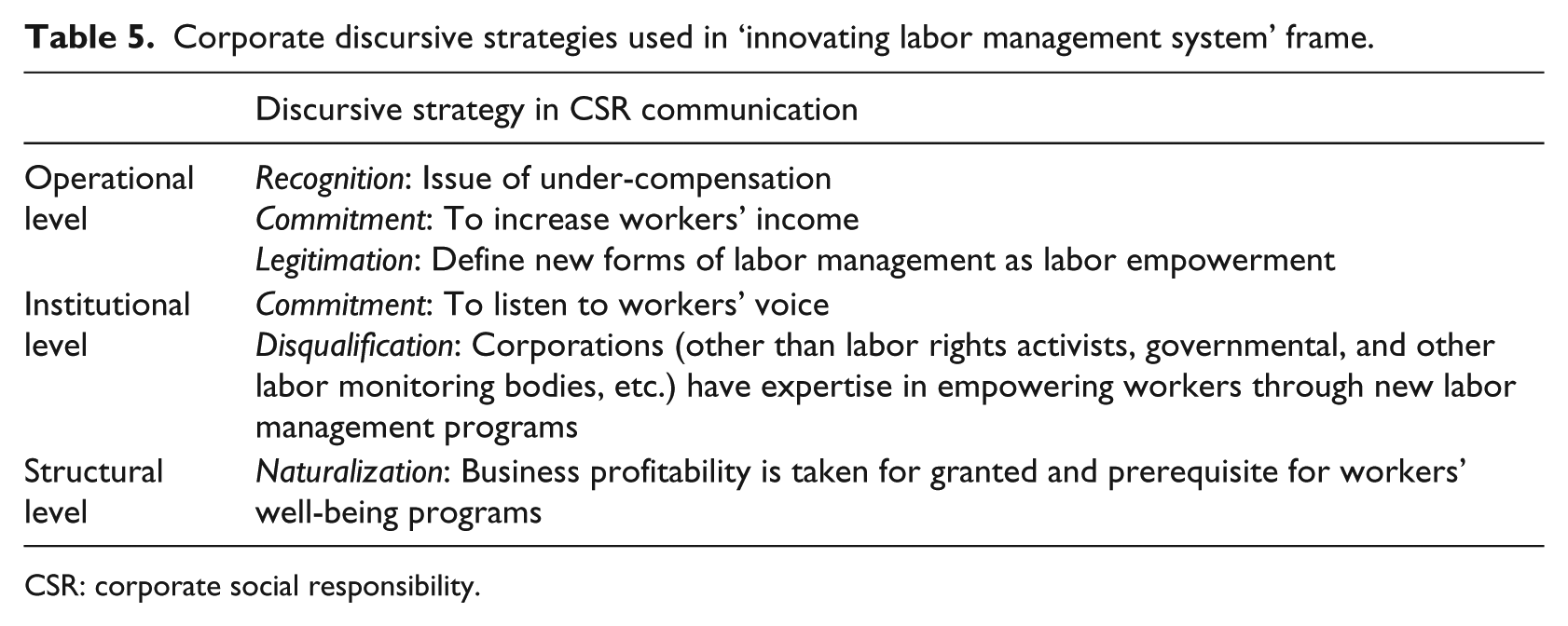
Discursive strategies are identified as the ways in which CSR discourse responds to the discursive openings at various levels. To answer RQ2 (How does this CSR framing respond to discursive opening?), I identify the key strategies of discursive closure observed from each frame (see Tables 3 to 5 for a list of key strategies observed in different frames) and demonstrate how they are integral to the internal logic of the frames.
Corporate discursive strategies used in ‘establishing ethical standards’ frame.
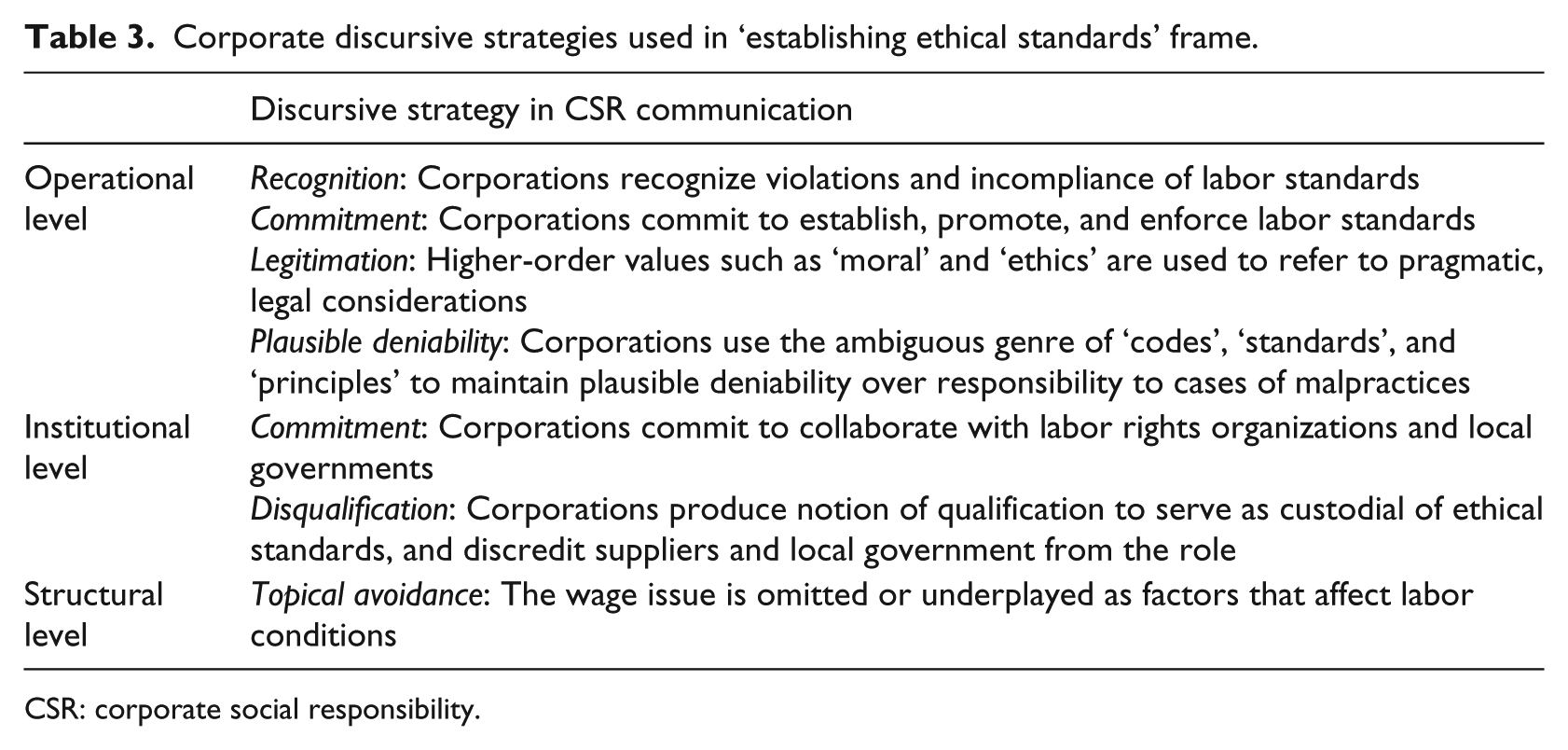
CSR: corporate social responsibility.
Corporate discursive strategies used in ‘providing essential services’ frame.
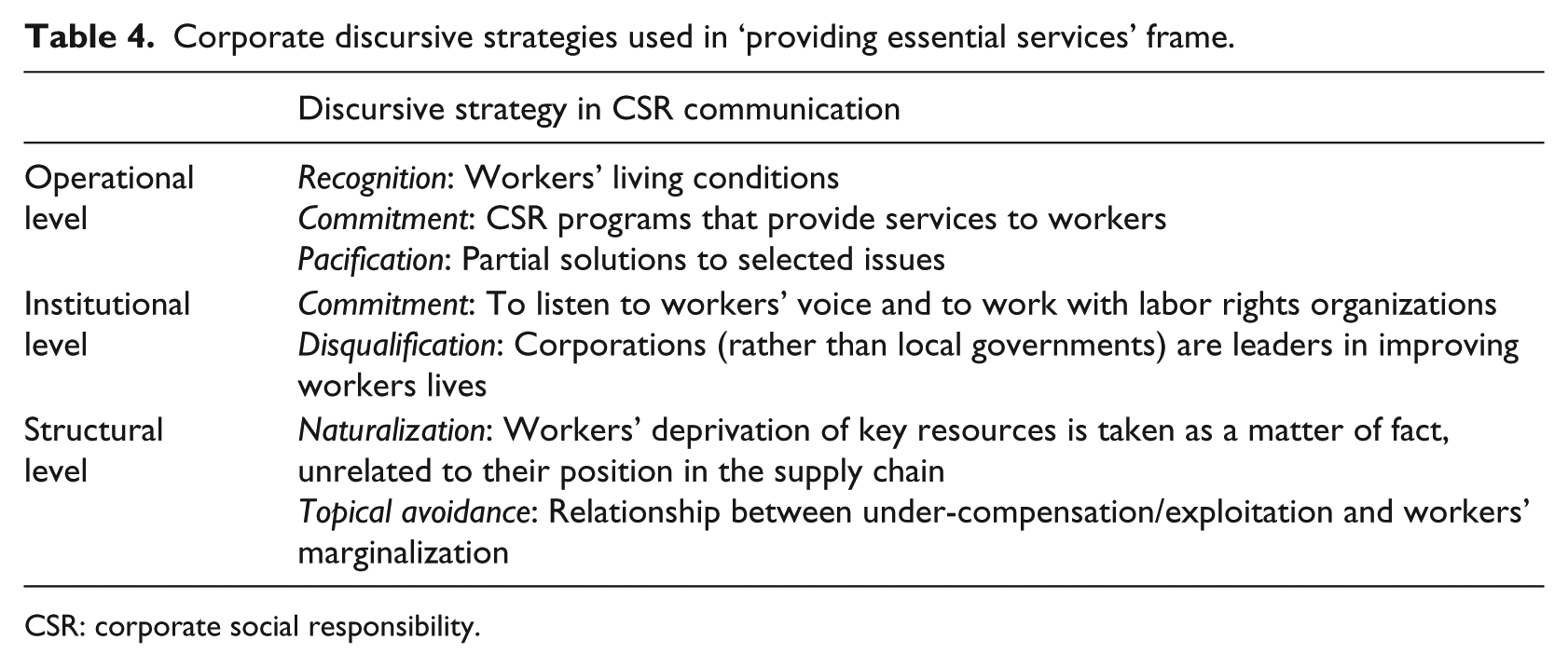
CSR: corporate social responsibility.
Corporate discursive strategies used in ‘innovating labor management system’ frame.
CSR: corporate social responsibility.
Discursive strategies: Operational level
At the operational level, discursive opening manifests as discussions of specific labor-related incidences, operational issues and policies in the garment supply chain context. Both non-closure discursive strategies and discursive closure strategies are identified at the operational level among the managerial CSR frames outlined in the previous section.
Non-closure discursive strategy: Recognition and commitment
A common feature of the managerial CSR frames is the recognition of problems at operational level, and the commitment to prevent future incidents or improve specific conditions by taking specific actions/CSR programs. For example, the establishing ethical standards frame recognizes the numerous reported cases of labor malpractice, which are defined as non-compliance to established standards. As Hanesbrands Inc. puts in their ‘Global Code of Conduct’, their responsibility is to be ‘vigilant, watch for and report any signs’ of violation. The US companies indicate commitment to improve labor management by taking a strong moral stance against violations. The commitment is manifest not only through strong language such as ‘zero tolerance’ (VF Corporation, n.d.-a), but also by highlighting the consequent punitive actions, which include increased (and often chargeable) audits (e.g. Nike, L Brands), correction/remediation programs (e.g. L Brands, Avon), order reductions (e.g. Nike, Hanesbrands), and even termination of the business relationship (e.g. Nike, VF Corporation).
The providing essential services frame recognizes that workers are often deprived of key resources and services and highlights the specific CSR actions of garment corporations to deal with workers’ poor living and working conditions. For example, Levi Strauss highlighted its worldwide initiatives including childcare facilities, women’s health and family planning education, and financial services (Levi Strauss & Co., n.d.-b). Many companies mentioned affordable and convenient childcare (e.g. Nike Inc., n.d.-b; VF Corporation, n.d.-b), sometimes using images like baby strollers to mark a category in the CSR webpage (Levi Strauss & Co., n.d.-b). Similar services include ‘on-site health clinics or financial literacy training’ (Nike Inc., n.d.-b) and Gap’s Women and Water program (Gap Inc., n.d.-c).
Strategy of discursive closure: Legitimation
Legitimation refers to the appeal to a ‘higher order’ value to obscure an inherent conflict within organizations. Within the establishing ethical standards frame, higher-order values such as ‘moral’ and ‘ethics’ are used to square pragmatic, legal considerations. While US companies claim that they uphold ‘the highest [emphasis mine] moral, ethical and legal standards’ (Nike Inc., 2010), these policy documents typically work to establish benchmarks of acceptable behavior among suppliers. For example, the minimum wage standard is usually based on the local ‘legal minimum wage’ (e.g. Nike, VF Corporation, Avon). Similarly, based on legal minimum, VF Corporation’s ‘Global Compliance Principles’ stipulate that ‘[n]o person shall be employed at an age younger than 15’ (VF Corporation, n.d.-e). L Brands’ supplier code of conduct states that workers ‘shall not be required, on a regularly scheduled basis, to work in excess of 60 hours’ (L Brands, n.d.). As a mode of systematic distortion, the merely legally admissible standards are conflated and legitimized as a high ethical stance.
Another example of legitimation can be found in the providing essential services frame, which enacts the ideological association of its services to the ‘universal human rights’ super value. In the introduction of its workers’ well-being program, for example, Timberland invokes its
. . . basic beliefs that every person is entitled to food that meets universal nutritional standards; clothing that reflects the person’s innate dignity; housing that allows privacy as well as shelter; affordable and accessible health care; and education that cultivates each person’s gifts and talents to enable positive community contributions. (VF Corporation, n.d.-f)
Here, the list of ‘universal human rights’ issues (as opposed to monetary compensation) is prioritized as more fundamental to workers’ rights and well-being.
The innovating labor management systems frame highlight the idea of innovation as the higher-order organizational super value and implies that problems with labor management only exists in the old paradigm, and will dissipate with new management systems that simultaneously empower workers and improve productivity. In this frame, the language of empowerment is also used to provide a rationale for new forms of exploitation, essentially through creating a category of symbolic benefits for workers that are separate from material rewards. This involves highlighting workers’ engagement in innovation, which creates ‘win-win’ for workers and management.
Strategy of discursive closure: Pacification
Pacification is the strategy of diverting conflict through an apparently reasonable attempt to engage it. Even as garment companies engage with debates about labor-related CSR issues by recognizing problems and making commitments to improve practices, they, nonetheless, strategically focus the construction of CSR around issues that are more peripheral to the corporate system. The providing essential services frame, for example, diverts discussions around urgent (and more conflictual) issues such as under-compensation and exploitation to a number of smaller infrastructure or enrichment programs (e.g. childcare facilities, women’s health and family planning education, financial services, etc.). These provide no more than partial solutions to issues of worker marginalization.
Pacification strategy can also be identified in the innovating labor management systems frame. The frame recognizes the marginalized condition of workers and the issue of under-compensation, and presents the innovation programs as a solution to worker’s marginalization condition. Close reading of the frame will reveal that workers will get a (small) share of the added value as a result of increased productivity and return of investment. The frame also argues for giving workers symbolic reward by listening to their voice and making them feel empowered. The frame (strategically) overlooks the dialectical relationship between material and symbolic aspects of labor management, and by providing predominantly symbolic rewards for worker-initiated innovations, effectively exercises what Hofbauer (1998) calls ‘capitalizing on subjectivity’ (p. 104)—an ideological system of self-motivated model workers who are rewarded just by the feeling of ‘being useful’.
Strategy of discursive closure: Plausible deniability
This type of closure produces speaker control through ambiguous messages that can be ‘present or disclaimed, said and not said’ (Deetz, 1992: 194). The various forms of ethical ‘codes’, ‘standards’, and ‘principles’ highlighted in the ethical standards frame can be understood as an ambiguous genre, characterized by what Fleming and Jones (2012) referred to as the ‘inbuilt cynical distance . . . between what one claims and what actually happens’ (Fleming and Jones, 2012: 6). Focusing on ethical codes, therefore, allows a corporation to pose as ethical leaders, yet maintain plausible deniability over responsibility related to actual labor practices in its supply chain.
Discursive strategies: Institutional level
Discursive openings at the institutional level focus on power dynamics within the organization and interactions among different social institutions along the supply chain. Specifically, managerial CSR discourse has to respond to questions about the huge power differential between MNCs and their Third World subcontractors, and between subcontractor management and workers. Both non-closure discursive strategies and discursive closure strategies were identified at the institutional level.
Non-closure discursive strategy: Recognition and commitment
At institutional level, managerial CSR discourse generally does not problematize the power of corporations as a social institution, but readily recognize that corporations (especially those with globalized supply chains) work with relatively under/disempowered social groups. For example, the providing essential services frame is grounded in the recognition of industrial workers’ marginalization condition. Therefore, CSR communication emphasizes the inclusion of workers’ voice in designing well-being programs. Workers’ voices are also used as benchmarks for the success of such programs. In an account of Timberland’s initiative to facilitate a community-based ECCE center, workers’ narratives are cited as the rationale for providing childcare services and testimonial to their success (VF Corporation, n.d.-b).
The innovation frame also recognizes the importance of empowering workers and inviting workers to the decision-making process. Reflecting on the management-centered logic behind older labor management methods, it calls for ‘a deeper understanding of the cultural differences between management and workers’ priorities and perceptions’ (Nike Inc., n.d.-b). The new model opens up ‘an opportunity for worker to benefit’ as business profitability trickles down to the workforce. More importantly, new management systems grant symbolic resources for workers to share their voice. As Nike puts it, ‘raising worker voices’ is part of the lean manufacturing approach, which the company believes ‘can empower workers and teams’ (Nike Inc., n.d.-b). Similarly, Pvh Corp. makes a direct link between workers’ empowerment and voice, stating that its factories ‘aim to empower workers to voice concerns’ (Pvh Corp., n.d.: 30). Similarly, workers’ voice is associated with workplace engagement—‘workers are engaged and enabled to drive business success’ (Nike Inc., n.d.-b), and equality—‘Workers’ voices are heard and they enjoy equality in the workplace and the community’ (Levi Strauss & Co., 2016).
Besides the workers’ population, managerial CSR discourse also highlights the importance of building partnership with local institutions on issues of labor-related CSR. Framed as establishing ethical standards, CSR communication emphasizes the importance of fostering collaborative relationships between corporations and other social institutions like international watchdogs, local governments, and suppliers. For example, Gap has committed to work with the local government and international labor organizations in dealing with the Sumangali scheme 3 in Southern India. (Gap Inc., n.d.-a)
Strategy of discursive closure: Disqualification
Disqualification is a discursive closure strategy that involves establishing standards or expertise that creates self-authority, and thereby includes or excludes certain groups or voices from a discussion. Disqualification is a distinct feature of managerial CSR discourse in the way it answers institutional-level questions about the relationship between corporations and other social institutions. Specifically, this is done by building the self-authority of corporations as custodian of labor rights, and discrediting other institutions (local government, suppliers, etc.) as labor rights violators.
For example, the innovation frame asserts that workers’ empowerment is best achieved by corporations located in the US—not labor rights activists, governmental bodies, or regulatory bodies. It further defines labor as a managerial issue (as opposed to a social justice issue, for example) and thereby (re)creates the condition of the ideological fiction of corporate expertise. The US corporations assume the role of transformative leaders by teaching (partnering with) suppliers to engage workers in innovations and other productivity-boosting activities (e.g. Gap Inc., n.d.-b; Levi Strauss & Co., 2016; Pvh Corp., n.d.; VF Corporation, n.d.-d).
Similarly, central to the ethical standards frame is the produced notion that only US based garment corporations are fit to serve as the custodians of ethical standards: this not only operates at the level of ‘ideological fiction’ (Deetz, 1992: 189) of expertise on the part of the corporations to formulate labor standards, but also at the level of justifying corporate control over the standard-setting process. Meanwhile, suppliers are noticeably disqualified as unwilling or incapable of meeting the rigorous labor standards. Compliance with labor standards, according to US companies, hinges on close inspection and evaluation programs. Further justifying close corporate monitoring and control, CSR frames allude to the lack of moral fiber or ethical business culture as the root of supplier non-compliance. Such allusions are sometimes made quite unsubtly when suppliers are accused of fudging records, dishonesty, and bribery. A number of companies (e.g. Nike, Avon, Ralph Lauren) emphasize the importance of ‘a true and accurate record of hours and wages’ (Avon Products Inc., n.d.) by suppliers, suggesting that supplier management cannot be fully trusted to provide honest account of their labor practices.
Individual supplier non-compliance is then discussed in the context of unethical business culture fraught with human rights violations, which can largely be traced to apathetic or colluding local governments. For example, the Gap Inc. describes:
. . . Each autumn, more than a million children are forced to work in Uzbekistan’s cotton fields, picking that cotton for export to international markets. One of the most troubling aspects of this exploitation is that the use of forced child labor is directly orchestrated by the national government, a practice that has been in place for decades. (Gap Inc., n.d.-a)
These vivid and provocative accounts of injustice serve to disqualify local government from the ethical labor standards discussion. Similarly, countries such as Bangladesh and Cambodia are considered as problematic due to ‘minimal government regulation and enforcement around human rights’ (VF Corporation, n.d.-a). The US corporation further claims that due to political, environmental, and human rights issues, ‘certain countries are deemed unacceptable for the manufacture of VF products’ (VF Corporation, n.d.-g). While the statement is targeting at a specific list of countries, it serves to place garment corporations in positions of comparative moral superiority, and local governments in positions subject to judgments and disqualifications.
The self-authority of corporations is often based on the geopolitics of the global supply chain. For example, the essential services frame argues that workers’ disenfranchisement stems from their generally marginalized position in the Third World context, unrelated to their employment in the supply chain. In many cases, supply chain jobs are described as an opportunity to escape marginalization. While the Third World context is framed as lacking the resources, know-how, and commitment to improve the lives of the marginalized population, corporations are depicted as capable, resourceful, and ethically engaged to bring positive changes.
Discursive strategies: Structural level
At the structural level, garment corporations face the challenge of political economic discussions concerning issues of labor exploitation, and in particular, the cost-reduction logic inherent in the supply chain manufacturing model. Specifically, corporations face challenges that link worker marginalization to the exploitative supply chain labor model, and the call for fairer level of compensation. Discursive closure strategies of topical avoidance and naturalization are identified at the structural level.
Strategy of discursive closure: Topical avoidance
Topical avoidance, as Deetz (1992) states, is a routine strategy within organizations that declaims what values are considered relevant or appropriate for discussion. Topical avoidance is the most pronounced at the structural level, as there is next to none discussion of the political economy of supply chain manufacturing and its impact on the level of labor exploitation in managerial CSR frames.
Within the establishing ethical standards frame, the topic avoidance strategy is deployed by obfuscating the wage issue with numerous other concerns in the list of ethical codes. A discussion of wage as one of many operational issues replaces structural-level discussions on exploitation and under-compensation. For example, Nike’s ‘systemic’ approach to labor management emphasizes operational issues such as ‘lack of access to affordable and effective ways to care for children, manage money, or access to education/career training’ (Nike Inc., n.d.-b). Similarly, Levi Strauss states that the key to solving labor-related problems is to focus on ‘topics that go beyond traditional workplace issues’ (Levi Strauss & Co., 2016: 8)—wage being one of the ‘traditional workplace issues’. Incidentally, Levi Strauss’ 20-page labor guideline contains no mentions of terms like ‘pay’, ‘salary’, ‘compensation’, or ‘wage’. This approach of sidestepping wages in the interest of ‘other services’ is explored in greater detail in the next CSR frame.
The providing essential service frame avoids the topic of under-compensation by focusing on the impact of other factors on workers’ marginalization. The emphasis is placed on the ‘many factors outside the factory [that] affect workers’ ability to show up on time and in good health every day’ (Nike Inc., n.d.-b). These factors—access to childcare, health services, and financial literacy, for example—are explained in more detail and with more colorful cases and examples on the website. In contrast, there is a dearth of elaboration on wages and their impact on workers’ lived experience.
Strategy of discursive closure: Naturalization
Naturalization takes place when social structures and phenomena are taken for granted, treated as natural, immutable, and unquestionable. A worker being deprived of key resources is treated as a naturally occurring situation, and unrelated to the specificities of supply chain manufacturing as a business practice. This naturalization process allows corporations to discuss how to help marginalized workers without reflecting on the role they might have played in the marginalization process.
Meanwhile, corporate profitability is naturalized even as CSR communication discusses workers’ well-being programs. In providing service frame, for example, benefit to the companies and their business partners are typically discussed in economic terms, emphasizing that ‘investing in (workers) . . . makes business sense’ (Nike Inc., n.d.-b). Pvh Corp. recognizes that workers’ issues have an ‘effect on productivity’ (Pvh Corp., n.d.: 30). Levi Strauss justified its worker well-being program by stating that the initiative has ‘demonstrated 4:1 return on investment for some programs’ (Levi Strauss & Co., n.d.-b).
Similarly, a distinct feature of the innovation frame is the naturalization of corporate profit. It takes for granted that profitability is a prerequisite for CSR activities, and certainly no labor management system, no matter how innovative or paradigm-shifting, should allow workers to benefit at the company’s loss. This principle translates to the ‘commonsensical’ expectation for a CSR program to boost productivity or efficiency beyond the cost involved, therefore making the program a ‘good investment’. Numerous examples of this can be found, where the major advantage of the revolutionary labor management system is the ability to tap into workers’ potential and stimulate business growth. Nike makes the connection between empowering workers and productivity by explaining that ‘factories investing in and listening to their workers and involving them in production discussions makes business sense, as measured by increased productivity and worker well-being’ (Nike Inc., n.d.-b). In another instance, Nike argues that ensuring suppliers’ financial competitiveness is the only way to increase wages. ‘Our theory is that when factories invest in their workforce, they will see higher productivity and returns that can be shared across Nike, contract factories and their workers’(Nike Inc., n.d.-b).
Discussion: Rethinking systematically distorted communication
While it is not surprising that garment corporations are ambivalent to discursive openings—simultaneously deploying closure and non-closure strategies in response to challenges and public pressure, I have identified a number of consistent patterns in which different types of discursive strategies are employed to deal with discursive openings at different levels (see Table 6 for a list of non-closure and closure discursive strategies used).
Corporate discursive strategies corresponding to competing discourses at operational, institutional, and structural level.
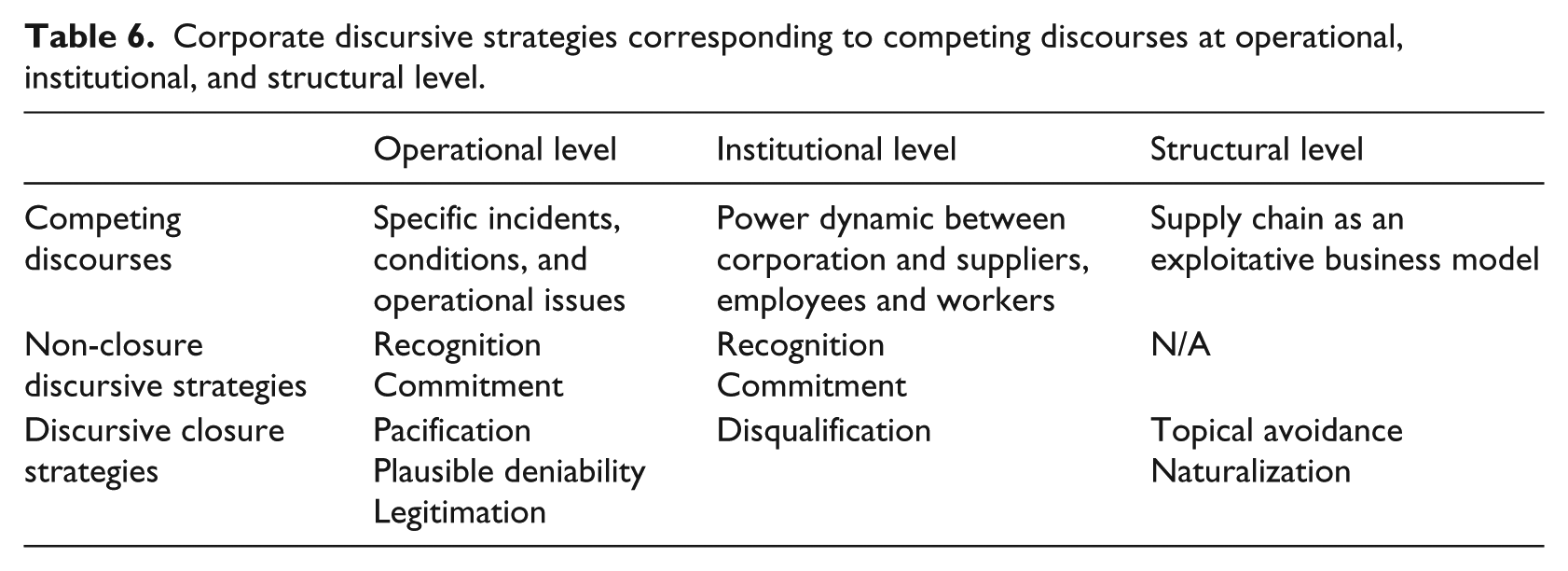
First, several non-closure discursive strategies are identified in response to operational- and institutional-level discourses, but there is no significant non-closure discursive engagement with structural-level discourses. CSR communication expresses acknowledgement of, and agreement with, operational-level discourses by highlighting specific incidents, conditions, and other operational issues. It also commits to deal with these specific issues, either by acting against supplier incompliance, providing services to workers, or revamping management practices. At the institutional level, CSR communication acknowledges issues with power dynamics and interactions among different social institutions along the supply chain. It emphasizes efforts to empower workers and collaborate with other social institutions such as government offices and labor rights groups in improving working conditions in the supply chain. There is no significant non-closure discursive engagement with structural-level discourses, which highlight the cost-reduction logic inherent to the supply chain manufacturing model.
Second, strategies of discursive closure are identified in response to operational-, institutional-, and structural-level discourses, with particular types of strategies more prevalent in each category. Particular types of closure strategies can be used in conjunction with non-closure strategies. For example, even as corporations commit to specific actions against labor malpractice and improvement of workers’ lives at the operational level, managerial discourses deploy strategies of legitimation, pacification, and plausible deniability, largely to give more importance to specific CSR programs, present them as solutions to broader labor-related issues, and provide disclaimers about the effectiveness of the CSR solutions. At the institutional level, recognizing the problem of power disparities, CSR communication emphasizes the need to empower workers and collaborate with other social actors/institutions. However, such commitments are premised on corporations taking the central role and the Third World suppliers and governments disqualified from discussing labor issues.
Third, non-closure and closure discursive strategies are not deployed in separate domains, but used simultaneously in the construction of CSR frames that have coherent internal logic. For example, in the providing essential services frame, CSR communication argues for the ‘systemic approach’ that focuses on the ‘many factors outside the factory’. This recognizes workers’ marginalization as problematic, but simultaneously elides the issue of under-compensation, which is central to workers’ marginalization. Similarly, in the ‘innovating labor management systems’ frame, a non-closure strategy is identified at the institutional level that acknowledges the importance of listening to workers’ voices and engaging them in decision-making. However, the argument for worker engagement programs as ‘good investment’ can be understood as discursive closure at the structural level that naturalizes corporate profit and exploitation.
While managerial CSR discourse does not perform totalizing and complete discursive closure, I argue that the ‘small steps of constant improvement’ resulting from its non-closure discursive engagement with the discursive field has very limited potential toward major social transformation from the current state of labor abuse and injustice. Moreover, it works more toward further consolidates corporate power and domination. This is because managerial CSR discourse: (a) consistently moves toward discursive closure on structural-level debates in the form of topical avoidance and naturalizing structural issues; (b) consistently presents operational-level engagement as solutions to structural issues such as exploitation and workers’ marginalization; and (c) consistently switches the institutional-level discussions of issues of power to that of corporate leadership in the language of ‘empowerment’ and ‘partnership’. These discursive strategies allow corporations to legitimize and reproduce languages of corporate domination even as they actively engage with some expressions of opposition. Instead of totalizing and completing discursive closure, systematically distorted communication in managerial CSR discourse manifests as a consistent pattern and assemblage of both discursive closure and non-closure strategies.
Conclusion and limitation
The theoretical contributions of this article are three-fold. The primary contribution is that it clarifies current theoretical debates about the potential of CSR discourse in bringing about positive social transformations. The opposing arguments are raised by the structural approach (Banerjee, 2008; Fleming and Jones, 2012), which focuses on the centrality of corporate institutions in contemporary society, and the procedural approach (Christensen et al., 2013; Scherer and Palazzo, 2007), which highlights the constitutive power of CSR language to bring about those small steps of improvement. While the structural approach is often critiqued for failing to recognize the ‘small steps of constant improvement’ (Scherer and Palazzo, 2007: 1107), the procedural approach is yet to prove that those improvements can actually mount up to substantial social transformation. In light of this debate, I use a communicative approach to CSR discourse to explore the mechanism by which managerial CSR discourse can contribute to small steps of constant improvement, and yet simultaneously work against more substantial social transformation. Specifically, I propose a more granular understanding of CSR communication by situating corporate discourse in a fragmented discursive field. This perspective captures the parallel and strategic processes of the corporate discourse to simultaneously open up and close down discursive space to diverse opposing discourses. In doing so, managerial CSR discourse allows corporations to be open for change at the operational (and, to some degree, the institutional) level(s) but closed for transformation at the structural level.
The second theoretical contribution of this article is that it complicates Deetz’s conceptualization of systematically distorted communication (Deetz, 1992) for a contested, fragmented discursive field. While Deetz has focused on discursive closure in his original conceptualization, the article argues for a conceptualization of systematically distorted communication as a consistent pattern and assemblage (rather than mere occurrences) of discursive both closure and non-closure strategies. My analysis brings Deetz’s conceptualization of systematically distorted communication to the contested, fragmented discursive field of CSR, and demonstrates how hegemonic consent can take place (in important but largely hidden aspects of the debate) even as dialogues and compromises are found in other aspects. Simply put, just as the identification of some instances of discursive closure is not sufficient to draw conclusions about ideological hegemony, a few identified instances of open engagement with opposing discourses are similarly inadequate for drawing conclusions about corporations’ participation in deliberative democracy. Moreover, my analysis shows that at the frame level, discursive closure and non-closure strategies are often deployed simultaneously in a consistent version of reality. The same corporate discursive event can (and often does) interact with multiple competing discourses, putting discursive closure to some, yet showing open engagement with others. As such, it is often impossible to isolate certain speech events as non-distorted communication, and separate them from distorted communication. Therefore, both discursive engagement and closure are important to the role that CSR discourse plays in the social process marked by systematically distorted communication.
Finally, the third contribution of this article is the argument for a more dynamic view of Thackaberry’s (2004) conceptualization of discursive openings, highlighting the interactions among different components of the discursive openings in a fragmented discursive field. A survey of alternative discourses about supply chain labor reveals that the discursive opening has several components that can be broadly categorized into operational, institutional, and structural-level discourses. Different components of the discursive opening often complement each other, but also be competing and contradictory. For example, while operational-level discourses generally consider the compliance to codes of conduct as key, both institutional and structural-level discourses are skeptical about the effectiveness of CSR programs that lean heavily on supplier codes of conduct. My analysis of the garment industry CSR reveals that the internal structure of the discursive opening (that it has multiple components that support, complement, compete, and contradict with each other) allows corporate discourse to simultaneously engage positively with some components of the opening, while exert discursive closure to other components. Moreover, discursive engagement at the operational level contributes to systematically distorted communication if it serves as a substitute for structural-level discussions. Therefore, to evaluate a discursive opening on its potential for social change, the analysis should go beyond the identification of competing discourse and contradictions, and focus on the internal structure of the discursive opening. This means, for example, that activist and social movement organizations should be skeptical of operational-level solutions that are disconnected from broader structural debates.
An obvious limitation to this study is its focus on a single industry. I recognize that this is not the only industry within which the supply chain is relevant, and that US corporations may differ significantly from their European or other global counterparts. How applicable these findings are to other industry or geographic contexts, and even to other (non-CSR) elements of corporate discourse, is to be determined through future research.
Footnotes
Funding
The author(s) received no financial support for the research, authorship, and/or publication of this article.
