



Abstract
Using rich and extensive data collected from police Inspectors over an extended period (2011–2014), this study explores two research questions that seek to (1) define extreme work in policing and (2) understand how it is maintained and reproduced. For some, by definition, the work of the emergency services is understood to be extreme, but the urgent and dangerous elements of policing form only a small part of an Inspector’s job and for these incidents they are well-trained in advance and well-cared for afterwards. When police Inspectors describe their work in times of austerity, it is not the emergency aspects that they experience as extreme work. Rather, it is the intensity of work over long hours above contract, which are both involuntary and unrewarded. In seeking to understand what drives extreme work and why it is accepted, especially when it is not preferred, not paid for and has detrimental effects on health and wellbeing, we uncover a process of institutional maintenance through which over-work: (1) is intensified via the extra demands imposed by austerity; (2) is maintained through work practices, a strong professional identity and a masculine police culture; but (3) is not ‘normalized’ in the sense of being embraced or celebrated by police Inspectors.
Keywords
Introduction
What constitutes ‘extreme work’? In the eyes of many, the term ‘extreme’ would naturally apply to the work of our emergency services—paramedics, fire-fighters and police officers—given the inherent dangers of the job and their exposure to ‘sometimes unimaginable and very challenging situations’ (Smith and Charles, 2013: 2). But much police work is mundane, if not boring (Waddington, 1999: 297). For example, when Britain’s second largest police Force, Greater Manchester Police (GMP), tweeted the details of all 999 calls in a 24-hour period (October 2010), only a third reported crimes (e.g. burglary, theft, domestic violence, sexual offences, traffic incidents and drugs-related offences) while the remaining two-thirds were classified as ‘social work’ (e.g. missing person, anti-social behaviour, relationship disputes, alcohol-related disturbances, mental health issues and animal concerns). To be sure, even seemingly mundane interactions between the police and public can have a profound effect on individuals, families and communities (e.g. a warning rather than arrest of a teenager for a minor drugs offence, referral to social services in a suspected case of domestic abuse, and diffusing racial tension on the streets that might otherwise escalate into a riot), but the day-to-day work of most police officers is not replete with car chases, armed robberies or public disorder.
Extreme jobs are more usually defined in terms of long, sometimes unpredictable and unsocial hours of work combined with intense working. The adverse effects of long and arduous hours on employees’ health and wellbeing have been well-documented (Chatzitheochari and Arber, 2009: 32–3; Dembe, 2009) including studies of police officers (e.g. Brown et al., 1996; Vila and Moore, 2008), but when extreme jobs are occupied by ‘extreme job holders’—that is, those who display an exceptional level of involvement in their work and enjoy excitement and extreme challenge (Gascoigne et al., 2015)—then deleterious effects are often mitigated (Crank and Caldero, 1991; Stotland, 1991). The extreme incumbents of these extreme jobs ‘don’t feel exploited; they feel exalted’ (Hewlett and Luce, 2006: 52). Perhaps, then, we should not be too concerned about the management consultant or financial advisor working to very tight deadlines at the beck and call of clients, especially if they enjoy their work and are extremely well rewarded. But what about police Inspectors 1 who, while accepting the ‘exigencies of duty’, report a preference for working fewer hours and who, following promotion, are suddenly expected to manage their own time and are no longer remunerated for overtime? For most jobs, unpaid overtime is ‘a puzzle for explanation’ (Campbell and Van Wanrooy, 2013: 1140), especially when overtime hours are not freely chosen as the worker is then at serious risk of ‘occupational burnout’ (Beckers et al., 2008).
The ‘normalization’ of extreme work has been noted across both the private and public sectors in the United Kingdom (McCann et al., 2008), but the study of police work can magnify processes and relationships (e.g. Smith and Charles, 2013: 33) such that any normalization of extreme work is more readily exposed and more easily identified and understood. The extreme is thrown into sharper relief because ‘police have unique legal powers and perform an often unpleasant job which tends to bring them into contact with people who are dysfunctional, angry, agitated, inebriated, in crisis and sometimes armed’ (Vila and Moore, 2008: 191). Furthermore, many of the most difficult decisions facing police officers are ‘made in fluid, ambiguous, and emotionally charged situations where lives, property, and liberty can be lost in a split second’ (Vila, 2006: 973). Importantly, this is not what police Inspectors experience as extreme; rather, it is the mundane everyday hassles of organizational life which have escalated under austerity budgets and relentless targets that lie at the heart of extreme (adverse) outcomes for police Inspectors in terms of their health, general wellbeing and work–life balance.
Our analysis of the British Police Service demonstrates how work practices interact with occupational identity to constrain Inspectors’ choices over working time and work tasks to create and maintain an institution of over-work (Lawrence and Suddaby, 2006) which, under the additional workloads demanded by austerity, is now widely experienced as ‘extreme’. In the following section, we define and differentiate extreme work in the Police Service before we elaborate our data and methods. In a subsequent section, using the accounts that Inspectors provide for workplace time allocations—their reflexive commentaries on behaviour—we consider how actors perceive their action to be intelligible and warrantable (cf. Kuhn, 2006: 1341). We then elaborate why this matters for Inspectors, the Police Service and wider society.
Unlike the professionals described by Hewlett and Luce (2006), police Inspectors feel ‘compelled by’, rather than ‘committed to’, external and internal pressures to work excessive hours. The immediate drivers of extreme work in the Police Service are external, most notably budget cuts and the demand for police officers, in the words of the Home Secretary, ‘to be the tough, no-nonsense crime-fighters they signed up to be … I haven’t asked the police to be social workers … I’ve told them to cut crime’. 2
Arguably the more important drivers are internal, specifically the institution of over-work within the Inspecting ranks that is maintained and reproduced through both coercive elements of policing and its normative foundations. The former ensure that over-work is ‘normalized’ in day-to-day (operational) policing via the demands of the job and the commands of senior officers, whereas the latter helps to maintain extreme patterns of working despite the dissatisfaction this generates within the Inspecting ranks. Thus, while institutions are never entirely stable and are always subject to challenge and change (Lawrence and Suddaby, 2006: 234), over-work is maintained within the Police Service by the normative foundations of the ‘cop culture’ (Waddington, 1999) in which an exaggerated sense of mission ensures that officers are ‘ever-available’ and always ready to ‘tough it out’. In particular, some Inspectors willingly accept long hours when this involves ‘real’ police work (catching criminals) and in many respects this particular (hegemonic) masculinity (Connell and Messerschmidt, 2005) is still the most honoured way of being a policeman (i.e. it requires all other men to position themselves in relation to the tough, no-nonsense crime-fighter). In contrast, many more Inspectors, both men and women, express an overwhelming desire to avoid the shame of being labelled as someone who is ‘unable to cope’, the guilt associated with ‘only’ working what is supposed to be the normal 40-hour week, and the inevitable privileging of work over other aspects of their lives. The combination of identity work and work practices that constitute the institution of over-work in the police service might ensure that Inspectors meet the extreme work demands associated with austerity, but our analysis shows that extreme is not taken for granted and in this sense is not ‘normalized’.
Extreme work and what makes police work extreme
Studies of extreme work, per se, are few and far between (Gascoigne et al., 2015) but most focus on working time and the intensity of work. Of greater concern in more recent years is the ‘normalization’ of extreme work, variously attributed to societal trends (e.g. globalization, liberalization and consequent competition), sector-specific developments (e.g. technological innovations or the new public management) and organizational drivers (e.g. lean supply chains, flexible work practices, flatter organizational hierarchies and more intrusive and more intensive monitoring of performance). For many in middle management, the quid pro quo is a more interesting job that typically attracts much higher rewards, although the (financial) rewards are less forthcoming in the public sector where extreme work, as a result, is often more distressing (McCann et al., 2008: 365–6). For public sector workers, therefore, the normalization of extreme work presents a rather different (theoretical) puzzle and an important (practical) challenge for both managers and managed, especially during times of austerity.
One of the now standard definitions of extreme work assumes a minimum of 60 hours per week plus any 5 of the following 10 characteristics:
Unpredictable flows of work;
Fast-paced work under tight deadlines;
Inordinate scope of responsibility that amounts to more than one job;
Work-related events outside regular work hours;
Availability to clients (citizens) 24/7;
Responsibility for profit and loss;
Responsibility for mentoring and recruitment;
Large amount of travel;
Large number of direct reports;
Physical presence at workplace at least 10 hours a day (Hewlett and Luce, 2006: 51).
The (extreme) work of police Inspectors ticks 8 (possibly 9) of the 10 characteristics (highlighted in italic), specifically those that ‘go with the job’ in an emergency service where demand (criminal activity, public disorder and ‘social work’) is largely unpredictable (1 and 5), those that are investigation-specific or attributable to the ‘exigencies of duty’ (2), those that go with the supervisory/managerial responsibilities of the rank (7, 9 and often 10), those that arise from (political) initiatives such as community policing (4) and those that become more prominent and pervasive at times of austerity (3 and 10). Travel time and distance (8) is also an issue for many Inspectors as recent Force reorganization has typically involved the combination of (geographically defined) operational units in most Constabularies. On reflection, however, with the exception of an inordinate scope of responsibility that amounts to more than one job (3) and the requirement to be physically present at the workplace at least 10 hours a day (10), none of the other 8 characteristics are inherently ‘extreme’.
With the requirement for ‘any five out of ten’, clearly what matters in this definition is the cumulative impact of these different job characteristics. Of greater importance, however, are the work practices that can either facilitate or mitigate the extreme potential of these job characteristics. Consider mitigation: if an organization builds ‘slack’ into its work systems then an unpredictable flow of work (1) and tight deadlines (2) can be readily accommodated; if employees are granted ‘time off in lieu’ (TOIL) then attending work-related events ‘out of hours’ (4) or taking calls from clients 24/7 (5) is effectively compensated; responsibility for profit and loss (6) might give some managers the autonomy they crave and the financial rewards they deserve (e.g. if the company offers profit-related pay or share options); with appropriate training and support, mentoring subordinates (7) can not only be gratifying but might even reduce workloads if tasks and responsibilities can be delegated to highly competent colleagues; travel (8) can always be factored into working time and made less stressful if journeys by train or plane are first/business class; and there is nothing untoward about numerous direct reports (9) if these are part of the employee’s job description (unless, of course, the employee is being pulled in many different directions by ambiguous expectations or unrealistic targets from those who demand reports or require supervision). In short, it is through particular work practices that difficult and potentially extreme job characteristics can be made acceptable. In the alternative, seemingly normal job characteristics can be transformed into extreme work.
The two exceptions (3 and 10) to what now appears a rather benign list of job characteristics merit closer inspection. Responsibility for more than one job (3) is clearly an example of more ‘intensive effort’ while being in work for 10 hours or more a day (10) constitutes ‘extensive effort’ (Green, 2001). Within the Police Service, it is not uncommon for Inspectors to spend long hours at work. Prior to the election of the Conservative-Liberal Coalition Government of the United Kingdom in May 2010, extensive effort had already been identified as (potentially) extreme for a growing number of Inspectors (Inspectors’ Branch Board, Metropolitan Police Service (IBB-MPS), 2008), although systematic data were hard to come by as Force Duty Management Systems (DMS) are effectively duty rostering systems (allocating Inspectors to a 40-hour week) rather than duty recording systems (i.e. an accurate record of actual hours worked). With the onset of austerity and the target set by government to achieve more (fewer crimes) with much less (a 20% reduction in the police budget under the Comprehensive Spending Review between March 2010 and March 2015), ever-expanding workloads (3) were identified as both a separate cause for concern and a primary cause of excessive working hours (10).
For police Inspectors, there are two reference points—lower and upper limits—for working time. The lower limit (minimum) is based on a rostered and remunerated working week of 40 hours. Although Force Agreements advise line managers to ‘consider the normal week to be no less than 40 hours’, they caution that ‘Whilst officers can be required to work beyond those hours, the requirement to work should not become the norm, be abused or become regular and expected’ (MPS, 2008, emphasis added). Recall, however, that work practices can either mitigate or facilitate extreme work, in this instance the ‘regular and expected’ demand for Inspectors to work ‘beyond the call of duty’. The principal work practices that facilitate (potential) abuse of Inspectors’ working time are twofold.
First, as servants of the Crown rather than employees, all police officers in Britain can be required (commanded) to work as directed (i.e. according to the ‘exigencies of duty’). Those issuing commands work extremely long hours: most Superintendents work 50–60 hours per week, with more than one-in-ten working 60–70 hours per week (Donaldson-Feilder and Tharani, 2011: 14), while it is not uncommon for Chief Officers to work 70–75 hours per week (Caless, 2011: 70). This creates a high level of demand and an expectation of similar levels of ‘commitment’ from those in the ranks immediately below (i.e. Chief Inspectors and Inspectors) (Smith and Charles, 2013: 81). As one of the participants in a recent study of Association of Chief Police Officer (ACPO) ranks pointed out, ‘Chief Officers’ working habits quickly become those of the Force and have the potential to skew judgement’ (quoted by Caless, 2011: 71). In today’s Police Service, those in leadership positions have been described as ‘Smart macho managers … driven by their own competitiveness [who] give short shrift to employees less eager to work excessive hours or unable to deliver to tight schedules’ (Brown, 2007: 206).
The second work practice facilitator of (potential) abuse comes not from command but conditions of service. In September 1994, Inspectors’ entitlements to payment for overtime and working on public holidays and rest days were removed in return for a payment of £3250 awarded as an increase in pensionable pay. Crucially, these changes to the conditions of service of the Inspecting Ranks should not have altered, nor were they intended to alter, the average hours worked each week in posts filled by members of those ranks … For sound reasons to do with the health and welfare of the officer, the safety of others and effective working, no police officers should be required to work regular excessive hours … This is a particular consideration in the case of Inspectors, Chief Inspectors and higher ranks, who are not paid overtime. (Home Office Circular 21/97)
Despite these assurances, the Inspecting ranks are often required to work unscheduled overtime and ‘on-call’, and many experience difficulties ‘taking back’ time-owed in lieu, cancelled rest days and even rostered rest days and annual holidays. According to the Police Federation, ‘in today’s climate of “more for less” … [the 1994 Agreement] … is eagerly exploited by many of our senior managers. This has resulted in the Inspecting ranks becoming the most “put upon” in the Service’ (Inspectors’ Central Committee (ICC), 2011: 2).
The ‘upper limit’ for Inspectors’ working time, and the point beyond which, ipso facto, the ‘normal’ becomes the ‘extreme’, is defined as 48 hours per week, sustained over a period of 17 weeks. This upper limit (maximum) is, of course, derived from the (European) Working Time Regulations (WTRs) (1998) which expressly apply (Regulation 17) to police officers and other Crown servants, unlike most employment laws. This maximum is much lower (12 hours per week less) than the minimum number of hours that define extreme work in North America (Hewlett and Luce, 2006: 51), but in the United States, there are no comparable statutory limitations on the working time of different occupational groups, including police officers (Vila and Moore, 2008: 186). Put differently, in a European context, the now ‘standard’ definition of extreme work (Hewlett and Luce, 2006: 51) would be illegal (unless the employee consented to ‘opt out’ of the WTRs). Furthermore, if extreme jobs are defined by the nature of the work as well as the hours of work (e.g. junior doctors working in A&E) then arguably the upper weekly limit and other WTRs should be more protective (e.g. a lower threshold for weekly hours and longer rest periods between shifts). In recognition of this fact, some of the provisions in Police Regulations (e.g. weekly rest entitlements and daily rest breaks) are more generous than those provided in the WTRs.
For all occupational groups, there are sound medical reasons for applying the WTRs as the basic definition for extreme work in terms of maximum weekly hours, minimum rest periods between shifts, minimum break time at work, and so on (e.g. Spurgeon, 2003; White and Beswick, 2003). For the Police Service, the WTRs arguably constitute insufficient protection from extreme work but are currently the only legal protection enjoyed by Inspectors (ICC, 2011: 11). Health and safety alone should be sufficient justification to focus our analysis of working time on the statutory 48 hours maximum. As Dembe (2009) asks, should workers be able to ‘choose’ to work excessively long hours, especially in critical occupations with implications for public health and social order (p. 203)? We could also ask whether employers should be ‘allowed’ to extract 48 hours’ work as a norm, especially when only 40 hours are remunerated.
Investigating extreme work in the Police Service
Any study of the causes of long working hours calls for a careful combination of quantitative and qualitative methods, especially in situations where workers’ preferences in respect of income (work) and leisure (non-work) are shaped over time by prevailing norms and organizational culture (Campbell and Van Wanrooy, 2013). In the case of police work, extreme hours are driven by the demands of austerity, enabled by work practices and (reluctantly) accepted, but not always internalized, as part of an Inspector’s professional identity. Consequently, our research methods in this endeavour were mixed and sequential (Creswell et al., 2008: 66), based initially on data generated through an online survey designed by the IBB of the MPS. The ICC of the Police Federation of England & Wales (PFEW) agreed to distribute this survey to all Inspectors in England and Wales, using their unique warrant number email address. A personal invitation to take part in the survey was sent out by email prior to the survey week with a link to the questionnaire. On opening the link, the respondent received a covering letter from the Chair and Secretary of the ICC and the questionnaire.
The survey covered the respondent’s working time, the employer’s record of hours worked, accrued time off in the form of annual leave and rest days, and other ‘TOIL’. Personal characteristics such as age, years of service, sex, rank, area of policing and Force were included in order to measure inter-group differences in hours of work. A series of fixed-format (closed-ended) and open-ended questions (free-text boxes) explored Inspectors’ motivation and attitudes towards working long hours, recording of hours, refusals to work long hours and any adverse health and work–life balance consequences from working long hours. Respondents were also encouraged to maintain a working time diary for the duration of the survey reference week (24–30 January 2011).
The survey achieved 4589 responses (a response rate of 52%). The data were checked against official statistics published by the Home Office to establish that the sample was representative by sex, rank and area of policing. Our expectation—no doubt based on watching too many TV dramas depicting hard-working detectives—was that Criminal Investigation Department (CID) officers in urban Forces would largely account for long hours. In fact, ordinary least squares (OLS) regression indicated that variation in hours worked by Inspectors were not well explained by the individual job or person characteristics measured in the survey (Turnbull and Wass, 2012: 70–7). 3
Based on these initial results, we began a dialogue with the ICC and IBB reps to better understand why Inspectors work what many themselves consider ‘excessive’ hours, especially when this has a marked (detrimental) impact on their personal health, general wellbeing and work–life balance. As Campbell and Van Wanrooy (2013: 1139) have demonstrated, descriptive data from large-scale surveys on working time need to be supplemented with a programme of in-depth interviews. In particular, interviews often reveal ambivalence towards long hours, reflecting compromises between what is desirable and what is feasible (Campbell and Van Wanrooy, 2013: 1132). Thus, following a series of one-to-one interviews and several group discussions with Federation reps at meetings of the IBB Chairs and Secretaries, we extended our qualitative methods via a series of nine focus group meetings in three Constabularies and the MPS. Concurrently, the Scottish Police Federation (SPF) requested a similar survey of their Inspecting ranks. For consistency with the data from England and Wales, the survey was replicated using the same methods for the week beginning 5 September 2011, but with additional questions relating to family status, ethnicity, hours preference, shift patterns, and adverse effects on sleep. The Scottish survey secured 449 returns (a response rate of 40%).
Analysis of the focus groups’ discourse provided an insight into how the identity of being a police officer/Inspector is constituted, how this affects the decisions and actions that individuals make during their working (and non-working) hours, and how these decisions and actions are socially constituted within the prevailing police culture.
4
Methodologically, however, the problem is that, when we inquire, people invariably offer a front-stage discursive performance which tends to privilege a positive essentialist image of ‘self’ or ‘identity’ whilst discursive displays of ambiguity and indecision or a negative self-evaluation are rare. (Ybema et al., 2009: 314)
Every focus group started in this way, with participants typically projecting a macho, confident, self-reliant and resilient ‘self’. But as the conversation developed (the meetings typically lasted around 2 hours) uneasiness and self-doubt crept into the discussion, especially when Inspectors began to challenge the assumptions, opinions and decisions of their colleagues or when officers admitted to not being able to cope with the demands of the job. In every group, we heard the voices of ‘subordinated masculinities’ (Connell and Messerschmidt, 2005: 832) and the marginalization and de-legitimization of alternatives was much less in evidence when the focus group also included policewomen (as opposed to policewomen). 5
A further source of qualitative data came from detailed responses to open text survey questions provided by over a third of respondents on the subjects of part-time working, reluctance to share concerns about long working hours with senior officers, when and why the respondent had refused to work excessive hours, the impact of long hours on health, barriers to promotion, and finally an opportunity for ‘any other comments’. All quotes were carefully (re)read to establish recurring themes or issues, informed by the interviews and focus groups. For example, responses to the open text question asking for elaboration on why the respondent had ‘never refused’ to work what they considered to be ‘excessive hours’ was coded as ‘damaging to promotion prospects’, ‘nobody else to cover’, ‘professional commitment’, ‘goes with the job’ and ‘don’t want to be seen as weak/unwilling/unable to cope’. This then allowed a more systematic analysis of these data using keywords.
Following the publication of a report for the ICC based on the surveys, initial interviews and focus groups (Turnbull and Wass, 2012), which was debated at the PFEW’s Annual Conference in 2012, Humberside IBB requested a ‘Force Report’ comparing the results for their Constabulary with the national picture. This initiative led to a successful joint application with the ICC (PFEW and SPF) to the Economic and Social Research Council’s (ESRC) Knowledge Exchange Opportunities (KEO) Scheme (ES/K005618/1), which involved, inter alia, a follow-up survey of working time in South Yorkshire, case studies in two rural Forces, and 10 regional workshops (based on the organizational regions of the PFEW and SPF) that provided an opportunity to evaluate the impact of the UK government’s Comprehensive Spending Review and to review Force Reports that were prepared prior to each workshop. 6 When Federation reps, human resource (HR) managers and other participants from different Forces ‘compared notes’ on their Force Reports at these workshops, the ensuing discussion generated rich qualitative data. In particular, while the quantitative data laid bare Inspectors’ working time and their lack of temporal control, the qualitative data revealed how Inspectors struggle to maintain a coherent sense of self in the context of ever increasing demands imposed by austerity and how their identities may comply with or resist organizational goals.
Why the normal becomes extreme and how the extreme is ‘normalized’
All institutions need on-going maintenance to support, repair or recreate the social mechanisms that ensure compliance (Lawrence and Suddaby, 2006: 230), especially when the work expected of the workforce becomes ‘extreme’ and the extreme is normalized in their day-to-day working lives. But what is experienced as ‘extreme’ in the Police Service? How is extreme (over) work enabled and policed, embedded and routinized in everyday practice? Can Inspectors ‘live up’ to the idealized ‘good cop’—the fearless, heroic crime-fighter who is physically fit, emotionally strong, assertive, tenacious, resilient and ‘ever available’?
While not wanting to belittle the extreme situations faced by police officers, or indeed the ever-present threat of danger, it is the everyday hassles of organization life that cause stress for police officers (Stinchcomb, 2004: 264) and the work practices driving extensive and intensive effort that are experienced as extreme. As one of the Inspectors at a focus group of the MPS pointed out: ‘If it’s a traumatic event you get support. If you’re drowning in paperwork, you’re just told to get on with it’. This same point was borne out during a conversation at one of our other focus groups:
It’s quite alright for Inspectors to have post-traumatic stress, we deal with that kind of stress and we deal with it very well in the manly, sexy, machismo way. It’s alright to have a tear about that one. But dealing with your workload you are just soft and mamby-pamby, you can’t really cope, so get out. And that’s exactly the way that it’s still perceived.
When we look at stress around difficult policing incidents, that’s very good. But I think the stress of day-to-day, normal work—and I use the word ‘normal’ selectively—I don’t think we as a Force manage it particularly well.
We’re getting very good around significant incidents and I think we are very good around that. I just think it’s this everyday, this relentless pursuit of work pressure. We can deal with extraordinary stuff but not the daily grind. The extraordinary is not what breaks people, it is the day-to-day stuff and it builds, builds and builds then people start falling over. (Kent Police, first focus group)
At what point, then, do ‘people start falling over’? How many Inspectors work excessive hours, how many hours do they work and how intense are these working hours?
From the survey hours’ diary (January 2011), average weekly hours worked by the Inspecting ranks in England and Wales were 44 in what was widely regarded as a ‘quiet week’. In a ‘normal week’ in Scotland, and 9 months further into austerity (September 2011), the average was 48 hours. The absence of a ‘blip’ in the distribution at 40 hours in either survey indicates that a 40-hour working week was in no sense a ‘norm’. One-in-four of the sample worked more than 49 hours during the reference week in England and Wales and a similar proportion worked more than 54 hours in Scotland. 7 The follow-up survey (March 2013) of Inspecting ranks in South Yorkshire found that almost 63% worked 48 hours or more (compared to 28% in this Force in January 2011) and not a single respondent reported working the rostered 40-hour week.
In Scotland, over 41% of Inspectors would prefer to work fewer hours, and this figure rises to over 54% for women.
8
While the majority express a preference for the ‘same hours’, survey questions of this type
9
not only capture preferences but also feasibility (i.e. employees may simply accept their current workload as they see no possible alternative) (Campbell and Van Wanrooy, 2013: 1137). Moreover, any ‘choice’ is unlikely to reflect a simple (rational) calculation between income and leisure because of a new form of ‘lumpiness’ of labour demand in contemporary society whereby ‘the employer does not forbid adjustment of the working time, but circumstances make work come in “lumps” of tasks that undermine the choice between income and leisure that flexible arrangements allow in principle’ (Van Echtelt et al., 2006: 497). Thus, Inspectors are told to ‘manage their own time’ and the Police Service offers an impressive array of flexible working practices (Home Office, 2007)—an example of ‘enabling work’ (Lawrence and Suddaby, 2006: 230–1) designed to maintain the resilience of the Inspecting ranks—but there are crimes to solve, communities to protect and social work to perform, and increasingly not enough time or resources to do all of these. When asked whether ‘the job has to be done regardless of hours worked’, almost 85% of respondents in England and Wales, and almost 87% in Scotland, either ‘strongly agreed’ or ‘agreed’ with this statement. For the vast majority—over 76% in England and Wales and more than 79% in Scotland—‘working long hours is necessitated by my role’, which most Inspectors attribute to the fact that ‘there isn’t enough [organizational] resilience to avoid extended hours’:
10
There is little resilience—when a job breaks, no matter what your personal commitments or responsibilities, there is no one else to cover the role so you have to stay on. Whilst this is part of the role of a manager, there is often a very wide interpretation of what is an ‘exigency of duty’. (Female Support Inspector)
11
A further indication of Inspectors’ lack of control over working time is the number of accrued rest days and annual leave days owing, as well as TOIL. At the time of the surveys, almost 90% of Inspectors had accrued rest days owing (on average just over 10 days per person) and over 90% were carrying accrued annual leave (on average 9 days per person). TOIL was reported by 48% of respondents with a median number of 13 days owed, but is likely to be under-recorded for two reasons. First, the questionnaire offered a maximum (fixed response) option of ‘100+’ hours, which proved to be inadequate for many Inspectors. Second, many Forces do not recognize or record TOIL and most Inspectors, understandably, do not keep a personal record: I have worked an extra 586 hours (five hundred and eighty-six hours) [over the last 10 months] on top of my normal hours. These extra hours do not go onto any form of time-off card. (Male Detective Inspector)
This is just one example of how work practices—in this instance the deficiencies of Force DMS—can turn a normal work practice (the autonomy of middle managers to manage their own time) into an extreme pattern of working time. All institutions need on-going maintenance to support, repair or recreate the social mechanisms that ensure compliance (Lawrence and Suddaby, 2006: 230). While Force DMS are an example of ‘deterrence’—a coercive barrier to institutional change (Lawrence and Suddaby, 2006: 232)—a different form of institutional maintenance work is ‘enabling’ via the use of ‘work extending technologies’ (Duxbury et al., 2006). When Police Forces issued smart phones and laptops, Inspectors became available to colleagues and the public 24/7: I work on my weekly leaves every single time with my job Blackberry and take every phone call on my job phone, much to the annoyance of my wife … Sometimes the ‘quick phone call’ at home can become protracted and run into 2–3 hours easily. (Male Operational Inspector) I rarely ‘switch off’ from work and reply to emails all hours of day and night every day. Otherwise, I would have too many emails to be able to see what needs doing on return to duty after days off. (Female Support Inspector)
Despite these pressures, many Inspectors were adamant that ‘I am not a victim. I work long hours because I owe it to the officers I lead to be competent and available in my role’ (male Detective Inspector). Competency is essential to maintain the respect of colleagues—superiors and subordinates—as well as the trust of citizens if British policing is to be ‘by consent’. Competency is therefore central to professional practice (Fournier, 1999: 287) and is not simply about the knowledge of the practitioner but appropriate conduct (e.g. for the Inspector to be ‘available in my role’). Being a cop is widely seen as a vocation or a calling and not simply a job (Loftus, 2010: 4), ‘a defining identity, almost like being a priest or a rabbi’ (Skolnick, 2008: 35), a view echoed by Steve Williams, former Chairman of the PFEW: ‘being a police officer is a job like no other. It’s a vocation, a decent and honourable calling’ (Keynote Speech to PFEW Conference, Bournemouth 2014). This ‘calling’ goes some way to explain the reproduction of extreme (over) work in the Inspecting ranks, as a male Community Inspector explained, As a vocation as opposed to simply a job, I have never minded working long hours where this would help achieve objectives that match my personal values, e.g. making a difference to my local community.
Given the exaggerated sense of mission that police officers typically display towards their role (Loftus, 2010: 1; Waddington, 1999: 296), it is hardly surprising that many Inspectors explain long hours in terms of their personal commitment and professional pride: A strong sense of public service and pride in working for the police is the key driver to doing longer hours. It would be easy to just leave the office. However, this would let down colleagues and ultimately the community. (Female Operational Chief Inspector)
Studies of different occupational groups have demonstrated how the discursive resources relating to professionalism can discipline workers’ conduct and self-constitution (e.g. Fournier, 1999), which the following discussion at a focus group with Inspectors serves to illustrate:
You know, sometimes the only thing that works to reduce the stress is to get the work done. And I would never, ever dream of going to anybody saying: ‘I can’t cope’. I would never dream of it.
Why? Do you know why?
It’s two things I think. [Holds one finger in the air] The [Police] Service doesn’t allow you to do it. It’s not done. It’s not a done thing. [Holds two fingers in the air] It admits defeat and it means you will be overlooked for the next case, the next good job. Not promotion necessarily, the recognition for something. If you went to your senior officer and said: ‘I am feeling stressed, I’ve got stress headaches, I’m going to need some time off work and I need to see a counsellor at work’, they’re going to take something away from you, they’re going to take away from you the best part, the bit you like, and leave you the crap.
And give you some more crap! There are consequences aren’t there as well, because that’s what you’re talking about. As firearms commanders, if we were to say we’re stressed …
Then actually, you know, the reward is, well we’ll take you off the firearms, and that may be the only thing you enjoy.
Yes, yes.
And you know, no-one actually ever says to you ‘we’ll take you off your day-to-day grind’. (Kent Police, second focus group)
It was not uncommon for Inspectors to willingly accept long hours when this involved ‘real’ police work, whether firearms or, for example, ‘high risk missing person enquiries’ (male Community Inspector).
12
Many more Inspectors articulated a ‘complicit masculinity’ (Connell and Messerschmidt, 2005: 832) inasmuch as they are prepared to put in the hours but still resent being ‘put upon’: The role of FIM [Force Incident Manager] means being the manager of all Control room functions and staff, across the Force on a 24/7 basis. It also means being in place when that spontaneous firearms incident occurs or that requirement for Taser, high-risk missing person, tactical pursuit options or other authorities are immediately required … I get on with it (‘suck it up’) but still resent the fact that no one really cares. (Male Operational Inspector)
The reproduction of over-work requires continuing justification to self and others (Collinson, 2003) (‘never, ever saying “I can’t cope”’), but ‘demonizing’ often goes hand-in-hand with ‘valorizing’ in the maintenance of institutions (Lawrence and Suddaby, 2006: 232). Thus, it was not uncommon for Inspectors to express guilt if they are seen to be, or see themselves to be: ‘not “pulling their weight.” I find myself being guilty of that sometimes’ (male Community Chief Inspector). Others felt equally shamed if they even entertain the thought of a normal working week: There is now a culture at Inspecting rank of working extended hours as being the norm. If I don’t work at least 5 hours extra per week then I feel I am cheating the organization. The norm is around 8–10 extra hours. I anticipate I will work over 300 extra hours this year to get the job done. This is well over the annual leave entitlement I get. This culture is particularly prevalent on the Community Teams, where you feel guilty if you only do a straight 8 hours shift. (Male Community Inspector)
Over-work—doing more than one job and working excessive hours to do these jobs—is thus maintained and reproduced through a profound sense of mission and the ‘cult of masculinity’ that permeates police work. Part of the competitive, masculine self—the officer who devotes his (or her) life and identity to the organization, to the exclusion of the private sphere—is the need to be ‘seen to be keen’ (i.e. the committed cop who works long hours) (Davies and Thomas, 2003: 696). Through the cult of masculinity, ‘the exceptional and the exceptionable is made heroic’ (Waddington, 1999: 299) but all too often at the expense of additional ‘face time’ (Elsbach et al., 2010) to secure promotion—‘If you don’t work stupid hours then you have no chance of gaining the next rank’ (male Operational Inspector)—or to maintain self-esteem. When asked if they had ever refused what they consider to be excessive working hours, more than 86% of respondents in England and Wales, and almost 84% in Scotland, had ‘never refused’. When asked why they accepted excessive hours, many Inspectors commented on not wanting this to be ‘seen as a weakness’ (male Detective Inspector). For one woman in her early 50s, this was articulated as a ‘fear of appearing a weak “aging” female unable to cope with “sharp end” policing’ (Operational Inspector).
Why extreme work matters in the Police Service
Extreme work can have extreme consequences for organizations, individuals and wider society (Gascoigne et al., 2015). When the organization in question is the Police Service, operating with a much-reduced budget, the adverse consequences can be more pronounced. By way of example, consider how ‘normal’ work, when it becomes extreme, might impact on the decision-making of Inspectors and their day-to-day interaction with citizens: Fatigue has its biggest impact on your cognitive capacity, your ability to ‘read’ people—their body language, you know, understanding their intentions. We do this all the time, it’s part of the job, but after an extended shift, often without any breaks, your capacity to do this drops off, not gradually but exponentially. (IBB rep, ESRC-ICC Regional Workshop)
If an officer ‘misreads’ a situation or a citizen’s intentions, this might put the officer in question at risk and might also degrade interaction between police and public and undermine the foundations of ‘policing by consent’ (e.g. unwarranted ‘stop-and-search’ or the misinterpretation of non-aggressive gestures and a ‘heavy-handed’ reaction by the officer).
Consider next the toxic combination of extreme working conditions in an extreme situation. If a mentally ill person is arrested late at night in North Yorkshire on a charge of ‘disorderly behaviour’, there will be only two Inspectors covering the night shift, with responsibility for five custody suites, across the entire Force area (3341 sq. miles). These two Inspectors will be responsible for all critical incidents in North Yorkshire as well as any Police and Criminal Evidence Act (PACE) 13 reviews, including in this example the mentally ill detainee. Most Inspectors are unwilling to undertake PACE reviews by telephone as they need to get it right—‘Inspector is the rank where the buck stops’ (male Operational Inspector)—so they will often travel some distance between custody suites to interview the detainee in person. When they arrive, they often find it difficult to secure the necessary support from mental health services: ‘Other agencies are also “battered and bruised” with the budget cuts and they are often unwilling to take charge of a person who is possibly intoxicated and obviously distressed and disorderly’ (Operational Inspector, interview notes). 14 Most Inspectors have not been trained to deal with the mentally ill in custody, 15 and police cells are clearly not a ‘place of safety’ for the mentally ill.
Table 1 speaks to the threats of extreme work to human sustainability (see Gascoigne et al., 2015), which is not simply a question of physical and mental health and wellbeing but also work–life balance and the richness of social life (e.g. participation in community activities) (Pfeffer, 2010: 35). Long hours undermine Inspectors’ personal resilience and sustainability. For many Inspectors, ‘The “line in the sand,” the point beyond which you won’t go or can’t go, is not the point of fatigue, it’s the point of burnout’ (former Detective Inspector, ESRC-ICC Regional Workshop). This is how another Inspector described his experience of extreme work: You can only work on empty for so long, then you collapse, you just fall over. It then takes a long time to rebuild your resilience. When you do return to work, it’s like going back to the trenches of World War I, like going back to the first day of the Somme on every day of the week. (Community Inspector, ESRC-ICC Regional Workshop)
Adverse effects of long working hours.
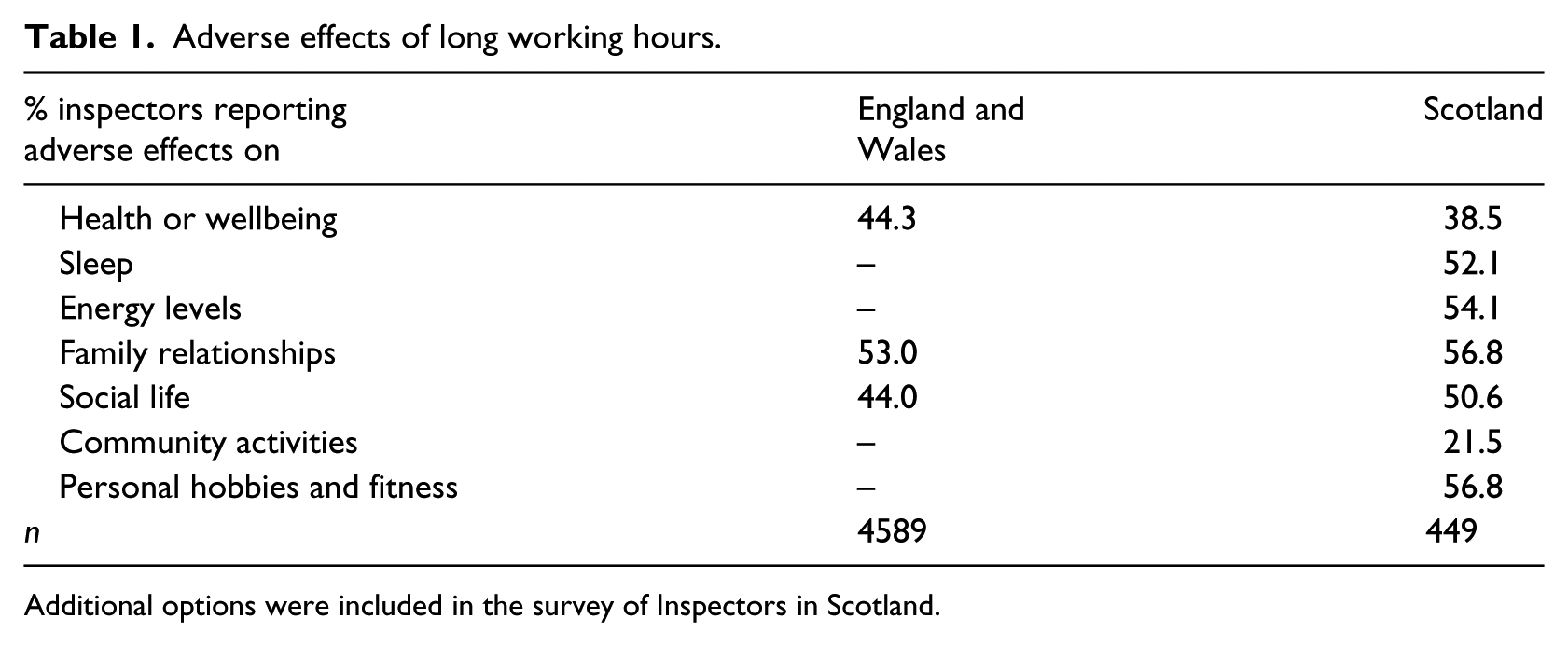
Additional options were included in the survey of Inspectors in Scotland.
Over-work in the British Police Service is inimical to diversity as women find long hours more difficult to cope with, especially when they have a ‘second shift’ at home with family, childcare or other caring responsibilities. Women make up 30% of all Constables but only 20% of Sergeants and 18% of Inspectors. Only 15% of Chief Superintendents are currently women (Home Office, 2013). Despite a formal commitment to flexible working, the Police Service in general, and specific Forces and departments in particular (e.g. CID), assume ‘ever availability’ within the Inspecting (and higher) ranks. The difficulties women face are exemplified by the denigration of part-time working—the masculine ‘cop culture’ often portrays part-time workers as ‘part able and part committed’ (British Association of Women Police (BAWP), 2002), as workers who enjoy certain ‘privileges’ rather than ‘entitlements’. Both in policy and practice, part-time work tends to be seen as a deviation from the full-time norm of policing, as a ‘concession’ to women who have family responsibilities that some policewomen also complain about: ‘I am used to working long hours whilst all the part-time and maternity brigade swan off at 4pm. It’s life’ (female Detective Inspector).
All too often there is no specific managerial strategy for the deployment of part-time workers (IBB-MPS, 2014). In the words of one Chief Officer, The police service is utterly opposed to flexibility in things like working from home, flexitime or ‘nine-day fortnights’. All these things are seen as HR fads, and not part of ‘proper’ policing. (Quoted by Caless, 2011: 74)
Thus, gendered conceptions of police work continue to reflect and support the way policing is organized and ‘manned’, based as it is around the assumption of a ‘perfect manager’ as found elsewhere in both the private and public sectors (Ford and Collinson, 2011). Policewomen comply, policewomen complain, My boss (DCI) works at least 12 hours every day on top of a 3-hour daily commute. A mind blowing 15-hour day, every day. She doesn’t use her leave entitlement. She doesn’t put pressure on me to do the same but … there is however, indirect pressure in so far as I constantly feel, wrongly, that I am somehow not pulling my weight by comparison. A newly implemented MPS ‘on-call’ DI’s rota has made matters worse by requiring me to regularly take on-call responsibility on 12-hour weekend night shifts for seven London Boroughs … It’s a crazy situation … driving alone across London to a critical incident at 5am after working for 10 hours and 6 days prior to that and being expected to make good decisions. This is NOT progress. (Female Detective Inspector)
As women seek to progress in the Police Service, their choices are increasingly constrained. Some will simply curtail their ambitions to be promoted: It is obvious that I cannot provide the same commitment as some other male colleagues who do not have the same issues to contend with and can get in at a much earlier hour which appears what is required. In view of this I have decided that the current climate is not going to work with seeking further promotion if my home/private life is to remain intact. (Female Community Inspector)
Others curtail their ambitions to work in specific roles: The DI [Detective Inspector] role is the one that gets hit really hard. The on-call is ridiculous. I’d love to do the role as I have been a DS [Detective Sergeant] but as a single parent I could not cope with the hours worked. (Female Community Inspector)
Extreme work within the Inspecting ranks—long unsocial hours combined with responsibilities that amount to more than one job—cannot be sustained without detriment to the workforce (adverse health effects), the organization (unrepresentative of the community) and wider society (degraded interactions). Leaving aside the fact that almost every police Force is breaking the law (WTRs) by failing to accurately record Inspectors’ hours and ensure a maximum working week of 48 hours with adequate rest breaks and recovery time between shifts, the Police Service has a duty of care to its workforce as well as the citizens and communities it serves. When they ‘mess up massively’ because of the pressures of work, Inspectors expect to be ‘hung out to dry’ (male Operational Inspector) rather than supported by their Force—in South Yorkshire, 84% of Inspectors who responded to our March 2013 survey agreed that they ‘do not trust the organization to look out for your interests’. At the ICC’s Annual Conference in 2014, when the issue of PACE reviews for mentally ill detainees was debated, Tom Winsor, Her Majesty’s Chief Inspector of Constabulary, was asked whether ‘austerity is a defence’ if the Inspector ‘cocks up’? His response was unequivocal: ‘No. The liberty of the citizen is too precious’. 16
Conclusion
At a meeting to review their recent performance, a group of Inspectors were told by their Superintendent to ‘Step up, don’t play up’, followed by the observation that ‘If you don’t like it, Morrison’s are recruiting’. The ‘threat’, of course, was ‘said in jest, these comments always are. But that doesn’t stop everyone taking the hint: you “step up,” you don’t “play up”’ (Community Inspector, ESRC-ICC Regional Workshop). Unlike regular employees, servants of the Crown can be commanded to perform extreme work, but this does not make Inspectors an ‘exceptional case’, despite the exceptional (inherently dangerous) work they are occasionally called upon to perform. In fact, as for most middle managers, it is what would normally be regarded as the mundane aspects of the job—‘the day-to-day stuff’, ‘your day-to-day grind’—that is more often experienced as extreme. In day-to-day operational policing, extreme (over) work is reproduced through coercive forms of institutional maintenance as well as the normative ideal of the tough, no-nonsense crime-fighter. But Inspectors are experienced enough to appreciate the value of community policing and the ‘social work’ they are called upon to perform. They certainly don’t appreciate their commitment to the job being exploited by the Police Service in terms of unpaid overtime, cancelled rest days, accumulated annual leave and toiling for no TOIL.
In the Police Service, selves and roles are tied to the organization through professional training and progression through the ranks, producing a strong sense of mission (‘get the job done’) and a heroic (masculine) work culture (‘don’t complain’). Professional discipline has allowed police Forces to meet their targets and deliver ‘more for less’, but at what cost to individual Inspectors, the Police Service and wider society? It is already recognized that the WTRs provide insufficient protection for employees who work overtime under ‘adverse circumstances’, including overtime that is involuntary and unremunerated (Beckers et al., 2008: 47). Add to this the demands of multiple roles and Inspectors who ‘step up’ are increasingly likely to ‘fall down’. In times of austerity, police Inspectors struggle to maintain a positive self-image and the personal resilience they need to ‘get the job done’, not least because they struggle to find time to do justice to their job(s): ‘Never mind a good job, you were just trying to make sure that you didn’t mess up massively’ (MPS, first focus group). In this way, when the Police Service is struggling to maintain its service delivery, extreme work can also produce extreme consequences for individuals (the liberty of the citizen) and wider society (policing by consent).
Footnotes
Funding
The Inspectors’ Central Committee (ICC) and Inspectors’ Branch Board reps (Police Federation of England & Wales (PFEW) and Scottish Police Federation (SPF)) provided support throughout this project. The Economic and Social Research Council (ESRC) (ES/K005618/1) provided financial support for the second phase of the research.