




Abstract
Our highly sensitive ethnographic study with anti-money-laundering analysts delves into the understudied link between embodiment and ethics in organizations. We begin by reclaiming the importance of bodies and embodiment in the business ethics literature, which largely assumes preeminence of the mind over the body. We then draw on French phenomenologist Michel Henry’s theory of the subjective body to advance our understanding of ethics as endogenous embodied practice rooted in life. Through the experiential realities of our ethnographic work, we show how the two interrelated dimensions in which embodiment occurs (subjective body and organic body) operate at two interrelated levels (subjective and intersubjective experience) to advance theory on the implications of corporeal ethics in organizations. More specifically, by reclaiming and specifying the ontologically embodied and shared dimensions of ethical subjectivity in life, we show the emergence and development of an esprit de corps, which allows embodying collective ethical practice while resisting to continuous external pressures.
Keywords
Introduction
Ethics […] shows itself to be co-extensive with life, and its full development. (M. Henry, 2012 [1987]: 96)
1
Most studies on organization studies refer to workers, managers, CEOs and teams as if they were abstract entities deprived of bodies, in order to focus on their cognitive abilities or emotional-biochemical facets. We often have to go back to the literary descriptions of 19th century novelists like Zola to get a sense of what being a worker actually felt like. In our field, it is mostly through ethnography and participant observations that we can approach workplace life (Van Maanen, 2011). However, the implications and the role of the body remain fairly understudied (Hassard et al., 2000) particularly when considering ethics and organization (Pullen and Rhodes, 2013).
Today, business ethics is mostly conceptualized as organizational actions that can be judged in light of particular criteria and contextual factors because it is thought from and directed to exteriority (i.e. focused on developing measures, and codes of ethics). In response to this exogenous perspective, the recently developed business ethics as practice approach, hereafter, BEAP (Clegg et al., 2007; Loacker and Muhr, 2009; Painter-Morland, 2008), has already moved beyond this somewhat instrumental approach to reclaim an endogenous ethics with a subjective nature. This perspective seeks to be more organizationally relevant (Barker, 2002; Pullen and Rhodes, 2013) by conceiving ethics as ongoing organizational phenomena (Ibarra-Colado et al., 2006; Pérezts, 2014; Puyou and Faÿ, 2013; Wray-Bliss, 2002, 2009), implying one’s responsibility to others (Bevan and Corvellec, 2007; Roberts, 2001) and, thus, the ethical self as personally committed to the practices in which it engages (Deslandes, 2013; Ibarra-Colado et al., 2006; Loacker and Muhr, 2009; McMurray et al., 2011). Following this line, this article considers ethics endogenously and as pertaining to being, which links us back to an epicenter of ethics as embedded in ethical subjects instead of codes of ethics, or other tools designed to either implement or measure ethics (Baker and Roberts, 2011). However, in doing so, we point to an area that remains largely underdeveloped: the bodily dimension of ethics. How are bodies at work more than simply bodies at work? How do embodied subjectivities deploy ethical or unethical practice as individuals and organized working groups? How does the practice of endogenous embodied ethics encounter, and conflict with exogenous organizational ethics?
Our paper seeks to explore the conflicting relationship between working bodies, exogenous versus endogenous ethics, and organization to advance our understanding of business ethics as endogenous embodied practice. First, we argue that embodied ethics constitute a neglected dimension in the rationalist Western paradigm, which asserts the ontological and moral primacy of the reasoning mind (logos) over the body (bios). Within this paradigm, ethics are somehow assumed to preexist bodies, and to constrain them exogenously. Bodies are then mostly seen as the object of disciplinary and surveillance practices (Ball, 2005; Hassard et al., 2000). In contrast, we believe it is impossible to think about ethical subjectivity and ethical practice independently from the people—as living beings—who incarnate it.
With the quote above by French phenomenologist Michel Henry (1922–2002), marginally known in organization studies, as our starting point, we aim at introducing a novel way to tackle this underdeveloped dimension by exploring how, in organizations, embodied life may be experienced as the locus of ethical subjectivity and practice. More specifically, we argue that a Henryan perspective of an ethics ‘co-extensive with life itself’ can greatly contribute to renewing our understanding of endogenous embodied ethics as organizational phenomena. Henry’s theory of the subjective body allows delving into this issue in two major ways: first, by conceiving ethical practice from the standpoint of interrelated subjective and organic body experience, that is by grounding the possibility of ethics in embodied life itself; and second, by pointing to how this individual experience can also grow at a shared level. Following Henry, we show how ethics are viscerally lived, experienced and enacted not only by individuals, but also and foremost through the continued collective ethical effort underlying what we identify and develop as an esprit de corps from which the immanence of life is sustained and grows to enable resistance to hostile environments.
We shall present these findings through an ethnographic study that captures the experiential realities of embodied ethics at work. It was conducted in a particularly confidential and unique setting: the everyday work of compliance analysts in a French investment bank (FIB), dedicated to anti-money-laundering. We will end by discussing implications and avenues for further research.
Ethics and bodies: examining an underdeveloped link in the literature
Recent developments following the practice turn in business ethics seek to consider the way ‘ethics [actually] happens’ (Clegg et al., 2007). This has lead to rethinking business ethics as ‘the everyday business of business’ (Painter-Morland, 2008), that is, embedded in everyday activities. However, while this new perspective has helped researchers break free from exogenous, measurable and depersonalized perspectives on ethics, its corporeal dimension remains not only underdeveloped (Pullen and Rhodes, 2013), but also ambiguous.
Indeed, if we consider our Western societies’ ethical development, the underlying relationship between ethics and the body is far from being morally neutral. It is rather of a conflicting nature. For instance, the Greek logocentric heritage has had a profound influence on granting a superior ontological value to the rational soul (logos) while considering the living body as our animal and vile side. Such an ontological dichotomy, illustrated by Cartesian rationalism based on the ‘ego-cogito’, has favored the moral conceptions of the body as the locus of sin and deviance, which can be found in Stoicism and Jansenism, for example. Morality, deontology or even practical wisdom (whether inspired by Aristotle or Kant) has thus long been exogenous to the body, imposing rules over its otherwise almost ‘natural’ immorality.
As critical management scholars, we cannot but remark that bodies are a key dimension in organizations (Hassard et al., 2000), yet founding mainstream works carry the same underlying assumption about human nature and human bodies (Ball, 2005), which can then hardly be considered as a basis for the possibility of embodied ethics and practice. Indeed, Taylor’s principles were elaborated based on rationalist scientificity. Simon’s cognitive views convey a disembodied conception of man depicted as an Information Processing System. Such widespread theories have conceptualized the firm on the dichotomy of conception (mind of the corporation) versus execution (body of the corporation), which largely persists today. Utilitarian ethics cohere with this view of rational management, which, through disembodied and indifferent calculation, organizes and constrains the workforce for the ‘production’ of greater social good. In this context, (often) paternalistic workforce ethics inevitably appear as an object of disciplinary tools and processes.
Conceiving ethics as an everyday practice, BEAP clearly seeks to depart from the exogenous perspective in which some scholars have tended to lock ethics. As Nietzsche (1991 [1881]) would argue, obedience or compliance with norms is not in itself ethical, it is simply duty. In his terms, mere compliance with norms ‘kills’ ethics by reducing it to a deontological and utilitarian approach that reinforces the dichotomy highlighted above. However, despite its various philosophical influences discussed hereafter, BEAP struggles to account for the role of the body in ethical subjectivity and practice, leaving the link between embodiment and ethics insufficiently theorized.
Indeed, the virtue ethics approach remains dependent on the domination of the mind over the body, despite offering the advantage of focusing on moral agency instead of depersonalizing ethics. Accordingly, these studies highlight that all individuals must exercise phronesis (practical wisdom) in order to develop strength of character and decide on the most appropriate behavior for acting virtuously in particular contexts (Hackett and Wang, 2012; Koehn, 1995; Moore, 2005). Here, the sensing body provides raw knowledge about the situation but, although the rational soul drives the process, stressing primacy of logos over the body. Therefore, accounting for embodied bonds and heart-rooted solidarity when organizational contexts do not incline toward ethical behavior remains a pending issue for virtue ethics approaches (Deslandes, 2011).
Furthermore, critical scholars have built on the final works of Foucault to develop the notion of ethical subjectivity in which any conceptualization of ethics as actual practice must be rooted in ‘how people at work constitute themselves as subjects in relation to ethics and the practices they adopt in forming their sense of an ethical self’ (Clegg et al., 2007; Deslandes, 2013; Ibarra-Colado et al., 2006; Loacker and Muhr, 2009; McMurray et al., 2011: 543–44). Here, it is attempted to link ethics back to its etymological roots pertaining to being and ethos, that is, an ontological foundation (Pérezts, 2012). Indeed, a clear focus is not only on moral agency, but also on the self, as the locus of ethics, which then results from intertwining exogenous norms and endogenous freedom: ‘the self is ethical insofar as it exercises a freedom both in terms of what to do and who to be’ (McMurray et al., 2011: 544). However, there is still a surprising logocentric lack of consideration of the body in and of itself as bodies in this Foucauldian heritage remain mostly alienated and objects of control.
Recently, the importance of embodiment has been stressed in a rather novel way by drawing on phenomenology. Hancock (2008), following Merleau-Ponty, asserts that the pre-reflexive body is the site of perception, power and recognition and therefore of mundane inter-subjectivity. From this perspective, the body can indeed be the locus of moral behaviors such as generosity and responsibility (cf. Hancock, 2008; Küpers, 2014, both drawing on Diprose’s notion of corporeal generosity). However, it is difficult to find in Merleau-Ponty alone how the pre-reflexive body intentionally turned toward the world may get a sense of self (Faÿ, 2005; Henry, 2004). Hancock (2008) indeed significantly underlines that: ‘it is in the alienation of the body to the gaze of the other that enables us to exist within a process of corporeal being and becoming’ (p. 1361). The risk that aggregated embodied existence does not lead to ethics at the collective level either then arises. As an illustration of this, Chikudate (2002) analyzed a Japanese bank where common embodied sense led to ‘collective myopia’ and racketeering practices. Such possibilities for unethical behavior create the difficulty of using Merleau-Ponty’s pre-reflexive embodied logos intentionally turned toward the world to account for ethics lived and practiced in organizational contexts driven by non-ethical objectives.
Another stream of research (Bevan and Corvellec, 2007; Loacker and Muhr, 2009; Roberts, 2001, to quote but a few) has increasingly relied on Levinas to depart from the logocentric perspective and to foster the possibility of an endogenous embodied ethics. In a pioneering work, Roberts (2001) underlines this embodiment of ethics: ‘the ground of ethics lies in our corporeal sensibility to proximate others’ (p. 109). Indeed Levinas departs from Western rationalism and ontology in an interesting manner, dismissing the logos at two levels: (1) my infinite responsibility as an ethical subject toward all others arises in an embodied (not only visual but also almost mystical) encounter—at times traumatic—with the Other’s face, and (2) ethics precedes ontology because my sense of being unfolds from my response to the Other. However, although Levinas performs a very interesting ontological turn in favor of the embodied encounter with the vulnerable Other, several questions regarding organizational ethics remain unanswered: How do Levinasian perspectives account for ethics when, in organizations, the Other is not demanding and weak but aggressive and ‘armed’ with exogenous moral and economic doxa, instruments, measures and figures? Where does the energy to encounter and get close to such others appear?
To summarize, we found that virtue Ethics and Foucauldian approaches still rely heavily on reflexivity and do not easily depart from Greek dualism and rationalism, while Merleau-Pontyan and Levinasian views, each in their own way, lean toward an alienation of the self in the other. Therefore, although such approaches have certainly contributed to our understanding of the cognitive, evaluative, political, and even to some extent the bodily dimensions of our being or ethics, we still lack an encompassing proposal that would allow the possibility of departing from Greek dualism while drawing on an ontology of our subjective embodied and ethical life, sharing its essence and praxis with others. Can we find a different (non-alienated) corps (body) in the corp-oration, and how do these corps develop into an esprit de corps, that is, a common spirit and feeling of belonging among an organized group? Henry’s original theory of the subjective body can shed useful light on these questions.
Re-embodying ethical practice: insights from Henryan phenomenology
Although the contribution of phenomenology is widely acknowledged in organization studies, the work of Michel Henry remains marginally known in this field (Faÿ, 2005, 2007; Faÿ et al., 2010; Letiche, 2006, 2009) and in business ethics (Puyou and Faÿ, 2013). In this section, we develop the ways in which his phenomenological proposal differs from others, allowing us to substantially contribute to articulating ethics and subjective/intersubjective living bodies, and organizing.
The radical immanence of embodied life
In the Essence of Manifestation, Henry (1973 [1963]) distinguished two modes of appearing of phenomena in a radical, novel way. The first, widely explored both by Husserl and Heidegger, is our capacity to perceive phenomena ‘in the light of the world’: outside of us, through the objective mediation of representations. Yet for Henry, there is another way phenomena appear to us, which he calls the ‘light of life’. Sentiments, emotions and feelings of effort appear to us from affectivity, with no distance between subject and object, and thus in an immediate way. Nonetheless, Henry contributes to more than simply an ‘affective turn’ in organizations’ studies. Indeed, at the core of this second mode of appearance is the materiality of our subjective and affective body where our being in life appears to us as an inescapable experience. From this radical phenomenological novelty, Henry built a theory of the subjective body giving full ontological status to embodied subjective life.
Henry argues that western philosophy largely gave ontological primacy to logos, as illustrated by Descartes’ ‘cogito ergo sum.’ Hence, the immanence of embodied subjective life was ignored or overlooked, being subordinated to the reasoning mind as discussed above, leading to deontological or utilitarian ethics. Henry argues that when life was rediscovered in the 19th and 20th centuries by thinkers such as Schopenhauer, Nietzsche, Bergson or Merleau-Ponty (1962), it was mostly as a blind and anonymous flow of energy on which people were embarked: ‘I feel destined to move in a flow of endless life […] along with which there comes to me the feeling of my contingency’ wrote Merleau-Ponty (1962: 364). This happened in parallel with a rational reduction of life by science to its objectified representations such as biology or chemistry (for the human body) or sociology and other social sciences (for collective human organizations). Henry (2005) states that his philosophy of subjective embodied life came from his own experience of resistance in Nazi-occupied France: The experience of resistance and maquis have had a profound influence on my understanding of life … the essence of true life was revealing to me, as invisible. In the worst moments, when the world became an atrocity, I felt it [life] inside of me as a secret to be protected and which was protecting me. (p. 491, our translation).
Inspired by Spinoza’s conatus, Henry later conceptualizes that each subjective life, as a subjective body, is endowed with an endogenous dynamic, an effort to maintain itself and grow independently of the variety of existential circumstances. At the same time, he also underlines the experience of being in life as a gift that we all share because no one gives oneself life: ‘the movement through which life tirelessly comes into oneself … is already given to oneself in the absolute passivity of the radical immanence of life’ (Henry, 2012: 98). Hence, life is the ontological foundation where the three endogenous dimensions of each subjective body will be deployed: to maintain itself, to grow, and to be involved in the given/giving dynamic. Needless to say that such an ontological perspective differs from selfish utilitarian views that ground the common good in the aggregated pursuit of individual interests.
Phenomenology of subjective and active bodies
Henry’s (1975 [1965]) Philosophy and Phenomenology of the Body is the core of an entire development on the radical immanence of one’s living subjective affective body totally interconnected with one’s organic body. Referring to the non-Cartesian, 18th century philosopher, Maine de Biran, Henry underlines that by exercising any of the powers of our organic body, we may feel having power over such powers (i.e. we have power over our power to seize objects). This is precisely our affective subjective body, which appears to us in action not as the Cartesian ‘I think’ but as the phenomenological ‘I can’. Thus, Henry both distinguishes and associates our subjective body and our organic body: the life of our subjective body fuels the efforts and abilities of our organic body in the world. At first, the world appears to us as resistance to such efforts while also a sense of fulfillment may appear—or not—in the subjective body. Henry uses the word praxis and infuses it with the full and rich sense of the subjective body experiencing itself while being active. This phenomenological approach to practice, immediately given in active and affective embodied life, departs from considering practice exogenously and through various abstract representations (Letiche, 2006). Furthermore, in his re-reading of Marx, Henry (1976) comments, Although it is by essence individual, it [praxis] is never the fact of an isolated ego … Because, in order to make a living, individuals act together, they live together. Being-with is acting-together and relies on it. Similarly to being, inter-subjectivity finds its originary essence in praxis. (pp. 118–19, our translation)
Hence, Henry argues that living collectives emerge from the endogenous ontological organizing dynamic of subjective bodies and alienation emerges when mechanical, objective, economic or technological systems become the foundation of organization. Hence, the crucial test of being able to share, or not, the embodied dynamic of subjective bodies in the various configurations and interpretations of the different roles we play (Gély, 2007).
Ethics as co-praxis
For Henry (2012 [1987]), ‘ethics is not a separate domain, […] it shows itself to be co-extensive with life and its full development’ (p. 96) and consequently does not result from following exogenous norms. Instead, Henry fundamentally reverses the logocentric exogenous perspective: Rather than determining the action of life, goals, norms and values are determined by it. Consequently, ethics appears when working alongside and sharing efforts with others, we feel that we cohere with the endogenous dynamic of our own life, which ‘knows immediately’ (pre-reflexively) what is good for it. Such sharing of life’s immanent dynamics offers insights to develop a Henryan perspective on ethics lived as co-praxis in a social body, that is, as shared within a group, with no difference between shared ethics and shared praxis.
Yet Henry acknowledges that ethical practice is not natural or spontaneous, and one must sometimes accept that there will be moments of suffering. Fleeing from such suffering is then always possible, as are unethical practices. In Barbarism, Henry (2012 [1987]) analyzed the difficulty of ethical practices in the modern world where the organization of work is no longer rooted in the subjective and organic body: Imagine a world where the organization of work is no longer rooted in organic subjectivity, where work is no longer the actualization of one’s power … and thus the ‘liberation of their energy’. Then instead of this feeling of liberation a profound malaise comes to affect existence and numb it … locked into a suffering that no longer goes beyond itself in enjoyment … The impossibility of fleeing oneself becomes anxiety. (pp. 103–04)
Such malaise may also trigger creativity and responsibility, that is, in the Henryan sense, the energy and power to resist and to act differently. Now we will rely on the Henry’s theory of the subjective body for providing a possible understanding on how ethical resistance against the pressure of hostile environments can be subjectively and collectively lived and embodied, as our case below shows.
An ethnographic study of embodied ethical practice
Research setting and methodology
Since the 1989 G7 ‘Summit of the Arch’, banks have had to assume the formal role of ‘watchdogs’ of financial markets, with specific compliance teams dedicated to Anti-Money Laundering (AML). The underlying objective is to fight crime, terrorism, and the mafia during the transformation process of illegal money into legal wealth. For financial institutions, this means researching potential clients prior to entering a business relationship and throughout its duration, and identifying possible threats in terms of reputation or involvement in undesirable and/or illegal activities that can affect their own reputation and/or criminal liability (cf. Favarel-Garrigues et al., 2007). To do so, AML analysts had to mobilize their training in both regulations/risk management and financial products/activities they supervised. Within and outside of FIB, the team studied was renowned for being particularly efficient at ensuring their risk-management function by being morally ‘unbendable’. However, the working climate was tense: the implementation of new AML regulations inevitably exacerbated tensions with Front Officers, whose ability to trade was hindered and sometimes compromised. The compliance team was perceived as the ‘internal police,’ and struggled daily to justify their work to their ‘colleagues’ at the Front Office, who were actually their ‘internal client’ (cf. Pérezts et al., 2011; Pérezts and Picard, 2014 for more details on the team).
AML is an extremely sensitive and confidential area of banking compliance. Access was negotiated over several months and gained only by personal relations with and trust of the team manager, who supported the research project internally. Despite the sensitive context of the financial crisis aftermath, in 2010, the first author began a 9 months ethnographic study at the Paris-based headquarters of FIB to observe and share ‘from within’ (Letiche, 2006), day-to-day AML compliance practices. She became an integral part of the environment, collecting experiential realities from the perspective of non-participant observation, followed by a period of participant observation in the form of a 2-month internship within the AML team. Adopting a practice approach (Nielsen, 2010), she recorded actual behaviors, narratives of real-world contexts regarding ethical problems (Czarniawska, 2004) in the form of verbatim and rich descriptions, in situ discussions, 12 semi-structured interviews with key actors (from different hierarchical levels of the compliance department and the specific unit studied), and ethnographic note-taking (Van Maanen, 1988). This provided a unique insider view of ethics at work in banking compliance, while upholding strict measures of confidentiality (guaranteeing anonymity of data) and transparency of the research objective (Groundwater-Smith and Mockler, 2007). Furthermore, our data allow us to shed light on various aspects of the subjective meaning the practitioners, including the researcher as a trainee, gave to their experience.
The first author shared her ethnographic journal and notes (over 250 pages) with two of these actors three times (in 2011, in 2013 and in 2014) to solicit their feedback and validation of both the transcriptions of situations and her analysis (McMurray et al., 2011). Consistent with ethnographic techniques, this process improved the reliability of our interpretation (Silverman, 2006) and allowed us to gather ‘tales’ from the field (Goodall, 2008; Van Maanen, 1988). Such tales are useful to make sense of ‘what people actually do’ and the particularity of situations that inform the way macro structures unfold in the dynamics of practice at the micro level of individual subjectivity (Evens, 2006).
Analysis of field accounts
To analyze our data, we faced the challenge of operationalizing and theorizing the corporeal and subjective dimensions of ethics. The overall process is summarized in Table 1 (e.g. coding, dynamic articulation).
Phases of analysis.
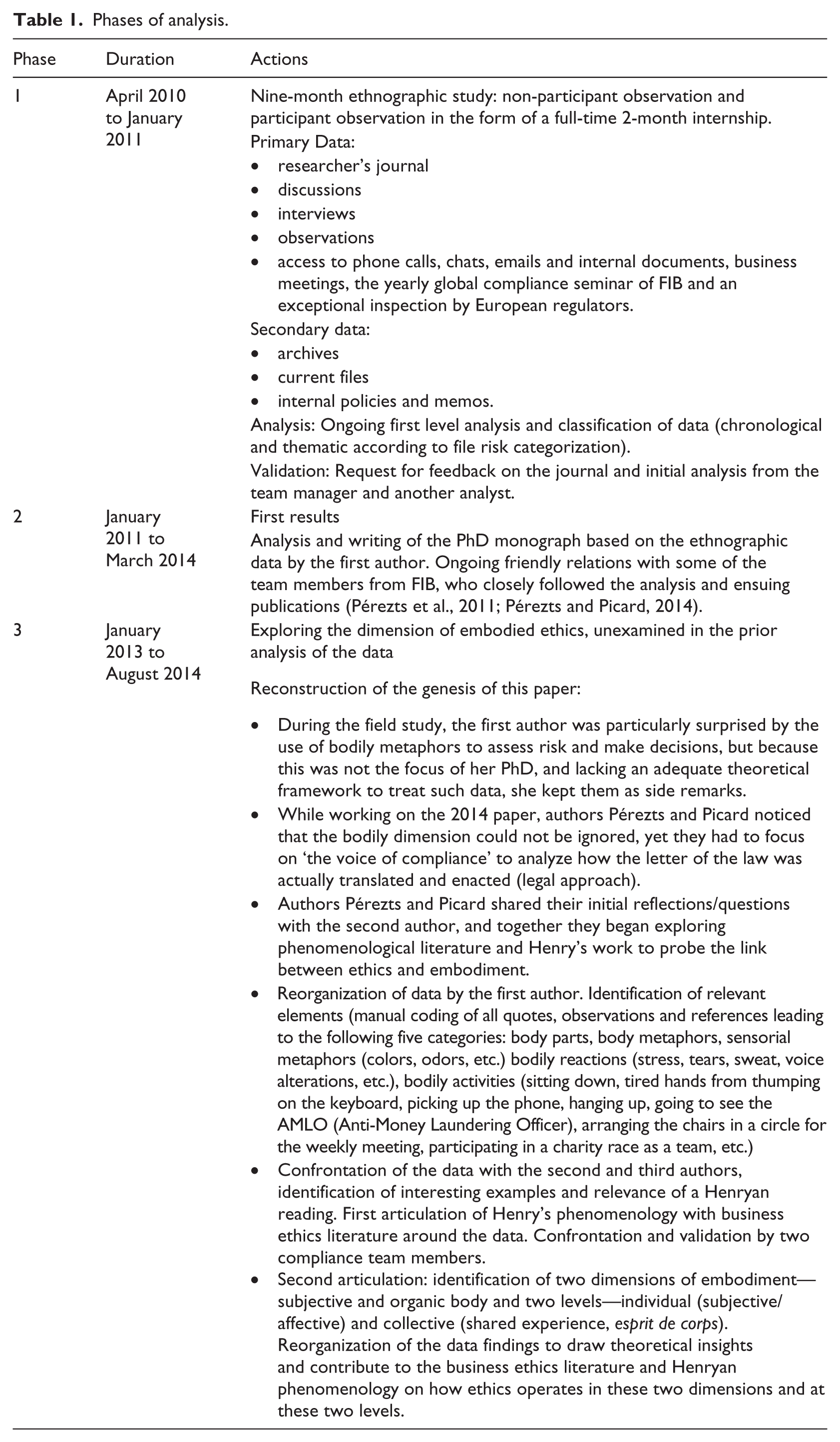
Our contribution derived from a co-generative dialogue (Depraz et al., 2003) including phenomenological reduction insights (Faÿ and Riot, 2007). First, the first author’s own experience in the field, ‘taking close to the same shit others take day-in and day-out’ (Van Maanen, 2011: 220) was crucial: She experienced firsthand the subjective and shared embodiment of ethics. Given that ethnography is close to a phenomenological perspective, the first author was particularly ‘open to the feelings, sentiments and specificity of the researched […] beneath the self-serving rational gloss [in line with] a phenomenology of organization focusing on the antinomy between life and representation’ (Letiche, 2006: 11–12). Second, to ensure higher reliability, her experience as an embedded researcher was shared and discussed among the three authors through the creation of narratives (Van Maanen, 1988) and related phenomenological interpretations. This methodological approach facilitated an ongoing dialogue where each author’s singular experience and theoretical horizon was never subordinate to the others’ but rather invigorated by them which brought new insights into being an ethical analyst as an embodied experience.
We found that bodies, although often ignored, are at the forefront of any organized activity, including banking compliance despite its reliance on abstractions such as legal regulations, procedures, specialized software, and bureaucratic workflows. Figure 1 summarizes our results about the role of the two interrelated dimensions of embodiment (subjective and organic body) as both individual and shared experience also interrelated, leading to the emergence of an esprit de corps. Below, we shall detail these findings by interweaving narratives of the role bodies play in the daily practices of compliance, shown indented, and in a different font, and paragraphs containing our analysis drawing on Henry’s insights.
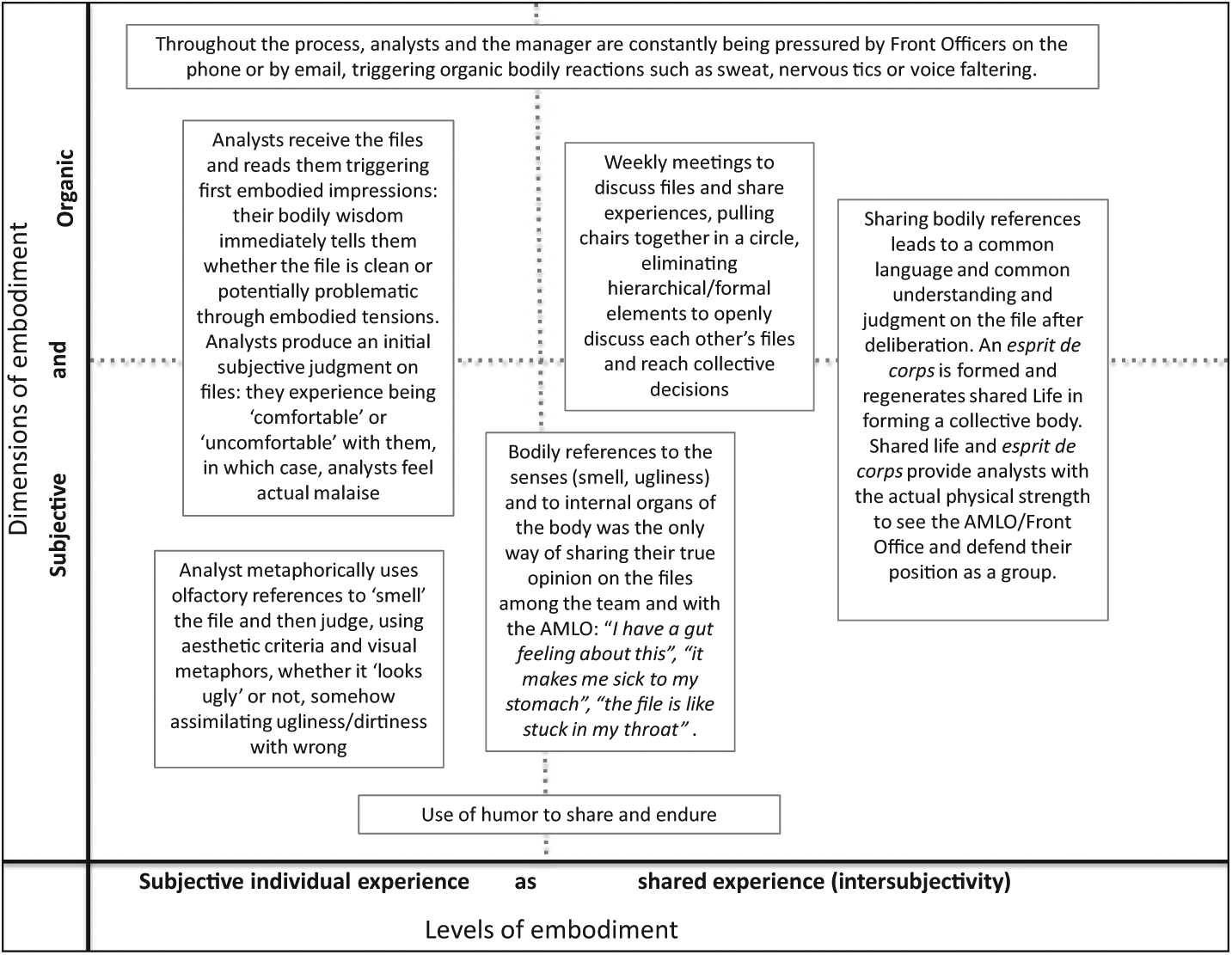
Interrelated dimensions and levels of embodiment.
Ethics as practice of a subjective and organic body
The main work of compliance analysts is to categorize potential clients by giving them a risk rating, and making business decisions accordingly. At first, it seems that they rely solely on diverse specialized lists and databases (e.g. lists of uncooperative countries, of previous sanctions). Yet such tools are far from sufficient because they are numerous and independent from each other, so often contain disparate information. Analysts must thus ‘manually’ triangulate this information to properly conduct their screening investigations, implying, and sometimes despite the lists, a synesthetic understanding of the files (i.e. on triangulating with sensorial impressions), which, when combined, trigger a particular risk-labeling: Analysts, may be compared to police dogs, if such an analogy may be used, literally ‘sniffing out’ potentially risky clients thanks to their expertise and their ‘developed sense of smell’, sometimes despite (or especially in cases of) apparent ‘compliance.’ Indeed, around 20% of the files concerned non-profit organizations, where neophytes in money laundering would least suspect unethical practices to occur. However, ‘those are the most tricky cases’, commented the analyst in charge of one such file, ‘it’s all good intentions and good deeds, but this kind of thing often stinks. Curiously, it’s where you would suspect the least that there is often something hidden.’
2
The first author concluded that the underlying work of the FIB team was to be ‘nosy’ and to pry into ‘stinky’ files. Indeed, analysts sometimes request that a file be blocked altogether solely on the basis of ‘an itchy feeling that something doesn’t smell right’ or at least call for continuing investigations despite time pressures and apparent compliance. In AML, pecunia non olet (money has no smell) seemed to ring false, but money did appear to have a color. From white as snow to deep black, and numerous shades of gray in between to categorize the ‘dirtiness’ of the money and to describe analysts’ personal feeling about the file. Through numerous discussions with the analysts, emails between team members and observations, the first author gained a sense of how the experience of dealing with sensitive cases could be uncomfortable, stressful and even painful. Some analysts had even developed nervous tics and literally lost their breath when the phone rang and they knew it was the Front Officer complaining about delays in their work.
Analysts’ organic bodies are thus the receptacle of their subjective bodies’ actions and warnings. The color metaphors appear here as a way to make sense of the degree of riskiness for them and for the bank. In fact, before analysts could hide their embodied experience behind legal arguments, their ‘subjective body had to talk’ and make its organic and sensorial arguments known. This can partly be explained by the fact that analysts’ personal liability is very high if a file gets approved and money laundering is later revealed (10 years of imprisonment and 750,000 Euros in fines, not to mention job termination), which might lead us to think that they simply obey the rules. However, it does not fully explain why they track ‘dirty files’: in the end, we noticed that whether the file is compliant or not comes second to their ‘feeling’ about it, whether they are comfortable or not with it, regardless or in spite of its compliance (Pérezts and Picard, 2014). The ‘dirtiness’ of potential clients or transactions is thus something that is felt in the analyst’s body prior to being thought and justified with their rational minds. In many respects, ‘bodily wisdom’ and its alerts in the form of embodied tensions were the most important tool in the everyday practice of dealing with exogenous norms of AML compliance. Indeed, our data analysis suggests that the body—surprisingly from the standpoint of the logocentric perspective—actually appears to be the first locus where categorization, judgment and sense of accountability are manifested.
For Henry, the living subjective body, endowed with the endogenous ethical dynamism of life, translates its meaning into sensorial metaphors and ‘gut feeling’. The question of AML is therefore far trickier than equating compliance with exogenous norms: it engages the whole person of the analysts conducting these checks. Following Henry’s perspective, the living subjective and organic body crucially reveals how analysts experience their life itself at work. Elements such as nervous tics appear—at the organic body level—as the test of one’s subjective body, one’s life lacking confidence in its ‘I can’, when dealing with difficult files or hostile Front Officers.
From the subjective malaise of working bodies to shared embodiment
AML analysts could certainly conduct their screenings indifferently, remaining aloof from situations and dealing with files bureaucratically. This might be a means to preserve oneself from being affected, but strikingly the AML Team at FIB refused to succumb to the role of mere service provider to a petulant internal client by mechanically turning compliance into a box-ticking procedure: The newly arrived team members were particularly subject to high ‘emotional cost’ and visible embodied tensions—their legs would move frantically underneath the desk whenever the phone rang; they kept rubbing their sweaty hands together. The first author was able to document how Front Officers would harass AML analysts numerous times a day on the phone and with emails, pressuring them to rubberstamp the file, and do it quickly. They would constantly debase them as a useless ‘cost center’, address them disrespectfully, and blame them with their hierarchy if their own results were not satisfactory. Mentoring of newer analysts by more experienced ones was one of the manager’s priorities for the team, particularly because they could share tricks and restore confidence in their ability to resist aggressions. Indeed, more experienced analysts had somehow learned to live through pressures in a different affection than guilt or stress. For instance, their tone of voice was barely altered when being continuously insulted over the phone by impatient Front Officers, or they sometimes even ‘play[ed] with their nerves as they like to play with ours’ like by letting the phone ring. During the fieldwork, the first author benefited from such mentoring, officially by two analysts, but in practice by the whole team, who were very open and willing to share their tricks of the trade and sense of internal politics, and quickly welcomed her into their ‘sharing of life’s difficulties.’ Despite being officially individually responsible for the various files, none of the analysts actually worked alone. Once the team agreed on the dirtiness or stinkyness of the file, they were able to collectively negotiate its refusal with their hierarchy. In such sensitive cases, they would usually call a meeting with the AMLO and go up to the 27th floor to personally explain the bodily ‘reasons’ for their refusal or doubts—sensory manifestations/ethical evaluation that can hardly be explained in emails—to which the AMLO usually responded with similar bodily based arguments as the only way to relate to their justifications: ‘I’m not comfortable with this file either’.
If the organic body is the first indicator of embodied tension in the subjective living body, it was not endured in isolation: the ability to face difficult situations cannot be reduced to solitary action because it includes interpersonal relationships. Sharing wisdom and tricks of the trade raises the sense of togetherness and illustrates Henry’s argument that ‘being-with is acting together’. Furthermore, sharing assessments through organic sense metaphors within a team reinforces both their lives and the strength of their embodied ‘I can’. They can then resist hostile aggressiveness from the front office and hold their positions. In a Henryan vocabulary, sharing with others through their subjective and affective body, they experience the coming to itself of life generating or regenerating their subjective power to act. Their interpersonal links strengthen as they share the risky assessment and move their bodies (as a collective body) to share their embodied wisdom with the AMLO. ‘Going up’ appears as a manifestation of the subjective body’s energy to move both the individual organic body and sharing this with others to manifest the collective body of the team: The first author then remarked that analysts often joke and make humorous remarks to lighten up the tense atmosphere and relieve stress within the group. For example, it was a common practice that if things were getting tense on the phone, the analyst would put the loudspeaker on, so that other analysts could hear and bear witness to both sides of the conversation. Before going on to debriefing together on what to do, analysts would often replay parts of the conversation and mimick the faces of the Front Officers, to humorously strengthen their affective life, made fragile through the stress of the situation.
Humor appears here as a different manifestation of affective life, to help individuals endure its more painful experiences and resist hostile environments. Such use of humor within the team indeed proved to be an effective way to show support for another analyst when dealing with complicated but potentially lucrative files (Westwood and Johnston, 2012). Thus, the compliance procedure and basic team-work is not enough: there is simultaneously an ongoing process of affective life being shared through subjective and organic bodies. Indeed, by mimicking the faces of Front officers whom analysts did not actually see with their organic body (most were phone or email conversations), shared humor with their colleagues allowed analysts to experience being member of one ‘body’ and resist aggressiveness as one. We consequently argue, in a Henryan perspective, that shared humor, appears here as a regenerating move of affective life strengthening itself with others: Another key moment in performing compliance ethically was during the weekly meetings introduced by the manager. Far from being the bureaucratic moment considered as a waste of time, these were among analysts’ most awaited moments of the week. They would pull their chairs together around a circle, hierarchies would disappear, leaving only the analysts as people, and they would return to the most difficult files of the week by literally re-acting/reliving the situations and conversations. Other analysts would thus be apprised of the situation. They then decided as a team which rating to give a client, while sharing and reenacting their objective of ‘moralizing the front’. The group acted as a singular and essential organizational ‘organ’ of FIB.
Through the mediation of the group and its embodied and shared know-how (what tricks to use and when), ethics appears far removed from painless box-ticking. During these meetings, we observed the possibility of both shared individual regeneration and collective ethical practice. This occurred not from sharing figures and statistics but through sharing events of working life as lived in a subjective and organic body. In this sense, shared praxis, like shared active and affective life, appeared as the locus of shared effort on how to actualize ethics, a shared sense of togetherness and shared sense of each life’s growth and regenerated confidence in its capacity to act. We thus identify such regular meetings as the key moment for the emergence and maintenance of a corps with an esprit de corps, enabling analysts to embody ethical practice and resist continuous pressure from Front Officers.
Ethics as endogenous embodied practice and esprit de corps: discussion and conclusion
We refer to Henry’s theory of the subjective body to explore how the body both experiences and enables endogenous ethical practice in hostile organizational environments, thus contributing to the BEAP approach. The body appears as the locus of the incarnated ethical self, manifesting embodied wisdom through embodied organic feelings and metaphors. Yet practicing ethics in hostile environments is also lived as a test that might undermine the living subjective body’s strength for acting. In such contexts, one needs to find resources to sustain one’s embodied affective life’s and its desire to act ethically and resist whenever necessary. In our case, such ‘resistance’ was not against an institutionalized form of oppression since the AML function is an integral part of financial organizations, but to the everyday aggressiveness that Front Officers imposed on compliance employees in the name of profit. Through sharing humor (Westwood and Johnston, 2012), sharing with more experienced others and sharing life experiences during weekly meetings, subjective bodies were experiencing the regeneration of their active lives. Finally, a corporeal ethics and shared feeling of goodness emerged while individual and collective abilities were growing, along with strength for ethical resistance (Pullen and Rhodes, 2013). Through such shared and embodied ethical praxis, a corps and an esprit de corps emerges which in turn sustains practice.
We thus argue that ethics are pre-reflexive, embodied and prevail in the everyday ongoing process of bodies at work—co-praxis in Henryan terms—in which life carves out its immanence. Ethics appears in fact as an existential and embodied struggle with the way reality is experienced through subjective and ethical affectivity, thus revealing its potential for resistance (McMurray et al., 2011). The sense of what is right is described here as enacted through the affective and organic body rather than through rational intentions, yet far from being a passive, stabilized, or even taken-for-granted ‘state of being’. This is in line with other critical works on ethical subjectivity (Ibarra-Colado et al., 2006; McMurray et al., 2011; Wray-Bliss, 2009). Members of the team embody endogenous ethical practice not because they comply with exogenous norms (cf. Nietzsche, 1991 [1881]; Pérezts and Picard, 2014) but because they render it ‘co-extensive with their lives’; together they listen to their subjective and organic body and together they act accordingly. Ultimately, in their hostile organizational context, the ‘communal existence’ (Diprose, 2002) achieved in practice through embodied esprit de corps appears to be the condition of the possibility for endogenous embodied ethics to challenge, resist, interpret and enact exogenous ethics. Therefore, we show how the body—organic, subjective and intersubjective—is the locus of an endogenous and ‘affectively charged’ (Pullen and Rhodes, 2013) ethical experience and practice far different from a Kantian deontological perspective. Henry’s phenomenology helped us to theoretically do justice to such complex experiential realities (Letiche, 2006), which are often hard to account for. Indeed, grounding ethics in the giving/receiving immanence of the subjective body and on our empirical findings furthers Diprose’s notion of corporeal generosity as explored by Hancock (2008), Pullen and Rhodes (2013) 3 and Küpers (2014). Nevertheless, in our field study, we show that ethics are not only a question of generosity but also that they are lived through the ability to corporeally and intersubjectively resist the test of aggressive assaults (i.e. from the Front Officer in our case). The analysts were constantly embedded in such ‘trouble’ including threats through verbal violence. Such violence is seen as a risk for foreclosing ethics from a Levinasian perspective (Baker and Roberts, 2011). However, our data show how co-praxis, sharing experiences of attacks and esprit de corps avoid anesthetizing and closing oneself from one’s affectivity and thus to give up.
Taking such difficulties into consideration, several scholars argued in favor of an ‘ethical culture’ to sustain morally responsible managerial practices (Gibson, 2011; Painter-Morland, 2008; Todeschini, 2011). For Henry and in our field study, training the culture is transmitting ways of feeling and practicing where life can enjoy itself growing with others according to its own dynamism while resisting hostility (Pérezts et al., 2011). It is in such shared experience that the fact of being a corps and sharing esprit de corps emerges.
Here, insecurity was not leading to ‘survival strategies’ (Collinson, 2003). It was the outcome of an assertive affirmation of a shared desire to enact exogenous regulations not restrictedly on the basis of templates, but more subtlety, to block dangerous deals on the basis of embodied wisdom and esprit de corps. Such assertive affirmation is slightly different from the Foucauldian dynamic of a self aiming at constituting itself as an ethical self (Deslandes, 2013; Loacker and Muhr, 2009). Indeed, in our Henryan analysis, esprit de corps provides the ethical subject with resources to actualize itself as such through viable practices. Furthermore, the esprit de corps goes beyond sharing the ethical ‘reason of emotions’ recognized in neurobiology (Damasio, 1994). It intensifies the living and affective bond within the subjects through friendship (French et al., 2009) and encouragement in shared-praxis. This differs significantly from following ideal images of noble behavior or courageous leaders (Hackett and Wang, 2012).
Through such experiential realities that give ‘flesh and bones’ to the literature on embodied ethics (Hassard et al., 2000; Pullen and Rhodes, 2013) connected with Henry’s notions, we revisited the bodily metaphor of esprit de corps, too often reduced to the search of effectiveness through team-building with little if any empirical grounding (Boyt et al., 2005). Blumer (1951) identifies three elements as characterizing esprit de corps: the construction of an endogroup versus an exogroup (i.e. ‘us’ against ‘them’, analysts against Front Officers), the development of a companionship and camaraderie (i.e. jokes, sharing tasks and responsibility on the files) and the constitution of collective rituals (i.e. weekly meetings, Christmas dinner). Yet this cannot be reduced to a ‘shared conscience’ of belonging to the same group and sharing its fate and values. On the contrary, we build on Henry’s phenomenology to understand the genealogy of such esprit de corps as shared attempt to actualize an embodied ethical life despite pressures and hostilities, which precisely aim at undermining one’s life. Indeed, sharing the same difficult experience with others, joking together, helping others at risk, training newcomers and blocking money laundering with a sense of an important mission was in fact a way to help the ontological ethical self to keep confidence in itself and find ways of actualizing its power.
Therefore, we illustrate that organizational ethics appears in a living corps continuously generated/regenerated through shared active life, or esprit de corps. This means that individuals are united in their subjective uniqueness as are the different organs of the body each holding their own full responsibility. In other words, a renewed sense of self appears, that of being ‘one among others’ because remarkably, solidarity in praxis prevents the ‘I can’ from falling into feelings of despair, paralysis and inaction (‘I can no more’). In that sense, active and affective life is thus reconnected with its ontological source: ‘community is an underground layer and everyone drinks the same water at that source’ (Henry, 1990: 178, our translation).
Concluding remarks
We have explored the lived experience of being a compliance analyst relying on Henryan theory of the subjective body and showing its potential for articulating embodiment and ethics in organizational complex settings. Our article also paves the way for future research in relation with other theoretical frameworks. First, other essential aspects of embodiment such as race or gender highlighted by critical feminist perspectives and queer theory have unfortunately not been considered here in order to focus on the subjective/intersubjective layers of embodied ethics and practice. Second, Henry’s work might yield interesting conversations, particularly in exploring the connection between affective life and the roles we are asked to play, following Gély’s (2007) reading of Henry that could potentially contribute to theories of organizational and professional identity. Third, potential contributions of Henry’s phenomenology of life to post-structuralist research in organizations (Mutch et al., 2006, among others) might also be developed. Indeed, the emancipating and organizing power of shared subjective body or shared flesh of life, corps and esprit de corps as they appeared here, could be interestingly discussed with various emancipating levers such as self-reflexivity (Caldwell, 2007), ‘flesh of the world’ (Küpers, 2014), and the politics of resistance in organizational ethics (Pullen and Rhodes, 2013).
We conclude by a methodological remark on engaged scholarship. Relational and embodied engagement of researchers with their subjects of study is essential in business ethics research because it is through sharing their practices that we can achieve validity, in that ‘all philosophical ethics is concerned, informed and precipitated by practice’ (Painter-Morland, 2008: viii; cf. Letiche, 2006). It would have been impossible to expound on the vicissitudes of exercising the role of compliance analysts within a team without sharing the embodied experience of being one, and experiencing the tensions and life-engaging shared moments with them firsthand (Van Maanen, 2011). Being an engaged scholar was an inescapable way of understanding the complex relation between ethics and embodied subjectivity within organizations, and a way to make ethics ‘inhabited’ and meaningful.
Footnotes
Acknowledgements
Mar Pérezts would like to thank her Ph.D supervisor Jean-Philippe Bouilloud and her committee for their support and suggestions. The authors are most grateful to the editors of the Special Issue Alison Pullen, Carl Rhodes and Rene Ten Bos, and to the anonymous reviewers for their invaluable help in reviewing this paper, and to Thierry Berlanda for his insightful comments on its earlier versions.