




Abstract
This article synthesizes the results of a research on the emergence of organizational forms within solidary economy in Brazil. Discussion on solidary economy highlights the problem of how to apprehend its typical interstitial organizing phenomena. The response is given with the aid of Victor Turner’s anthropological concepts ‘liminality’ and ‘communitas’—or ‘anti-structure’—which define the ontology of social interstices. After contextualization to contemporary capitalism and to the field of organizational studies, a new approach to the solidary economy organizing process is proposed through the theoretical construct called liminal organization. The analytical framework is applied in a case study of a company taken over by workers. Empirical evidence shows that liminal organizations live in contradiction as organizing processes in which structure and anti-structure are permanently tensioned.
Solidary economy (SE) in Brazil flourishes through organizing processes guided by the necessity to produce for surviving (Santos, 2002). Nearly 2 million Brazilians live from such economic activities (Brasil, 2007). They comprise a myriad of productive arrangements—cooperatives, associations, small companies, informal and non-legalized firms, and so on—which are usually called ‘non-capitalist production’ (Santos, 2002), ‘other economy’ (Cattani, 2003), or ‘economic alternatives’ (Lisboa, 2006).
The variety of labels shows the vivid debate around the contradictory place of SE within capitalism. A copious theoretical production—by universities, churches, unions, non-governmental organization (NGOs)—aims to define SE and its organizational forms. Commonplace among engaged intellectuals is to consider the opposition of SE to the dominant economic model. An idea was stated from the normative standpoint of an organizational ideal-type inspired by Rochdale pioneers in which three features would be mandatory: cooperative production, worker self-management (WSM), and solidarity (Brasil, 2007; Gaiger, 2004; Singer, 2002, 2003). These three qualities are postulated as if they were able to condense all SE organizational processes.
Nevertheless, there is enough empirical evidence to raise suspicion about the regency of these practices (Attie, 2007; Calbino, 2013; Costa, 2007; Faria, 2009; Meira, 2009; Sarria-Icaza, 2002; Tauile, 2005). It is more plausible to understand organizing in this realm as a kind of creative process of workers in struggle against capitalism in a sort of creativity by necessity that shadows the system more than confronts it. Workers do not behave consistently with the normative machinery; practically speaking, cooperation, solidarity, and WSM are not always evident due to the distinctive contexts of each experience and the divergent values guiding economic action (Sarria-Icaza, 2002). In fact, it would be naïve not to contextualize and conceive SE enterprises (SEE) as a spontaneous empirical construction of workers since it emerged as a defensive response to mass unemployment during the 1990s (Singer, 2002).
It is intriguing, however, that the idealized conceptions of organizing and organization remain almost untouched although the SE movement has been evidently supported by discrepant organizational processes. The paradox is that workers’ real behaviors are bastardized for not coinciding with what is expected from real (idealized) workers. Researchers allegedly looking for alternatives to capitalism end up producing a great misunderstanding for not openly criticizing the taken-for-granted conceptions of the field. Workers’ organizing practices are contradictorily intertwined with the capitalist system not because they behave badly, but because of the subversive character they hold. In this article, I propose an understanding of workers’ praxis as situated and constrained but also rebel and insurgent. I intend to look at these organizing processes from an unexplored ontological perspective, taking SE as typically interstitial to capitalism in order to increase the intelligibility of SE organizing phenomena.
The analysis that follows is confined to companies taken over by workers (CTW), also called recuperadas—bankrupt capitalist firms that have been taken over by ex-employees. In Brazil, due to the economic crisis of the 1990s, businesses that were mostly medium or small could not resist the aggressive market liberalization. The existence of CTW is inseparable from this socioeconomic context in which structural unemployment and the growing obsolescence of working time as a measure of value lead workers to seek a way out of the labor market (Vieitez and Dal Ri, 2001). Usually pushed to segments not attractive to larger corporations, CTW find themselves dealing with inherited equipment, work processes, and management practices. The neutrality of technique and depoliticized factory interactions—creations of management ideology (Tragtenberg, 1992)—are embedded in the applied technology, and workers do not easily unveil these subtle devices (Vieitez and Dal Ri, 2001).
To develop the interstitial apprehension of organizations, I will take the anthropological concepts of liminality and communitas developed by Victor W. Turner (1967, 1969, 1974a, 1974b, 1977). In light of both concepts, I examine the condition of marginalized individuals and groups in contemporary society. Then I propose a theoretical hypothesis called liminal organization. Finally, I present a case study of a Brazilian CTW—fictitiously called Omega—in which liminal organization is demonstrated to be a useful concept to catch the process conducted by workers as managers.
The interstitial ontological condition of solidary economy
SE is in fact made in the interstices that the inherent crises of capitalism leave unoccupied. Bankrupt companies taken by ex-employees … unproductive land returned to peasants through land reform … the trash that infests cities and is recycled by collectors’ cooperatives … The challenge is to motivate and rescue the crowd left in the margin, to make them see that their own emancipation is possible only if they become themselves protagonists. (Paul Singer, 2003)
Paul Singer has been Secretary of the National Department for SE in Brazil, since its creation in the year 2003. Professor of Economics at the University of São Paulo, Singer is an influential Marxist thinker of his generation (he was born in 1932), and his political engagement has been indispensable to the spread of SE in Brazil. The quotation above answers the question about the relationship between SE and capitalism. It is worth noting that margin and interstice as concepts were never directly developed in Singer’s thought; neither the idea of an interstice nor the nature of economic ventures developed in this realm has been targeted in his work. The silence is disturbing, once the idea of interstice of capitalism has ontological weight.
In a recent interview, Singer (2012) again defines SE as something interstitial and contradictory. Speaking as national Secretary, he admitted that all kinds of discrimination and exclusion end up falling within the SE movement. Singer in fact has embraced the ambiguity of the relationship between SE and capitalism by suggesting that the interstice means a live contradiction within the system that hides something new and expresses exotic modes of production that manifest themselves as isolated productive provinces. These considerations, albeit plausible, do not have support in the writings of Singer. Fortunately, we can find help elsewhere.
Inspired by Karl Polanyi, Laurence Roulleau-Berger (1994, 2003) defines a realm called intermediate spaces to account for the interstitial activities in the margins of capitalism. The perspective is that of a plural economy, and the rationale is the following: the more the self-regulated market is intertwined with other economic modes—non-market, non-monetary, and informal—the higher will be the local social capillarity allowing individuals to circulate through precarious activities and to take part in different kinds of economic groups. On the contrary, the more disarticulated the economic modes are, the more intensely individuals will be pushed to vulnerable areas, to inhabit non-legitimate worlds and be exposed to the risk of social disdain. Lower capillarity plunges individuals into a struggle for recognition. Nowadays, social differences are seemingly less noticeable, although inequalities accentuate between those who have and those who do not have a place in the market society. Today, the struggle for places has succeeded the class struggle (Roulleau-Berger, 2003).
Intermediate spaces are products of the struggle for recognition. Social fragmentation makes room for the embodiment of mobilization and collective resistance spaces, which can be more or less autonomous vis-a-vis the public space. Economic actions are thought of as part of a domain of different orders: the ‘big capitalist production’ and the worlds of ‘small production’, diversified as they are and less visible. Over the last 20 years, the increase of inequalities has boosted intermediate spaces in two forms: (1) ‘social creative spaces’ occupy the interstices of institutional forms; (2) ‘social restoration spaces are produced through adjustments, arrangements, dealings and disputes between institutional and non-institutional forms’. (Roulleau-Berger, 2003: 150–51). Both are social invisible places where the experience of insecurity fosters symbolic and material sharing. They are places that redefine social order and disorder, although their connection to the institutional public space—market and the State—remains ambiguous. If the increasing perception of rational and legitimacy deficits brings some visibility to these relative autonomous spaces in the organization of society, the hope of having them all unified in a Center seems to be an illusion (Roulleau-Berger, 1994). But why conceive them as ephemeral passages from social invisibility to recognition? Would it be possible to claim interstitial economic life to be an everlasting phenomenon? Is the organized life of the interstice conceivable?
Recalling Paul Singer, these questions concern the ontological condition of SE in which the feasibility of organized life within social interstices is at stake. Following that, the thesis of social integration seems unsustainable simply because the system that supposedly recognizes people is the very same that discriminates and excludes them. How can we better understand the interstitial economic life underlying SE organizations? Brazilian writer João Guimarães Rosa (1964) describes the interstice in a piece called ‘The third bank of the river’: a man decides to live in the middle of a river alone in his canoe; he does not perform an interrupted crossing, but the being in-between banks; the storyteller is the son admiring the foggy figure of the father but afraid to follow him. If the living in between banks is thinkable and everlasting in literature, my research strategy is precisely to conceive the interstice as a social condition similar to the one on the third bank: a permanent stay as opposed to the idea of a mere passage toward social recognition.
Interestingly, subversion is embedded in the very existence within the margin:
…We do not choose the margin, we are pushed to it … We talk about the ‘excluded’ in an obvious attempt to substantiate what is merely the result of an ideological choice. But through this designation, an ‘out of field’ is created, from where astonishing questions come along. As a place for the lack of substance, the margin can just play the ‘out the place’ role that allows symbolization … in the edge of what is established … it can create a potential space for invention and recombination … (François, 2001: 10–12)
Margin and interstice designate the place par excellence of the instituting force, meaning the interrogation of the reified society. The instituting (society) is able to break the chain of imaginary significations on which the institution rests (Castoriadis, 1995). This is the privileged path to critically confront the teleological ideal-type assessment to SEE. From now on in this article, organization defines a situated creation of human beings (Castoriadis, 1995), and SEE is thought to be an emergent organizing phenomenon for which the interstitial character is decisive.
Liminality and communitas: visiting the anti-structure
Communitas breaks through in the interstices of structure, in liminality; at the edge of structure, in marginality; and from beneath structure, in inferiority. (Turner, 1969: 128)
Victor W. Turner (1969) takes rites of passage as processes that follow all change of place, state, social position, and age. They perform a transitional sequence: separation, margin or limen, and aggregation. The first and third phases comprise symbolic behaviors anchored in well-defined social positions. During the second phase, the ritual subject undergoes imprecision and ambiguity when he passes through a culture realm disengaged from his or her past or coming state (Turner, 1967). State is a metonymy to all stable culturally recurrent and recognizable conditions (Turner, 1977). Limen means threshold. So liminality is the way Turner calls the intermediate period. Liminal persons are in a situation of having no state as they are ambiguously situated ‘betwixt and between’ (Turner, 1967), since the model of society is that of a structure of positions and the period of margin or limen is typically inter-structural.
Communitas frequently develops among liminals as a non-structured relationship between individuals who are not segmented into functions and statuses, seeing each other as total human beings (Turner, 1974a). Communal groups transcend distinctions of rank, age, kinship, position, and even sex in rare cases; but such spontaneity and immediacy can seldom last for very long. As time goes by, they become norm-governed relationships between social persons (Turner, 1969).
Liminality and communitas are the two faces of the same token and define a region of imprecision within the social space. Liminal subjects are structurally invisible because members of society see only what they expect to see; they are conditioned by what is learned, defined, and classified in their culture (Turner, 1969). Structural invisibility exposes the embroilment of social classification and causes the disorder of the usual social categories. Significantly, in traditional societies liminal symbolism combines life and death: gestation, parturition, and suckling come together with decomposition and catabolism (Turner, 1967). But liminal anatomy may not be confused with faulty defined statuses: duality means that something cannot be defined in static terms. The strength of liminality comes from its extraordinary condition of denying social structure. That is why Turner (1967: 97) calls it the ‘anti-structure’, defining a realm of pure possibility and opening. The intimacy of the opposite in a single representation characterizes the peculiar liminal unity: ‘that which is neither this nor that, and yet both’. (Turner, 1967: 99). The very notion of society is twisted by the dynamic qualities of a discontinuous vital process of states, in which sociostructured and non-structured episodes are intertwined. Liminality has important implications for a general theory of the sociocultural process (Turner, 1977):
The implied dynamics of the relationship between social structure and anti-structure is the source of all institutions and social problems. Art, play, sport, speculation and philosophical experimentation thrive in reflexive interims between well defined positions and realms of social structures and cultural systems … in the sociocultural calculus, communitas and liminality represent the zeros and minus without whom it would not be possible to a social group to compute or evaluate its actual situation or its becoming in a calculated future. (Turner, 1974a: 6)
Turner (1969) emphasizes the emergence of groups with liminal attributes in periods of crisis and radical social transition when society itself seems to be moving. In this sense, social life can be seen as process-driven because structural action ‘swiftly becomes arid and mechanical if those involved in it are not periodically immersed in the regenerative abyss of communitas’ (Turner, 1969: 138). Communitas (anti-structure) and structure interrelate in a life flux. Turner (1969) defines ‘spontaneous’ and ‘existential’ communitas as typically ephemeral social forms that arise in the interstices of the social structure. Two other forms—‘normative’ and ‘ideological’—are human attempts to perpetuate the ecstasy of communal life, as the cases of utopian projects or monastic sects, but both already belong to the realm of structural society.
Contemporary liminality and the place of solidary economy
If liminal episodes are functionally integrated to the structural logic of traditional societies, in modern societies they are linked to what could be generally considered as crises in social processes originated from internal adjustments, external adaptations, or unexpected disasters (Turner, 1977). If traditionally societies alternate sociostructural and anti-structural phases, it is uncertain whether this same flux is still in place in contemporary society.
Recent capitalism is driven by market fundamentalism, producing intense privatization of what was once public and common, depriving people from the public space and otherness (Chaui, 1999; Oliveira and Rizek, 2007). The State has become an investment portfolio for private capital to dispute; deregulation amplifies an already widespread marketization (Paulani, 2008). Labor rights and guarantees are disqualified as obstacles to the fluidity of markets. It is noteworthy that labor commodification has always meant a forced inclusion of workers in labor market and has been counterbalanced by the political struggle for labor rights. The step backward to commodification is due to a renewed pattern of capital reproduction of accumulation by dispossession, a dynamics which updates the practices of primitive accumulation (Fontes, 1996). The regression of all labor and environmental regulation and the dismantling of rights, constructed through years of tough class struggle, have been the most flagrant policies on behalf of the neoliberal orthodoxy (Harvey, 2003).
All these changes sharpen forced inclusions and internal exclusions typical of the existence under the market imperative. According to Balibar,
… nobody can be excluded from the market simply because nobody can leave it, because the market is a form or a ‘social formation’ with no exteriority … when someone is excluded from the market, in fact, either functionally or not, this person is kept in its edges, and these edges are always inside it. Would be the market this paradoxical structure or social institution, perhaps unprecedented in history, which always includes their own ‘margins’ (thus, its own ‘marginals’) that, finally, only knows internal exclusion? (Balibar quoted in Fontes, 1996: 5)
Since the late 20th century, capital expansion has been driven by the growth of target market segments allied to flexible mass production. Technology reduces manpower and creates a population increasingly pulled out of the labor market. In a kind of mercantile deportation, production limits consumption to selected social groups. If inclusion and exclusion have been historically accounted as one single process, lately the internal exclusion runs parallel to a retraction of social inclusion. Nowadays, the intense use of the suffix ‘less’, which has synonyms in virtually all languages, is a sign of the danger of producing disposable populations (Fontes, 1996).
Liminality enlightens the understanding of contemporary social processes of inclusion–exclusion. Traditional societies guided subjects through the social transition in which separation, limen, and reintegration made a whole. Today, liminality means the emergence of the anti-structural realm linked to the moving of society. The spiral form of capitalist crisis spins people to a marginal condition. In late capitalism social integration has lost substance, liminality is unchained of the whole process, and subjects are pushed to the limen and abandoned.
Today liminal subjects are by-products of a specific dynamics that extends liminal permanence and produces a paradoxical social condition of inclusion by absence. Individuals are structurally included in society in a condition of ‘part without part’ (Rancière, 1996). In Turner’s terms, it represents more and more a state, as if the restoration of the structural balance of society had the effect of extending the liminal stage to the point of disrupting its transient character. Therefore, if functionalization means capital reproduction, there is an inescapable contradiction: the inclusive dimension against the non-integrating dynamism. Thus, the new impetus of accumulation generates a new kind of social disciplined device that does not expel out individuals, groups, and populations from the system, but endlessly reissues forms of social inequality as segregation, discrimination, apartheids (ethnic, social, national, etc.) (Fontes, 1996).
In Brazil, workers’ adherence to alternatives to labor market is a clear defensive reaction to the crisis, which has made SE become a prominent social movement (Brasil, 2007). The organizational formats engendered have similarities to anti-structural spaces being prone to communitas, once they are correlates of a condition in which subjects are relatively equal while interconnected, othered, and marginalized by the rest of society (Davis, 2008). Liminality eases the analytical apprehension of the specific structuring processes emerging from this sociohistorical texture.
The concept of liminal organization
Contemporary liminality is the expression of the contradictory mechanism of functionalization of margins by inclusive exclusion. Individuals and human groups occupying anti-structural spaces are negatively integrated to social structure. There is a pattern in which the communitas that comes from the liminal condition is gradually confronted with the structural dimension in a contradictory process of integration/disintegration. I call liminal organization the peculiar organizing path of human groups that survive the functional contradiction of contemporary liminality.
The theoretical foundation of the concept was first envisaged through the work of Paul Singer, in which the interstitial condition appears sparsely. The notion of intermediate spaces developed by Laurence Roulleau-Berger was the necessary push to settle down what was just an intuition. The bringing of liminality and communitas to the organization studies (OS) scene is due to an insight that happened during field research. In this article, liminal organization accounts for the organizational emergence within the SE movement and is defined as the structuring of communitas facing the market system background. The path of each human group defines its peculiar way of organizing itself. Analytically, there are two borderlines: (1) the complete externalization, setting out market independence through an unlikely self-sufficiency; (2) the absolute conversion and adherence to capitalist organization and management. The concrete process is open to uncertainty and difficult to predict.
SE is a fertile soil for liminal organizations. Among these, CTW are relevant cases because they rely on a very specific transition: a company is taken over by employees, making them associates of a new venture in which the heritage is more of a curse than a blessing. The form and organicity of CTW is subject to debate. Researchers usually look for radical changes, finding diligent workers struggling against what they inherited. But instead of plain WSM and autonomy, they often find only a relative gain in labor process control and some degree of democratic decision making. These findings motivate skepticism about workers’ ability to deeply change their own reality (Faria et al., 2008; Gutierrez, 2001; Kraychete et al., 2000; Lisboa, 2006; Novaes, 2010; Rufino, 2005; Santos, 2002; Vieitez and Dal Ri, 2001). My hypothesis is that it would be more effective to capture CTW real world as an emergent organizing phenomenon open to indetermination with unpredictable outcomes. Liminal organization is the propositional concept constructed to account for this intention.
In contrast with the approach developed here, OS literature handles the concept of liminality as the ambiguous condition of individuals and groups within organizations (Beech, 2011; Garsten, 1999; Postuła and Postuła, 2011) and of organizations themselves in relation to formal institutionalization processes or organizational fields (Cunha and Cabral-Cardoso, 2006). Czarniawska and Mazza (2003) propose a concept of liminal organization as an element of the consulting process, when sanctioned rules are temporarily replaced by aporias. For them, liminal organization designates the space of transition to the new repertoire of the client company. Most importantly, they identify the consultant as liminal subject due to his/her routine of constant mobility betwixt and between university, office, and client company.
Actually, the emphasis on individuality, ambiguity, and imprecision ends up obliterating the social ties constructed among liminals that are crucial to the anthropological conception. The fixation on structural references obfuscates the organizational analyst. The work of reframing liminality in OS includes the important task of bringing communitas back to the scene. Although this article is only a short contribution to this aim, it attempts to illuminate a hidden side of the theoretical dimension of liminality in the OS literature and calls attention to communitas as a meaningful analytic device to decode organizational emergence and structuring processes in deprived social contexts.
Brief note on method
Case study method involves the formulation of a preliminary theory related to the topic of study prior to any data collection (Yin, 2009). It should not be limited to a mere description, but rely on assumptions and concepts. It should be guided by a theoretical framework that serves as a guiding principle for data collection in order to avoid the ‘error of a “misplaced concrete” to better ensure the relevance and interpretation of data gathering’ (Bruyne et al., 1977: 227). The case study below describes a Brazilian CTW. It tries to reconstruct the history of a group of workers practicing the company management over the years. The focus of analysis is the process of formation and transformation of communitas and its integration into the market and social structure. The field research was conducted between 2008 and 2009, based on seven in-depth interviews combined with observation and ad hoc document analysis. The interviews were addressed in order to get elaborate and detailed answers with the purpose of exploring the subjective meanings attributed to concepts or events (Gray, 2004). The experience was observed with unconditional acceptance of the actions as represented by the subjects, and trust in the conscious expression of their needs and wishes, such as presented in their discourses (Enriquez, 1997). The content analysis of discourses aimed to include congruence and/or contradiction between ‘discourse and the act of performing it’, contradictions in the organization of discourses and conflicts in discourses of different people or groups (Enriquez, 1997: 135–36).
The case study of Omega
We grabbed everyone, as if we were drowning (laughs), than we said: ‘in that boat we need to fit everyone’. We’ve had a boat but it was punctured. Let’s draw the water from it in order to demonstrate our work to the people. (Interview with Cooperator 1)
In a small village in the Brazilian southeastern countryside, it was the year 2000, when 31 former employees decided to take over the company. They had a shareholders’ proposition to formalize a cooperative and take control. One cooperator describes his talk with colleagues:
We should not be afraid! Otherwise we will have to compete for jobs out there! (emphatic). Why don’t we take it to manage? We have nothing to lose … If we fail, we stop it … It is better to repent tomorrow after trying than to regret for not trying. (Interview with Cooperator 2)
Ten years later, 27 of the beginners manage a limited liability company with almost 100 employees.
The national survey of SE (Brasil, 2007) helps to understand the condition of Omega around 2005. The workers declared that the new venture had been mainly motivated to be an alternative to unemployment. They informed a debt of around US$28,000 due to investments and also that they had had difficulty to obtain credit, mainly because of interest rates. At the time, they were a cooperative of 27 cooperators—each one earned around US$ 700 a month—and the decision process is described as democratic and participative. They declared having no employees.
The 27 workers had no previous formal professional education: everyone learned by practicing and training in the workplace. They were all factory men except for one who had been recalled from retirement to help in accounting. The tenure in the old job—from 5 to 20 years—indicates strong bonds among them. This unity has produced an unusual type of management in a sort of democratic brotherhood. Discussion is confined to the group in what is called the ‘Friday meeting’ when all important decisions are approved. Only the 27 self-denominated ‘cooperators’ participate, and a room with a long table was built especially for the event. Over the years, about 100 employees were gradually hired, but never do they participate in the decision process.
Do employees also participate in the Friday meetings?
No, just cooperators. The meetings are to address the company issues (…). Majority, it is approved; minority, not approved.
Does everybody vote?
Since we transformed the cooperative into a company… we brought the same way of managing here as well. President, vice-president, all right, but the way to solve remains the same. (Interview with Cooperator 3)
The Omega way of managing defines the way cooperators run the company: ‘We manage here kind of professional, kind of by heart’ (interview with Cooperator 3). The paradoxical combination of profession and heart is consciously expressed and reveals the peculiar logic of everyday practices imprinted in the relationship with employees. The discourse reveals a tension in defining the limits between ‘we’ and ‘they’: while claiming there is no difference, the distance is at once put and denied. Cooperator 1 highlights this relationship:
Do you think employees perceive you as bosses?
They do, yes. Especially this one in my section […]. We treat them well because we too have been employees … they are like us and we cannot be rude with them. It is unpleasant, don’t you agree? (Interview with Cooperator 1)
The vivid memory of hard times is impossible to miss when interviewing the people of Omega. The metaphor of the small punctured boat describes the condition of having nothing to lose. They were fighting to escape unemployment. The hardships made all the employees’ material situation highly critical, they were up to the point of giving up. At the time, municipality offered them food stamps only available to the unemployed or the very poor. They all live in the small town and have a simple country life. During the hard period they had to live with the modest payments of labor debts negotiated with the former bosses. However, it was necessary to recover the facilities because one of the former managers was also interested in the control and tried some maneuver to lower company value by neglecting repair and maintenance and sabotaging client orders. Fortunately, the shareholders identified his plans and decided in favor of the cooperative. When workers finally took over, they had to bring back all that had been abandoned for a long time. During the hard times, the housework kept them occupied while two veteran cooperators were visiting costumers. After 6 months of deprivation, purchase orders began slowly to come—‘with the aid of God’, ‘God bless!’—as I heard sometimes.
During the process, they formed a brotherhood: a collective of absolutely equal individuals struggling to survive. As Turner (1967) pointed out, the adage ‘each for all and all for each’ describes much of the behavior in seclusion recorded by ethnographers. From the liminal standpoint of the small punctured boat, Omega has become a hierarchical structure (see Figure 2). Its way of managing expresses the dilemma between (1) the fraternity that emerged from the liminal period of scarcity and (2) the institutional state of a company. Dilemmas like this one show the singular functioning of liminal organizations in which liminal roots always interfere in the structuring process pushed by structural imperatives.
‘In the beginning, we had no experience in anything …’
In a region of sugarcane plantations and mills, Omega was born by vertical integration to meet demands of a big mill for storage and refinement equipment. The plant is dedicated mainly to the manufacturing of boilers. The company is located about 100 kilometers away from the regional cluster and is physically isolated from competitors. The technology is strongly dependent upon skilled craftsmanship and all interviewees expose a feeling of pride as the work seems to have a sense in itself.
On the maiden 5 to 6 months, it was necessary to restore the plant. Almost everything had to be redone. The activity of looking for work alternated with security and cleaning. A rule of sharing sacrifice was established: ‘We arrived here in the morning … we were not able to do anything (emphatic). What did we do then? We bought a set of hoes and between a little job and another, we hoed outside’ (interview with Cooperator 3). The process was not linear since the installments received from workers’ rights dwindled to some people. The first earnings of the cooperative were directed to those with less: each for all and all for each:
When the first payment was issued, it was something great, dude! It was half of what we had agreed. Each one had an agreed salary, but not everybody received it … If a guy said: ‘Dude, I have no more installments!’ he received first of all. Those who had the longest installments … waited a bit more. (Interview with Cooperator 3)
At the time, inherited disparities in specialization and earnings created an atmosphere of dissatisfaction. Moreover, the assumption of the company raised disciplinary problems such as delays, absenteeism, and laziness. Productive efficiency and workday journey also caused disagreements. But under the sign of the common sacrifice a legitimate consensus emerged. The decision of paying everyone equally seemed a logical outcome:
We reached a very important point … Sometimes someone asked: Are you all paid the same? Yes, the same! No matter the role because everybody suffered the same way. Everybody had a hard fight all together. So, when we grew, we did not leave it out. Never … (Interview with Cooperator 1)
Inherited structural differences are then reconfigured by mutual identification, which culminates in the homogenization of equal withdrawals. The suffering experienced belongs to everybody and justifies the sacrifice. Concrete traces of communitas emerge:
We took a bid on a very big pipe, and we alone were there … So I quit my work in the mechanics, another one quit his work … Everybody helped. I could only help in the plating, not with the welding. There’s no advantage in trying to do something that you ignore … I managed the wheel bridge, the hammer; I helped the boilermaker [… I became] an assistant. (Interview with Cooperator 1)
Sacrifice signals the cut of the group from the difference left outside, it outlines the communitas. At the time, the dismissal of two cooperators showed that disrespect to the common rules could be understood as a threat: ‘… a rotten orange in a box rots and pollutes the whole box’ (interview with Cooperator 1). Two firings were approved in the Friday general assembly, both reported as repeated indiscipline. Some people said that it had been the most difficult decision ever taken. I was also told that both had been financially irresponsible to the point of causing problems with an important bank loan. This is a sign that structural constraints have arisen in the episode. The group was then reduced from 31 to 27 due to these two expulsions plus two other less traumatic exits, even though one is a case of death caused by a heart attack during security night duty:
Is there a man who died at work? He was dear to you all …
Yes, he was. We passed the rights to his wife, now every year we take something to his wife … for festive seasons. Whenever it is necessary, we never deny it, do you understand? (Interview with Cooperator 1)
The mutual aggregation gives the group of cooperators one common face: sacrifice is then directed to the company, which demands collective loyalty. Mutual bonds seem stronger than ever when communitas begins to be crossed by demands of the instituted society. To run the company, some concessions have to be made: communitas is pressed by structural rules. The existential dilemmas of a liminal organization are now being experienced by Omega, but the game is still the same: heart versus profession. At this point, the fraternity of communitas is still in charge except for the events when ‘it has to be accepted since it is for the company!’
‘… Today we try to improve every day’
In 2005, Omega is converted to a limited-liability company in order to raise market confidence because ‘customers hesitate to trust a cooperative’, said Cooperator 2. Changes are gradually made to align the company to market demands. Operations encompass manufacturing, assembly, installation, and maintenance; suppliers respond to the finishing services inside Omega facilities while outsourced teams assemble the equipment in the field (see Figure 1). The company serves mainly the sugar and alcohol markets with less frequent orders from fertilizing, petroleum, and mining.

The production process of Omega.
The organizational structure is an imprint of the whole process: a cooperative over the inherited hierarchy (Figure 2). The deliberative body (Assembly) is on top and elects the board of directors and the managerial staff for a 3-year term, with one re-election. Individual decision-making autonomy is limited, but it is not possible to establish the trigger point of the requirement to submit a decision to the Assembly. Cooperator autonomy is sacred, but its limit is not explicit. The rule seems to be personal and dependent on hesitation or dissatisfaction with a personal decision.
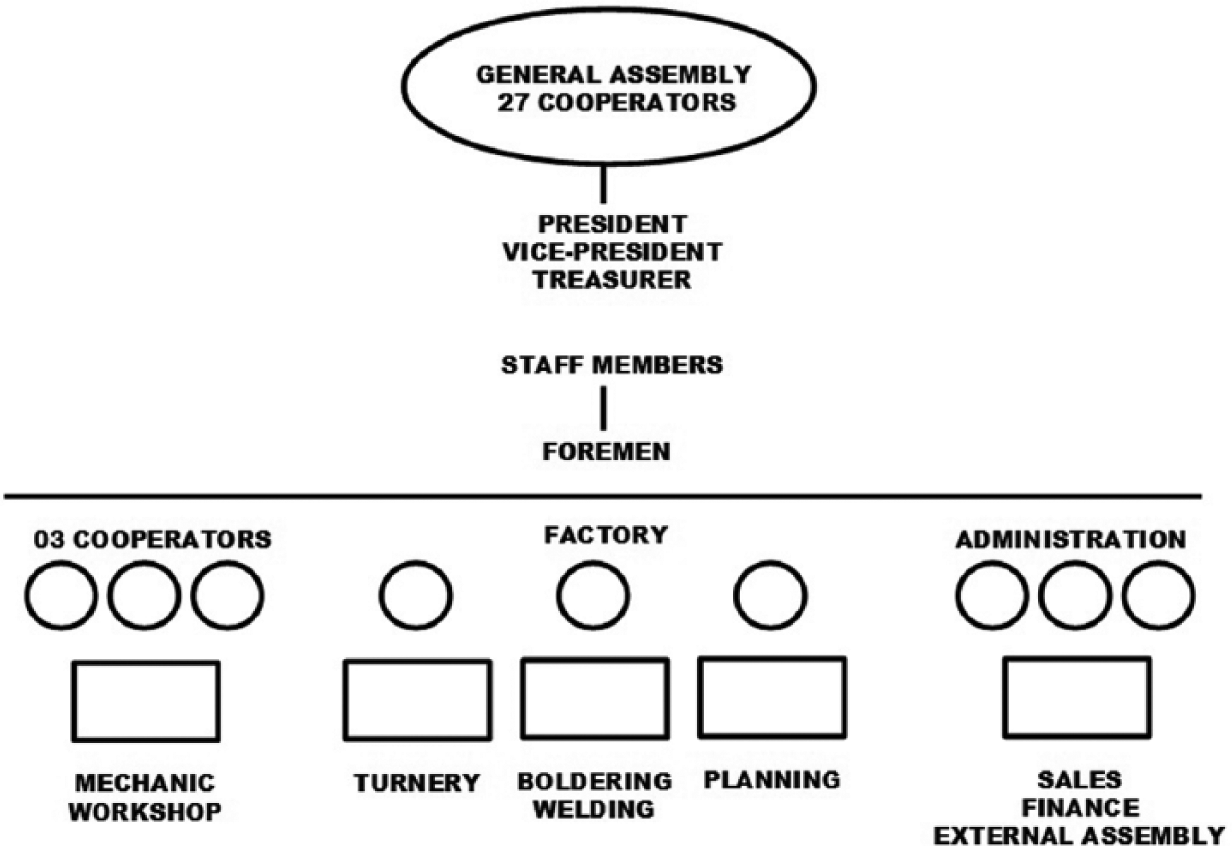
The organizational structure of Omega.
Management positions are held side by side with everyone’s original duties. The president is a turner, when necessary he abandons the machine to become the president. The same happens in other positions. Figure 2 was built upon drawings made with the help of three cooperators. In the Omega way of management, the assignments of technical-productive and managerial roles do not produce segregation among cooperators. Communitas is preserved at the top. Profession goes up and down throughout hierarchy. The liminal organization of Omega was generated by a duality that is still printed in its structure.
The duality is replicated in different ranks. Production coordination is a good example. Everyone knows the whole operation plan. When a drawing reaches the factory, foremen communicate and organize themselves telling one another what is being done. When an operation is coming to its end, the information goes to the person in charge for the next operation, impelling the production flow. Such informality makes the control and assessment of manufacturing costs difficult, which worries the planning and control staff.
Both sides of the Omega organicity—communitas and structure—appear in a dialectic in which equality is the propeller of technical-productive and administrative processes. The path is created from a pendulum motion in which elements of communitas are crossed by the structural constraints, without losing substance. Unity and equality among cooperators appear clearly:
We became a close group … Three or four years ago an accident happened with a member that was going to a nearby town to seek a part … it was raining, he hit the car! … He called us and we helped him and took him to the hospital. We called one another and soon all the twenty-seven of us were there, all around him. Everybody was there. One called the other. (Interview with Cooperator 3)
Yet it is not the same between cooperators and employees, for whom the duality is more intense. When I asked Cooperator 3 if employees could participate in the Friday meetings, he replied, ‘No! Only cooperators, the meetings are to address the company issues!’ Company issues are not employee business. They were hired when ‘the gear was already running’, to replace cooperators in the arduous jobs. Gradually, they have been led to factory positions. Seemingly for cooperators there is no contradiction in combining WSM with employees, as Cooperator 2 told me when I asked about WSM in Omega: ‘Regarding the self-management with employees, I think our relationship with them is very healthy. We are all friends here, right? Occasionally someone has a problem, but we solve it soon enough. We try to help’.
In liminal organizations, the necessity to work with ambiguity leads to the ability to integrate equality and hierarchy—WSM versus standard management—in order to overcome contradictions between structure and anti-structure and to switch them functionally in the company operation. One noticeable feature of the Omega way of management is the selective condescendence to administrative controls required by the market. Selling fluctuations, albeit treated carefully, are seen as events that do not undermine the soundness of the company:
The beginning was a difficult task … After two or three years, we had a minor crisis … Three or four years ago we had a crisis and had to go to the bank … The wages were assured, although we were some time in the red and recovered our situation. We fought hard to be free from banking issues … (Interview with Cooperator 5)
Omega has 60 active clients, and orders remain stable. The labor process is now being shaped by concerns for efficiency and quality. Customers require inspection and certification procedures. Some time ago a consultant was hired to implement a quality system. Since then, these activities have been partially incorporated, but not to the system as a whole. In an informal talk, it was revealed that the consultant could not accept the collective decision mechanism because for him efficiency was being harmed.
A committee of six cooperators is now in charge to implement total quality management (TQM) tools. Reports collected suggest utter rejection of these practices: they have tried ‘labor gym’, ‘5 S’ and intend to seek International Organization for Standardization (ISO) certifications. Gymnastics failed. Cooperators rejected it tacitly, and employees followed them. Quality inspection seems to be more easily accepted. As to the ‘5 S’, nothing was done except a training course. An old faded poster in the lunchroom shows the internal campaign to raise the awareness among members, with no result:
It’s hard! When we implemented the gym in the morning, you would see eighty employees, but only ten in the gym. What can be done? The company is investing, but the employees do not offer a feedback, and forcing them is something difficult. If you fire one, you affect the company. (Interview with Cooperator 5)
The conflict with the current informality slows the adjustments to the pace of mutual understanding. One of the employees is an engineer hired to improve logistics, planning, and processes. Cooperator 5 told me that the employee was hired as an engineer but is not yet adapted, ‘we are studying a way to get him better because he has some good ideas … I think that eventually he will be part of the production team’. As a result, the production engineering is not fully functional. Significantly, the changes have to wait until the group decides it is time to sacrifice the communitas in the name of structural efficiency. This is the logic of a liminal organization, permanently oscillating between structure and anti-structure.
Communitas is still sacred in Omega: it is the realm of the Friday meetings, the weekly general assemblies of cooperators. The organizational structure carries its genetic provenance: communitas is in charge of the company, an absurdity that is possible because of the ability to deal with ambiguity. This overlap is the outstanding trace of Omega as a liminal organization. The structuration process has its golden rule: the weekly meeting of cooperators decides company issues. This is not an idyllic vision; the meeting is a sort of ritual that feeds the group up. As Turner (1969) puts it, structural action ‘swiftly becomes arid and mechanical if those involved in it are not periodically immersed in the regenerative abyss of communitas’ (p. 138).
The Omega case suggests that when a liminal organization is facing the contradiction between structure and anti-structure, structure is only chosen at last, when some danger is cognitively at sight and no other way can be imagined. For instance, resistance to implement quality tools can be interpreted as disdain for control because the decision is postponed as long as possible. If quality procedures are able to improve productivity and market legitimacy, should it not be considered an imperative by Omega cooperators? Would it not be logical to go for it?
The answer has to be given with communitas views. Omega has an operational pattern neither aligned to WSM practices nor coherent with standard management. They dare to be not predictable. Their path must be seen as open-ended because it is dependent on the contradictions they confront. The essential issue is that unpredictability means potential transformation. Following Turner (1977), this is the way by which institutions can be open to change: liminality is particularly conducive to play; and play introduces new forms of symbolic action and experimental behavior. An experiment in this sense means ‘any action or process undertaken to discover something not yet known, not scientific experimentation nor what is based on experience … In liminality, new ways of acting and new combinations of symbols are tried out to be discarded or accepted’ (p. 40).
Final remarks
Liminal organization is a hypothetical construct motivated by the search for a theoretical substance for the interstitial life of SEE. It is supported by a number of assumptions presented above, which deserve to be remarked in this conclusion. First, organizations are thought of as situated human creations (Castoriadis, 1995). Second, SE experiences are organizational processes in which the results are not implied from the beginning, they are not prefigured idealized forms or ideal types. Third, SEE are ontologically rooted in what Paul Singer (2003, 2012) calls interstices of capitalism and Laurence Roulleau-Berger (1994, 2003) calls intermediate spaces. Fourth, liminality and communitas are concepts forged by anthropologist Victor W. Turner (1967, 1969, 1974a, 1974b, 1977) that are crucial to the understanding of interstitial ontology as a situated condition of human existence. Fifth, liminality and communitas are theoretically able to illuminate the specific contradiction of contemporary social inclusive exclusion.
Considering all the assumptions above, a liminal organization defines the type of human collective action in which communitas is structurally integrated to the social system by exclusion. Its evolutional path is open to change in a process of permanent confrontation with structural contradictions. This is a pattern in which the communitas is gradually confronted with the structural dimension. Liminal organization means the way of organizing that survives the functional contradiction of liminality today. It is constructed to capture the process that arises within liminal groups which live the daily experience of inclusive exclusion. In this article, the concept accounts for the organizational emergence within SE movement, where the structuring process situated in a CTW is analyzed through a case study.
The case of Omega shows that a fundamental contradiction conducts liminal organizational evolution: communitas and social structure interlace in varying degrees to define a situated way of organizing. In the beginning, the experience of marginalization led the group of workers to assure its existence apart from society, as liminal subjects. They invented surviving strategies to keep things going, fighting to escape unemployment by remaking the abandoned facilities, standing up against scarcity with the small money received. Communitas emergence was noted by a series of events in which the central symbol is the sacrifice that moved everyone to an equal condition. The first signal of antagonism within communitas happened with the embodiment of rules, the recognition of a difference, and punishment of deviants. This is a turning point in which the group of liminal subjects begins the development of an organization. Afterward, social structure made its appearance by interfering in the organizing process but always mediated by the communitas. As a liminal organization, the Omega organizing process is a swing between structure and anti-structure, meaning that the coercive mechanisms implied in institutions and technology will meet the brotherhood of cooperators in an ongoing challenging contradictory process. As a result, it is difficult to predict what will happen from now on. The structuring of Omega may not be as revolutionary as some engaged intellectuals would like, but it shows the creativity that flourishes from the liminal condition of subjects, expressing idiosyncratic organizational forms and practices.
The contribution of the analytical perspective developed here is a conceptual proposition to decipher the typical character of all organizational structuration which happens in the margins of society. In the OS field, the dominant individualistic perspective and the emphasis on ambiguity and imprecision end up obliterating the social ties constructed among liminal individuals which are crucial to the anthropological concept: communitas has to be rescued from oblivion. The work of reframing liminality in OS includes the important task of bringing communitas back to the scene. This article is only a short contribution to this aim and claims that communitas is a meaningful dimension of analysis to deal with organizational emergence and structuring of interstitial and marginal organizing processes.
In Turner’s terminology, communitas is anti-structure, the counterpart of social structure to account for emerging organizing processes: ‘The implied dynamics of the relationship between social structure and anti-structure [is] the source of all institutions and social problems …’ (Turner, 1974a: 6). When dealing with interstitial phenomena, the absence of a structural fixed reference produces evident constraint to researcher apprehension and analysis. In periods of social transition, like ours, concepts like liminality and communitas help to regain confidence in the possibility of a general theory of sociocultural process (Turner, 1977). Moreover, as some authors have pointed out, the concept of organization can eventually hinder the apprehension of diffuse phenomena (Ibarra-Colado, 2006; Misoczky, 2009). In this objection may rest an important contribution of this article: to hypothesize a concept of organization potentially able to support phenomenal fluidity. Anti-structure may be a hard concept for organizational theory because it makes it possible to erase the threshold between process and structural approaches: it is the place where such distinction is diffuse and cannot be directly addressed.
Footnotes
Funding
This research received no specific grant from any funding agency in the public, commercial, or not-for-profit sectors.