




Abstract
The article opens by briefly reviewing studies of sexuality in and around organizations from the 1970s. These studies showed considerable theoretical, empirical and conceptual development, as in the concept of organization sexuality. Building on this, the article’s first task is to analyse alternative future scenarios for organization sexualities, by way of changing intersections of gender, sexuality and organizational forms. Possible gendered future scenarios are outlined based on, first, gender equality/inequality and, second, gender similarity/difference between women, men and further genders: hyper-patriarchy scenario—men and women becoming more divergent; with greater inequality; late capitalist gender scenario—genders becoming more convergent, with greater inequality; bi-polar scenario—men and women becoming more divergent, with greater equality; postgender scenario—genders becoming more convergent, with greater equality. Somewhat similar scenarios for organization sexualities are elaborated in terms of gender/sexual equality and inequality and sexual/gender similarity and difference: heteropatriarchies scenario—greater sexual/gender difference and greater sexual or sexual/gender inequality; late capitalist sexual scenario—greater sexual/gender similarity and greater sexual or gender/sexual inequality; sexual differentiation scenario—greater sexual/gender difference and greater sexual or sexual/gender equality; sexual blurring scenario—greater sexual/gender similarity and greater sexual or sexual/gender equality. The article’s second task is to addresses the impact of globalizations and transnationalizations, specifically information and communication technologies and other socio-technologies, for future scenarios of organization sexualities. The characteristic affordances of ICTs—technological control, virtual reproducibility, conditional communality, unfinished undecidability—are mapped onto the four scenarios above and the implications outlined.
Keywords
The late 1970s and early 1980s were an exciting time for studies of gender and organizations. Yet while gender divisions of labour and gender structuring of authority were well recognized, studies of sexuality in and around organizations were much less well developed. In 1983 Organization Studies published a critical overview of research on organizations and gender that included reviewing research on sexuality (Hearn and Parkin, 1983). The following year saw Gibson Burrell’s ‘Sex and Organizational Analysis’: with a clear historical orientation, this was an important contribution to critical organization studies and studies of sexuality and organizations (Burrell, 1984).
These academic developments built on earlier activism. In the 1970s the question of sexuality in workplaces was made visible in campaigns and policy development. Sexual harassment was named and studied, thanks to feminist campaigners and journalists (Farley, 1978). Feminist research on sexual harassment soon took off. By 1987 there were ten bibliographies of studies and texts on sexual harassment (Högbacka et al., 1987). Researchers made the long history of sexual harassment in organizations explicit, pointing to its documentation in 19th century and earlier texts (Hearn, 1992). Another important area of activism around work organizations in the 1970s and 1980s concerned discrimination against and respect for gay, lesbian and bisexual people and sexualities. Now, 30 years on we can look back and assess how studies of sexualities and organizations have progressed (see Hearn, 2011). Meanwhile, a less considered, but equally important, question is: what possible futures might there be for the relations of sexualities and organizations and their study?
Very important as these 1970s and 1980s interventions were, they tended to construct the relevance of sexuality through and around ‘inappropriate behaviour’—so that sexuality, when made explicit, was generally reduced to either the inappropriateness of harassment or the inappropriateness of discrimination against people seen by those discriminating as having or embodying ‘inappropriate’ sexualities. Moves away from this prime concern with inappropriate sexual behaviour, including by those who discriminate against dissident sexualities, led in the 1980s towards academic concern with a wider range of aspects of sexuality in organizations and towards taken-for-granted, though far from innocent, sexualities of the ‘ones’, the heterosexuals and dominant (hetero)sexualities, rather than the ‘others’ in organizations as problematic. This latter framing sought to study sexualities in organizations in a more accurate, empirical way; it was also politically informed, as a more fundamental approach to the entrenched, embedded relations of sexualities and power in organizations.
These wider concerns with sexuality included heterosexual norms, ideologies, experiences and relationships in organizations, lesbians’ and gay men’s broader experiences and relationships in organizations rather than only discriminations and focused case studies. Sometimes these wider ranging aspects of sexuality in organizations were discussed more in the popular press and magazines than in research; academia lagged behind popular culture. A continuing theme has been how many organizations and managements embrace dominant heterosexual ideologies and practices, for example, some male managers’ reliance on wives (Kanter, 1977).
These empirical concerns and studies merged with policy development, and were taken up in more general theoretical and conceptual overviews. In ‘Sex’ at ‘Work’ (Hearn and Parkin, 1987/1995) and The Sexuality of Organization (Hearn et al., 1989), the concepts of the sexual (or non-sexual) goals of organizations and sexual work were elaborated. Building on Bland et al. (1978), the concept of sexual work, in referring to work done in relation to sexuality, is distinct from that of ‘sex work’, referring to the selling of sex. In particular, the concept of organization sexuality was articulated (Aitchison, 2003; Cockburn, 1991; Hearn and Parkin, 1987/1995). Organization sexuality entails the simultaneous, paradoxical and powerful co-occurrence of organizational dynamics/practices and sexual dynamics/practices: sexuality constructs organization and organization constructs sexuality. This simultaneity distinguishes it from organizational sexuality, as the latter suggests a particular kind of sexuality in organization(s). In its original formulation the following features of organization sexuality were emphasized: movement and proximity, feelings and emotions, ideology and consciousness, language and imagery (Hearn and Parkin 1987/1995: ch. 7).
In such approaches organizations have been understood as structured, gendered, sexualed, sexually-encoded (re)productions. The term ‘sexualed’ (and ‘sexualing’) here parallels ‘gendered’ (and ‘gendering’), to refer to generic meanings and activities in relation to sexuality, that are not necessarily sexualized and may indeed be non-sexual(ized), and is distinct from ‘sexualized’, as in sexualization, where sexuality is used or exploited for other purposes, such as selling a car. Sexuality is seen as material-discursive, simultaneously bodily, material and discursive (Hearn, 1992, 1998, 2008, 2012). The notion of the material(ist)-discursive and various similar concepts can also be recognized in works of Foucault, Laclau and Mouffe, Haraway, Barad, amongst many others. As the material-discursive social expression of, social relations of or social references to, physical, bodily desire(s), sexuality, including sexual violence, is often as a key aspect of the (re)production of gender dominance and patriarchal relations. Sexualities, while in focus, are not separate, autonomous phenomena, but are deeply political-economic-cultural; they are not to be simply placed within external asexual political economy or cultural contexts, yet their political-economic-cultural character is not to be neglected. This involves the very constitution of sexuality categories.
The range of conceptual and empirical analyses of organizations and sexualities have raised many theoretical issues, including relations of material, bodily experiences, oppressions around sexuality, and discursive constructions of sexuality, and sexuality as a major element in forming the gendered body. Critical interrogation of sexualities has led to greater concern with the visual and the haptic in knowledge construction in both academia and everyday organizational life, such as the importance of dress, appearance and body displays, for example, in influencing the credibility of knowledge producers in organizations (Brower and Jones, 2013). Additionally, a growing area of organizational research is on transgender, transsexual and intersex people (Brossi et al., 2012; Davis, 2009, 2011; Namaste, 2000; Schilt, 2006; Schilt and Connell, 2007; Schilt and Wiswall, 2008) and organizational policy development on LGBTTIQ (lesbian, gay, bisexual, transgender, transsexual, intersex, queer) sexualities, prompted by movement organizing and legal changes, for example, in the European Court of Human Rights.
Following this brief overview, we can ask: so, what now? What is in store for ‘sexualities and organizations’ and associated research? This is a huge canvas, but the focus of this article is more limited. The first task is to continue work on organization sexuality in analysing alternative future scenarios for organization sexualities, by way of changing intersections of gender, sexuality and organizational forms. Scenario here means alternative possible, if contradictory, futures, conceived as gendered/sexual organizational social relations, even though different aspects occur at local, global, organizational, transnational levels and in different combinations. These scenarios, in part evident in current trends, may develop differentially and in various permutations in future local and translocal situations.
The second task is to consider the impacts of globalizations, glocalizations and transnationalizations, more specifically information and communication technologies (ICTs) and other socio-technologies, for future scenarios of organization sexualities. This is partly as a critique of most mainstream analyses of globalization, especially those from the global ‘North’ that have avoided explicit gender and sexuality analysis. Many texts, even critical texts, present globalization as agendered and asexual, emphasizing ‘neutral’ transnational economic units within ‘neutral’ economic processes, reproducing an implicit male narrative. ‘Genderless’ analyses of globalization persist in much mainstream work, even with the large feminist literature on gendered globalization (Parpart and Zalewski, 2008; Peterson and Runyan, 1999; Young et al., 2011). Moreover, in simultaneously affirming and deconstructing the nation, transnationalization may be a more useful term than globalization. The prefix ‘trans’ refers to moving across or between nations or problematizing, metamorphosing, even dissolving, national boundaries or creating new transnational social realities (Grewal and Kaplan, 2001; Hearn, 2004; Hearn and Blagojević, 2013; Povinelli and Chauncey, 1999). Elaborating on organization sexuality scenarios means bringing together changing forms of sexuality, organization, transnationalizations and socio-technologies.
As a final word of introduction, I should make clear the future is both a topic and a political issue of vision, and that writing about the future is also writing on the present. The remainder of this article briefly examines possible gender scenarios as first steps to considering organization sexuality scenarios. These latter scenarios are then discussed in terms of their possible reconstitution through the impact of socio-technologies, followed by concluding reflections.
Alternative gender scenarios
In considering possible gendered future(s) of men, women and further genders, different scenarios can follow from differentiations of, first, gender equality and inequality and, second, gender similarity (homogeneity) and difference (heterogeneity) between women, men and further genders. This includes the question of to what extent the two-gender model remains dominant or is problematized through the assertion of further gender categories. It also parallels the long established debate on gender, similarity and difference. These possibilities can be understood at different levels of analysis, from the local and organizational to the multinational enterprise (MNE), to beyond to glocal/global/transnational processes. Similarly, changing gender relations, genders, women, men and further genders can themselves be contextualized at different levels of analysis: local, organizational, transnational and so on.
Thus four scenarios can be outlined through intersections of gender equality/inequality and gender similarity/difference, characterized as follows:
the hyper-patriarchy scenario: men and women becoming more divergent, and with greater oppression and inequality. There is an assertion of men’s and women’s difference from each other, and the taken-for-grantedness of cisgender, 1 coupled with trends towards inequality stemming in part from neoliberalism, which, might be thought of as the global doomsday scenario, not least on environmental grounds. While hyper-patriarchal scenarios may seem primarily as social, they are likely to have long-term environmental outcomes in terms of resource degradation, climate change, drought, poverty and hardship. Coupled with imperialist adventuring, these may ferment patriarchal posturing, wars and conflicts, with further environmental ecoconflicts, and dire consequences for sexuality and gender relations in terms of ill-health and disease, as ecofeminists make clear. Hyper-patriarchal sexualities are literally unhealthy, for many.
the late capitalist scenario: men, women and further genders becoming more convergent, with greater oppression and inequality. This might at first sight seem similar to the previous scenario, but the difference is that in this trajectory capitalist and imperialist social relations overwhelm gender relations. This could be thought of as ‘pure capitalism’, whether in expansive or collapsing mode, as this cares not for the age, gender, ethnicity, racialization or sexuality of workers, consumers and their exploitation.
the bi-polar scenario: men and women becoming more divergent, for example, in segregated practices, and with greater equality. Traditionalism is combined with gender equality, and perhaps human rights or respect for and celebration of difference.
the postgender scenario: men, women and further genders becoming more convergent and with greater equality. Gender and gender antagonisms are or appear transcended, for example, plural fragmentation or crossing of dichotomous gender boundaries, whether through economic imperatives, political action, virtual realities, or some utopian change (Hearn, 2010). This raises the possibility that gender may not be a central dimension of analysis and practice in the future (see Scott, n.d.; cf. Haraway, 1988 on ‘vision’).
These gender scenarios might be understood at different local, national, transnational and global levels and in various permutations and contradictions. There are of course many other possible scenarios, for example, gender inversion, with women becoming dominant (Jernolöv, 2010), or scenarios that are composite, in-between or moving across gender paradigms. At the global and transnational level, these scenarios, and especially the first two involving greater inequality, can be interpreted as forms of transnational patriarchies or, as a shorthand, transpatriarchies (Hearn, 2009). Such systems of transnational gender dominance between, across and beyond nations and national borders, as in transnational governmental and business institutions, may be simply reinforced by greater inequalities or in the case of the last two scenarios ameliorated as lessening inequality also operates within transpatriarchal histories and contexts, and is far from utopian.
Alternative sexuality scenarios: implications for organization sexualities
While sexual scenarios are not necessarily marked by globalization, there are several rationales for emphasizing the global/glocal/transnational in future organization sexualities. First, in the face of globalizing, glocalizing and transnationalizing forces, sexuality is liable to considerable historical transformation. Key global issues, with major, albeit uneven, effects on sexualities and organizations, include: male domination of MNEs; extension of commodity production and exchange; neo-liberalism; migration; sex trade; militarism; global symbolic systems; advances in ICTs; and environmental change.
Second, this move is part, or an extension, of understandings of sexuality as not simply personal or private, but constructed through public, political, organizational and societal structures and processes; it points to the interconnectedness of immediate sexual practice and apparently distant global/transnational conditions. Just as cities are spatially organized partly through sexuality, so the world is organized in sexual-spatial ways, as in regionalized sex trafficking. Globalization may disturb the naturalism of sexuality (desire which is felt to be ‘primordial’, most one’s own [MacKinnon, 1982]) and much sexual discourse, with unpredictable consequences.
Third, transnational mobility, ease of travel, transnational education, work abroad, international partnering websites and the spread of Englishes prompt more transnational sexual partnerings, whilst such partnerings in turn prompt further migration (Binnie, 2004; Niedomysl et al., 2010). And fourth, there is the impact of specific globalizing/transnationalizing sexual representations, and through ICTs and other media blurrings of the sexual real and the sexual fictive. These various changing conditions together in no way downplay the power of local flesh-to-flesh sexualities. Rather, they link with changing forms of organizations and organization sexualities.
So, what happens if we now relate the gender scenarios discussed above to sexuality and organization sexualities? Accordingly, we may consider sexual or sexual/gender equality and inequality, and also sexual or sexual/gender similarity (even blurring) and difference. There are pressures towards, first, both unequalizing (for example, capitalist commodification of sexuality) and equalizing (for example, sexual emancipatory movements) social-sexual processes and, second, both sexual differentiations (for example, differential sexual segregations and identifications) and sexual de-differentiations (for example, sexual collectivizations and sexual blurrings), at the local, organizational, global and transnational levels. These suggest various possible sexual scenarios and implications for organization sexualities:
the heteropatriarchies scenario: greater sexual or sexual/gender difference and greater sexual or sexual/gender inequality;
the late capitalist sexual scenario: greater sexual or sexual/gender similarity and greater sexual or sexual/gender inequality;
the sexual differentiation scenario: greater sexual or sexual/gender difference and greater sexual or sexual/gender equality;
the sexual blurring scenario: greater sexual or sexual/gender similarity and greater sexual or sexual/gender equality.
Such scenarios might be understood as forms of (in)equality regimes (Acker, 2006), as operating at various local or global levels, in permutations and with various contradictions, and as facilitating, even constituting, alternative organization sexualities. To be more precise, sexualities in organizations intersect with differential organizational forms. In particular, these forms may be characterized in terms of: first, the extent of hierarchization and, second, the extent to which organizational hierarchization and segregation corresponds and coincides with specific social divisions, in this context, sexuality divisions.
The Heteropatriarchies scenario
In this scenario greater sexual or sexual/gender difference is coupled with greater sexual or sexual/gender inequality. Organizational forms in this scenario are overwhelmingly hierarchical, in states, MNEs and their partnerships, and become more so, perhaps with the assistance of greater state and corporate technological surveillance and controls. Global corporations become yet more hierarchical and powerful, along with elites and the mega-rich.
Horizontal and vertical gender segregation is enacted and reinforced by unequal sexual (and gender) differentiations and differentially sexual/gender-defined persons/labour (Acker, 1990). Organizations forms are characterized by entrenched organizational hierarchization and segregation co-occurring with sexuality divisions. Dominant heterosexualities, especially dominant men’s heterosexualities, are likely to escalate. This includes the pervasive dominance of masculinist heterosexualities, as well as associations of some of those heterosexualities with invocations of violence and violation. Eroticization of dominance (MacKinnon, 1982) may be accompanied by violencization of sexuality (Hearn, 1998). Hierarchically organized sexualities and sexual violences are accentuated, coupled with sexual commodifications and differentiations. It is likely that there will be more explicit articulations of interplays of sexuality and violence, whether in the organization of war, torture and terrorism, or (inter)personal violence in organizations. Organization sexuality is patriarchal, hierarchical and violating, at least for some, and especially the most vulnerable through class, gender, sexuality and racialization.
There are many ways in which such heteropatriarchies develop and change, for example, through extensions of transnational patriarchal corporate concentrations. Corporate responsibility becomes increasingly disconnected from local social conditions and social problems created and held to be the business of ‘others’, as exemplified in the exceedingly low tax payments by some MNEs. 2 Transpatriarchal disconnection is part of a long history of historico-spatial processes, moving from local to state to transnational institutions. This brings, however, some loss of expected privilege, including sexual security in the local context, for some men, leading to the transnational outsourcing of sexual oppression, as in differential, racialized growth of the sex trade (Jeffreys, 2009, 2013). Losses, or perceived losses, of power amongst certain men and women interplay with processes of recouping of patriarchal power, as part of the project of the ‘restoration’ of patriarchal rights and privileges (Kimmel, 2002).
These can also facilitate greater transnational individual and collective non-responsibility, especially by those in power, meaning certain men especially. Connell (1998) posited ‘transnational business masculinity’ that may be increasingly hegemonic and directly connected to patterns of world trade dominated by the West and the global ‘North’ (Connell and Wood, 2005). This is marked by egocentrism, precarious and conditional loyalty to employers, and declining sense of responsibility. It differs from traditional bourgeois masculinity by its libertarian sexuality and tendency to commodify relations with women, whether in sex(ual)ist employment practices or sexploitation in marketing, managed by corporate elites. However, empirical studies show considerable national variation in how corporate leaders live their lives (Reis, 2004). Overall, organization sexualities are characteristically hierarchical, with organizational structures simultaneously reinforced by commodified, hierarchical heterosexualities corresponding to those structures.
The late capitalist sexual scenario
With this scenario, with greater sexual or sexual/gender similarity and greater sexual or sexual/gender inequality, we move to a modified and what at first might appear less hierarchal modes of organizing. The worker and the manager are now no longer so tightly defined by social markers, but are more ‘flexible’, or rather a more flexible commodity, including sexually. Here flexibility overrides difference, differentiation and social categorizations, sometimes with connotations of the postmodern or queer. Despite appearances, one route to this ‘flexibilization’ scenario is through greater sexual commodification, even if paradoxically it can involve both differentiating and de-differentiating market tendencies; another is capitalist emiseration, financial crisis or collapse, reducing sexuality to the similarity of (economic) function. Such a scenario might develop differentially in relatively localized, national contexts.
In organizational terms this ‘flexible’ scenario can be seen as continuing a long debate, with antecedents in Human Relations Theory, the ‘Coming death of bureaucracy’ (Bennis, 1966) and organizational forms under modernity, new capitalism and disorganized capitalism (Harvey, 1989). In the late modern postindustrial era organization itself may seem obsolete (Barley and Kunda, 2001; Thompson, 1993; Walsh et al., 2006). As Ahrne and Brunsson (2010) argued, It may appear as if organization, often associated with bureaucracy and hierarchy, is a phenomenon of the past, and that contemporary societies are characterized either by less structured forms of interaction among highly autonomous actors, perhaps leading to networks; or by highly structured forms with little freedom of action for individuals and organizations, such as the concept of institution suggests. (2010: 2)
Through temporary and shifting membership, lean flexibilization, project and network organizing, the basic idea of ‘organization’ is no longer taken-for-granted; elusiveness of the organization may be a feature of late modern organizational life. Organizations and organization sexuality appear less hierarchical, less segregated, more sexually flexible, but capitalism cares not for the sex or sexuality of workers or customers. The fungibility of labour and organization under neoliberal capitalism, especially iCapitalism, is noted by many commentators (Fraser, 2009: 109–110; Ong, 2006: Stacey 1987; Winnubst, 2012: 92–93). Indeed so-called ‘iCapitalists’ have long been zealots for radical neoliberal capitalism, and often male dominance: California’s Silicon Valley … embodies a value system that merges a counter-cultural 60s romantic individualism with a cold-eyed commitment to free markets … this rebellious pose … reconciled a whole swath of the educated professional classes … to free-market capitalism … The iCapitalists … presented a far more appealing vision to liberals—one of denimed democracy, of gender-blind and colour-blind egalitarianism. (Priestland 2013)
Making this harsh vision, including by implication for sexualities, palatable may assist the relatively privileged in this scenario, but not those less privileged or excluded, even if differentiations of sexualities no longer correspond so easily to organizational hierarchies. The surface may appear less hierarchical, more flexible, even queer, but the deep sexual/gender structure remains patriarchal and capitalistic, echoing recent discussions of the disarticulation of feminism (McRobbie, 2009; Scharff, 2011; see Fraser, 2009).
The sexual differentiation scenario
This scenario involves both greater sexual or sexual/gender difference and greater sexual or sexual/gender equality. With this, differentiation and diversification of sexualities apply not only to women and men, female and male, but also to further sexual differentiations. The most obvious examples are LGBTTIQ sexualities. These are, in this scenario, likely to become more apparent, influential, even legitimated and different forms of identity politics. Differentiation may proceed in other ways, for example, through ageing of populations and sexualities, suggesting elaborations of both relatively dominant and relatively subordinated sexualities, in, say, cross-generational sexual relations. A differentiating logic might also be evident in greater sexual diversity in relation to ethnicity, racialization, nationality, religion and further intersections, through greater social-sexual contacts across and between localities, countries and cultures, with enhanced physical and virtual mobility and a multiplicity of sexual identities.
Such changes do not necessarily suggest greater sexual/gender equality in themselves, and certainly not in the short term. Differentiation can proceed alongside more segregated spheres for women and men, and separated identity politics and organizational caucuses. This fits with recognizing the rights and legitimations of sexual identity communities, and in that sense with some respect at work, equal opportunities, gender mainstreaming, diversity management and human rights logics, whether in neoliberal nations, social democratic welfare states or transnationally, as in the EU. It can be market-driven by consumerism and consumer-differentiated sexualities, and even by nationalistic constructions of majority ethnic, often heterosexual sexualities.
In this scenario organization sexualities are more complex formations: state and corporate organizations are less explicitly heteronormative, with a variety of sexual rights asserted and affirmed, along with a burgeoning of multiple, less hierarchical sexual-social movements and sexual identities and positionings. Yet at the same time, such a scenario can have some surprising consequences. One example derives from Puar’s (2007) analysis of homonationalism: the processes by which US or other national citizenship is extended to some but not other lesbians, gays and queers. Building on the notion of homonormativity (Duggan, 2003), she points to exclusionary strategies developed through a ‘new ideal’ LGBT figure, for example, after 9/11 in displays of the US flag at gay bars and parades and prominent gays’ support for US military intervention. Homonationalism highlights possible collusions between homosexuality and patriotism, standing against the terrorist and ostensibly persecution of queers and women elsewhere. This example illustrates more contradictory organization sexualities, and more contradictory forms of organization, simultaneously less hierarchical but sexually excluding.
The sexual blurring scenario
This fourth scenario shares some features with the previous scenario in terms of recognitions of diversity, but can be characterized as combining greater sexual or sexual/gender similarity and greater sexual or sexual/gender equality. In this, organizing and organization sexualities become less hierarchical, less dependent on gendered divisions of labour and authority, less dependent on fixed sexual categorizations. Organizations and sexualities here are more complex, less certain, provisional, unfinished—not fixed in (sexual) identity, heterosexual, homosexual or queer. But here, sexual diversity leads onto similarity (or similarization) and convergence, not separations or segregations of identity and of practices. For example, Roseneil (2007) has written that: This convergence between homosexual and heterosexual ways of life amongst people at one end of the spectrum of individualization is happening in parallel to a similar convergence at the other end of the spectrum, amongst those choosing coupledom, cohabitation and often children, as civil/domestic partnership, or marriage, becomes available to same-sex partners on similar terms to traditional heterosexual marriage in many countries. Whilst it might be too early to declare the end of the heterosexual/homosexual hierarchy, the binary is becoming increasingly unstable (see also Brickell, 2006; Roseneil, 2005).
In this fourth scenario there is a profound paradox in the move to sexual similarity, or convergence from the processes of sexual differentiation and identifications. The profileration of sexual identities is likely to increase not just the problematization of (hetero and homo)sexual normativity, albeit probably rather slowly, but the problematization of ‘homosexuality’ and further sexualities—perhaps of sexuality and sex ‘themselves’. With sexuality categories becoming defined in more complex ways, this may well promote further blurring of sexual categories. These might include public discourses and sexual practices that drift in quite opposite directions regarding sexual power and inequalities.
There are several ways of moving from the differentiation of sexual identities towards sexual similarity and blurrings in constructions of organization sexualities. Similarity can arise from difference in several ways that might be characterized as transversal sexual politics (see Cockburn and Hunter, 1999; Yuval-Davis, 1997). First, intersections can shift from structured fragmentations of social groups and social divisions to fracturings of personal social-sexual experience (Bradley, 1996; Hearn, 1992). To take again the example of ageing, this can also impact on the aged blurring of organizational members and users, in relation to sexualities. Ageing sexualities may challenge (hetero and homo)sexual normativity, by subverting or problematizing taken-for-granted youthful sexualities—a theme taken up in the fracturing of subjectivities amongst older men and men with disabilities (Jackson, 2001, 2003). Crip theory (McRuer, 2006) may provide a fertile base for further elaboration on the intersections of disability, ageing and even dying, as a basis for sexualities. This trajectory, in opening very different, diverse sexual possibilities within and around organizational contexts, also represents a critique of the limitations of gender equality policy, or at least top-down gender equality.
A second way towards sexual blurring might be through deconstruction, even the abolition, of gender sexual categories, such as the very categories of ‘women’ and ‘men’ (Wittig, 1992). Many texts have shown the limitations of a view of gender as overly dichotomized or in a fixed relation to sex, focusing on. transgenderism, transsexualism, genderqueer, along with more specific terms, such as ‘gender ambiguity’ (Epstein and Straub, 1991), ‘undoing gender’ (Butler, 2004) and ‘gender pluralism’ (Monro, 2005). More specific multiple multiplicities include: agender, bigender, pangender, third sex/gender, MTFTM, FTMTF, ‘bois’ and ‘tomboys’, ‘cissies’, ‘pansies’, ‘pretty boys’, metrosexuals, feminine men, midlings, androgenous persons, masculine women, masculine-of-centre, female masculinity (Hill and Mays, 2011), and possibly queer heterosexualities (Heasley, 2005). Organization sexuality becomes highly multiplex in form and substance, and destabilized at a very fundamental level.
A third route is through challenging the very idea of sexuality, a point to return to in relation to ICTs. All these routes may paradoxically suggest unities in similarity by way of unstable difference. Organization sexualities here are more complex, more paradoxical still, with fragmentations, fracturings and differentiated/ing similarity, a form of ‘sexual multitude’, 3 even a disavowal of queer dissimilarity (Parker, 2002). At the transnational level, this blurring links to possible, less obvious aspects of transnational patriarchies. While referring to the power of gender categories, the term may also invoke ‘trans’ in more complex ways. There are incipient signs that patriarchal relations might be entering a new, perhaps strange, historical phase. Some women might adopt what can be called ‘more patriarchal’ styles of leading (Wajcman, 1998), while some men in power might adopt what can be called ‘less obviously patriarchal’ styles, whilst retaining power (Brittan, 1989; Moore, 1988). Indeed, ‘feminism’ can also be used to justify (trans)patriarchal relations and forms of domination (cf. Eisenstein, 2004; Fraser, 2009). This could usher in changing forms of ‘transgenderized’ patriarchal power or patriarchal relations separated from the bodies of men and women, as in some virtual futures.
Impacts of socio-technologies: on reconstituting organization sexualities
These broad scenarios of organization sexualities are, however, clearly not the whole story. Cutting across them are variable impacts of major technological, or more accurately socio-technological, change, especially ICTs, but also other technologies, such as biomedical interventions, body modifications, drugs facilitating sex, and even future drugs for becoming or staying in love (Knudsen and Olrik, 2013). Such various socio-technological developments map onto all four organization sexuality scenarios outlined, with major impacts especially for immediate organizational action and experience.
ICTs involve multiple complex technologies. Characteristic features include: time/space compression of distance and physical separation, instantaneousness in real time, asynchronicity, reproducibility of images, creation of virtual bodies, blurring of the ‘real’ and the ‘representational’. More specifically, the affordances of computerized communication networks include: broader bandwidth; wireless portability; globalized connectivity; personalization (Wellman, 2001); and blurrings between online and offline, codex and net (Mays and Thoburn, 2013). ICTs have multiple possible impacts on sexuality, with changing forms locally/globally. Speed and ease of ICTs creates many possibilities for new forms of cybersexual experimentation, such as multi-media sex, interactive sex, interactive pornography and random connecting or bridging internet webcam users. Greater technological connectedness impacts on organization sexualities, including on organizational boundaries, and amongst organizational members and ‘consumers’, and their reformulation as, say, prosumers. The shift from ‘cyberspace’ to Web 2.0 means a move to more interactive activities (Arora, 2012): while Web 1.0 technology was about connecting information, Web 2.0 aims to connect people ‘putting the “I” in user interface, and the “we” into Webs of social participation’ (Davis, 2008). 4
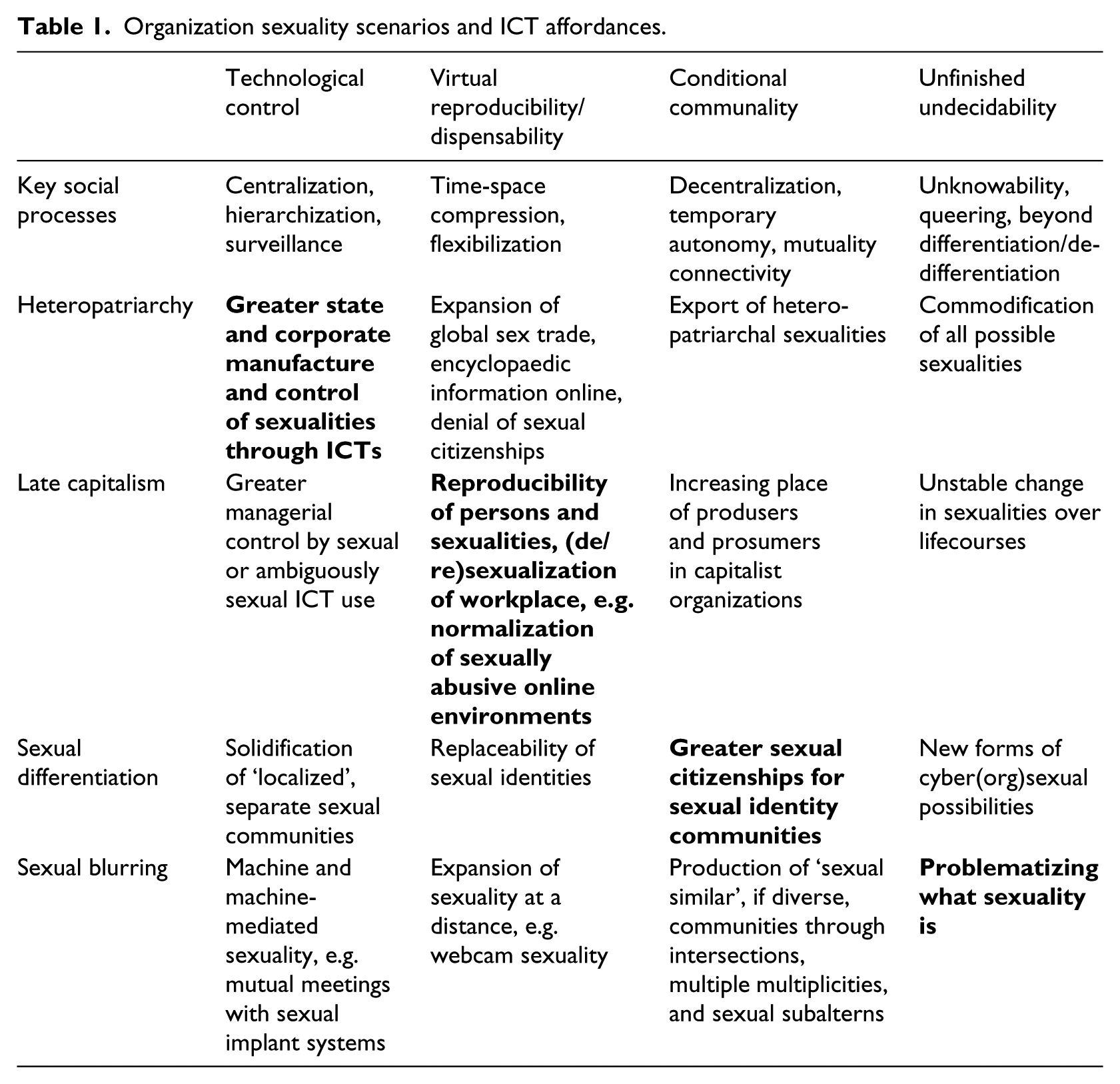
In simplifying these complex processes, I highlight four broad characteristic affordances offered by ICTs making possible different forms of (sexual) action: technological control, virtual reproducibility, conditional communality and unfinished undecidability (see Table 1). In some ways, the first and third, and the second and fourth, of these are in significant tensions, if not totally opposed. These affordances map onto and intersect with the scenarios outlined. Whilst all aspects of ICTs are relevant to all scenarios, there are some key ‘archetypical’ elements of each scenario, presented in bold text . Furthermore, these ICT affordances are to some extent cumulative, so that each acts upon and make the others more complex.
Organization sexuality scenarios and ICT affordances.
Technological control
ICTs can be seen as part of the long history of the relations of technological control and sexuality. Technological control here refers to both the greater control that ICTs may exert over sexualities, and the greater possibilities of the use of ICTs in controlling sexualities. This is clear in possibilities for state and corporate manufacture, control and greater surveillance of sexualities, especially dissident sexualities, through ICTs. Meanwhile, growing surveillance by ICTs are accompanied by reciprocal processes of their disruption, through hacking. All ‘privacy’, including sexual privacy, is now potentially public.
While ICTs may be experienced and frequently represented as giving individuals access to ‘more information’, they also provide means for corporate entities to access far more information ‘about us’. Many nation-states, 5 along with Google, Facebook and similar companies, assemble, retain and interrogate masses of information on personal, including sexual, preferences, through virtual searches and other e-traces. Compilations of information and surveillances, sexual or otherwise, facilitated in moves towards combinations of technologies and systems integrated into larger wholes, are part of ‘surveillant assemblages’ (Haggerty and Ericsson, 2000). The evolving ICTs affect and effect gender and sexuality systems where mechanisms of power, particularly surveillance, are inserted into the fabric of everyday life, with individuals having less control over sexual data in the future (Schmidt and Cohen, 2013). Indeed, the Web may become increasingly framed around different national webs, with varying degrees of state control over personal and sexual life (Schmidt and Cohen, 2013), setting up potential for conflicts and contradictions with transnational actors, corporations and social movements. Additionally, what may be founded as self-help social-sexual communities of interest can become exclusionary, pay-to-use capitalist enterprises.
At the immediate organizational level, greater managerial control and surveillance can be exerted on organizational members. This might be by sexual or ambiguously sexual use of ICTs, whether embedded within managerial email directives or arising from online underlife, just as offline managerial power can be maintained by ambiguous sexual joking. On the other hand, ICTs also provide the capabilities to establish, promote and solidify many and various sexual (identity) communities—both dominant and less recognized or dissident sexualities, as elaborated below.
A further area of technological control in the conduct of sexuality is machine sex or machine-mediated sex: ‘having sex’ with and with the assistance of an object or machine, or mediated by a machine. Machines are likely to function increasingly as intermediaries between humans. A simple example is the ‘lovers’ cup’ that registers activity when used, drunk from, kissed by another person. These are ‘two cups that are connected by the internet. When either person picks up a glass, red LEDs on their partner’s glass glow gently. And when either puts the glass to their lips, sensors make white LEDs on the rim of the other glass glow brightly, so you can tell when your other half takes a sip’ (Jha, 2010: 3). A more advanced example is virtual reality lightweight ‘sex body suits’ with haptic interfaces, so that activity and stimulation, or their effects, in one location can be reproduced or mirrored in another for another person. These make possible simulations or virtualizations of the ‘total’ body. As Levy puts it, in the future ‘instead of one lover asking the other, “Do you have a condom?” the key question may become, “Is your bodysuit strapped on?” or “Are you connected to the haptic interface?”’ (Levy, 2007: 268).
A more complex example still is the production of life-like ‘sex dolls’, available with various degrees of technological sophistication, with some passing as human for short periods of time. With ICTs, there are various more elaborate possibilities, for variation, responsiveness and programmability. Machine sex can become more elaborated with sex robots, androids or humanoids, with more advanced, enhanced features, simulated skin, orifices, sexual movement (Levy, 2007; Mogensen, 2013). There are important distinctions to be made here in terms of the accuracy of simulation and extent of reciprocity. There are possibilities for more complete engagement or simulation of more senses, from single sense media (telephone) to more complex media (computer, initially words, then visuals, then sound, now technologies that convert one medium to another) and a ‘more accurate’, multi-sensory simulation representing the body/flesh/touch. This field of teledildonics is likely to expand in the future, with increasing possibilities for both sexual exploitation and radical reformulations of sexuality. The possible limiting and harmful effects of robotic sex, in terms of the commodification, imposition and alienation of organization sexuality, are not difficult to discern (Turkle, 2011).
There are also increasing technological and more everyday possibilities for many-to-many ‘new sexual affordances’ for mutual identification, for example, matchmaker systems combining virtual community, collaborative filtering and web-to-cellphone technology, so people can know who is in the physical vicinity at that moment and who shares certain affinities and willingness to be contacted (Rheingold, 2000; Wellman, 2001). These include: the Yenta matchmaker system; Grindr, (http://grindr.com/) the iphone 4’s Siri application (http://www.apple.com/iphone/videos/#tv-ads-roadtrip) and the Tinder application for locating potential sexual-social partners in the immediate vicinity (Heawood, 2013), the so-called ‘sex satnavs’, enhancing possibilities for new forms of dating between websites and smart phones. Sexually-coded ‘implants’ will allow people to seek others with similarly or presumed compatibly coded sexualities. The latter can be external to the body skin, in a ‘blackberry’ or mobile phone-type device or implanted within. The recent quantified self and bio-hacking social movement, in which people undertake intensive monitoring of their bodies and selves, can also be directed to sexuality. Body suits, teledildonics, implants and the like have potential to for extend the reach and scope of transnational relations into the realm of touch itself. Such possibilities can change social-sexual relationships and organization sexualities more generally. Organizations become dispersed in their effects, bodily-virtually; organizations pervade the body, perhaps dissolving the body-virtual hyphen.
Virtual reproducibility/dispensability
Moves to and interplays of virtualities and surveillances, along with time-space compression, flexibilization and changes around sex at a distance and mediated physical contact constitute major historical changes with profoundly contradictory implications. In many ways virtual reproducibility is one aspect of technological control, but it also raises some more specific issues. Virtualization processes present sites for both reinforcements and contestations of gender hegemony in terms of bodily presence/absence of men, women and further genders, with positive, negative and contradictory effects of ICTs upon sexuality and sexual violences.
Most significantly, ICTs have been hugely successful in promoting global trafficking and sexual exploitation of women, children and sometimes men, in supplying encyclopaedic information on prostitution and the reconstitution, delivery and expansion of the global sex trade. This is nothing less than a major historical transformation, both online and offline. Pornographers have been leaders in developing computer imaging, interactive technologies and live videoconferencing, internet privacy and secure payment services. This can involve buying transnational live sex shows, in which the consumer, usually male, can direct the show anywhere in the world, with real-time global communication. They also lead to denials of many people’s sexual citizenships, through the sex trade, pornographization or pornification of popular culture more broadly (Attwood, 2009; Dines, 2010; Hearn, 2006; Hearn and Parkin, 2001; Hughes, 2002) and even the ‘mainstreamification’ of pornography (Empel, 2013). Such global changes constitute new forms of transpatriarchies, with virtual imperialist/neo-colonialist exploitation alongside and supportive of direct non-virtual imperialisms/neo-colonialisms. As modes of production and communication become more disembodied, possibilities for the reproduction of sexual texts increase, accessible on millions of screens worldwide through interactive-sharing. The ‘real’ and the ‘representational’ converge; sexual commodification proceeds apace; pornography is liable to virtualization; images once stored electronically can be reproduced and manipulated. ‘The woman’, and perhaps ‘the man’, as dominant actors in virtuality, are dispensable. ICTs increase potential for varied global/local sexualized cultures and more general pornographizing of sex, including complex multi-media, online/offline sexual environments.
While sex trade organizations are forms of organizing in themselves, these same affordances can also be brought into workplaces more generally, in terms of the reproducibility of persons and sexualities and the replaceability of sexualities. This can include the sexualization, desexualization or resexualization of workplaces, through, for example, the normalization of sexually abusive online environments. This abusive normalization is amply illustrated by Lori Kendall’s (2002) study of the ‘virtual pub’ and by Parmy Olson (2012) in her recent study of the hacking network, Anonymous, both of which provide ample examples of homosocial, homophobic, sexist and racist practice online. The greater propensity and power to insult and abuse, when there is less facial or eye contact, is especially concerning (Lapidot-Lefler and Barak, 2012). This may partly explain the mass, even ubiquity, of sexist, racist and abusive material on the Web.
Software can also make humans replaceable in more direct ways. The software program AV Webcam Morpher enables users to play with their gender identities by streaming ‘fake webcam stream’ (Cam Thief 2008). The program can ‘trick’ people by broadcasting a set of programmed ‘human’ visual and verbal expressions, such as trick voices and faces for hello, goodbye, smile, disgust, kiss, flirt and so on. The software enables the user to record their audience as part of a gendered performance game. 6 This may be evident in extended use of sexually programmed avatars in marketing, sales and customer services, with the problematization of trust within organization sexuality, but also a normalization of that problematization. It is one of many routes to diverse sexualities.
Conditional communality
Conditional communality refers to the ICTs’ affordance to facilitate forms of organizing that tend towards decentralization, mutuality, connectivity, within certain prescribed limits, as with temporary autonomy zones (TAZs). While this is often a democratizing facility, it can be used within and by state and corporate organizations to spread not only liberatory messages, but also heteropatriarchal ones. However, overall this is a route to more localized, relatively distinct, sexual identity communities and organizations.
Such virtual communities of interest, for or against particular sexualities, dominant or dissident, appear to offer safe, trustworthy ‘homes’ and arenas for support for members of sexual communities, and this may be so in some cases. They range from small independent cells to global movements. This is especially important for those relatively isolated or unable to act in public with ease, giving sexual information and providing possibilities for meeting by mutual agreement potential partners (sometimes with less emphasis on physical appearance). At the same time ICTs are also sites for extension and diffusion of disembodied sexual capitalism, consumer cultures and pleasures. Yet the familiarity of this aspect of this affordance can be deceptive: indeed its very familiarity may constitute a new hegemony (Hearn et al., 2013). Comparison may be made here with engineered ‘familial’ corporate cultures promoted at the same time as the greater disembodiment of global corporate institutions (Ezzy, 2001).
For such various complex reasons ICTs do not only act as media for sexualities and sexualized violences, but increasingly can be constitutive of them, and may do so in new ways in the future. A key additional issue is the increasingly important place of consumers, produsers and prosumers, as part of make-up of organizations. These are no longer simply served by organizations but, in some senses, make the organizations. The boundaries between production and consumption of sexualities blur. Having said that, these decentralizing affordances will probably continue to promote greater sexual citizenships, with more inclusive, diverse sexualities, and to problematize (hetero)sexual normativity, even with the rise of religious fundamentalisms and neo-conservativisms.
Finally, regarding conditional communality, there are various trends towards qualified sexual similarity, through transversal sexual politics of diverse communities. Sexual similarity through conditional communality is paradoxical; it may be based on complex fracturings, intersections, abolitions and multiple multiplicities, partly be facilitated by ICTs. However, rigid sexual identity becomes subordinated to sexual commonality in difference. These subordinated sexualities/genders could be seen as constituting sexual subalterns (Kapur, 2005; Spivak, 1988), whereby multiplicity forms the basis for new forms of transversal sexual reformulations and conditionally similar interests. This might be found in the imploding, self-shattering organization sexuality of the dark room, the nightclub or even certain political, aesthetic and spiritual organizations, with their particular sexual effervescences or jouissance (Winnubst, 2012), perhaps forming heterotopic ‘fundamentally unreal spaces’ (Foucault, 2008: 17).
Unfinished undecidability
ICTs in many profound ways (re)present unfinished undecidability, that is unknowable, beyond differentiation/de-differentiation. This might appear at first to suggest an anarchistic future, but, on the contrary, all possible sexualities can themselves be open to commodification in time. It is just that ICTs may destabilize sexualities, including making for greater unstable change in sexualities over lifecourses (Ayu Saraswati, 2013). As discussed, ICTs bring many possible cybersexualities in and around organizations, what might be called cyber(org)sexualities. They create major opportunities to do and organize sexuality differently, and for new forms of sexuality: techno-sex, high-tech sex, non-connection sex, mobile phone sex, cybersex, virtual sex, multimedia interactive sex and so on.
A relevant and unfinished technological change concerns the relations of sexualities, emotions and ICTs. Current socio-technologies can assist in making certain emotions public, through monitoring how non-verbal behaviour and bodily changes convey information on intentions and feelings, as through biometric photo-tracking of facial micro-movements, as in airport security applications, or ‘social X-ray glasses’ or ‘new reality goggles’ that assess emotions (Adee, 2011). Thus meeting people can be with or without knowledge of what they are thinking or feeling, emotionally, sexually. One might meet with options of: i) no such information on either side (assuming two parties); ii) fuller knowledge of both parties or iii) knowledge by one but not both parties, which the other might accept or to block with filtering technology. Social-sexual contacts could be conducted in parallel social-sexual ‘universes’, with or without knowledge of others’ sexual or other feelings. The notion of office romances takes on a whole new dimension.
Equally, cyberspace, in its ubiquitous, decentralized spatial forms, can at times seem ontologically queer. Future hegemonies are likely to be in part virtual, socio-technological, contingent, experienced as consensual, transnational, transcending borders, problematizing bodies and sexualities. Put together, these technological possibilities and scenarios are likely to produce significant changes in what is meant by sexuality, or sexualities, what sexual practices are done, and what (sexual) relationships are. Most interestingly, ICTs may problematize what sexuality is. Sexuality categories are likely to become defined in more complex ways and with more complex blurrings, in interrelations with other social categories and intersectionalities, and in deconstructions and transnationalizations of those categories. These blurrings include between flesh-to-flesh sexual relationships, and sexual interactions, that are not flesh-to-flesh; and between sexual relationships and machine relationships. These possibilities may problematize men, women and further gender categories, and their sexualities, such that sexuality is not tied to place and can become a newly transnational it, even reconstituted as not about contact with other fleshly persons at all. New scenarios of postsexualities, beyond sexuality emerge, fracturing organization sexuality, perhaps making it a redundant possibility.
Concluding comments
This article has analysed possible futures of organization sexualities. The organization sexuality scenarios outlined, with their associated organizational forms, map onto and intersect with the various affordances of ICTs. These possibilities raise practical, political, ethical, and indeed research dilemmas. One issue that appears of special importance is the relation of similarity and difference, in terms of both sexualities and organizations. As noted, similarity can arise paradoxically from difference, from transversal sexual politics. This includes the impacts of blurrings, fracturings, intersections, abolitions and the organizing of sexual subordinates and sexual subalterns. Such a scenario of sexual blurring can also have implications for what is to be understood by gender, sex and sexuality, and may even suggest the need for a concept addressing the non-equivalence of gender, sex and sexuality, or simply ‘gex’ as denoting non-equivalence (Hearn, 2012).
One possible dramatic, future lies in combining sexual blurring with the unfinished undecidability of ICTs: the problematization of what sexuality ‘itself’ is, with concomitant implications for organization sexualities, simultaneously sexualities and organizations. Long-term socio-technological change extends further, even to problematization of biological sex ‘itself’, including definitions and understandings of ‘female’/’male’ and presumed natural ‘givenness’, as discussed within queer biology (Hird, 2004). Relevant here are various forms of socio-genetic engineering, foetal monitoring, cloning and genetic (self-)monitoring. The 2003 film, Code 46, portrays a future partly inhabited by clones, with heavy spatial controls and ‘mediaeval’ separations between those in and outside ‘the city’: strict prohibitions exist on inappropriate sexual contact between clones. Such a scenario, in which social-biological identification, not identity, dominates life and sexuality, features in many futuristic texts.
The problematization of biological sex undermines references of sexuality to biological sex, as well as reminding us that gender is not necessarily a radical or critical concept, as it may reproduce other binaries and hierarchies (Bondi, 1998). A drastic rewriting of the body is suggested by a range of work from biologists (Roughgarden, 2004) to cultural theorists (Kirby, 1997). This is partly a matter of the reinvestigation of (queer)diversity in nature and amongst humans, partly deployment of social analysis in biological sites, and partly a critical take on the bio-social generally. Such issues are ripe material for researchers on work, organizations and management.