




Abstract
In this article we examine the marketing representations of the Toyota Prius, the first ‘green’ mass-produced automobile. Drawing on an interpretive analysis of Prius print advertisements in Canadian publications between 2006–2011 and a matched sample of other automobile advertisements, we observe how the Prius advertisements invoke imagination and how this process is channelled, via the integration of text and images offered in the advertising space, to particular themes and ideas. Through the use of an ambiguous system of signs, audiences are invited to imagine and thereby co-create the significance of hybrid electric vehicles. Three areas of imagining are emphasized by the advertisement structure—nature, harmony and agency—and we analyze these imaginings as potential moments of knowledge creation about climate change. We examine how the activity of imagining in relation to these three areas influences viewers’ knowledge and perception of climate change as well as their sense of responsibility for anthropogenic climate change. We discuss the consequences of using ambiguous messages to promote socially and politically charged products for consumers’ understanding and imagination.
Keywords
To say that we are a consumer culture means that our central shared values have to do with consumption. Accordingly, a consumer culture has effects far beyond actual consumption and its associated advertising. The shared concepts and values of a culture help people relate their individual lives to larger themes. (Goodman, 2003: 237)
In a culture rooted in consumption, advertisements are an ever-present medium that places our individual lives and choices in the context of larger themes. Advertisements are aesthetic spaces that relay messages and trigger conceptions about the symbolic significance of products and the experiences and status of consumers. By configuring images and text in relation to broader cultural references and often implicit sociopolitical projects, advertisements fuel desires for alternative future states and induce reflection on who we are, projections of who we wish to be and imaginations of what we could be (Campbell, 1987). We, as consumers, can then deploy the product or brand as a sign and potentially accomplish particular social goals such as identity creation and the expression of lifestyle and values (Arvidsson, 2005).
In this article, we analyze how print advertisements for the Toyota Prius, the first ‘green’ mass-produced automobile, are presented and how the link between human activity and climate change is, explicitly or implicitly, introduced and represented. We focus on how the ad system—including the selection and integration of images and text—conveys messages in relation to the issue of climate change (McQuarrie and Mick, 2003; Schroeder and Borgerson, 1998). We analyze advertisements as ‘aesthetic objects’ that are meaningful in relation to social themes and a broader ‘circuit of culture’ (Buchanan-Oliver et al., 2010), examining how the aesthetic terrain of the advertisement has the potential to stimulate the audience’s imagination.
We find that by presenting a relatively ambiguous system of text and images, the advertisements invoke a co-creative meaning-making process and invite consumers to imagine the significance of the Prius. Although this co-creative process has the potential for multiple messages across consumers, it is guided and shaped by the offered text and images. We conceptualize these imaginings as potential moments of knowledge creation about climate change. Through an interpretive analysis of Prius advertising, we identify three areas of imagining: nature, harmony and agency and examine how the activity of imagining in relation to these three themes constitutes a set of messages about anthropogenic climate change.
Representing the relationship between climate change and automobiles
Despite strong scientific consensus on the degree and causes of climate change, skepticism and inertia still pervade the public response. Organizations such as the Intergovernmental Panel on Climate Change (IPCC) provide rigorous scientific data, and there are numerous organizations (e.g. the Union of Concerned Scientists, National Resources Defense Council, ClimateInteractive) dedicated to informing citizens about climate change. However, the availability of this information has had circumscribed effects. Many people—as much as two-thirds of the US population—do not believe that human behaviour is responsible for climate change (Pew Research Center, 2009). Further, among those who do believe the scientific data, many have difficulty conceptualizing the timing and magnitude for action needed to mitigate the effects (Sterman, 2008). Hoffman (2011) argues that because of the limited impact of scientifically sound evidence of the rise of greenhouse gas levels on the public and on policy makers, changing perceptions and behaviour related to climate change require other means—such as cultural messages and aesthetic resources.
A cultural approach to shaping understandings of climate change may be particularly effective in domains of activity and consumption that are already heavily invested with social meaning. Automobiles, for example, are commodities and expenses, but also play a central role in Western culture (Urry, 2004). Although they have a practical use, cars also signal our style, values and socioeconomic status. Since the 1950s, sociologists have observed that the symbolic meanings of automobiles transcend their instrumental use (Riesman and Larrabee, 1957). Our car tells others about us, but also affords us freedom, escape, excitement, comfort and convenience (Conley, 2009). Alternative-fuel vehicles invite us to make aesthetic connections between automobile use and the environment, and between greenhouse gas emissions and climate change in particular. Their visual and textural representations constitute one particular way to shape new understandings. 1
Beyond the instrumental promotion of a product, an advertisement ‘acts as a representational system’ that creates reference and connection ‘outside the realm of the advertised product’ (Schroeder, 2002: 25). The representations and messages in advertisements offer a realm of referential associations and experiential possibilities (Kellner, 1990; Stokes and Hallett, 1992). In doing so, they are meant to have a semiotic effect on action (McQuarrie and Mick, 2003; Silbey, 2009).
In a shift from exercising tight corporate control over brand management by carefully constructing and targeting the ideas, symbols and messages linked to their products, corporate marketers increasingly are inviting consumers to assist in materially and symbolically defining their products, reconceptualizing this as a process of co-creation between corporations and consumers (Prahalad and Ramaswamy, 2004). Rather than educating and acculturating consumers about the particular and relatively determinate symbolic value of a product, marketing professionals draw on consumers’ competence, effort and imagination—the immaterial labour of consumers (Arvidsson, 2005)—to generate meaning and build value for their products and brands. The advertisements become cultural terrain that individuals negotiate and engage with to create their own experience and understand their choices (Peñaloza, 2000; Vargo and Lusch, 2004). To be sure, organizations attempt to control the nature and direction of co-creation. They also produce ‘ambiences’ (Arvidsson, 2005, 2006), atmospheres or environments that influence consumer perceptions and actions, and cultural resources, language, symbols and practices, that consumers may deploy to ‘produce the self as one chooses’ (Holt, 2002: 83).
Consumption may be fuelled by the ‘imagined relations between objects, between objects and humans, and between humans individually or collectively’ (Schau, 2000: 55). The exercise of imagining is conceived both as a creative and agentic process in which novelty can emerge (Chronis et al., 2012) and as a passive process that nurtures uncritical thought, suspension of disbelief and fantasy (March, 1995). In relation to advertising, imagining is likely to encourage new connections between one’s own habits and desires and larger societal themes (Goodman, 2003). When imagining, we are ‘free’ to create future-oriented scenarios, and choose roles that fulfill our desires and aspirations (Campbell, 1987). These new associations between self and context are roughly empirically grounded, but they may also generate fantasy, perceptions and interpretations untethered from possible or feasible courses of action. It is important to understand how consumer co-creation efforts are delimited and channelled by the ambiences and resources that ‘anticipate the agency of consumers and situate it within a number of more or less precise coordinates’ (Arvidsson, 2005: 245, 2006).
The cultural material that organizations offer is likely to influence whether co-creation efforts generate imaginative processes that tend toward creative, reflexive connections or toward those that encourage fantasy and disassociation. Detailed examinations of the processes and techniques involved in co-creation are few (Fisher and Smith, 2011), particularly those related to print advertising. This article examines how the combination of text and images in advertisements generates resources for imagining, and how the ambiguity of these resources situates imaginative possibilities in relation to scientific and technological knowledge about anthropogenic climate change. Below, we provide a short history of the Prius model and describe our data set and methods. Following this we present the findings of our analysis.
Research context and methods
We selected the Prius because it is the first ‘green’ mass-produced automobile and provides an opportunity to analyze any implicit or explicit connections made between this product, greenhouse gas emissions and climate change. 2 Traditionally, analyses of marketing communication have focused more on the perspective of either the sender or the receiver and less on the cultural resources offered in advertising. Our analysis is informed by three assumptions about advertisements: they are ‘aesthetic objects’ and may be analyzed as such; they are ‘socio-political artefacts’ and may be located in relation to broadly circulating social themes and they are meaningful within a broader ‘circuit of culture,’ and thus their interpretation occurs in relation to this circuit (Buchanan-Oliver et al., 2010: 638). 3 In this analysis, we do not investigate Toyota’s intentions or how consumers, in the context of their own lives and experiences, interpret the advertisements; rather, we access the landscape or space—the advertisements—which connects the cultural production and reception. As described below, we systematically examine this landscape and identify themes. While individual viewers will receive these themes differently, their interpretive processes are informed, shaped and constrained by the advertisement’s design. Multiple interpretations can co-exist, but they are not infinite, and their diversity has bounds. We examine the dominant themes in the text and images and suggest how these channel consumer interpretations.
The Toyota Prius
The Prius was introduced in Japan in 1997 and globally in 2001. The 3 million Prius vehicles sold worldwide represent about 50% of total hybrid electric vehicle (HEV) sales, and constitute, in the United States, 1% of vehicles in use. The Prius, like other HEVs, combines a gasoline engine with a storage-battery-powered electric motor. Despite the additional battery weight, a typical hybrid is considerably more fuel-efficient than a comparable non-hybrid gasoline vehicle because it recharges the storage battery with energy normally lost—for example, in braking—and by taking advantage of the most efficient operational modes of both the engine (high-speed cruising) and motor (low-speed driving and acceleration) (Diamond, 2009; How Hybrids Work, 2012).
While the Prius costs more than automobiles of similar size and power, annual fuel-cost savings allow the negating of this gap within the span of vehicle ownership (How Hybrids Work, 2012). Concomitantly, HEVs could offer significant societal benefits as well (Ogden and Williams, 2004). To illustrate, if 25% of the 100 Million US drivers traded their current ‘average’ car for a Prius, over 6 billion gallons of fuel would be saved annually, amounting to a 3% reduction in US carbon emissions. 4 Urban pollution and smog would also be reduced, as cars and trucks are the largest single source of air pollution in most urban areas (Friedman, 2003).
While anticipation of cost savings has been found to influence purchase decisions (Heffner et al., 2005; Year of the Hybrid, 2004), ownership has also been associated with other socioeconomic factors. HEV drivers tend to have higher income and education levels and to be older and more environmentally conscious than the average car buyer (Hybridcars, 2006; Kahn, 2007). US lifestyle studies report that hybrid drivers are more likely than non-hybrid owners to ski and hike, practice yoga, eat organic food and to identify themselves as Democrat or Democrat-leaning (58%) than as Republican or Republican-leaning (14%) (Scarborough Research, 2007).
Research methods
We examine the cultural resources and messages portrayed in automobile advertising and not available through an analysis of corporate strategy or managerial perspectives (Buchanan-Oliver et al., 2010). We deliberately exclude Toyota’s corporate communications to focus on the advertisements’ visuals and text. We identified and analyzed all of the 33 unique Toyota Prius advertisements found in Canadian publications—national publications such as the Globe and Mail, National Post and Maclean’s and niche presses such as En Route, Toronto Life and BC Business—between 2006–2011. To facilitate image collection, we examined only print advertisements, and purchased them from the Nielsen Company. Our data set is large enough to allow the identification of patterns but small enough to reveal multiple, rich levels of meaning (Conley, 2009).
To contextualize and inform our study of the Prius advertisements, we also collected comparator advertisements. Using the Nielsen source information, we identified a sample of 51 automobile advertisements located in the same publications on the same dates. We treated this as a matched sample and used it to compare and contrast with our analysis of the Prius advertisements. This comparative approach adds a valuable perspective to our understanding of the sample advertisements (Berger, 2011) and helped us develop conceptual themes in the Prius advertisements.
We employed a multistaged approach, first organizing our sample with a content analysis, and then, using compositional and interpretive analyses, drew on visual studies and interpreted the results in the context of broader social and cultural themes. Content analysis provided an objective framework with which to systematically read and organize the advertisements. To begin, we created several categories to sort the advertisements, including size, orientation (spatial), dominant colour scheme and ad type. We also coded textual elements for the inclusion of words such as ‘environment’, ‘synergy’ and ‘fuel efficiency’ in the ad copy. We identified three main advertisement layouts: 1) Sale and instrumental advertisements that featured pricing and financing information, and consisting of small image with large body of text (25%); 2) Large image (usually car against studio backdrop) with tagline or minimal text (27%); 3) A scene or narrative layout in which the car is placed into an environment or, in two cases, not pictured at all (48%). Categories 2 and 3 are used in three-quarters of the Prius advertisements and are the primary focus of this article. From these, we selected ten representative advertisements that were most compelling (Schroeder and Borgerson, 1998). Through analysis of this subset, we developed an initial set of codes, which provided the basis for coding the remaining advertisements.
Our research is influenced by several studies that take an interpretive approach to advertising images, using semiotic or interpretive analysis (Buchanan-Oliver et al., 2010; Conley, 2009; McLean, 2009; Schroeder and Borgerson, 1998). This is in contrast to traditional content analysis, often employed in the quantitative examination of issues portrayed in mass media to observe patterns and identify trends, which is of limited use for capturing meaning or nuance. The interpretant, or cultural analyst, is absent in this straightforward reading of the signs and symbols (Schroeder et al., 2006). Visual analysis complements this approach by drawing on the same tools used by art historians to study and understand the visual rhetoric of the image (Schroeder and Borgerson, 1998).
Working in isolation, each author undertook a visual analysis of the ten sample advertisements, attaching codes to the text and images using no set vocabulary. Through this open-coding process, we iteratively recorded descriptive elements of the images such as colour, objects and setting, as well as subjective observations such as mood. Next we met to discuss our observations and understanding of the images and to discuss codes, agree on definitions and, where appropriate, combine codes. Once established, this standard vocabulary was used by a fourth coder to code the remaining advertisements. The fourth coder added new terms in discussion with the group and collapsed codes identified as redundant.
The coded advertisements were then examined. Through an interpretive analysis of the coded elements, we theorized the relationships between codes. We drew on art historical methods, including compositional interpretation and semiotics, to elicit connotative meanings and layers of meaning. 5 We developed categories by grouping codes that were similar in description (e.g. ‘Weather—no variation’: no shadows, sun shining, dry roads) and, through an iterative, interactive process, clustered related categories into major themes that cut across the advertisements (e.g. hyperreal nature included the categories of weather—no variation, sculpted landscape, brilliant colours, etc.). The process involved developing descriptive write-ups for each category and then, as categories were grouped, for each theme (Charmaz, 2006). Although we identified multiple themes (such as Exclusivity and Gender), we found three—Nature, Harmony and Agency—to be dominant and present in most of the advertisements.
Findings
In this section we present the findings of our analysis. We begin by describing how the advertisements elicit co-creation by explicitly and implicitly inviting the viewer to imagine. Following this we present the three themes to which the advertisements direct our imaginative capacities—(hyperreal) nature, harmony, and agency, suggesting how the ambiguity in each of these themes influences imaginings. Throughout the findings, we examine how our comparator advertisements foreclose opportunities to co-create and contrast their portrayals of automobiles and nature.
Eliciting co-creation and inviting imagination
The advertisements induce the viewer to imagine through two means: first, through direct invocation, and second, through an expansive, open perspective that invites the viewer into and includes him or her in the advertising space. Direct invocation is observed when the text in the advertisement challenges the viewer to consider new possibilities and to create new perspectives. One-third of the advertisements directly invite us to imagine. The text in Advertisement 1, for example, asks,
… What if all cars were like the Prius? What if, like the Prius, they were highly fuel-efficient and produced 70% fewer smog-forming emissions than the average new car? Imagine a world where every car offered superior power and performance and an ultra-quiet drive. What would it be like if all cars were powered by Hybrid Synergy Drive technology? Imagine.
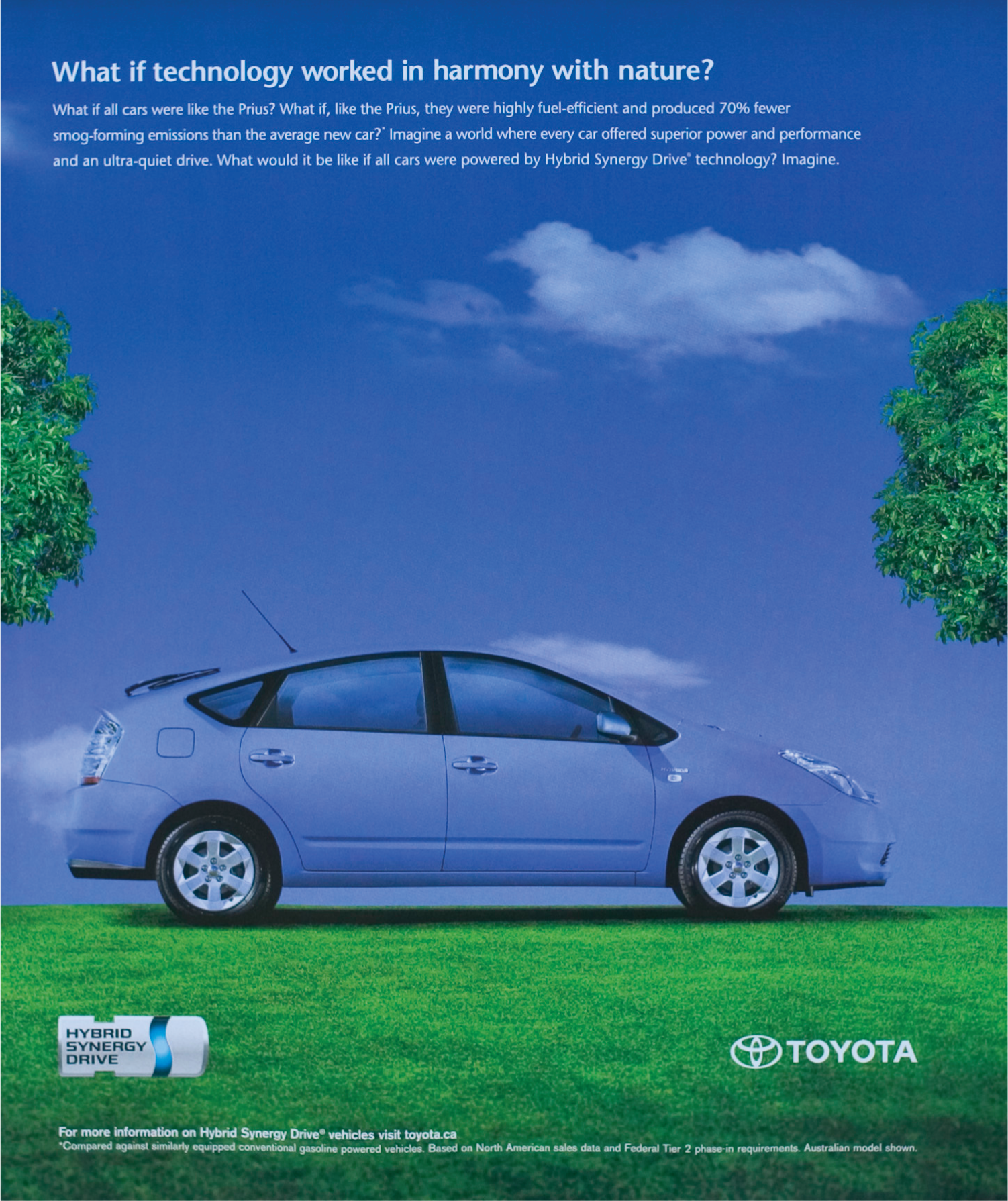
Toyota. Canadian House and Home. 1 November 2006.
The viewer is asked to make distinctions between the Prius and other, single-energy-source automobiles and to consider the positive implications of a worldwide fleet of automobiles that are efficient, clean, quiet, and yet powerful. The viewer is invited, twice, to imagine. While this is the most directive advertisement, others such as Advertisement 2 offer the possibilities of clean air, fuel efficiency, power and quietness, and then ask the viewer ‘what will your reason be?’ This invitation to co-create allows for the possibility of different reasons across viewers but also multivocal reasons for any one viewer.
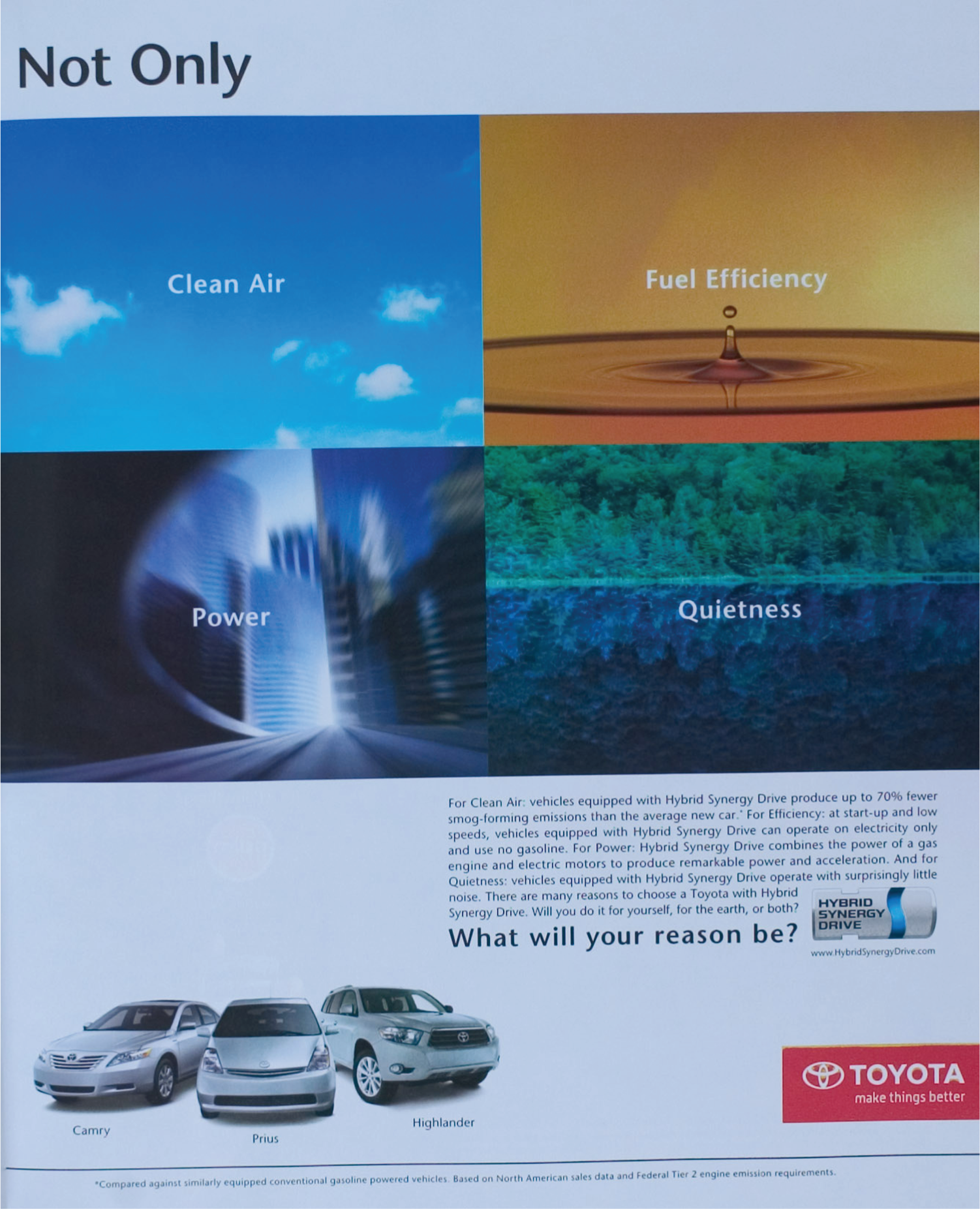
Toyota. EnRoute Air Canada. 7 November 2009.
The Prius advertisements establish a sense of engagement through a spatial relationship created by placing the product at eye level (or lower) relative to the viewer’s point of view. Perspective adds attitudinal meaning, and here it suggests we are equal to, or more powerful than, the product, making us comfortable enough to project ourselves into the scene (Kress and Van Leeuwen, 2006; Williamson, 1978). We read an indirect invitation to imagine, as invoked by the vertical and horizontal dimensions of the advertisements. The degrees of these angles can describe the levels of involved or detached engagement of the viewer (Jewitt and Oyama, 2001). In the Prius advertisements, the car is usually photographed from the front, and at a 45-degree angle, rather than straight on from the side, which would suggest that the viewer is on the sidelines, and not a participant (Jewitt and Oyama, 2001). This horizontal angling is mirrored in the non-Prius advertisements to indicate involvement and to maximize the view of the product. 6
We notice a shift in the vertical angle and the proximity of the cars in the comparison advertisements, resulting in a very different feeling for the viewer (see Advertisements 3 and 4). Here, the cars are more frequently photographed from a lower vantage point, giving the product an air of superiority and dominance. As a result of this use of perspective, the viewer’s symbolic power is lost to the product (Jewitt and Oyama, 2001). The almost predatory feeling we can read from this image is emphasized by the change in spatial orientation. The size of the frame relative to the size of the product establishes social distance, which plays in to the power of the advertisement (Kress and Van Leeuwen, 2006). In these advertisements the image dominates the page, moving into the viewer’s personal space and potentially affecting the viewer’s comfort level.
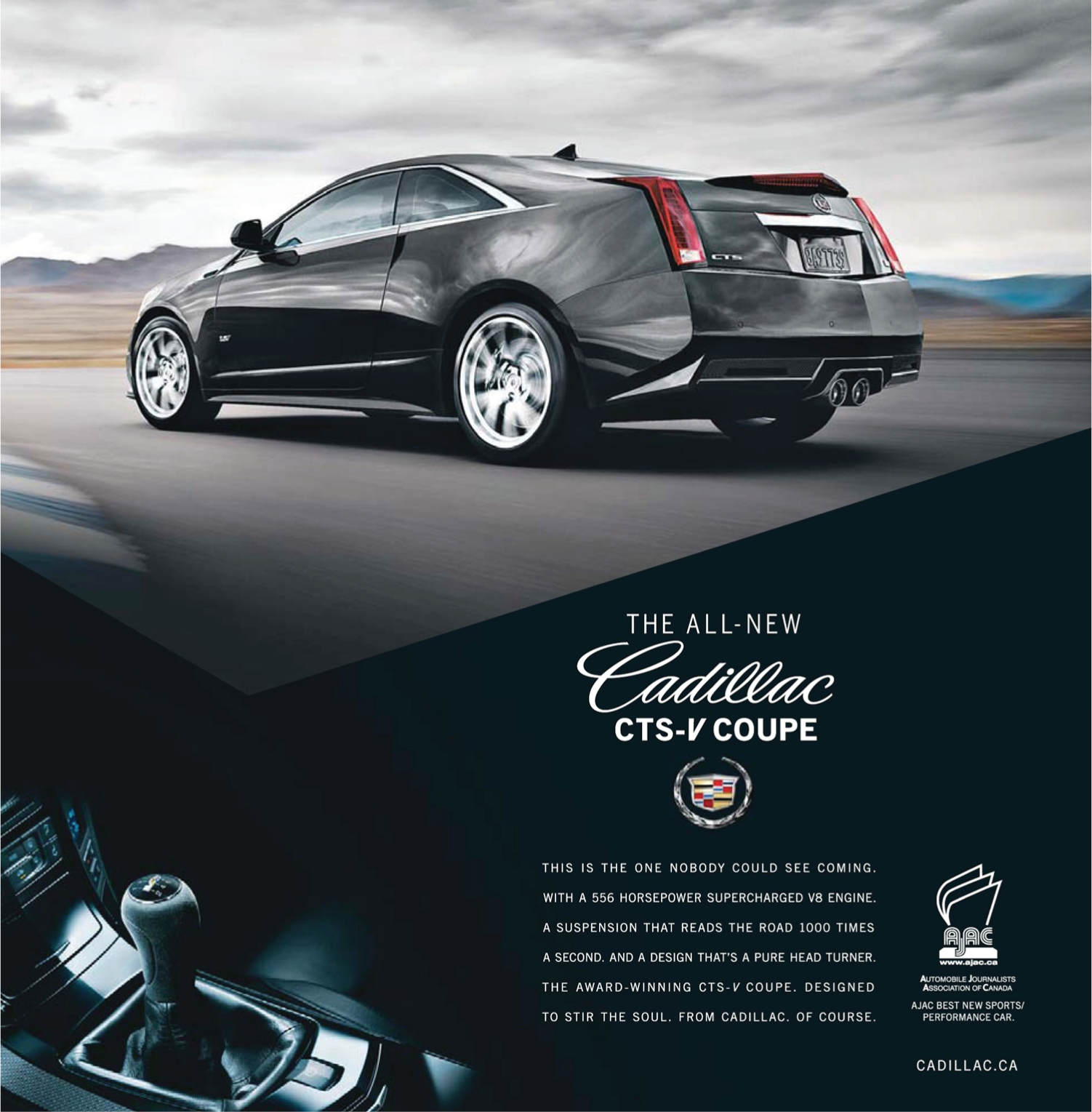
Cadillac. Globe and Mail. 16 February 2011.
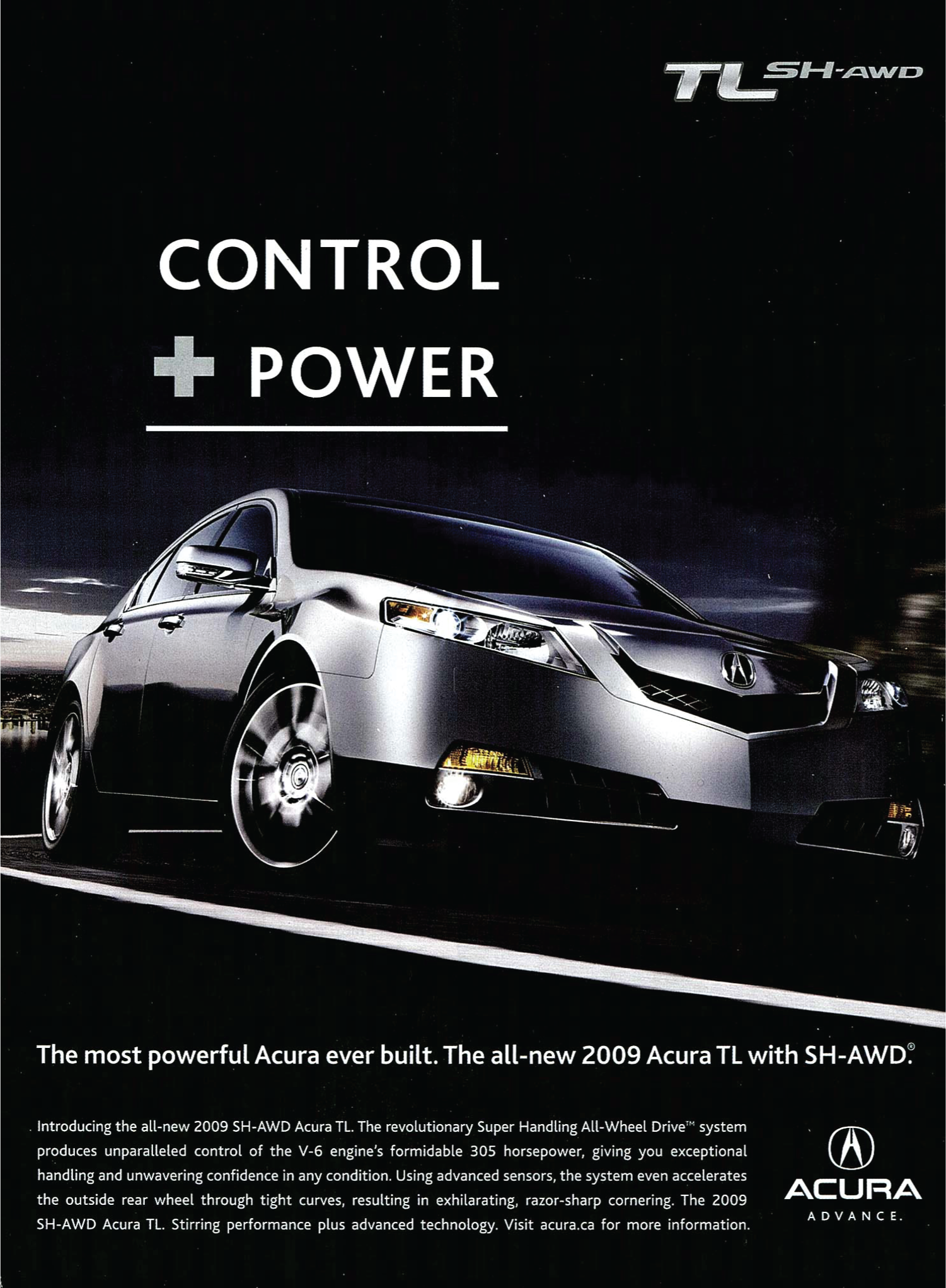
Acura. Canadian Business. 27 March 2009.
The feeling of belonging, of being invited to participate in the Prius advertisements, is reinforced by the absence of people in them (common in automobile advertising), perhaps intended to allow the viewer to more easily imagine sitting in the driver’s seat, to enter the advertisement by filling an absence felt there (McLean, 2009; Williamson, 1978). This invitation is repeated in the advertisements’ design, which is welcoming, clean and fresh, inviting the viewer to enter the scene and participate. The clean white studio backdrop, and the silvery white or blue 7 cars in these advertisements, may be read as a blank canvas, ripe for participation. This fresh colour scheme is distinctly different from our comparison advertisements, which replace blue skies and leafy trees with dark and moody landscapes, and include shiny grey and black cars. The latter scheme depicts these vehicles as dark, masculine, and predatory, in stark contrast to the Prius advertisements, which feel comparatively light, gender-neutral and asexual (McLean, 2009).
Overall, readers are invited to co-create a world in which alternative-fuel vehicles begin to replace automobiles with internal combustion engines. We are to imagine a world in which most consumers have switched to cars like the Prius. Advertisement 5 depicts a blue Prius on a country road, the seaside just visible beyond a field of wildflowers. Blue sky with white, wispy clouds stretches up from the distant horizon, occupying three-quarters of the image. Here, in addition to imagining a leisurely drive, we can imagine that our drive from the city has left little impact on the environment. The tagline says, ‘You’ll see less (smog) up here (in the sky) … because there are over a million Toyota hybrids down here’. At once reminding us that the act of driving contributes to atmospheric pollution, it proposes that more hybrids on the road will lead to less smog. Of course, this is logically possible only if hybrid cars begin to replace internal combustion engines. The viewer is left to surmise this. The body of the text contains this information: ‘Every Toyota hybrid vehicle produces up to 70% less smog-forming emissions. And with over a million Toyota hybrids worldwide on the road today, that’s a whole lot of less’. In other words, this ad enables us to imagine that by purchasing a Prius, we will continue to pollute the environment, but less. Another tagline explicates directly: ‘If you are looking for yet another good way to shrink your footprint, we suggest tapping it against the gas pedal’. Achieving this overall co-created vision of a world with more hybrids requires guiding imagination in particular directions. Below, we examine how the advertisements channel imagination to themes of nature, harmony, and agency, which although analytically separated in this article, are brought together in each advertisement, and how ambiguous and absent cues facilitate multiple imaginings.
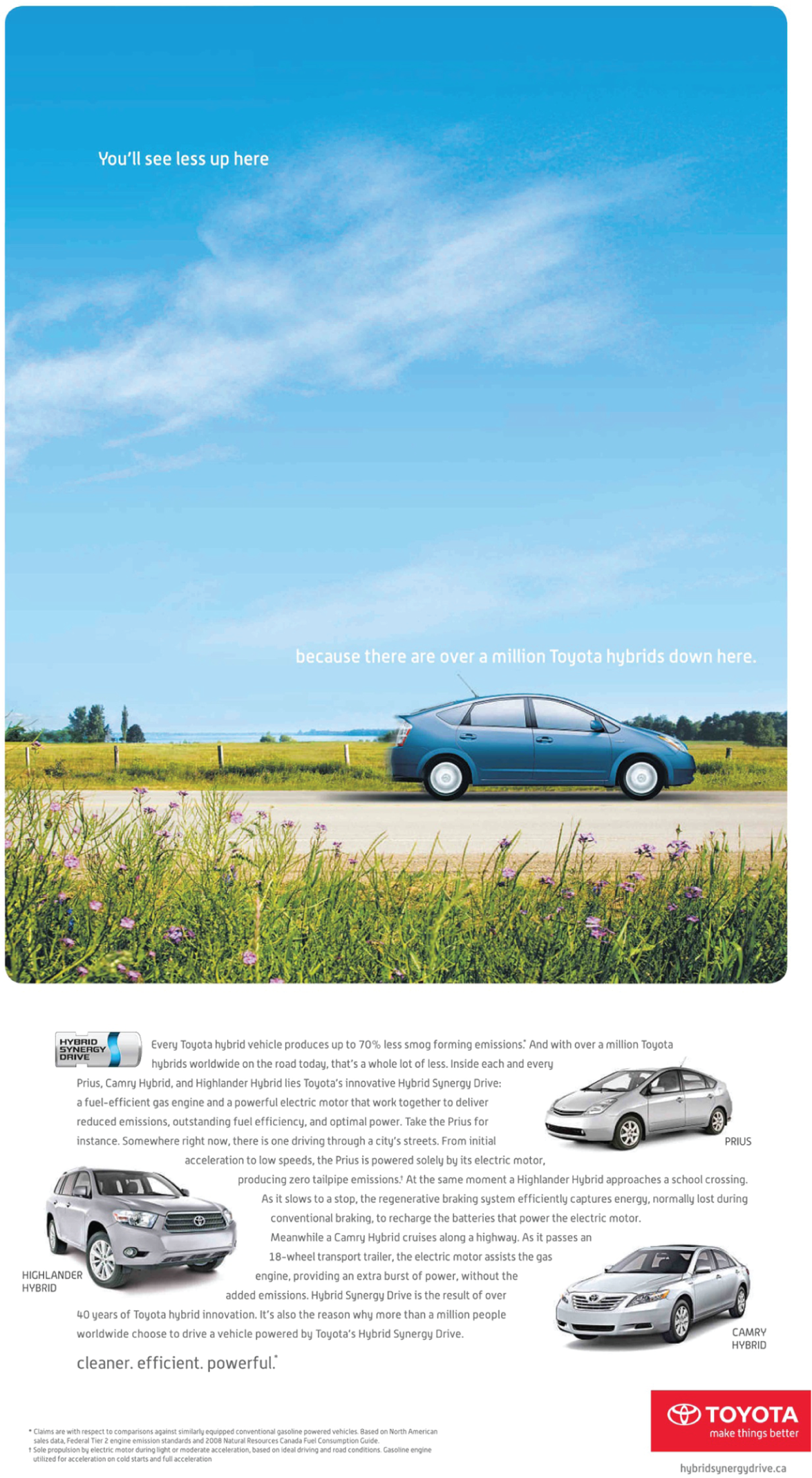
Toyota. Vancouver Sun. 26 July 2008.
(Hyperreal) nature
Nature is central to each advertisement. The majority of the advertisements employ an earthy palette of blues and greens (85%). Sky, water, trees and grass feature prominently in the Prius ads, invoking thoughts of the globe, Mother Nature or a summer’s day. The narrative advertisements are set outside, under big blue skies or green trees. Alternatively, nature is inserted through images. The text-based ads feature greenery, with the text superimposed on close-ups of dewy leaves or framed by boughs. However, nature in the advertisements is different from what we observe through our windows. For example, in Advertisement 5, the natural environment is prominent, but largely unrecognizable. It is presented as artificial and staged. Several aspects of the representations of the natural environment accomplish this. First, the colours are brilliant blues and greens, lit by a bright but unseen sun. The sun is shining, but it cannot be located. Second, nature is presented as uniform. Trees, grass and wildflowers are manicured and appear controlled. Nature is not wild, and it has lost its fractals, nonsymmetrical patterns and variation. Third, shadows or any potential darkness are erased or tightly controlled. There are no other ‘moods’, varying states of nature or seasons. The setting is always sunny, clear and clean. It never rains. A storm has never passed, leaving droplets or wet roads. It is always the peak of summer.
The advertisements allow for the imagination of a future where nature is ‘better’ than it is now. The ads are futuristic in a subtle way. They are connected to the present (at first glance everything is recognizable) but they are transitioned to the future (upon examination they portray scenes that are staged, groomed and difficult to locate). This relates to what social theorists call the ‘hyperreal’, in which objects or experiences are presented without any of their known, undesirable features (Borgmann, 1992). Hyperreality is an improvement on reality. Hyperreality is ‘more pliable, rich, and brilliant … [it is] the capacity to engineer realities or environments that are “better”’ (Cypher and Higgs, 1997: 111). In this case nature is portrayed without pollution and degradation. Rather than normal weather variation, we see fixed blue skies brought to life with nothing more than the single touch of a white cloud.
These portrayals of nature diverge sharply from those in the matched sample of ads, in which rain showers fall on the highway, clouds loom on the horizon, streams emerge on the path and unwieldy trees grow alongside the road. In these advertisements, the vehicle is pitted against nature, and the driver’s ability to drive on, maintaining control over nature, is demonstrated. The viewer can observe that technology is able to dominate and control nature.
In the Prius advertisements nature is also controlled, but it is not dominated. In these representations control relates to the ability to repair and reorder nature. The hyperrealities represented in these advertisements express an improved, rehabilitated future reality. Nature is presented as fixable and pliable. Pollution and other impurities have been airbrushed from the images. The representations diverge from ‘reality’ because they have been purified and now transcend the dirty, stunted, uncontrolled and uncared-for nature. Further, the advertisements suggest that this control is possible through relative passivity. The natural environment can be re-engineered via a new vehicle stock rather than a large-scale change in habits. Attempts to create visual and textual links between automobile use and climate change are focused on imagining the Prius’s ability to rejuvenate nature. This suggests that it is possible to solve current climate change issues by replacing internal combustion engines with hybrid technologies.
Harmony
Imagining a hyperreal nature is significant not only because of what it says about the resilience of nature but also because the advertisements take this concept a step further and ask us to be in harmony with nature—the hyperreal version of it. Overall, we are asked to reimagine the relationship between technology and nature as harmonious: ‘What if technology worked in harmony with nature?’ (Advertisement 1). In this advertisement the Prius is literally integrated into nature: seen in profile, parked on green grass, between two seemingly identical leafy green trees. The blue of the car matches the blue of the summer sky beyond and the horizon line aligns perfectly with the car’s tyres, so that the blue sky is also visible underneath the vehicle. The technology of this car, then, is in perfect harmony with nature, as natural as the trees among which it sits. This integration might alternately be read as camouflage; the car is so like nature that it blends into the background. The word ‘imagine’ is stressed in the text of the ad, perhaps a nod to the idealized reality in which this car exists.
In Advertisement 6 the car is removed completely, rendered invisible through its reduction to a silhouette. The illustrations—five white, two-dimensional silhouettes against a blue sky—read more like depictions of toy cars than of machines. The tagline tells us that ‘[Toyota] designed what’s inside to work with what’s outside’, meaning, literally illustrating, how the gasoline will kick in when the car meets an incline, but visually suggesting that the car’s mechanics will not interfere with the environment. It is significant that Toyota calls the technology that shifts between the petroleum and electric vehicles the ‘synergy’ drive system. This stylized advertisement shows how the vehicle will perform ‘outside’, yet this is not a recognizable landscape and does not exist in reality. Olsen describes the inside/outside dialectic in SUV advertising as related to the inside, domestic and material life of humans, a familiar place where we have control and where the outside is intangible, ‘ephemeral and diffuse’ (2002: 191). By contrast, the Prius advertisement suggests how the inside of the vehicle is in touch and harmonized with the external, natural realm.
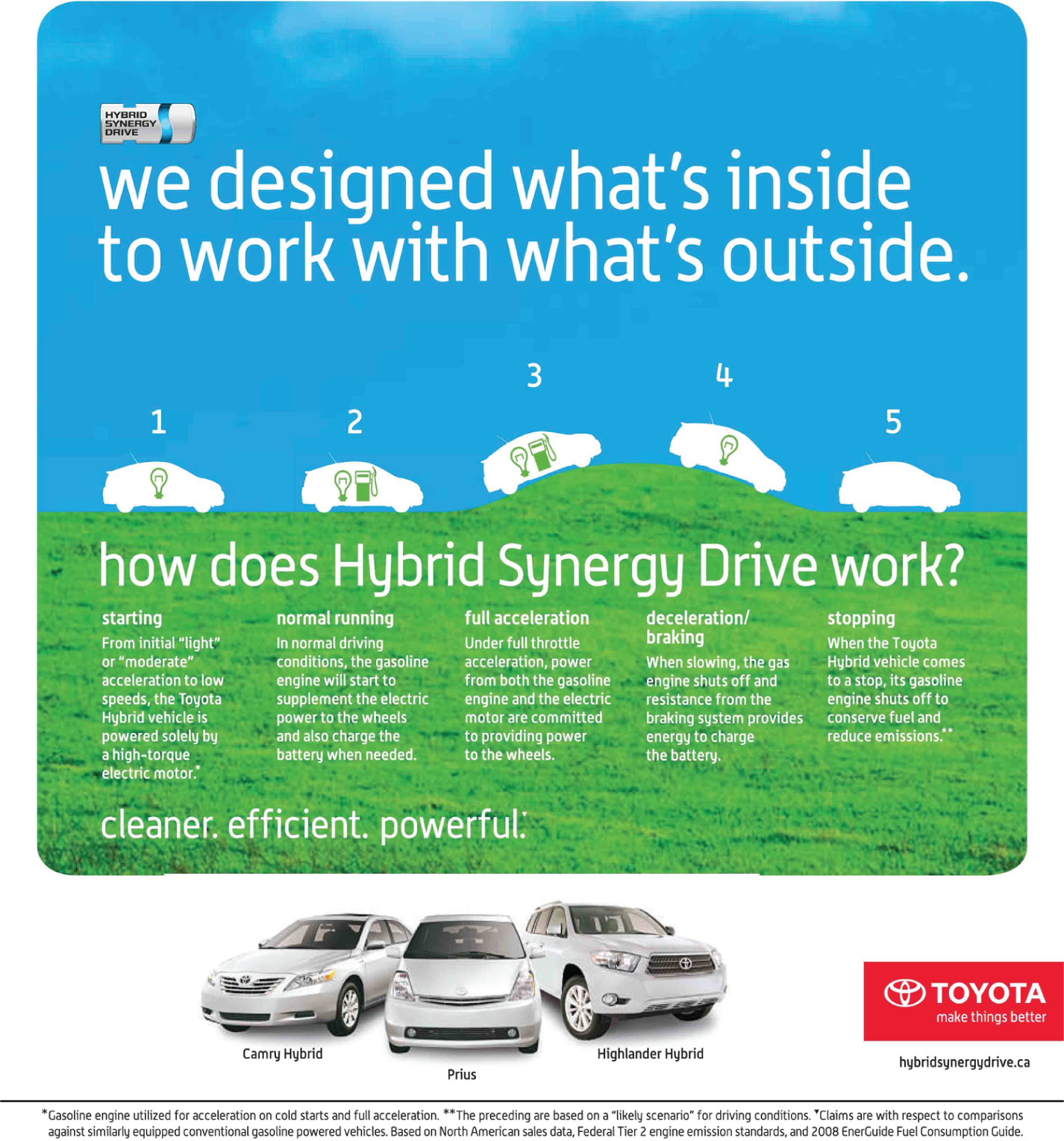
Toyota. Vancouver Province. 8 May 2008.
Harmony between the Prius and nature is also suggested by the lack of motion in the advertisements. Most of the ads show the vehicle parked and at rest. Even when shown on the road, the vehicles appear to be still. In Advertisement 5 we, the readers, are positioned at the side of the road, in the tall grass looking across the road to a distant body of water. While the Prius on the road is meant to be in motion—the back of the car is blurred slightly, suggesting movement—the overall impression is that this car has stopped to admire the vista, and that the car’s occupants might be standing at the side of the road with us to take a photograph or enjoy a picnic. This stillness is in opposition to the non-Prius sample of advertisements, which suggest movement and speed. Advertisement 3 shows a Cadillac zooming away from us on a deserted highway, the road stretching out toward low mountains in the distance, the only feature of the landscape. The clouds in the sky appear to be moving toward us, adding to the sense that the car is speeding away. This advertisement combines perspectival and non-perspectival elements (Kress and Van Leeuwen, 2006), not seen in the Prius advertisements. The viewer’s perspective is simultaneously from a ‘non-place’ on the asphalt, looking up at the car, and inside the vehicle, next to the gearshift.
Car advertising often represents driving or car ownership as signifying material wealth and social status, freedom, power and speed (Conley, 2009; McLean, 2009; Meister, 1997; Olsen, 2002); and vehicles are typically framed against a backdrop of a busy metropolis or ‘urban jungle’ (McLean, 2009) or the rugged wilderness to be dominated by the adventurous driver. In contrast, the built environment and the wilderness are notably absent in the Prius advertisements. The car is a passive aspect of the setting, usually embedded in a largely natural environment. As it is pictured, the car does not have an obvious effect on the environment. Perfected nature is cast as a paradise in which the Prius is presented as in harmony with nature.
This repetition of harmony, the close relationship between nature and technology, suggests that perhaps nature is also a technology and that, by extension, the same design and control that Toyota brings to its automobiles may be possible in nature. Alternatively, if technology won’t work in harmony with nature, what about the other way around? Perhaps as we harmonize technology and hyperreal nature, our control of technology and nature will increase, and the climate change consequences, predicted based on scientific evidence, can be averted. This leads to questions about agency.
Agency
As human beings, are we closer to technology or to nature—or do we manipulate both? The Prius advertisements are remarkable for what they lack—actors and action. With one exception, they do not include people, and, as noted above, the cars are never in motion. Further, the car doors are never open and the windows are closed and darkened. While automobile advertisements often lack people, the images are usually oriented so that the viewer is looking at the driver’s seat or staring out the driver’s window. In the Prius advertisements, viewers are not invited to imagine themselves in the car (as a driver) or driving (see, for example, Advertisements 1, 2 and 5). The implication of this absence of actors and action is that there are no behavioural choices (decision to drive, speed of driving, distance of driving) to make.
The issue of driving, an environmentally damaging choice, is on the one hand not available for reflection. Any consideration or guilt that might be associated with such choices is glossed over or removed through the sun, sky and greenery of the imagery, which transports us directly to recreation and escape (Sheller, 2004). On the other hand, driving is also not sensationalized in the Prius advertisements. The experience of driving is not featured or promoted. This is in stark contrast to the comparator advertisements in which the viewer is encouraged to feel the speed, smooth turns, fast pick-up and secure braking of the driving experience. Most automobile advertisements offer the experience of a safe ride or an exhilarating joyride. The journey itself, in a new car, is offered as the experience.
The Prius offers an experience; however, that experience is not related to driving. The Prius advertisements censor the journey (and its negative consequences for the environment) and instead focus on the destination. In the case of Prius the destination, to which we are automatically transported, is a place or space where one can be in harmony with the environment. Advertisement 7, in which a mosaic of thumbnail images fills the page to the margins, delivers this message best. Each of the two-dozen images depicts an open window, and over half are looking out—at the sea, mountains, green fields—while the rest are taken from the outside looking in (though the interiors are not visible). While different in style from the rest of our sample, this ad contains the same elements: blue sky, green grass, flowers, sun. Several images include filmy curtains, caught in the breeze, while many others show shutters thrown wide open. The open windows suggest the exchange of air between the inside and the outside and the resulting sense of connection and wholeness. There is, however, more than just a sense of ‘fresher air’, as the ad’s tagline states, ‘One million Toyota hybrid drivers have opened up to a world of fresher air’. Despite the absence of a human component, the objects in these images provide clues for the viewer in building a ‘self’ to complete the narrative. These clues are particularly strong with the interior shots, where the angle of the shot lends a feeling of spatiality, of being in those rooms, at those windows. It is not difficult for the viewer to combine his or her persona with that of the absent occupiers of these spaces, to imagine a new self to fill the absence (Williamson, 1978).
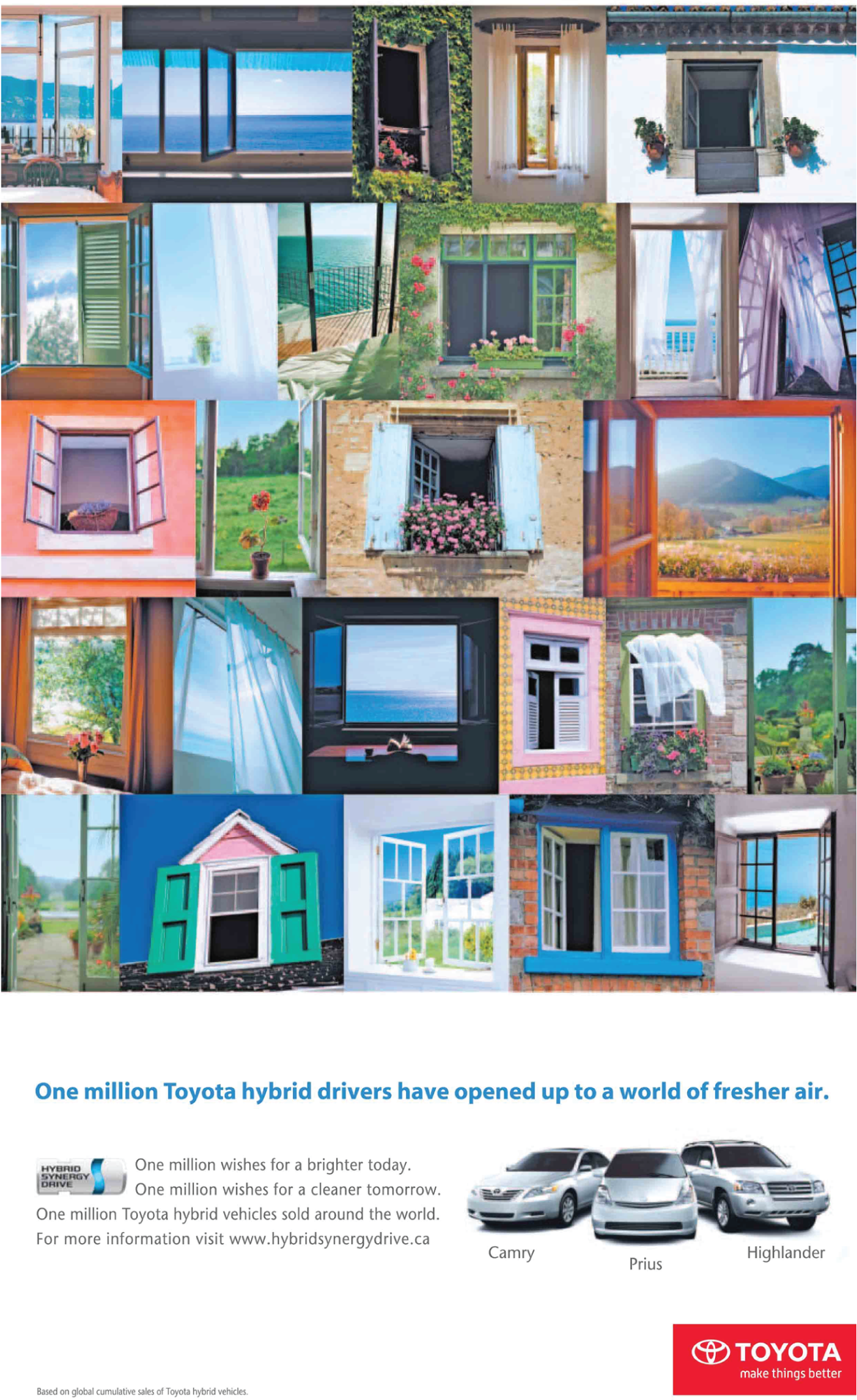
Toyota. Globe and Mail. 7 June 2008.
Discussion
Our analysis examines the representational practices surrounding the Prius and considers how the audience is invited to co-create its meaning. Viewers are invited to enter the advertisement and to actively make sense of the product via two techniques: through direct textual content, and more often through the visual construction and composition of the advertisement, with attention to angle of view, setting, spatial relationship and colour scheme. Together, these techniques encourage participation and co-creation in the advertisement.
Co-creation strategies depend on the consumer’s capacity to imagine. When the viewer enters this aesthetic landscape, ambiguities within the advertisements—vagueness, indeterminacy and absences—stimulate consumer sense-making of the cues. Imagining involves developing connections between self and context or structure (Mills, 1959). Through the development of new or unfamiliar associations, imaginative processes may beget realizations. Synthesizing our findings, we argue that ambiguities which allow imagining connections with the current state of social, scientific and technical aspects of reality help viewers create new knowledge. In contrast, other ambiguities enable associations that lead the viewer into the fantastical. Winnicott (1971) labelled the imaginative processes which generate understandings of self and reality as imaginative fantasy and distinguished them from flights into fantasy, imaginations that generate illusory, dissociative notions of self and reality. We discuss how the configuration of images and texts produces ambiguity that may simultaneously allow for two kinds of imagining—reflexivity and fantasy—in relation to the issue of climate change.
Ambiguity, imagination, and reflexivity
Ambiguities that are in some way tethered to the current state of the world offer new imaginings that have the potential to generate reflexivity. Reflexivity involves reflection and possibly revision of self and social practices in light of new information (Giddens, 1990). In particular, ambiguities in the form of absences allow viewers to fill in what is missing (often the self or the practice) in relation to the scene and via this allow new connections to be made. For example, the Prius advertisements are missing the explicit identity-building function of advertising found in many other brand campaigns (Buchanan-Oliver et al., 2010). The advertisements are largely ‘unpeopled’ and do not feature driving behaviour or other lifestyle cues that often appear in the comparator advertisements. This could indicate a post-apocalyptic scene; however, the advertisements, by asking questions and presenting us with sunny skies, acknowledge that the world has not ended. What are we to make of the incongruity of the simultaneous absence of agents and practices but the assumption of agency?
The absence of people—both from the vehicles and from the narrative scenes—contributes to the viewer’s ease of imagining, allowing for escape from the constraints of reality and ‘freedom from social exclusions’ (Conley, 2009: 53). Because the advertisements do not associate an identity or set of identities with the Prius, viewers may be stimulated to ‘try on’ the Prius and have the opportunity to craft their interpretation of the car in relation to their identity or vice versa. The advertisements provide the occasion for and the context in which viewers can reconstitute their identities (Schroeder and Borgerson, 1998). The absence allows for a plurality of people to identify with the brand, and this inclusiveness circumvents alienating or stigmatizing customer segments (Puntoni et al., 2011). Likewise, another advertisement invites reflexivity on self and motives in asking viewers ‘what will your reason be?’ and offering possibilities ranging from speed to performance, noise and fuel efficiency. This reflexivity is more likely to lead to the generation of insight because it is grounded in choices that fit with existing consumer considerations and because there are multiple possibilities listed and, by extension, more that can be imagined.
The advertisements also facilitate reflexive, meaning-making processes concerning the viewer’s relationship with the earth. They substitute the experience of driving with the experience of being in harmony with nature. The overwhelming references to leaves, sky and grass in the advertising images, colour scheme and text offer the viewer a sensory conduit to nature, but here again, the individual viewer’s connection is unscripted. Unlike comparator advertisements, some of which also place the viewer in a natural environment, the Prius driver’s activities are not suggested. Symbolic associations with particular activities are not made. There are no skis or canoes on the roof rack, no camping gear spilling out, and no nearby mountains to ascend. Prius drivers, it seems, are encouraged to ‘just be’. This ambiguity offers the viewer an openness to imagine and co-create possibilities for the self in nature.
The absences and ambiguities surrounding who might drive a Prius and what their forays into nature might bring provide critical openings to provoke, on a wider scale, thoughts about driving a Prius but also one’s connection to the environment. These ambiguities allow individuals to create new connections, possibilities that offer new identifications but also potentially changes in activities. Consequently, ambiguity affords knowledge creation by inviting reflexivity and customization of identification and practices.
Ambiguity, imagination, and fantasy
In contrast, other ambiguities in the advertisements support the development of false associations between self and context. These ambiguities allow viewers to disconnect from their context and, through the fantastical, withdraw from present and future difficulties related to climate change. Several ambiguities encourage viewers to imagine associations that are scientifically and technologically disconnected from the present. For example, the advertisements suggest a link between technological advancement (the Prius) and the repair of nature (clear skies, vibrant trees, clean water). They do this through the association of hybrid technology and repaired, hyperreal nature, and also through the text, which claims that by tapping the gas pedal of a hybrid car, the viewer can enter the world of the cleaner, better environment. Further, the use of hyperreal images invites the reader into a fantastical, imaginary, utopian location (Baudrillard, 1993). Passivity—the lack of motion, degradation and activity—pervades this utopian vision. The advertisements cross ‘into a space whose curvature is no longer that of the real’ (Baudrillard, 1993: 4), and this may temporarily disorient the viewer. As Hjerpe and Linnér (2009) discuss, utopia is usually thought of as an ideal; however, it is etymologically the ideal place, which is no place. The viewer may be at first be confused by what is real and what is simulated, but as at Disneyland, the iconic example of the hyperreal, consumers can quickly suspend disbelief, and they are rewarded by escape from the complex and inherently flawed ‘real’. It is an utterly human strategy for seeking escape and denial from ‘disorder’ and ‘matter out of place’, or in this case nature out of control, including melting glaciers, increasing temperatures, flooding and changing weather patterns (Douglas, 1966: 41). The airbrushing of nature forecloses the opportunity to imagine one’s connection to current and future states of nature, allowing for illusions and neutralizing fears (McLean, 2009).
The Prius, embedded within a hyperreal world, allows the viewer to disassociate from the original nature from which this copy was generated. Images that constitute the fabric of sustainability and scientific debates on climate change, such as technology, time, nature and human behaviour, are not configured in ways that stimulate important connections between self and context. The advertisements do not problematize current practices, and a sense of urgency and time constraints is missing, and in this sense the advertisements are severely limited in terms of the resources—images and text—that they offer the consumers to become self-conscious and creative in relation to the ecological crisis. In this fantasy realm, attention moves away from concrete and constraining factors, such as emissions, pollution levels, footprints and energy and oil consumption, toward the presentation of nature in its idealized state.
Implications of ambiguity
The advertising space simultaneously provides consumers with resources for knowledge creation (cues about themselves and their relationship with nature) and knowledge denial (about the need for and urgency of new consumer practices). The consumer is encouraged to rethink personal consumption behaviour in relation to a product and nature, but in a controlled way. The consumer is encouraged to fantasize that through the purchase of the product, climate change may be addressed. The implication is that the viewer is left with a false sense of security in which utopian possibilities are allowed to dominate. Any fears or suspicions of the anthropomorphic effect of increasing greenhouse gas levels are allayed.
Co-creation marketing approaches simultaneously obfuscate and problematize the producing organization’s strategic intentions in the design and production of these aesthetic landscapes. Although we can assume that organizations are self-interested in their actions, as organizations continue to lean toward co-creative modes in generating the symbolic meaning of their products, the raw material of their advertisements becomes part of the public domain that members may appropriate and repurpose—intentionally or not—to understand their choices in relation to a broader array of issues.
However, the Prius advertisements offer a partially ambiguous aesthetic terrain that is limited in this respect. They are not an endlessly fruitful terrain that allows viewers to radically reimagine the significance of automobiles. The advertisements reinforce thought processes that ‘support the consumer’s consumptive role at the expense of more collective concerns’ (Linder, 2006: 105). Although consumers are invited to co-create within this advertising space, they are given wide berth to imagine their relationship with the Prius and nature. The ambiguities related to the consumer’s identity and experience allow for pluralism and multiplicity. In contrast, the ambiguities about the relationship between the Prius and the repair of nature facilitate less creativity. The connection between the two is made more explicit, and thus consumer fantasies are more directed.
Ambiguity as strategy?
While analysis of the advertisements cannot reveal Toyota’s intentions or desired responses, the findings of pervasive ambiguity on topics of consumer identity and the relationship between technology and nature have implications for the literature on green marketing, the promotion of sustainable products and services (Gordon et al., 2011; Polonsky, 2011). Natural environment issues are increasingly a criterion in advertising strategies as growing segments of consumers, investors and policy makers express concern about the environment (Iyer and Banerjee, 1993; Menon and Menon, 1997). However, studies identify several risks involved in green marketing. First, consumers who purchase green items may fear being perceived as inauthentic (Kadirov and Varey, 2012) or elitist (Crane, 2000). As a result, an organization’s green marketing may actually alienate sympathetic, potential customers and, by association, established customers of the organization’s established lines of non-green products. Second, organizations that engage in green marketing attract intense scrutiny of their green credibility (Banerjee et al., 1995) and face the potential threat of ‘greenwashing’ accusations (Karna et al., 2001). Third, organizations face the challenge of promoting ‘green’ product categories without denigrating established product categories that are clearly environmentally inferior.
In relation to these three risks, the use of ambiguous cues may be of strategic benefit. This assertion is counter to the green marketing literature which considers ambiguity in green product marketing an indication of ‘greenwashing’ and the obfuscation of the green features of the product (Leonidou et al., 2010: 8). Ambiguity about the ‘greenness’ of products and the absence of identity and lifestyle images in advertisements may permit consumers with environmental sympathies to avoid stigma and may deflect evaluation and criticism of the organization. Additionally, because such ambiguity involves heavy reliance on consumer co-creation processes, this may further reduce the potential for a green backlash. Critical treatments of co-creation have argued that the transformation of the passive consumer to the active, co-creating consumer ‘expands upon Fordist models of control by transforming resistance and opposition to marketing power into a source of economic value and by actively encouraging consumer experimentation and innovation, even if resistive in nature’ (Zwick et al., 2008: 168). Thus, while seemingly ‘democratizing’ consumption (Fisher and Smith, 2011), control through ambiguity may act as ‘a Trojan horse, a gift which if accepted engulfs and controls’ resistance, cynicism and the potential for mocking appropriation of brand images (Kadirov and Varey, 2012: 6; Žižek, 2007). The ambiguity of the advertisement may neutralize potentially critical viewers.
Eisenberg (1984) argues that ambiguity in communication, in allowing for multiple readings of symbols, can be a strategic resource when organizations face a diverse audience. Ambiguity has the ‘capacity to promote unified diversity’ because it engenders consensus on abstractions without imposing determinate interpretations (Eisenberg, 2007: 8). For example, purposely vague cues about the identity and preferences of the consumer in cologne advertisements allow a single advertisement to appeal simultaneously to heterosexual and homosexual men (Puntoni et al., 2010). This ‘purposeful polysemy can become important to avoid the risk of backlash from members of the dominant culture’ (Bhat et al., 1998; Puntoni et al., 2011: 26). While Toyota’s intentions are unknown, the absence of identity and lifestyle cues is socially inclusive and avoids stigmatizing Prius drivers and, by implication, those who do not drive a Prius. The ambiguous advertisements in this way include not only environmentalists but also other consumer segments with different values and practices.
Ambiguity in communication can also help organizations balance multiple, sometimes conflicting goals or transition to new goals by ‘fostering deniability’ (Eisenberg, 2007: 14). In socially contested arenas like ‘green’ automobiles, ambiguity of advertisements helps organizations face the challenge of promoting the advanced features of new products without making distinctions between new and established product categories that denigrate the latter (Robertson and Gatignon, 1986). This also reduces typical risks of illegitimacy discounts and burdens of balancing resource when promoting diverse categories (Freeman and Hannan, 1983; Hsu, 2006; Zuckerman, 1999). By avoiding clear and specific claims about green products, organizations avoid scrutiny of those claims and comparisons to their non-green products. They may also avoid negative attention to their overall performance in relation to the natural environment. Although Toyota has a product that is unambiguously better than internal combustion engine products in terms of fuel consumption and greenhouse gas emissions, the organization does not exploit this advantage directly. Doing this would suggest that their other product lines are not only possibly technologically inferior but also ecologically—and thereby socially—questionable. This strategic containment of contradictions, through ambiguity, may help Toyota attract mainstream consumers to the world’s first mass-produced green car while sustaining other product categories that are ecologically inferior.
Limitations and future research
This study has several limitations that present opportunities for future research. First, it is limited in what it can claim because it is based on a sample of approximately 80 advertisements and focuses primarily on the cultural messages related to one brand in one country. The robustness of our findings could be tested by continuing to collect advertisements over time but also across different countries and cultures. Second, this study, like most studies of cultural influence on cognition and action (e.g. Lawrence and Phillips, 2004), analyses the system of signs presented without testing their effect. Future studies could examine how these carefully constructed invitations to imagine technology in harmony with nature influence a range of viewers to make sense of and articulate knowledge of climate change. For example, as in Puntoni et al. (2011), studies could introduce simulated exposure to a range of conditions and analyze the process and outcomes of imagining in relation to these advertisements. Third, our study is limited to print advertisements. Future studies could consider and compare different advertising mediums (e.g. Internet and television advertisements) in terms of not only inviting viewers to imagine but also the range of themes possible to present. Fourth, we limit our study to the symbolic realm, whereas the phenomenon of climate change is characterized by an ‘entanglement of the social and the material aspects’ (Ansari et al., 2011; Whiteman and Cooper, 2011). Possible extensions of our work in this direction could involve understanding how the relationships between representations, practices and technologies coevolve.
Conclusion
We considered how symbolic representations found in advertising text and images may serve as an alternative influence on the way climate change and other issues are interpreted and brought to life. In the case of the Prius, the advertisements have the potential to influence the population’s understanding of the global challenge of increasing greenhouse gas emissions. Our findings demonstrate how, through an ambiguous arrangement of images and text, viewers are invited to generate their own understanding of the Prius. We find that potential moments of knowledge creation in this co-creative process are channeled toward imaginings related to nature, harmony and agency, quite distinct from (but not unbound by) the product and its role in society.
Because the ‘response to climate change is fundamentally affected by the way organizational actors … imagine and communicate a present-day image of future climate changed worlds’ (Wright et al., 2011), altering the signification of automobiles will depend, in part, on how automobile manufacturers contribute to building a cultural realm regarding the purchase and use of their products (Conley, 2009). While corporations, as self-interested parties, may not intentionally produce broader influences, the visual and textual dimension of their product advertising permeates our imaginings and has consequences for understandings of climate change. Where scientific data and empirical observations fail to persuade, language, images and practices with broad appeal may influence understandings of the nature and extent of climate change. Aesthetic objects and messages offer an opportunity to bring to the foreground the urgent need for behavioural change to limit the impact of societal change issues. The aesthetic landscape makes room for multiple conflicting sets of symbols, practices and discourses related to anthropogenic climate change that may offer resources for the building of alternative cultural repertoires that consumers can draw on for reflection and to generate new interpretations of their individual actions.