




Abstract
In this article we pursue a dialogue between Callon’s (1998) ‘performativity thesis’ and Critical Management Studies (CMS). We make use of the performativity thesis to elaborate on the construction of a market and the generation of calculative and rational economic agency in a specific empirical setting: the markets for relationships offered by dating services. We find evidence for ‘effective’ performativity, where technical processes and outcomes are shaped by academic theory. We link the performativity analysis with three critical perspectives: a novel enclosure in the commodification and sale of relationships; the politics of standardization, classification, expertise and responsibility; and the enactment of instrumentally rational, self-interested social relations through the individualist assumptions of matching systems. We argue that a performativity analysis must begin with a critical politics: what kind of world would we like to see performed?
This article argues that the ‘performativity thesis’ (Callon, 1998)can be a powerful tool for Critical Management Studies (CMS), and advocates in turn a more critical positioning of ‘performativity’ within the context of the social studies of markets. We argue that Callon’s performativity—the claim that economics intervenes in and constructs the world that it describes—offers a theoretical framework that allows CMS to identify and engage with the material processes of economization, to be employed alongside existing notions of ‘reactivity’ and the sociology of classification (Espeland and Saunder, 2007; Jeacle and Carter, 2011; Willmott, 2011). Despite the popularity of performativity as a means of understanding identity (Butler, 1990), the critical possibilities of economic ‘performation’ as an analytical lens have perhaps been overlooked in the literature of CMS. We suggest that its great strength lies in its ability to give an account of how the economic objects that we encounter under neo-liberal capitalism—high finance (MacKenzie and Millo, 2003) or even entrepreneurial opportunities (Roscoe et al., 2013)—come into being, to elaborate on the ‘state of affairs at hand’ (Latour, 2007: 144). Studies of the translation of economic theory into organizational regimes, institutional practices and individual behaviour have the potential to speak to the key themes of CMS: relations of power, the politics of classification, commodification and the spread of economic logics. At the same time we suggest that a critical perspective can greatly enrich the performativity thesis.
Our empirical site for this article is commercial dating services. Thanks to the growth of online activity dating services, often treated as something of a novelty, have become a socially significant cultural phenomena. Online sites result in large numbers of marriages in the US and Europe annually—one such site claims to account for 542 marriages every day, or nearly 5% of all American marriages each year. 1 Dating services are big business, with one European firm turning over approximately €200 million. 2 But online dating sites do more than simply facilitate efficient searches for matches. They employ sophisticated, proprietary technologies to suggest matches for users; they coach users in relationships; they even suggest how best to manage relationships. There exists a substantial literature on the psychological underpinnings of online dating (Finkel et al., 2012) and on the way that it is understood by users, often as a form of shopping or consumption activity (Heino et al., 2010; Whitty and Carr, 2006). In this article we present a critical perspective on commercial dating services. There are commonalities of interest between existing work in CMS and our empirical site: expert systems, rankings and classification have attracted notice (Espeland and Saunder, 2007; Willmott, 2011) and entrepreneurship has been critiqued as a rent seeking phenomenon of capitalist social relations (Jones and Spicer, 2005) dependent on novel means of enclosure and expropriation (Jones and Murtola, 2012). Yet dating services, which embody all of these processes to a greater or lesser extent, have escaped scrutiny. They have, perhaps, been naturalized as just another variety of the pre-modern marriage market (Bourdieu,1970). This is, we suggest, a mistake. Dating services expropriate relationships as profit opportunities: operators of dating services, particularly those which employ proprietary algorithmic matching, sell the promise of successful relationships to clients seeking partners. In order to do this, dating services claim the authority of rational approaches and scientific method (Porter, 1995) despite the questionable underpinnings of their matching processes (Finkel et al., 2012). The processes of classification, epitomized by dating services, are well recognized as highly political (Bowker and Leigh Starr, 1990). In short, dating services are an untested and unlicensed form of social engineering (Houran et al., 2004); we are in the early years of the internet dating boom, and have yet to see its consequences. For these reasons alone, we suggest that the topic is an important one.
It is well recognized that economic logics (Carter et al., 2010) and classificatory structures (Espeland and Sauder, 2007) reshape organizations. The performativity approach is grounded in the material artefacts through which cognition and agency are distributed, and where the social world is best understood as a ‘summing up of interactions through various kinds of devices, inscriptions, forms and formulae’ (Latour, 1999: 17). Conceiving of rankings as cognitive frames of action, for example, is an inadequate methodological representation. As Pollock and D’Adderio (2012) point out, even something as simple as a ranking requires a calculative device—the list: ‘analytically the notion of devices useful because it captures how a ranking is an artifice, an artefact, the product of a practice’ (p. 566). Moreover, where rankings of law schools, for example, represent only the ideal types envisaged by the builders of lists (Espeland and Sauder, 2007) the performativity thesis forces us to engage with the power of academic knowledge in reshaping our daily lives: in organizations, in practices, and as we argue in this article, even in relationships. We recognize that the knowledge and theories of the social sciences are generative and that different modes of calculation and measurement will produce differing social worlds (Law and Urry, 2004). We are able to trace the messy pathways between social science and the practices and devices that govern everyday life, from the very small to the global. Performativity is important precisely because scales are so unstable (MacKenzie, 2009), but its complexity and instability makes it difficult to investigate. As MacKenzie notes, empirical work and the building of theoretical conclusions must proceed with caution. We must simply examine ‘the state of affairs at hand’ (Latour, 2007).
Performativity, as a theoretical position and a methodological injunction, remains politically mute. It is ‘all cogs and no car’ (Chakrabortty, 16 April 2012). We argue that it can be greatly invigorated by a political, critical engagement, that it can become a ‘critical performativity’ (Spicer et al., 2009). Performativity can stand as a place holder for a variety of critical engagements, and we open up some such possibilities in the final part of this article. Our own motivation, however, is more personal. We propose, following Alasdair MacIntyre (1981), that human virtues are discovered in relations, over time, and through effort. Loving relationships, therefore, are an important space for the development of human flourishing. We recognize this to be the case in our daily interactions as parents, spouses, colleagues, friends and children. MacIntyre presents an account of contemporary emotivism, the solipsistic pursuit of satisfaction exemplified in the persona of the manager, therapist and aesthete. In this article we consider the possibility that dating services perform that same solipsistic rationality. We show that dating services bring the processes of matching closer towards those supposed in the models on which the sites are based, that they exhibit at the very least an ‘effective performativity’ (MacKenzie, 2006a). We show the dating algorithms have a substantive effect upon the pairings that leave the sites and that the infrastructures of profile, advertisement, search and selection recast the user as a ‘cyborg-dater’ (echoing Callon, 2007), enacting the dynamic preferences of homo oeconomics, privileging the virtues of efficiency and self-interest, and realizing the ambitions of economic models of markets. If the logic of economics can be shown to permeate our personal relationships, then MacIntyre’s terrifying and barren ‘emotivism’ looms large.
The structure of the article is as follows. We will begin our analysis by introducing the performativity thesis set in the context of parallel approaches within organizational literature. We will specify two aspects of the thesis, and using each we will conduct an examination of dating services. In our discussion we will present a critical account of dating services and advocate a critical performativity, while noting the limitations of our study. We conclude by proposing a closer dialogue between performativity and CMS research.
The performativity thesis
‘Performative’ and ‘performativity’ are, as du Gay (2010) notes, widely used terms in contemporary social sciences. We focus on the ‘performativity thesis’ of Michel Callon (1998), who has argued that economics plays a ‘performative’ role in the construction of the economy. Put most simply, Callon means that economics makes the world it describes. Callon’s definition of economics is deliberately broad—it includes, for example, practices such as accounting, marketing, management and other peripherally ‘economic’ disciplines (Guala, 2007: 135)—but his analytic focus is always at the micro-level: economics intervenes in specific ways, at specific times, and in specific places. Subsequent empirical work has illustrated the ability of economics to enrol other disciplines from the social and natural sciences into its calculative network, for example, medicine (Sjögren and Helgesson, 2007; Roscoe, 2013) and marine biology (Holm and Nielsen, 2007). Callon insists upon the materially embedded nature of economic calculation, and sees economic processes and agency as being constructed, or performed, through the systematic use of devices and infrastructures into which economic theory has been written. Economics is self-referential. Creating sites and laboratories in the real world (Muniesa and Callon, 2007), it is a sophisticated project of measurement (metrology) that manufactures the conditions through which it can describe its object (Mitchell, 2008). For Callon, and in the literature that follows, economics is able to enrol techniques and theories from the social sciences, medicine and even the natural sciences into this metrological project, stabilizing networks of knowledge around its own fundamental calculative apparatus.
Callon’s claim, challenging though it may have been (MacKenzie and Millo, 2003), was not sui generis. Within the social sciences, JL Austin’s (1978) invocation of the performativity of language had led to reflections upon the constitutive nature of theory. Some years before Callon formalized the thesis, Faulhaber and Baumol (1988) considered the real world consequences of economics, while Garcia-Parpet (1986) offered French readers an empirical account of the transformation of a rural strawberry market to an neo-classical model. Elsewhere, Judith Butler’s (1990) argument that gender is an outcome of social and linguistic performance, always provisional, ambiguous and incomplete, has led to much debate. Butler follows Foucault in seeing the subject as continuously formed by discourses and power relations (McKinlay, 2010) and her arguments have given rise to sustained reflection on the part of critical management scholars on, for example the performance of sexual identities in organizational settings (Ward and Winstanley, 2005) and spaces (Tyler and Cohen, 2010) or the achievement of professional identities through performance (Hodgson, 2005; Poulter and Land, 2008).
Callon’s work also parallels the flourishing critical sociology of classification (Bowker and Leigh Starr, 1999; Power, 2011), which employs the notion of ‘reactivity’ (Espeland and Sauder, 2007, Willmott, 2011). Here classifications and rankings are cognitive rather than material frames that ‘change how people make sense of situations … offer a generalized accounts for interpreting behaviour … and help organise the stock of knowledge that participants routinely use’ (Espeland and Sauder, 2007: 10–11). Similarly, standardized metrics such as cost benefit ratios ‘transform cognition’ through a process of ‘commensuration’, that ‘shapes what we pay attention to, which things are connected to other things, and how we express sameness and difference’ (Espeland and Sauder, 2007: 16). Rankings, when applied by governing bodies, permeate and configure institutional strategies. Espeland and Sauder show how league tables cause US law schools to reallocate resources and redefine working practices in order to increase their status, thus coming to resemble the entities described by the rankings. City rankings commensurate cities, ordering them and organizing competition between them, bringing into being the very state of affairs that the league tables purport to describe (Kornberger and Carter, 2010). Critically informed work has shown that rankings can exercise a disciplinary function. Academic journal lists reinforce the hegemony of scholarship that values homogeneity, technical excellence and conformity over innovation, novelty and critique (Willmott, 2011). Publicly available, community-driven rankings, facilitated by the Internet, create a culture of constant surveillance among those who are ranked: such websites ‘revise the boundaries of expertise’ (Jeacle and Carter, 2011; Scott and Orlikowski, 2012: 36) and transform accountability into a ubiquitous disciplinary measure, enforced by swift feedback and open access (Scott and Orlikowski, 2012).
It is the insistence on the material embeddedness of calculation that distinguishes Callon’s performativity not only from Butler’s performativity of gender, but also from the sociology of classification and from other superficially similar approaches, such as Robert K. Merton’s (1948) self-fulfilling prophecy, or Ian Hacking’s ‘looping effects’, where performativity is a ‘particularly tight self-referential loop triggered by the normative character of a speech act’ (Guala, 2007: 153). Callon focuses on the ‘market devices’ (Muniesa et al., 2007) through which calculation is achieved, taking the socio-technical agencement, or assembly, as the fundamental unit of decision making. For Callon and those writing in this tradition, actors are never truly ‘naked’: framing and commensuration, the interpretation of behaviour, and the stock of knowledge employed by participants are all embedded in the material infrastructures of the marketplaces as they are in language and cognition. Again, organizational scholars have been receptive to the notion of performativity enacted through material devices. Cabantous et al. (2010) demonstrate that rational choice is an organizational achievement, ‘crafted’ by trained analysts, theory and artefacts who work to frame organizational decisions and render them calculable (Callon, 2007). Here, Cabantous et al. provide empirical evidence to support Ferraro et al.’s (2005) assertion that rational man can be constructed in organizational settings. Corporate strategy is performed through devices such as the Boston Box or the Balanced Scorecard (Carter et al., 2010: 528), organizational routines may be performative, distributed and iterative cycles of framing (D’Adderio, 2008), and stock market traders are inextricably bound up with their technological apparatus (Muniesa, 2008: Preda, 2009; Roscoe and Howorth, 2009).
At the same time, critics have resisted performativity. The performativity of ‘functionalist’ (Burrell and Morgan, 1979) management research has been a source of concern to critical management scholars (Fournier and Grey, 2000). Spicer et al. (2009) demand a critical performativity that ‘involves an affirmative stance, an ethic of care, a pragmatic orientation, engagement with potentialities, and striving for a normative orientation’ (p. 544). Anthropologists insist that economic transactions can never be stripped from their material and cultural settings (Maurer, 2005; Miller, 2002, 2005). Economic historians have argued that the performativity narratives are simplistic and historically naïve (Nik-Khan and Mirowski, 2007), and researchers with a positivist inclination have suggested that performativity will break itself upon the rocks of ‘human nature’ and ‘reality’ (Felin and Foss, 2009). A more persistent critique, manifest across much empirical and philosophical work is the notion that performativity carries within it the seeds of its own destruction; a dialectic where ‘every economic performation is somehow assumed to bring into being its own counter-programme’ (du Gay, 2010: 177). Indeed, Callon (1998) claims that the economic frames of agency and institutions continually overspill and must be remade: the performance is always on-going and always, in part, failing. Donald Mackenzie’s study of options pricing, with Yuval Millo, is considered the exemplary empirical account of economic performativity, and the story it tells is far from straightforward: an equation manages to create a world in which it can flourish, yet at the same time the world overspills the narrow boundaries of financial economics, contributing to a market crash—Black Monday of 1987—so severe that the exchange itself could only be saved by the socially embedded nature of the financial system (MacKenzie, 2004, 2006a; MacKenzie and Millo, 2003). While Du Gay is right to resist the suggestion that performativity’s self-destruction is a philosophical inevitability, empirical work does systematically identify overflowings from and oppositions to economic framing, whether in options pricing, organizational routines (D’Adderio, 2008), or the modelling of supply curves for hypothetical markets in transplant organs (Roscoe, 2013).
MacKenzie (2006a) offers a comprehensive taxonomy of performative action, which we summarize in Table 1. He presents increasingly specific versions of performativity, allowing for a fine grained and insightful analysis of interactions between theories, devices and performances (D’Adderio, 2008). In the loosest sense, the term simply indicates that economic theory is adopted in general organizational settings: the construction of a central bank inspired by monetarist principles, for example, or Pinochet’s ‘Chicago Boys’, a ‘vivid manifestation of a general phenomenon’ (MacKenzie, 2006a: 16). MacKenzie considers such interactions ‘generic performativity’. His next level of interaction, ‘effective performativity’, requires that economic theory has an effect upon the processes it describes. It is, he notes, vital that use of the process has made a difference: ‘perhaps a process involving use of the aspect of economics in question differs in some significant way (has different features, different outcomes, and so on) from what would take place if economics was not used’ (MacKenzie, 2006a: 17). Evidence can be garnered from observation, supported, in the almost inevitable absence of a control group, by conjecture and judgement.
Taxonomy of performativity (MacKenzie, 2006a: 16–21.
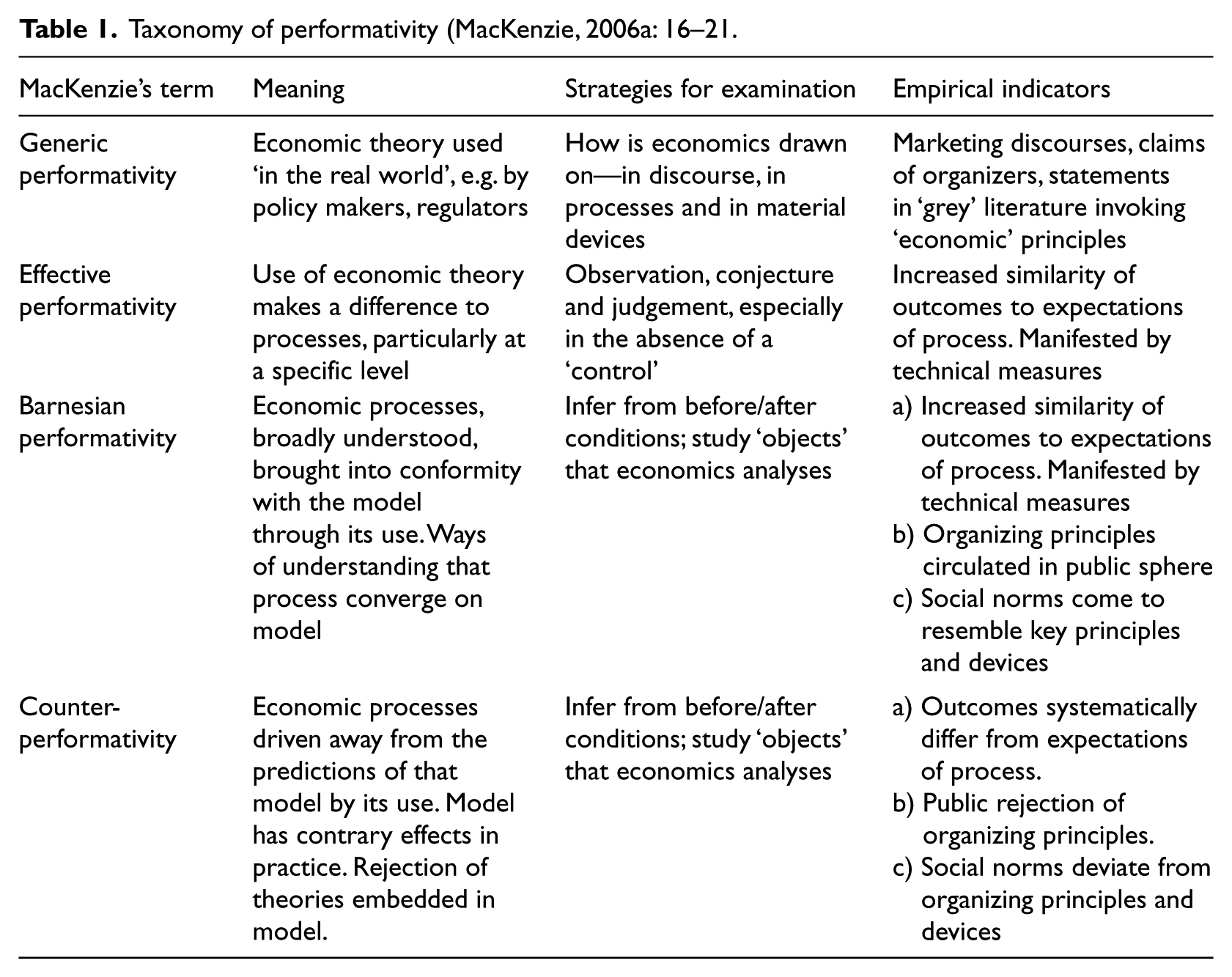
Most ‘intriguing’ of all is ‘Barnesian’ performativity. In this case, ‘processes are being altered in ways that bear on their conformity to the aspect of economics in question … economic processes or their outcomes are altered so that they better correspond to the model’ (MacKenzie, 2006a: 19). In his early work on the topic, Mackenzie named this phenomenon ‘Austinian performativity’. An attack by Emmanuel Didier (2005), convinced Mackenzie that an ‘invocation of Austin could be read as suggesting that the performativity of economics was a linguistic matter’ (MacKenzie, 2006b: 1). He took up the term ‘Barnesian’ after sociologist Barry Barnes who had emphasized socio-material phenomena feedback loops as the building blocks of social life (Barnes, 1983): ‘I have conceived of a society as a distribution of self-referring knowledge substantially confirmed by the practice it sustains’ (Barnes, 1988 cited in MacKenzie, 2006a: 2033). In ‘Barnesian’ performativity, economic models integrated into the objects and architectures of markets, move processes and outcomes towards the predictions of the models. MacKenzie (2006a) is careful to avoid the pathology implied in Merton’s self-fulfilling prophecy, noting that the performance of Black-Scholes’ model persisted only as it became the exemplar of a generally accepted model: to be truly performative, the general principles invoked by the model must be manifested in the world around it (p. 20). Finally, MacKenzie (2006a) suggests that economic theories may have contrary effects. In this case, widespread adoption of the model causes social processes to systematically deviate from the predictions of the model; MacKenzie’s examples include the role of portfolio insurance in the 1987 market crash (MacKenzie, 2004).
In our view MacKenzie understates the most contentious aspect of Callon’s thesis, the claim that economics constitutes economic agency (Callon, 1998, 2007). For Callon, the self-interested, instrumentally rational maximizing actor—homo oeconomics—is ‘performed’ in specific sites, not only through language or cognitive framing, but also through the provision of appropriately calibrated economic prostheses (material tools), and through a process of habilitation by which the environment around an agent is configured to promote economic behaviour (Callon, 2008). This performance, like those of gender and identity, is inevitably unstable and contested, and economic agency is never a finished state: the construction of economic agencies precipitates an endless series of ‘over-flowings’ (Callon, 1998) or ‘counter-performativity’ (MacKenzie, 2006a). Empirical studies such as Holm’s account of the generation of economic behaviour among Norwegian fishermen (Holm and Nielsen, 2007), have focused on the micro level interactions through which economic agency is constituted. These studies have clearly recognized the moral and political consequences of the implementation of economic valuation and rational calculation in organizational situations (Sjögren and Helgesson, 2007; Roscoe, 2013). Callon’s (1998) notion of economics is deliberately broad and these studies also indicate the reach of economic ways of organizing and the ability to enrol modes of calculation from other scientific disciplines: the negotiations over fishing quotas depend upon statistical calculations of fishing stocks; healthcare economics enrols clinical measures of life quality or morbidity alongside cost-benefit analysis.
The recognition that theoretical work in economics and in the social sciences plays a part in the construction of the social world begs important questions. MacKenzie (2006: 273) concludes his work by asking: what kind of a world would we like to see performed? MacKenzie’s provocation must be the point of departure for a critically inspired study of performativity, rich in politics and emancipatory intent: ‘an affirmative stance, an ethic of care, a pragmatic orientation, engagement with potentialities, and striving for a normative orientation’ (Spicer et al., 2009: 544).
Studying performativity: a methodological approach
In methodological terms, performativity approaches are distinguished by an emphasis upon the material devices as crucial actors in the agencements that constitute decision and action. Empirically, research must focus on the embeddedness, or inscription, of theory in these devices and the role of devices in calculative arrangements. Empirical work should demonstrate the travel of a theory into devices and thus into practices, understandings and outcomes; in the messy, non-linear story of performativity (Callon, 2007), the theory must form the ‘Ariadne’s thread’ that links diverse phenomena and renders them intelligible (Latour, 1988). In Table 2, we suggest empirical identifiers for the three categories of performativity discussed above.
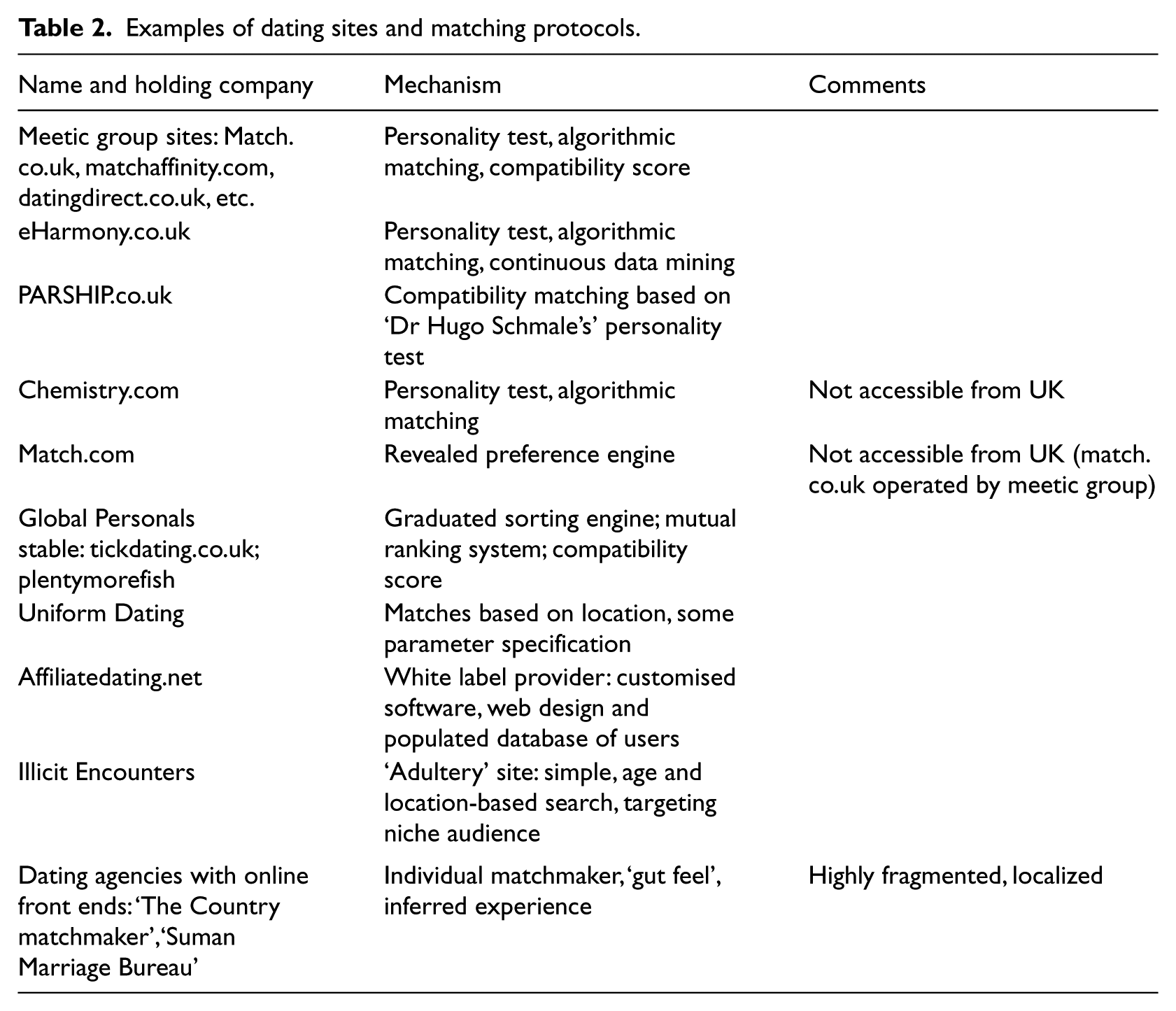
Examples of dating sites and matching protocols.
First of all, there is generic performativity, the assertion that theories or models are used by participants in organizational processes. In the sphere of economics, public declarations of regulators, central bankers, etc. can be taken as sufficient sources so long as (notes Mackenzie, 2006a: 18) the processes in question involve material devices that incorporate economic theory. Effective performativity is more challenging. According to Mackenzie (2006a: 18) the implementation of models must be seen to make a difference: perhaps different features, or outcomes. Mackenzie’s own work has shown how prices came to resemble options pricing models. The third category, Barnesian performativity, is harder to demonstrate. Recognizing that social life is itself a self-referential process (Barnes, 1983) it requires researchers to demonstrate that the principles invoked by the model are used in understanding and organizing the activities in question. The model must have travelled widely enough to make a difference within a community. So, for example, the industry ranking devices studied by Pollock and D’Adderio (2012) were generally understood to shape the purchasing decisions of corporate buyers and had spawned a subsector devoted to the improvement of clients’ positioning in the matrices. To demonstrate empirically that a given theory has reorganized a particular group of social processes so systematically is likely to require, therefore, not only examination of the technical issues at hand, but also an engagement with narratives in the public sphere, and a first-hand study of market participants. Finally, demonstrating the systematic rejection of the models implied by a ‘counter-performativity’ might require a prolonged engagement with the user community. The indicators of counter performativity would not only include a deviation in any technical indicators, such as the prices during the stock market crash, but would also include personal narratives that overtly challenged, rejected or strategically gamed the principles in question.
Our focus in this article is on the principles of matching invoked by dating services, and particularly online sites. The explosion in popularity of dating services, the sheer scale and influence of the largest dating firms, and the resulting impact on relationship formation suggests that a focus on the matching engines and principles behind the services is an important topic for research in both critical management and the social sciences more generally (Finkel et al., 2012). Matching algorithms and databases are commercially sensitive and proprietary technologies remain secret. While low barriers to entry encourage a steady stream of new innovators and niche operations, network effects and economies of scale mean that the market is dominated by a small number of companies located in the USA and Europe. Access to employees is controlled by gatekeepers such as public relations managers, and the privately held status of some of the largest of these companies limits the amount of mandatory public declarations.
User interfaces, on the other hand, are publicly available to all who choose to browse a website, with more material available for those who sign up and complete the registration process. There is a wide variety of interfaces in existence, as the examples in Table 2 illustrate. We have, for reasons of generalization, treated interfaces as if they fall into three main, overlapping categories: sites employing algorithmic matching; sites employing search and sort mechanisms; web-based front ends for off-line relationship brokers. Data collection therefore began with an examination of the online interfaces of dating sites, the publicly available content and in particular the advisory material that surround these sites, and the ranking and search systems used to generate matches. All of this material is in the public domain, made freely available by websites with the intention of attracting paying customers. We began with a review of the sites listed in Table 2 (with the exception of those not available in the UK) to investigate general principles of organization and operational functionality; we have browsed and interacted with all of these sites, used the search function, reviewed the profile construction requirements, and immersed ourselves in text provided by the operators: relationship advice, forums, questions and answers and so forth. Accessing these sites usually required registration. Neither of the authors had been members of any dating website previously. We have also taken the personality tests offered by three major websites, paying particular attention to the construction and justification of matches by the sites: textual discourse forms an important aspect of the matching process (Hine, 2000; Kozinets, 2002). Online research was conducted intensively over two two-week periods in January 2011 and March 2012; data were recorded with notes, screenshots and printouts. Our methods parallel those used by other recent studies in online fields, notably the study of ‘TripAdvisor’ by Jeacle and Carter (2011). We did not complete profiles, pay for subscriptions or engage in any communication with members, and our registrations were deleted once reviews had been completed. To have engaged further with users’ online material in this setting would raise issues of ethics, both research and personal. For this reason none of the study data is drawn from or based on information published by individuals, nor did we review individual profiles during our research.
Online observation is usefully corroborated by external sources (Kozinets, 2002: 64). We have pursued a more focused investigation of a global dating company, where we have been able to conduct two interviews with senior research scientists involved in the matching program (here S1 and S2), to examine a detailed patent application, and secondary material published online, in the academic and ‘grey’ literature, as well as the mainstream media. The interviews were conducted by telephone, and were both approximately 45 minutes in length; the first was recorded by notes and the second transcribed. Interview data were corroborated (Ahrens and Chapman, 2006) by secondary sources and media articles, analysed around emerging key themes (Boeije, 2002). We also make use of secondary material published by other companies. Where secondary or public sources have been used, firms have not been anonymized. We conducted a further seven interviews with the operators of agencies, who, while often maintaining web shop fronts, distinguish themselves from the large online firms by their use of personal matching methods. Approximately 100 letters of introduction were sent to small-scale agencies, identified by an online search. All respondents were interviewed, with interviewees located across the UK: Glasgow, London, Stirling and Manchester. These interviews were conducted in person, with one exception, by the second author, and lasted between one and two hours. Agents are referred to as A1 to A7.
Our analysis of this material has been inductive and comparison based (Boeije, 2002; Miles and Huberman, 1994). We began with a provocation—dating services might be an example of performativity—that stemmed from the repeated appeals to scientific and economic modes of thinking we observed in television and radio advertising. We set out to describe the state of affairs at hand: to produce a detailed and plausible account through a careful analysis of the principles invoked by dating services and the manner in which those principles were enacted in the practices and devices offered. These principles, as we uncovered them, became organizing categories for further comparative analysis (Boeije, 2002).
Building a market for love
The enterprise of turning relationships into entrepreneurial opportunities, of building a market for love, involves certain assumptions: that relationships are predictable and manageable, and that successful relationships share crucial elements that can be identified by the methods of social science. These claims are predicated on the maximizing actor of formalist economics (Becker, 1973), self-interested and driven by incentives: ‘The proposition that individuals seek for themselves maximum reward at minimum cost is hardly startling. Theories in a wide variety of disciplines rest on the assumption that “man is selfish”’ (Walster et al., 1973: 1). While successful relationships are widely understood to be built on mutuality and the avoidance of selfishness (Caughlin and Huston, 2010), relationship providers highlight the more self-centred virtues of immediate personal satisfaction. For S2, the great virtue of online services is to improve individual choice, in terms of fairness, scope and quality: Instead of a local matchmaker where there was 200 or 500 people it is a system that allows you to have millions of people, to be able to make the choices even better … I think we can help people find choice and make better choices. (S2)
We first of all examine those sites using algorithmic matching, where information supplied by users is processed by proprietary systems in order to provide a list of matches. In these cases users have relatively few choices of partner from the entire population of the database, and rely upon the expertise embedded in the algorithm. Algorithmic matching should be of interest to critical scholars because it does more than provide a better selection of potential partners; it deploys the rhetoric of scientific method to claim ownership of, and the right to derive entrepreneurial rents from, the social context of human partnerships.
We focus particularly on one company, an early innovator in online dating, although our account is corroborated by material published by rival operators, such as the ‘technical manual’ of the online firm True.com (TRUE and Jerabek, 2004). Although the notion of computerized matching has existed since the early days of computing (Paumgarten, 2011), it was the birth of the internet that offered the promise of large-scale commercial dating operations. The founder of this firm, a farsighted entrepreneur, decided to develop an empirically based method of matching couples. He enlisted a clinical psychologist (S1) to help him assemble the data necessary to develop matching algorithms. S1 recalled that in the late 1990s the psychological literature on matching was unable to offer meaningful predictors of suitability, instead making general claims about assortative (like-for-like) matching. Our review of the literature from the pre-Internet era bears this out: matching was seen in terms of endogamy (marriage within a specific class or group) and homogamy (marriage to culturally similar people) (Kalmijn, 1998: 399).
Establishing a commercial entity, however, required the discovery of factors capable of predicting stable long-term relationships. In order to identify such factors, the entrepreneur and psychologist conducted large-scale surveys of married couples in the United States (S1). The surveys were extremely detailed, totalling approximately 900 questions (S2), and included a standard measure of marital happiness (Spanier, 1976). Factor analysis across the population was used to identify the factors that could be linked with couples and individuals scoring in the upper quartiles of marital happiness, with happiness measures taken as a proxy for long-term stability. The particular insight of these scientists was to treat combinations of traits across partners as constitutive of successful relationships. Finding partners therefore became a problem of matching co-dependent variables, a position predicated on the belief that individuals’ core personalities are relatively static and that they can be treated accordingly, while hobbies and pastimes may change: There is fairly good evidence in personality psychology that your personality tends to crystallise in your twenties, and then will continue to evolve slowly … but it is pretty much stable across most of adulthood for most people. (S2)
According to S1, developing effective indicators required a large investment of laboratory time, validating measures, analysing and re-surveying. He recalled the results as being surprising, and that the factors identified by the survey could not have been easily determined from raw data: assortative matching appeared unimportant, particularly in terms of hobbies and pastimes. Both S1 and S2 claimed that stable matches are predictable on the basis of certain personality traits. Yet the common theme in both interviews was not the positive compatibility of traits but the avoidance of strife: ‘none of these things doom a relationship—it is just that each one of them makes the relationship a little bit easier and over time and a number of situations, that adds up’ (S2). Beneath the trappings of science, there are shadows of folk-wisdom. As eHarmony founder Neil Clark Warren puts it: ‘in successful relationships similarities are like money in the bank. Differences are like debts you owe. It’s all right to have a few differences as long as you have plenty of equity in your account’ (Gottlieb, 2006).
Perhaps, there is just good common sense at work here, as in one firm’s life coaching endeavours: we have run some interventions where we have tried to teach people, for example, to be more responsive to partners sharing good news, to be better celebrators of good things happening … (S2)
Life coaching itself raises a problem: if couples are matched, or mismatched, from the outset on account of their personality traits, then how can it be possible to coach them through difficult times? Implicit in the existence of life coaching is a critique of the matching process, one that speaks to the mutability of partnerships and their basis in empathy and commonality (Caughlin and Huston, 2010).
The algorithm knows best
On joining such a service, users complete a detailed questionnaire. In the case of S1/2’s website the questionnaire comprises approximately 250 questions and is compatible with the original survey and also includes happiness indicators. Those who are considered incapable of forming long-term relationships (who fall into lower quartiles of the marital happiness ranking) are screened out at an early stage before the payment of fees and subscription to the site (S1, patent application); similarly, the first author had access to one site politely declined due to the trivial matter of being already married. Certainly, this part of the process is backed by strong empirical evidence. Particular indicators in individuals are predictive of (un)successful relationships irrespective of the partner and a well-designed questionnaire can identify these indicators (Finkel et al., 2012). The majority are presented with matches generated by the application of the firm’s proprietary factor analysis. Many sites include a numeric score of ‘compatibility’ which compresses all indications into a single number; on this basis they can offer users a ranked list of compatible matches. Sites also provide detailed advisory material indicating how particular personality types will interact with potential partners and justifying the match; Dating Direct Affinity provides a comprehensive personality report described as ‘a mine of useful information—plus a way to really understand yourself and your potential for love better’. 3
S1 stated that understanding the causes of a successful relationship remains a formidable task—‘we don’t know the magic spark’ (S1) and physical chemistry is ‘hard to model’ (S2). He maintained that the aim of the service is to link together people who have a statistical probability of developing a long-term relationship. For this reason matching may not produce results that appear immediately attractive. In a parallel case, the New York Times journalist John Tierney has provided an amusing account of the inability of eHarmony, which uses a matchmaking algorithm, to match him with his wife of 12 years, despite honest completion of the profiles and a close geographical location: he is, he jokes, trying to hold the marriage together (Tierney, 2008). One dating agent reported a similar story, of a client who gave up on online dating having specified a preference for matches from the Manchester area and who instead received people from Highlands, Birmingham, London. So he said ‘I don’t know how on earth they worked that out because I was quite specific in what I wanted … he had 72 contacts and he said he didn’t hear back from any of them … because they hadn’t paid [ their subscription and were unable to send messages in return] (A2)
In Tierney’s account, eHarmony’s pioneer, Galen Buckwalter responds that the firms’ matching aims for long-term compatibility, adding ‘Long-term satisfaction is not the same as short-term attraction. A lot of people, when they see their initial matches, it’s like, this is crap’ (Tierney, 2008). The scientist is explicitly upholding the principles of matching inscribed into his algorithm, over and above the non-specialist personal judgements of individuals. To some extent, he may have good reasons to do so, as people are not skilled in identifying matches from profiles (Finkel et al., 2012). But the statement can also be read as justifying the central claims of eHarmony: that matches made by the site are better than those achieved in the wild; that the algorithm, on the basis of the specialist knowledge and research inscribed into it, is a better judge of long-term satisfaction than people themselves and that this scientific knowledge legitimates the charging of subscriptions to access that knowledge, and thus the entrepreneurial exploitation of relationship formation. As we make clear below, these claims are accompanied by a new rhetoric about the beginnings of relationships as an act of rational choice, rather than a moment of good luck or a consequence of biological, genetic attraction. After all, the algorithm knows best.
Users attempting to second-guess the algorithms may be floored by the nature of some questions, for example: Your personal ad in one sentence [is] Wild horses will take us to the edge of the world to fetch a star—with me, each new day is a new adventure. [Or] Your rescue remedy, your parachute and your lifeboat—I’ll be there to catch you when you fall.
Alternatively, other physical and psychological traits may be collected for sorting. One site asks new users to select the colour which best reflects their view of life (blue/yellow/orange/red/pink/green). Another asks users to compare finger lengths on the left-hand (index finger longer or shorter than ring finger); this is claimed to be a measure of testosterone levels experienced by the individual as a foetus and therefore as an indicator of director or negotiator personality status (directors apparently have a longer ring finger) (Gottlieb, 2006). A former chief executive of Match.com describes its ‘revealed preference’ mechanism as follows: You may specify that you’d like your date to be blond or tall or Jewish or a non-smoking Democrat, but you may have a habit of reaching out to pot-smoking South Asian Republicans. This is called ‘revealed preference’, and it is the essential element in Match’s algorithmic process. Match knows what’s right for you—even if it doesn’t really know you. After taking stock of your stated and revealed preferences, the software finds people on the site who have similar dissonances between the two, and uses their experiences to approximate what yours should be. (Paumgarten, 2011)
The theory of revealed preference, pioneered by the great economist Paul Samuelson (1948) in the first half of the 20th century and a staple of economic theory since, assumes that the true preferences of individuals may be inferred mathematically from their consumption choices. In the case of Match.com’s ‘revealed preference’ mechanism, economic assumptions about the way that individuals move through websites, where profile browsing can be modelled like any other consumption activity to disclose preferences unknown even to the user, are embedded in the site. Basic economic axioms—that individuals act in a self-interested way and respond to stimuli in a consistent way—are invoked in the use of one individual’s outcomes and behaviour to model that of another person with ‘similar dissonances’. Dating is treated like shopping, where partners are commodities to be compared and consumed, and the task of the marketer is to provide products that best meet the demands of buyers.
In each case, users are asked to trust in the analytic power of the algorithm. Match knows what’s right for you, even if it doesn’t know you. Introductory questionnaires may be impenetrable, and analytic processes are invisible. eHarmony offers ‘scientific matching’ and match.com ‘dating you can trust’. The absence of immediate attraction can be justified on the basis of long-term compatibility, and limited shortlists of potential matches restrict the ability of users to browse independently: values drive relationships, while other kinds of attraction are ‘more malleable’ (S2). Operators of dating agencies emphasize the need to work on and grow the attractiveness of a partner: ‘even if you may not initially find them especially beautiful, that person will become more and more beautiful as you get to know them, if they have all the other qualities that you are looking for’ (A2). Agents encourage clients to get to know the individuals that are being introduced to them via telephone calls before actually meeting. Users and clients are advised to concentrate on the qualities that one is looking for: to treat matching not as an act of fate or biological determination, but of active and rational choice, where personal attributes form the basis of attraction
S1 and S2 concede that detailed discussions of the algorithm are precluded by the firm’s intellectual property concerns. Nevertheless, both scientists were extremely positive about the quality of matches produced by their system, with S1 stating, on the basis of follow-up surveys, that couples matched by the database were happier in their relationship than those matching ‘in the wild’. They are convinced by their own measures, and willing to convince others that technical measurement—survey data, classical test theory and measure construction—are capable of improving the choices that people make in their relationships: It is one of the responsibilities that we have, as a company, as a creator … to say ‘hey we need to make sure that these things have proof behind them, that they have evidence, that they are good services and that they are actually beneficial’. (S2)
Among the dating agents, however, we detected a sustained cynicism as to the impact and usefulness of online dating, a place where there is ‘easy money to be made’ (A2), and an expert activity reduced to a mass database: ‘Spending £30 a month online is pretty unlikely to find your life partner!!’ (A5)
Economic agency in the land of love
Not all dating sites employ algorithms. Others allow users to sort through their own matches using predetermined criteria and search mechanisms. These sites offer an illustration of the performance of economic agency. Users joining these sites complete a detailed self-description, using stated categories, and fill in short-form textual descriptions under formal headings. They then encounter a search and screening mechanism that will be familiar to anyone who has used the Internet to search for a second-hand car or a house. These interfaces offer users a detailed menu of choices, where the most complex allow users to select partner attributes including: age, height, type of figure, hair length, hair colour, interests (using predetermined categories such as music, movies, animals, gardening, cooking), marital status, ethnic origin, religion, education, children, and whether the relationship seeker has preferences according to drinking or smoking. At the top of the screen, a counter lists the availability of matches: users see the effect of their searching on supply and make trade-offs between characteristics and availability. Even in the case of sites with less complex search mechanisms, most will allow users to specify preferences according to age, location, smoking, drinking and body type.
These interfaces implement particular categories of understanding and accounting for the body and for personality, creating a ‘standard body’ (Jeacle, 2003) and perhaps a ‘standard personality’ as well. Users make individual rankings of the relative value of these categories and are encouraged, therefore, to establish the relative merits of different categories (hair colour versus hair length, for example), and their value in the face of scarcity. They also create the impression of ready availability of matches, especially where a broad search is used. The searcher (of either gender) is constituted as the one who controls, selects and manipulates potential matches from the available pool selection decisions are made by the agencement of user and online interface; at the moment of selection it is impossible for either the searcher or the searched for to manipulate a choice in a way other than the interface requires.
Those who use dating agencies that offer a personal matchmaking service surrender their judgement of partners to the expertise and experience of the individual agent. However, economic rationality structures their choice of agent. Agents offer a broadly similar service, picking matches by ‘gut feel’ yet their fees range from £300 to £10,000 per annum. Fee structures signal exclusivity based on financial resources and serve as a screening mechanism for wealthy professionals, for example, to ‘cut out gold-diggers’ (A5).
Are dating services performative?
Do algorithms and interfaces matter? When dating service providers promise ‘someone special, someone who shares your interests, someone just like you’ 4 or seek partners with ‘exactly the same relationship goal’ (A5) does this have a substantive effect upon the outcomes of sites in the behaviour of individuals? Are they performative in an effective sense, or even in a socially constitutive, Barnesian, sense? First of all we should investigate the ways that algorithms shape markets, and then consider how dating sites are used.
We have suggested that an effective performativity might be shown by an increased similarity of outcomes to the predictions of models within the limited range of the dating services, but with no perceptible social consequence. Here, we can offer both evidence and conjecture. In terms of evidence, one (critical) industry paper notes that according to ‘eHarmony … the validity of [its] methods derives from the fact that the … respondents obtained higher DAS [compatibility] scores than the control group. However, by definition, the eHarmony couples exist precisely because their members’ predicted DAS score would be optimal’ (Houran et al., 2004: 513). In a simpler language, eHarmony demonstrates that its ranking score for a successful relationship—a bilateral score—is higher in the couples who leave this site matched than it is ‘in the wild’. Houran et al. complain that the algorithm matches couples according to this score, and that eHarmony is guilty of fulfilling its own prophecy in using the same device to measure output as it uses to construct it. We simply note that the algorithm has been effective: here we have an example of effective performativity, including a control group comprising those matched in the wild. eHarmony’s algorithm is a self-referential, ‘metrological’ (Mitchell, 2008) project, comprising reflexive measurement and performance. The well-established Dyadic Adjustment Scale, or DAS (Spanier, 1976) is enrolled into an increasingly strong network and incorporated into the metrological system.
Academic economists have also investigated the extent to which the outcomes of dating sites resemble the econometric strategies of matching. Hitch et al. (2010) examine the matching outcomes of an online dating site and find that they are in line with the predictions of the Gale-Shapley algorithm (i.e. matches are algorithmically ‘stable’). In the case that we examined, the system was built by an individual with academic expertise and a doctorate in computer neural networking (S1/2); we suggest that outcomes match textbook algorithms because these textbook algorithms have been implemented in matching systems.
As noted in Table 2, the closeness of outcomes to the predictions of models is a predicate for Barnesian performativity, but researchers need also to demonstrate the circulation of organizing principles, in this case compatibility in everyday discourses, and in the conduct of individuals in their search for relationships. We might expect to see the general principles underlying the mechanisms of sites (the dynamic preferences enacted by multiple search categories, for example) spilling into the behaviour of participants. Are users disciplined into a particular way of acting, as is the case with the hotel staff surveyed by Tripadvisor (Jeacle and Carter, 2011; Scott and Orlikowski, 2012) or are they encouraged to frame and organize potential dates in a maximizing, self-interested manner?
There is substantial empirical evidence that users do systematically treat online dating as an economic activity, as a form of consumption or ‘relationshopping’, quickly scanning large numbers of profiles and shopping for ‘perfect parts’ (Heino et al., 2010). The process of comparison and evaluation of multiple profiles, has the effect of lowering commitment and ‘fosters judgemental, assessment-based evaluations’ (Finkel et al., 2012: 47). Whitty and Carr (2006) found users viewing ‘the profiles as if they had a shopping list where they would tick off which products met the specifications they were looking for’(p. 131). A corollary of judgemental evaluation of the profiles of others is that users will come to a nuanced appreciation of the value of their own. Heino et al.’s (2010) respondents calibrated their ‘market worth’ through feedback mechanisms such as responses to profiles, while in the match-making experiment described by Shaw Taylor et al. (2011) individuals, having first of all constructed a profile for a dating site, approach others of equivalent ‘worth’. Though we might take these findings as preliminary indications of how individuals behave when using dating sites, the evidence falls short of that needed to demonstrate a Barnesian performativity: that dating services have fundamentally reconfigured the way relationships are formed and develop. The narrow focus of our investigation precludes such a demonstration, and there is much scope for further research on the users of dating services.
The evidence for counter-performativity is of a similar kind, and we must be equally cautious in our conclusions. We can find examples of a public subversion or even rejection of the principles of dating services: Webb (2013) tells her audience how she used her skills as a data analyst to ‘reverse engineer’ her profile and meet her ideal husband. She learned what successful online daters do, producing a generic, aspirational profile, lying about key features and learning how to handle the communication process. She abandoned her professional persona, and her black belt in Aikido. Instead she became ‘fun’. Her newly launched ‘super-profile’ immediately attracted 60 replies, including her husband to be.
Empirical research on the use of dating sites tells a similar story. In their own descriptions, individuals construct profiles that will display themselves in the best possible light. Users ‘struggled to present themselves as unique individuals within the constraints of a technical system that encourage[s] homogeneity, negotiating a desire to stand out with the need to blend in’ (Ellison et al., 2006: 433). These efforts are likely to lead to some degree of dissimulation, or at the very least, exaggeration. Whitty and Carr found that individuals are strategic in the manipulation of their online profiles, using multiple versions, or testing the market using promise of a casual relationship. Users present idealized versions of themselves online (Ellison et al., 2006) or engage in outright deception, becoming younger, slimmer and taller (Hancock et al., 2007; Whitty and Carr, 2006) with enough consistency for the lies to be considered intentional (Toma et al., 2008). Our own interviews held similar accounts of deception and profile enhancement. Dating agents offered stories of clients who had moved off-line in pursuit of more reliable introductions. Online, dishonesty was seen as the norm: There are guys, they say to me ‘Oh, I shave 10 years off online’. Women do it too. People have turned up and they have gone, she is size 20 she’s never a 12! (A2)
Or, Of every five men who are online, three are either in a relationship or married … I used these online sites before … I actually met men through these online sites, actually met a wing commander who was in fact married and didn’t say. So when I talk about these online sites and the pitfalls, I do actually know what I’m talking about, I have done them all myself. (A5)
Systematic deception, provoked by the economising nature of the online interfaces, may be understood as an instance of counter-performativity, with relationship seekers resisting and undoing the standardising work of online infrastructures, to the point where online dating was regarded by some as irredeemably corrupt: ‘Once you want a relationship you need to get off-line’ (A1).
Discussion
Our intention in this article is to develop mutually enriching links between Callon’s performativity thesis and CMS: to develop a critical edge in performativity studies and to investigate the possibilities for the use of performativity as an analytical framework in CMS. Our vehicle has been an examination of dating services from the perspective of performativity, highlighting the role of economic theory and material devices in the construction of a market and the generation of instrumentally rational, economic behaviour: a construction that is as yet unsettled, unfinished and overflowing. We develop a critical analysis of dating services and make a step towards the ‘critical performativity’ demanded by Spicer et al. (2009).
While dating services are not a new phenomenon, it is the sheer scale of online dating that has made it a phenomenon of social consequence. We are not the first to recognize that the mechanisms through which partners are matched are vitally important, and to be concerned about the lack of disclosure. As Fenkel et al. (2012) argue in their review the science of dating is less convincing than the commercial claims made on its behalf might indicate. The long term social impact of the phenomenon has yet to become apparent: The prospect that millions of singles are making life changing decisions based on compatibility tests that are not scientifically sound is a sobering one. Indeed, medical patients would not take a drug that has not been approved by the FDA … and likewise people looking for relationships should not so willingly trust online psychological tests and matching systems that have not been independently proven to meet professional testing standards. (Houran et al., 2004: 521–522)
We argued first of all that a body of literature and scientific practice, driven as much by commercial concerns as by scientific investigation, has been systematically applied to establish organizing principles for matching. Theories of compatibility have made their way into dating algorithms, and thus into the pairings produced by these services. The agencements (Muniesa et al., 2007) of dating services enrol economic notions of self-interest and utility maximization, psychological (or in dating agents, folk) theories of matching and compatibility, and methodological assumptions of the quantitative social sciences.
Science and commerce are entwined in the relationship-scientific endeavours of these organizations. We suggest that this is a clear example of an effective performativity, with scientific theory structuring the micro processes of algorithms and shaping organizational development in local situations.
Online dating sites do not disclose the mechanisms behind their algorithms, although they will discuss the principles on which the algorithm is built. We must be cautious in our conclusions, but it seems that protocols of dating sites do shift outcomes towards a likeness of the assumptions on which they are made: higher firm-defined compatibility scores, the occurrence of homogamy, of match-making phenomena, and of algorithmically stable outcomes. We have presented at least some indications that a Barnesian performativity is in place: that online dating might be changing the way that relationships are forming. Upfront disclosure and an emphasis on immediate compatibility (if not attraction) privilege efficiency as a central virtue for large-scale online dating services: as Whitty and Carr (2006) note, online dating operates on an entirely different model from the slow process of mutual learning and disclosure encountered in off-line relationships, with those posting advertisements encouraged to disclose as much information about themselves as possible in order to achieve a better match. The final indicator for Barnesian performativity might be that the principles of compatibility organize the search for relationships beyond dating services and that they assume an important role in the continuation of relationships. This is beyond the scope of the present study and presents intriguing possibilities for future research.
We are left with the question of overflowing and counter-performativity. Again we must be cautious in our conclusions but we may see the germ of counter-performativity even within our narrow focus. Life coaching, whether delivered in person by large firms or individual agents, or through the help and advice columns that surround websites, sits uncomfortably with the models on which matching is based. Profiles and search interfaces depend on full and honest disclosure. Webb’s reverse engineering of the system, or the petty dishonesties revealed in existing research show how users struggle with the overt competition that dating engines impose.
Our focus in this article has been on the use of dating services to find partners; it is an important research topic, though beyond the possibilities of this article, to consider whether economic rationalities persist into relationships once they have begun. For every public tale of internet relationship misery (Overton, 2012) there may be many silent successes. The standard bodies (Jeacle, 2003) constructed in online interfaces may be overthrown and undone when encountered in the wild; already they are corroded by the steady manipulation of self-description. We simply do not know. We do argue, however, that the making of an online market in marriage has the potential to radically reconfigure the beginnings of a relationship. Where the literature of relationships describes mutuality, empathy and self-sacrifice as the basis for flourishing (Caughlin and Huston, 2010), the economizing structures of dating services encourage instrumental maximization, short-term gratification and strategic, even deceitful manipulation.
The discussion could be usefully framed as a ‘reactivity’ to ranking systems (Espeland and Sauder, 2007); as Fiore and Donath (2004: 1395, quoted in Ellison et al., 2006) argue, ‘the features of a person that Match.com presents as salient to romance will begin to have some psychological and cultural influences if 40 million Americans view them every month’. We would suggest, however, that the performativity thesis offers a much more powerful critique by recognizing the construction of an economically minded agencement: homo oeconomicus, a cyborg of algorithm, ranking and human, at work selecting relationships. The tendency of online daters to ‘shop’ for relationships is well documented, with a list of necessary attributes and a focus on up-front disclosure. But the cyborg-dater (Callon, 2007) goes further, enacting the dynamic preferences of an economic agent, ranking attributes, making trade-offs and juggling preference with scarcity. In this, online dating services make real the ambitions of economists such as Becker (1973: 914), who advocated the modelling of the marriage market as another step in economics’ journey towards producing ‘a unified framework for all behaviour involving scarce resources, nonmarket as well as market, nonmonetary as well as monetary’.
Mainstream research in entrepreneurship has regarded scientific knowledge as a reliable source of opportunity for profit (Shane, 2002). Research of a more critical bent has criticized entrepreneurship for its role in capitalist regimes of production, dependent upon expropriation and novel means of enclosure (Jones and Murtola, 2012). A performativity-driven analysis illustrates how dating services have made use of scientific knowledge in a particularly novel moment of exploitation: the objectification and enclosure of personal relationships. We have detailed the method of data collection, factor analysis and algorithmic matching operated by one firm, and provided supplementary evidence of similar algorithms used by others. The online services that employ algorithmic matching have invoked scientific method and statistical expertise to instantiate a relationship as a saleable commodity. What is on offer here is not a list of interested others, but a statistically derived match with one (or a small number of) future partners. These matches are contextualized by advisory material describing the virtue of an individual’s complementarity or compatibility with a future partner. Stable relationships have been drawn from the ether, priced up, and sold. Though it might seem a peculiar analogy, we suggest that there are parallels with the process of securitization, where a statistical distribution turns a heterogeneous bundle of legal claims and unpredictable revenues into a tradable commodity (MacKenzie, 2009). Both appear to be a peculiarity of global capitalism; let us hope that managed affairs prove more durable than mortgage bonds.
A critical perspective will also draw attention to the politics that must necessarily inform a process of classification, sorting and ranking (Bowker and Leigh Starr, 1999 ; Kornberger and Carter, 2010). We noted, for example, that a minority of individuals who failed to achieve a satisfactory score on a psychological test for relationship happiness—who, in other words, are judged unable to form a stable relationship—are excluded from the matching service of one company. While such a decision may improve the overall distribution of matches, and consequently the commercial success of the firm, it is an act of classification that has real consequences for those individuals excluded.
Moreover, there is an asymmetry between the claims of expertise deployed by dating agencies and responsibility for the outcomes of matches made. Agents promise stable matches, informed by science or experience, yet fail to explain the basis of matching to users. Evaluation of the service provided is in the outcomes delivered (i.e. matches) and not in the process used. Risk is borne by the individual relationship seeker and a breakdown in the partnership may be merely another profit opportunity for the matching service. In the US, dating services have begun to be held accountable for their actions through civil actions and protective legislation at state level (Coleman, 2011)
Most of all, our study has been motivated by a concern that the solipsism of economic rationality might impoverish the lives of those who use dating services. We do not defend naïve conceptions of romantic love, but believe that mutual, empathetic relationships are an important space for the development of human flourishing. We appeal to moral philosophy (MacIntyre, 1981) and to the literature of relationships to defend this contention (Caughlin and Huston, 2010). By this account, short-term self-interest and the emphasis on immediate gratification implicit in online ‘relationshopping’ (Heino et al., 2010) or the dynamic preferences of the cyborg-dater can only be corrosive to flourishing and virtue. On the other hand, there may yet be an outside, a rejection of economic value. If, in the end, we have failed to demonstrate a truly ‘Barnesian’ colonization of love, it will be with some degree of relief.
Conclusions
In this article we have considered the extent to which the ‘performativity thesis’ (Callon, 1998) can be used to analyse the growing social phenomenon of dating services. Our intention in doing so has been to develop a constructive dialogue between Callon’s materially embedded performativity of and CMS’ demand for of performativity that is radical and liberating.
We have argued that large-scale dating services are performed by an understanding of choice as essentially individual and rational, by academic and lay theories of matching and a commitment to the methodology of social science. Operationalized by algorithmic computing, and with outcomes reflecting the predictions of economic theory, these services show an ‘effective’ performativity (MacKenzie, 2006a), where the use of theories makes a different to processes and their outcomes. We then considered whether economic agency is constituted in specific settings through language, texts, and appropriately calibrated ‘economic’ devices (Callon, 2007, 2008) and that the agencements of dating services lead agents to act in an individualistic, rationally maximizing manner. We have offered evidence of this within the confines of dating services. However, we must be cautious in our conclusions. Our research is focused on the mechanisms and principles employed by dating services, and we have not investigated how these principles are taken up by users in their developing relationships. We cannot therefore claim to have identified a Barnesian performativity, although we have perceived its shadow.
We began our investigation with the provocation offered by MacKenzie: if theory can constitute a social world, what kind of a world we would like to see performed? How should we engender the affirmative, pragmatic and normative performativity demanded by critical management studies (Spicer et al., 2009)? In this article, we have shown that the performativity thesis can offer a methodological approach that is receptive to a critical, emancipatory approach. It focuses attention on the genesis of social structures, acknowledging with critical management studies that organizational arrangements are not destiny (Alcadipani and Hassard, 2010), but novel ‘performations’ dependent upon the authority of academic theory and calculative superiority for their stability and coercive power. Our own politics have focused on enclosure, on the asymmetry of expertise and responsibility, and the solipsism of the ‘cyborg dater’. We suggest, though, that the performativity thesis and the accompanying focus on market devices will be equally beneficial in analysing other sites and can give voice to other critical concerns: new perspectives on gender, sexuality and economic power, for example, as skilfully explored in Pettinger’s (2012) study of the website ‘Punternet’. We have set out just one possibility for a mutually enriching dialogue with CMS: we hope that the ‘performativity thesis’ may yet be added to be lexicon of critical management research.