




Abstract
Drawing on Pierre Bourdieu’s theory of social practice, this article develops a novel approach to the study of corporate social responsibility (CSR). According to this approach, pro-social activities are conceptualized as social practices that individual managers employ in their efforts to attain social power. Whether such practices are enacted or not depends on (1) the particular features of the social field; (2) the individual managers’ socially shaped dispositions and (3) their stock of different forms of capital. By combining these theoretical concepts, the Bourdieusian approach we develop highlights the interplay between the economic and non-economic motivations that underlie CSR, acknowledging influences both on the micro- and the macro-level, as well as deterministic and voluntaristic aspects of human behaviour.
Keywords
Over the last two decades the corporate world has witnessed a dramatic rise in the concern for corporate social responsibility (CSR) (Carroll, 2008; Vogel, 2005). Corporations engage increasingly in pro-social behaviour, such as supporting healthcare systems, fighting corruption and eliminating child labour. In the academic literature, the pro-social behaviour of corporations is well documented and examined from a range of different theoretical perspectives (Crane et al., 2008). While this has led to a host of insights into different aspects of CSR, the diverse motivations behind pro-social activities are still not fully understood. Most theoretical approaches to CSR focus either on the economic motivations or on the non-economic motivations behind CSR—the economic approach (McWilliams and Siegel, 2001) and the political approach (Scherer and Palazzo, 2011) are prominent examples of each category. As a consequence, very little is known about the interplay between the economic and non-economic motivations that underlie CSR. Of the two approaches that do address different types of motivation simultaneously, i.e. the managerial utility approach (Hemingway and Maclagan, 2004) and institutional theory (Campbell, 2007), neither examines specifically or sufficiently the interplay between economic and non-economic motivations.
Against this background, the aim of this article is to develop an approach to CSR that allows researchers to explore how the different types of motivation for pro-social behaviour interact and develop over time. For this purpose we will draw on the practice theory of Pierre Bourdieu. As we will show, his idea that human activities are influenced by the interplay of economic, social, cultural and symbolic elements is especially suited to studying the diverse motivations behind CSR activities. From this perspective, we will conceptualize CSR activities as social practices that are employed by individual managers in their efforts to attain social power. Whether such practices are enacted or not depends on (1) the features of the particular social field; (2) the individual managers’ socially shaped dispositions and (3) their stock of and quest for (economic, social, cultural and symbolic) capital. By combining these theoretical concepts, our Bourdieusian approach brings to the fore the mechanisms through which the economic and non-economic motivations behind CSR interrelate and develop over time; moreover, it takes into account various influences on both the micro- and the macro-level, as well as deterministic and voluntaristic aspects of human behaviour. This lends our approach the potential to open up a host of novel questions for future research on CSR.
This article contributes to two different streams of literature: first, it enhances the literature on CSR by adding a new theoretical perspective that makes it possible to address important aspects of the CSR phenomenon that other theoretical approaches have not been able to capture. Although the world view that our perspective provides is inevitably partial, we believe that it has the potential to offer decisive insights into motivations behind CSR activities. Second, it contributes to the burgeoning number of studies that propagate the application of a practice lens to understanding and studying organizations (Whittington, 2003; Whittington et al., 2006) by showing how this can be extended to the field of CSR—which may create new opportunities for collaboration across different areas of research.
The remainder of this article is structured into four sections. We will begin by reviewing the existing theoretical approaches to CSR and pointing out their assumptions and limitations. Against this background, we will go on to explain how Bourdieu’s practice theory can be applied to the study of CSR; for this purpose we will draw particularly on Bourdieu’s concepts of capital, habitus and social field including the field-specific illusio. Following that, we will discuss the explanatory power of the Bourdieusian approach in the context of existing approaches to CSR and outline the areas in which our approach can be further developed. We will conclude with a short summary of our argument.
Review of the prevalent approaches to CSR
A wide variety of definitions of the term CSR can be found in the existing literature. For example, McWilliams and Siegel (2001: 117) describe CSR as ‘actions that appear to further some social good, beyond the interests of the firm and that which is required by law’, while others emphasize altruistic or ‘other-regarding’ motivations as key to understanding the concept of social responsibility (Roberts, 2003). For the purposes of this article we define CSR broadly as the actions of corporate actors that address social and ethical values beyond legal requirements. This definition abstracts from the specific motivations of corporate actors and focuses on the outcomes of their actions. For instance, when corporate actors provide funding to a theatre, their action is a token of CSR, independently of whether they had strategic motives for doing so or felt morally obliged to favour the social good. Here, we refer to the activities that individuals carry out in order to materialize such endeavours as ‘pro-social behaviour’. Thus, pro-social behaviour includes, for example, volunteering, philanthropic engagements and releasing budgets that fund ‘green’ manufacturing.
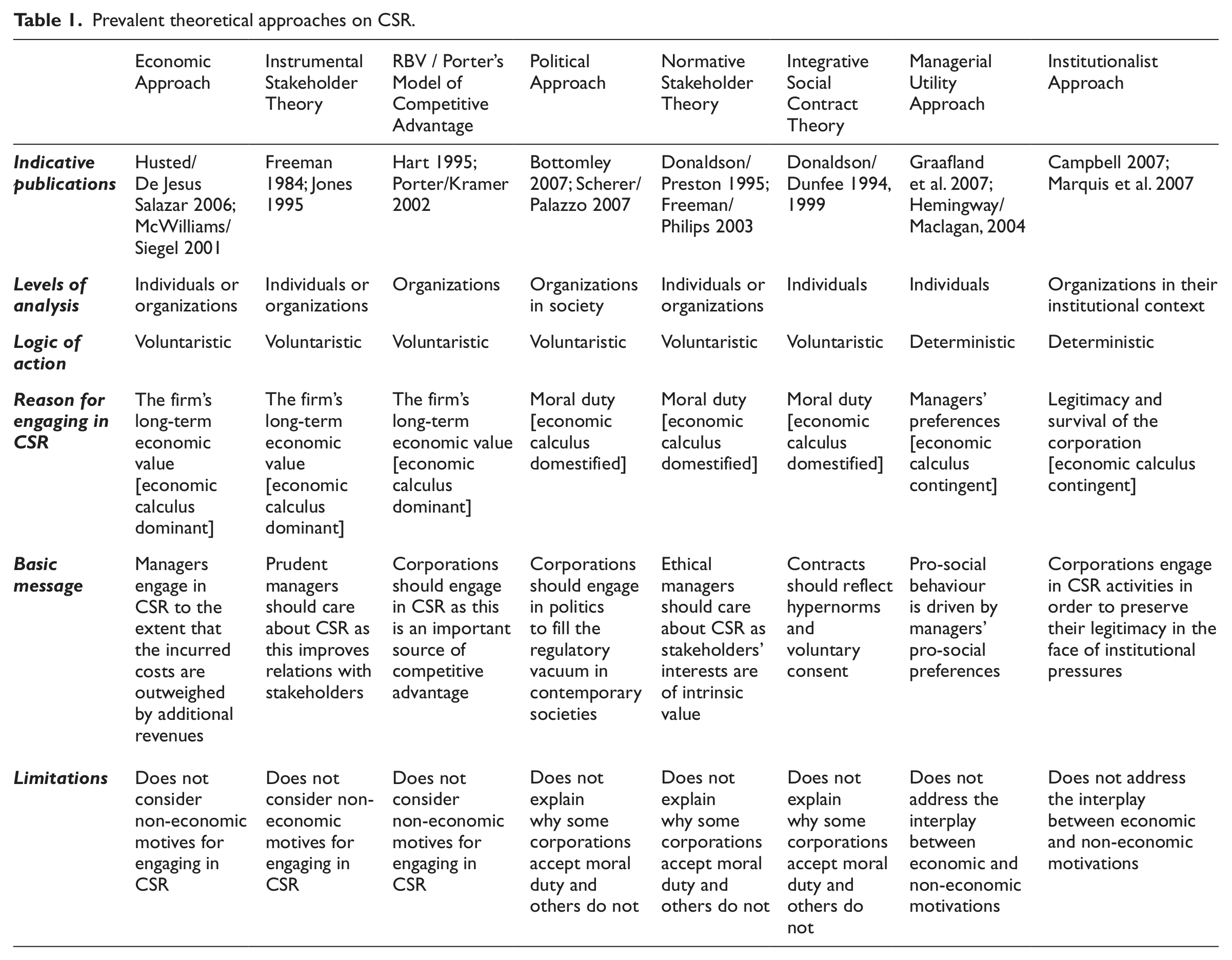
A review of the CSR literature reveals a host of different theoretical approaches (for an overview see Table 1). Arguably most research in the field of CSR takes an instrumental view of this concept (Lockett et al., 2006; Windsor, 2006). That is, any expenditure that results from pursuing a socially beneficial goal is conceptualized not as a sacrifice of profit but as a corporate investment that helps maximize (future) corporate cash flows. One perspective that propagates such a view is the economic approach, according to which pro-social behaviour is a tool for optimizing corporate profit (e.g. Husted and De Jesus Salazar, 2006; McWilliams and Siegel, 2001). This approach presupposes that managers analyse CSR activities without any ‘pre-conceived ideas or normative commitments [because] only by correctly analysing supply and demand conditions can managers hope to make CSR decisions that are strategically or economically sound’ (Orlitzky et al., 2011: 10). Accordingly, changes in corporate activities that indicate a more pro-social orientation are explained as results of changes in the economic conditions under which corporations operate in their markets, rather than changes in the attitudes of individual managers towards ethically desired goals.
Prevalent theoretical approaches on CSR.
A second approach, which is related to this economic perspective, is based on instrumental stakeholder theory. According to this approach corporations are expected to satisfy their stakeholders’ demands, however, taking stakeholder interests into account is seen as rooted in firm performance (Freeman, 1984; Jones, 1995; Pajunen, 2006). Indeed, stakeholder theory defines and identifies stakeholders according to their relevance to economic success. Because stakeholders are considered to provide important resources, satisfying their needs becomes a precondition for achieving sustainable business success (Hill and Jones, 1992). Consequently, corporations are expected to satisfy the needs of those groups of stakeholders that may have a significant influence on the ability of corporations to survive and make profit. Conversely, without an economic incentive, corporations are expected not to respond to stakeholder demands (Berman et al., 1999).
The same logic applies to approaches that are based on Porter’s model of competitive advantage or on the resource-based view of the firm. The former argues that pro-social behaviour serves both business and society (Porter and Kramer, 2006). This model assumes that there is no trade-off between profits and social goals, such as ‘philanthropic investments’; consequently, the antagonism between profit and ethics can be resolved (Porter and Kramer, 2002). Even governmental regulation is said to enhance the competitiveness of corporations, as regulations may trigger innovations (Porter and van der Linde, 1995). Similarly, the resource-based view argues that pro-social behaviour can contribute to the development of rare, valuable and non-substitutable resources that provide the basis for competitive advantage. In his natural-resource-based view of the firm, Hart (1995) suggests, for example, that companies have to follow three interconnected strategies (pollution prevention, product stewardship and sustainable development) to sustain a competitive advantage.
All of the above perspectives conceptualize CSR activities as a means of sustaining or furthering economic wealth. Many empirical studies support such an instrumental view by showing that pro-social behaviour may favour business prospects in many respects (e.g. Borck and Coglianese, 2009; Stites and Michael, 2011). However, the idea of the ‘virtuous circle’ (Porter and Kramer, 2002) through which economic profit and the social good reinforce each other does not grasp the whole story. For instance, Margolis and Walsh’s meta-analysis (2003) has undermined belief in the empirical validity of the positive relationship between social responsibility and economic profit. Thus, explaining pro-social activities as a form of enlightened value maximization seems to be too simple. In the existing literature there are many examples of companies that have engaged in pro-social activities in the absence of any economic incentive (Matten and Crane, 2005); these empirical examples demonstrate the limitations of approaches that assume profit maximization as the sole explanation for corporate actions.
There are, however, other theoretical approaches to CSR, which transcend purely economic explanations of corporate activities and do not assume that all pro-social behaviour necessarily benefits the corporation itself. One prominent example is the political approach to CSR, which emphasizes the political role of corporations because of their power to influence social life inside and outside the firm (Davis, 1976). This approach goes beyond the instrumental view of corporations in that it puts forward ‘a new understanding of global politics where […] corporations […] play an active role in the democratic regulation and control of market transactions’ (Scherer and Palazzo, 2011: 3; see also Bottomley, 2007; Deetz, 1991). In that view, corporations are not only economic but also political actors that have the duty to engage in political processes in order to fill the regulatory vacuum in contemporary societies (Scherer and Palazzo, 2007). This political role broadens the scope of corporate activity significantly, as corporations are not expected simply to serve markets but also to fulfil political functions, which may include supporting healthcare systems, fighting corruption, providing education or preserving peace (Logsdon and Wood, 2002). To cope with such tasks, corporations have to restrain the economic calculus and install a mode of governance that is in line with democratic principles (Gilbert et al., 2011; Steinmann and Scherer, 1998).
Another approach that transcends purely economic explanations is normative stakeholder theory, which claims that the purpose of business is value creation for various stakeholders and that each stakeholder group merits consideration for its own sake (Bowie, 2012; Donaldson and Preston, 1995; Freeman et al., 2004). Managers should not try to satisfy the interests of stakeholder groups in expectation of profitability in the long term, but because it is their fiduciary duty to do so. This duty becomes most obvious in moral and economic trade-offs, where satisfying one group of stakeholders comes at the price of dissatisfying another stakeholder group. In order to give greater guidance in such situations, scholars have combined stakeholder theory with various ethical approaches such as those developed by Rawls (Phillips, 1997), deontologists (Bowie, 1999), critical theorists (Reed, 2002) and libertarians (Freeman and Philips, 2002).
The integrative social contract theory (ISCT) follows a similar line of argument. This approach focuses on two kinds of contracts that managers have to adhere to in order to fulfil their moral responsibilities: macro- and micro-social contracts (Donaldson and Dunfee, 1999). The former is a hypothetical contract among economic agents that defines the normative ground rules for creating the latter. Whereas the macro-social contract demands the informed consent of the contracting parties, the micro-social contract reflects the social and cultural embedding of the contracting parties in local communities. However, Donaldson and Dunfee assume that the informed consent that the macro-social contract stipulates is not a satisfactory restriction on corporate contracting in real life, as it virtually allows companies to draft a contract any way they please. To address that shortcoming, they introduce the notion of ‘hypernorms’, which reflect the convergence of ‘religious, political, and philosophical thought’ (Donaldson and Dunfee, 2000: 441). The purpose of hypernorms is to impose additional restrictions on the activities of managers, who ought to ‘respect the dignity of each human person’ even if this implies economic loss (Donaldson and Dunfee, 1994: 267).
Clearly, all three perspectives—the ISCT, normative stakeholder theory and the political approach—have the potential to give guidance on moral issues in the business world. Indeed, there are many firms that use ‘social criteria as a basis for actions that are right, good, and just for society’ and engage in pro-social behaviour ‘for the singular goal of helping others’ (Sánchez, 2000: 364). However, as these three theories are primarily normative they do not explain why some corporate actors accept their moral duty by engaging in pro-social activities while others do not. While they argue for the primacy of non-economic motives over economic ones, they do not explore under which conditions the behaviour of corporate actors is prompted by the former rather than the latter.
The managerial utility approach appears more successful in explaining why managers behave in a pro-social manner. This approach rests on the basic insight that their personal values affect not only the way in which managers perceive and interpret the world but also the choices they make. Consequently, it conceptualizes pro-social behaviour as a manifestation of managerial preferences (Hemingway and Maclagan, 2004; Swanson, 2008). Starting from the assumption that these preferences are not entirely determined by organizational structures and available resources, it posits that managers use their discretion to express their personal values in their decisions (Wood, 1991). Several empirical studies support this view. For example, Agle et al. (1999) found a significant relationship between the values of CEOs and corporate social performance, while Graafland et al. (2007) compiled evidence that the religious beliefs of corporate leaders are reflected in corporate business conduct. Overall, the managerial utility approach explains quite persuasively differences in the degree to which managers engage in pro-social activities on the basis of differences in their preferences. Nevertheless, although this approach allows addressing both economic and non-economic motivations in relation to CSR, it does not explore how they interact and develop over time, which limits its ability to explain changes in pro-social behaviour.
In contrast to the micro-level focus of the managerial utility approach, the institutional approach concentrates on the macro-level, which includes the market, local communities and state regulation (Campbell, 2007; Marquis et al., 2007). From that perspective, the various forms of pro-social behaviour are explained through the embeddedness of organizations in different formal and informal institutions, such as laws and religious norms respectively (Brammer et al., 2012): in order to preserve their legitimacy and ensure their survival, organizations conform to institutionalized expectations of pro-social behaviour. While corporations that operate in the same institutional field are considered to be subject to the same institutional pressures and to adopt the same pro-social practices, pro-social behaviour is expected to vary across institutional fields (Doh and Guay, 2006; Kang and Moon, 2012).
The institutional approach clearly highlights the importance of the institutional environment in explaining pro-social behaviour. It thus addresses both economic and non-economic motives by relating them to CSR expectations within institutional contexts such as economic and legal systems or geographical regions. However, like the managerial utility approach, the institutional approach does not address the interplay between economic and non-economic motivations in the context of CSR. In addition, it is not able to explain differences in pro-social behaviour between organizations in the same institutional field, i.e. organizations confronted with the same institutional pressures.
As this overview has shown, the existing literature comprises a wide range of different theoretical approaches that can be used to explore the phenomenon of CSR. While each of these has helped to shed light on various important aspects of pro-social behaviour, they all have their limitations when it comes to explaining different categories of motivations that lead to such behaviour. Most commonly, they either overemphasize one category but disregard others, or they fail to explore the interplay between different categories. Against this background we will now introduce the central building blocks of the Bourdieusian approach we have developed in order to address this gap in understanding CSR activities.
A Bourdieusian perspective on pro-social practices
Bourdieu puts social practices, i.e. socially shaped activities performed by individual actors, at the centre of his analysis (Bourdieu, 1977, 1990). Actors, such as members of an organization, enact many different kinds of practices, including pro-social practices such as giving donations, attending courses on green technologies or organizing charity dinners. These practices are enacted in various social arenas—which Bourdieu termed ‘social fields’—where people compete for different kinds of economic, social, cultural and symbolic assets that he referred to as ‘capital’. According to Bourdieu (1986), an individual’s motive for enacting any particular practice is the chance to increase his or her capital and thus attain power. According to this rationale, actors are expected to employ pro-social practices whenever they assume that this will increase their capital and thus improve their relative power position in the social field. This, however, does not mean that actors employ pro-social practices strategically. On the contrary, such practices are more likely to be enacted without conscious reflection. In this sense, pro-social practices follow a ‘practical’—not a rational—logic. In the following we will introduce a Bourdieusian perspective on CSR by elaborating on his concepts of capital, habitus and field including the field specific illusio.
Pro-social practices as a means of transforming individual capital
According to Bourdieu (1977, 1990, 2005) all practices are directed towards the acquisition and transformation of an individual’s (monetary or non-monetary) capital. By enacting practices, actors invest the capital they have acquired through former practices, in order to acquire more of the same capital or to transform it into other types of capital.
Bourdieu (1986) distinguishes between three general forms of capital: economic capital refers to monetary income as well as other financial resources and assets. Actors such as shareholders possess economic capital in the form of shares in the firm, whereas in the case of managers or employees capital takes the form of budget control and wages. Cultural capital exists in two different forms: incorporated cultural capital, which consists of experiences and habits acquired during the socialization process and manifested in an actor’s knowledge, and institutionalized cultural capital, which consists of formal educational qualifications. Institutionalized cultural capital in the form of a job title, such as ‘CEO’ or ‘chairman’, can be conferred. What is conferrable here is the title itself—the institutionalized cultural capital—and not what constitutes the precondition for the specific appropriation, i.e. the possession of the means of ‘being CEO’ or practicing it as this entails the incorporated cultural capital. Social capital is the sum of resources that can be mobilized through membership in or access to important networks. Of particular importance here are ‘strong ties’ to other individuals, which promote trust and reciprocity and facilitate the transfer of private information and critical resources (Gulati et al., 2002). In the context of organizations, the social capital of different actors may thus differ in regard to the strength and reach of their ties to other actors within and outside their organization.
Like all other practices, pro-social practices have to be understood as attempts to acquire or transform capital. For example, the description by Jennings (2006) of how Dennis Koslowski as CEO of Tyco, a global leader in fire safety and security solutions, sponsored a travelling museum show can be interpreted as an account of the transformation of Koslowski’s economic capital (i.e. the budget of 4.5 million dollars at his disposal) into social and cultural capital: through this sponsorship he probably developed relationships with impresarios and directors of theatres (social capital) and additionally gained specific knowledge on, for example, funding theatres and the arts in general (cultural capital). In this and similar examples, pro-social practices can be understood as attempts to transform an individual actor’s economic capital into other forms of capital. From this perspective, pro-social behaviour can be understood not as a sacrifice of economic capital for the social good, but as a transformation of the amount and structure of an individual actor’s capital into other forms of capital. Thus, the voluntary sponsorship of museum shows in particular, and engaging in pro-social behaviour in general, can be regarded as an ‘anti-economic economy’ (Bourdieu, 1993: 54): economic resources are transformed into other forms of capital, which in turn can be invested so that other practices can be enacted.
Bourdieu argued that, in order to appreciate fully how capital functions and how it is converted from one type to another, it is necessary to take into account an important characteristic of all types of capital, namely, that they are based on mutual cognition and recognition among actors (Bourdieu, 1980, 1986, 1996). This is what lends capital a symbolic character and function. Symbolic capital cannot be regarded as another form of capital; economic, cultural and social capital are transformed into symbolic capital if they are accorded positive recognition, esteem or honour by other actors. Thus, in order to understand why an organizational member engages in pro-social practices it is vital to take into account the symbolic functioning or transformation of that individual’s capital.
To elucidate symbolic transformations two points have to be highlighted. The first point is that individuals might enact practices that function as ‘representatives’ of other practices. Thus, we have to distinguish the practice of publicly documenting (that is, the representation of) pro-social practices from the pro-social practices themselves. For example, actors might describe on their corporate websites and in their reports how they apply pro-social practices. While people often assume a direct relation between the practice of description and that of application, this might not be the case. One potential problem with representations is that actors may anticipate the perceptions and evaluations of others and, as a result, mask the real motivation for engaging in pro-social behaviour. To return to the example we used above, it is possible that some of the managers at Tyco may have chosen to sponsor museum shows—a pro-social choice—in order to increase Tyco’s brand reputation. However, anticipating the possibility that other actors, such as consumers and members of NGOs, might evaluate this as a ‘narcissistic’ investment (Roberts, 2001) and consequently deny its symbolic recognition, the PR managers of Tyco may have decided not to communicate the economic motivation that had prompted this act of sponsoring. Instead, they may have presented this investment as a genuine attempt on Tyco’s part to promote the social good. This example illustrates how representational practices may mask the real motivations that lead actors to engage in pro-social behaviour. This also explains why reports may function as ‘self-presentational devices’ that are ‘self-laudatory’, rather than as accurate accounts of pro-social activities (Hooghiemstra, 2000).
The second point is that representational practices might function as a kind of ‘simulacra’ (Deleuze and Krauss, 1983). Whereas in the case we have just described individuals enact certain practices but mask the underlying motivation, simulacra represent practices that do not exist. In that sense they are not representations of real practices but of illusions. That is, managers report that they enact their moral duties with regard to the social good, but do not enact the respective practices: their reports function as simulacra that aim to deceive other actors. Roberts (2003: 250) described such behaviour as a ‘sort of prosthesis, readily attached to the corporate body, that repairs its appearance but in no way changes its actual conduct’. Others have described such practices as ‘green-washing’ or ‘blue-washing’—i.e. painting over a corporation’s image with the veneer of environmental or social responsibility respectively (Laufer, 2003). The reason behind such practices is, again, the effort of individuals to acquire and transform capital. As long as the deceived actors perceive simulacra as representations of real practices, simulacra are transformed into symbolic capital that ultimately enhances the capital that fraudsters possess.
Habitus as producer of pro-social practices
According to Bourdieu (1977), the engagement of actors in pro-social practices depends not only on the possibility and legitimacy of transforming capital but also on the individual actors’ dispositions, their so-called habitus. The concept of habitus emphasizes that practices are engendered and regulated by incorporated, generalized, transposable perceptions and ways of thinking, rather than just by cultural roles, by norms or by conscious intentions, meanings or calculations (Swartz, 2002). Habitus provides actors with a kind of generative grammar, i.e. with cognitive frames and preferences that direct their actions (Golsorkhi et al., 2009). Bourdieu defines habitus as ‘systems of durable, transposable dispositions’ (1977: 72), which actors have acquired during the process of their personal socialization. Thus, the members of an organization are more likely to behave pro-socially if they have acquired the corresponding disposition through past practices. For example, the manner in which pro-social behaviour is taught—if at all—at universities, influences an individual’s future practices via the dispositions of which that individual’s habitus consists. For example, in their meta-analysis of more than 50 studies, Schlaeffli et al. (1985) found that moral reasoning increased through moral education, particularly in the case of participants aged in their 20s and 30s. Given that most students are in this age group, Trevino and Nelson (2010: 15–17) concluded that courses in business ethics clearly have the ability to change an actor’s disposition towards pro-social behaviour.
Since dispositions are tied to individuals, whether organizations engage in CSR or not depends on their individual members. In the light of this, it is not surprising to observe that areas of corporate funding often shift when the organizational members change (Roschwalb, 1990). When members of the organization employ pro-social practices, this reflects their unique dispositions. Thus, these members’ dispositions—their cognitive frames and preferences—are key to understanding whether and in which manner they engage in pro-social practices. In this vein, the preferences of managers are ‘significantly associated with the direction of foundation charitable activities for certain causes’ (Werbel and Carter, 2002: 56).
Another aspect of Bourdieu’s concept of habitus is that action tends to be less consciously reflective than commonly assumed. Bourdieu writes that ‘agents never know completely what they are doing’ (1990: 69) because their practices are largely reflective of their habitus. Consequently, pro-social practices largely occur tacitly. That does not mean, however, that engaging in pro-social practices is never the result of strategic conduct; of course it is possible that, for example, certain members of an organization may consciously fund museum shows to achieve some instrumental end. However, as Bourdieu argues, most of the time actors are not aware of how their practices are driven by dispositions that have been ‘formed through past experience’ (Dewey, 1988: 33). In this sense, pro-social practices do not follow a rational but a ‘practical’ logic as actors do not ‘generally adopt the theoretical attitude of seeing action as a choice among all other possibilities; they usually see one or a few possibilities’ (Calhoun, 1999: 145). Pro-social practices are thus immanent in a certain habitus and reveal themselves as a process of everyday practical coping. Practical coping occurs in the broader context in which the members of an organization enact their practices (Chia and Holt, 2006; Garsten and Hasselström, 2003). Bourdieu refers to this broader context as the ‘social field’, which we will introduce in the next section.
Pro-social practices as a struggle for power in organizational fields
Whether individuals engage or not in pro-social practices depends not only on their habitus and the composition of their capital but also on the specific structures of the ‘field’, that is, the social contexts in which they are embedded. In other words, the conditions that must be fulfilled for a pro-social practice to be enacted ‘cannot be understood without addressing the context [i.e. the social field] within which it takes place’ (Dillard and Yuthas, 2002: 52). For Bourdieu (1996, 2005), the social field is constituted by the network of relations among different actors. More precisely, he relates the concept of social fields to the concepts of capital and habitus to show that social fields are structures of power relations among actors and that social action has a perpetuating or transforming effect on these relations. In other words, social fields are political arenas (Brint and Karabel, 1991). Because capital is not equally distributed, actors in social fields continuously strive to acquire (different forms of) capital, as bearers of different amounts and combinations of capital, some of which yield greater advantages within that particular field than others. Accordingly, it is possible to distinguish between dominating and dominated positions, depending on the amount and composition of capital. The overall pattern of dominant and dominated positions constitutes (the objective structure of) the social field (Bourdieu, 1977, 1990, 2005).
In our context, the relevant social field is the organizational field, which reflects the current power relations among different actors in and around the focal organization. The organizational field does not include only the actors of the focal organization—even though this part is especially relevant to explaining the practices of these particular actors—but all actors who play a role in a given activity, as power relations usually extend the organization’s boundary (DiMaggio and Powell, 1991). Thus, the organizational field may include some of the managers of other corporations, suppliers, customers, journalists, investors and members of governmental and non-governmental organizations.
As the members of an organization continuously strive to acquire capital through their practices, the positions of all actors in the organizational field, and consequently its structure, are not stable. Thus, the structure of the organizational field is constituted by the actual power relations among actors, which are characterized by an ongoing power struggle for attaining a dominant position in the field. This implies that, within the organizational field, positions are negotiated, and also created, through the pro-social manoeuvrings of employees, investors, members of NGOs and so on. The aim of these manoeuvrings—or practices—is to transform capital in a way that will increase an actor’s power in the organizational field. Capital therefore plays a key role—as a weapon, constraint or stake—in determining the development and range of possible actions available to agents (Malsch et al., 2011). The acquisition of capital underlies all social actions as the different forms of capital can be employed as weapons to defend an actor’s position and as stakes to achieve a better position (Bourdieu and Wacquant, 1992).
In this sense, the members of an organization engage in pro-social practices if these can either enhance or stabilize their position. For example, in their case study of massive downsizing at a Swedish company, Bergström and Diedrichs (2011) showed how an actor’s position may be enhanced via pro-social practices. Although more than 10,000 people were dismissed, most actors, including the Swedish government, seemed to agree that the company had demonstrated social responsibility in the process of dismissal, as the discharged workers were supported through various voluntary programmes financed by the company. The managers who developed and implemented these voluntary programmes employed their individual capital in order to get promoted to spokespersons for the company’s social responsibility and thus enhance their respective field positions.
At the same time, however, actors who enact pro-social practices occasionally risk significantly their power position in an organizational field because their investment of capital might fail. In Drumright’s documentation (1994) of how an organization changed its policies to move towards greener purchasing, an actor judged the risk she took in fighting for greener buying decisions in the following way: It was scary … What made it scary was the ‘what if’s’. What if I misjudge the intensity or the longevity of the issue … I didn’t think I could lose my job, but I was concerned I could lose my credibility. Obviously, the downside was when this thing goes to the top; if they say, ‘No, we don’t agree’, it could be damaging to my career. (1994: 5)
Through pro-social practices actors might also be able to stabilize their dominant positions. Top managers, for example, may engage in pro-social practices in order to acquire the symbolic capital that is needed to stabilize their power. Norbert Reithofer, the CEO of BMW, for example, financed the Institute for Advanced Study at the Technical University of Munich and was in turn awarded an honorary doctorate from the same university (BMW-Group, 2010; TU-Munich, 2010). In this case, the CEO’s economic capital, in the form of budget control, and his social capital, in the form of his personal relations to other dominant actors at this university, were transformed into an institutionalized form of cultural capital. An honorary doctorate is highly recognized in the organizational field and can thus be seen as a form of symbolic capital (Bourdieu, 1986) that legitimizes the capital owner’s dominant position. Thus, the willingness of actors to engage in pro-social practices depends on whether these generate capital that can enhance or stabilize their position, whereas their ability to act pro-socially is determined by the capital that they hold or to which they have access (Lawrence, 1999). Symbolic capital—and the means by which it is created—plays a central role in power relations among the relative positions of actors in a field because it provides a basis ‘for a non-economic form of domination and hierarchy’ (Gaventa, 2003: 6).
In order to explain why particular (pro-social or other) practices are regarded as legitimate or not and how dominant actors might influence this perception, it is necessary to introduce the concept of illusio as a particularly important aspect of the social field. In Bourdieu’s practice theory, the concept of illusio stands for the field members’ unconsciously shared evaluations of the different forms of capital (Bourdieu, 1997). That is, by determining what value the actors within a field attribute to different forms of capital, the illusio shapes the respective power struggles in the field (Bourdieu, 1984, 1988, 1990). At the same time, through their struggles for capital, actors acknowledge and reinforce the importance of specific forms of capital, which in turn reproduces the illusio. The transformation of resources within a particular field is thus related to the actors’ assumptions of what is of value in that field (Sandberg and Tsoukas, 2011). Hence, illusio can also be described as an ideology that determines how actors in a specific field perceive the legitimacy of particular pro-social practices (Abercrombie and Turner, 1978).
From that perspective, illusio can be said to function ‘like the imperial system—a wonderful instrument of ideology, much bigger and more powerful than television or propaganda’ (Bourdieu and Eagleton, 1992: 114) or as ‘legitimate violence’ (Bourdieu, 1993: 73), in the sense that it regulates the relationships between agents in a field in such a way that it favours those who have already the most established positions. For that reason, it serves the interests of the dominant actors, who in the organizational field might be the CEOs and large shareholders of corporations or activists from NGOs, as these have the capacity to determine which composition of capital will be the most influential and dominant in the field. Dominant actors, albeit largely unconsciously, are those who define activities as legitimate and formulate the policies of the organizational field; in other words, they shape the rules according to which the struggle for power is conducted. On the basis of the field’s illusio, they can largely control which, if any, pro-social practices are able to produce valuable capital that can enhance the positions of actors in that field. Consequently, in order to enhance their positions according to the field’s illusio, dominated actors conform to the pro-social perceptions of dominant actors. In that way, all members of the field unconsciously contribute to the formation and continuation of the ideology and thus limit the possibilities of resistance. Even though some members of the organizational field may privately disagree with the (positive or negative) evaluation of particular pro-social practices, they will nevertheless conform to the field’s illusio in their effort to enhance their power in the field. Because the habitus of actors is also shaped by the illusio of a given field, the alignment of habitus with the field’s illusio lends actors the practical ability to perceive their position as natural and their practices as the natural way to operate.
A good example of how dominant actors determine the illusio and thus the legitimacy of pro-social practices is the study of PackCo by Baker und Roberts (2011). They describe how the chairman of that company, for various reasons, was keen on engaging in environmental programmes, which he considered exemplary of PackCo’s ‘noble purpose’. However, when a survey revealed that the employees were not satisfied with the way the company dealt with its social responsibility, top managers did not change their perception of the company’s ‘noble purpose’. Instead, they reinterpreted the poll’s results as a failure on the employees’ part to appreciate properly PackCo’s social responsibility and tried by various means to ‘educate’ staff on employee responsibility towards the environment. Baker and Roberts concluded that ‘responsibility was in this way turned into an obligation of staff; [the] management’s role was only to ensure that staff understood the company’s self defined ideals (2011: 13).
Changes in the legitimacy of pro-social behaviour as result of field changes
The legitimacy of pro-social practices within a particular social field might change over time. Illegitimate practices might become legitimate and vice-versa. Zadek (2004), for example, described how Nike’s attitude to pro-social practices changed dramatically in the course of a few years. Such changes have to be conceptualized as the result of changes in the illusio of a particular field. According to Bourdieu, we can distinguish two central mechanisms of change. Both of these mechanisms rest on the interplay between habitus and field.
The first mechanism results from changes in the dispositions of the dominant actors. As we have argued before, actors will only engage in pro-social practices if the dominant actors have deemed these practices legitimate, i.e. if these practices conform to the field’s illusio. Whether or not dominant actors deem such practices legitimate ultimately depends on their individual dispositions, i.e. their habitus. However, the dominant actors’ habitus might change (Bourdieu, 1984; Navarro, 2006) and, as a consequence, their evaluation of pro-social behaviour might also change. For instance, to go back to the example of Tyco, the fact that the then CEO Dennis Koslowski became a member of the Whitney Museum’s board during his time as a CEO at Tyco may well have shaped his attitude towards certain pro-social practices (Jennings, 2006). Thus, his habitus might have been modified through the acquisition of new dispositions that he gained as a participant in another social field—that of fine arts. As the evaluation of pro-social practices depends on the preferences and interests of the dominant actors, Dennis Koslowski, as dominant actor, was in the position to determine that philanthropy (i.e. giving donations to institutions like theatres, museums, schools and the like) was to be considered a legitimate practice in the organizational field of Tyco. Thus dominant members are able to change the understanding of pro-social behaviour by controlling the illusio of a particular organizational field in that they determine whether particular pro-social practices are deemed productive and legitimate in that field.
The second mechanism of change does not rest on the reproduction of the established power structures, but on revolutionary changes made to the established power structures that are induced by ‘newcomers’ (Golsorkhi et al., 2009). In other words, the system of authority within a field can change, including the very rules according to which the field operates (Bourdieu, 1984; Madsen, 2004). A change in the power structures typically results from a mismatch between the dominant actors’ habitus and the structures that are specific to a given organizational field. As Bourdieu writes, this mismatch can be clearly seen in all the situations in which [habitus is] not the product of the conditions of its actualization […]: this is the case […] when old people quixotically cling to dispositions that are out of place and out of time; or when the dispositions of an agent rising, or falling, in the social structure […] are at odds with the position that agent occupies. (Bourdieu, 2005: 214)
Thus, when the habitus of the dominant actors is no longer in line with the field structures, an opportunity is created for other actors to challenge the existing positions of power. For example, when the habitus of a CEO becomes unaligned with the structures of the field, other members of the executive team might gradually edge the CEO out of his or her dominant position. If these executives have been socialized differently—for example as a result of their business education—they might also introduce new views on pro-social behaviour. In other words, because the CEO’s habitus no longer matches the new structure of the organizational field, the other executives are able to occupy positions that are no longer accessible to the CEO. When the habitus encounters a social field that is discrepant from the fields in which it originated, it triggers the transformation of the rules that are specific to the new field (Bourdieu and Wacquant, 1992). In the above example, the habitus of the new executives might trigger the re-evaluation of and an increase in the value of pro-social practices within the organizational field. The executives’ influence on the field’s illusio will also trigger a reassessment of which capital is of value and consequently a change in the power structure of the organizational field. In this sense, new actors who enter an organizational field might reshape that field’s struggles and change the current understanding of pro-social behaviour. Through their habitus, the newcomers might endow with legitimacy their own composition of capital within the organizational field; as a result, they may shift the power structure by excluding the existing holders of legitimate capital from key positions. In this case a new structure of domination emerges in that field, with other rules, stakes and forms of capital, as well as a new illusio that will change the beliefs and values of actors in relation to pro-social behaviour.
Discussion: comparison and further development of a Bourdieusian approach to CSR
The Bourdieusian approach to CSR developed here provides a new way of exploring why organizational actors engage in pro-social behaviour. In the following we will discuss and compare the merits of this approach with those of existing theoretical perspectives on CSR and outline the areas in which it could be further developed.
Comparison of the Bourdieusian approach to the prevalent approaches to CSR
The Bourdieusian approach developed in this article can be compared to other approaches in relation to three central aspects (see also Table 1). The first point of comparison concerns the reason for engaging in CSR, according to each approach. The Bourdieusian logic of the ‘anti-economic economy’ has provided important insights into why corporate actors engage in pro-social behaviour. According to Bourdieu, these decisions need not be driven by the economic impact they are expected to have on shareholder value, as instrumental approaches suggest (i.e. the economic approach, instrumental stakeholder theory and the resource-based view or Porter’s model of competitive advantage), nor by an ‘intrinsic rationale’ (Basu and Palazzo, 2008) of managers or corporations that restrains the economic calculus (as suggested by the political approach, normative stakeholder theory and integrative social contract theory). If managers invest their capital in CSR initiatives—such as participating in the Global Compact, voluntarily disclosing information about supply chains or engaging in political lobbying for mandatory regulations on global standards for social auditing (Zadek, 2004)—according to our Bourdieusian approach this should be interpreted as individual attempts to gain capital that will help these managers to sustain or enhance their position in the respective organizational field.
Although in this respect our Bourdieusian perspective seems to be similar to instrumental perspectives on CSR two differences have to be highlighted: first, our Bourdieusian perspective expands the role of the calculus for maximizing capital, assuming that all organizational practices aim at the transformation and acquisition of different forms of capital, and not just of economic capital. In that sense, it makes no sense to speak of ‘costly philanthropy’ (Mackey et al., 2007: 818). Second, our Bourdieusian approach clearly extends simple instrumental understandings of the role of capital by highlighting the inextricably social and political nature of the process of capital acquisition and conversion (Everett, 2002), as well as the key role of symbolic mediation in this process. Consequently, our Bourdieusian perspective conceives the value of social and of cultural capital as independent of their economic impact. In that respect, the transformation and acquisition of these forms of capital can be regarded as independent of the possession of economic capital, in the sense that social capital can be transformed into cultural capital (and vice versa) without economic capital being involved in this transformation. Instead, the value of CSR practices and the likelihood that they will be enacted depend ultimately on the interplay between the ideology of a given field, the preferences of the actors in that field and the actors’ capital positions employed. The Bourdieusian perspective developed here allows for a wide range of motivations for engaging in CSR, including authentic concern for the social good (as assumed by normative approaches), as well as instrumental concern for economic profit (as suggested by the various instrumental approaches). Thus, it overcomes the limitations of one-sided treatments of the relationship between profit and pro-social behaviour.
From a Bourdieusian perspective, the value of capital is determined by its symbolic transformation. Consequently, the role of economic capital in explaining pro-social behaviour is not predetermined but contingent on the specific constellation of other factors. In that sense, it has certain similarities to the managerial utility approach and the institutional perspective, both of which assume that the role of economic capital is contingent either on the preference structure of individuals or the institutional structure. The difference from these approaches lies in the way the contingency is conceptualized: the managerial utility approach and the intuitionalist perspective allow for a disregard of the capital maximization calculus depending on the respective institutional structures or individual preferences. By contrast, our Bourdieusian perspective does not allow for the possibility that actors may altogether disregard the calculus of capital maximization as such. Bourdieu assumes that there is always an (implicit) attempt to maximize some form of capital so, in that sense, capital maximization is not limited to economic capital. Thus, the perspective presented in this article offers a novel understanding of pro-social behaviour, based on Bourdieu’s notion of an ‘anti-economic economy’, which provides a framework for analysing and explaining systematically the interplay of economic and non-economic motivations in relation to pro-social behaviour.
The second point of comparison concerns the logic of action; that is, the extent to which pro-social behaviour is treated as the result of a conscious choice between alternative courses of action. In the Bourdieusian approach presented here, action is based on a ‘practical logic’ (Bourdieu, 1990), i.e. actions are conceptualized as typically unreflective selections between alternatives and as part of a form of ‘practical coping’ (Chia and Holt, 2006). This distinguishes our approach clearly from the prevalent approaches to CSR. More specifically, according to the economic approach, managers act in an economically rational manner; that is, they calculate the outcomes of alternative courses of action and choose voluntarily between these alternatives. The political approach also assumes voluntaristic action but differs in its understanding of rationality, which it defines discursively. In both stakeholder approaches, managers are assumed to resolve the potential trade-off between the interests of different stakeholders by critically reflecting on the entitlements and potential influences of each group, while the integrative social contract theory posits that managers have the duty to reflect on and ultimately change their contracting behaviour. The common point of all these approaches is that they assume that corporate actors can select between different courses of action and that they make their choices consciously. In other words, they argue that managers are able to decide to engage in pro-social behaviour as a result of critical reflection, without being constrained by ‘objective structures’ (Bourdieu, 1990) that would determine their perceptions and evaluations.
The managerial utility approach and the institutionalist approach make the opposite assumption about the logic that directs agents to choose a particular course of action. The latter does not explicitly clarify the extent to which personal values are accessible to critical reflection. However, because the managerial utility approach assumes that individual values are determined by the cultural and religious settings to which actors are exposed (Hemingway and Maclagan, 2004), one could argue that, according to this approach, the choices managers make between different courses of action are largely determined by such factors. Finally, the institutionalist approach conceives pro-social actions as the purely reactive responses of corporations to institutional pressures, leaving little room for manoeuvre. From that viewpoint, pro-social practices do not reflect the voluntary actions of managers but are induced by social structures. In relation to CSR, the choices of actors are highly institutionalized, and thus ‘beyond the discretion of any individual participant or organization’ (Meyer and Rowan, 1977: 344).
The Bourdieusian approach offers a different take on what prompts agents to choose a particular course of action, which combines deterministic and voluntaristic elements. It assumes that the field structures and the habitus define a limited set of alternative courses of actions that the corporate actor can choose from, both consciously and unconsciously. Under ‘normal’ circumstances the selection will be done in the mode of ‘practical coping’, i.e. without critical reflection. In cases of a practical breakdown, however, which might be caused e.g. by a mismatch between habitus and field, actors have the possibility of switching to a mode of conscious reflection. By allowing actors to switch between different levels of consciousness in the enactment of pro-social behaviour, the Bourdieusian approach goes beyond the one-sided treatments of action in the existing approaches to CSR. This novel angle allows the Bourdieusian perspective to call the researcher’s attention to two important questions that have hardly been addressed in the CSR literature so far: to what extent are pro-social practices consciously enacted and to what degree are actors able to reflect critically on them? These questions are crucial, particularly for normative approaches that emphasize the responsibility of managers in relation to wider social issues, which is typically thought to presuppose the possibility of individual choice (Dennett, 1984).
Our third and final point of comparison concerns the level of analysis. In Bourdieu’s theory, practice is shaped through micro- and macro-level phenomena. The interplay between these two levels has to be taken into account in order to explain why actors engage in pro-social activities. In contrast to that, all existing approaches focus either on the micro- or on the macro-level. Whereas Hart (1995) and Porter and Kramer (2002) do not address the individual level at all, the economic approach and the two stakeholder theories treat managers and organizations as identical entities; the terms ‘manager’ and ‘corporation’ become interchangeable (Orlitzky et al., 2011). On that basis these approaches assume that corporations act homologously, which leads to a conceptualization of CSR as a corporate activity. Apart from these two, other approaches also tend to focus on only one level of analysis. Both the integrative social contract theory and the managerial utility approach address only the individual level. The former explains pro-social behaviour on the basis of the duty of managers to adhere to hypernorms; the latter refers to managers’ individual preference structures.
The only theories that systematically address more than one level of analysis are the political and the institutional approaches to CSR. The former focuses on the corporation’s role in society. Corporations are expected to become democratized and involved in political processes in order to fulfil their political function in a globalized world. Nevertheless, by concentrating on the organizational and societal levels of analysis, the political approach tends to neglect the level of individual actors. Similarly, the institutionalist approach focuses on the interplay between organizations and their institutional fields by drawing a complex picture of how pro-social practices are influenced by the wider institutional structures in which they are embedded. However, it overemphasizes the macro-perspective, reducing the influence of individual agency to a minimum (Tempel and Walgenbach, 2007).
In contrast to the above, our Bourdieusian approach examines how both the micro- and the macro-level influence pro-social behaviour: pro-social activities result from a combination of the micro-level dispositions of individual actors and the macro-structures of the field, which include illusio and the distribution of capital. This makes it possible to account for the structures of markets, politics and social identities without having to ignore the influence of individual preferences. In addition, the Bourdieusian approach shifts the attention to the interplay between micro- and macro-level forces, acknowledging that both levels have to be taken into account and specifying how they interrelate.
In sum, our approach can be seen as a fruitful addition to the existing approaches to CSR. Its strength lies particularly in its ability to provide a more holistic framework for analysing what prompts actors to engage in CSR activities by emphasizing the interplay between economic and non-economic motivations and acknowledging both micro- and macro-influences, as well as voluntaristic and deterministic aspects of human behaviour; in other words, by focusing on the ‘daily experiences and moral problems of real people in their everyday life’ (Tronto, 1993: 79).
Opportunities for further developments of the Bourdieusian approach to CSR
In this article we have described the key building blocks of a Bourdieusian approach to CSR. For the full potential of this novel approach to be unleashed, further research is necessary. In the following we will highlight three aspects in particular: (1) the relations between different fields; (2) pluralism and divergence in organizational fields and (3) the relations between different (pro-social and other) practices.
First, in our description of the Bourdieusian approach to CSR we have focused particularly on the structures and dynamics within an individual field. The field was thereby portrayed as largely autonomous; i.e. as a relatively independent universe, characterized by unique stakes and distinctive dynamics. Nevertheless, as Bourdieu (1990) stressed, different fields might possess different degrees of autonomy. Some fields might be self-determined while others might be significantly influenced by other related fields. In view of that, future research might explore how the capital acquisition of actors in one organizational field might influence their position (i.e. their stakes and acquisition of capital) and thus their practices in another field. Similarly, it would be worth exploring how an actor’s practices in an organizational field are affected by that actor’s habitus when that is shaped by the structure, and especially the illusio, of other fields. Exploring these potential influences across field boundaries could provide additional insights into the mechanisms through which attitudes towards pro-social practices may change. This would allow us to capture the effects that, for example, social movements (Crossley, 2003) or political manoeuvres (Bourdieu, 1998) in adjacent fields might have on pro-social behaviour in a particular organizational field. Examples of key questions in this line of inquiry are: how do changes in related fields influence the power structures in a given organizational field? How does this affect the conditions under which actors within that organizational field undertake pro-social initiatives? Also, which factors determine whether and to what extent external changes affect the organizational field?
Second, we based our Bourdieusian approach to CSR on the assumption that all practices within a particular field are subject to the same illusio. This suggests that in each organizational field there is only one mode of evaluating pro-social behaviours. However, in the era of globalization and with the prevalence of multinational corporations operating in pluralistic contexts (Scherer et al., forthcoming), the assumption of a single and consistent illusio that guides the evaluations of pro-social practices becomes somewhat problematic. For that reason, future research needs to explore the potential co-existence of several illusiones within the same field, as a result of which pro-social practices might be evaluated differently—for instance, while some dominant actors might regard particular pro-social practices as legitimate, other dominant actors might take a different view. Examples of key questions in this line of inquiry are: how can we conceptualize the co-existence of different illusiones within the same field? How do different illusiones relate to each other and how do they affect the structures of power? How do multiple illusiones affect the legitimacy and development of different pro-social practices? Finally, how does the co-existence of different illusiones affect the likelihood of false, rather than true, representations of pro-social practices?
A third area that needs to be explored further is the way in which different (pro-social and other) practices relate to each other. As is fairly self-evident, an organizational practice is not enacted in isolation but in the context of other practices. Exploring the potential relations between different practices might provide important insights into the likelihood that particular pro-social practices may be adopted. We could distinguish crudely between neutral, complementary and conflicting relations between practices. For instance, practices that enhance the transparency of the organization with the aim of fighting corruption and practices that are aimed at defending the privacy of corporate members are likely to conflict. Similarly, auditing and inspection practices might undermine the practice of false representation that corporations may employ in relation to CSR. Examples of complementary practices are ISO standards for CSR. Typically there is an overlap between the various requirements for certification, so adopting several standards is easier for companies than adopting a single standard (see e.g. Corbett and Kirsch, 2001). Examples of key questions in this line of inquiry are: what types of relations can be distinguished between different practices? How does illusio affect the way in which different practices interrelate? How does the way in which various practices interrelate affect the likelihood that a particular pro-social practice may be adopted? Also, how does the way in which practices interrelate affect the extent to which organizations misrepresent their pro-social behaviour?
Conclusion
We started this article by asking why corporate actors engage in pro-social behaviour and suggesting that Bourdieu’s theory of social practice is particularly well suited to exploring this question because it allows researchers to examine the interplay between the economic and non-economic motivations that underlie such behaviour. Our Bourdieusian approach conceptualizes pro-social behaviour as the transformation of economic capital into other forms of capital. Whether this transformation is likely to occur or not depends on which forms of capital are of value in a given field. In turn, the value of capital rests on its social recognition by dominant actors. Bourdieu understood social life as an ongoing struggle for power; in that respect, pro-social behaviour may function as a weapon or stake if it increases the corporate actors’ capital. Thus, overall, our Bourdieusian perspective contributes to a novel understanding of economic and non-economic explanations of pro-social behaviour.
Furthermore, our Bourdieusian approach shifts the attention to two broader issues: first, in order to grasp the link between broader societal structures and habitually shaped perceptions, it suggests that pro-social behaviour should be seen as a form of social practice. In this sense, pro-social behaviour is neither deterministically prescribed by the organizational context nor is it free and autonomous; it is an artful interpretation of that context (Tsoukas and Chia, 2002). This highlights the hardly discussed aspect of consciousness and of the ability of individuals to reflect on their pro-social behaviour. Second, our approach is in line with recent calls for examining CSR on multiple levels (Heugens and Scherer, 2010; Orlitzky et al., 2011): focusing on a single level of analysis is not an adequate way of achieving a more realistic account of what drives CSR behaviour. Using Bourdieu’s theory as a conceptual framework inevitably broadens the scope of research to include the interplay between individual actors and organizational fields in the context of CSR. As Whittington (2011: 185) recently pointed out, ‘practice–theoretic research can never be purely “micro” or “macro”; the other is always present’.
Although the Bourdieusian approach developed in this article provides new insights into pro-social behaviour, it is not meant to substitute other theoretical perspectives on this topic. Like all theoretical perspectives, it has, inevitably, certain limitations. More specifically, by assuming that the pursuit of capital can explain all pro-social behaviour, it probably overemphasizes the role of power in human action. It should also be noted that this is certainly not the only way to apply Bourdieu’s theory to CSR, as there are many different readings of his work (King, 2000; Schatzki, 1987). At the same time, we believe that, by shedding new light on the drivers of pro-social behaviour and thus triggering a host of exciting new questions that await exploration, our approach will prove particularly fruitful to future research.
Footnotes
Notes
Author biographies
Dominik van Aaken is Assistant Professor at the Institute of Production Management and Managerial Accounting at the University of Munich, Germany. He studied business administration at Ingolstadt (Germany) and Budapest (Hungary). He holds a doctoral degree in Business Administration from the University of Munich. In his research he applies economic approaches and practice approaches to questions of organization, management, and corporate social responsibility. Address: University of Munich, Ludwigstr. 28 Rgb., Munich, 80537, Germany.
Violetta Splitter is a Research Associate in the field of Organization and Management at the University of Zurich, Switzerland. She studied business administration in Munich and Brussels. Her research interests include strategy-as-practice, the transferability of management ideas and concepts, the practical relevance of management education and research as well as Bourdieusian perspectives on organizational phenomena. Address: University of Zurich, Universitätsstrasse 84, Zurich, 8006, Switzerland.
David Seidl holds the Chair of Organization and Management at the University of Zurich, Switzerland and is Research Associate at the Centre for Business Studies (CBR) at Cambridge University, UK. He studied management and sociology in Munich, London and Witten/Herdecke. He holds a doctoral degree in management studies from the University of Cambridge. In his research he applies systemic approaches and practice approaches to questions of organization and management, on which he has published widely in leading academic journals. Address: University of Zurich, Universitätsstrasse 84, Zurich, 8006, Switzerland. Email: