




Abstract
Organization has published 569 papers in its 20 years. Of these 44% have been cited less than four times, and just on 9%, or 48 papers, have never been cited at all—not even by their own authors. What might we make of these lonely and seemingly neglected papers? Are they the Eleanor Rigbys and the Father McKenzies of the academic world? As a contribution to the Journal’s 20th Anniversary issue this paper offers a discussion of Organization’s uncited 48.
Keywords
Introduction
Organization has published 569 papers in its 20 years. 1 Of these 44% have been cited less than four times, and just on 9%, or 48 papers, have never been cited at all—not even by their own authors. 2 What might we make of these lonely and seemingly neglected papers? Are they the Eleanor Rigbys and the Father McKenzies 3 of the academic world? As a contribution to the journal’s 20th Anniversary issue this paper offers a discussion of Organization’s uncited 48.
Journal ‘unciteliness’
Before we consider the uncited papers we should address two questions: how do we know that the 48 are indeed ‘uncited’, and to what extent is uncitation an effect of their publication in Organization? One way to deal with this latter question is to compare Organization’s ‘uncited’ rate with that of other journals of a similar ilk. If the rate is dramatically higher than the average across similar journals then we might assume that paper uncitation is an effect of the journal. If the rate is lower than others then perhaps uncitation has something to do with the papers themselves—or some other variable (see Table 1).
Organization’s ‘uncited-ness’ compared to other journals
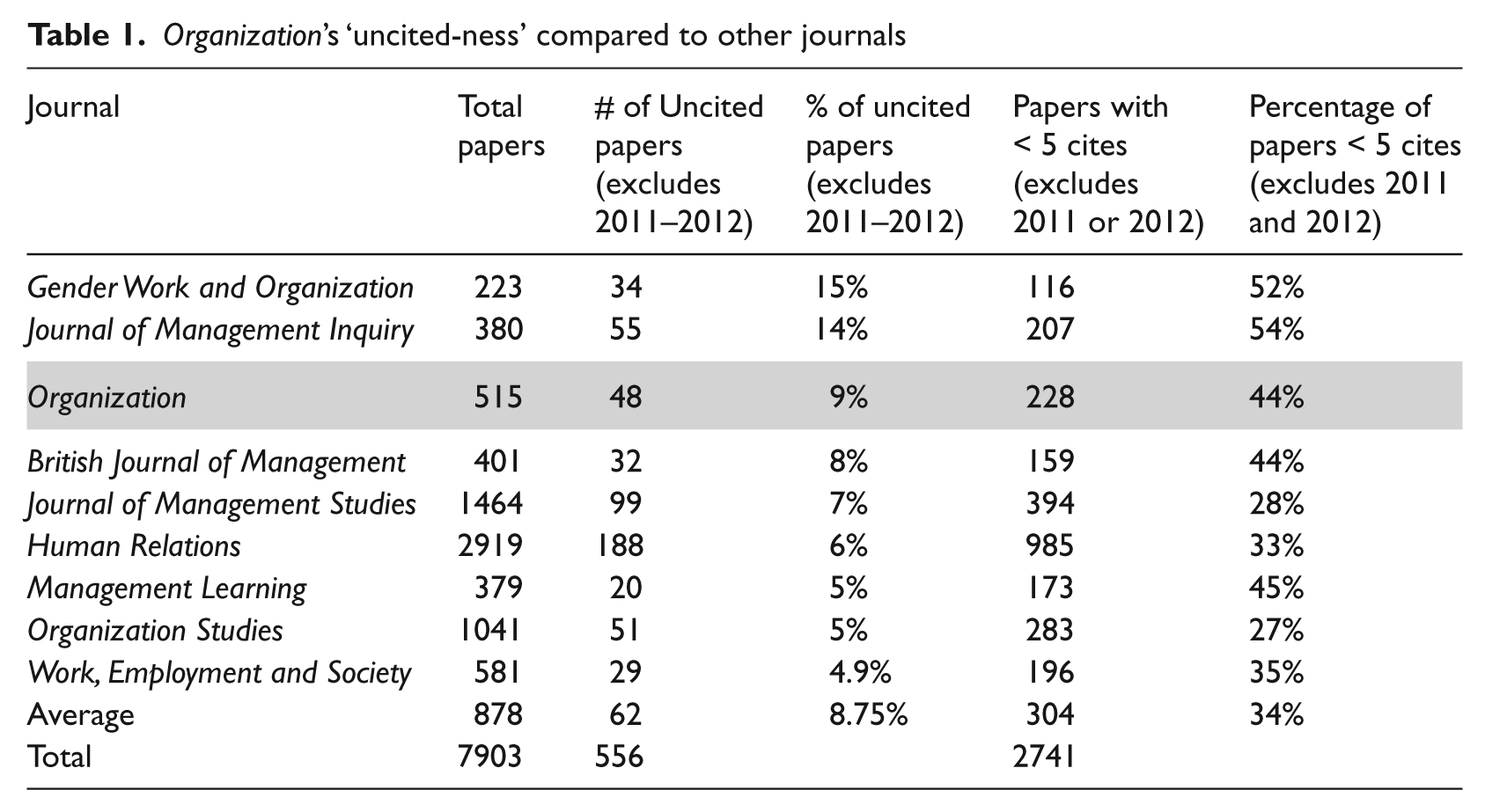
Organization’s 9% uncitation rate is just above the average for the nine journals in this list. This suggests that uncitation is related to both the journal and the paper. As for the Journal, the 9% figure places Organization alongside Gender, Work and Organization and the Journal of Management Inquiry both of which have particular and explicit publishing missions. Organization, as has been discussed elsewhere, is an explicitly critical and neo-disciplinary journal (Editorial Team, 2003; Parker and Thomas, 2012). Consequently, as Li and Parker’s recent citation flows analysis illustrates (2013), the Journal is cited less than those at the ‘core’ of the organization and management field and the papers it does publish tend to look beyond this field for their citational support. Given its mandate and citational reach one needs to ask if Thomson’s Web of Science database—which do not include citations in books, institutional repositories, open access journals or other internet resources and many publications in languages other than English—is a suitable device to gauge rates of citation or, in our case, uncitation.
Uncitation errors
Citation data on journals, authors and papers is readily available through Google Scholar, and via subscriptions from Thomson Reuters’ Web of Science and Reed Elsevier’s Scopus. Thomson’s databases, developed originally by US information scientist Gene Garfield, are the default resource used by governments, publishers and authors and are seemingly the most reliable means of identifying the impact of scholarly works (for discussion see Harzing, 2008; Reedijk 1998). Before making a case for using Google Scholar as a basis for identifying uncitation, I first want to draw attention to one of the problems with Thomson’s database.
Among the Organization 48 is a paper by Peruvemba Jaya (2001), a communications scholar currently at the University of Ottawa. Peruvemba’s paper, ironically, is concerned with the invisibility of third world scholarship in the West, and describes itself as an effort to ‘give voice to the silencing and invisibility processes taking place around us’ (2001: 228). Thomson’s Web of Science database identifies the paper as un-cited. However, if we turn to Google Scholar we find that Peruvemba Jaya’s paper has been cited 17 times in prominent journals, edited books and institutional repositories. How come? The anomaly appears to be an ISI input error involving the mis-spelling of the author’s name (see Figure 1a and Figure 1b).
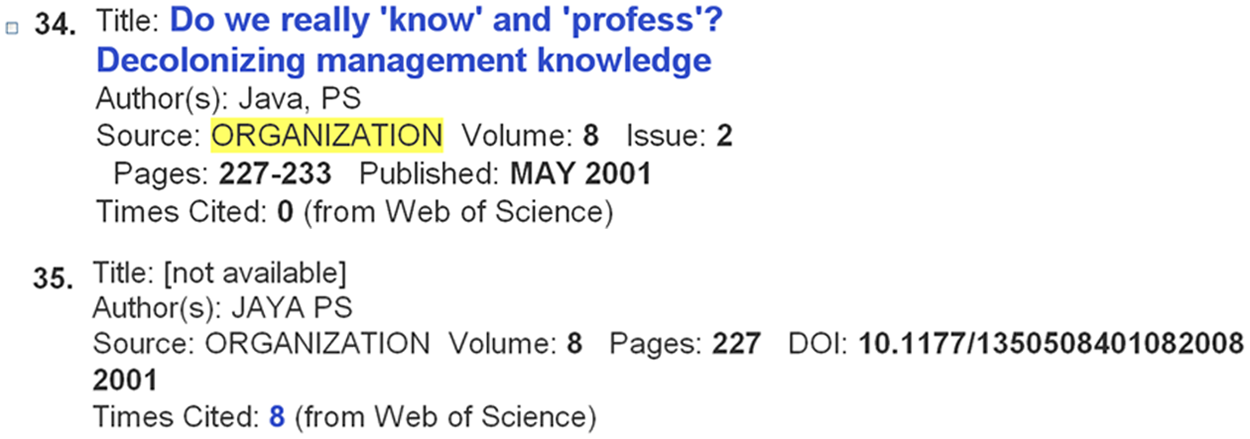
A misspelling of the author’s name has consigned a highly cited paper to Organization’s uncited list
Thomson’s database has created two records for the paper each with different spellings of the author’s name. In the first record (Figure 1 #34), Peruvemba’s surname is spelt wrongly with a ‘v’ instead of a ‘y’. Not surprisingly, given this misspelling, no citations have been logged with this first record. In the second record (Figure 1 #35), Peruvemba’s name is spelt correctly. While this record logs eight citations it is without the paper’s title, the journal’s edition number and the full set of page numbers. This second record only appears in the reference lists of papers that cite it, and not through author, paper or journal searches. Despite the duplicate journal title, correct first page number and journal volume in both records Thomson’s database seems to assume that this second record is a separate publication.
For the record, Peruvemba’s work is cited in very complimentary fashion in papers published in Organization, Third World Quarterly, World Development, the Academy of Management Review (Jack et al., 2008; Ozkazanc-Pan, 2008) and Organization Studies (Ruef and Harness, 2009), The paper’s 17 Google Scholar citations also includes reference in papers found in open access institutional repositories and high profile edited books (Alvesson et al., 2009; Clegg et al., 2006; Thomson and Walker, 2010).
Clearly we are not in a position to challenge the reliability of Thomson’s entire citation database on the basis of what seems to be one human or machine error. But the case does show that the database is far from error free and as such one should cross-check citation records with non-ISI databases to be sure of one’s claims (see Reedijk, 1998 for suggestions).
Citation blinkers
The bigger issue is the limitations of the Thomson Reuters databases as a pre-internet technology that ignores citations in books, online journals and repositories. In our case Thomson’s database identified 48 un-cited Organization papers—about 10% of the total published. If we check these 48 with Google Scholar our list drops by 40 to just eight uncited papers (an 83% reduction). According to Google Scholar each of the 40 were not uncited, but cited on average four times each. Peruvemba Jaya’s paper (2001), with its 17 citations, is the most cited of Organization’s 48 on the Thomson-Reuters uncited list. If we take a brief look at the source of the citations Google Scholar recorded for the 40 papers (and Thomson’s Web of Science did not) they tend to fall into six distinctive groups: books, non-Web of Science surveyed journals, papers published by journals in an online format prior to print, papers in languages other than English, papers in repositories, e.g. SSRN and institutional repositories (working papers), and conference papers. Let’s take an example from the Organization 48. Jesper Blomberg’s excellent paper (2009) on gender relations at the Stockholm Stock Exchange is a useful exemplar. Google Scholar logs three citations against this paper (which, incidentally, includes for me one of the best analyses of workplace gender regimes I’ve read). These are: a book, The Handbook of Gender, Work and Organization (Jeanes et al., 2011), a non-Web of Science journal, the International Journal of Gender and Entrepreneurship (Smith, 2010) and a paper published in Organization but in a pre-print online first version (Knights and Tulberg, 2011). This was published online in June 2011 but didn’t appeared in a conventional edition until July, 2012. Because Thomson’s database does not include papers published online (ahead of print) or books, or large numbers of specialist journals in its collection, then Jesper Blomberg’s paper is, officially at least, uncited (see Harzing, 2008, for comparison between Google and Thomson’s citation databases).
Citation clubs
Referencing is said to have developed in juridical publications in the late 17th Century as a means of signalling ‘works of controversy’ (Czarniawska, 1998). Nowadays the meaning and purpose of citation varies significantly not simply in terms of author practice but in the wider institutional context into which citation analysis is used. For the academic authors citation is, on the face of it, simply a means of connecting the present with non-present texts in ways that support and enhance a paper’s narrative. At its best citation is, as Barbara Czarniawska notes (1998), a means of telling a topic’s ‘meta story’. It also serves to signal an author’s membership of a research community, asserts or defends ‘space’ in that community or academic field and affirms claims over the ownership and originality of an idea, approach, framework or theory (Cronin, 1984).
For the university, the state and the corporation (publishers) citation means other things. For the university, citation may well be used to guard against academic dishonesty (Wasley, 2006) but it is also used as a measure of research reputation. For example, the methodology behind the annual Times Higher Education’s (THE) university rankings derives 30% of university reputational from journal citations. The THE’s Citation analysis is delivered, incidentally, by Thomson Reuters. 4 For the State, citation may well be used as a measure of national competitiveness (Ministry of Research, Science and Technology, 2006) and value for money (Tertiary Education Commission, 2003). Meanwhile for publishers citation plays a role in promoting and calculating the value of publishing assets and may also be a means of intensifying competitive relations between journals and editors—something that may well create the conditions for coercive citation (White and Fong, 2012).
But that said, the use of citation analysis is contested. On this we can simply note the official advice to subject panels for the UK’s upcoming Research Evaluation Exercise which includes the following: ‘No sub-panel will make use of journal impact factors, rankings or lists, or the perceived standing of the publisher, in assessing the quality of research outputs’(HEFC, 2012: 8). Panels have also been told that while they may decide to use citation data ‘to reach rounded judgements about the full range of assessment criteria’ (HEFC, 2012: 8), they must ‘recognise the limited value of citation data patterns’ (HEFC, 2012: 8).
Nevertheless there is a strong desire, given the seductive power of the numerical quantification of academic work (Nkomo, 2009), to regard citation as a means of ranking journals and papers (see the debate between Rowlinson et al., 2011 and Willmott, 2011). Given this, some might assume then that uncitation is best regarded as the simple inverse of citation. If citation suggests impact and recognition, then the implication might be that uncitation means insignificance, over-supply or even waste. But what if uncitation is not the reverse of citation—but something quite different. Citation at its best, Barbara Czarniawska (1998) suggests, tells the meta-story of a topic. Such meta-stories are not rewritten at each outing; they rely on familiar and well-worn coordinates that confirm particular citational networks. Co-citation analysis confirms this point (Üsdiken and Pasadeos, 1995). Our reference lists, used in co-citation analysis, confirm the network positions of prominent scholars in a field. The suggestion is that academic authors take shortcuts. They learn, or perhaps simply copy, the citational habits of a field’s dominant group and may fail to read broadly beyond a given set of papers or journals that address their topic. The joke is of course that academics read papers from the back by starting with the reference list. Consequently, uncitation is not necessarily a function of insignificance, but a function of exclusion from the citational habits and co-citational network that presents the meta-story of a topic or field. An uncited paper is simply ‘off the radar’. Uncitation is not a measure of waste, but an indicator of a paper’s separation from the citation routines of the dominant co-citational coalitions of a particular journal, or group of journals. As such we should probably read uncited papers, not as the ‘unfortunates’, but as proxies for unrealized impact, influence or contribution; as a potential source of topics, theory, questions or frameworks hitherto ignored by co-citation clubs.
What then might we make of the Organization 8? If Organization is a journal necessarily on the margin of the organization and management field by dint of its particular character, mandate and flow of citations (that flow away from the field), it may well be that the Organization 8 have significant potential to make a contribution to the field. These eight uncited papers—‘unloved’ by Thomson, Reed Elsevier’s and even Google’s citation technologies—are surely on the margin of the margin. We might assume that they are indeed the Eleanor Rigby’s of the academic world. But perhaps we have been too quick to gauge their worth because (as yet) they don’t appear in our field’s citation lists? To conclude this paper I offer a few appreciative comments on each of the Organization 8.
Race and class in the US workplace (Saunders, 1996)
This is a paper with all the qualities of an excellent critical contribution. It is direct, probing, tackles a central economic issue and concludes with a call to action. Entitled ‘Why do African-American Men Earn Less? Earnings Inequality in Economics Theory and Policy’, the paper is an effort to explain why wage differentials in US workplaces between white and African-American men began to diverge in the 1980s after a period of convergence. The paper considers a series of explanatory options before turnings its headlights on discrimination as the likely cause. It argues that employers had turned back to the tactic of favouring white men over black men in order to increase economic returns. It notes that this is ‘in spite of existing laws and perhaps because of lax enforcement and recent favourable court conditions, firms persist in discriminating by race’ (1996: 515). The paper’s uncitation is perhaps not surprising. It is somewhat out of place in an organization studies journal. It is laced with conventional economic analysis and concludes by asking if economists would be willing to turn what they know into activist policy advice addressing problems.
Setting the postcolonial agenda (Pratt, 1997)
Four papers from Organization’s mammoth 19-paper special issue entitled ‘Understanding Contemporary Latin America and its Organizations’ have made the Organization 8. Inevitably all the papers in this special issue are short. But what each paper misses in length it makes up for in directness. Each, in its own way, is often unswerving and uncompromising in its effort to confront and address the problems it sets itself. In this vein Mary Louise Pratt’s contribution is an astonishingly rich critique of Western theory building which then outlines a non-Western mode of theory development. Pratt’s approach is via an expanded reading of ‘culture’ and ‘difference’ that prioritizes social movements as the seed bed of theoretical exploration. The paper points to the rise of ‘localism’, ‘pragmatism’ and ‘anti-utopianism’ as the hallmarks of postcolonial organizational theory.
At the border (Herrarra, 1997)
The Mexico-US border is one of the most compelling and perhaps important organizing boundaries on the planet. Herrarra’s paper is a lively and highly condensed offering of three readings of this border as cultural signifier. For him the border is a creator of national identities (e.g. ‘the Mexican’), a postmodern laboratory with its high tech factory towns, and part of the modernizization project for Mexican politics. Each reading is then unpacked and questioned.
Communication as transdiscipline (Barbero, 1997)
Academic innovation is the focus of this paper. Jesus Barbero’s paper is an ambitious and intriguing effort to rethink, in a few short pages, the academic study of communication in Latin America. It proposes to see communication as a trans-disciplinary academic field and offers national history, urban sensitivities and cultural markets as topics for illustrative analysis. He concludes by highlighting that the overall purpose of such work is to extend and develop viable forms of citizenship.
Considering the similar Other (Ross, 1997)
Jerry Ross’ paper, the last of the Latin American special issue to make the Organization 8, is a exploration of claims to similarity and difference between US and Latin American Organizations. It draws comparisons between organizations in the two locations and highlights how differences and divergences between US and Latin American Organizations at the local level may be smaller than the differences between local and national sites in the US, e.g. between elite and local institutions and between local outposts and organizational headquarters in the US.
Practitioner speaking (Stager Jacques, 1999)
Practitioners don’t feature often in the pages of Organization—certainly not as the authors of papers. Leslie Stager Jacques’ paper is then a novel contribution. Theoretically informed, pragmatic and highly reflective the paper is at once delightful and challenging and as such is a possible template for a wider debate on the theorization of practice. It may also be a template for debate on the practice of theorizing in academic fields. But at its core the paper is an exploration of what Leslie regards as the necessity—closer relations between theorists and practitioners.
Outsourcing academic research (Raman, 2001)
Some papers have a prophetic element and, for me, this is one of them. Recently a firm sent me and other colleagues an email hawking research and data analysis work that could be done more quickly and cheaply in India. The letter claimed that the company’s clients included researchers from elite US, Japanese and European Universities. Sujatha Raman’s paper (2001) is an imaginative presentation of the outsourcing of university research to firms in low wage economies. It is in retrospect a prescient and rich presentation of the scenario just described. At the same time the paper itself is an engaging contribution to discussion of the transition from feudal to the capitalist organizing of academic labour in universities.
Not for profits? (Leal, 2006)
Some papers are memorable for the tone and style of their argumentation. They seem to require attention from the reader. They call up a reaction, and manage to address us directly. Fernando Leal’s paper is just such a piece. It carries its argument about the fraud and corruption in seemingly not-for-profits and non-governmental organizations in such a way that the reader is drawn into considering the problem.
A letter to Egypt—with love (Riad, 2008)
Many papers are built on a love relation. Not love for or with someone else but with something else, something often deeply personal and problematizing. Sally Riad’s reflective and auto-ethnographic analysis of ‘Egypt’ is one such paper. It is at once a postmodern analysis of organizations as texts, and at the same time a meditation on the formation of one’s subjectivity. It works as an exemplar in both directions.
So, in conclusion, lonely papers deserve our attention not our disregard. If a published paper goes uncited then a blinkered database may be keeping it from view or a co-citation club has yet to find it a home. If you discover a lonely paper it probably deserves, at the very least, a good old fashion reading.