




Abstract
We analyze recent citation data to identify leading contributors and rising scholars in the field of economics education. Using a curated list of journals endorsed by the American Economic Association’s Committee on Economic Education, we construct a focused i10 index based on citations received between 2020 and 2024. This metric emphasizes sustained influence across multiple papers and avoids distortions caused by singly highly cited articles. Our results include rankings of top-cited scholars overall, high performers by i10 index, impactful early- and mid-career scholars, and leading researchers outside of North America. Additionally, we also identify the ten most cited articles during our sample period to highlight topics resonating with current researchers. In doing so, we document the breadth of contemporary economics pedagogy research and recognize the evolving institutional professional roles of those contributing to its growth.
Introduction
The academic study of economics pedagogy has matured considerably since the first formal treatments appeared in general-interest journals in the 1960s. Over the past fifty years, scholars have explored how to teach economics more effectively, often advocating for methods that move beyond traditional lectures. Yet, the profession remains deeply rooted in the lecture format (Asarta et al., 2021).
Much of this growth can be attributed to a relatively small group of scholars whose influential work continues to shape how economics is taught. These individuals stand as the field’s giants, figures whose contributions have defined both its boundaries and its trajectory. As Isaac Newton famously remarked: “If I have seen further, it is by standing on the shoulders of giants.” The same can be said of economics education today. Their contributions have shaped the journals and the direction of inquiry for decades. However, like any evolving discipline, economics pedagogy must also take stock of where innovation is coming from now and whether newer voices are gaining traction among their peers.
This study examines how recent scholarship in economics education has resonated within the academic community. Using citation data over a five-year period from 2020 to 2024, we identify the scholars and articles that have garnered the greatest contemporary attention, with particular attention on those who published their first paper in the field after January 2015. Our goal is not to diminish the foundational work of the well-established figures in the field, but rather to complement existing historical accounts by highlighting the next generation of pedagogical scholarship, those whose work is shaping the field today and may continue to do so in the years ahead. By documenting the influence of newer scholars, we contribute to the ongoing conversation about how the field is evolving, not only in what is taught, but in who is helping lead that evolution.
Literature Review
The scholarship of economics pedagogy has evolved significantly over the past half-century. A key early milestone was the founding of The Journal of Economic Education in 1969 (Villard, 1969a), which offered a dedicated outlet for teaching-focused work. Around the same time, contributions also appeared in general-interest journals (McConnell & Lamphear, 1969; Paden & Moyer, 1969; Villard, 1969b; Whitney, 1960), providing descriptive accounts of classroom practices without systematic empirical support.
It wasn’t until 1991, however, that the American Economic Association formally introduced a dedicated JEL code: A2–General Economics and Teaching. This change brought research on economics education together under a unified classification system (Heikkilä, 2022) and reflected a broader institutional shift in how emerging fields were recognized within the discipline (Cherrier, 2017). Prior to 1991, pedagogy-related work was part of a broader group known as “general economics,” which included articles that were intended for “teachers of general courses and all nonspecialists.” The reclassification gave economics education a clearer intellectual identity and improved its visibility in bibliography databases (Saunders, 2012). 1
Since then, scholars have increasingly organized their work into quasi-experimental evaluations, comparing pedagogical interventions, assessing learning outcomes, and rigorously testing classroom innovations (Allgood & Schaur, 2019; Grimes & Mixon, 2021). For example, Johnson and Meder (2024) trace how technology-based methods have shifted from simple descriptive accounts to more robust, quasi-experimental studies of digital tools’ effect on student learning. Over time, the field moved decisively from proposing novel activities to empirically validating which approaches truly enhance understanding.
Additional outlets have since emerged or expanded their scope, signaling growth in the community of researchers who study the way economics is taught. The International Review of Economics Education debuted in 2001 and broadened the field by incorporating international perspectives and comparative studies (Davies & Johnston, 2003). More recently, outlets such as the Journal for Economics Teaching have further diversified the publication landscape, showcasing active learning innovations, online pedagogies, and other instructional technologies (Ghent & Mateer, 2016). These developments underscore an increasingly vibrant, global community dedicated to improving the way economics is taught and how students learn.
Previous meta-studies of economics pedagogy researchers tend to emphasize career-long impact. For example, Grimes and Mixon (2021) rank scholars by total lifetime citations, while Ferrara and Asarta (2023) and Marshall and O’Roark (2023) analyze demographic patterns among top researchers. Mixon & Upadhyaya (2024a, 2024b, 2025) further investigate whether institutional rank of faculty influences outcomes. Although informative, these retrospective approaches risk overlooking scholars whose careers began more recently. When emerging researchers do appear in the literature, the focus is often on the impact of individual articles (Birdi et al., 2023, 2026) or part of a broader research question focused on the topics researchers are studying (Fernandez et al., 2021), how universities rank in teaching-focused research (Lo et al., 2008), or changes to a pedagogy journal’s impact factor (Asarta & Mixon, 2019; Mixon & Upadhyaya, 2008).
By contrast, our work seeks to identify emerging scholars who have garnered significant attention in the field over the past few years. Academic-star prediction models from other fields (Arbaugh et al., 2017; Nie et al., 2019;) and studies on young economists’ productivity patterns (Battistin & Ovidi, 2022; Bryan, 2019; Conley & Önder, 2014) suggest several productivity metrics (e.g., specialized h-index, machine learning forecasts, publication ratings), but do not consider the impact that researchers have had in a particular field. We build on these insights by focusing on a citation-based i10 index for a five-year period from 2020 to 2024 to highlight scholars (both giants and rising stars) who have made a significant impact on current pedagogy.
Methodology
To identify the most cited research in economics education between 2020 and 2024, we implemented a multi-stage data collection process focused on published scholarship related to teaching, pedagogy, and instructional practice. Our approach began by identifying authors who have published articles in the field. We then reviewed their publication records to determine which articles were relevant in our productivity metric. From there, we built a dataset of scholars and qualifying articles, allowing us to collect citation data over a fixed five-year period.
Author Selection Criteria
Our initial set of authors was constructed using a Google Scholar keyword search for terms related to teaching and pedagogy in economics (e.g., teaching economics, economic education, economics pedagogy). From this pool, we expanded our database by including co-authors on relevant papers, even if those individuals did not explicitly list economics education among their research interests. This approach allowed us to capture scholars who contribute to the field but may primarily identify with other fields.
To further increase coverage, we manually reviewed articles published over the past decade in the journals classified as “specialized field journals” by the American Economic Association (AEA) Committee on Economic Education. 2 We also reviewed previous winners of the Kenneth G. Elzinga Distinguished Teaching Award presented by the Southern Economic Association and the Distinguished Economic Education Award presented by the American Economic Association’s Committee on Economic Education. These manual reviews identified additional contributors who neither appear in our initial keyword search nor co-author with someone who self-identified with an interest in economics education.
Because Google Scholar does not provide full publication histories for users without public profiles, we were only able to include researchers with a visible Google Scholar presence. As a result, authors without a profile appear in our dataset only if they are co-authored with someone who does maintain an active Google Scholar profile. This limitation means that while our search was broad and systematic, complete coverage of every contributor to the field cannot be guaranteed.
Article Inclusion Criteria
For each identified scholar, we reviewed their publication history as listed on their Google Scholar account and recorded every article that met our inclusion criteria, regardless of publication year. To start, an article was eligible for inclusion only if it appeared in a recognized peer-reviewed academic journal; we excluded all working papers, book chapters, textbooks, and institutional white papers.
We define pedagogy-related scholarship broadly, aiming to capture the full scope of research on teaching economics and closely related fields. This included empirical studies on teaching methods, theoretical discussions of instructional design, evaluations of learning outcomes, and descriptive or conceptual papers focused on economics instruction. We also included work that addressed adjacent topics, such as personal finance and quantitative methods, so long as the article clearly centered on teaching or learning in those fields. This broad definition allows us to include research that contributes to the understanding or improvement of how economics and related content is taught.
To assess the peer-review status of articles, we relied on whether the journal identifies itself as a peer-reviewed academic outlet. 3 We did not verify peer-review status of individual articles or assess whether a journal employed a single-blind, double-blind, or editorial review process. While this may result in a relatively small number of invited commentaries or editorials, it offers a consistent and scalable method for including published scholarship. Our guiding principle was to include articles that underwent some form of editorial or peer assessment prior to publication in a recognized academic journal. This includes short-format contributions such as those published in the AEA Papers and Proceedings, which follow a structured editorial review process, even if it differs from traditional blind peer review. 4
Citation Attribution
After finalizing the list of qualifying authors and articles, we record the total number of citations each article received between January 1, 2020 and December 31, 2024. This five-year citation window balances the need to reflect recent scholarly impact while allowing enough time for authors to accumulate citations. Citation counts for each author include all document types indexed by Google Scholar, such as journal articles, books, dissertations, and working papers. 5 However, to be eligible for inclusion in our dataset, an article must have appeared in a recognized peer-reviewed academic journal. Books, book chapters, working papers, and other non-peer-reviewed materials were excluded from the article selection process. Once eligible articles were identified, we included all citations to those articles as reported by Google Scholar, regardless of the source of citation. These counts were used to calculate an individual i10 index based solely on an author’s contribution to economics education and closely related pedagogical research. 6
All citation data was collected during a three-week window in late Fall 2025. Google Scholar citation counts are dynamic and can fluctuate as articles are indexed, merged, or removed. These changes may result from authors updating their profiles or from Google Scholar’s automated indexing system. Despite these fluctuations, Google Scholar remains a useful tool for tracking research impact. Its comprehensive coverage often includes more citations than proprietary databases. 7
Citations were attributed in full to each author listed on a publication, regardless of author order or the number of co-authors. 8 While this whole-count approach simplifies the ranking process, it can inflate citation totals for highly collaborative researchers. Moreover, although uncommon, this method could inadvertently reward honorary co-authors who contributed little or nothing to a given paper. Such practices are broadly considered unjustifiable within the profession (Necker, 2014), even though a small share of economists have admitted to participating in them (List et al., 2001).
Metric Construction
We construct a citation-based i10 index for each author whose relevant publications accrued citations between January 2020 and December 2024. By counting only those articles that have reached a minimum of 10 citations during this five-year window, the i10 index emphasizes work that is actively engaging scholars today. Unlike the H-index, which aggregates an author’s entire career output and can be dominated by older, once-high-impact publications, the i10 index yields a simpler measure of current influence, thereby ensuring that our rankings reflect the pulse of the field as it stands.
The i10 index also offers practical advantages in transparency and replicability. Google Scholar reports each author’s publication list and citation counts, allowing any researcher to reproduce our calculations without specialized software or manual sorting. 9
As a threshold measure, the i10 index also mitigates the distorting effect of a single “blockbuster” article: no matter how many citations a single paper accrues, it contributes only one unit to the i10 total. This feature prevents exceptional but isolated success from overshadowing a broader pattern of consistently cited work.
Finally, we believe the i10 index provides a more equitable platform for emerging scholars whose productivity may be smaller but whose recent contributions have already demonstrated impact. Early career scholars who have published only a handful of articles can attain visibility by surpassing the ten-citation threshold, whereas an H-index may remain low until they accumulate a significantly larger body of work.
Results and Discussion
The results presented below highlight citation activity among economics education publications between 2020 and 2024. We report both total citation counts and an adjusted i10 index to identify scholars with meaningful contemporary impact in the field. To provide additional context, we include each author’s first year of publication for a qualifying article as a proxy for when they began contributing to economics education research. While this measure is imperfect, it serves as a useful benchmark to distinguish between longstanding contributors and more recent entrants.
We limit our analysis to contributors who are, to our knowledge, still living, though current employment status is not a requirement for inclusion. When publicly available information identifies an individual as an emeritus faculty member, we have noted that distinction. Additionally, we attempt to identify teaching-specialists faculty as classified by Mixon and Upadhyaya (2024b) and through personal review of institutional websites. This approach ensures that we are evaluating authors whose scholarship may still be actively read, cited, or built upon in the current economics community and helps contextualize shifts in authorship patterns, especially as non-tenure-track roles become more prominent in economics education.
To complement the author-level analysis, we conclude the section by highlighting the ten most cited articles from the five-year period to illustrate the kinds of topics and methods that are shaping the current economics pedagogy.
Overall Citation Patterns
Top 50 scholars ranked by total economics pedagogy citation counts (2020–2024)
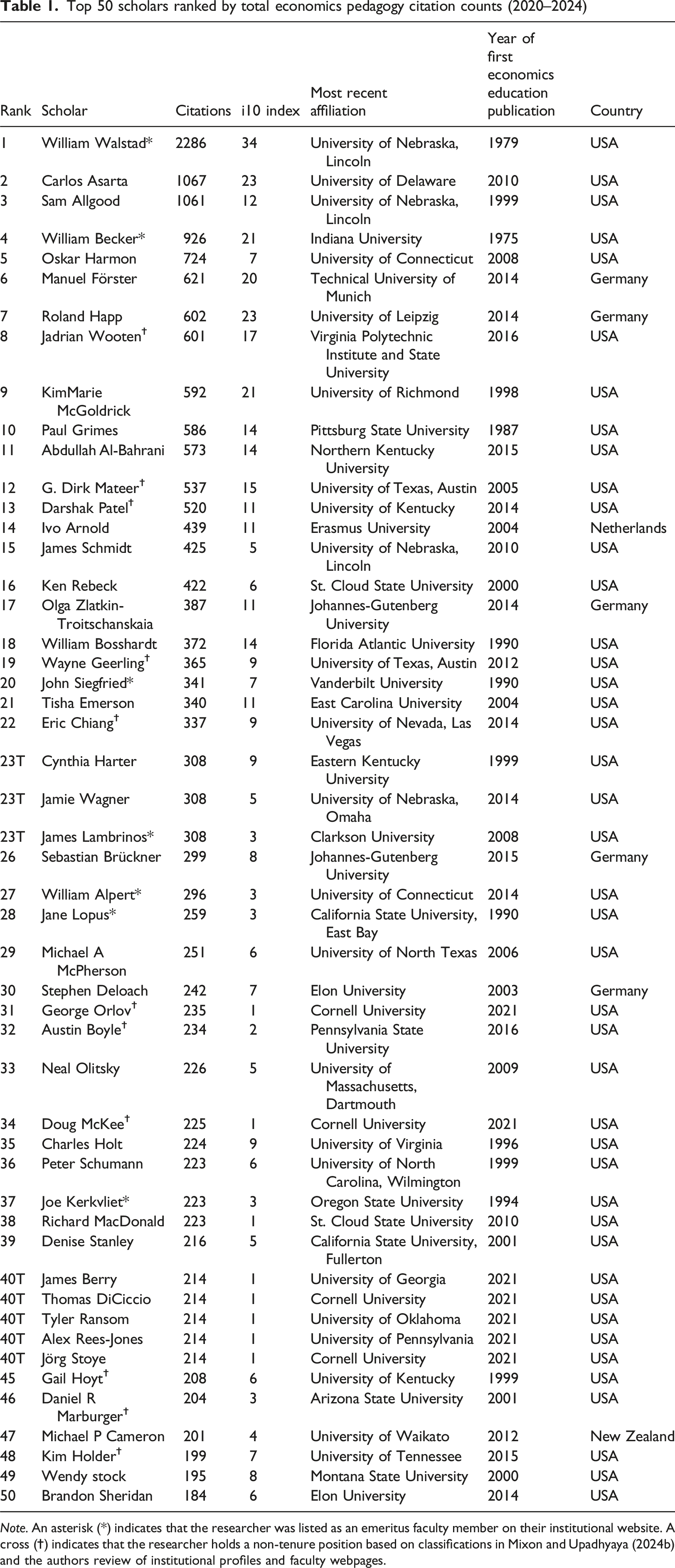
Note. An asterisk (*) indicates that the researcher was listed as an emeritus faculty member on their institutional website. A cross (✝) indicates that the researcher holds a non-tenure position based on classifications in Mixon and Upadhyaya (2024b) and the authors review of institutional profiles and faculty webpages.
As expected, a small number of authors dominate the upper tail of the distribution. William Walstad, Carlos Asarta, Sam Allgood, and William Becker anchor the top of the list, each obtaining more than 900 citations during the five-year window. Walstad stands out in particular: his body of work amassed 2,286 citations during this period, more than double that of the next highest author. His longstanding contributions have proven foundational, firmly establishing him as the most widely cited scholar in economics pedagogy.
While total citation counts can highlight prominent scholars, the measure could be skewed by a single high-impact article or even co-authorship on a blockbuster paper. For instance, some authors may appear in the top 50 due to one or two exceptionally cited publications, even if they do not regularly publish in the field. As such, Table 1 is best interpreted as a snapshot of visibility rather than a definitive list of the most actively engaged economics education scholars.
Several authors on this list also appear in Mixon and Upadhyaya's (2024b) study of the most productive teaching-focused economics faculty, suggesting that economics pedagogy remains a vibrant research outlet for clinical and non-tenure-track scholars. Editorial service also overlaps with research visibility: several top-ranked authors currently serve, or have served, on editorial boards of field journals such as The Journal of Economic Education, International Review of Economics Education, and Journal for Economics Teaching. Their involvement in these roles likely reflects, and reinforces, their leadership within the field.
Adjusted i10 Index Leaders
Top scholars ranked by a pedagogy–adjusted i10 index (2020–2024) with a minimum index of 5
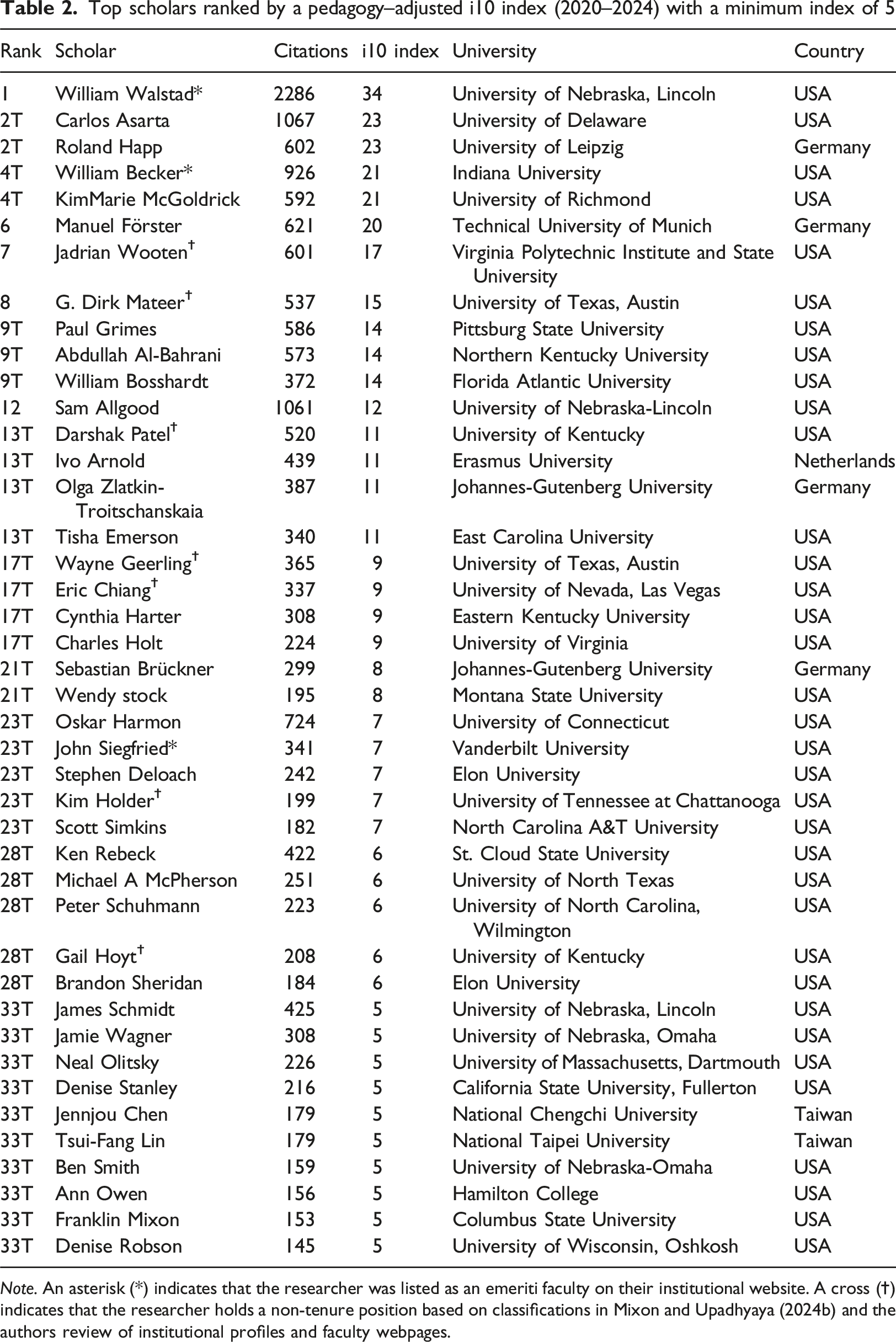
Note. An asterisk (*) indicates that the researcher was listed as an emeriti faculty on their institutional website. A cross (✝) indicates that the researcher holds a non-tenure position based on classifications in Mixon and Upadhyaya (2024b) and the authors review of institutional profiles and faculty webpages.
More than forty authors had at least five articles surplus this ten-citation threshold during the sample period, meaning that even the lowest-ranked individuals in Table 2 had at least 50 citations spread across at least five distinct articles. We view this as a stronger signal of scholarly engagement and influence within economics education. These authors are not just visible due to limited success. They have contributed several academic articles that have garnered recent attention from fellow educators and researchers.
Once again, William Walstad leads the group with 34 qualifying articles, underscoring the remarkable breadth of his contributions. Fifteen additional scholars have ten or more qualifying articles, representing a diverse mix of institutions, career stages, and research interests. Unlike total citation rankings, the adjusted i10 index allows early- and mid-career scholars to emerge as key voices in the field, even if their cumulative citation counts are low. In short, Table 2 provides a more reliable benchmark for identifying engaged researchers in economics pedagogy, and we encourage readers to treat it as the primary reference for gauging contemporary scholarly leadership.
Identifying Rising Scholars
Top 20 scholars with first economics pedagogy article published after January 2015 (minimum of 100 citations, 2020-2024), sorted by i10 index
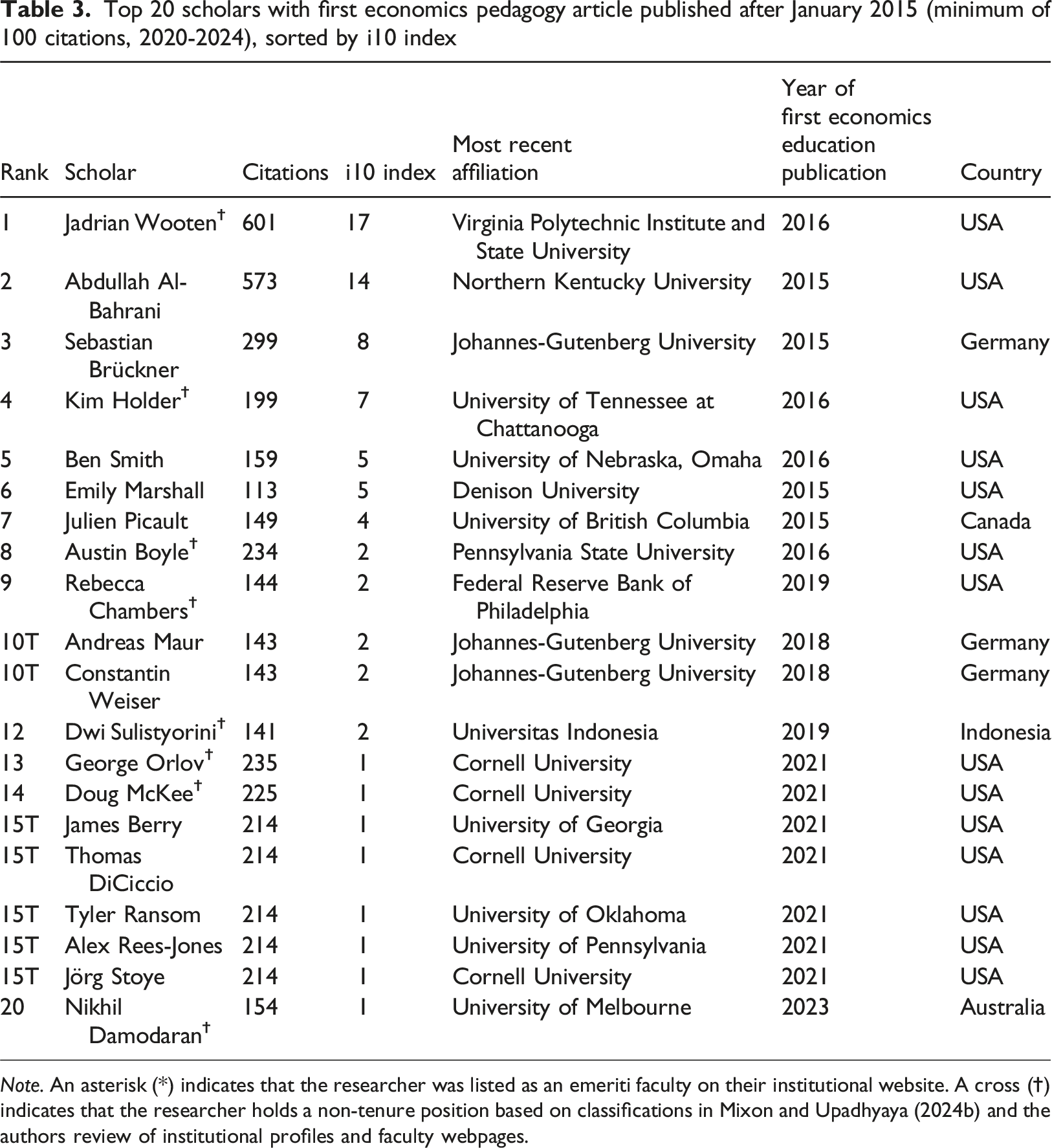
Note. An asterisk (*) indicates that the researcher was listed as an emeriti faculty on their institutional website. A cross (✝) indicates that the researcher holds a non-tenure position based on classifications in Mixon and Upadhyaya (2024b) and the authors review of institutional profiles and faculty webpages.
Twenty researchers meet the definition of an emerging scholar, each accumulating more than 100 citations between 2020 and 2024. At the top of this group are Jadrian Wooten and Abdullah Al-Bahrani, both of whom also rank among the top 15 most cited scholars overall in terms of total citations and adjusted i10 index. Their work is not simply gaining traction, but is helping shape the current direction of economics education research.
Other emerging scholars on this list demonstrate different paths to impact. Some have produced several well-cited articles, while others have made a significant mark with just one influential publication. This variation underscores the field’s openness to diverse contributions, regardless of quantity.
Collectively, these scholars publish across a wide range of topics and journals, from classroom experiments, assessment design, to studies focused on diversity, inclusion, and access. Their work reflects a broadening of the field’s research agenda and a growing willingness to engage with both foundational pedagogical questions and contemporary challenges. Many are also taking on editorial roles in leading journals, reinforcing their positions as both rising voices and future stewards of the discipline.
Most Cited Articles
While author-level metrics shed light on sustained scholarly influence, article-level citations offer a more granular view of the specific studies that have captured the field’s attention. The ten most cited qualifying articles between 2020 and 2024 are summarized in Table A1 (Online Appendix). These articles represent the individual publications that have resonated most strongly with researchers in recent years.
The journals represented in this list highlight the field’s interdisciplinary reach. With the exception of two articles in International Review of Economics Education, none appear in the AEA’s specialized field journal list. Instead, high-impact studies often appear in journals such as Journal of Consumer Affairs and Internet and Higher Education, underscoring the broad relevance of economics pedagogy research across fields.
Thematically, financial literacy and online learning dominate the list, accounting for seven of the ten most cited articles. The remaining studies address classroom pedagogy and academic integrity. Notably, most of these articles were published after 2015, including several released just before the start of our citation window. This suggests that impactful research in economics education can achieve visibility quickly, especially when it addresses a timeline issue (Elzinga, 2001).
Recent interest in instructional technology, including tools like ChatGPT, signals a potential shift in the field’s research agenda. These findings are consistent with topic modeling results from Fernandez et al. (2021), which identified emerging interest in financial literacy, course design, and curriculum development. Our citation-based analysis supports and extends that work by identifying the specific articles that have helped define the field’s current direction.
Citations by Region
Although economics education research is increasingly global in scope, the most highly cited scholars in our sample remain heavily concentrated in North America. To highlight influential scholars working outside of the United States and Canada, we present a list of top-cited international contributors in Table A2 (see Online Appendix
The relatively limited presence of non-North American researchers in our overall citation rankings should not be interpreted as a reflection of lower research quality. Instead, it likely stems from structural and institutional factors that shape scholarly visibility and influence. Our analysis included only English-language publications, many of which are edited by U.S.-based journals catering primarily to American academic audiences. For example, The Journal of Economic Education, one of the most prominent outlets in the field, is housed at a U.S. institution (Asarta & Mixon, 2019; Méndez-Carbajo & Mixon, 2022).
Beyond language and editorial geography, faculty incentives and institutional norms play a substantial role. In some countries, pedagogical research receives limited institutional support and is given less weight in promotion and tenure evaluations (Lo et al., 2015). Even among Anglophone countries, expectations for teaching-focused faculty vary considerably. As Arico et al. (2024) noted, faculty in the United States, Canada, and the United Kingdom face different norms regarding the share of their workload that should be devoted to scholarship.
Despite these structural hurdles, the scholars highlighted in Table A2 exemplify the growing international engagement in economics education research. Their contributions span active learning strategies, assessment design, and curriculum development. Their presence reinforces the importance of broadening our data sources in future research. Incorporating multilingual databases or region-specific journal indices could offer a more comprehensive understanding of global trends in the field.
Conclusion
The work presented above acknowledges the significant foundational contributions made by economics education scholars in recent publications. By spotlighting both well-established figures and emerging voices, we aim to document a broad and evolving landscape of scholarship that continues to shape how economics is taught and learned. Replicating this study every five years will allow us to identify the new wave of influential research and researchers in real time, providing a consistent benchmark for tracking how the field develops.
Importantly, we recognize that pedagogical scholarship, especially publications focused on novel classroom techniques, may not accumulate citations as quickly as traditional empirical work. In many cases, early contributions describing instructional innovations are cited only after subsequent studies assess their effectiveness. As such, our snapshot of recent citation activity may under-represent research that is influential in practice but has not yet diffused widely in the literature.
At the same time, our findings underscore a meaningful shift in who is producing high-impact economics education research. Several of the most active and cited researchers during our sample period, especially the emerging scholars, are non-tenure track faculty or teaching specialists. This aligns with recent findings by Mixon and Upadhyaya (2024b), who document substantial scholarly output by clinical faculty around the United States. Their analysis found that 206 clinical faculty have produced research cited more than 125,000 times, reinforcing that academic productivity is not limited to tenure-stream positions. Our results reflect the growing role of these educators in the field.
This pattern also mirrors broader changes across higher education. Many institutions are expanding or formalizing teaching-focused roles that allow for promotion, scholarly activity, and service (Emerson & Hoyt, 2024). These roles, often categorized as collegiate, clinical, or professor-in-practice, support scholarship on teaching and learning while offering more stable career pathways. In some cases, such as at the University of California at Berkeley, teaching-focused faculty are now eligible for tenure under distinct evaluation criteria. As these roles become more common, we may see continued growth in the volume and visibility of pedagogy-focused scholarship. This trend may also help explain why many top-cited emerging scholars in our sample began publishing in the field after 2015.
Looking ahead, we anticipate that the next interaction of this project (2025–2029) will reflect emerging topics of interest, including the rise of artificial intelligence in education and job placement, diversity and inclusion issues, and the importance of coding in the curriculum (Birdi et al., 2026). Early evidence suggests that tools like ChatGPT are already influencing economics instruction (Flynn, 2025; Geerling et al., 2023), and future research is likely to expand on these themes.
At the same time, the field has an opportunity to more fully embrace the “credibility revolution” that has reshaped empirical economics in recent decades. Rigorous causal identification strategies such as randomized control trials and natural experiments can offer deeper insights into what pedagogical practices genuinely improve student learning outcomes (Allgood & McGoldrick, 2025; Orlov et al., 2025; Pugatch & Schroeder, 2025; Stock, 2025). While descriptive studies and innovation-focused articles remain valuable, pairing them with credible empirical strategies would strengthen the evidence base and provide clearer guidance for instructions and institutions alike.
By highlighting both enduring influence and methodological innovation, we aim to contribute a forward-looking conversation about what it means to do meaningful, rigorous, and policy-relevant research in economics education.
Footnotes

Funding
The authors received no financial support for the research, authorship, and/or publication of this article.
Declaration of Conflicting Interests
The authors declared no potential conflicts of interest with respect to the research, authorship, and/or publication of this article.