




Abstract
Alasdair MacIntyre’s distinction between institutions and practices helps illuminate how powerful institutional forces frame and constrain the practice of organizational research as well as the output and positioning of scholarly journals like Organization. Yet his conceptual frame is limited, not least because it is unclear whether the activity of managing is, or is not, a practice. This article builds on MacIntyre’s ideas by incorporating Aristotle’s concepts of poíēsis, praxis, téchnē and phrónēsis. Rather than ask, following MacIntyre, whether management is a practice, this wider network of concepts provides a richer frame for understanding the nature of managing and the appropriate role for academia. The article outlines a phronetic paradigm for organizational inquiry, and concludes by briefly examining the implications of such a paradigm for research and learning.
Alasdair MacIntyre’s distinction between institutions and practices helps illuminate how powerful institutional forces frame and constrain the practice of organizational research as well as the output and positioning of scholarly journals like Organization. Yet his conceptual frame is limited, not least because it is unclear whether the activity of managing is, or is not, a practice. This article seeks to build on MacIntyre’s ideas by incorporating Aristotle’s concepts of poíēsis, praxis, téchnē and phrónēsis into the conversation. Rather than ask, following MacIntyre, whether management is a practice, this wider network of concepts provides a richer frame for understanding the nature of managing. The article proposes a phronetic paradigm for organizational inquiry, and concludes by examining the implications of such a paradigm for research and learning.
An anniversary is a time to celebrate, a time to remember the past, to review where we are or might have been, and to reflect on the embedded patterns of action that we might or might not follow into the future. And there is much to celebrate after 20 years of Organization, which is now, by any measure, a top-ranked academic journal. More broadly, the community of critical management scholars is punching well above its collective weight, especially in the UK where some 15–20% of the highest ranking management academics (those with four ‘4-star’ publications in six years) are associated with critical management studies (Spoelstra and Butler, forthcoming). Similarly, business schools identified as being ‘critical’ in orientation—such as the University of Leicester’s School of Management and the School of Business and Management at Queen Mary University of London—performed very successfully in the UK’s most recent Research Assessment Exercise (Rowlinson and Hassard, 2011). Of course ‘critical’ inquiry extends far beyond the UK. It is also growing in popularity, especially in organization studies, as illustrated in Figure 1 which plots the number of articles in the Web of Science database that include the words ‘theory’, ‘critical’, and ‘organization’ (the ‘adjusted’ count makes allowance for the different number of articles published in the database each year).
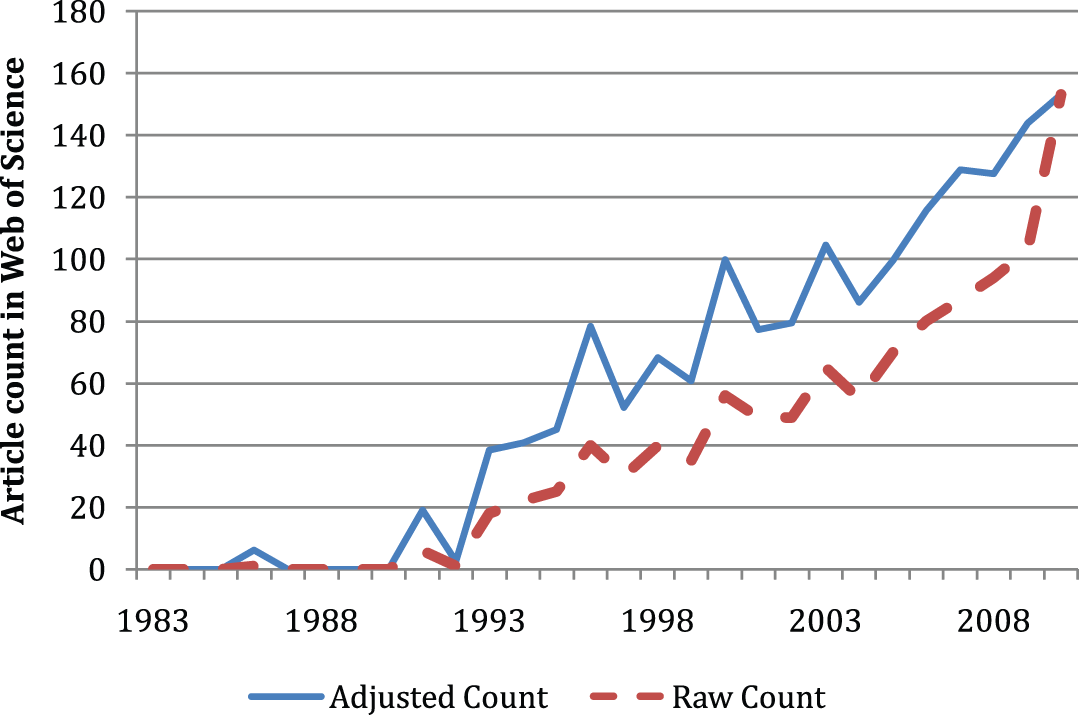
Count of articles containing ‘theory’, ‘critical’ and ‘organization’
Table 1 celebrates the birth and history of Organization by locating and marking the event within a ‘register’ of journal births. One thing that’s noticeable from this register is how young the discipline is. Organization Science and Organization Studies were ‘born’ in 1990 and 1980 respectively; management studies is older, but it is also a relatively young discipline as evidenced by the birth date of the field’s major journals.
‘Birth date’ of selected journals
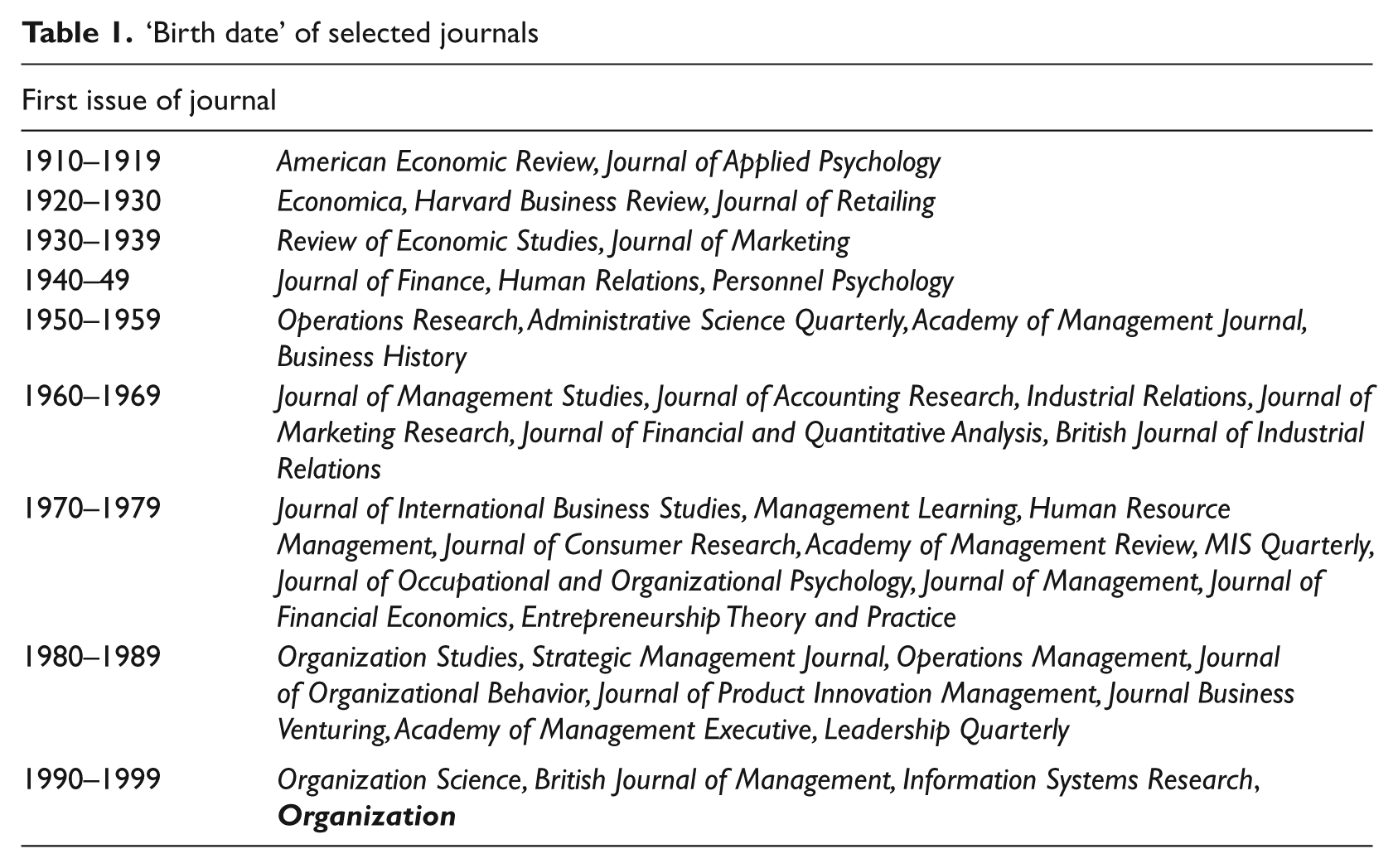
Looking at the birth and development of the Journal in the context of other journal births reminds us of the wider systemic and institutional forces at play, forces that can easily overwhelm the aspirations of journal editors. For instance, most people today would not associate Organization Science with radical approaches to inquiry, even though the editors of that journal, in its first issue, predicted that it would ‘loosen the normal science straitjacket in which the field finds itself … [and] stay open to and even encourage radical approaches’ (Daft and Lewin, 1990: 7). And if Organization has been more committed to experimentation—one cannot envisage Organization Science having a special issue on Christmas—it is still quite similar to other journals in the field, at least in terms of the amount of ‘critical’ research it publishes, notwithstanding its editorial vision (Dunne et al., 2008a).
We can identify a range of powerful institutional forces that work to effect this isomorphism. Journal ranking lists, and their use in tenure and appointment systems are clearly important, but so too are the conventions of the peer review procedure and the economics and politics of journal publishing (Gabriel, 2010; Willmott, 2011). In particular, there is growing disquiet about the monopoly powers that publishing houses have acquired and are acquiring (Poynder, 2011), and the phenomenon of ‘academic capitalism’ in which authors, reviewers and editors are complicit participants (Ylijoki, 2003).
Journal ranking lists and their use in review processes, such as the RAE and REF systems in the UK, can foster not only mimesis, but also disciplinary insularity, by encouraging scholars to publish in a small number of journals which works to privilege a narrow range of possible styles. Fashion fosters homogeneity, as Simmel (1904/1971) observed a long time ago. The fashion logic at work in organization studies has led to much academic debate about which journals should be on the list, the appropriateness of the score obtained by different journals, the merits of the value system underpinning the scoring rationale, and the way specific genres of inquiry, locations, languages and traditions are excluded or privileged (Rowlinson et al., 2011). For instance, a running gripe is how a ‘US’ research approach dominates organizational research and marginalizes an alternative ‘European’ tradition (Grey, 2010; Hinings, 2010; Meyer and Boxenbaum, 2010; Willmott, 2011).
Less obviously, but perhaps more importantly, these institutional forces affect the ‘trade’ and circulation of ideas. For instance, Battilana et al. (2010) have analysed the exporting and re-importing of ideas between European and North American communities of organizational researchers, through analysing articles published in Organization Studies. In a more extensive study, Oswick et al. (2011) examined the uptake and origins of theory contributions to organization and management studies. Their study showed that theories are sourced from a very diverse set of fields, and that the most popular theories in organization and management studies are ‘imported’ from elsewhere. They did not assess how many theories ‘produced’ in organization and management studies are ‘exported’ to other fields, though it is practically certain that such exporting is relatively small and that a defining feature of the field is its massive ‘deficit’ in intellectual trade.
The purpose of this introduction is to set the scene, identifying the particular contestations and challenges that Organization and other similar journals face. Interpretative frames help us describe, understand and engage with such challenges, and in this article I leverage the work of Alasdair MacIntyre, especially his ideas on practice and institutions, for this purpose. The next section of the article introduces and summarizes these concepts.
MacIntyre and management
At the centre of MacIntyre’s work is the concept of ‘practice’, which he defines as follows:
By a ‘practice’ I am going to mean any coherent and complex form of socially established cooperative human activity through which goods internal to that form of activity are realised in the course of trying to achieve those standards of excellence which are appropriate to, and partially definitive of, that form of activity, with the result that human powers to achieve excellence, and human conceptions of the ends and goods involved, are systematically extended. Tic-tac-toe is not an example of a practice in this sense, nor is throwing a football with skill; but the game of football is, and so is chess. Bricklaying is not a practice; architecture is. Planting turnips is not a practice; farming is. So are the enquiries of physics, chemistry and biology, and so is the work of the historian, and so are painting and music. (MacIntyre, 1981/1984: 187)
For MacIntyre, practices are always situated in place and time, in a living, historical tradition.
A second important concept in his frame is the notion of an institution. Again, it is best to reproduce his own definition:
Practices must not be confused with institutions. Chess, physics and medicine are practices; chess clubs, laboratories and hospitals are institutions … They are involved in acquiring money and other material goods; they are structured in terms of power and status, and they distribute money, power and status as rewards. Nor could they do otherwise if they are to sustain not only themselves, but also the practices of which they are the bearers. (MacIntyre, 1981/1984: 194)
Institutions are reflexive and open to change:
So when an institution—a university, say, or a farm, or a hospital—is the bearer of a tradition of practice or practices, its common life will be partly, but in a centrally important way, constituted by a continuous argument as to what a university is and ought to be or what good farming is or what good medicine is (MacIntyre, 1981/1984: 222)
MacIntyre then proceeds to make an important and influential distinction between what he calls ‘internal goods’ and ‘external goods’. To explain the distinction he tells a story of an adult encouraging a child to play chess. Initially, this encouragement is effected through promising the child some tangible reward, for example sweets or money, if she plays the game. Over time, the child comes to enjoy playing the game and will play solely for the love of playing chess regardless of any reward. In a nutshell, this captures his distinction between internal and external goods: the enjoyment derived through playing the game itself is an ‘internal good’ while the sweets or money constitute an ‘external good’. As well as enjoyment and joy, a practice’s internal good also includes the attainment of the practice’s proper ends and the possession and exercise of its requisite skills and virtues.
Crucially, MacIntyre associates internal goods with practices, and external goods with institutions. Applied to research, one might understand an internal good as the joy one gets from writing, analysing, reading, collecting data and the other activities that constitute the practice of doing research. In contrast, Research Assessment Exercises, which are created and maintained by the institution rather than the practice, are a good example of an external good. Such goods are ‘characteristically objects of competition in which there are winners and losers’ and when achieved ‘are always some individual’s property and possession’ (MacIntyre, 1981/1984: 190). These distinctions are captured nicely by the actress Glenn Close, who in a recent interview, spoke about her love for the ‘craft’ of acting (an internal good) and her detachment from the entertainment industry’s intense concern with acting awards (external goods): ‘I love what I do and the craft of it … I’m aware that the world likes to have winners and losers. I understand the entertainment value in that, of course, but as it applies to my craft it kind of doesn’t make sense’ (Clayton-Lee, 2012: 42).
While practices depend on institutions—‘no practice can survive for any length of time un-sustained by institutions’ (MacIntyre, 1981/1984: 194)—they can also work to create an unnecessary focus on external goods which can be harmful to the practice: ‘the ideals and the creativity of the practice are always vulnerable to the acquisitiveness of the institution’ (MacIntyre, 1981/1984: 194). In particular, MacIntyre is hostile to the bureaucratic manager, who he sees as the primary advocate of techniques that can damage if not destroy practices and their constituent virtues.
Virtues are the final important concept in MacIntyre’s frame, and he explicitly associates them with internal goods and practices rather than external goods and institutions: ‘A virtue is an acquired human quality the possession and exercise of which tends to enable us to achieve those goods which are internal to practices and the lack of which effectively prevents us from achieving such goods’ (MacIntyre, 1981/1984: 191). Again, virtues are understood and constituted contextually and historically:
[First,] all morality is always to some degree tied to the socially local and particular … and secondly that there is no way to possess the virtues except as part of a tradition in which we inherit them and our understanding of them from a series of predecessors (MacIntyre, 1981/1984: 127)
And again, these goods and virtues emerge and change over time: ‘A living tradition then is an historically extended, socially embedded argument, and an argument precisely in part about the goods which constitute that tradition’ (MacIntyre, 1981/1984: 222).
MacIntyre’s distinction between practices and institutions, and his association of internal goods and virtues with the former and external goods with the latter, becomes somewhat confused when he admits:
The making and sustaining of forms of human community—and therefore of institutions—itself has all the characteristics of a practice, and moreover of a practice which stands in a peculiarly close relationship to the exercise of the virtues (MacIntyre, 1981/1984: 194)
Thus, making and sustaining an institution can be understood as a practice of sorts. To clarify, it is useful to distinguish between an institutional practice and a core practice (though MacIntyre doesn’t use these terms).
Is management a practice?
The above summary of MacIntyre’s concepts and theoretical frame is necessary before we can consider the obvious and important question, ‘Is management a practice?’. While MacIntyre doesn’t address the issue explicitly, it is clear—based on his characterization of managers as no more than amoral implementers of bureaucratic rationality—that management is not a practice (Beadle, 2008). Specifically, it is not compelling to describe business or management as a ‘productive craft’ since business and management are never more than a means. We can speak of the ‘business of farming’, or the ‘business of fishing’ but the concept of the ‘business of business’ doesn’t make much sense. Neither are there good examples of the excellence of business (as business)—save for vague and rather empty terms like ‘customer service’—nor examples of the ‘internal goods’ of management that are in any sense specific to management. And if management is a practice, then what and where is the institution with which it has a dialectic relationship? Since management is always related to something else, it is proper to totally and solely locate it within the institutional realm of particular practices. A further argument draws on MacIntyre’s assertion that teaching is not a practice:
I say that teachers are involved in a variety of practices and that teaching is an ingredient in every practice … Teaching is never more than a means, that is it has no point and purpose except for the point and purpose of the activities to which it introduces students. All teaching is for the sake of something else and so teaching does not have its own goods. The life of a teacher is therefore not a specific kind of life. The life of a teacher of mathematics, whose goods are the goods of mathematics, is one thing; a life of a teacher of music whose goods are the goods of music is another. This is one reason why any conception of the philosophy of education as a distinct area of philosophical enquiry is a mistake. (MacIntyre and Dunne, 2002: 8–9)
In other words, it is inappropriate to extract the educational element out of different practices and put them together as a single practice. The same logic applies even more so to the ‘practice’ of management, because, while it is relatively easy to identify an institution (the school), and internal and external goods associated with teaching, we cannot easily do this for management.
MacIntyre’s argument that teaching is not a practice is less convincing if we restrict teaching to primary and second level education [for development see Dunne (2003)]. It has more merit at the third level and raises interesting issues for our understanding of the university and the business school. Indeed one would expect MacIntyre to be especially hostile to the business school because not only is it, in his view, an institution that fosters and promulgates bureaucratic rationality, but it is also premised on the false and dangerous notion of conjoining elements from different practices together. From this perspective, the attempt to construe management as a distinct practice is best understood as a political (and unethical) move, in which management researchers and business schools are deeply implicated.
However, there are a number of reasons why we might argue that management is a practice [for development, see Christensen (2012); Brewer (1997), Moore (2002, 2005a, 2005b)]. First, ‘management’ is recognizably a ‘coherent and complex form of socially established human activity’, with its own ‘standards of excellence’. Presumably there are goods internal to the practice of management—even if these could only be identified through interpretative studies of managers—and so it appears to meet the requirements that MacIntyre sets for deciding whether a set of activities is a practice or not. Second, MacIntyre’s rather narrow (and prejudiced) view of what managers do is not supported by studies of managerial work (e.g. Mintzberg (1973)). Not only do managers seek to maximize efficiency, but they also copy, follow rules, pursue individual goals, have fun, encourage employees and a myriad of other things that constitute the human condition. Third, even if we accepted MacIntyre’s understanding of the manager as bureaucrat, then the activities associated with this character still only constitute an institutional rather than a core practice, as defined above.
Developing the conversation
MacIntyre’s set of concepts provides a useful critical take on management, on the business school and on the idea of the university. Yet it is problematic for a number of reasons. His ideas about a form of life—based around activities like football, fishing, chess-playing, architecture and medicine—are initially seductive, but at many levels they are a long way from the reality of contemporary organizations. He is clearly unhappy with modernity, bureaucracy and capitalism, but too often his critique comes across as wishful sentimentalizing for a pre-modern romantic idyll. Moreover, his basic concepts are much too slippery when we try to apply them, generating all sorts of empirical conundrums. Is farming a practice, or are the different types of farming distinct practices? What practice is a brand manager part of? Is the video game Grand Theft Auto a practice, just like the game of chess? How do practices emerge and disappear?
Part of the problem is perhaps that MacIntyre has tended, in his seminal book After Virtue—by far his most cited work in management—to conflate a number of Aristotelian ideas into his single concept of practice. This section of the article restores some of these distinctions, in particular, drawing on the work of Joseph Dunne (1993, 2005, 2011), with whom MacIntyre had an interesting dialogue about whether or not teaching is a practice (Dunne, 2003; MacIntyre and Dunne, 2002).
In his masterful book, Back to the Rough Ground, Dunne (1993) discusses many of Aristotle’s major concepts but here I will focus on just four—poíēsis, praxis, téchnē and phrónēsis—as shown in Table 2.
Framing concepts (after Aristotle)

Poíēsis describes an activity associated with making or fabricating something, which necessarily terminates in and brings about a separate product or outcome that provides it with its end or telos. Three types of poíēsis or domain of activity can be distinguished (though neither Aristotle nor Dunne make this categorization). Artefactual poíēsis describes the activity of making some thing, such as building a house or making a chair. In contrast, performative poíēsis involves no artefact, and so includes activities like performing a dance or gymnastics. What is distinctive about the third type, influential poíēsis, is that luck or chance necessarily intervenes. For example, a doctor may work at making a patient better, but despite the doctor doing excellent work, the patient may still die.
Praxis, unlike poíēsis, is not structured around a separately identifiable outcome; rather it is the domain of activity where the end is realized in the very doing of the activity itself: ‘while making has an end other than itself, action cannot, for good action [praxis] itself is its end’ (Aristotle, 2007: 6.5 1140b7). Thus, praxis has to do with the conduct of one’s life as a citizen; it is about activities such as being friendly, honest, truthful, loyal, helpful. In essence, the distinction between poíēsis and praxis is between productive and ethical activity.
Poíēsis and praxis are distinct domains of activity and each has an associated form of knowledge. Téchnē, or productive knowledge, is associated with poíēsis and describes the kind of knowledge possessed by an expert in a specialized craft who understands the principles underlying the production of an object or a state of affairs. Dunne identifies two forms of téchnē: first there is the knowledge that explains how an artefact comes into being; in other words it is a form of knowledge underpinning the ability to analyse and describe how an artefact is made. A second form of knowledge is involved in actually making an artefact or creating a performance; in other words it is the knowledge underpinning the ability to manufacture an artefact or produce a state of affairs. An important point about téchnē is that while it does contain a concept of ‘excellence’ (e.g. ‘I know how to make an excellent chair’) this does not provide a basis for ethical action.
Phrónēsis, or practical wisdom, is the form of knowledge associated with praxis. It is acquired and deployed not in the making of any product separate from oneself but rather in one’s actions with one’s fellows. It is not knowledge of ethical ideas or universal principles (which distinguishes it from utilitarian and deontological ethical systems), but rather it describes a resourcefulness and perceptiveness of mind and characterizes a person who knows how to act with virtue. It is good, practical moral judgement. Phrónēsis is distinct from téchnē, just as poíēsis is distinct from praxis: ‘Phrónēsis cannot be … téchnē … because acting and making are different kinds of things’ (Aristotle, 2007: 6.5 1140b3). Téchnē is specialized and domain specific; in contrast, phrónēsis—while gained through domain-specific experience and recognizing that virtue is always realized in concrete situations—is neither specialized nor domain specific but is instead coextensive with living a good life. And while there is such a thing as excellence in téchnē, ‘there is no such thing as excellence in phrónēsis’ (because phrónēsis is itself an excellence) (Aristotle, 2007: 6.5 1140b22).
For completeness, it is worth distinguishing téchnē and phrónēsis from three other concepts in Aristotle’s frame: epistēmē, sophia and noûs. Epistēmē is logically deduced knowledge of relations between objects that do not admit to change. The paradigmatic model of how this form of knowledge comes to be is the deduction of a trigonometric theorem from geometrical axioms. Thus, geometry is a good example of epistēmē in Aristotle’s sense. Sophia is the ability to think well and wisely about universal truths and theories. In contrast to phrónēsis, which is the wisdom associated with the practical matters of human life, sophia is the wisdom associated with thinking about ‘things much more divine in their nature than man, e.g. most conspicuously, the bodies of which the heavens are framed’ (Aristotle, 2007: 6.5 1141b1). Finally, noûs is Aristotle’s term for intuitive understanding, which is distinct from sense perception and reasoning. Noûs is foundational in that it centres on the ability to make sense of what is perceived and to reason: it is ‘the part of the soul by which it knows and understands’ (Aristotle and Hicks, 1907: 429a9–10).
These concepts provide a way of reframing the question of whether or not management is a practice to a somewhat different question about whether management is best understood as poíēsis or praxis. In so far as management is about realizing desirable end results—for example, satisfied customers—it might properly be considered as poíēsis. However, when one considers popular understandings of the nature of managerial work—e.g. Mintzberg (1973) which emphasizes the manager’s interpersonal, informational and decisional roles—it seems clear that management is also captured by Aristotle’s concept of praxis. At the level of knowledge, it is also clear that knowing how to lead, handle disturbances, negotiate, represent, initiate change, allocate resources, disseminate information, monitor and be a figurehead is not téchnē or productive knowledge, but rather phrónēsis (practical wisdom), which is acquired and deployed not in the making of an artefact but through interacting with others in one’s community. Indeed since ‘managing’ can transcend the production of particular artifacts or the creation of particular states of affairs it is perhaps better understood as a form of praxis rather than poíēsis.
The distinction introduced in this article between core and institutional practice is also helpful, even if we know that practices are always embedded in one another and are always ‘leaky’. Seeing management as an institutional rather than core practice is important because it helps us recognize and respond to the corrosive effect that management activity can have on core practices. In particular, it highlights the way that attempts in different domains to identify and foster ‘excellence’ and ‘quality’ can work to shift the focus from internal to external goods. In this respect, MacIntyre gives us a helpful frame for interpreting the trends outlined at the start of the article, especially the way research has become a competitive game centred on the external goods of journal rankings and research assessment exercises, which work to diminish the internal good obtained through the actual activity of doing research, which also diminishes the practice of research work itself. Concepts like internal and external goods are valuable because they provide an accessible and intuitively appealing vocabulary that, when used appropriately, can rebuff and limit the corrosive effect that managerial techniques have on core practices.
Towards a phronetic paradigm
This article began by briefly reflecting on Organization’s short history and context, noting, in particular, the game playing and institutional isomorphism that surround and infuse the Journal’s activities. I believe that Alasdair MacIntyre’s work—and especially Dunne’s (1993) more nuanced reading of Aristotle—provides a powerful frame for clarifying how we should make sense of what’s going on and how we should now proceed. In this concluding section of the article, I use these ideas to outline a phronetic paradigm of organizational research.
A phronetic paradigm is centred on the idea, based on the concepts of téchnē and phrónēsis, that knowing and judgement emerge through the lived experience of making and acting. It provides, inter alia, a distinctive understanding of the nature of academic work and the relationship between academics and practitioners, and between theory and practice. It can be usefully compared with what we might call the epistemic paradigm, wherein practitioners are constituted as objects of research carried out by experts, and also as consumers of that research which takes the form of epistēmē. In contrast, within a phronetic paradigm practitioners are conceptualized as critical, reflective researchers and perpetual students (Antonacopoulou, 2010; Flyvbjerg, 2001). Here, the issue is not about creating abstract knowledge (epistēmē) and then making it practical or relevant to practitioners, nor to instruct or dictate to them, nor to moralize. Rather, the academic goal is to help practitioners in their reflective work: to develop their phrónēsis. Part of the conceptual power of phrónēsis is that it counters the desire to create a systematic body of generalized knowledge (‘technical rationality’) and reminds us that we should neither forget nor seek to overcome the conditionality, situatedness and historicity of human life. Instead, it impels us to recognize and work with the dialectic between téchnē, which abstracts from past experience of making things, and phrónēsis which is always experiential, modifiable and premised on the value of improvisation and indeterminateness. The ethics of phrónēsis reminds us that tasks are not value-neutral nor can they be immunized against the human condition. Phrónēsis provides the ethical foundation for téchnē, which is why one should not try to deploy the latter cut loose from the former. For instance, one might make a table, ‘badly’, for a needy person, or one might play a flute, ‘excellently’, for the S.S. in Dachau, or one might be an ‘excellent’ HR manager in an illegal (or legal) drug distributer. Phrónēsis provides the practical wisdom to make a judgement on what’s right and wrong, good and bad, just and unjust in these cases (Nyberg, 2008).
While there have been recent calls for a phronetic approach to organizational research (Antonacopoulou, 2010; Cairns and Sliwa, 2008; Nonaka and Toyama, 2007; Rämö, 2011), a coherent phronetic paradigm—in which teaching, learning, research and management are centred on the idea of phrónēsis—has yet to be articulated or brought into being. Doing so will be difficult because, as outlined in the beginning of this article, powerful institutional forces, which are largely hostile to a phronetic paradigm, constitute and constrain the academic study of organizational phenomena. For instance, if there was a deep commitment to situated studies then one would expect location to be identified in the title of published articles. However, only nine of the most recent 100 articles published in Organization (and five in Organization Studies) include a country or location in the article title. Along with Dunne and colleagues’ (2008a) analysis of ‘critical resarch’, this suggests that while Organization (qua community) might be playing the game well, it might perhaps be playing the wrong game.
So, what might we do differently, and can MacIntyre help us map out a way forward? A long-standing criticism of MacIntyre is that, despite his indignant critique of the modern world, he offers little by way of alternative save for nostalgic hankering for long-lost and romanticized ways of living. Thus his argument is innately conservative. However, there is also a radical dimension to his thinking [see Blackledge and Knight (2011) for a collection of essays on his ‘revolutionary Aristotelianism’] that can be exploited within a phronetic paradigm of organizational research. For instance, if we accept that management is not a practice, then profound questions are raised about our understanding of what and how we should teach and research, as well as the nature of, and rationale for, the institutions within which teaching and research are conducted. Specifically, the implication of MacIntyre’s argument is that we should work to situate management teaching and research in core practices rather than collaborate in the inauthentic work of trying to make ‘management’ a core practice itself. Following this logic, it is difficult to see a rationale for the business school as conventionally understood, or a coherent epistemological basis for most management and organizational research. This might be fanciful since it is difficult to envision a world without the industry of business education and research, but it does provide an additional and provocative theoretical perspective on criticisms of the business school (Dunne et al., 2008b; Jones and O’Doherty, 2005; Starkey and Tempest, 2008) and on the hermetic nature of management and organizational research described at the outset of this article.
A phronetic paradigm also provides an understanding of knowledge production that is quite distinct from what is commonly known as Mode 1 and Mode 2 (Huff and Huff, 2001). Mode 1 is concerned with discipline based scientific practice, where the concentration is on the quality of the work initiated and executed by academic investigators within a rather homogenous discipline that is collectively focused on conceptual development. In contrast, Mode 2 knowledge production is problem-centred, transdisciplinary, and centred on the needs of business and agencies that fund research. These differences between Mode 1 and Mode 2 are routinely abbreviated to a distinction between ‘rigour’ and ‘relevance’. In contrast, the concept of a phronetic paradigm suggests a quite different mode of knowledge production, which I will term Mode Φ, Φ (Phi) being the first letter of the Greek word for phrónēsis (φρόνησις). If Mode 1 is centred on rigour and Mode 2 on relevance, then Mode Φ is focused on ‘rectitude’, in so far as ethics and wise practice are at the heart of phrónēsis. And if Mode 2 challenges the status that Mode 1 accords the individual researcher and academic community, Mode Φ emphasizes the academic’s responsibility and freedom to critique practice and practitioner understandings of what is ‘relevant’. However, it must be a dialectic relationship that also respects and is embedded in the world of practice. This might be articulated, in a journal like Organization, through various forms of Socratic dialogue between practitioners and academics that is centred on the rightness (and righteousness) of action.
Mode Φ does not mean that either rigour or relevance are jettisoned. Rather, just as Greek letters are routinely used in mathematics to indicate variables that can take different values, Mode Φ might best be understood as a mode of knowledge production that can incorporate, not only Modes 1 and 2, but also Mode 3, where the purpose is the common good, and Mode 0, representing private patronage of academic endeavour (Bresnen and Burrell, 2013). What distinguishes Mode Φ, however, is that it is primarily concerned with what is right and ethical, within a broadly Aristotelian world view.
Conclusion
MacIntyre’s reading of Aristotle gives us a helpful way of thinking through the conversations in, about and around journals like Organization, that are embedded in and are constituted by the dialectic between institutions and practice. Building on this, Artistotle’s wider frame of terms, especially his concept of phrónēsis, provides a skeletal frame for a new form of critical management studies. While the term paradigm might be over-used and abused, it makes much sense to speak of a phronetic paradigm, centred on Aristotle’s concepts of praxis and phrónēsis. While such a paradigm exists only in outline, it can still be distinguished from the two paradigms that dominate contemporary organizational and management research: the interpretative paradigm, which is focused on describing how things come to be and how actors interpret the world, and the positivist paradigm, which is rooted in formulating epistēmē or scientific knowledge. It is perhaps unlikely that a phronetic paradigm will emerge in or be associated with Organization, given the power of path dependency and institutions and the personal investments already made. Nevertheless, such a paradigm could provide an alternative model of engaging critically with managing and organizing, as well as new modes of researching, teaching and learning.
Footnotes
Acknowledgements
The author thanks Sebastian Green, Joseph Dunne, Mads Schmidt Christensen, Albert Mills and Kevin Scally for their helpful comments on this paper. In addition he thanks the participants of the Organization@20 Workshop in Cardiff Business School and attendees at a research seminar in Copenhagen Business School, both held in April 2012. Special thanks to Robyn Thomas and Martin Parker for their insights and suggestions.
Biography
 .
.