




Abstract
Traditional approaches to organizational improvisation treat it as a merely functional response to environmental constrains and unforeseen disruptions, neglecting its moral dimension, especially the valued ends improvisers aim to achieve. We attempt to address this gap by drawing on virtue ethics. In particular, we explore how phronetic improvisation is accomplished by drawing on the diary of an emergency-room physician, in which she describes her (and colleagues’) experience of dealing with Covid-19 in a New York Hospital, during the first spike in March–April 2020. We argue that improvisation is phronetic insofar as practitioners actively care for the valued ends of their practice. In particular, practitioners seek to phronetically fulfil the internal goods of their practice, while complying with institutional demands, in the context of coping with situational exigencies. Phronetic improvisation involves paying attention to what is salient in the situation at hand, while informed by an open-ended commitment to valued ends and constrained by scarce resources, and driven by a willingness to meet what is at stake through adapting general knowledge to situational demands. Such an inventive process may involve reshaping the original internal goods of the practice, in light of important institutional constrains.
Introduction
Improvisation is recognized as an important organizational ability that is particularly critical when organizations face novel and/or disruptive circumstances (Chelariu et al., 2002; Magni et al., 2009; Wiedemann et al., 2021). It is seen to be extremely valuable, especially in dealing with unexpected problems ranging from critical to mundane, such as handling the Covid-19 pandemic (Wiedner et al., 2020) and bush fires (Dwyer and Hardy, 2016; Holt and Cornelissen, 2014; Weick, 1993) or coping with equipment failure (Meziani and Cabantous, 2020; Rerup, 2001), advancing new product development (Kyriakopoulos, 2011; Moorman and Miner, 1998) and introducing new software (Orlikowski, 1996).
Notwithstanding small differences in definitions, organizational improvisation (hereafter: OI) is widely understood to be deliberate action, in which planning and execution converge to often produce novel outcomes, in response to unanticipated exogenous or endogenous events, by drawing on material, sociocognitive and affective resources available (Ciuchta et al., 2021: 290–291; Cunha et al., 2017: 560; Hadida et al., 2015: 440; Mannucci et al., 2021: 614; Suarez and Montes, 2019: 575; Weick, 1998: 544). OI studies consistently highlight that improvisation occurs at different levels, is socially embedded and technically mediated: it is accomplished insofar as skilful agents draw on shared norms and technical knowledge, usually in the context of enacting routines, when faced with interruption (Batista et al., 2016; Bechky and Okhuysen, 2011; Kamoche and Cunha, 2001; Mannucci et al., 2021; Suarez and Montes, 2019; Weick, 1998). It has been broadly, albeit usually tacitly, assumed that OI is necessarily positive (Ciuchta et al., 2021; Mannucci et al., 2021; Suarez and Montes, 2019), although, research has usefully shown that OI can lead to negative outcomes too (Giustiniano et al., 2016), or, to put it more broadly, OI outcomes are contingent (Ciuchta et al., 2021: 300; Gross, 2014; Kyriakopoulos, 2011; Moorman and Miner, 1998).
While acknowledging the contingency of OI provides nuances, it tends to assume a merely ‘functional’ view of improvisation, whereby the latter is seen as a contingent response to ‘environmental constraints, in particular resource scarcity and surprise’ (Visscher et al., 2018: 356) and to situational variability (Batista et al., 2016; Kamoche and Cunha, 2001; Suarez and Montes, 2019). Such a view, while rightly emphasizing the situational adaptability of deliberate action, misses the ‘purposive’ character of human agency (Chia and Holt, 2006: 639), namely, the improvisers’ understanding, as disclosed in their actions, of what constitutes good action, which they aim to accomplish in their improvisational practice (Fowers et al., 2021: 4; Hall, 2018: 27; Tsoukas, 2018a: 186; Vera and Crossan, 2004: 743). Indeed, it is because agents’ improvisational action is oriented towards achieving valued collective ends that it may be described as ‘good’ (Vera and Crossan, 2004: 743), that is, effectively responding to situational needs. While paying attention to empirical contingency is important, contingency is intelligible only insofar as the ontological priority of the valued ends improvisers seek to accomplish is acknowledged (Beadle and Moore, 2006; Nicolini, 2011; Schatzki, 1996, 2006).
Such priority matters given the wide acceptance of the social embeddedness thesis (Reckwitz, 2002; Sayer, 2011; Schatzki, 2002), namely, that improvisers are embedded in practices, in pursuit of the latter’s ends (Amis and Greenwood, 2021; Nicolini, 2012; Nicolini and Monteiro, 2017; Tsoukas, 2018a, 2018b). For instance, the improvisation of jazz musicians (Bastien and Hostager, 1988), special weapons and tactics (SWAT) teams (Bechky and Okhuysen, 2011) and medical staff (Batista et al., 2016) are examples of socially embedded practitioners seeking to attain the ends of their respective practices – producing novel music, reducing the threat from suspects and offering quality patient care in highly volatile conditions. Each collective end orients agents’ improvisations towards realizing the respective underlying values (novelty, threat reduction, high quality care). Thus, OI is not simply a merely functional endeavour, but one that is morally committed towards accomplishing the valued ends of respective practices (see MacIntyre, 2007; Moore, 2017; Tsoukas, 2018b). However, as we will show in more detail in the next section, the connection between values and OI has been seriously under-studied (for exceptions, see Dutton et al., 2006; Feldman, 2000). Even the most thorough recent reviews of OI research (Ciuchta et al., 2021; Hadida et al., 2015) have failed to notice the importance of valued ends in OI. This is a gap that needs to be acknowledged and filled in. We aim to do this in the present study.
In particular, we explore how valued ends 1 guide OI and how, at a deeper level, change in valued ends themselves, as a result of resource scarcity, shapes OI. We do this by drawing on the ‘Covid-diary’ of an emergency-room physician, Dr Ouyang (2020), which captures her own and colleague’s experiences of coping with the first spike of the pandemic during March and April 2020. Drawing on virtue ethics (hereafter: VE) (MacIntyre, 2007; Moore, 2017; Tsoukas, 2018b), we argue that, caring for the valued ends of their practice, practitioners try to attain and preserve them through phronetic improvisation. Specifically, improvisation is phronetic insofar as practitioners seek to fulfil the internal good of their practice, while complying with institutional demands, in the context of coping with situational exigencies. Such an inherently inventive process may involve reshaping the original internal goods of the practice, in light of important institutional constrains.
The structure of the article is as follows: First, we acknowledge the contributions and selectively discuss prior OI research, focussing on the extent to which, and how, they have grappled with values and OI. Second, we offer an account of VE, especially drawing on MacIntyre (2007), and theoretically develop its implications for OI. Third, we summarize Dr Ouyang’s (2020) fascinating Covid-diary about how she and colleagues coped with the Covid-19 spike in spring 2020. Fourth, we show how our VE-informed framework of OI analytically illuminates Dr Ouyang’s improvisational experience and use the latter to further enrich the framework. Finally, in the discussion, we provide clarifications, summarize and further elaborate on the contributions of our framework, and suggest new directions for further research.
Organizational improvisation and values: a neglected relationship
In this section, we selectively review prior literature on OI, 2 aiming, in particular, to uncover the extent to which, and how, moral values have been treated. The purpose of our brief review is to cull insights, identify gaps and problematize approaches.
Early studies on OI were inspired by art metaphors (i.e. mainly jazz and improvisation theatre), leading to suggestive analogies. Thus, just like jazz improvisers inherently seek novelty, so organizations may be seen as dealing with novelty, insofar as their members deal with surprises (Hatch, 1999; Weick, 1998). In particular, scholars have highlighted that, like in jazz, improvisation in organizations is shaped by social and technical structures (Bastien and Hostager, 1988; Kamoche and Cunha, 2001). Social structures refer to ‘behavioural norms and communicative codes’, which are acquired through socialization and constrain the improvisation processes (Bastien and Hostager, 1988: 587). Technical structures refer to agents knowing what a task entails and how it can be performed (Kamoche and Cunha, 2001: 747). The normative context produced by social and technical structures is suggested to be ‘largely [. . .] tacit’ (Kamoche and Cunha, 2001: 748). Improvisation is seen to be driven by norms that are understood as ‘minimal tacit rules that are rarely articulated’ (Barrett, 1998: 612).
Later research, especially following a process approach (Ciuchta et al., 2021: 296–299; Cunha et al., 2017), has moved beyond the analogical reasoning suggested by early metaphorical approaches to focus on the sociomaterial micro-processes that underlie the performance of OI (Cunha et al., 2009: 182). Specifically, one stream of studies focusses on identifying types of improvisation, including bricolage (Baker and Nelson, 2005; Chelariu et al., 2002; Cunha et al., 2015; Hadida et al., 2015). Another focusses on explaining how OI allows organizations to make ‘do in the face of unexpected events’ (Bechky and Okhuysen, 2011: 256) by using available socio-cognitive resources (Batista et al., 2016; Bechky and Okhuysen, 2011; Brady, 2011). Finally, some scholars, although not addressing OI per se, have highlighted the importance of values for adaptive, situated action. Thus, Feldman (2000) perceptively noted that routine participants are driven by a collective ‘ideal’ (p. 613) when enacting a routine. The ‘ideal’, Feldman suggests, is part of the ostensive aspect of a routine, whereas the actions taken to enact it comprise its performative aspect. The latter is ‘inherently improvisational’ (Feldman and Pentland, 2003: 102). Similarly, Dutton et al. (2006), in their study of ‘compassion organizing’, explored how normal work routines were spontaneously modified to address human suffering at work. To put it more broadly, even the most mundane or technical routines are underlain by a ‘teleo-affective structure’ (Schatzki, 2002: 87), which researchers need to pay attention to.
Existing approaches to OI have generated several insights. By suggesting generative analogies, metaphorical studies turned attention to (and legitimized the study of) improvisation as an endogenous feature of organizing (Tsoukas, 2019: 30). Typological studies have shed light on different manifestations of improvisation. Process approaches further advanced our understanding by shedding light on how OI is accomplished. However, with the few above-mentioned exceptions, metaphorical, typological and process approaches have predominantly conceived of OI as a merely functional response: practitioners are understood to enact OI, in response to surprising (by design or by accident) events, to, mainly, deal with resource scarcity, emergent opportunities and/or unexpected problems (Bingham, 2009; Hadjimichael, 2017; King and Ranft, 2001; Patriotta and Gruber, 2015; Suarez and Montes, 2019; Visscher et al., 2018). The values that underlie OI have not been considered to any great extent, if at all. This is surprising given that values have been found to shape structures of organizing (Bansal, 2003; Perkmann and Spicer, 2014) and direct organizational action towards specific ends (Tsoukas, 2018b; Yanow and Tsoukas, 2009). Whether, for example, improvisation is performed by thoracic surgeons (King and Ranft, 2001), Mount Everest mountaineers (Suarez and Montes, 2019), or motorcycle repair shop owners (Baker and Nelson, 2005), it is performed for the sake of certain valued ends – respectively: to restore health, maintain safety, offer quality service.
However, while the question of values in diverse OI processes has been mostly implicitly, or rarely explicitly, referred to in the literature, the role and impact of values on OI have not been addressed in any depth. The reason, we suggest, is that the prevailing functional view of OI privileges the contingency style of theorizing (Sandberg and Tsoukas, 2011: 341; Tsoukas, 2005: 384), whereby studies seek to reveal what antecedent conditions or processes bring about certain OI-related outcomes (Ciuchta et al., 2021). Despite refining empirically our understanding of OI, the contingency view leaves out the ‘noncontingent’ features of OI, namely, the foundational ‘distinctions that provide its practitioners with a certain orientation’ (Sandberg and Tsoukas, 2011: 343). Specifically, prior to considering the contingent accomplishment of OI, improvisers, qua practitioners, must be seen as acting in the service of furthering certain collective ends, be it passenger, climber or firefighter safety (Kontogiannis and Malakis, 2013; Suarez and Montes, 2019; Weick, 1993); human health (Batista et al., 2016; King and Ranft, 2001); student education (Butcher et al., 2020) and so on.
To improvise appropriately, more is involved than situationally adapting rules or seeking to overcome surprise and/or resource shortage. For improvisation to be intelligible, the collective ends improvisers strive to accomplish ‘must be accorded ontological priority – they are a point of reference [for action]’ (Sandberg and Tsoukas, 2011: 344). Practitioners are noncontingently (i.e. necessarily) oriented towards the ends to be achieved, since it is those ends that provide improvisational activity with a certain meaning, in the first place. Bansal (2003) made a similar point by pointing out that organizational values are ‘necessary conditions’ (p. 510) that define what outcomes to be pursued and how. Viewing organizational improvisers as merely contingently responding to resource scarcity and situational variability misses the improvisers’ prior understanding of what constitutes good or appropriate action in their practice (Bansal, 2003; Tsoukas, 2018a: 186). In short, noncontingent purposiveness comes ontologically first, contingent responsiveness empirically follows (Shotter and Tsoukas, 2014b: 383; Tsoukas, 2005: 384). In the rest of the article, we draw on VE to empirically explore how collective values, embedded in practices, shape OI. Before turning to our case study, we provide first an outline of VE.
Organizations, virtue ethics and improvisation
Virtue ethics and organizations
Over the years, VE has been shown to be particularly amenable to being extended to understanding important aspects of organizational life (Moore, 2017; Tsoukas, 2018a, 2018b). This has been so for a number of reasons. First, VE is broadly aligned with practice-based approaches, which, increasingly, have been influential in organization studies (Tsoukas, 2018b: 331; see Feldman and Orlikowski, 2011; Nicolini and Monteiro, 2017; Vaara and Whittington, 2012). Second, VE provides a sophisticated vocabulary to grasp at once the moral, affective and social texture of the practices organizational members engage in (Moore, 2017: 5; Tsoukas, 2018a). And third, VE stresses two key features of organizational life: routine repetitiveness and contextual adaptiveness (Dionysiou and Tsoukas, 2013; Feldman, 2000; Feldman and Pentland, 2003). In this section, we will mainly focus on MacIntyre’s (2007) conception of VE, since (a) it coherently integrates collective ends, agents’ affective orientation and the moral texture of agency, and (b) has been the most influential account of VE in organization studies (see Bernacchio, 2018; Moore, 2017; Sison et al., 2012). In particular, four concepts will be discussed: practice, goods, virtues and phronesis.
A ‘practice’ is a complex sociomaterial activity, whose members have jointly developed and sustained over time, in their effort to fulfil and further develop its ‘internal goods’, as they are subjected to the ‘standards of excellence’ that are characteristic of it at a point in time (Dunne, 2011: 14; MacIntyre, 2007: 191). ‘Internal goods’ are definitive of a practice, and include: (a) the characteristic outcomes of a practice (e.g. treating patients and educating students), the attainment of which provides the practice with its telos (end), and which can be properly appreciated only by those taking part in the practice; and (b) practitioners’ capabilities, in the form of technical competencies and character virtues, acquired through and exercised in practice, in the course of trying to achieve appropriate ‘standards of excellence’ (Dunne, 2011: 14). It should be noted that in VE, internal goods connote both values (i.e. what is deemed important) and valence (i.e. desired outcomes). In aiming to fulfil the internal goods of their practice, practitioners develop a particular affective orientation concerning what matters in it (Shotter and Tsoukas, 2014: 230–231). For example, the practice of SWAT units is underlain by the collective appreciation of reducing danger from suspected criminals (the telos – end – of the practice). Valuing this end directs practitioners’ activities and attunes practitioners emotionally towards attaining it. Members of this particular practice learn the technical competencies and character virtues that enable them to fulfil the valued end of the practice.
For practices to be sustained over time, they require institutionalization. According to MacIntyre (2007: 194), ‘institutions’ provide structures that mediate between practices and wider social, economic and political goals. Insofar as institutions provide resources, impose regulatory procedures and are structured in terms of power, money and status, they are ‘necessarily concerned with external goods’ (MacIntyre, 2007: 194). ‘External goods’ have two main characteristics: (a) they can be gained in ways other than participating in a particular practice (e.g. money and status) and (b) they are acquired by individuals. Institutions, therefore, involve processes of acquiring the requisite resources to sustain a practice and distribute rewards (and sanctions) to practitioners. For example, in MacIntyrean terms, while jazz is a practice, a jazz club is an institution. The latter provides a framework to musicians to practise jazz and earn an income as jazz musicians.
Practices and institutions need each other: an institution without a practice is empty, while a practice without an institution is unsustainable. However, the relationship between practices and institutions is potentially antagonistic: while, at its best, an institution supports realizing the internal goods of a practice (Dunne, 2011: 14), the latter is ‘always vulnerable to the acquisitiveness of the institution’ (MacIntyre, 2007: 194). In other words, whereas practices are typically concerned with excellence, institutions are typically concerned with success. However, in organizations, both are important and need to be balanced (Tsoukas, 2018a).
As mentioned earlier, to appropriately enact a practice requires that practitioners develop technical competence and character virtues. Character virtues transcend a particular practice, although they are distinctly shaped in the context of one, and are important, since to realize the internal goods of a practice, one will need virtues such as courage, honesty, patience and perseverance. As Dunne (2011: 14) notes, character virtues ‘focus and direct one’s energy and attention, disciplining one’s desires, putting one at the disposal, so to speak, of what needs to be accomplished in each situation where the ends of the practice are at stake’. Character virtues are learnt through habituation – repeated practice. This, however, does not simply imply repeated attempts to mimic actions. Instead, repeated practice involves the attempt to ‘approximate some ideal action type that has been set as one’s goal’ (Sherman, 1989: 178–179).
Developing character virtues is a process of learning to make commitments to the valued ends of a practice. Specifically, through habituation practitioners develop a disposition to act in a particular way (Dreyfus, 2017; Ribeiro, 2014). Insofar as this is the case, practitioners develop the ability to spontaneously relate to unfolding situations in terms of their practice’s valued ends and, therefore, seek the characteristic outcomes (i.e. internal goods) the practice aims to achieve. Moreover, the ongoing effort to attain the ends of a practice is entwined with affect, since affect is crucial in enabling practitioners to spontaneously discern what is salient and relevant in a situation, that is, what matters (Fowers et al., 2021; Lindebaum et al., 2017; Nussbaum, 2001; Solomon, 2007). Developing character virtues makes practical choices ‘modular’ (Chappell, 2009: 105): practitioners do not consciously think about every single possible choice, but, instead, their character virtues act as ‘filters that pre-select which possibilities’ are salient to attend to (Tsoukas, 2018b: 329). For example, a virtuous air traffic controller cares about the safety of aircraft (i.e. the internal good of their practice). When he or she notices an aircraft in distress, they do not deliberate about whether to help; they are rather spontaneously drawn to do so (see Biggs, 1979).
However, having developed modularly structured character virtues is not enough for making practical choices. This is because certain situations lend themselves to conflicting ways of responding (Fowers et al., 2021: 4–5; Johnson, 1993: 186); more than one character virtue is relevant. For example, providing feedback to a student can be done kindly or honestly – both virtues are relevant, although conflicting (Kristjánsson et al., 2021: 11; Schwartz and Sharpe, 2006: 377–378). Hence, the main question, when presented with such a situation, is asking what one should do in the specific circumstances faced (Tsoukas, 2018b: 329). This question is not related to technical knowledge alone but it involves moral evaluations as well. To address it properly requires phronesis (Kontos, 2013; Kristjánsson et al., 2021; MacIntyre, 2007; Nonaka and Toyama, 2007: 378; Schwartz and Sharpe, 2006). The latter, more widely known as ‘practical wisdom’, is understood as knowing how to do the right thing, at the right time, in the right manner (Schwartz, 2011; Schwartz and Sharpe, 2006, 2010; Shotter and Tsoukas, 2014a, 2014b; Wilson, 2020: 284). Drawing on Aristotle, MacIntyre (2007: 154) notes that phronesis is a ‘master virtue’ (Schwartz and Sharpe, 2006: 376), ‘without which none of the virtues of character can be exercised’. Phronesis is not a matter of simply following rules or having technical knowledge. Rules, guidelines and technical know-how are not enough because they cannot integrate situational uniqueness and value-laden, calibrated responsiveness. Phronesis involves the practitioner’s ability to appropriately cope – that is, respond in line with the practice’s valued ends – with situational uniqueness.
Implications of virtue ethics for organizational improvization: a theoretical framework
MacIntyre’s version of VE provides us with the language to better understand OI. The VE-informed framework we suggest here underscores the phronetic character of improvisation, as the latter is enacted by practitioners who are driven to accomplish the values ends (i.e. internal goods) of their practice (Tsoukas, 2018b). To put it differently, improvisation becomes phronetic insofar as it goes beyond situational inventiveness to include actively caring for accomplishing the internal goods of a practice. Thus, when presented with an unexpected challenge to which they need to respond, practitioners are called to phronetically balance three dimensions: (a) attain the valued ends (internal goods) of their practice, (b) comply with the demands of their institutions (as understood by MacIntyre) and (c) attend to situational exigencies. As mentioned earlier, research on routines has shown that practitioners’ enactment of a routine includes an ‘ostensive’ and a ‘performative’ component (Feldman and Pentland, 2003: 101; see also Dionysiou and Tsoukas, 2013). In light of VE, the ostensive component includes the ‘internal goods’ of the practice as well as the ‘institutional’ guidelines to be followed, while the performative component includes the improvisational actions taken to adapt the ostensive to situational exigencies. Below, we present an idealized account of how phronetic improvisation works.
Faced with a surprising (i.e. novel) situation, practitioners respond to it through what their practice considers valuable and, therefore, caring for its internal goods, while also taking into account the external goods, including resources, that are made available by the institution. Both caring about internal goods and drawing on the requisite resources, to respond to the unforeseen, in the context of enacting a routine, call for improvisation. The unforeseen or surprising need not be a ‘big’ event but anything that interrupts the smooth enactment of a routine. There is always something at stake when practitioners attempt to realize the internal goods of their practice by making use of whatever resources are available to them. Practitioners do not impose a design on stable material but intervene in an open-ended field of forces, subjected to the vagaries of chance, timing and interactional emergence (Dunne, 2011). Their actions necessarily have the character of improvisational novelty: seeking to realize in situ particular internal goods, practitioners bring forth what could not have been predicted prior to undertaking action and, by doing so, they disclose themselves in new ways (Dunne, 2011: 21).
Having a modular structure, character virtues spontaneously focus practitioners’ attention to what is situationally salient, orienting them to perceive possibilities for action that further the realization of internal goods and, therefore, the practice’s valued ends. At the same time, character virtues are mediated through phronesis, insofar as practitioners appropriately adapt their general knowledge (encapsulated by rules, formulas, protocols, best-practice guidelines, personal experience) to situational idiosyncrasies in a principled manner, that is, in a way that is intelligible to others. Intelligibility lies not so much in specifying chains of causality as in narrative plausibility – constructing a plot through which the particular is brought into ‘an illuminating connection’ (Dunne, 2011: 18) to the general (MacIntyre, 2007). It is because there is always an excess in human action, that is, a practitioner is regularly faced with situational uniqueness and is often called to adjudicate between or integrate several virtues that apply to the same situation (Fowers et al., 2021: 9; Kristjánsson et al., 2021: 8–9), that phronesis is necessary. As Dunne (2011: 18) remarks, ‘what comes up here and now, what challenges one in a new situation, may not be comfortably encompassed by one’s previous experience, but rather may require that experience be reconstructed’. Improvisation, therefore, is phronetic when practitioners simultaneously pay attention to what is salient in the situation at hand, informed by the open-ended commitment to valued ends and the emotional attunement it brings about, and are willing to meet what is at stake through adapting general knowledge to situational demands.
In the next two sections, we will first report the case of an emergency-room physician, Dr Ouyang, by drawing on her diary, as she and her colleagues coped with the first spike of the Covid-19 pandemic in March–April 2020, and, then, we will demonstrate how our framework sheds light on her OI experience, and vice versa.
A case study of improvisation and Covid-19: an insider’s account
The Covid-19 pandemic tested healthcare systems across the world (Armocida et al., 2020; Jöbges et al., 2020: 952–953). High virus transmissibility and, initially, lack of diagnostic means, resulted in a high number of Covid-19 infections during March/April 2020 in Europe and the United States. As a result, a large number of infected patients required hospitalization and, in many cases, care in intensive care units (ICU). Moreover, caring for Covid-19 patients requires additional protective equipment (e.g. face masks, gowns), ICU equipment (e.g. ventilators) and diagnostic tests (WHO, 2020). The surge in demand for hospitalization, in combination with limited equipment production capacity in a number of countries, found many hospitals and healthcare systems ill-prepared to deal with the spike in demand (Dargaville et al., 2020; Ranney et al., 2020). The problem was further compounded by medical staff also contracting Covid-19, thus making existing staff shortages more unpredictably acute (Rasmussen et al., 2020). The upshot of all the above, especially during March and April 2020, in the United States and Europe, was a significantly above-average high death toll (e.g. see Woolf et al., 2020).
In this section, we will heavily draw on Dr Ouyang’s (2020) Covid-19 diary, published in the New York Times Magazine (14 April 2020). 3 In her diary, Dr Ouyang, a physician, describes her experience of dealing with Covid-19 patients in a New York hospital. Her diary covers the period of the first Covid-19 spike in New York (between March and April 2020) and sheds light on her own and colleagues’ experience of coping, as medical professionals, with the Covid-19 outbreak.
Diaries are useful and valuable sources of information about the daily work lives of people. Over the last decades, diary methods have been increasingly used in organizational research (Beal and Weiss, 2003; Ohly et al., 2010). Specifically, they afford a glimpse into the experience (i.e. thoughts, feelings and behaviours) of the diary author in relation to unfolding events. This has two benefits. First, it is a method that permits to capture, in detail, the agent’s experience over a period of time (Ohly et al., 2010: 79). Second, using diaries can minimize retrospection (and its problems, see Bolger et al., 2003: 580), if an account of an experienced event is written chronologically close to the actual experience of the event. At the same time, while personal diaries or accounts may reflect their authors’ biases, they do not simply articulate events as a list of facts, but as a meaningfully organized narrative (van Hulst and Tsoukas, 2021: 2), thus presenting an opportunity to understand what is salient to participants (Holstein and Gubrium, 2004: 142; see also Bell, 1998).
Admittedly, the utilized diary is a secondary source for us and its limitations must be acknowledged. The diary was collected by a third party (New York Times Magazine) and, most likely, was edited for mass publication, without consideration to the purposes of a scholarly study. Nevertheless, secondary data sources are recognized as potentially reliable sources of information for generating insights about organizations (Harris, 2001: 191–192). In particular, especially when engaging with historical information, diaries allow one to reduce the problem of recall. Moreover, unobtrusive access to publicly available secondary data (like Dr Ouyang’s diary) can permit replication, validity and reliability checks better than some methods that rely on primary data collection (Harris, 2001: 191–192). Finally, the legitimacy of using secondary sources is further strengthened by simply considering the large number of insightful studies that have drawn on such sources (Badaracco, 2002; Vaughan, 1996; Weick, 1993; Weick and Sutcliffe, 2015; Wiedemann et al., 2021).
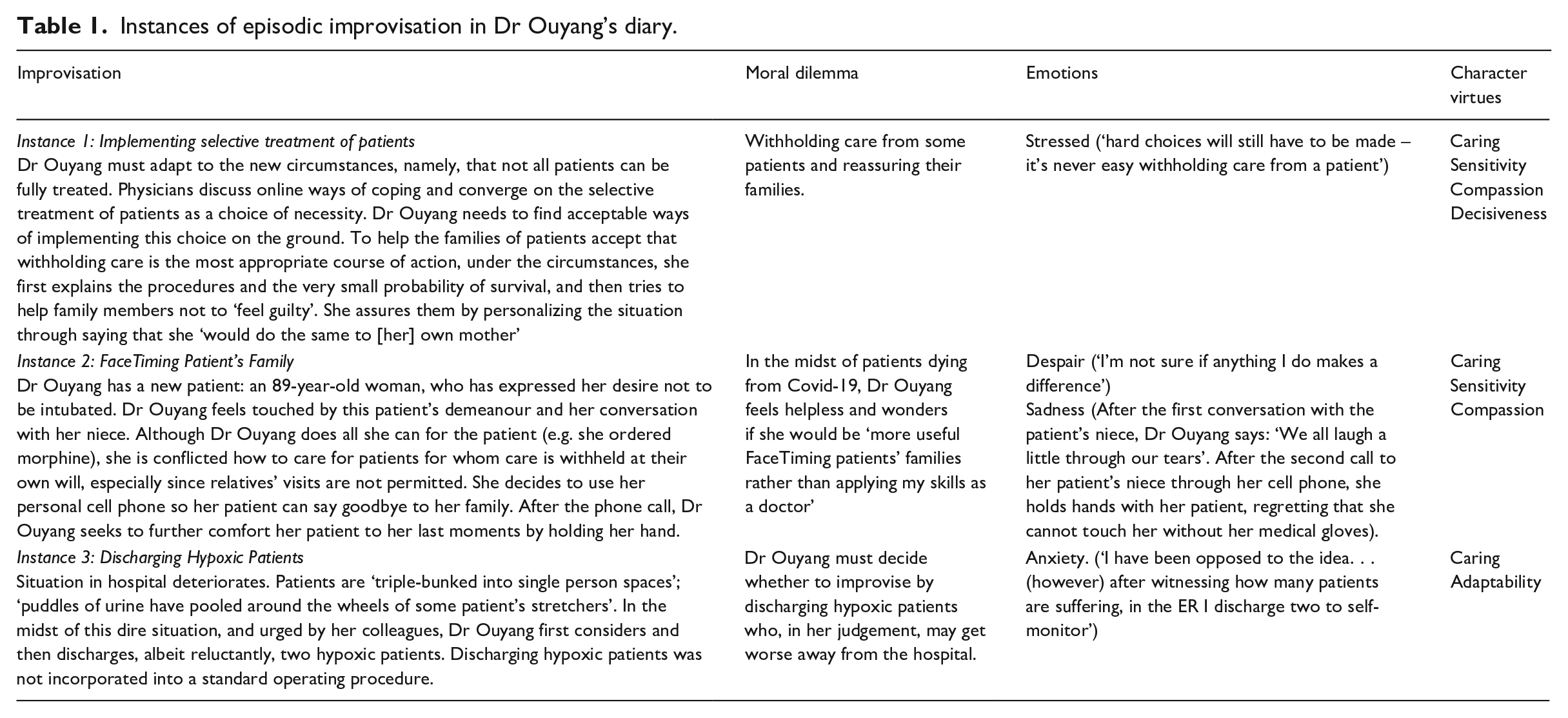
Below, we summarize Dr Ouyang’s account of her weekly experiences between March and April 2020. Moreover, in Table 1, we identify three instances of ‘episodic’ improvisation, which exhibit the core features of improvisation – that is, spontaneously responding to an event that is ‘not incorporated in standard operating organizational procedures’ in ‘a novel and useful way’ (Cunha et al., 2015: 516). We relate each instance to key themes in VE accounts of OI – experienced moral dilemmas, emotions and character virtues.
Instances of episodic improvisation in Dr Ouyang’s diary.
Second week of March
Last week, the first confirmed coronavirus case is hospitalized in New York. Dr Ouyang and colleagues at her hospital start ‘to hold regular [virtual] Covid-focused meetings’. Participants enquire about test availability and personal protection. In the meantime, Dr Ouyang continues to learn about the situation in Italy. She learns that apart from respiratory issues, some patients have diarrhoea. She also learns that due to scarce resources, ‘those deemed too old or too sick don’t get ventilators or have them taken away so that they can be used for patients who are more likely to survive’. Indeed, her Italian colleague explains: ‘if you think of it as saving the most number of lives, that’s it, you have to do it’.
Third week of March
Virtual meetings continue. During one, a colleague of Ouyang shares a scenario that begs the question about whether they should resuscitate a patient who suffers a cardiac arrest from Covid-19. The group learnt, from China, that when this happens the chances of survival are zero. Meanwhile, stocks of masks, gowns and face shields are gradually starting to deplete and the hospital introduced a new no-visitor policy. Ironically, Dr Ouyang is soon faced with a difficult case. An 80-year-old patient, who shows signs of Covid-19, and is originally designated with ‘do not resuscitate’ (DNR) is brought in. The patient has not walked in years and has advanced dementia. The family reverses the DNR instruction. As the patient’s breathing worsens, Dr Ouyang feels that she is ‘supposed to obey their wishes’. She is troubled. She notes: ‘I want to do everything for my patients, as much as they and their families want, just as we have always done. But what do I owe my future patients?’
Fourth week of March
A new reality begins to set in. In some cases, whatever oxygen is given to patients, often proves insufficient. The shortage of equipment is such that Dr Ouyang and her colleagues start ‘trial runs of putting two patients on one ventilator’ and due to the number of patients, some are placed in the hallways; those that need it are given portable oxygen tanks. Now all virtual meetings pose the question of who should get a ventilator and who should not. Dr Ouyang and her colleagues want guidelines, wishing to shift away from the traditional ‘first-come, first served’ basis. Despite equipment coming in from other states, Dr Ouyang realizes that ‘hard choices have to be made – it’s never easy withholding care from a patient’. Indeed, the situation has led her to believe that when resources are scarce, doctors can and should make judgments about who should get more care. Soon I’m just not going to intubate the 80-something-year-old patient . . . so that there will be a ventilator available for the 30 year old who comes in later.
She regrets intubating an elderly man the previous week; she should have saved the ventilator for ‘a future someone else’, she notes. She has conversations with some patients’ family members to explain that it would be best not to treat them. She explains that she ‘would do the same to [her] own mother’. Nevertheless, she realizes that she cannot guarantee that the patients would not survive, but she finds some solace in knowing that she ‘didn’t prolong their suffering’. As the situation worsens, and the hospital becomes overwhelmed, Ouyang realizes that ‘what may have been unimaginable even a week ago seems completely possible, even likely now’.
First week of April
The situation is even more challenging. An increasing number of patients are succumbing to the coronavirus. While palliative care doctors initially helped Ouyang with life-death conversations, they are now overwhelmed. Dr Ouyang has a new 89-year-old patient. The patient explains that she does not want a breathing tube. Dr Ouyang calls her niece to inform her. The niece states that she would like to reverse her aunt’s decision. Dr Ouyang stands firm, stressing that her aunt made her wishes clear. In the end, the niece agrees that a peaceful death would be best. Ouyang seeing that the patient is still awake, decides to use her own cell-phone to ‘facetime’ her niece so they can see and talk to each other. Dr Ouyang orders morphine for her patient and spends the next 3 hours treating other patients. During that time, Dr Ouyang starts wondering whether she is ‘more useful FaceTiming patients’ families rather than using [her] skills as a doctor’. She decides to use her phone to call her patient’s niece again and she describes in moving terms the scene: I love you, she says to her aunt. My patient flutters her eyes half-open. I love you too, she slowly replies, her voice noticeably weaker now. I put my hand on her hand. She grabs my fingers. . .she doesn’t want to let go. I don’t want to either. I look down at my purple-gloved hand holding hers. . .I hate that she has to feel synthetic rubber, that she doesn’t get an actual human touch before she departs the living.
Second week of April
The hospital is overcrowded. Patients are ‘triple bunked into single-person spaces, curtains pushed aside’. The city is about to roll out field hospitals. Patient after patient perishes. Even medical staff fall ill and many are lost. Death is the number one topic staff is discussing. Under these circumstances, Dr Ouyang faces a new dilemma. Should she start sending hypoxic patients home? She knows that oxygen levels can drop dramatically. She feels that this is too unsafe and refuses. Nevertheless, her colleagues ‘beg’ her to re-consider. They argue that the patients, ‘at least under these circumstances’, will receive better care at home. Dr Ouyang relents after remembering ‘how many patients are suffering in hospital’. She immediately discharges some patients. She concludes her diary with the following thoughts: My promise to [patients] has always been that when they come . . ., I will do everything I can to help them live. This is how we approached every shift . . . This is no longer the sole operating principle of emergency medicine in New York City . . . I’ve never felt less useful as a doctor. The one thing I can do – what I think will matter most, in the end – is just to be a person first, for these patients and their families.
Understanding improvisation at Covid-19-related hospital work through virtue ethics: the case of phronetic improvisation
In this section, we will interpret Dr Ouyang’s and her colleagues’ experiences through our account of phronetic improvisation, thus yielding new insights into OI. Moreover, we will show how accounting for her experience enriches our framework.
Dr Ouyang and her colleagues’ understanding of the unfolding situation is shaped by the internal goods of their medical practice and the material constraints – the resources – of their institution. Prior to the heavy demands the pandemic made on the use of hospital resources, the internal goods had included doing the best for every patient. That is why when an elderly patient is brought in, and even though the patient had multiple underlying health problems, Dr Ouyang would still provide them with the maximum care. Having learnt to realize this internal good through habituation, Dr Ouyang and her colleagues developed particular character virtues, such as care for and sensitivity to patients (Fowers et al., 2021). However, as they learn more about the coronavirus, they become concerned about the choices they might have to make for their patients in the future. They anticipate that they will not be able to achieve their practice’s internal good, due to a shortage of resources and, hence, they must make difficult choices.
That is why Dr Ouyang and her colleagues start having discussions about potentially morally challenging situations they may face: under what conditions should they resuscitate patients? Which patients should receive a ventilator? How should they currently allocate care, while also considering the needs of future patients? These are no merely technical questions but moral ones too (Fowers et al., 2021: 4; Kristjánsson et al., 2021: 3). There were no a priori rules, standard operating procedures or routines that mandated what response should be enacted or specified the exact manner of its enaction (i.e. when and how).
Addressing these questions brings out the deep interdependence of practice and institution. When the institution cannot provide the practice with the requisite external goods (in this case, resources), the original internal good of the practice is likely re-shaped. Phronetic improvisation may, thus, be first-order when practitioners focus more on being situationally inventive with the means available, whereas it may be second-order when the core of internal goods itself is reconstituted in light of pragmatic needs (see Figure 1). Although some VE philosophers characterize such reconstitution as inherently distortive of the internal goods of practice (Dunne, 2011: 14; MacIntyre, 2007: 194), our case study shows that this need not be the case. Modifying an original internal good need not be distortive but pragmatically ethical, as here. In conditions of resource scarcity, the realization of internal goods is mediated by the availability of resources. Internal goods have a core but no essence – they may change over time, depending on, among other things, the availability of resources. While distortion is a possibility, as, for example, when excessive pressure for success may undercut the pursuit of excellence, the form internal goods take is, more generally, partially contingent on the form external goods take.
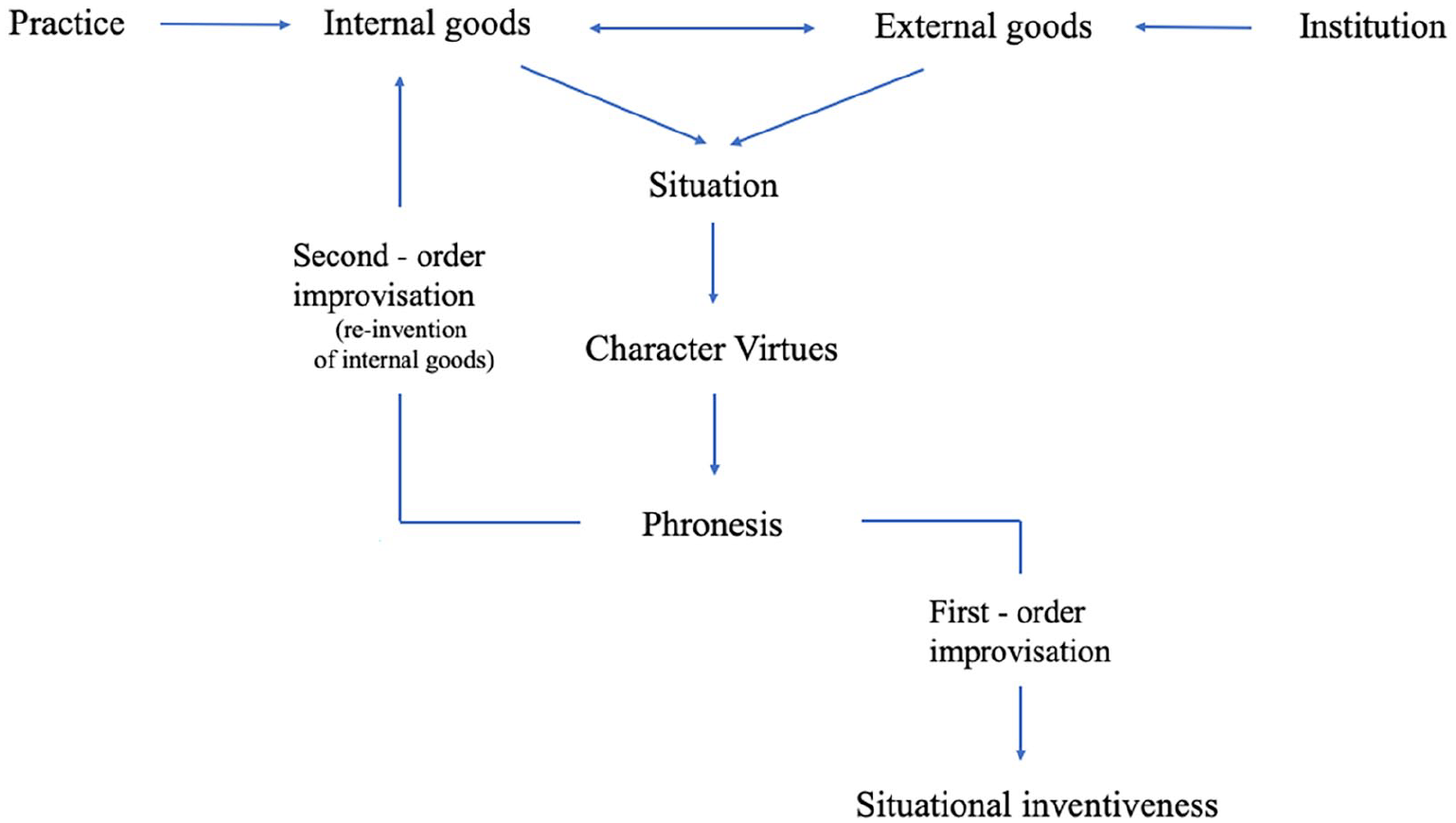
Phronetic improvisation: first-order and second-order improvisation.
Thus, in the case of Dr Ouyang and her associates, the original internal good (i.e. offering the best care to every patient) is gradually transformed to questions that relate to choosing which patient should receive the best care, in the circumstances. By the fourth week of March, when there is a hike of coronavirus patients at the hospital, a partially new internal good is pursued: to conserve resources, maximally treat those patients who are most likely to survive. The original internal good has, thus, been reconstituted along the lines of pragmatic, utilitarian principles. Dr Ouyang realizes that although this is painful, since she still deeply cares for the original internal good, she must, nonetheless, pragmatically adapt by withholding care from some patients. She commits to the new internal good, explaining to patients’ families that she would do the same to her ‘own mother’. It is noteworthy that Dr Ouyang’ actions were not already planned but emerged as ‘nonroutine responses’ (Suarez and Montes, 2019: 589) to ‘unanticipated problems’ (p. 590), since there were ‘no standard operating organizational procedures’ for such events (Cunha et al., 2015: 516). She had to phronetically improvise so as to act in a manner that respected the new internal good as well as her patients and their families.
The new internal good becomes a guiding compass for Dr Ouyang’s improvisation, so much so that she admits that what was ‘unimaginable even a week ago seems completely possible [now]’. Thus, to maximize the number of patients saved, two patients are placed on the same ventilator. To cope with the limited number of spaces, patients are kept in hallways and are given oxygen tanks, instead of the standard oxygen that comes out of the wall. These are inherently improvisational actions, since these responses were triggered by the exigencies of the situation. The new internal good, however, does not mean that medical staff ceased to care about the patients that could not be saved. On the contrary, having developed certain character virtues through her participation in medical practice (i.e. care for patients), Dr Ouyang is still oriented to act with a caring and sensitive outlook. Through a series of improvisations, she adapts her character virtues to the changing context.
For example, in the first week of April, when Dr Ouyang meets her 89-year-old patient she complies with the new internal good: she accepts the patient’s wishes to withhold care, despite disagreement from her family. Nevertheless, Dr Ouyang is morally troubled: how should she care for patients who cannot be saved? Knowing the recently established institutional directive of not permitting visitors, she keeps wondering about how she ought to care for the patients that will not be given maximum treatment. The pursuit of the new internal good, guided by her character virtue of care, presented her with a new possibility. Dr Ouyang understands that she would be ‘more useful’ to her patients who would not be maximally cared by connecting them with their families. She improvises by using her personal cell phone to allow her patient to see and talk to her niece and say goodbye. This is an instance of phronetic improvisation. Faced with a novel situation, Dr Ouyang imaginatively improvises in a manner that is appropriate (i.e. morally relevant) to the circumstances.
The following week, team improvisation is enacted. Members of Dr Ouyang’s team make a novel suggestion: hypoxic patients had better be discharged than kept in hospital. Such a response was not part of the standard operating procedures. Dr Ouyang, however, was faced with a moral dilemma. Her character virtue of care and the associated commitment to the internal good of her practice (i.e. saving as many patients as possible) came into conflict with her team’s suggestion. She knows that if she discharges patients, they will likely get worse when they go home. Hence, she is initially reluctant to accept the suggestion. However, as the situation drastically deteriorates, she relents and discharges two hypoxic patients. This is another instance of phronetic improvisation at the individual and team levels: Dr Ouyang grasps the most salient feature of the situation (i.e. severe resource scarcity), informed by the open-ended commitment to valued ends (i.e. offering quality care to her patients) and the emotional attunement it brings about (i.e. distress), and adapts her generic moral-cum-technical knowledge to situational exigencies by acquiescing to the improvisation suggested by her team.
In summary, Dr Ouyang perceived the unusual situations she confronted through the lens of her medical practice, mediated by the demands of the institution. Her concern for preserving the internal goods of her practice, albeit adapted to the distressing circumstances, coupled with her character virtues, enabled her to phronetically confront the moral issues presented by the Covid patients she was treating. She engaged in both first-order and second-order phronetic improvisation, insofar as she was sensitive to the reconstituted nature of the internal goods due to the scarcity of external goods, while seeking ways to realize the original internal goods in the new context, in the best possible way.
Discussion and conclusion
We have argued that hitherto OI research has, mostly, refrained from considering the importance of moral values for improvisation, and we have suggested here how this may be rectified by drawing on VE. In this section, we will first clarify aspects of our argument, outline our contributions and offer suggestions for further research.
Clarifications
(a) We have argued that OI is noncontingently (i.e. necessarily) oriented towards the pursuit of valued ends. Does this imply that either OI is always empirically driven by such ends or that it is inherently phronetic? No, it does not. As Sandberg and Tsoukas (2011: 343) have noted, ‘existential noncontingency does not preclude historical contingency – far from it’. A physician, for example, who is more concerned with the external goods of their practice, such as money and fame, may resort to taking bribes from pharmaceutical companies (Vigdor, 2020) or engage in exploitative or abusive relationships with their patients (Hauser and Astor, 2018). In such cases, the physician contingently falls short of the valued ends of their practice (Berger, 2014; Zyglidopoulos et al., 2017). Further research may usefully shed light on the conditions in which such distortive actions occur.
As already noted, improvisation is phronetic only when it serves the internal goods of the practice in a situationally sensitive manner. Thus, a salesperson, like those working in a real estate office in David Mamet’s play Glengarry Glen Ross (McCann, 1997), who is trying to close a deal by any means possible, does not display phronesis but what Aristotle, (2009: 1144a25) called ‘deinotes’ ( ‘cleverness’) (Kristjánsson et al., 2021: 6; Russell, 2009: 24). Cleverness, however, is praiseworthy only if it is in the service of valued ends. While both the phronimos and the deinos are clever, notes Aristotle (2009: 1144a25–1145a10), only the former displays ethical character. Seen, therefore, in VE terms, phronetic improvisation requires practitioners to have developed character virtues through socialization in practices, to be able, on a case by case basis, to phronetically balance valued ends (viz. internal goods), institutional constrains (available resources, guidelines and protocols), and situational exigencies.
(b) Dr Ouyang’s diary is a personal account of her experience with treating Covid-19 patents in a hospital. In that sense, it might be seen as an example of individual improvisation. However, upon closer inspection, it is more than that. Her actions across Instances #1 and #3 reflect collective improvisation, insofar Dr Ouyang enacts team-established patterns. Even Instance #2, the closest to individual improvisation, cannot be properly understood unless the individual is seen as embedded in practice. By according ontological primacy to the embeddedness of agents, VE joins up noncontingently the individual and collective levels of analysis to underscore the irreducibly sociality of individual action (Tsoukas, 2005: 383–385). Thus, individuals are seen as doing what they do not because of particular individual traits they possess but because of their practice-shaped character – the internal goods and standards of excellence they have internalized through their participation in practices. Such an anti-individualist ontology does not obviate further analytical distinctions between levels of analysis. While acknowledging the noncontingent relationship between the agent (individual) and practice (collective), it is important to further explore the ‘cognitive and social dynamics’ (Suarez and Montes, 2019: 592), whereby something that may start as an individual improvisational act may end up interactively generating a collective outcome, and vice versa, how collectively generated patterns of action (as in Instances #1 and #3) shape individual actions (Mannucci et al., 2021: 616; see also Ciuchta et al., 2021: 306).
(c) It is widely accepted that improvisation is a spontaneous – extemporaneous – activity in response to unanticipated occurrences, in which planning (design) and execution (implementation) converge (Ciuchta et al., 2021: 290–291; Mannucci et al., 2021: 614). At the same time, it is also widely accepted that phronesis, being a ‘master virtue’ (Schwartz and Sharpe, 2006: 379), involves the capacity to reflect on, evaluate and integrate several character virtues for the sake of a good life (Fowers et al., 2021: 7; Kristjánsson et al., 2021: 3–4). How is, then, phronetic improvisation possible, since improvisation involves extemporaneity while phronesis reflection? Yet, the contradiction is only apparent. As any form of expertise, phronesis follows a developmental path (Dreyfus and Dreyfus, 2014: 188) – it gradually develops with experience and, at its peak, becomes intuitive, that is, spontaneously executed. Specifically, at the beginning, the budding phronimos relies on rules and principles, then moves on to apply contextualized maxims, and ‘in the highest stage, would leave rules and principles behind and develop more and more refined spontaneous ethical responses’ (Dreyfus and Dreyfus, 2014: 189). Such a developmental view of phronesis enables researchers to explore its various stages of development as well as how planning and execution are intertwined in a variety of improvisational contexts. Suarez and Montes (2019: 593) and Abrantes et al. (2018: 60) have argued that rather than presupposing that OI is always extemporaneous, there may be degrees of extemporaneity. We saw evidence of this in Dr Ouyang’s case. While in Instance #2 she acts extemporaneously, in Instances #1 and #3, her action is more deliberative and planned. More empirical research is needed to explore degrees of extemporaneity in diverse contexts, under different time pressures.
Contributions
Our contribution is threefold. First, we have reconceptualized OI as a value-infused rather than merely functional response to constraints or surprises, as has been broadly understood by mainstream OI research. In particular, the value our VE framework adds is that it unveils the moral dimension of OI, insofar as the latter is seen as aiming to accomplish collective ends in often unexpectedly variable contexts.
Second, we add nuances to scholarly understanding OI through distinguishing between first-order and second-order improvisation. Specifically, OI unfolds differently, depending on where it stands on the continuum between mundane and extreme circumstances. In mundane circumstances, practitioners are committed to striking a balance between, mainly, the ostensive part of a routine and situational particularities – practitioners, then, engage in first-order improvisation. However, in extreme circumstances, in which the institution cannot provide the resources to accomplish the practice’s internal good, practitioners need to modify the latter. Such as process of modifying the internal good calls for second-order improvisation, insofar as it reshapes the valued ends (rather than merely the means) improvisation aims to achieve (Argyris, 2005). First-order improvisation may still be ongoing to the extent that practitioners may continue to adapt the modified internal good in the face of situational exigencies.
Third, our framework sheds light on the hitherto underexplored ‘motivational’ and ‘interpretive processes’ that underlie OI (Cunha et al., 2017: 566–567). For example, revisiting Batista et al.’s (2016) study, medical staff may insightfully be seen as motivated to improvise thanks to the development of character virtues (such as care and decisiveness) and the associated emotions, for the sake of preserving an internal good (i.e. providing the best possible care to their patients). To do so, they must act in a phronetic manner, namely, to spontaneously see what is morally salient in the situation at hand and engage in an interpretative process that takes into account the circumstances of their patients and institutional guidelines available.
Further research
We have already mentioned possibilities for further research. We offer four more here. First, VE can further contribute to process studies (Ciuchta et al., 2021: 296–299) by illuminating the micro-processes of how OI is enacted phronetically. Specifically, future studies could shed light on practitioners’ perceived possibilities of action and the relevant skills developed that enable practitioners to enact phronetic improvisation, thus extending the promising line of research started by Mannucci et al. (2021). Responding phronetically to situations has been tied to high levels of skilfulness, perceptual acuity and moral clarity (Shotter and Tsoukas, 2014a, 2014b). To better understand this process, longitudinal qualitative research may further elucidate how agents develop their expertise to perceive situationally appropriate possibilities for the realization of the internal goods of their practice, in diverse empirical contexts. Skilfulness and situational discretion can be studied through comparing the situational reactions of experienced and non-experienced agents in a particular practice (e.g. aviation, medicine and logistics), as well as through conducting longitudinal studies of how agents gradually become improvisation experts.
Second, as already mentioned, appropriate responses to situations are tied to valuing certain ends (internal goods). It is because practitioners have learnt to value certain ends that they develop a disposition to experience certain emotions depending on how situations unfold (e.g. frustration, sympathy, joy and anger) (Gehman et al., 2013; Shotter and Tsoukas, 2014a, 2014b; Solomon, 2007). More empirical work is needed to explore how emotions are tied to the enactment of improvisation (Fisher and Barrett, 2019: 149). For example, future research may explore how verbal and non-verbal expressions are linked to OI. Verbal expressions, including the pitch of voice, can reveal the emotions and judgement of agents while they are dealing with a situation (or describing it post hoc) (Ekman and Friesen, 2003). Phenomenological interviews may be especially helpful because they seek to evoke lived experience (see Sandberg, 2000). Non-verbal expressions, tied to body language (e.g. posture, facial expressions and other micro acts, including the absence of expression), can be equally revealing about how agents feel about a situation (e.g. de Rond et al., 2019; Ekman and Friesen, 2003). Video research methods could be useful in capturing and analysing these (Anikin and Persson, 2017).
Third, while we have focussed here on how improvisation of an ‘episodic’ type (Cunha et al., 2015) can be phronetic, future VE-informed research could explore the relationship of phronesis with other types of improvisation. Bricolage, in particular, deserves closer attention, especially since there is significant lack of clarity in the literature. Bricolage and improvisation are sometimes treated ‘almost interchangeably’ (Ciuchta et al., 2021: 292); are suggested to ‘belong to the same construct’ (Cunha et al., 1999: 307; see also Weick, 1998: 548); improvisation is thought to be a type of bricolage (Baker and Nelson, 2005), and vice versa (Cunha et al., 1999); or the two are considered distinct (Archer et al., 2009). More confusingly, it is suggested that bricolage and improvisation may be empirically difficult to distinguish because they are both ‘often found together’ (Archer et al., 2009: 6) and ‘occur concurrently’ (Ciuchta et al., 2021: 292). As well as more research to clarify the status of bricolage, the latter, too, may become phronetic, just like improvisation does, although this suggestion requires further empirical validation. For example, in the diary, there appears an instance of phronetic bricolage when Dr Ouyang, lacking ventilators, puts non-intubated patients prone on their stomachs to help them breathe. This is bricolage since it exhibits creativity in ‘making do by applying combinations of the resources at hand’ (Baker and Nelson, 2005: 33). It is also phronetic because Dr Ouyang seeks to cope with the lack of resources in a manner that safeguards the internal goods of her practice.
Fourth, a VE-informed approach can further account for unsuccessful OI. As highlighted by Giustiniano et al. (2016), explanations of OI tend to focus on successful cases, whereas processes tied to failed OI have not been well understood, nor extensively researched. For example, during the Costa Concordia sinking, the Captain and the crew were shown to enact routines that were counter to institutional guidelines (e.g. distance to shore) and internal goods (e.g. safety) (Giustiniano et al., 2016). Empirical work could help to further account for the processes that contribute to improvisational failure by attempting to understand how bad habits (and the associated character vices) develop and are enacted in the face of situations. This can be approached by studying published accounts of improvisation incidents, as well as accident and near miss reports (e.g. Weick, 1993), and/or by engaging with ethnographic techniques that capture everyday practices and responses to arising situations.
Footnotes
Acknowledgements
We would like to thank professors Ace Simpson and Shireen Kanji, as well as the three anonymous reviewers for their thoughtful feedback and guidance on previous drafts of this manuscript. In addition, Demetris Hadjimichael would like to dedicate this article to the memory of his grandfather, Yiannis Demetriou Patsalou, who passed away during the first wave of the Covid-19 pandemic.
Funding
The author(s) disclosed receipt of the following financial support for the research, authorship, and/or publication of this article: A part of Demetris Hadjimichael’s work was supported by the Economic and Social Research Council (grant number: ES/J500203/1).
