




Abstract
Leading business and management journals claim to be ‘world-leading’ but are dominated by Anglo-American scholars. The extent of this domination is demonstrated graphically in this article through cartograms based on 2010/2011 authorship and editorship data in top management journals. The dramatically skewed production of management scholarship is both ethically problematic in terms of Anglo-American domination of leading journals and the exclusion of many developing regions, and anachronistic given the shift of global production away from the North Atlantic in recent years. This continuing neo-colonial domination of intellectual production underpins the inequitable organization of the global economy and specifically the disproportionate realisation of wealth in the global North at the expense of the global South. The article proposes a series of measures to begin redressing the imbalance.
Academic journals are assuming ever-increasing importance in university life. Careers are increasingly dependent on journal publication record, notwithstanding other contributions to scholarship, teaching and community. Journal ranking has become a significant industry, creating measurable indices of productivity that can be used to discipline and reward individuals and institutions. Numerous scholars have questioned both the legitimacy of the rankings system and the uses to which it is put. However, the debate has only rarely focused on questions of international equity.
Ranking has led to emphasis on ‘international’ or ‘world’ class publishing as an aspirational pinnacle. In the UK, the business and management panel in the 2008 Research Assessment Exercise (RAE) categorized scholarship hierarchically including whether it was internationally excellent. 1 Similarly, the UK Association of Business Schools (ABS) categorizes its top-ranked “4*” journals as “world elite” (Harvey et el., 2010). 2 Many other countries have formally and informally embraced the international ranking approach.
The confection of a ‘world championship’ of scholarship renders highly significant the geographic distribution of editorship and authorship among championship contenders. We explored this issue by conducting an analysis of author location for all articles published in 13 highly-ranked business journals during 2010, and of the 2011 editorial boards of the same journals. Results were mapped using the cartogram approach, in which a physical globe map is distorted in order to represent the relative weight of data from each country, thus providing a striking graphical representation of the data. We critically discuss the significance of the results in terms of both a global academic hierarchy and a broader neo-colonial division of labour between the global North and South. 3 The findings are then connected within existing critical research on journal relevance and on transnational power imbalances in intellectual production.
This article is framed within the tradition of critical postcolonial management studies (Prasad, 2003), a field which has been developed through numerous contributions in this Journal and elsewhere over the past decade. However, it has the limited objective,within the available space, of documenting a neo-colonialist hierarchy in management journals and proposing ‘actionable responses’ in accordance with this Journal’s ‘Speaking Out’ theme.
Mapping neo-colonial domination in management scholarship
Journals were selected using the ABS Academic Journal Quality Guide (2010). Among the 22 ABS subject categories, we chose three relevant to this article’s focus; general management, international business and area studies and organizational studies. We selected all 4* journals in these fields and added Organization (3*), for a total 12 journals. 4 The academic affiliation country of the 1843 authors associated with the 765 articles published in 2010 in the 12 journals was documented. Academic affiliations and countries of the 1, 934 members of the 12 editorial boards were collected from journal websites. The charts below show the top ten countries of authors and editorial board members( see Figures 1a and 1b): 5
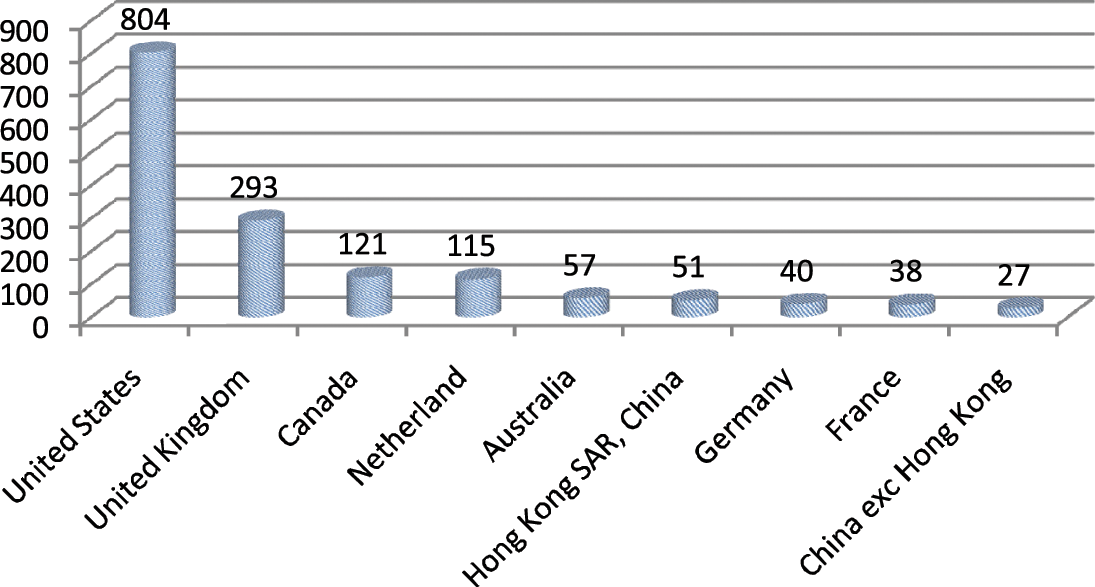
Top 10 countries of authors
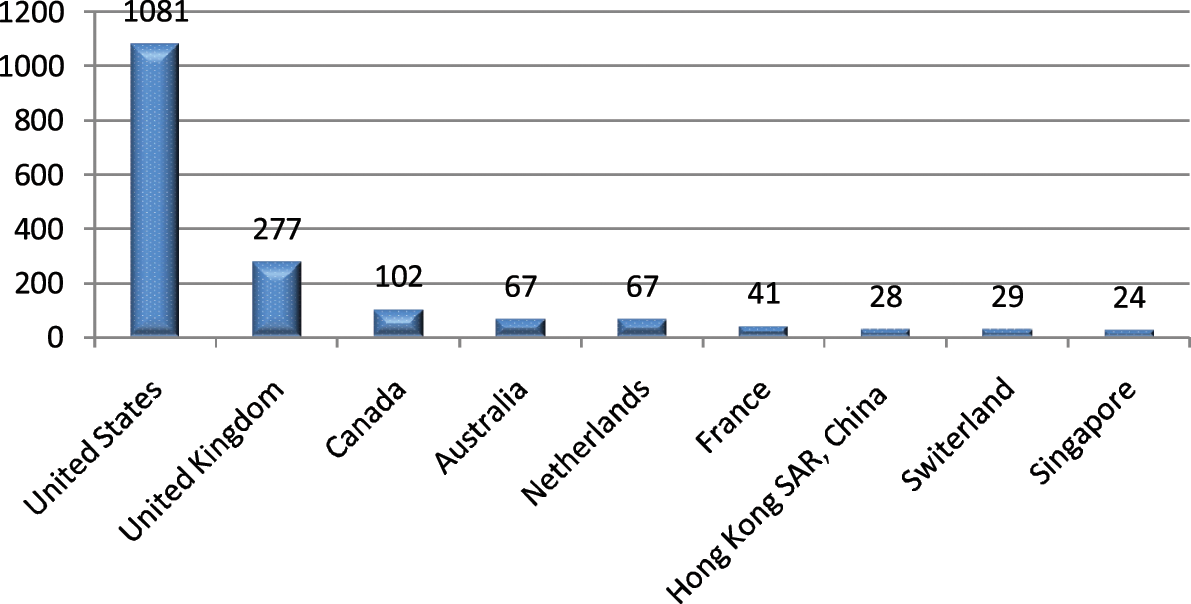
Top 10 countries of editors
The tabular data confirm that little has changed since earlier critical research on international management scholarship (Wong-Ming Ji and Mir, 1997). However, the extent of Western predominance is best graphically demonstrated. We experimented with cartograms, which present the data with considerable visual impact, especially when contrasted with traditional geographic representations. These cartograms, presented below the traditional Mercator projection, are based on algorithms developed by Gastner and Newman (2004) (see Figures 2–4). 6
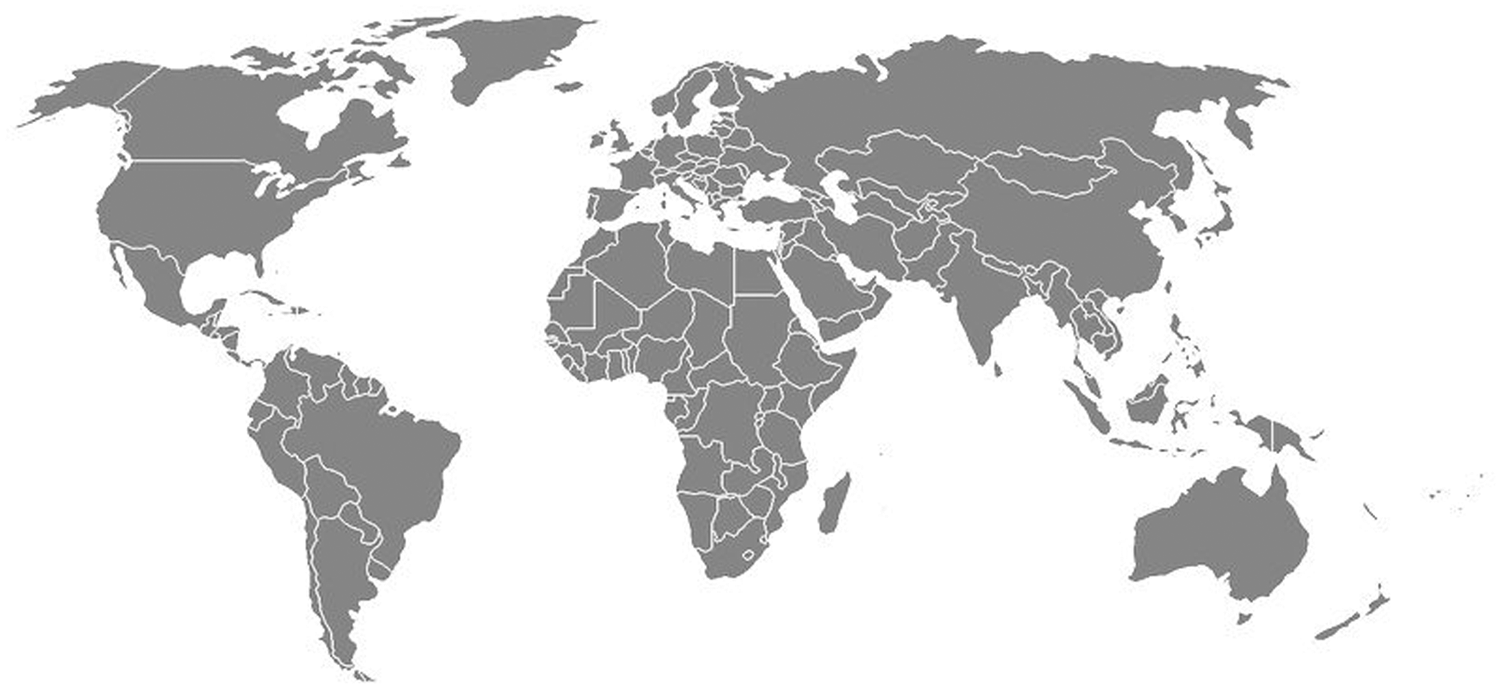
Standard mercator projection
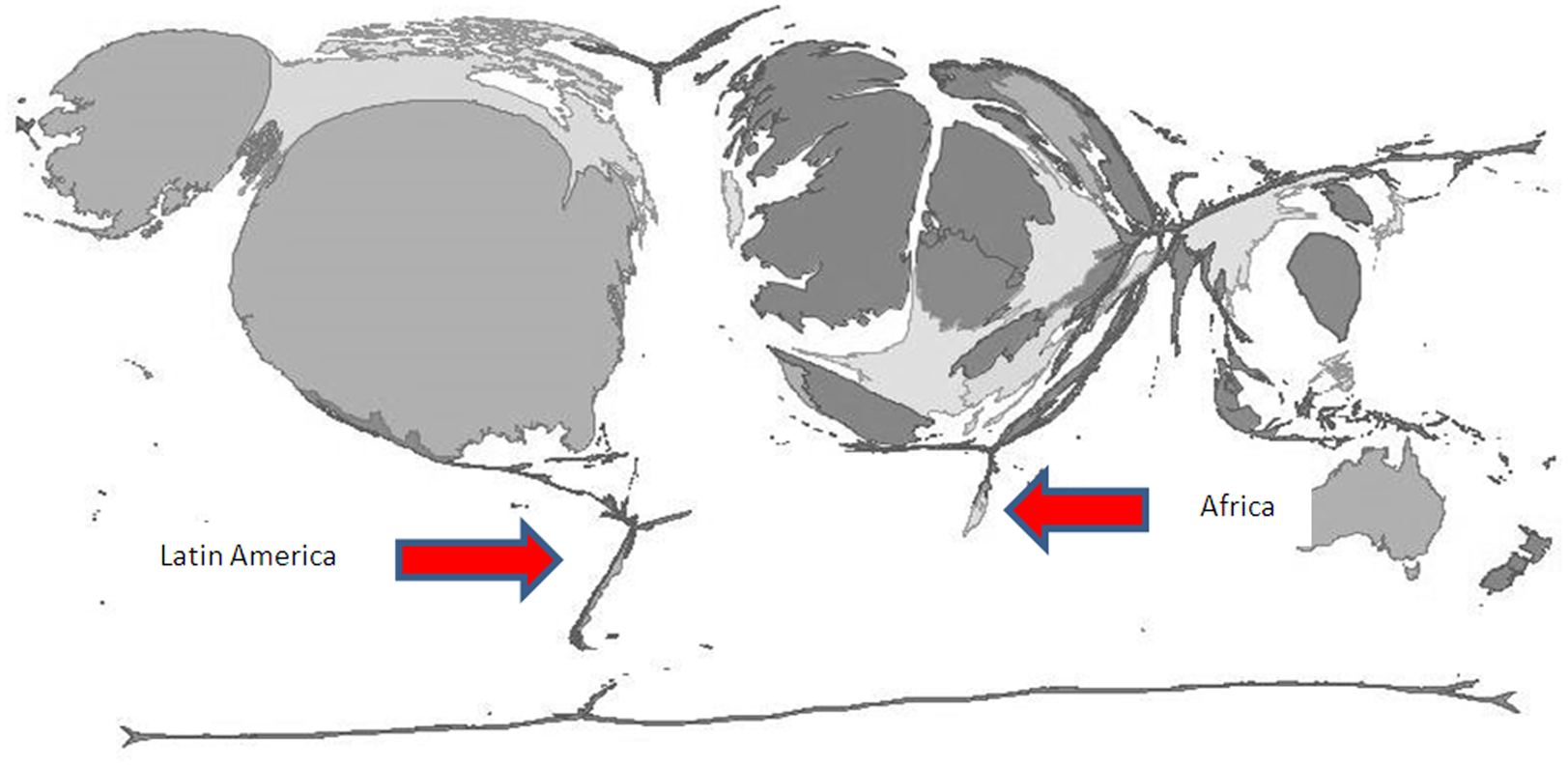
Cartogram of author country affiliations
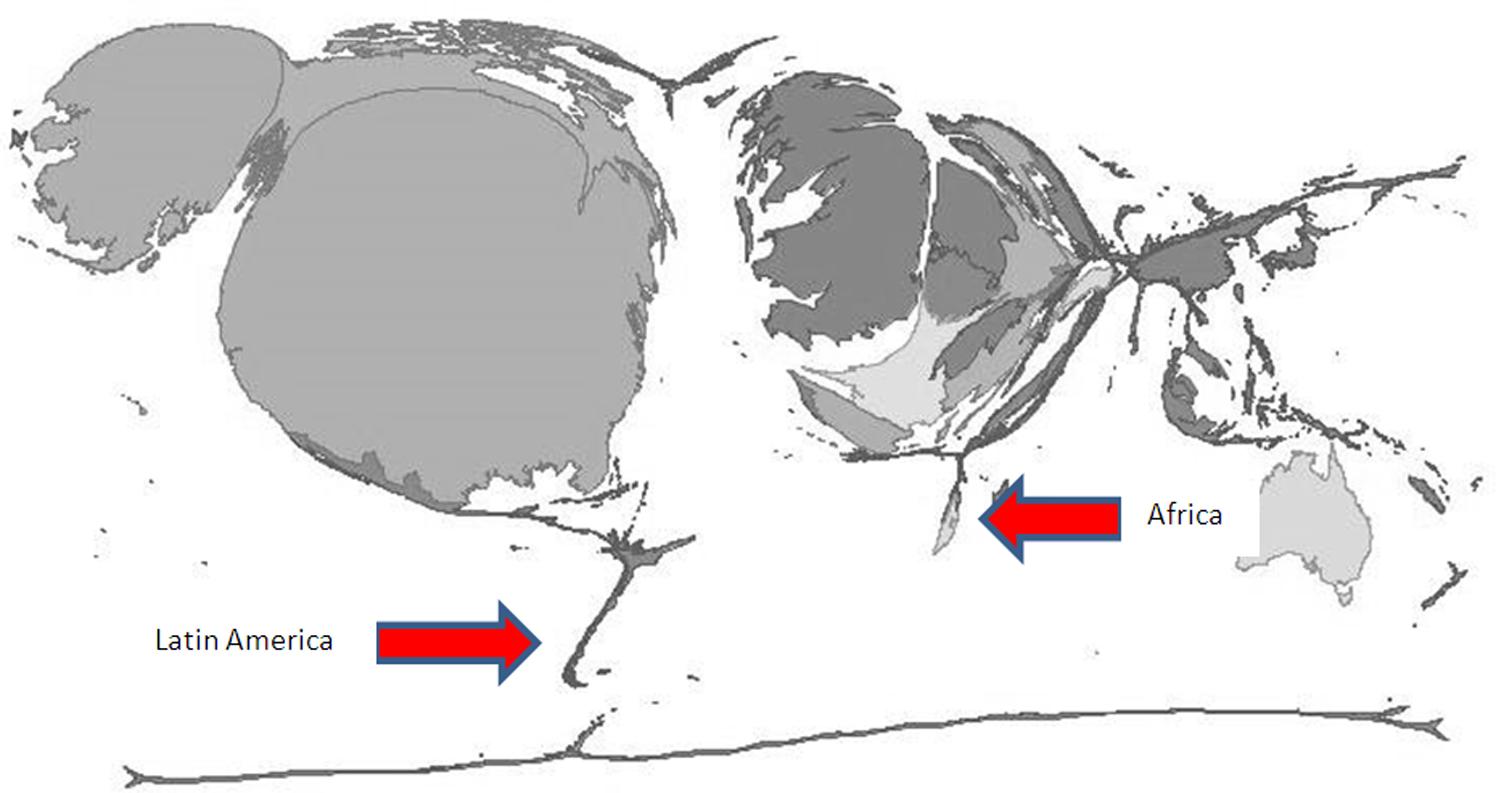
Cartogram of editorial board country affiliation
The author and editor cartograms are most appropriately compared with the population cartogram (Figure 5) which represents territorial size according to population. They demonstrate how ‘world-leading’ management scholarship is dominated by North America and the UK, with smaller contributions from other European countries and Australasia. There is little difference between the author and editor mapping, suggesting the presence of a mutually reinforcing circle of academics concentrated in the Anglo-American orbit. Most striking, however, is the almost complete absence of both Africa and Latin America from the maps. What small representation is achieved from Africa derives largely from South Africa.
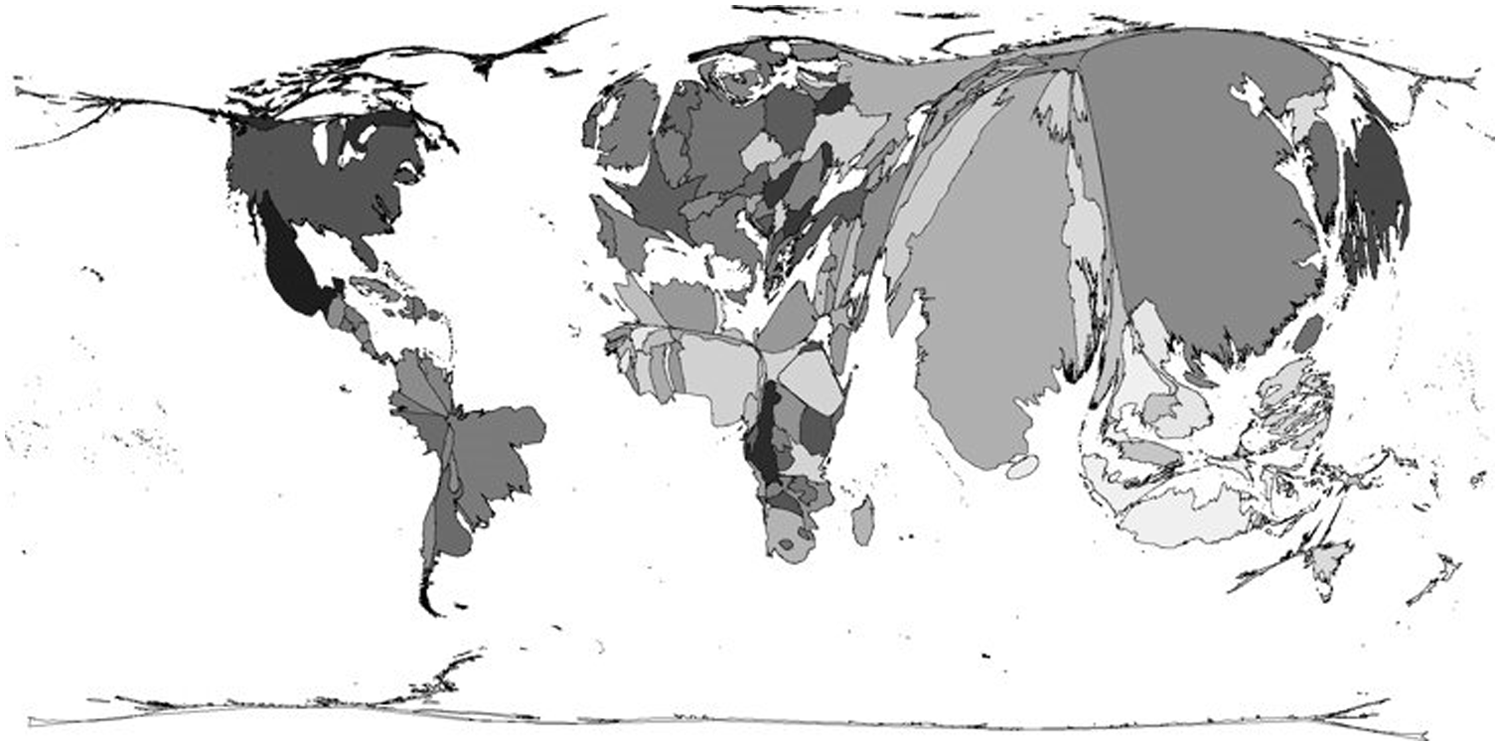
World population cartogram
The substantial under-representation of Asia is also notable. Not only does Asia account for three-fifths of the world’s population, the Asian economy has rapidly expanded in recent years. For example, PwC (2011) projects that by 2020, the GDP of the world’s seven largest emerging economies (the ‘E7’) will exceed that of the G7, and that by 2050, China and India will be the world’s two largest economies. The cartograms show that this global transformation is not reflected in a concomitant shift in the source of global scholarly production. Indeed, much of the Asian presence on the cartograms is due to the tiny former British enclave of Hong Kong, its population of 7 million achieving a higher number of authorships and editorships than the rest of China with its population of 1.3 billion, 190 times greater.
Overall, the cartograms demonstrate that the ideas of the South either do not exist, or are considered worthless, in ‘world-class’ management scholarship. The next section explores the processes that produce this gross imbalance in academic production and power.
The construction of neo-colonial relationships of domination and exclusion in academic journal publication
The systematic exclusion of non-Western scholarship from major management journals is the result of a variety of interconnected factors, and is tied to overall patterns of domination in the world economy and society. This section explores some of these dynamics and interconnections, and responds to the most common justifications for the neo-colonial scholarly hierarchy.
The apparent disjuncture between shifts in the global economy and the continuing domination of Western scholars could be claimed to reflect a continuing imbalance in scholarly ‘quality’, with the again-comforting conclusion that Asia will doubtless eventually ‘catch up’. However, this argument introduces a conundrum. If practical business and management in Asia is apparently in the process of overtaking its Western counterparts, then either management scholarship is utterly irrelevant to and disconnected from this process, or if not (as management scholars would like to assume), then the processes by which management scholarship is translated into management practice in emerging economies is being completely missed by the ‘world-elite’ management journals.
Language provides another exclusionary logic. Ngugiwa Thiong’o (1987) discussed the impact of colonial languages on independent thinking amongst Africans. Like Ibarra-Colado (2008), he underlines the alienation entailed in adoption of English or French as the language of intellectual endeavour, leading to: a deliberate disassociation of the language of conceptualisation, of thinking, of formal education; of mental development, from the language of daily interaction in the home and in the community … it is like producing a society of bodiless heads and headless bodies. (waThiong’o, 1987)
Journals classified as world-leading (for example, Academy of Management Review) assume that scholarship should be in English, 7 while the ABS journal quality guide satisfies itself that, ‘English has become the international academic language’ (Harvey et al., 2010: 11) without need for further reflection about the implications of this claim. However, Japan’s under-representation, despite its widely-imitated management innovations, suggests such Western scholarly complacency is misplaced. Steps that could be taken to begin to redress language imperialism are considered in the final section of the article.
The domination of English as both ‘the language of international business’ and the ‘international academic language’ points to an underpinning logic governing both the economy and the academy. While globalization appears to demonstrate that ‘the world is flat’ (Friedman, 2007), it actually represents the extension of Western domination into new terrain. Within the economy, the massive transfer of production and service work from West to East means that, ‘profits are increasingly generated in developing countries rather than in developed countries’ (UNCTAD, 2008: 4). However this process is controlled by Western capital (Gereffi et al., 2005), reflecting the exploitation of global labour arbitrage, with value realization still occurring largely in the West (Smith, 2010). With 46 of the world’s 50 largest MNCs headquartered in North America, Europe, and Japan, profits from transnational production processes are predominantly realized in the West. Using the iconic Apple iPhone and iPad as examples, while assembled in China, it is estimated that, ‘only $10 or less in direct labor wages that go into an iPhone or iPad is paid to China workers. So while each unit sold in the US adds from $229 to $275 to the US–China trade deficit (the estimated factory costs of an iPhone or iPad), the portion retained in China’s economy is a tiny fraction of that amount’ (Kraemer et al., 2011).
The intellectual domination of the West parallels economic domination maintained through control of the top of the value chain; just as the economic value chain is governed by Western interests, so is the scholarly value chain. The skewed appearance of the editor and author cartograms can be explained by the proposition that the production of scholarly management knowledge reflects neither geography nor population, but rather a global distribution of power. The close concordance between economic and scholarly power distribution can be seen by comparing the global GDP cartogram below with the author and editor cartograms above (see Figure 6). 8
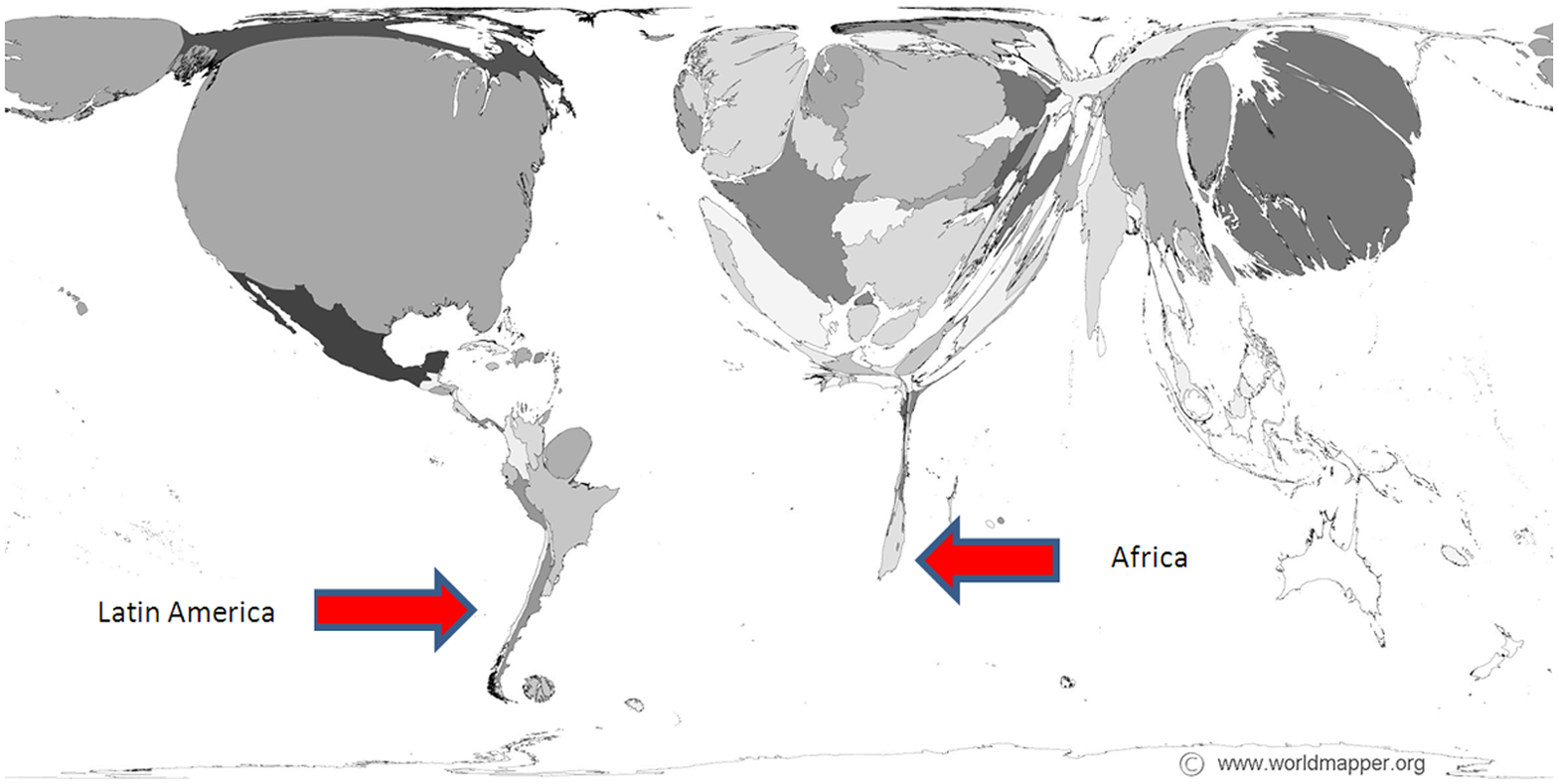
World GDP cartogram (2006)
There is, of course, much scholarship about emerging economies published in ‘world-class’ journals, but it predominantly emanates from Western-based authors, so that the ‘profits’ of global scholarship are returned to the West. Scholarly production thus imitates the power imbalance of the ‘real’ economy, a relationship justified by mainstream management scholars’ endorsement of a world hierarchically divided between ‘[t]hose who grow; those who make; those who create; those who coordinate’ (Czinkota and Ronkainen, 2005: 117). In terms of intellectual integrity, however, it is perverse that ‘world-class’ scholarship on emerging economies should largely originate from outside those countries, inevitably producing a contemporary business scholarship manifestation of Orientalism (Ibarra-Colado, 2006; Said, 1978). 9
The micro- and macro-processes of scholarly domination resulting in the under-representation of indigenous emerging economy scholarship in so-called ‘world class’ journals remain largely unexplored. In this restricted space we consider just two phenomena prevalent in China and India; misalignment between emerging economy and developed country scholarship objectives, and the pressure imposed on emerging economy scholars to ‘prove’ they are world class by conforming to Western-dominated journal mores.
Both Indian and Chinese indigenous scholarship tend to take a different—and often more ‘practically relevant’—form than Western academic publication. In India, for example, a considerable proportion of key scholarly work is published in the Economic and Political Weekly, which scores zero stars on Western rankings list but nevertheless attracts India’s leading (and many international) thinkers. EPW’s explorations of the global financial crisis and impact on India were more timely and relevant than most Western scholarship that badly lagged in exploring the crisis. 10
Similarly, the norms of Chinese scholarly management journals diverge from those of the West, with more focus on theory development and less on empirics, thus rendering academic production largely ‘unpublishable’ in so-called ‘world class’ journals. Consequently, within Western journals Chinese management issues are typically defined and analysed using Western concepts. One example concerns guanxi, a topic widely explored in Western journals using a ‘social capital’ framework deriving from Western scholars Coleman, Putnam and Bourdieu. An alternative perspective, published only in domestic Chinese publications, argues that parallels between guanxi and social capital theory are quite limited, with guanxi considerably more focused on patronage, the influence of power and relationship with officialdom (Zhai, 2004, 2009).
A more insidious result of Western domination of leading journals is its colonizing effect on scholarship in emerging economies. This effect is heightened as academic institutions in major emerging economies seek to ‘prove’ that they too are ‘world-class’. In China, therefore, ‘internationalization, standardization and empiricization’ have become the basic norms of management research. In order to get published, Chinese scholars skew their research interests towards those of Western academics. Even when working on Chinese questions, they use Western research concepts and frameworks to appeal to Western editors, ignoring the Chinese context. This results in production of great quantities of mimetic work, and scholars proficient at technical data analysis, but few significant contributions to management research and practice in China (Xi & Han, 2010). Keim (2011), focusing on Africa, notes this same phenomenon in international sociology.
Connecting academic neo-colonialism to the journal ranking system
In this section, we connect our findings of geographic and cultural inequity with the debate within the management academy on journal rankings and relevance, and in turn, with broader critiques of academic colonialism.
The voluminous scholarly debate on journal rankings and relevance focuses on the merits and impacts of ranking systems. As early as 1995, Willmott criticized growing managerialist control of research agendas, leading to standardization and narrow specialization. In 2011, he related this process to ‘journal list fetishism’, which systematically discriminates against emergent research (often in areas of radical critique), encouraging attention ‘to safe and frequently trivial topics based upon conservative methodologies’ (Willmott, 2011: 434), diverting scholars away from practical engagement. Willmott’s comments are mainly UK-directed but identify exclusionary practices that also marginalize non-Western scholarship. Nkomo (2009) also argues that journal rankings encourage mimetic scholarship aimed at publishing in leading journals. Consistent with our findings, she notes how journal rankings guide South African scholars away from journals focusing on national concerns. Özbilgin (2009) emphasizes white male domination of academic journals and, ‘The connectivity of the journal ranking system with hegemonic structures of gender, race, and class inequality and disadvantage’ (Özbilgin, 2009: 113). There is a vicious circle of academic inequality, with leading journal actors largely coming from top academic institutions. Further, ranking systems discriminate against region-focused journals.
Tourish argues that ranking hampers scholarly relevance and integrity, encouraging, ‘a false view that the outlet in which one publishes is more important than the quality of the ideas contained in papers’ (Tourish, 2010: 6). This hinders, ‘emerging new disciplines and sub-disciplines’, and ‘those journals which seek to champion distinctive or innovative approaches’ (Tourish, 2010, 3); the same phenomenon we noted as overshadowing Chinese management scholarship.
Wells (2010) explores the relationship between journal rankings and specialized scholarship; specifically, study of business and the environment. Quality journals addressing business and environment issues from a broader environmental focus are either excluded from management journal rankings, or accorded a low score. This phenomenon also occurs in journals addressing developing country issues which are invariably lower ranked, even when clearly ‘world elite’, such as World Development. 11
Grey (2010) examines the impact of US domination of business journals on innovative and radical scholarship in Europe. A comparison between ASQ and Organization Studies demonstrates the domination of American authors in ASQ, with a more internationally diverse authorship in OS, which he argues reflects US scholarly hegemony and demonstrates a ‘parochial’ North American cultural/intellectual protectionism. As we have seen, although continental Europe is under-represented in top management journal publication, developing regions are almost completely excluded.
Dunne et al. (2008) surveyed topics addressed in top business and management journals in 2003–2004, finding ‘a remarkable lack of attention being paid to the pressing social and political issues of our day’ (p. 272). We have noted that this disengagement contrasts with journals like India’s EPW, but Western domination of elite-ranked journals forces emerging country scholars to choose between relevance and international recognition (and career).
Our empirical findings also connect with the broader discussion on academic neo-colonialism, and confirm findings of earlier research. Lal (2004) argues that colonization began by violent conquest but continued through domination of knowledge; ‘every conquest is pre-eminently a conquest of knowledge’. Baber (2003) and Alvares (2011) show that during colonial rule in India, theoretical endeavour was restricted to British universities, with Indian scholars rarely admitted, and that this hierarchy continues in scholarly categorization; non-Western societies are suitable for ‘regional’ case studies, whereas Western case studies can have general significance. Alvares (2002) concludes that, ‘one culture has become the norm for all others, to the extent that diverse majorities around the globe would seek to destroy their own identities and selves in the misguided drive to imitate or replicate the main features of the dominating culture’.
Keim (2011), writing on international sociology, notes that the global South remains largely ‘exogenous, subordinated and dependent’. She draws on Burawoy’s (2005) ‘public sociology’ as a vehicle to move beyond deconstruction towards counter-hegemonic sociological practice in the global South. The key aspect of public sociology is intellectual engagement and thus the strengthening of civil society. She provides an example of the development of independent scholarship in the global South through a staged approach that permitted establishment of a specifically South African labour studies. The first stage entailed withdrawal from Northern-dominated academic preoccupations to address practical concerns of the emergent labour movement under apartheid repression. This led to policy support to the independent labour movement; ideas from outside were incorporated only where they were practically useful, for example in developing training materials for labour activists. This experience emboldened South African sociologists to develop scholarship rooted in indigenous experience and challenges rather than imported Western ideas. Drawing from Keim, in the final section we propose some steps to begin redressing the imbalances and inequity in management journal scholarship that we have mapped and discussed.
What is to be done?
The international inequity graphically demonstrated in this article reflects the domination of management scholarship by networks of academics primarily located in the West, and specifically in the Anglo-American cultural and intellectual universe. Adopting their approaches and focus (whether writing on specifically Western topics or exploring the non-Western world) is required in order to publish and be cited, and for journals, to achieve a high ranking. By contrast, journals with non-Western focus and interests attract lesser-known academics, and are cited less. These journals thus remain low-ranking, and in the context of a global academic market, most scholars—even from emerging economies—seek to ‘escape’ from them in order to improve their careers. As a result, knowledge rooted in, and responsive to, emerging non-Western societies remains marginal. The self-perpetuating nexus of editorial boards, article authorship and journal rankings is illustrated below (see Figure 7).
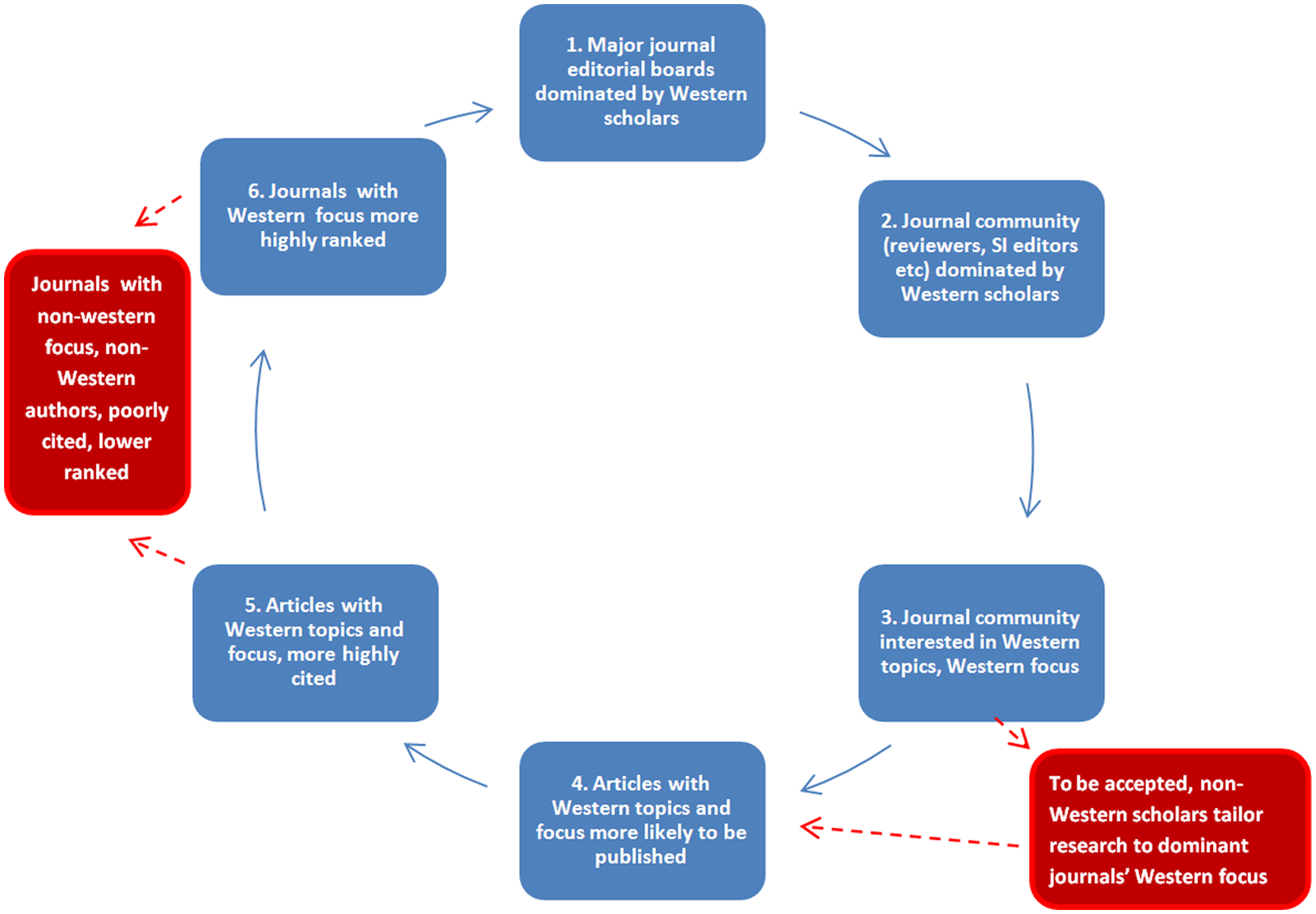
The cycle of domination and exclusion in journal publication
The article has argued that the domination of Western scholarship is part of an overall neo-colonial political economy that continues and is extended in the era of globalization. The subfield of management scholarship will always be influenced by wider power dynamics, but there are steps that can be taken to begin to redress the overwhelming Western bias of intellectual production.
The most immediate direct step that can be taken is a rebalancing of editorial boards—and responsibility for editorial tasks—to provide substantially higher representation of non-Western scholars. Editorial boards are at the strategic centre of the journal community; they influence the interests of the journal, the networks of reviewers, the selection of special issue topics, etc. The widening of boards will thus have a cascading effect both on diversity of authorship and on inclusivity of fields of publication interest. Parallels can be drawn with the process of inclusion of women scholars in the management academy, which is incomplete, but at least in progress (Mavin et al., 2004). The inclusion of wider circles of scholars in the journal community will also serve to increase readership and relevance, and thus the viability of scholarly management publishing.
Increasing geographic and cultural editorial board diversity and inclusivity may also strengthen resistance towards, and ultimate rejection of the journal ranking fetish. No all-purpose list can legitimately hierarchize very different scholarly roles and responsibilities in all parts of the world. Journal publishing guidelines and wider scholarship incentives need to be recalibrated in favour of engaged research, which in turn would more closely align journals with the development objectives of Southern scholars.
Non-English language scholarship needs to be acknowledged; the insistence that all ‘world-class’ scholarship must be conducted in English is naked cultural imperialism. Major journals could regularly include translations of key scholarship, as well as an abstracts section of research from non-English journals; the collaboration entailed in this endeavour would itself expand international scholarly engagement and again, expand the relevance, reach and market for journals.
Records should be maintained and published of the geographic breakdown of accepted and rejected journal submissions. Journals such as Organization have devoted Special Issues to management in ‘the South’; this should be encouraged but ultimately needs to be transcended with consistent inclusion of non-Western scholarship in regular issues; again made feasible through expanding the journal editorial community to include non-Western scholars.
Journal mission statements and objectives should be revised to include international equity. Journals should adopt action plans both to revise their own practices and to campaign for international development support to higher education in the global South. Journals could enter into partnerships with journals from the global South both to produce special issues and to share resources and expertise. Journals should insist in contract negotiations that access providers exempt developing country scholars from absurdly high access fees.
Ultimately, the rebalancing of journals to include the concerns and interests of the global South will make journals more relevant and more reflective of a world that extends far beyond the Anglo-American ‘world-elite’.
Footnotes
Notes
Biographies
Jonathan Murphy is Senior Lecturer in International Management at Cardiff Business School, Cardiff University. He previously lectured in Almaty, Kazakhstan, and has worked as an international development consultant in numerous countries in Africa and Asia. Address: Cardiff University, Aberconway Building, Cardiff, CF62 6SH, UK. Email:
Jingqi Zhu is a PhD student at Cardiff Business School, Cardiff University. Originally from Kunming, Yunnan, China, she previously studied and taught business management at East China Normal University in Shanghai. Address: Cardiff University, Aberconway Building, Cardiff, CF62 6SH, UK. Email: