



Abstract
Whilst colonialism remains under-researched as a variable that influences residents’ perceptions of tourism, few researchers have commented on its impacts. This observation explains the need to explore how and why colonialism influences residents’ perceptions of tourism in Nigeria. The paper adopts an ethnographic approach to interact with stakeholders who witnessed colonialism in the country. The analysis shows dissimilarities among participants’ perceptions of colonialism and tourism. The results suggest that for tourism to be sustained and gain residents’ support, the developers and planners need to make residents part of the planning process as this could help change their orientation.
Introduction
The tourism sector is globally recognized as a viable source of foreign exchange. The sector has become one of the dominant forces in the economies of emerging and advanced countries (Dieke, 2003; Hammad et al., 2017a, 2017b; Ozturk et al., 2015). Such growth has equally become possible because of increased awareness of tourism’s potential to, among other things, generate socio-cultural and environmental benefits for host communities, especially in the emerging economies (Brida et al., 2014; Eraqi, 2007; Zhuang et al., 2019). As a result, countries within emerging economies have turned to tourism for economic empowerment, self-determination and rural development (Adu-Ampong, 2017; Dieke, 2000a). To maximize the benefits from tourism, the industry requires appropriate planning and implementation of sound policies because its development comes with both positive and negative impacts. This explains why Hawkins (1982) likened tourism to ‘a goose that not only lays a golden egg, but also fouls its own nest’ (p.iii).
This quote implies a recognition of the positive and negative impacts that come with tourism development on the lifestyle and culture of the local people (Jaafar et al., 2015; Nejati et al., 2014; Ozturk et al., 2015; Ramseook-Munhurrun and Naidoo 2011; Rasoolimanesh et al., 2015). Moving beyond the consideration of the economic benefits of tourism, negative socio-cultural and environmental impacts in destinations necessitated stakeholders to re-assess the advocacy for conventional tourism. The re-assessment shifted the paradigm to indicators of the triple bottom line to support holistic planning (Jafari, 1990). The paradigm shift gave rise to responsible types of tourism, focused on maximizing the positive and minimizing the negative economic, environmental and socio-cultural consequences. Responsible tourism includes eco, agri, alternative and green forms (Choi and Sirakaya, 2005) that recognize the importance of residents’ perceptions (Hammad et al., 2017a; Ozturk et al., 2015; Ritchie and Inkari, 2006). These types of tourism work on the premise that no size fits all, meaning that the context and nature of tourism development, as well as the expectations of residents, vary from one destination to another. For instance, residents who experienced colonialism may have different perceptions of tourism as a western concept, which could be misconstrued as a new form of colonialism (Butler and Hinch, 2007). Therefore, colonialism has the propensity to influence how residents perceive tourism, especially in a country with a colonial history, such as Nigeria.
Although colonialism has not been extensively researched in the literature as much as other variables to show how it influences residents’ perceptions of tourism (Bandyopadhyay, 2011), some scholars have commented on the connections between tourism and (neo)colonialism (Butler and Hinch, 1996, 2007; Palmer, 1994). These authors noted that while tourism in itself does not propagate colonialism, it could indirectly serve ss an agent of neo-colonialism because of the dominance of tourists from the advanced economies taking vacation to the emerging economies or the way tour planners and operators represent destinations within emerging economies during marketing. Butler and Hinch (1996) added that many local people could perceive tourism as a ‘new form of sugar’, meaning that they could see tourism as a colonial plan introduced by the advanced countries to penetrate the culture of people in the peripheral region. This explains why it is important to research how colonialism could influence residents’ perceptions of tourism in Nigeria because the country has more than 50 years of colonial history (Ozigbo, 1999), and research on the topic area is extremely limited.
Framed by this background, the current research explores how and whether colonialism can influence the perceptions of residents in the Southeastern region of Nigeria toward tourism. The region represents a destination where tourism is still in the early stages of development. As an exploratory research, the study employs an ethnographic approach to interact with the tourism stakeholders in the region to understand how the effects of colonialism influence the way they view the tourism industry and their willingness (or not) to accept and support its development. Only stakeholders who were born during the colonial period (before 1960 when Nigeria got her independence) were interviewed because they witnessed colonialism first-hand. The next section reviews the literature on tourism and colonialism. This will be followed by a brief background on colonialism in Nigeria, information on the study area, the research methods used and presentation of the findings. The paper ends with a conclusion, limitations and suggestions for future research in the study area.
Literature review on tourism and colonialism
Scholars have discussed residents’ perceptions of tourism impacts because of increased awareness that tourism comes with both positive and negative impacts (Almeida-Garcia et al., 2015; Gunn, 2004; Woosnam et al., 2018). Gunn captured the point this way ‘the traditional view that all tourism development is positive is merely a half-truth’ (p.4). Over the years, many scholars have argued for more holistic research to understand how and why residents perceive tourism the way they do. Research on the topic area started in the 1970s (Gursoy et al., 2019; Mansfeld and Ginosar, 1994; Tosun, 2002; Vargas-Sanchez et al., 2011), focusing on the rural areas within the United States before spreading to other destinations and countries (Almeida-Garcia et al., 2015). Whilst there has been a proliferation of studies on this topic area, the main challenges are the inconsistency of findings, the lack of universal scales and the variations in methodological and theoretical approaches (Cordero, 2008; Gursoy et al., 2019; Rasoolimanesh and Seyfi, 2021). More so, scholars noted that the quantitative approach dominates the topic area (Monterrubio et al., 2015; Nunkoo et al., 2013), and this research will contribute to knowledge by using a qualitative approach. Understanding residents’ perceptions helps to assess their quality of life and discuss how to reduce the friction between them, tourists and tourism (Cordero, 2008).
In the tourism literature, several socio-demographic variables and factors have been identified as influencing residents’ perceptions of tourism impacts, determining whether they will support or reject the industry (Song et al., 2021). Some of the variables and socio-demographic characteristics identified include residents’ nationality (Hammad et al., 2017a, 2017b); age, birthplace and education (Almeida-Garcia et al., 2015; Ap and Crompton, 1998), residents’ income (Gursoy et al., 2019), residents’ attachment to their community (Almeida-Garcia et al., 2016; Lankford and Howard, 1994; Woosnam et al., 2018), residents-tourists level of interactions (Almeida-Garcia et al., 2015; Nzama, 2008), knowledge about tourism (Javier, 2016; Tosun, 2000), residents’ proximity to the tourist centre (Jurowski and Gursoy, 2004; Ritchie and Inkari, 2006), type of tourist and tourism targeted (Madrigal, 1995; Vargas-Sanchez et al., 2011), the involvement of residents in tourism decision-making and planning (Lawson, 2013; Muganda et al., 2013b; Sirakaya et al., 2002), benefits from tourism and level of economic and tourism development (Andereck et al., 2005; Latkova and Vogt, 2012; Nunkoo, 2015; Nunkoo and Ramkissoon, 2010; Nunkoo et al., 2013). Apart from these variables, how colonialism (and neo-colonialism) influence residents’ perceptions seem under-discussed.
Colonialism, which Kim and Prideaux (2012) defined as imposing political power over a people and their territory, has been traced to the 15th century when the Spanish and Portuguese established empires in Africa and South America. Research is needed to explore how residents in these regions perceive tourism development due to colonial experiences and the effects of post-colonialism, which is currently limited, especially in Africa. Bandyopadhyay (2011) had earlier noted that scholars seem to have neglected how tourism acts as an agent of colonialism based on how destinations in colonized territories are presented. In some cases, tourism planners in advanced economies seem to encourage colonialism by the way they represent a destination in the emerging economies. For instance, in her study of tourism and colonialism in the Bahamas, Palmer (1994) explained how representing the country as a former British colony through advertisements influenced the local peoples’ view of the industry as privileging western tourists. Aponte-Pares (2019) also commented on how tourist destinations in Puerto Rico are presented as a former U.S colony, which ignores the true representation of the peoples’ contemporary culture. This observation is consistent with the views of Butler and Hinch (2007, 1996), who observed that while tourism can increase self-determination for people in emerging economies, they could misconstrue the industry as a new form of colonialism. The reason for this assessment might be the dominance of western scholars, tourists and consultants in the industry (Carlisle et al., 2013; Yankholmes, 2014).
Some scholars have also noted the potential for tourism to act as a tool for maintaining/restoring peace and strengthening colonial ties between the colonizer and colonized. In a study conducted by Kim and Prideaux (2012), the authors noted that the Japanese (the colonizer) and South Koreans (the colonized) have gone beyond their chequered historical past with regards to the Japanese harsh colonial rule. Today, Japanese and South Korean tourists no longer see the issues of the past as relevant. This means that the bilateral arrangements between the two countries have improved the tourist flow. McKercher and Decosta (2007) also noted the lingering effects of colonialism on tourists’ preference for destinations to visit and identified tourists from colonizers as the source market for the colonized. This was the case reported by Tichaawa and Mhlanga (2015) about Zimbabwean tourism industry targeting the European tourists after her independence in 1980. McKercher and Decosta (2007) and Gay (2020) observed that residents from Europe (France) and America have more propensity to travel to destinations they share historical/political ties with and vice versa. In the views of Castro (2017), colonialism was a driving force that propelled a new form of tourism in the 19th century, with the European imperial policy encouraging travels to colonies for artistic, social, political and cultural reasons. Within sub-Saharan Africa, Brito-Henriques (2014) noted that the post-colonial agenda influence how the Portuguese post-colonial societies are touristically shaped and presented in a Portuguese travel magazine – the Blue Travel magazine. Whilst such representations and advertisements can attract more western tourists, the implication is that the countries colonized by Portugal within Africa could sometimes be presented to favour the western tourists without considering the contemporary situation of these countries or the perceptions of the local people.
Drawing from the foregoing, it is important to consider possible links between tourism and colonialism in Nigeria because of the country’s colonial history. Local people may consider tourism a western practice propagated to continue western dominance. Eyisi (2021) in an earlier study found the effect of colonialism on how some residents perceive tourism impacts in Southeastern Nigeria, leading to many older residents rejecting tourism for fear of western influence and domination (especially from British tourists). For countries without a colonial past, this might not be the case. For instance, Wondirad et al. (2020), in their research conducted in Ethiopia, found no evidence that locals are concerned about foreign Non-Governmental Organizations (as agents of sustainability in ecotourism development in the country) having neo-colonial agendas. This is understandable because Ethiopia is the only country in Africa without a colonial experience. Therefore, as more countries with a colonial history turn to tourism as a source of socio-economic development, research is needed to understand how, and explain why, they perceive tourism issues the way they do. Hence this research seeks to understand the colonial dynamics that could inhibit the local peoples’ willingness to accept tourism. The research will answer the question: can colonialism influence residents’ perceptions of tourism in Southeastern Nigeria? If yes, how and why?
A brief history of colonialism in Nigeria
Nigeria is a country in West Africa and has a long history of organized political societies dating centuries before colonialism (Akume, 2013) was introduced in the 20th century. Nigeria lies between latitudes 4oN and 14oN and longitudes 3oE and 15oE of the meridian (Ofomata, 2002) with an estimated population of 219, 034,000 in 2020 and a population density of 221 people per km2 (Falola et al., 2019). Nigeria occupies a land area of 923,769 km2 (Okpoko and Okpoko, 2002). The Niger Republic borders it to the north, Chad and Cameroon to the east, the Gulf of Guinea, an arm of the Atlantic Ocean to the south, and to the west Benin Republic (Falola et al., 2019). The country’s boundaries were established because of trade and overseas territorial acquisitions by Western European powers in the 19th century. Okpoko and Ezeh (2011) gave a detailed discussion of Africa (including Nigeria) during pre-colonial, colonial and post-colonial periods, covering the writings of many scholars. These include the earlier merchants who travelled toward the Sudanic Sahara (such as Herodotus and Al Bakri), the romantic speculators, the colonial apologists made up of western anthropologists and writers employed by the colonialists, and modern Africanist traditions (Okpoko and Ezeh, 2011). Their writings showed that colonialism has a long root in Africa, including Nigeria.
The name Nigeria came through the amalgamation of the Northern and Southern Protectorates by the British Colonial Government in 1914 (Okpoko and Okpoko, 2002). After the amalgamation, whilst British rule altered the Nigerian culture, it also brought some positive impacts. These include the introduction of Christianity, western education, the English language, a new form of trade and exchange (currency), improvement in transportation and communication, and exportation of cash crops (Falola et al., 2019). Positive strides were also made by foreign art educators and officers (E.H Duckworth and K.C Murray) to preserve and promote Nigerian cultural materials (Okpoko, 2011). Other landmarks include the introduction of Nigerian magazines (African messenger in 1921 and the Nigerian Advocate in 1923), the establishment of a museum in Jos, Plateau State, in 1952 and the establishment of the Department of Fine Art in Ibadan, Oyo State, in 1953 (Fasuyi, 1973). The British ruled Nigeria until 1st October 1960, and it later became a republic in 1963. At independence, many people tagged Nigeria ‘the giant of Africa’ because of its potentials and population (Falola and Heaton, 2008), but decades of instability and corruption have crashed the beacon of hope.
Similarly, on a regional level, the introduction of colonialism, Christianity and western education in the Southeastern region of Nigeria altered the culture and way of life of the Igbo people in diverse ways. This point resonates with the views of Ozigbo (1999: 115), who noted ‘with the introduction of Christianity (1841), Western education (1858), Western culture and British colonialism (1902) into Igboland, a new Igbo society eventually emerged’. As a result of these western importations, the very thing - culture - that hold the Igbo people together was threatened (Achebe, 2008). Today, the historical account of the Igbo people has been somewhat diluted. In addition, information on the Igbo people of Southeastern Nigeria is scantly documented for some possible reasons. For instance, Afigbo (1981) and Nwaezeigwe (2007) noted that unlike some tribes in Nigeria, the Igbo people do not have a centralized traditional government system and their historical accounts were orally transmitted, not recorded. It was the introduction of European culture that replaced the long-standing culture of informal transmission of knowledge to formal.
The study area
This research was conducted in Southeastern region of Nigeria, one of the six geopolitical zones in the country. The region comprises Abia, Anambra, Ebonyi, Enugu and Imo (see Figure 1). It is home to the Igbo people, one of the dominant tribes in Nigeria (Nwaezeigwe, 2007). The people's history is immersed in myths, probably because it was not documented (Afigbo, 1975a; Ijoma, 2002). Nwaezeigwe (2007) attributed the lack of information on the origin of the Igbo people to a lack of centralized kingdoms with institutionalized instruments for transmitting oral traditions. For this research, some communities were selected within Anambra and Enugu States. The history of Anambra and Enugu States date to 1976 when the old Anambra State was created from the then Eastern Central Zone and Enugu State was made the capital (https://anambrastate.gov.ng/history/). In 1991, old Anambra was divided into Anambra and Enugu States when the then government decided to create more states in the country. Anambra State changed its capital to Awka and Enugu State retained Enugu metropolis as its capital. The two States have maintained a close relationship and still share similar cultural values and practices that could be harnessed for tourism and economic development. Map of Southeastern Nigeria showing the five major states.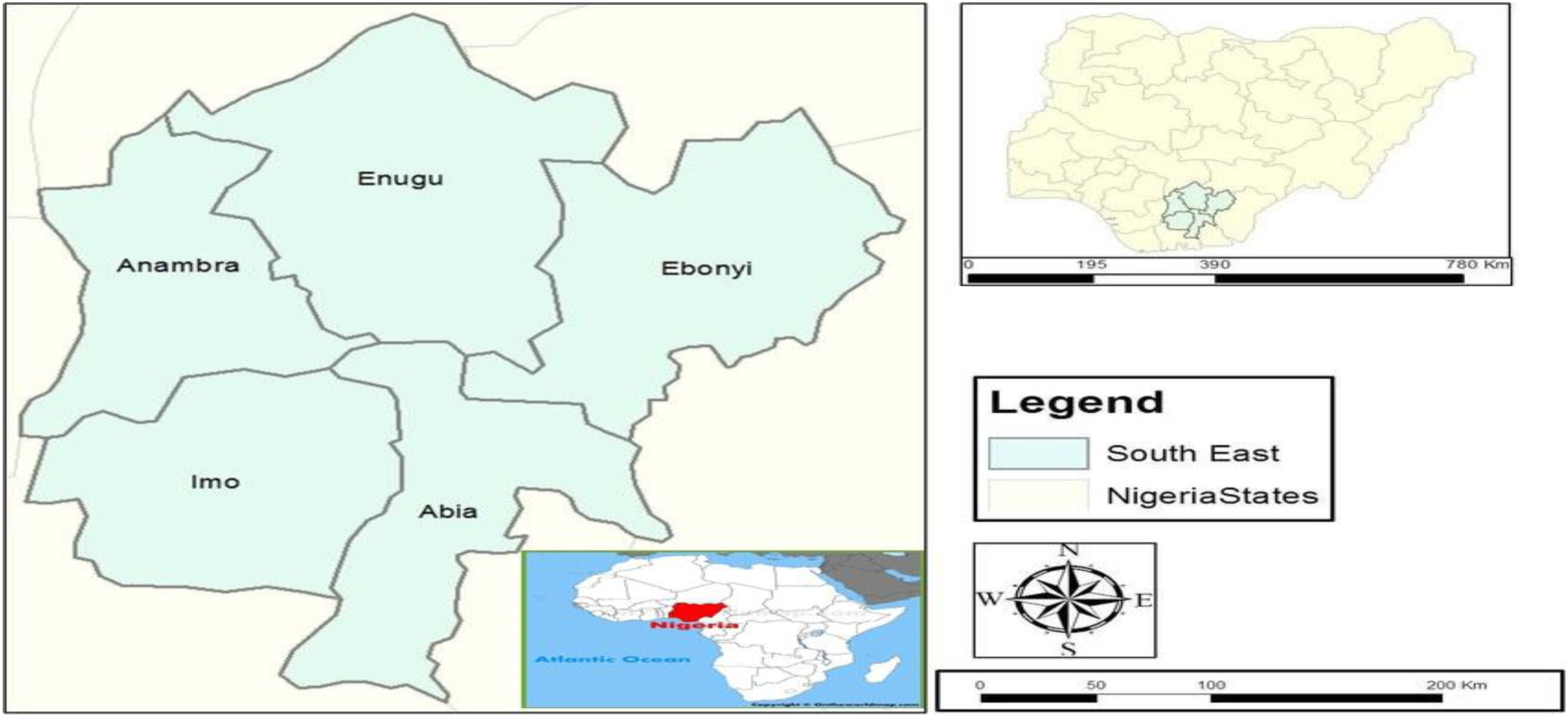
Anambra State is the commercial nave centre of Southeastern Nigeria. The State shares boundaries with Delta and Edo States to the west, Imo and Rivers States to the south, Enugu State to the east and Kogi State to the north. Anambra State derived its name from the ‘Omambala River’. Omambala River is on the northern part of the State and stretches to the famous River Niger (Okonkwo, 2011). Anambra State has a landmass of 4, 844 km2 and a population of 5,527,809 as of 2016 (The National Bureau of Statistics, 2018). The State has 21 LGAs with about 177 communities. On the other hand, Enugu State got its name from the hilly nature of the environment; the word ‘Enugu’ is derived from ‘Enu-Ugwu’, meaning ‘the top of the hill’. Enugu State became an important economic centre in 1909 when coal was discovered (Enugu State Vision 4, 2020). The State has a landmass of about 8,000 km2 and is located between latitudes 5° 55″ and 7° 10″ North and longitudes 6° 50″ and 7° 55″ East. The State is bounded to the east by Ebonyi State, to the west by Anambra State, to the north by Kogi and Benue States and the south by Abia State. The National Bureau of Statistics (2018) placed the 2016 population at 4,411,119. There are 17 LGAs in the State with about 400 communities.
Within Anambra and Enugu States, we chose the Agulu-Aguinyi Clan and the Ntuegbe-Nese Clan, respectively, because they have intriguing cultural values that tourism researchers have not well explored. This research adds to knowledge about the Igbo peoples’ perceptions of colonialism and its subsequent impacts on supporting or rejecting tourism. Our study area represents a destination within an emerging economy where tourism is in the early stages of development and offers an opportunity for proper planning to support sustainability. We also have linguistic advantage and experience as ethnographers and tourism researchers in the region. More so, we are indigenous and have lived and worked in the area for over 20 years.
Methodology
This qualitative research used ethnographic data collection methods - participant observations, focus group discussions (FGD) and interviews. Qualitative research helps researchers to use insights and intuitions (Nunkoo et al., 2013) as well as considers the feelings and detailed perceptions of participants. We deemed the ethnographic methods of data collection appropriate for this research because they supplied in-depth information that revealed the Igbo people’s emotions and belief systems and captured in detail how they construct knowledge about colonialism, its effect and their implications for tourism. Using this approach enabled participants who experienced colonialism and are knowledgeable about the Igbo culture to talk freely and supply valuable information for analysis. In line with ethnographic approach, we visited our participants in their natural setting (Holloway et al., 2010) to establish the required rapport for our interactions as co-creators of knowledge. As part of ethnographic method of data collection, documentary sources (Bowen, 2009) were used to strengthen the data collected during the fieldwork (triangulation).
We adopted a purposive sampling technique during the fieldwork because the goal was to identify and interview people who were born during colonialism to share first-hand information. Purposive sampling ensures that a researcher selects people knowledgeable about a research topic (Robinson, 2014). Our participants include traditional rulers, and men and women representatives who experienced colonialism before independence. Since we targeted participants who share similar attributes of experiencing colonialism, we reached the saturation point (which is an integral part of qualitative research) when this category of people in the study area were identified. We asked participants to share their experiences about colonialism, its effects and how it affects their perceptions of tourism. Before commencing the fieldwork, we secured permission from the traditional ruler in each community to meet with the participants. All the participants signed the consent forms (either the Igbo or English version) to express their willingness to participate in the research. These approaches enabled the research team to establish the relationship required to secure the participants' cooperation.
The research sample size.

Participant as an observer offered us the opportunity to observe the participants’ reactions and actions. We organized FGD sessions with the men and women representatives. The one-on-one interviews with the traditional rulers and the chief priests were unstructured. Only residents who were 62 years old or above - those born before 1960 when Nigeria got independence - were included in this research. All participants have a pseudonym derived from the name of their community. All the interviews lasted 1.5–2 h, were audio-recorded and later transcribed to suit an English audience. Before conducting the fieldwork, we designed the interview guide, proofread and made corrections. We also pretested the questions with several local people before commencing the actual fieldwork.
Data analysis
The data collected during the fieldwork formed useful focal points for the qualitative data analysis and interpretations. Qualitative data analysis categorizes events, things, persons and properties that characterize them (Schatzman and Strauss, 1973 cited in Creswell, 2009). Qualitative data analysis deals mainly with textual materials and aims to arrive at coherent and structured ideas. As Ritchie and Spencer (2011) put it: material collected through qualitative methods is invariably unstructured and unwieldy. A high proportion of it is text based, consisting of verbatim transcriptions of interviews or discussions, field notes or other written documents… The qualitative researcher has to provide some coherence and structure to this cumbersome data set while retaining a hold of the original accounts and observations from which it is derived. All of this has implications for the methods of analysis which are developed. (p. 5)
Qualitative data analysis could take the form of grounded theory, narrative, hermeneutic or content analyses (Bhattacherjee, 2012). We used content analysis (CA) which has become an important analytical process in qualitative research (Vaismoradi et al., 2013). CA can provide a detailed interpretation of materials to identify patterns, themes and meanings using a systematic approach to compare and summarize given data (Camprubi and Coromina, 2016). CA has become a standard analytical tool in social science research for understanding human communications (Camprubi and Coromina, 2016). Hsieh and Shannon (2005) noted that CA often takes one of three forms; conventional (when there is limited literature on a topic), directed (when there is literature to act as a framework) and summative (for quantifying the contextual use of words). We utilized the directed approach in this research. We also used NVivo 11 software, which enabled us to save time and reduce human errors in the analysis process. Johnston (2006) highlighted the importance of Nvivo software in guiding qualitative researchers during data analysis and coding.
In tourism research, Camprubi and Coromina (2016) and Stephchenko et al. (2009) have employed CA. CA is used to select, analyze, and code texts useful for addressing research questions (Bhattacherjee, 2012). In CA, if well conducted, two coders would arrive at the same result (Camprubi and Coromina, 2016). As with other analytical methods, CA has limitations; its success depends on the skills of the researcher. This means that inexperienced coders may undermine the reliability of the process. We followed the processes identified by Roller and Lavrakas (2015); we absorbed data and determined the unit of analysis (the participants’ comments concerning their perceptions of colonialism and its effects on tourism acceptance or rejection). We developed nodes, conducted preliminary coding of data and coded the contents. After coding, we identified categories across codes based on similarities and differences, identified themes and patterns across the entire categories and draw interpretations and implications from the categories.
During the analysis, data were cleaned to avoid grammatical errors, duplication of responses, errors in the attribution of comments to the wrong respondent and separating paragraphs and sections correctly. While doing this, we retained the direct statements of participants and transcribed them verbatim. This is consistent with the views of Ritchie and Spencer (2011) who noted that majority of material collected through qualitative methods is text based, consisting of verbatim transcriptions of interviews or discussions.
Findings and discussions
The analysis of data derived from the participants revealed three broad categories leading to some themes. The first category comprises people who have acquired western education, have converted to Christianity and wanted tourism because they believe that tourism will improve the local peoples’ wellbeing. These people seem to understand how tourism operates. We termed this category of participants ‘the tourism optimists’ with the theme that we called ‘the hopefuls’. The second category comprises mostly non-Christians (adherents of African traditional religion), some of whom did not acquire western education. They rejected tourism development for fear of western influence, domination and the tendency for tourism to alter the peoples’ cultural values, just as in the case of colonialism. We termed this group of participants ‘the tourism pessimists’ with the theme that we called the antagonists. The last group comprises people that we termed ‘the tourism neutralists’ with the theme that we called the indifferentists – most of these participants have either acquired western education or converted to Christianity; they understood the benefits of tourism but are still apprehensive about accepting future tourism development. They prefer to remain neutral in their assessment of tourism because they acknowledge the benefits of tourism as a western phenomenon but also have some misgivings because of its potentials to introduce negative impacts. The findings of this research guided the theoretical framework presented in Figure 2. We will now discuss the findings generated from the analysis in the next session. The theoretical framework.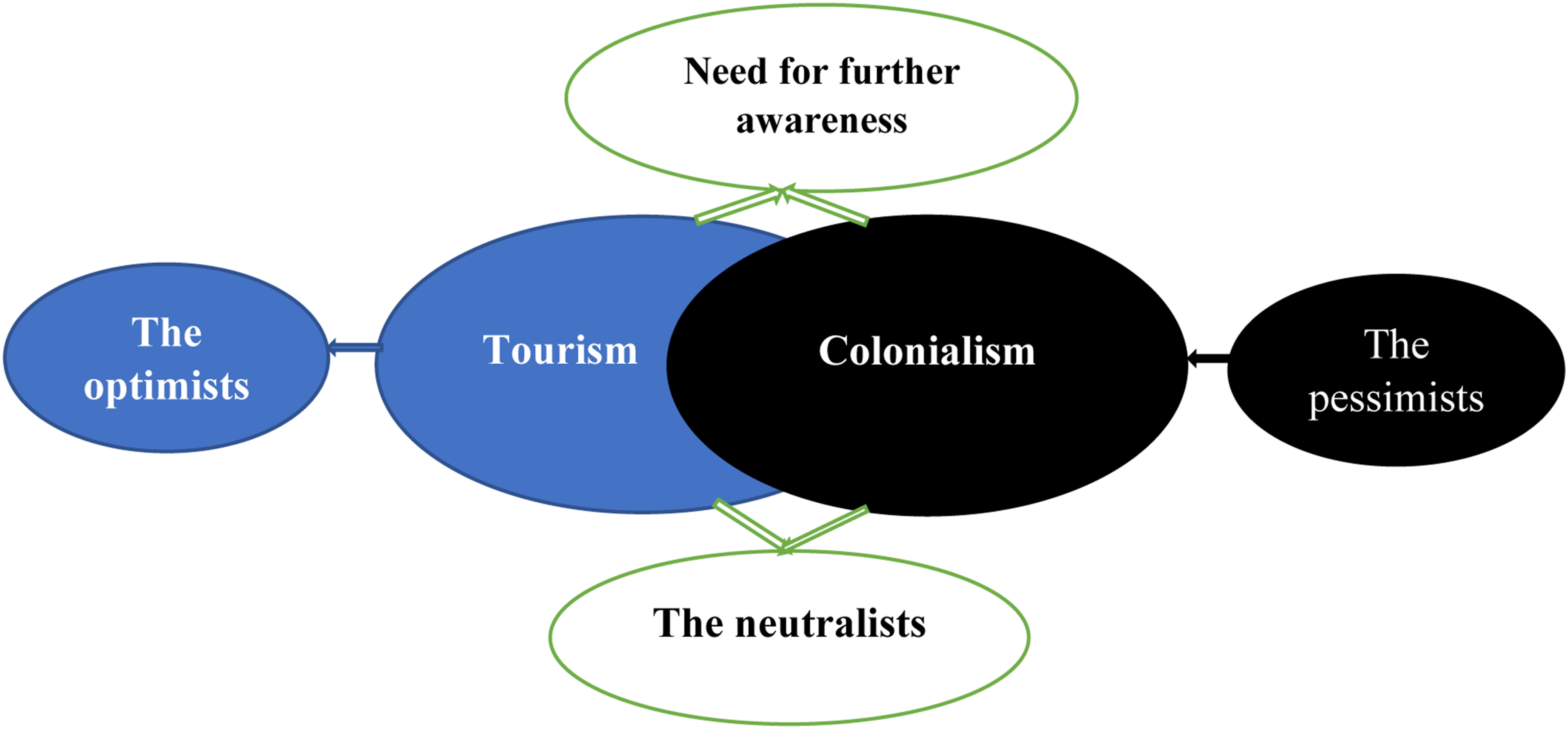
The tourism optimists (the hopefuls)
This group comprises mainly women and men representatives, and some traditional rulers. Their reason for supporting tourism is connected to positive expectations from the industry, such as getting skilled and unskilled jobs, attracting government’s attention through initiating community projects (such as improved rural road networks and electricity) and better living standards. Whilst most members of this group understand how tourism operates, few of them supported its development without a clear understanding of what tourism is about. To these participants, the driving force for supporting tourism is the current hardship in the area, which they lamented has increased in recent times. If tourism would bring a better standard of living, the participants noted that they are willing to participate and support its development.
One of the traditional rulers in Enugu State noted that they had received several promises from the government in the past that are unfulfilled, and they are tired of depending on such promises. Another women representative in Anambra State lamented that life has been difficult and she does not think that the colonial masters should be blamed for the current difficulties in Nigeria. As she said: I am not blaming the colonial masters for what we are going through today. What we are suffering is the insensitivity and wickedness of our fellow Nigerians [politicians] who have refused to use their positions to serve the people who voted them into office’ (participant 115).
Another important observation about this group is that many of the people have acquired western education through community and government sponsorship in the past. For instance, one of the members of this group – a retired school principal in Enugu State – observed that colonialism is not entirely bad because there were many positive impacts such as western education, urbanization and Christianity. He believed that what is required is to do the right thing during tourism development, such as serious consultation by all the interest groups (the local people, government and planners). The participant recounted how he benefitted from the colonial government’s sponsorship to acquire western education up to the university level. As a result of such empowerment, he has held key positions in the society, including at the state and local levels. As he noted, Our story over the years has been from one complaint to another. The colonial masters [white foreigners] left more than five decades ago and up until today, what has changed? Like I already said, I benefitted from colonial scholarship, but today, many Nigerians cannot boast of the same privilege (participant 16).
The tourism optimists are tilted toward support for tourism because they understood and accepted its development, probably because many of them acquired western education. The reflections of the members of this group about the effects of colonialism on whether to support or reject tourism are understandable. Whilst this group acknowledge that British colonialism did not bring only positive impacts, they argued that with the happenings in the country today, including insecurity, abuse of power and public office, poverty and corruption, it is better to stop grossing over the past and face modern reality. Most of these realities, they noted, are being perpetrated by fellow Nigerians (politics). Therefore, as part of facing reality, these people are willing to support and accept tourism to better their lives. The finding is consistent with the point made by Kim and Prideaux (2012) about colonizers and the colonized moving beyond past rift due to colonialism to embrace their contemporary lives. It makes sense to argue that this group of participants are criticizing the poor performance of the contemporary Nigerian government instead of grossing over the psychological effects of colonialism. Additionally, similar to Andereck et al. (2005), Nunkoo et al. (2013) and Nunkoo and Ramkissoon (2010), our finding confirmed that expectations of benefits influence how residents perceive tourism development. The point to make here is that in reality, some residents in Southeastern Nigeria prefer a better life instead of lamenting about the effects of colonialism, which led to support for tourism development.
The tourism pessimists (the antagonists)
The view of the tourism pessimists is in sharp contrast to the optimists. The members of this group expressed their annoyance, concern, fear and worry about tourism development, the benefits notwithstanding. This group comprises mainly traditional rulers and men’s representatives. Another point is that most of these participants did not acquire western education and were non-Christians. They noted that they hold their culture very sacrosanct, constantly consulting with the gods on behalf of their people. This group seemed more concerned about the potential impacts of tourism on their culture, noting that tourism could erode the remaining aspects that survived colonialism. One of the traditional rulers in Anambra State noted that he does not like the effects of Christianity and modernization (which are products of colonialism) on their culture. He complained that visitors’ patronage to the shrines has declined drastically in recent times. Another representative of the men group in Enugu State compared the local Igbo lifestyle with the modern system in the urban areas, noting some sharp contrasts. For instance, he stated thus: Many social vices such as promiscuity, stealing and the use of hard drugs have increased in Igboland since Christianity was introduced, teaching its believers about forgiveness. Before then, violation of local norms attracted the wrath of the gods against the culprit, which encouraged people to live in accordance with the local norms (participant 109).
The implication is that these participants have some misgivings about tourism and may not participate in or support its development because of the psychological effects of colonialism. Many people in this group associated tourism with colonialism because they are both western concepts and are judged to likely have similar or related impacts. For instance, one of the traditional rulers in Anambra State, who was visibly angry, acknowledged that his community needs development to improve their lifestyle as they travel more than 1 hour to get to the nearby community school and fetch clean water. They also encounter difficulties in transporting their farm products because of the bad roads in the community. However, while that is the case, his major concern is if tourism could impact their local cultural values and practices, such as tourists violating the laws of the land, entering sacred sites and introducing strange behaviours that are antithetical to their belief system. As he noted, It is not about whether I will support and encourage my people to consider accepting tourism in our community. What we should be talking about is how it will be developed, what could come out of it and who could get hurt in the process (participant 111).
Antagonizing tourism because of the psychological effects of colonialism or using tourism to propagate neo(colonialism) remains a concern that has not been well documented in the study of residents’ perceptions (Bandyopadhyay, 2011), especially for studies conducted in countries with colonial history, including those in Africa. Some local people’s antagonism of tourism is understandable because many prolific writers in the tourism field, international donors, consultants and tourists are from advanced countries (Carlisle et al., 2013; Yankholmes, 2014). As a result, some local people may be sceptical about accepting tourism for fear of its negative impacts on their socio-cultural values (Castro, 2017; Gay, 2020). Our findings resonate with the point made about tourism serving as the new form of sugar, meaning that some local people may see tourism as a new form of colonialism devised by advanced economies to penetrate the culture of local people in emerging economies (Butler and Hinch, 2007). Our finding calls for tourism awareness creation to sensitize the local people about what to expect (see the framework), understand what they want from the industry and how to monitor the effects of colonialism (Palmer, 1994).
The tourism neutralists (the indifferentists)
This group represents educated and non-educated, Christian and non-Christian participants, who were neither in support of tourism nor antagonized its development. In assessing tourism, their comments suggested that whether colonialism would influence their perceptions or not depends on how its planning is approached, who will participate and the potential impacts. These participants prefer to remain neutral in their assessment until tourism begins to develop, noting that while colonialism and tourism are western ideas, they may not produce the same results. One of the members - a men representative in Anambra State - noted that more Nigerians are now educated to defend their rights and empowered to resist projects that are detrimental to their wellbeing. Another reason, he noted, is that unlike the military era, Nigeria now runs a democratic system of government, which adopts a bottom-up approach that allows the local people to decide what they want and also cater for their needs. As he puts it: Many of us are now in a good position to decide what we want and how it should be done. This is the good thing about being educated. We are not afraid to approach the traditional ruler and speak our mind. If we see that the right thing is being done, we cannot raise any objection, otherwise, we will not tolerate what we don’t want. Until then [when tourism starts], I cannot say much (participant 70).
Drawing from the quote, participant 70 believed that if well planned, tourism might benefit the local people more than colonialism. Another participant – a women representative in Enugu State – commented on empowerment. She added that women are now more empowered to make decisions than six decades ago. Concerning perceptions about the influence of colonialism on tourism, this participant is somewhat indifferent and require more time to make an assessment. As she said: Things have changed. In our days, women were not allowed to acquire western education as men because of our culture. Once you are up to the age of marriage, you are expected to get married. However, this is no longer the case. We cannot assess what we have not seen; let us wait and see what tourism can bring (participant 10).
The perception of this group explains the need to pursue the type of tourism that addresses local concerns and expectations, which will likely improve their support for touirsm. It is important to note here that the level of education and tourism knowledge of these participants was instrumental in placing them in an advantageous position to make critical reflections about tourism and its impacts (this supports the points made by Ap and Cromptom, 1998; Gursoy et al., 2019; Javier, 2016). The position of these participants showed that the government and tourism planners have a major role to play to gain their support for sustainable tourism development to occur in the region. This means that the local peoples’ favourable disposition toward tourism will depend on the nature and assessment of the positive and negative impacts of tourism, the level of representation of local views and concerns and their participation in the planning and development process. These expectations mirror the views of Almeida-Garcia et al. (2015); Muganda et al. (2013b) and Vargas-Sanchez et al. (2011) about the variables and factors that influence how residents perceive tourism. It remains to see how these perceptions will turn out if tourism actually starts to develop in the future, as the level of tourism has been reported in the literature as a variable that influences whether residents will continue to support tourism or not (Latkova and Vogt, 2012; Woosnam et al., 2018).
Conclusion
The discussions in this paper showed that colonialism could influence the perceptions of some residents in Southeastern Nigerian about tourism development. It was interesting to observe that although all the participants witnessed colonialism, the experience impacted them in different ways, which could explain why they reacted to the impacts of tourism differently. It also makes sense to note that how the local people in the area interpret and understand tourism differs, confirming that a community is heterogeneous, which has been reported in the literature by several authors. Our findings also confirmed that there are political, economic and socio-cultural dynamics that influence how residents in western and emerging economies perceive tourism and its impacts. For instance, countries without a colonial history might have different perceptions about tourism, as is the case with Ethiopia earlier highlighted. To this end, our research has contributed to knowledge by exploring how residents within a colonized country reacts to tourism and its impacts.
Therefore, it is important to conduct further research in other communities within Anambra and Enugu States, other states within Southeastern Nigeria and other regions of the country. If this happens, it will help to understand how colonialism has influenced the perceptions of local Nigerians towards tourism. Therefore, we note that the results of this research cannot be taken as the generalized views of all Southeastern Nigerian. That said, the results of this study have theoretical and practical implications. Theoretically, since our findings confirmed that colonialism could influence how residents perceive tourism and its impacts, we suggest that the variable should be included as one of the significant variables reported in the tourism literature that can influence residents’ perceptions, especially in countries with a colonial history. Additionally, researchers who are indigenous to these colonized countries (such as the authors of this paper) should be encouraged to conduct such research because they share related ideology and thought pattern on the sensitivity of colonialism with potential participants. Practically, the findings showed that the government and tourism planners (including developers) in the study area have some works to do in terms of creating tourism awareness to improve residents' perceptions of tourism.
As reflected in the findings of this paper, it is still a long way before the type of tourism envisaged by the local Igbo people of Southeastern Nigeria will be initiated and achieved. The government, tourism planners, developers and local people all have the significant task of working together to address concerns and expectations early in the planning and development process. This means that stakeholder collaboration, genuine community participation (bottom-up approach), good governance, respect for local culture, equitable sharing of benefits from tourism, creating tourism awareness, empowerment, establishment of trust and pursuance of niche tourism (the type that will not be perceived to support western dominance such as rural, indigenous, responsible and community-based) are all central to improving and achieving sustainable tourism in the future.
Footnotes
Declaration of Conflicting Interests
The author(s) declared no potential conflicts of interest with respect to the research, authorship, and/or publication of this article.
Funding
The author(s) received no financial support for the research, authorship, and/or publication of this article.
Ethical Consent
The reearch for this paper was approved by the Murdoch University Human Ethics Committee with project number 2018/009.
