




Abstract
How do moral arguments influence economic decisions? This study reconstructs five discussions about offshoring production to low-cost countries to understand how moral arguments attack the legitimacy of economic strategies. From these case studies about offshoring, I derive three mechanisms by which moral arguments influence economic decisions. Firstly, moral arguments appeal to values, influencing what their addressee defines as economically rational. Secondly, denouncing management decisions as immoral can deprive managers of valuable social capital and legitimacy within their company, thereby exerting economic pressure. Thirdly, depicting management decisions as immoral can destroy a company’s public legitimacy, further exerting economic pressure. Apart from highlighting the social mechanisms underlying moral influence, this article also shows the limits of influence-seeking through moral arguments. It contributes to the existing literature on legitimacy and economic decision-making, especially with regard to offshoring. The article concludes by developing insights about how moral arguments and interest-seeking interact in capitalism based on the empirical material.
Keywords
How do moral arguments influence companies that are deciding whether to offshore production to low-cost countries? Existing studies often assume that companies base their location decisions on rational calculations (see Bathelt and Glückler, 2002: 135; Dörrenbächer and Riedel, 2000: 18; Massa-Wirth, 2007: 21ff.; Meardi et al., 2009; Peters, 2001: 12, 141). In this vein, Cappelli (1985: 101ff.) claimed, for example, that managers push domestic workers to accept lower wages by calculating that foreign locations produce more cheaply. Dworkin (1988: 19f.) similarly highlighted that workers and unions agree to concessions to the degree that they are threatened by plant shutdowns and relocations. Raess and Burgoon (2006: 300) find that exposure to international markets and the likelihood of worker concessions correlate. Organizations such as the McKinsey Global Institute (Farrell, 2006: 120) boast that, with their help, ‘executives make decisions on the basis of facts’, so that: ‘For every dollar of spending on business services that moves offshore, US companies save 58 cents’ (Agrawal and Farrell, 2003). The underlying assumption behind such studies and the claims associated with them is that companies can rationally weigh the pros and cons of different production sites and then relocate to the most productive one.
What could possibly be problematic about such an understanding, according to which companies calculate costs and benefits of different options in order to maximize their economic benefit? The problem is that economists (Porter, 1976: 25ff.; 1998: 341), management scholars (Hardock, 2000: 29f.), management advisors (Richter and Buchner, 2004) and economic geographers (Schamp, 2002) claim that calculating the success of offshoring is impossible at the time a decision is made. Thus, many relocations turn out differently than planned. Studies about offshoring show that ‘Every fourth to sixth offshoring activity is countered by a back shoring activity in the following 4–5 years’ (Kinkel and Maloca, 2009: 163). While more than one in six offshoring attempts fail, virtually all develop differently than initially planned (Blohm and Lüder, 1995: 225; Buhmann and Kinkel, 2004: 33; Fraunhofer-Institut, 2004: 10; Lay et al., 2004: 1; Schulte, 2002: 44f.). While some studies thus claim it is possible to rationally calculate the benefits of an offshoring decision, others criticize such claims as driven by a false belief in calculability (Levy, 2005: 687).
Faced with these deficiencies of rational choice modeling, a research tradition has developed that stresses social influences, rather than rational calculations, to explain decisions under uncertainty (Beckert, 1996: 827f ; DiMaggio and Powell, 1991 [1983]: 67ff.; Hodgson, 1988: 205; March and Simon, 1958; Meyer and Rowen, 1977; Pfeffer and Salancik, 1978: 252f.; Schumpeter, 1997 [1934]: 125; Weber, 1976 [1922]: 12). Such approaches postulate that what actors justify post hoc as ‘economically rational’ is in fact influenced by the social network of the decision maker and the ideas that circulate within it (Granovetter, 2005: 35; Zukin and DiMaggio, 1990: 14ff). This literature thus argues that economic decisions do not result from socially isolated calculations, but are influenced by the social embeddedness of actors and by the specific moral arguments this social context allows for (Etzioni, 1988; Granovetter, 1985).
The literature on corporate social responsibility (CSR) echoes this, positing that CSR should not be studied by asking whether it is profitable to behave in accordance with moral norms. Nor should researchers simply try to find philosophical norms according to which companies should act. Instead, they should try to understand how ‘legitimacy is constructed through joint communicative efforts of the parties involved’ (Scherer and Palazzo, 2007: 1103). To understand how companies construct legitimacy, one has to study the discourse by which they defend themselves and by which stakeholders attack them for their actions. Yet, I know of no study that traces how moral arguments influence decisions to offshore production as one classical economic decision (but see Uzzi, 1996; 1997). This is therefore the aim of this study—to understand how normative arguments influence economic strategies. A number of studies approach this subject, but they all stop short of conceptualizing the mechanisms, by which moral arguments influence economic actions, which is what this study will do. The following section reviews existing studies to situate my argument in the literature and to delineate the gap in research that it fills.
Pfeffer and Salancik (1978) classically conceptualized how companies depend on social legitimacy as a crucial resource. In order to obtain it, they have to accord with what society defines as morally appropriate (Pfeffer and Salancik, 1978: 193f.). In a less functionalistic view of social legitimacy, DiMaggio and Powell (1991 [1983], see also Meyer and Rowen, 1977) maintained that organizations not only try to gain social legitimacy strategically, but are influenced by what is seen as socially legitimate beyond instrumental considerations. In a widely cited article, Suchman (1995) explained how what he calls ‘moral legitimacy’ is situated in this conceptual framework. He argues that companies enjoy moral legitimacy because society perceives them as doing ‘the right thing’ with reference to commonly accepted social values (Suchman, 1995: 579). Companies can maintain moral legitimacy when they can defend their actions in public discussions (Suchman, 1995: 585). This argument rests on Habermas’ logic of communicative action, according to which an action is not legitimate because it advances an actor’s self-interest or because it is rule-guided. Instead, moral legitimacy is derived from a discourse in which others are non-coercively convinced that an action is acceptable (Habermas, 1981: 31f.). To repair the moral legitimacy of their company, managers might therefore not only try to excuse actions, but also justify them by some morally acceptable standard (Suchman, 1995: 580). While this can be dismissed as window-dressing, managers might also change their plans to repair moral legitimacy (Suchman, 1995: 598). This article tries to understand how this happens in order to explain the social conditions that make it possible for moral arguments to influence how economic actors pursue their economic interests. Despite the likelihood that manipulation is widespread in legitimating discourses, studies have shown that moral arguments can affect companies because they try to establish moral legitimacy. This article builds on these studies and tries to advance this literature. In the following section I introduce the most important results of these studies and the questions that they leave open.
Keck and Sikkink (1998: 23f) argue that international activists use ‘moral leverage’ by ‘mobilizing shame’ to get companies to behave in accordance with what can be proclaimed as morally appropriate in a given social context. But Keck and Sikkink do not discuss the specific mechanisms through which public discourse about moral appropriateness influences companies. Kostova and Zaheer (1999) ask what multinationals can do about legitimacy problems. But, like Keck and Sikkink, they do not explain how public ‘naming and shaming’ gets companies to change their decisions. Maynard (2001) details one mechanism by which moral arguments influence companies. He argues that transnational corporations are neither subject to strong moral control from within (the company), nor are they strongly controlled from the outside, e.g. by other corporations or governments. So Maynard (2001: 18) claims instead that a ‘fourth policing mechanism, public exposure, is most instrumental in constraining the transnational’s illegal or immoral activity’. But he, too, does not specify the mechanisms through which public exposure influences companies.
Johnson and Holub (2003) probably come closest to studying this. They analysed how moral arguments were used publicly to stop US corporations from moving their tax base to the Bahamas. They demonstrated how labour unions, politicians, the media, public protests in their wake, and at times even shareholders damage the moral legitimacy of companies through moral arguments, and how companies try to repair this damage. But while they show that a company can be stopped from offshoring by moral appeals, they claim more broadly: ‘corporate legitimacy is now in the hands of all the company’s stakeholders. Companies will need to explicitly consider the determinants of their legitimacy and the implications of the implied social contract under which they operate, to remain relevant in the days ahead’ (Johnson and Holub, 2003: 269). Their strong claim that companies have to act in accordance with moral norms must be tested however, rather than postulated. This is what this study does; it tries to understand the conditions under which moral arguments do influence companies—and those under which they do not.
This responds to Margolis and Walsh’s frequently cited review essay (2003), which finds that the literature on corporate social responsibility mainly tries to show that CSR initiatives have a positive economic impact on companies. But while this may be the case, they also show that the literature leaves the empirical question open as to how companies deal with society’s demands to act in a socially responsible way. Thus, there is so far no ‘systematic descriptive inquiry into corporations’ responses to calls for an expanded role’ beyond a narrowly defined maximization of profits (Margolis and Walsh, 2003: 284). I seek to fill this gap by asking what happens when companies are asked to go beyond pursuing what they initially defined as being in their economic self-interest.
Pinpointing the need for such research, Vaara et al. (2006: 789; also Vaara and Tienari, 2008) argue that ‘there is a specific lack of knowledge concerning the discursive processes, practices, and strategies used to (re)construct senses of legitimacy/illegitimacy’. But while they show that companies use discourses of normalization, authorization, rationalization, moralization and narrativization to legitimate their relocating decisions, they do not show how these different legitimization strategies influence companies (Vaara et al., 2006: 806f). Other related literature shows how social movements influence companies, but it does not analyse offshoring and the mechanisms by which moral arguments influence companies. King and Soule (2007: 430) show statistically that public protests against a company depress its stock price by about 0.4% to 1% over 26 days. They emphasize that protests against companies are effective when they inform investors that stakeholders are dissatisfied about a company’s actions (King and Soule, 2007: 435). But, once again, we hear very little about why companies change their plans when investors become aware that stakeholders are dissatisfied about company strategies (see King and Soule, 2007: 436ff). Similarly, King (2008: 404) uses quantitative findings to show that companies give in to—often morally motivated—calls for boycotts that threaten to damage their reputations. Indeed, this reputation-damaging effect seems to be more important than factually declining sales (King, 2008: 413). But again, this only shows the co-occurrence of two variables: calls for boycotts and company decisions. King (2008: 415) thus points to the problem that ‘these findings challenge us to specify the mechanisms whereby activists attain political influence’.
The literature thus has not identified the mechanisms by which moral arguments influence companies. Mechanisms are ‘recurrent processes linking specified initial conditions and a specific outcome’ (Mayntz, 2004: 241; for similar definitions, see Gross, 2009: 358, 364; Hedström and Swedberg, 1998: 10). They are thus to be understood as processes that link causes and consequences, namely the cause of moral influence to the consequence of a business decision (in this case about offshoring). The middle section of this article will therefore show how moral arguments influenced discussions about offshoring in five cases. These empirical studies of discussions about offshoring will yield three mechanisms by which moral arguments influence economic strategies, namely by: 1) influencing managers’ perceptions of what is economically rational in the first place; 2) pressuring companies from within since moral arguments denouncing managers’ actions undermine the workforce’s willingness to cooperate and thus destroy social capital; 3) pressuring companies by destroying their public legitimacy.
In deciding what constitutes a moral argument, I draw on Durkheim’s conception of morality. Durkheim (1953 [1924]: 36) claimed that morality has an obligatory character. It demands respect, and ‘our will defers’ (Durkheim, 1953 [1924]: 56). According to Durkheim, moral arguments require individuals to follow society’s norms and interests and possibly neglect their own. However, Durkheim also claims that if a moral norm is internalized, it is hard to separate from individual interests and desires, since we can ‘find charm in the accomplishment of a moral act’ (Durkheim, 1953 [1924]: 45). In this sense, Durkheim’s conception of morality is different from a Kantian perspective in that it conceptualizes morality not only as duty, but also as desire, even though its source is always society and never the individual. Importantly, Durkheim does not equate morality with a universalistic standard of righteousness; he sees it in socially relativistic terms. While he claims that ‘no act has ever been regarded as moral which is oriented exclusively to the preservation of the individual’, he also claims that ‘we cannot aspire to a morality other than that which is related to the state of our society’ (Durkheim, 1953 [1924]: 37, 61). Thus, whatever rules a society widely accepts can be described as moral. This can be counterintuitive. For example, from a contrary, universalistic moral viewpoint, giving work to someone in a foreign country by offshoring is as morally right as giving work to a domestic worker. But—for better or for worse—this is not how morality works. A vignette experiment by Robertson et al. (2010) showed that subjects were more outraged about companies offshoring production (relocating across borders), than about companies simply relocating production within national borders, even though from a universalistic perspective this should make no difference. We will see how this plays out in the case studies below.
It is not only vignette experiments that show how moral considerations might influence offshoring decisions; company surveys can do this as well. In a representative survey conducted by the German Federal Statistical Office, exactly 50% of companies surveyed cited moral scruples as a (very) relevant barrier to their offshoring plans. They were mentioned more often as preventing offshoring, than insufficient know-how, the absence of suitable foreign suppliers, fear of plagiarism and insecurity about international standards (Statistisches Bundesamt, 2008: 10). To be sure, both experiments and surveys suffer from biases. Especially in an area as sensitive as morality, socially desirable answers might affect responses. It is thus possible that companies act differently than surveys and experiments would lead us to suppose. Yet, the surveys and experiments cited above at the very least indicate that it makes sense to use a qualitative study to understand if and how moral arguments influence companies in their economic strategies. The following section outlines the methodology behind this study.
Case selection and process tracing
To find out whether and how moral arguments influence company strategies, I use heuristic case studies (Eckstein, 1975: 104f). Instead of proposing a theoretical conceptualization up front, I tried to develop an empirically grounded conception of how moral arguments exert influence (Glaser and Strauss, 1967; Strauss and Corbin, 1990; 1994). While even the most typical cases never allow for statistical generalization, they make it possible to understand relationships between variables, or, in other words, causal mechanisms (Gerring, 2007: 93). To find representative cases that would illustrate mechanisms by which moral arguments influence companies, the German metalworkers’ trade union IG Metall named companies where moral arguments changed economic plans and companies where they did not. Of the companies named in which moral arguments did influence economic strategies, I chose five that seemed especially illustrative of the phenomenon and traced the discussion that led to their decisions. All of the companies analysed were German, active in traditional sectors of industrial engineering and wanted to offshore production (for a more elaborate description of each case, see Schröder, 2011a). Table 1 presents some basic facts about each company, the factors influencing its interest to offshore and how moral arguments entered in.
Key features of the case studies.
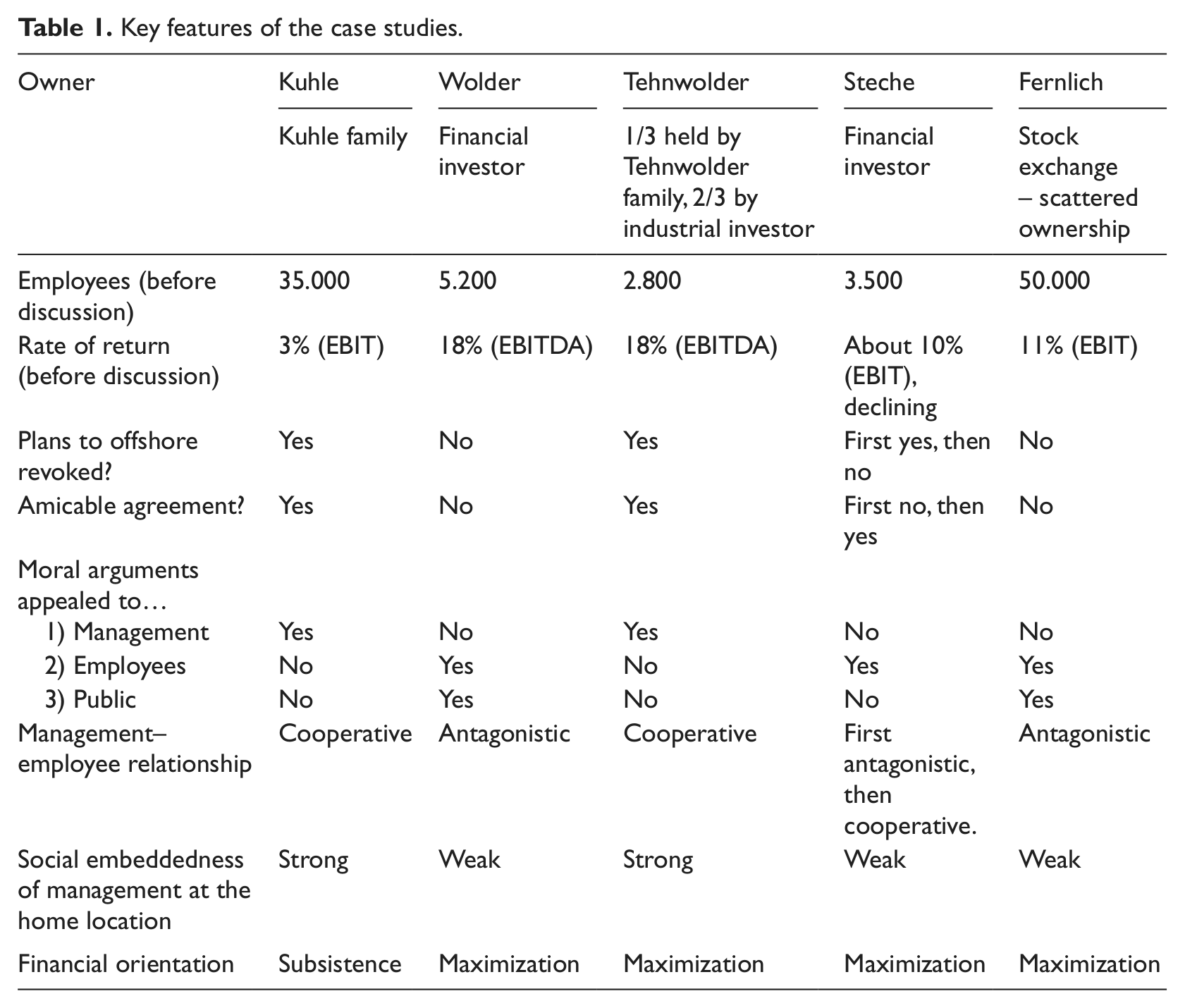
Table 1 illustrates that the companies’ managements were differently embedded before each discussion about offshoring took place. Management was weakly embedded if it had no personal ties to the company’s home region. Following Max Weber’s (1988 [1920]: 44) distinction, companies that tended to content themselves with a certain rate of return, beyond which they refrained from trying to increase profits, are labelled as having a ‘subsistence’ financial orientation; companies that publicly declared their interest in maximizing profits are labeled as having a ‘maximization’ orientation. As I will show, this made a difference in how moral arguments could exert an influence on decisions about offshoring.
To reconstruct the discussions as inductively as possible, I examined who made what arguments and how plans were changed or not changed after these arguments were made. Methodologically this was a ‘systematic process analysis’ (Hall, 2007; also see George and Bennett, 2005: 214) in which I traced how the discussion about offshoring proceeded without making any theoretical generalizations up front. For each company, I interviewed the head of the works council, the trade union representative and a member of the management board. The interviews were semi-structured. While each interviewee had to answer certain questions, he could also elaborate on what he deemed important. The broader question was always who made what moral arguments and what happened after these arguments were made. After reconstructing the basic contours of the discussion, I asked what happened at particular junctures, especially right before management changed its plans. After I knew what happened from the interviewees’ standpoint, I aimed to understand why it happened. Following the tradition of interpretative sociology (Blumer, 1984 [1969]; Garfinkel, 1967), this approach does have a problem: one can never entirely discern why people acted as they did. Not only might they hide this from the investigator, they themselves might not be truly aware of their motives (Abel, 1948; Freud, 1992 [1923]; Weber, 1976 [1922]: 2).
The focus of inquiry was therefore not on what ‘truly’ motivates individuals, but on the visible social effects of moral arguments. To nonetheless filter out as much as possible of what was subjective interpretation and what was intersubjective consensus, the research project asked two interviewees that, given their structural position (most often a manager versus an employee-representative), should have opposed opinions. In such cases, this study will only cite the ‘unlikely’ opinion, e.g. it will not cite if the management of a company says it treat its workers well. All interviews were recorded, transcribed and are cited with the time segment where something was said in the audio file. Strict anonymization was promised in order to ensure accurate information. Thus, all used names are synonyms. To make sure that information was not biased through a collective redefinition of the situation, the research project triangulated what interviewees said with archival material that emanated during the discussion, such as letters, flyers and personal memos. After assembling the empirical material and making it anonymous, I sent the researcher’s interpretations to the key participants of the respective discussion on offshoring to get their opinion on the interpretation of the data.
The following sections give an account of the reconstructed discussions about offshoring with regard to what moral arguments were made and what effect they had. Every case study is centred on one way in which moral arguments influence economic strategies. A first case study shows how moral arguments preserve moral legitimacy by restraining profit-seeking. A second case study shows how moral arguments fail to restrain profit-seeking under different social circumstances. A third case shows how moral arguments influence what actors define as economically rational. A fourth case shows how moral arguments work by influencing social capital; a fifth shows how moral arguments influence economic strategies through attacking moral legitimacy by involving the public. The section after the case studies conceptualizes how moral arguments exert an influence through three pathways, and the mechanisms behind this. The study then concludes how these mechanisms advance or contradict existing research.
Discussions about offshoring traced
How moral arguments preserve moral legitimacy
This first case study, regarding the company ‘Kuhle’, shows how moral arguments restrain profit-maximization, but at the same time make it possible to cooperate with workers so as to avoid financial losses. The CEO of this company, Magnus Kuhle, was the last in a long line of heirs to manage—and own—the family-owned company Kuhle. But Kuhle’s 3% profit rate (EBIT—earnings before interests and taxes as percentage of turnover) did not allow him to finance future investments. Consequently, he asked his workforce to agree to wage cuts. He threatened to offshore production to a low-cost country, if his workforce declined.
The employees, the works council and the trade union were puzzled. Should they agree to the proposed wage cuts? Neither they nor the management could fully calculate whether an existing foreign plant was more efficient than the home plant. Accordingly, the employee-representatives did not know whether the threat to offshore was credible. The uncertainty arose because the home plant did most of the research and development. In Kuhle’s accounting, these services were then ‘sold’ to the foreign plant. But the price could be set somewhat arbitrarily, so that it remained unclear how profitable the home plant was in comparison to the foreign one. Therefore, no one could be sure if offshoring production would really save costs (Kuhle 6. Interview: 47. Min.). The employees also did not know if management just bluffed or if they were well-advised to grant concessions because offshoring was a credible threat. As no one could fully calculate what was most profitable, Magnus Kuhle could have tricked the employees into granting concessions by threatening to offshore, while really only using this threat to extract concessions. But the employees and their representatives ultimately decided to give in to his demands. The works council summed up what tipped the balance in favour of granting concessions:
Magnus Kuhle gave me a personal promise, [he] said: ‘If we reach an agreement about concessions, then I promise you, the production is not going to Eastern Europe, even though from a strictly financial point of view, we should produce there’. (Kuhle 2. Interview: 45–50. Min.)
In essence, Magnus Kuhle promised to honour the worker’s concessions by not doing what he articulated as rational ‘from a strictly financial point of view’. But why did the employee-representatives trust him? After all, he could have tried to trick them in feigning responsibility. Then, after they had granted concessions, he could offshore nonetheless. The works council and trade union representative mentioned they nonetheless trusted him for two reasons. First, they articulated that in prior conflicts, he had often refrained from pursuing his material interest to not infringe workers’ rights that he saw as morally justified, such as decent wages and working conditions (Kuhle 2. Interview: 50-55. Min.; Kuhle 3. Interview: 63. Min.). Secondly, the works council and the trade union representative said they could trust Magnus Kuhle, because he had visibly refrained from extracting short-run profit from the company in the past. Each year, he only took a fixed sum of profit out of the company for private use. This was a sum that even the employee-representatives considered ‘modest’ (Kuhle 2. Interview: 70–75. Min.). The works council representative gave his interpretation of why Magnus Kuhle refrained from extracting more money out of the company:
Well, I guess that is their moral point of view, since it is a family-owned traditional company. I always say: ‘He can only eat and drink till he’s full’. […] I guess it is really a moral code of honour that influences him. (Kuhle 2. Interview: 70–75. Min.)
This means that on the one side, since Magnus Kuhle did not have to satisfy shareholders, he could contend himself with a ‘sufficient’ rate of profit. On the other side, he saw it as a moral obligation to not take more profit than he needed out of the company. We can never be sure what motivation really stood behind Magnus Kuhle’s visible action. But that he only took a ‘modest’ sum out of the company for personal use comes close to what Max Weber (2002 [1905]: 16) described as a ‘traditional’ work ethic: ‘a person does not “by nature” want to make more and more money, but simply to live—to live in the manner in which he is accustomed to live, and to earn as much as is necessary for this’. Even though it might be unusual to find such a subsistence-based ethic in a company that successfully operates in world markets, it is no less rational than an ethic centred on the maximization of short-run profit. Instead, Magnus Kuhle only got the needed concessions because the workers were convinced that he did not try to enrich himself. As he had built up a stock of credibility, they granted him the benefit of the doubt when he asked for concessions.
Put in game-theoretic terms, while each side could have defected, possibly to gain short-term advantages, workers instead cooperated by accepting lower wages, essentially because they felt Magnus Kuhle was doing the same for them. First, this illustrates that economic agents are not the short-term oriented ‘self-interest seekers with guile’, which economic theory and classic game theory often portray them to be (Williamson, 1985: 47ff, 64ff; classically, see: Von Neumann and Morgenstern, 1944). Magnus Kuhle had built up moral legitimacy, so that his employees perceived him as someone doing ‘the right thing’. This in turn helped him to push through his plans later on; it led to cognitive legitimacy as what he did was ‘by default’ seen in a positive light (see the terminology in Suchman, 1995). His employees saw him as someone to be trusted, who had their well-being in mind. In this way, a stock of moral legitimacy can build up cognitive legitimacy and thereby become self-preserving; others automatically assume you are moral, because they have perceived you as such in the past. While this benefited him, Magnus Kuhle also had to pay a price to uphold this moral legitimacy. He had to visibly refrain from profit-maximization, while he was free to pursue ‘sufficient’ profits. In other companies, this was not the case. Instead, moral arguments were used to attack legitimacy and in this way exerted influence as a rhetorical weapon that hurt management.
How moral arguments fail to restrain profit-seeking
Magnus Kuhle seems to have accepted lower short-term material returns, with the result that his workforce reciprocated. The workers granted concessions that prevented offshoring. In comparison to this, the management of the companies Tehnwolder and Wolder both claimed to maximize profits. But even though each of the two companies was in a similar economic situation, they acted in starkly opposed ways. Their actions reflected that Tehnwolder’s social situation was more favourable for moral arguments to influence definitions of economic rationality. The companies Tehnwolder and Wolder were once one company, but a foreign private equity investor bought one half (which then became Wolder) while the family retained control of the other half (which became Tehnwolder). Both companies faced similar economic conditions. The only major difference was that the Tehnwolder-family had strong social ties to the company’s region and workforce. It was socially embedded.
Contrary to this, James Layden, Wolder’s CEO, was a foreigner installed by the financial investor that bought Wolder. He had no social ties to the company’s workforce or region, so employees and the works council regarded him with suspicion; he did not have the same cognitive legitimacy that socially embedded patriarchs such as Magnus Kuhle and Reinhard Tehnwolder enjoyed. As he announced a plan to reduce costs by 150 Million Euro, employees thought their initial suspicion was warranted. They supposed this proved that Layden did not care about them. This was especially the case as Wolder already had an 18% profit rate (EBITDA), which Layden tried to increase even further.
However, the works council chairman agreed with Layden that Wolder had to become more profitable. Similar to Layden, the works council chairman saw the need to fulfill the profitability-demands of the financial investor. The only difference was that he rejected widespread layoffs or offshoring to make Wolder more profitable. Layden thought differently once he had taken advice from McScott management consultancy, which recommended to lay off up to 2,700 of the 4,500 German workers. The head of the works council in turn rejected this. He argued that such redundancies would be disastrous to the company’s public image, as they would cost the company moral legitimacy, since they would be seen as serving to increase a high profit rate even further, while being cruel to domestic workers. He demanded a second opinion from another consultancy firm. This second consultancy firm concluded that the same savings Layden expected by offshoring could be realized by increasing productivity at the home plant, resulting in the layoff of only 800, instead of 2,700 workers.
At this point, one expert opinion suggested offshoring would be most efficient; another suggested improving the home plant would be. What was economically rational was open to interpretation. In this economic uncertainty, the works council chairman used moral arguments. He argued that Layden had a responsibility towards the workers, and that it would damage Wolder’s public reputation, and thus cause economic harm, if he closed German plants. In the end, Layden decided to lay off somewhat more workers than the second expert opinion suggested, but less than McScott had recommended. Why did he lay off fewer workers than he initially planned? And why did he not avoid layoffs altogether—as Tehnwolder did in a similar economic situation? The CEO of the company, as well as the works council and trade union representatives, voiced their opinions:
They [the management] said: ‘We’re sorry, but we can’t act differently. You must understand, we’re sorry for the region, but we must maneuver Wolder through tough competition. If we don’t do that, the company is going down’. (Wolder 3. Interview: 114. Min.) Well, here we get to the core of the question: Does a company feel connected to a region and its employees? Tehnwolder, in comparison, says: ‘We have a reputation to lose, we got high-quality production, and we continue producing here’. Layden instead argued: ‘It doesn’t matter where we produce, as long as it is as cheap as possible. For us, only the brand-name Wolder counts’. […] The only way to exert pressure is if the managers realize that their operational figures are getting worse because the company’s image is affected […]. People said they do not want to buy products from China or wherever. They said they want German products and that workers should not be treated like that. And interestingly, what we lost in turnover, Tehnwolder gained. (Wolder / Tehnwolder 1. Interview: 49. Min.) Every time we informed the public, the managers got pretty nervous. You can recognize this by how they behave. After you’ve known them for a while, you can definitely pick it up by how they act. [When there was critical media coverage], they would approach us: ‘Can’t we have a talk? Do you have time for a coffee? We are not the bad guys!’. It is by such subtleties that you recognize how the media coverage bothered them. (Wolder 1. Interview: 57. Min.)
So even though managers and employee-representatives mentioned that the protests did not influence the CEO directly, it seems as if Wolder’s management wanted to avoid that the public regards the company as immoral. Management feared that public protests could damage Wolder’s brand name. Apparently, Layden feared Wolder’s moral legitimacy could be damaged, and that this would translate into reduced sales. What is interesting is that during the entire discussion, even Layden himself did not fundamentally question that Wolder’s economic situation was similar to that of Tehnwolder (Wolder Interview 15.08.2005). Yet, Tehnwolder did not lay off a single worker, while Wolder did. Tehnwolder was in a similar economic situation, with similar economic goals, yet it acted differently. Why was this?
How moral arguments influence economic rationality
One thing was different for Tehnwolder, and this was the social embeddedness of its management. Reinhard Tehnwolder managed the company. He had not only invented many of the company’s products himself, he had also succeeded his father in managing the company and wanted to pass it on to his own son when he became too old to manage it. When the trade union once carried out a warning strike against him at his hometown, he put up an indignant notice at the company, claiming to see such protests as a ‘personal insult and affront’, since it would be ‘unfair’ to damage his personal reputation in his hometown. After the conflict was settled, he presented a small bottle of champagne and a glass to every employee. He attached a note, suggesting to flush the anger about the conflict down and to return to the company’s cooperative atmosphere, which he deemed vital for its success. With such gestures, he tried to maintain his social legitimacy, claiming to keep the workers’ interests in mind.
Friedrich Enteler was the company’s chief financial officer. He also claimed a social obligation to Tehnwolder’s region and employees. The trade union and works council mentioned that both managers had indeed taken the workers interests into account so far. But Tehnwolder’s management was also not ignorant of China’s low labour costs. They thought about upgrading a Chinese production hall into a complete factory. However, it was unclear to them if producing in China was really as cheap as it seemed on first sight, since they knew about many competitor firms that had encountered difficulties after having offshored, so that they had to re-relocate back to their home plants. Differently from Wolder, this uncertainty did not manifest itself through two opposed expert opinions. Instead, the management itself admitted it was unsure about what to see as an optimal strategy. Enteler and Tehnwolder disclosed to their works council that they could hardly estimate how the Chinese labour costs would develop in the long run, how expensive it would be to build up a high quality-standard, how often German engineers and managers would have to help out in the new plant and how exchange rates would develop. As the long-run development of these factors is—and must be—unknown, whether to offshore or not could not be calculated on an entirely rational base. Depending on how high Enteler estimated the uncertain costs behind offshoring, it made more or less sense to him (Tehnwolder 4. Interview: 6. Min.). Even though he tried to calculate an optimal solution, he acknowledged early on: ‘You can’t calculate anything; realistically, you can only approximate’ (Tehnwolder 4. Interview: 48. Min.).
The domestic workers feared losing their jobs, only because management even considered offshoring. Yet, both the works council and the managers wanted to avoid a conflict that might destroy the company’s high trust and social capital (Tehnwolder 2. Interview: 22. Min.; Tehnwolder 3. Interview: 3. Min.). A labour dispute hovered as a threat in the background, but the works council representative stated he would not escalate the conflict before having exhausted all other possibilities (Tehnwolder 1. Interview: 25. Min.). It was at this point—when it was uncertain what was economically rational—that the works council representative used moral arguments. He appealed to Enteler and Reinhard Tehnwolder to not cut jobs at the home plant, reminding them of their moral obligation for the workers and the home region, which they themselves had articulated (Tehnwolder 4. Interview: 15. Min.).
Reinhard Tehnwolder and Enteler responded they would indeed prefer to stay at the home location, but had to take into account what could be legitimized as economically rational. By saying they would regret to offshore, but had to follow economic incentives, they used a similar justification as Wolder’s CEO Layden. In contrast to Wolder, however, Tehnwolder’s management was more open to the works council’s suggestions about what could be seen as economically rational. They discussed with him what could be seen as economically profitable and morally justifiable at the same time. Management and the works council agreed on more flexible working times, which did not breach the existing collective labour agreement. In exchange for the more flexible working time, management promised to increase production at the home location (Tehnwolder 3. Interview: 9. Min.; Tehnwolder 2. Interview: 52. Min.). A representative of the works council, trade union and management (in that order) mentioned that because the managers had personal ties to the home region, they aligned what they saw as economically rational to what was articulated as morally appropriate:
They definitely wanted to prevent the offshoring of production. Because if 2.000 jobs get lost here, then that is a regional catastrophe and our executive board does feel an obligation to prevent this. However, it is also true that they put this into perspective: First money, then social considerations. [But] the reason we chose a different strategy is definitely the owner-structure. That was the only reason. If we had a financial investor here at Tehnwolder, the whole thing would have been totally reversed. That was the ultimate reason and it has something to do with morality. (Tehnwolder 2. Interview: 81. Min.) I presume Tehnwolder’s management sees a sociopolitical responsibility in what they do. They argue: ‘I simply cannot alienate the people that worked hard to make Tehnwolder successful’. But, as I said, there is also the other side, which is that they claim: ‘If our employees are motivated and stand behind the products and the company, we can be much more successful’. And, as you can see, they actually are pretty successful. (Wolder / Tehnwolder 1. Interview: 8. Min.) From what I have seen, managers without social ties to the region base their decisions exclusively on operating figures. But that’s wrong; you need intuition and a long-term perspective. China’s wages increase by ten percent annually, key people there cost almost what they cost here; if you want well-qualified employees, the fluctuation is much higher. […] You have a different perspective coming from a solid background and having social ties […]. It’s simply the difference of having personal ties to a region. (Tehnwolder 3. Interview: 25. Min.)
So while Tehnwolder’s management adapted its economic strategy to conform to the moral arguments from its social environment, it did not have the feeling (contrary to Kuhle) that it sacrificed profit in order to respond to moral arguments. Instead, moral arguments influenced what it saw as economically rational in the first place. In doing so, Tehnwolder’s socially embedded management was starkly opposed to Wolder’s socially disembedded one. This was not for economic reasons. Both managements acted on the assumption that the two companies were in similar economic circumstances. Both had 80% of their production in Germany, but only 20% of their sales; both were of comparable size, produced similar goods, had similarly high profits of almost 20% of turnover and had to bear the same high German labour costs; they were even each other’s fiercest competitor. But in spite of this similar economic situation, they acted differently. Neither of the two companies did something it defined as economically irrational, but each defined differently what it saw as economically rational in the first place, depending on how it was socially embedded. While Tehnwolder adapted what it saw as economically rational to what was articulated as morally legitimate, the socially disembedded management of Wolder refused to do so.
After Tehnwolder‘s management agreed to improve the home plant, instead of offshoring, Wolder’s offshoring discussion took place (see the preceding section). Due to the similar name, location and products of the companies, the public frequently confounded them. Tehnwolder had to assign two employees to deal with angry customers that mistakenly blamed Tehnwolder for Wolder’s offshoring plans. Tehnwolder’s management then used the occasion to distance itself from its sister company. It coined a slogan in TV commercials that Wolder was ‘not part of the family’. Reinhard Tehnwolder publicly disapproved of James Layden’s disregard for his domestic workers. Journalists recurrently asked him if it was not economically irresponsible to stay at the home location, as Tehnwolder—just as Wolder—faced low domestic demand, high labour costs, a strong currency and rising prices for raw materials. He pejoratively replied, hinting to Wolder’s management: ‘If you do your homework, you do not have to offshore’. He called the complaints of Wolder’s management a ‘distraction from their own mistakes and an expression of lacking creativity’. He claimed that instead of ‘saving a couple of percentage points in labour costs’, Wolder should organize its production efficiently (Tehnwolder 6. Interview: 13.07.2005). Later, the head of the works council recapitulated the rationale behind this public relations campaign:
After Wolder got discredited, we knew we needed a public campaign to differentiate us. So we did this on purpose. We started […] the campaign, including his [Reinhard Tehnwolder’s] statement: ‘No, I am not the bad guy, I am the good one’. And later we [the employee representatives] could use this statement as a yardstick to measure him by. Afterwards, we could continuously argue: ‘Well, now you also have to act differently’. That was sort of the moral corner, where we could build up pressure. (Tehnwolder 1. Interview: 52. Min.)
The works council indeed used Reinhard Tehnwolder’s initial moral justifications to exert pressure when the management thought about offshoring two years later. As an alternative to offshoring, management demanded a 40-hour week at the domestic plant (Tehnwolder 4. Interview: 32. Min.). But now, Reinhard Tehnwolder’s past promises made moral arguments possible. The works council mentioned that only two years ago, Reinhard Tehnwolder had still said that the well-qualified workers and the good infrastructure balanced the high labour costs, and that he had an obligation to stay at the home plant, as long as this was economically feasible (Tehnwolder 1. Interview: 22. Min.). The head of the works council warned Reinhard Tehnwolder that if he cut wages or increased working hours in spite of these past promises, the motivation and productivity of the workers would suffer, which in the end could damage the company’s high profits. After the works council made these arguments, Enteler himself said he left the negotiations ‘with empty hands’ (Tehnwolder 1. Interview: 19. Min.). Later, he discussed why he did not insist on wage cuts or longer working hours:
To be honest, we thought we just can’t do this. Because we realized that if we take away income from our workers, some would get into financial problems. […] Many of our workers are in family situations where they need every penny. And that was an argument where we conceded that cuts could not be realized without bloodshed. (Tehnwolder 4. Interview: 9. and 46. Min.)
Tehnwolder’s management claimed to not want to maximize profits in a way that would cause ‘bloodshed’. It is always problematic to take such statements at face value. But the works council and trade union agreed that Reinhard Tehnwolder acted accordingly (Wolder / Tehnwolder 1. Interview: 59. Min.; Tehnwolder 2. Interview: 56. Min.). However, Reinhard Tehnwolder did not feel he was sacrificing profits for this decision. After the works council and the trade union had used moral arguments to avoid longer working hours or offshoring, Enteler and Reinhard Tehnwolder mentioned they could not afford to offshore or have the workers work longer, as it was more profitable to stay at the home location and not to overstress the workers there. If one searched, reasons for staying at the home location could be found: the quality of the products from the home plant was high and the workforce was motivated. The management claimed that both offshoring and longer working hours could damage this motivation; and indeed Tehnwolder’s profits matched Wolder’s.
But whereas Wolder’s socially disembedded management was blind to reasons to stay, Tehnwolder’s socially embedded management was blind to reasons to leave. So while existing studies claim ‘that moral legitimation, perhaps even more than pragmatic legitimation, carries with it a substantial likelihood of unanticipated goal displacement’ (Suchman, 1995: 588), this case study shows a slightly different mechanism of how moral arguments work. The attempt to uphold moral legitimacy in the case of Tehnwolder did not change the company’s ultimate goal of making a high profit. But it changed how the company thought it could achieve this goal. The attempt to uphold moral legitimacy influenced what Tehnwolder perceived as an economically rational way to pursue its profitability-goal. In this sense, while moral arguments in a certain social embeddedness could not change the ultimate goal of making profit, they could change the intermediate goal, of how this profit was to be pursued. Both managements therefore perceived reality through a certain frame. Even though each company claimed what the other did was irrational, each reached a high profit rate of about 20% (EBITDA / turnover). The comparison of the two companies therefore gives reason to believe that moral arguments, in situations of uncertainty, influence what managements define as economically rational as a function of the social environment in which they are embedded.
How repairing moral legitimacy enables economic strategies
Steche, the fourth case, illustrates how moral arguments repair legitimacy and how this enables pursuing economic strategies that are precluded when one is perceived as immoral. The company Steche was originally family-owned. Then a financial investor bought it; its declared aim was to maximize the company’s profit to resell it. It therefore installed Hermann Thüren as new CEO, who immediately demanded wage cuts, threatening to offshore production if employees refused. Faced with the possibility of losing production, the works council and workers reluctantly agreed to have their wages reduced. In return, Thüren promised to not offshore production.
Some months later, however, a worker found an internal note on a copying machine, stating that in spite of the promises made, production should be offshored anyway. Apparently, the management had hoped to reduce wages and offshore anyway, in spite of making promises to the contrary. The works council perceived this as a major breach of trust. Its representative asked one of the design draftsmen if a production line, which Thüren had promised for the home factory, would even fit there. The draftsman admitted that Thüren had coerced him into pretending that the production line would fit into the domestic factory, so as to give employees the false impression that he would not offshore, to get concessions. The works council representative now knew for sure that Thüren had lied to him. He therefore assumed he simply wanted to ‘get the company ready for sale. […] The only thing that counts for them is to get out of there’ (Steche 4. Interview: 43–47. Min.). After he discovered that Thüren wanted to offshore the production line, which he had promised to leave at the home location, he stormed into his CEO’s office and snapped at him: ‘Not with me, no way!’ And added: ‘Why don’t you prepare the insolvency right away?’ (Steche 1. Interview: 12. Min.; Steche 2. Interview: 46. and 49. Min.). Knowing Thüren had cheated them, the works council now did everything to put obstacles in his way, even at the cost of damaging the company. Although the works council chairman believed that additional concessions were indeed necessary to keep the company alive, he believed he could not entrust them to a CEO that had cheated him. Two members of the works-council and a member of the union (in that order) recount why the employee-representatives preferred to let the company head towards bankruptcy instead of granting concessions, which they themselves found economically expedient:
As I was in the supervisory board, I knew the financial figures. Judging by these, I should have said that we have to offshore to Eastern Europe. But I couldn’t do that’. (Steche 1. Interview: 26–28. Min.) It was extortion! Always according to the theme: Either you do this or we’ll offshore to Eastern Europe. And at some point the workers were so fed up, sorry I have to say it this way, that they said: ‘We just don’t care anymore’. (Steche 2. Interview: 40. Min.). At this point we simply refused to cooperate. We had an agreement; both sides had committed themselves to invest here, to start new projects, start new lines of production, qualify workers. Nothing had happened. And then they wanted to pull off an ominous ‘Plan B’: We are offshoring! Because suddenly they realized that this made more sense. […] If they have a contract with me and they do not adhere to it, then a trade union can easily use moral arguments to agitate the workforce. (Steche 3. Interview: 30. and 60. Min.)
In the view of the workers, the CEO had lost all moral legitimacy. The workforce ceased to believe that the CEO was committed to doing ‘the right thing’ or that he could be trusted at all for that matter. This had measurable economic consequences. As they felt deceived, employees—intentionally or unintentionally—worked more carelessly. Soon, Steche’s industrial customers complained about a notable decrease in the quality of the company’s products. This became so severe that the private equity firm had to conclude contracts with Steche’s industrial customers. The private equity firm had to pledge to stop deceiving workers so that they would become more motivated to invest in the quality of the company’s products. The works council recounts this:
I used to be afraid of those private equity guys. But now they are forced to establish a good reputation. And this is what they do at one of our large industrial customers now. They have to sign agreements that they won’t sell Steche to anyone who has only short-term profits in mind. They have to guarantee that if they sell Steche, it’ll be to someone who the workers can trust, not to someone who wants to exploit Steche. This is the sort of trust they are forced to build up now. So now the chairman of the supervisory board frequently calls me to ask how an employee-meeting went, how the employees see things and whether the working morale is good. That was totally different before. These guys are afraid now […] that the workers don’t feel treated well, because if the workers are discontent, they will work sloppily, which means Steche’s products will lose their industry-wide reputation […], and that makes a difference that we really feel here. (Steche 1. Interview: 32–39. Min.)
The private equity firm behind Steche was even forced to replace Thüren with a new CEO, who had to promise to not deceive the workers any longer. The new CEO, Lauer, approached the workers in a completely different way. He made an effort to build rapport and trust. He organized a banquet, where the board of directors served as waiters. Such trust-building measures did not remain without effect. Steche’s employees started to see Lauer as ‘one of them’. After he established this trust, he got concessions; worker-representatives even agreed to offshoring, while they fiercely opposed Thüren when he tried to offshore. In one of the discussions, the trade union representative asked the works council if he should agree to Lauer’s plan to offshore, which was essentially similar to Thüren’s. The works council representative replied: ‘Robert, we have to go along with this, it’s the best thing for the company’ (Steche 2. Interview: 53. Min.).
It was therefore not economic facts per se that got employee-representatives to support or reject offshoring. Instead, they based their actions on whether they felt cheated or not. In this sense, this story was the opposite of Kuhle, whose CEO was trusted and therefore given permission to pursue his economic interests when he could have cheated his employees. In Steche’s case, the new CEO conversely had to repair the management’s moral legitimacy, to pursue what he thought of as an economically rational strategy. It was only after the CEO was seen to behave in accordance with what the workers perceived as morally appropriate that he could pursue economic interests by offshoring.
How moral arguments undermine social moral legitimacy
Fernlich, the last case, shows how a company can be deprived of moral legitimacy and how this affects its economic strategy. Heinrich Zalohma was CEO of this stock-listed company. He did what many CEOs were afraid to do; he publicly claimed to have no special moral obligation to Fernlich’s home workforce or region. His works council and trade union sometimes claimed that his declared strategy of uncompromising profit maximization had to take into account public sensibilities. But whenever this happened, he countered that he was entirely and exclusively obliged to his shareholders and that the workers of the domestic plant deserved no special moral recognition, neither compared to shareholders, nor compared to foreign workers. He argued that giving work to a foreign worker is no less moral than giving it to a domestic one. From a universalistic moral perspective, this is hard to counter. But this argument enraged the public, as this case study will show. Appealing to Zalohma directly on behalf of the domestic workers proved unsuccessful; contrary to what happened at Kuhle, he did not change his strategy. Employee representatives also could not convince him that the success of offshoring was uncertain; contrary to what happened at Tehnwolder, he was convinced to be able to calculate the success of his plans, claiming all relevant figures and their development could be rationally deduced. It seemed as if directly appealing to Zalohma had no effect. The conflict then gained momentum, as he announced the closure of a profitable home plant to increase the company’s profit by 0.5 percentage points.
Having been unable to talk Zalohma out of this, the works council and trade union started a media campaign to exert pressure. They gave newspaper interviews, arguing that Zalohma’s profit maximization was immoral, allegedly lacking any regard for domestic employees and their families. Newspapers eagerly picked up this argument. It made great headlines for them to portray the victims of Zalohma’s offshoring and profit-maximization plans. Far from covering the process neutrally, newspapers were highly biased. The trade union made sure images of a family father in tears, with a two year old son, were broadcasted repeatedly. The father claimed he did not know how he would pay for his newly-bought house and take care of his young family, now that he was to be laid off. This coverage was highly tendentious and bordering on manipulation, as workers with families were in fact protected from most layoffs. While other companies announced much higher layoffs, they were not criticized nearly as much. Some even profited from the occasion by distancing themselves from Fernlich. Competitors published newspaper advertisements, asserting that Fernlich’s CEO lacked moral responsibility and that—in contrast to him—they felt committed to staying in Germany. A manager from a competitor company argued Zalohma had transgressed the boundaries of what was morally permissible, even in a market society. Newspapers depicted him as a heartless capitalist and accused him of advancing a ‘sick predatory capitalism’. The coverage was highly biased. No one mentioned that Zalohma gave work to foreign workers; hardly any news media lauded his high rate of return, which benefitted the shareholders. The trade union representative, when discussing why the media reports were so biased against Zalohma, stated that Zalohma ‘did them every favor’, by claiming:
… that he could not understand the workers and their representatives at all, that we’d be fools for not seeing the necessity of working 42 hours a week. With such statements, he continually provided us with something we could react to. And then there were the journalists … To be honest, I think they were happy about every statement he made, because whenever he gave an interview, they knew the conflict would drag on and they could cover it. (Fernlich 4. Interview: 67. Min) Basically the company itself and Zalohma played no major role in our strategy. Instead, it was important for us to exert pressure through public opinion, so that Zalohma would wonder whether it made sense to keep on waging this war—in the end it was a war—against us or if it was better to reach a compromise. […] Creating images for the media, that was an important part of the strategy. (Fernlich 4. Interview: 60. Min)
Possibly, the public and media were glad to have a scapegoat for trends that are often hard to criticize due to their impersonal nature, such as the need of companies to pursue profits and to offshore to low-cost countries. Whatever the motivation of the media to take a biased view against the company, it did not remain without effect. A newspaper reported that after the coverage, a quarter of Fernlich’s customers near the home plant started boycotting the company’s products. Most critiqued that Zalohma did not try to avert losses, but to maximize profits, by offshoring production from a plant that was already profitable. Even Fernlich’s senior executive criticized Zalohma. A member of the supervisory board, the management board and the trade union (in that order) recall why Zalohma met such resistance even by his own managers in a meeting:
The argumentation triggered something in the upper management […]. They argued: ‘Well, my kids should also be able to take up an apprenticeship someday, develop themselves, or whatever. And to destroy all these perspectives for a couple of cents …’. These are the kinds of thoughts they have. (Fernlich 2. Interview: 59. Min.) You cannot explain this rationally, because something enters in there, which you cannot control—and it has to do with emotions. […] You cannot use rational arguments against emotions. (Fernlich 3. Interview: 2. Min.) I stood next to him [Zalohma] and thought: ‘My god, the darling of the stock exchange is nervous as a little child’. He gave me his hand; it was dripping of sweat, because he realized that his own management ceased to support him. So the moralization of the issue […] worked. Because in Germany, there is a certain … no matter what economic times we went through … everyone should make money … but everyone also has to be able to survive. This basic moral consensus seems to exist in our society and Zalohma violated it. (Fernlich 4. Interview: 55–58. Min)
At this point, the trade union could convince brokers that Fernlich’s stock price would suffer from the internal conflicts and negative publicity. The trade union persuaded a bank to criticize Fernlich’s ‘negative newsflow’ and to suggest selling the stock due to ‘internal and external credibility damage’. The bank argued angry workers could start conflicts and strikes, causing ‘damage in the order of millions’. Fernlich’s own public relations department was ‘horrified about Zalohma’s behaviour, as he did not respect any rules of internal communication’ (Fernlich 6. Interview: 2. Min.). A media response analysis of Fernlich’s public relations department estimated that the negative publicity he generated had cost the company 1.5 million Euro by that point (Fernlich 3. Interview: 23. Min.).
The trade union’s media campaign now also affected members of the supervisory board. At a meeting, the chairman (and ex-CEO) complained: ‘I came by cab today; the cabdriver was cursing the entire ride about those goddamn capitalists at Fernlich. I didn’t dare to say who I was’ (cited by a participant of the meeting). Two other members of the employer’s side of the supervisory board insisted Zalohma could not legitimize everything by arguing he had to increase the rate of return; a company also had other responsibilities. Shortly after this meeting, even the moderate Confederation of German Trade Unions started to call for protests. It was never certain whether this influenced Fernlich’s stock price, as many influences bore on it simultaneously. But when the protests began, a second bank downgraded Fernlich’s stock from ‘buy’ to ‘hold’. It argued a possible wildcat strike would be costly to Fernlich (Fernlich 2. Interview: 73. Min.). Two days later, the protests climaxed, when—according to the trade union—virtually the entire German staff illicitly stopped working to protest Zalohma’s decision. The protest was out of proportion, as almost 100 workers went on strike for every announced dismissal.
When the protest took on such magnitude, Fernlich’s public relations department argued that the costs of negative publicity had started to exceed the projected benefits of offshoring. Zalohma had to deviate from his initial plans by offshoring less and later. One member of the board of directors acknowledged afterwards that by using the media campaign, the trade union had played its cards ‘100 percent right’ and created high costs by damaging the company image (Fernlich 3. Interview: 42. Min.; Fernlich 4. Interview: 40. Min). An anonymous expert claimed that the media campaign and the closing costs of the home plant amounted to about 50 Million Euro; the management estimated costs of 15 Million Euro (Fernlich 3. Interview: 79. Min.). The first amount equalled what offshoring should have saved within 8.3 years; the second what it should have saved within 2.5 years. Some managers mentioned anonymously that the conflict had cost more than offshoring was meant to save. After the negotiations, Zalohma went to one of the works council representatives, shook his hand and said ‘one—zero for you’ (Fernlich 2. Interview: 21. Min.).
Mechanisms behind moral influence
The case studies of the last section showed a number of ways in which moral arguments can influence economic interests. This section uses the case studies to answer the questions that were outlined in the introductory section. Namely, it will advance the existing literature by distilling three mechanisms from the case studies through which moral arguments influence economic interests. The mechanisms are presented in Figure 1.
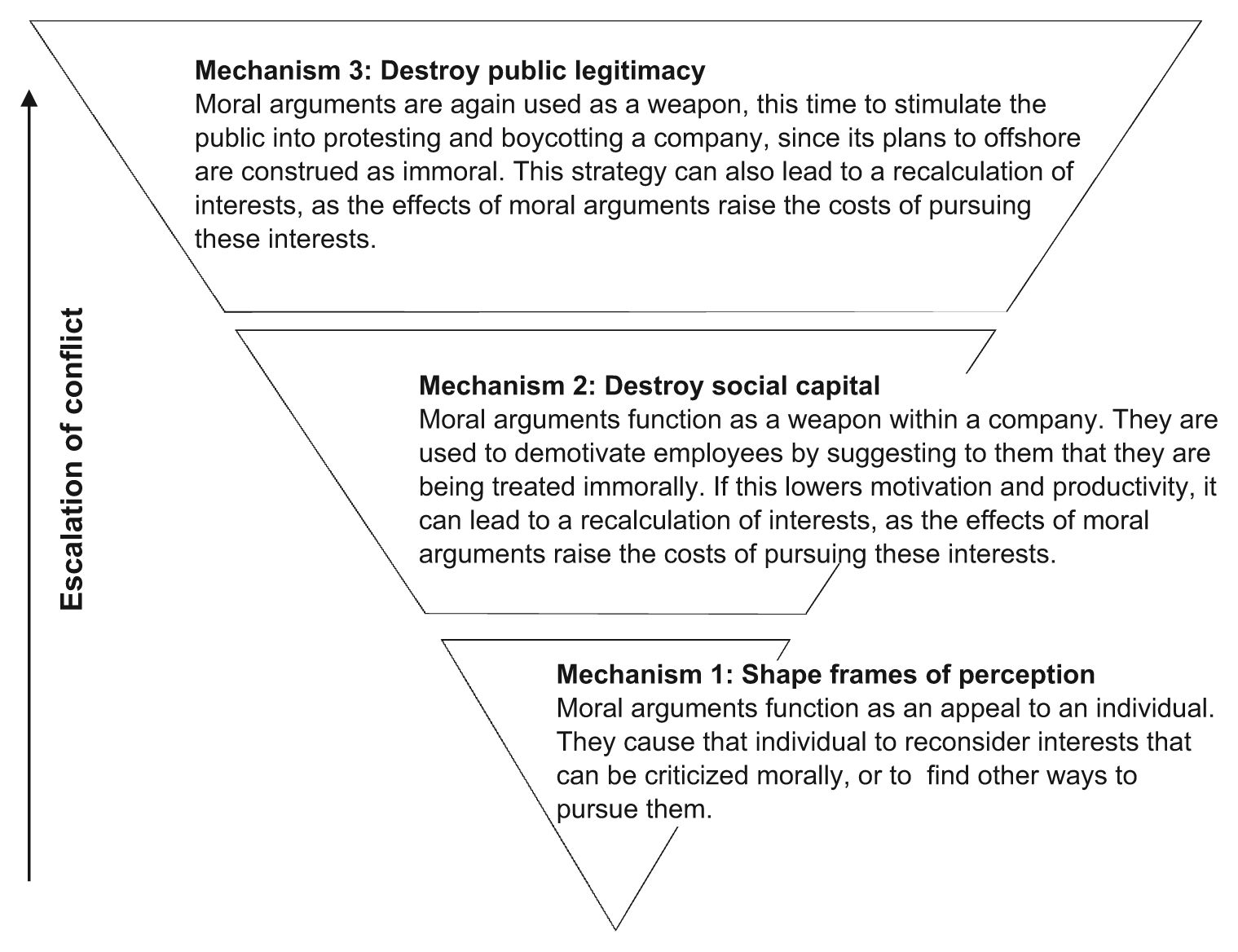
Three mechanisms of moral influence: how moral arguments influence economic interests.
The three mechanisms of moral influence build on each other. No employee representative would start a societal macro-conflict without trying to find a solution within the company first. Similarly, no employee-representative would start a company-wide conflict without talking to the management first. The second mechanism in turn relies on the first, as workers are enraged by managers who were not attentive to moral appeals on their behalf (thus by the first influence-mechanism not having worked). The public in turn is enraged by the first and second influence-mechanisms not having worked (managers not listening to moral appeals and allegedly not treating workers well). Going the other way, each level of escalation uses the next as a threat. Managers might listen to moral appeals because they are afraid that if they do not, workers will be enraged. Managers in turn might treat workers well, as they are not only afraid of their anger, but also of negative publicity. Even though the three stages influence each other, it makes sense to separate them analytically, as three different mechanisms underlie them, through which moral arguments influence economic decisions, namely by influencing: 1) what individuals see as economically rational; 2) social capital of an organization; 3) public legitimacy. The following sections theorize how these three different mechanisms of moral influence work.
First mechanism: how moral arguments frame perceptions of economic rationality
This mechanism of moral influence depends on uncertainty. In the examined companies, no CEO refrained from doing something of which he was sure that it was rational, only because moral arguments told him so. 1 But in such situations, it is nonetheless possible to promote one specific way of pursuing interests as most morally appropriate and yet no less economically rational. In the case of Tehnwolder, employee representatives argued that staying at the home location could be as economically beneficial as offshoring, while conforming to the moral arguments of the social environment. What is this influence-mechanism based on? As Kaplan (2008) has shown, economic decisions are taken through a cognitive ‘frame’, a socially influenced way of perceiving the world. The case studies above suggest that moral arguments influence such frames. This influence is not always consciously acknowledged, and is therefore hard to study. But especially the comparison of the companies Wolder and Tehnwolder suggests that moral arguments influence perceptions of what is seen as rational in this way.
Additionally, when managers do not know what is most economically rational, they can be reminded of having mentioned a moral obligation to their social environment. This can lead them to choose one strategy over another, insofar as they want to avoid cognitive dissonance. The best case study to illustrate this is Tehnwolder, whose CEO narrowed his own room for maneuver through moral announcements. A variant of what Elster describes as ‘adaptive preference formation’ underlies this mechanism. This means that something you initially wanted becomes undesirable once it has been pointed out that it is unattainable or conflicts with other desires, such as to do ‘the right thing’ (Elster, 1983: 110). Importantly, actors do not renege on what they see as economically rational due to this, but adapt what they see as rational in the first place.
However, whether such an adaptation really takes place depends on how strongly a decision maker is socially embedded in the environment, on whose behalf moral arguments are made (also see Uzzi and Lancaster, 2004: 321). In the absence of such social embeddedness, it becomes probable that the mobilized moral arguments are incongruent with those that the decision maker accepts as appropriate. While the companies Kuhnle and Tehnwolder suggest that moral arguments alter what socially embedded actors see as economically rational, the companies Wolder and Fernlich illustrate that moral arguments affect much less those actors who have no social ties to the local domestic environment that raises the moral argument.
Second mechanism: how moral arguments reduce social capital
If, as just described, managers reject moral appeals, works councils can use this to incite workers to withdraw their goodwill, on which companies depend for efficient production. This will only be done when the first strategy of moral influence has failed. The reason is simple: it is impossible to argue that someone was unreceptive to moral arguments, unless these have been made. But why is it possible to inflict economic damage on a company by criticizing it morally in front of its workforce? What is the link, by which the workforce’s perception creates economic costs to a company? What is the mechanism that makes moral arguments work here?
Beginning with Durkheim, numerous studies have stressed that an implicit contract complements formal working contracts: employees expect to be treated well, while managers expect that employees should do more than work-to-rule. In other words, each side expects that the other will do more than what it legally has to (Arrow, 1970: 70f; Blau, 1964: 206; Durkheim, 1977 [1893]: 267ff; Frey, 1997: 88ff; Gouldner, 1954: 137, 179; Granovetter, 1985: 487ff; Weber, 1980 [1922]: 28). This expectation is only fulfilled if each side trusts the goodwill of the other. If not, each side could defect, expecting that the other will. So if arguments convince employees that managers behave immorally, in the sense of not honouring their part of an implicit contract, then workers will cease to honour their part. In more practical terms: when employee-representatives tell a workforce that managers behave immorally, then these workers will be less (intrinsically) motivated.
Two conditions have to be met for this mechanism to work. The first condition occurs when much social capital in the form of mutual trust underpins the working relationship between management and workforce; 2 because working together depends on mutual trust, moral arguments can be used to exert leverage by destroying this mutual trust. As moral arguments can destroy intrinsic, but not extrinsic motivation, such as pay, they work to the degree that a company is a ‘loyalty system’, where social capital is high and where ‘attempts [prevail] to elicit cooperation from workers deriving not only from incentives but also from identification with the firm or with some set of individuals that encourages high standards and productivity’ (Granovetter, 2005: 42). Second, this mechanism not only depends on its direct effect on workers, but also on managers being aware of it. In the company Fernlich, employees may or may not have become less productive when moral arguments expressed that management did not uphold ‘its part of the deal’. But regardless of the factual effect of moral arguments on productivity, the CEO did not acknowledge that they had an effect, so that indeed they had none. Therefore, this effect suffers from the Thomas-Theorem, namely that only ‘if men define situations as real, they become real in their consequences’ (Thomas and Thomas, 1970 [1928]: 572).
The company in which the working of this mechanism was most apparent was Steche. Its CEO was even replaced because an outside investor thought that his treatment of workers, which they perceived as immoral, lowered their productivity. Tehnwolder’s management also argued it had to be receptive to moral arguments made on the worker’s behalf, if it wished to uphold the working morale of its staff. In this sense, moral arguments influence economic actions because they can destroy the willingness to cooperate of those, who a company depends on. This is not only true with regard to workers, but also with regard to the public.
Third mechanism: how moral arguments destroy public moral legitimacy
If moral arguments cannot establish a cognitive frame through which something is seen as economically rational, and if they cannot affect a company’s social capital, so as to impose themselves, then a third mechanism of influence becomes important. Companies are deprived of moral legitimacy when they act against what is seen as morally appropriate in a broader social context. Suchman (1995: 600) proposed that companies defend themselves against claims of moral illegitimacy by excusing and justifying themselves, but they can also respond by changing their actions. This study wanted to find out when companies not only justify or excuse themselves but indeed change their economic plans to accord to moral arguments. The best case study to illustrate this is Fernlich, where two mechanisms of moral influence failed. Moral arguments did not get the CEO to adapt what he saw as economically rational, and the employees could not destroy social capital to pressure him to change his plans. The first mechanism failed because Fernlich’s CEO believed in the calculability of economic strategies. The second mechanism failed because he believed workers were only motivated by extrinsic incentives anyways, so that lower social capital would be unproblematic.
After these two mechanisms of moral influence failed, a public media campaign affected him. But why does a company fear being perceived as immoral by the public? The mechanism that became apparent here is that companies consider negative media attention as adverse advertising. This is stating the obvious. But more complicated than that, companies fear costs that are hard to measure. They fear damage to their company image, as Fernlich and Wolder illustrate. Existing scholarship suggests that public protests against companies can lower stock-prices by informing investors that important stakeholders are unsatisfied about the company (King and Soule, 2007: 435). The Fernlich case study documents how this statistical correlation comes about. Management gave in when public protests convinced banks of significant conflicts within the company. More diffusely, as the case of Wolder illustrates, managers get nervous when the company’s public image is threatened.
A condition for this mechanism to work—relying as it does on public indignation—seems to be that companies want to maximize profits that are already high. Fernlich’s trade union and supervisory board members claimed that what most enraged the public was that the company wanted to maximize profits by offshoring an already profitable plant. This is remarkable on a more theoretical level. Because while, according to Weber, capitalism itself is based on an ever-increasing multiplication of capital, there seem to be remnants of a ‘traditionalistic’ ethic (see the distinction between a capitalist and a traditionalistic ethic, Weber, 1988 [1920]: 44ff.). According to this view, the public gives companies much leeway when they are trying to ensure their survival. But when companies try to make more than ‘sufficient’ profits—in the case studies when they tried to increase profits to over 10%—the public can become agitated. So when companies try to maximize economic gains, public anger can be mobilized against them. This means that, paradoxically, capitalist societies protest something which at the same time defines them: the maximization of profits.
Conclusions
This study contributes to a number of literatures. Most generally, while existing studies assume that companies can rationally calculate if it makes sense to offshore, this study has illustrated that moral arguments and social influences bear on these decisions. The initial reason why this is possible is uncertainty about an optimal course of action. Different from the industrial relations studies cited in the introduction, this study shows that the rationality of offshoring is socially constructed, as companies cannot know whether it will make sense to offshore or to stay. The ensuing question of this article was how, in the absence of calculability, this social construction takes place. How do social influences bear on economic decisions and let one particular economic option appear rational? The answer to this question lies in the above-mentioned three mechanisms, by which moral arguments influence economic interests.
What is the added value of these mechanisms? The existing literature shows how activists attack companies for their actions (Keck and Sikkink, 1998; Kostova and Zaheer, 1999; Vaara and Tienari, 2008; Vaara et al., 2006). But it leaves open how managers legitimize themselves and by what mechanisms these legitimizations can be undermined through moral arguments (Suchman, 1995: 602). This article has illustrated how moral arguments affect not only individuals directly, but also exert pressure on firms by lowering trust and connected social capital within the company, as well as social legitimacy in wider society. Thereby, this article complements existing studies, which point out that companies adapt their strategies to protests, but which leave open the mechanisms, through which these protests influence companies (King and Soule, 2007; King, 2008). While existing studies showed correlations, this study tried to find mechanisms explaining causation.
Some of the findings of this study diverge from established wisdom. Existing studies claim that companies cannot act satisfactorily, when behaving immorally (see Johnson and Holub, 2003: 269; Margolis and Walsh, 2003: 273). This article has shown that there are limits to such claims. None of the studied companies changed its plans merely because it feared to be perceived as immoral. When managers changed their plans, this resulted from a mixture of economic and moral arguments. As the case of Fernlich shows, companies can stretch social norms fairly widely. Similar to Johnson and Holub (2003: 269) or Margolis and Walsh (2003: 273), Maynard (2001: 24f) claims that
to the degree the transnational [corporation] is aware of and concerned with its image, it is likely to behave ethically […] the journalistic rule of proximity that assumes people are most concerned about their immediate surroundings seems to apply.
While this article showed that companies can stretch fairly widely what is seen as morally appropriate, it also showed that media indeed takes a ‘proximity-biased’ view. In each discussion where the media was involved, content was territorially biased, defending as moral what benefited the local audience. This provides a counterpoint to Palazzo and Scherer’s (2006: 95) claim that moral legitimacy is increasingly established in a postnational world, so that ‘theories of CSR will have to operate under a postnational constellation’. This study shows the limits of such arguments, in that there was not a single case where media argued what is obvious from a morally universalistic point of view: that offshoring is morally unproblematic because it gives jobs to people in other countries.
What can we learn from this? First, it gives us reason to assume that territorial media attention and moral indignation counter international trade. Theories of international trade postulate that both countries that offshore and countries that receive offshored production profit from this. But public protests do not mirror this conviction. Second, the findings of this study may offer us a broader insight about morality in capitalist societies. It seems as if an action cannot be legitimized as moral because it benefits a third party as a side effect. Possibly, the media attention in the case of Fernlich would have been different if the stated goal of the offshoring decisions had been to make workers in other countries better off. But this was not the case. Instead, the argument that offshoring will ‘somehow’ benefit others does not soothe protests. This is interesting, because it illustrates that the idea of an invisible hand turning ‘private vices into public virtues’ is not universally accepted, even though capitalism is based on it (Mandeville, 1989 [1705]; Smith, 1976 [1776]). 3 Similar to what Scherer and Palazzo (2007) argue, this study finds that there are no ‘hypernorms’, according to which companies can legitimize themselves. Accordingly, it would make no sense for CSR-studies to try to find such norms. Instead, analogous to what Habermas (1981: 385) argues, companies have to legitimize their actions in a discourse that takes considerations of local justice into account, until all parties involved in a discourse can agree that a company’s action is rational and appropriate. So while it is unrealistic to assume that companies solely care about reaching a consensus with their respective social environment, it is true that they must engage in communicative action to try to reach such a consensus with the society that surrounds them. In this respect, the case studies illustrated that, for better or for worse, the public perceives the playing out of a universalistic morality (‘somehow this is going to benefit all’) or a capitalist rhetoric (‘we have to benefit the shareholders’) against local expectations of reciprocity as a rhetorical trick, especially when the alleged orientation on universalistic principles increases the utility of one party vis-à-vis another. Thus, what legitimizes itself as a moral act has to be intentionally moral to be judged favourably.
Since the findings of this article are based on case studies, it remains to be seen if the model of moral influence that was sketched herein applies to other contexts as well. Specifically, it might be that lower-quality production than the companies studied in this article engaged in makes it harder to use moral arguments. Because with low-quality production, the gains of offshoring might be easier to calculate, leaving less room for uncertainty. This would shrink the ‘rationality gap’, within which moral arguments can operate. Further research is also needed to discover if the findings and theoretical generalizations drawn from this study apply to a wider range of company decisions and countries with different institutional settings. Studies of the US indicate that offshoring is no less ‘condemned as immoral, unconscionable, dishonest and unpatriotic’ there (Johnson and Holub, 2003: 269). A priori, we have reason to assume that activists will try to convince managers of alternative ways to pursue economic interests in other countries as well, and try to use moral arguments as a weapon within and outside of the company, if appeals do not work. Using moral arguments as a weapon should work to the degree that companies in other countries are dependent on social capital of their employees and on moral legitimacy of the society in which they operate.
The German institutional structure of labour relations leaves much room for intervention by employees. Conflicts in other countries may therefore more quickly proceed to the level where a company is publicly blamed for what it does, instead of containing the conflict within the company. At the same time, one wonders whether in Anglo-American countries it is more difficult to use this level of conflict, as it involves enraging the public against the pursuit of a high shareholder value. Hopefully, studies that will check for this can build on and refine the mechanisms of moral influence, which this article has outlined.
Footnotes
Notes
Author biography
