




Abstract
Over the past few decades, the legitimacy of membership-based social movement organizations (SMOs) has been called into question (Bosso, 2005; Jordan and Maloney, 1997, 2007; Putnam, 2000). As professionally-run institutions, SMOs have been accused of a preoccupation with maintaining income through membership marketing at the expense of fostering active participation among their members. In a nutshell, SMOs are seen to be self-serving ‘protest businesses’ which contribute little to social movement activism, and civic engagement in general. Our research into student members of a leading SMO takes issue with this assertion. Whilst organizationally SMOs can appear bureaucratic and impersonal in their marketing strategies, it cannot be assumed that this approach is only capable of attracting passive ‘chequebook activists’. Our findings suggest that younger members feel a sense of loyalty and trust towards the SMO as an effective ‘brand leader’ in its field, though this is by no means unrelenting. As reflexive consumers of activism, members have also grown more accustomed to the flexibilities of emerging post-bureaucratic ‘DIY’ activist groups. In sum, SMOs would benefit from a stronger and more consistent ‘feedback loop’ between the organization and its younger and more active members, as this will help provide scope for greater innovation whilst resisting tendencies towards self-serving ‘bureaucratized activism’.
Bureaucratic activism in the age of reflexivity
In Western democratic societies there appears to be much confusion and conjecture over the health of civic participation today. According to traditional indicators, it appears to be in crisis, with evidence coming from low voter turnout in elections and the interminable decline of party membership (Norris, 2001, 2002; Putnam, 2000). According to broader political indicators, however, civic engagement seems to be flourishing, with politics achieving greater reach and diversity through the proliferation of social movements, civic societies and interest groups (Pattie et al., 2004). At the very least, this picture suggests that it is becoming increasingly difficult to effectively ascertain exactly how, and to what extent individuals are really engaged with political processes today, as there is no longer consensus-forming over how best we should measure citizen-based participation in contemporary democratic societies.
Certainly, a number of accounts suggest that individuals have at least greater opportunity for political engagement and participation than ever before. Giddens (1991: 35) observes how individuals have become liberated from the traditional, prescriptive, class-dominated structures of ‘early’ modernity, and are now more able to think and act more ‘reflexively’. In essence, this process of reflexive modernization (Beck et al., 1994) is said to have enabled individuals to rationally, critically monitor and evaluate personal choices and activities. These changes, too, have coincided with and been complemented by similar organizational transformations: the modern bureaucracy has come under scrutiny for its perceived rigid and hierarchical nature, whilst in contrast the rise in status of so-called ‘post-bureaucratic’ principles of decentralization, consensus-forming and networked relationships are seen to offer greater flexibility for both actors and organizations (Courpasson, 2000; Grey and Garsten, 2001; Hodgson, 2004).
In terms of political change, these transformations might help us explain the rise in new forms of political action outside of the traditional party-democratic paradigm, as individuals have been given the opportunity to reflexively pursue new ‘post material’ political interests. New social movements are a key facet of this transformation, and arguably the most powerful and successful of these—membership-based social movement organizations (SMOs) such as Amnesty International, Friends of the Earth, Greenpeace and the World Wildlife Fund—can each claim a membership of over two million supporters. For this reason, Beck (2008) identifies SMOs as important institutions in the collective effort to address the uniquely transnational nature of civil society today.
Yet it has been argued that the legitimacy of social movement organizations as institutions of civic engagement is open to scrutiny. Politically, these groups represent something new and post-material, but organizationally they operate in the most part as modern bureaucracies. According to Jordan and Maloney (1997, 2007), campaigns and activist agendas are centrally managed and controlled, with members required simply to give little more than ‘surrogate’ participation through their financial support and membership status. Consequently, they argue that this self-sustaining approach towards membership leaves SMOs functioning essentially as ‘protest businesses’, as high membership numbers are sought through aggressive marketing strategies in order to sustain the organization financially.
Furthermore, SMOs face increased competition from a number of newer, more radical ‘DIY’ social movements (Cleveland, 2003; Crossley, 2003; McKay, 1998). They recognize the bureaucratic impositions placed on SMOs and as a result are keen to encourage and facilitate greater active participation from their members. This favouring of organizational networks and participatory democracy is arguably analogous to aforementioned ‘post-bureaucratic’ principles. Although smaller than SMOs, many of these groups consciously distinguish themselves from ‘chequebook activist’ groups as an important part of their group identity (Plows, 1998).
To summarize, SMOs have been accused of producing a political activism that is highly efficient in its reach, yet arguably superficial in depth: a ‘bureaucratized’ form of activism. This leads us to a number of questions regarding current patterns of, and opportunities for, political activism. First, are SMOs capable of commanding loyalty and commitment from their members, in spite of a bureaucratic approach towards membership? This infers a second question, that taking into account the emergence of DIY activist groups, to what extent does bureaucratized activism suit the requirements of young activists today?
This article examines the experiences of ‘bureaucratic activism’ among younger activists in a leading membership-based SMO using a case study from research conducted by the Social Research Centre at Roehampton University in 2008. The study seeks to measure membership commitment by exploring members’ participation, loyalty and attitudes in a leading SMO’s youth and student groups. This will provide a valuable intersection in that it focuses on a potentially more reflexive and active generation of activists, who despite the growing presence and popularity of DIY groups among its cohort have nevertheless chosen to participate in an orthodox, ‘traditional’ SMO.
Social movement organizations and bureaucracy: from protest to ‘protest businesses?’
‘Bureaucracy’ has become something of a dirty word in contemporary parlance, usually characterized as a rationalizing, domineering force that is both inefficient and a threat to individual autonomy. Indeed, promises to ‘cut bureaucracy’ (whatever the bureaucracy might be trying to achieve) have become popular rallying calls for politicians as sure-fire vote winners. Whilst this perhaps offers more an illustration of how bureaucracy has historically been (mis)used, its potential to dominate and self-sustain is nevertheless well-founded. Yet as Kallinicos (2003) observes, the rise of the modern bureaucracy had the unlikely effect of granting individuals greater freedom than had been previously experienced. The separation of work from the rest of people’s lives by institutionally demarcating the ‘workplace’ from the home, as well as the imposition of an organizational rationality distinct from localized, hereditary labour relations had the more general impact of decoupling the life chances of individuals from their inherited social status. This helped create unlikely freedoms, as the different roles and contexts of work, family and community presuppose different skills, identities and schemas of social capital, thus enabling individuals to become increasingly adaptable to changing conditions.
This ethic of mobility arguably helped initiate major social change, as workers became ‘individualized’ from secure, traditional ways of life and were now confronted with the unfamiliar ‘task’ of actively constructing a new identity from a plurality of different social and cultural lifestyle options available (Bauman, 2000; Beck, 1992). Of interest here is how these transformations have coincided with major changes in the field of politics. The increasingly global nature of certain political issues—be they environmentalism, human rights or terrorism—has given rise to a more globalized political awareness, one in which both individuals and states ‘can no longer cut themselves off from the rest of the world’ (Bauman, 2002: 88). This global politics is said to be outside the jurisdiction of individual states, and has thus created a political vacuum for new, alternative political cultures to prosper (O’Byrne and Hensby, 2011: 23). For many authors, including Habermas (1987) and Touraine (1981), ‘new social movements’ have been its special and essential product. Borne out of the ‘expectations explosion’ of the 1960s and 1970s, new social movements are distinct from traditional party politics in that they engage directly with global political issues that transcend local and national interests.
It should be noted that in practice, this apparent paradigm shift is far from a clean and teleological process. In particular, many of today’s high-profile SMOs remain structurally rooted in—and arguably defined by—the bureaucratic and hierarchical conventions still prevalent at the time of their founding. This curious blend of old and new can be seen as creating an organizational tension between the personal autonomy and reflexivity of its members and the rigidity of its organizational structure, an awkward contradiction that potentially causes conflict over how SMOs should be run.
The question of whether bureaucratization for SMOs represents a pragmatic attempt to formalize its interests and influence, or whether it signals a more Weberian process of rationalized self-sustenance has been contested across the social movement literature. Meyer and Tarrow (1998) take the former view in arguing that once a social movement establishes its cause and voice, it starts to become a vocation for those who wish to continue its campaigns and attract more supporters. This being recognized, social movements face pressures to formalize, professionalize and institutionalize in order to sustain and develop their political presence. For many of the social movements that survived the collapse of student activism as a mass movement in the late 1960s, institutionalization represented a more pragmatic option than continuing with politically-integrated pressure groups such as trade unions, or engaging in more extreme repertoires such as terrorism (Meyer and Tarrow, 1998: 16).
The transformation from a small or disparate social movement to a large SMO inevitably transforms the relationship the organization has with its members and supporters. This is in part due to the greater requirement of resources necessary to keep such organizations afloat: paid staff, office space, communications technologies, as well as the time and money spent mobilizing and organizing campaign resources to actually develop and communicate their ideas. As McCarthy and Zald (1973) observe, political activism is effectively an industry like any other, and consists of formal organizations engaging in social movement ‘work’. This ‘resource mobilization’ approach also acknowledges that individuals are not necessarily predisposed to engage in political activism (even if they support the cause in principle) as they may lack resources to mobilize, or are too disorganized to mobilize the resources they do have.
For Tarrow (1998), institutionalization does not necessarily entail rationalization. Taking a historical approach, he sees SMOs as part of a wider system of contentious politics: although institutionalization is common for social movements, there remains scope for innovation and reinvention through what he refers to as ‘protest cycles’. This begins when political debates and conflict cause popular confidence in the possibilities of collective action to strengthen, leading to the emergence of new, more radical activist groups. These groups challenge the existing rules and routines of social movement activity, leading to innovations in leadership, repertoires and organization. In this way, through political and organizational self-reflection, social movements can retain a crucially progressive edge.
One can argue that the systematic incorporation of ‘innovation’ into the protest cycle represents a conscious refutation of critiques that see institutionalized protest as tantamount to ‘selling out’. Such critiques may be over-simplistic in that they ignore the basic need for political groups to organize in order to find supporters, but the motives and processes of institutionalization nevertheless require close scrutiny. A more Weberian view has been put forward by Jordan and Maloney, who in two major studies (1997, 2007) have analysed in some detail the bureaucratic management styles prevalent among many leading SMOs and interest groups. Their findings are initially similar to that of Meyer and Tarrow, but differ in arguing that as soon as social movements become large institutions, the emphasis on achieving campaigning goals and developing new repertoires of activism quickly becomes sidelined by the overwhelming demands from the bureaucratic organization to sustain itself. Bureaucratization consequently becomes self-fulfilling, with SMOs effectively becoming ‘protest businesses’.
The root of this pressure arguably comes from the need to formalize supporters into a mass group of fee-paying members: as the organization expands, greater attention is paid to building and maintaining high membership figures, as subscription fees and donations regularly account for over 80% of a SMO’s overall income. 1 This heavily-professionalized marketing approach has certainly been successful, as SMOs have been able to expand their membership base dramatically. Both Skocpol (2003) and Bosso (2005) note how in the United States the growth in social movement membership in the 1980s owed much to groups switching to recruiting their leaders and professionals according to their ‘management expertise’ rather than their personal commitment to political activism (Bosso, 2005: 91).
The use of professionalized recruitment and management techniques also reconceptualizes expectations of membership participation. Jordan and Maloney note that as the organization’s financial backbone, SMOs deliberately set the demands of membership as low as possible so as to maximize the number of joiners. In particular, this involves lowering the cost of membership, both financially and in its expectations of participation, so that members only need participate if they so wish (Jordan and Maloney, 2007: 83). In any case, membership-based participation is usually limited to signing petitions, fundraising and sometimes joining demonstrations, and is deemed generally to be fairly insignificant to the overall functioning of the organization’s campaigns. Instead, campaigns are dominated by a small core-elite of professional activists who lobby governments and NGOs, write reports and release information to the media. For individual members, the simple act of joining is sold as a meaningful—albeit ‘surrogate’—form of participation, as organizations see healthy membership numbers as an important part their policy-influencing armoury (Jordan and Maloney, 2007: 157).
Perhaps inevitably, this approach raises questions over whether simply joining a SMO represents a ‘genuine’ form of civic participation or not. Certainly, professionalized marketing strategies are driven less towards those who will participate and more to those who will pay, resulting in a membership demographic dominated by the more affluent and better educated, though not necessarily the most active (Jordan and Maloney, 2006: 127). Furthermore, the overwhelming emphasis placed on joining above maintaining and developing their existing membership produces high annual dropout rates: Jordan and Maloney’s survey of Friends of the Earth in the UK found that only 35% of those who joined in 1991 re-joined in 1992, whereas for Amnesty International the dropout rate was 40% after the first year (Jordan and Maloney, 1998: 407).
Jordan and Maloney conclude that the overwhelming pressures for social movements to professionalize and then maintain bureaucratic management systems limits the scope for a culture of active participation among its members. Nevertheless, they contend that this approach is essentially a realistic one, especially when considering the overwhelming cost of funding its work and maintaining the ‘brand image’ of a respected activist institution. Other, more critical accounts, however, indicate that the acceptance of bureaucratic and professionalized methods reflects a rationalization process throughout the organization. Rawcliffe (1998) sees this bureaucratization as the inexorable fate of social movements, where goal transformation leads to a ‘conservatization’ of the organization. In the case of British SMOs in the 1990s, Rawcliffe found that staff felt that management had lost sight of broader campaigning objectives and instead were becoming increasingly preoccupied with organizational goals. Professionalization has of course been justified on the grounds that SMO work requires skilled professionals like any other industry, though it does lead Murphy and Bendell (1997) to note that in the future, ideologically-neutral SMO professionals may have more in common with the corporate directors they are supposedly campaigning against than the people or environments they are meant to be protecting.
Jordan and Maloney themselves note how this shift of priorities towards business interests has also extended to SMOs’ relationship with other social movement groups: rather than seeing them as fellow activists, they are effectively treated as competitors. Smaller, more local groups inevitably suffer the most, as ‘big brand’ SMOs, with their richer array of recruitment resources have sought to monopolize their position within the activism field (2007: 178–179). This raises the broader issue of important grassroots social movement participation being marginalized in favour of low-cost, big-business ‘chequebook activism’. On this subject, Putnam (2000) is blunt in his views: It is not that direct-mail organizations are morally evil or politically ineffective. It may be more efficient technically for us to hire other people to act for us politically. However, such organizations provide neither connectedness among members nor direct engagement in civic give-and-take, and they certainly do not represent participatory democracy. (2000: 160)
DIY social movements and post-bureaucracy: resisting the protest business?
One can deduce from the preceding analysis that the perceived problem of an increasingly rationalized form of membership participation in SMOs has organizational as well as political roots. This allows us to consider the recent literature on ‘post-bureaucratic’ forms of organization, from which we will be able to draw useful parallels with the new generation of so-called ‘DIY’ social movements.
The point has often been made in organization studies that ‘post-bureaucracy’ is an arbitrary label for a fairly disparate hotchpotch of new management techniques, and is usually more readily described in terms of what it is not, rather than what it actually is (Hodgson, 2004: 83). Nevertheless, one can at least identify a basic set of defining principles and characteristics by following the model set out by Heckscher (1994). First, echoing the ‘ideal speech situation’ advocated by Habermas, consensus is reached through institutionalized dialogue, rather than forced through via acquiescence to authority. Second, post-bureaucracies imply a networked organizational structure, comprised of self-autonomous and self-regulating sub-groupings, allowing for flexible decision making processes which appear to oppose the rigid hierarchies of traditional bureaucracies. Third and finally, knowledge and information is managed openly and transparently across the organization, allowing for permeable boundaries and the sharing of responsibilities.
There are numerous different methods and strategies that are said to apply post-bureaucratic principles. Many of which, in fact, hold rather contentious claims: for example, certain uses of ICT networks and de-territorialized work spaces can actually be seen to intensify bureaucratic surveillance and control in capitalist firms (see Brocklehurst, 2001; Hodgson, 2004). What is misunderstood through these applications is that the post-bureaucratic principle makes a fundamental break from Weber’s original model by initiating a decentring of power structures through a commitment to networked relationships and consensus dialogue. This is explained further by Sewell, who argues that the distinguishing feature of post-bureaucracies ‘is the creation of shared meaning, which obviates the need for the principles of hierarchy and explicitly rule-governed behaviour’ (Sewell, 1998: 408).
Taken away from the rationalities of capitalist firms, we argue that the emerging generation of ‘DIY’ social movements provide a surprisingly fruitful illustration of the post-bureaucratic principle. These groups—which include among others Earth First!, smashEDO, and Rising Tide—consciously distinguish themselves from SMOs by their commitment to a more radical idealism, manifesting itself through a more flexible activist agenda, inter-group collaboration and greater organizational spontaneity. These groups believed that SMOs had become ‘too concerned about alienating its members and losing respectability in the eyes of political elites’ (Doherty, quoted in McKay, 1998: 8) and as a result, were not providing sufficient opportunities for members seeking active involvement. In contrast, the new generation of activists sought groups with a looser and more flexible member-organization relationship that allowed its subjects the freedom to pursue their own personal goals and agendas by participating in a range of different groups.
Organizationally, power in DIY groups is decentred and strictly anti-hierarchical. Traditional, bureaucratic systems such as fixed memberships, AGMs and prescriptive agenda-setting are either set to a minimum or outright rejected, with tasks and responsibilities delegated more equally and informally (Harding, 1998: 80–81). At a local level, Purkis (2001) observes how senior activists operate as facilitators rather than legislators, with decision-making processes reflexively monitored so as to ensure commitment to open communication and participation above the formation of hierarchies. At a broader, structural level, individual groups are considered as members of a wider social movement network, though every group considers itself as equal and self-sufficient in its own day-to-day running (Cleveland, 2003: 169).
This commitment to post-bureaucratic principles has also provided greater scope for new, innovative ‘direct action’ repertoires such as eye-catching media events and viral campaigns, hence the ‘DIY’ moniker (McKay, 1998). This has arguably contributed to the success of these groups as an attractive choice for young activists (Cleveland, 2003; Purkis, 2001). By contrast, processes of institutionalization have limited capacities for SMOs to engage in such flexible and creative practices, as institutionalization has entailed more codified political agendas and repertoires (Crossley, 2003; Meyer and Tarrow, 2005; Tilly, 2004). Consequently, coalition working has been resisted to avoid confusing the organization’s wider identity agenda, as well as potentially damaging its image and reputation as a reasonable and lawful activist group.
However, even with new network technologies at its disposal, it remains to be seen whether DIY social movements are themselves impervious to the same historical pressures to institutionalize that their predecessors experienced. DIY activist groups remain acutely self-aware in their commitment to post-bureaucratic principles, but as Purkis (2001) found in his study of a 1990s radical environment network, achieving this creates notable everyday struggles. First, Purkis saw that the rejection of bureaucratic organization in favour of informal and shared responsibility often reduced the effectiveness of how activities were carried out, leading to a situation where nobody would actually take the initiative. Second, a commitment to a ‘leaderless’ culture was compromised by the everyday practicalities of group behaviour, as the core group of activists found themselves as ‘accidental leaders’ through their greater commitment to the organizing of activities (often borne out of frustration from the lack of involvement among other members), and their possession of greater cultural capital, relating to greater experience of activism and the local knowledge of available resources and social networks.
In other cases, groups may in practice be far less reflexive than they claim, as more familiar forms of leadership patterns re-emerge: Plows (1995), for example, acknowledges the way in which the ‘ego-warrior’ rather than ‘eco-warrior’ have come to dominate some protest groups (McKay, 1998: 8–9; see also Blühdorn, 2006). The resultant problems of strategizing for a disunified multitude of restless activists has led Deslandes and King (2006) to argue that faced with either a paralysis of action or directionless chaos, many activist groups have preferred to operate under the aegis of ‘aesthetic reflexivity’, where a self-image of fluid and autonomous political autonomy masks a more mundane reality of short-term and small-scale targets and goals. A conscious decision to act pragmatically whilst ostensibly refuting the stigmatized ‘bureaucratic aesthetic’ suggests that institutionalization is at work already, and that a degree of bureaucracy is unavoidable.
This arguably puts the rigid, bureaucratized practices of ‘protest businesses’ in a more positive light. Ultimately, for all of its faults ‘bureaucracy’ should not be automatically stigmatized for invoking elitist hierarchies and loss of character. On the contrary, one can argue that the basic principles of bureaucracy—rationality, regulation, specialized roles and tasks, auditing—remain crucial in order to keep the myriad practical matters of any large organization routinely running (Casey, 2004). As Kallinicos (2003) notes, bureaucracy is often identified with Fordism, Taylorism or worse, Orwellian images of ‘Big Brother’ and the loss of identity in the face of tyrannical rule. Yet such inflamed images obscure the value of bureaucracy as a basic method of organization. Du Gay (2000, 2004) also points out that their prioritization of impersonal democracy over subjective inter-staff relationships highlights the fact that the effective running of the organization in question should be of paramount importance.
Adapting the bureaucratic model: research study into participation among student activists of a leading SMO
Jordan and Maloney (2007) make the general observation that regardless of whether ‘chequebook activism’ represents an authentic form of civic engagement or not, SMOs are essentially well-run organizations that provide an effective activist ‘service’ for the type of customer it attracts. They also infer that if a SMO were to introduce post-bureaucratic forms of participatory organization seen in ‘DIY’ groups, its membership figures would drop significantly, leading to an overall weakening of its capacity to operate as a politically-influential pressure group. Nevertheless, Jordan and Maloney note how SMOs recognize the political legitimacy of having at least some of its members involved in active participation (Jordan and Maloney, 2007: 159). Moreover, Tarrow’s (1998) theory of protest cycles certainly highlights the importance of SMOs remaining adaptable, not only in its politics, but also its organization and repertoires of protest. In a nutshell, there is a certain amount of pressure on SMOs to avoid falling into their own cycles of rationalized conduct through professionalization, and remain open to the demands of each new generation in order to secure their long-term future as meaningful expressions of political activism.
For many SMOs, the potential to foster a more post-bureaucratic approach towards active participation lies in their youth and local sub-groups. These groups are partially devolved from the broader membership mass: SMOs such as Amnesty International, Friends of the Earth, Greenpeace and RSPB all have established networks of local branches. Rootes (2005), too, notes how Greenpeace’s ‘active supporters’ network was set up specifically to harness the energies of the many supporters who wanted to be more involved in campaigns, but ‘had no wish to attend monthly meetings’ (Rootes, 2005: 37–38). At a structural level, these sub-groups represent a concession to more active and flexible forms of participation, but they nevertheless remain accountable to the overarching SMO bureaucracy. This raises key questions over the future of active participation in SMOs. How, for example, does joining a sub-group affect membership commitment and loyalty to the wider organization? Does this form of activism conform more to a flexible and post-bureaucratic ‘DIY’ model, or does it continue to bear the hallmarks of ‘protest business’ sensibilities? These questions formed key foundations of our research project which will conclude this article.
The study 2 looked at member participation in youth and student groups attached to the UK branch of a leading SMO. Samples were drawn from the population of young activists belonging to youth and student-based societies, that is, groups formed under the tutelage of the wider SMO. Once established, these groups are expected to promote and campaign for particular causes selected by the organization, from which they receive banners, leaflets and other materials to aid campaigning. The study employed both quantitative and qualitative methods: online questionnaires centred on measuring levels and forms of participation, followed by 28 telephone interviews with group representatives, and seven focus groups, including semi-structured group interviews. Additionally, focus group interviews were conducted with staff members working at the SMO’s head office. In all, online survey responses were received from groups in 26 universities, six FE colleges and 100 schools. 3 The evidence presented here is taken from the student respondents, as it is felt to be more relevant to the debates surrounding membership patterns presented so far in this article. 4
Key findings centred on three themes, the first of which was membership loyalty. Our research showed that many of the young activists were simultaneously holding a variety of roles or affiliations with a number of campaign groups or social movements. Whilst membership or affiliation with political societies was also a recurrent theme, it did not, however, extend to membership of political parties. These trends also complement notions of identity as a ‘reflexive project of the self’ (Giddens, 1991) for it suggests a more individualized, consumerist approach to activist membership, where groups are sampled and then critically compared.
In terms of membership participation, 44% of respondents from universities said that their group had ‘worked’ with groups outside of their own institution. One might have concluded that multiple memberships and collaboration would reduce individuals’ available time, but it appeared that the cumulative effects of bridging with other groups actually increased mobilization and participation. This was most apparent in collaboration over the organizing of large campaign events, where activists would cross boundaries and protest on behalf of other groups. As a result, participation in such events often far exceeded core membership of the activist groups.
There was no indication in the research study that size of group is related in any meaningful way to activity—small groups can be active and, conversely, large groups might not be—however, interview data suggests that some respondents find the amount of work involved in campaigns to be very heavy. Collaborating with other societies, for example at events, may suggest that some of the smaller groups are managing to maintain high levels of activity due to work being shared with other campaign groups or societies. In contrast to focus group interviews with SMO staff members who would sometimes refer to other groups as ‘the competition’, the language of collaboration was more apparent in interviews with activists, who would regularly employ such phrases as: ‘we took part in … we worked with … we have collaborated with … we have [also] taken part in … we teamed up with … ’.
Exploration of the contribution of collaboration to levels of activity and participation would be a further area of research given that it was an emerging theme rather than a research question in the original study. What we can at least ascertain from these findings is that whilst cross-group activity tends to be resisted by SMOs in their core campaigning (hence ‘the competition’), at an agency level it is both a legitimate and valued activity. Although much of this can be interpreted in terms of the pragmatic pooling of resources to ensure successful and well-attended events, the emphasis placed on micro-mobilization suggests a prioritization of the cause in question over the boundaries of membership. In this way, membership is indeed a fluid and flexible category, and thus complements DIY more than SMO constructions of membership participation.
Nevertheless, such fluid and flexible definitions did not appear to diminish membership loyalty to the SMO in question. In fact, if loyalty can be measured, at least in part, by the period of time an activist spends on campaign work, our survey results show that member loyalty was surprisingly high. The online survey was aimed at representatives of youth and student societies who answered questions both on their own activism and that of their group. Focus groups included the views of group leaders, committee members and those more loosely associated that did not have an ‘official’ role. Among these core activists—that is, group leaders—93% reported spending at least three hours each week on activism relating to the SMO (see Figure 1). Within this percentage 12% reported spending ten hours or more per week engaged in activism relating to the organization. In addition, although participation in youth and student societies does not require full, paid-up subscription to the SMO itself, figures were nevertheless healthy, with 88% of group leaders declaring full membership. Loyalty, then, can be understood to be reflexively and pragmatically deployed according to the needs and prerogatives of the individual. This might also partly explain the aversion to political party membership, which incorporates a more inflexible and long-term political identity.
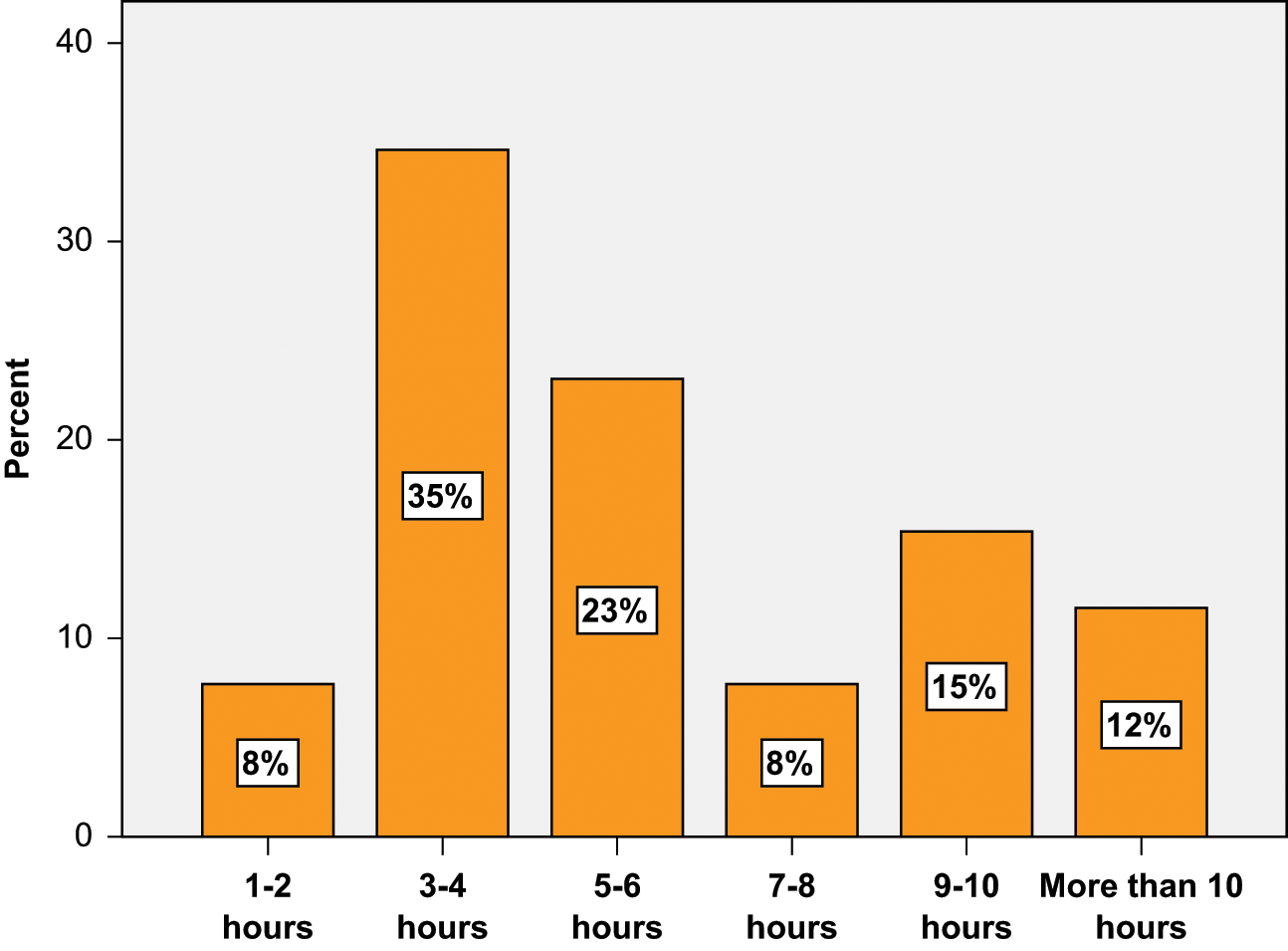
Time spent by university respondents on campaigning and other associated activities for the SMO studied
The second theme concerned the accessibility and dissemination of knowledge and information relating to political activism. Although the reflexive modernization literature would suggest an image of reflexively-minded activists actively and critically evaluating information from a variety of different sources, our findings presented a more modest picture. Regardless of the undoubted proliferation of information via media and the internet, our survey showed that the principle sources of campaign information used by members came from the SMO itself (see Table 1). Reflexive appropriation of information outside of the SMO’s resources was evident, but this information was almost exclusively derived from other campaign groups and organizations. Most surprising was that only 1% of respondents reported turning to the ‘general media’ for information to use in campaigning.
Sources of information used by university SMO group for campaigning events
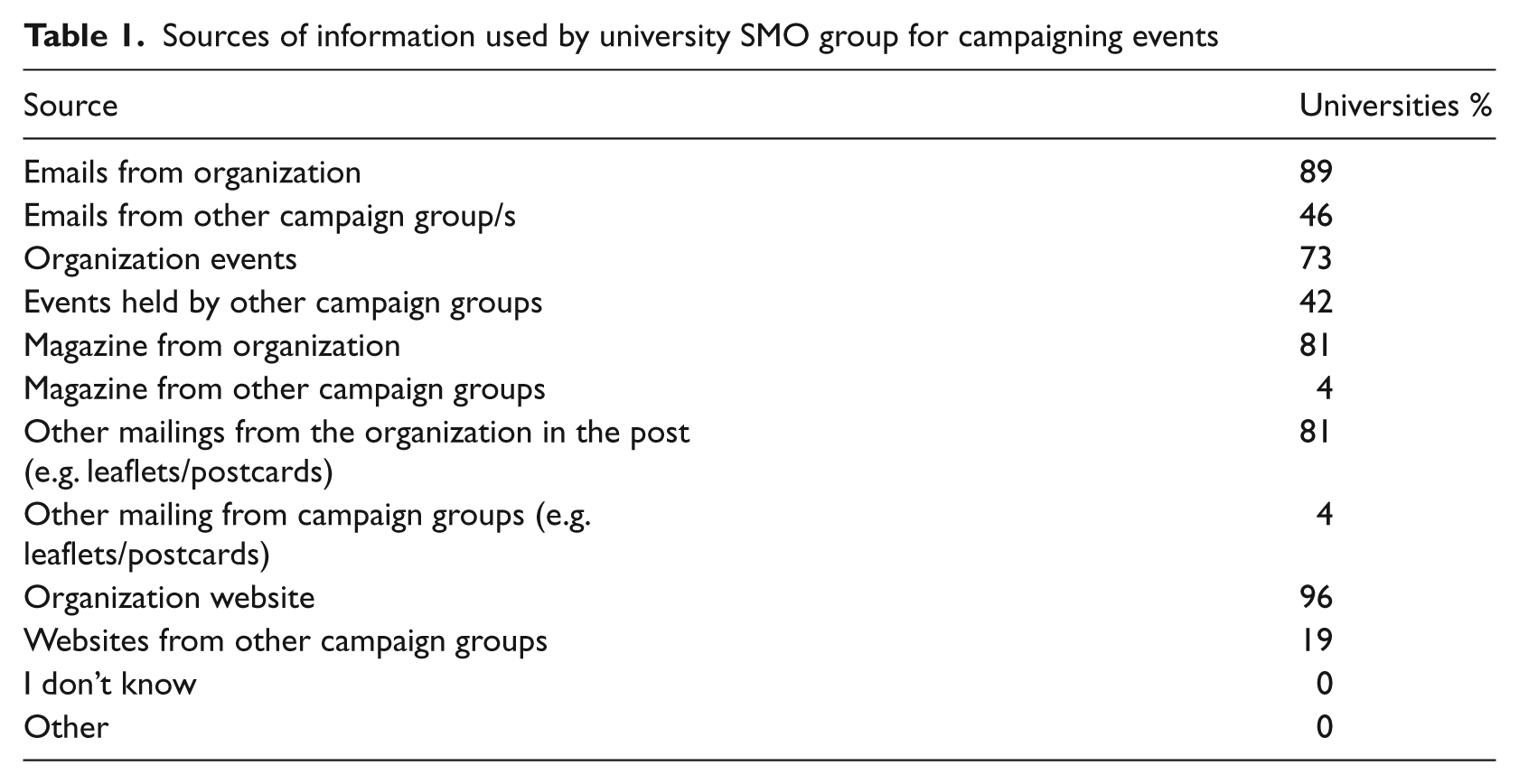
These results suggest that despite a seemingly infinite spectrum from which to access campaign information, members and leaders valued the authority of SMOs in their ability to filter, interpret and disseminate knowledge related to political issues. This is more in line with ‘resource mobilization theory’ advocated by McCarthy and Zald (1973), and perhaps presents an important caveat to the practice of reflexive thought and identity construction through the guise of DIY activism: ultimately, individuals still lack the resources and wherewithal to actively construct their own political identities, and instead look to trusted organizations to provide an authoritative voice on issues which might otherwise appear too complex and subjective through personal research. In other words, we can see that through well-researched and reliable research SMOs can provide a much-needed context and framework for one to actually ‘be’ reflexive.
The final theme focused on the relationship between membership and organization. A key survey question asked respondents to indicate how far they felt their group could influence how the organization worked with young people on a national level. Again, drawing on results from the student societies (members aged 18–23), 62% agreed and 19% strongly agreed that their group could influence the way the organization worked with young people on a national level. From the sample of respondents who were not fully paid-up members, 48% agreed and 7% strongly agreed.
Despite these broadly positive responses, our qualitative research suggested that feelings towards member-organization relationships were perhaps more fragile. On the one hand, the dissemination of campaign resources from the central organization was seen by many as inflexible, with little opportunity to adapt standard resources. Frustration at a ‘top-down’ approach was extended to the perceived inflexibility of issues selected for campaigns, which might have led to some members—via their multiple memberships— ‘jumping ship’ to other groups where they could pursue their particular agendas.
On the other hand, despite the tight control over campaign issues and resources and the apparent adherence to these prescribed activities by members, a common theme from interviews with group leaders was disappointment at the lack of feedback from the organization once campaigns had been completed. In some cases, the organization even neglected to inform its members whether campaign aims—especially those with specific goals and targets—had been achieved. Many interviewees expressed their disappointment with the SMO’s lack of communicative dialogue with members, again citing a top-down relationship in which emails and letters sent to head office were often left unanswered. In spite of these disappointments, however, there was much praise—and pride—in the organization’s overall reputation for successful activism and a sustained commitment to the SMO’s wider cause.
Conclusion
Whilst the ‘protest business’ argument can be seen to provide a fairly convincing portrayal of the self-sustaining bureaucratic practices that have come to dominate SMO management, evidence drawn from our own (admittedly small-scale) study suggests that this instrumentally-rational approach to political activism has not necessarily filtered down to all members. Drawing from our research, we can identify four key findings that provide important caveats to the ‘protest business’ thesis in its characterization of SMO members.
First, it should be noted that not all members are the same. From our research, we found that the activities and commitment levels of the student members contrasted starkly to the depiction of SMO members outlined in Jordan and Maloney’s study. Time was spent reading activism materials and planning campaign work, and members generally felt that they could influence how the organization worked, although certain frustrations over campaign materials suggested that this was not always borne out in practice. One should, of course, acknowledge that student members are not necessarily typical of the SMOs broader membership, but they nevertheless represent a distinctive and active part of its populace. In joining the SMO, our findings indicate that the members studied expected to contribute more than ‘surrogate participation’. This suggests that taking a ‘broad brush’ approach to characterizing SMO members should generally be resisted.
Second, the study suggested that not only were student members committed, they were also reflexive, i.e. able to critically monitor and evaluate their relationship with the SMO in question. The apparent degree of loyalty shown by student members was perhaps surprising given that many belonged to more than one social movement group, but this did not mean that members were uncritical. In fact, those with multiple memberships are well positioned to compare different campaign repertoires across a range of different groups. In other words, it is possible that should members feel that the SMO is failing to provide effective campaigning opportunities they will be more than willing to take their activism elsewhere. As a result, the findings highlight the importance of having strong ‘feedback loops’ between organization and membership, as it appears that active members would prefer to be treated as important voices in the organization’s decision-making process, instead of indistinguishable ‘surrogate participants’ as depicted in Jordan and Maloney’s study. According to our research findings, lack of feedback was a recurring complaint, and it is our view that members’ multiple affiliations across different campaign groups suggested that they had grown more accustomed to the post-bureaucratic principle of institutionalized dialogue (often in the form of deliberative democracy) when helping organize campaigns for its more flexible ‘DIY’ competitors.
Moreover, a feedback loop may also help SMOs make better use of its more active members. As members and supporters of multiple protest groups, they are more likely to compare and contrast popular and effective campaigns and repertoires across the political continuum. This sort of agency-level experience, when fed back into the overall system, might prove valuable in facilitating greater organizational progressiveness and flexibility, albeit within the confines of the basic SMO structure.
Third, despite demands for greater institutionalized dialogue, it is important to emphasize the role of SMOs as institutions of expertise. Where Jordan and Maloney assume apathy among members, this could be interpreted instead as a conscious trust in the organization’s ability to take the lead on social movement campaigns. Admittedly, on the basis of this research such an argument cannot be extended beyond youth and student activists, and would warrant further investigation in order to capture the attitudes of ‘ordinary’ paid-up members. Nevertheless, for people to be mobilized into signing petitions, donating money, even simply becoming a member, the SMO is expected to have used its materials and expertise to select a political issue worthy of mass attention, and present it in a way that is both accurate and convincing. This was clearly demonstrated in the favouring by activists of campaign materials offered by the SMO’s central planning committee, illustrating at the very least a healthy respect for the SMO’s knowledge and expertise, even if the materials themselves were sometimes considered inflexible.
Fourth and finally, we may observe that much of this is ultimately made possible by some degree of bureaucratic organization. As we have seen, a key finding from the research is the enduring loyalty and trust felt by members towards the SMO in question. This is illustrated in the usage of official materials for campaign information: clearly, such materials could not be produced and distributed on a wide scale without some degree of bureaucratic organization. Furthermore, loyalty towards the SMO has been aided by decades of brand-building, both in a marketing sense, and in the sort of front-line campaign work (and resultant media coverage) that the SMO engages in. So whilst bureaucracy left to its own devices can provoke suspicion, pessimism and apathy, when applied effectively—that is, with an appropriate balance struck between campaign goals and organizational maintenance—bureaucracy can help consolidate support and generate loyalty and trust like any other brand. So for all its palpable faults, maybe bureaucracy shouldn’t be such a dirty word in political activism after all.
Footnotes
Notes
Author Biographies
Alexander Hensby is a Political Sociologist at the University of Edinburgh, where he is currently researching participation and non-participation in the UK student movement for his PhD. He previously lectured in sociology and education at the University of Roehampton, and was research fellow at its Social Research Centre. He is the co-author (with Darren O’Byrne) of Theorizing Global Studies (Palgrave, 2011). Address: University of Edinburgh, Chrystal Macmillan Building, Edinburgh, EH8 9LD, UK. Email:
Joanne Sibthorpe is as an Applied Researcher at the University of Roehampton, London, working in research and business development. Her research interests are in strategies of mobilization of supporters, focusing on the impact of e-networked activism on grassroots activist groups and established social movement organizations. She has experience and interests in quantitative and qualitative social research methods, in particular social survey design. Address: University of Roehampton, 80 Roehampton Lane, London SW15 5SL, UK. Email:
Stephen Driver is Head of Social Sciences at the University of Roehampton, London. Stephen is a political scientist and has written widely on British politics and policy. He is the co-author (with Luke Martell) of a series of studies of ‘New Labour’. Stephen’s latest book, Understanding British Political Parties (Polity, Cambridge), was published in April 2011. Address: University of Roehampton, 80 Roehampton Lane, London SW15 5SL, UK. Email: