




Abstract
Academic commentary on the excellence project has tended to operate with a caricature of Tom Peters and has, furthermore, made broad claims for the organizing potential of the stories that feature in his texts. This article argues that any attempt to explore the nature of guru theory or to account for the organizing potential of its storyworld must look beyond such distortions and should be located within a critical analysis of storytelling practice. To this end we offer a sustained engagement with the work of Tom Peters and a longitudinal analysis of the stories that he has used to bring form and substance to his excellence project. Recognizing the dynamic nature of the excellence project the article focuses upon Peters’ attempts to feminize the concept and practice of business excellence.Through an analysis of Tom Peters’ storytelling practice we seek to explore the role, status and position of women in the excellence project and the extent of Peters’ conversion to ‘the women’s thing’. We argue that there is a narrative continuity in Peters’ work, which continues to portray women as organizationally problematic, and so, unworthy of full organizational membership. Reflecting upon this finding the article suggests a response to Peters’ attempts to feminize the excellence project that builds upon the transgressive potential of humour.
As critical scholars of management, work and organization we tend to define ourselves in relation to other signifiers. As critical scholars, therefore, we are not mainstream in our concerns (Llewellyn, 1999). When we reflect upon the business of management we are, most certainly, not orthodox in our reasoning (Tsoukas, 2005; Tsoukas and Chia, 2002). Indeed as a (loose) collective we are against management (Parker, 2004) and we are singularly unimpressed by fashionable notions (Collins, 2011).
Commenting on the constitution that underpins critical management scholarship, Parker (2004) observes that it is a political project divided by a common purpose that has been expressed in negative terms. For Parker, therefore, critical management scholars are united only insofar as they reject positivism, instrumentalism and quietism.
This article offers an account of management, work and organization that is, in the terms outlined above, ‘critical’: Its focus is the management guru Tom Peters. 1 Its aim is to offer a critical analysis of the orientations and concerns which shape Peters’ writing on the business of management. This aim, however, is problematic because as critical scholars of management we are disinclined to take gurus seriously. As a collective we dislike the representations of business and management rendered by the gurus yet we find these unworthy of sustained scrutiny. Consequently guru literature, when it appears in critical management scholarship, is rendered in a limited fashion and is cast ‘as a foil’ (Parker, 2004: 118) for our superior logic and intellect. Despite its aims, therefore, critical management scholarship tends to produce limited and curiously calculated accounts of the gurus of management. Thus Parker’s (2004) analysis suggests that when the subject is guru literature it is necessary to be more than just ‘critical’. Recognizing this our analysis of Tom Peters and his ‘excellence project’ might be regarded as being doubly critical insofar as it paddles against the mainstream currents of business and management scholarship and the prevailing conventions of ‘critical management’.
The conventions of critical management scholarship demand that guru literature should be challenged. As a leading and unapologetically pro-business commentator, 2 Tom Peters has been attacked and has often been ridiculed by more critical scholars (Gabriel, 2008). Such attacks make for good sport of course (Collins, 2001). But they have a tendency to descend into caricature. Indeed Collins (2007) notes that commentaries on the excellence project often contain fundamental errors of fact which suggest that Peters belongs to that category of writers who should be attacked but need not be read! This attitude can make it difficult to legitimate any more sustained engagement with guru literature. Indeed experience suggests that when confronted by an article on Tom Peters editors are, simultaneously, dismissive of this man’s work on business excellence and disdainful of any attempt to explain why this project should be made the subject of serious academic scrutiny.
Mindful of this prejudice we aim to offer a distinctive analysis of the work of Tom Peters which accommodates, yet challenges and extends the conventions of critical scholarship. Thus we offer an analysis of Tom Peters’ storywork that has been designed to explore the preferences and priorities, which underpin the excellence project. This broad aim is no doubt familiar to many subscribers. Indeed readers and reviewers may already be howling that they ‘have heard all this before’. And to some extent this complaint is valid. A number of others have, indeed, offered critical accounts of guru storytelling (see Höpfl, 1995; Rüling, 2005). In fact a large number of commentators have suggested that the gurus of management use stories of organization to attract and to retain a following (see Collins, 2007). However these accounts of the guru-as-storyteller limit critical inquiry insofar as they make broad claims for the organizing potential of the stories that feature in guru literature yet fail to consider in any detail the storytelling practices that shape these texts (Collins, 2012). We argue, therefore, that any attempt to explore the nature of guru literature or to account for the organizing potential of its storywork must be located within a critical review of its storytelling practice. To this end the article offers a longitudinal analysis of the stories that Tom Peters has used in his attempts to bring shape and substance to the excellence project. Acknowledging the extent to which ‘critical management’ has sought to make space for gender in the analysis of management and organization we will build upon a critical review of Peters’ storytelling practice as we seek to account for the role, status and position of women in the storyworld of the excellence project.
Accordingly, our article is structured as follows: To avoid caricaturing our subject we begin with a brief, but balanced, appreciation of the career of Tom Peters, which acknowledges the dynamic nature of the excellence project. Reflecting upon the development of the excellence project we will focus upon the emergence of the ‘women’s thing’ (Peters, n.d.). This ‘women’s thing’, as we shall see, builds upon Peters’ recognition that business has failed to appreciate the market power and potential of women. In an attempt to challenge such organized stupidity Peters has developed a narrative, which advises women to roar their discontents.
In our second main section we will pursue this changing narrative as we turn our attention to the literature on organizational storytelling. Exploring the divisions that scar this landscape we will provide an overview of the debates that shape the storytelling terrain. Building upon this critical review our third main section will offer a reanalysis of the excellence project. Reflecting Peters’ conviction that stories can provide key insights into personal orientations and organizational priorities (see Peters, 2003; Peters and Austin, 1985; Peters and Waterman, 1982) we will review the tales that shape Peters’ narratives of business. Analysing eight, key, texts produced between 1982 and 2003 (Peters, 1987, 1992, 1993, 1994, 1997, 2003; Peters and Austin, 1985; Peters and Waterman, 1982) we will offer an account of the methods that underpin our research and an examination of the storytelling practices that bring shape and substance to Peters’ assertions. Reflecting upon these practices we will attempt to assess the extent to which Peters’ public conversion to the ‘women’s thing’ has altered the narrative of business excellence. Finally our concluding section will suggest a response to Peters’ thing that builds upon the transgressive potential of humour.
Tom Peters—management guru
Tom Peters was born in Baltimore in 1942. He holds undergraduate and postgraduate degrees in engineering from Cornell. In addition, he holds an MBA and a PhD from Stanford.
Peters joined McKinsey & Co in 1974 and became a partner just three years later. In 1981 he resigned his partnership to concentrate on the production of a book that sought to distil the outputs of the research into ‘organizational effectiveness’, which he had conducted on behalf of his employer.
In Search of Excellence, co-authored with Robert Waterman (Peters and Waterman, 1982), launched a project that has endured for some three decades. 3 Indeed this text, the project which it nurtured and the spin-offs (including awards, journals and trans-national studies) which it spawned, changed Peters’ life dramatically. It would not be an exaggeration to suggest that In Search of Excellence catapulted Peters into the media spotlight, transforming him overnight from a mere management consultant into the guru of management (Crainer, 1997; Collins, 2007; Rhodes and Westwood, 2008).
Cole (1999) observes that our media is attracted to the sensational and Tom Peters’ guru career has been nothing if not spectacular. In Search of Excellence, for example, was the first non- biographical business text to top the New York Times ‘Best Sellers List’. It remained atop this listing for two years until it was pushed into second position by Peters’ follow-up work: A Passion for Excellence (Peters and Austin, 1985). The Tom Peters Group (see Collins, 2007) estimates that in the US alone In Search of Excellence has racked up more than 4.2 million sales. 4 Little wonder, then, that the publisher Bloomsbury named this text the ‘Greatest Business Book of All Time’.
Crainer (1997) reminds us, however, that this market success was unexpected. Indeed Hyatt (1999) notes that early iterations of the excellence project—presented as day-long seminars—actually ‘bombed’ with McKinsey’s clients. Furthermore Hyatt observes that this endeavour only began to achieve success when Peters abandoned the orthodox narrative of consulting practice in favour of a more anecdotal approach. Recognizing the significance of this change many commentators have suggested that Peters’ success as an author and business commentator derives largely from his skill as a storyteller (see Maidique, 1983; McConkie and Bass, 1986; Watson, 2001).
Yet book writing is but a small part of what management gurus do. Indeed the top gurus 5 spend the bulk of their time consulting to organizations and giving lectures. Booking agents in the UK (who prefer to remain anonymous) suggest that Tom Peters is, and has been for some years, one of the highest paid performers on the seminar circuit. At present Peters can command around (US) $85,000 for a 60-minute conference speech and, despite this fee structure, still finds it necessary to restrict his speaking engagements to a maximum of 100 per year.
As critical scholars of management, however, we tend to be sceptical of narratives which root themselves within, and define themselves according to, orthodox market metrics. Thus the term ‘popular management’ (Pagel and Westerfelhaus, 2005; Rüling, 2005), tends to betray a political-aesthetic judgement rather than signalling, merely, an empirical fact (see Rhodes and Westwood, 2008). When academics suggest that a text belongs to the genre of ‘popular management’, therefore they assert that the work in question need not be taken seriously.
Gabriel (2008) is very much aware of this prejudice. Consequently he couches his reappraisal of Tom Peters’ standing in terms of those indicators, which act as proxies for academic quality. Noting that many serious scholars have, either, forgotten or given up on this commentator, Gabriel reminds us that In Search of Excellence ‘is a book cited more than 3000 times in academic journals since its publication, continuing to draw about 60 or more citations annually’ (p. 1064). This, he reminds us, ‘remains a considerably larger number than the 1600 citings of Gareth Morgan’s Images of Organization or the 1500 citings of Mintzberg’s Nature of Managerial Work’ (p. 1064).
Colville et al. (1999) approach the question of Peters’ legacy from a different angle. They are, perhaps unsurprisingly, forceful advocates for the excellence project. Indeed they insist that In Search of Excellence is a complex and theoretical work, which continues to exercise an influence over managerial practice:
People want to have good conversations about life and living. ISOE gave them the pretext to have those conversations openly and with feeling in the 1980s. ISOE continues to serve that purpose . . . That is why ISOE has had staying power. (Colville et al., 1999: 141).
Linstead (2002), however, protests that Colville and his colleagues over-play their hand when they praise the excellence project. Examining the roots of this endeavour, Linstead argues that In Search of Excellence builds upon a rather shallow theoretical foundation. Thus he observes that the text, which launched the excellence project considered only a small sample of the organizational theory that was available in the 1980s and, what is more, selected only from those theorists who had oriented themselves to the pursuit of, narrowly, ‘functional and performative ends’ (p. 671).
Watson (2001), in contrast, seems more forgiving of Peters’ theoretical eclecticism. Focusing upon the very essence of social organization, Watson argues that the excellence project has had a significant impact upon the theory and practice of management because it successfully positions managers, not as rude technicians, but as heroic actors; narrative craftsmen whose job it is to make meaning for those who would, otherwise, be drowned in the ambiguity of everyday life. Building upon this understanding, Gabriel (2008) suggests that Peters should be viewed ‘as someone who, in the tradition of F W Taylor, reinvented the manager in line with the demands of his times’ (p. 1066). Thus Gabriel suggests that future scholars of management will speak of ‘Petersism’ (p. 1066) as we now speak of Fordism and Taylorism.
Gabriel’s reflections on Petersism are insightful and provocative. Yet his review indulges a static account of the excellence project. Indeed Gabriel seems to suggest that Petersism might now be regarded as an historical anachronism which may be filed with shoulder pads, big hair and even bigger mobile phones as, both, symptom and symbol of the 1980s. Yet any sustained engagement with the writing of this guru soon reveals that ‘Petersism’ is an inherently dynamic philosophy. Thus we must acknowledge that the excellence project has continued to evolve within the broad parameters of guru theorizing outlined by Huczynski (1993). 6 In recent years, for example, Peters has widened the base of the excellence project to include European organizations which were, of course, excluded from In Search of Excellence (see Peters, 1992). Similarly—and from at least the mid-1990s—Peters (1994, 1997) has enlarged the excellence project to take account of the seductive language of product design. In parallel with this concern for design matters the excellence project has been extended, yet further, to celebrate (ostensibly) the position and the potential of women in the modern economy.
Tom Peters, himself, dates this latter development quite precisely. It occurred, he tells us, at 9am on December 18th 1996 in the offices of Wordworks ‘one of America’s nine million women-owned businesses’ (Peters n.d.: 3, emphasis in original) when thirty female entrepreneurs made him, painfully, aware that he, in common with the rest of the business world, had been blind to the needs, power and potential of women. Since that day in December 1996 Peters has, he tells us, worked to incorporate ‘the women’s thing’ in his narratives of business excellence so that organizations, the world over, will hear when women roar their discontents.
In our third section we will attempt to probe Peters’ conversion to the ‘women’s thing’ as we consider the tales that he uses to narrate the business of excellence. Yet before we can turn to this we must consider the key controversies that shape the debates on organizational storytelling.
Women, work and storywork
Recognizing the important role which stories play in Tom Peters’ narratives of business, this section will attempt to construct an overview of the debates on organizational storytelling. Indeed this section and the next will attempt to construct an analysis of storytelling that can facilitate a critical appraisal of the epiphany that Peters experienced—rather earlier in the calendar than is normal—on December 18th 1996.
Reflecting upon the roots of the current interest in narratives and stories, Gabriel (2000) reminds us that the, contemporary, interest in storytelling derives from earlier attempts to catalogue and harvest folklore and yet departs from this tradition insofar as it insists that organizational stories have meaning and significance only when they are recognized as vital constituents of social organization. In this respect the interpretative studies of organizational storytelling that are preferred by Gabriel (2000) and by Boje (1991, 2001) represent an attempt to redeem stories from those traditions of modernist scholarship which, by the 1930s, had deemed such narratives to be a) moribund and b) subordinate to ‘fact’.
Yet this shared commitment to organizational storytelling as a mode of inquiry can disguise the presence of deeper-seated disputes. At root, these disputes reflect basic disagreements about the nature of organizational stories; their key characteristics; and their organizational function.
On the first of these fractures—the nature of organizational stories—a basic division may be drawn between inductive and deductive commentaries. On the inductive side of this division stand Greatbatch and Clark (2005) who, perhaps uniquely, argue that a story is defined by its audience and that any attempt to suggest otherwise is determinist. On the deductive side of this debate we find commentators such as Boje (1991) and Gabriel (2000, 2004) who argue that stories share common structural traits and so may be defined a priori.
The second fault-line in the storytelling terrain opens a debate on the key characteristics of organizational stories and divides those who hold to a classical account of narrative form (see Aristotle, 1965) from those who subscribe to an antenarrative approach. This dispute pits Boje (2001) and a select group of followers (see for example Adorisio, 2009) against pretty much everyone else (see for example Czarniawska, 1997, 1999; Gabriel, 2000; Hopkinson, 2003; Martin et al., 1983; Søderberg, 2003). The classical side of this fracture is, therefore, (densely) populated by those who argue that plots are a core structural characteristic of those narrative forms that we commonly label as stories. On the antenarrative side of this divide, meanwhile, Boje (2001) stoutly maintains his support for a deductive approach yet insists that organizational stories exist prior to the conventions of plotting and characterization and, what is more, must struggle to evade these strictures.
The debate on the function of organizational storytelling separates those who view stories as tools that managers may employ to enhance organizational control from those who see stories as localized products of organizational complexity. This fault-line has acquired a variety of labels. Boje (1991), for example, distinguishes those texts which offer ‘monological narratives’ of business from others that seek to explore the ‘organic’ and ‘polyphonic’ character of organizational stories. Echoing this division, Collins (2007, 2012) makes a distinction between ‘top-down’ and ‘bottom-up’ accounts of organizational storytelling. Indeed he suggests that guru literature views storytelling as an exercise in ‘public sensegiving’ (Gioia and Chittepeddi, 1991) whereas critical management scholars have been concerned to explore the ‘local sensemaking’ processes (Weick, 1995) which organizational tales reflect and project.
Analysing organizational rhetoric, Höpfl (1995) offers an account of guru literature, which explores the divisions between these sensegiving and sensemaking perspectives. She argues that we should separate those texts that seek to advance the corporate management of identity from those which in seeking a more intimate connection with the complex and contested nature of identity might be considered to be poetic. Höpfl concedes that rhetoric and poetry have often been considered as equivalents. Indeed she acknowledges that these narrative forms have often aroused suspicion and in being jointly associated with manipulation, self-advance and trickery have attracted condemnation. Nonetheless she protests that rhetoric and poetry exhibit different orientations and in so doing trace quite different trajectories.
Pursuing these differences in orientation, Höpfl (1995) argues that rhetoric is a masculine projection defined by its ‘directedness’ (p. 178, emphasis in original). Thus
rhetoric has a trajectory towards its intent and is fulfilled by its outcome. It is directed to an audience (present or absent) and achieves its objective by provoking a response. Rhetoric is completed by the Other. It is concerned with the skills and strategies of manipulation and, therefore, offers a repertoire of stylistic devices which are to be developed to this end. (p. 176)
Poetry, on the other hand, seeks a relationship with the complexity and connectedness of a lived experience that extends beyond the workplace. Thus Höpfl argues that poetry restores voice to the text and in so doing threatens the ordered, but manipulative rationality of corporate rhetorics. Poetry, therefore, is separate from and disruptive of organizational rhetoric: Its narrative speaks from within movements, processes and biographies and in highlighting organizational ambivalence invites employees to withdraw their consent to corporate plans.
Commenting further on the experience of organizational rhetoric and on the tensions between the life-narratives of the poetic and the templates-for-performance promulgated by guru literature, Höpfl places gender—explicitly—within the debates on popular management and organizational storytelling. She argues that women, in particular, have difficulties with guru rhetoric. Indeed she observes that popular management is predicated on the existence of a self-identity that is simple, singular, stable and saturated by the world of work whereas the identity of women workers is complex, multiple, moving and—more so than for their male counterparts—divided between any number of competing dimensions and orientations. Furthermore she argues that, viewed from within the masculine perspective of guru literature, women represent a disruptive presence that must be dominated. Remarking on this process, Höpfl suggests that guru literature manages women by acting to deny their organizational membership.
It might be countered, however, that Höpfl’s work tends to downplay the extent to which all narrative forms—including ‘the poetic’—depend upon rhetorical flourishes to secure their meaning and effect (Schön, 1979). Equally it might be argued that Höpfl’s own separation of ‘the rhetorical’ from ‘the poetic’ is, itself, evidence of a highly masculinist projection. Indeed. the works of Linstead et al. (2005), Tyler (2005) and Bendl (2008) suggest that Höpfl has produced an account of work, management and organization which fails to concede the difficulties that men have in the performance of masculinity. And yet Höpfl does appreciate the limits which local sensemaking processes place on public sensegiving and she does, at least, invite us to make gender an explicit element in the analysis of guru literature. Thus her work prompts us to consider the manner in which Tom Peters has used organizational stories to locate and to account for the position of women within his excellence project. Accordingly our next section will examine the stories that Peters has employed to shape our understanding of the social organization of the workplace. Yet before we embark upon this undertaking we must first account for the manner in which we have separated Peters’ stories from his more general narratives of business.
Defining organizational stories
In our analysis of the storywork that underpins the excellence project we reject the inductionist approach preferred by Greatbatch and Clark (2005). This approach, despite the protestations of its authors, disguises some rather deep-seated and highly deductive assumptions about what an audience might hear. Furthermore this ‘anything goes’ approach to storytelling tends to conflate and confuse those narrative forms that more thoroughly deductive accounts have been at pains to separate (see Gabriel, 2000). Similarly we reject Boje’s antenarrative analysis because this account of the essence of storytelling diminishes the portability and performativity of workplace tales (Collins, 2007). Finally, we reject as simplistic those accounts of organizational storytelling which suggest that tales of organization possess an unmediated sensegiving capability. Following Gabriel, therefore, we define stories as those special and local forms of narrative which:
place characters in a predicament;
unfold in a manner that reflects the structure of the plot and the essential; traits of the characters involved;
depend upon symbolic resources;
proceed to a satisfactory conclusion;
seek a relationship with a deeper and more enduring truth than is achieved through mere factual verification.
Method
In an attempt to locate, describe and analyse the stories that Peters has employed in his narratives of business those texts previously identified as constituting the excellence project (Peters, 1987, 1992, 1993, 1994, 1997, 2003; Peters and Austin, 1985; Peters and Waterman, 1982) have been reviewed. To assist with this process, and to facilitate subsequent verification and reanalysis of the texts, a cataloguing form similar to that employed by Gabriel (1995) has been employed. This form collected information detailing:
the location, the opening words and the closing phrase of each of the poetic tales identified;
the main characters of each story;
the dominant theme of each tale;
the underlying emotional qualities of each tale—whether prides, sadness, etc.;
the dominant narrative type—whether tragic, comic, etc.
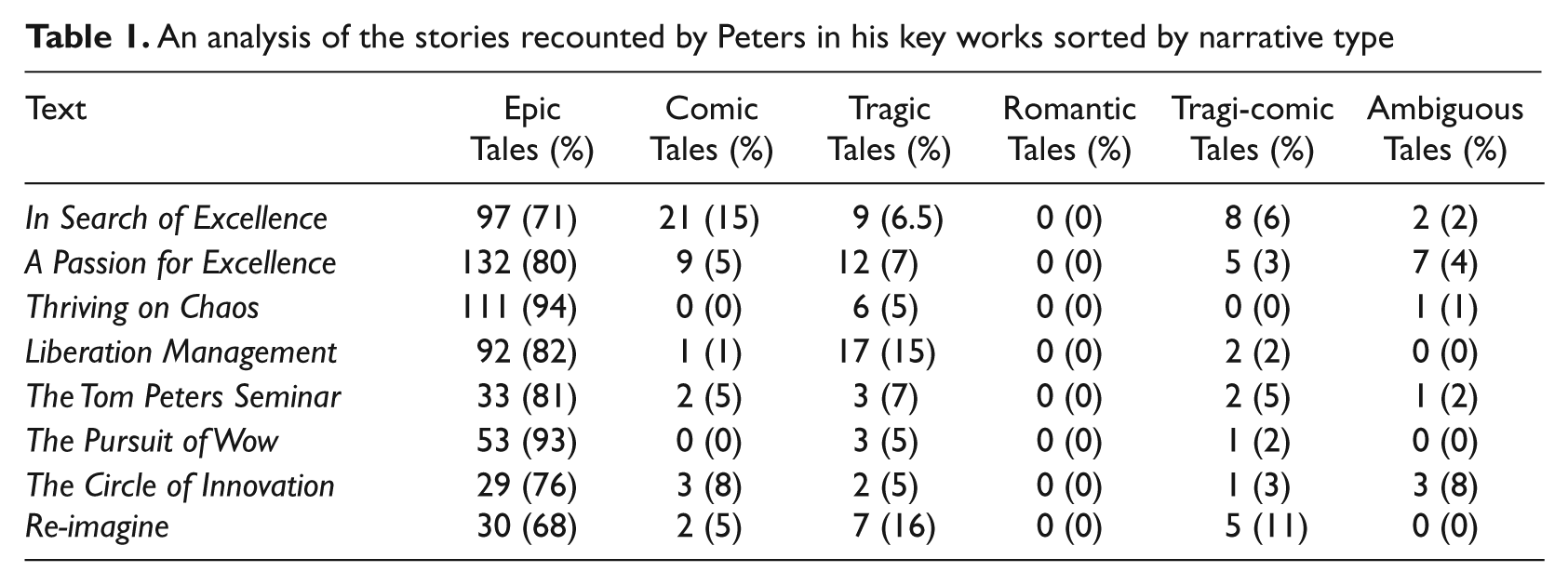
Readers may well protest that this attempt to signal the dominant narrative type of the tale under scrutiny tends to conflict with our preferred outline of organizational storytelling which suggested that such narratives are temporary, local and fragile. Yet in response to this (anticipated) objection we counter that it is possible to recognize, simultaneously, the feasibility of local and alternative renderings of organizational tales and the intention of the original storyteller. Thus our attempt to chart the dominant narrative type of each of the tales catalogued should be viewed as an attempt to name the author’s intention and is based upon an analysis of the tale within its immediate context. That said the cataloguing exercise turned over a few instances where Peters seems to fail outright in his sensegiving endeavours. A very few stories, therefore, have been catalogued as ‘ambiguous’ because in these instances, Peters appears unable to communicate a clear sense of his intentions and orientations. Table 1 offers an account of the broad contours of Peters’ storywork.
An analysis of the stories recounted by Peters in his key works sorted by narrative type
On average it took some five days of intensive working to catalogue and to chart the stories contained in each of the texts selected for analysis. This labour was undertaken during the late summer and early autumn of 2004. Subsequent reanalysis and verification of this initial cataloguing required a further 15 days. In total it took some ten weeks of labour to create our initial catalogue of Peters’ organizational storytelling.
The analyses of Höpfl (1995) and Rüling (2005) among others (see for example Maidique, 1983; McConkie and Bass, 1985) assert that popular management builds and depends upon heroic or epic stories of business success. Our catalogue, however, extends Höpfl’s analysis and modifies Rüling’s review insofar as it demonstrates that the storytelling practices of the excellence project are broader and more diverse than previously imagined. Thus Table 1 makes it plain that Peters leans upon epic stories of success but will happily employ comic or tragic tales when these support his aims.
In 2010, a funding award from the British Academy enabled the preparation of a digital archive of Peters’ storytelling, designed to facilitate further analysis of the excellence project. This digitized catalogue of Peter’s storywork has been re-examined to explore Peters’ conversion to ‘the women’s thing’.
Women in Tom Peters’ Storyworld
Table 2 tabulates those tales from Peters’ storyworld, which feature female characters, or otherwise signal the presence of women (at work). It demonstrates that, while women have been seriously under-represented in Peters’ storyworld they have, at least, become more visible in the narratives of business excellence that he has published since the mid-1990s. In this regard there is some evidence to suggest that Peters’ epiphany of 1996 did, in fact, lead to a more substantive change in his conduct.
Women in Tom Peters’ storyworld
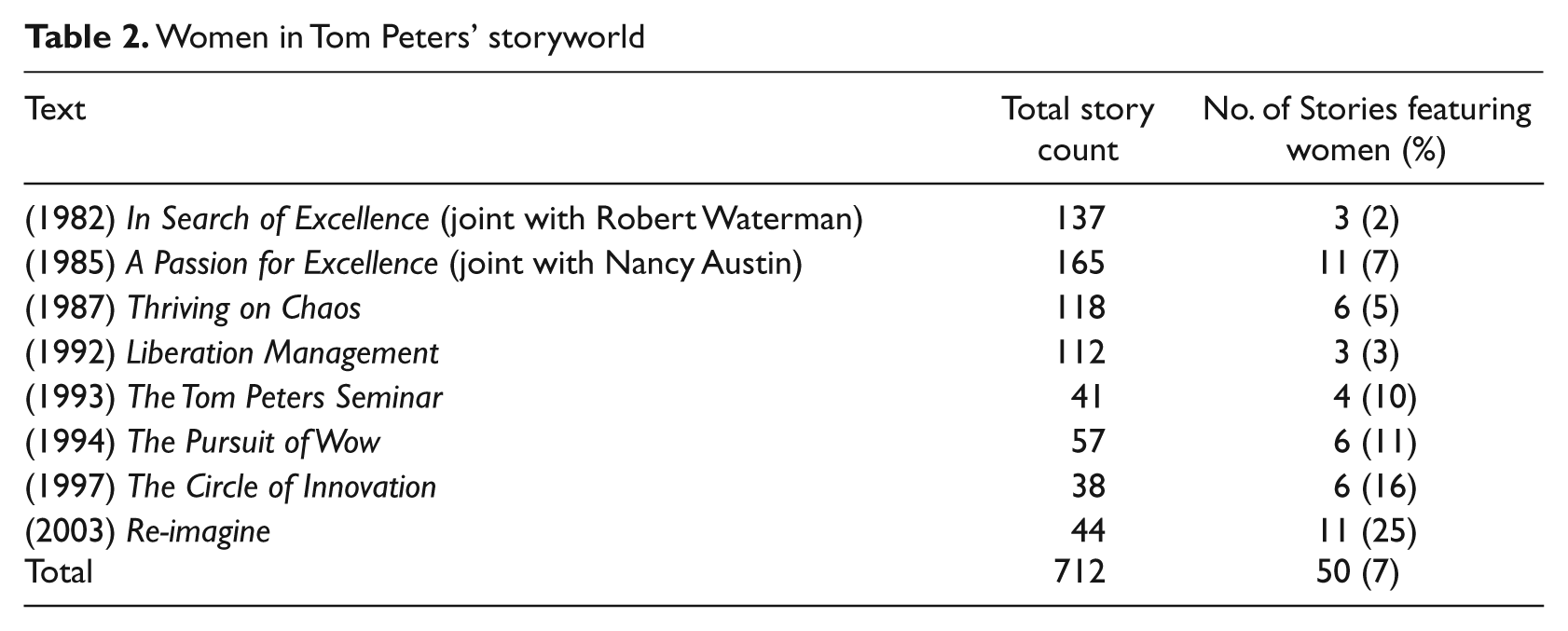
Yet when we subject Peters’ tales of women and work to more detailed scrutiny it soon becomes apparent that, while women are increasingly present in Peters’ storyworld, they remain marginal to and, largely, silent within a world of work that is overwhelmingly masculine in its orientation and trajectory. In an attempt to explore these storytelling preferences and practices we will offer an analysis of Peters’ texts pre- and post-revelation.
1982–1996
In Search of Excellence is Peters’ most famous and most lauded text (Collins, 2007). This is the text that established the basic structure of modern guru literature (Huczynski, 1993) and in so doing opened the flood-gates for cultural studies of management. Yet when we examine the tales that Peters and Waterman use to advance their analysis of business excellence it quickly becomes apparent that in this political project women will serve the revolution by making the tea. Thus in a corpus of 137 tales women appear in just three stories and then indirectly and never in the context of the workplace itself. Indeed in the first of these stories ‘the woman’ is an adjunct to the main action and is, consequently, mentioned as an aside:
LaPiere, a white professor, toured the United States in 1934 with a young Chinese student and his wife. They stopped at 66 hotels or motels and at 184 restaurants. All but one of the hotels or motels gave them space, and they were never refused service at a restaurant. Sometime later a letter was sent to the establishments asking whether they would accept Chinese as guests. [There was a strong anti-Chinese bias in the United States at the time.] Ninety-two percent said they would not. LaPiere, and many after him, interpreted these findings as reflecting a major inconsistency between behaviour and attitudes. Almost all the proprietors behaved in a tolerant fashion, but they expressed an intolerant attitude when questioned by letter. (Peters and Waterman, 1982: 73–74, parentheses and emphasis in original)
In the second story we have not one but a number of women present. This tale, however, deals with its characters en bloc. Thus we have saleswomen, who parade and are rewarded with trinkets, and management—unlabelled in gender terms, and so, male—who orchestrate the actions of their female employees.
The saleswomen do a lot in this narrative. They are always on the move. Yet it is the managers who are the heroes of this drama. The saleswomen have, therefore, walk-on parts in a larger pageant, which has been designed a) to reveal past conduct and b) to shape future behaviour. Consequently the women present in this tale do not appear as characters in their own right and are not granted full organizational membership. They are, but, variables within a very public system of management control:
Tupperware makes about $200 million in pre-tax earnings on about $800 million in sales of simple plastic bowls. The key management task is motivating the more than 80,000 salespeople, and a prime ingredient is ‘Rally’. Every Monday night all the saleswomen attend a Rally for their distributorship. At Rally, everyone marches up on stage—in the reverse order of last week’s sales—during a process known as Count Up (while their peers celebrate them by joining in All Rise). Almost everyone, if she’s done anything at all, receives a pin or badge—or several pins and badges. Then they repeat the entire process with small units marching up. On the one hand, this is a fairly punishing drill—straight head-on-head competition that can’t be avoided. On the other hand, it is cast with a positive tone: everybody wins; applause and hoopla surround the entire event; and the evaluation technique is informal rather than paper-laden. In fact, the entire Tupperware system is aimed at generating good news opportunities and celebration. Every week there is an array of new contests. Take any three moribund distributorships: management will give a prize to whichever one has the best sales increase in the next eight weeks. Then there are the thirty days of Jubilee each year in which 15,000 are feted (3,000 at a time in week-long events) with awards, prizes and ceremonies of all kinds. The entire environment is one that utilizes, in the extreme, positive reinforcement. (Peters and Waterman, 1982: 123–124, emphasis in original)
The third tale of women and work reproduced by Peters and Waterman (1982) is similar to the first insofar as it casts ‘the woman’ in a supporting role and places her in a domestic setting. Indeed in this third tale the presence of the woman is merely implied and arises only insofar as we are willing to assume that a family is composed of a husband, a wife and (some) child(ren). Thus the woman’s identity is entirely constituted by her position within a family that is surprised by, but eternally grateful to, a generous corporate benefactor. Indeed the real hero of this, second-hand, tale is Proctor and Gamble, which appears in the guise of a ‘good Scrooge’:
7
One of our colleagues was in the brand-management program at P&G for three months as a summer hire. He recalls that his family still received a Thanksgiving turkey from P&G five years later. (Peters and Waterman, 1982: 261–262)
In fairness to Peters, however, we should point out that there are some tales in his pre-1996 texts where women do feature more prominently. Indeed there are a number of stories in the key texts produced between 1982 and 1994 which feature women as senior employees or as organizational decision-takers of some significance.
In total there are 11 tales which allow women to occupy such privileged roles in Peters’ storyworld. Four of these tales are found in A Passion for Excellence (Peters and Austin, 1985), which was co-authored with Nancy Austin, and four more are to be found in Thriving on Chaos (Peters, 1987); Liberation Management (Peters, 1992); The Circle of Innovation (Peters, 1997) and Re-imagine (Peters, 2003). Each offer one tale of female achievement in the workplace. Notably only two of these stories appear after Peters’ conversion to the ‘women’s thing’. And perhaps more alarmingly these tales tend to suggest that women who ‘make it’ at work do so thanks to the assistance of a male sponsor who, quite unlike his female counterpart, enjoys full organizational membership.
The tale below deals with an interaction between Sarah and Bill. Sarah began working for Bill in a junior, and gendered, position. Yet despite the modesty of her entry-level Sarah has prospered. Her present position in W. L. Gore is unclear because Bill ‘doesn’t stand on formality’ and does not encourage the use of rank and title. However, it is clear that Sarah is trusted as an employee and can, in fact, be entrusted with the good name and reputation of W. L. Gore. Yet it is Bill who is the hero of this tale. When all is said and done it is Bill who owns W. L. Gore and it is he who has caused and allowed Sarah to do whatever it is she must do for the company:
Sarah worked for W. L. Gore & Associates. She began as a secretary-bookkeeper in one of Gore’s twenty-eight factories. Bill Gore doesn’t stand on formality. There are no titles whatsoever in the company. Sarah was to go to a meeting in Phoenix to talk about W. L. Gore. She ran into Bill, on one of his many visits, a couple of weeks before going to the event. ‘I’m going to this meeting, Billy’, she said, ‘and they’re going to want to know who I am. What do I do?’ ‘Well Sarah, that’s up to you’, Gore replied. ‘What do you want to be?’ ‘Beats me’. ‘Well how about ‘Supreme Commander’?’ Sarah agreed. Sarah is an ‘owner’ of W. L. Gore & Associates in the deepest sense of that word. (Peters and Austin, 1985: 218)
Our next tale features Laurie Schwartz. Laurie, we learn, has a career. Laurie is in charge. Indeed, Laurie has secured a turnaround in the fortunes of a commercial district whose success is central to the vitality of the City of Baltimore. Yet it is Mayor Don Schaefer who is the hero of this tale. It is Don who is the real agent of change. Thus the story below makes it clear that Laurie is in charge of Charles Street because the mayor, as a full member of the organization, told others ‘to do whatever [Laurie] says’. So while Laurie has been allowed to give orders, it is Don who pulls the strings. Indeed, we learn that Laurie is in charge of Charles Street because the mayor deftly manoeuvred her, stirring her desires . . . to return to the public sector. Laurie’s task is, therefore, Don’s mission. She is a success because Don willed it so!
Laurie Schwartz had worked for Mayor Don Schaefer but had taken off to pursue a career in the private sector. After a chance get-together at a Christmas party, he once again tapped her. She had indicated that she might be available for one of his famous ‘special projects’. Without another word, he invited her to a meeting. He didn’t tell her what it was about, even after she joined a confab of senior business people from Charles Street. With amenities quickly out of the way, the mayor got down to business. ‘I want you to meet Laurie Schwartz. She’, he declared, ‘is now Ms. Charles Street. She’s going to get us here’. (Baltimore’s main business street was not being transformed at a pace that was up to Schafer’s soaring standards). And that was that. Charles Street was Schwartz’s. The mayor dragged her back down to City Hall, where the city’s department heads were assembled. ‘Laurie’s back’, the mayor announced. ‘She’s running Charles Street, and you’re to do whatever she says’ The charge was about that simple, though the execution obviously was not. A couple of years later Charles Street was fast becoming a gem, with over 100 million new dollars invested in it. Laurie Schwartz was the cheerleader, the quarterback, the de facto chairman of the board. Did Schaefer really believe that she could pull off this miracle? One suspects he did. It is clear that he delegated the responsibility to her unequivocally. She was out on a limb. She had said she was somewhat interested in doing something for him; in return he had lobbed a key part of the city her way. Schaefer had done a frightening thing to her. She believed in him, believed in his compelling vision, believed in his track record of making the impossible seem almost routine. Moreover, she believed that he believed in her, and that he wouldn’t have done this ‘to her’ unless he thought she could pull it off. So she now had the monkey on her back for a piece of his—their—vision. It was her ball, in her court. Deliver or else, her psyche said; and that’s precisely what His Honor had intended’. (Peters, 1987: 456–457, emphasis in original)
Those few women allowed access to the executive cadre who are not, obviously, in debt to a male sponsor exhibit a distinctive approach to management in Peters’ storyworld. This approach, which is lauded by Peters, suggests a style of managing that retains a rather masculine psychology. Thus in the tale below Mary Kay Ash demonstrates that she has, perhaps uniquely, a proven ability to snap people out of depression:
Mary Kay Ash, in her book Mary Kay on People Management, reprises that ‘stretching’ theme with her account of a telephone call from a ‘consultant’ (her term for May Kay field people) in Michigan, who was not doing well in her business We talked for a while, and I finally told her. ‘Here’s what we’re going to do. We’re going to have a special contest just for you. I want you to book ten beauty shows for next week, and after you’ve held ten, I want you to call me back and tell me how you did’. ‘Ten shows?’ ‘That’s right’, I answered. ‘I want you to call each hostess in your datebook, and say that you just talked to Mary Kay. Tell her that I’ve established a contest for you, and then let her know how much you want to win it. Finally ask her to be a hostess for next week’. Based on what she told me, I knew her problem: she was giving only one or two beauty shows a month. I also knew that former hostesses would be the most receptive, giving her a better chance to book more beauty shows. With enough exposure, I felt she would do well. She just needed to gain confidence. At the end of the following week she called me to back to report $748 in sales. Although it was not among the highest sales recorded that week it was by far a record for her. Even though she hadn’t booked all ten shows, she was elated and seemed to have snapped out of her depression. (Peters and Austin, 1985: 363)
Such accounts of female, managerial, achievement are, however, rare in the storyworld of the excellence project. More typically those women who do make an appearance within Peters’ tales of workplace endeavour are cast as low-ranking employees. This casting process is not in itself problematic. Women are, after all, under-represented in the senior ranks of management and are, furthermore, comparatively rare in the upper-reaches of professional organizations (Bolton and Muzio, 2007). What is problematic, however, is Peters’ suggestion that an absence of creativity explains women’s subordination. Thus the story reproduced below relates the manner in which an heroic male manager precipitated an outbreak of creativity among a group of women workers whose passivity and lethargy had made them contemptible:
A tough industrial enterprise in Ireland has a couple of dozen facilities, each with about seventy-five to two hundred employees. One of the managers proposed that once every several months each facility should have an ‘open house’, featuring a garden-variety cafeteria meal for each of their people and members of their families. It was to be held in the canteen at the factory ‘the people in the canteen [the work force there] are not exactly looked upon as the most creative people in the world. They’re held in some contempt, frankly. But you wouldn’t have believed how they responded to this. I remember, in place after place, seeing an out-pouring the likes of which I wouldn’t have dreamt. It was more like coming to dinner at a fine hotel in Dublin. Massive, beautiful, extremely elaborate butter sculptures were created. It was a delight to behold’. And he is further amazed by the reactions of the families: ‘It was astonishing. In some cases it was the first time in over a dozen years of employment that families had ever been to the facility, had ever seen where their husband or wife or son or daughter worked’. He adds that the goodwill (and productivity) that have been garnered is substantial. Such small things, such big payoffs!’. (Peters and Austin, 1985: 223–224, emphasis and parentheses in original)
Elli Parnelli, the female character in our next tale fares a little better than these Irish employees. At least she is granted a name! But then pets, performing chimps and all manner of compliant children are also named by their keepers. On reflection it may have been better for Elli had she remained nameless because, in this account of a meeting that took place between Peters’ co-author (Nancy Austin) and a company chairman, poor Elli is cast as a good girl whose clever master has taught her a trick!
Successful North American Tool & Die’s chairman, Tom Melohn, talks with Nancy. She asks him what he looks for in a prospective employee. Melohn scribbles something on a table napkin, hides it momentarily, and asks Elli Parnelli, the office manager who makes the hiring decisions along with Melohn, what she looks for. She answers without hesitation: ‘Someone who’s a caring person’. Nancy adds that as Melohn looks at Parrnelli and nods his agreement, his eyes are filled with tears. (Peters and Austin, 1985: 289)
But at least Elli is a good girl. Such is her grace, in fact, that she can move grown men to tears. Pity the bad girls. Pity the drones; the servants of bureaucracy; the harrumphing heralds of consumer dis-satisfaction. Pity those women who for the want of a good man(ager) bring customers to the brink of another form of emotional outburst:
The 8 am request seemed simple enough. I was arriving at the Washington, DC, hotel at 1 pm, and needed a room for the night. Night? Try nightmare. The reservation person said my ‘early’ arrival (4 pm is standard check-in time) meant I need a ‘day room’, then a regular room for the night. ‘Same room, though?’ I asked. ‘Probably. First you’ll need to check with the front desk on the day room’. ‘You can’t do that for me?’ I asked. ‘No you need to set up the day room first, then get transferred back to me’. ‘Seems strange’, I said. ‘Well’, she almost huffed, ‘it’s two departments’. (As if I give a tinker’s dam about the hotel’s org. chart!) ‘But’, she added, sensing my frustration, ‘you could ask the front desk for the “day room”, then after you check in, call down and extend it for the night’. ‘But I wouldn’t be assured of a place to sleep tonight that way, would I?’ ‘No but the chances are good’. (Peters, 1994: 175–176 emphasis in original). ‘Hey-hegggggggggggggggghhhhhhhhhhhhhhh!’ So goes the sixth line of dialogue in Tom Wolfe’s The Bonfire of the Vanities. And so go I. And you too, I bet, when you have to deal with an unresponsive behemoth of a company. But let me start the story at the beginning. Several years ago my wife, Kate, and I built a guest house on our Vermont farm. The phone lines were installed when we were away, and we returned to find two open switch boxes inside the house, with a spaghetti tangle of loose wires dangling from each. I called to get the wiring job done. The approximate conversation with GTE in abbreviated form, adds new meaning to the concept of Catch-22 (and to the word hey-hegggggggggggggggghhhhhhhhhhhhhhh): ME: I’d like to have some phone work completed. Could you send a service person out? SHE: Exactly what do you want done? ME: I’m not sure, because I don’t know what was installed. I’d like a service person to help me sort it out. SHE: You’ll have to tell me exactly what you want done. ME: But I can’t I don’t know SHE: Then I can’t initiate an order. ME: Why can’t you send a service person out? SHE: It would be inefficient. ME: OK, I’ll make something up to get us started. SHE: You’re being sarcastic. ME: No, just desperate. On it went. I ended up talking to a supervisor and placing a ‘pretend’ order for something I didn’t want. Then it was time to schedule the visit (a.k.a adding insult to the injury already sustained). ME: (on a Thursday): Can you get someone out here on Friday or Monday? I leave for the Far East on Tuesday, and a guest is arriving for a long stay as soon as I get back. SHE: I think we can send someone out on Monday or Tuesday. ME: Tuesday won’t help. SHE: We can try for Monday. ME: OK what time? SHE: Excuse me? ME: What time? SHE: Monday. ME: But what time on Monday? SHE: I could put down morning, but I certainly can’t guarantee anything. ME: My wife and I work and we can’t hang around all day. SHE: I can’t help that. ME: But we can’t give up 16 combined hours of working time on the off chance that the service person will show up. SHE: Sorry. ME: (to myself): Hey hegggggggggggggggghhhhhhhhhhhhhhh! (Peters, 1994:9-10)
Texts post-1996
Peters has produced two books since his conversion to the ‘women’s thing’ in 1996 which have been catalogued from a storytelling perspective. 8 The first of these, The Circle of Innovation (Peters, 1997), offers six tales that feature female characters to some degree. In absolute terms this figure matches the number of stories of women and work that featured in The Pursuit of Wow (Peters, 1994) and in Thriving on Chaos (Peters, 1987). In percentage terms, however, these six tales represent a significant increase in the tales told of women and work (see Table 2).
Re-imagine (Peters, 2003) contains 11 tales of women and work. This places it on a par with A Passion for Excellence (Peters and Austin, 1985). In percentage terms, however, Re-imagine is Peters’ most feminized text. Such quantitative changes, however, mask thematic continuities in Tom Peter’s storytelling. Indeed further analysis suggests that Peters’ post-epiphany texts retain the services of the casting director who was employed between 1982 and 1994. Thus two of the six tales featured in The Circle of Innovation (Peters, 1997) mention women merely as an aside. In the first of these Donna Karan is mentioned as ‘a maverick’ in a tale that actually discusses the reward policies of retailers (p. 106). In the second Tom Peters’ current spouse—Susan Sargent—gets an honourable mention as the co-founder of their textile business (p. 282). Two of the remaining four tales offer praise for managers who allow feminine attributes to impinge upon their recruitment and selection decisions. In the first of these Herb Kelleher is praised for rejecting an employment application from a pilot who was off-hand in his dealings with a nameless, female, receptionist (p. 470). In the second Colleen Barrett is praised for prosecuting a hiring policy that values the qualities of ‘warmth’ and ‘smiling’ (p. 468). Tyler (2005) argues, however, that such accounts of women at work do little, either, to challenge gender stereotypes or to advance the cause of women workers. Indeed, Tyler’s analysis suggests that stories which centre upon the, supposed, emotional awareness of women workers tend to reinforce those processes that marginalize women in the workplace insofar as they construct men as agents who effect change and women as the emotional maintenance crew who must manage the affective consequences of economic and technological dislocation.
Two of the 11 tales reproduced in Re-imagine actually deal with the obstacles to career advancement, routinely, encountered by women. This first of these is credited to Robert Reich who in a ‘little tale of misogyny’ (Highsmith, 1995) details the trials of a female academic seeking tenure (p. 273). The second of these tales is, however, more positive insofar as it recounts De Loitte’s efforts to remove those organizational impediments that had prevented women becoming partners in the firm (p. 275). There is only one story in Re-imagine, however, which features a woman in a senior management position. In this tale Carly Fiorina, the CEO of Hewlett Packard (HP), earns her organizational membership by displaying an openly aggressive approach to business (p. 86). Indeed she is praised for the manner in which she sets about her competitors: Noting that IBM and Sun Microsystems made extensive use of Pricewaterhouse Coopers (PwC), Fiorina confides that she made a bid to purchase PwC, solely, to prevent her key competitors from gaining access to their trusted advisors!
In a departure from the pre-1996 texts, five of the 11 tales of women and work that feature in Re-imagine (46%) and one of the six tales recounted in The Circle of Innovation (17%) feature female characters, who despite their professional achievements, are subjected to petty indignities when they encounter car salesman, physicians, auctioneers, and hoteliers:
Open your ears (I recently did) and the stories just keep coming at you. During a break in one of my seminars, I was buttonholed by a female banking executive (E-X-E-C-U-T-I-V-E) who told me her version of this too-often-told tale. She and her husband went into a car dealership. During the 20 minutes that they were there, she reports, the salesperson ignored her. . . ‘except at the very end, to explain a feature that would help me when I “lost my key”’. He (salesman) missed something . . . the sale. (and I bet he was surprised!?). (Peters, 1997: 419, parentheses in original) A California State Senator with severe back and neck problems visits a renowned physician, and brings along her husband for moral support. Ten minutes into the conversation with the doc, she is forced to interrupt: ‘Excuse me, Doctor, but it’s my neck that’s in pain’ (the doc had been talking exclusively to the husband about her problem). (Peters, 2003: 169, parentheses in original)
These accounts of the perils of the service encounter work well as anecdotes because they entertain and appal in equal measure. Indeed we should note that, quite unlike Peters’ other tales, it is the male characters that appear as contemptible in these stories. Yet the question that remains, and which our concluding section will attempt to address, is: why—given his conversion to ‘the women’s thing’—does Peters offer so few positive tales of women and work? Why does he continue to cast women in roles which place question marks over their organizational membership?
Concluding comments
Tom Peters has—whether we like it or not—made a significant contribution to the business of management. Scholars attempting to come to terms with Peters’ mission and legacy have cast his work as a foil for their more reasoned concerns and orientations and in so doing have made broad claims as to the organizing potential of the stories that feature in the excellence project. In contrast we have argued that any attempt to explore the nature of guru literature or to account for the organizing potential of its storywork must be located within an analysis of storytelling practice. Consequently we have offered a longitudinal analysis of the stories that underpin the excellence project. Through this analysis we have sought to demonstrate that the excellence project is richer, more dynamic, more diverse in its storytelling practice and more reflexive than previously imagined.
Few adults demonstrate reflexivity. Fewer still do so publicly. So Peters should be given credit for acknowledging—in print—the sexist nature of his early writings and should, furthermore, be rewarded for taking steps to address this chauvinism. But in calculating Peters’ ‘reward’ we should, first, count the steps taken and the distance travelled.
When Peters says ‘woman worker’ why does he see a female consumer? When he says ‘barrister’ why does he see a grumpy barista? The answer to these questions is that Peters’ journey on the ‘women’s thing’ has been a short one. Indeed it has been truncated because the philosophy upon which it depends is self-limiting. Thus Peters tells us that his commentary on the ‘women’s thing’ is motivated by a love of business: He wants to make people richer not better. Invoking punctuation in a fashion that seems to dismiss the whole woman’s movement, therefore, he states that he is ‘Not a champion for “women’s rights”’ (Peters, n.d.: 4). Excusing this limitation he insists that ‘many others have done that much better than I’ (p. 4). This statement is patently accurate. But it does not justify the manner in which Peters suborns this movement. Thus Peters avers that ‘OPPORTUNITY’ (p. 4, emphasis in original)—not rights—is the central motif in his women’s thing. Indeed he confides that he is a champion for the
opportunity that exists . . . if still male-dominated management took advantage of the leadership skills of under-valued women in their ranks. The opportunity that exists—amounting to trillions of dollars in the US alone if bankers and car makers and hoteliers and health care providers ‘got it’ . . . started to develop the products that women wanted, started to deliver them in ways that women would appreciate. (4: ellipses and emphasis in original)
Is this a philosophy that might make a difference to the working lives of women? Is this a manifesto that might help a woman to secure a partnership or a tenured professorship? Hardly. Is this an approach that will secure flexible working, affordable child-care or a living wage? No. This is a philosophy that traduces women workers, translating them into emotional props and marketing targets. Thus our review of Peters’ storytelling practice suggests that, at the outset, the excellence project failed to acknowledge women as economically productive members of society. Furthermore our analysis of later iterations of this project suggests that—despite his epiphany of 1996—Tom Peters still doubts the capabilities of women workers, and so, continues to deny them organizational membership. When women merit an appearance in Peters’ tales of the workplace, therefore, they may be cast in just one of two ways. They may be cast as ‘honorary males’ whose masculine practices merit something approaching full organizational membership. Alternatively, and more frequently, women are cast as minor characters; bit-players in a male-oriented and male-dominated drama. When such tales are positive the female characters dress the stage and appear as corporate hand-maidens and/or office angels. When the tale is more tragic in its orientation, however, the female characters will be cast in terms which suggest that they are problematic for the organization. Indeed, our review of Peters’ storytelling practices demonstrates that these small tragedies portray women in terms which suggest that they are incomplete and will remain so in the absence of a good man(ager).
How, then, should we respond to Peters’ conversion to the women’s thing?
Commenting on the nature of humour, Höpfl (2007) provides a (partial) endorsement for Tom Peters’ suggestion that women should roar to make their organizational presence widely known. Building upon her earlier accounts of rhetoric, masculinity and exclusion, Höpfl (2007) offers an analysis of humour that moves, artfully, between boardroom and bedroom. Noting the thrusting and overtly masculine nature of popular management she argues that organizational humour should be viewed as a strategy of resistance since all manner of masculine projections are vulnerable to the mockery of laughter. Indeed she advises those who are made the Objects of such projections that a well-timed snigger should be enough to reveal or to induce a blustering impotence.
Recognizing the political nature of the excellence project and the subversive potential of humour, therefore, we suggest that those of us who are made the Objects of Peters’ feminized excellence project should indeed roar. . .with laughter.
Footnotes
1
Greatbatch and Clark (2005) suggest that the term—management guru—was first employed by the British newspaper The Sunday Times in 1983. Recognizing the long-standing usage of this term we employ it here as a convenient synonym and as a shorthand form of expression. We recognize, however, that the term remains contested and controversial (see Collins, 2000).
2
Tom Peters is wont to speak, aphoristically, of his love of business. Quite what it means to love business and the extent to which this ‘love’ of business might undermine one’s ability to express love of/ for humanity is less often scrutinized.
3
Peters’ recent seminar series demonstrates his on-going commitment to ‘excellence’. In September 2009 Peters toured Glasgow, Manchester and London. The seminars he presented were entitled ‘Still In Search of Excellence’. These seminars were held to publicize Peters’ newest book (Peters, 2010).
4
The complexities of international publishing agreements and the lax enforcement of copyright protection in certain territories makes it difficult to form reliable estimates of Peters’ international sales.
5
Davenport and his colleagues (Davenport and Prusak with Wilson, 2003) offer a ranking of the top gurus. This league table suggests that there is a need to discriminate between the market-leading gurus and other less influential opinion-holders.
6
Product and service innovation is stifled by formal mechanisms, and so, must be allowed to emerge from within environments that foster experimentation. Success in management accrues to those who display a bias for action. Managers cannot command commitment to the customer. They can, however, lead and coordinate action through the careful manipulation of cultural norms and values. Customers must be recognized as the primary source of organizational innovation. The role of management is to cultivate an orientation towards customers and markets that is supportive of business excellence. argues that the excellence project has, as its central feature, the contention that all modern organizations need to be designed to reflect the needs of the sovereign consumer. This core contention, he adds, is underpinned by five key assertions:
7
This is, of course, a reference to Ebenezer Scrooge the hero of A Christmas Carol (Dickens, 1995 [1843]). In this tale, Scrooge, a hard-hearted miser who chooses not to celebrate the birth of Christ is visited one Christmas eve by the ghost of his former business partner and by three spirits. These spirits educate Scrooge on the poverty of his personal philosophy. Having learned that mankind is his business; Scrooge resolves to mend his ways and—amongst other charitable acts—buys a prize turkey for the family of his long-suffering employee, Bob Cratchit. Ironically, Peters provides a curious echo of Scrooge’s failed doctrine whenever he professes his love for business!
8
In 2010 Peters produced a new book on business excellence entitled The Big Little Things: 163 Ways to Pursue Business Excellence. The stories from this text have not, so far, been catalogued. Preliminary analysis, however, suggests that Peters’ most recent text, like the text that precedes it (Peters, 2003) has a rather barren storyworld (see ).