




Abstract
The interest in organizational play is growing, both in popular business discourse and organization studies. As the presumption that play is dysfunctional for organizations is increasingly discarded, the existing positions may be divided into two camps; one proposes ‘serious play’ as an engine for business and the other insists that work and play are largely indistinguishable in the postindustrial organization. Our field study of a design and communications company in Denmark shows that organizational play can be much more than just functional to the organization. We identify three ways in which workplaces engage in play: play as a (serious) continuation of work, play as a (critical) intervention into work and play as an (uninvited) usurpation of work.
It is the middle of a normal working day. Jacob and Nikolai, communication advisors in the Danish design firm Ryland Inc., 1 send out an elaborate report of the company football team’s latest match. The report is sent via email to everyone in the company, and it vividly describes FC Ryland’s victories and losses, its dancing cheerleaders, and its strategic planning. The adventures of the club are wholly fictitious save for the fact that Ryland Inc.’s modest football team does play some even more modest matches against other company teams. Yet, through these reports, FC Ryland comes to imitate what actually goes on in Ryland Inc. in a mostly light-hearted way, but sometimes also more seriously. Here’s an excerpt of one of these ‘football reports’, which provides a fake account of the actual company Ryland Inc.:
The company accounts are really masking substantial differences in earnings between the many divisions. For example, the subsidiary company Ryland Inc. contributed with a surplus of 8,700,000 DKK, Ryland Bio Inc. hit a straight zero on account of some creative tax avoidance manoeuvres, while Ryland Beer Ltd. and the football club FC Ryland made -86.400 DKR and -8,613,557.50 DKK, respectively. (14 August 2006)
One can read this as a way of asking the question that has become popular in organizational studies on play: is organizational play as profitable as its proponents habitually suggest? Perhaps this email cheerfully suggests that this is not the case: the company football team and the beer subsidiary swallow the profits of the ‘real’ company Ryland Inc.
Recent organizational research presents a different picture. Many scholars see in organizational play an opportunity to foster innovation, motivation and flexibility, among many other virtues (Dandridge, 1986; Deal and Key, 1998; Dougherty and Takacs, 2004; Jacobs and Statler, 2006; Roos et al., 2004), whereas other scholars maintain that work and play can no longer be separated from one another in the post-industrial organization (Kane, 2004). These scholars can and do draw upon substantial empirical evidence: many organizations, such as Google, Lego, Southwest Airlines, and Sony, as well as a growing number of public organizations, consciously experiment with different forms of play. Team-building exercises, simulation games, puzzle-solving activities, office parties, themed dress-down days, and colourful, aesthetically-stimulating workplaces are notable examples of this trend. Deal and Key (1998: 115) nicely phrase the main assumption behind these different experiments: ‘It pays to play’.
In this article we are not directly concerned with the question of what conditions make organizational play profitable, or what other benefits organizational play may have. We do not argue against the idea that play may bring functional advantages to the organization. However, we do argue that organizational play cannot be designed to fulfil specific functions for the organization. That is to say, play is defined by its ‘autotelic’ nature (Csikszentmihalyi, 1975), which is to say that it contains its own telos and its own rewards. This implies that play is a much richer phenomenon than functional analyses of play have suggested: play creates a world of its own by ‘doubling’ the actual world (Andersen, 2009). In this ‘shadow version’ of the world, as one of the writers of the football reports calls it, other rules apply. In play, in the words of Gadamer (1975: 102), ‘all those purposive relations that determine active and caring existence have not simply disappeared, but are curiously suspended’. We further claim that the role that play will ultimately perform in relation to work must be evaluated empirically. This can only be undertaken if the study of organizational play is analysed on its own terms; so the question we ask in this article is not ‘Under what conditions may play benefit work?’ but ‘What does organizational play do in relation to work?’. The main contribution of this article is found in the second and third part of our analysis: play as intervention in and as usurpation of work. In these parts, we do not look upon play from the perspective of work, but take organizational play as the starting point of our analysis and explore how it ‘plays out’ in relation to work.
We ask this question in relation to the football reports mentioned above. These football reports, written by Nikolai and Jacob, create through playing the shadow organization FC Ryland, which sometimes resembles the real Ryland Inc. but also, as we will see, drifts into uncharted territories. Our analysis of these football reports shows a very varied and constantly changing relation of play to work. While play in organizations is generally defined from the point of view of work, we show that play will sometimes get the upper hand in this relation, and come to define how the relation between work and play is at all to be understood. As play and work develop dynamically in relation to the tasks at hand in Ryland Inc., play is also drawn into the tasks the company sets itself in various ways.
In the terms that we develop in this article, play can continue work, intervene in work, and usurp work. In the first relation (play as continuation of work), play and work are separated but remain in a cooperative relation where both contribute to reaching organizational goals. In this situation, play is defined almost entirely by work as, for instance, in company sports but also in the multiple instances where play is used directly to foster various organizational processes. In the second relation (play as intervention in work), play is more autonomous: its relation to work is no longer harmonic and play proves to be able to instantiate a crisis in the organization and the way it handles its predefined goals. In the third relation (play as usurpation), we show that play demonstrates an ability to take over central tasks in the organization, tasks that work is not itself capable of dealing with. In a sense, play is ‘functional’ again as it is in the ‘cooperative’ mode, but now the relation is defined not by work but, on the contrary, by play.
We start with a review of the organizational literature on play, and distinguish two major strands: the functional studies of organizational play, and the argument for the blurring of the boundaries between work and play. After a section on method, the empirical part is divided into three parts, where play continues work, intervenes in work and usurps work, respectively. We finally discuss what consequences this analysis may have for emerging research on work and play.
Work and play in organization studies
Play became one of the central tenets in popular business literature and practice in the early 1980s. The interest in play is sometimes merely metaphorical, as in the use of play-metaphors like ‘team work’ and ‘team-players’ (Anderson-Gough et al., 1998), the chess-metaphor in literature on strategy and leadership (Koller, 2004), or in talk about winning ‘the game of business’ (Stalk and Lachenauer, 2004). Others have argued that ‘framing’ and ‘relabeling’ our work as play is enough to make us feel liberated and refreshed (Dougherty and Takacs, 2004: 576), which indicates a rather cynical managerial strategy:
Apart from such indirect interest in play, many organizational researchers have also turned directly to the study of organizational play. The main assertion is that play, under certain conditions, may benefit organizations. This marks a significant shift from the dominant ideology of the modern industrial workplace, where work and play were seen as strictly separated activities. Organizational play was seen as a danger to business. Henry Ford is very explicit about this in an oft-cited passage in his autobiography:
When we are at work we ought to be at work. When we are at play we ought to be at play. There is no use trying to mix the two. The sole object ought to be to get the work done and to get paid for it. When the work is done, then play can come, but not before. (Ford, 2007: 65–66)
For Ford, play at work is something that must be avoided because of the way it impedes productivity, and throughout high industrialism the view that play is essentially dysfunctional prevailed. From the 1980s onwards, however, play is given functional attributes both in popular business writing and the academic journal literature. In other words, it is advisable to mix work with play after all, because under certain circumstances play gets the work done better than work can. Through play, employees are capable of expressing their unique capabilities, which enhances job satisfaction, bonding and motivation (Rood and Meneley, 1991), but also unleashes a creative potential that will materialize in innovative products (Deal and Key, 1997; Schrage, 2000), organizational learning (Statler et al., 2009), pedagogy (Dey and Steyaert, 2007), and ultimately superior business performance (Schrage, 2000; Statler et al., 2009). This perspective is captured in the notion of ‘serious play’, which is mostly used in studies of educational practices (e.g. Rieber et al., 1998), but which has also sparked interest in organization studies (Jacobs and Statler, 2006; Rood and Meneley, 1991; Roos and Victor, 1999; Roos et al., 2004; Schrage, 2000; Statler et al., 2009). The idea of serious play suggests a radical distinction between work and play. It refers to ‘those activities which differ qualitatively from work, yet purposefully benefit the organization’ (Statler et al., 2009: 96). Serious play, to offer a variation on von Clausewitz’s formula regarding the relation between war and politics, essentially sees play as a continuation of work by other means.
While becoming increasingly important, the idea behind serious play was already noted by the historian Johan Huizinga in his 1938 book Homo Ludens: ‘some of the great business concerns deliberately instil the play-spirit into their workers so as to step up production’ (2000 [1938]: 200). This observation remains valid, and the ‘play-spirit’ of which Huizinga speaks suits especially well a lot of the work—or at least management’s idea of the work—undertaken in contemporary creative industries.
Ideas around serious play dominate the organizational literature, but we may also distinguish a different strand that observes and/or argues for a blurring of work and play (Burke, 1971; Kane, 2004; Williams, 2010). In some instances, this idea is itself based on the observation that play is becoming a more important organizational phenomenon. However, in some versions the blurring of work and play is also celebrated for its ability to conjoin our mundane work-life with an imagined utopia, in which the everyday world of scarce resources, boredom and toil and hardship has vanished. For the theologian John Hughes (2007: 226), this is what characterizes the work of God: ‘God’s work cannot be contrasted to play, for its very gratuity and immediate delight is best understood as a form of play’. Some organizational research on work and play still relies on such a utopian feature, a fact that enables Richard Burke to end his discussion of work and play with the following evangelical exclamation: ‘My formula for utopia is simple: it is a community in which everyone plays at work and works at play. Anything less would fail to satisfy me for long’ (1971: 47; see also Denhardt, 1989). Similarly, Gordon Dahl (1972: 114) exclaims prophetically that, ‘for those who are truly liberated, i.e. those who are free in spirit, work actually becomes play’. These celebrations of the blurring of work and play can today be found in many contemporary business books that provide us vivid images of knowledge-intensive firms populated by demigods, who have risen from the earthly conditions of work. This is, for example, the case for ‘the creative class’ that, in Richard Florida’s (2002) phrasing, has ‘risen’.
Such enthusiasm has not remained unanswered, and we also witness a strong, recent interest in play in critical corners of organization studies (e.g. Andersen, 2009; Costea et al., 2005; Dey and Steyaert, 2007; Fleming and Spicer, 2008; Hunter et al., 2010; Letiche and Maier, 2005; Rehn, 2009; Styhre, 2008) and, more broadly, in social and political theory (e.g. Connor, 2005) and media studies (Andersen, forthcoming). Seen from this perspective, organizational activities that go beyond mere work are analysed in connection to freedom and control. On the one hand the increasingly self-managing employee is motivated through activities like organizational play to express his or her ‘authentic’ self (Johnsen et al., 2009; Kunda, 1992) and entrepreneurial qualities (Sørensen, 2010). On the other hand this self also becomes the precondition for an intensification of productivity (Contu, 2008; Connor, 2005), tapping into the brain reserves of immaterial labour (Lazzarato, 1996: 303) and eliciting all-encompassing ‘neo-normative control’ (Fleming and Sturdy, 2009).
The blind spot that we find in the idea of serious play and critical thinking about work and play is that they basically are only able to see play from the point of view of work. Play is evaluated in terms of how it may contribute to the work of the organization, and how it may colonize the working employee, respectively. This perspective has its merits, of course, but what it systematically fails to engage with is how work may look from the perspective of play. Almost all studies of play subsume play under work, and while this is both conceptually and empirically valid, we want to point out that one may observe work from the point of view of play: how does work look when observed from play’s perspective?
We call this situation the intervention in and usurpation of work by play. This change of perspective leads to new insights about the interrelation between play and work. While in most studies play ‘inspires’ work and makes it more ‘creative’, it never takes over work and changes the way the organization operates, in a way that may go against managerial intent. Play on this account remains a tool, not an activity in its own right. In what follows, we also argue against the blurring of work and play: the increasing importance of play in organizations does not mean that work and play may no longer be separated from one another. They remain conceptually different, even though they co-exist. Indeed, the only way to say something about the ways in which organizational play performs within organizations is to distinguish it conceptually from work.
Method
Our study started with a general round of interviews with 12 employees of Ryland Inc. and a number of observations of meetings and festivities. It was part of a larger study around issues of leadership and identity among middle managers in knowledge intensive firms. The theme of play was initially not our focus. Our interview questions focused at the outset on leadership style, leadership transition and leadership in the creative sector. However, it quickly became apparent, both in interviews and observations, that play was an important theme inside the company in various ways. We found it in the theatrical form of the weekly Monday-morning meetings, where the CEO of the company would semi-nonchalantly stand with one foot on a chair while the others sit on tables and the floor; in the purchase of a gaming console (mentioned in several of the interviews); in ideas around building a colourful ‘playroom’ which was meant to align relaxation with creativity; in talk around the company football team (‘FC Ryland’); and finally, and most importantly, in the ‘football reports’, which is the central focus of the empirical parts of this article.
These football reports are normally (but not always) linked to the matches of FC Ryland. After the match Nikolai and Jacob ‘report’ on the accomplishments of the team in an email that they send to all employees of the company. These emails vary in size, the shortest being only five or six lines, the longest up to two pages. In total we have studied 51 reports, written over a period of three years. The first of these reports are close to actual representations of the matches, but they increasingly diverge from the matches as such, becoming more diverse and playful and inventing a world of their own. We term the production and dispersion of these reports ‘play’, to the extent that they conjure a world of their own in which the rules of everyday life are suspended, and in which the playing follows its own, autotelic logic.
The reports, then, strike us as interesting because they do not sit easily within the majority of studies of organizational play that promote playful activities as extensions of the functional organization. To be precise, they did occasionally perform this function (as we will show), but more often they did much more than that: there was more going on in these reports than one would expect on the basis of existing studies of play in organizations. Consequently, we decided to focus in greater detail on these football reports, starting with a document analysis of 35 reports that had been written at the time, plus a 20-minute video featuring interviews with the ‘manager’ and ‘star players’ of the football team alongside an FC Ryland song (the video was shown at a Christmas party where the writers of the football reports received the Employee of the Year Award). In the final phase of our study we conducted six more interviews with special focus on the football reports. This included one lengthy interview with one of the writers of the football reports (Nikolai), where we asked him to reflect upon some of our interpretations of the reports. We also studied another 16 football reports that were written after our initial document study. In total, the study was based on 18 interviews and a document analysis of 51 football reports and one video.
The sections that now follow are primarily based on our analysis of the football reports and on the interviews (three in total) with their two authors. To a lesser extent we also rely on interviews with other members of the organizations, whom we asked to reflect upon the role of the football reports within Ryland Inc. Our main concern has been to capture the conceptual variations of the relation between work and play, i.e. to go beyond the single proposition of play’s functionality as an extension of work.
We take an interpretive approach, but this must be qualified as the very possibility of interpretation is itself at stake when it comes to the nature of play. Our aim is to uncover the meaning of play (‘FC Ryland’) in and for Ryland Inc., and to show how it relates to the work that Ryland Inc performs. The first thing to note here is that we name the creation of the world of FC Ryland through the football reports ‘play’. As one of the reviewers of this article has pointed out, parts of the empirical material may also be seen as irony, resistance or fun. However, we want to stress that while play may retroactively be identified as instances of irony, resistance or fun, play is by virtue of its autotelic character beyond the intentions of such external goals (Csikszentmihalyi, 1975). Our own material offers a number of examples where play is re-inscribed into the actual world as irony and critique.
At the same time, autotelic activity can be difficult to identify empirically. We have tried to sustain our interpretation of FC Ryland as an instance of play by examining the context of the players when they write, read and talk about these reports. We have partly tried to reconstruct this context by talking with the employees about the reports, but the value of their reflections upon the play (or functioning) of the football reports is limited for the simple reason that play is often given radically different meanings once it becomes detached from its habitat, i.e. the ‘playground’ that play itself establishes. We attempt to locate organizational play in its own right in order to explore how play is related to the (purposeful) work that the organization attempts to get done or, in some instances, avoids doing.
Finally, we should also mention that any characterization of our method remains contested in the world of FC Ryland, where our two football reporters complain that they are forced to give interviews about FC Ryland’s ups and downs to a Swedish ‘researcher within culture and organization [one of the authors of this article]—what in Denmark is known as gossip journalism’. (January 17, 2008)
In this report, they manage both to give a playful nod to the historical tensions between Sweden and Denmark, as well as to mock the trade of organization studies. By this means they invite the researchers into the game, mimicking the original interview-based case study and colouring the research process with a streak of action research (Yu, 2004). However, it may also serve as an example of the difficulty of deciding whether or not something may be interpreted as play. For example, when in an actual football match someone is tackled hard, this maybe an action stemming from the heat of the moment, in which case it would be part of the game (despite the fact that it also breaks its rules). But it may also be an act of revenge motivated by events outside the game, in which the action does not count as play because the rules of the actual world have not been suspended. In our example above, perhaps the authors are not so much inviting us into their game, as they are purposefully criticizing the current state of social science or the researcher in question. On the basis of the interviews with Nikolai and Jacob this seems unlikely, but this remains a matter of interpretation.
Introducing Ryland Inc.
In its 20 years of existence, the design company Ryland Inc. has undergone major changes in both size and core business. The company began as a small design company, but success for the company came as early as the second year, with some prestigious jobs and with Lars Ryland, founder of the company, winning a few prizes for some of his designs. With some ups and downs, Ryland has grown steadily and currently counts approximately 60 full-time employees in Denmark and Sweden. Today, the company is no longer dedicated to design only. It offers integrated media products consisting of design, communication and web-development.
The company works in one large, shared open office space that facilitates informal communication between the members of the organization. Social events are organized on a regular basis, including the (actual) games of the football team FC Ryland, Friday-afternoon drinks and going to the movies. Most employees describe the organizational culture as friendly, informal and as having a high degree of solidarity.
This, then, is the environment in which the football reports are produced and read. In terms of content, they cover a variety of themes and a variety of events, some of which actually took place, as for instance a company football game, some of which are entirely fictional. There has been unmistakable development over time. Early reports are very much about the company football matches that actually took place, narrated in a humorous way. One typical example is the following report from August 23, 2005:
There were great expectations regarding this Monday’s match against FC Capri. Not only had the opponent scratched its name for all its preceding matches in the fall season and hence been entirely without practice at this stage, but on top of that FC Ryland was able to present a no less than star-filled team. Furthermore, the energetic management succeeded in hiring the loved and well-known TV stars Selma and Louise for the team.
This report, as a typical example of the earlier reports, presents the actual football matches to the other employees at the company, in a playful way. However, the reports soon take a different turn, and are no longer primarily about the football matches. Instead there arises a play within the reports themselves, where they attain a self-referential status, and begin to create a number of virtual worlds, doubled organizations, all of which are at once different from and similar to Ryland Inc. A good example of this is the organizational chart of FC Ryland, published in one of the reports (10 March 2006) (see Figure 1).
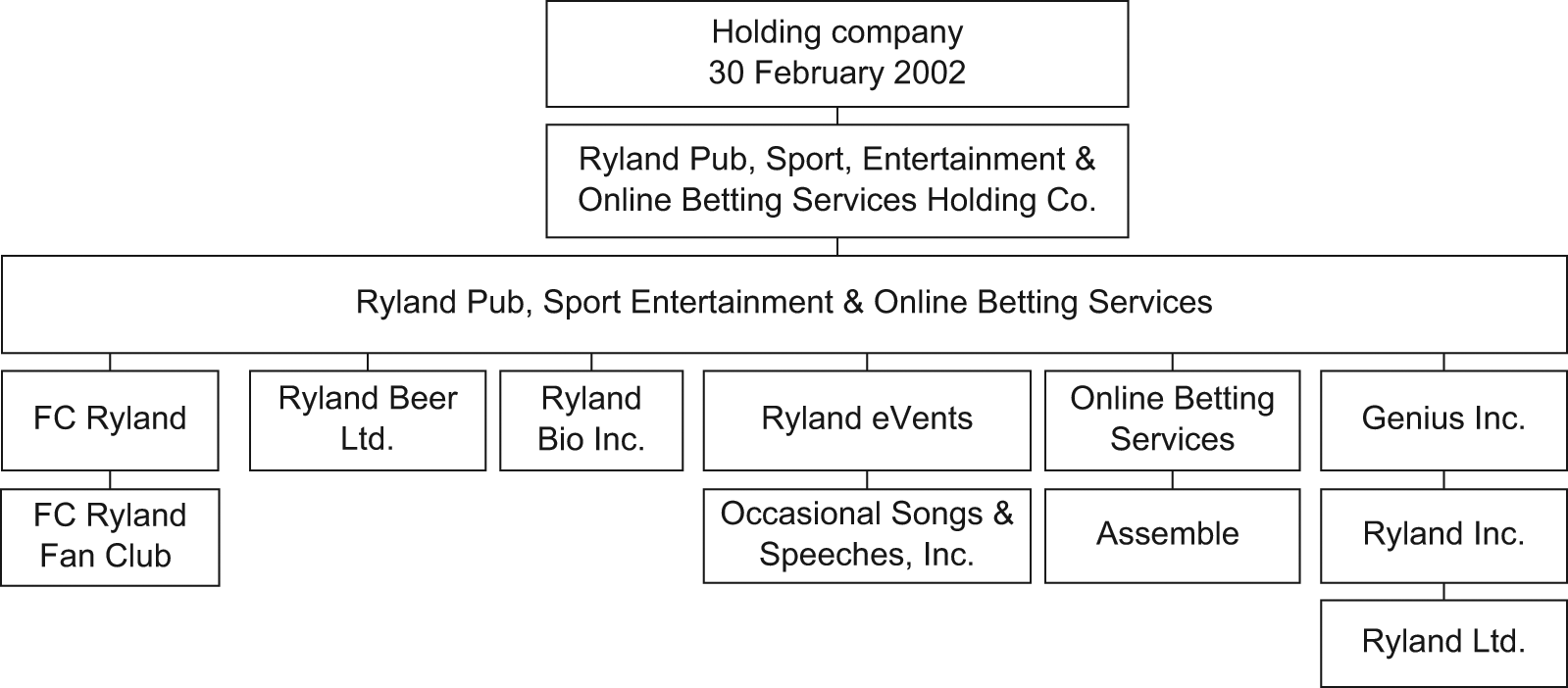
Organization chart FC Ryland (10 March, 2006)
As the ingenious chart makes clear, Ryland Pub, Sport Entertainment and Online Betting Services is considerably higher in rank than the more humble Ryland Inc., which is even situated beneath ‘Genius Inc.’ (a Swedish company with which Ryland Inc. negotiated merger plans at the time of this particular report). In this chart, the reports and the video material, many adventures unfold, some of which mimic, comment upon, ridicule or celebrate the actual company Ryland Inc., other passages comment upon business culture, the creative industry or politics more generally, and yet other passages appear entirely fictional. For example,
Just before the match, one of FC Ryland’s star players, Benjamin ‘Samuel’ Bernstein, was implicated in an extremely unpleasant incident. A hooligan attacked Bernstein in the middle of an important conversation about tactics and the result was imminent: throughout the match Bernstein’s play was as stagnant as the attitudes of his close friend Pia Kjærsgaard [a Danish right-wing nationalist]. (18 June 2007)
The character Bernstein is (under his real name) part of a Danish-Jewish intellectual family with left leaning attitudes. The report then scornfully links the attitudes of Bernstein to the attitudes of the (also actual) far right, Danish political figure Pia Kjærsgaard. All these events have little if anything to do with the football matches of FC Ryland (though there might have been a nasty tackle, of course) but contribute to the creation of what Nikolai has referred to as ‘the shadow organization’ FC Ryland. In our analysis of the football reports, which we shall now turn to, we are interested in these later reports.
Part I: play as a continuation of work
In this part we look into the situation where the play element in the football reports engages in a quite straightforward way with the work done in Ryland Inc. Since this is essentially the perspective that is implicit in the majority of organizational studies of play, we will be brief. The idea of play as a continuation of work is central, for example, in the idea of serious play that we’ve discussed above. As noted, serious play sees play as a continuation of work by other means. Work and play remain separate yet they can still cooperate in working towards a common goal: a symbiosis of work and play for the benefit of the organization and its members.
One of the most obvious examples of purposeful play is company football. In our case, the actual games of FC Ryland (as opposed to the fictitious organization FC Ryland that is created through the football reports), following much of organizational literature on play, could bring various advantages to the organization, especially in terms of motivation, employee involvement, bonding and physical and mental fitness of the employees. But even more so than the actual football matches, the football reports also contribute to this high commitment culture. The direct benefits that the organization enjoys are, for example, expressed in the positive feedback that Nikolai and Jacob frequently get from the other employees in Ryland Inc. One employee of the company has told us that she understands the football reports as contributing to a friendly atmosphere in the company that is needed to cope with the stress that deadlines bring. This was most likely also one of the reasons that CEO Lars Ryland decided to grant Nikolai and Jacob the Employee of the Year Award in 2005. Finally, while the organizational culture is an aggregated collective, the reports also have a perhaps obvious function for the narrators on an individual level. For example, when asked, Jacob readily admits that the reports function as a means of getting frustrations off his chest:
[The reports] are about frustrations and satire about the company and also about sports in general, actually. There is not much time in which to write them and they get all of my frustrations out as you can tell people what you really think, but in a way that no-one can really be annoyed about it.
Even though play can be a continuation of work we, as noted earlier, maintain conceptually throughout that play is autotelic (Csikszentmihalyi, 1975), i.e. that it contains its own goal. The possibility of play as a continuation of work reminds us that play may perform functions for the organization, but only as an advantageous side effect. That is to say: from the perspective of play, organizational functioning can never be the motivation; this would disrupt its autotelic nature. As stipulated, we want also to look at other relations between work and play. In the next part, we will see how play may intervene in work.
Part II: play as an intervention in work
Play’s relationship to work now becomes more complex. The playing in Ryland Inc., that is, the narrated life of FC Ryland, emerges now as more autonomous and what earlier appeared as play’s subordinated but harmonic and productive relation to work dissolves and becomes charged with conflicts and ambiguities. Such emergent autonomy enables play to become a vehicle of criticism of Ryland Inc., especially its management, and play comes a way to question and contravene the way work is carried out in the organization. This autonomy, as we have emphasized, is based on play’s ability to ‘double’ the organization, or mimic it. In Man, Play, and Games (1961 [1958]), Roger Caillois carves out four types of play, one of which is ‘mimicry’ (see Styhre, 2008 for an insightful discussion). In mimicry, the player reiterates historicalsituations, real or imagined; the training of children is based on mimicry, and so is adult play when it imitates the surrounding world. The way in which FC Ryland comes to imitate Ryland Inc. through the football reports is clearly in Caillois’ category of mimicry. This goes well with Andersen’s thesis in his recent book Power at Play, where he develops a hypothesis of play as a ‘doubling’ of the organization:
play represents a distinct communicative doubling machine. Play doubles the world so that we have a world of play and a real world, and the doubling takes place on the side of play. That is, the real is not the real as such but the real world as it looks from the perspective of play. The real world observed through the form of play is the reality that the form of play plays with. (Andersen, 2009: 80)
This played reality is what concerns us when reading the empirical material, and in this section we will focus on the parts of the empirical material that support an interpretation of the relationship between play and work which grants play autonomy and a mimicking potential for criticism.
In a report from February 14, 2007, the venue of the final of the football tournament is the topic. There is going to be a celebration, and the ‘chief negotiator’ states that it is in fact the date of the party that is FC Ryland’s prime interest in regards to the tournament.
Placing [the party] on any other day than a Friday would be in direct opposition to the corporate values of the company.
Further, while negotiating this date, the same chief negotiator also extended an offer to one of the members of the Football League’s office who was responsible for how FC Ryland would fare in the draw for opponents in the tournament.
I offered to let a member organize a discount on a web contract for the League, which our subsidiary company Ryland Inc. is bidding on, if he could organize an advantageous draw. He wasn’t at his best, though. He started rambling about going to the press, although I was really talking about a web contract.
In this report, the ‘corporate values’ of FC Ryland seem to be more focused on the tournament’s final party than the tournament itself, and when it actually comes to the tournament the negotiator tries to bribe his way through to a better draw for the company’s team. The reports are rife with this kind of irony, where the not always straight-and-narrow sports industry is ridiculed, as a rule always with a nod to Ryland Inc. While there is no need to assume that Ryland Inc. is in any way more prone to foul play in business than any other company, this report confirms that in popular parlance the sports and entertainment industries are generally assumed to be corrupt, and ‘negotiations’ often imply counter-services and bribes. Likewise, in a report from December 12, 2006, management is again the target of mimicry (which, in this case, turns out to be mockery). Ryland Inc. is also in this report referred to as ‘a subsidiary’ of ‘FC Ryland Pub, Sport, Entertainment and Online Betting Services’. Here the authors follow the carnivalesque tradition identified by Bakhtin (1968 [1941]), where in the plays of the carnival, the dominant social structures are overturned (a strategy further developed, as we pointed out earlier, in FC Ryland’s Organizational Chart, see Figure 1). The report in question came out when in real life Bruno Hansen had become new managing director of Ryland Inc. In the report, he appears as ‘B. S. Hansen’:
The new CEO for FC Ryland Pub, Sport, Entertainment and Online Betting Services is going to be the former top player in FC Ryland, B. S. Hansen. The new man on board has proclaimed that a new, tough management style is going to be introduced, with annual five-year plans: ‘The endless sloppiness and roundtable pedagogy in the various teams must end. We will never achieve our goal of a billing level of 104% of all invoices. This will be my first action after the coup … sorry … the appointment, to send the whole battalion on a punishing training drill, already this Friday. Bubber, my right hand, will pick us up at noon, and then it is all about survival. So I hope that the exploited … I mean the employed … will remember to dress warmly’, B. S. Hansen yells into my Dictaphone.
Staying with the structure of the carnival, we see that what happens in FC Ryland is a tilted version of what happens in Ryland Inc., yet the mimicry can also here be read as a more general critique of contemporary business culture. First, the process of hiring a new CEO in FC Ryland mocks the ‘old boys’ network’ common to the world of sports, where more often than not ‘former top player[s]’ become CEOs of often colossal conglomerates. In other words: great players, who are nonetheless perfect amateurs in business, will decide the fate of scores of employees and huge assets. Having supplanted knowledge and skills with sheer power and networking capabilities, such corporations are likely to appear more prone to let ‘coup[s]’ take over from ‘appointment[s]’, and install a ‘tough management style’ to quell any criticism of ‘five-year plans’.
The new CEO of Ryland Inc., Bruno Hansen, appears as indicated as ‘B. S. Hansen’ in the report. This is a pun on the name of an infamous Danish macho management guru, B. S. Kristiansen, who uses his experiences from the Special Forces as basis for his management courses. This way management is mimicked as being in the hands of militarized he-men acting according to a totalitarian logic in which the most despised parts of planned ‘command and control’-economies (like ‘five-years plans’) are coupled with privatization and ruthless reformism (like ‘a billing level of 104% of all invoices’). In such an atmosphere of corporate cynicism any relevant training for managers would be to ‘send the whole battalion on a punishment drill’. The ‘roundtable pedagogy’ which the new CEO despises refers to the former Danish centre-right Prime Minister (who has since in fact become NATO Secretary General), Anders Fogh Rasmussen, who used the pejorative term ‘circle pedagogy’ referring to kids sitting in a circle on the floor, rather than sitting at tables being taught by a teacher behind her desk. The next step out of such soft pedagogy is, according to the report in question, militarized exercises with the aim of maximizing production. The mimicry of this report mocks a particular cynicism found in contemporary capitalism, in which business and violent interventions eventually coalesce (Klein, 2007).
In a later report (of January 17, 2008), a new layer of self-reflexivity is added to the play. This happens when the two communication advisors Nikolai and Jacob suddenly turn up in the report as ‘Junior CEOs’, eagerly criticizing the above mentioned new CEO-he-man B. S. Hansen, who has allegedly led FC Ryland into ‘air cover’, where ‘zero press releases, analysis or opinions’ has come out. The two position themselves as youthful vanguard of a coming showdown with the (senior) CEOs of FC Ryland:
We would certainly never turn the executive management in or reveal confidential material—unless of course it is in our interest.
The theme of management and corruption is now taken to its natural endpoint. While the ‘Junior CEOs’ predict their own victory in this confrontation, and while they promise ‘a more active policy of communication in FC Ryland in the coming year’, they also express a gloomy view of management: whatever your point of departure was, when you become part of management you will become corrupt.
This report can be read as a critical, if rather friendly, event of resistance. Yet, it is still play that creates the world that effectuates this resistance. This is also why parts of what is presented as ‘playful’ resistance in organization studies (see for instance Rodrigues and Collinson, 1995) does not really fit ‘our current vocabulary of power and resistance’, which as Fleming and Spicer argue, all too easily accept
a division between a devilish realm of domination in which employees are directed by dark-suited overlords and a world of sweetness and light in which emancipated employees frolic in a corporate playground overflowing with opportunities for naughtiness. (Fleming and Spicer, 2008: 304)
What makes such images too simplistic is precisely that they do not account for autotelic activities. When playing in Ryland Inc. becomes what we call an ‘intervention in work’ it does not do so as, for example, a tool of ‘labour’ mustering resistance against ‘management’. Play necessarily goes its own way: it remains ‘at play’ and is by its sheer ambiguity at times able to put the organization into a crisis. This may, then, happen in a way that functions as a critical intervention. A crisis akin to this might have been what the departing CEO Lars Ryland’s found himself going through at a company dinner. As one of the communication advisors recalled, Lars Ryland, irritated by all the ‘football talk’, stood up and directed himself to Bruno Hansen, the CEO-to be: ‘Bruno, will you please stand up and tell us what’s so interesting about football?’ Bruno did not stand up, and the cozy dinner atmosphere of course instantly evaporated. After the incident, Nikolai and Jacob made Lars Ryland head (‘Don’) of FC Ryland: is this a case of criticism, reconciliation, or ‘merely’ play? We, as researchers, are not in a position to decide: in so far as the football reports are to be understood as play, they cannot be reduced to an exterior function, although they retrospectively may be understood as such.
While we in this part have tried to show how the mimicry of play produces interventions into work, such interventions have not been confined to be either breaks from work or its prolongation, but also raised criticism of Ryland Inc. as well as of contemporary business practices. It has also brought a certain self-criticism to bear on the up-and-coming communication advisors themselves and at what may be their professional aspirations as ‘Junior CEOs’. This is a part of the logic of play: ‘the “game” plays the participants at least as much as the participants play the game’ (Letiche and Maier, 2005: 62; see also Serres, 1982: 244ff), or in Gadamer’s (1975: 106) words: ‘All playing is a being-played’. This logic also works on a collective level, and organizational play continuously poses the threat of putting the organization into a crisis in unforeseen ways. This endows play not only with the power to continue the work of the organization, or to intervene in it, but also to actively take over parts of organizational practice, potentially in contrast to managerial intent. This is what is discussed in the last part of the empirical analysis.
Part III: play as a usurpation of work
We now look at a scenario that may be more frequent than one would intuitively imagine, namely the situation in which ‘playing’ actually performs a measured amount of what would traditionally be considered the task of the organization without the organization’s consent. Playing here usurps work, and exposes, as it were, particular inabilities of the organization. In this way, play again comes to appear ‘functional’ to the organization, but now the logic of what happens is play’s own; play usurps work at the limit of work’s ability to organize the life of the company.
In relation to the stated organizational goals, play now becomes dysfunctional or at least non-functional, pointing to an excess in play that defies the organizational demands and not least any firm managerial intent. This opens new possibilities. Csikszentmihalyi and Bennett (1971: 45–46) assess play to be ‘grounded in the concept of possibility’, by which they mean that play cannot be reduced to this or that function, but continuously produces new possibilities (exiting opportunities as well as potential dangers). Play produces a flow of events that lacks an analytical viewpoint ‘outside’ the playful activity itself, and thus appears able to protect itself from becoming completely appropriated by the organization. Admittedly, there exists at this point, as Connor (2005: 6) argues, a risk of ‘a protective idealization, even a fetishisation, of the idea of play’. We will return to this risk in the next section. For now, we will try to refrain from such romanticism and stay focused on the empirical material.
Even if such ‘usurpatory’ function of play has gone unnoticed in the organizational literature, the process can nevertheless be illustrated at various points in the empirical material. In the following report from April 10, 2007 a rather serious episode in the history of Ryland Inc. is taken into consideration by the narrators. In the spring of 2007, three very popular colleagues left the company to start a business of their own, leaving behind them an atmosphere full of tension. In this context, Jacob and Nikolai published a report that stated that three ‘central players’ had left FC Ryland and formed their own club, ‘B10-4’. These players appeared in the report as the narrators themselves: the narrators impersonate the players that left, and give them their own, distinct voices. This impersonation made it possible to indirectly pay tribute to the three that left, short-circuiting the awkward embarrassment of somebody leaving a company which was really ‘one big family’ (quoted from a report dated April 1, 2008). The April 10, 2007 report, which is our current concern, even directly targeted the issue of jealousy. The narrators, that is, the players that left, say that it is
important for us to stress that [leaving FC Ryland] has nothing to do with all the babes that [FC Ryland’s] sports director Jane Nicholson has taken to her hotel room during the tournament. … We are not jealous. We can easily get girls to come to our rooms. No problems there. We are in fact expecting a strong season on the cheerleading front in the new club. [… ] There is altogether nothing bad to say about our old club. (April 10, 2007)
When interviewed later, Nikolai explained that by releasing a report ‘we can present a sort of shadow version of what happens in the organization’. Here Nikolai confirms Caillois’ notion that mimicry imitates life in play, creating a sphere in which, in Marcuse’s (1965 [1933]: 14) words, the objectivity of the world is ‘almost temporarily suspended’. This ‘shadow version’ of the organization is in effect that ‘doubling’ of the organization in play that Andersen (2009) has developed in his own studies. Yet this report represents a liminal case:
[The report about the players leaving] was kind of on the limit because it was such a sensitive issue. People were genuinely sad. Everyone supported [the three that left], wishing that they had the same courage.
Because of a conflict with management?
Maybe there had been some incidents with Lars [Ryland], a feeling that things were going too slow. […] That frustration got them talking about starting their own company. […] It is sensitive because Lars took it very personally; he got offended that they would leave the company that way. He didn’t congratulate them the way others did. He froze them out. The rest of the employees were also avoiding talking about it too much. It generated some anxiety; doubts if we were going to get the same revenue for example. After they left they actually took some of our clients with them.
This dense narrative confirms Gadamer’s (1975: 102) point that ‘play itself contains its own, even sacred, seriousness’; playful as it may be, play does not shun these most serious of matters, rather it incorporates them into its own, autotelic logic. We may interpret what happens here as a ritualization of the loss that Ryland Inc. had gone through, but without being able to handle it. It turned out to be an unspeakable event of escape from this ‘one big family’, an event that has become taboo, ‘avoided’ by the CEO Lars Ryland as well as, if only to a lesser degree, by the other employees. Even if everyone ‘supported them’, the three soon to be ex-colleagues were ultimately ‘froze[n] … out’. They left, but through play they re-entered the game in the process that Letiche and Maier (2005) identify as glissement. This is the procedure that lets a token or piece in a game be repositioned without lifting it from the game’s surface. While one leaves a game that way, one may also, it seems, re-enter the game through glissement.
The three that left the company are neither in nor out; they are formally supported by everyone but at the same time ‘frozen out’. It is at this point that the playful ritual performed in the report manifests itself as a way of handling the ‘sensitive issue’, without having to show the ‘courage’ that the ones that left had shown. Re-playing the escape ritually redeems the separation between the organization and those who have left, and bespeaks what is silenced. Huizinga (2000 [1938]: 15) argues that man in playing tries to compel the gods to effect in reality ‘a certain desired cosmic event’. This desired event is in our case redemption, or the re-establishment of the organizational community: ‘There is altogether nothing bad to say about our old club’. The ‘real’ narrators, Nicolai and Jacob, even name the new club ‘B10-4’, signaling thateverything, also seen from FC Ryland/Ryland Inc., is really okay. Through playing, the three outlaws, who had broken the code of the family, are allowed to forgive Ryland Inc. for the familial blockage that prevents it from letting go of its now former employees. The three who left are in an event of glissement reinitiated back into what Csikszentmihalyi (quoted in Abramis, 1990: 356) calls the ‘communitas’ of play. This is then a doubling of—yet also a resource for—the actual organizational community of Ryland Inc.
Beyond serious play
In the preceding parts we have looked at play’s relation to work in terms of continuation, intervention and usurpation. In part 1, work and play were both observed as being functional in relation to the organizational goals: this logic of continuation resonates, as it were, most strongly with the area’s mainstream research, which sees in play yet another resource to foster creativity, growth, employee engagement and productivity. While we also saw this confirmed in the material, it remains a limited and at times prejudiced way of looking at play in organizations. This motivated the second part, where play found a critical, interventionist modus that resulted in questioning Ryland Inc.’s managerial logic as well as the strategic logic of the up-and-coming narrators themselves. Lastly, the third part focused on the particular situation where play usurps work and takes over some tasks that the organization has shown itself incapable of performing. Here play shows a strange form of functionality against the (explicit or implicit) ‘intentions’ of the organization. While this admittedly happens in Ryland Inc. under quite specific circumstances, we suggested that such an event is more common than promoters of the idea of a goal-oriented organization would allow for.
Our analysis speaks to both camps in the organizational literature on play. First, let us consider the idea of ‘serious play’. The discovery of serious play in organization studies is an attempt to break with the prejudice that play cannot be productive; it is therefore a bad idea to follow Henry Ford’s suggestion to ban play from organizations. Play is obviously productive for work under certain conditions, and serious play is therefore possible. The notion of serious play might say something about contemporary work, but by no means exhausts the possibilities of organizational play. Organizational play, which in essence does not differ from play in general, is a much richer phenomenon than the notion of serious play suggests. Indeed, our analysis even shows that play can be far more serious than ‘serious play’. The usurpation of work, in our case the reconciliation between the organization and the loss of its three family members, has a seriousness that goes well beyond the idea of ‘serious business’. This finding is in line with Huizinga’s (2000 [1938]: 45) suggestion that ‘seriousness seeks to exclude play, whereas play can very well include seriousness’. In parts 2 and 3 we have seen some examples of the way in which play transgresses both the realm of the ‘serious’ (work) and the realm of the ‘unserious’ (recreation, fun). Organizational play is not just a way of working, or just a way of having fun. Play opens the organization for critique and can even subsume ‘serious’ work under its own authority.
The insight that organizational play is a much richer phenomenon than the notion of serious play suggests, also brings us to the second camp within (mostly popular) literature on organizational play: the thesis that the distinction between work and play is now blurred, and that Burke’s (1971: 47) utopian vision of a place where ‘everyone plays at work’ and, likewise, ‘works at play’ has become a tenable idea in knowledge work and the creative industries. Having analysed the relation between work and play throughout this article, such symmetry, however neat, seems misguided. While play is able to usurp work, work is not able to entirely take over play. In the first relation that we discussed, play is a continuation of work by other means. Company football is still play even when it plays out according to the productive logic of work. However, when play usurps work, work is no longer work; it has in fact been overtaken by play. This is not a two-way street, however. Play seems to be able to avoid usurpation in the face of work, but work cannot stave off usurpation in the face of play. Work may become play(ful), but play does not become fully colonized by work. In other words, the thesis that work and play are becoming indistinguishable in postindustrial organizations first blurs the conceptual distinction between work and play and, if anything, hampers our capacity to say something about phenomena of organizational play.
The implications of these insights for future studies of organizational play are perhaps not as straightforward as proponents of a steadily progressing organizational science might hope. As we have emphasized in this article, studying organizational play is by no means straightforward, especially not when the ambition is to study organizational play from the perspective of play. Strictly speaking, there is no interpretative study of organizational play from the perspective of play, because play does not tolerate interpretation. Any interpretation of that which is involved in organizational play is quickly reduced to a form of non-play (fun, work, critique, resistance, etc.). With this in mind, we should emphasize that the serious play perspective does not suffer from such methodological problems. Despite (or perhaps because of) its limited ambition, this perspective does manage to turn organizational play into a clearly defined object of study, namely, the conditions and circumstances under which play is likely to have desirable effects for organizations and their members. So our first recommendation for further research is to (continue to) question the very possibility of the study of organizational play without reducing it to a means-end logic that is foreign to play itself.
Secondly, we recognize that much more might be said about the idea of play as the usurpation of work, particularly when it comes to its relation to ethics. In our case, play’s usurpation of work appears to have found the ethical and social high ground: in play, a higher ethical standard emerged, in which the event of loss was ritualized and the three that left, as well as Ryland Inc. (which had not really allowed their departure), were redeemed. However, it by no means follows from this that play always brings redemption or elevates a situation to a higher ethical ground when it usurps work. Play’s ability to usurp work does not imply that such usurpation is always ‘to be preferred’. 2 In some instances play may very well be ethically threatening. In general, one recognizes a certain bias within organizational studies of play towards its assumed positive or even ethical nature (cf. Kane, 2004; Statler et al., 2009). There remains, in any case, a strong need to examine the ethics of organizational play more closely.