




Abstract
This article addresses current limitations in theorisations of fun, introducing Turner’s liminoid/liminal distinction of play and work. This suggests engaging in play – liminoid phenomena – releases individuals from everyday societal structures, like age-based identity memberships. Featuring participant data from a large UK-based insurance firm, the research highlights how play activities are underpinned by age-related assumptions. The study makes three contributions. First, conceptualising the ‘pseudo-liminoid’ – a space between work and play where the potential for play to be freeing is curtailed. Second, it problematises common positive attributes of organisational play, suggesting play can reproduce social norms, thus undermining why it was introduced to the organisation. Finally, it highlights how play and fun can be ‘aged’, with implications for how organisations conceive of play’s role in creating an inclusive workplace.
Introduction
This article explores workers’ experiences of play activities implemented to create fun and inclusive workplaces. It considers the potential for play at work to ‘free’ workers and allow them to be authentic, engaged or creative, which is often the motivation behind bringing play into the workplace. Play is also strongly associated with constructs around youth and so examining play in the work context can shed light on how age is conceived when workplaces seek to be fun.
The study draws on Turner’s (1982) liminal/liminoid framework, which distinguishes characteristics of work (liminal) and leisure (liminoid) activities in complex, post-industrial societies. Within this framework, ‘Optation pervades the liminoid phenomenon, obligation the liminal. One is all play and choice, an entertainment, the other is matter of deep seriousness, even dread, it is demanding, compulsory’ (Turner, 1982: 43). Consequently, at the heart of Turner’s (1982) distinction of the liminoid is how it constitutes spaces of fun (comprising play activities) that are optional and subversive to societal norms. Meanwhile, the liminal operates as obligatory phenomena that are bound within, and dictated by, societal constraints and identity memberships.
While Turner’s (1967) work on liminality has featured extensively in contemporary research, the liminoid remains under-utilised. In the context of fun workplaces, which attempt to disrupt the differentiation between work and leisure (Duerden et al., 2018), and purposefully blur the distinction as play activities are introduced into the workplace (Leclercq-Vandelannoitte, 2021; Smith et al., 2022), the liminoid is a useful tool of analysis as it brings into focus divisions between work and play.
Current research on fun and play emphasises these as tools to help the organisation and the individual working within it (Islam and Ahmed, 2023; Tetteh et al., 2021). Though some have indicated a darker side (Fleming and Sturdy, 2009; Fleming, 2014; Mielly et al., 2023), there remain calls for improved theorisations of fun, particularly from a sociological perspective (Fincham, 2016). In response, Turner (1982) explains why play has been adopted at work – to realise the potential of freedom from obligation and social norms – and facilitates the investigation of issues arising from this approach. Consequently, the research asks the following overarching research question: how does participation in play activities at work operate as liminoid phenomena?
To offer further depth to this question, the article also considers the inter-relation of age with play and work. Recognised here as a social norm, often used as a primary differentiator of experiences at work and undeniably common to all (Cutcher et al., 2021). Age is also ordinarily associated with playfulness and having fun. It is strongly linked to childhood but, perhaps counterintuitively, also embedded in the infantilising of the elderly, and associated with senility (Axelrad et al., 2023; Fincham, 2016). Therefore, age offers a lens to interrogate play in work as a potential liminoid phenomenon.
The research focus is an empirical case study, comprising interviews, focus groups and observations of a large UK insurance company (InsureCo, a pseudonym) that cites having fun at work as a core value. The analysis suggests the liminoid may not always operate as an alternative fun space when co-opted into the work. Relatedly, the research explicates the age-based effects of play activities at work to highlight the role that play activities have in reinforcing dominant identity memberships. Thus, findings indicate that a ‘pseudo-liminoid’ is in operation when play crosses the divide into work that has its own purposes and implications for workers and organisations.
First, the article explicates Turner’s (1982) liminal/liminoid distinction, and second, research investigating fun and play at work is reviewed and connected to Turner’s analysis before considering literatures critically exploring age at work. Next, methodology is outlined, describing data collection at InsureCo and the analytic process. The findings are presented in three thematic sections: child’s play; aged effects of play: I’ll leave the kids to it; and play at InsureCo: a pseudo-liminoid. Finally, the discussion and conclusion consider research contributions, limitations and future research directions.
Fun, play and the liminal/liminoid divide
Studies on work and employment have focused on the liminal and liminality because of its association with work, whereas play – conceptualised in opposition to work – constitutes the liminoid (Turner, 1982). However, if play is adopted in the domain of work, researchers need to also be attendant to the liminoid and whether its qualities can be retained in this context. While Turner’s (1967) work on liminality has become a staple in understanding a range of concerns in relation to work and employment (Söderlund and Borg, 2018), his notion of the liminoid has been relatively under-utilised despite that this brings into focus distinctions between work and leisure. Relevant to our work is that at the heart of Turner’s (1982) distinction of the liminoid is how it constitutes spaces of fun (comprising play activities) that are optional and subversive to societal norms.
The core distinctions between the liminal and liminoid phenomena according to Turner (1974, 1982) are outlined in Table 1 (adapted from Spiegel, 2015).
Distinctions between the liminal and liminoid.
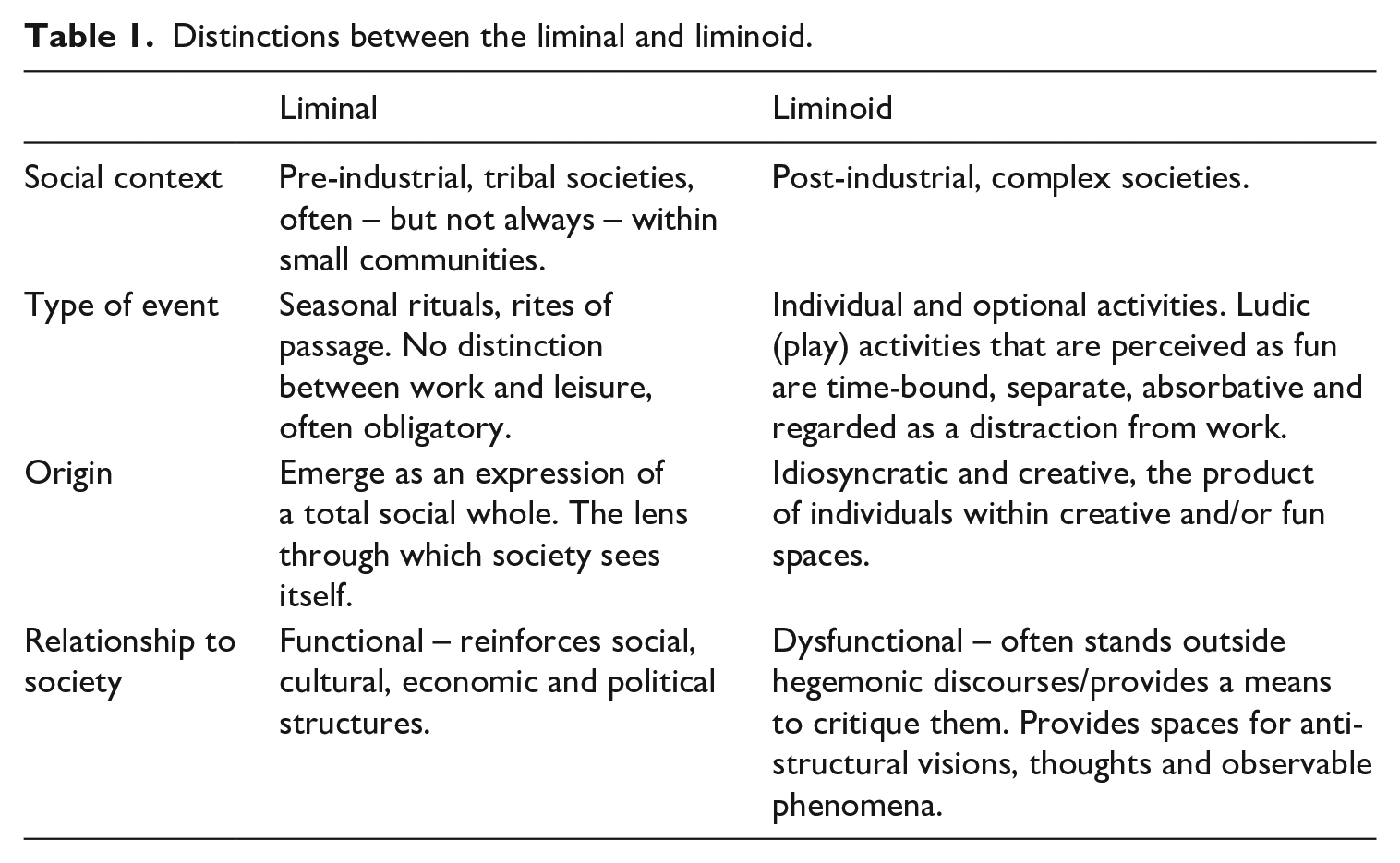
Therefore, Turner’s (1982) liminoid focuses attention on how leisure in a post-industrial society is ‘anti-structural’ as it serves as an opportunity of freedom for the individual (Turner, 1974). Liminoid spaces function as an escape from the rules and norms of everyday life (Taheri et al., 2015), what Turner (1982: 33) terms ‘dominant social orders and identity memberships’. Of particular relevance here, he emphasises how one works at the liminal, yet one plays with the liminoid, thus conceiving of the liminoid as social activities where play is separated from work and becomes an ‘independent domain of creative activity’ (Turner, 1982: 33).
Key to the liminal/liminoid divide is differentiating liminal ‘acts of obligation’ from liminoid ‘acts of optionality’ (Turner, 1974: 74). The difference then, lies in their degree of freedom (Spariosu, 2016). Turner (1982: 36–37) associates leisure with freedom: ‘leisure-time is associated with two types of freedom’; ‘freedom-from’ obligation and ‘freedom-to’ defined as ‘a chance to recuperate and enjoy natural, biological rhythms again’. Liminoid phenomena in post-industrial societies operate as sites of play, making the socio-economic system more tolerable, functioning as points of ‘release’ from normative structures (Turner, 1982: 52). In this, Turner (1974: 74–75) notes the importance of recognising that while a phenomenon may appear ‘play-like’, attention must be paid to how such ‘play’ supports or subverts or transcends dominant social orders.
Use of the liminoid has been limited to cultural studies (Huang, 2018), tourism and hospitality studies (Taheri et al., 2015, 2017) and consumer experience research (Ikäheimo, 2020; Lugosi, 2007; Roberts, 2015); all contexts that are regarded as sites of leisure, play, and fun. In the context of work and employment, the liminoid remains underexplored. Recent works consider how the position of unemployment is a liminoid identity that can serve to be anti-structural and resist ‘the dominant socio-economic order’ (Daskalaki and Simosi, 2018: 1166); or how journalists construct social media identities through blending the liminal and liminoid, allowing them to manoeuvre across the spectrum of obligation to optionality in this domain (Lê and Lander, 2023).
As we explore later, while there remains an extensive literature on fun at work, sociological theorisations of fun remain limited (Fincham, 2016). The liminoid has more to offer, particularly in Turner’s consideration of the blurring of distinctions between work and leisure and thus the liminal/liminoid divide (Spiegel, 2015). Closer critical reading of Turner’s (1982: 34–39) discussion of the work–leisure distinction centres on how leisure is intricately linked to the notion of work and vice versa – leisure exists and is pursued merely for the benefit of being a more productive worker. Therefore, Turner (1982) concedes that when society is more individualised, the distinction can become more arbitrary; the domain of work shapes the experience of liminoid phenomena. Thus, extending Turner’s (1982) theorisation of the liminoid to analyse play at work demands a focus on how engagement in play activities within the work domain can fulfil the antecedents of liminoid phenomena. Drawing on Turner (1982), we define play activities as those that are time-bound, deemed a distraction from day-to-day work tasks, absorptive, trivial, demarked by a particular level of intensity and highlighted for an absence of seriousness (Fincham, 2016).
Consequently, for Turner, trying to understand the relationship between work and play is at the heart of identifying truly liminoid as opposed to liminal phenomena. For instance, Turner (1982: 34) conceives of ‘serious play’ as separate from non-serious play activities that are completely ‘disengaged from necessity or obligation’. Thus, his notion of serious play suggests a blurring of the liminal/liminoid divide. The self-identified fun organisation, then, is of particular interest in extending current theorisations of fun at work through engagement in play activities using Turner’s conception of liminoid phenomena to understand increasingly blurred junctures between work and play. In using the concept of the liminoid and its distinction from the liminal, this research examines the extent to which play activities are co-opted within – rather than distinct from – work and whether they can retain the liminoid qualities that may have served as the rationale for their introduction into the workplace in the first instance.
Fun and play at work
While considerable empirical work investigates fun and play at work, as we explore below, critiques from the sociology of fun note the lack of theory-informed research (Fincham, 2016), particularly for adults in the domain of work. To date, research has been heavily informed by organisational psychology with quantitative approaches measuring the effects of fun on workplaces and employees. Consequently, fun is often conceived as an organisational tool to boost productivity (Fisher, 2010; Fluegge-Woolf, 2014), engagement (Jyoti and Dimple, 2022; Plester and Hutchinson, 2016; Tetteh et al., 2021) or embeddedness (Tews et al., 2015), ultimately to aid the bottom line (Bolton and Houlihan, 2009). Equally, it is considered positive for individual employees (Clancy and Linehan, 2019; Tews et al., 2014), aiding job/career satisfaction (Islam and Ahmed, 2023), employee thriving (Han et al., 2024) and inclusion (Petelczyc et al., 2018).
Meanwhile, qualitative approaches provide an appreciation of different forms of workplace fun in operation (Chan, 2010; Strömberg and Karlsson, 2009) and emphasise relationality (Fincham, 2016). For instance, Plester et al. (2015) distinguish between organic (employee-led), managed (manager-led) and task (intrinsic to the work) fun. Research on these different forms of workplace fun also indicate their different effects (both positive and negative). For example, suggesting workplace fun cannot be realised if the individual has limited agency over the fun (Clancy and Linehan, 2019; Owler and Morrison, 2020; Plester et al., 2015), thus beginning to question the value of managed fun.
Likewise, critical research problematises fun in the workplace where, at best, it alleviates boredom and alienation (Fleming and Sturdy, 2011; Mielly et al., 2023) and, at worst, operates as another means of control (Fleming and Sturdy, 2009; Grugulis et al., 2000; Fleming, 2014). Consequently, the combination of more managerial and critical considerations of fun at work result in an emerging understanding that it is multidimensional in the way it operates for organisations and is interpreted by individuals (Clancy and Linehan, 2019; Fincham, 2016; Plester et al., 2015).
Meanwhile, play activities are considered the means of engendering fun at work (Georganta and Montgomery, 2019; Petelczyc et al., 2018; Proyer, 2017; Tökkäri, 2015; Van Vleet and Feeney, 2015) and, like fun, are associated with specific organisational ends (Simpson et al., 2018). However, current research within the sociology of work lacks specificity (Michel et al., 2019; Petrou and Bakker, 2016): while some suggest organisational play is a set of specific tactics for fostering fun and is a more narrowly focused construct (Celestine and Yeo, 2021; Michel et al., 2019), research often uses play and fun interchangeably. This article draws on Turner’s (1974, 1982) conceptualisation of liminoid phenomena to conceive of play as ludic activities that realise the experience of fun, and thus these are separate but inter-related entities. Play activities should provide freedom and thus, because of participation in play, fun is observed as temporary experiential abandonment of societal structures.
Relatedly, when play is the focus, it is considered to have intrinsic value because it is assumed to bring about benefits such as flow, meaningfulness, authenticity and freedom (Butler and Spoelstra, 2024; Fincham, 2016; Tökkäri, 2015; Van Vleet and Feeney, 2015). This intrinsic value is why play has been adopted in the world of work as a significant trend (Butler and Spoelstra, 2024; Scharp et al., 2023). Nevertheless, both its intrinsic value – and whether that can be realised when transferred to the workplace – is beginning to be questioned (Butler and Spoelstra, 2024).
Consequently, while Turner’s (1982) theorising is yet to be applied in researching fun and play at work, his conceptualisation of the liminoid indicates why play, and therefore, fun, have increasingly featured as workplace phenomena, where workplaces seek to capture the value of the liminoid (play that involves freedom, choice and individual respite from norms) for the purposes of work. Nevertheless, his distinction of the liminal/liminoid divide reminds us that despite the supposed potential of the liminoid, if its distinction from the liminal is not maintained its value may not be realised. Therefore, the relations between work and play need to be at the centre of analysis of organisational fun and play. The liminal/liminoid divide allows us to be attuned to those relations, examining what can be realised when the two are blurred and play is adopted at work. This begins to question whether the potential value of the liminoid can ever be realised once in the confines of work. In turn, this liminal/liminoid analysis can also answer the emergent call for more research to further problematise the intrinsic value of play, particularly when in the context of work (Butler and Spoelstra, 2024).
A fun age
The sociology of fun suggests that ‘the sorts of things a person finds fun says something about them’ (Fincham, 2016: 43). Therefore, our experience of fun and play is closely tied to who we are and allows us to make ‘judgements and behaviours towards others on the basis of what is professed to be fun’ (Fincham, 2016: 43). This suggests that workplace fun is ‘difficult to promote equally to all employees’ (Plester et al., 2015: 381) and that play can in fact have an exclusionary potential (Butler and Spoelstra, 2024; Whitton and Langan, 2018). Play is strongly associated with childhood in the extant literature (Fincham, 2016; Tökkäri, 2015). Consequently, attending to age provides a means to examine engagement in play at work and its purported potential to, as Turner (1982) suggests, suspend dominant social orders.
Contemporary research is beginning to recognise age as a powerful means of classification (Aaltio et al., 2017; Thomas et al., 2014), with far-reaching implications for work and workers (Axelrad et al., 2023; Cutcher et al., 2021). Age is a complex intersection of meanings and assumptions that can be related to individuals (the aged body) and symbolically to professions, organisations and industries. Rather than being a fixed and independent variable (one’s chronological age), age can be understood as an identity associated with diverse and ambiguous meanings, dependent on context (Spedale, 2019; Wilińska et al., 2021).
Consequently, age constructs shape work experiences through differentiating groups’ abilities, characteristics and expected behaviours, especially through comparing notions of old and young (Down and Reveley, 2004; Riach, 2007) or different generations (Pritchard and Whiting, 2014; Reed and Thomas, 2021; Williams, 2020). Note that age constructs also shape leisure experiences; particularly, play is associated with childhood and developmental benefits (Fincham, 2016) yet, perhaps counterintuitively, also embedded in the infantilising of the elderly, and associated with senility (Axelrad et al., 2023). This lays the foundations for stereotyping often leading to ageism – in any direction (Aaltio et al., 2017; Barken, 2019).
In relation to Turner’s liminoid, this has yet to be applied in studies exploring age in work. However, in conceiving of age as a social norm and construct it can be considered as what Turner (1982) terms an ‘identity membership’ indicative of the ‘dominant social order’ in operation. This can aid in analysing the liminal/liminoid distinction within the workplace, because if organisational play becomes imbued with age-based constructs, it suggests a liminoid phenomenon has not been achieved as rules, norms and obligation arise.
Consequently, this research examines the nexus of workplace fun and play with constructs of age via the theoretical lens of the liminal/liminoid divide to examine how play activities are used to construct fun workplaces and the impact these have on workers and the organisation. This study therefore asks the following overarching research question: how does participation in play activities at work operate as liminoid phenomena? To investigate this, we further pose: what do the inter-relations between play at work and age indicate regarding the liminal/liminoid divide, and what are the implications of this for the workers and the organisation? The following section highlights how the research was conducted, and the analysis deployed in relation to these aims.
Methodology
This research focuses on a UK-headquartered international insurance company, InsureCo. In operation for over 30 years, the company additionally has offices in Canada, France, Gibraltar, India, Italy, Spain and the USA. Across its global operation it employs approximately 11,000 people, providing services for circa 10 million customers. This study centred on the UK headquarters, which is where the company was founded and operates as one of the largest insurers in the UK market. As the headquarters, functions on site included the company’s call centre, finance, human resources (HR), marketing, sales and pricing.
The organisation, and particularly the headquarters, has won awards, featured in media reviews as a ‘great place to work’ at a UK and European level, and regularly received third party endorsements as an exemplar of best practice. The company’s commitment to fun features heavily in those media reviews and endorsements. The average age at InsureCo is 29, with departments such as the call centre having a younger profile (average age 23) whereas the support departments such as marketing, HR, finance and pricing have a higher age profile (average 40+). Consequently, InsureCo was chosen as a case study firm both because fun was such a central feature of how the organisation positioned itself in the market and because of the diverse age dynamics within the company, particularly in the headquarters operation.
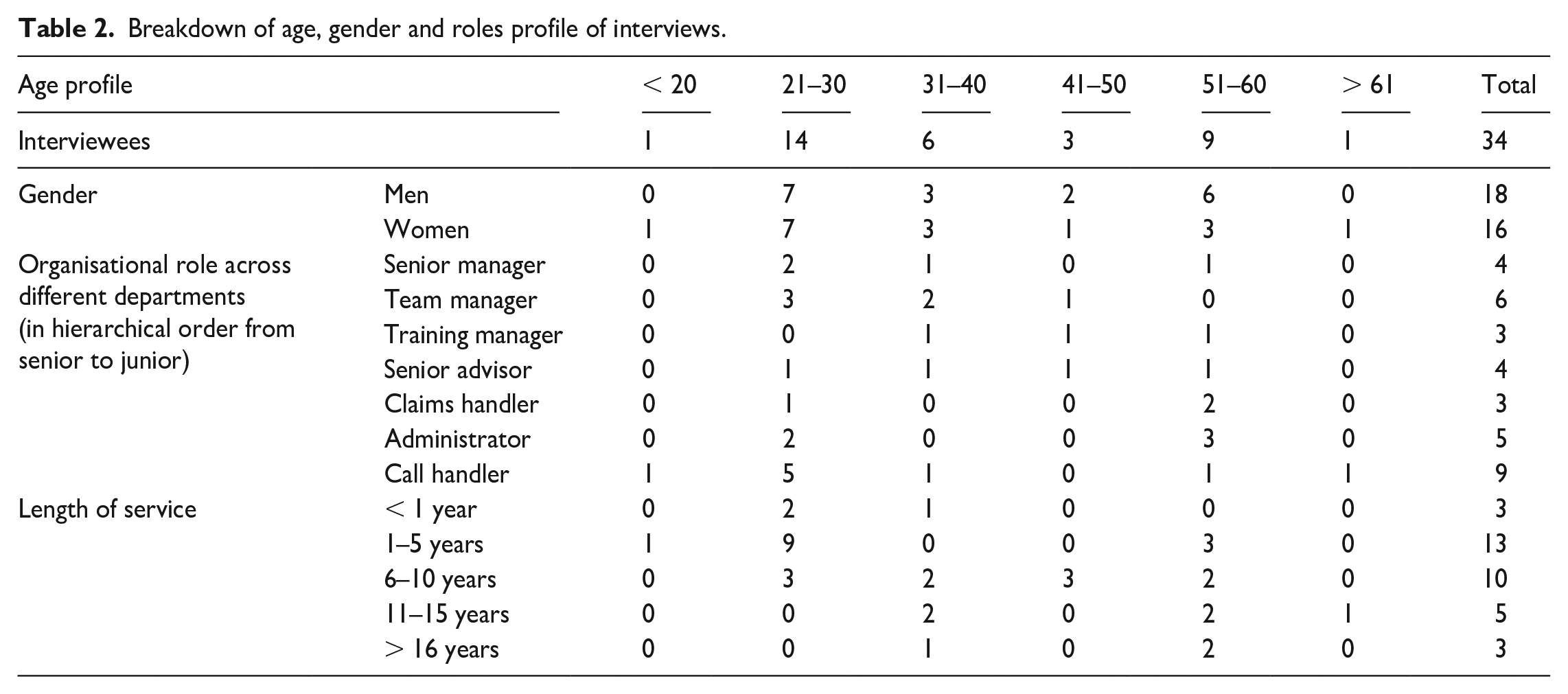
The data set (Table 2) consists of 34 interviews (comprising senior management through to frontline call handlers and a mixture of age and gender); two focus groups, one of younger workers (seven participants: four women, three men aged between 21 and 30) and one of older workers (six participants: two women, four men aged between 51 and 60); and observations of seven different team meetings.
Breakdown of age, gender and roles profile of interviews.
Interviews focused on the individual’s work experience, relationships with others and their experiences of fun, play and age at work. Meanwhile, focus groups examined more broadly the experiences of, and relationships between, older and younger workers (including their orientation to fun and play). As these forums brought together employees of a similar age, who often did not work together on a day-to-day basis, it provided a space for differences and similarities in experience to emerge.
Additionally, the first author undertook general observation over a 2-month period in the organisation and a review of its website. This provided the opportunity to examine how what was being said in interviews and focus groups was reflected both externally (e.g. the website) and internally (e.g. the use of office space). Immediately following the interviews and focus groups, the first author undertook additional observation of teams over the period of a month, particularly their regular team meetings and also the opportunity to observe the ‘dress rehearsals’ for presentations for an internal awards scheme. Notes of observations, both oral and written (often taken straight after an observation period), were collated and formed part of the transcript data set together with those from the interviews and focus groups. Therefore, this study’s qualitative approach incorporates a mixture of ‘asking questions’, ‘hanging out’ and ‘reading texts’ (Dingwall, 1997). Together these enable direct experience of, and both individual and group reflections on, how people experience fun and play across different age profiles (Alvesson, 2003; Coule, 2013; Lareau, 2021; Sandiford, 2015). Thus, our approach engages with the complexity of these phenomena, as reflected in Turner’s (1982) theorisation of the liminal/liminoid divide.
Our analysis of these data adopts an interpretative approach guided by our theoretical attention to play activities and age and their inter-relations with key facets of the liminal/liminoid divide. We used Braun and Clarke’s (2021) six-phase process of Reflexive Thematic Analysis (RTA) to support our analytic endeavour, as outlined below.
Phase one constitutes a process of data familiarisation, with a detailed reading and re-reading of data by the first author, who identified points of interest, apparent trends and their own thoughts and feelings about certain passages. Phase two involves initial coding (by the first author) through repeated reading of data. Initial descriptive codes at this point included, for example, ‘company and fun’, ‘old and fun’, ‘young and fun’, ‘playing games’ and ‘engagement with fun or play’. It is at this stage (Phase three) that the focus shifted from the interpretation of individual data to the interpretation of shared meaning across the dataset. The first author reviewed codes (which were primarily semantic) to identify patterns of shared meaning to develop potential themes and associated sub-themes. In moving to Phase four, developing the potential themes, all authors worked together to provide meaningful and congruent interpretations of the data that are relevant to the research focus. This process also involved reflexively working back and forth between these data, research questions and relevant literature to ensure we retained focus (Hancock and Tyler, 2024). It is also at this stage that we ensured enough data could substantiate a theme and related sub-themes. Phase five involves defining and naming themes and here the authors continued to work together, including challenging each other’s ideas to ensure a robust analytic process. For example, initial codes such as ‘playing games’, ‘avoiding play’ and ‘leading play’ were brought together under the theme ‘optionality in play’.
Our analytic approach thus recognises that themes are the result of shared meaning-making by the authors. Analysis is not a straightforward or automatic progression (from codes to themes for example) but involves significant iteration to ensure that the resultant themes are the result of a detailed analysis of underlying data items identified in the previous phases. Extensive logs of correspondence between the authors were used to ensure an audit trail of decisions during the analytic process (Cooke and Baumbusch, 2022). Relevant data extracts have been interrogated using our theoretical framework (Turner, 1974, 1982) to guide our analytic endeavour. Unusually, Braun and Clarke’s (2021) framework recognises that the analytic process continues through the writing (and rewriting) process (Phase six) such that the account presented in our findings is the culmination of recursive analytic and reflexive work by all authors. The aim through this process is to produce what Frandsen et al. (2023: 1575) refer to as a ‘coherent analytical narrative’ that fits the article format and communicates our main findings about fun, play and age.
Findings
From the analysis, three themes are presented that capture the accounts of organisational play activities at InsureCo: (1) Child’s play; (2) Aged effects of play: I’ll leave the kids to it; and (3) Play at InsureCo: a pseudo-liminoid.
Child’s play
InsureCo prided itself on being ‘fun’. This emphasis was highlighted in public-facing communications such as its website: Fun plays a vital role in helping us to ensure that our employees enjoy their work, encouraging each and every individual to produce excellent results. Organised activities for our staff are often weird, wild and wonderful, but they are also a great tool for motivation. (InsureCo website)
It was also evident in internal communications where a specific unit for fun had been created and was promoted through event artefacts (pictures, emails, staff noticeboards), serving as visual reminders of fun and play at the organisation. Play activities that featured included those during working hours, such as computer game competitions and fancy dress space-hopper races in the open plan office spaces. Others were held offsite (sometimes out of work hours), including paintballing, theme parks and nightclub trips.
The connection between workplace fun, play and productivity was also evident in communications and reinforced by employees, whether that be senior managers: ‘if people are happy doing the job, they do a better job, so we try to add in the extra bit of fun, incentivise the work they do’ (George, 30, Senior Manager, 9 years of service); or frontline workers ‘. . . there is as much emphasis on fun and keeping employees happy as there is on the work’ (Chloe, 21, Administrator, 2 years of service). Consequently, the boundaries between work and leisure became purposefully blurred, where play activities were encouraged through every aspect of the organisation to aid productivity and camaraderie.
While these observations may be symptomatic of other ‘fun’ organisations, a key area of distinction was the degree to which child-like play punctuated organisational life as part of this wider emphasis on fun at InsureCo. For instance, play activities were observed as standard practice at team meetings, which either began or ended with a game. These included the ‘After Eight Game’ (players must move a chocolate mint from their forehead into their mouths without using their hands) or ‘Boy, Girl, Fruit, Veg, Place’. As a call handler explained: there’s loads of you and somebody will say the alphabet in their mind and you tell them to stop and everyone’s got to think of a boy, a girl, a fruit, a veg, a place beginning with that [letter] [. . .] I haven’t played that since I was about 10 and I’m 35 now. So, we was all playing it. (Amanda, 35, Call Handler, < 1 year of service)
Other childhood games observed at team meetings included ‘I went to the shop’, where each participant adds an item to the shopping list, which must be remembered and recited in the correct order. Likewise, InsureCo workers participated in ‘Spider’s Web’, where all members of a group link hands while their arms are crossed and then proceed to loop under one another’s arms to come to a position where they are standing side-by-side, hands still joined but not crossed over.
As well as the everyday practice of team meetings, InsureCo had an annual ‘best division’ competition assessed by senior managers and involving an awards ceremony. This involved each division making a presentation, which had a child-like play quality and was conducted through the medium of song, dance and fancy dress. Observed dress rehearsals included a haka 1 dance, an adaptation of the song ‘Waltzing Matilda’ and another involving the Hollywood red carpet with workers dressed as various stars. Presentations also often required audience participation in the play (e.g. dancing during a Brazilian-themed presentation, donning a costume for an Australian-themed presentation).
Turner’s (1982) liminal/liminoid divide suggests a need to focus on the degree of obligation or optionality of this play. Team meetings were obligatory and had to be attended by all team members. While there was a degree of freedom initially present in the use of these child-like playground games (i.e. they were being used as moments of respite to bond the team before or after the meeting), these games constituted more serious play when it came to the degree of optionality afforded where participants were bounded by rules and in some cases physical restrictions. Often, the team leader instigated or adjudicated, but did not play the game, further emphasising the obligatory nature of this child-like play. However, team members were observed disappearing to the toilet during the games, voicing their reluctance, breaking the rules of the game to finish it quickly, or even returning to their work instead. Interestingly, these actions were not called out by team leaders or others in the team, suggesting a blurring of the lines between obligation and optionality.
In contrast, given what was at stake in the ‘best division’ competition, optionality was more constrained in this context. While some employees were centre stage, all employees had to take part by wearing fancy dress, dancing, singing and playing along. This was encouraged by managers who sanctioned time away from day-to-day working tasks to prepare, including a whole day devoted to practising and the competition itself. This despite the presentation only constituting 10% of each division’s score in the competition.
Interviews also underscored how the optionality of fun and play was bounded or constrained in some way by the needs of the organisation: ‘It’s quite a fun company to work for’, is probably what everybody would say [. . .] They go out of their way to make sure that you try to have some fun, even if you don’t really want it. (Margaret, 67, Call Handler, 12 years of service) The InsureCo culture is basically everyone’s happy, all the time. Have fun at work. Just be happy in your job and they want you to be happy . . . So, for instance, if you don’t take part and join in, it looks bad on you then. So, there is a level of pressure there . . . (Joanne, 21, Call Handler, < 1 year of service)
Here, fun has become mandatory and requires a sense of effort that would be expected in the context of completing a task, rather than a play activity that is pursued simply for its resulting affectual state.
Consequently, interviewees observed that performed optionality was in operation where they engaged in at least an assimilation of play – they partly played along – because they recognised there were advantages of adhering to, and engaging with, play activities in the organisation: Because I’m trying to progress and stuff, and move up the company, I push myself to get involved in them [play activities] . . . So I, personally, force myself to do so, but it’s not something I particularly want to do. (Thomas, 25, Senior Advisor, 2 years of service)
This recognition of obligation to at least perform the play was mirrored by some senior employees: I probably have to do more things I don’t want to do just because of the position I’m in, but at the end of the day it’s part of your role to make a fool of yourself now and again. (George, 30, Senior Manager, 9 years of service)
A commonality between accounts revolved around discussions of the centrality of fun and play to the organisation, which led to a sense of obligation to demonstrate that which is organisationally valued. Consequently, when play activities are situated in a work context, their potential to allow for freedom, choice and individual respite from norms and rules is constrained. The liminal/liminoid divide blurs where obligation and optionality conjoin because to engage in child’s play is to engage with the organisation’s priorities, norms and rules.
Aged effects of play: I’ll leave it to the kids
Turner’s (1982) liminoid is conceived as a domain in which dominant constructed social orders and identity memberships are subverted or transcended. This theme explores how aged subject positions around child-like play were present in the organisation and therefore how the social order and age-based norms around them were supported and maintained, rather than suspended within InsureCo.
Older: No fun
The subject position of an older worker being ‘no fun’ was both self-identified and noted by workers to signify difference between various groups of people at work on account of their orientation to fun and play. Individuals would draw on aged assumptions to express their views: without being disrespectful to older people, younger people are up for more of a laugh and getting involved, whereas some people are maybe in their, I don’t know, 50s or whatever, older, can just be like, ‘I don’t really want to do that, I’ll leave it to the kids’, you know? (Sophie, 30, Call Handler, < 1 year of service)
The distinction between older and younger workers was juxtapositioned against their ability to be involved in workplace fun and play where age was perceived as both a means for engagement (younger) and a barrier (older). This view – that engagement in play is exclusive to younger workers – was also expressed by HR staff: I suppose the young go-getters are more able to do that [run the fun activities for the company] because they have a lot more ideas, whereas somebody who is a little bit older may not have the same input, can’t see trends that the younger person may see. (Jane, 51, Senior Advisor, 15 years of service)
Older workers reflected this subject position, for example observing that, ‘perhaps the youngsters need the fun more than I do’ (Margaret, 67, Call Handler, 12 years of service). A distancing, by opting out of play activities, when possible (i.e. when optionality was less constrained), was noted in other accounts: Being of the younger generation, just the way they go, they’ll want to do a lot of singing, a lot of dancing and a lot of dressing up and, most of the time, it’s not for me. So, I just go ‘sorry, I’m not going to do it’. You may get a bit of pressure, but if you really want to opt out, it’s not a problem. (James, 53, Call Handler, 3 years of service)
Opting out of the play may be acceptable in certain circumstances, depending on the degree of optionality, but it nevertheless re-affirms the subject position of the older worker not wanting to have fun or be involved in play. Interestingly, the optionality of play engagement becomes a mechanism of subject-position reinforcement, rather than the engagement with play itself. In turn, the older worker has the potential to be sidelined because of their orientation to play: Sometimes they [the activities] can be a bit immature. Some of the games and daft things they do or whatever. But it’s the InsureCo culture, so you’ve just got to sit back and say if you’re not happy and have to go do those things, fantastic. If not, just not go and sit in the corner away, just carry on. (Chris, 55, Claims Handler, 14 years of service)
If the older worker pushes at the boundary between obligation and optionality, they may be able to avoid some of the play activities but in turn they opt out of the norms and values of the organisation and can be constructed as a more marginal figure because they do not want to play. By not playing, they reaffirm the stereotype that the older worker does not want to engage in the organisation as much as a younger worker and is thus happier being a bystander.
Younger: Play along
Younger workers took key roles delivering play and were constructed as the focus of this play at InsureCo: I think it [organised play] is geared towards the younger generation. (Thomas, 25, Senior Advisor, 2 years of service) . . . a lot of the things [InsureCo] do, in terms of the actual activities and the fun stuff, are probably more towards the younger people. (Will, 22, Call Handler, 2 years of service) . . . a young person in the company contributes that fun factor that everybody stresses at InsureCo. (Chloe, 21, Administrator, 2 years of service)
Interviewees, both managers and frontline staff, observed that younger workers were more active in co-ordinating the play (regardless of their position within the hierarchy), either formally through InsureCo’s specific unit, or informally within teams. This was also seen in the various observations of team meetings where the play was led by younger members of the team. Equally, younger members of the group became the most animated and involved in team meetings when play ensued or when play activities were being discussed and planned. Senior HR management observed that this did result in older workers not participating in the play activities: We have a [fun unit] here, which does a lot to drive the culture of fun in the workplace. Every department takes it in turn to organise things, a couple of things every month, and we see because the call centres [are] very active in doing these types of things, they tend to arrange things which suit their younger profile. But of course, they’re running this out for everybody, so we see less of a take up in the departments where the average age is 30–35 and they don’t always like to do the dressing up and silly games and things like that. (Mike, 57, Senior HR Manager, 18 years of service)
It is telling that here, those who do not want to participate are not that chronologically old. Despite this, a distinction between them and the more engaged and willing younger departments is made. Therefore, younger workers are strongly associated with the play activities, leading it and participating in it the most, compared with other age profiles in the organisation where the ‘older’ workers refrain from taking part where possible or have a lesser role in the play activities when they are obligated to take part.
Nevertheless, others who were not chronologically young, could still adhere to this subject position of ‘playing along’: In fact, some of the competitions, like if it is singing or dancing, you might get an older person who would be more happy to do it, ironically, than someone who’s like 20 who just doesn’t want to. (Will, 22, Call Handler, 2 years of service)
Consequently, those who were older could position themselves as ‘acting young’ or having a ‘young mindset’: ‘I think because the company is younger, it’s that kind of emphasis on acting young, and I think they have to in a way to get on with their teams’ (Lucas, 23, Team Manager, 3 years of service). This is neatly encapsulated by this older worker’s observation that in InsureCo: we’re like 53 going on 13 and I think that’s more the attitude that you come with. If you’re a 53-year-old coming here, then you’d probably struggle, but if you’ve got a young outlook anyway, then you just fit straight into it . . . (Adam, 53, Training Manager, 16 years of service)
This suggests that an organisation that prioritises fun and play can reinforce particular social norms (i.e. that all younger people like play) and therefore anyone who tries to not engage with that play when possible is constructed as ‘older’.
Turner’s liminal/liminoid divide suggests these subject positions in relation to fun and play constitute a status where the dominant social order has not been transcended, but instead re-affirmed, or in some cases reinforced. Consequently, rather than providing freedom to express individuality, choice and difference, play activities reinforced aged-based assumptions where play is for the young and not the old.
Play at InsureCo: A pseudo-liminoid
Overall, in applying Turner’s (1982) work on the liminal/liminoid divide to InsureCo, our analysis highlights that co-opting play into work creates what we term as ‘pseudo-liminoid’ phenomena. Within these pseudo-liminoid phenomena, only degrees of optionality are present rather than promising anti-structural spaces of freedom identified by Turner. In the pseudo-liminoid, a performative optionality pervades where the recognition of obligation results in the play being performed, even if its potential intrinsic value of engendering the likes of fun, authenticity, or flow is negated.
Equally, rather than serving to transcend or subvert social orders, the pseudo-liminoid allows the normative structure to be reinforced. Indeed, with older workers, the constrained optionality of play appeared to further emphasise differences. This is demonstrated in the aged subject positions around play constructed at InsureCo, which perpetuate societal age-based stereotypes. The liminal/liminoid divide indicates that the liminoid should be an opportunity for respite from everyday norms, and yet because the pseudo-liminoid blurs this distinction, we witness the social order in operation where child-like play is for the ‘young’ worker but the ‘older’ worker steps away unless they demonstrate their potential to act young. Here again, play has the potential to be performative, engaged with by individuals to be conceived in a certain way because of the inter-related norms around play and age operating in the organisation.
As organisational play becomes aged then this too has the potential to contribute to wider aged-based assumptions about the organisation. For instance, employees highlighted that the organisation’s focus on play and fun added to the general impression that InsureCo was not a place for older workers: We like to have a lot of fun . . . So, they do think that it’s a young company to work in, but it’s not. (Laura, 28, Administrator, 8 years of service) I did a little read up on InsureCo and I questioned whether I was too old to come and work for this company at 40. (Older Worker Focus Group, female, 10 years of service)
Likewise, in discussions, HR observed that InsureCo was young in its employee profile, however, they also admitted that this became a self-fulfilling prophecy as it became ‘difficult to recruit older workers because of the volume of younger workers we employ, which means the idea that we’re a young company sticks’, with a concession that ‘the fun and games we have might add to that idea’ (Karen, 40, Training Manager, 18 years of service).
The following and final sections of the article examine what this means for play, fun and age in organisations and the liminoid in general.
Discussion
This research examines workplace fun utilising Turner’s (1982) liminal/liminoid divide, considering inter-relations between age and play activities. At InsureCo, through the implementation of a wide range of play activities, fun is co-opted into the workplace. Consequently, as a liminoid phenomenon, play at work does not provide anti-structure (Turner, 1982), where social norms can be subverted; nor does play at work afford optionality, where individuals are free to choose without constraint. Instead, the optionality is bounded, and identity memberships reinforced.
Therefore, what emerges is a ‘performed optionality’ and with it the potential for further obligation. This ranges from ‘serious play’, which is more identity threatening and comes with obligation (e.g. the best division competition presentations), to ‘less-serious play’, which is less identity threatening and where the optionality is less constrained (e.g. games at team meetings). Nevertheless, once co-opted into the world of work, liminoid phenomena lose their potential for true optionality or anti-structure and instead work to reinforce normative structures. This can be seen in the aged subject positions created through play activities at InsureCo. When child-like play has been adopted at work, and optionality is bounded, the social norms of age are supported and maintained.
Consequently, our first contribution is in developing the concept of the ‘pseudo-liminoid’ in relation to workplace fun and play activities. Once play crosses the liminal/liminoid divide into work, then the values of liminoid phenomena (freedom, choice, individual respite) are far harder to realise. Therefore, in the context of workplaces that construct themselves as fun, work and play must coalesce, and with it the social order and notions of obligation, so a ‘pseudo-liminoid’ is the most that can be produced. In the pseudo-liminoid, a blurring of liminal/liminoid qualities occur where performed optionality and norms (in this case age-based norms) govern the play. We suggest that while there is value in assessing phenomena according to these distinctions, a blurring of this divide and its attendant implications may more accurately capture contemporary experiences (Lê and Lander, 2023; Spiegel, 2015). Consequently, our pseudo-liminoid concept extends the emerging literature on the liminal/liminoid divide.
Relatedly, using the liminal/liminoid divide to analyse the findings places greater emphasis on the need to develop more nuanced theorisations of play, where the underlying assumption so far has been that play activities engender fun in an organisation (Petelczyc et al., 2018; Proyer, 2017; Tökkäri, 2015). Fun, thus far within scholarship refers to bundles of practices utilised to achieve specific outcomes (i.e. control, momentary respite from mundane work, productivity). Therefore, understandings of fun are based on a series of common assumptions requiring deeper theorisation (Fincham, 2016). Hence, our second contribution demonstrates the need to theorise play and fun, highlighting the relational complexity of experiences of play activities at work. To do this, we applied Turner’s (1982) conception of play – liminoid phenomena – to focus on how play is aged in this organisational context and the subject positions that result from this. Thus, the findings challenge common narratives that laud the benefits of integrating play activities into work (Celestine and Yeo, 2021; Duerden et al., 2018; Scharp et al., 2023). Specifically, our research demonstrates that the child-like quality of play serves to reproduce aged-based identities and stereotypes and therefore this research contributes to the emerging work questioning the ethics of play (Butler and Spoelstra, 2024).
Our third contribution comes from studying the nexus of age and play. Not only does it demonstrate the ‘pseudo’ status of the liminoid, where social order and identity membership has come to bear down on the play, but it also highlights how play and fun can be ‘aged’. At InsureCo we regard workplace play as ‘aged’ both in its emphasis on child-like play activities, but also in relation to the aged subject positions constructed in the organisation on account of its emphasis on play. Aged fun has potential implications for how organisations and management conceive of play and its role in creating an inclusive workplace. Therefore, HR professionals need to be more attentive to the nuances of the norms and values that can underpin fun and play when it is heavily promoted within their organisations. Consequently, this article joins the emerging call (Aaltio et al., 2017; Thomas et al., 2014) for more engagement with critical analysis of how identities are underpinned by age (and age-related stereotypes) and influence organisations and their activities.
Conclusion
With the use of Turner’s (1982) liminal/liminoid framework, this study problematises fun and play at work, demonstrating that the premise behind bringing play into the workplace – to bring freedom, choice and respite – cannot be realised once the divide between work and play are blurred. In trying to create a fun workplace and include all, social norms still pervade and a pseudo-liminoid is all that can be achieved.
Nevertheless, this research offers an in-depth account from one company within a sector that often prioritises organisational fun to offset the demands of the work. Consequently, the findings may not be consistent with other occupational or organisational experiences. However, as well-being and happiness continue to be organisational priorities – particularly post-COVID (Personnel Today, 2021) – fun at work is an increasingly relevant research topic. For instance, examination of further intersections of work/play with other demographic features such as gender, class, race and disability would be useful to generate a more holistic view of people’s experiences. In addition, the observations from this study are within a physical and not virtual environment; there is much-needed work to examine the aged impact of play activities in virtual workspaces. Likewise, more exploration of aged fun in other settings beyond the work context may allow for further development of the ideas from this research.
Overall, our study indicates that the freedom and optionality of the liminoid are never truly achieved in the context of play at work. More thought needs to be given to the implications for practice – whether well-intentioned aims of introducing fun and play at work can be realised or if crossing the work/play divide leads to, at best, a dilution of the potential of play or, at worst, a means to exclude and marginalise certain demographic groups.
Footnotes
Acknowledgements
We would like to thank the constructive comments from the Editor and Reviewers that made the revision process such a positive experience. We would also like to thank all those at InsureCo who gave us their time to show how fun and play operated in that organisation.
Funding
The authors received no financial support for the research, authorship, and/or publication of this article.
