




Abstract
This provocation essay argues that our post-digital era, in which technology is thoroughly entangled in our lives and people are engaged in perpetual informal learning via social media, calls for a critical management pedagogical vision that embraces digitality. Engaging with how digital tools might serve critical education ends is crucial so as not to capitulate to those with corporate interests, such as those who run social media companies, the project of fostering an educated citizenry. This essay does not deny the many negative impacts of social media nor the risks associated with their further adoption, but advocates in favor of reimagining their governance and deployment. It builds on Hodgson and Watland’s (2004) exhortation for increased attention by critical management scholars to networked learning, in order to highlight the current relevance of the networked learning movement’s long-standing exploration of the intersection of radical pedagogies and educational technologies. It suggests one possible route forward to be for universities to become owners and managers of social media platforms, which would be sites of connection between students, faculty, staff and each other, as well as the broader community and citizenry.
In a 2004 Management Learning article, Hodgson and Watland argued that networked learning (NL), then defined as “[learning] supported by ICT (information and communications technology) used to connect learners with, in particular, other people . . . (learners, teachers/tutors, mentors, librarians, technical assistants, etc.) as well as to learning resources and information of various kinds and types,” merited increased attention from management education scholars. The authors expressed particular interest in versions of NL that framed the social web—in which people, often working collaboratively, become producers, not just consumers, of content—as offering affordances to enact a “social constructionist view that assumes that learning emerges from relational dialogue with and/or through others in learning communities” (Hodgson and Watland, 2004: 100). According to Hodgson and Watland (2004), true embrasure of NL would mean foundational changes to educational practices and the seeking out of a new paradigm of learning.
Twenty years later, a robust community of educators and scholars have focused on NL, with significant work having been generated by critical pedagogues (de Laat and Dohn, 2019; Networked Learning Editorial Collective, 2021). Indeed, in a world that some have called post-digital, implying that “the digital and online has . . . become thoroughly entangled and integrated in our everyday actions, interactions and experiences” (Nørgård, 2021: 1720), grappling with NL undoubtedly is important work, particularly for those invested in the future of critical education. For one, to not engage with how, within the university context, digital tools might serve critical ends is to capitulate to those with suspect motivations the project of fostering an educated citizenry. It is undeniable that, in good ways and bad, people are learning informally through online engagement, be it via Youtube videos or tweets on X, with social media (SM) spaces having become spaces of public pedagogy (Freishtat and Sandlin, 2010). In the formal context, the adoption of digital technologies and online learning is often viewed as “the solution to problems of scalability, efficiency and cost savings” (Fawns, 2019: 135), thus establishing a digitalised reality for higher education which is “aligning tightly with marketisation” and frames as inevitable a “datafied and surveillant future for teaching” (Bayne and Gallagher, 2021: 607). Learning thus is happening through digital channels, but not in ways many of us would want. Critical educators therefore must articulate an emancipatory post-digital vision for higher education, because to do otherwise is to yield the project of informal learning to corporate titans like Musk and Zuckerberg and that of formal learning to equally profit-motivated educational technology corporations. As articulated by Bayne and Gallagher (2021), we “need to get better at crafting [our] own, compelling counter-narratives concerning the future of technology in teaching, in order to assert the agency and presence of the academic and student bodies” (607).
This essay argues for critical management education (CME) to build on the work of the NL movement in order to advance a networked, post-digital pedagogical vision. It begins by reviewing the NL lineage and, through drawing on educational scholarship pointing to SM’s affordances for impacting learning and change, suggests their broader adoption within the university merits consideration. This section also addresses the risks of this vision, given the wide-ranging negative impacts of SM. The essay then links a broad vision for critical post-digital education to the specific interests of CME, suggesting the aims of CME and NL are aligned, with both advocating for learning environments that are entangled with the world and destabilize instructor-student hierarchies. It therefore would make sense for CME to consider how further embrasure of technology could help achieve its aims, particularly since a robust response to technological change can be understood as a gap in CME discourse (Hodgson and McConnell, 2019). This essay ends by offering one possible critical, networked, post-digital vision, which would be for universities to become owners of SM platforms that would be sites of connection between students, faculty, staff and each other, as well as the broader community and citizenry. In so doing, we within the university would claim in service of critical education SM’s affordances for self-directed learning, democratic co-creation of knowledge, and collective organizing.
Networked learning, post-digitality, and SM
Since its first conference in 1998, the NL movement has explored the intersection between radical pedagogies and educational technologies (McConnell et al., 2012). The movement can be summarized as having “emerged as a critical pedagogical response and attitude to perceived technological determination” (Hodgson and McConnell, 2019: 60). It is of particular interest to critical educators because it arose in explicit opposition to “ever-cheaper, ever-poorer, ‘content-led’ manifestations of online education” motivated by “an underlying policy or commercial motive linking automation and cost-reduction” (Networked Learning Editorial Collective, 2021: 320). Proponents of NL align themselves with emancipatory dispositions, informed by thinkers like Freire, which work to advance equity and sustainability.
A current definition of NL is as follows: Networked learning involves processes of collaborative, co-operative and collective inquiry, knowledge-creation and knowledgeable action, underpinned by trusting relationships, motivated by a sense of shared challenge and enabled by convivial technologies. Networked learning promotes connections: between people, between sites of learning and action, between ideas, resources and solutions, across time, space and media. (Networked Learning Editorial Collective, 2021: 320)
Core to this definition is its eschewing of transmission models in favor of learners connecting in self-directed ways with each other and resources, to engage in collective social learning and to blur distinctions between learning and action. For proponents of NL, technology is positioned not as barrier but as enabler to the more liberatory forms of learning critical educators had always hoped for but, before the social web, lacked tools to operationalize. While SM clearly have not lived up to their potential, their potential is revolutionary in “provid[ing] mechanisms for jettisoning the dominant neoliberal managerialist ideology and returning to a fully socialized view of knowledge and knowledge-sharing” (Peters, 2014: 2).
NL principles have become increasingly resonant as we have entered what some have called a post-digital era, with digital technology having come to infuse almost all aspects of life (de Laat and Dohn, 2019). To acknowledge post-digitality is to acknowledge that “we are no longer in a world where digital technology and media is separate, virtual, ‘other’ to a ‘natural’ human and social life” (Jandrić et al., 2019: n.p.). It thus becomes anachronistic to position the digital and non-digital as a binary polarity, separate and distinct from each other. In a post-digital era, NL—and Hodgson and Watland’s, 2004 exhortation to Management Learning readership—becomes all the more compelling.
At first glance, it might appear universities already are embracing the post-digital world. Online classes are commonplace. Multiple universities offer MOOCs. At the classroom level, many instructors integrate SM into their pedagogy. However, a closer look suggests the introduction of technology has not led to reimagining what teaching, learning, and the university might be but rather has replicated face-to-face classrooms, with the spatial isolation of the walled classroom replicated via the virtual walls of its online counterpart. Learning occurring digitally, particularly via SM, and that occurring in brick-and-mortar classrooms differ not simply because one is mitigated by technology. Taken seriously NL and post-digital pedagogy would suggest radical transformation of educational systems, since “the tacit epistemologies that underlie [SM] activities differ dramatically from . . . the historical understanding of knowledge, expertise, and learning on which formal education is based” (Dede, 2016: 96). To bring together the virtual and the face-to-face thus means bringing together very different modes of learning and knowing—blending not only the digital and analogue, but also the formal and informal, credentialed and recreational—to shepherd still-emerging pedagogies into being. These pedagogies—sometimes referred to as rhizomatic and characterized by a curriculum emerging from community interaction and negotiation (Cormier, 2008)—bear scant resemblance to those that currently characterize online learning at most universities, or even most MOOCs (Nørgård, 2021). As noted by Cope and Kalantzis (2009), “digital technologies arrived and almost immediately, old pedagogical practices . . . [were] mapped onto them and called a ‘learning management system.’ Something changes when this happens, but disappointingly, it is not much” (577).
The university’s reluctance to meaningfully transform constitutes both risk and lost opportunity. The risk is of marginalization. Universities were invented when information was scarce, and accessing it meant convening in specialized spaces, classrooms, which were “an information architecture . . . [that] practically made sense” (Cope and Kalantzis, 2009: 579). Today, however, information is abundant, accessible across space and time, its production emerges from a multiplicity of interconnected sources and, consequently, “the inflexibility of institutionally provided space is increasingly incongruous, being at odds with commonplace open and connective behaviours that exploit SM to make, share, and curate knowledge” (Middleton, 2018: 105). Indeed, in a context in which “web 2.0 interactive media are redefining what, how, and with whom we learn” (Dede, 2016: 95), questions arise about whether, if higher education were invented today, the class—be it face-to-face or virtual—would remain the primary vehicle for learning delivery (Dede, 2016). In a post-digital era, for the university to maintain a primary identity as a purveyor of classes is to risk decreased relevance, as all around people turn to fluid and ubiquitous forms of learning.
Moreover, post-digitality—and specifically the rise of the social web—presents opportunities. For over 15 years, studies of diverse populations—from high school students to professional groups to seniors to citizen scientists—and a variety of SM platforms have framed these platforms as sites of significant informal learning (Batsaikhan et al., 2022; Del Valle et al., 2020; Dezuani, 2021; Ebardo et al., 2020; Esteban-Guitart et al., 2018; Freishtat and Sandlin, 2010; Greenhow and Lewin, 2016; Ito et al., 2018; Liberatore et al., 2018; McPherson et al., 2015). These studies have shown that SM provide affordances to learn through networks of connection, co-create knowledge with others, and engage in flexible self-directed learning and thus offer expanded means for learning in ways that critical educators have long championed, for example through constructivist and community-of-practice approaches (Gonzalez-Sanmamed et al., 2020).
Particularly compelling for critical pedagogues is social movement learning scholarship, which points to movements like Black Lives Matter and Me Too to show SM’s instrumentality in fostering learning that impacts real-world change (Careless, 2015; de Veer and Valdivia-Vizarreta, 2021: 160; Malone, 2012; Simões et al., 2021). It also has highlighted the breadth of SM learning, demonstrating that those engaged with SM-based activism acquire subject-matter expertise, develop capabilities such as organizing for social change, develop capacity for self-reflection, and experience increased belief in their ability to shift political systems (Mercea and Yilmaz, 2018; Schroeder et al., 2020). Importantly, such learning impacts those outside the movement, leading to attitudinal and material change in the world. For instance, a study of the MeToo movement across 31 countries demonstrated it increased reporting of sex crimes by 10 percent (Levy and Mattsson, 2022). Furthermore, SM have amplified the voices of those who have lacked access to conventional channels, with one example illustrated in the book Indigenous Peoples Rise Up (Carlson and Berglund, 2021), which highlights their affordances for “expand[ing] the nature of Indigenous empowerment, communities, and social movements” (2–3). That SM have fostered this degree of learning and change despite, at present, being corporately owned “‘accidental’ civic spaces” (Zuckerman, 2022a: 38) points to the worthwhileness of considering what their intentional embrasure might achieve.
Clearly, the question of risk is germane. Would a university made porous by SM not be vulnerable to the havoc they have wreaked in society at large, including the fostering of disinformation, polarization, radicalization, conspiracy theories, distraction, superficiality, and bullying (Gilbert, 2020; Mundt et al., 2018)? While few would claim the contemporary university is perfect, many within remain committed to its role as a bastion for critical thinking; generation and dissemination of scholarly knowledge and researched evidence; and hosting of civil, reasoned discourse. Would embrasure of SM not be analogous to inviting the conquering barbarians in for tea?
This essay views the risks of SM as real and necessary to address—while at the same time advocating for the institutional courage to assert a critical, pro-education post-digital vision. It therefore joins thinkers who advocate for reimagining SM’s governance and deployment. For many, SM’s original sin is its business model (Kulwin, 2018; Zuckerman, 2022b). Motivated by selling advertising, gathering user data, and growing at any cost, private SM corporations are incentivized to tap into users’ most addictive tendencies, for instance by fueling outrage. Consequently, an appropriate focus would be structural change. As stated by Zuckerman (2022b), “the potentials of SM, and the distance between the real harms and potential benefits, mean a focus on improving the space is a high priority for advancing social justice” and there has been a consequent emergence of a Good Web movement that “envisions the possibility of SM that has a salutary role in a public sphere.” In his words, we can and should “imagine, experiment with, and build SM that can be good for society” (Zuckerman, 2022b: n.p.). This message has been echoed in a NL context by Cormier: We [in the educational system] need a pro-social web dammit. And we need to make it . . .. Do different technologies have different affordances that allow jerks to be more jerklike? Sure, but that post-digital lens asks us to look beyond the “Twitter is a cesspool” argument. (Cormier et al., 2019: 487)
This provocation can be understood as aligned with Cormier and the Good Web movement. It proposes that universities, those institutions societally mandated and best equipped to serve an educational mission, would be better stewards of powerful SM technologies than the corporations that currently control them and that, indeed, universities have a responsibility to play a larger role in what have become influential educational spaces.
Networked learning, post-digitality, and critical management education
The above 2020 definition of NL stresses the goals of nurturing collective inquiry, knowledge creation, and knowledgeable action, while promoting connections between “people, between sites of learning and action, between ideas, resources and solutions, across time, space and media” (Networked Learning Editorial Collective, 2021: 320). This section argues that the goals of NL and CME are aligned and that NL offers pedagogical practices that can advance the CME project.
CME, rooted in Critical Management Studies (CMS), expands management education by questioning institutional norms and challenging systems of domination (Cunliffe et al., 2002). It aims to nurture a sophistication of thought and action so that, as managers and citizens, students might not simply advance their own and their organizations’ agendas but serve a broader societal constituency, with particular attentiveness to those who historically have been marginalized (Grey, 2004; Zulfiqar and Prasad, 2021). A desirable CME learning situation is one in which educators to go beyond including CMS content in their curricula, consider the ways in which their own roles are infused with power, and adopt non-coercive pedagogies (Cunliffe et al., 2002).
A primary CME challenge rests in the seeming inevitability of classrooms replicating the very power dynamics they aim to transform, since “classrooms are learning environments characterized by power asymmetries where educators call the shots and with the best intentions . . . may yet end up contributing to coercive dynamics” (Lavine et al., 2022: 7). Moreover, the insularity of classroom environments, which can be conducive to “elitist armchair radicalism, safely insulated within academy walls” (Fenwick, 2005: 41), can work against CME’s aim of realizing a more just society. Consequently, critical management educators have been urged to “question the easy assumption that any critical space we create is a ‘clean’ or ‘safe’ space . . . while ignoring the permeable boundaries to the exterior world and its inequalities” and adopt what has been termed a critical process pedagogy (Perriton and Reynolds, 2018: 532). Participative approaches like teamwork have become accepted as strategies that, when deployed in tandem with instructor reflectivity, might mitigate power imbalances (Perriton and Reynolds, 2018). In response to classroom insularity, critical educators have advanced strategies like critically informed service learning (Dal Magro et al., 2020) and direct action for social change. For instance, Contu (2009) envisages coordinating teaching with “environmental campaigns, migrant workers’ campaigns, trade unions, human rights associations” and other organizations, having students “engage actively with working and organizing practices ‘out there’” (545). Similarly, Perriton and Reynolds (2018) propose strategies like “short-term educational events that populate otherwise empty spaces in institutional life—the educational equivalent of pop up shops” (531) and greater inclusion of non-students.
CME therefore can be understood as aligned with NL in countering educational institutions’ hegemonic norms and advocating for an engaged pedagogy that questions power structures. Moreover, both CME and NL advance pedagogies that extend the university into the world and blur distinctions between formal and informal learning. However, for NL, unlike CME, SM’s affordances offer a means for this extension and blurring. Indeed, within the CME literature, engagement with technological advancement has remained almost conspicuously absent. An illustrative example is Perriton and Reynolds, 2018 update to their 2004 article on critical process pedagogy, which identifies trends that necessitate pedagogical change, including the marketisation of education, internationalization, and the rise of identity politics. That the advent of the social web and digital society is not identified as one such trend would appear a notable omission given that, between 2004 and 2018, its impact surely rivaled other shifts.
Interestingly, in line with its commitment to critical perspectives, Management Learning has featured articles that highlight the emancipatory potential of SM when employed for self-organizing among faculty and staff (Bowes-Catton et al., 2020; Meisiel and Stanway, 2023). For example, Bowes-Catton et al’s., 2020 article highlighted how, using WhatsApp, university staff and faculty successfully “countered the politically quiescent trend in academia to comply . . . with neoliberalisation” and came to “an unusual form of emergent, spontaneous and grass-roots solidarity” (378). However, CME scholarship has not advocated for putting in the hands of students the same tools these authors perceive as so useful to staff and faculty. As observed by Hodgson and McConnell (2019), critical educators in other disciplines “have been quicker than their CME counterparts to take up and examine the issues associated with the complexities of the changing and post-digital landscape” (60). Reckoning with post-digitality therefore can be considered a gap in the CME discourse.
This provocation suggests that embrasure of a networked post-digital vision would advance the aims of CME. The next section offers one possible way such a vision might be operationalized.
A university-owned SM platform
This essay aims to encourage development of a networked post-digital CME without prescribing a single roadmap. Championing any one pathway risks raising more questions than answers, since a post-digital CME would likely be achieved through iterative learning over time. Yet as design thinking principles suggest (Liedtka, 2018), it is difficult to foster collaboration around a potential new future without an example—even a flawed prototype—of how it might manifest. I therefore advance one possible future, which is for universities to become owners and managers of SM platforms that would be sites of connection between students, faculty, staff and each other, as well as the broader community and citizenry. The university platform would enable the blurring of boundaries between formal and informal learning and between the social, civic, and academic spheres, and thus shift the university from its current identity as a provider of classes and programs to being a site of learning and community, mediated by SM. While formal classes would remain important, they would be decentered as the dominant sites of learning. The platform would not be the only space where out-of-class connections would happen but would serve as a central hub, connecting the university and society.
As illustrated in Figure 1, some formal class-based learning would occur through the SM platform, for instance, if professors used the platform to connect students in their classes to community members or extend beyond the classroom sphere in other ways. Similarly, some of the informal connecting that currently happens on commercial platforms would now happen within the university’s umbrella, replacing it with higher quality SM experiences. Industry reports suggest increased disenchantment with mainstream platforms (Chen, 2023; Mahtani, 2023) and a growing interest in niche ones that “concentrate on specific industries, interests, or hobbies [and] provide a safe haven for a specific group of people to bond and share their experiences” (Jones, 2023: n.p.), indicating potential appeal for a university-based platform. One can imagine, for example, that in the wake of an emerging news event, those seeking learning and discussion would select a university platform, especially one where they had existing relationships.
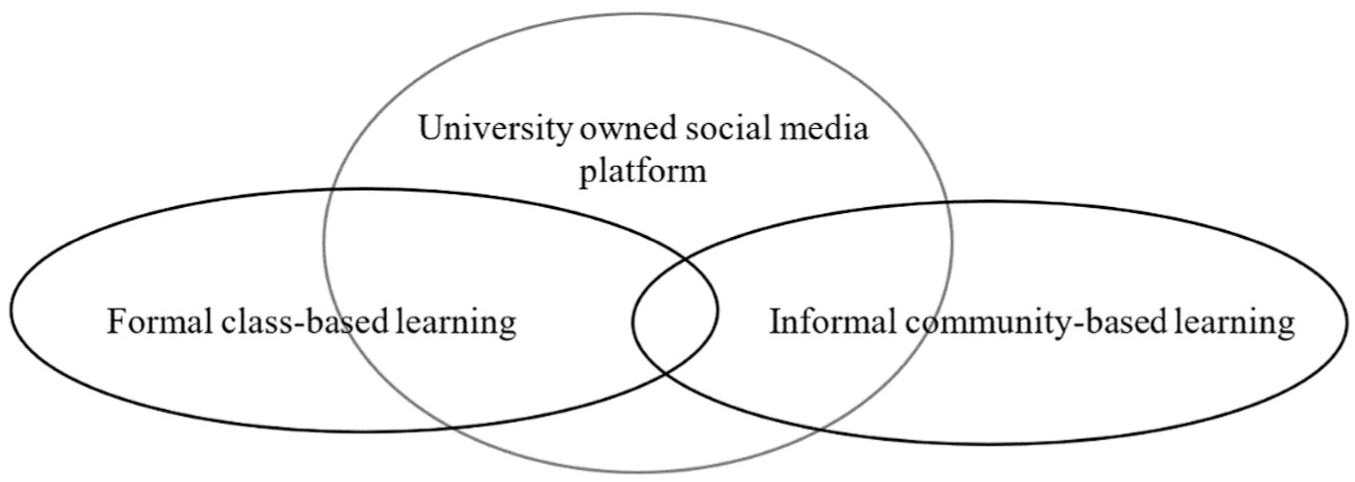
Schematic of a university owned social media platform.
(Wenger et al., 2002) principles for cultivating communities of practice have been shown to be applicable to online communities (Liberatore et al., 2018) and also have informed the prototype’s design. These principles include: (1) design for evolution, which refers to communities evolving organically according to users’ interests; (2) foster dialogue between inside and outside perspectives, including between novices and experts; (3) enable multiple levels of participation to accommodate diverse needs; (4) and provide both public and private community spaces, for instance through privacy settings that allow users to decide which subgroups to include in a given activity. Furthermore, an abundance of activity is needed, since people are drawn to SM for diverse reasons, including connection, entertainment, and learning. Also key is a sense of vibrancy—that the platform is “jumping, alive with energy” (Bingham and Conner, 2015: 128)—and thus might offer multiple draws for each user.
Guided by the above, I envision a platform comprised of three spaces (Figure 2):
Organic informal learning and socializing: This space would allow community members to initiate discussions, groups, or events based on their interests, ranging from social meetups to study groups and professional networking.
Activism and organizing for change: This space would provide a platform for research centers and community members to organize for positive change.
University-initiated content and discussion: This space would offer university news, events, and faculty research discussions.
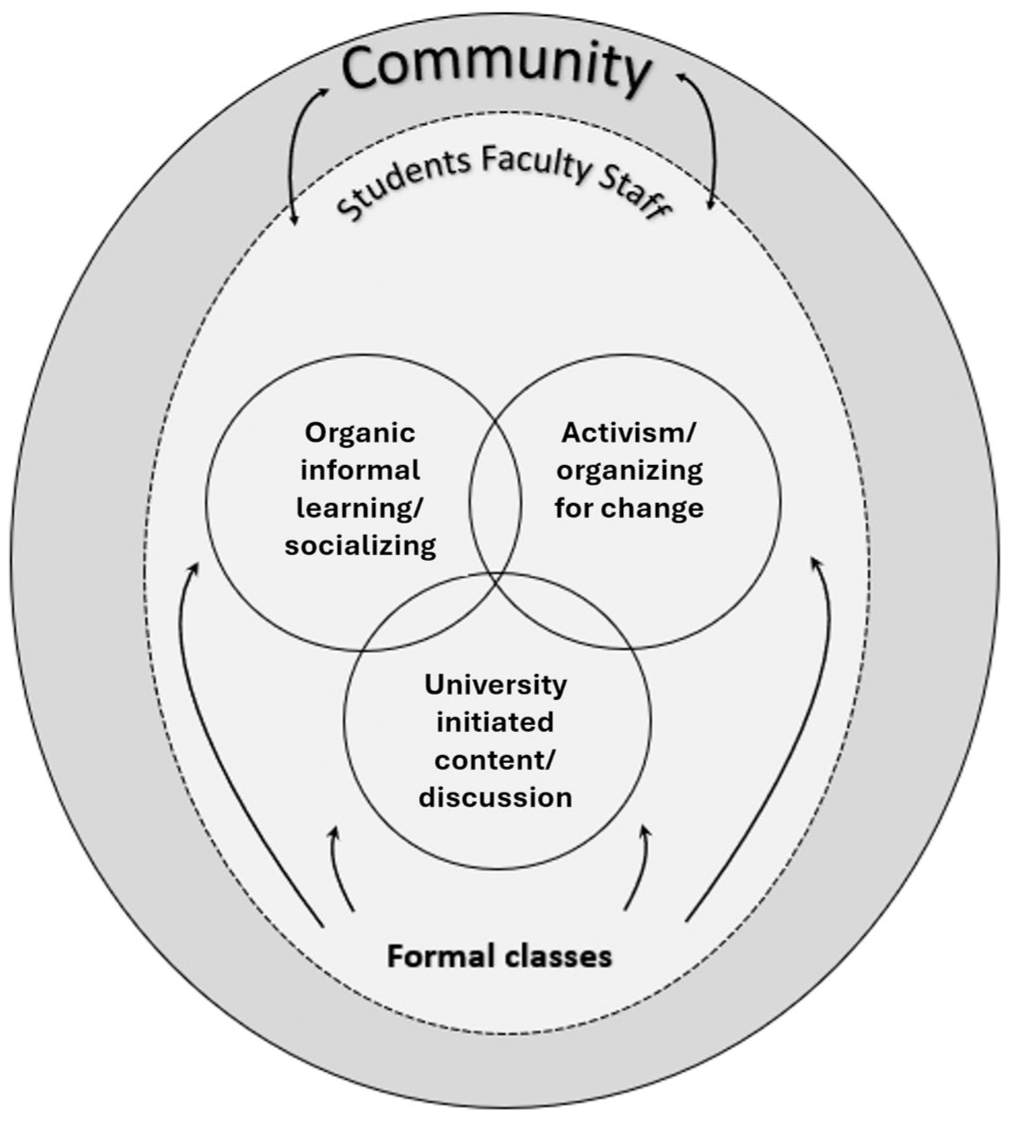
Prototype of a university owned social media platform.
The platform, particularly in spaces 1 and 2, would embody Cormier’s (2008) ideal of the community becoming the curriculum, “not driven by predefined inputs from expert . . . [but] constructed and negotiated in real time by the contributions of those engaged in the learning process” (n.p.). It would differ from conventional learning management systems by favoring a rhizomatic approach with learning emerging organically from user-initiated discussions, negotiated in real time, and blurring boundaries between formal instruction, informal socializing, and civic activism.
Figure 2 communicates the linking of some formal classes to the SM space and the porousness of the university to the outside world.
Clearly, innumerable questions remain: What new staff or faculty positions would be needed and how would they complement current roles? How would a university platform positively engage users? How would it avoid the many toxic flaws of existing platforms? Within the scope of this essay, hopefully it suffices to note that many scholars and practitioners whose expertise might be tapped are engaged in these questions’ exploration. In terms of the skills needed to manage virtual communities, there is a maturing body of practitioner knowledge around the role of “community professionals” (CMX, n.d.). As to fostering positive engagement, certain niche platforms offer lessons and inspiration, with one example being social networks of amateur readers and writers, where users can post their writing and comment on that of others. Studies of one such platform, Wattpad, point to the vibrant possibilities in entangling community and informal learning, suggesting that despite commonplace notions around young people’s declining literary interests, they in fact may be engaging with literature “at an unprecedented scale” (Pianzola et al., 2020: 1). Wattpad has been shown not only to advance students’ literacy, collaboration, and feedback skills, but also to nurture feelings of belonging and the formation of friendships (Garcia-Roca, 2021; Ito et al., 2018). That it largely is experienced as a welcoming space suggests that the problems of large corporate platforms may not be those of well-moderated niche communities.
Indeed, multiple initiatives and a growing body of research suggest that the right stewardship can enable thriving pro-social SM spaces. New forms of SM are being spearheaded by those involved in the aforementioned Good Web movement (Zuckerman, 2022b), as well as by organizations like the Dutch PublicSpaces, committed to virtual ecosystems that “serve the common interest and do not seek profit” (PublicSpaces Foundation, n.d.) and the American New_Public, whose Public Spaces Incubator has convened organizations from seven countries to reconceptualize SM platforms for public conversation (New_Public, n.d.). Such initiatives are supplemented by research into how civility and pro-sociality can be nurtured through SM architecture, algorithms, and moderation (Kim et al., 2022). All the above lends credence to the hope that, in properly motivated hands, a university SM platform might be a space of learning, connection and flourishing.
A final question is whether universities, which have shown themselves to be as likely—if not more so—to succumb to forces of marketization than to resist them, would be motivated and able to steward such a space. Hopeful NL experiments exist, particularly at the program level (e.g. Lee and Bligh, 2023), but the realism of institutional-level adoption remains an open question. That said, the realism question could be raised about any hopeful vision of institutional transformation. As Barnett (2017) argues in advancing his concept of the ecological university, universities are “supremely layered institutions” (173); critical, progressive positions exist within institutions exhibiting corporate-like behaviors; and these optimistic pockets of innovation could emerge as forces of positive institutional transformation, which should be pursued. He acknowledges that such transformation “[may not be] likely to appear, given the circumstances of the world. But, realistically, it could appear” (Barnett, 2017: 173). Indeed, as universities pursue growth, scale and efficiency, it becomes all the more urgent for “communities of scholarship to take on the task of articulating confident, alternative imaginaries for the future of teaching in universities which re-introduce the values we want to teach and live by” (Bayne and Gallagher, 2021: 608).
Conclusion
This essay aligns itself with those who perceive SM as possessing affordances to “dramatically expand possibilities for mobilisation, intervention and resistance” due to their “continuously connected, decentralised and open social structure that transcends territorial boundaries, overcomes physical and temporal barriers” (Gonzalez-Sanmamed et al., 2020: 87–88). It also champions the view that, in the context of universities adopting technology primarily to achieve growth, scale, and efficiency, critical scholars have a duty to advance bold, alternative visions that serve students and society. It suggests that a path to such a future might be achieved by hearkening Hodgson and Watland (2004)’s call to pay further attention to the NL movement, with its history of exploring how technology might serve radical pedagogy. Finally, it advances one potential path forward for a networked, post-digital critical vision, which would be for universities to become owners and managers of SM platforms.
Footnotes

Funding
The author received no financial support for the research, authorship, and/or publication of this article.
Declaration of conflicting interests
The author declared no potential conflicts of interest with respect to the research, authorship, and/or publication of this article.