




Abstract
Management scholarship faces a challenge in maintaining relevance, as it struggles to influence and shape practices that address pressing societal problems such as social inequalities and environmental degradation. While critical management education has surfaced as a promising avenue for reshaping management practices, it has yet to realize its potential. This article aims to address this relevance crisis by examining the limits of critical management education, particularly through the lens of Freire’s contributions. By recognizing coloniality as a crucial institutional constraint that underlies various forms of oppression, we gain insights into the barriers hindering our relevance. Overseeing this constraint is troubling within business schools, often viewed as colonial endeavors. Consequently, these insights shed light on our circumstances and limitations in producing social change. In response, we suggest reframing critical management education as a form of critical performativity informed by Freire’s insights. In this light, knowledge serves as a catalyst for change, empowered by its relational, responsible, and provocative validity. By embracing Freire’s principles of thematic investigation, thematization, and problematization, we provide a comprehensive framework for understanding and addressing academic oppressions as a fundamental step in the quest for social change, offering valuable insights for future research and interventions in critical management education and beyond.
Keywords
Introduction
Management scholarship faces a crisis of relevance, as we struggle to produce practical changes to address the pressing social and environmental challenges of our times. Existing discussions on this topic have explored various aspects, including the need to redefine the role and scope of management scholarship (Bartunek, 2002, 2020; Hambrick, 2007; Mckelvey, 2006; Van de Ven and Johnson, 2006; Weick, 1999, 2007), the need for practical application of scholarly work (Anderson et al., 2017; Gulati, 2007; Hoffman, 2016; Nicolai, 2004; Spicer et al., 2009), reflections on the nature of academic work and limitations of scholars (Alvesson and Spicer, 2016; Elangovan and Hoffman, 2019; Harley, 2018; Knights and Clarke, 2014; Pratt, 2008), blunt criticism of the growing irrelevance of academic works (Tourish, 2020), and an emphasis on the urgency for transformations (Alvarez and Rangan, 2019; Contu, 2019; Parker, 2018; Woodman, 2016).
In response to these challenges, management education (ME) has been pointed out as a potential venue for increasing our relevance by educating managers to become change agents. However, this is far from being a simple task (see Coronado, 2016; Cunliffe, 2002; Fournier and Grey, 2000; French and Grey, 1996; Grey, 2002; Huault et al., 2014; Huault and Perret, 2011; Learmonth, 2007; Perriton and Reynolds, 2004; Prasad and Caproni, 1997), especially due to the lack of clarity of how education impacts business practices—a connection that is often taken for granted.
Another promising approach is the critical management education (CME) movement, which has emerged to transform management practices through “critical” education (Contu, 2009; Grey, 2004; Huault and Perret, 2011; Learmonth, 2007). However, we argue that fundamental dilemmas have hindered CME from realizing its full potential. Many of them are related to fierce burdens associated with our own identities as critical scholars. First, being labeled as critical management academic rather than simply management academic places us in an unprivileged position within business schools (BSs). Moreover, the “critical” label brings the baggage of critical management studies (CMS) into the scene, which includes critiques such as being an overly intellectual “closed system” (Clegg et al., 2006; Ford et al., 2010); being inadvertently or actively dismissive of ethical debates (Brewis and Wray-Bliss, 2008; Spicer et al., 2009); being dominated numerically and hierarchically by white, middle-class, heterosexual, able-bodied, global northern men (see Brewis and Wray-Bliss, 2008: 1528); being concerned with “esoteric” matters; or even being considered a nihilistic movement (Alvesson et al., 2009). In short, these critiques reveal a scenario of crisis that puts at stake the very meaning of being critical and its implications.
However, we believe that CME remains a highly prominent approach in this challenging scenario, even though some “unfinished businesses” need to be addressed. In particular, the work of Paulo Freire is considered a fundamental ground for CME (see Perriton and Reynolds, 2004), and yet his precise contribution has often been overlooked in this field (Dal Magro et al., 2020). One largely ignored aspect of his contribution is his centering on colonialism as a key historical force that explains many aspects of our daily struggles (see Walsh, 2015; for an exception, see Woods et al., 2021). This is especially worrisome in the context of BSs, as it has been argued that ME has historically served as an important vessel for Anglo-Saxon colonialism (Alcadipani, 2017; Alcadipani and Bertero, 2012; Cooke and Alcadipani, 2015; Ibarra-Colado, 2006; Yousfi, 2021).
ME has served to perpetuate colonial power relations because it propagates and legitimizes questionable norms and values that reproduce inequalities and political systems of domination throughout the world (Huault and Perret, 2011; Ul-Haq, 2022), at the same time as it presents itself as an ideology-free technique (Goshal, 2005; Grey, 2002). The term “coloniality,” originally coined by Aníbal Quijano (2000), explains how Eurocentric/colonial assumptions embed oppressive knowledge production systems. Also, it exposes its vulnerabilities by revealing the blind spots and the silences upon which Western conceptions of knowledge are built (Santos, 2014).
We address these shortcomings by attempting to answer a fundamental question: How does Freire contribute to unleashing CME’s potential to drive social change in management practices? To answer this question, this article is organized as follows. We will first address the question of the applicability of Freire’s insights in the context of BSs, giving special attention to his take on colonialism and why his insights are important in this context. Second, we address the shortcomings of CME and shed light on existing discussions that have attempted to tackle them. We emphasize the discussion on critical performativity and the need to go beyond existing discussion by acknowledging our own oppressive situation and its colonial roots in order to drive social change in BSs. Third, inspired by Freire’s notion of “thematization” we expose some of the daily struggles of BS academics as reflected in recent literature. Thematization is the departing point of Freire’s social change efforts, and it involves getting acquainted with a group’s thematic universe to comprehend their challenges and experiences. Finally, we conclude this article by clarifying how Freire’s pedagogy is a peculiar form of critical performativity (see Walsh, 2015) that departs from understanding our own situations in order to generate relevant knowledge as a catalytic force for change due to its relational, responsible, and provocative nature.
Becoming and educating rebels: can we embrace Freire’s pedagogy in the business classroom and beyond?
Before proceeding, we must face head-on an unavoidable question: How can Freire’s pedagogy, originally conceived for empowering oppressed groups, be effectively practiced in the unique contexts of BSs, places historically associated with epistemic colonial domination and typically linked to high social status and privilege? A simple answer to this question rests on the fact that Freire’s pedagogy was, by his own account, conceived precisely in a historical setting—the Brazilian society—deeply dominated by a colonial logic. Thus, his efforts and experiences were historically submerged in the need to transgress our colonial culture of silencing and oppression (see also Gadotti, 2004). This pedagogy developed important tools for political struggles in colonial settings such as BSs.
This pedagogy is commonly called critical pedagogy (Freire, 2000, 2018a; Freire and Faundez, 2017; Leca et al., 2014; Leca and Barin Cruz, 2021). Freire is known for being the most popular Brazilian theorist in history; some argue that this is due to the fact that his work carried a message that was, at the same time, simple enough to achieve broad audiences and theoretically deep enough to catch the attention of specialized scholars (Chabalgoity, 2015). In summary, Freire advocated for and put into practice a pedagogical/investigative approach aimed at giving voice to groups of society that were silenced and/or made invisible by systems of oppression historically legitimized by Western colonialism (Beckett, 2013).
In Pedagogy of the Oppressed, Freire described 15 years of experiences working with rural communities. This work is crucial for providing a clear framework for social action aimed at establishing local changes (Freire, 2018b). Regarding the main phases involved in the fieldwork that Freire meticulously described in this book, we summarize its key points in three stages: (1) investigation: to acquire knowledge on the community’s current situation and struggles; (2) mediation: to facilitate and stimulate as the community’s existential and concrete situation becomes visible and “problematic” (historical problematization); and (3) collaboration: to establish, through dialogue, cultural actions that both assimilate the aspirations of the oppressed and continuously problematize the meanings of such aspirations. Each stage reinforces a particular type of validity for the knowledge-building efforts that take place when one attempts to grasp oppressive local situations to act upon them.
The framework for social action proposed by Freire, which we define as a methodological structure, may be replicated in various scenarios. Others have referred to this framework as a “situated pedagogy,” an approach that could be adapted for diverse places, different stakeholders, and varying conditions (Shor, 2018: 1338). Furthermore, Freire (2018b) established clear methodological guidelines that demonstrate his appreciation for academic rigor and also show his commitment to disassociating “democratic procedure and lack of academic rigor” and “academic rigor and authoritarian procedure” (Freire and Faundez, 2017: 65).
Considering this understanding, it is worth recognizing that although the precise contribution of Freire to the CME movement has often been taken for granted, it is important to say that CME also demonstrates that the colonial condition has often been ignored as a historical engine shaping ME and the oppressive management practices it disseminates and legitimates (Alcadipani, 2017; Ibarra-Colado, 2006). To approach this thorny issue, we must first examine if and especially how management knowledge reinforces coloniality (see Ibarra-Colado, 2006; Quijano, 2007), or how oppressive colonial power manifests in subtle ways in our field (Alcadipani and Bertero, 2012; Cooke and Alcadipani, 2015; Yousfi, 2021).
To deal with oppressive colonial power, Freire strongly defends that education is the central feature of building movements for social change (Gottesman, 2010). Although he primarily addressed popular education, there is no evidence in his works that the author set any limits as to which classroom would benefit from his approach or which classroom should be banned from using it. In fact, we believe that this would be deeply contradictory to his open and generous approach to education and his faith in humanity: everyone should get the chance to reflect on their situation, even if it means going through a profound rebirth (Freire, 2018b). Even if we accept the premise that BSs stand more at the “oppressor’s” side as Freire would have conceived it, we find in Freire’s work the justification as to why his pedagogy can and should be used in this context.
This is because of two crucial characteristics of Freire’s pedagogy, namely, that it is problem-posing and situated, meaning that it can be adapted to different scenarios, places, and stakeholders (Shor, 2018). This also means that in the context of BSs, Paulo Freire’s pedagogy demands profound engagement with the broader institutional constraints that shape our academic environments and how it affects ourselves and our own capacity to become change agents. As Freire (2000) eloquently expresses: I have the right to be angry, to express it, to have it as motivation for my fight just as I have the right to love, to express my love to the world, to have it as motivation for my fight because, historically, I experience History as a time of possibility, not determination [. . .] My right to anger presupposes that, in the historical experience in which I participate, tomorrow is not something “pre-given,” but a challenge, a problem. [. . .] I cannot fold my arms fatalistically in the face of misery, thus emptying my responsibility in the cynical and “lukewarm” discourse that speaks of the impossibility of change because reality is just like that. The discourse of accommodation or its defense, the discourse of exalting imposed silence resulting in the immobility of the silenced, the discourse that praises adaptation taken as fate or destiny is a discourse that denies humanization, from whose responsibility we cannot exempt ourselves. Adaptation to situations that deny humanization can only be accepted as a consequence of the dominating experience or as an exercise of resistance, as a tactic in political struggle. I give the impression that today I accept the condition of being silenced in order to fight against the denial of myself when I can. (p. 36)
These words underscore the dynamic nature of historical experience, emphasizing the need to perceive tomorrow as a challenge, not a predetermined outcome. Freire urges us to reject fatalistic resignation in the face of how BSs have served a colonial logic or have historically perpetrated and reinforced inequalities and other societal issues and everyday oppressions. Instead, he urges us to embrace our responsibility as academics and also practitioners to actively confront and transform the conditions that, through violent oppression, deny humanization to ourselves and others. As he further explains, “problem-posing education is revolutionary futurity. . . Any situation in which some individuals prevent others from engaging in the process of inquiry is one of violence” (Freire, 2018b: 65–66). To fully grasp the significance of Freire’s message, therefore, it is essential to explore his powerful insights in their entirety, and for this, we must put BSs and management scholarship institutions, their place in history and their violences under scrutiny.
Implementing Paulo Freire’s pedagogy is undeniably a complex endeavor, especially within the challenging context of BSs. The substantial challenges it presents could clarify the assertion that, despite claims that CME is predominantly influenced by Freirean ideas, we lack evidence to substantiate this claim (e.g. Perriton and Reynolds, 2004). It may also account for the absence of a thorough analysis of Freire’s works and their actual influence on CME theory and practices (Wickert and Schaefer, 2015).
Furthermore, other works that have used Freire’s ideas in management classrooms are usually restricted to describing isolated pedagogical experiences (e.g. Dal Magro et al., 2020; Gent, 2009). Most works within CME have centered their efforts mainly on elaborating new forms of pedagogic methods to be applied in BS classrooms (Contu, 2009), thus often leaving aside a deeper analysis of the oppressive nature of management scholarship. The issue here lies in the fact that this is an absolutely necessary step to practice Freire’s teachings. Nonetheless, we are not suggesting that Freire has been “incorrectly” used or “misinterpreted” in this field, nor do we advocate for any sort of “theoretical purity.” We simply claim that Freire’s work bears more potential to contribute to BSs than what has been explored so far.
The applicability of Freire’s (1992, 2000, 2018b) insights in the context of BSs emerges from the attention to his pedagogy, which promotes change due to its relational perspective, responsible actions, provocative knowledge, and criticism that offer valuable guidance and support to change practices. It means that Freire’s pedagogy sheds light on CME, especially if we focus on the existing discussions on critical performativity (Walsh, 2015). This concept has been broadly defined as the “more practical” act of conceiving discourse and combining critical theory and practice to encourage emancipation in practical organizational work (Alvesson and Spicer, 2012; Gond et al., 2016). In the following section, we will focus on the literature of critical performativity as a possible way to be more efficient in producing needed social changes through CME, drawing on the insightful perspectives of Paulo Freire to also address its shortcomings.
Reframing critical performativity as a decolonial struggle: resisting conforming positivity
The emerging debates surrounding “critical performativity” provide important insights into how to make critical projects more successful in our academia. However, this is a controversial debate that initiated in an attempt to reverse the discomforting notion that the CMS movement is characterized by anti-performativity (see Fournier and Grey, 2000). Besides that, critical performativity has been criticized in three crucial points: (1) even though it acknowledges that institutional forces contribute to the success or failures of critical ventures, it fails to recognize and validate the inner dilemmas and silencing we face as critical scholars (see Hartmann, 2014); (2) this approach often overemphasizes the need to get close to managers and has little to say about ME and its problematic nature; and (3) critical performativity portrays performativity in an overly optimistic lens that is often unrealistic (Fleming and Banerjee, 2016).
Nonetheless, critical performativity wishes to contribute to the venture of making management scholarship more relevant within practical changes (Alvesson and Spicer, 2012; Gond et al., 2016). This approach acknowledges that the institutional context where we are and stand as scholars severely strengthens or limits the chances of critical projects to be successful (Leca and Barin Cruz, 2021), a point which is not always explicitly addressed in CMS and CME. The silence of critical scholars about the many constraining political issues and often oppressive institutional forces that shape our work today inspires us to reflect on the following question: How can we educate change agents if we are unable to change our own oppressive situation? (Fleming and Banerjee, 2016: 269).
While we largely agree with such points, raised particularly by Fleming and Banerjee (2016), we have significant reservations about the authors’ conclusion that to make a meaningful contribution, the CMS community needs to fight for spaces that enable scholars to “uselessly” reflect, imagine inconceivable utopias, take their good time to read and reread the canons, lose themselves in lofty theorizing and patiently study minute empirical details and texts in order to ask “big” questions, even those without obvious practical answers. (p. 273)
Although every single individual in the world should have free space and opportunity to engage in intellectual work if they so desire, a depiction that moves us further away from our own realities can be particularly problematic. In this sense, Freire’s work and his insights on the coloniality approach are complementary to the critical performativity approach and can help overcome the shortcomings we have highlighted in this section, especially those raised by Fleming and Banerjee (2016). The main point here is that Freire’s situated pedagogy is aligned with critical performativity’s situational approach, but goes one step further as it recognizes the need to struggle against the adverse and unfair conditions that critical scholars face to change any given situation.
On the contrary, Freire’s pedagogy complements critical performativity by bringing education to the foreground, as learning is essential for agency. It problematizes the broader political settings that make free and creative learning endeavors difficult and precarious (Freire, 2001; Freire and Faundez, 2017). Here, we argue that Freire’s approach can help overcome the shortcomings in this literature and reframe our notion of what critical performativity means, especially by emphasizing the role of politics and the need to understand how our institutions constrain us.
The broader political setting that we debate here is colonization, and we do so for two reasons: (1) colonization has shaped Western culture for over 500 years and remains a key component of world politics; and (2) BSs and management and organization knowledge have been labeled as colonial ventures. It is possible to say that coloniality offers valuable insight on how to understand our situation in this specific context as a first step to resist and possibly seize the power to speak and be seen, which is insistently misappropriated by the colonial logic.
Decolonial scholars are strongly committed to acting in such settings through the project of seizing Western epistemology in favor of silenced voices. This involves the unveiling of epistemic silences of Western epistemology and affirming the epistemic rights of the racially devalued, and decolonial options to allow the silences to build arguments to confront those who take ‘originality’ as the ultimate criterion for the final judgment. (Mignolo, 2009: 162)
Although Freire wrote before this movement emerged, he is a fundamental reference in Latin American critical theory and a precursor of the so-called epistemologies of the South (Altamirano, 2016; Beckett, 2013; Cortina et al., 2019; Margonis, 2003; Rozas, 2007). The author consistently highlighted the dangers of falling prey to the disguises of Eurocentrism. In his own words: The predatory presence of the colonizer [. . .] his unquestioned ambition to destroy the cultural identity of nationals considered inferior, almost animals, none of this can be forgotten when, distanced from [the colonial] time, we run the risk of softening the invasion and seeing it as a kind of civilizing gift. (Freire, 2000: 34, our translation)
Freire (2018b) also says we should not ignore that workers, urban people, peasants, are “immersed in a colonial context” that constitutes almost our “umbilical” connection to the world (p. 117).
In this sense, coloniality forms an ambiguous historical backdrop essential for critical scholars striving to be seen and heard in BSs. However, Freire’s works extend beyond analyzing coloniality-based oppression; they provide comprehensive guidelines for unveiling all forms of oppression (including coloniality-based ones). According to Freirean pedagogy, the forefront of our concerns should always be occupied by the realities and everyday struggles of a community that demand immediate attention—the “limit situations,” as termed by the author (Freire, 2000, 2001). In contrast to the vague and often circular understanding associated with the concept of social change in this field, Freire introduced in his pedagogy a method that is empirically supported, thus providing a clear theoretical foundation for action. This means that community-level social struggles possess an essentially pedagogical nature that drives participants toward political action (Freire, 1992, 2018b). This was perhaps the most crucial insight of Paulo Freire.
Freire’s foundation for action is based on what he termed the “dialogical matrix,” which directly opposes the colonial logic of what Freire (2018b) identified as the “anti-dialogical matrix.” The latter is defined by four imperatives: (1) the need to conquer; (2) divide to dominate; (3) manipulation; and (4) cultural invasion. Freire’s approach has far-reaching political implications for the realm of management scholarship, making it more than a mere instructional tactic for use in classrooms as just another possible method.
Considering critical performativity as a potential path for efficiently generating necessary social changes through CME, we can posit that Freire’s insightful perspectives regard critical pedagogy as relevant for scrutinizing our situation as BS academics and understanding our own situation and constraints as critical scholars. Therefore, Freire’s insights offer clarity on our situation and aid in comprehending our shortcomings in serving our communities better. It is possible to assert that Freire’s contributions provide insights which help overcome the constraints limiting our relevance and ability to effect change as academics.
Since coloniality is particularly concerning within BSs, often viewed as colonial ventures, ignoring coloniality is a way of maintaining its impacts as a key institutional constraint underlying various forms of oppression (Quijano, 2000). Below we present the possibility of reframing critical performativity as a decolonial struggle, guided by Paulo Freire’s insightful perspectives. It can inspire us to become change agents in addressing our own oppressive situation and making practical changes to tackle the pressing social challenges of our times. Considering all these potentials, Freire’s contributions can unleash CME’s capacity to drive social change in management practices.
This is not a windmill: what are we struggling with?
Critical scholars have been successful in depicting management as an oppressive and ideologically biased endeavor which presents itself as an “ideology-free” technique (Grey, 2002). However, a key blind spot in CMS lies in its failure to acknowledge the very existence of cognitive imperialism as the modus operandi of Western scholarship. This contributes directly to the silencing and oppression which this movement attempts to undermine.
To illustrate this assumption, we departed from Freire’s notion of “thematization” to understand the daily struggles we experience as critical academics in BS. We conducted a non-exhaustive exploratory thematic analysis of recent papers addressing academic oppressions, and a comprehensive understanding of the prevalent themes has been achieved. In order to identify the themes, we asked ourselves the following questions: (1) Is this a recurrent theme? (2) Is this theme partially or totally contained in another more recurrent theme? (3) Does the theme personally resonate with our own experiences living and being as critical academics in the Global South? (4) Is this theme relevant for the comprehension of the multifaceted nature of academic oppressions in business education?
This analysis allowed us to arrive in 10 prominent themes that encapsulate the multifaceted and complex situation we face as critical academics in BSs. These 10 themes point toward oppressive knowledge–power relations that we contend are relevant for understanding how our own scholarship may be hindering our community from becoming more inclusive and relevant. Table 1 shows a summary of the identified themes.
Types of oppression and their expression within management scholarship.
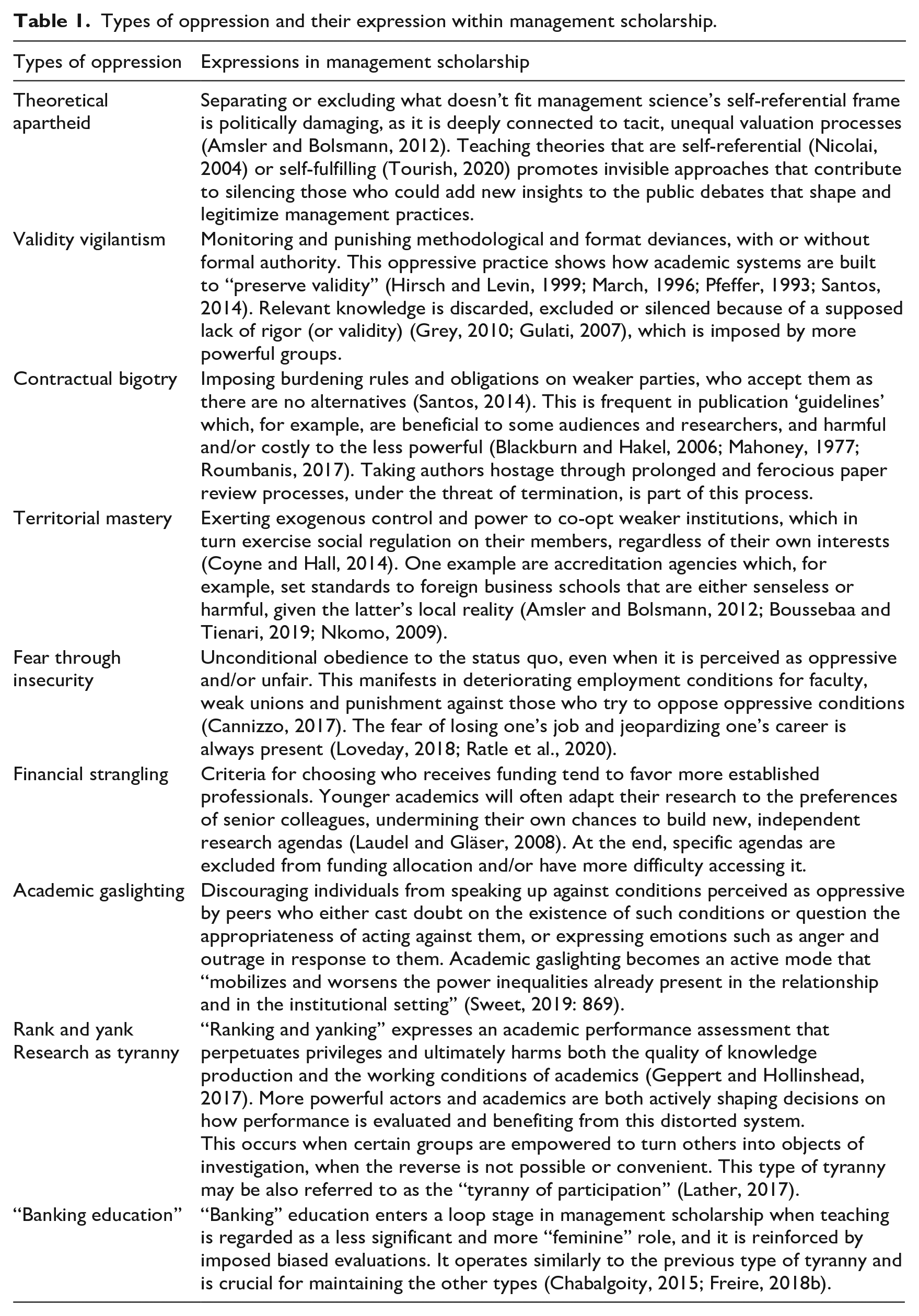
Although the description of these 10 types of oppression and their expression within management scholarship is not exhaustive, these themes have one common mechanism that must be challenged: the imposition/production of passivity, which has a deep colonial root. Freire’s framework is a potential path to addressing and countering each of these oppressive categories, as shown below.
Theoretical apartheid
The theoretical apartheid may be reproduced also by critical scholars who advance in their career through oppressive practices, probably “driven by power or vanity, rather than by the values that they officially subscribed to, such as justice and equality” (Elzinga, 2012: 477–478). Because this process silences those who could contribute underexploited perspectives to management practices, Freire’s (2018b) framework addresses this oppressive category, since fighting oppression involves acquiring critical knowledge, that is, critical knowledge of the situation in which participants/local people find themselves. This so-called situation is primarily historical and structured by the conditions in which “the people’s thought and language dialectically constitute each other” (Freire, 2018b: 71, our translation).
Validity vigilantism
It is certainly worrying when such knowledge is discarded or labeled as invalid because of a lack of understanding of the local conditions it emerged from (Tuck and McKenzie, 2015), or simply because it is knowledge “outside their paradigms of choice, uses a method outside their comfort zones, or simply comes from the wrong tribe” (Gulati, 2007: 778). In validity vigilantism, theory building and data generation/analysis may be reduced to a fetishized technique, which ultimately serves a perverse exclusion system, as this ethos “is accessible only to the privileged few who have the security and resources to enable its pursuit” (Bell and Willmott, 2020: 1374).
Freire’s framework addresses this oppressive category by obtaining people’s approval for the intervention. That is, the researchers must identify those interested in participating in data collection. The investigation must be “prolonged” (though no time standard is fixed) and must involve observation and data collection on multiple aspects and situations experienced by participants in their communal life. Importantly, every behavior and attitude of the researchers during the process must be comprehensible to those with whom they interact, which requires substantial training for data collectors, who are also community members (Freire, 2018b).
Contractual bigotry
This may take many forms in today’s management scholarship, as it is based on the assumption that instead of promoting what we “signed up for,” that is, an ideal democratic and autonomous scholarship, we often find ourselves in a system of privilege that disproportionately benefits a few while burdening and silencing others (Dean and Forray, 2018). Freire’s framework addresses this oppressive category when the author clearly states that a “sufficient” number (not predefined but highly dependent on the size and diversity of the community at hand) of individuals must agree to engage in informal dialogues. This is done to provide an opportunity for clear understanding of the purpose of the rules/context (Freire, 2018b). In other words, Freire’s framework provides further insights on how to build understanding through authentic dialogues toward critical knowledge development, as a means to avoid ending up in a “hostage situation,” as is often imposed by a contractual bigotry process.
Territorial mastery
Territorial mastery shows two basic and interconnected traits: first, it prioritizes a globalizing and cosmopolitan orientation over local ones (Alvesson and Spicer, 2016; Amsler and Bolsmann, 2012; Bell et al., 2017); second, it is essentially parochial, that is, founded on the ignorance of others’ ways, which are perceived as inferior (see Boyacigiller and Adler, 1991). As pointed out by Grey (2010), “we might say that the development of management and organization research is inseparable from its macro-political context” (p. 681).
Freire’s (2018b) framework challenges this oppressive category through the analytical stage of “historicizing” the struggles and concerns of community members. This involves problematizing the struggles and situating them within the broader social and political context of the local reality of today, all while upholding the primacy of “indigenous” knowledge derived from authentic dialogues. Placing the identified struggles in a wider historical context is essential in order to avoid viewing the investigated community as an isolated entity, while also respecting the primacy of the community’s knowledge and how it frames its experiences locally, through its language and vocabularies. Thus, local community knowledge becomes a potent force against the territorial mastery process.
Fear through insecurity
In order to survive in academia with some level of security, we are compelled to publish in a few highly ranked journals—predominantly from the United States, but also from Europe—and the punishment for those unable to meet these criteria is becoming increasingly harsh (Alvesson and Spicer, 2016; Santos and Silva, 2023). These oppressive systems “replace collective security and cooperation by individual competition” (see Hanlon, 2018: 303). While this trend has impacted academic careers across the board, it disproportionately affects BSs, which requires us to be especially aware of its threats (McCann et al., 2020).
Freire’s (2018a) framework addresses this oppressive category by explaining that, in this scenario, it is necessary to encourage participants to view the “totality of their situation”. The author encountered a challenge in his fieldwork, where participants often had a “focal” view of their existential struggles, which limited their ability to see these within the broader political background. The wider political background, or the “totality” of the situation, is presented to participants through “auxiliary codes.” These codes are shown in a manner that highlights their connection to the “essential code,” thus maintaining individuals’ interest in collective actions. This provides an alternative tool against the fear through insecurity experienced in academic careers, that is, using collective actions fostered by a view of the totality of the situation experienced by the group.
Financial strangling
When funding institutions steer researchers toward orthodox and mainstream perspectives to the detriment of unorthodox ones, this results in a further loss of autonomy for academics. Pressured to secure funding from their institutions, researchers tend to avoid risks and conform (see Laudel, 2006). The funding “market” resembles an oligopoly where “few traders have the major share, and each oligopolist has significant power to influence the market” (Young et al., 2008: 1419).
Freire’s (2018b) framework has the potential to address this oppressive category if we draw inspiration from his “circles of investigation”. In fact, we believe this is the most challenging aspect of Freire’s framework, as it requires an assessment of the entire community where the practical intervention is intended. All conversations within these circles are to be recorded for subsequent analysis by a multidisciplinary team, as elaborated below. If successful, this investigation will pave the way for identifying the “thematic universe” of the people and the set of its “generating themes” (Freire, 2018b). The inspiration here lies in recognizing that autonomy of thought is intertwined with the identification of circles of investigation where we can integrate diverse perspectives, interests, and the universe of a group against the financial strangulation process centered on oligopoly and orthodox thinking.
Academic gaslighting
Academic gaslighting often manifests through the use of “humor” that eventually “helps sustain the oppressive system” (Contu, 2008: 367). The most prevalent form of humor in academia is linked to perpetuating oppressive scholarly practices by framing them as “just a game and everyone knows it” (see Butler and Spoelstra, 2020). We all know it is a harsh game, right? So, let us all just be tough guys and, please, be good sports! Besides, “‘you don’t play monopoly and complain about the rules’ (Professor)” (Knights and Clarke, 2014: 347). Right? Ha!
Freire’s (2018b) framework addresses this oppressive category by emphasizing that when someone expresses themselves through language, language is both action and reflection. However, Freire (2018b) distinguishes between “inauthentic words” and “authentic words,” and asserts that only the latter have the capacity to foster meaningful changes because “dialogue is an existential requirement” (p. 109). To deny someone the right to speak in their own language, according to Freire, is a dehumanizing aggression. Thus, the idea of relationality imposed by academic gaslighting could be challenged by a perspective deeply anchored in Freire’s notion of language as an existential demand. This perspective is exercised through what Freire calls authentic dialogues, aimed at building an understanding of the reality of the people.
Rank and yank
Oppressive “ranking” practices emerge under the guise of accountability, presenting themselves as a form of governance/management of academic performance that supposedly installs transparency and ensures the proper execution of scholars’ duties (Butler and Spoelstra, 2014). However, this mode of governance poses significant threats to academia, as “accountability is an alternative to trust, and efforts to strengthen it usually involve parallel efforts to weaken trust” (Elzinga, 2012: 425). This ultimately leads to a reduction in academic self-governance.
Freire’s framework has the potential to address this oppressive category through a process called thematic investigation. As highlighted by Freire (2018a), both the people and the investigators are active subjects in a sui generis process of codification occurring through live interactions with the people and never in isolation from them. According to the author, codification is both explicit and enigmatic—it consists in existential situations that depict the struggles of the people. Considering that the rank and yank process can be viewed as a form of social struggle, one that benefits more powerful actors and academics who control performance evaluation within this distorted system, Freire’s framework suggests that the terms in which interactions in ranking and yanking occur can be recognized as a type of interaction with the people. Being a type of interaction, it is susceptible to interventions that combat its legitimization and maintenance.
Research as “tyranny.”
The research-as-tyranny practice is particularly associated with the tendency to publish research solely for career advancement through exploitative methods. This practice reflects the lack of reciprocity and unequal power relations prevalent in various Western methodological traditions (Bell et al., 2017). Freire’s framework opposes this oppressive category by asserting that the initial step in fighting oppression is to understand it from the people’s perspective. This perspective (or thought) can only be accessed if one is sensitive to the language of the people (Freire, 2018b).
“Banking education.”
The prevailing system has primarily been shaped by a consumerist model adopted by many universities in their interaction with students. This model is oppressive toward faculty as universities heavily rely on “student evaluations as the dominant means to assess the quality of teaching [. . .] and these evaluations figure prominently into tenure and promotion decisions” (Chory and Offstein, 2017: 21). This creates a perfect storm that promotes and maintains the “banking education” in management programs, ultimately causing all the other practices to enter into a loop stage.
Freire’s framework counters this banking education by emphasizing the significance of the academic context as a privileged space for students’ learning and for reinforcing their autonomous and liberating ways of thinking. While it is crucial to acknowledge and resist the constraints and issues within this type of education, we believe that Freire’s pedagogy offers a more critical and liberating approach, granting academics greater freedom to express their ideas in BS classrooms.
Breaking the oppression cycle and fostering change: Freire’s framework
By understanding the larger picture and recognizing the interconnectedness of these practices, we have identified systemic issues that hinder critical thinking, creativity, and the pursuit of meaningful knowledge, essential elements fostering social change through CME. However, our failure to confront the 10 types of oppression and their manifestation within management scholarship is partly explained by the fact that many critical academics, and academics in general, may choose not to take political stands (Parker, 2002) which are necessary for engaging in critical performativity within this oppressive scenario (Contu, 2019; Fleming and Banerjee, 2016; Fotaki and Prasad, 2013; Wickert and Schaefer, 2015).
For those seeking permanencies rather than changes, confronting the 10 types of oppression and their manifestation within management scholarship may resemble some of our community members admitting to “wrongdoings” (Amsler and Bolsmann, 2012). We propose naming this process “surrendering by forgiving & forgetting.” Individuals admitting to “wrongdoings” seek redemption without actively contributing to substantial changes. The “sinner” or the “player” achieves their goal by receiving praise for exhibiting “human qualities” or “academic virtues,” while also getting published in the process (a crowning act of cynical double-dealing, as noted by Butler and Spoelstra, 2014). This practice overlaps with what previous research has termed cynical compliance: “they are cynical and can thus avoid the pain and costs of following any urge to resistance” (Alvesson and Spicer, 2016). This practice is highly problematic as it perpetuates the existence of a perverse system of privilege, validating defensive assertions, “particularly as the reference to ‘admitting forthrightly’ suggests that it is a rhetorical confession rather than an argumentative request. The inherently political nature of this elitism is exposed” (Amsler and Bolsmann, 2012: 293).
Nevertheless, when referring to the academic community, it would be unfair to judge critical academics without considering their unprivileged position resulting from the theoretical apartheid they are subjected to, their additional economic, psychological and other burdens, and the political risks this position implies. We cannot overlook the powerful system represented by the 10 types of oppression and their expressions within management scholarship, nor the ways in which they restrict us. It is essential to understand how education fits into the bigger picture to realize the potential of CME and the transformative capacity of Freire’s framework for producing change.
Thus, it is essential to understand how the collection of oppressive academic practices described in this section operates, creating a culture where individuals are silenced and discouraged from active participation. This dynamic results in the production and perpetuation of irrelevant management scholarship. Figure 1 illustrates what we term as the ugly mug of academic oppression in ME.
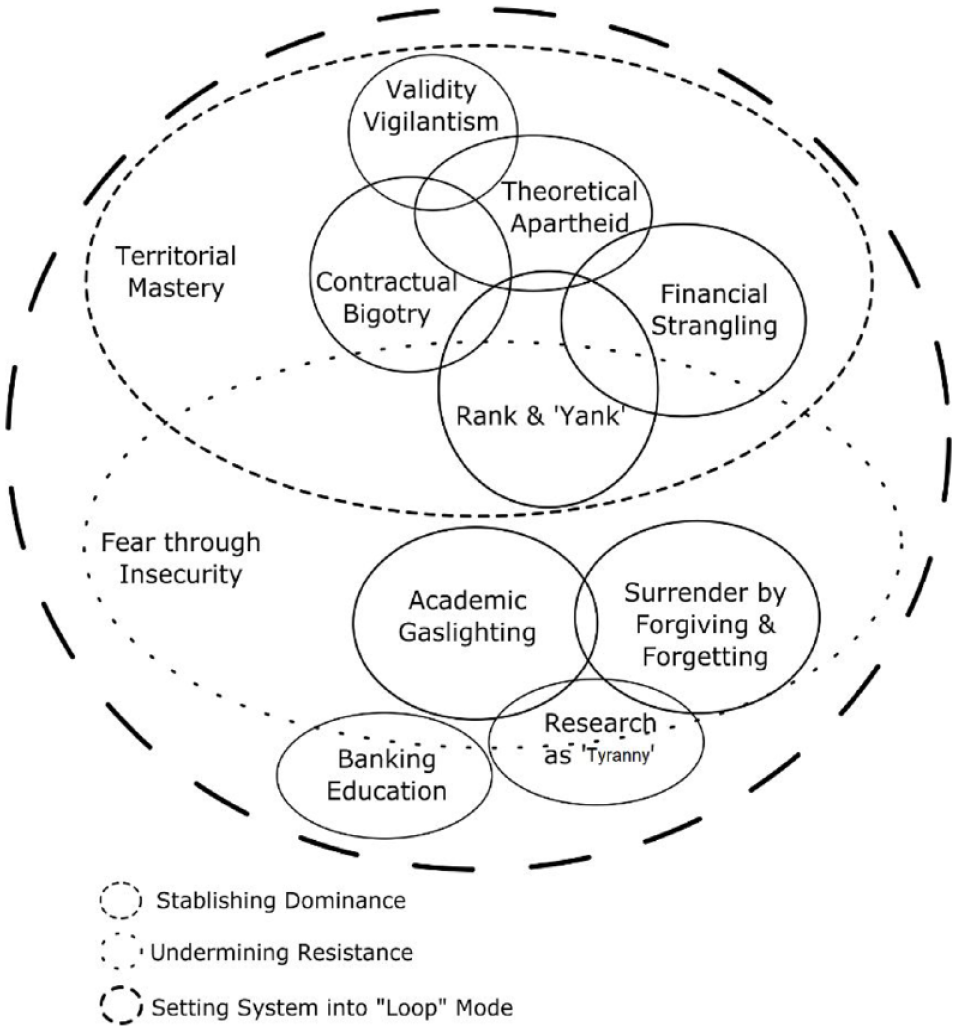
Management education’s system of oppression.
Within the oppressive academic landscape, Figure 1 suggests that certain practices serve to silence individuals by instilling fear and insecurity, while others perpetuate a territorial domination imposed by institutions primarily based in the Global North, disadvantaging those in other regions. As we visualize the oppression system in ME, we must always remind ourselves that we are not business scholars—we are management scholars.
As eloquently expressed by Professor Anita McGahan in the 2017 Presidential Address at the Academy of Management, we must confront the most pressing problems of our times in all types of organizations—companies, governments, nongovernmental organizations (NGOs), churches, hospitals, police, jails, agencies, and so on. Particularly, we should address the issues facing the most vulnerable: The problems of the vulnerable everywhere are our problem. Climate is our problem. These are our problems because bad management is complicit in their genesis and because the only chance to resolve them is in the assembly of free people in organizations. (McGahan, 2018: 175, emphasis added)
Hence, we have hardly any chance to effectively address these problems and jointly propose understandings and solutions for practical issues if we are subjected to a system of domination that has rendered many of us passive and thus oppressed beings ourselves. The key implication for managerial practices that we may draw from this article and our own experiences of being “managed”—in academia, of course—is that bad management practices begin when they turn into vessels of dominance and violence, imposing passivity on their members, especially the most vulnerable ones. In doing so, they cease to serve the best interests of our communities.
Freire’s tools prove invaluable in the challenging battle against oppressions and bad management practices everywhere. We have shown that these practices can manifest in various and even subtle ways that often become naturalized. Freire brings in the spike we need as academics, lecturers, researchers, and managers to denaturalize these systems by raising a radical critique against passivity. He strongly asserts that passivity dehumanizes people, inflicts damage on political life and communities everywhere, and is thus unacceptable—which goes far beyond Dewey’s milder critique framing it as an unhealthy way of approaching people (Bingham, 2016). Freire (2018b) also calls this process a “cultural action” that will compose the seed for instigating catalytic social change.
Drawing inspiration from these forms of breaking the oppression cycle and fostering change, the following section will systematically explore and outline a framework that reframes CME as a form of critical performativity. Our goal is to provide a comprehensive understanding of how this framework can be applied to CME, shedding light on its transformative potential and its capacity to challenge established norms and power structures within BSs.
Freire’s framework: a peculiar form of critical performativity
Freire’s principles, explored in the previous section, initially imply that CME cannot be practiced or regarded in isolation from the broader knowledge-making systems it is part of. According to this framework, education cannot be seen as a vessel for simply disseminating knowledge; it needs to extend beyond the classroom by becoming a process of investigation, thematization, and problematization. This approach aims to uncover the roots of what truly matters in any given community where CME is taking place. Table 2 summarizes this process.
Summary of framework and implications for CME.
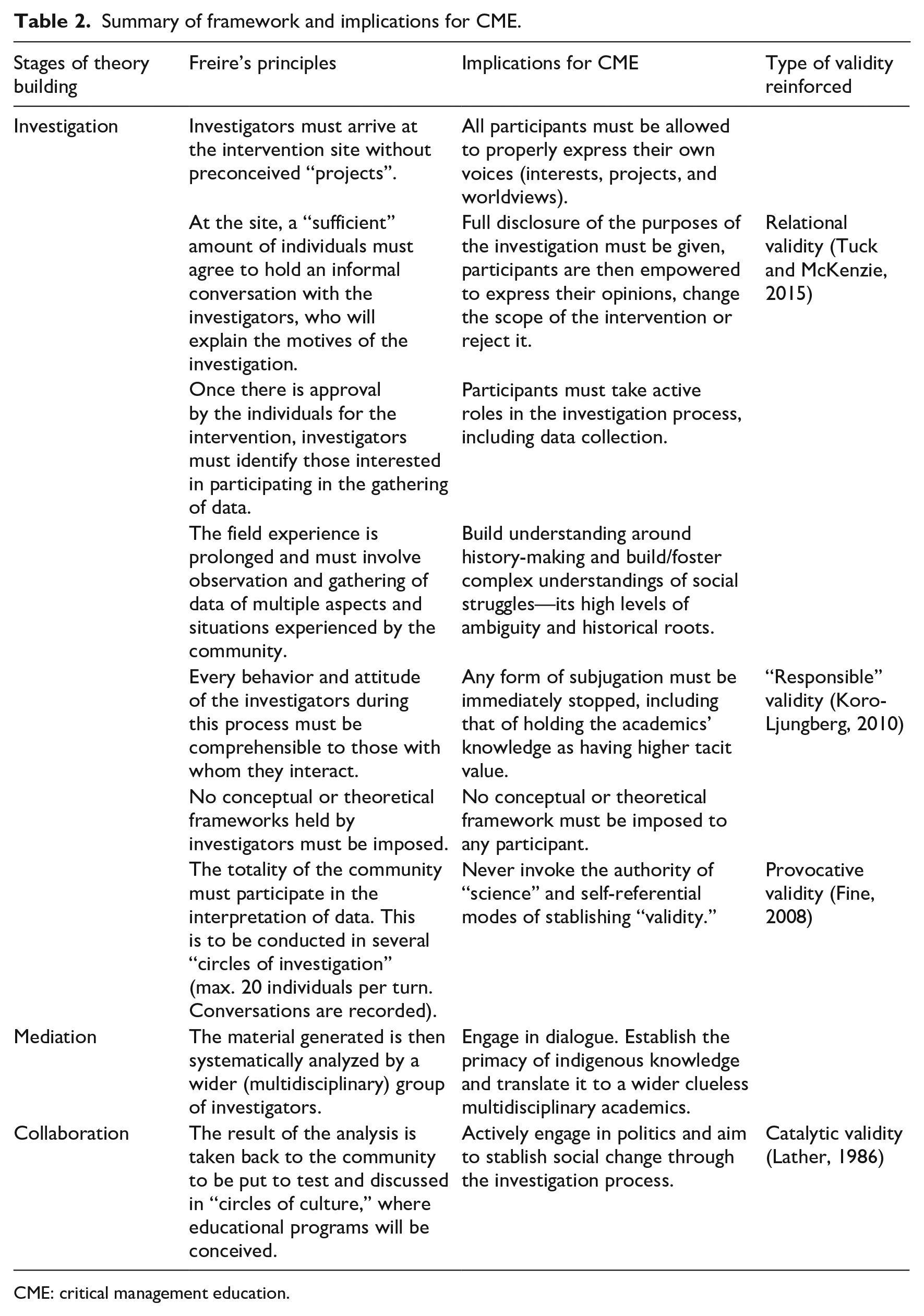
CME: critical management education.
This framework broadens the problematization of management scholarship and prompts several fundamental questions for those wishing to practice it: What knowledge must we teach in our classrooms? How is it produced, and how should we assess it? What criteria validate knowledge, making it worthy of our time and space within the classroom, especially if our goal is to bring about actual changes in the status quo? What power dynamics do we place ourselves in when we open space for such knowledge? In terms of conceiving changes in our communities, what criteria should be considered in deeming knowledge valid and worthy of consideration, and how should these changes be implemented?
Freire’s framework provides a general response to these questions. First, it assumes that all knowledge reinforced and produced by CME and our scholarships should have its validity justified in the following terms: it is valid because it is relevant, and it is relevant because it is connected to people’s actual struggles (relational validity), because it respects multiple points of view (responsible validity), because it pushes participants out of their comfort zones and into discovering/questioning the world in new ways (provocative validity), and because it reorients and energizes participants toward action (catalytic validity). Producing and teaching this type of knowledge is, thus, not an end in itself; otherwise, we would be in line with the self-fulfilling logic that has been pushing us toward irrelevance and oppression.
Freire’s framework presents a set of non-negotiable principles that can be used to formulate methodological guidelines at each of these stages, ensuring the validity of the produced knowledge. Each stage plays a role in reinforcing a different type of validity. Systematizing this contribution to CME aligns with Freire’s practical and theoretical opposition to associating “democratic procedure and lack of academic rigor” and “academic rigor and authoritarian procedure” (Freire and Faundez, 2017: 65). Nonetheless, we show that Freire has a unique approach to academic rigor that is applicable to any setting where learning (understood as an active process of knowledge-making) is taking place. Such rigor is achieved by ensuring the validity of knowledge claims through the combination of four criteria for assessing validity.
Nonetheless, these guidelines enable us to produce a very distinctive form of critical performativity that must adhere to an alternative combination of validity criteria to pursue social change. In broad terms, this framework instructs academics on how to establish relational, responsible, and catalytically valid assumptions about the needs and wishes of a specific community in order to guide changes in disarrayed and potentially oppressive practices and institutional forces. Furthermore, it teaches academics, students, and practitioners to assess the validity of knowledge claims based on this peculiar combination of validity-inducing factors.
In addition, according to the Freirean framework presented above, the impact of CME on management practices cannot be taken for granted, as though it naturally led to better or fairer practices. Instead, we demonstrated that the framework establishes clear principles or guidelines that, when applied, serve as triggers for change and provoke actual changes in local situations. In the following section, we will discuss the general implications of conceiving CME as a form of critical performativity using Freire’s insights.
General implications for CME
In the context of CME, Freire’s approach proposes that liberating practices commence at the stage of planning the syllabus for a given course, which must necessarily be developed together with the people who are the targeted participants (Freire, 2018a, 2018b; Freire and Faundez, 2017). An important note to highlight here is that Freire does not use the words students, pupils, or any other synonym to refer to the audience of his educational efforts; he consistently employs the expression “the people.” A situation is primarily historical and consists of the structural conditions in which “the thought and language of the people, dialectically, constitute each other” (Freire, 2018b: 121, our translation). At this stage, to assess this situation, the educator must investigate the people’s thematic universe and identify its generating themes.
Other premises of Freire’s work that have important implications for education include: (1) the oppressors cannot “free” the oppressed from their subjugated position; (2) only the oppressed can liberate themselves from this position; (3) however, the oppressed may be so deeply immersed in this oppressive reality that they perceive it in a fatalist rather than a critical way (i.e. as an injustice that may be acted upon); (4) education (acquiring the right to one’s own voice—the right to exist and coexist) plays a major role both in maintaining this immersion and in developing this so-called critical view; and (5) the educational process must be emotionally engaging through the mobilization of ambiguous feelings of indignation, outrage, restlessness, and hope. Based on these premises, Freire built a method for intervening in oppressive realities and promoting change in the situation of subjects historically constructed as passive.
Nevertheless, we acknowledge from the start that BSs and CME pose specific contexts that require careful consideration for the effective application of this framework. Below, we summarize some of the main implications.
To be impactful, CME must rely on a bottom-up logic of acquiring knowledge about communities’ current situations, needs, and worldviews which are relevant for fostering changes in disarrayed and potentially oppressive local conditions that deepen societal and environmental problems (relationality).
This initial generalization implies that CME cannot be a purely theoretical movement; it cannot impose worldviews or a single worldview (theory) on a given community. This has implications for the community of academics engaged with CME. For example, they need to recognize and address the historical issue of colonial oppression in ME in order to understand the oppressive conditions in this field. This also addresses one of CME’s shortcomings highlighted in this article, that is, the dry abstractions of critical theory that have historically characterized this movement (Grey, 2004).
2. CME must challenge coloniality within BSs because it is a politically informed practice embedded in deep, ambiguous, historical roots. This implies building processes of consciousness-raising in our communities (Chabalgoity, 2015; Freire, 2002, 2018b).
Consciousness-raising, in turn, is the process of realizing that a given community’s concerns and struggles are not individual; rather, they are collective, situated in time and space, and therefore reflect broad historical conditions. In Freire’s terms, it is the role of educators and investigators to “historicize” their concerns and struggles through a consciousness-raising process that must occur in an epistemically responsible and collegiate manner (responsibility).
The consciousness-raising process through epistemic responsibility requires, first and foremost, that CMS’s own inner dilemmas and silences are addressed. The curriculum content for CME courses, for example, must be proposed by a group of academics that adequately represent the diversity of worldviews that compose this academic community (thus, not mainly male, white, middle-class, heterosexual, Northern in origin, and able-bodied; see also Fleming and Banerjee, 2016).
3. In the context of BSs, the consciousness-raising process through CME is inherently linked to a process of deconstructing the historically imperialist aspect of ME (see Alcadipani and Bertero, 2012; Alcadipani and Faria, 2014; Barros et al., 2018; Cooke and Alcadipani, 2015). This is a fundamental task to open grounds for alternative ways of seeing and feeling that relate to the genuine concerns of members of our communities. They are, in turn, also explicitly taught to replicate this mode of being and acting in any given organizational or communal context they are or become part of (provocative).
We would like to clarify that BS communities include academics, students, and practitioners. First, in this particular community, historicizing means recognizing coloniality as a necessary aspect of ME that directly affects concerns and struggles of its members. It cannot be ignored because it has acted as a central engine of oppression in the particular ways through which ME was born and spread across the globe. However, historicizing must take place as acts of provocation rather than as an imposition of a given agenda in this context.
Thus, Freire’s framework reframes the supposed dilemma of CME being torn into two conflicting positions: “the radical position of the teacher whose duty is to expose domination, and a pragmatic conception based on active participation and cooperation with the publics addressed” (Huault and Perret, 2011). This framework implies that the teacher does not have the duty to expose domination. Rather, the educator or the researcher/investigator has a much humbler task, namely, to provoke students, practitioners, and other participants to build their own reflections and/or assess the validity of claims regarding the reflections of a given community.
4. CME must be energizing and reorient participants toward action (catalytic).
This aspect of a Freirean-decolonial framing of CME has been called for by previous works (Learmonth, 2007). Particularly in notorious disagreements among critical scholars who advocate that critical scholarship, including education, must not have an immediate commitment to practical results or implications (Fournier and Grey, 2000) and those who advocate for critical performativity (Cabantous et al., 2016; Gond et al., 2016; King and Learmonth, 2015; Learmonth et al., 2012). A Freirean-decolonial approach aligns with the latter, thus reframing this movement and helping to tackle the critiques directed at it, which we addressed in this article. Furthermore, we also showed that a Freirean approach to critical performativity complements postcolonial approaches, as it does not discard theory as an American/Western category, which would be consistent with a more deconstructionist approach (Weiss, 2000). Also, it brings in the practical orientation that is sometimes lacking in the latter.
Freire’s work is also an extraordinary example of an alternative approach to rigorous knowledge-making systems, and it may serve as a general model for producing and disseminating relational, responsible, provocative, and catalytic knowledge by naming one main opponent: passivity. The act of naming an opponent is a crucial step in the decolonial struggle, as it provides clarity of setting and intention (Watkins et al., 2018). We claim that passivity is an opponent that provides more clarity of intention than the category of “colonizer” because it is a key element of today’s authoritarian political facet of global capitalism (a transmutation of coloniality).
For the purpose of this article, we aspire to be provocative enough in showing that, according to a Freirean approach, building critical performativity outside a colonial logic means recognizing/identifying historical and systematic oppressions and actively acting against it. Still, Freire presents a positive approach to human nature that may contribute to the challenge posed by Sumanthra Goshal (2005: 86) of reversing the then 50-year-long trend in management scholarship about conceiving human nature in a negative light.
In short, a Freirean framework reframes CME in four interrelated ways: (1) by fostering solidarity and plurality, embracing multiple voices and opening ways for changing the terms (assumptions, regulations, principles) in order to teach alternative ways of building or assessing the validity of claims and assumptions that are attached to a particular community’s concerns and current situation (relationality); (2) by exposing/historicizing and interrupting the dynamics of power that oppress and dehumanize subjects in any given community against a wider historical background (responsibility); (3) by delinking scholarship from the modern/colonial praxis of living and by stablishing alternatives for living, knowing, sensing, and loving through dialogue and alterity inside and outside BSs (provocative); and (4) by reorientating and energizing academics, students, practitioners, and any given community members toward action (catalytic).
In conclusion, this framework does not perceive CME as a tool to “save” students from alienation by revealing and denouncing power structures. Instead, it views CME as a critical performativity tool for establishing changes at the community level—which must include our own academic community in the first place. In the context of our wider communities, these practices may encompass a wide array of organizations, not limited to businesses, that must also be investigated as part of the universe of participants.
Concluding remarks
In conclusion, this article set out to address the crisis of relevance in management scholarship by examining the potential of CME and the contribution of Paulo Freire’s work. The original intentions of this study, as outlined in the “Introduction,” were to explore the applicability of Freire’s insights within the context of BSs and to address the shortcomings of CME by reframing it as a form of critical performativity.
To begin with, the article delved into the importance of recognizing colonialism as a key historical force that shapes our daily struggles and its implications for BSs. It highlighted the role of ME in perpetuating colonial power relations and reproducing inequalities. By neglecting the concept of coloniality, ME fails to challenge the underlying logic that permeates the field and hinders the production of alternative and relevant forms of scholarship. Moreover, the article discusses the institutional constraints that academics encounter in BSs, constraints that severely burden critical scholars and Global South scholars.
The subsequent sections of the article aimed to bridge these gaps. They examined how Freire’s insights, particularly his perspective on colonialism, are crucial in understanding the constraints and challenges faced within BSs. By incorporating Freire’s framework, the article proposed a form of critical performativity that addresses the shortcomings of CME. This approach recognizes the need for a relational, responsible, and provocative approach to knowledge generation grounded in actual community needs.
In conclusion, this article emphasizes the need to critically engage with the works of Freire and challenge the status quo in management scholarship. By doing so, we hope to inspire scholars, educators, and practitioners to embrace a more transformative and socially responsible approach in their work, leading to meaningful and impactful changes in management practices.
Finally, addressing the politics and inner dilemmas of ME is a challenging task. It leaves us no choice but to confront rather unpleasant facets and pitfalls of being and standing as an academic. We hope to have shown that ignoring these issues is not a choice for everyone, and abstaining from this dialogue or turning a blind eye to it already signals a privilege. In fact, doing so is actively playing a role in making invisible and thus silencing all those who are, in one way or another, being oppressed or made passive in knowledge-making systems that ultimately shape ME and management practices.
However, our aim was not only to provoke and expose unpleasant truths or incite pointless shame or indignation. We hope that it is not just CMS and CME scholars who feel provoked by this essay; rather, we hope that all management scholars can reflect on their potential to act on some of our world’s most urgent issues. These issues have been consistently failed by an ill-built oppressive system that shapes the logic of the “dominant academic.” Our supposed goal of building better and fairer relationships and practices inside and outside BSs/academia can only be conceived when considered outside relationships of domination and subjugation. In other words, for serious reflection and intervention in our world through CME and scholarship, we should address the political issue of passivity and silencing.
Building CME as critical performativity outside of a colonial logic is not only a complex endeavor. It is a dangerous political struggle against an equally dangerous opponent: oppression. Battling this enemy requires our collective efforts and focus. Still, Freire teaches us about the loving nature of critique and the fact that we as academics should not be battling each other, as we need to build bridges among ourselves and with our local communities to drive social change.
