




Abstract
Scholarly publishing of research on management and business topics is organized in a stratified organizational field, where limited access to authorship and homogenized research practices are institutionalized in a metricized system of quality assessment that amplifies inequality. The system privileges authors from core regions of a knowledge network and favors Western norms of knowledge production. This article explores diversity and stratification in 16 management research journals grouped into four different tiers, comparing subscription print journals and Open Access publishing across two grades of quality status. Analysis of authorship location and the use of normative Western research practices provides evidence that inequality is pervasive in the field. It is suggested that management scholars, journal editors, and universities can counteract inequality by initiating global research collaborations that engage deeply with the context of diverse forms of scholarship and knowledge and aim to disseminate in diversified publication outlets.
Keywords
Introduction
The development of scholarly knowledge through management research is a constituent part of Management Learning (Anderson et al., 2020). Such knowledge is produced by researchers in business schools, who publish their work in scholarly journals not only to advance their careers but also to support the regulative endorsement and public recognition of the institutions that employ them (Amsler and Bolsmann, 2012; Merton, 1968). A concern to the Management Learning community is the criticism that the system of scholarly publishing is marred by inequality (Honig et al., 2018; Macdonald and Kam, 2007; Tourish, 2020), where some publication types are privileged over others, some scholars are rewarded disproportionately compared to others based on the journals in which they publish, and some forms of scholarship are favored over others (Aguinis et al., 2020; Amsler and Bolsmann, 2012). Inequalities in the publishing system relate to several other ills, such as the corporatization of editorial work, homogenization and triviality of management knowledge, and the spread of predatory journals (Macdonald, 2025; Mcleod et al., 2018; Tourish, 2020). As a result, the vitality of the field is stunted by domineering paradigms, and its capacity for dealing innovatively with contemporary challenges is impeded (Harley and Fleming, 2021).
Inequality in contemporary academic publishing is embedded in the broader institutional field of higher education, where neoliberal policies have created a system in which the scholarly work that should be a public good is defined by market value and appropriated for private gain (Fleming, 2021; Giroux, 2015). Like the universities that house them, business schools are run like corporations, and management scholars are motivated to score “hits” in top-tier journals by filling minor gaps in widely accepted mainstream theories, rather than engage with societal issues through critical inquiry (Harley and Fleming, 2021; Macdonald, 2025). A powerful force underlying these developments has been the use of metrics and rankings as objective indicators for the academic quality of scholarly journals and business schools, thereby legitimating the neoliberal imaginary of zero-sum competition that drives growing inequality in the publication system (Brankovic, 2022; Ringel et al., 2020; Sauder and Espeland, 2009). In tandem with and amplified by the metrification of research quality assessment, scholarly knowledge has become increasingly homogeneous and dominated by Western academic standards (Willmott, 2011), thus curtailing the global capacity to utilize diverse know-how and expertise.
In the Academy, there have been calls for more representation of voices that advocate for non-Western interests (Hamann et al., 2020; Ibarra-Colado, 2006) and for research that qualifies universal knowledge claims with contextual consideration (Bell et al., 2017). As scholarly publishing of management research is becoming a global business, some international authors seeking access to the extant system of knowledge dissemination aim to challenge the status quo while others that benefit from it enlist countervailing forces (Abdallah, 2024; Boussebaa, 2024). One challenger to the dominant regime of traditional subscription journals has been the Open Access (OA) publishing movement, which arose to meet demands for fast, free, and open knowledge dissemination (Björk and Korkeamaki, 2020). Yet the diffusion of OA in the disciplines relevant to Management Learning has been slow and failed to garner widespread legitimacy (Laakso and Björk, 2022; Thananusak and Ansari, 2018). Reactionary responses have ridden the OA bandwagon to launch new forms of exploitation, with established publishers introducing “Hybrid” OA options and illicit entrepreneurs publishing predatory OA journals.
The goal of the study presented here is to take stock of inequality in contemporary management research publishing. Inequality refers to “the ways in which access to resources and opportunities is differentially distributed across a population,” and two of its symptoms are a lack of diversity and stratification (Amis et al., 2021: 431). To achieve this goal empirically, I ask: how much diversity and stratification exist in the global institutional affiliation of authors and the use of Western research norms across four types of journals that differ in status and access? The article starts by developing a macro perspective about the institutional field of scholarly publishing (Brankovic et al., 2023; DiMaggio and Powell, 1983) and thereby identifying the multi-level nature of inequality at: (1) the overarching level of the field and its institutional logics; (2) the organizational level of journal quality metrics and rankings that operate through institutional isomorphism and asymmetric knowledge flows; and (3) the individual level of normative research practices that are rewarded by existing higher-level structures. The presentation of this conceptual framework weaves these different levels together by integrating the key aspects of analysis, as described: Types of Publishing outlets, global inequality in reference to a dominant North/West, and the valuation of research norms and quality standards. The ensuing inventory of scholarly knowledge production then shows where and how much inequality in global research authorship is manifest in four different classes of management journals, thus building on a recent article in Management Learning (Üsdiken et al., 2025), which showed that authors from peripheral regions of the world have seen increased access to some top-level management journals over the last two decades.
The main contribution of the article is empirical and addresses its core focus on inequality by revealing stratification and lack of diversity in global authorship location across all four journal types included in the analysis, as well as profiling the dominance of mainstream Western research practices in them. Importantly, the study shows that less inequality and dominance are manifest in OA and lower ranked journals, compared to top-tier journals. It also provides evidence that the dangers of predatory publishing persist but can be spotted by the absence of collaborative authorship patterns. Inequalities in management scholarship have always been a part of the publishing system (Burrell, 1996; Üsdiken, 2014). However, in light of globalization in management scholarship (Üsdiken et al., 2025), acknowledgment of the harm done by epistemic colonialism (Barros and Alcadipani, 2023), and current shifts in political ideology that threaten to claw back on equality gains, there is urgency to remind the scholarly community that we all carry a responsibility to end exclusionary practices. Scholarship is becoming more homogeneous and knowledge increasingly hierarchical (Muehlfeld et al., 2025) while many mainstream journals continue to publish “aresponsible” research (Tourish and Craig, 2025). To encourage a push toward more equal access for global voices, this study contributes with a concluding appeal to make scholarly publishing of management research more open and diverse by inviting authors to practice context (McLaren and Durepos, 2021). This calls for authors to explicitly articulate the contexts they choose for their research and explain how their epistemic positioning in the research accounts for those choices. The purpose of practicing context is to convey the meaning and relevance of diverse scholarship forms so they can be acknowledged by journal editors and academic leaders and valued beyond metrics and journal rankings (Lindebaum and Hibbert, 2024).
Theoretical background
The institutional field (DiMaggio and Powell, 1983) of academic publishing comprises individual researchers who produce and read scholarly knowledge, journal publishers that disseminate that knowledge, business schools and universities, as well as other organizations, such as regulators, funders, assessors, and accrediting bodies (McLeod et al., 2018). Within this field, a collective structure has congealed around scholarly research as the currency for attaining disciplinary legitimacy (Zald, 1993), which has come to be dominated over time by mainstream methods, carried out in the mirror image of the natural sciences and positivist standards (Burrell, 1996; Üsdiken, 2014). The institutionalized medium for bringing scholarly research to an audience of primarily other researchers is the scholarly journal, which has been the standard bearer for written knowledge dissemination in academia for centuries (Morrison, 2021). The first specialized journals focusing on Management research emerged in the 1950s, and today, Clarivate (https://clarivate.com/) lists 660 journals across the combined subject areas of Business, Management, and Management and Organization.
Isomorphism (DiMaggio and Powell, 1983) with the neoliberal regime prevalent in higher education has generated two sources of stratification in scholarly publishing: a change in the institutional logic of editorial practices and the institutionalization of metrics used to assess the quality of scholarly publishing. Both emerged in connection with government regulation and cultural expectation to align post-secondary education with administrative systems that mirror corporate practices and wield market-based control (Fleming, 2021). Starting in the late 20th century, the meaning and value of scholarly knowledge thus came to be redefined by emphasizing its instrumental use to create private benefit rather than its intrinsic purposes to provoke civic debate or generate public awareness (Fleming, 2021; Giroux, 2015). Business management curricula have been shoehorned to conform with standardized templates that are enforced by accreditation agencies, such as AACSB or EQUIS, whose assessments signal the market value of education. Contemporary management research is appraised for its measurable impact, and researchers are motivated by gap-filling or paradigm development in self-referential academic debates that affirm widely accepted ways of thinking rather than stimulate critical understanding (Harley and Fleming, 2021; Macdonald, 2025).
Scholarly publishing has followed a similar path toward commodification (Fleming, 2021). One important field-level change has been a transition of the institutional logic of editorship. A field’s institutional logic comprises a set of assumptions and values that guide how actors enact structural constraints by defining legitimate identities, rules of interaction, and means-ends connections (Thornton and Ocasio, 2008). According to Thornton and Ocasio (1999), early scholarly publishing was organized based on the professional identity of small associations that were driven by editorial reputation and competed for the academic value of publications. In contrast, today’s publishing system works like big business, is shaped by corporate identity, governed by market interest, and motivated by profit (Thananusak and Ansari, 2018). A few large publishing houses located in the United States and Western Europe control the market (Forgues and Liarte, 2013; Laakso and Björk, 2022), limiting access to the knowledge they publish through large-scale subscriptions that university libraries purchase for their members and affiliates. Stratification has ensued as researchers without access to a university library face a pay-per-article regime, the cost of which is sufficiently high to effectively exclude those with limited resources (Bohannon, 2016; Collyer, 2018).
Inequality has also been propagated by the institutionalization of quantitative metrics, such as citation counts, journal impact factors (JIF), and journal ranking lists (e.g. ABDC, Financial Times 50), which are used to assess the value of published research (Aguinis, et al., 2020; Thananusak and Ansari, 2018). In the market-based logic of managerial control in today’s business school, these metrics appear as objective and normal but they mask the complexity of academic knowledge production (Soh, 2017). They also distort valuation because the ranking lists that classify journals into ordinal status categories lack a legitimate criterion for category distinctions or size and create incentives for researchers to view publishing as a zero-sum competition (Brankovic, 2022; Macdonald, 2025; Merton, 1968). Rankings operate in a recursive manner, where continual updates, highly inter-dependent measurement practices, and public appeal to the interest of multiple stakeholders in the field self-generate a demand for their enduring usage, which yields institutional persistence (Ringel et al., 2020) and stratification (Merton, 1968).
Furthermore, since JIF computation is based on citation rates and citation to an article is strongly affected by the perception of quality that prior journal rank signals (Merton, 1968), top-tier publication outlets breed disproportionate citation rates that amplify existing journal status differences (Sauder and Espeland, 2009). Since metrics are also used to assess faculty member research performance and support institutional accreditation (Thananusak and Ansari, 2018; Willmott, 2011), it hardly surprises that aiming for top-tier publication has falsely displaced critical inquiry as a motivator for selecting study topics (Fleming, 2021; Macdonald, 2025). This incentive structure has been argued to generate academic gamesmanship, dishonesty, and fraud (Harley, 2019; Honig et al., 2018; Macdonald and Kam, 2007; Tourish, 2020).
The institutionalization of market logic and journal metrics in the field of scholarly publishing has combined to spread stratification across the globe. All top-ranked journals that publish mainstream management research are produced in Western countries (Laakso and Björk, 2022), require publications written in English (Boussebaa and Tienari, 2021), and favor the topics, styles, norms, and methods of the Western research paradigms valued by North-American and European universities (Barros and Alcadipani, 2023; Collyer, 2018; Üsdiken, 2014). Management researchers based in the Global South and East who want to advance their academic careers are thus under pressure to publish in Western journals, write in a foreign language, and address a foreign audience about managerial issues of interest to foreign countries (Barros and Alcadipani, 2023; Boussebaa and Tienari, 2021; Ibarra-Colado, 2006).
Global knowledge flows are asymmetric (Collyer, 2018) and organized in a core–periphery structure (Üsdiken, 2014; Üsdiken et al., 2025), where knowledge developed in the North/West is abundantly exchanged within those regions and exported to the South/East, but there is no corresponding flow of knowledge from the South/East to the North/West and little or no flow among the various regions of the South/East. The structures of this institutional system produce epistemic colonialism (Ibarra-Colado, 2006), where the paradigms of mainstream Western research define what a legitimate scholarly publication in management should look like, following the norms of US-style research that is founded on objectivist assumptions, formal hypothesis testing, and quantitative analysis (Üsdiken, 2014). These core norms of Western business school research maintain a claim to universal and complete mastery of knowledge production through a “logic of extraction through inferiorization,” which is embedded in the assumption that Western business management is the foundation for global capitalism as well as in the structures and practices of the core professional identity of the Western management researcher (Abdallah, 2024: 391). A new form of tutelage involves the use of qualitative methods for gaining access to European top-level journals, but dependence by the periphery on regions located closer to the core persists (Üsdiken et al., 2025).
Zooming back out to the broader management education field, when institutions in the Global periphery aim to meet the requirements of government or business school accreditation for research output, additional pressure is exerted on faculty researchers to abide by the standards of the West (Prasad, Segarra, and Villanueva, 2019). The self-reinforcing logic of ranking lists means in practice that publishing in prominent Western journals is what counts for moving up in the global institutional ranks. Accreditation bodies and professional associations provide training to scholars for learning the “right way” of doing research so they can publish in those journals. Positioned to mute advocacy of their local managerial knowledge and issues, scholars in the global South and East are thus incentivized to participate in suppressing the diversity of published scholarship (Barros and Alcadipani, 2023; Ibarra-Colado, 2006; Willmott, 2011). Pushed to the periphery are Indigenous world views and contextually developed theories that highlight the unique insights of local ways of being a management scholar or doing management research (Barros and Alcadipani, 2023; Bell et al., 2017; Boussebaa, 2024).
Institutional change and continued inequality in a stratified field
Despite the forces of homogenization that institutionalize established patterns (DiMaggio and Powell, 1983), fields undergo change when social actors recognize that the existing system is not meeting their interests (Maguire et al., 2004), and field-level conditions can exert social, technical, or political pressures on the system that create opportunities to alter the field by acting on existing contradictions, reward structures, or competition (Oliver, 1992). Open Access publishing can be understood as a new institutional category (Glynn and Navis, 2013) in the “market” of scholarly outlets for management research, but a category that operates according to a different logic (Thornton and Ocasio, 2008). OA journals emerged as knowledge producers, users, and publishers took advantage of a new technology to counter structural inequalities in the distribution of rewards, but their appearance also gave rise to resistance by the establishment and new perils to global equality. The disrupting effects of Internet technology on print publishing and growing global demand for research dissemination by an expanding population of trained management scholars opened a space for OA because it offered unlimited publication space with easy online accessibility but without the usual in-press delays or production costs for journal operations (Harzing and Adler, 2016). Open Access means free viewing through online publication and free re-use according to a Creative Commons license. Instead of collecting reader fees, OA journals are subsidized by sponsor organizations or fund operations with fees borne by authors called article processing charges (APCs).
Open Access journals have appeared worldwide in most research disciplines to compete with established subscription journals, and different models of OA have evolved that use different payment methods, publication delays, and archive locations (Piwowar et al., 2018; Siler, 2020). Diamond OA journals accept submissions without costs to authors and are funded by a third party, such as professional associations, while Gold OA journals levy APCs on authors but waive or partially defray those costs for authors from developing countries or institutions with OA publishing agreements. In mainstream management and business research, the diffusion of OA has been comparatively slow and sparse. Using the FT50 journal list, Laakso and Björk (2022) compared OA publishing uptake in business management to that in 16 other scholarly fields. They found that the business disciplines as a whole ranked lowest, with OA having only an 8 percent share of scholarly journals and a 6 percent share of published articles. They also found that not a single management OA journal was considered in the top tier of scholarly outlets and that diffusion of OA publishing in sub-fields, such as Organizational Behavior and Strategic Management, was at a comparably small 8 percent share of total publications. Interestingly, outside of four Western countries where over 80 percent of management research is published (the United States, the United Kingdom, Germany, and the Netherlands), the share of OA publications was above 30 percent, showing that researchers are looking for alternatives to publish their work (Björk and Korkeamaki, 2020).
Established print journals thus continue to be the dominant category for publishing in the management disciplines, intimating institutional opposition and the persistence of field-level inequality in knowledge production. Forgues and Liarte (2013) argued that the initial growth of OA publications caused the large publishing houses to consolidate in order to defend their market position against the entrance of the new OA category. Like Harzing and Adler (2016), they concluded that new OA journals face legitimacy challenges in a field where individual researchers are more concerned about the career benefits of publishing in the established print journal outlets than about ensuring access to a broad readership. For management scholarship, this also means continued barriers to the dissemination of diverse local knowledges and research practices, as authors from peripheral regions who wish to advance their individual careers or make contributions to the advancement of their institutions have little choice but to follow the Western norms favored by the top-tier journals. Finally, subscription journals have co-opted the OA model by offering what is called Hybrid OA. This is an option for authors to make their individual accepted submissions accessible by charging APCs at a rate far above that of Gold OA journals, yet access to the full journal remains subscription based. Some subscription journals offer Bronze OA, which places restrictions on the use of freely accessible research articles and gives the journal the right to retain knowledge ownership.
In addition to opposition and resistance by the establishment, the field also saw the entrance of so-called predatory journals: fraudulent online publishers that present themselves as legitimate outlets for scholarly research but lack expertise in academic publishing, are motivated by profit rather than knowledge dissemination, fail to provide adequate peer evaluation or editorial guidance, and engage in deceptive solicitation practices to lure potential authors into submitting their work (Harzing and Adler, 2016). These journals were taking advantage of systemic inequality by exploiting the low cost of OA production and appealing to the aspirations of scholars from the Global South and East to find alternative access to knowledge dissemination in the face of exclusionary publishing norms in Western journals. By aiming for low rejection rates through discounted APCs compared to legitimate OA journals (Siler, 2020) and physically locating themselves in the Global South or East (Harzing and Adler, 2016), the predatory OA (POA) publisher preys on authors who are young, inexperienced, and located in developing nations (Xia et al., 2015).
The POA journal category is a threat to the entire field of management research publishing because it undermines the credibility of scholarship, serves as a vehicle for fraudulent or unethical claims, and can tarnish the reputations of individual researchers (Dobusch and Heimstädt, 2019; Thananusak and Ansari, 2018). It also contributes to growing stratification by exacerbating the marginalization of authors from the Global South and East and creating confusion about the legitimacy of the OA category in general, thereby boosting resistance by the established institutional order (Dobusch and Heimstädt, 2019; Siler, 2020).
Given an impetus toward institutional change through OA publishing that was motivated by a desire to create new spaces in the field for scholarly knowledge dissemination, what is the current state of inequality in authorship of management and business publishing? Adoption of legitimate OA publishing in management research has been stunted because of opposition and resistance in the existing institutional order. Since top-tier journals favor Western research norms and standards, thereby erecting barriers for authors from the Global South and East, predatory publishers have seized the opportunity to line their own pockets by exploiting OA technology and meeting the demand created by exclusionary barriers. Two contrasts for exploring inequality are thus: Print versus OA publishing and high versus low journal status. Given that management scholarship is dominated by Western publishing houses (Laakso and Björk, 2022) and favors Western research norms (Barros and Alcadipani, 2023; Ibarra-Colado, 2006), two manifestations of inequality are the location of scholars in the Global South/East versus the North/West and the preference for research presented in line with Western scientific research norms.
Methodology
The research combines qualitative with quantitative techniques and uses an archival research design to compare inequality of authorship across two facets of scholarly publishing: mode of dissemination and journal rank. The data were taken from mainstream management and business research journals selected in the North-American context, where I am located and maintain my professional identity. The journal types include high-status (tier A+) and low-status (tier C) subscription journals versus established OA journals and illegitimate predatory OA journals. The principal unit of observation in the analysis was the institutional affiliation of the authors of each article, which I used to record geographic authorship location and thereby assess the presence of international voices in research publications. Two levels of analysis for examining inequality this way are (1) different journal titles and (2) different journal types (i.e. A+, C, OA, POA). I also observed the use of Western research standards, comparing the use of scientific hypothesis testing as a normative practice and formal claims of contextualization as divergent practice across the four different journal types. Finally, I explored visual patterns of inequality in international co-authorship across journal types using network images. Overall interpretations were made by triangulating among these different examinations.
Data
Table 1 lists all 16 journal titles included in the study. Across those journals, the data sample comprised 909 research articles and 2436 authorships by researchers from 85 countries over a time window covering the year 2020. For some journals, this window extended up to three months into 2019 or 2021, or both, in order attain an adequate sample size. Subscription journals were selected from the A+ and C categories in the ABDC journal list, legitimate OA journals were selected from the Directory of Open Access Journals (DOAJ), and POA journals were selected from Beall’s black list (Beall, 2017). I chose four A+ journals from the ABDC list as representing the highest North-American standard in mainstream business management research, three of which were part of a 2014 study of top-tier management journals by Üsdiken and all of which symbolize legitimacy in their title (Glynn and Abzug, 2002): Administrative Science Quarterly (ASQ), Journal of Management (JoM), Organization Science (OS), and Academy of Management Journal (AMJ). None offer any formal OA options (i.e. no Hybrid OA). I selected four journals from the DOAJ by looking first for the terms Management, Administration, Organization, and Business in the journal titles as indicator for their mainstream focus and symbolic legitimacy (Glynn and Abzug, 2002). From this list, I first eliminated titles indicating a specific country or secondary disciplinary focus and then selected four as established based on affiliation with a legitimate publisher organization, such as a major publishing house, professional association, or post-secondary institution. Two long-standing mainstream OA journals, Business Research Quarterly (BRQ) and M@n@gement, are supported by European professional associations in Spain and France, respectively. The former was first published in 2014 and is also housed by SAGE Publishing, while the latter counts among the pioneers in the OA field, having been established in 1998. Both are considered Diamond OA. Administrative Sciences was established in 2011 and is housed by the well-known Swiss OA publisher MDPI, while Cogent Business and Management (established in 2014) is published by Taylor and Francis. Both journals are considered Gold OA.
Research journals titles overview.
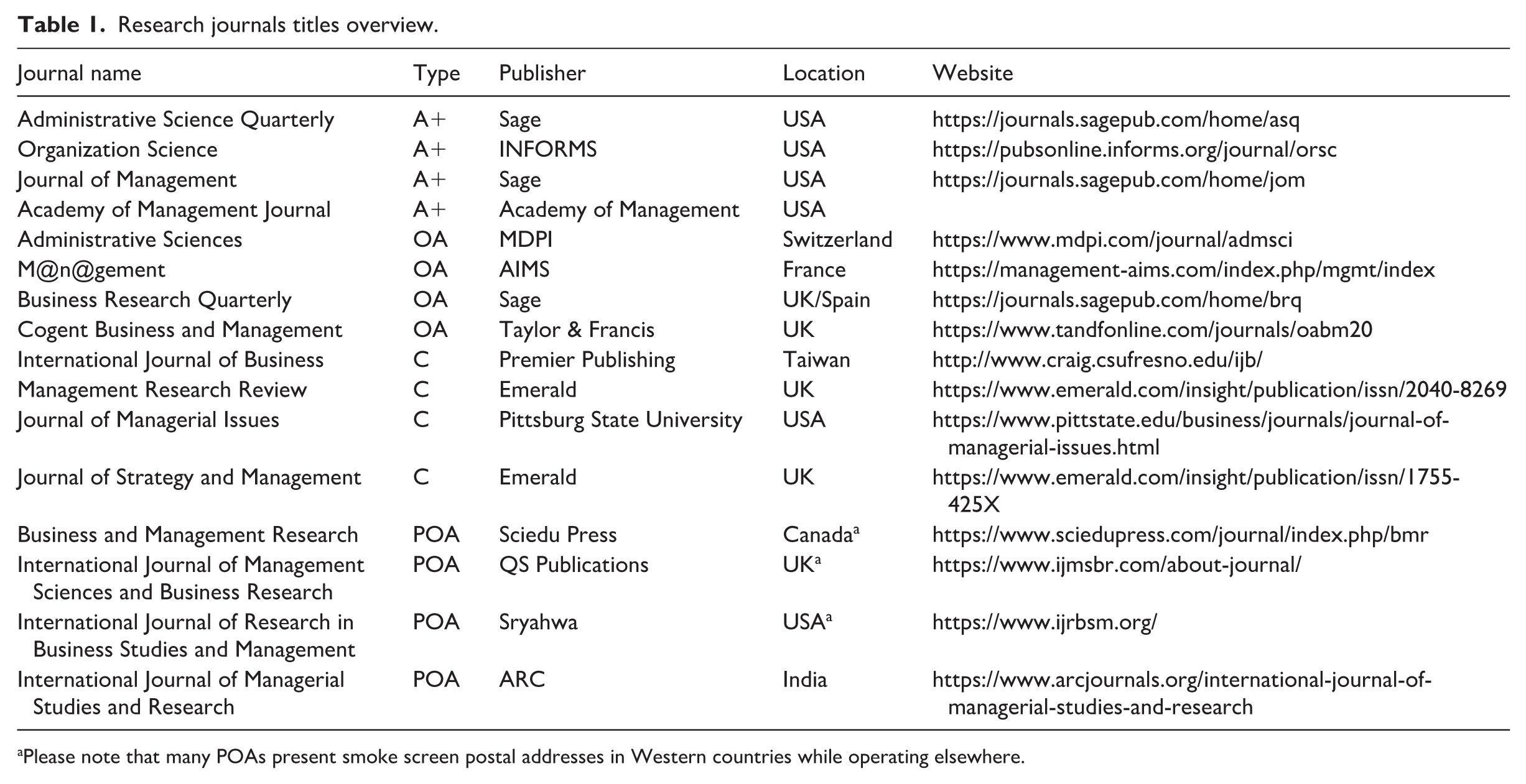
Please note that many POAs present smoke screen postal addresses in Western countries while operating elsewhere.
I chose C journals from the ABDC list based on similar criteria as OA journals, first looking for legitimate names, excluding journals with a secondary disciplinary or regional focus expressed in the title, and making sure they were supported by a legitimate organization or institution. Four were then chosen at random from among those that had been in existence for at least 15 years, International Journal of Business, Management Research Review, Journal of Managerial Issues, and Journal of Strategy and Management. Finally, I chose four POA journals by accessing Beall’s (2017) black list of predatory journals and publishers, looking for titles appealing to business management research. As there were many such journals, I first chose every tenth journal down the list that met the naming criterion, testing its weblink for continued operation, choosing those that had an accessible archive of at least three recent years, and excluding those that published only two-pagers or had only one article per volume: Business and Management Research, International Journal of Management Sciences and Business Research, International Journal of Research in Business Studies and Management, and International Journal of Managerial Studies and Research. The reader may note the peculiar similarity among the last three titles, monikers that reveal the typical POA journal attributes of global appeal, broad disciplinary coverage, and mimicry of terms in legitimate journal titles.
Measurement
I used two different meanings of diversity in mainstream management research to assess systemic equality: variety and disparity (Harrison and Klein, 2007). Derived from the notion of ecological diversity, variety examines the extent to which there are differences in category among members of a social unit, such as kinds of people in a group or authorship affiliation in a journal title. Variety captures the range of different kinds in the social unit and how evenly those kinds are represented among the members of the unit. For example, several researchers participate in a research collaboration based on their local expertise, and different locales make the collaboration more diverse, while having a similar number of experts for each locale makes representation more equal. Disparity examines the degree of unevenness in access to or possession of valued resources and captures stratification, where “differences privilege the few over the many” (Harrison and Klein, 2007: 1200). To illustrate the most disparate case, a scholarly journal may publish articles written by authors from only one location, such as a country or university. Disparity diminishes toward equality as authors from other locations are given access until voices from all possible locations are represented in that journal.
The most common quantitative indicator of variety is Blau’s index, also known as the Herfindahl index (Harrison and Klein, 2007). Since this index can be affected by the number of members in a given social unit—in this case, the number of authors included in the published materials of a given journal or journal type—I use a modified index that removes this bias (Biemann and Kearney, 2010). For disparity, I used the well-known Gini coefficient, also adjusted to remove bias due to sample size (Biemann and Kearney, 2010). The formulae for both statistics are provided in Appendix 1, and both indices increase as the variety or disparity increases. In other words, more equality is evidenced by a higher Blau index and a lower Gini coefficient. While the Gini coefficient can be interpreted independently of metric, Blau’s index is meaningful only in a comparative sense, and I will compare journals and journal types primarily for their relative standing in terms of both variety and disparity. On the separate question of research norms diversity, I also looked at the prevalence of hypothesis testing and references to contextualizing information in the published articles, aggregated for each journal title and journal type.
In order to compute these indicators of variety and disparity, I compiled article-level information using content analysis (Krippendorff, 2019). I first examined each article holistically and removed editorials and book reviews. In addition, I excluded special issue publications in the OA journal Administrative Sciences because at the time of data collection, a suspicion had been raised that its publisher, MDPI, used such issues as a strategic editorial tool to boost publication numbers (Oviedo-García, 2021), which I judged to have potential for restricting variance in authorship location. I then counted the number of authors on each article in the sample and recorded the country where each author’s institution was located. Using this information, I computed Blau’s index at two levels of analysis, the journal title and the journal type, and for two levels of geographic location granularity: 85 individual countries and six geographic regions (The Anglophone world, Continental Europe, Latin America, Africa, Middle East, and East/South Asia). These geographic regions were selected in line with the ideas that English is the dominant language (Boussebaa and Tienari, 2021) and that a binary distinction between core and periphery masks differentiation in both (Üsdiken et al., 2025). I similarly computed the Gini coefficient of authorship at the journal and journal type levels, aggregated at different granularities by country and by region. Appendix 1 provides details about all computations.
I also content-coded whether each research article made use of statistical testing. In some cases, primarily among predatory journals, no hypotheses were explicitly stated, but statistical testing was nevertheless carried out to answer a research question or examine a proposition. I decided to code all articles that made use of statistical testing as conducting “hypothesis testing” but not those that merely compared quantitative data trends and descriptive statistics (e.g. means, percentages, etc.). I further recorded for each article whether ot not it included a specific country context in the title or as a keyword, not accepting generalizing geographic terms (e.g. Sub-Saharan Africa or Eastern Europe) but accepting sub-national or culturally geographic keywords (e.g. Hongkong, Kibbutzim). I used those data for conducting statistical comparison tests of proportions or distributions across journal types to determine differences in the extent to which research articles in them made use of hypothesis testing or presented a frame of reference with a contextual emphasis on a specific geographic location. I note that my use of statistical testing is intended to fall in line with my general strategy of making a case for critical examination of the dominant system by using the methods (and language) of that system. Finally, I constructed dyadic data matrices that denote international co-authorship among all 85 countries, where each observation was the number of journal articles that individual authors from a given pair of countries published together. I used those data to prepare images of networks with the software UCINET (Borgatti et al., 2002), yielding a visual depiction of network stratification in the potential flow of knowledge exchange during co-authored projects (Üsdiken et al., 2025).
Findings
Preliminary observations about article authorship across different nations and journal types revealed predictable patterns. The United States dominate with nearly a quarter of total authorships (570), 65 percent of which were published in A+ journals and 30 percent in C journals. Three Western Nations, Canada, Germany, and the United Kingdom, evidence a similar pattern of over 50 percent authorship in A+ journals followed by C journals as the second most frequent outlet. France and Spain evidence over 75 percent of authorship in OA journals, owing largely to their national professional associations operating one of the journals in the sample (See Table 1), and more than half of Malaysian and Pakistani authorships were found in legitimate OA journals. One third of Chinese authors appear in A+ and nearly half in POA journals—an interesting duality—while nearly two-thirds of Nigerian and Vietnamese authors appear in POA journals.
Diversity of authorship
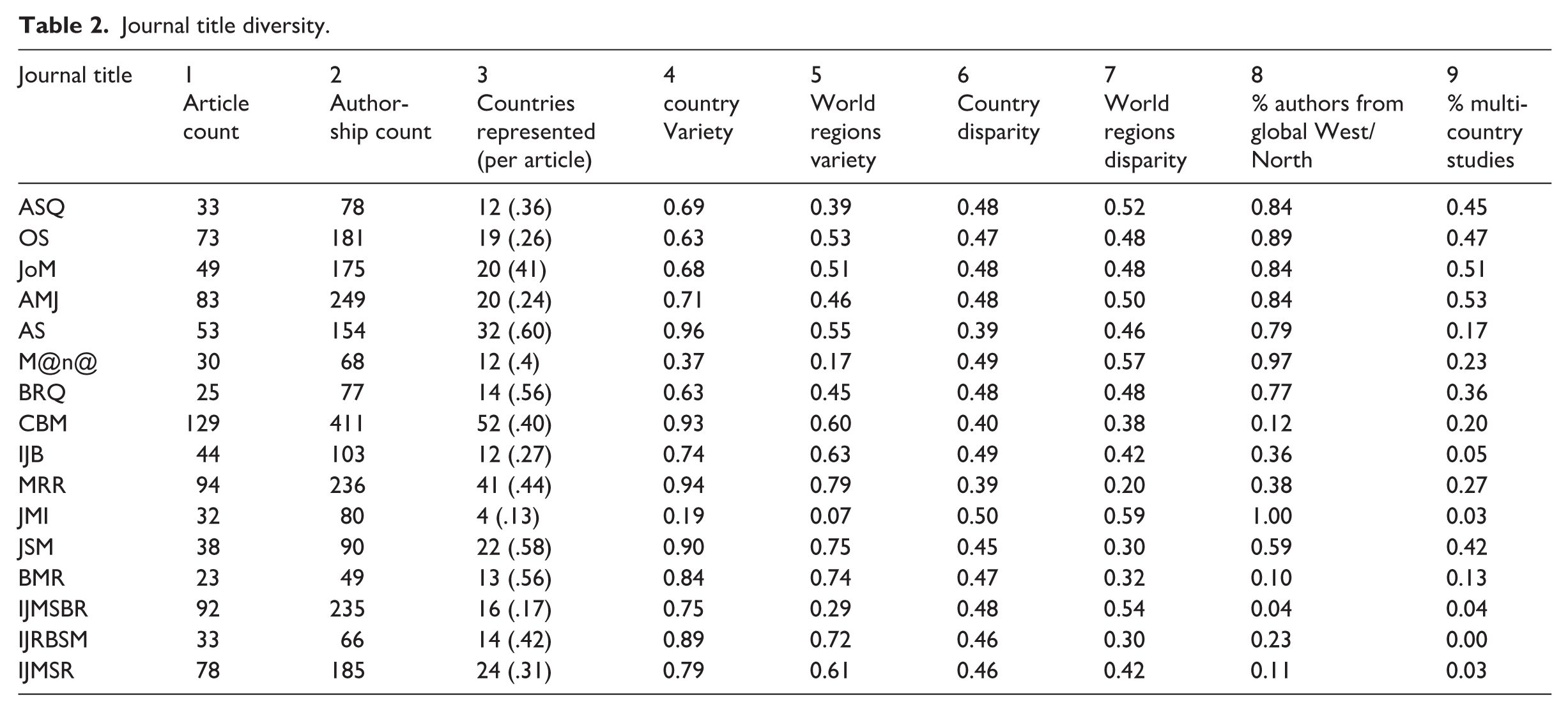
Tables 2 and 3 present overall findings about diversity examined at the journal title and the journal type levels, respectively. Although variability in the number of publications and authorships is considerable across journals, the data are fairly evenly distributed across journal type (Columns 1 and 2 in Tables 2 and 3). Considering first the distribution of authorship by scholars from different countries, Columns 3 to 5 in Table 2 show that the Blau index for individual A+ journals tends to fall in the middle of the range, below those seen for many OA, C, and POA journals, but notably higher than journals with the least variety. However, Table 3 shows that A+ journals as a group had a more homogeneous authorship profile than the other three journal types, owing largely to a preponderance of authorship from the Anglophone World and Continental Europe (See column 8). Thus, A+ journals represent voices from many different countries, but those countries tend to be located in the privileged world, and more than 50 percent of authorships in each journal title were located in the United States.
Journal title diversity.
Journal type diversity.
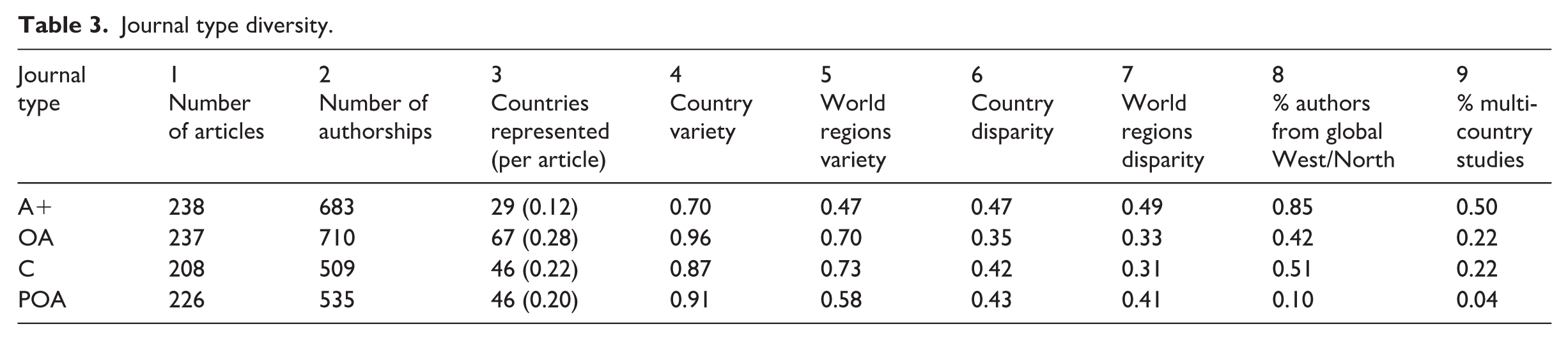
Open Access journals evidenced considerable variability on the measures of authorship variety. As expected, the two OA journals operating under the auspices of a national professional association showed less variety than the other two OA journals: 79 percent of authorship in M@n@gement were located in France while 60 percent of authorship in Business Research Quarterly were from Spain. The other two OA journals exhibited the highest country variety of all journals, while regional variety was in the middle of the range for each OA journals, except M@n@gement. As was the case for A+ journals, this result is attributable to the high percentage of authorships in three of the OA journals being located in the Global West/North, as shown in column 8. The exception was Cogent Business and Management, which also had by some margin the highest number of articles and authorships in the data. Collectively and compared to the other journal types, OA journals evidenced the highest Blau index for both country and regional variety and represented the most diverse international voices, with slightly less than half of authorships being located in countries of the Global West/North.
C journal titles evidenced a considerable variety of authorship, with one exception: Journal of Managerial Issues, published at Pittsburg State University, had 90 percent authorship by scholars from the United States and featured the lowest values of diversity in the entire sample. Conversely, two Emerald-published journals, Management Research Review and Journal of Strategy and Management, exhibited some of the highest Blau index values in the sample, comparable in country variety only to the most diverse OA journals. Collectively, the C journal type featured more country variety than A+ journals, global regional variety at a level comparable to that of OA journals, and about half of authorships from places other than the Global West/North (See Table 3).
Findings for authorship variety in POA journals present several contrasts to the other types. All four individual titles featured high values for Blau’s variety index based on unique countries, and variety across regions was comparable to that of C journals. As a journal type, POA journals showed variety for individual country representation comparable to that of other types, but lower when computed across regions. In stark contrast to A+ journals, Column 8 shows that only 10 percent of authorship in POA journals was located in the Global West/North. Diversity was curtailed in these journals by the preponderance of authorship from Africa and South Asia, especially Nigeria, Kenya, China, Vietnam, and Pakistan.
Stratification of authorship
Turning to stratification, the Gini index increases as authorship becomes geographically more concentrated, ranging from zero to a maximum of 1 when all authors in a journal or journal type are located in one country or region. Column 6 in Table 2 shows that at the country level, most journal titles evidenced a similar Gini coefficient, with two OA and one C journals having comparatively lower Gini coefficients. Less stratification was evident for a few journals at the regional granularity, but most titles showed lightly increased stratification at this higher level of geographic aggregation. When grouped by journal type, OA and C journals evidenced the least inequality, while A+ journals were the most stratified at both levels of granularity and POA journals fell in the mid-range. Figure 1 provides an alternative illustration of stratification in the form of Lorenz curves, which depict the fraction of authorships in each journal type as a function of location counts. The figure shows that 87 percent of authorships in A+ journals are located in 10 percent of the 85 countries included in this study sample, whereas only 54 percent of OA journal authorships, 66 percent of C journal authorships, and 76 percent of POA journal authorships are concentrated in the same one-tenth proportion of sample countries. The diagonal across the figure indicates total equality and best shows the difference between A+ and OA journals while also clearly depicting that inequality is pervasive regardless of journal type.
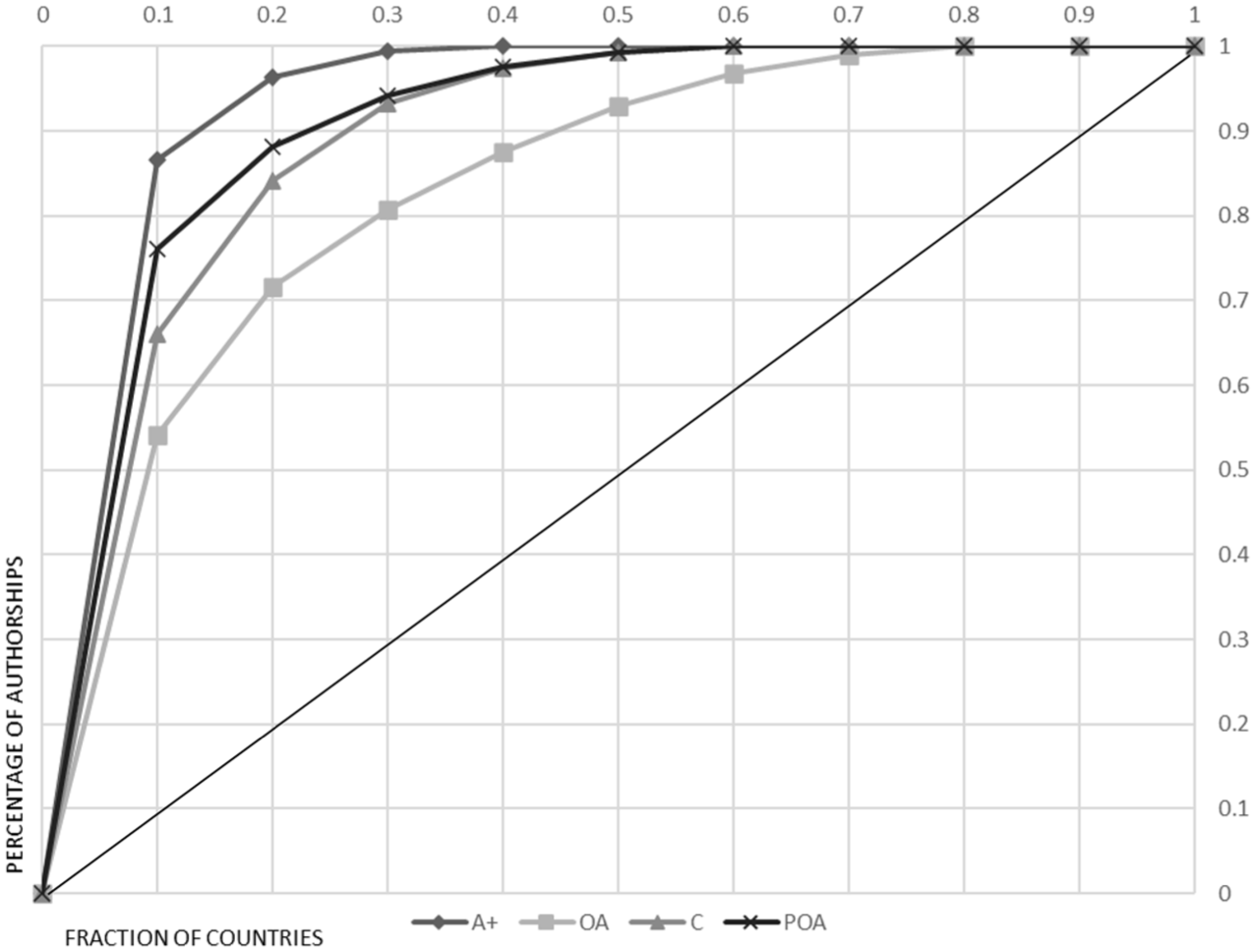
Stratification of authorship as Lorenz curves.
Representation of Western research norms
In order to examine the representation of Western research norms, I compared the extent to which articles in the study sample made use of hypothesis testing and explicitly referenced a specific country or other cultural indicator of nationality in the title or keywords. Given the different sample sizes between titles, I conducted this analysis at the level of journal types, and given the ordinal nature of the variables, I used non-parametric tests to ascertain any differences. The top half of Table 4 displays the data for conducting the analysis on the use of hypothesis testing (1 = yes, 0 = no), showing that about 50 percent or more of articles published in any journal type made use of this normative procedure in scientific Western research. A chi-square test of homogeneity in frequency distribution was significant (χ2 = 21.3, d.f. = 3, p < 0.01), providing evidence that there were meaningful differences between journal types. In the absence of any hypotheses, I conducted two-sided pairwise Z-tests to identify differences in the proportion of hypothesis testing between each pair journal types. The results showed hypothesis testing in POA journals was significantly less prominent than in A+ journals (Z = 4.14, p < 0.01) or in C journals (Z = 3.14, p < 0.01), while it was more prominent in A+ journals compared to OA journals (Z = 2.25, p < 0.025). The difference between OA and POA journals was marginally significant (Z = 1.94, p < 0.06), while the remaining two contrasts were insignificant.
Practices of Western research norms.
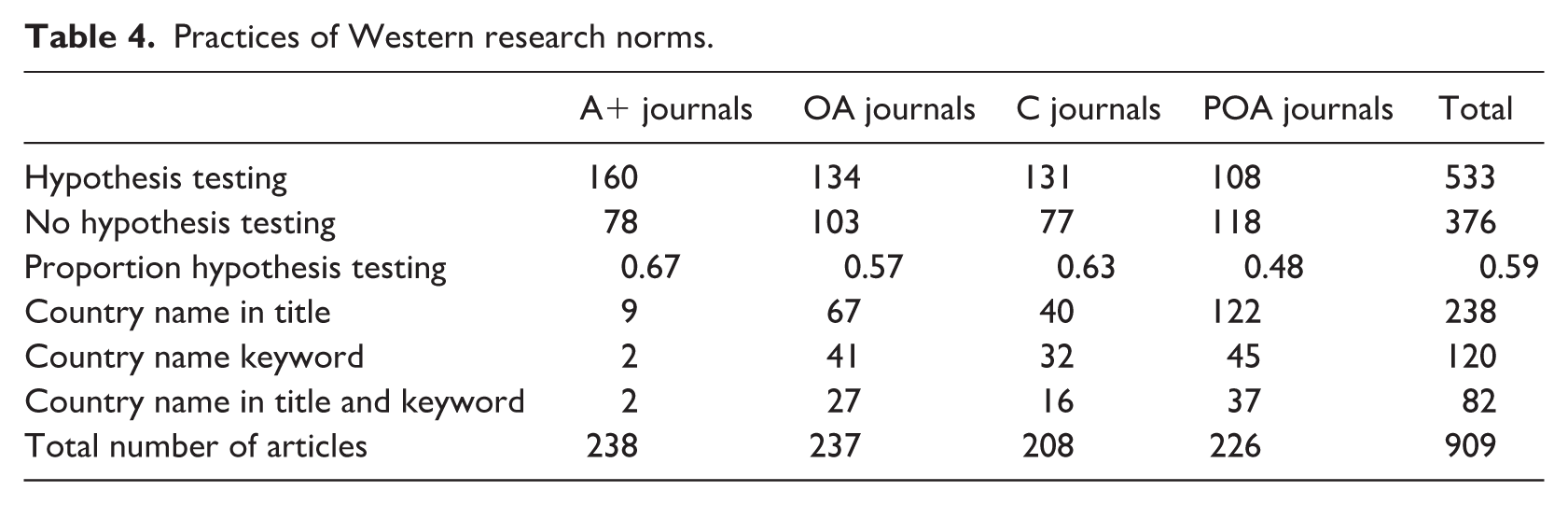
To examine the practice of contextualizing research for a specific country, thereby deviating from the Western norm of universal knowledge claims, each article was assigned an ordinal value: zero (no country mentioned in title or keywords); one (country listed in the title or among the keywords); two (country listed in both title and keywords). Table 4 shows the frequencies for each type of observation, and to test for differences between journal types, I used the independent samples Kruskal–Wallis test. The test can be used for seeing if three or more independent data samples are taken from a common population, given that research is conducted using Western norms in this case. A significant result shows that this is unlikely, and post-hoc tests can be used to determine which samples differ to such an extent that they are likely to come from different populations. The Kruskal–Wallis statistic was 156.326 (3 d.f., p < 0.01), and all pairwise comparisons, using the Bonferroni correction for multiple tests, were significant at the p < 0.01 level, the only exception being that there was no difference between OA and C journals.
Table 5 displays a more fine-grained examination of regional variation in the practice of Western research norms, using the location of the first author for grouping all articles into the six geographic regions. The table shows the homogenizing force of the dominant research style to stay away from using specific country contexts as keyword and to test formal hypotheses, especially among articles in subscription print journals led by scholars from South and East Asia. The table also shows that authorship from all regions appears less bound by Western norms when publishing in OA journals, compared to A+ journals. Publications in C journals evidenced a similar attenuated impact of Western norms. The absence of explicit editorial standards seems evident in POA articles, where Anglophone and European authors appear unchained from the usual normative oversight by deviating significantly from the Western standard, while other authors tend to comply with the invisible gaze of the proverbial panopticon, especially those located in Africa.
Practice of Western research norms by the first authorship from different regions. a
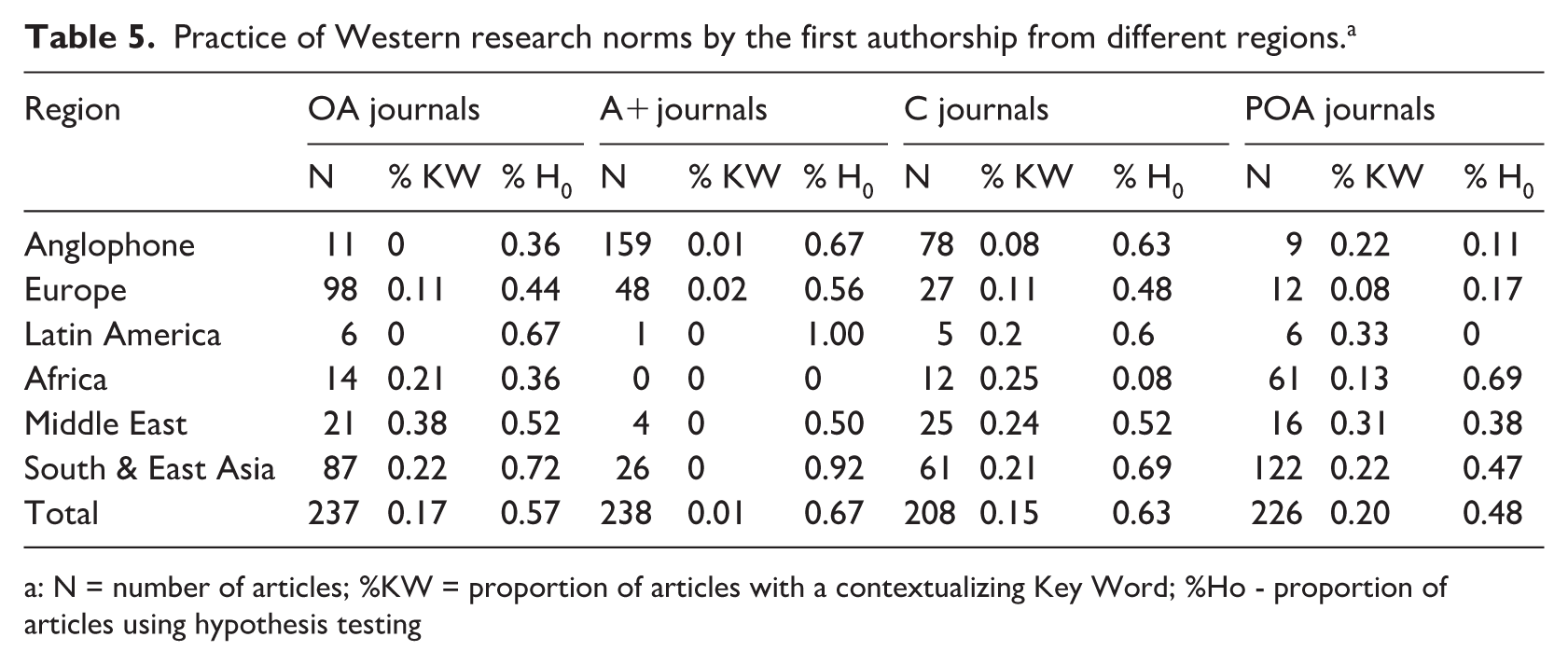
N = number of articles; %KW = proportion of articles with a contextualizing Key Word; %Ho - proportion of articles using hypothesis testing
Networks of international co-authorship
The last part of the analysis examined journal article co-authorship involving diverse geographic locations. Column 9 in Table 3 shows that international co-authorship was strongly evident in A+ journals and virtually absent in POA journals, with OA and C journals showing similarly intermediate levels. More detailed patterns of co-authorship can be gleaned from the network images in Figure 2, where each edge connecting a given pair of countries depicts at least one co-authored research article published in different journal types. Countries that do not have any-international co-authorships are not shown in these images. A typical core–periphery pattern would show countries at the center of the network with many co-authorships among each other and peripheral countries having a few co-authorships with the core but none among each other (Nelson, 2001). In Panel (d) of Figure 2, the POA network shows the near absence of international co-authorship and will not be further discussed. Each of the other three networks showed a core–periphery pattern with some variation.
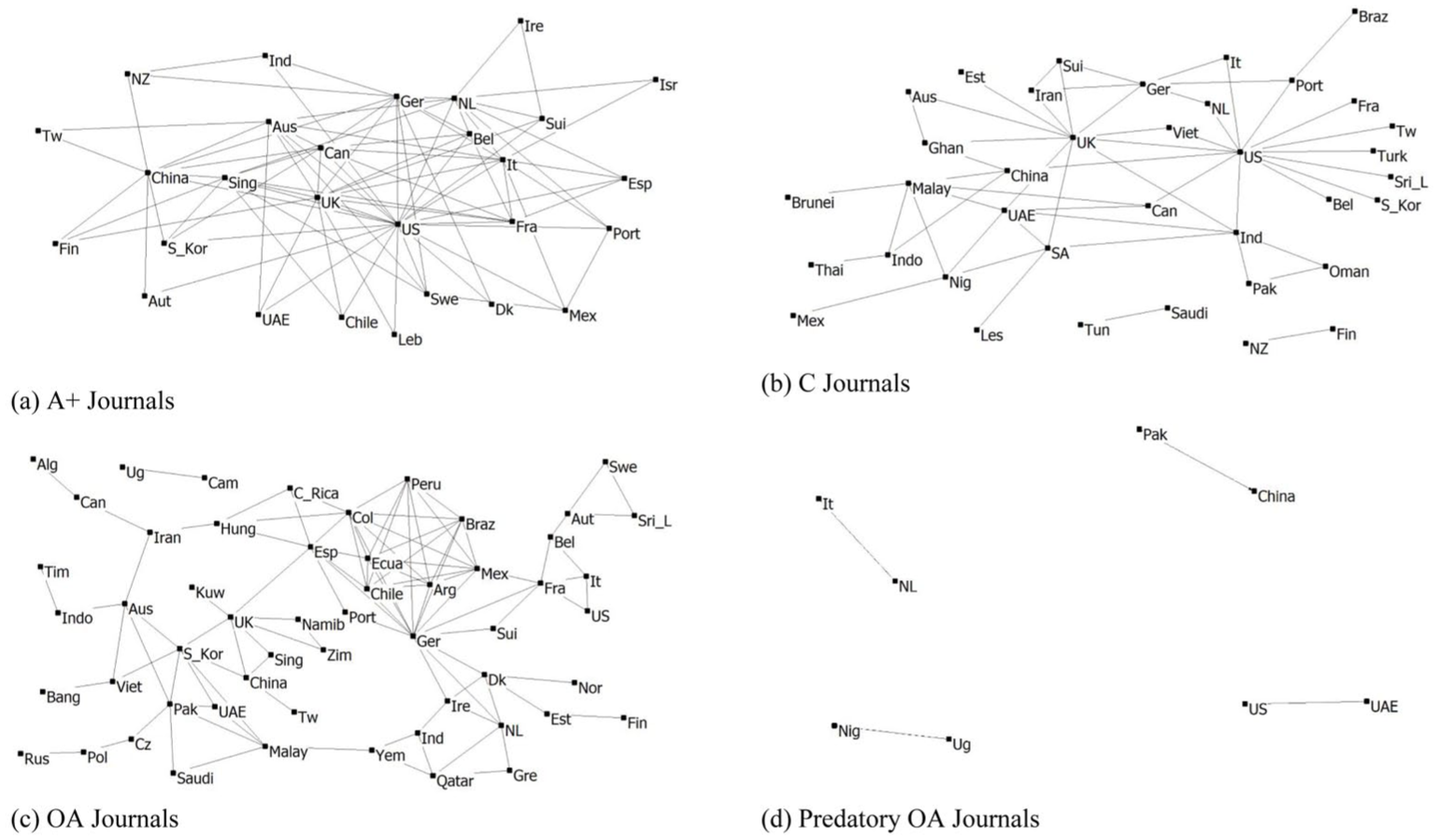
Co-authorship networks: (a) A+ journals, (b) C journals, (c) OA journals, and (d) Predatory OA journals.
The dominance of the Anglophone world in A+ journals (Panel a of Figure 2) is clearly evident by the overlapping co-authorship ties among Anglophone nations in the left part of the network center region and their ties to nations in Continental Europe at the right side of the center. The East Asian nations of China, Singapore, and South Korea form a third part of the core on the left side of the network. This depiction dovetails with recent discussions by Üsdiken et al. (2025) about the emergence of a secondary core and a semi-periphery in top management journals. The periphery surrounding the center contains remarkably few countries, features several nations that are well connected to the center, and is notable for the absence of any African countries. A more pronounced core–periphery is evident in C journal co-authorship, shown in Panel b of Figure 2. The United States is the most central nation, but its connectivity to the rest of the world is less cohesive, and its co-authorships feature many single countries that have no other international partners. A second core is centered around the United Kingdom (Üsdiken et al., 2025), which connects to what appears to be a semi-periphery comprising research partners, in such nations as India, China, and the UAE, that bridge to the peripheral region. Notable is the small number of countries from Latin America, as is the number of countries with just a single tie, connoting their dependence on co-authors in central or semi-peripheral parts of the network for access to collaborative knowledge resources.
Finally, the network of international co-authorship in OA journals features a notable divergence from that of the other journal types. The network clearly shows the prevalence of OA publishing in Latin America at the center (Björk and Korkeamaki, 2020) and a remarkably marginal position of US publishing on the right side. Spain, Germany, and South Korea are in semi-peripheral bridging positions that connect the flow of collaborations between Asian and European regions, with the United Kingdom also serving to connect primarily Spanish-speaking countries with East Asia.
Discussion
The preceding study makes important empirical contributions to our knowledge about inequality in mainstream management research dissemination. Building on the idea that existing structures and practices in the institutional field of scholarly publishing perpetuate unequal access to knowledge resources and publication opportunities across global divides, I found widespread homogeneity and stratification in international authorship and the practice of Western research norms. These findings offer a sobering inventory of management scholarship, and the irony of the investigation is that, as a scholar located in Canada who was trained in the normative style of Western research and has never published OA, I represent much of the existing institutional order. In keeping with the practices of Management Learning (Anderson et al., 2020), I offer a reflexive discussion from this positioning in the hope it will raise the reader’s attention to the role of their own scholarly identity for shaping the future of management scholarship.
My first set of thoughts focus on my use of research methods that are firmly established in the Global core for studying concerns important to the periphery. I make use of quantitative analysis and nomothetic data patterns to represent colonial legacies and critique the system of objectivist classifications in the scholarly publishing system. Critical traditions more commonly use a subjectivist approach and rely on ideographic methods (Burrell, 1996). My combination of these different approaches reflects a contextual logic for positioning the research: The foci on global authorships and OA journals, as well as the concern for exclusions rooted in colonial legacy, arose from my primary interest in the systemic impact of metrics and journal ranking lists in scholarly publishing. Questions about how much inequality is manifest in different types of publishing outlets brought those other facets of the empirical context into focus as part of the research design. By using methods typical for the dominant research approach in a context that permits critique of an ugly side of the system dominated by that approach, this study supplies evidence to those who advocate for change on behalf of the periphery in a form that appeals to mainstream audiences. Extending this contextual rationale, a conclusion from the study is that making the mainstream publishing system more accessible and enhancing its diversity may require that journal editors and individual researchers engage more purposefully with contextual factors in the research process (McLaren and Durepos, 2021), a point I will expand on below.
My second reflection focuses on the contribution this study makes through the comparison between top-tier A+ journals on the one hand versus OA and C-level journals on the other. The findings corroborate the work by Üsdiken and colleagues, who have documented the dominant role of “quantitative hypothetico-deductive” research in the construction of global management knowledge, underwritten by a center of US-based researchers and a secondary core comprising anglophone and Western European scholars all publishing in top-tier journals (Üsdiken, 2014; Üsdiken et al., 2025: 234). An important contribution is the evidence provided here about comparatively lesser domination by the United States in other types of outlets for management research and the spaces that may exist there for non-conformist research. Lower stratification and higher diversity in authorship, as well as greater prevalence of norm-deviating research in OA and C journals, bring to mind a call by Macdonald and Kam (2007) for researchers to publish in outlets other than the top-level journals. This demands more than a change of individual publication strategy and asks for the systemic transformation of research assessment practices in business schools. Academic leaders will need to work at developing criteria that can assess the unique intersection of scholarly and applied value beyond the JIF (e.g. Brankovic et al., 2023; Harley and Fleming, 2021), embrace outputs for more engaged scholarship (Berkowitz and Delacour, 2020), and encourage more bibliodiversity in publication outlets, such as monographs, edited volumes, general interest books, and applied or professional journals. Management Learning is likely to be one important forum for scholars to engage in discussion about such changes (Anderson et al., 2020).
Compared to other journal types in this study, OA journals published voices that were more equally distributed across all parts of the world and more inclusive of non-conforming research practices. Removing financial barriers thus made a difference. Two of the OA journals used a Diamond standard, removing all costs to authors and readers, while the other two used a Gold standard, where authors pay APCs that are waived for scholars from peripheral regions. The two Gold OA journals were operated by larger publishers yet featured more variety and less stratification than their Diamond standard peers, whose status as the official outlet for a national professional organization likely accounts for that finding. Comparing the two Diamond OA journals shows that such limitations of national scope could be reduced by partnership with a publishing house: BRQ is funded by the Spanish Academy of Management but published by SAGE, and compared to its French peer, M@n@gement, it evidenced less stratification, more variety, and more international co-authorships. International co-authorships by scholars from peripheral regions have also yielded more representation in top-tier journals (Üsdiken et al., 2025).
The networks in Figure 2 thus suggest that OA authors from semi-peripheral nations, such as Germany, Spain, and South Korea, could leverage their bridging positions to collaborate with international co-authorship and enhance diversity without increasing disparity. Important will be to avoid creating new forms of dependence or working in hierarchical forms of collaboration and to encourage the use of developmental resources for scholars from the periphery. Options include open data practices (Berkowitz and Delacour, 2022), context-specific theorizing (Üsdiken et al., 2025), and free OA peer reviews (Dobusch and Heimstädt, 2019). At the editorial level, partnerships with journals in the Global South and East, many of which are OA (Khanna et al., 2022), can serve as an avenue for integrating scholarship through special issues and targeted calls for submission. Such initiatives must ensure that editorial policies and reviewer standards are open to voices that do not conform to the epistemological mainstream of the core (Barros and Alcadipani, 2023). In addition, we may wish to advocate for representation of multiple perspectives, such as Canadian Indigenous two-eyed seeing, which acknowledges the legitimacy of both Western and Indigenous ways of knowing (Bartlett et al., 2012), and tap journals that are well positioned to support collaborations, such as African Journal of Business.
To make pluralistic and multi-epistemic scholarship like two-eyed seeing acceptable in the global publishing system and advocate for a mutual exchange of ideas between core and periphery will take more than editorial encouragement. To address the epistemic colonialism implicit in domination by Western research norms requires forms of scholarship that engage deeply with context of local culture and institutions as seen through the eyes of scholars with lived experience (Barros and Alcadipani, 2023) and expertise of that context (Gümüsay and Amis, 2021). It means going beyond the definitions of context in the mainstream literature that focus primarily on the empirical setting (Johns, 2006). Instead, one needs to engage also the researcher’s positioning in their context, such as their location at the periphery or the center (Barros and Alcadipani, 2023), the researcher’s personal connections to the research project (Berger, 2015), their social identities (Empson, 2013), and their positions in the web of power relations (Rose, 1997). These can be leveraged to contextualize epistemological assumptions, articulate a rationale for selecting some contextual parameters for analysis over others, and clarify how and why that selection is relevant to the knowledge produced (McLaren and Durepos, 2021), thereby enhancing legitimacy through transparency and accountability (Berkowitz and Delacour, 2022). Ultimately, such contextual practice may yield a scholarly vocabulary that gives researchers a legitimate voice for explaining the social and institutional factors that affect their knowledge production activities and enrich the polyphony of scholarly conversations (Muehlfeld et al., 2025), subject to epistemic and contextual relevance (King, 2024).
A last contribution of this study is issuing a reminder about the ongoing threat to management scholarship of predatory OA journals, especially those operating at the fringes of the system from where they prey on vulnerable scholars and contribute to the perpetuation of core–periphery patterns in global management knowledge flows. The good news first: In light of doubt about how to distinguish legitimate OA from POA journals (Harzing and Adler, 2016), the evidence presented here suggests that the former are on the right path of differentiating from the latter by virtue of more equality across regional divides and more international co-authorships. On the negative side, the absence of international collaboration was a particularly striking feature of POA journals and a likely source of its contribution to the continued marginalization of peripheral voices. In addition, stratification in POA journal authorship was notably higher than in OA or C journals, owing to a preponderance of work from countries in the periphery. Indeed, there were entire issues of POA journals in which all authors were from the same African or South Asian country, in some cases even from the same institution in those countries. The harm done to the researchers who were duped into submitting their work to such a publication is difficult to estimate, and the results of this study suggest that more efforts by scholars, publication outlets, and institutional leadership located in central regions of the knowledge network to collaborate with their peers in the periphery would be a first step to invite them toward fair access.
In conclusion, I would like to emphasize that my findings represent a mere snapshot in time of a limited range of the management knowledge produced worldwide. In line with my own career trajectory and having aimed for a look at the core of the institutional field, my focus on mainstream management publications leaves gaps to be examined in future research. I have excluded some journal types from the sample, in particular European top-tier journals, which have been examined previously (e.g. Üsdiken, 2014; Üsdiken et al., 2025), and many OA journals that focus explicitly outside the mainstream or publish in a language other than English. Yet, given that the OA outlets in the sample were published in Europe, and two were run by a national professional association, the results likely overestimate the degree of inequality in global OA publishing.
I acknowledge also that I am not in a position to speak on behalf of scholars from the Global South or East, nor for the Indigenous peoples of the world. I can reflect on my own professional position in graduate research training and the resulting interactions with students of different backgrounds and from different parts of the world. As part of doing this study, I have begun to decolonize norms of scholarship by advising all my students to clearly articulate a position statement for their research (Cunliffe and Karunanayake, 2013). I believe that doing so will not only permit them to see that all research offers only a partial view of the world but also caution them to stay humble in clearly contextualizing the meaning and relevance of their research findings. To the extent that journal editors develop principles or guidelines that require authors to incorporate position statements into their articles and use them to explain how they contextualized their research, more inclusive uses of all the world’s knowledges and more innovative thinking may yet be realized. Equally important, all of us mainstream management researchers need to reflect on our privileged position at the center of the global management knowledge network. To what extent do we ourselves contribute to the persistence of inequality by publishing research that speaks exclusively to parochial debates targeted at our narrow disciplinary communities and carried out within the precepts of the dominant paradigm?
Footnotes
Appendix 1
Formulae for Diversity Indicators
nk—number of observations (i.e. authorships) in the kth category (country/region location)
n = total number of observations
Di = amount of a given resource attributed to the ith member of the social unit (in this study, the number of authorships in a given journal or journal type attributed to the ith country or ith region)
Dj = amount of a given resource attributed to the jth member of the social unit (in this study, the number of authorships in a given journal or journal type attributed to the jth country or jth region)
N = number of members in the social unit (in this study, the total number of countries or regions)
Dmean = average amount of a given resource attributed per member of the social unit (in this study, the average number of authorships in a given journal or journal type per country or region)

Funding
The author disclosed receipt of the following financial support for the research, authorship, and/or publication of this article: I wish to thank two anonymous reviewers of Management Learning for their valuable feedback that helped significantly improve the framing and focus of this study. I acknowledge financial support by the Athabasca University Academic Research Fund and am grateful to the research assistance with data coding provided by DBA student David A. Newman. Alex Kondra and Fiona McQuarry provided valuable feedback on earlier versions of the manuscript. Parts of the study were first presented at the 2023 Annual Conference of the Administrative Sciences Association of Canada in Toronto.
Declaration of Conflicting Interests
The author declared no potential conflicts of interest with respect to the research, authorship, and/or publication of this article.