




Abstract
In this article, we seek to problematise socially constructed models of learning in higher education. Rather than another way to achieve predetermined and measurable learning outcomes, we ask what education and learning might look like if we centred the meanings that students themselves make. We do so through the concept of the lacuna, which we conceptualise as both the necessary space for learning, where predetermined knowledge and outcomes are withheld, and also the mystery of those moments of profound learning which are beyond the educator’s control. We contribute to management learning in two ways. Through the concept of the lacuna, we invite educators to reflect on the extent to which students are enabled to construct their own meanings and knowledge, and how they might surface and centre such learning. Second, we present an account of teaching practice and specific pedagogies of Collaborative Autoethnography as Pedagogy and of drawing which, we propose, are helpful to facilitate the creation of a lacuna, and through which we analyse key moments of working with and within the lacuna in the classroom.
Keywords
Introduction
All the other modules we have studied are equipping us with tools, models, theories and answers to some extent. But this module goes beyond, it takes us to a completely different place. It allows students to connect with themselves, to get to understand how they function, how they engage with their own experiences. It is the only element/module that makes a difference at the personal level. It is not about utilising tools, or finding ‘the answer’ to a specific question (e.g. in finance) which everyone can do more or less. But it is about knowing how we interact with our own experiences, how we can do it better, could we become entrepreneurs, do I really understand what that means. I feel I have become more engaged in this module than ever before, in a committed/personal way. To have a level of consciousness of what ‘I’ as an individual student can do or learn, etc. . .The need to become ‘me’ – Student reflective account
This article emerges from the authors’ deep and reflective engagement with an example of teaching practice, which has led us to problematise the notion of socially constructed learning and the extent to which we are able to enact such a model of learning within contemporary higher education. We both write and teach from a social constructivist perspective of learning which assumes that individuals co-construct knowledge through interaction with one another and in the context of their own social environment, personal knowledge and experience (Mueller and Anderson, 2014; Vygotsky, 1978). Within this paradigm, the role of the educator is not to supply pre-defined knowledge but to create opportunities and conditions for such co-constructed learning, to scaffold student learning through carefully planned and designed learning activities, and to facilitate student reflection on their experience and learning (Cascavilla et al., 2022; Neck and Corbett, 2018; Sioukas, 2023; Verduijn and Berglund, 2020). This approach to learning is thus more student- or demand-led (Cascavilla et al., 2022) with the educator’s approach guided by student needs, context and experience. Yet, in the context of a marketised and managerialist higher education sector, it is still assumed that students need to be able to achieve specified and measurable learning outcomes (Hartmann, 2019; Mandalaki et al., 2022), something our student quote also alludes to. In other words, social constructivism becomes a more student-centred process for nevertheless achieving educator-determined knowledge, and the educator remains critical for supplying, if not ready-packaged knowledge, then appropriate methods to enable students to access such knowledge for themselves.
In this article, we seek to trouble the notion of socially constructed learning. We ask: what would education and learning look like if we took the concept of socially constructed learning as an outcome, rather than as a means to achieving predetermined learning objectives? What would the role of the educator be in such a learning environment?
We believe that (sometimes) great things can happen in the classroom, where both students and educators experience profound moments of insight and learning which resonate and which are lasting. Many of us will have experienced such moments in the classroom which surprised or delighted or derailed us, and which transcended our planned activities and processes. Yet, these moments are rarely captured or written about, and they rarely form part of the assessment or evaluation of learning. In this article, we wish to centre such moments of learning as the goal of socially constructed learning itself, where students become ‘disobedient’, to paraphrase Latour (2000) and make their own valuable meanings from the educator’s materials and intentions. We also wish to address some of the means through which student learning might start to become de-coupled from educator control and intention.
To do so, we employ the metaphor of the lacuna. The lacuna is a gap, space or cavity: it is an absence rather than something simply hidden or unseen. Through its Latin origins, it can also mean a pool or a lake: a space where the outline and surface is apparent, but whose depths can only be individually known by stepping into it. Within teaching practice, we argue that the lacuna articulates two important insights. It reflects the mystery of profound learning: that is, learning that is student-driven and student-constructed, the meanings that the student actually takes and constructs rather than what the educator intended or planned. That is, it reflects the educator’s lack of control to either determine what or how exactly students co-construct their own knowledge (Higgins, 2022). Second, it represents the need to create space for learning, beyond a dedicated physical place and time in which learning is intended to happen. The lacuna creates conditions for learning and co-construction of knowledge by creating absence: by removing the familiar scaffolding of learning such as PowerPoint slides or case studies, and the educator role as the source of knowledge and director of activities; and by creating need for learners to themselves step into the space in order to explore it.
Our theorisation of the lacuna emerged from an example of teaching practice undertaken by one of the authors, David, and our subsequent shared reflections on that practice. The teaching example was the design and delivery of a module on Entrepreneurship within a Masters in Business and Management programme. We contribute to management learning in two ways. First, we problematise models of socially constructed learning in the HE classroom and, through the concept of the lacuna, invite educators to reflect on the extent to which students are enabled to construct their own meanings and knowledge, and how they might surface and centre such learning. That is, through the lacuna we seek to centre social construction of learning as an end in itself, rather than as a means to achieving defined and measured learning outcomes. Second, we present an account of teaching practice and specific pedagogies which, we believe, are helpful to facilitate the creation of a lacuna, and in which we analyse key moments of working with and within the lacuna in the classroom.
The article proceeds as follows. In the next sections, we set out the background to the teaching practice we write about. We review entrepreneurship education as a special case of management education which highlights tensions between knowledge and practice and what is possible to teach in the classroom. We then discuss, and problematise socially constructed models of learning within an HE system predicated on measurable learning outcomes, and how the notion of the lacuna offers an alternative perspective. Second, we introduce our example of teaching practice, starting with an account of our pedagogical approach and methods, and then an account of selected activities within the module and some particular moments of learning. In the final section, we discuss the metaphor of the lacuna as the necessary space at the heart of learning, and the implications for management learning.
Entrepreneurship: a special case of management learning
Entrepreneurship education has become an established part of Business and Management Schools (Hägg and Kurczewska, 2022), both for training new venture creators and more generally facilitating creativity and entrepreneurial mindsets in business and management graduates (Verduijn and Berglund, 2020). Within the growth in both entrepreneurship education and scholarship (Hagg and Gabrielsson, 2019; Hägg and Kurczewska, 2022) is a lively debate as to whether and how entrepreneurship can be taught (Bhatia and Levina, 2020; Sioukas, 2023; Tiberius and Weyland, 2024). Entrepreneurs themselves struggle to define entrepreneurial knowledge (Tiberius and Weyland, 2024), reflecting academic views that entrepreneurship is a complex mixture of both tangible skills, knowledge and competences, and intangible qualities which nevertheless make the difference between success and failure (Cornellissen and Clarke, 2010). Increasingly entrepreneurship researchers and educators emphasise entrepreneurship as unique within business and management and requiring different models to traditional linear, sequential, Taylorist practices (Anspach, 2025; Higgins et al., 2019). Entrepreneurship is not traditionally rational (Bhatia and Levina, 2020) but works with uncertainty, complexity and ambiguity (Sioukas, 2023). Rather than having a defined purpose, entrepreneurship is predicated on divergence, and on imagining the world as it could be (Bhatia and Levina, 2020; Dimov and Pistrui, 2022). Rather than a uniform practice, entrepreneurship is understood as related to the individual and their everyday, situated, reflexive practices (Anspach, 2025; Ellborg, 2023). The notion of ‘entrepreneuring’ (Johannisson, 2011; Steyaert, 2007) or ‘becoming’ is gaining increasing currency as a way of life which encompasses history and lived experience, affect, relationships, sensemaking, orientation, and informal and taken for granted activities and responses as well as more formal skills, knowledge and practice (Anspach, 2025; Verduijn and Berglund, 2020).
Entrepreneurship education has therefore seen a particularly pronounced shift from educator-directed models to student-centred approaches (Dimov and Pistrui, 2022; Ellborg, 2023; Hagg and Gabrielsson, 2019; Hägg and Kurczewska, 2022; Verduijn and Berglund, 2020). Socially constructed models of learning have been highlighted as especially applicable to entrepreneurship education through giving students responsibility for their own learning, enabling learners to engage with and make sense of themselves and their own world in novel and transformative ways, and encouraging critical reflection (Hägg and Kurczewska, 2022; Sioukas, 2023). Entrepreneurship education has thus become increasingly innovative and diverse (Tiberius and Weyland, 2024), characterised by pedagogies which attend to individual student needs and context (Ellborg, 2023; Fayolle et al., 2016), are focused on practice (Motta and Galina, 2023) and which seek to de-centre the role of the educator as the supplier of knowledge (Sioukas, 2023; Thomassen et al., 2020).
Nevertheless, social construction models of learning remain problematic in several ways. One issue is how such models fit within the context of Business and Management Schools, where programme design and assessment is still predicated on students acquiring predetermined knowledge which can be tested and measured (Hartmann, 2019; Mandalaki et al., 2022). Many education researchers have highlighted how students are typically unprepared for social constructivist modes of learning and especially how to draw on the ‘expertise’ of their own experience of the world (Clark et al., 2012; Krahenbuhl, 2016; Neergaard and Christensen, 2017; Sioukas, 2023), recommending scaffolding through more educator-directed methods. Moreover, the neoliberal model of education’s focus on cost saving and customer satisfaction drives structured, replicable, homogeneous ‘student experience’ (Boncori et al., 2020) and reinforces quantifiable student performance as the measure of success for both student and educator (Hartmann, 2019; Mandalaki et al., 2022). Thus, both students and educators have a strong disincentive to deviate from familiar, established practices where performance may feel more predictable and manageable, or to even recognise alternative modes as legitimate (Mandalaki et al., 2022; Sioukas, 2023).
Socially constructed learning also presents more general challenges. Formal education systems are educator-led by design: it is assumed that students undertake such education in order to acquire (and be able to measurably demonstrate) predetermined knowledge and skills, set variously by governments, academia, professions or employers. How, then, can curriculum design account for socially constructed learning? To what extent are our more innovative educational practices merely alternative, more student-centred ways of enabling students to acquire knowledge we (and the curriculum) have predetermined (i.e. as process towards a particular end), and to what extent can we accommodate students determining their own meanings and value of knowledge (and the value of the process itself)? How might curricula recognise and centre the socially constructed knowledge of students themselves, rather than the extent to which they are able to replicate our own knowledge? How might teaching practices recognise processes of student learning: processes of engagement with others, critical interrogation of their social worlds and reflexive interrogation of identities, values and assumptions (Higgins et al., 2013; Neck and Corbett, 2018)?
In this article, we therefore ask: what would education and learning look like if we took the concept of socially constructed learning as an outcome, rather than a means to achieving predetermined learning objectives? We suggest that we need to adopt alternative lenses, or metaphors, to enable us to start to think about learning outside established structures of formal education and especially the neoliberal university and to reflect on and to undo some of our own assumptions as educators, and what might be possible. The metaphor we propose and operationalise in this article is the lacuna or the unknown, and unknowable space. The lacuna is a valuable framing metaphor for two reasons. First, it invites us as educators to centre processes of student learning, and student learning itself, in all its messiness, ambiguity and unexpectedness, rather than as measurable and assessable outcomes: to centre and thus to engage with the mystery of what students learn, what meanings they make and how they make them. Rather than working out how to know and measure them, we may instead acknowledge and work with the unknown elements of the classroom. Second, the lacuna offers a productive metaphor for how we might create conditions for socially constructed, student-centred learning through creating space. The space of the lacuna represents absence: absence of familiar practices and structures on which both students and educators may have learned to rely; absence of clear direction or goals; absence of authority and answers. It also represents the unknown and thus also invites curiosity. The lacuna cannot be understood from the outside: it can only be understood through entering, exploring and experiencing it. It is a space to invite students to step into and explore for themselves.
To demonstrate the possibilities of the lacuna as a framing metaphor, in the next sections, we present an account of an example from our own teaching practice and examine it from the perspective of creating and working within the lacuna. We start by setting out our pedagogy and methods, followed by an account of how these were used on one teaching occasion.
Collaborative Autoethnography as pedagogy: learning as enquiry
The pedagogy underpinning our example of teaching is based on the principles of Collaborative Autoethnography (CAE). CAE is traditionally thought of as a form of research. Autoethnography is a method which seeks to illuminate and critique cultural practices through selected experiences of being part of such a culture (Ellis et al., 2011; Jones et al., 2013). Through evocative accounts of experience, and through critical and reflexive analysis, the autoethnographer reveals and examines the connections between the personal and the cultural and generates theoretical insight (Ellis et al., 2011; Learmonth and Humphreys, 2012). CAE extends this by incorporating multiple experiences, in which two or more share and interrogate their experiences with one another, their commonalities and their differences, as well as their shared socio-cultural context (Chang, 2008; Ellis and Bochner, 2006).
CAE has considerable capacity to extend and expand the nature of enquiry. Its collaborative nature is potentially emancipatory: CAE involves not only seeking multiple perspectives (Hernandez et al., 2017) but possibilities for questioning, challenging or undoing dominant discourses and power effects (Alhadad et al., 2021; Arnold and Norton, 2021; Crowley et al., 2025) when collaborators are able to share deeply felt experiences, question one another and express their own doubts (Arnold and Norton, 2021; Crowley et al., 2025). CAE also deepens the reflexive nature of autoethnography. It extends the interrogation of the self as both researcher and participant and the relationship of the self to the environment (Crowley et al., 2025; Grocott, 2022) because the involvement of collaborators moves us from simply questioning what we know to how we know it, and how we know the other (Guyotte and Sochacka, 2016).
These particular features and qualities of CAE and its purpose of enquiry through collaborative dialogue therefore also make it a possible mode of learning, as well as a mode of research. CAE becomes pedagogy when the goal is for learners to collaboratively craft accounts of a topic or concept – such as entrepreneurship – which are reflective of their diverse and common understandings, perceptions and experiences of the topic, reflective of the contexts, experiences and histories which inform such diverse perceptions of it, and reflective of the processes by which the learners came to craft such an account. We are not aware of CAE being used – or at least reported – as pedagogy elsewhere, but it offers a framework for socially constructed mode of learning in a number of ways. CAE as pedagogy acknowledges that learning and meaning are socially constructed and informed by social context because it deliberately centres individual learners, their lived experience and their meaning-making, rather than centring predetermined theories and models and then inviting learners to apply them. Rather than measuring learning against externally prescribed knowledge statements, the learning outcome is simply – but also profoundly – the meanings that learners have produced between themselves. CAE as pedagogy also centres dialogue between learners: in order to craft a collaborative account, learners must find ways of questioning one another and themselves, of testing assumptions, and be able to express their own experiences in ways that others can grasp.
At this point, it is important to note that the purpose of CAE as pedagogy is not to produce agreed, final accounts. Risks of CAE as a mode of research have been highlighted around managing power relations within the group of collaborators: who gets to speak, whose voice is heard and who gets credited (Alhadad et al., 2021) and the influence of perceived views of the group on what is said (Arnold and Norton, 2021). As pedagogy, it is important to centre not just the collaborative element but the auto or individual element and to hold both in ‘productive tension’ (Guyotte and Sochacka, 2016). Learners are not a homogeneous whole but remain individual with their own knowledge, experience and needs. The goal of CAE as pedagogy is not to produce a shared account of learning or a shared conclusion, but to enable learners to critically examine and interrogate something with and through others, and to be able to reflexively understand the processes through which they deepened their understanding of themselves and their relationship to others and their own context. Hence, in the teaching activities that we will discuss later, students started with collaborative activities but finished with personal reflective accounts.
Interpreted through the metaphor of the lacuna, CAE as pedagogy reflects two important features. CAE as pedagogy creates space for learning because it does not rely on traditional forms of learning. Its starting point is not the educator telling students what they know, or signalling to students what they will need to know. Rather, students are invited to find out for themselves what they know, individually and collaboratively. Second, and relatedly, CAE as pedagogy requires the educator to cede control of the learning process and learning outcomes. Having set a task of collaboratively crafting accounts of experience of a topic, the educator cannot know what accounts the students will produce. The goal is not the content of what is produced but the processes of collaboration and reflexivity.
Creating dialogue without speaking: using drawing
As we have already noted, social constructivist modes of learning can be challenging for students (Clark et al., 2012; Krahenbuhl, 2016; Neergaard and Christensen, 2017; Sioukas, 2023). A particular challenge of CAE as pedagogy, with its focus on learning as enquiry and the crafting of accounts of a topic or concept that are reflective of the experiences, contexts and histories of the collaborators, is to be able to instigate learner-led dialogue about a topic without first offering the educator’s ideas (Pässilä et al., 2016) – which then frame, prescribe and constrain how learners feel able to think about, relate to and talk about a topic. Paradoxically, one way to facilitate such disruption of traditional pedagogies is to extend the nature of disruption by the use of non-verbal methods of expression and communication. In our case, we found that drawing was a powerful way to enable students to access and express thoughts and experiences, and to start to work collaboratively with one another.
Drawing as enquiry utilises images to express ideas, concepts, relations, life experiences, attitudes, feelings, behaviours or assumptions (Berthoin Antal and Strauß, 2014). The very nature of arts-based practices such as drawing can be an important way of disrupting traditional modes of learning dependent on the educator holding solutions (Simpson et al., 2021) and academic conventions of written expression (Walsh and Powell, 2020). The challenge of expressing oneself in non-verbal ways may help to disrupt traditional linear logics and surface ambiguities, contradictions, multiplicities, the unspoken and perhaps the unspeakable (Seppälä et al., 2020; Van Buskirk et al., 2018) and through aesthetic distancing, where arts-based forms of expression de-familiarise a topic, concept or experience (Pässilä et al., 2016). It may also prompt learners to access and to embrace alternative ways of knowing through emotion, senses, embodiment and imagination (Pässilä et al., 2016; Van Buskirk et al., 2018). Drawing can also facilitate dialogue when the image becomes a generative intermediary between the drawer and the viewer. To interpret the image in words, the viewer must speak to the image and engage in sensemaking, looking for meaning in the particular choice of images, design and arrangement (Guillemin, 2004), and also interpreting the image through their own experiences and understandings to create a meaningful account of it (Van Buskirk et al., 2018). Equally, the drawer is prompted to speak through the image, to connect the image to themselves and their intentions. From the perspective of the lacuna, drawing therefore further contributes to the creation of space and the unknown, by disrupting traditional modes of thinking and de-familiarising traditional accounts of a topic.
Into the classroom
We now present an account of our example of teaching practice, in which the second author, David, designed and facilitated a Master’s degree module using CAE as pedagogy, and drawing. The purpose of our account is to examine this pedagogical approach – of learning as enquiry and of enquiry through drawing – through the lens of the metaphor of the lacuna: the ways in which such methods facilitated the creation a lacuna, and key moments of working with and within the lacuna in the classroom.
Methodologically, we want to be clear that our account is a retrospective one. It was in talking about, and reflecting on David’s classroom experience of delivering this module that we started to develop our ideas about the challenge of socially constructed learning in the context of a neoliberal HE system, and how the metaphor of the lacuna helped to frame our thinking and reflect further on our teaching practice. In putting this account together, we therefore draw on practices of memory work (Haug, 2008) from David’s experience as the educator in the classroom, notes made by David during class discussions, David’s reflective journal that he kept during the module, and artefacts from the classroom, namely drawings that students produced, and student reflective accounts that they produced as a module requirement. Our account is therefore not systematic or data-driven, although we believe that there is much important ‘data’ that can be found in it. Rather, it is to produce an evocative account (Ellis et al., 2011; Jones et al., 2013) of key moments within the module: moments which suggest instances of profound insight and learning, and which we argue are usefully understood through the metaphorical framework of the lacuna.
The module, on Entrepreneurship theory and practice, was an optional module in a full-time Masters in Business and Management programme at a French Business School. As dictated by the programme structure, it ran as a five-day block in the summer of 2022 following a year of study. The module was intended both for students wishing to pursue entrepreneurship as a profession and those seeking to enhance their career through developing creativity and an entrepreneurial mind-set (c.f. Verduijn and Berglund, 2020). Fifteen students took the module. They would all be classed as ‘mature’ with at least two-year professional experience, and came from a range of professional backgrounds, from engineering to service-based sectors.
David’s involvement in the module was as a visiting lecturer, and this guest status plus the module’s optionality afforded the opportunity to experiment more radically than had been possible in his home institution. His design was driven by personal and professional desire for students to define their own learning, and his belief that his role as an educator was not to tell students what the Academy judged that they needed to know, but for them to dialogically engage with what they knew already. Instead of formal learning outcomes, the central aim of the module was for students to critically engage with and reflect upon their own personal entrepreneurial development as a means of generating new understandings and insight into how they perceived and understood their own practice, and the influence of their own assumptions, values and culture.
Throughout the module, David employed CAE as a pedagogy of learning as collaborative enquiry, combined with drawing. At the start of the module, David asked the students to self-organise into groups of three to four. He spoke to them about the tasks (drawing, reflecting and writing, both collaboratively and individually) they were going to undertake together throughout the module and particularly about his approach to teaching, emphasising the value of their knowledge and experiences, and his position as one of facilitation rather than imparting knowledge. The groups were then given sheets of A3 paper and coloured markers, and told that their first task was to collectively draw an image of ‘What does entrepreneurship mean to me?’ David assured the students that their use of imagery symbolising ideas of the entrepreneur was the focus rather than the quality of drawing. However, his overall aim was to immediately immerse the students in an activity of collaborative enquiry. On reflection, we now see David seeking to create a lacuna for the students and inviting them to step into it.
Initially, there was resistance. Some students questioned the activity as not what they expected in a Master’s programme, or ‘something for play school’, while others insisted that they could not draw. Some students began by writing words rather than drawing. David encouraged the students to attempt the task and, where they struggled to know what to do or why, to focus on the feelings that the task was engendering. Eventually, all the groups produced a drawing. David then asked the students to individually write how they felt about the process of drawing and their experience of it, and how these connected to the drawings. Students were then invited to share their individual stories of doing the exercise with the whole group. This was followed by a group discussion where the students reflected on one another’s drawings and stories and asked questions of one another. In this switching from collaborative to individual tasks to collaborative discussions, we thus see the ‘productive tension’ (Guyotte and Sochacka, 2016) between the collaborative and auto elements of CAE.
The activities described above formed the basis for the five days of teaching. By considering the question ‘What does entrepreneurship mean to me?’ this opening discussion sought to surface the students’ raw view of how they visualised ‘entrepreneurship’ without the complications of theory, literature or an educator perspective. Over the course of the week, students were asked to consider other key experiences which shaped and influenced their understanding of entrepreneurship, such as entrepreneurial success and failure, being and becoming an entrepreneur. It is important to note that, in keeping with the stated module aim, David did not pre-plan or instigate any specific entrepreneurship curriculum, but allowed topics to emerge as students discovered, raised and explored them; indeed, these initial drawings and the themes they generated heavily influenced the initial direction of the module. The module VLE contained links to relevant readings and resources which David signposted students to as and when they became pertinent to classroom conversations. The programme required an assessment point but in keeping with the pedagogical principles, the student’s task was simply to write a narrative account of their experience of the module which critically reflected on the drawing and storytelling activities and the dialogues these generated. This was only graded pass/fail.
Stepping into the lacuna: the drawings
We now present and discuss some of the drawings from that first activity, and the subsequent storytelling and dialogues that occurred in the classroom on that first day. We have purposefully selected these drawings as illustrative examples of what students produced, and especially to highlight the range of student responses to the task and the range of ways their drawings enabled them to explore and interrogate their experiences and feelings about it.
Drawing 1 depicts a figure seated or kneeling, surrounded by clouds, spirals and stars, and a caption ‘You’re allowed to dream’. Talking about their drawing, these students described a relatively literal depiction of the entrepreneur as someone who has the capacity to dream, to imagine and to transform these ideas into a reality. Through contemplation, the figure is discovering what might be possible, seeking out interest and excitement. Notably, these students still felt the need to include words despite the request to use images only.
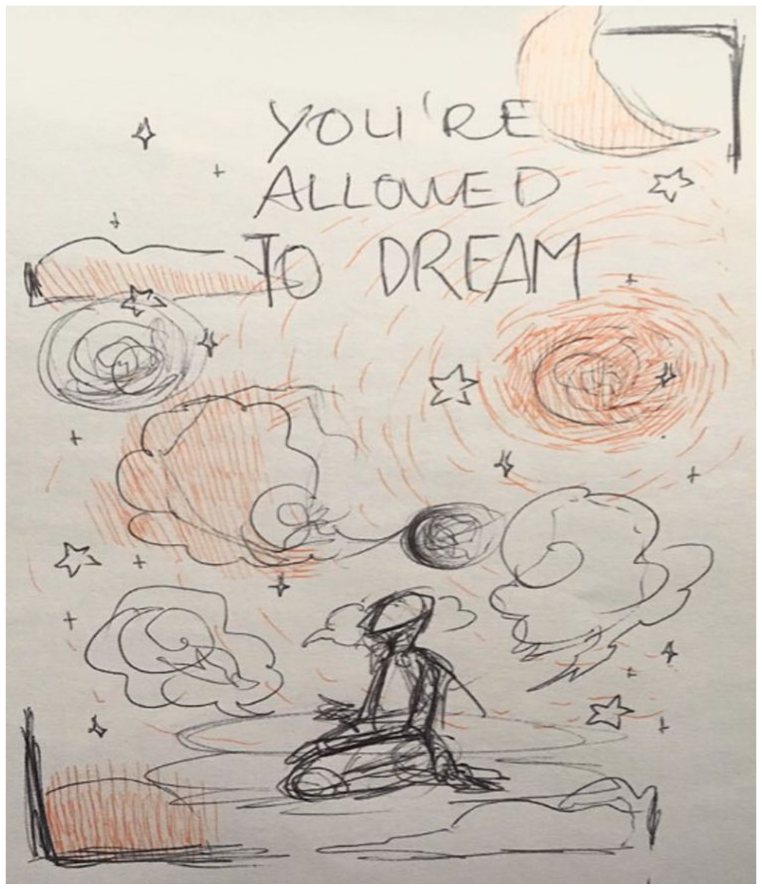
Sketching thoughts.
Drawing 2 also appears quite literal. There is a figure with their back to us, facing a range of different aspects of business such as money, charts, inputs and outputs, and padlocks – things secured, or to be unlocked? The drawing is full of movement but also some ambiguity: do the open arms suggest the person is embracing these different elements, moving towards them, or juggling them? When talking about their drawing, students explained that all of these issues were factors which they felt must be dealt with within entrepreneurship. However, through the subsequent reflective discussions, more nuanced and metaphorical ideas emerged. One student described their reflections on the drawing:
For me, this drawing represents the need for honesty, the need to capture and nurture our freedom to think and dream, how we are recognising and dealing with the issue of creating a business and our own life’s journeys. There are many fears and uncertainties, choices to be made but equally we have to remain grounded while coping with the contradiction of being different and seeking ways to overcome such difference. All of these influenced by our actions and choices, the judgement we make becomes so important. I am always afraid of – what if I miss something? (David’s classroom notes)
Here, in speaking to the picture, the student’s reflection takes them from the liberation of possibility, self-expression and self-determination, to the concomitant loneliness of the entrepreneur, and the anxiety of being solely responsible for themselves, their decisions and the quality of their judgement.
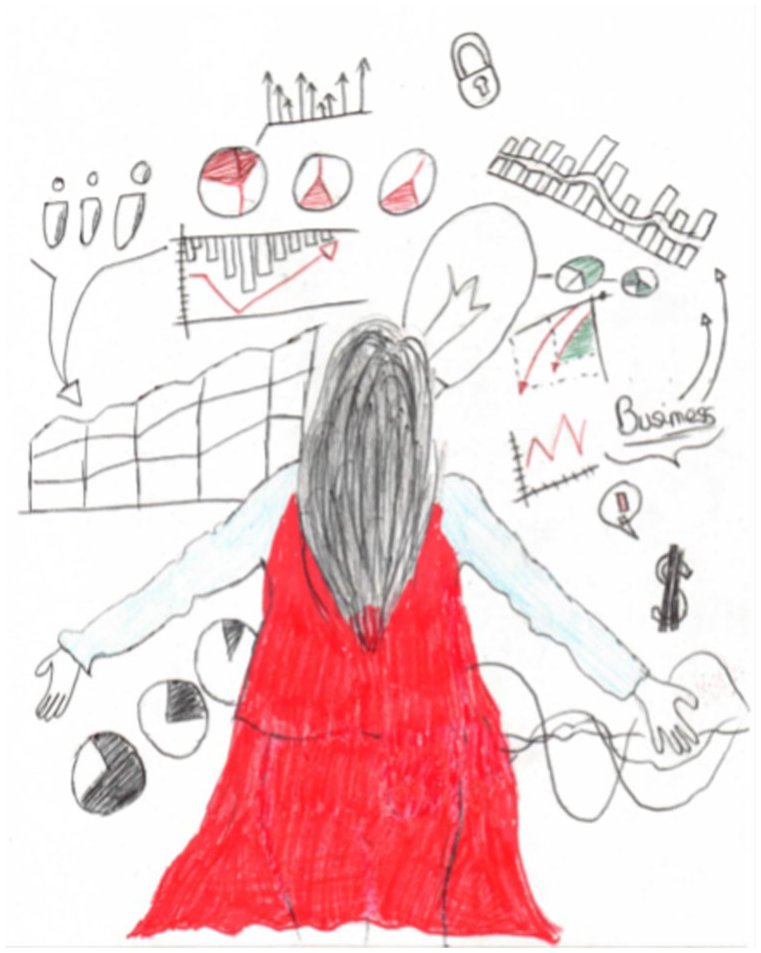
Finding self.
In contrast again, Drawing 3 depicts an individual sitting alone on a branch. This group found the task of capturing how they understood entrepreneurship unsettling and resisted the idea of coming up with their own meanings of entrepreneurship, insisting that this was something David should be telling them. David assured them that he was interested in their initial views, but the students remained focused on the ‘right answer’ or ‘best definition’. David then suggested they discuss how they felt about the question itself, their unease and the unsettling nature of the question, as well as drawing how they personally viewed the idea of an entrepreneur. It was from these discussions that the idea of a tree emerged.
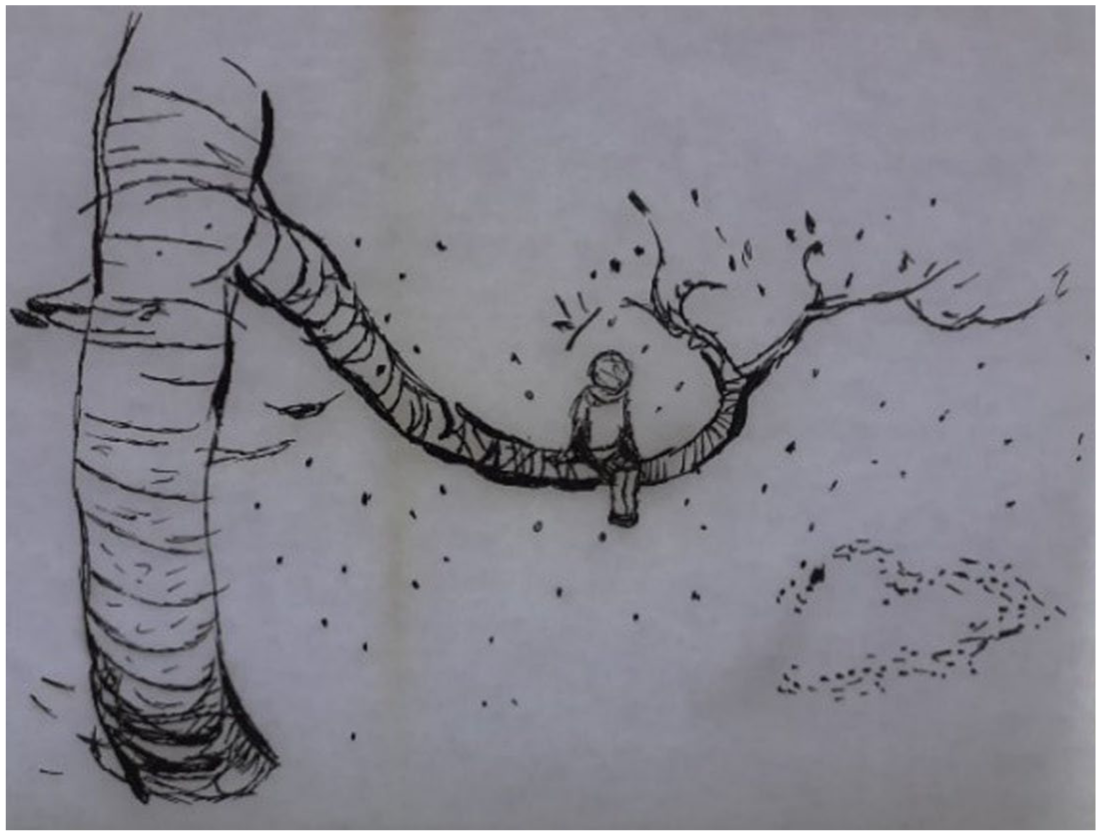
Falling in love.
The students subsequently explained that the tree in this image represented existing knowledge. The lines on the trunk represent the passing of time and the development of knowledge, suggesting the thicker the trunk, the more assured we can be about ‘how we define an entrepreneur’. These students contended with the issue of ‘difference’, and how there are different approaches to this question, and their conversations turned towards the idea of coping with differences: ‘what is right for me and my view/experience?’ They decided to represent this point of tension by placing a single person on a branch, and an incomplete heart made up of fallen leaves. For these students, the lone figure, holding the branch with both hands and looking down, represented their own uncertainty, but also their willingness to try something different, and the possibilities of the leaves from the tree of knowledge forming something new. The figure represents their own desire to be creative, to be novel, yet they feel isolated and ‘stuck’.
This group of students found that the process of drawing eventually helped to surface personal and collective tensions. The process enhanced their appreciation of their own opinions and experiences – the value of which they had questioned in a classroom setting. As these students discussed their drawing with the class, and their experiences of producing it, the tone of the discussions became deeper and more personal as students began to engage with the idea of provoking and challenging one another, offering potential alternative views and questions, encouraging themselves to give richer accounts of their assumptions and experiences, to make connections and elicit unexpected revelations. In the middle of the discussions, one student announced:
I am terrified that our dialogue will break down. I don’t want us to lose this thread; at the same time, I am so excited about what could be to come. From an academic perspective. . .we must be disciplined enough not to become. . .overloaded with theory, at the expense of this rich dialogue (David’s classroom notes).
This drawing in particular helped the students explore basic concepts in the development of their initial thinking about entrepreneurship, relating to how their own experience could be used to help them discover their own knowledge. One student commented:
Where is the passion? How can we use our practical wisdom or judgment as a means of how we make sense of things? I have so many questions in my mind about this – I can see it so clearly in this drawing but how do we articulate these ideas – that is me sitting on that branch! If I decide to develop my understanding of entrepreneurship in this way and take a chance, will I be able to articulate these ideas? (David’s classroom notes)
This same student also reflected on the value of the process of drawing itself:
This drawing is the closest I have got to really seeing what I am thinking and feeling, this is the first time I have been allowed this freedom. As I reflect on this image, even looking at my lone figure I feel so alive, attuned to the ideas I can produce. Bizarrely, this feels a little like preparing to go to confession in church, something I have not done since I was a child (David’s classroom notes)
Reading these three examples of drawings and discussions through the metaphor of the lacuna, we find several important insights. The first is that CAE as pedagogy and using drawing are not a panacea. The educator cannot control or guarantee the quality of engagement of learning, and we have deliberately included more superficial responses to the task in our selection. The second is the value of helping students to remain ‘in the lacuna’, facing the unknown and their own uncertainties, for as long as possible. For the third group who struggled with the meaning and value of the task, David eventually suggested that they stayed with the feelings that the task was producing in them, and this then became a way in for the group to start drawing. Notably, this group seemed to benefit from initially acknowledging their resistance and doubt as to the value of their own experience and knowledge: perhaps it was this early reflection about their feelings that enabled them to continue to explore them more deeply, compared to groups who undertook the task ‘as a task’. But third, David also sustained the lacuna beyond the drawing task: through reflexive dialogue of personal accounts and class discussions of the drawings, students continued to surface and articulate insights into their own understandings of entrepreneurship. The task, which might have been completed in an hour, lasted the whole of the first morning. Fourth, we note how students started to become aware themselves of deepening ‘moments of learning’, the value of the space they found themselves in and its fragility and dependence on their ongoing commitment to one another: ‘I am terrified our dialogue will break down’. Students increasingly drove the conversations themselves.
At this point, it is also worth highlighting the experience of the educator in this process. For David, this was a first attempt at such a form of teaching, and he felt anxiety before the start:
I have never attempted to engage in a style of teaching which feels so abstract: will it be too participative and overwhelming for them? . . .This is something I will be judged upon, but what if it does not have the impact I feel it could have, what will I do, how will I feel? And not just about me – I don’t want to let the students down, I don’t want to ruin their learning experience – David’s reflective journal
The point of the lacuna is that the educator does not know what will happen, how students will respond to it or what they will discover if they enter it. Nor is it straightforward to facilitate student participation or to know when to step in to intervene, and when to step back. David continually reflected on the extent to which he should offer directions as to what students might do or reflect on, and to what extent to leave them to work through the unknown. His intervention with the third group might appear to have been successful, but what might have happened if he had left them alone?
Remaining in the lacuna
We have focused on the first activity of the module, and three examples of drawings and conversations that emerged from it, in order to illustrate David’s pedagogical approach in some detail. As we have noted above, this activity is reflective of the whole module. Considering the module as a whole, and drawing on both David’s memories, notes and reflective journal, and student reflective accounts submitted at the end of the module, we identify three elements as important for sustaining and deepening collaborative and reflexive dialogue between the students, and for the broader concept of ‘working within the lacuna’.
The first was repetition. Students did not all find the module easy or comfortable. They felt threatened by the lack of structure and academic input, and especially what was required of the assessment and ‘what it was we needed to be writing, how to get the good grade. Looking for THE answer’ (student reflective account, italics in original). As our three examples of drawings revealed, students might only engage at an initially superficial level, or resist the task. Many students reported initial scepticism, both in the classroom and in their later reflective accounts. However, continued immersion in the module activities and conversations helped them to start to think about themselves, and what they could do as learners, differently, and this was facilitated by the intensive nature of teaching the module within a single week. For some, the process remained discomforting even as they found ways to be and act differently:
From my experience or practice, this is not a world where people want to be seen as vulnerable. So I guess that is how I started, a kind of ‘WTF’ moment, thinking I am not going to expose myself like that. But at some point, I realised that through my drawing and emerging story I could do it. It became the medium I used to get exposed – student reflective account.
For others, there was a particular moment of illumination:
I asked David what his favourite story was out of all the ones submitted through the module. It was one about someone’s journey down a corridor on their way to a meeting to secure funding for a new business. I think at that moment I realised that the subject matter of the story was probably not the most important to think about but that it would be about the journey I would undertake in that story and in writing it, and how I would be able to connect with the readers (whoever they are, me, the lecturer, someone else) and make them come on that journey with me, connecting with them – student reflective account.
The second factor was the drawings. Forming a starting point for individual accounts and collaborations on ideas and experiences of entrepreneurship, the accumulated drawings also remained as additional voices for dialogue. For example, part way through the module David brought drawings produced the previous day back into the classroom, stuck them to the walls and asked students to pick one they had not previously been involved with and write about it for an hour. Students became attached to the drawings as physical representations of their learning and dialogues and on the final day, when David put up all the drawings, they all took numerous pictures. We speculate that perhaps the drawings, in addition to their capacity for multiple interpretations, also acted as physical artefacts which provided students with something importantly tangible in the uncertainty of the lacuna.
The third factor was to provide some scaffolding for the student’s development of dialogical skills. However, in contrast to previous authors who argue for the need to provide scaffolding before more student-driven learning (Clark et al., 2012; Neergaard and Christensen, 2017; Sioukas, 2023), David deliberately held back from discussing formal entrepreneurship theories and concepts until they became relevant to the emergent student collaborative conversations. In this way, focus remained entirely on the students and the meanings that they constructed between them, rather trying to guide them towards any predetermined outcome. As the module progressed, and as students started to identify and explore emerging connections between stories David also began to introduce more formal concepts and practices to the students such as awareness, attentiveness, context, empathy, complexity, practice and provocative questioning. Through these sessions, David and the students gradually built a collective and agreed lexicon of common language and meanings to advance a more engaged level of discussion in the students, enabling them to acquire a more sophisticated linguistic repertoire of methods which could be applied to their personal development.
Accounting for learning in the lacuna
The nature of the lacuna, as a metaphor for socially constructed learning, means not pre-determining what learning should achieve. As a commitment to co-constructed knowledge, the measure of learning becomes exactly the co-constructed meanings that learners have produced between themselves. The value of learning is not whether learners achieved and can demonstrate particular knowledge or skills, but whether their learning and co-constructed knowledge is valuable and meaningful to them.
The assessment point of the module was a reflective account, graded pass/fail. Students were simply asked to write a story of themselves based on the drawings they produced and encountered throughout the module. By re-reading these accounts, we identify four particular areas of meaningful learning. These are not, of course the only possible areas of learning that students could take from the module; some may be specific to this cohort and this module; and we also acknowledge that we have not done justice to the individual learnings of every student by focusing on common themes. However, we present these to propose that ceding educator control and not pre-determining learning outcomes need not preclude students learning meaningfully, or capturing and evaluating such learning.
The question or assignment was to simply write a story through drawings. When did we lose the ability to understand and do something as simple as that? Maybe it is all that BS talk about how the elite are more brilliant, more intelligent, more everything than other people, the ‘you are so special you lot’ talk that we heard so many times during that first year. It makes you think that what you have to achieve is complicated and requires a lot of academic thinking and reading. . .so I guess we were just looking for the ‘hidden’ meaning of writing and telling a story, not seeing yet that the story itself was the meaning, the means to making sense of it, of us – student reflective account.
Reaching out to that freedom takes a lot of courage. . .it means being exposed, getting out of the comfort zone, being prepared to confront and rethink the image we have drawn of ourselves over the years. It can have profound implications. So it becomes a very hard task – student reflective account.
Even as students developed the willingness and confidence to reveal more of themselves, they were aware that others continued to struggle:
I think I tried to tell someone about what and how I was writing, once I had started, but because they were still in that indecisive or doubting phase it was hard to engage in a conversation. It felt like I was the one out of place for actually mentioning I was making progress – student reflective account.
My notes from the previous session end with ‘the idea of a metaphor’ and on a separate piece of paper the last thing I wrote that previous day ‘The clock is ticking; the tempo is set’. . .Before that point, I had known WHAT I wanted to write about, then I knew HOW I wanted to write about it (student reflective account).
A metaphor still needed to be precise and meaningful and used within a familiar language:
I guess the obvious reason for choosing to use a metaphor as a means of expressing my thoughts is because I wanted to make it relatable, accessible to whoever was going to read it. Talking about my thinking to those not familiar with what it is I do can be a challenge even when talking face to face with someone, when they can ask questions and clarify things they might not know or understand. So I needed to be able to make the subject matter accessible, break down the barriers of the practice’s language and ‘dialect’ – student reflective account.
Students also emphasised the importance of being able to accurately share the completeness of their experience. The reader should be able to share in the experience and ‘come on that journey with me’.
The second time I wrote, I took more time thinking about the words used, the characters, how I was defining them, making sure I had them right, that I could relate who they were on paper and in practice. I wanted the reader to be able to see the characters as they were, how I perceived them to be. I wanted the reader to share the experience, to be able to relate to the people in the story and how this was expressed through the drawings, creating a space where words and imagine become one, so that they would understand better – student reflective account.
Some students reflected on how drawing and storytelling also helped them to connect with their own experiences more completely and insightfully. What we choose to draw may reveal what is important to us: ‘there is actually always a motive behind the stories we chose to tell’; ‘how our language was expressed through drawn out imagines was actually amazing’. One student described undertaking a form of internal dialogue with their own drawing, creating something and then contemplating their feelings towards it. Their ability to write about their ‘entrepreneurship story’ depended, they suggest, on their ability to access their feelings about it, and this became possible through contemplating an image.
I drew an imagine which I felt represented a point of contemplation and started thinking about what it was I liked/still like about it. I wondered if there had been a common theme or means of storytelling I could identify with and maybe use this a means of creating my entrepreneurship story. I wanted to know what I liked to see in order to understand how I would like to write – student reflective account.
The idea that entrepreneurship is taught seems just BS it is our own actions which shape, nurture and develop. . .surely it’s just within us. . .David is giving us the freedom but maybe such expression is simply too much for some, then again only some are entrepreneurs – student reflective account.
Here the student deliberately connects the freedom to express and act within the module, and its riskiness, to entrepreneurship. Rather than being something that can be taught, entrepreneurship is an expression of self through action, and the willingness to act: not everyone will be able to act from themselves, without instruction or supervision. Another student reflected that the freedom they experienced when writing was perhaps ‘my gut instinct kicking in’ which was a reflection of their professional practice: ‘I always had that gut instinct way of going about things’. Other students suggested that the practices of drawing and writing about their practice could become part of, and enhance their entrepreneurial selves, by making new sense of their actions and practices: ‘It was my private land, a secret garden where I could express things in other ways, a way out of the everyday of doing things’.
Discussion and conclusions: centering the lacuna within teaching practice
In this article, we problematise the notion of socially constructed learning in the neoliberal and managerialist context of higher education, where homogeneity and especially measurable learning outcomes and student performance are paramount. We asked: what would education and learning look like if we took the concept of socially constructed learning as an outcome, rather than as a means to achieving predetermined learning objectives? What would the role of the educator be in such a learning environment? By employing the metaphor of the lacuna, we have sought to conceptualise conditions that support and facilitate socially constructed, student-centred and student-driven learning. The lacuna expresses both the necessary space for socially constructed learning, where predetermined knowledge and learning outcomes are withheld and in which students are invited to enter to explore the unknown space for themselves, and also the mystery of what students actually learn, what meanings they make and how they make them, outside of the educator’s control. We have illustrated and explored this through an account of an example of a Master’s-level module on entrepreneurship, and how some particular teaching practices helped to create conditions for such a lacuna.
Our article makes two contributions to management learning. First, through the concept of the lacuna, we invite educators to reflect on the extent to which students are enabled to construct their own meanings and knowledge within the classroom. We suggest that the metaphor of the lacuna, as the unknown, and unknowable space is a valuable way of re-framing how we think about, and approach student learning. Instead of focusing on learning outcomes, that is, determining what students need to learn and then how they might best learn it, the lacuna invites us to acknowledge, centre and work with the unknown, uncontrollable elements within the classroom (Higgins, 2022; Higgins et al., 2013). The lacuna also suggests the importance of not simply creating space for learning but creating absence: of familiar practices and structures on which both students and educators might have learned to rely; absence of clear direction or goals; absence of authority and answers. The lacuna thus invites us to view socially constructed learning as an end in itself, and the educator’s role as creating and facilitating the conditions in which students can learn through and with one another, rather than directing and managing the direction and goals of learning. The lacuna also invites further important questions: for whose benefit is learning intended? Who defines what learning counts? Who determines the value of learning? Is it meaningful to ‘assess learning’? We may also recall the words of one student’s reflective account: ‘The question or assignment was to simply write a story through drawings. . . when did we lose the ability to understand and do something as simple as that?’ The lacuna thus also invites us to re-learn the simplicity of our attempts to make meaningful connections with students in the classroom and to join them in the lacuna. When did that cease to be the most meaningful thing we can do in the classroom?
Our second contribution extends the first. We have presented an account of teaching practices, namely CAE as pedagogy and the use of drawing, and how these can be used to create the conditions of the lacuna. CAE becomes pedagogy when the goal is for learners to collaboratively craft accounts of a topic which is reflective of their diverse and common understandings, perceptions and experiences, of the experiences and histories which inform such diverse perceptions of it, and of the processes by which they came to craft such an account. CAE deliberately centres dialogue between learners: in order to craft such an account, learners must find ways of questioning one another and themselves, of testing assumptions, and be able to express their own experiences in ways that others can grasp. In the example of the module presented within this article, drawing was also an effective method for facilitating such collaborative dialogue. The playful, apparently simplistic or childish nature of drawing disrupted the students’ expectations of what a business education module should be like and provoked discussions about those expectations and their feelings about them. The drawings also facilitated dialogue, as students sought to speak though their own image, and to speak to another’s image, and to connect images with their own experiences and to create meanings. And they became a means of sustaining such dialogue, as artefacts that could be revisited and which students began to refer to as physical representations of their learning and dialogues.
We have also demonstrated some of the evidence of learning that took place through our featured activity of a drawing task, and student reflective accounts of the module as a whole. Importantly, the module enabled students to co-construct knowledge which is both meaningful to them and highly relevant to management and entrepreneurial practice. In the case of this module on entrepreneurship, student reflective accounts addressed issues of identity, as learners, professionals and entrepreneurs, what constructed, sustained and threatened such identities and whether they might be undone or unlearned. They reflected on finding new and alternative ways to more deeply communicate their experiences and ideas with others and to find points of connection with the other. And many made connections between their drawings, dialogues and efforts to communicate with entrepreneurship itself, as a practice that emerges from the self and is an expression of self through action. Rather than aiming to teach students specified learning objectives based on the ‘what’ of entrepreneurship, CAE as pedagogy centred attention and learning on the ‘becoming’ of entrepreneurship, or ‘entrepreneuring’ (Johannisson, 2011; Steyaert, 2007). By engaging with one another, and with their own perceptions and constructions of entrepreneurship, students begin to become critically aware and reflective of their own narratives and the contexts in which they were formed. That is, the module did not so much teach what entrepreneurship is, but enabled students to begin to develop the ability to identify, interrogate and reflect on the complex mixture of tangible and intangible knowledge, skills and competences which may lead to entrepreneurial success (Cornellissen and Clarke, 2010). They are better equipped not so much to look for entrepreneurship as to recognise it when they encounter it, and to recognise the possibilities of entrepreneurship in themselves and their interactions with others.
Finally, we offer some brief thoughts on how the lacuna might be incorporated into formal programmes of education. From our example, we highlight two features. The first is a focus on preparing students to work with their discipline in practice, and especially what it means to be or to become that management practitioner – the disciplinary equivalent of ‘entrepreneuring’ (Johannisson, 2011; Steyaert, 2007). We suggest that this is an essential dimension of any management education programme, but also a dimension that is most suited to lacuna-based teaching practices, compared to specific technical skills which may require more direction and scaffolding. The second is the value of reflective accounts as a means of assessment. Such accounts require students to articulate and thus more deeply recognise and reflect on what they have learned and its meaning for them. They also allow for mapping back to formal learning outcomes to satisfy HE institutional requirements. We might even be bold enough to invite students to undertake their own mapping and reflect on the relevance of such learning outcomes. But we also suggest that the lacuna might serve to question and trouble existing practices which already aim to centre student learning, such as flipped classroom approaches which start with a problem or experience and then integrate elements of curricula. Here we invite educators to reflect on their willingness to stay in the lacuna and with student-constructed meanings, and when – if ever – they revert back to a curriculum.
Nevertheless, we also find ourselves continuing to question our own role in such an alternative pedagogy. In seeking to create and to teach within the lacuna, we recognise the role that we as educators play in the classroom and in the construction of shared stories and meanings. We have described, illustrated and discussed how David sought to step back from traditional teaching practices of leading, showing or telling, or of specifying learning goals for the students to achieve, and offered some evidence that students did co-construct knowledge and were able to articulate moments of learning and meaning. Yet, we acknowledge that this module was still normatively framed: as a module which formed part of an academic programme, set in a classroom in a building dedicated to teaching, with a ‘module leader’ in the classroom directing activities, even when those directions are that students should be self-directing, and with the requirement to produce something as an output of participation. Although the students were prompted to seek different meanings of their classroom experience and learning, they were still encouraged to find and be able to articulate some form of meaning. They sought, and expected to find, what they thought David wanted them to achieve during the module. We are not naïve enough to assume that we (or our students) are easily freed from the conventions of the Academy, or that they do not continue to influence our teaching practice. The lacuna is as much a space for us to collaboratively craft new accounts of teaching and learning which are reflective of our diverse and common understandings, perceptions and experiences.
Footnotes

Funding
The authors received no financial support for the research, authorship and/or publication of this article.
Declaration of conflicting interests
The authors declared no potential conflicts of interest with respect to the research, authorship and/or publication of this article.