



Abstract
Taking a multiple-practitioner perspective on entrepreneurial identity construction, we explore how identities can be co-constructed through social interactions. In the context of a social entrepreneurship course at a Belgian business school, we stress the role of collective narratives in breaking free of dominant frames of reference and shaping emancipatory ones. As the stories unfold, collective narratives provide opportunities to perform and negotiate dominant identities as discursive resources: to ‘thin’ certain parts and ‘thicken’ other preferred traits. Through collective narrative practices, practitioners can disrupt the dominant individual heroic entrepreneur myth and develop new entrepreneurial identities reflecting an understanding of entrepreneurship as collective action. Our original intervention method, scaffolding conversations, shows how narratives can be collected and analysed at the individual and group levels, providing members with opportunities to reflect on their shared experiences, struggles and hopes.
Keywords
Introduction
From an Entrepreneurship as Practice (EaP) perspective, identities are performances of the self in social contexts, for both the self and other audiences (Reveley and Down, 2009). It posits the importance of social interactions for entrepreneurial identity (EI) construction (Anderson et al., 2019) whereby practitioners co-construct a situated sense of self within the local context. Accordingly, narratives – that is, the way people narrate who they are and what they do (Mmbaga et al., 2020) – are central to understanding identity construction. First, narratives are used to gain access to practitioner perceptions of their experiences in interactions with others (García and Welter, 2013; Warren, 2004), providing key insights into the embeddedness and processual nature of entrepreneurial actions. This highlights how identity construction is a two-way process, as individuals are both influenced and influential in social contexts. Second, as situated ways of saying and doing, narratives are part of the identity construction process. This shows how, through narratives, practitioners link events together in larger plots (Fletcher, 2007), make sense of everyday events and choices (Watson, 2002) and author their self-representations in contexts (Gherardi, 2015). From this perspective, narratives are practices whereby discursive resources are mobilised and edited, often renegotiating the dominant plots of, for instance, masculinity and heroism (Gherardi, 2015; Xian et al., 2021). It stresses the role of narratives as tools to break free of constraining frames of reference and shape emancipatory ones (Radu-Lefebvre et al., 2021) while simultaneously exposing instances where self-authoring reinforces dominant norms (Frederiksen and Berglund, 2020).
Paradoxically, narrative practices in the context of identity construction are usually studied from the perspective of a single narrator, leaving the role of a collective underexplored (Essers et al., 2022). Absent from the debate, as suggested by Radu-Lefebvre et al. (2021), is a better understanding of how EI may be co-constructed through social interactions by studying the dyadic and group levels of analysis. Likewise, Wagenschwanz (2021) calls for a more in-depth understanding of the multi-level influences on identity construction for entrepreneurial practitioners, such as the team and the external environment. However, a collective perspective on narrative identity construction remains scarce.
Embracing the collective dimension of identity construction would help in understanding how practitioners, at the group level, attend to and account for their shared entrepreneurial experience (Campbell, 2019, 2021). This is important when cultivating identities that resist dominant plots (Frederiksen and Berglund, 2020), especially when practitioners aim to bring social change and address complex societal problems (Wagenschwanz, 2021). Indeed, individuals often perform dominant identities that are conveyed in the social structures they are challenging, which hinders systemic change (Cho, 2006; Jones et al., 2008). As such, they cultivate identities that diverge from the traditional and dominant myth of the heroic individual entrepreneur (Drakopoulou Dodd and Anderson, 2007). This article therefore, addresses the following research question: how do collective narrative practices provide individuals with opportunities to depart from dominant entrepreneurial identities and co-construct new, socially anchored identities?
We explore this question by taking a multiple-practitioner perspective (Champenois et al., 2020) on EI construction. Using scaffolding conversations (White and Epston, 1990), we study the collective construction of narrative EIs produced through the interaction of students and other members of their social environment in the context of a social entrepreneurship (SE) course in a Belgian business school. We invited students to re-tell stories of ‘sparkling moments’, contextualise their struggles and co-create in teams polyphonic future-oriented stories (Lawrence and Maitlis, 2012). Using holistic-content and form analysis of narratives, whereby the narrative is taken as a whole, and each section of the text is interpreted considering the whole story (Lieblich et al., 1998), we show how collective narratives enable individuals to perform and edit ways of authoring their self-presentations. We follow the tales of Witnesses, Resisters, Victims and Perpetrators of injustice and discuss the social interactions that supported changes in their self-authoring representations.
Our article makes two main contributions to the literature on EaP and EI construction. First, we uncover how, through collective narrative practices, practitioners may disrupt the dominant individual heroic entrepreneur myth and develop EIs that align with an understanding of entrepreneurship as collective action. It documents the processes of ‘thinning the plot’ of dominant identities, which can be edited and negotiated, and ‘thickening the counter-plot’ (Beech, 2017; Freedman and Combs, 1996) by incorporating other possible viewpoints that refer to, and emerge from, collective endeavours. Second, we respond to calls for methods that grasp practices at the group level. We build the scaffolding conversations method, which provides practitioners (in this case, students) with opportunities to reflect on their shared experiences and influences on identities. This method shows how narrative practices, which are usually studied at the individual level (Essers et al., 2022; Radu-Lefebvre et al., 2021), can be collected and analysed as collective narratives and therefore, enable the group-level study of how EI may be co-constructed through social interactions.
In the next section, we review the literature on (collective) EI narratives. We then explain the research setting and the methods used in this study, including scaffolding conversations as a data collection method. The results are then presented by level of analysis, exposing the tales of the four archetypal representations that emerged. We then discuss these results in light of the contributions made to theory and method. We end by acknowledging the study’s limitations and offering paths for future research.
Collective EI narratives
Questioning dominant EIs through narrative practices
EaP research has refined our understanding of the way practitioners (and not just ‘entrepreneurs’) dynamically construct their EI. It suggests that identity is something that is ‘done’ and is ‘said’ (Gherardi, 2015: 651) when practitioners narrate their story in social settings such as their family business (Watson, 2009), networks of entrepreneurial actors (Anderson and Warren, 2011) or community of practice (Warren, 2004). Focusing on contexts where dominant societal discourses might create identity conflicts and tensions (García and Welter, 2013), extant research shows how practitioners narrate who they are and what they do, sometimes resisting, scripting or activating dominant identities of heroism and masculinity (Hytti et al., 2017; Warren, 2004). As such, EIs have been approached as narrative identity – that is, ‘the product of, and realised in, narrative accounts of individuals past, present and future’ (Hytti, 2005: 598) through collective endeavours and dialogues between members of the practitioner’s social environment (Champenois et al., 2020; Essers and Benschop, 2007).
From that perspective, narratives are not merely accounts of what is said and done. Rather, they are situated practices – ways of doing and saying things – carried out by practitioners (see Champenois et al., 2020; Gartner and Teague, 2020). As such, narratives are meaning-creating practices defined by their ability to connect stakeholders (Berglund and Glaser, 2022) as protagonists in a common story (Garud et al., 2014). Furthermore, narratives render the ideas of innovation and the place of stakeholders intelligible despite the uncertainty that surrounds them (Cornelissen and Clarke, 2010). Through narratives, practitioners link past events together in larger plots (Fletcher, 2007), make sense of everyday events and choices (Watson, 2002) and author their self-representations in contexts (Gherardi, 2015).
By exploring narrative practices in relation to EI construction, EaP research facilitates an understanding of identity construction in a variety of settings that distance themselves from heroic entrepreneurs. For example, Down and Warren (2008) explore the role of clichés, associated with bravery, risk, ambition and self-sufficiency, in identity construction. Likewise, Anderson and Warren (2011) show how practitioners are emboldened by entrepreneurial discourse to effect creative destruction, enabling them to present themselves as heroes or jesters, and turning this into a strategic advantage for their venture. Such stories can be part of a quest for learning and growth (Gill and Larson, 2014; Phillips, 2013), or used as a coping mechanism when facing challenges, trauma or injustice (Refai et al., 2018; Tomlinson and Colgan, 2014).
Scenes of identity tensions are thus, promising settings such as where teams of practitioners address their shared experience of the venture (Campbell, 2021) and co-construct what it means to be an entrepreneur (Wagenschwanz, 2021). Likewise, SE and education have been identified as relevant scenes for exploring entrepreneurial practices (Champenois et al., 2020) and identity construction (Tracey and Phillips, 2007). Indeed, students can experience identity conflicts due to the need to bridge logics between the commercial identity that they have learned in their curriculum and the new identity propositions in SE, which help in deconstructing the heroic posture of entrepreneurs (Fowler et al., 2019; Pache and Chowdhury, 2012). More broadly, practitioners may need to negotiate the messianic character often conveyed in stories about SE (Dey and Steyaert, 2010; Nicholls and Cho, 2006) to build more realistic or critical EIs.
Self-authoring representation as stabilised artefacts
Approached as narratives, EIs are fluid and ever-changing. They are continuously revised as past plots are reinterpreted and the imagined future is shaped in relation to others (Bruner, 1986; Hytti, 2005). They are not a static substance or category. As such, extant EaP research on EI has mostly contributed to an identity-as-process perspective (Leitch and Harrison, 2016; Radu-Lefebvre et al., 2021), which focuses on construction processes where individuals make sense of a situated sense of self within the local context, rather than on the assumption of an identity label.
Yet, by addressing dominant discourses, EaP also engages with theories that are usually associated with a more static vision of EI, such as role identity theory (Hoang and Gimeno, 2010; Mathias and Williams, 2017) or social identity theory (Alsos et al., 2016; Fauchart and Gruber, 2011) – that is, identity-as-property. In particular, social identity theory studies relatively stable attributes of EIs and focuses mainly on their influence (Tajfel and Turner, 1979) on the individual and the firm. It investigates how an entrepreneur’s membership in a group guides their social motivations, self-evaluations and frames of reference (Fauchart and Gruber, 2011). As such, it shows how entrepreneurs draw on the social context elements of identity that nourish their vision of their ‘self’ (Mmbaga et al., 2020), such as gender networks (Greenberg and Mollick, 2017), social enterprises (Hall-Phillips et al., 2016) or social classes (Li and Gustafsson, 2012).
While social identity theory supposes that categories are socially constructed and sustained, this stream of research has mainly dealt with the consequences of membership. For instance, Alsos et al. (2016) build on Fauchart and Gruber (2011) to examine the relationship between salient social identity categories and the extent to which entrepreneurs adopt effectual and causal behaviours. Likewise, Brändle et al. (2018) show that nascent entrepreneurs who identify with a self-interested understanding of entrepreneurship feel more capable of applying entrepreneurial skills than their counterparts who identify with the social mission, independently from their levels of experience or learning. This leads to calls for an exploration of the underlying social identity construction processes that give rise to variations in feelings of self-efficacy. However, the positivist instruments typically associated with social identity theory (Leitch and Harrison, 2016; Radu-Lefebvre et al., 2021) fall short in meeting this ambition.
Addressing these limitations, authors such as Knox et al. (2021) adopt a practice perspective to demonstrate how social identity categories are (re)produced through social interactions. Likewise, Anderson et al. (2019) build on both social identity theories and EaP to highlight a two-way process of social identity categories, which influence entrepreneurial behaviour (Alsos et al., 2016) and are influenced in return. They suggest that identities can be seen as performances of the self in social contexts, for both the self and other audiences (Anderson et al., 2019; Reveley and Down, 2009). Social identities become discursive resources (of heroism, masculinity, messianism): cultural stereotypes or personas that individuals may attach to them (Watson, 2009). Such discursive resources can be related to societal discourses that are influential across space or bound to a specific context (Ashcraft, 2007; Gill and Larson, 2014); they can also relate directly to entrepreneurial discourses or go beyond them (Watson, 2009). For instance, Gherardi (2015) shows how the self-narrated identities of women can turn from the ‘firm-creator’ to the ‘co-author of a project’, the ‘responsible wife’ and the ‘member of the second generation’. Through self-authoring, these women negotiate with one of the major narratives of the field, namely the work–family life balance (Champenois et al., 2020), which results in the enactment of stabilised self-representations. However, the identification of such categories is not a goal per se. Priority is given to understanding practitioner ways of doing and saying in social settings and how such practices generate and perpetuate the otherwise-entitative identity categories within society (Anderson et al., 2019; Knox et al., 2021). In other words, self-representations are of interest in EaP research as artefacts in a more or less stabilised form (Berglund and Glaser, 2022) that individuals engage with in social settings when performing and negotiating their entrepreneurial identities.
Relevant research questions include how practitioners leverage narratives to construct identity and acquire resources and legitimacy for themselves or their venture (Mmbaga et al., 2020), how collectives and networks of practitioners help in developing identities that are emboldening while remaining critical of the visionary, heroic entrepreneurs (Anderson and Warren, 2011), and the way practitioners and their stakeholders co-produce artefacts, such as identity or business models (Champenois et al., 2020), notably through shared stories and multi-voiced conversations (Berglund and Glaser, 2022; Campbell, 2019). The latter, involving the participation of others, calls for collective narrative practices (Lawrence and Maitlis, 2012); these are collective in the sense that they involve multiple voices referring to and emerging from collective endeavours.
To date, the literature has focused on narratives from a single narrator (Essers et al., 2022). Extant research points to the importance of relational discursive resources, such as practitioner needs for closeness and belonging (Knox et al., 2021) for the construction of entrepreneurial identities. However, those findings remain centred on individual needs as opposed to the underlying collective endeavours. Instead, a collective narrative perspective would help in understanding how practitioners, at the group level, attend to and account for their shared entrepreneurial experience (Campbell, 2019, 2021; Knox et al., 2021). Beech (2017) suggests that multiple voices can help develop a more realistic understanding of the entrepreneurial experience and a ‘less totalizing, restrictive assessment of the other’ (p. 366). Likewise, Lawrence and Maitlis (2012) argue that the collective nature of this process would allow for more anchored, realistic – although sometimes imagined – identities. A key question arises: How do collective narrative practices provide practitioners with opportunities to depart from dominant entrepreneurial identities and co-construct new, socially anchored identities?
Collective narrative practices: A conceptual framework
While individual narrative practices concern the situated ways people narrate who they are and what they do as single authors, collective narrative practices refer to the socially embedded co-construction and use of verbal or written accounts that inform about the members of a collective. Such practices focus on the shared experiences, struggles and hopes of members by describing the skills and knowledge with which they engage in those situations. This approach considers that individual struggles are often rooted in broader social and political contexts and that the co-construction of joint stories by people in collectives can open up their possibilities for action (Lawrence and Maitlis, 2012), especially when projecting hopeful narratives about the future. It highlights that shared experiences (past), struggles (present) and hopes (future) are socially constructed (Hytti, 2005) and therefore, open to influence, which facilitates action while appreciating its limits (Lawrence and Maitlis, 2012).
Building on the work of White and Epston (1990) as well as on theorists of care such as Dutton et al. (2006), Lawrence and Maitlis (2012) identify three types of narrative practices: constructing histories of sparkling moments where individuals are free of the problem, contextualising struggles as social constructions, and co-constructing polyphonic future-oriented stories with other members of the collective. For Beech (2017), this is about building individual and collective stories, which are not the complete truth and can be deliberately broadened to incorporate new viewpoints, thereby opening up possibilities for action. To facilitate narrative practices, White (1999) proposes the use of scaffolding conversations. He describes how certain sequences of questions resemble scaffolds that help individuals reinterpret their experience, engage their curiosity and stretch their imagination. In our educational context, these scaffolding conversations invite learners to answer questions about their actions (what are they doing?), their intentions (why are they doing it?) and their relations to others (who is involved?). Together, the three dimensions of action, intention and relations create what Baker et al. (2005) call a conversational learning space (see the inner triangle in Figure 1). Within this conversational space, scaffolding questions stimulate learner efforts to understand how their experiences today are influenced by their interpretation of the past, their vision of themselves and their hopes for the future. They offer a starting point for their identity integration in the classroom (Yip et al., 2020): who am I regarding my actions and my intentions?
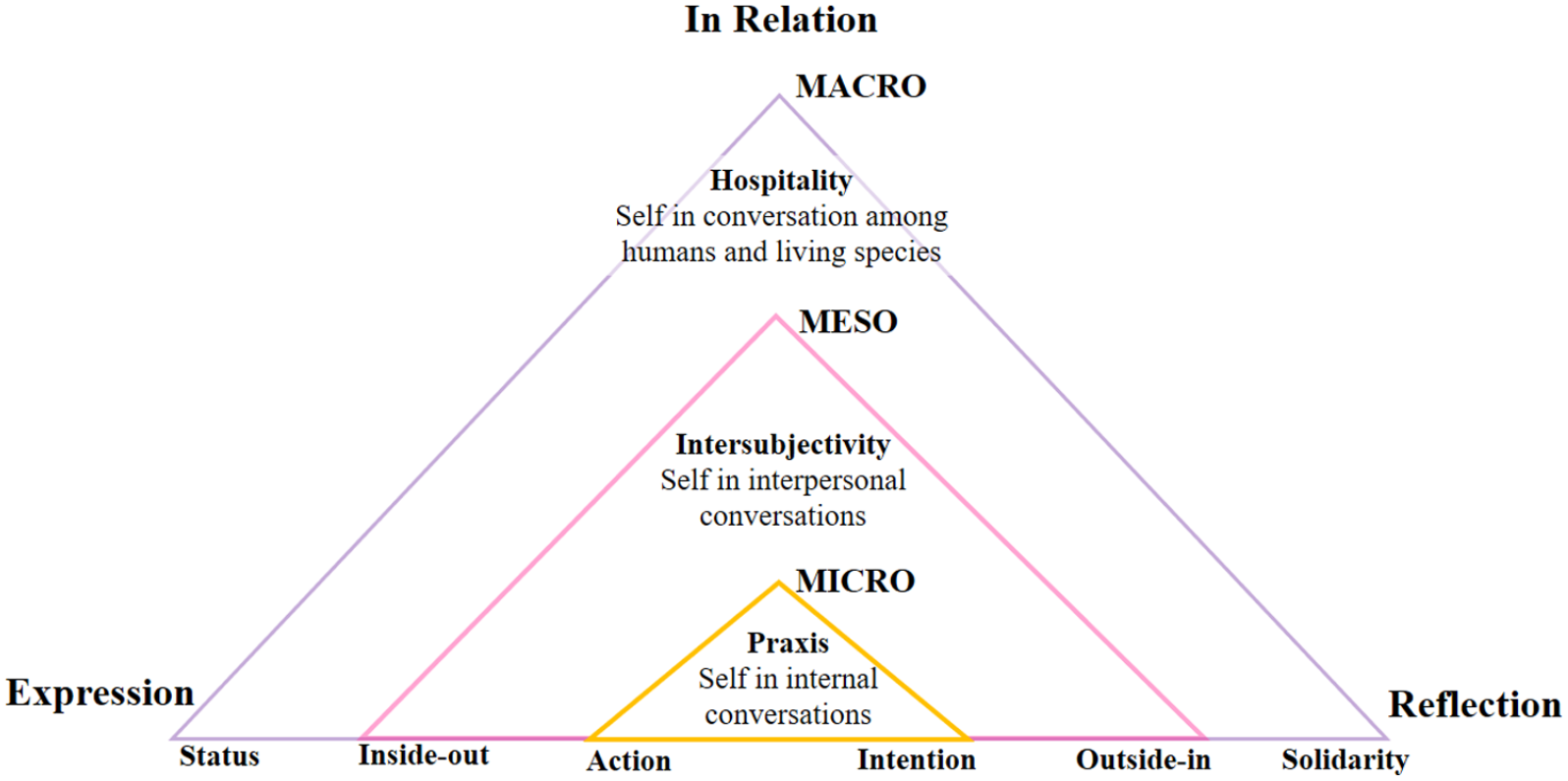
A scaffolding conversation model: dialectics at the micro-, meso- and macro-levels, based on Baker et al. (1998, 2002, 2005).
Identity integration can be described as the ‘process of bringing together various aspects of one’s self into a coherent whole, and the sense of self-continuity and wholeness that emerges as a result of these processes’ (Mitchell et al., 2021: 2). By narrating their self, individuals can consciously construct an identity that brings them a sense of integration, meaning and purpose (Syed and McLean, 2018). Such a conceptualisation of narrative identity, as a selective and subjective account of how one came to be the person one is currently (Singer, 2004), enables one to see identity as ever-changing and influenced by the social context (Hytti, 2005; Reveley and Down, 2009). Indeed, the way we ‘tell’ ourselves depends on the people with whom we engage in conversations: ourselves, other members of our collectives or even society as a whole.
According to Conversational Experiential Learning (CEL) (Baker et al., 2002, 2005), conversational spaces provide learners with opportunities to construct meaning about their experiences as social entrepreneurs and transform those experiences into knowledge. They can be conducted at multiple levels, enabling learners to reflect on their experiences at the micro (individual), meso (team) and macro (external social environment) levels (see the three levels of conversational spaces in Figure 1).
At the micro level, the dialectic of ‘praxis’ (Baker et al., 2002) creates an internal conversational space for the self concerning its personal intentions, aspirations, values and motivation (hereafter intentions) and how such intentions are expressed (or not) in actions. By structuring conversational spaces at the micro level, educators invite students to explore their self in terms of intentions and related actions. At the meso level, the dialectic of ‘intersubjectivity’ (Baker et al., 2002) concerns conversations in interpersonal situations. Learners can discuss their intentions and actions with their interlocutors in an inside-out motion: personal intentions are enacted ‘out there’ with others as the audience. They can also integrate others’ expressions of intentions and actions in an outside-in motion, thereby reflecting on the influence of the collective on their self. Finally, at the macro level, the dialectic of ‘hospitality’ explores the tension between status and solidarity (Baker et al., 1998, 2002) when the self is in relation to other human beings and living species at a broader level. It is about the ‘ranking and linking dynamics that shape the social realm of conversation’ (Baker et al., 2002: 53). Status refers to the ranking or positioning of individuals within their social system and the recognition of privileged leading positions that might guide conversations by regulating the expression flows among participants according to recognised expertise or other sources of dominance. Solidarity, instead, is about the extent to which one is interpersonally linked with others in a network of relationships (Baker et al., 2002). Building on Freire (2018), it also refers to the inclusion in the conversations of the voices of absentees – that is, silenced voices that might suffer from a lack of legitimacy or visibility. Enabling conversational spaces at the macro level invites students to consider the influential position of participants and absentees from broader social systems regarding their collective and individual intentions and actions.
As with a conversation (Campbell, 2021), identity integration is bi-directional and implies a position whereby the learner is both influenced and influential. Inviting students to engage in the three conversational learning spaces can reveal the sense-making processes experienced by learners within their collectives: the way they narrate their entrepreneurial experiences and write alternative stories about themselves, their teams and the rest of the world in the face of societal narratives of social and environmental injustices. CEL has inspired the design of SE courses (Parris and McInnis-Bowers, 2017) and SE learning environments (Hockerts, 2018) that are deemed conducive to identity transformation. Furthermore, CEL would be effective in supporting identity integration by students in providing opportunities to reflect on their own values, intentions and emotions when acting in social contexts (Akrivou and Bradbury-Huang, 2015; Sims, 2004). As such, our scaffolding conversation model, structured at the micro, meso and macro levels in line with the dialectics of CEL, offers a relevant framework to implement collective narrative practices in an educational context.
In the next section, we present the methods used: the research setting, the data collection through scaffolding conversations, and the data analysis through holistic-content and form analysis.
Methods
Research setting
Our field study considers an SE course in a French-speaking business school in Belgium. The course is in English and intended for master’s students who have chosen a six-course elective in Corporate Sustainable Management. The students are asked to develop an entrepreneurial project in teams of three to five that addresses a social or environmental issue. At the end of the course, they submit a report on the business model they developed and tested.
A team of three teacher-researchers established a narrative device within this learning environment, inviting students to write several reflective journals about their joint entrepreneurial experiences, their struggles and their hopes. Reflective journals serve a twofold objective. First, the pedagogical purpose is to support students’ awareness of their implicit knowledge through the development of reflective capacity (Raelin, 2007). This is particularly useful in SE courses where competing discourses created by the global and local context make identity construction a very personal reflective project (Giddens, 1991). Second, for research purposes, the journals reflect student meaning-making and become empirical data for narrative analysis.
Building on Raelin’s (2007) epistemology of practice, our research strategy is based on using collective narratives to reveal the tacit assumptions that students employ to make sense of their entrepreneurial experience within the course ecosystem. We use the term ‘ecosystem’ when considering the student’s social environment as they position themselves inside a network or a community with others to whom they are interpersonally linked (Baker et al., 1998, 2002). The intention is not to shape or transform student life stories. We consider that students are ‘authors of their own life’ (White and Epston, 1990): they are invited to adopt new perspectives on their entrepreneurial experience and, thereby, to reflect on new considerations about themselves and their experiences that were not previously visible (Beech, 2017; Hammack, 2008).
The first pilot of the narrative device was tested with the 2020 cohort. A refined version was used in subsequent years. For this research, we focus on the 2021 cohort. A total of 72 students were enrolled in the course in 2021, 68 of whom completed all deliverables for the course and participated in all the steps of the narrative device.
Data collection for narrative research through scaffolding conversations
To collect the narrative materials, we used the narrative practices inspired by White and Epston (1990), operationalised through scaffolding questions in the reflective journals and structured according to CEL. Our intention was for the students to pass through (1) praxis (micro level) – inviting them to explore their self in terms of personal values, intentions, motivations and related actions; (2) intersubjectivity (meso level) – enabling the students to express their self as a part of a collective as well as to reflect on the influence of the collective on their self and (3) hospitality (macro level) – inviting the students to consider the influential position of participants and absentees on collective and individual intentions and actions. As the course unfolded (see Figure 2), the students were invited to write their stories through reflective journals using photo elicitation and scaffolding questions (see Appendix).
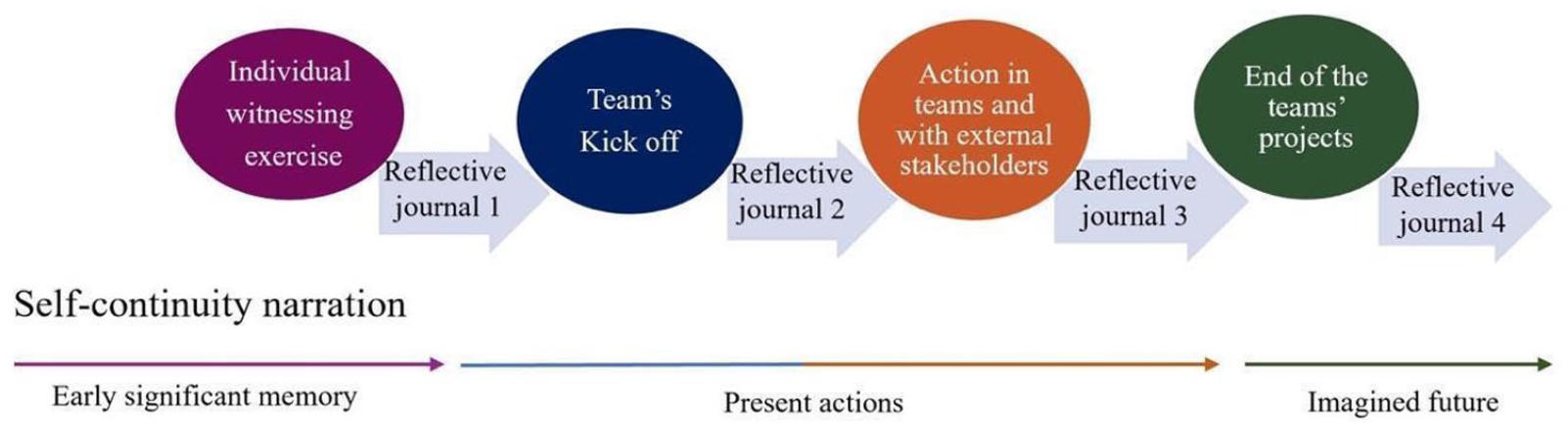
Data collection through reflective journals.
At the very beginning of the course, we invited the students to watch a series of short videos addressing different themes of social and environmental injustices. We followed Kaplan’s (2008) approach of empathy for vulnerable communities (Hoffman, 2008) and the concept of witnessing by using images or videos to prompt questions, enable a broader understanding of the complexity of injustice and elicit how a person sees the world. The students were then required to choose, individually, a subject that resonated with them and for which they would stand during the course. To guide them, we proposed an automatic writing exercise followed by the completion of their first reflective journal about a significant memory (Lieblich et al., 1998: 79) of awareness of the injustice that they had chosen. In terms of the student identity construction, this conversation with themselves allowed them to narrate the process that made them consider who they were on the day they embarked on the course by giving sense to a selected personal past experience associated with their current social and environmental concerns.
We give an example through the story of Léo: ‘When I first came to Belgium with my family, I didn’t speak the language and I was put aside and discriminated [against] by others of my age because I was different, and it made me feel different’. In Léo’s example, the articulation of his initial memories to his current intention of action is expressed as follows: Today, even people born in this country and who grew up here, are discriminated [against], put aside in our society because of their differences. I would like to be able to provide them with the same opportunities as everyone else.
Next, the teachers established the student teams based on the injustices mentioned in the initial reflective logs. When the students first met in teams (kick-off session), they were invited to conduct a narrative exercise on the externalisation of the problem (Denborough, 2008). They used photo elicitation to create a fictional persona to characterise the problem (here, the injustice they chose) and those who resist it. This creative way of expressing the ambitions, the hold and the impact of the problem aimed to uncover questions, awareness and motivating paths of explorations for the individual and the team. It also enabled the sharing of personal intentions while establishing a certain distance from the problem in order to envisage the future (alone and as a team) (Lawrence and Mailtis, 2012).
Through their second reflective journal, the students recorded how they made sense of this initial session. To grasp how they processed what was happening in the teams during their first meeting, we collected and cross-referenced the student testimonies by team to recreate a polyphonic story. This illustrated how the students experienced the back-and-forth movement between being influenced and being an influencer in their team. As an example of the cross-referenced operation, we return to Léo’s case: I went from feeling angry and sad about the injustices shared and experienced by my colleagues, to feelings of hope and comfort. Comfort that I am not the only one with the same vision of the world. . . We can always find similarities and fight the same battle.
We cross-referenced this with the story of Zélie, who was in the same team: I even said to myself that it was perhaps not a very strategic choice to deal with racism, knowing that we would have to create an entrepreneurial project related to racism. After sharing this ‘fear’, we tried to think together, and we were able to identify several important avenues to explore for a potential entrepreneurial project.
After the six week course, in the third reflective journal, we captured through the student stories how teams or more broadly the ecosystem can be leveraged (or not) for collective action. As an example at the team level, for Emma: ‘The fact that there are three people with the same will and determination pushes us to do great things, to surpass ourselves’; and at the ecosystem level for Ambre: ‘We communicate with stakeholders who, when we explain our project to them, are directly excited to collaborate with us and participate in our project’.
At the end of the 10-week course, we questioned the students again about their vision of themselves, their team and their ecosystem through the fourth and final reflective journal to capture the evolving nature of identity. The analysis of the collective narratives about the effects of their team’s intentions and actions on their identity integration revealed different inner experiences. It also revealed elements of integration at the macro level, where the students narrated how they attended and accounted for conversations with other members of the community. They considered the voices of absentees, such as vulnerable persons, minorities and other living species, but also other actors such as activists, politicians, philosophers and lobbyists. It also included experts, field practitioners, teachers and other student teams, where interdisciplinary, intercultural or intergenerational interactions enriched their experience.
As an example, for Gabriel: I was able to exchange with the creators of the biodegradable net and I found it very enriching. I will have a call with the coordinator of the project next week and I am sure that this will bring me a lot for the project as well as in my professional development.
Holistic-content and holistic-form analysis of narratives
We followed Lieblich et al.’s (1998) methods of holistic-content and holistic-form analysis of narratives. Through holistic-content analysis, the narrative is taken as a whole and each section of the text is interpreted considering the story in its entirety. A holistic approach is thus preferred to traditional categorical content analysis where the study aims to explore changes in the protagonist’s self-representations as the story unfolds (Lieblich et al., 1998). While a categorical content analysis is useful to understand the narrated representation at one point in the story, a holistic-content analysis is more appropriate to explore its development and co-construction. Then, through holistic-form analysis, we focus on the overall plot structure. Indeed, the plot structure is more difficult to manipulate than the contents and thus reveals a deeper layer of the narrator’s identity. Accordingly, Lieblich et al. (1998) suggest a holistic-form analysis of the plots to identify the ‘turning point in the story, which sheds light on the entire development’ (p. 13).
To implement the holistic-content and holistic-form analyses, we proceeded in three steps. First, we examined all the narrative contents (reflective journals) and reconstructed the story of each student individually. Like Essers et al. (2022), we applied open coding to inductively unveil the main themes mentioned by the different members of the collective. Concerning data management, we used QSR NVivo 12 (González-López et al., 2019; Vázquez-Burgete et al., 2012) to store the data, preparing for analysis by highlighting significant content.
Second, we reconstructed shared narratives as the individual stories intertwined in groups, thereby revealing multi-voiced stories. Our unit of analysis is thus, the collective identity narrative whereby shared experiences, struggles and hopes are co-constructed by members of the ecosystem. The analysis is multi-level, as the story unfolds at the micro (individual), meso (group, teams) and macro (society, the ecosystem) levels. More specifically, we used thematic coding categories to analyse each level through the lens of CEL: the dialectics of praxis, intersubjectivity and hospitality. Through thematic coding, we organised and complemented the codes that emerged from the open coding by drawing on the CEL concepts. Our coding subcategories included entrepreneurial perception and self-perception (for praxis), intentions, observed group effect, motivational levers, strategy and team perception (for intersubjectivity), and stakeholder voices, silenced voices, status perception, future generation perception and hope (for hospitality). The coding subcategories, illustrated with quotes, are provided as Supplemental Materials.
Finally, we analysed the form of the collective identity narratives: the archetypal plots that emerged from the narratives (Lieblich et al., 1998) as the students made sense of their joint entrepreneurial experiences and of the key turning points that influenced their shared story. In doing so, we inductively identify four main plots linked to dominant representations (see Figure 3, as well as Supplemental Material 1 for additional verbatims), which were performed and negotiated within the ecosystem of the course, and which evolved through major turning points.
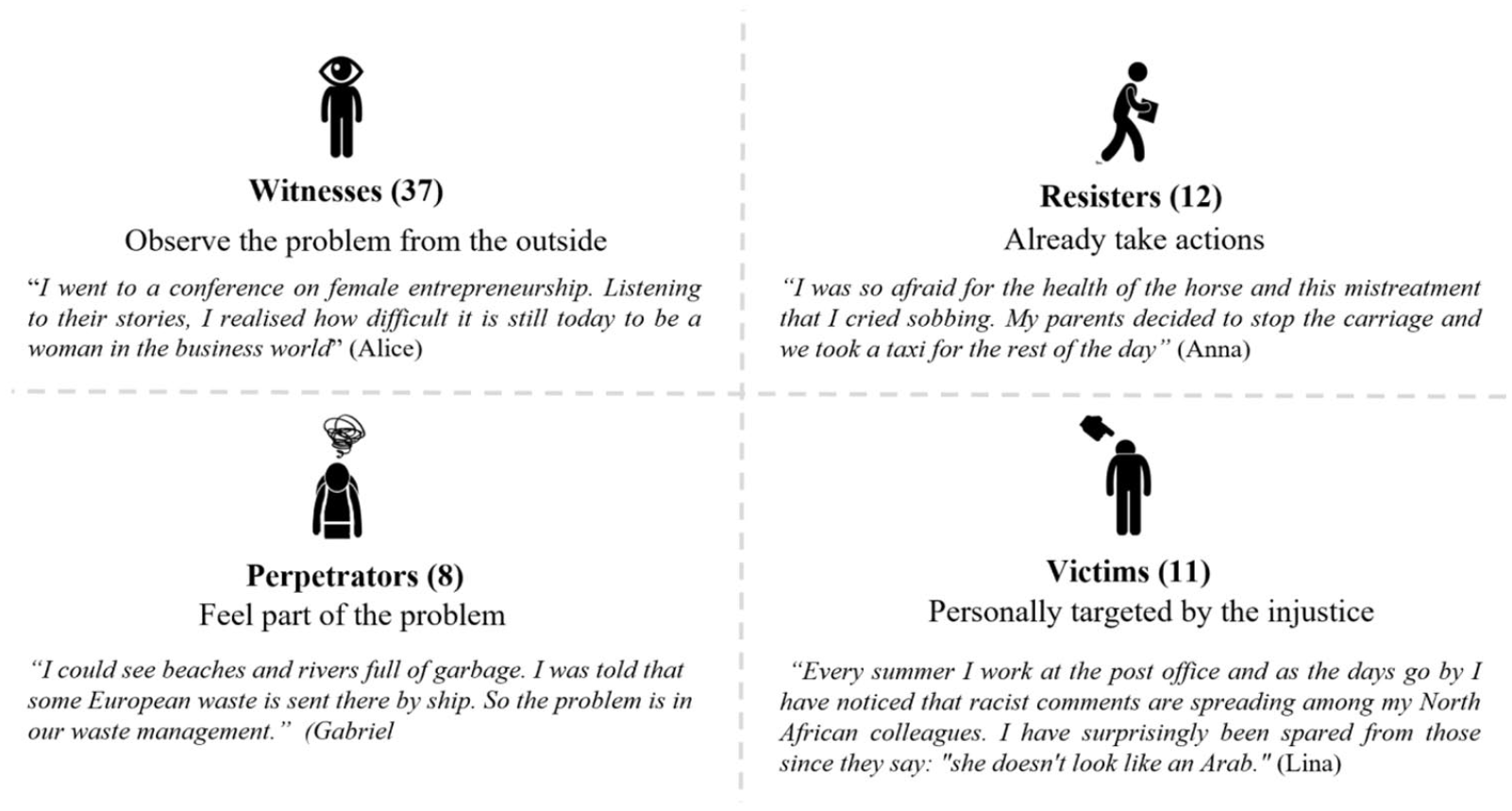
Initial authoring representations: witnesses, resisters, victims and perpetrators.
The process began with the first reflective journal. When asked about a first significant memory and the reasons for being concerned about a specific social or environmental injustice, some students shared how they experienced witnessing the injustice. The first journal informed how some students engaged in ‘Tales of Witnesses’ that unfolded in the subsequent journals (37 from 68 students). However, other students emphasised how they had already taken action to resist the injustice and we called this plot ‘Tales of Resisters’ (12 from 68 students). Others revealed how they had been personally targeted by the injustice; we called those stories ‘Tales of Victims’ (11 from 68 students). Some of the students even felt part of the problem due to their human condition; we termed these stories ‘Tales of Perpetrators’ (8 from students). Together, these initial self-representations refer to pre-existing roles that protagonists seize as discursive resources and reproduce. As proposed by Grigore et al. (2021), we use upper case letters to distinguish the self-authored representations in this research from society’s actual victims, witnesses, resisters and perpetrators.
As the story unfolded, the collective narratives provided the practitioners with opportunities to perform and negotiate their EIs: to ‘thin’ part of them and to ‘thicken’ other preferred traits. In the next section, we explore how those narratives enabled the practitioners to depart from dominant identities and to co-construct new ones through the social interactions within the course ecosystem.
Results
Micro level: Student integration of intentions and actions of the self
The dialectic of praxis was active when the students engaged in internal conversations to align their actions and their intentions. At the beginning of the story, four archetypal representations emerged, as the protagonists seized pre-existing discursive resources about injustices in society: the Witnesses, Resisters, Victims and Perpetrators. 1
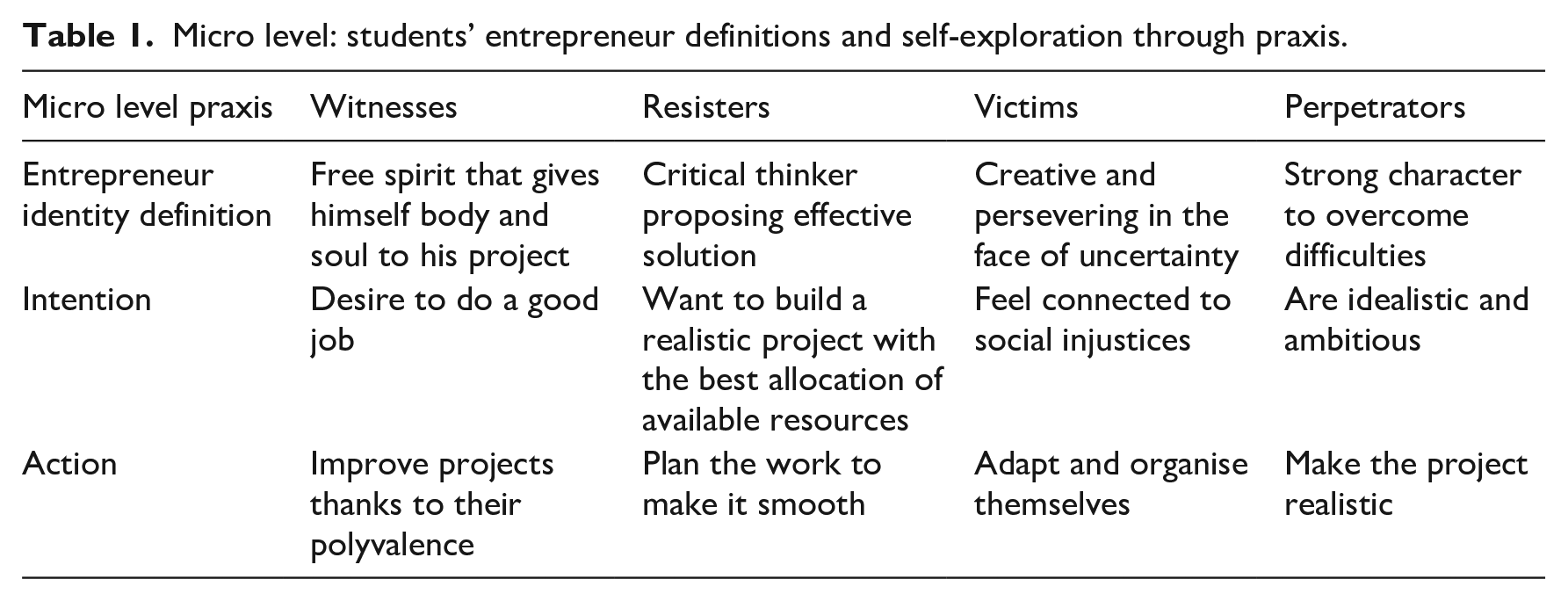
Through holistic-form analysis, we found that these different starting points were important because they were the self-authored representations the students chose to account for their experience with the injustice they were about to tackle with their team. We present hereafter a compilation of student stories that describe each perception at the micro level, illustrated by verbatims. Table 1 synthesises the findings related to the micro level (see also Supplemental Material 2 for additional verbatims).
Micro level: students’ entrepreneur definitions and self-exploration through praxis.
Tales of witnesses
In most teams, we found students who authored themselves as Witnesses of injustice at the beginning of their entrepreneurial journey. They observed the problem from the outside and were shocked. As Alice stated, ‘I went to a conference on female entrepreneurship. Listening to their stories, I realised how difficult it is still today to be a woman in the business world’.
They embarked on entrepreneurial projects aiming to do a good job but quickly realised that they needed additional methods and knowledge. Soon, the volume and diversity of the work led them to reconsider their way of working: compromising on details, focusing on what was important, getting straight to the task and working fast. They learned to recognise their own qualities as well as those of others. The large number of tasks required multi-tasking skills and they ultimately felt useful, even if it was to review the work of others. Reauthoring their Witness stance, thickening self-representation in terms of multi-skilled teammates, they used the analogy of a Swiss Army knife for entrepreneurs who have many skills and know how to use them. The Witnesses were captivated by the free spirit of entrepreneurs, notably how they let their imaginations run wild and give themselves body and soul to their project (see Table 1). Rose shared, ‘People who embark on an entrepreneurial project are for me very free spirits who let their imagination run wild and give themselves body and soul to their project so much it captivates them’.
Tales of resisters
Students authoring themselves as Resisters spontaneously explained in their journals how they had already acted to try to resist the problem. As Anna stated, ‘I was so afraid for the health of the horse and this mistreatment that I cried sobbing. My parents decided to stop the carriage and we took a taxi for the rest of the day’. The Resisters were enthusiastic about jumping into solving a problem that mattered to them. They tried to work efficiently so that no one else had to work after them. They wanted to leave room for other people’s ideas but were always ready to mediate or decide if required. They endeavoured to make the work run smoothly by preparing a to-do list, ensuring that the tasks were distributed and that no one was discouraged. Ambre shared, ‘I managed the smooth running of the team, the way our meetings were held and who managed the distribution of the things to be done’. Their ambition was to build a realistic project with the best allocation of available resources. Usually, to be comfortable, they need to develop a general plan and distance themselves to obtain the big picture. In this case, they had to thin their self-representation of being solution-oriented and thicken what they call their entrepreneurial stance of critical thinker, or risk missing the real problem or proposing a suboptimal solution.
Tales of victims
Tales of Victims were specific to those students who related to social injustices (racism, gender inequality and LGBTQ+ discrimination) as they had personally been the subject of them. Surprisingly, no students authored themselves as Victims of environmental injustice whose future was compromised.
Every summer I work at the post office and as the days go by, I have noticed that racist comments are spreading among my North African colleagues. I have surprisingly been spared from those since they say: she doesn’t look like an Arab. (Lina)
The Victims substantially developed their ability to adapt to others and to changes. They reported having learned to organise and deal with multiple agendas and ideas. The Victims also felt they had listened greatly to others to understand their motivations. As Lina noted, ‘I have learned that adapting and understanding the other’s point of view is a crucial dimension’. Accustomed to feeling safe by controlling details, the Victims had to learn to recognise and accept uncertainties. This was a major turning point, as not everybody can relinquish their need to control every aspect of the project. When they learn self-control and give other scenarios a chance, Victims thin their usual story of having everything under control which, when it gets out of hand, leads them to withdraw.
At certain points, I may find myself a little bit lost because I fall on something I didn’t think about but that can be critical for the project. This can lead me to withdraw from the project . . . Little details are what make the difference between a simple thought and a concrete sustainable project that has the capacity to see the light and make a real change. (Lise)
Moreover, the Victims discovered new facets of themselves by assuming new identities (their team’s identity) and acting as such on social networks. This experience, lived as a revelation, allowed them to experiment with uncertainty and motivated them to continue trying to undertake new challenges, thickening self-representations of creativity and perseverance. For them, an entrepreneur is creative and perseveres even when uncertain about the end result. Zoe shared, ‘It is about developing creativity and always trying to find solutions to problems’.
Tales of perpetrators
Finally, some of the students authored themselves as part of the problem; they felt responsible for the damage caused by humans to other humans, to living species and the planet. Gabriel stated, ‘I could see beaches and rivers full of garbage. I was told that some European waste is sent there by ship. So the problem is in our waste management’.
The Perpetrators worked well in teams and gained confidence in their ability to assert themselves. Thinning their self-representations as ‘part of the problem’, they saw themselves as curious challengers who questioned and scrutinised the proposals of others. The Perpetrators discovered that their intervention makes a project more interesting and tangible because they do not compromise with the difficulties. Idealistic and ambitious, this experience thickens their self-representation of being complex thinkers who have learned to think concretely and to organise themselves. For them, entrepreneurship meant having a strong character to overcome difficulties and to see the glass as half full.
You need to follow a plan if you want to achieve your ambitious goals. There is no point in running around. You need a kind of ‘To-do list’, a clear idea of the objective to be achieved. This entrepreneurial project forced us to think concretely. (Jade)
Meso level: Identity integration through inside-out and outside-in motions
Intersubjectivity involves the conversation of the self in interpersonal situations. This conversational space considers the self in relation to a person or a group through the dialectic of outside-in and inside-out. Working on team projects developing entrepreneurial solutions for social and environmental injustice prompted the students to express their logics and emotions and listen to others. The teams experimented with the dialectic of intersubjectivity during creative processes where the suspension of judgement and the development of empathy skills were essential or when engaging in actions such as developing innovative solutions or exploring the field. Table 2 synthesises the findings related to the meso level. More verbatim responses are presented in Supplemental Material 3.
Meso level: students’ self-exploration through intersubjectivity.
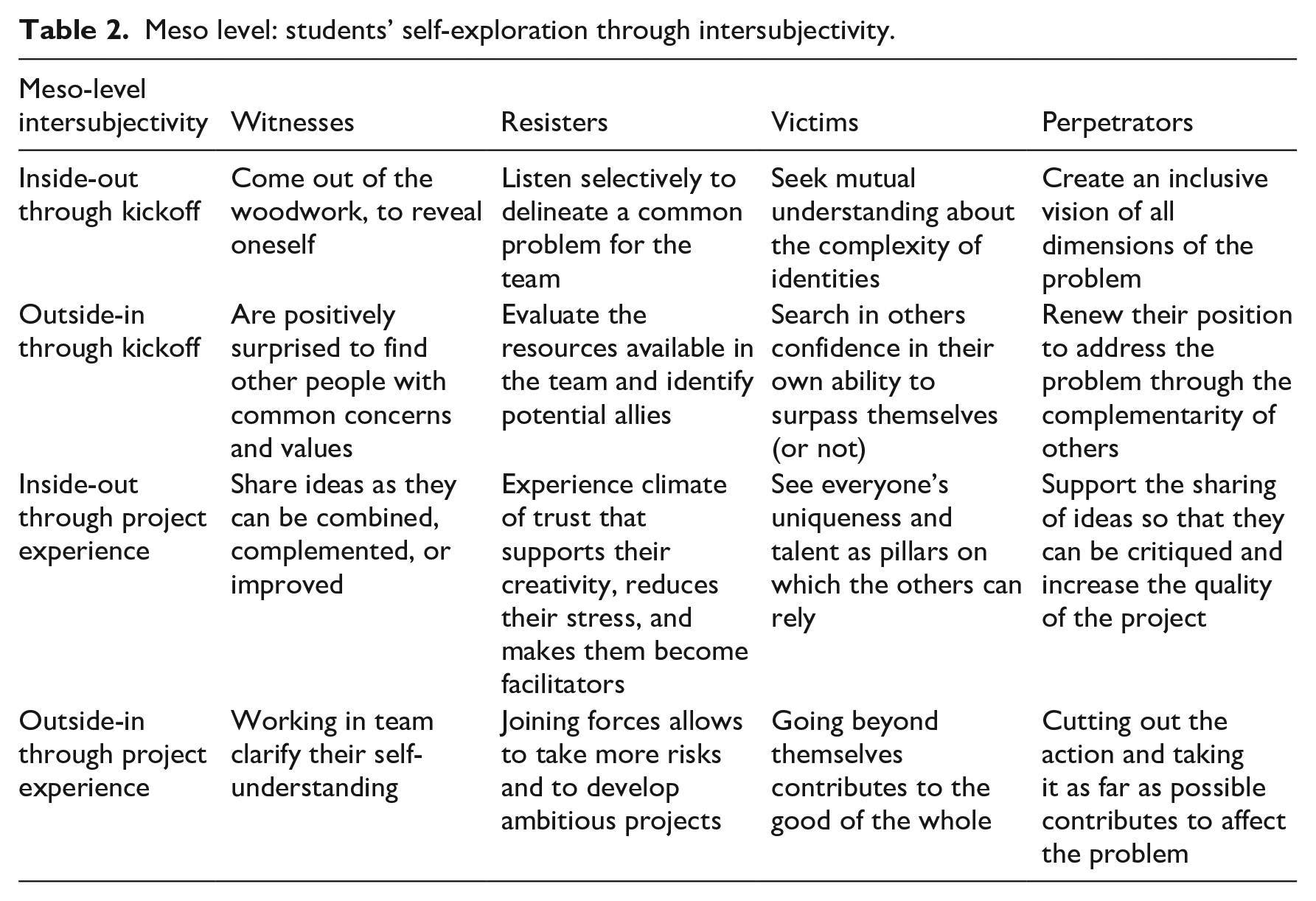
Tales of witnesses
The Witnesses described the experiences of encountering their team as a means of emerging into the open; they were curious and receptive to the stories of others, which they discovered with pleasure. The exercise was seen as a way to stimulate their creativity; they were impressed by their team’s productive ability and were pleasantly surprised to encounter an audience that shared their concerns and values.
It can be seen as obvious that I’m not the only one, but in my life, it doesn’t feel like there are a lot of people caring about them so I always thought to be different from others and that people would find me weird. (Lou)
The Witnesses realised that they were not the only ones concerned, which was a turning point that thickened their identity construction. The meeting encouraged their desire to make their voices heard and to mobilise. They perceived their team’s commitment to the cause as the driving force behind the project. For this reason, they wanted to involve everyone in the conversation and saw potential in developing a sense of collective efficacy – that is, a belief that, together, they could develop a project that worked (Bandura, 2000).
Knowing that I am part of a group that shares the same values as me makes me feel less alone in a cause that requires a lot of energy. I really feel that as a group, the impact of our advocacy can be successful and it motivates me. (Lucie)
In the teams comprised of only students authoring themselves as Witnesses (3 teams from 20), the discussions were optimistic. In hindsight, however, some of the teammates wondered whether their enthusiasm for a shared vision of the problem masked an understanding biased by their common socio-economic backgrounds (an aspect often challenged by the Perpetrators in other groups) or if their exploration of the problem would result in their team creating a project that made sense and had an impact (an aspect often addressed by the Resisters).
In action, the Witnesses learned to work and think differently by working in a team that wanted to live its values and invest in a project for the common good; they saw their ideas combining, complementing or improving thanks to team diversity. Creativity could be developed in an atmosphere of respect, listening and even friendship, which gave meaning to their learning. This dynamic brought many surprises, such as how society’s problems are deeper than imagined, that leadership can be shared without rivalry, or that the investment of teammates can be linked to something other than academic success. The issues at stake maintained team member motivation despite the frustration, especially when their project was solid. When it transpired that the envisaged solution was too idealised, the team absorbed the shock, enabling a quicker and better rebound. Finally, they felt pride in bringing projects to fruition on such themes with team members who were unknown to them three months previously. They admitted that without the team they would never have succeeded in expressing their sentiments or their goals for the project.
I did exactly what the teachers asked me to do. However, it has sometimes led me to believe that I was not the true ‘owner’ of my work. I do not think that alone, I would have dared to really express what I wanted for this project. Working with people with whom one is not used to working also has the great advantage of bringing unexpected results that make a project special. (Emilie)
As such, they expressed their team as a visionary that helped to clarify who they were and what they wanted, thinning the self-authored traits of an undefined single passive person and thickening a self-representation of a link in the action-taker chain. When Witnesses meet a Perpetrator, the conversation can sometimes awaken the activist in them.
Tales of resisters
Being somewhat impatient, the Resisters endeavoured to provide their team with avenues to move from theory to action; they invested effort into organising the flow of the activity (speaking, timing, etc.) and were critical of the teaching method’s originality. The problem externalisation exercise was considered as a way to find common ground, extend their vision of the problem and evaluate the best way to address it.
I was excited and happy that the general idea of what must be done to achieve the common goal of resisting the causes of why the gap keeps widening was mutually shared amongst us. The stories shared on the resisters, the resisters’ avatar and even real-life cases pointed me to the direction that for this situation to be tackled, it has to be a collective effort. (Louis)
To this end, they made future projections and sought to identify allies in their team to achieve both academic goals and social impact. We note that the Resisters tended to experience difficulty reaching a certain level of abstraction, even if they recognised the benefits in hindsight. For them, the sharing of views was useful to ascertain areas of mutual agreement and positively influence the team motivation, which they would need to address large-scale injustices. They admitted having difficulty listening to their teammates and even to their own feelings. The reflective journals were perceived as an interesting tool to express their emotions, while the prospect of the coming weeks working on the project left them curious about the future and the efficacy of their teammates.
In action, the Resisters liked to plan and anticipate. Working in a team taught them to go back and forth to reconsider their own ideas and to adapt their planning to circumstances. Speaking about their team, the Resisters first evaluated the organisation of the work as an indicator of performance: respect for deadlines, balance in the sharing of tasks and the active participation of all. There was surprise at the warm atmosphere of the project, the trust that developed between members who did not know each other, the investment of all in the project and the richness and diversity of ideas. This path invited them to thin the plot of being a motivator for their team and to thicken a story where they felt supported, saw their stress reduced and could step back and facilitate instead of managing. The team learned to listen and build a mutual understanding so that everyone could work independently and with confidence. A turning point occurred when their project, which questioned the team’s ability to succeed, led them to consider their school actions differently. They realised that good academic grades are not the only fuel for action; joining forces with others reduced their need for controllability and enabled them to take risks and develop bold, ambitious and socially committed projects.
By living this team experience, I’m learning that it is really interesting to move away from my comfort zone because it expends the vision I have and permits me to see new possibilities. . . Our team made me take a risk in the project we chose. (Jules)
From a multi-voiced perspective, when cross-analysing the journals by teams, we discovered that the Resisters imbued others with the feeling of knowing what they were talking about, which was deemed reassuring and motivating, especially through the Victim and Witness voices. The Perpetrators’ vision raised the debate to a higher level of abstraction that challenged the Resisters and offered them an opening to new avenues of exploration. Under the pressure of the group, the Resisters could accept an unexpected, for them, direction if they saw a benefit in it, such as broadening their horizon and knowledge.
Tales of victims
The Victims were deeply attached to their view of the problem; talking about it revealed part of their identity and they were fearful of judgement. Generally, they tried to speak last to gauge whether to reveal themselves; their vision was to seek approval but not to impose themselves, out of respect for others, they wanted everyone to be able to contribute and try to listen to others. If they recognised themselves within the collective vision of the problem, they felt lucky to have found a team with whom they felt connected. In contrast, if the team’s understanding of the problem differed from their own vision, the Victims tended to lose confidence. To feel comfortable, they needed mutual understanding. Clara said, ‘I gained confidence when we each gave our opinion on the issue to work on because I felt I was listening and not judging’. They processed by questioning: Who am I? Who are the others? What do we have in common, for example, origins, backgrounds, studies? When they talked about their choice of picture, identical choices reassured them, even if the pictures opened up different stories. For example, ‘It allows us to understand each other, to see where the other is coming from, to analyse sometimes even why a colleague thinks like that and not otherwise’ (Julie).
Hope was attained from having met teammates who were sensitive to their problems. This awareness encouraged them to leave their comfort zone, open up to their teammates and consider a union that would enable them to overcome their limitations; they wondered whether the team project would succeed in influencing their lives as well as the community to which they belonged. In action, the Victims expressed the need to be recognised for who they were; they tended to feel different and fear judgement (from teammates, teachers, etc.). Aspiring not to offend others, they could find it difficult to express themselves or to be heard. Recognition of their contribution enhanced their self-perception and confidence. Finding their place and being included thins their self-authored traits of a singular and misunderstood person and thickens their self-representation of a talented person and a pillar on which everyone in the team can rely.
Communication and respect were really the keys to getting along with my peers but also to moving forward effectively in our work. Indeed, by the fact that I feel listened to, respected and supported, I have the desire to participate and go as far as possible in this work. (Adam)
They enjoyed observing the synergies and mutual reinforcement between team members. Through the challenges encountered by their project, they understood how to go beyond themselves to contribute to the good of the common goals. Team members learned to adapt without feeling attacked, to successfully move forward for themselves, to make concessions, to put themselves in other people’s shoes, and to express themselves tactfully or even when they felt ‘it is not worth it’.
My team is important to me as I completely agree with the idea to work together to achieve higher goals. We realised that our first idea wasn’t feasible. So, my team adapted it and now we have a project that we believe could work in real life. (Eva)
When the Victims met a Perpetrator who had repented, they experienced this as proof that society can change. It fed their hope for the future of society and motivated them. In mixed groups containing positions other than Victims, other characters generally brought ideas for exploration that won team support.
Tales of perpetrators
The Perpetrators arrived with a vision that included themselves in a complex problem because of their human condition. At times this position was a barrier as they felt powerless to tackle such a challenging issue tending to see the problem externalisation exercise as an opportunity to philosophise or express personal opinions, without having to verify their source, which they found surprising in a university course.
I never had this kind of work. I mean something totally abstract, that has to be produced on the spot, where I don’t have to check the information because it is just my opinion that I express in the work. I found it quite destabilising at first because it was the unknown for me. Finally, I found that it pushed me to be creative, to interact with others, to express my opinion during the course. (Arthur)
Team members were receptive to the pedagogical device (use of photo elicitation and problem externalisation); their choice of picture was an interesting support that made them consider their own positioning, especially when they realised that the same image could illustrate both the problem and those who resist it. The latter fed their understanding of the choice of position that could be envisaged and stimulated their curiosity. The constitution of the imposed teams was experienced rather positively as it provided an opportunity to encounter new visions of the problem, then perceived as a source of inspiration and renewal. Some wished to spend more time discussing the coherence and complementarity of the perspectives to develop the trust between teammates that they needed to move forward. Once the team had established a vision of the problem, they experienced the choice of a common goal as an enjoyable moment that contributed to the positive team climate.
Several members had close ideas about the goal of our group work. This is a very good way to find coherence and sense in the group work. In fact, it also consolidated my desire to try to tackle this issue during the course. (Lucas)
In action, cohesion was a key element for the Perpetrators. For them, the driving force behind action stemmed from team member aspirations; these needed to be shared and the project served to achieve them. The Perpetrators were team players and wanted to guide the process by keeping an open mind as they considered criticisms to advance the project and make it realistic. Peer validation was very important to them. The more tangible elements that their project contained, the more they were convinced to progress in the right direction. Thanks to their team, they discovered how to break a problem down into smaller pieces to find a way to solve it at their own scale, set short-term intermediate outcomes and prioritise. Their team enabled them to embrace the complexity of taking action and working as thoroughly as possible to successfully propose a quality solution that had an impact on the problem. This thins their self-representation of being powerless pawns and thickens their self-representation of being aware, well surrounded and proceeding step by step.
The interesting part is that we were able to achieve a lot of concrete steps of the project development such as creating a prototype of the product, making people in our surroundings provide feedback and getting a few partnerships. . . Working on those steps allowed us to focus on building a solid entrepreneurial project, to find motivation and to want to do everything to the best of our ability to achieve our part of a higher goal. (Lucas)
When they encountered a Resister, the Perpetrators’ complex view of the problem could prompt them to challenge the former’s solution-oriented operational vision of the project, while recognising the importance of organising themselves to feel they were moving forward.
Macro level: Student’s integration of status and solidarity
The dialectic of hospitality is the widest conversational space and concerns polarities between the status of the stakeholders involved in the conversations and student solidarity with the absentees and the voiceless. This macro level of conversation using the dialectic of hospitality, through solidarity and status, is particularly relevant in SE education where students’ actions are nurtured by their intentions to engage in favour of justice but also constrained by the institutional rules of the game (Pache and Chowdhury, 2012). Additional verbatim accounts related to our findings are in Supplemental Material 4. Table 3 synthesises the findings.
Macro level: hospitality – students’ awareness of other systemic influential positions.
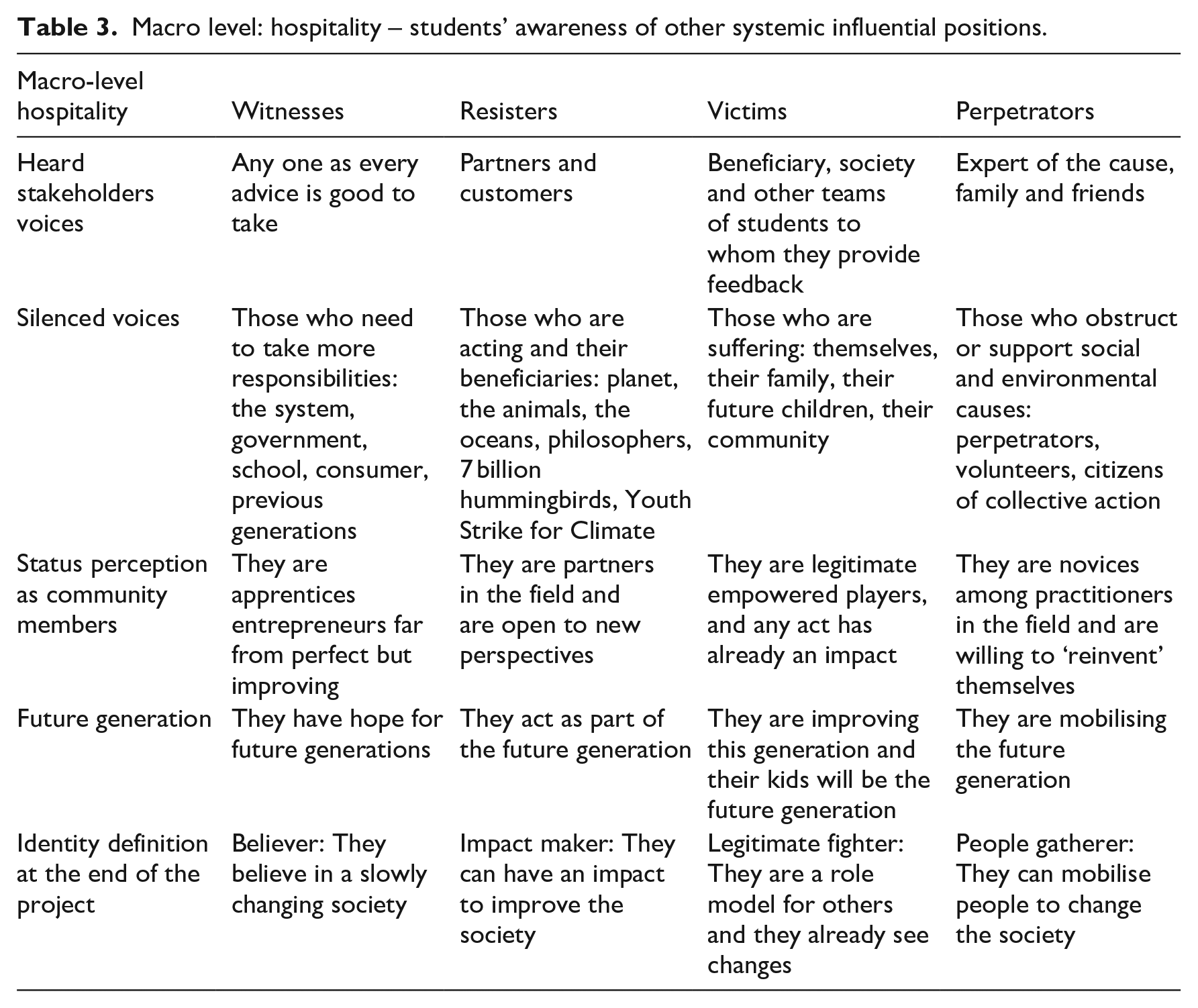
Tales of witnesses
The Witnesses were positively surprised to see so many stakeholders taking part in the conversation. A turning point occurred when they realised that they were not alone in their quest for social and/or environmental justice and that others believed in their project, this unexpected feedback was very encouraging and directly affected their motivation, pushing them to excel. Extensive feedback was sought to validate their project.
We are attentive to both the people who work in the field of our project (i.e. not far from us) and to the people who do not have a foothold in the field (i.e. far from us). We have considered the comments, suggestions, advice, and remarks we received from all the people who answered our online survey. (Quentin)
Eventually, however, it became complicated to decide which opinion to pursue. Each new element revealed the limitations of their own perceptions. When feedback critically questioned the project, the Witnesses were overcome with fear and began to reconsider the whole project perceiving two choices: consider the comments as unfounded or follow their team who saw them as resources to better delineate the limitations of the project. As such, they became apprentice-entrepreneurs: while they considered their project as far from perfect, positive remarks encouraged them to continue and improve. For example, ‘We know our project is far from perfect and it is always interesting to see the view of other people’ (Lou).
Absentees were revealed through their narrated imagined futures. The Witnesses acknowledged having much to learn about social and environmental injustice but recognised that being educated and able to think for themselves rendered them privileged. While the presence of societal concerns in their study programme showed them that the world is changing, they also said that being a business student comes with certain biases, including the inherent narrow focus on profit. Eleonore stated, ‘Being a business student comes with some prejudices, among which is the inherent focus on only profit. . . My intention is to promote other values within my future work’. There is hope for future generations, but change takes time. While they felt a growing will around them, the effects of which were starting to be seen, a sizeable challenge remained the blame for which as attributed to previous generations and assumptions that elderly people would never change.
Raising awareness and educating is only the first step to a more equal society. I think that older people won’t change anymore, so we have to start with young people and then penalise legally, more severely these behaviours. (Rose)
Voices at the macro level thin the self-representation by Witnesses as being isolated, inexperienced and anonymous and thicken their self-representation of being on the active track as apprentice-entrepreneurs. This can prevent them from changing positions and engaging. While they believed that everyone can contribute to a better world, they also noted that without a conducive ecosystem, entrepreneurial efforts may be in vain.
It is a society’s, country’s and the government’s responsibility to provide an environment in which these start-ups can grow and ‘blossom’. Without the right infrastructure and support from the government and countries or the willingness for the consumer to change their behaviour, the initial efforts may be fruitless. (Eleonore)
Tales of resisters
The Resisters wanted to do more and see further. Thanks to feedback, they realised that the challenge was achievable but above all, that a door was opening to new perspectives; they wanted to maximise options, seize opportunities, connect ideas and build on others’ projects. They saw themselves as potential partners for external stakeholders with whom they could collaborate and were also excited about interviewing future customers to test their ideas. In addition, seeing the level of investment from teammates when conversing with the outside world showed them that they were all invested, which motivated them encouraging them to believe anything was possible if they worked on it.
We communicate with stakeholders who, when we explain our project to them, are directly excited to collaborate with us and participate in our project. The stakeholders we have contact with in our fictitious start-up project are, for example, an influencer with values very aligned with our project, a farm store, a vegetarian restaurant, a team of students from this course who defend the animal cause with whom we could potentially do a partnership, etc. (Ambre)
When considering the future and the silenced voices, they referred to, among others, the planet, animals, oceans, natural ecosystems, seven billion hummingbirds and the Youth Strike for Climate. It was understood that if they wished to avoid becoming negative and desperate, they had to act; to this end, they wanted to change the way they behave and consume and encouraged others to do the same, because they believed that individual positive actions add up to change in society.
I’m learning that everyone can play the role of the hummingbird. I also learned that we will need seven billion hummingbirds acting together to fight all social and sustainable issues; otherwise, the fire will keep on burning forever. (Victor)
For them, young people are mobilising to make a difference, want to work for committed companies or even start their own projects with a positive impact. There is no time to lose; they are part of the future generation and are motivated to make the world a better place; it was believed there was support to act and they had ideas to implement to become impact makers. There was hope for the future in acknowledging the ability of SE students to propose projects that can make things change. This experience thins Resisters’ self-representation of those who take the forefront to avoid unpleasant emotions and thickens their self-representation of processing as potential partners and even as impact makers.
Tales of victims
The Victims quickly realised that talking to outsiders had an impact since educating people was an issue; they were happy to talk with influencers who wanted to help to spread their story. Changing society was a key element; cooperation was required with many stakeholders because everyone had a role to play, although some were more legitimate than others. Reaching out to others was foremost an opportunity to meet their beneficiaries, without whose input and views they did not see themselves building a project. Contacting their beneficiaries thus, enabled them to gather positive feedback and constructive opinions; this strengthened the project but also created the feeling for the Victims that they were legitimate.
I really had the impression to be in my place and to feel legitimate to ask my questions and especially to explain my feeling about our project. I felt listened to and above all understood by our beneficiaries, which reinforced the idea that our project is interesting. (Adam)
When talking about feedback, they primarily considered that which they had given to others. While they did not find this exercise simple, preparing it as a team revealed the extent to which they agreed with each other, which reassured them.
The Victims envisaged the future primarily in terms of a fight; they were living through change and every action they took contributed to making the world a more equitable place. They also sought greater justice and were acting; they could influence their fate and the projects they developed during the course would emerge sooner or later. It was recognised that this could be a way to live and not just a hobby. Free from hesitation, they wished to participate in the debate, to be an example for their peers and to improve society for their children. There was considerable optimism because things were already moving and could only improve. Macro-level discussion thins Victims’ self-representation of being a lone wolf seeking justice and thickens their self-representation of being a legitimate role model or even fighter. In effect, they are enhancing this generation and their children will be better off than themselves.
Indeed, I think that it can play an important role in this transition of mentalities. This is important to me because I am a young woman, and I don’t want to go through what my mum and other women their age go through every day. I want my children to have the right to develop in the field they want without being judged, and I want my daughters (if I have any) to be properly rewarded for the work they do. (Clara)
Tales of perpetrators
The Perpetrators appreciated feedback and saw it as an opportunity to make their project more tangible and realistic. While considering themselves novices, they contacted experts they considered to be highly qualified and sought greater contributions from their friends and family. Their ability to be humble, flexible and to accept change was reflected upon because entrepreneurship is also about being able to reinvent themselves. It was recognised they were acting for others (society) and the stakeholders were ultimately the pillars of their project.
. . .our friends and family, whom we ask for advice and guidance, parents, or even specialists in the world of cosmetics. (. . .) I had to take a step back from our ideas. This is something that I think many entrepreneurs have to do, to reinvent themselves and come up with better ideas. (Benjamin)
Analogously, they imagined themselves at a wedding party surrounded by strangers but feeling as though they were among friends. From their perspective, interactions are imperative to drive progress; the lack of any competitive spirit between the student teams was also emphasised. Regarding the future, they wished to remain abreast of innovations, solutions and laws that enable societal changes so that they can spread them. The team’s sought to influence people’s mindsets because they had confidence in their ability to see the benefit for all and wished to act in accordance with their values, both in the way they lived and how they considered their professional projects. For them, the pursuit of personal ambition alone was unviable; it was important to think of the group and not the individual; they wanted to succeed in convincing all stakeholders that everyone has an interest. It was considered that everyone must feel responsible for the world and they must raise the awareness this. This awareness thins the Perpetrators’ self-representation of being trapped in an obscure scenario and thickens their self-representation of being novice players with the ability to act as people gatherers; a better world is needed for everyone, not just for themselves. Their generation is capable of shifting the boundaries but they need to be gathered.
If we want to have a real impact on our future, we must all mobilise and to mobilise everyone, they must have an interest. . . because I think that our generation is full of ambition but our life goes so fast that we don’t have time to achieve many things! We must succeed in convincing all the stakeholders. (Arthur)
Synthesis: EI thinning and thickening through collective action
Our research reveals how identity narratives are woven together across multiple levels, thus repositioning EI development away from an individualistic experience. At the micro level, students are invited to develop their mindfulness about their personal values, intentions, motivations and related actions. At the meso level, they can experiment with their capacities to be influential and be influenced in groups. At the macro level, they are offered the opportunity to consider systemic influential positions, including those of absentees, on collective and individual actions and intentions.
Through the analysis of the collective narratives, we see that the protagonists go back and forth between levels to elaborate on their joint life stories. Social interactions at each level provide turning points where the authoring self-representations of Witnesses, Resisters, Victims and Perpetrators are performed and negotiated (see Figure 4), thinning some of their traits and thickening other preferred ones (see Figure 5). Ultimately, we suggest four archetypal plots that narrate a different experience for the development of EIs, departing from the four initial self-representations.
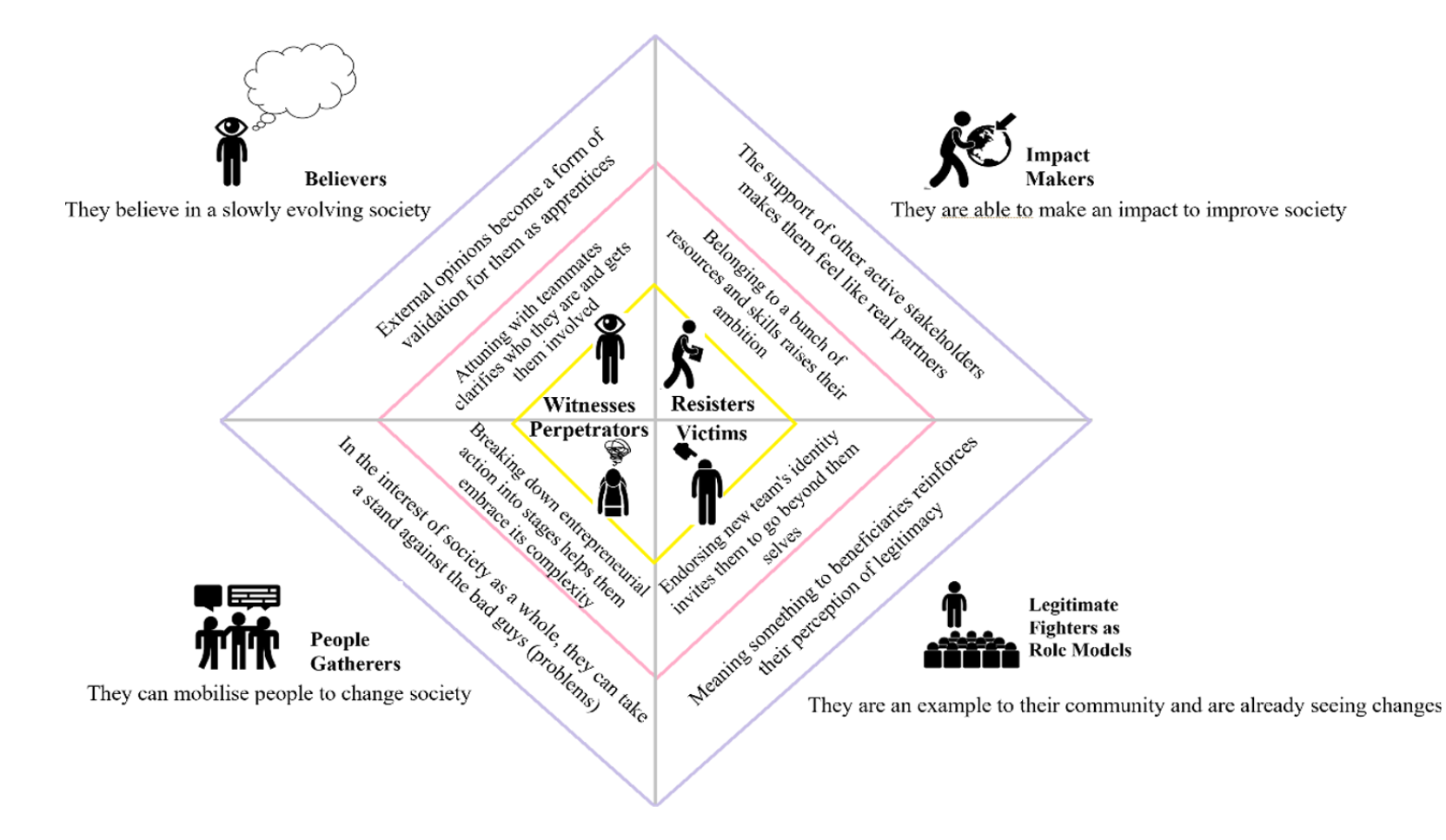
Entrepreneurial identity thickening through entrepreneurship as collective action.
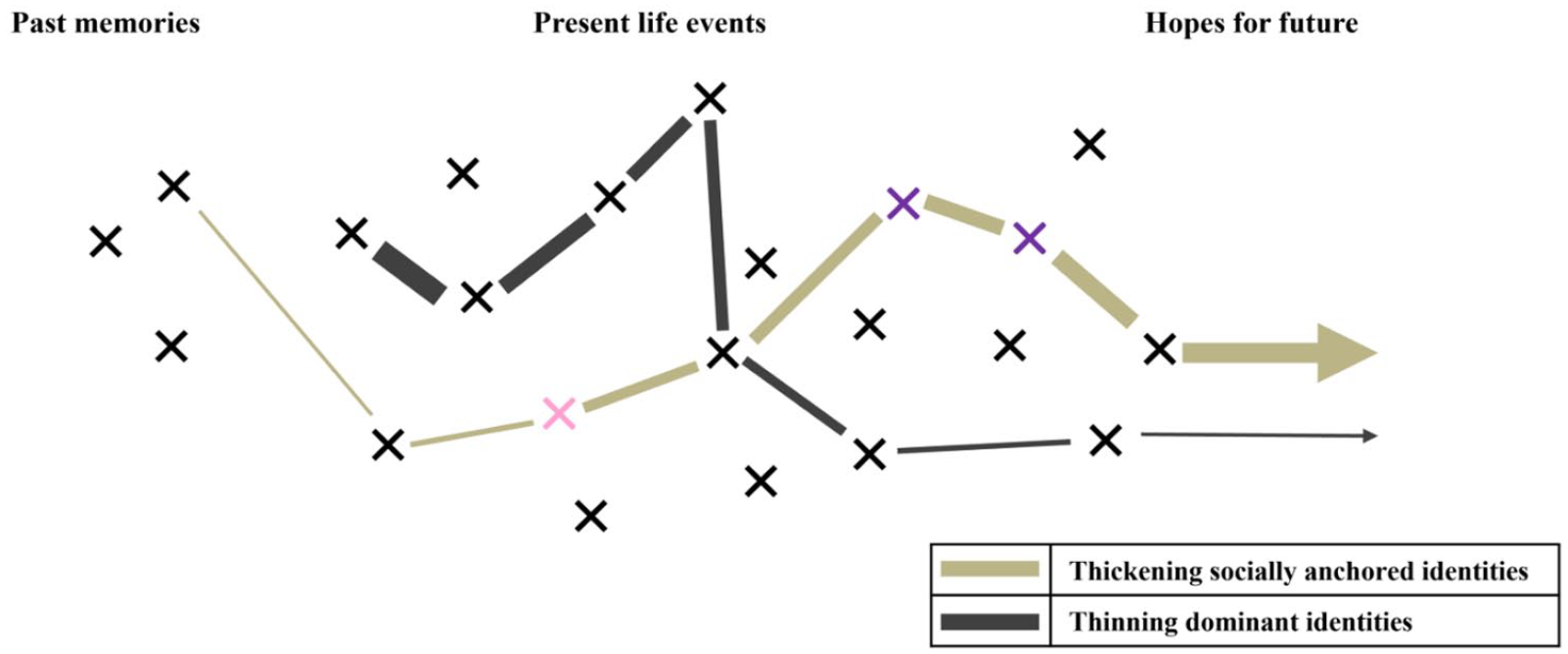
Thinning dominant identities and thickening alternative plots through entrepreneurship as collective action.
Witnesses were positively surprised to discover that they were not alone in their concern over the injustice when they met their team. This increased their sense of collective agency (Lawrence and Maitlis, 2012), which can be defined as a motivated striving to engage in a shared entrepreneurial project. Social interactions at the team level were especially important since this is where members of the collective revealed shared values and sealed commitments to those values. This concerns co-constructing shared intentions and nourishing their motivation to act on them. They can be seen as ‘attuning’ practices within the team – that is, articulating and feeling what matters and what people care about (Nicolini, 2012; Schatzki, 1996). The Witnesses were also affected by the amount of feedback provided by the ecosystem. These became turning points that helped them gain confidence that their voices mattered and thicken their self-representation as multi-skilled apprentice-entrepreneurs, increasing their sense of being useful. However, the Witnesses also hoped that those legitimately in charge in society would ensure that everyone’s efforts were moving in the right direction. The team required convincing that a conducive environment had been established. If those in charge are making an effort, then their own quest for justice is valid. Alternating between the ecosystem and the team, the Witnesses are authoring as believers that society can change.
Likewise, as their story unfolded, the students authoring as Resisters encountered turning points related to their team when they learned that their peers were efficient, committed and reliable. Their teams – and themselves – were steadily narrated as an array of resources and skills at the service of a systemic impact. This increased their shared beliefs in their collective capacity to produce the desired results – that is, collective efficacy (Bandura, 2000). Thus far, the literature on entrepreneurship has focused on self-efficacy as the main construct when studying entrepreneurial agency, including in SE (Bacq and Alt, 2018). Indeed, as Bandura (2000: 75) claims, ‘Unless people believe that they can produce desired effects and forestall undesired ones by their actions, they have little incentive to act’. However, Bandura (2000: 75) adds that ‘The growing interdependence of human functioning is placing a premium on the exercise of collective agency through shared beliefs in the power to produce effects by collective action’. The collective narratives reveal how, by considering the collective dimension of efficacy beyond their individual capabilities and strength of character, the Resisters lightened the pressure on their own shoulders, enabling them to explore alternative, creative paths to target something other than good grades in a new drive for impact. The Resisters therefore, narrate evolving self-representations, thinning the traits of individualistic work organiser or leader and authoring as team players instead, through collective emboldening. At the macro level, the Resisters reflected on how their generation is mobilising to make a difference. Attuning with what is important for them as a generation, and reflecting on their own participation in this community, the Resisters thickened the traits of impact makers, which emphasises the importance of collective action and helps in deconstructing the myth of the heroic entrepreneur (Fowler et al., 2019; Pache and Chowdhury, 2012).
For students authoring themselves as Victims, important turning points were revealed through interaction with the ecosystem. First, social interactions with beneficiaries gave the Victims a sense of legitimacy. They were empowered as legitimate players, thinning traits of helplessness. Second, by engaging in collective action and reflecting on their impact on the ecosystem, for instance when providing feedback to other teams, the Victims learned that they could be legitimate fighters and, in turn, empower their peers by becoming role models. At the team level, they saw their team as a crew that supported them when undertaking challenges; if the team could do it, then anything was possible. Notably, being a team member provided the Victims with opportunities to embrace uncertainties and experiment with creativity. As suggested by Beech (2017: 364), ‘change can impact negatively on people such that they are fatigued, unable to achieve their aspired-to identities and may be perpetually liminal’. We note the particular salience of this for the students authoring as Victims, who felt a greater sense of vulnerability when operating outside their known sphere. Engaging in teamwork enables them to thicken an identity as entrepreneurs who recognise and cope with uncertainty, accepting that not knowing is normal (Beech, 2017; Campbell, 2021).
Finally, the students authoring as Perpetrators, through their teamwork, learned to reduce the problem from an overwhelming to a manageable one. They saw that incremental actions, step by step and prioritised by the team, could effect change, which was important. Brändle et al. (2018) suggest that nascent entrepreneurs who identify a mission to change the world are more likely to feel overwhelmed by the complexity of the entrepreneurial opportunity, as in the Tales of Perpetrators. We thus learn how reflection and action at the team level help students authoring as Perpetrators develop an understanding of their EI that is both influential and influenced by social interactions, enabling them to regain agency. Furthermore, turning points were revealed at the ecosystem level when they identified the ‘bad guys’ and took a stance against them in teams. They considered it possible to live in a society that has a negative impact while still supporting those who make a difference, which is worth it. If they can change and reinvent themselves, then others should be gathered and join the movement. Self representation evolved to express identities as people gatherers who mobilise others to change society. Through collective narratives, the Perpetrators developed EIs that reflect an understanding of entrepreneurship as collective action, which is socially constructed and thus, also open to influences by the individuals themselves, who regain agency.
The four thickening plots depicted in Figure 4 are archetypal and not deterministic; the protagonists rarely fit perfectly into them, nor are they tied exclusively to one plot. A student may author themselves as a Witness whose self-representation evolves towards a Resister as the story unfolds; for instance, when meeting with a teammate who challenges their cultural biases. Likewise, not all the students arrived at a thickened understanding of their EI, and not all were hopeful that social injustices could be overcome. For instance, the students authoring themselves as Victims also narrated how they must learn to recognise and accept uncertainties as a source of vulnerability. Otherwise, they become stuck and withdraw from the entrepreneurial project.
Discussion
In this article, we examine how collective narratives provide practitioners with opportunities to depart from dominant EIs and co-construct new identities that build on their shared entrepreneurial experience in contexts, in this case, an SE course in a Belgian business school. We conclude with a discussion on how our findings contribute to a multiple-practitioner perspective on EI construction by showing how collective narratives provide practitioners with opportunities to thin the plot of dominant identities and thicken the counter-plot (Freedman and Combs, 1996) to embrace identities that better fit the individual’s experience of the entrepreneurial process as a collective endeavour. Key findings include the idea of attuning – that is, articulating and feeling what matters and what people care about in the collective, which allows for the development of a shared sense of collective efficacy. Together, the findings demonstrate how narrative identities are woven together across multiple levels, thus repositioning EI construction away from the individualistic. It advances our understanding of entrepreneurship as collective action by developing theoretical and methodological tools to better apprehend the collective interpersonal dynamics that facilitate entrepreneurship contexts.
Contributions to a multiple-practitioner perspective on EI construction
Cultivating identities that diverge from the traditional and dominant myth of the heroic individual entrepreneur is an important challenge emphasised by the EaP literature (Drakopoulou Dodd and Anderson, 2007; Frederiksen and Berglund, 2020) and which matters particularly when entrepreneurial practitioners are addressing complex societal problems and striving for social change (Wagenschwanz, 2021). Indeed, practitioners often perform dominant identities that are conveyed in the social structures they are challenging, thereby hindering deep systemic change (Jones et al., 2008). For instance, Brändle et al. (2018) show that individualistic entrepreneurs have higher levels of self-efficacy than their counterparts identifying with the social mission. Detrimental effects range from causing overconfident entrepreneurs to set unattainable goals, to over-challenged practitioners being deterred by complex opportunities. More interestingly, their results suggest that variations in beliefs of self-efficacy are not due to different levels of experience or learning but are instead deeply rooted in practitioners’ entrepreneurial social identity.
To meet this challenge, the literature on EaP suggests considering a multiple-practitioner perspective on EI construction. According to Campbell (2019, 2021), this would provide a richer understanding of how practitioners, in groups, attend to and account for their shared entrepreneurial experience and develop more realistic identities while facing complex challenges. Adopting an EaP perspective (see Anderson et al., 2019; Campbell, 2021; Gherardi, 2015; Hytti, 2005; Knox et al., 2021) by considering that EI involves interaction with others and is performed when presenting the self in situated narratives, and that entrepreneurial practitioners draw on various discursive resources to do so, our study contributes to this literature on EI constructions, including the role of narratives as coping mechanisms when faced with challenges, trauma or injustice (Refai et al., 2018; Tomlinson and Colgan, 2014). We especially enrich extant research by showing how collective narratives provide opportunities to reflect on the role of teams and ecosystems in the process of EI construction and, conversely, the role of the protagonists as influencers in teams and ecosystems.
First, collective narratives reveal an increased sense of collective agency (Lawrence and Maitlis, 2012) for nascent entrepreneurs, as they realise that the team members and the community share a desired social change and a motivation to act on it. Beyond striving for belonging, closeness and esteem (Knox et al., 2021), which are centred on the needs of the individual, collective narratives support ‘attuning’ with peers – that is, articulating and feeling what matters and what people care about in the collective (Nicolini, 2012; Schatzki, 1996). We find that attuning is closely related to the formation of a key element of agency (Bandura, 2000; Thomas et al., 2022), namely collective efficacy. By attuning to shared intentions, concerns and values, practitioners find that they are not alone in facing the complex societal injustices and are emboldened to face them, even without activating a heroic, individualistic EI. They thin traits associated with their initial authored representation (feeling ‘part of the problem’ for Perpetrators, for instance) and thicken traits based on their collective entrepreneurial experience (for Perpetrators, authoring as ‘complex thinkers who embrace difficulties’).
For some of our students, the thickening of their collective entrepreneurial traits (multi-skilled teammate, impact-maker, gatherer, to name a few) was combined with a thinning of individualistic traits (the ‘leader entrepreneur’ or the ‘work organiser’). Through this, we shed light on the EI construction processes of thinning and thickening, which build on attuning and feelings of collective efficacy. As such, we contribute to a renewed vision of efficacy. We highlight how a focus on its collective dimension could disrupt the detrimental effects of archetypal identities by providing opportunities to reflect on one’s influence on others. Likewise, we show how variations in feelings of efficacy can arise (Brändle et al., 2018). As suggested by Teague et al. (2021), variation is an underdeveloped topic in EaP. In this work, we suggest that variation is important when considering the construction of socially anchored EIs, notably when building feelings and beliefs of (collective) efficacy.
Second, we contribute to a better understanding of injustices as an important repertoire of discursive resources for collective EI narratives (Refai et al., 2018; Tomlinson and Colgan, 2014). By highlighting the various self-representations that students narrate as starting points of their tales, and how these identities can evolve along the plots, our findings go beyond acknowledging injustice as a trigger for entrepreneurship. While Yitshaki and Kropp (2016) uncover proximity to a social need by life events in the past as a motivational pull factor to SE, our research further details how this experience with injustice influences the co-construction of the EI. They anchor the whole entrepreneurial process, the individual and the collective to which they belong in their respective experience of injustice and how these experiences interact.
As the climate crisis intensifies, creating social injustices in the process and leaving people feeling angry, eco-anxious and powerless, it becomes even more important to understand how we can disrupt the dominant individual heroic entrepreneur myth and develop new EIs that reflect an understanding of entrepreneurship as collective action. We thus invite more research on the role of societal narratives about upcoming social changes (collapsology, doomism; see Mann, 2020): the way they are negotiated into collective narratives in entrepreneurial contexts and the way they support (or not) the co-construction of emboldened but realistic collective EIs needed to face the grand challenge of our generation.
The scaffolding conversation method for collective narrative identities
With the scaffolding conversation method, we make a methodological contribution by using ‘conversations’ as research tools for EaP (Campbell, 2021) that enable a grasping of the group level of analysis (Radu-Lefevbre et al., 2021). Likewise, we address the limitation of many studies, as underlined by Essers et al. (2022), that narratives are usually approached from an individual perspective through an ‘individual interview strategy’ (Watson, 2009), thereby limiting our understanding of the roles of collectives such as entrepreneurial teams and their external social environment in EI construction (Wagenschwanz, 2021). We propose a method that provides practitioners (in this case students) with opportunities to attend to and to account for their shared experiences and respective influences on identity. This method shows how narrative practices, which are usually studied at the individual level, can be gathered and analysed as collective narratives and therefore enrich the study of how EI may be co-constructed through social interactions. It contributes to entrepreneurship as collective action by offering a new methodological approach to advance our understanding of collective interpersonal dynamics. Beyond its utility in capturing collective narratives, the method we developed may be used as a pedagogical approach for responding to calls to integrate reflexivity in (social) entrepreneurship teaching (McNally et al., 2020; Plaskoff, 2012). By opening conversation spaces where individuals can re-tell stories of sparkling moments (micro), contextualise their struggles (macro) and co-create in team stories (meso), and by documenting the process, we show how students can effectively co-create an EI, although not all students will follow the same plot, or even reach the same destination. It suggests that narrative practices can help students to develop (1) mindfulness about their personal values, intentions, motivations and related actions at the micro level; (2) capacities to be both influential and influenced in collectives; and (3) awareness of other systemic influential positions, including those of absentees, on collective and individual actions and intentions. Reflective journals, teamwork and field interactions are already present in (social) entrepreneurship education. Yet, we bring an original lens to make sense of a learner’s identity construction through those experiences. This has implications for actors involved in entrepreneurship (mentors, teachers, policy makers) who are part of the practitioners’ ecosystem and contribute to the social construction of EIs.
Limitations and future research
Building on our methodological contribution, we also reflect on its limitations. We cannot affirm that all our respondents are able (and willing) to engage in conversations about their EI. Likewise, we question our influential approach as teachers who may invite learners to project themselves as nascent (social) entrepreneurs: do the learners really have the required leeway to be the author of their life or do they consider this identity proposal as an artificial and mandatory position for completing the course? A focus on negative cases, when collective narratives reveal the story of practitioners who uncritically embrace a heroic entrepreneurial posture (or, conversely, maintain a feeling of powerlessness), could partially address this limitation. Furthermore, extended collective narratives after students have completed their degree may shed new light on their authorship.
Another important boundary condition is our focus on an entrepreneurial context that explicitly targets social change. According to the collective narrative approach implemented in this research, collective action is about reflecting and acting on shared desired social changes. This closely aligns with the definition of collective action as proposed in other fields such as political psychology, namely ‘what people do with, and on behalf of, other people who they are committed to, to bring about (or prevent) a desired social change’ (Thomas et al., 2022: 108). It is also in line with Bandura’s vision of collective action as addressing desired social changes (Bandura, 2000). Given the importance of attuning with peers about shared intentions and values for the development of socially anchored identities, we wonder whether attuning about profit, growth or financial sustainability would contribute in the same way to the development of socially anchored identities. It is an important boundary of our work since we cannot guarantee that the conversation method would extend to the collection of group-level data in entrepreneurial collectives that do not target a desired social change. As such, it calls for an exploration of the scaffolding conversation method in a variety of entrepreneurial settings, such as cooperatives, family businesses or even growth-oriented ‘ambitious’ ventures.
Conclusion
To conclude, we suggest that the scaffolding conversation method shows how narratives can be collected and analysed at the individual, group and ecosystem levels, providing members with opportunities to reflect on their shared experiences, struggles and hopes. Through the tales of Witnesses, Resisters, Victims and Perpetrators of injustice, we discuss the social interactions, at the team and ecosystem levels, that supported changes in their self-authoring representations through the thinning of individualistic traits and the thickening of traits building on their collective entrepreneurial experience. By providing opportunities to reflect upon one’s influence on others, collective narratives contribute to considering what matters and what people care about and to belonging; practitioners find that they are not alone in facing complex societal injustices. By highlighting that entrepreneurial practitioners, engaged in collective narratives, are emboldened to face societal injustices, even without activating a heroic, individualistic EI, our study invites a renewed focus on collective efficacy, rather than self-efficacy, as a way to disrupt the detrimental effects of archetypal individualistic EIs.
Supplemental Material
sj-docx-1-isb-10.1177_02662426231184164 – Supplemental material for It all starts with a story: Questioning dominant entrepreneurial identities through collective narrative practices
Supplemental material, sj-docx-1-isb-10.1177_02662426231184164 for It all starts with a story: Questioning dominant entrepreneurial identities through collective narrative practices by Julie Solbreux, Julie Hermans, Sophie Pondeville and Frédéric Dufays in International Small Business Journal
Footnotes
Appendix
Funding
The author(s) received no financial support for the research, authorship, and/or publication of this article.

Supplemental Material
Supplemental material for this article is available online.
Notes
Author biographies
References
Supplementary Material
Please find the following supplemental material available below.
For Open Access articles published under a Creative Commons License, all supplemental material carries the same license as the article it is associated with.
For non-Open Access articles published, all supplemental material carries a non-exclusive license, and permission requests for re-use of supplemental material or any part of supplemental material shall be sent directly to the copyright owner as specified in the copyright notice associated with the article.
