




Abstract
This study explores how hiring managers and HR recruiters negotiate issues of diversity and inclusion – specifically gender and ethnicity – during recruitment processes within a large Swedish corporation. Drawing on a Foucauldian approach, it examines the interplay of power, knowledge, learning, and truth in these negotiations. The study contributes to critical management research on diversity and inclusion in recruitment. Based on ethnographic observations of 20 meetings across seven recruitment processes, the article illustrates how informal learning and power/knowledge dynamics shape understandings of diversity and inclusion. Findings show that the recruiters and managers’ understanding of diversity in the workplace are narrow. They focus on surface-level diversity – primarily European nationalities and binary gender identities (counting men and women) – while overlooking more nuanced understandings. Although hierarchical differences between managers and recruiters pose challenges, informal learning does occur to some extent, as both parties influence each other’s views on diversity during recruitment. Nevertheless, opportunities for reflexive and critical learning are often missed due to prevailing power/knowledge relations, which hinder deeper engagement with diversity and inclusion.
Keywords
Introduction
In recent years, initiatives to strengthen Diversity, Equity, and Inclusion (DEI) have been broadly challenged in many ways throughout Western societies. Nevertheless, it still is crucial for organisations aspiring to be seen as an attractive employer to develop a solid corporate agenda regarding DEI issues if it wishes to be successful in the search for talent (Alteri, 2025). For decades, as societies have become more diverse in various ways, it has become increasingly important for organisations to develop policies and strategies regarding how to handle the challenges and opportunities provided by a diverse workforce, as well as the diversity in the customer base and the societal context in which the organisation operates (Moriarty et al., 2012; Shen et al., 2009).
Diversity initiatives within organisations have become more explicitly questioned, especially in the wake of Donald Trump’s anti-DEI agenda (Ng et al., 2025). However, many companies are still committed to issues of equality, diversity, and inclusion in the workplace in various ways. How organisations’ policies view and value diversity and inclusion have been thoroughly studied (Dobbin and Kalev, 2013; Triana et al., 2021) and it is still common that companies put considerable effort into branding their image as DEI friendly (Jonsen et al., 2021). Many firms have positions such as ‘diversity specialists’ to promote the importance of DEI (Bohonos, 2023).
Dean and Zamora (2022: 1) provide a critical examination of what they call ‘the vast expansion of the DEI industry over the last decades’. These authors argue that, in certain ways, a progressive attitude towards DEI issues has become common across the corporate world, not least when it comes to gender equality in the workplace. Dean and Zamora (2022) critique the progressive potential of DEI corporate policy, arguing that it has become something that is seen as inevitably positive. Thus, it becomes increasingly difficult to critically reflect upon DEI issues within organisations. For instance, professionals devoted to diversity and inclusion within their organisations may remain stuck in cisgender perspectives, potentially creating barriers for non-binary employees (Ozturk et al., 2024). At the same time, DEI remains a contested concept and is implemented in diverse ways across companies. In practice, it often focuses on rather superficial aspects, such as counting the number of men and women in various positions. Ozturk and Tatli (2016) argue that a more nuanced understanding of gender identity diversity could strengthen organisations’ DEI efforts. This could be achieved, for instance, by recognising the various challenges and forms of discrimination faced by non-binary employees.
Ortlieb and Sieben (2013), along with Dean and Zamora (2022), point out that companies regularly engage in enhancing diversity within their organisations from a strict business logic perspective. Ortlieb and Sieben (2013) argue that, in various ways, ethnic minorities are a ‘critical resource’ for today’s organisations. One pertinent way of addressing, attracting, and recruiting this critical resource is for a company to develop and display a solid DEI image.
Critical diversity studies in organisations
DEI in organisations has previously been examined from the perspective of critical diversity management studies. Romani et al. (2019) argue that diversity measures may in fact reproduce inequalities within organisations. Benevolent, yet potentially discriminatory, rationalities may position marginalised groups as inferior and in need of specific support, strengthening the existing hierarchical order within organisations rather than challenging it. This rationality creates a position where certain subjects are included in an organisation, but in subordinated positions (Mulinari and Neergaard, 2010).
Studies on inclusion and diversity in organisations, particularly those based on a Foucauldian analytical approach, have previously highlighted how inclusive subjectivities are constructed within organisations. Brewis (2019) draws upon Foucault’s notions of power/knowledge, discipline, and practices of the self when analysing subject formation in diversity training. Ahonen et al. (2014) make use of Foucault’s concepts of governmentality and biopolitics when arguing that diversity in both organisational practices and research run the risk of producing knowledge that leads to stereotypical categorisations and the normalisation of certain subjectivities.
In this study, I adopt a similar Foucauldian analytical approach with an explicit focus on critically analysing negotiations in terms of ‘games of truth’. Through this approach I analyse how tensions as well as consensus concerning ethnicity, gender and inclusion in recruitment processes are played out between hiring managers and HR recruiters. When conducting research from a discourse-oriented perspective, it is important to reflect on the constitutive nature of discourses (Fejes, 2006). The use of categories such as migrants, men, and women carries the risk of reinforcing the very definitions of ethnicity and gender that are subject to critical examination. Therefore, engaging in critical reflection on one’s own research practices becomes essential.
Diversity and inclusion in recruitment processes is a set of values that, in various ways, can be both advocated and contested; thus, they can be seen as being constantly negotiated. In terms of diversity, particularly in recruitment, different biases and adverse impacts have been scrutinised by researchers (Hardy et al., 2022). In the Swedish context, experimental evidence further suggests that discrimination during recruitment is particularly pronounced for male ethnocultural minorities (Bursell et al., 2021).
The particular relationship between recruiters and managers is especially important for understanding how diversity and inclusion is shaped during recruitment processes. Yet, as Andersen (2025) argues, this relationship is still under-researched. Similarly, Alteri (2025) argues that while there is substantial research on how to avoid discrimination in the workplace, the hiring process – particularly its early stages – remains underexplored and in need of further research.
The study presented in this article, with its theoretically and empirically grounded analysis, contributes knowledge about how diversity and inclusion are negotiated by key actors involved in recruitment processes. With its novel focus on Foucauldian ‘games of truth’, this study contributes new and distinctive knowledge to critical diversity studies, particularly in relation to learning for inclusion and diversity in recruitment.
Against this background, the aim of this article is to contribute knowledge about how hiring managers and HR recruiters negotiate and learn about ethnicity and gender during recruitment processes. The focus is primarily on nationality, ethnocultural background, and gender as categories of diversity because these are the main categorisations talked about in the data material. The questions guiding the analysis revolve around how HR recruiters and hiring managers learn (or not learn), negotiate and either reach a common understanding or maintain contesting perspectives regarding the meaning and importance of diversity and inclusion in the recruitment process. The following research questions have informed the analysis:
Research Question 1 (RQ1). How are the relationships of power/knowledge and learning between hiring managers and HR recruiters negotiated?
Research Question 2 (RQ2). How are diversity and inclusion negotiated during recruitment processes and what is (or is not) learned from these negotiations?
Power, truth, and learning from a Foucauldian perspective
Different ways of theorising and diverse methods are needed to capture the complexities of the role of language in HR and management practices (Presbitero et al., 2023). This study provides insights into discourses of diversity, with a particular focus on the use of language as a form of professional communication during negotiations revolving around diversity and inclusion when recruiting for new positions. Engstrand and Enberg (2020) suggest that relational power and positioning in the production of knowledge and truth emerge as discursive talk. Power struggles can both reinforce and undermine specific views and values. Therefore, it is important to study power relations as they are played out in concrete discussions and negotiations.
This study employs a Foucauldian perspective, focusing on three main conceptualisations. First, (1) Power/knowledge are understood as intertwined concepts, where one cannot be separated from the other. Here, power is an intrinsic part of every social relationship. However, it is never totally in the hands of one person, because where there is power, there is resistance – power and knowledge are always intertwined and an integral part of all relationships (Foucault, 1990). As recruitment processes take place within relationships of power/knowledge, they contribute to the classification and positioning of subjects through meticulous ‘inspection, inscription, comparison [and] judgement’ of the job-seeking subject (Barratt, 2003: 1073).
A second analytical tool from Foucault’s toolbox (2), games of truth (Foucault, 1997), provides a useful concept for analysing ongoing negotiations between hiring managers and HR recruiters regarding how ‘truth’ and meaning are established in negotiations, and how learning may, or may not, take place within a relationship imbued by power/knowledge. Analysing games of truth from a Foucauldian perspective is not about trying to determine what is true or false in the empirical data material. Rather, the focus is on how language is used when negotiating meaning, how truth games are played out in power relationships (Foucault, 2014), and how normality and deviance are produced within power relationships and related to specific subject positions. Foucault (1977) argued that power shapes knowledge, deviance, and normality, thus creating norms by categorising subjects based on their perceived deviations from the accepted norm. Hence, the ‘normal’ – that which is taken for granted – is deeply intertwined with formations of power and knowledge.
The third concept I make use of in the analysis is (3) regimes of truth (Foucault, 1977), which is deployed to describe the societal and organisational context in which these games of truth take place. Foucault defined regimes of truth as specific knowledge that has gained the status of truth in certain contexts. Those who can decide what counts as true are considered experts in their particular area of expertise (see Lorenzini, 2015). In this article, regimes of truth are understood as the dominant discourses that currently prevail in society and organisations around issues of diversity and inclusion. Such dominant discourses/regimes of truth are central to my analysis of how HR recruiters and hiring managers negotiate because they both need to align with the values and ideals that are established within their organisation, and across society more widely.
The games of truth played out during recruitment processes take place within hierarchical learning relationships in the workplace. In line with Tynjälä (2008), I recognise that learning in the workplace takes place in different organisational settings, ranging from individual relationships, through different divisions, to various workplace networks and communities of practice. In addition, workplace learning can be achieved both informally and spontaneously between colleagues and formally as part of organised educational efforts initiated by management.
In this study, the empirical data consists of records of meetings in which hiring managers and HR recruiters are discussing ongoing recruitment processes. In such meetings, the research focus on exploring the informal learning that takes place (as well as missed opportunities for learning) within individual relationships in the workplace. Informal learning is an important aspect of developing the expert knowledge needed to conduct recruitment processes (cf. Tynjälä, 2008). Furthermore, learning is understood here as a situated, communicative, and relational activity, which takes place within particular communities of practice (Lave and Wenger, 1991; Wastesson, 2024). The HR recruiters and hiring managers are part of the communities of practice within their organisation and the recruitment process seeks to bring new members into the community of practice of the hiring managers.
Learning for enhanced diversity and inclusion in recruitment calls for a critical and reflexive perspective, where practitioners focus on questioning one’s own taken-for-granted assumptions (Maclean and Harvey, 2025). Reflexive learning practices foster critical awareness and a will to see multiple perspectives (Cunliffe, 2002; Maclean et al., 2012). Hence, adopting a critical and reflexive approach to learning is valuable for identifying and reflecting on why certain learning opportunities are overlooked.
From the Foucauldian perspective adopted in this study, learning is also understood as a matter of seeking to influence others’ ways of conceiving certain issues and to shape the conduct of others (see Fejes and Nicoll, 2008; Masschelein et al., 2007). Thus, learning is understood as a matter of ‘conducting the conduct’ of oneself and others (Foucault, 1991, 2007; Rose, 1999). Therefore, the game of negotiating truths about DEI during recruitment processes is analysed as a kind of informal learning that takes place within the truth games played out between hiring managers and HR practitioners. Hence, the negotiations between hiring managers and HR recruiters are themselves moments of learning potential. In these moments, learning could occur as well as become a missed opportunity for learning depending on the nature of the negotiations that take place. In line with Peters (2004), I see these truth games as a kind of learning process that shapes subjects and fosters certain ways of thinking and being.
Methodology
In this section, I first present the national context in which the study took place, with a focus on diversity and inclusion in Swedish society and organisations. Thereafter, the empirical data, research method and ethical reflections are presented.
Diversity and inclusion in a Swedish context
Sweden has been a country of immigration for decades. Today, approximately 25 percent of the population are either foreign born or have two parents born abroad, making Sweden one of the most ethnoculturally diverse countries in Europe (Engdahl and Liljeberg, 2024).
Sweden has been described as a forerunner for equality, and the Swedish government has a long tradition of promoting equal opportunities on the labour market (Bauer et al., 2024; Lykke, 2016). Officials and politicians in the Nordic countries, not least in Sweden, have long been engaged in combatting exclusion and discrimination and developing generous welfare policies (de la Porte et al., 2022). For instance, companies in Sweden are obliged to develop policies for handling equal opportunities regarding gender. Sweden has been portrayed as the ‘best in class’ when it comes to diversity and inclusion and is sometimes highlighted as a role model for equality (Lykke, 2016). However, the discourse portraying Sweden in such a positive light has also been challenged by research as well as in politics.
The Swedish labour market is segmented and the conditions for inclusion in working life differ between various disadvantaged groups. Certain groups of migrants, especially newly arrived and migrants without sufficient education, find it very difficult to establish themselves on the labour market (Andersson et al., 2017; Larsson, 2015; SCB, 2021). In addition, highly educated migrants in Sweden also face substantial barriers in relation to equality and inclusion on the labour market – their employment rates and wages are lower than comparable highly educated Swedish-born people (Irastorza and Bevelander, 2021). Although migrants in Sweden have traditionally been granted extensive formal social rights, many still struggle to achieve full inclusion in the labour market and within organisations, often finding themselves in positions of subordinate inclusion (Mulinari and Neergaard, 2010).
For many years, the image of Sweden as a forerunner for equality and inclusive politics for migrants has also faced challenges from the right-wing nationalist movement, propelled by electoral success for the right wing populist party The Sweden Democrats. This has contributed to the spread and normalisation of ethnic nationalism and anti-immigration discourses in Swedish politics (Elgenius and Rydgren, 2024). Off (2023) notes that conservative gender values also have increased in Sweden, in pace with electoral support for right wing populist parties.
Empirical data
The empirical base of this study consists of seven hiring processes in a large multinational corporation with approximately 20,000 employees in northwestern Europe. The company’s HQ is located in Sweden. When describing its DEI efforts on its website, the company states that it works with gender equality and that it is proud to have many women in leading positions. The proportion of female managers in the company is around 40 percent. The company states that it works systematically with diversity from several different perspectives and refers to Swedish discrimination legislation, which prohibits discrimination based on gender, transgender identity or expression, ethnicity, religion or other belief, disability, sexual orientation, or age. The company examined has, for a long time, employed dedicated diversity specialists at the highest levels of the organisation, who, according to the company’s website, work to promote diversity and inclusion within the corporate culture.
Furthermore, it is stated, on the website, that the company works continuously with knowledge development driving diversity and inclusion and carries out various training courses for its staff in this area. Since I did not conduct in-depth interviews with the managers or recruiters in this study, I cannot make any definitive claims regarding their diversity training, which I acknowledge is a limitation of the study.
All seven hiring processes that were followed were for white-collar, highly skilled positions. However, it included a great variety of positions, from managerial to different kinds of technical experts and HR specialists. The job candidates for these positions were both male and female and included individuals with and without experience of migration, with various ethnocultural backgrounds. This variety of positions and job candidates makes the studied hiring processes interesting from a DEI perspective. Below is a table of the job positions and approximated characteristics of the HR recruiters and hiring managers followed in the study:
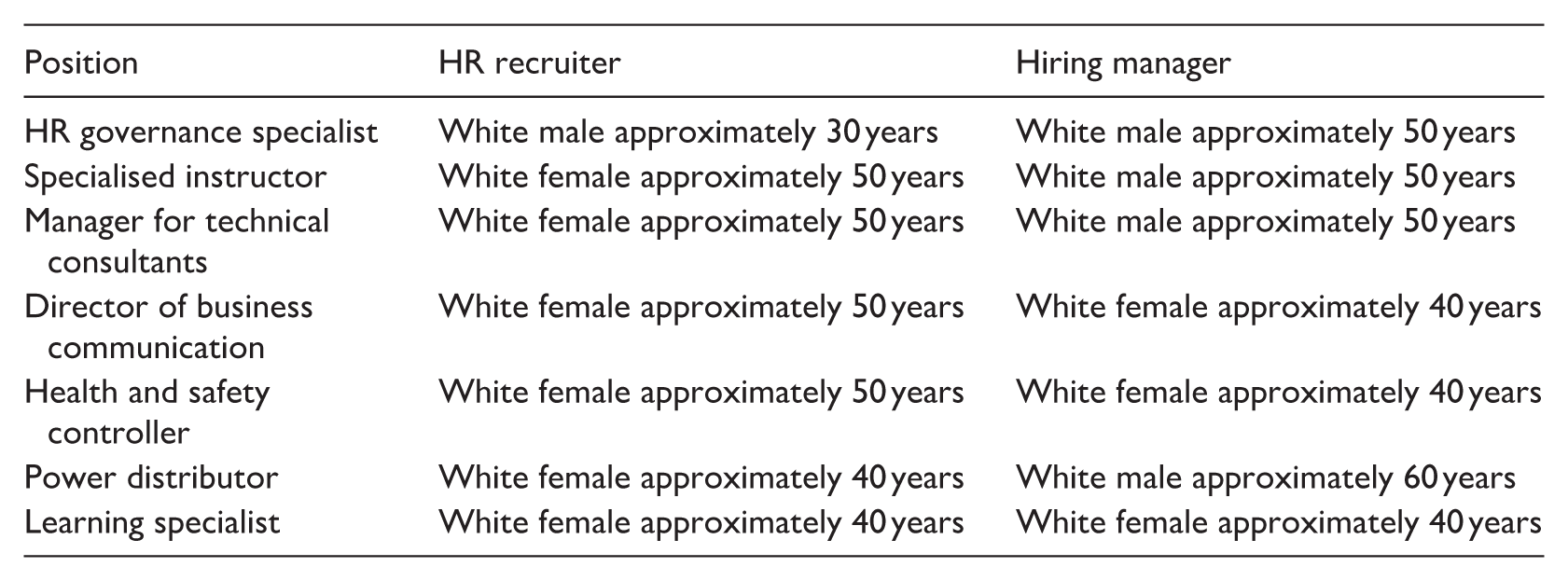
For reasons of research ethics – i.e. anonymity–the specific positions and persons are not related to quotes used in the article.
The empirical observations were conducted at meetings relating to specific hiring processes, which took place between hiring managers and HR recruiters. Hiring managers are positioned as experts about the particular job position that is announced, in terms of technical skills and other abilities that the work tasks require. In the corporate hierarchy, hiring managers are positioned above HR recruiters. HR recruiters are experts in Human Resource Management, job interviewing, judging competence/personalities, and screening CVs. DEI can be part of their expertise to varying degrees. The reason for observing hiring managers and HR recruiters was that the holders of these two positions were the main actors involved in the hiring process at this company.
In observing the hiring processes, online observations of start-up meetings were conducted, in which the hiring managers and HR recruiters discussed the upcoming recruitment, the roles and competences that were needed, how the job ad should be formulated, et cetera. I also observed screening meetings where candidates were ranked and chosen for interview. After the job interviews had taken place, a decision meeting between the HR recruiter and hiring manager was also observed. In total, 20 different meetings were observed as part of the seven hiring processes.
Method
The data material was carefully and systematically examined with a broad focus on how issues of diversity and inclusion were discussed in the observed meetings. The aim and research questions of the study served as a compass, guiding what I was focusing on within the data. Through this approach, the categories that structure the article gradually emerged. The Foucauldian analytical concepts presented earlier, then provided a theoretical lens for a deeper analysis of the data material.
The meetings between hiring managers and HR recruiters provided a suitable site for interrogating games of truth as they were played out concretely. Sandler and Thedvall (2017) argues that an ethnography of meetings can render visible the circulation of ideas and discussions about corporate policy, which are imbued with both power and resistance, not least in relation to decision-making. Meetings are themselves practices of discursive negotiation, where truths are shaped within power/knowledge relationships of learning. Thus, I have observed meetings as the site of truth games, which enable the actors to impose their reasoning and values upon each other.
The observed meetings were conducted online, with the researcher primarily assuming a non-participatory role. However, the observations did involve limited participation, in that I occasionally posed clarifying questions during the meetings and engaged in informal conversations once the meetings were formally ended. Importantly, the researcher did not actively contribute to the substantive discussions or negotiations related to the recruitment processes.
The meetings were recorded and transcribed using a transcription AI programme. Parts of the transcripts were then selected for in-depth analysis and used for quotes in the article. These quotes were manually transcribed verbatim and translated from Swedish to English by the author.
Reflection on research ethics
The study was conducted according to scholarly accepted ethical guidelines in social research The research project has been ethically vetted by the Swedish Ethical Review Authority. A key ethical concern in critical diversity studies is whether the researcher risks contributing to the stigmatisation of the people or groups being studied. Researchers examining discourses and the construction of subjectivities inevitably become co-producers of the very discourses and subjectivities they seek to analyse. It is not possible to fully detach oneself from the discourses under scrutiny (Fejes, 2006). By accepting and employing established categorisations–such as ‘immigrants’, ‘men’, and ‘women’, ‘white-collar’, low-skill/high-skill’–researchers risk reproducing the very conceptions of nationality, ethnicity, gender, and labour-market distinctions they aim to critically interrogate. Thus, research focusing on ethnicity and gender call for a reflexive approach to one’s own role as a researcher. In this sense, it is important to critically reflect upon how intersections of categories are formulated and to recognise the constitutive role of discourse, even those produced in one’s own research (Spellman, 2024).
One approach to addressing this issue is proposed by Gunaratnam (2003), who advocates working both with and against established concepts and discourses. By acknowledging that both gender and ethnicity are historically situated and socially constructed, my ambition has been to avoid essentialising the categories and discourses I analyse. In line with this perspective, my focus is on how ethnicity and gender are produced and negotiated within ‘games of truth’ and how these categorisations may be positioned and discursively constructed as not being aligned with a supposed normality.
Findings
In the following, the findings are presented in two main sections. In line with the first research question, I begin with examining how the relationships of power/knowledge and learning between the hiring manager and HR recruiters are negotiated and played out as games of truth. Thereafter, in line with the second research question, the analytical focus shifts to the negotiation of diversity and inclusion within the examined recruitment processes, as well as the potential for mutual learning between HR recruiters and managers. This section begins by analysing how diversity – particularly regarding ethnicity and nationality – is discussed, before turning to the ways in which gender diversity is negotiated.
Negotiating power/knowledge and learning
Below, I present how the tensions and power positionings between hiring managers and HR recruiters are played out as games of truth. The power that comes with the managers’ expert-knowledge position regarding the specific jobs they are recruiting for is used to establish a certain relationship and areas of expertise within the recruitment process. Both a level of consensus and certain tensions between hiring managers and HR recruiters are apparent in these games of truth. The HR recruiter below reflects upon her role in recruitment processes and about her relation to the hiring managers:
My role is to help others pose the right questions. All managers have a choice regarding how to formulate the [job interview] questions, in order to make the candidate talk and maybe answer the questions in the way you want. So, it’s my role to assess the candidate’s personality and competence. I don’t have knowledge about all the positions here at the company. Of course, I understand some positions better than others, but it’s pretty hard for me to decide [which candidate should get the job], so that’s the manager’s role completely.
This HR recruiter has a clear picture of her role in recruitment processes, and states that, in the end, it is the hiring manager who decides which candidate to hire. As we can see in the excerpt below, a hiring manager reflecting upon the roles of HR recruiters and managers, shares the view that it is the hiring manager who ultimately decides who is to be employed:
The HR recruiter is kind of the guarantor for the process itself. Then it’s my role, in the end, to make the decision [about who to hire]. But I feel a strong support from the HR recruiter. I can discuss it with her, because she works with these situations on a daily basis and also the fact that she’s ‘in-house’, that’s the biggest advantage for me. The HR recruiter follows the process and can assess whether my gut feeling has been correct, so to speak. [. . .] So, I would say that I lean pretty much on the HR recruiter’s opinion, when she has one.
Here, the hiring manager positions the HR recruiter as a final guarantor for the recruitment process. The HR recruiter can evaluate whether the manager’s ‘gut feeling’ was correct or not. If we take both quotes above into consideration, we can see that a reciprocal kind of informal learning between HR recruiter and manager is taking place. The recruiter learns from the manager about specific requirements for certain job positions within the organisation. The manager, on the other hand, learns how to assess job candidates in a more general sense and about the process of recruitment from the HR recruiter, who has this as their area of expertise.
In the following, we see how the hiring manager for a very specialised job position emphasises the importance of both personality and experience, something that the HR recruiter wants more clearly explained:
The combination of the right person and the right background, kind of. . .
And what is the right person, if one looks at important characteristics for this role?
I think, we must start somewhere [. . .] to socialise with people, one must enjoy that, and to co-operate.
Here, the hiring manager argues for the importance of the candidate’s social skills, that the candidate needs to be good at co-operation within the work team. When the HR recruiter and manager discuss the educational background of the candidates, the hiring manager is open to different kinds of experience and expertise, as long as the candidate is fairly senior and easy to co-operate with. In this way, informal learning takes place, as the recruiter is learning from the hiring manager about what specific characteristics are needed for the particular position.
In the quote below, we can see that the hiring manager is positioning himself as a legitimate expert due to his long and wide experience as a manager and the fact that he has been engaged in recruitment before. The HR recruiter accepts his authoritarian self-positioning and suggests that her role and expertise is to write good job ads:
So, I’ve been involved in hiring before, been manager at different levels over a very long period, since 2008. So, I feel that I have a job to do here, to specify this [job description]. I’ll also get assistance, internally, to do that part. I know some parts, that’s the way it is.
I can write an appealing job ad that will attract many [applicants].
This self-positioning of the hiring manager is a demonstration of power in itself. As Engstrand and Enberg (2020) remind us, power and positioning constitute an integral part of all ‘discursive talk’. The hiring manager positions himself as experienced in terms of both recruitment and management at various levels, indicating a strong power/knowledge position vis-à-vis the HR recruiter, who is more or less positioned as an assistant. The reciprocity of learning between manager and HR recruiter is being challenged by their hierarchical positions and power/knowledge dynamics. Some informal learning does occur during this meeting, when the HR recruiter and manager share their views and knowledge. Nevertheless, the learning potential is hampered when the manager positions himself in a dominating power/knowledge position vis-à-vis the HR recruiter.
Negotiating ethnic and national diversity
During the seven recruitment processes, the HR recruiter frequently asked the hiring manager questions about diversity in their particular work team. In the following, we see a conversation that starts with the HR recruiter asking the hiring manager about diversity in his team:
How is the team’s composition regarding, you know, I mean, diversity, gender, age, education, and areas of responsibility?
[. . .]
We have diversity, somewhat, ethnic background. [. . .] For now, I only have people born in Western Germany, Eastern Germany, Austria, Sweden, Holland, Estonia. [. . .] There’s a certain overrepresentation for Germany if one looks at nationalities.
The hiring manager then concludes that, if diversity is to be achieved in his team, he needs to hire a ‘Swedish male’. In the discussion above, the meaning of diversity focuses mainly on northwestern European nationalities. Given that Sweden in particular, and western Europe in general, are highly multi-ethnic and multicultural societies, this discussion about diversity in terms of national identities has a rather narrow scope. Nationality seems to be somewhat easy and straightforward to discuss, normalising the position of people from northwestern parts of Europe. Issues of non-European ethnocultural diversity in a broader sense are not touched upon, even though several of the job candidates had non-European backgrounds.
The argument that the manager’s department already includes a diverse range of individuals from other European countries and therefore requires a ‘Swedish man’ to enhance diversity illustrates the limitations of this narrow diversity discourse. In this situation, the HR recruiter misses an opportunity to foster reflexive learning about diversity in recruitment. Had they engaged in a critical discussion about the broader and deeper meanings of diversity – beyond a superficial focus on European nationalities – and contextualised it to promote critical awareness of the social setting in which learning occurs, they might have encouraged a more nuanced understanding of diversity and its implications (Maclean et al., 2012). Such reflexive and critical learning could have prompted the hiring manager to reflect on and question his own taken-for-granted assumptions about diversity within his team (cf. Maclean and Harvey, 2025).
One way of interpreting why this learning did not take place lie in the internal power/knowledge dynamics of the meeting. The manager holds both subject-matter expertise regarding the position and a stronger formal power position within the organisational hierarchy, which may inhibit the HR recruiter’s ability to deepen the conversation around diversity. A more profound understanding of diversity could lead to (self-)critical reflection on individuals lived experiences, challenge personal prejudice, and foster awareness of the various power dynamics that shape recruitment processes.
Below, we see another example where the discussion on ethnocultural diversity revolves around western European nationalities. Here, the diversity of the team is portrayed as becoming enhanced by a job candidate being married to a UK citizen, which is described as giving her wider cultural perspectives and international experience, something that is deemed useful for the job position:
The decision [to hire this candidate] was first and foremost based on analytical strategical competence. They [the future colleagues] thought that both [of the final candidates] were super nice to talk to. But it actually was a diversity aspect, that we got to know about in the discussions. She’s married to an Englishman, so the feeling was that she had wider reference frames. She had lived abroad and had other perspectives that could be of use in this job, when one is working with people from various cultures and with international experience.
The decision to hire a Swedish woman, in a Swedish company, is thus argued for in terms of both competence and diversity: she is deemed to have cultural and international experience because her husband comes from the UK. This superficial discussion on diversity, relating to whom one is married to, is then raised again when the manager discusses the national identity of her employees. Below, we can see that the hiring manager once again situates the discussion on national diversity in the context of whom the employee or job candidate is married to:
When we discuss diversity and such, I think that I have two out of four who can identify more with this job candidate, because in my team I have an American who’s married to a Swede and a Brit married to a Swede, so they have the same situation as this job candidate, but she’s a Swede and married to a Brit.
Once again, northern and western national identities are discussed, and are thus normalised and taken for granted, while the absence of non-western identities in the work team is not mentioned at all. Since two of the four employees in this team already have similar marital-nationality arrangements, hiring one more could hardly be seen as bringing diversity to the team, at least not in terms of ethnicity, culture, or nationality.
The situation involving the nationality of the job candidate’s partner reveals another superficial engagement with the concept of diversity and represents a missed opportunity for learning. Had the HR recruiter used this moment to initiate a deeper conversation about what diversity entails, it could have fostered a more critical and reflexive approach – one that moves beyond surface-level understandings. In such a scenario, they would have had the chance to explore the complexities of diversity and challenge their own assumptions. Why such learning did not occur is hard to answer definitively, but one interpretation is that the power/knowledge dynamics between the HR recruiter and the hiring manager hinders the recruiter to initiate such critical perspectives in the negotiations. These dynamics shape their relationship and the conditions for learning, potentially hampering the possibilities to critically engage with diversity issues during the recruitment process.
Reasoning about ethnocultural diversity beyond northwestern European national identities seemed to be difficult for these HR recruiters and hiring managers. As we have seen, the discussion on this topic repeatedly revolves around quite a narrow, western-European scope, focusing on nationality, rather than a broader ethnocultural diversity, which would be more representative of the multi-ethnic demographics of Swedish society. One part of the explanation for this might be that the studied company is active mainly in northwestern Europe and the job candidates therefore often come from these countries. However, there was no shortage of candidates with backgrounds outside of Europe. The boundaries of the multinational reach of this large company are to a certain extent conflated with the nationalities most frequently discussed in the diversity discourse co-produced by the hiring managers and HR recruiters in their recruitment processes. Thus, the discussions on DEI are situated within the geographical context in which the company is engaged.
In one recruitment process for a managerial position, one of the job candidates–a white, middle-aged Swedish man- already worked in the company. The hiring manager–also a white, middle-aged Swedish man–knew him well from having previously worked together. The hiring manager had very positive thoughts and experiences about this particular candidate, who got the job in the end. If the diversity of the company/teams/departments is already low, then the potential for enhanced diversity may be hampered when recruiting is based on previous homosocial relationships between the hiring manager and the job candidate. This also provides a missed opportunity for critical and reflexive learning (Maclean and Harvey, 2025; Maclean et al., 2012) about DEI and instead of challenging stereotypes, this recruitment is likely to reproduce the existing (non-)diversity, thereby strengthening homogeneity in the workplace.
Negotiating gender diversity
If the complexities of ethnocultural diversity are reduced by a narrow focus on western national identities, a similar rationality appears when negotiating diversity in terms of gender. HR recruiters and hiring managers consistently negotiate diversity in terms of the male and female gender of the applicants. In the following, the hiring manager reflects upon the gender composition of her team and the pool of job applicants. Her team consists mostly of female employees. Hence, she wanted to employ a male candidate, if only there were one. . . ‘Absolutely, we wanted a guy, it was just that, there were none [in the pool of candidates]’. Gender diversity is here spoken about in a straightforward manner, in terms of the desire to hire ‘a guy’. Nevertheless, this is hindered by the lack of male applicants in the pool of candidates. Here, a binary understanding of gender is normalised and taken for granted, while other, non-binary gender identities are not considered and are thereby silenced.
The gender-diversity discourse that emerges, focusing solely on the binary positions of male and female applicants, seems to be an easy one around which to achieve a common understanding. Below we see a conversation where both the HR recruiter and hiring manager are concerned that only male applicants have been positioned as top candidates in a recruitment process:
So, I think we should check him, then we have four male candidates. All the more reason to really conduct that telephone interview with the female applicant [who was not seen as a top candidate] as well.
Absolutely.
If we were to take another look, are there any women who come out as second best? Who we could take another look at?
The binary gender construction of male/female is part of a well-established regime of truth regarding gender equality in Sweden, which makes it easy to reach a common understanding and align the language around the importance of gender and having both male and female job applicants. The strong regime of truth regarding gender equality solely for men and women hinders learning for a more nuanced and reflexive understanding of gender inclusion in the workplace. In the quote below, the HR recruiter reflects upon the diversity in the ‘mixed’ pool of applicants for a position in HR:
The pool of candidates was pretty mixed. I’ve not really counted yet, and now I’m talking about women. Eight, a few more men than women. But it’s very even. Pretty even, anyhow, for an HR position. That feels very good. And we even had applicants who didn’t have Swedish origins, so that was great.
Her main focus is on counting men and women when considering gender diversity. Regarding national and ethnocultural diversity, she simply states that it was ‘great’ that they ‘even’ had applicants who did not have ‘Swedish origins’. As we have already seen, there is a common desire to create gender diversity in the recruitment process, although from a narrow perspective, focusing on hiring individuals from whichever is the underrepresented gender position of male or female. Due to the strong consensus between managers and recruiters there is a lack of reflexive, critical and mutual learning (Maclean and Harvey, 2025; Maclean et al., 2012) which could have deepened and broadened the understanding of gender diversity in recruitment.
Discussion
The relationship between recruiters and managers which is central for understanding how diversity is shaped during recruitment processes is still under-researched (Andersen, 2025) and the hiring process is still in need of further research (Alteri, 2025). The main contribution of this article is to offer empirically and theoretically grounded knowledge into critical management research on diversity and inclusion in recruitment. It illustrates how learning processes and power/knowledge dynamics shape the truth games of diversity in recruitment. The findings reveal how the power positioning between hiring managers and HR recruiters are played out as games of truth. The power that comes with the managers’ expert-knowledge position is used to establish a certain relationship and areas of expertise within the recruitment process. Both consensus and certain tensions between hiring managers and HR recruiters are apparent in these games of truth. The learning potential is somewhat hampered when the manager’s position themself in a dominating power/knowledge position vis-à-vis the HR recruiter.
The findings also reveal that recruiters and managers share a recognition of the importance of gender and national diversity in the workplace. Ethnicity and gender are the two most thoroughly analysed categorisations when it comes to DEI in organisations (Triana et al., 2021). These categories – as negotiated by recruiters and managers – are narrowly defined, focusing primarily on European nationalities and binary gender identities (men and women).
This limited framing constructs non-binary gender identities and non-European ethnocultural backgrounds as not, in an obvious way, belonging to the normalised category of European men and women. In terms of informal learning (Tynjälä, 2008) the analysis has shown that both the HR recruiters and hiring managers seek to influence each other’s ways of conceiving the meaning and value of diversity in recruitment processes, in ways that may be more or less reciprocal. The truth games played out in the negotiations between recruiters and managers is a kind of informal learning processes that has the potential to shape certain ways of thinking about diversity and inclusion (cf. Peters, 2004). However, negotiations specifically around gender diversity involve less learning, due to a more established consensus between recruiters and managers.
Opportunities for reflexive and critical learning are regularly missed, as prevailing power/knowledge relations hinder a deeper and more critical engagement with diversity and inclusion. As argued in previous research, DEI initiatives may reproduce inequalities and position marginalised groups as subordinate within organisations, even if there is a desire to generate greater diversity and inclusion in the workplace (Romani et al., 2019). This rationality has been conceptualised as subordinate inclusion (Mulinari and Neergaard, 2010). Also, a refined understanding of gender identity, which recognises the specific challenges and discrimination faced by non-binary employees, could strengthen the organisation’s DEI ambitions when it comes to recruitment (cf. Ozturk and Tatli, 2016; Ozturk et al., 2024).
Although some informal learning did take place (Tynjälä, 2008), one could argue that there was not enough informal learning going on between the HR recruiters and hiring managers. In several instances, there was a potential for critical and reflexive learning (Cunliffe, 2002) to take place. However, such learning was sometimes reduced by the hierarchical power position of the manager, due both to their formal position as managers and to their expert knowledge about the specific job positions being discussed. The hiring managers could position themselves in dominant positions, as a demonstration of power in itself, constructing the HR recruiter as more of an assistant than an expert on recruitment and DEI. In this way, power is linked to positioning (Engstrand and Enberg, 2020). If the HR recruiters had been able to provide more learning and nuanced expert knowledge regarding DEI in recruitment processes, non-discriminatory ways of making hiring decisions could have been strengthened. Hence, power and knowledge are challenging the HR recruiters to take a more critical approach during the games of truth that were played.
Moving beyond established truths and taken-for-granted knowledge calls for critical reflexive learning, which questions established regimes of truth and thus opens up space for new ways of thinking about, and approaching, diversity and inclusion during recruitment processes (see Morillas and Romani, 2023). The recruitment process, aimed at identifying the most suitable candidate for a given position, can itself be understood as a game of truth. However, the recruitment process offers no guarantee that the ‘right’ candidate will ultimately be selected. Many qualified applicants may be excluded when they are positioned as less suitable, within the truth games played between recruiters and managers.
Since these games of truth unfold within relations of power and knowledge, there are moments where mutual learning could occur but instead become missed opportunities. This highlights the need for a more critical and reflexive dialogue among those involved in recruitment. Such communication can focus on questioning stereotypes and one’s own taken-for-granted assumptions (Maclean and Harvey, 2025). Moreover, a reflexive learning practice seeks to foster critical awareness of the social context in which learning takes place, as well as the capacity to consider multiple perspectives (Maclean et al., 2012). Such open, critical, and reflexive dialogue (Cunliffe, 2002), grounded in mutual respect for each other’s expertise, is beneficial for workplace learning and has the potential to strengthen practitioners’ ability to develop both broader and deeper understandings of diversity and inclusion in recruitment processes.
The conditions for developing and implementing DEI initiatives in organisations are influenced by the overarching values in the surrounding society. In line with the recent political developments where gender conservative and nationalist values are increasingly becoming mainstream (Elgenius and Rydgren, 2024; Off, 2023), organisations’ will to create inclusive and diverse workplaces may decrease, even in Sweden. These developments are especially negative to subjects positioned as not being aligned with prevailing norms (cf. Foucault, 1977). This contemporary political landscape raises important issues for future research, concerning organisations’ ambitions to initiate and implement progressive DEI agendas and engage in inclusive recruitment processes.
Footnotes

Ethical considerations
This research has been ethically approved by the Swedish Ethical Review Authority, reference number 2020-07033
Consent to participate
Informed consent to participate in this study was written and verbal.
Funding
The author disclosed receipt of the following financial support for the research, authorship, and/or publication of this article: This study was funded by The Swedish Research Council for Health, Working Life and Welfare (Forte). Reference number 2019-01228.
Declaration of conflicting interests
The author declared no potential conflicts of interest with respect to the research, authorship, and/or publication of this article.