




Abstract
This article critically examines how management educators navigate the certainty–emergence paradox through identity play in their work. Drawing on a 14-month collaborative autoethnographic study, we show how educators experiment with provisional selves to work through classroom tensions. Our analysis reveals that identity play enables educators to experiment with a spectrum of identities to traverse paradoxes without seeking closure in classroom practice. We surface the individual, institutional, and relational conditions that shape identity play. With this, we contribute to management learning and education literature by showing how identity play offers moments of agency and creativity in navigating paradoxes. We problematise this process by foregrounding the institutional insecurities, hegemonic logics, and subtle coercions that constrain the scope for genuine autonomy. Identity play emerges here not as a simple solution, but as a precarious, emotionally charged act of resistance – an ongoing negotiation with paradoxes that can expose educators to vulnerability and self-doubt. We redefine identity play as a fragile, contingent practice that enables situated agency rather than complete emancipation. We invite further inquiry into how identity play can be cultivated as a critical strategy for addressing institutional paradoxes in various educational and organisational settings.
Introduction
We all want to be loved and want to be seen as relevant, useful and valuable. Is that what drives my desire to be seen as a fountain of wisdom in my didactic lectures? A self-seeking interest to be in the limelight? Is that what leads me to privilege my ‘expert’ knowledge over the participants’ knowledge? I wonder if you share the same doubts, worries and existential questions.
In this article, we argue that the concept of identity play (Ibarra and Petriglieri, 2010) offers a valuable lens for understanding the kinds of dilemmas captured in the opening quote, while we, in our roles as management educators, navigate the paradoxes inherent in contemporary universities. These paradoxes manifest in tensions between exercising scholarly autonomy while meeting institutional accountability expectations (Jones, 2025); cultivating critical, reflective thinking alongside delivering market-driven skills (Knights et al., 2022); and enacting authentic pedagogical identities while attending to externally visible performance norms (Lund Dean et al., 2020). In our teaching, we experience these tensions as we try to reconcile critical and creative pedagogies, which sit uneasily alongside professional and vocational training imperatives of the business school (Knights et al., 2022). Navigating these competing demands often brings our professional identities into play, shaping the choices we make (Knights and Clarke, 2014).
The literature frequently portrays educator identity as either threatened by paradoxical demands (e.g. Petriglieri, 2011) or internally conflicted (e.g. Archer, 2008). Here, identity work typically appears as a defensive strategy – a means of stabilising the self to restore stability and internal coherence amid expanding and conflicting ideas about what it is to be an academic (e.g. Pick et al., 2017). Our collaborative autoethnographic (CAE) reflections suggest a more generative and critical possibility. We illustrate how identity play allows educators to inhabit paradox experimentally rather than attempting to resolve it.
Identity play foregrounds critical-reflexive experimentation, inviting us to ‘try on’ and enact multiple, sometimes contradictory, identities in response to competing institutional demands. In doing so, it opens space for questioning taken-for-granted assumptions, including assumptions about which of our educator identities are ‘correct’ or desirable (Knights et al., 2022). It also recognises the ethical dimensions of teaching practice, cultivating an attentiveness to consequences of different identities and reflecting on how our choices as educators shape possibilities for learning (Cunliffe, 2004; Knights et al., 2022). At the same time, the scope for identity play is not unconstrained: it takes place within institutional contexts marked by performance expectations, power asymmetries and varying degrees of institutional and collegial support. Yet, despite the centrality of these dynamics in contemporary universities, the literature has paid limited attention to how identity play operates under these conditions.
To address this gap, we ask: How does identity play help us, as educators, to navigate paradoxes? Drawing on data from our CAE study, we reveal whether, and under what conditions, identity play can become a source of agency amid the challenges of contemporary academic life. We also show how fragile and uneven these opportunities are, bounded by the institutional and social structures that often compel a return to sanctioned identities.
We make three interconnected contributions. First, we extend paradox theory by illustrating how identity play can act as a generative capacity for staying with paradox rather than resolving it. Second, we contribute to management learning and education literature by demonstrating how identity play enables educators to momentarily resist normative expectations and experiment with alternative selves. Third, we enrich identity literature by offering a critical, processual account of identity play, surfacing possibilities of identity play, and the conditions that make play more or less viable. By adopting a critical lens, we problematise play, asking: who is allowed to play, under what conditions, and at what cost? In doing so, we foreground the perils and high stakes of identity play, setting the stage for a deeper exploration of the complexities of professional becoming.
Theoretical background
Since Kerr (1963) coined the term ‘multiversity’ to describe the multiple and often competing goals within contemporary universities, educators have been facing a persistent ‘tug-of-war’ (Smith, 2014: 62) that implicates their professional identities and shapes their teaching practice. These tensions surface in competing expectations: between cultivating disciplinary rigour and demonstrating practical relevance (Clinebell and Clinebell, 2008); between educating for business impact and social impact (Baudoin et al., 2022); between meeting performance demands and attending to the affective dimensions of teaching (Osborn, 2006); and between conforming to the ideal of an ‘all round auditable academic, productive commodity’ and reclaiming professional autonomy (Jones, 2025: 91).
As educators try to reconcile these tensions, they negotiate and construct their identity in interaction with the people and systems around them (Petriglieri and Ashford, 2023), seeking a sense of coherence, confidence, and credibility in their professional roles (Crozier and Woolnough, 2020). In striving to ‘enact [the] required self’ (Gagnon, 2008: 389) within fractured institutional contexts that impose contradictory demands, educators frequently encounter experiences of identity fragmentation – a condition Shore (2010) evocatively likens to schizophrenia.
Research suggests that to manage these tensions, educators often prioritise one pole of the tension over the other to maintain coherence across their various identities (Ibarra and Petriglieri, 2010). For instance, they may adopt the identity of ‘the sage on the stage’, presenting themselves as ‘the master of theory’, or ‘the guide on the side’, facilitating knowledge construction as a ‘spare part’ (Iszatt-White et al., 2017). The former identity, shaped by the scrutiny of students, senior professors and managers, satisfies the desire to be ‘an efficient and effective disseminator of knowledge’ through a ‘disciplined delivery of taught materials’ (Knights et al., 2022: 610–612). While this identity delivers instrumental benefits and satisfies the university managers by securing consistency in student experience, it reduces the space for pedagogical experimentation and adaptation to learner needs (Tomkins and Nicholds, 2017). As a result, many educators also gravitate towards the latter identity, which allows them to embrace broader social, ethical, and environmental values beyond the corporate focus on efficiency, rationality, and profitability (Knights et al., 2022).
While such an either/or approach is likely to offer stability and internal coherence, from paradox literature, we can infer that it can also lead to premature convergence on and overconfidence in current understanding and practices (Cunha and Putnam, 2019). When one pole is consistently favoured over the other, for example, to cultivate an impression of an efficient professional, it becomes harder to change preferred response. This leads to an uncritical entrenchment in a single pole (Smith and Lewis, 2011), and reduces educators’ capacity to engage both poles creatively. In this regard, while the inclination to resolve the tension by getting attached to one identity over another can contribute to a more stable self-concept, this pursuit of finality is illusory. This, in fact, makes paradox navigation more difficult (Schad et al., 2016), since paradoxes are not problems to be solved once and for all, but enduring tensions that resurface over time in new guises (Smith and Lewis, 2011). As Poole and Van de Ven (1989) note, actors may attempt to manage paradox through temporal or spatial separation or through synthesis, but such strategies only temporarily relieve the tension. A dynamic equilibrium perspective instead highlights that paradoxes persist, requiring actors to engage in ongoing, situated responses that oscillate between poles while holding their interdependence in view (Smith and Lewis, 2011).
A central claim in paradox research is that navigating such tensions requires supporting both poles in a ‘consistently inconsistent’ manner (Smith and Lewis, 2011: 393). Confronting paradox, then, is about inhabiting contradiction, and developing responses that engage the generative potential of both poles (Schad et al., 2016). This suggests that a search for synergistic approaches that value each pole and enable their interplay allows educators to embody both ‘the sage on the stage’ and ‘the guide on the side’ (Iszatt-White et al., 2017). Such a both/and approach can contribute to educators’ creativity (Miron-Spektor et al., 2011) and innovation (Gebert et al., 2010). Arguably, a both/and approach is not only generative but also embodies a more critically reflective and ethical practice (Cunliffe, 2004) requiring educators to consider the responsibilities and consequences of their choices. Yet, existing literature lacks insights on an integrative both/and approach to identity construction and enactment when confronting paradox.
Ashforth and Reingen (2014) have hinted at the possibility that individuals can ‘keep that duality in play over time rather than “resolve” it once and for all’ (p. 476, emphasis in original) in their group-level analysis. However, the individual dynamics of working through this duality are less evident. To unpack this and contribute to an understanding of individual approaches to and processes of paradox navigation, we draw from ideas on identity play (Ibarra and Obodaru, 2020; Ibarra and Petriglieri, 2010), which is aligned with dramaturgical and interactionist accounts of identity (Goffman, 1971 [1959]). In this view, identity is constructed and sustained through social interaction, continuously negotiated via performance, and shaped by the expectations and feedback of others.
Identity play is defined as people’s iterative engagement in provisional but active trials of a variety of alternative possible selves (Ibarra and Obodaru, 2020) ‘without necessarily seeking to adopt any of them on a permanent basis’ (Ibarra and Petriglieri, 2010: 17). The activities associated with identity play are similar to the ones in identity work as it involves surplus effort to invent or reinvent oneself, but it differs in its approach. Unlike identity work, which is driven by a need for consistency, legitimacy and social fit (Brown, 2015), the defining feature of identity play is the circuitous path of divergent exploration and experimentation driven by discovery (Ibarra and Obodaru, 2020). Processes underpinning identity work and play both frame the self as a performance enacted for an audience, involving the management of impressions through role-taking and situational adaptation (Goffman, 1971 [1959]). Yet while identity work often seeks to stabilise a coherent self-presentation, identity play allows for more fluid, improvisational, and even transgressive performances that open space for imagining who one might become.
In this regard, in identity play, rather than seeking a resolution, individuals deliberately sustain ambiguity, iteratively and actively ‘trying on’ alternative identities in an effort to ‘obtain new information about one’s self’ (Ibarra and Obodaru, 2020: 479) while also challenging or at least revealing taken-for-granted assumptions. By doing so, identity play has the potential to counteract the vicious circle of convergence and narrowness (Cunha and Putnam, 2019) by putting existing knowledge about oneself under scrutiny. The process of discovery inherent in identity play can transform vicious circles into reinforcing, virtuous circles when navigating paradox.
Each new identity they ‘try on’ (Ibarra, 1999) may come with its unique set of conflicting demands and expectations, and the discrepancies one experiences can be painful (Ibarra and Obodaru, 2020). Even so, in identity play, the process of choosing between co-existing and competing identities is intentionally prolonged (Ibarra and Obodaru, 2016). While this may signify an uncertain transition, identity play emphasises ‘being both here and there’ (Petriglieri et al., 2018: 511, emphasis in original) rather than a feeling of being ‘neither here nor there’ (Turner, 1969: 95). In this regard, identity play has the potential to define a novel creative synergy that addresses both oppositional elements together. Overall, identity play presents a promising but underexplored avenue for navigating the paradoxes of management education.
Methodology
We utilised collaborative autoethnography (CAE), which involves recalling and critically reflecting on one’s lived experiences with others, in a multiple-perspective context (Chang et al., 2016). We considered CAE to be the appropriate methodological approach for four reasons. First, many consider identity a sensitive phenomenon (Amabile and Hall, 2021), as it involves deeply personal aspects of educators’ lives. In this regard, CAE was instrumental in illuminating experiences and identities that would be difficult to capture otherwise (Nordbäck et al., 2022). Second, CAE reflects our deliberate effort to capture ‘research affectivity’ (Kenny and Gilmore, 2014) by surfacing the implicit ‘knowing’ that cannot be grasped at the moment. Third, with CAE, we could speak in our own voice without the intermediary role of the researcher for filtering the various experiences through their interpretations, perspectives and agendas (Lapadat, 2017). Fourth, unlike autoethnographic studies of academic work and identities (e.g. Tienari, 2019; Tomkins and Nicholds, 2017), the collective aspect of CAE was essential for reaching beyond self-experience and individual storytelling (Nordbäck et al., 2022). Due to its dialogic process, CAE facilitated collective self-reflection to illuminate how our experiences shape and are shaped by institutional practices and, therefore, aided theoretical development (Kempster and Iszatt-White, 2013; Kempster and Parry, 2018). In this sense, beyond its methodological suitability, CAE also aligned with our emancipatory and transformative intent to create spaces where dialogue, debate and reimagining become possible (Zawadzki and Jensen, 2020).
The constitution of our CAE group was purposeful. In pursuing what Amabile and Hall (2021) call ‘self-relevant research’, we all had significant personal experience of the phenomenon under study, and deemed it essential to our self-concept as management educators. While our personal connection to the research setting offered unique insights, we also recognised the importance of bringing in outsider perspectives to overcome blind spots and preconceived notions restricting our understanding. As Jones and Bartunek (2021) suggested, one way to increase the breadth of perspectives involves including members in the research team with various experiences with the phenomenon. As detailed in Table 1, we composed our CAE group with members to reflect a diversity of roles and institutions.
Research team.
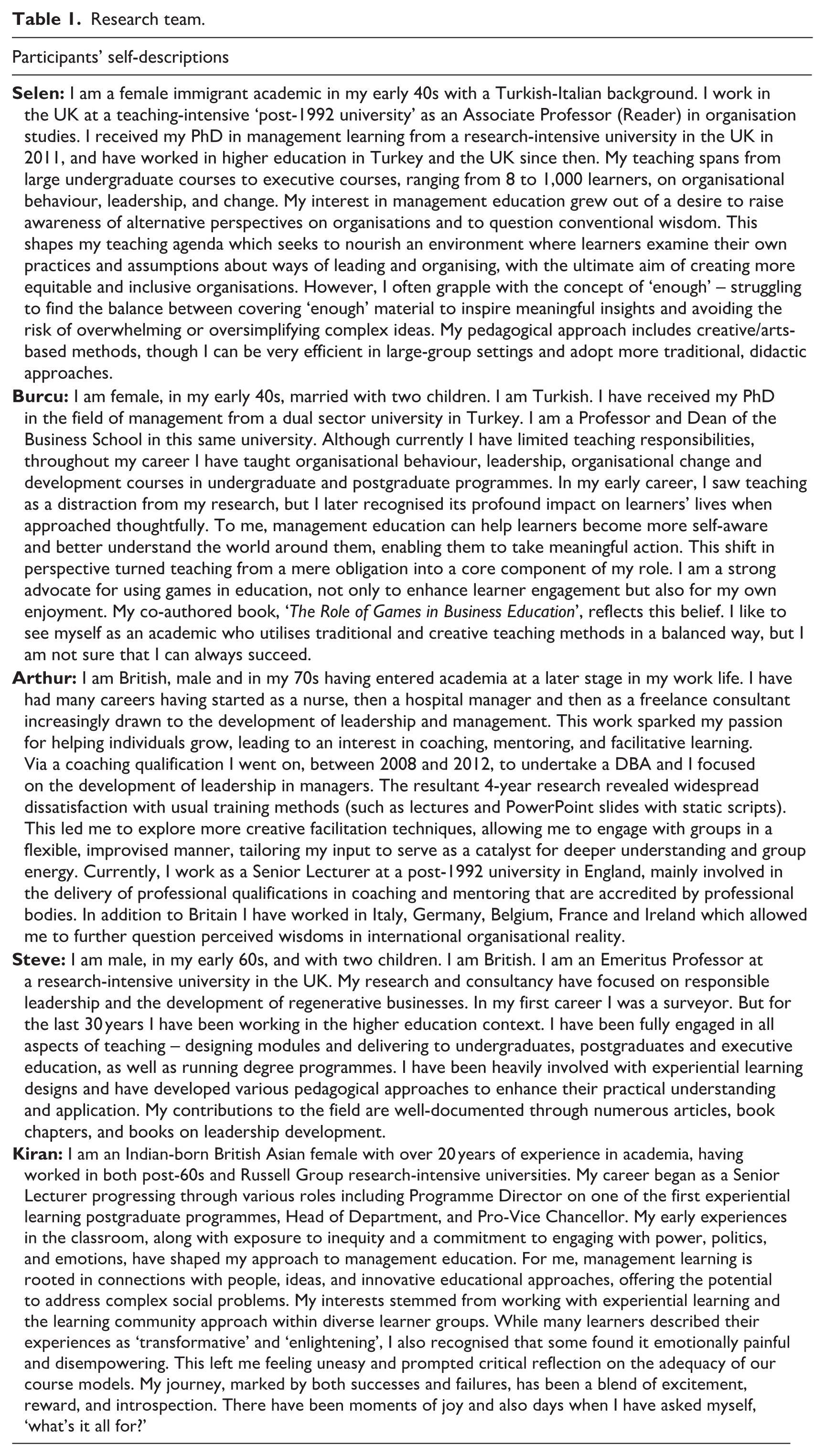
An important quality criterion in CAE concerns verisimilitude and plausibility with others who have been through similar experiences (Kempster and Parry, 2018). To this end, in designing our CAE, we split the research team into two. The first three authors – Selen, Burcu and Arthur – collectively and critically reflected on their experiences, making sense of the situations they were in and reworking their knowledge as ‘knowing-from-within’ (Cunliffe, 2002). The fourth and fifth authors – Steve and Kiran – acted as questioners and provocateurs to ensure that the explanation of one context connected with others’ experiences. This was not about proving or disproving our views from a position of strength or correctness, but checking that the emerging theory captured something that resonates with the lived experiences of other management educators (Kempster and Parry, 2018).
In designing the CAE, we drew on a dialogic approach, described as a ‘testimonio’, and designed an ‘organised reflexive dialogue’ (Iszatt-White et al., 2017) through a series of letters, followed by in-depth conversations. The steps of our CAE are depicted in Figure 1.
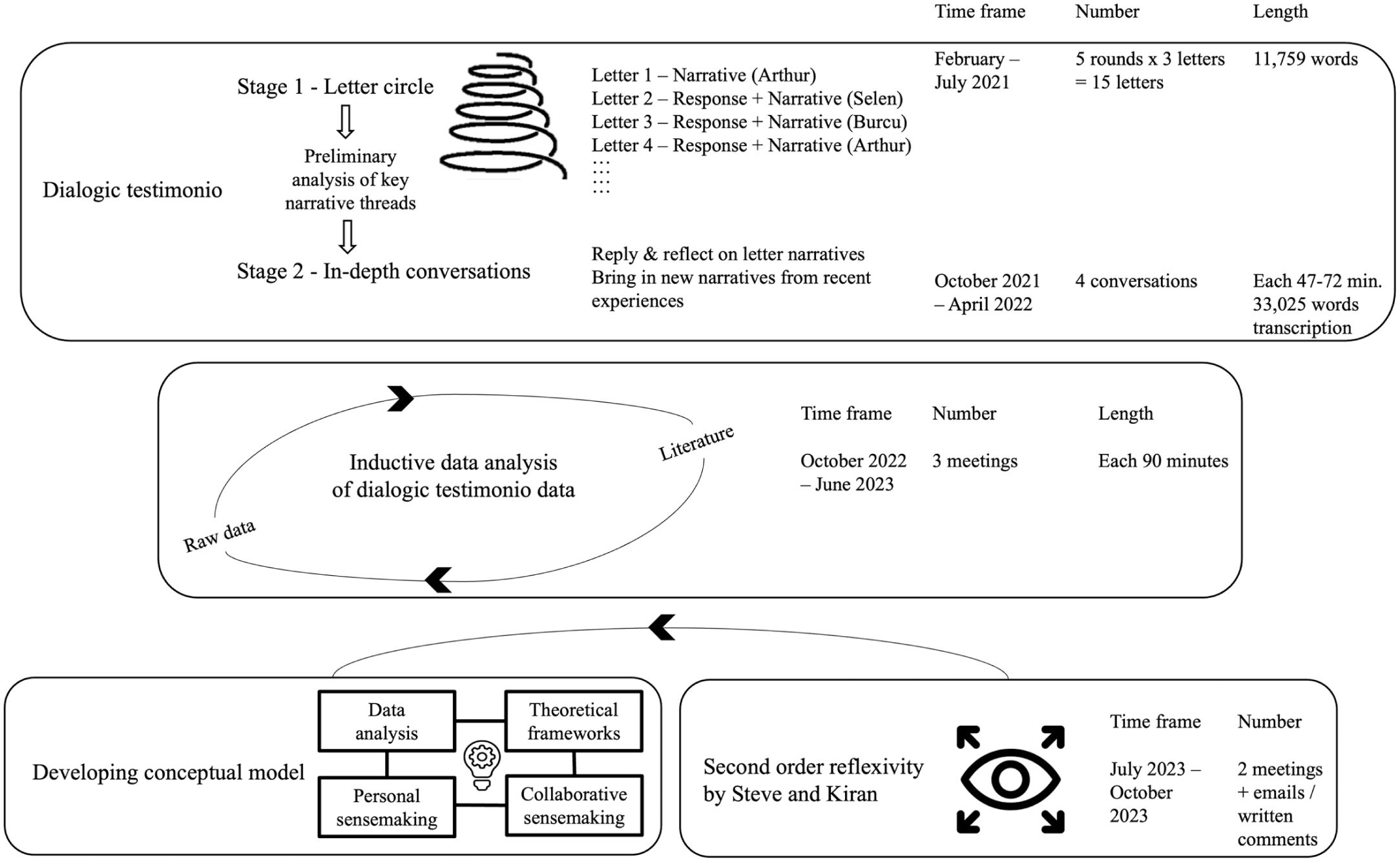
The research process.
Data sources
Letters
The first three authors exchanged five rounds of letters over seven months between February 2021 and July 2021. Writing letters was used as a method of inquiry to reflect on and illuminate our past experiences as management educators, their contingencies, and contextual features through the lens of the present (Iszatt-White et al., 2017). The letters included emotions, ambivalences, realisations, provocations, struggles, and questions that surfaced through our experiences. For instance, the letters highlighted our individual aspirations and values for teaching, our identification with dominant and emerging practices, expectations and discourses surrounding teaching, institutionally and practically. Letters were a way of engaging in a written dialogue; we responded to some of the issues highlighted in the preceding letter and also reflected on our own experiences, which provided material for further interpretation for the subsequent letter. We followed the same order in exchanging letters in the five rounds – Arthur went first, Selen was second, and Burcu was the final writer. Five rounds produced a total of 15 letters, amounting to 11,759 words.
In-depth conversations
After exchanging the letters, we undertook a preliminary reading to orient ourselves to the key elements of our experiences. Through careful reading and re-reading, we identified recurring topics and points of interest, paying attention to the diversity of meanings attached to them. This exploratory sense-making informed the second stage of data collection, which involved in-depth conversations. We first shared and discussed what resonated most strongly with each of us and agreed on a set of focal areas to guide the conversations. Then, during these conversations, we revisited and expanded on the narratives from the letters to critically explore how our accounts resonated with or diverged from each other (Nordbäck et al., 2022).
In the first conversation, we noticed language that signalled tensions, such as ‘yet’, ‘but’, ‘on the one hand . . . on the other hand’, ‘fine line’, ‘balance’ and ‘how can you . . . and still . . .’. We also noticed that we did not depict these tensions as either/or trade-offs. Instead, we perceived them as central to our practice. Paradox emerged as our research focus in this first conversation. In subsequent conversations, we kept our attention on these lived tensions, probing more deeply into each other’s experiences and how we worked through them.
Uncertain of how many rounds of letters or conversations would be necessary, we allowed the process to unfold emergently. We agreed to stop the inquiry after four conversations, as we felt that the data was saturated in a theoretical sampling sense and that further iterations would undermine its reliability (Kempster and Stewart, 2010) since we recognised that over time we became vested and entangled in each other’s narratives. We conducted four conversations over 6 months between October 2021 and April 2022. Each lasted between 47 and 72 minutes and was recorded. The transcriptions were accessible via a shared folder, allowing time to read them before the following conversation.
Data analysis
We adopted an inductive, iterative approach to analysis, which involved a collaborative and dialogic process among the five authors as we went back and forth between data and theory as we coded, categorised and abstracted data to higher-level concepts (Gioia et al., 2013). Figure 2 shows the data structure, which visually represents the progression from first-order codes to theoretical categories.
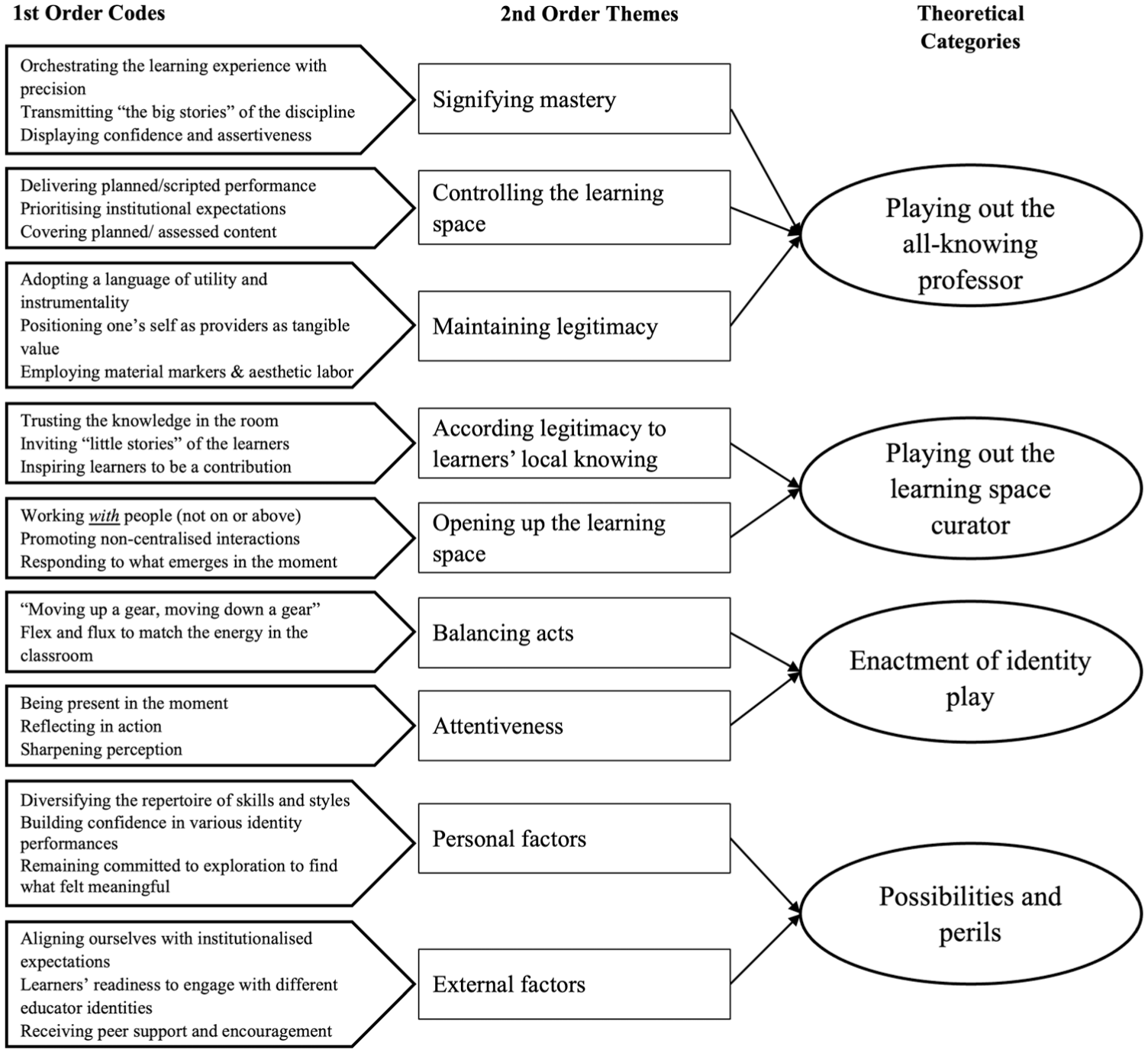
Data structure.
While the process was nonlinear, we present our analysis as a series of three steps for readability purposes.
Step 1: identifying first-order codes
After the fourth conversation, with the entire data set at hand, we started open coding and memo writing. Coding was done collaboratively on Google Docs to annotate the data using highlighters and comment boxes. 1 While coding, we focused on practices that, on the surface, looked contradictory (i.e. paradoxical) and how we, as management educators, switched between these practices in our delivery. This process resulted in first-order codes, such as ‘orchestrating the learning experience with precision’, ‘responding to what emerges in the moment’ and ‘flex and flux to match the energy in the classroom’.
Step 2: grouping codes into second-order themes
Next, to generate second-order themes, we explored patterns and relationships among the groups of first-order codes (Gioia et al., 2013), which also involved iterating back and forth between data analysis and literature on paradox and education (e.g. Iszatt-White et al., 2017; Palmer, 2017). The literature provided us with ‘sensitising concepts’ that offer ways of understanding and organising our experience (Charmaz, 2006). For example, informed by Palmer (2017), the theme ‘controlling the learning space’ emerged around first-order empirical codes: (a) delivering planned/scripted performance, (b) prioritising institutional expectations, and (c) covering planned/assessed content. These codes were grouped, as they all suggested creating and maintaining a predictable and known learning terrain pedagogically owned and controlled by the educator (Iszatt-White et al., 2017). Sensitising concepts from the literature simply laid the foundation for analysing research data, helping us examine first-order codes, and not all themes were informed by the literature.
Step 3: developing theoretical categories
In the final stage, we developed more abstract theoretical categories. This process was aided by three subsequent meetings, each lasting around 90 minutes, and an intensive data analysis retreat lasting three full days, where we worked collaboratively, focusing on formulating an overarching theory, actively and continually calling into question our emerging theoretical understanding. An insight derived at this stage was that different practices required educators to assume different personas in the classroom. This variation gained theoretical traction when revisiting the data while reading Ibarra’s work on identity (Ibarra, 1999; Ibarra and Petriglieri, 2010). Consequently, we were sensitised to the concept of identity play. It is important to note that, as with Step 2, identity play did not operate as an a priori category we forced data onto. It prompted us to ‘ask particular kinds of questions’ (Charmaz, 2006: 11), which helped us to take a fresh look at the data by illuminating different aspects of it. Step 3 resulted in four aggregate theoretical categories that conceptually explain the elements of identity play that management educators engage in when navigating the certainty–emergence paradox.
Before we present our findings, we want to note the issue of relational ethics. At one level, CAE provided greater anonymity for ‘implicated others’ in our accounts than a solo autoethnography (Lapadat, 2017). However, on another level, because our names are known to the readers of this article, we were aware that others would be more easily identifiable than in most qualitative research, where pseudonyms might be adequate. Given CAE’s emergent and open-ended quality, informed consent before the research was not possible. We felt that approaching implicated others retrospectively, after having written the paper, was potentially coercive, ‘placing undue obligation on research “subjects” to volunteer’ (Tolich, 2010: 1600), therefore, we agreed to omit any mention of implicated others.
Balancing on the paradox tightrope
The analysis of these rich, longitudinal reflections highlights that we, as management educators, experience multiple tensions between two polarities that appear to be in opposition yet are interdependent and complementary. This is what we call the certainty–emergence paradox that reflects the tension between providing structured, authoritative knowledge to ensure clarity and legitimacy and creating space for locally-sensitive, co-constructed learning that allows knowledge to evolve through dynamic and adaptive interactions. As experienced management educators, we were aware that it was possible to construct certainty–emergence as a duality by choosing only one pole. However, our data revealed that we constructed it as a paradox, not a choice to be made, but a balance to be maintained: You can just say, ‘Oh, I am going to focus on the big stories of the discipline’ or, ‘I will take a very slow process’. But we aren’t doing that, we are constantly recreating and rebalancing that paradox. (Selen, Conversation 3)
This is a paradox because in a management education classroom, these two worlds can clash when learners expect to be taught by self-assured subject matter experts who can provide universal frameworks that can be applied across various contexts, yet who can remain in an ongoing dialogue with learners to co-create knowledge relevant to practical realities and immediate local contexts. Failing to enact a language of certainty in the delivery of education may make it difficult to communicate disciplinary rigour to learners who may otherwise question the credibility and legitimacy of the educator. Alternatively, a lack of concern for what emerges in the moment for the learners can make it difficult to engage learners who expect to see the relevance of the education to their lived experiences.
This awareness of paradox led us to ‘beautifully sandwiching’ (Arthur, Conversation 1) between different educator identities and associated roles and behaviours, as needed. In seeking ‘balance or variety’ (Arthur, Conversation 1), we realised that we were like actors assuming different characters on stage during a play. We navigated a spectrum of identities, enhancing our agency to provisionally ‘try on’ different ways of being without wishing to commit to a fixed or final self-concept as we reshaped our roles in response to the shifting dynamics of the learning space. For example, on one end, we identified with the all-knowing professor, on the other, the identity of the learning space curator. Both identities are explored in the following sections. We then describe the process of identity play that allows us to navigate these identities to work through the certainty–emergence paradox.
Playing out the all-knowing professor
The all-knowing professor identity was performed through intended and structured teaching practice designed to exercise control over the situation and/or over others. In this identity, we took on the responsibility of orchestrating the learning experience with precision, ensuring that content was delivered in a way that signified mastery. To sustain this identity, we adopted a demeanour that displayed confidence and assertiveness – as an intentional part of the performance necessary to uphold the all-knowing façade: It’s not enough to know John Kotter’s eight-step change model but . . . you need to know everything because you are a university lecturer; you need to be a fountain of wisdom. (Selen, Conversation 1)
Communicating our mastery in this identity was tied to the transmission of disciplinary knowledge, carefully packaged to be standardised, structured and digestible for learners. We positioned ourselves as legitimate experts by imparting ‘the big stories of the discipline’ (Arthur and Selen, Conversation 3) that were ‘tried and tested’ (Selen, Conversation 3) from authoritative sources. The all-knowing professor identity can be culturally traced back to perceived institutionalised norms and an assumption that our employers, peers, and learners expect to see the ‘master of theory’ and ‘sage on the stage’ (Iszatt-White et al., 2017: 588) in their interactions with us. In this regard, this identity felt legitimate since social validation was built into its successful performance.
Control was central to enacting this identity – control over the learning space, the topics covered, and the flow of classroom interactions. We saw control as necessary to meet institutional expectations, as it assured us that ‘learning outcomes are met’ and that we achieved ‘a degree of common denominator on what has been learnt and understood’ (Selen, Letter 4) since we had covered the ‘content which will feature in their assignments’ (Selen, Conversation 1). Beyond these formal requirements, the all-knowing professor identity also helped us prevent the class from descending into what we feared as a ‘chaotic void’ (Selen, Conversation 1). Without such control, we worried learners would be ‘totally uninformed and even more confused than they were at the start because they didn’t know what was going on’ (Selen, Letter 3).
The need to maintain legitimacy and credibility made the all-knowing professor identity adopt a language of utility and instrumentality. As the all-knowing professor, we positioned ourselves as providers of tangible value, conscious that learners ‘pay a lot of money for this course’ (Arthur, Conversation 3), and expect content that is ‘useful and relevant’ (Arthur, Letter 1). With the motivation to provide learners with ‘“the best value” for their time’ (Selen, Letter 2) and ‘money’ (Arthur, Conversation 3) and to make that value ‘visible’ (Burcu, Conversation 1), we emphasised offering ‘immediate tactics’ (Burcu, Conversation 1) and ‘“how to” approaches’ (Selen Letter 2) that were framed as necessary for improving ‘individual and company performance’ (Arthur, Letter 2).
The all-knowing professor identity also had a material dimension. PowerPoint packs, lecture scripts, and detailed lesson plans helped us to communicate self-reliance by reassuring our learners (and ourselves) that ‘[our] pockets are NOT empty!’ (Burcu, Letter 1). Since ‘an absence of PowerPoint packs’ could signal ‘an apparent lack of planning’ (Arthur, Letter 1), these materials were instrumental for showing we know what we are talking about, have thought it through, and are prepared. Other material markers spanned into the realm of aesthetic labour. Our choice of professional attire or a new ‘haircut to look older’ (Burcu, Conversation 1) became a way to project credibility and secure legitimacy in learners’ eyes.
Playing out the learning space curator
The learning space curator identity accorded legitimacy to learners’ local knowledge by ‘trusting the knowledge in the room’ (Selen, Conversation 2). Recognising that ‘what learners know is valuable’ (Selen, Letter 1), in this identity, we invited ‘the little stories of the learners’ (Selen, Conversation 2). This approach suggested a move beyond passive conceptualisations of learning, which view the learner as an empty vessel to be filled with disciplinary knowledge. Instead, we sought to create possibilities that would ‘inspire the learners to
In this identity, we engaged in role behaviours that focused on cultivating conditions that allowed learning to unfold unpredictably, shaped by learners’ experiences, disciplinary knowledge, and emergent discussions. Positioning learners as active participants rather than recipients of knowledge, we provided them with enhanced agency and opportunities to share experiences, viewpoints, and stories, relating new knowledge to these. We perceived the benefits of the classroom to emerge from non-centralised interactions among learners, topics, activities, and ourselves – interactions that could not be fully anticipated, prescribed, or controlled.
Repositioning ourselves in the educator-learner relationship meant embracing a role that was not about dictating a learning path but about contributing to a somewhat unpredictable project with a significant social and relational dimension. Consequently, our distinctive role became to nurture an environment where learners can ‘hold an attitude of curiosity and playfulness . . . take stock and reflect on their experiences’ (Selen, Letter 2) alone and in groups, and ‘share their knowledge and learn from each other’ (Burcu, Conversation 1): We work with people, not on them or above them. That makes the space that you create a joint space; so working together with people who are peers. (Arthur, Conversation 1)
To give enough space to the learners, we needed to step aside and change the nature of our relationship with them. Therefore, occupying this identity required us to become ‘spare parts’ (Iszatt-White et al., 2017: 589) dedicated to supporting learners in their unique learning journeys. This meant giving up on the idea of having all the answers already and showing ‘humility and an awareness of limits to our intellectual resources’ (Selen, Letter 1) and our individual knowingness. The emphasis was less on preparing the teaching material but more on preparing our mindset to be capable of working with fluid, unpredictable interactions: My view is that you need to prepare yourself to be able to do that rather than prepare the material. I mean preparing the mindset. (Arthur, Conversation 2)
This shift altered how we approached both planning and delivery. Planning became about anticipating various possible directions and imagining experiences. Delivery, in turn, became about facilitating interactions that led to relevant, yet somewhat unknown, outcomes, which demanded a high degree of flexibility to respond to what ‘emerges in the moment’ (Selen, Letter 1). This required a willingness and an ability to be open to interruptions to our routine practice. In this respect, central to this identity was an appreciation of ‘randomness’ in the behaviours, expectations and reactions of learners (and of ourselves) for the creation and functioning of a productive learning space.
Enactment of identity play
Identity play was not a punctuated, mechanistic oscillation, where we switched between predetermined chunks of 20 minute theory, 15 minute reflection, and similar trends, as this felt ‘a bit artificial’ and ‘forced’ (Selen, Conversation 2). Instead, we moved between identities – expert, lecturer, facilitator, provocateur – flexibly and fluidly as we tuned in and responded to ‘the energy’ (Arthur, Conversation 3) in the classroom and ‘switched modes’ by ‘moving up a gear, moving down a gear’ (Arthur, Conversation 1): Holding the balance is a bit like, say, how trees survive in windy conditions so that when it’s calm, the tree is like this, [RAISES HIS FINGER], but when the conditions change, they move in order not to break. (Arthur, Conversation 3)
Being ‘elastic enough, but durable, concrete enough’ (Burcu, Conversation 2) was complex. By removing the objective boundaries imposed by lesson plans or any pedagogic ‘best practice’ that would predict a rhythm, to ‘catch the balance right all the time’ (Burcu, Conversation 2), we had to learn to create structural and temporal boundaries that were intersubjectively constructed with the learners.
Identity play, then, unfolded as an emergent but deliberate flow, calling for attentiveness and critical reflection-in-action. This meant remaining present in the moment, reading the classroom, and sensing when to shift roles. We consciously attended to learners’ reactions, the complexities of their interactions, and our feelings to understand whether our assumed identity resonated or clashed with the evolving classroom dynamics: Suddenly, you think, ‘I’ve been like this too long, so I need to bend a little bit’. (Arthur, Conversation 3)
Rather than simply ‘doing’ and then reflecting after the fact – or not at all – we noticed how our minds worked in the middle of doing. We became aware of our thinking as we taught, recognising shifts in the classroom and in ourselves as they happened. This immediate, ongoing reflection allowed us to shape the learning experience as it unfolded, ensuring it remained meaningful and impactful. Teaching was not a matter of following a predetermined script but of actively engaging with the moment, resisting the pull of autopilot, and instead remaining attuned to what was emerging: It requires conscious presence in the classroom, it requires us pay (rather than seek) attention to the dynamics and events that unfold in front of us as well as an attention to our intention. It requires heightened awareness and a commitment to do something about what comes to our awareness. (Selen, Letter 5)
What we paid attention to mattered, shaping how we navigated and sustained identity play. The attentional limits of our cognitive system meant that we inevitably made choices about what to focus on. However, by deliberately broadening the scope of our attentional span, we could attend to divergent perspectives and subtle classroom cues. With a more nuanced appreciation and expanded awareness of the classroom context, we noticed shifts in energy, tensions in discussions, and the unfolding needs of learners. Consequently, our attentional quality allowed us to adapt with fluidity and be more at ease with emergence. In this sense, sustaining identity play was not only about switching roles but about broadening the field of attention and cultivating sensitivity to the subtleties of experience to allow ourselves to hold multiple possibilities in view.
Possibilities and perils of identity play
Enacting identity play was not always possible or attractive. Identity play became possible when multiple, subjectively experienced and dynamically interacting factors in ourselves and our external environment encouraged such exploratory behaviours.
Personal factors
Identities visited during identity play required us to adjust our role behaviours, styles and skills to align with the features of each chosen identity. Our individual repertoires, shaped by our prior academic journeys, institutional and national cultures, and teaching contexts, were critical in influencing the breadth and depth of identity play. The richer and more varied our collection of skills and styles, the greater our confidence and dexterity in experimenting with a broad range of identities. For example, Burcu admitted that even though she enjoyed trying out different possibilities of being in the classroom, she questioned whether she was ‘equipped with necessary skills to do so’ (Burcu, Letter 1). In her institution’s context, the identity of the all-knowing professor was both well-received and well-practised, making it tempting to ‘retreat into the familiar’ (Selen, Conversation 2). However, Burcu found it easier to resist that pull when given adequate time and intellectual resources to prepare and imagine alternative learning experiences. In contrast, Selen appeared to have the broadest repertoire, shaped by her varied academic journey across institutions and her experience working with diverse learner audiences. What felt familiar and comfortable to her spanned a wider variety of perspectives and a broader range of identities. This diversity allowed for a smoother navigation between different identities along the continuum, making exploration accessible and fulfilling. The observations within our CAE group suggest that diversity in educator’s repertoire enhances the potential for identity play.
Identity play was an uneasy experience at the start, marked by hesitation, fear, and self-doubt. Initially, we found it difficult to imagine ourselves and learners in unfamiliar roles. However, we also perceived that ‘the rewards are worth the risk . . . rather than say okay, [we are] just going to keep it safe and going to go down the well-trodden path’ (Arthur, Conversation 1). Therefore, we continued experimenting with different aspects of our educator selves. The more we experienced different ways of delivery (or ways of being in the classroom), the more we built confidence in our various identity performances. Deliberate and persistent engagement with identity play, along with reflection, transformed previously unfamiliar identities into ones within our comfort zone, broadening the breadth and depth of our identity landscape: In one of those workshops [my colleague] suggested using the erasure poetry technique. And, you know, I have used some other creative methods in the past. Drawing, stories, story writing, Lego, for example, but poetry totally freaked me out. I was like, ‘God, this really won’t work’. And I think it worked fine in the end. (Selen, Conversation 2)
In this sense, like slipping into new costumes to see what fits best, through experimentation with identity play, we gained insight into what felt meaningful and true to ourselves.
External factors
In our letters, but particularly during the conversations, we frequently reflected on the perceived need to align ourselves with institutionalised expectations, which showed covert support for the all-knowing professor identity. This was partly culturally constructed around a set of practices that supported the hierarchical norms positioning educators as the primary sources of knowledge and learners as recipients. Moreover, the prevailing structures and processes within our institutions led to increased bureaucratisation concerning quality assurance and scrutiny systems (see also Jauhiainen et al., 2015). Our institutions conveyed contradictory messages by expressing support for innovation in teaching while simultaneously emphasising the need for certainty to meet the predetermined course and programme learning outcomes monitored through formalised accreditation and moderation processes. Therefore, at times, we perceived identity play as risky because it inherently made our teaching less predictable and, thus, maybe, less desirable: The institution pushes on you and forces you to think, ‘I want to do it this way, but actually, I can only do it in a more formal way’. (Arthur, Conversation 3)
In addition to our institutions, learners were important actors in our organisational contexts, impacting the possibility of identity play. We recognised that learners, epsecially given the rising awareness of neurodiversity, differed in their level of readiness to welcome educator identity play, specifically concerning their ability and willingness to engage within the learning spaces created by our different identities. This readiness was influenced by both the level of learners and the broader cultural context.
When we start teaching with poetry, to me, the anxiety is being unable to make the value of the session visible. That’s a risk . . . Will [learners] be impressed with the method? (Burcu, Conversation 1)
In contexts where institutional expectations emphasise standardised outcomes and visible ‘value’, we worried that departing from the all-knowing professor identity and experimenting with different identities could be perceived as a failure to deliver the expected ‘product’. If learners got something other than what they (quite literally) bought into – to be told by experts, why, what and how – this amplified the risk associated with identity play: [After a session which involved Lego Serious Play and facilitation on conflict management] Because of a few questions they asked, I showed a few slides. You had to see the excitement in the room. So [that was] the expectation of the audience. They expected somebody to tell them everything. (Burcu, Conversation 1)
Such experiences prompted a critical reflection on the ethical implications of our pedagogic choices, as we considered how our shifts between identities might shape learners’ experiences and engagement. We found that successful identity play necessitated engaging with our learners to understand their readiness and receptiveness to diverse role behaviours. Communicating the rationale behind identity shifts and ‘planting the seed in their head’ (Arthur, Conversation 2) helped learners to reimagine us and themselves in new roles: If you do a workshop for four hours about leadership, and then, three and a half hours later you say, ‘And now, I want you to get your paper out, and I want you to draw a picture of . . .’ People are likely to say, ‘what is that?’ But if you say to people right at the beginning, ‘We’re using some creative methods, and at times I’m going to ask you to do this’. So, you’re signposting to what you’re doing. It’s then much easier to say, ‘And now, we’ve reached the part where we’re going to do this’. It can be surprising but not shocking which would deter both you and the learners from participating. (Arthur, Conversation 2)
Although identity play appears to be a personal affair experienced at the individual level by the educator, we acknowledge that we were part of a collective: the higher education community. In this respect, the peer support and encouragement we received from our colleagues and within our CAE group supported our efforts to play our way along the continuum. The more opportunities we had to share our experiences with colleagues, the more we were able to mitigate our hesitations and the less we were inclined to close play prematurely. Our ‘collective bravery’ (Arthur, Letter 3) grew as a result: I was soooo tempted just to give them an hour-long lecture . . . and maybe give them a bit of time to reflect on what that means for their own practice. Luckily, I was co-delivering, so that didn’t happen. (Selen, Letter 3)
In discussions with peers, we stopped anticipating a tension-free teaching experience, and we felt more at ease with the provisionality of our educator identities. The relationships we built and maintained with like-minded peers, within and beyond our institutions, helped foster feelings of understanding and offered a platform for collectively questioning often unstated assumptions about effective teaching and consider the ethical, power-based and relational consequences of our choices in navigating the paradox, thereby sustaining the enactment of identity play.
Discussion
We theorise our inductive findings and incorporate relevant literature to offer a heuristic device, illustrated in Figure 3, that illuminates how educators can navigate the certainty–emergence paradox in management education through identity play.
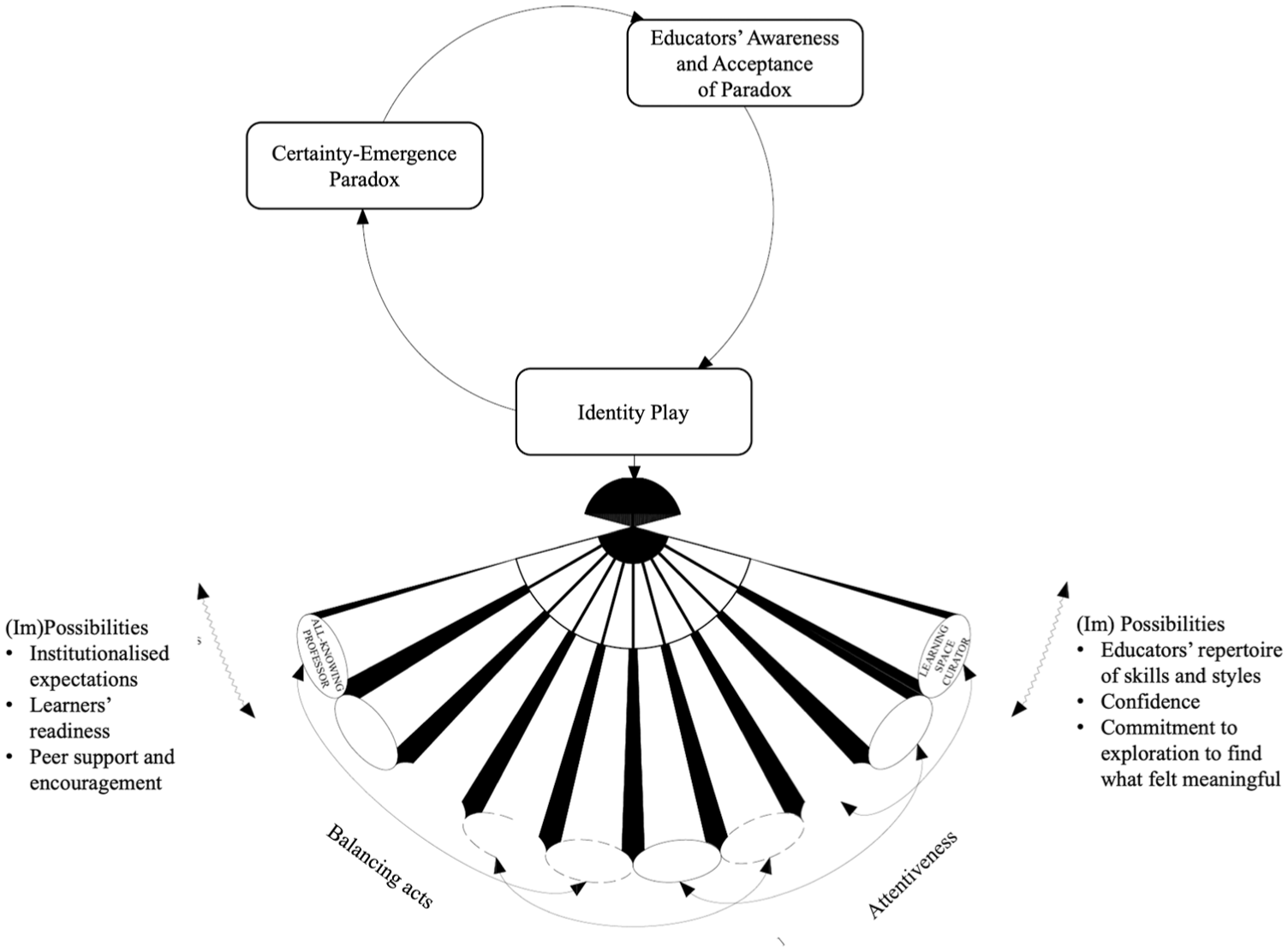
A heuristic device for navigating paradox through identity play.
The intensification of governance in business schools has rendered the tensions between certainty and emergence especially pronounced for educators seeking to balance structured knowledge delivery with space for emergent, locally-sensitive learning. In line with paradox theory, we understand these tensions as both enduring features of academic life and as dynamics made salient through educators’ interpretations in practice (Smith and Lewis, 2011). While some educators may counterproductively avoid these tensions, others ‘work through’ paradox (Lüscher and Lewis, 2008), staying within contradictions rather than retreating into defensive or reductive stances. Our findings suggest that working through this paradox involves identity play – a process of fragmenting one’s self into several, often conflicting identities that the educator takes up provisionally in their classroom practice.
The heuristic device depicts two stylised identity poles: the all-knowing professor and the learning space curator. These were selected to illustrate the dynamic tension we observed most clearly. However, these two poles simplify a far broader and more fluid repertoire of provisional identities, represented in Figure 3 by the multiple circles. Dashed circles, semi-circles and gaps in the figure reflect the ongoing, incomplete and indeterminate nature of identity play, which centres on discovery rather than preservation (Cnossen and Stephenson, 2022). Resonating with Smith and Lewis’ (2011) notion of dynamic equilibrium, our heuristic highlights that educators move iteratively between poles, making provisional choices in the short term while remaining mindful of their interdependence over time. In this way, identity play reflects the kind of ‘consistent inconsistency’ (Smith and Lewis, 2011) that paradox theory highlights: a situated and experimental practice of holding tensions open rather than collapsing them into premature resolution.
The image of a folding fan captures the individual and external factors that can open up or close down the possibilities for identity play. At the individual level, the educator’s capacity to engage in identity play is partly shaped by their repertoire of competencies and pedagogical styles, contributing to their adaptability to the changing dynamics in the classroom (Budtz-Jørgensen et al., 2019). However, competence acquisition is neither neutral nor a trivial technical task of adding something to one’s toolbox, but becomes part of identity (Gabor, 2013). Therefore, a perceived lack of competence within a particular identity can evoke self-doubt (Beech, 2008) and insecurity (LaPointe, 2013). Consequently, the educator may revert to identities that feel more ‘true-to-self’ (Ibarra, 1999: 788) at the risk of ‘premature closure’ (Ibarra and Obodaru, 2020: 567) of the folding fan. The folding fan metaphor, therefore, gestures towards both expansion and contraction of possibilities, influenced not simply by skill sets but also by affective experiences, as educators explore the limits and opportunities of their repertoire. In practical terms, the folding fan heuristic can serve as a reflective tool for educators to surface and examine the repertoire of identities they habitually draw upon in the classroom. This can inform their pedagogical choices in real time, but also guide longer-term professional development by making visible patterns of risk-aversion or overreliance on familiar roles.
By mapping moments when particular identities are opened up or prematurely closed, educators can better recognise the factors that enable or constrain their capacity to experiment with new roles. After all, beyond the individual, identity play unfolds within a broader institutional context. Identity play becomes possible in a safe space that allows an individual to explore and craft a wide variety of possible selves without fear of repercussions (Stanko et al., 2022). Yet, the new managerialist governance of higher education (Jauhiainen et al., 2015) subtly shapes which identities are legitimised or penalised (Knights and Clarke, 2014), and structures pedagogical agency in ways that are often implicit and difficult to contest (Knights et al., 2022). In this respect, playing with identities that go against the dominant discourses involves a degree of pedagogical risk-taking (Mangan et al., 2016) and, therefore, exposes educators to reputational and career vulnerabilities, especially acute for early-career or contingent academics (Ratle et al., 2020; Robinson et al., 2017).
While our heuristic is informed by our particular empirical context, which is conducive for identity play, we acknowledge that these opportunities are not evenly distributed and are differentially entwined with institutionalised hierarchies of power and security that may afford or constrain identity play. We recognise that we benefit from particular privileges and enabling conditions that supported our experimentation. Our professional work settings afford us – at least in part – degrees of academic freedom, managerial tolerance for pedagogic risk and collegial support (including our CAE group) that was critically reflective and supportive of experimentation. We have opportunities to experiment across undergraduate, postgraduate, and vocational courses, and to engage in cross-institutional collaborations spanning different cultures and institutional types. These opportunities broadenis our pedagogical repertoire and confidence enabling identity play. This privilege allows us to engage intensively, and coincidentally, with the very identities and paradoxes we are researching. Collectively, these factors remind us that our capacity to ‘play’ is not simply a matter of individual agency but is scaffolded by structural and relational supports.
At the same time, we recognise that such affordances remain unevenly distributed within and across universities, often shaped by contract type, workload, accreditation demands, and local expectations. Even within our research team, different positionalities are apparent. For example, Arthur is an early-career academic but occupies a relatively secure institutional position as a senior lecturer following an established career as a leadership consultant and a professional coach. Selen, on the other hand, is a younger woman, an immigrant academic, yet one with deeper institutional experience that influences her scope for experimentation in the classroom. Burcu, although holding a senior position, works within cultural and institutional contexts markedly different from the rest of the team. This also illustrates a broader tension: while seniority can provide greater autonomy, it can also limit experimentation, as individuals in such positions often face stronger expectations about how their roles should be enacted. These examples further stress that identity play is not purely an individual practice but is conditioned by complex, intersecting structures of privilege, job security/precarity, and institutional embeddedness. Here the heuristic can be used in faculty development or mentoring settings to help the educator critically reflect on the structural conditions that make experimentation feel safe or risky and which may require additional support or negotiation. Indeed, the unease we felt through identity play was a consequence of challenging the unstated assumptions of educational identity set within an institutional structure and societal norms; for example, the students’ expectation of an all-knowing professor.
Possibilities for identity play are shaped not only by the educator’s interactions with this broader institutional context, but also with the local dynamics created by the learners in the classroom. As the educator navigates between different identities, shifting from authoritative to more facilitative or collaborative roles, learners, too, must oscillate between detachment and involvement (Kolb, 1984), and engage in identity play themselves. In this regard, for identity play to be successful, it seems that learners too need to embrace aspects of critical pedagogy in the discomfort of provisionality, both in their own conduct and in that of the educator. If learners become disoriented, confused or upset by a mismatch between their expectations and the reality of its delivery (Elliott and Robinson, 2012), we suggest that this is likely to dampen engagement (Mangan et al., 2016), and ultimately push the educator out of identity play. From the educator’s perspective, identity play involves cultivating a classroom environment where provisionality and working across opposing poles of engagement are not only tolerated but valued by the learners (Lüscher and Lewis, 2008). In the moment of teaching, the heuristic can act as a reminder that drifting too far towards either pole risks shutting down learner engagement. But it can also be used as a design tool more purposefully. Educators can actively design moments in a class that intentionally ‘open the fan’ by inviting ambiguity, alongside moments that ‘close’ it to provide stability.
Play ceases when educators rigidify into predefined identities, failing to confront and critically reflect on their pedagogical biases (Simpson et al., 2010). This is further exacerbated when classroom conditions restrict the relational space for identity play, by silencing or sidelining certain learner voices. The uneven distribution of voice and influence in classrooms, shaped by power differentials nested within social ecosystems of internalised roles for educators and learners (Taylor and Robinson, 2009), can limit educators’ ability to engage in identity play. Furthermore, learners enter the classroom with embedded expectations of teaching, and internalised assumptions about how knowledge is produced and who holds authority (Bragg, 2007). These taken-for-granted orientations shape, often unconsciously, how they respond to different educator identities and the relational possibilities available for identity play. By validating only specific educator identities as legitimate and acceptable (Knights et al., 2022), learners effectively delimit the boundaries within which identity play can occur. Educators may find it difficult to recognise and disrupt these dynamics, especially when certain learner voices are more readily legitimised due to their positioning within wider structural hierarchies (Arnot and Reay, 2007). For educators, this highlights the need to critically engage with how structural and relational forces shape the space for identity play. Our heuristic device can help educators anticipate these moments of closure, prompting reflection on how they might reopen possibilities for play. Deliberate, mutual engagement with learners can enable identity play by helping the educator shift between roles and reshape the classroom dynamic, opening the relational space for play.
We are also mindful that identity play carries an emotional weight. Engaging with paradox evokes frustration, anxiety and fear (Smith, 2014; Smith and Lewis, 2011). The ‘colleagueship’ that develops through the shared experience of paradox (Deeds Pamphile, 2022: 1292) emerges as a vital resource for tolerating the painful discrepancies inherent in identity play (Ibarra and Obodaru, 2020). Our own experience of CAE underscored the importance of peer support and encouragement for surfacing moments of both affirmation and dissonance, bringing to light perspectives we had previously overlooked (Mangan et al., 2016) and reflecting on different ways in which we can deal with the complexities of academic life (Nordbäck et al., 2022). Peer relations enabled a more expansive orientation to our identities as educators, and an increased commitment to keeping the folding fan open longer. However, we are cautious not to romanticise peer support, recognising that peer interactions too are embedded within institutional hierarchies, subtly reproducing dominant power relations and norms that can limit, as much as enable, experimentation (Fleming and Spicer, 2003; Hawkins, 2013). Collegiality can function as an organisational control mechanism, prompting behaviours aligned with institutional expectations (Fleming and Harley, 2024). Accordingly, while peer support may provide necessary emotional scaffolding for identity play, it also shapes (and at times constrains) the range of identities that can be safely explored.
Finally, our heuristic device suggests that identity play involves a series of ‘consistent, ongoing microshifts’ (Schad et al., 2016: 37), as the educator performs balancing acts when they notice the learning environment is drifting towards one pole of the certainty–emergence paradox. In this sense, identity play operates akin to a ‘semi-structure’ to prevent the classroom ‘slipping into pure chaos or pure structure’ (Brown and Eisenhardt, 1997: 29) through constant attention. These microshifts are also about being attentive to the potential risks of operating on autopilot, rigidly adhering to established plans, familiar routines and well-known recipes, which can lead to competency traps (Levitt and March, 1988). Avoiding such traps requires ongoing learning from paradox itself, recognising that contradictions invite experimentation and reflexive engagement (Smith and Lewis, 2011).
From a critical-reflexive pedagogical perspective (Cunliffe, 2004), such iterative experimentation has the potential to be pedagogically generative. By deliberately exploring alternative professional selves in response to emerging classroom dynamics, educators can cultivate reflexivity, ethical awareness, and attentiveness to relational and institutional influences on practice. In this way, the heuristic offers not only a conceptual lens but also a practical device for cultivating reflexivity in real time, and in the process expanding what becomes possible for educators and learners alike.
Theoretical contributions
Like any heuristic, we recognise that our device selectively abstracts to clarify key patterns observed in our empirical context rather than capture every possible nuance. Similarly, the metaphor of the folding fan, as with all metaphors, both help reveal insights on a phenomenon but can also obscure. As a consequence, we acknowledge that our exploration and theorisation offer a partial and provisional understanding of identity play and the paradox at ‘play’. Yet, its value lies in making visible salient dynamics that may otherwise remain diffuse and unarticulated in practice. With these insights, we propose three distinct contributions.
Our first contribution lies in extending paradox scholarship by foregrounding identity play as a site of possibility and contestation for confronting paradox. Prior work often frames paradox as threatening to selfhood (Petriglieri, 2011); in contrast, we show that individuals can keep opposing identities in play, in the moment and over time, to navigate paradox. With this insight, we offer an alternative perspective and argue that paradox can be a space of possibility for individuals to explore and expand their sense of self. Identity play makes the very presence of paradox instructive, revealing that coherence is always provisional, that professional selves must be held lightly, and that experimentation remains possible precisely because tensions resist closure. By fostering detachment from a taken-for-granted sense of self (DelMonte, 2003), identity play enables a self-conscious, critical questioning regarding who to be. This questioning, in turn, can help to counteract complacency and habituality in what to do (Cunliffe, 2004) and think creatively about integrating opposing forces.
Second, we contribute to management learning and education literature by showing that, despite standardising pressures and compliance-driven expectations, educators can still preserve and indeed enhance an agentic sense of self and purpose by anchoring their identities in meaningful localities and relationships (Nordbäck et al., 2022). Identity play places educator agency front and centre by showing how individuals not only react to but also shape the paradox by purposefully introducing ambiguity and constructing provisional selves. In this sense, identity play resonates with critical pedagogical commitments to embracing plurality of voices and situatedness over institutional norms that prescribe ‘correct’ educator identities. This presents a more optimistic view of individual agency in business schools (Ratle et al., 2020), contrasting with its portrayals as sites of conformity and reaction to ‘unowned’ and ‘impersonal’ processes (MacKay and Chia, 2013). While we do not claim that educators enjoy ‘unfettered agency to (re)create themselves in any way they choose’ (Brown, 2022: 1217), we argue for ‘embedded agency’ (Weiser and Laamanen, 2022: 13), meaning that the capacity for identity play is shaped, and at times curtailed, by institutional norms, professional histories and relational dynamics of the classroom. This framing contrasts with depictions of agency as either heroic resistance or passive compliance, offering a situated understanding of agency-in-action.
Third, we contribute to identity play literature by challenging the assumption that play requires low-institutionalisation contexts where there are few established orders (Stanko et al., 2022) and liminal or ‘bracketed’ experiences (Howard-Grenville et al., 2011) like sabbaticals (Schabram et al., 2023). Our findings show that higher education, despite growing trends of convergence and total administration (McCann et al., 2020), still offers a conducive context for experimenting with one’s identity repertoire. Classrooms, we argue, offer educators transitory holding environments (Petriglieri et al., 2019), offering educators a rich identity landscape with a plurality of role models, and diverse and complex learner profiles and interactions. The settings we worked in through this research gave us privileged spaces for us to understand and experiment with, safely, our own unique identity play fan. Yet, we recognise that such spaces are fragile and unequally accessible. Without careful attention, identity play risks becoming another form of sanctioned adaptability, reinforcing rather than subverting hegemonic norms.
Conclusion
Business schools and their faculty face complex, competing demands (Shore, 2010), prompting a move beyond either/or thinking towards more nuanced, synergistic responses (Smith, 2014). By unpacking the lived experience of paradox, we have laid the foundation for a deeper understanding of how identity play shapes the ways in which management educators navigate the certainty–emergence paradox in their educational practice. Our conceptualisation of identity play is informed by paradox scholarship that highlights the embeddedness of paradoxes in educational contexts and their activation through the lived experience of teaching and learning. From this perspective, paradoxes are omnipresent and resurface across contexts, requiring ongoing navigation rather than resolution (Smith and Lewis, 2011).
We see identity play as one such navigation mechanism, enabling educators to sustain the tension between certainty and emergence by making micro-shifts between alternative selves, and thus keeping both poles alive without collapsing them into a premature closure. Our heuristic device surfaces how such play is shaped by individual capacities, institutional contexts, learner interactions, and peer relationships – all of which expand or constrain educators’ ability to adopt provisional identities in practice.
As with other qualitative studies, our findings are context-specific yet can be naturalistically generalised to other contexts where academics navigate tensions. For example, educators experience tensions as they are expected to undertake traditional teaching and research activities while becoming increasingly involved in entrepreneurial activities to generate income (Harris, 2005). This requires them to reconcile the requirements for scholarly impact in their research and the impact of their research on practice (Bartunek and Rynes, 2014). Research also acknowledged the tensions confronted by manager-academics, such as deans, as they try to balance the identities of academic and the corporate-informed executive (Gallos, 2002). Given the salience of tensions in the contemporary university, an interesting area for further research can test the resonance of our heuristic device with a bigger group of management educators across cultural and institutional contexts.
Insights from our model may also transfer to a variety of professional settings that grant individuals varying levels of agency in expressing and suppressing certain identities in response to paradoxical situations. In our case, the relative freedoms of academic life – including a degree of autonomy in classroom design, collegial support, and the comparatively low institutionalisation of teaching practices – afforded us the scope to experiment and persist with identity play. These conditions of privilege likely shaped both the enactments we report and our ability to sustain them, meaning our account may foreground possibilities that are harder to realise in more tightly constrained contexts. We therefore treat our insights as situated rather than universal and invite future research to examine how identity play is enabled or curtailed in settings where identities are more tightly codified and play may feel less safe – whether in other professional roles such as auditors, flight attendants, or army officers, or in academic contexts marked by reduced academic freedom.
Furthermore, the process of identity play is bi-directional. Our heuristic device highlights that identity play occurs within a complex set of relationships with others who exhibit unique (and sometimes contradictory) reactions to the identities being played out. In our study, owing to the limitations of CAE, the feedback of others was interpreted retrospectively, and arguably was homogenised and simplified in our accounts. Future research can capture iterative dynamics between the parties involved in identity play by employing different methods or further diversifying the participant profiles included in the study.
Finally, while our study focuses on the individual management educator, we recognise the surplus effort of exploring and experimenting with provisional identities to navigate paradoxes. In this regard, business schools are responsible for providing institutional mechanisms to help educators cultivate a diverse set of experiences and skills for enabling meaningful engagements with identity play. These can include offering peer groups and action learning sets, and enabling sustained interaction of the educators with these. Within these spaces, management educators, bonded by their shared commitment to identity play, can seek, appreciate and discuss different possibilities, identify gaps in their repertoire, learn from one another, and, ultimately, build cognitive, behavioural, emotional and relational capabilities to integrate variety and provisionality in their educational practice. Importantly, these institutional mechanisms should be designed to support, rather than prescribe, educator identities, avoiding the imposition of standardising pressures (Bristow et al., 2019). Their value lies precisely in sustaining plurality rather than foreclosing it; otherwise, the attempt to enable identity play risks reproducing the very paradox it aims to navigate.
Footnotes
Acknowledgements
Earlier versions of this paper were presented at the 2nd Paradox Research, Education and Practice (PREP) Conference and the VI Paradox & Plurality Annual Meeting. We are grateful to the organisers, and to the discussants and participants for their insightful feedback and encouragement, especially to Marco Berti, Miguel Pina e Cunha, and Camille Pradies.

Ethical considerations
This autoethnographic study is based solely on the authors’ personal experiences and does not involve the collection or analysis of documents, data, or recorded materials containing identifiable information about other individuals. As such, formal ethical approval was not sought.
Informed consent statement
As the study draws exclusively on the author’s own experiences and does not involve human participants beyond the authors themselves, informed consent was not required.
Funding
The authors received no financial support for the research, authorship, and/or publication of this article.
Declaration of conflicting interests
The authors declared no potential conflicts of interest with respect to the research, authorship, and/or publication of this article.
Data availability statement
The data supporting this study consist of personal reflections generated through autoethnographic methods and are not publicly available.