




Abstract
This article seeks to address the professional development of executive MBA students holistically and from the learners’ perspective. The aim is to examine how more experienced managers outline their goals for professional development and how this in turn should be considered in designing a program pedagogy to help them become more paradox-savvy. We discuss the learning and development of these senior professionals as being more leadership oriented and wisdom based than knowledge based, drawing attention to several paradoxical tensions inherent in this approach. Our study involves participants in an internationally accredited executive education program, employing a theoretically constructed comprehensive approach to managerial learning. The results of our qualitative study shed light on this process and promise to (a) help executive learners outline key goals for their professional development as well as (b) guide educators in the further development of holistic learning in executive programs embracing the paradoxical nature of managerial learning.
Introduction
This article examines the professional development of managers from the managerial work perspective. This sounds obvious, but it is common to address management education curriculum and the goals of managerial development without challenging their appropriateness for the actual practice of management. This has received considerable critical attention in the literature (e.g. Bennis and O’Toole, 2005; Mintzberg, 2004; Pfeffer and Fong, 2002), with particular regard to executive education (Büchel and Antunes, 2007; Tushman et al., 2007) and executive MBA (EMBA) programs (e.g. Hilgert, 1995; Kitchlew, 2020; Subedi, 2004). This article attempts to demonstrate that by embracing the paradoxical nature of managerial learning and engaging in comprehensive, mindful goal setting, the relevance of executive education can be significantly enhanced.
Growing concern within the management research field for its practical relevance in organizational managerial work (Pfeffer, 2007; Will, 2012) has led to a recent stream of research termed the “practice turn” (Ahrens and Chapman, 2007; Skærbæk and Tryggestad, 2010; Whittington, 2011), emphasizing the practical aspects of managerial work. Although research has been carried out to shed light on the practice of management (e.g. Holmberg and Tyrstrup, 2010; Korica et al., 2017; Tengblad, 2006) and the multidimensionality of executive work has also been examined through the lens of paradoxes and tensions faced by managers in their leadership roles (e.g. Gaim et al, 2022; Griffin et al., 2022; Segal, 2017), there remains a gap concerning the professional development of from this perspective. Recent studies (e.g. Han and Liang, 2015; Houldsworth et al., 2024) have identified essential developmental areas such as analytical frameworks, well-connected networks, self-discovery, and career capital formation, all of which align with executive education goals but further emphasize the need to explore how managers can set learning goals to address these areas holistically, and how different learning objective areas relate to and complement one another in practice. Despite some existing research on learning paradoxes and pedagogy (e.g. Cunha et al., 2022; Lewis and Dehler, 2000; Smith et al., 2012; Vince et al., 2018), there seems to be a limited exploration of how acknowledging the paradoxical nature of the world could offer new perspectives to practicing managers in setting their learning goals. How should an individual working in an executive position determine the direction for their learning and professional development?
Building upon the intricate and paradoxical nature of managerial work and learning, this research explores the construction of learning goals in managerial contexts. We propose that shaping the learning process through a deep understanding of areas needing development can enhance the effectiveness and transformative potential of executive education. The research questions of this article are as follows: (1) How do experienced managers in an EMBA program outline their learning goals for professional development? (2) In the light of the paradoxical nature of executive work and learning, how should these goals be considered in designing holistic educational experiences?
This study, responding to calls for paradox research that informs practice (Lewis and Smith, 2022) and the exploration of individual-level paradoxes (Schad et al., 2016), examines the professional development of executive students from a holistic and learner-centric perspective. We investigated experienced managers in an internationally accredited EMBA program, employing a theory-based model and data-driven analysis (Gioia et al., 2012) to identify paradoxical tensions in managerial learning goals. Our participants, averaging 44 years of age, represented diverse fields and managerial roles in both business and public sectors.
The findings reveal two primary paradoxical tensions in executive learning: First, there is a dual focus on individual learning, which involves enhancing personal expertise and self-knowledge, and on simultaneously fostering collaborative learning through professional networks and workplace contexts. Second, there is a tension between building leadership capacity and taking immediate actions. This highlights the paradoxical tension between executives’ gradual transformation, achieved through enhancing expertise and professional networks, and the need to address immediate challenges through swift action and evolving personal leadership style. Furthermore, our research addresses concerns about the impact and relevance of management education (Mintzberg, 2004; Pfeffer and Fong, 2002; Tushman et al., 2007) and its suitability for experienced adults (Costigan and Brink, 2015; De Déa Roglio and Light, 2009; Rubin and Dierdorff, 2009). By proposing a paradox-based model, we offer a framework for reconciling structured education with the dynamic managerial environment, potentially enhancing learning outcomes and reinforcing the role of business schools in promoting impactful professional development.
Literature review
Framing learning goals in executive education
Understanding the professional development of managers, especially at the executive level, starts with the nature of managerial work itself (Kotter, 1982; Mintzberg, 1973, 1975; Pfeffer and Fong, 2002). Executive roles are not only technical or analytical but also involve navigating complex, ambiguous situations beyond the application of codified knowledge. Scholars highlight the need for integrative, context-sensitive judgment, sometimes described as practical wisdom or leadership insight (Kessler and Bailey, 2007; Mintzberg, 2004), which is especially relevant for executives facing competing demands and paradoxical tensions (Kessler, 2020; Lord and Hall, 2005).
Shifts in management thinking have prompted criticism of business education’s relevance to real-world managerial work (Asik-Dizdar, 2015; Bennis and O’Toole, 2005; Khurana, 2007; Mintzberg, 2004; Pfeffer and Fong, 2002). Traditional classroom teaching often fails to address the complexity and immediacy of managerial challenges, and critics question whether programs develop competencies aligned with managers’ needs (David et al., 2011; Rubin and Dierdorff, 2009). Costigan and Brink’s (2015) review of MBA programs found that learning goals typically emphasize knowledge, skills, and content areas rather than holistic, context-sensitive learning. Related critiques point to an overemphasis on theory at the expense of practice (Minocha et al., 2017).
While the holistic view on managerial work provides the context for this research, our focus is on MBA education. Offered for over a century, MBA degrees were designed as generalist, postgraduate programs to develop business leaders. Executive master’s programs emerged in the 1930s and soon evolved into part-time formats that allowed busy executives to combine studies with careers, laying the foundation for modern EMBA programs (Phillips-Madson and Sloan, 1988; Price, 2004). This model has since proliferated globally, with a surge in programs in recent decades (Allahar and Brathwaite, 2017; Petit, 2011).
EMBA programs initially stood out by enrolling experienced professionals, tailoring outcomes to their goals, and emphasizing a professional focus with cohort-based project learning (Executive MBA Council, 2012; Hou and Chen, 2020; Kaltenecker and Okoye, 2021; Kariuki, 2020; Siegert, 2008; Steele et al., 2016). Over time, their focus converged with that of general MBA degrees, and differentiation shifted to amenities such as catered meals, overnight housing, international travel, and curated materials (Mallon, 2014; Petit, 2011). These programs have also been criticized as cash-cow profit centers, with some lowering recruitment standards and curricular rigor to attract more students, becoming glitzier but weaker versions of the MBA (Hilgert, 1995; Kitchlew, 2020; Subedi, 2004).
Learning in EMBA programs is shaped by participants’ prior experience, active leadership roles, and current organizational realities. Executive students engage in complex managerial work, making their workplace the most relevant site of learning (Fox, 1997; Garvin, 2007). A situated and personalized approach emphasizes how everyday leadership situations, peer interaction, and organizational dynamics provide raw material for development (Contu and Willmott, 2003; De Déa Roglio and Light, 2009). Scholars argue that EMBA pedagogy should be anchored in these developmental needs and participants’ experience (Currie and Knights, 2003; Minocha et al., 2017; Tushman et al., 2007).
Yet even when learning is grounded in participants’ experience and work context, articulating meaningful learning goals is far from straightforward and leadership development remains complex and often paradoxical. For example, as Currie and Knights (2003) emphasize, learning also requires stepping outside one’s comfort zone. Addressing executive learning calls for conceptual tools that help managers recognize and work with the persistent tensions they face in their professional development.
Paradoxical nature of executive work and learning
Managerial work is inherently paradoxical, especially in executive roles (Gaim et al., 2022; Liu et al., 2020). Paradoxes are “contradictory yet interrelated elements that exist simultaneously and persist over time” (Smith and Lewis, 2011), capturing essential aspects of executive work and the “pedagogy of paradox” needed to navigate it (Lewis and Dehler, 2000). Complexity-oriented scholars stress that paradoxes are lived and continuously renegotiated in everyday organizing (Mowles, 2015), making them an experiential feature of dynamic contexts. Leadership has been described as inherently paradoxical, requiring opposite behaviors to engage with tensions and foster sustainable change (Pradies et al., 2020). Leaders’ greatest challenges often involve managing strategic and structural paradoxes linked to core functions such as performing, organizing, belonging, and learning (Lewis and Smith, 2022). Professional identity is similarly shaped through the interplay of uncertainty and action, requiring comfort with ambiguity (Segal, 2017).
In paradox theory, competing demands faced by actors are depicted as interdependent and persistent tensions, suggesting that actors should embrace, engage with, and navigate these tensions instead of seeking resolution (Carmine and Smith, 2021). Putnam et al. (2016) elucidate the key concepts of the paradox theory domain in the following manner. Tensions signify the experience of competing demands, resulting in a tug-of-war between alternative options and leading individuals to navigate opposing forces. Dilemmas, conversely, encompass explicit conflicts wherein clear advantages and disadvantages permit resolution through trade-offs. These situations entail one-shot encounters, requiring actors to weigh pros and cons to reach decisions. Persistent paradoxes underlie these dilemmas, embodying deeper layers of opposition and abstract contradictions like exploration and exploitation, stability and change, and today and tomorrow.
We see paradox as a critical differentiator of learning goals and processes in executive education. Leaders’ ability to embrace seemingly contradictory alternatives and adopt a paradoxical mindset is crucial for individual and organizational success (Smith et al., 2016; Waldman and Bowen, 2016). Executive education pedagogy should not oversimplify or remove paradoxes but help executives identify and manage them. Addressing the complexity of executive learning through the lens of paradox theory reveals tensions that enrich understanding. For example, experienced managers are expected to understand what and how they need to learn, but reliance on personal views can limit perspective. Similarly, while business schools offer structured curricula, the managerial context of learners should influence the learning process, creating tension between planned education and the dynamic nature of managerial work. However, aligning management education with participants’ experience is not simple. An immediate empirical world might overly restrict thinking, posing challenges for managers to see the full potential of professional development (Weick, 1995).
A further tension is the aspiration-confirmation dilemma (Kim et al., 2023), where participants desire transformation yet also seek to confirm existing competencies, views, and values. This inclination to stay within one’s comfort zone can impede self-development (Ibarra, 2015), especially during career transitions when there is a strong impulse to safeguard identity. In new or uncertain settings, individuals often revert to familiar behaviors. Ibarra (2015) calls this the “authenticity paradox,” where feelings of being an imposter can signal growth. This reflects the conflict between the need for development and the pull of familiarity and security, a dynamic also evident in the temporal trade-offs of the “learning–performing paradox” (Smith and Lewis, 2011), balancing the building of future capabilities with meeting current managerial demands.
A useful concept for addressing this complexity is paradox-savviness, the ability to recognize, engage with, and navigate persistent tensions in leadership without defaulting to either/or thinking (Waldman and Bowen, 2016). Paradox-savvy leaders can hold competing demands in view, reflect on their interdependencies and seek integrative responses rather than simple trade-offs. This is not a fixed trait, but a capability developed over time through experience, self-reflection and learning in complex contexts. Executive roles are full of complexity and ambiguity, and leaders often need to deal with competing demands at the same time. Doing that well requires more than just applying technical knowledge, it calls for good judgment, reflection, and the ability to see situations from different perspectives (Smith et al., 2016; Waldman and Bowen, 2016).
Several adult learning theories support this idea. Kegan (1994) highlights how mature learners in complex roles must continue developing their thinking and relational capacity, while Barbuto and Millard (2012) describe how dilemmas can drive transformative learning. Minocha et al. (2017) emphasize “practice intelligence,” learning rooted in real problems, suited to managers balancing development with daily responsibilities. This view aligns with the idea of phronesis, or practical wisdom, where acting wisely in real-life situations draws on experience, judgment, and values (Flyvbjerg, 2001; Raelin, 2007). Wisdom develops through experience, reflection, and the integration of thought and action, and whole-person approaches stress that emotional insight, values, and self-awareness are integral to becoming a wise leader (Ardelt, 2020; Waddock and Lozano, 2013), The Berlin Wisdom Model (Baltes and Staudinger, 2000) likewise notes that learning does not follow a straight path. Paradox-based learning can support this development by helping executives work productively with tensions in their learning.
To the best of the authors’ knowledge, this is the first study to examine paradoxes in learning goal setting for experienced managers. While previous research has addressed learning paradoxes and pedagogy (Lewis and Dehler, 2000; Smith et al., 2012; Vince et al., 2018), little attention has been paid to the paradoxical nature of managerial learning. Some studies link paradoxes to creativity, highlighting generative paradoxes that foster innovation and change (Cunha et al., 2022) and paradoxical frames that enable handling inconsistencies (Smith and Tushman, 2005) and encourage paradoxical inquiry (Miron-Spektor et al., 2011). A paradox mindset is considered essential for unlocking the potential of everyday tensions (Miron-Spektor et al., 2018), and managers can benefit from sharing experiences of paradoxes in MBA and DBA settings (Griffin et al., 2022).
We base our work on the previously presented viewpoints from existing literature and contend that embracing paradoxical thinking offers a valuable approach for navigating the tension between structured education and the dynamic nature of managerial work. This article emphasizes the need to explore paradoxical tensions that both hinder and facilitate learning (Lewis and Dehler, 2000) and introduces a holistic model designed to address the paradoxical context of executive learning and define learners’ goals.
Elaborating a framework for executive holistic learning
Outlining learning goals remains a persistent challenge in the context of executive development. While managerial learning has been widely studied, there is less agreement on how to frame the goals of such learning in a way that reflects the complexity of executive roles. A manager’s professional development is a multidimensional and socially embedded process (Antonacopoulou and Chiva, 2007), one that extends beyond information acquisition to include reflection, interaction, and workplace application. In this context, holistic learning refers to supporting the learner as a whole person by combining expertise development with self-awareness, social learning, and impact on work practice.
In this study, we apply a framework informed by a model presented by Aaltola et al. (2022), which identifies four key areas of executive learning: expertise, self-knowledge, professional networks, and the pursuit of meaningful change in one’s own work and organization. These dimensions reflect both individual and contextual aspects of development and provide a structured way to examine the learning goals of experienced managers. The relevance of these domains is supported by a growing body of research that emphasizes the multifaceted nature of executive development. Han and Liang (2015) highlight analytical capabilities, self-discovery, and networking as central outcomes of EMBA programs, while Houldsworth et al. (2024) describe career capital in terms of knowing-how, knowing-why, and knowing-whom. Regarding change management as a learning goal, Gosling and Mintzberg (2006) and Raelin (2007) argue that executive education should result not only in personal growth but also in meaningful changes in leadership practice and organizational outcomes. This perspective highlights the importance of connecting learning closely to real work and practice (Gosling and Mintzberg, 2006) while also recognizing the value of learners’ lived experience as a key resource in leadership development (De Déa Roglio and Light, 2009). In the following sections, we elaborate on each of the four learning domains in more detail, drawing on existing literature to clarify how they connect with established understandings of executive development and learning.
Expertise needed in managerial work
Managerial work requires a broad range of expertise, so it is essential to ask what kind of knowledge is crucial for managers’ development. Management research and literature, like other disciplines, has fragmented into specialized subareas. Business management encompasses functions like marketing, finance, and ICT. Developing general management expertise broadens perspectives and fosters a comprehensive understanding. At the same time, there is the challenge that managerial work and its competence requirements depend strongly on the context (Mintzberg, 2004).
Practicing managers navigate the challenge of aligning general academic competence recommendations with the diverse nature of their roles, shaped by varying organizational operations and responsibilities (Dierdorff et al., 2009). This challenge is further complicated by individual differences in learning goals and development needs, highlighting the value of more personalized approaches to management learning (Antonacopoulou and Güttel, 2011). The dynamic context of managerial work, coupled with evolving situations, emphasizes the tension between planned education and the realities of their daily tasks. It becomes challenging to direct management education content using conventional educational planning methods. Consequently, managers themselves play a pivotal role in defining their needed expertise and learning themes, a process influenced by their unique needs and the strategic direction of their organization. This collaborative synergy, fostered through interaction, empowers managers to apply their developed competence effectively for the organization’s benefit, as emphasized by Legge et al. (2007).
Manager’s personal development and self-knowledge
Strong self-knowledge is crucial for meaningful learning and leadership development. Bill George’s True North (2010) and Showry and Manasa (2014) highlight the importance of self-awareness in leadership. While some critique exists regarding overly positive views on managerial identity (Alvesson and Einola, 2019), self-knowledge remains essential for navigating leadership challenges. A manager’s understanding of their own competencies, strengths, and development needs is foundational to building expertise.
Beyond knowledge and skills, personal development also relies on values and alignment with the organization’s mission, as emphasized by Kessler’s (2020) wise leadership model. This model integrates traditional leadership with emotional intelligence (Boyatzis et al., 2002), highlighting empathy and resonant leadership (Caldwell and Hayes, 2016). Self-knowledge directly ties into professional competence, including problem-solving and continuous learning (Schmidt and Hunter, 2000). Learning shapes professional identity and leads to behavioral changes (Clapp-Smith et al., 2019), and MBA studies have shown their role in shaping life stories (Ruth, 2017). Collaborative learning further supports this process, as interaction with peers and experts helps clarify one’s managerial identity.
Self-knowledge allows managers to separate situational factors from personal biases, enhancing decision-making and openness to alternatives. This reflective approach fosters constructive interactions and helps managers better understand their actions and consider different perspectives (Goleman, 2004). Effective managerial performance also requires motivation, ambition, and execution skills (Parppei, 2008), along with power and influence, as Pfeffer (2022) notes, which are critical for achieving goals in management.
Professional networking as an approach to competence development
In the 2000s, management education has shifted from traditional teacher-centered information transmission to a learner-centered, interactive approach (Culpin and Scott, 2012). This change underlines the crucial role of experience exchange, interactive learning, and peer group engagement in managerial development (Barber, 2018; Beechler et al., 2013; Brahma et al., 2021). In addition, research indicates that group interactions significantly enhance managerial development (Barber, 2018; O’Neill and Bent, 2015), with even a single day of networking yielding measurable performance benefits (Carnabuci & Quintane, 2023).
Despite management’s interactive nature, accountable managers might feel isolated. Long-term education programs, promoting collaborative learning, create an environment where managers share challenges, fostering a professional network and trust-based social capital essential for ongoing development. These networks not only facilitate collaborative problem-solving but also encourage ongoing professional cooperation and learning even after the education program concludes. This competency aligns with the social connection aspect in the wise leadership discourse (Kessler, 2020), encompassing collaboration, communication, and coordination.
A manager’s development networks comprise other managers and experts both within and outside of the organization. At its best, collaborative learning in these development networks allows an experienced manager to integrate new information with existing knowledge—also by challenging earlier thinking. Learning in and from networks require deepening listening skills, “learning to listen and listening to learn.” Learning from the views and experiences of others helps one create an idea of what is possible and desirable in the development of one’s own leadership and organization. However, this form of learning requires a psychologically safe environment for collaborative discussions (Edmondson, 1999; O’Neill, 2009). Dialogical interaction enables managers to reflect on their ideas and assumptions, expanding their understanding of experiences (Cunliffe, 2002). Without this safety net, discussions may devolve into confrontations, hindering genuine reflection on personal views.
Change as the ultimate goal of managerial learning
Managers, as famously stated by Peter Drucker (1974), are action-focused, tasked with ensuring their organization’s long-term success. Consequently, a manager’s learning endeavors aim not only to increase knowledge but also to drive operational change (Kirkpatrick and Kirkpatrick, 1994). A manager’s work and organizational context aren’t isolated from their development; they form integral parts of the learning process, engaging in constructive dialogue between theory and practice (Gosling and Mintzberg, 2006). In addition to acquiring new information and knowledge frameworks, managers must continually identify crucial areas for development within their work environment. This approach transforms their organization into a learning platform, offering specific targets for learning experiments and change projects identified by the manager. This aligns with the action-oriented, execution-focused, and value-added dimensions in wise leader development literature (Kessler, 2020), emphasizing efficiency, effectiveness, and implementation, among other key areas. The particular development and change areas defined by the manager cannot be random but must be justified. This is an essential element of managerial professional development and competence.
In addition to identifying the initial situation which obstructs the development of the organization, the ability to act and progress toward the chosen goals is also important for development—in other words, change management. To achieve the desired results, change management often requires a wider approach than a focus on a manager’s own unit or organization. A manager must be able to bring together all the relevant parties, expertise and resources which are needed to truly move the organization or part of it toward the desired goal. Effective learning for a leader is not just an increase in knowledge, but a change in their personal as well as in their organization’s actions.
Methodology and research design
This study adopts an interpretive approach to management research, emphasizing the subjective meanings individuals assign to their development and the socially constructed nature of professional learning (Lukka, 2010). Through qualitative analysis, we examine how experienced managers articulate and frame their learning goals. The empirical data were collected in a triple-accredited EMBA program at a Finnish university, designed for senior business professionals who study alongside full-time managerial roles. The program has about 40 years of history and draws participants with 15–20 years of managerial experience across sectors. Their ongoing leadership responsibilities provide a meaningful context for reflecting on learning needs in real time.
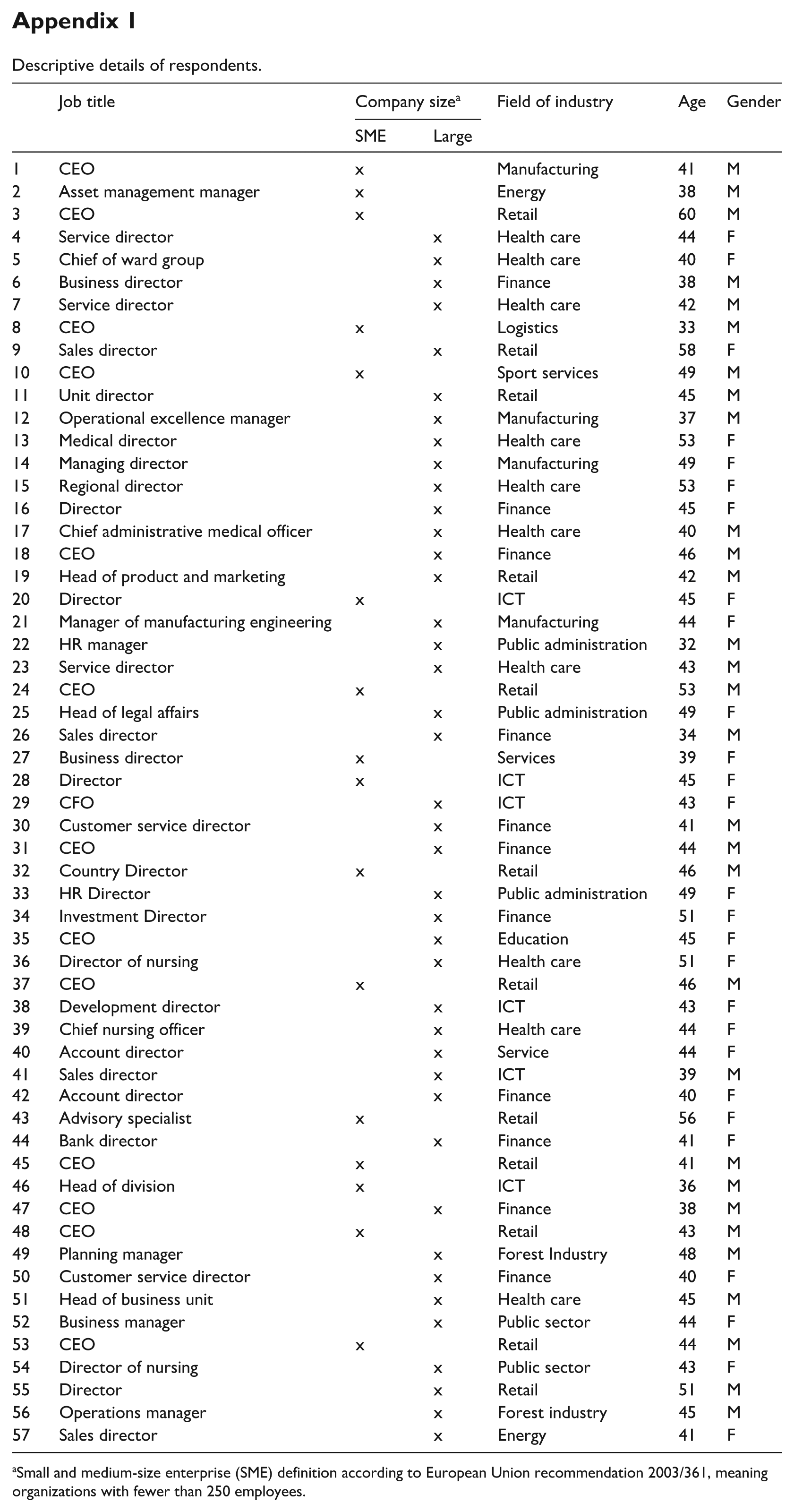
The data consist of written texts from 57 respondents produced at the start of their EMBA studies. The written assignment given to them was as part of a required but non-graded course assignment. The assignment was developmental in nature, aimed at helping participants articulate their personal learning goals. It introduced four guiding perspectives (expertise, self-knowledge, professional networks, change) as a theoretical frame to help participants consider their goals broadly and from different perspectives. Participants were invited to reflect freely on each area as it applied to their own situation. The format encouraged individual prioritization and open-ended responses, ranging from structured lists to richly reasoned narratives. Data were collected from 57 experienced managers who graduated from the EMBA program during 2020–2022. The average age of respondents was 44, with 31 being male. They represented diverse organizations (72% from large organizations, 28% from SMEs) and sectors (77% from private companies, 23% from public sector organizations). See Appendix 1 for further descriptive details of the respondents.
The written assignment was chosen for its unique benefits. It encouraged EMBA students to articulate structured learning goals at the start of their studies. Writing, as opposed to speaking, requires deeper contemplation and allows for extended reflection over time which is particularly valuable when exploring implicit assumptions and future aspirations. Unlike interviews, it provides the opportunity to revise and structure thoughts. The format guided participants to define their learning goals for each perspective. Responses varied from prioritized lists to detailed, reflective paragraphs, explaining the rationale behind their goals. On average, responses were 784 words long, collected at the beginning of their EMBA studies.
The qualitative analysis proceeded in two broad phases: an empirical coding phase and a theory-informed interpretive phase. The empirical phase drew on principles from Gioia et al. (2012), Ryan and Bernard (2003), and grounded theory methodology, and was supported by the use of ATLAS.ti software for coding and data management. The analysis progressed through the following steps.
Familiarization
All 57 essays were read repeatedly to gain a holistic sense of the content. This phase involved immersing in the material without predefined codes, allowing for sensitivity to both unique expressions and recurring patterns.
Initial open coding (first-order codes)
Open coding was conducted across the full dataset, generating 302 first-order codes. These codes reflected participants’ own words and phrasing, capturing concrete expressions of learning goals and intentions.
Clustering and categorization (second-order themes)
Using Ryan and Bernard’s (2003) cutting and sorting technique, the first-order codes were grouped eventually into 36 second-order themes. These intermediate themes represented latent similarities and organizing ideas that began to bridge the gap between raw codes and broader developmental goals.
Thematic synthesis using four learning domains
At this stage, the second-order themes were further synthesized and organized using the four theoretical learning domains presented by Aaltola et al. (2022): (1) Expertise, (2) Self-Knowledge, (3) Networks, and (4) Change management. The framework provided a conceptual structure that supported the grouping and consolidation of related themes into a more manageable and meaningful set. This process resulted in 13 final themes, each typically composed of 2–5 second-order themes, which themselves were built from multiple first-order codes. This approach enabled us to preserve empirical detail while linking findings to an existing conceptual framework, the four-dimensional model of executive learning (Aaltola et al. 2022).
Interpretive phase through paradox theory
In the last phase of the analysis, we revisited the formed domain-based themes through the lens of paradox theory (Lewis and Dehler, 2000; Smith and Lewis, 2011). This led to the identification of two overarching paradoxical structures—personal mastery versus collective development and potential versus performance—which cut across the four learning areas and helped conceptualize the dynamic tensions embedded in the learning goals.
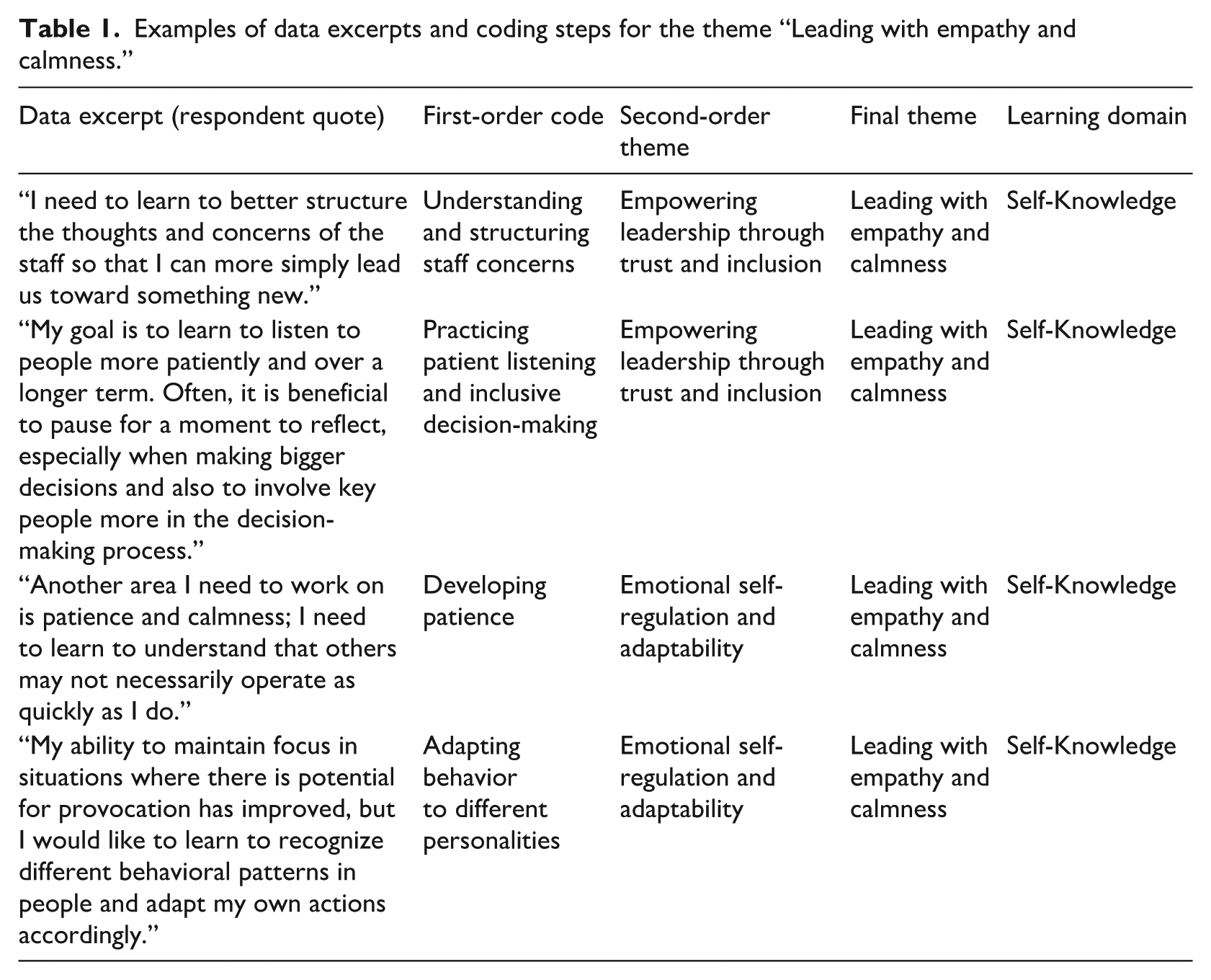
To illustrate the analytical process, Table 1 presents data excerpts and coding steps that contributed to the formation of one final theme—Leading with empathy and calmness (within the domain of Self-Knowledge). The examples show how individual expressions were coded, grouped into second-order themes, and eventually synthesized into a broader theme.
Examples of data excerpts and coding steps for the theme “Leading with empathy and calmness.”
Results
Our analysis resulted in a set of distinct learning goal themes, which are presented below using the four-dimensional framework of executive learning (Aaltola et al., 2022).
Expertise
The results under the learning goals area on expertise can be categorized into three main themes. The first recurring theme was strategic general management. Many respondents described their need to develop their understanding in strategic thinking and management and set goals seeking to address business issues holistically from general management perspective. One respondent argued the following: I see the desire and potential for my own learning in more demanding issues than those that are related to my own current job description. Even though I get to be extensively involved in running the entire business by being a member in the management team, I see considerable room for development for me in, e.g., financial management, strategic planning and even managing people in general. (Sales director)
Another respondent emphasized the practical side of strategic development: Personally, I want to learn especially about strategic management. I am particularly interested in how strategy is made concrete, followed up, and measured. How can we ensure that our strategic actions are moving us in the right direction in everyday practice, and how do we continuously update those actions to stay aligned with our strategy? (Director)
Another theme the respondents wanted to further their expertise in was financial management and performance measurement. This area can be characterized as a need to gain expertise related to various approaches to organizational management control systems, including financial issues in general, management accounting models and strategic performance measurement systems. One participant articulated the importance of this theme as follows: In my work, leading change processes will be essential, whether the changes relate to revising the organizational model, adopting more cost-efficient practices, or to measuring results and goals, and rewarding or engaging staff. [. . .] I believe my area for development in this is setting goals and indicators, and monitoring their implementation. (Director)
Another respondent highlighted the need to strengthen financial acumen more directly: I also want to strengthen financial knowledge and financial management skills. With the help of my studies, I am looking for certainty in financial management as well as business risk assessment and management. (Director)
A third theme within expertise focused on developing change leadership capabilities. While change management is often discussed as a separate area, here it was framed as a domain of professional expertise, that is, as part of the practical know-how managers seek to strengthen. Respondents emphasized their need to grow as leaders by gaining tools for organizational development, coaching, and building more adaptive and people-centered workplaces. One participant expressed this need in terms of people leadership: Above all, I want to learn more about the approaches and dynamics of leading people. Working in a large organization also requires leading the wider organization or network and setting an example. What are the best ways for me to succeed in these? (Sales Director)
Another respondent pointed to the need for practical capabilities to manage change creatively and effectively: This especially requires finding new, creative solutions in project management. Carrying out changes in the organization is an area where I need new tools. (Regional Director)
Self-knowledge
When examining the respondents learning goals related to their personal development, three broad themes emerged from the analysis. Perhaps the single most dominant result was the respondents’ pursuit of power and bigger role. This theme referred to seeking to improve self-esteem and to be more courageous regarding their personal ambitions. In addition, the ambition toward more strategic leadership roles was often explicit. As the following respondents put it, Personally, I would like to learn to be more courageous; in my thinking, in my actions, in the way I influence other people. (Director) I also want to grow into a more confident leader who believes in themselves and their leadership more than I do now. (Bank Director)
Another theme was related to self-awareness and life balance, in which managers seek to be more aware of their own strengths and weaknesses. This quest for self-knowledge often included aims in order to master their life-balance better and to master their time and prioritizing issues better. As two participants noted, “Learning to identify and make use of my strengths, recognizing my weaknesses and either developing them or learning to cope with them” (Manager) Time management is an area where I need significant improvement. It is also connected to setting my own goals, meaning the ability to separate areas where I aim very high, those where a satisfactory result is enough through prioritization, and areas that may not require any effort at all. (HR Director)
The third theme describing their goals in self-knowledge and personal development was leading with empathy and calmness. This general theme had two main sides in it. First, many respondents aimed to develop a more participatory and empowering leadership style as well as to genuinely listen to people and understand their viewpoints. They also described, however, their needs to further their self-control in professional contexts, to adapt their own behavior and to have more patience. These goals are captured in the following reflections: People in my work environment are not completely on the same wavelength as me, and I sometimes have to slow down and clarify the direction to others several times. This makes me frustrated, and I would like to develop myself to be more compassionate, i.e., to listen and to understand my work community better. (CEO) I want to learn to listen without immediately forming my own conclusions and interpretations, but instead truly hear what the other person is saying. I am practicing how to reflect and take time to process my responses before putting them out there. I’ve made progress in this, but there’s still clearly room for improvement and more to learn. (Director)
Networks
The main findings related to the respondents’ aims in professional networking can be categorized into four themes. First, many respondents expressed their interest in utilizing various networks. This theme of joining networks online and offline included development networks regarding their EMBA studies but also went beyond that context, such as aiming to use LinkedIn more proactively, participating in professional events, and becoming a member in the chamber of commerce. One respondent illustrated this growing awareness of digital networking opportunities as follows: I should start using social media and its different channels more for professional purposes. My previous experience has mostly been related to leisure and volunteer activities, but that has already opened my eyes to the power it holds today. (Service Director)
Another distinctive theme was developing collaborative learning skills. Here managers set goals for improving their own ability and activity in sharing their experiences while being open to the experiences of others, asking questions, reducing their prejudice, and not taking ideas for granted. One director formulated a learning goal under this theme in the following way: My goal is to be interested in others. I focus on situations where experiences are shared. I try not to form preconceptions. (Director)
Another respondent emphasized reciprocity in collaboration: I also aim to be active in group work and meetings. I do my best to help others in areas where I have particular expertise. I believe that genuine willingness to help leads to the building of a fruitful network. (Sales Director)
The third development goal theme in this category was expanding personal contacts. In this category, respondents described their goals to build contacts with people who have specific profile, expertise, and/or capabilities. Sometimes the aim was to contact leaders in a similar type of position than the respondent, but sometimes also exceeding those boundaries. As one Managing Director put it, In terms of my work, the most beneficial thing would be to share experiences related to the operations of medium-sized and large organizations, as well as implementing process improvements and cultural changes within them.
Another respondent emphasized learning from outside their own field: Curiosity about what is happening around me is important for developing my own competence. Not only within my own field but also in other industries. By observing how leaders in other fields operate, I can gain insights that help me improve my own skills. (CEO)
The fourth theme was exploring other organizations and businesses. This was different compared to the previous theme in that, instead of specific leaders and experts, the target was to expose oneself to the operating context and logic of different organizations, even a new field of industry. Often the aim was also to benchmark various organizations, their culture, and operating models. Respondents frequently framed this as a way to benchmark and gain fresh perspectives: I believe that I can learn the most from completely different businesses. I have noticed that if you focus on networking and learning from people who come from the same business area, your vision easily becomes tunnel-like. That’s why I’m looking forward to hearing stories from others about their own environments and thinking about what new things and insights I could bring from them into my own environment. (Manager) All EMBA participants are in managerial positions, so it is interesting to hear how organizations can best make use of the full range of their people’s competencies and how that competence is developed. (CEO)
Change management
Here the results can be categorized into four themes. First, in structuring an efficient organization, participants described goals in organizational restructuring, developing processes and productivity, and financial management models and systems: We should renew our management control system to meet the needs of this time in such a way that it provides the organization support and the framework through which we operate. This requires systematicity and organizational ability, while all parts of the organization must be made to understand their own role and responsibility as part of the structure. (Customer service director) Improving efficiency and productivity more broadly is essential. Today, efficiency requirements come from the market, and we as an organization cannot afford to define softer targets ourselves. A sufficient level of efficiency is a prerequisite for competitiveness. I believe this is a whole way of thinking rather than a single project. It requires continuous reflection and questioning. (Director)
A counterpart to this was a second theme, innovating and renewing the business, in which the focus was on developing new business models and visionary leadership, often in practical terms, such as in digital transformation of the business. One respondent emphasized the need to modernize customer engagement: I feel that in all of our strategic thinking, project development and customer service development, we should take the digitizing world into account. The customers of the future are used to a completely different service environment. (CEO)
Another reflected on the importance of cultivating a culture that allows experimentation and embraces failure as part of learning: Shifting toward a bolder and more experimental mindset. Traditionally, there has been a strong emphasis on getting things right the first time. A new kind of culture allows for mistakes and creates room to try different ways of doing things. This can lead to discovering new and better practices. For me, this requires encouragement to stay curious and to bring forward alternative perspectives. (CEO)
The third area for organizational development and learning was distinctive from the previous two. It concerned developing leadership and employer attractiveness. The respondents held a view that developing their organizations’ overall leadership practices, competence development and so on would lead to a stronger positive employee experience and employer brand: A major development effort is to improve the employer image so that the organization is no longer seen as a hierarchical and outdated working environment. This change will require understanding of organizational culture and the lifestyles of younger generations. It will also require us to change our own ways of working, moving away from the “old, proven methods,” toward more flexible practices. And it calls for a new kind of equality between different professional groups. (Director)
The fourth theme in the change management category was very business focused, concentrating on strengthening customer focus and sales. One respondent described this the following way: Superior customer experience is the goal. Actors from outside our industry (e.g., Google) or new companies (e.g., Tesla) have already decisively changed the industry with their customer-oriented operating methods. How is our company able to renew itself and what can we do about it? (Director)
Another respondent highlighted the shift from reactive to proactive customer engagement: Turning customer interaction from inbound contact to proactive outreach. Currently, we respond when the customer initiates contact. In the future, especially due to changes in the behavior of younger generations, this mindset should be reversed. We should actively manage customer relationships and reach out to them regularly while also identifying their needs. (CEO)
Interpreting the paradoxical structure of executive learning goals
Building on the 13 final themes developed in the empirical phase, we engaged in a theory-informed interpretive stage, viewing the results through the lens of paradox theory (Lewis and Dehler, 2000; Smith and Lewis, 2011). In this stage, we reflected on the relationships between the themes and learning domains to explore potential tensions among them. Through iterative cycles of conceptual reflection, literature engagement, and visual mapping, we considered how the learning goals might represent competing yet interdependent priorities in executive development. This process led us to conceptualize two overarching paradoxical structures—personal mastery versus collective development, and potential versus performance—which we elaborate in the next section.
Figure 1 seeks to depict in graphical format the overarching tensions identified in executive learning goals. It illustrates how the two paradoxes—personal mastery versus collective development, and potential versus performance—cut across the four learning domains and interrelate with one another. First, the learning goals can be approached based on the nature of the learning process. Many respondents emphasized individual development goals, such as strengthening strategic and financial expertise, improving time management, or gaining self-awareness and emotional resilience. These efforts were often linked to building personal confidence and a stronger sense of capability in executive roles. Through developing themselves, managers aim to construct personal self-efficacy: the idea and conviction that they can meet the demands of executive leadership.
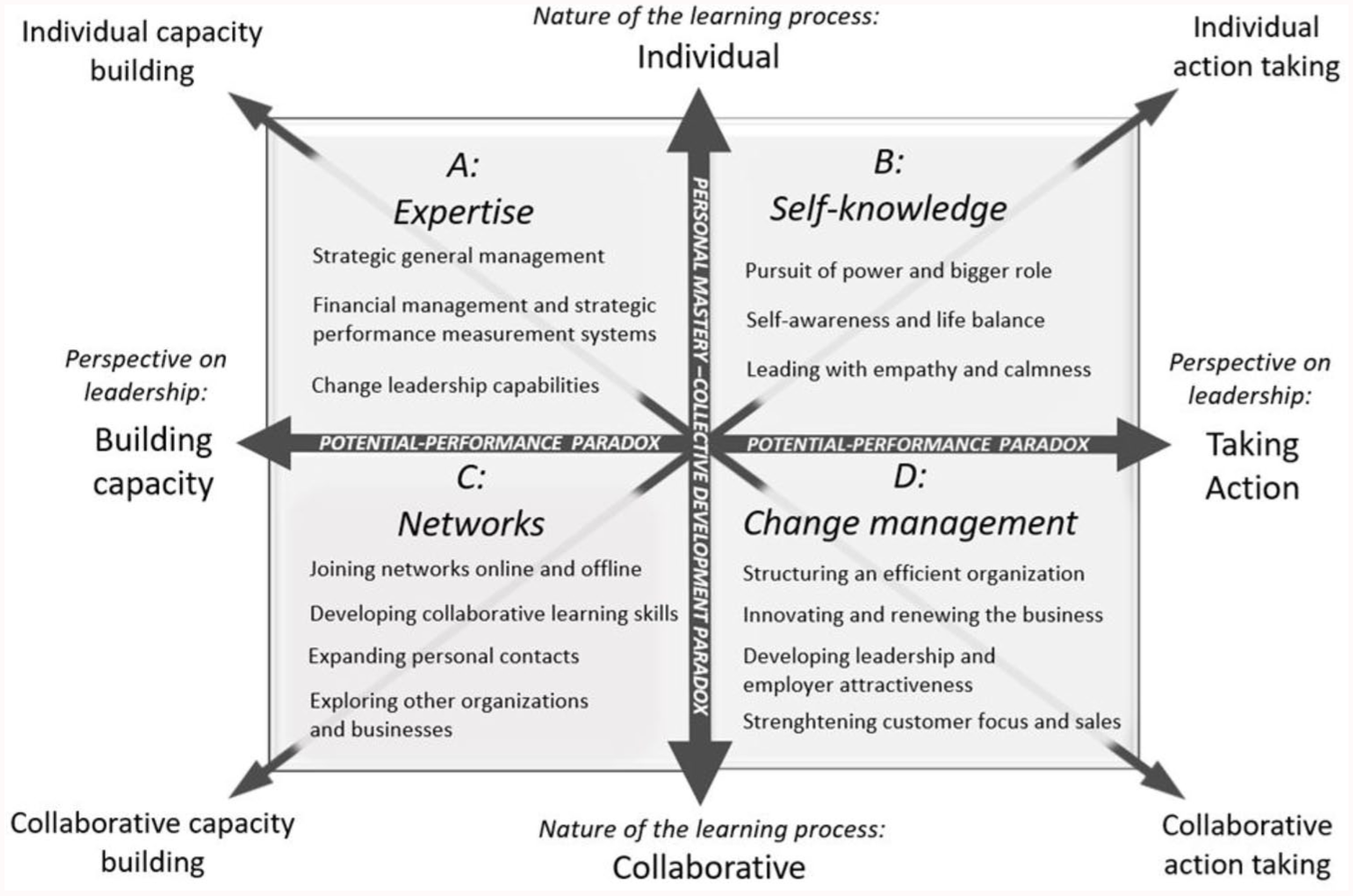
Goal setting in executive learning: A paradoxical framework approach.
At the same time, the data revealed a strong emphasis on interactional and organizational embeddedness. Respondents described learning goals related to engaging more actively with peers, participating in collaborative learning, benchmarking across industries, and supporting broader organizational development. These collaborative aspirations were particularly visible in goals related to networks and change management, where learning was framed as a way to generate impact beyond the self. Taken together, these patterns highlight a fundamental tension we conceptualize as the “personal mastery-collective development paradox.” Executive learning integrates individualistic elements focused on enhancing expertise and self-awareness with a collective dimension centered on network expansion and the co-creative application of learning within the organization.
Another paradoxical dualism of executive learning goals can be conceptualized in terms of the learning goals’ perspective on leadership. The goals related to expertise and networks are essentially about enhancing the learner’s leadership capacity, while self-knowledge and change management are characterized by proactive, action-oriented development efforts. In the realm of self-knowledge, the findings emphasize the managers’ efforts to adapt their leadership approaches to various situations and to adopt a more decisive and practical stance in their current roles and career progression. The learning goals within the change management category depict an even more explicit orientation toward leadership action, showcasing the managers’ intentions to implement change and innovation within their organizations. Therefore, holistic professional development for managers encompasses both capacity-building and active implementation, giving rise to what may be termed the “potential-performance paradox.” This paradox is grounded in the respondents’ orientation toward both long-term leadership capacity and immediate organizational impact. Goals related to expertise and networking often reflect an aspirational stance: developing strategic insight, financial acumen, or peer engagement to be leveraged in the future. In contrast, goals found in self-knowledge and change management reflect more action-oriented ambitions—leading with empathy, to restructure organizations, or to drive digital renewal. These patterns illustrate how executives seek to balance preparation for future roles with the demand to perform and transform in the present.
These two overarching paradoxes align with the three constitutive aspects of a paradox, opposition, interdependence, and persistence, as defined by Smith and Lewis (2011) and noted by Carmine and De Marchi (2022). Opposition refers to elements that appear logical in isolation but seem contradictory when they coexist, as in the case of learning goals that emphasize either individual mastery or collaborative development. Interdependence means that these opposing elements are also mutually reinforcing: for example, taking action builds leadership capacity through experience, while developing capacity enhances the effectiveness of actions. Persistence captures the enduring nature of these tensions, which remain present and unresolved over time, posing ongoing challenges for experienced learners.
Our article posits that by accepting and engaging with these contradictions, experienced managers can formulate learning goals tailored to the distinctive demands of their professional contexts, thereby fostering more impactful learning and developmental progress. In doing so, the study contributes to the growing body of work on paradox within management learning (e.g. Cunha et al., 2022; Vince et al., 2018) by conceptualizing how tensions such as those between personal mastery and collective development, or between potential and performance, shape the way executives articulate and pursue their development. Beyond its theoretical contribution to paradox theory, elaborated further in the conclusion, the study also responds to long-standing critiques about the lack of practical foundations in management development research (Asik-Dizdar, 2015; Bennis and O’Toole, 2005; Mintzberg, 2004; Pfeffer and Fong, 2002) by introducing a framework grounded in empirical data and focused on the holistic development of practicing managers. It also expands recent research on EMBA learning (Han and Liang, 2015; Houldsworth et al., 2024) by showing how learning objectives related to personal growth, collaboration, and organizational impact are not only interrelated but also structured through persistent tensions that experienced learners must navigate.
Our model aligns diverse perceptions of executive learning with the complex realities of professional development. It helps bridge the gap between idealized frameworks of management education and the paradoxical tensions that shape how experienced managers learn and grow. Recognizing these tensions, rather than suppressing them, supports more adaptive and sustained development. Avoidance can stall action, whereas constructive engagement with paradox can promote ongoing learning and organizational contribution.
Discussion
Theoretical contributions
Our study contributes to paradox theory in three main ways. First, it identifies two overarching paradoxes in executive learning—personal mastery versus collective development, and potential versus performance. This aligns with what Carmine and De Marchi (2022) describe as the “detective use” of paradoxical tensions, where the focus is on revealing and articulating tensions that might otherwise remain implicit. As Mowles (2015) points out, paradoxes are not just abstract ideas but realities that managers face in their everyday work. This highlights the need for executive education to support leaders in handling both the bigger picture and the daily, practical side of these tensions in the course of their learning. It becomes clear that addressing managerial professional development in a comprehensive manner requires more than focusing on a single element, such as solely improving expertise or merely expanding networks. Rather than concentrating on one side or stage of the tension, our study extends Cunha et al.’s (2022) ideas on exploring the dynamic and temporal dimensions of the process, advocating for a holistic approach that is essential for effectively navigating these complex and enduring challenges.
The second contribution of our study to paradox theory lies is the four-dimensional model presented in this article. Beyond highlighting specific paradoxical tensions, the model advances theorizing in its dimensions as well as in their combination. It enriches the literature by introducing a comprehensive model for managerial learning and conceptualizing how business actors can understand and address tensions in learning as cognitive frames (Carmine and De Marchi, 2023; Hahn et al., 2014). Our model not only aligns with but also exemplifies Griffin et al.’s (2022) call to consider individual and collective dimensions in the development of paradox mindsets, as well as Smith and Lewis’ (2022) highlighting of boundaries within the paradox system. It serves as a representation of structures that are instrumental in guiding mindsets and behaviors, demonstrating how leaders can navigate paradoxes, thereby embodying the core principles (higher purpose, separating and connecting, guardrails) of Smith and Lewis’ concept of boundaries.
Central to our model of holistic professional development for managers is an overarching vision that inspires individuals to become better versions of themselves. This vision acts as a higher purpose and a driving force, encouraging learners to focus on the long term and fostering the inspiration and motivation needed to confront paradoxes. While existing paradox research has occasionally highlighted limitations in individuals’ ability to act in the face of paradoxes (Berti and Simpson, 2021), we argue that in the context of personal development for executives with significant agency, these limitations are less pronounced. Contrary to this, our model offers an approach to effectively navigate paradoxes through separating and connecting, that is, appreciating each perspective independently and then integrating them to value their synergies. As such it reinforces Miron-Spektor et al.’s (2018) ideas on the paradox mindset and how it might be influenced by cognitive, behavioral, and contextual factors. This approach thus operates also as guardrails (Smith and Lewis, 2022), ensuring a balanced approach and preventing an excessive focus on any single aspect of development.
The third and most overarching contribution of our work to paradox theory is the introduction of the “pedagogy of paradox” (Lewis and Dehler, 2000) approach in executive learning. Learning paradoxes as such have been acknowledged as a broad category within paradox research (Smith and Lewis, 2011) and learning has been positioned as one pole in paradoxical oppositions, for example in learning-performance paradox (Aoki, 2020). This study contributes by demonstrating that when learning is more deeply analyzed through the lens of paradox theory, inherent paradoxes become evident specifically within the context of executive learning. Existing research has examined paradoxes predominantly at an organizational level (Smith and Lewis, 2022; Vince et al., 2018), with less emphasis on the individual. There has been exploration into paradoxes in the context of executive development which has approached executive development through the lenses of professional career identity and personal change (Ibarra, 2015; Sugiyama and Ladge, 2022), and outlined methods for weaving paradox thinking into management education pedagogy (Lewis and Dehler, 2000; Smith et al., 2012). Our work contributes to this literature by providing an understanding and detailed exploration of the connection between executive learning and paradoxes. It extends Smith et al.’s (2012) effort to explore paradox-embracing conceptions of leadership as well as Waldman and Bowen’s (2016) emphasis of the need to better understand and assess paradox-savvy leadership. To the best of the authors’ knowledge, this study is the first examination of paradoxes in learning goal setting for experienced practicing managers.
Practical implications for EMBA students and other executives
In contrast to the conventional academic paths, EMBA education offers a unique chance to integrate competence development with adult learners’ broader agency and managerial context. Our work offers a practical framework for directing learning in this environment. First, EMBA’s core is enhancing managerial and leadership expertise through knowledge acquisition and application, encouraging critical evaluation and linking new information with existing knowledge. Second, it aims to heighten self-awareness in leadership, using this understanding to shape professional identity and interactions. Third, effective management education involves leveraging development networks, learning from diverse managerial perspectives, and building reciprocal relationships. Fourth, a key goal is enhancing strategic change capabilities in leaders and their organizations, focusing on identifying and implementing necessary organizational changes. This approach integrates students’ work experience and agency into EMBA’s pedagogical design, shaping their and their organizations’ futures.
The paradoxical nature of executive work (Smith et al., 2016; Waldman and Bowen, 2016) highlights the need for a comprehensive approach in executive professional development. Segal (2017) further emphasizes that this development itself is paradoxical, requiring leaders to navigate uncertainty and act before full understanding emerges, which shapes both their professional identity and strategic capabilities. This study contributes to this field by introducing a paradoxical and holistic approach to executive learning, offering a practical framework for any practicing manager seeking to guide and assess their growth. For example, by evaluating the four learning elements, managers can identify overemphasized or neglected areas in their own professional development. Moreover, this article’s findings have the potential for substantial societal impact, given the critical roles managers play in shaping the future of organizations and society at large. The presented framework helps to create a setting where innovative dialogue between conceptual insights and real-world applications is cultivated, while simultaneously advancing the development of organizations and their leadership.
Conclusions for the management education institutions
This study builds on Alajoutsjärvi et al.’s (2015) call for examining the fidelity of business schools to their domain and mission as well as Sharma et al.’s (2022) challenge to incorporate co-creation of related processes between academics and managers. The findings are vital for executive education providers in higher education, especially as business schools are facing criticism for not aligning their management education closely with the practical needs of today’s managerial work (David et al., 2011; Minocha et al., 2017; Rubin and Dierdorff, 2009). To address this, we proposed a framework for embracing apparent contradictions in executive learning and tailoring learning objectives to align with the unique demands of professional contexts. We suggest that adopting this paradox-savvy approach to executive learning not only enhances learning outcomes for experienced managers but also elevates the role of business schools in facilitating meaningful and impactful professional development. Management education should integrate academic content with a clear vision of managerial and leadership development. This approach, reflecting the institution’s view of current and future managerial needs, should shape both the pedagogical framework and delivery of management education.
Several scholars have called for management education to better integrate participants’ managerial experiences into the learning process (Currie and Knights, 2003; De Déa Roglio and Light, 2009; Garvin, 2007; Minocha et al., 2017; Ruane, 2016; Tushman et al., 2007) and align educational content with real-world contexts (De Déa Roglio and Light, 2009; Ruane, 2016). This article responds by presenting a holistic, paradoxical model as a key to unlocking the professional development of executive participants. The framework offers a practical tool for curriculum assessment and development in management education. Institutions can use its four dimensions to evaluate their approach to executive development and align their curriculum with these core areas. Experts from different institutions could first reflect on whether they agree with these four dimensions of holistic development, and then assess whether their curricula adequately cover these critical aspects.
To fully leverage this framework, management education institutions should also determine the most effective methods to promote executive growth in these four key areas. While these institutions often excel in imparting expertise, we argue that holistic development requires a broader approach. For self-knowledge, reflective practices are essential; in networking, interactions with fellow students are crucial; and in change management, the student’s organization plays a key role. Wise institutions recognize and adapt to this holistic view, shaping their roles to support comprehensive student development. Furthermore, in addition to defining learning outcomes for the entire program, active support and systematic evaluation of the learning outcomes are crucial, yet often neglected. We argue that executive education providers should prompt participants to consider their development in the defined directions from the start of their studies, encourage ongoing reflection throughout, and evaluate their learning at the end of their studies. This approach, recognizing the holistic nature of executive development, can enhance overall student growth. Working with found contradictions and tensions offers even potential in developing new insight and theory as suggested by Poole and van de Ven (1989).
Limitations of the study and suggestions for further research
This study has several limitations. First, the data were collected through a written assignment that was part of a required but non-graded course activity. While the assignment’s purpose was developmental, and participants were encouraged to express their own priorities, the use of a four-part framework may have shaped the structure and focus of their reflections. This framing offered a shared basis for analysis, but may also have influenced how openly or broadly participants interpreted their learning needs. Second, although the analysis followed an inductive process grounded in participants’ own language, paradox theory was applied retrospectively during the interpretive phase. The participants were not explicitly asked to reflect on paradoxes, and as such, the identified tensions represent analytical interpretations rather than self-declared paradoxical reasoning. Third, the study was conducted within a single EMBA program in one national and institutional context. While participants represented a wide range of industries and roles, further research is needed to assess the transferability of the findings to other cultural, professional, and educational settings. Finally, the results reflect the views of experienced managers at a particular moment in time, at the start of a longer developmental process.
Despite these limitations, the study adds to our understanding of the holistic professional development of managers and holds a number of insights for future research. Future studies could examine how learning goals evolve during the program or compare stated goals with actual learning outcomes. Longitudinal or comparative research could strengthen understanding of how goal setting and paradox navigation develop over time in executive education. Further work is also needed in that area to understand the learners’ world of experience. One specific area for more study could be the collaborative learning approach highlighted by the results. Even though the significance of managers’ collaborative learning is well known and recognized, the professional development of managers has not been investigated much from the perspective of collaborative learning (Lee and Bonk, 2014).
The article offers a paradox-savvy approach for developing university-level executive education to achieve a more profound impact. Executive education for more experienced participants should be founded on the understanding that the executive’s role is a constant state of developing oneself and one’s organization. Moreover, it is assumed that the role requires comprehensive definition of the ambitions and explicit goals for one’s professional development. By focusing more holistically on learning goals, recognizing the learner’s agency and key role, and embracing the paradoxical nature of executive work and development, management education can truly put the “executive” back in the EMBA.
Footnotes
Appendix
Descriptive details of respondents.
| Job title | Company size a | Field of industry | Age | Gender | ||
|---|---|---|---|---|---|---|
| SME | Large | |||||
| 1 | CEO | x | Manufacturing | 41 | M | |
| 2 | Asset management manager | x | Energy | 38 | M | |
| 3 | CEO | x | Retail | 60 | M | |
| 4 | Service director | x | Health care | 44 | F | |
| 5 | Chief of ward group | x | Health care | 40 | F | |
| 6 | Business director | x | Finance | 38 | M | |
| 7 | Service director | x | Health care | 42 | M | |
| 8 | CEO | x | Logistics | 33 | M | |
| 9 | Sales director | x | Retail | 58 | F | |
| 10 | CEO | x | Sport services | 49 | M | |
| 11 | Unit director | x | Retail | 45 | M | |
| 12 | Operational excellence manager | x | Manufacturing | 37 | M | |
| 13 | Medical director | x | Health care | 53 | F | |
| 14 | Managing director | x | Manufacturing | 49 | F | |
| 15 | Regional director | x | Health care | 53 | F | |
| 16 | Director | x | Finance | 45 | F | |
| 17 | Chief administrative medical officer | x | Health care | 40 | M | |
| 18 | CEO | x | Finance | 46 | M | |
| 19 | Head of product and marketing | x | Retail | 42 | M | |
| 20 | Director | x | ICT | 45 | F | |
| 21 | Manager of manufacturing engineering | x | Manufacturing | 44 | F | |
| 22 | HR manager | x | Public administration | 32 | M | |
| 23 | Service director | x | Health care | 43 | M | |
| 24 | CEO | x | Retail | 53 | M | |
| 25 | Head of legal affairs | x | Public administration | 49 | F | |
| 26 | Sales director | x | Finance | 34 | M | |
| 27 | Business director | x | Services | 39 | F | |
| 28 | Director | x | ICT | 45 | F | |
| 29 | CFO | x | ICT | 43 | F | |
| 30 | Customer service director | x | Finance | 41 | M | |
| 31 | CEO | x | Finance | 44 | M | |
| 32 | Country Director | x | Retail | 46 | M | |
| 33 | HR Director | x | Public administration | 49 | F | |
| 34 | Investment Director | x | Finance | 51 | F | |
| 35 | CEO | x | Education | 45 | F | |
| 36 | Director of nursing | x | Health care | 51 | F | |
| 37 | CEO | x | Retail | 46 | M | |
| 38 | Development director | x | ICT | 43 | F | |
| 39 | Chief nursing officer | x | Health care | 44 | F | |
| 40 | Account director | x | Service | 44 | F | |
| 41 | Sales director | x | ICT | 39 | M | |
| 42 | Account director | x | Finance | 40 | F | |
| 43 | Advisory specialist | x | Retail | 56 | F | |
| 44 | Bank director | x | Finance | 41 | F | |
| 45 | CEO | x | Retail | 41 | M | |
| 46 | Head of division | x | ICT | 36 | M | |
| 47 | CEO | x | Finance | 38 | M | |
| 48 | CEO | x | Retail | 43 | M | |
| 49 | Planning manager | x | Forest Industry | 48 | M | |
| 50 | Customer service director | x | Finance | 40 | F | |
| 51 | Head of business unit | x | Health care | 45 | M | |
| 52 | Business manager | x | Public sector | 44 | F | |
| 53 | CEO | x | Retail | 44 | M | |
| 54 | Director of nursing | x | Public sector | 43 | F | |
| 55 | Director | x | Retail | 51 | M | |
| 56 | Operations manager | x | Forest industry | 45 | M | |
| 57 | Sales director | x | Energy | 41 | F | |
Small and medium-size enterprise (SME) definition according to European Union recommendation 2003/361, meaning organizations with fewer than 250 employees.

Ethical considerations
Ethical standards and data management protocols, including notifications and data protection statements mandated by the University of Jyväskylä administration, were rigorously followed.
Consent to participate
Written consent was obtained from all participants, who were informed about the study and the intended use of data in accordance with the University of Jyväskylä’s guidelines.
Consent for publication
Not applicable.
Funding
The authors received no financial support for the research, authorship, and/or publication of this article.
Declaration of conflicting interests
The authors declared no potential conflicts of interest with respect to the research, authorship, and/or publication of this article.
Data availability statement
We are unable to share our data, as participants were assured that it would be handled solely by our research team and were not asked for consent to share it with third parties.